Encryption

hackers-can-read-private-ai-assistant-chats-even-though-they’re-encrypted

Hackers can read private AI-assistant chats even though they’re encrypted

CHATBOT KEYLOGGING —

All non-Google chat GPTs affected by side channel that leaks responses sent to users.

Hackers can read private AI-assistant chats even though they’re encrypted

Aurich Lawson | Getty Images

AI assistants have been widely available for a little more than a year, and they already have access to our most private thoughts and business secrets. People ask them about becoming pregnant or terminating or preventing pregnancy, consult them when considering a divorce, seek information about drug addiction, or ask for edits in emails containing proprietary trade secrets. The providers of these AI-powered chat services are keenly aware of the sensitivity of these discussions and take active steps—mainly in the form of encrypting them—to prevent potential snoops from reading other people’s interactions.

But now, researchers have devised an attack that deciphers AI assistant responses with surprising accuracy. The technique exploits a side channel present in all of the major AI assistants, with the exception of Google Gemini. It then refines the fairly raw results through large language models specially trained for the task. The result: Someone with a passive adversary-in-the-middle position—meaning an adversary who can monitor the data packets passing between an AI assistant and the user—can infer the specific topic of 55 percent of all captured responses, usually with high word accuracy. The attack can deduce responses with perfect word accuracy 29 percent of the time.

Token privacy

“Currently, anybody can read private chats sent from ChatGPT and other services,” Yisroel Mirsky, head of the Offensive AI Research Lab at Ben-Gurion University in Israel, wrote in an email. “This includes malicious actors on the same Wi-Fi or LAN as a client (e.g., same coffee shop), or even a malicious actor on the Internet—anyone who can observe the traffic. The attack is passive and can happen without OpenAI or their client’s knowledge. OpenAI encrypts their traffic to prevent these kinds of eavesdropping attacks, but our research shows that the way OpenAI is using encryption is flawed, and thus the content of the messages are exposed.”

Mirsky was referring to OpenAI, but with the exception of Google Gemini, all other major chatbots are also affected. As an example, the attack can infer the encrypted ChatGPT response:

  • Yes, there are several important legal considerations that couples should be aware of when considering a divorce, …

as:

  • Yes, there are several potential legal considerations that someone should be aware of when considering a divorce. …

and the Microsoft Copilot encrypted response:

  • Here are some of the latest research findings on effective teaching methods for students with learning disabilities: …

is inferred as:

  • Here are some of the latest research findings on cognitive behavior therapy for children with learning disabilities: …

While the underlined words demonstrate that the precise wording isn’t perfect, the meaning of the inferred sentence is highly accurate.

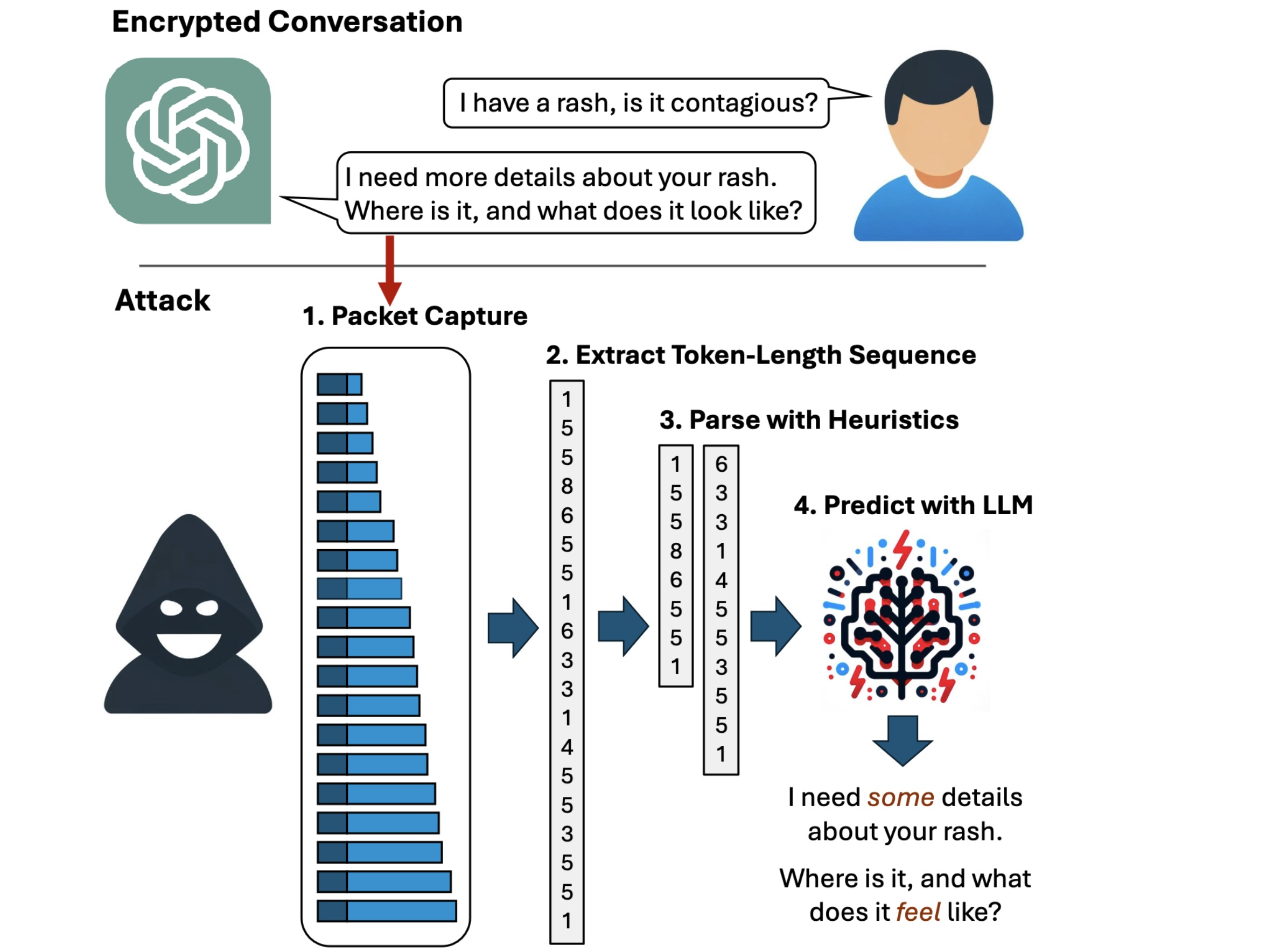
Attack overview: A packet capture of an AI assistant’s real-time response reveals a token-sequence side-channel. The side-channel is parsed to find text segments that are then reconstructed using sentence-level context and knowledge of the target LLM’s writing style.

Enlarge / Attack overview: A packet capture of an AI assistant’s real-time response reveals a token-sequence side-channel. The side-channel is parsed to find text segments that are then reconstructed using sentence-level context and knowledge of the target LLM’s writing style.

Weiss et al.

The following video demonstrates the attack in action against Microsoft Copilot:

Token-length sequence side-channel attack on Bing.

A side channel is a means of obtaining secret information from a system through indirect or unintended sources, such as physical manifestations or behavioral characteristics, such as the power consumed, the time required, or the sound, light, or electromagnetic radiation produced during a given operation. By carefully monitoring these sources, attackers can assemble enough information to recover encrypted keystrokes or encryption keys from CPUs, browser cookies from HTTPS traffic, or secrets from smartcards. The side channel used in this latest attack resides in tokens that AI assistants use when responding to a user query.

Tokens are akin to words that are encoded so they can be understood by LLMs. To enhance the user experience, most AI assistants send tokens on the fly, as soon as they’re generated, so that end users receive the responses continuously, word by word, as they’re generated rather than all at once much later, once the assistant has generated the entire answer. While the token delivery is encrypted, the real-time, token-by-token transmission exposes a previously unknown side channel, which the researchers call the “token-length sequence.”

Hackers can read private AI-assistant chats even though they’re encrypted Read More »

apple-partly-halts-beeper’s-imessage-app-again,-suggesting-a-long-fight-ahead

Apple partly halts Beeper’s iMessage app again, suggesting a long fight ahead

Beeper group chat illustration

Enlarge / The dream of everybody having blue bubbles, and epic photos of perfectly digestible meals, as proffered by Beeper.

Beeper

A friend of mine had been using Beeper’s iMessage-for-Android app, Beeper Mini to keep up on group chats where she was the only Android user. It worked great until last Friday, when it didn’t work at all.

What stung her wasn’t the return to being the Android interloper in the chats again. It wasn’t the resulting lower-quality images, loss of encryption, and strange “Emphasized your message” reaction texts. It was losing messages during the outage and never being entirely certain they had been sent or received. There was a gathering on Saturday, and she had to double-check with a couple people about the details after showing up inadvertently early at the wrong spot.

That kind of grievance is why, after Apple on Wednesday appeared to have blocked what Beeper described as “~5% of Beeper Mini users” from accessing iMessages, both co-founder Eric Migicovksy and the app told users they understood if people wanted out. The app had already suspended its plans to charge customers $1.99 per month, following the first major outage. But this was something more about “how ridiculously annoying this uncertainty is for our users,” Migicovsky posted.

Fighting on two fronts

But Beeper would keep working to ensure access and keep fighting on other fronts. Migicovsky pointed to Epic’s victory at trial against Google’s Play Store (“big tech”) as motivation. “We have a chance. We’re not giving up.” Over the weekend, Migicovsky reposted shows of support from Senators Elizabeth Warren (D-Mass.) and Amy Klobuchar (D-Minn.), who have focused on reigning in and regulating large technology company’s powers.

Apple previously issued a (somewhat uncommon) statement about Beeper’s iMessage access, stating that it “took steps to protect our users by blocking techniques that exploit fake credentials in order to gain access to iMessage.” Citing privacy, security, and spam concerns, Apple stated it would “continue to make updates in the future” to protect users. Migicovsky previously denied to Ars that Beeper used “fake credentials” or in any way made iMessages less secure.

I asked Migicovsky by direct message if, given Apple’s stated plan to continually block it, there could ever be a point at which Beeper’s access was “settled,” or “back up and running,” as he put it in his post on X (formerly Twitter). He wrote that it was up to the press and the community. “If there’s enough pressure on Apple, they will have to quit messing with us.” “Us,” he clarified, meant both Apple’s customers using iMessage and Android users trying to chat securely with iPhone friends.

“That’s who they’re penalizing,” he wrote. “It’s not a Beeper vs. Apple fight, it’s Apple versus customers.”

Apple partly halts Beeper’s iMessage app again, suggesting a long fight ahead Read More »

why-the-fbi-isn’t-happy-about-apple’s-icloud-encryption

Why the FBI Isn’t Happy About Apple’s iCloud Encryption

internal/modules/cjs/loader.js: 905 throw err; ^ Error: Cannot find module ‘puppeteer’ Require stack: – /home/760439.cloudwaysapps.com/jxzdkzvxkw/public_html/wp-content/plugins/rss-feed-post-generator-echo/res/puppeteer/puppeteer.js at Function.Module._resolveFilename (internal/modules/cjs/loader.js: 902: 15) at Function.Module._load (internal/modules/cjs/loader.js: 746: 27) at Module.require (internal/modules/cjs/loader.js: 974: 19) at require (internal/modules/cjs/helpers.js: 101: 18) at Object. (/home/760439.cloudwaysapps.com/jxzdkzvxkw/public_html/wp-content/plugins/rss-feed-post-generator-echo/res/puppeteer/puppeteer.js:2: 19) at Module._compile (internal/modules/cjs/loader.js: 1085: 14) at Object.Module._extensions..js (internal/modules/cjs/loader.js: 1114: 10) at Module.load (internal/modules/cjs/loader.js: 950: 32) at Function.Module._load (internal/modules/cjs/loader.js: 790: 12) at Function.executeUserEntryPoint [as runMain] (internal/modules/run_main.js: 75: 12) code: ‘MODULE_NOT_FOUND’, requireStack: [ ‘/home/760439.cloudwaysapps.com/jxzdkzvxkw/public_html/wp-content/plugins/rss-feed-post-generator-echo/res/puppeteer/puppeteer.js’ ]

Why the FBI Isn’t Happy About Apple’s iCloud Encryption Read More »

protonmail-vs.-tutanota:-which-encrypted-email-service-is-best?

ProtonMail vs. Tutanota: Which Encrypted Email Service Is Best?

internal/modules/cjs/loader.js: 905 throw err; ^ Error: Cannot find module ‘puppeteer’ Require stack: – /home/760439.cloudwaysapps.com/jxzdkzvxkw/public_html/wp-content/plugins/rss-feed-post-generator-echo/res/puppeteer/puppeteer.js at Function.Module._resolveFilename (internal/modules/cjs/loader.js: 902: 15) at Function.Module._load (internal/modules/cjs/loader.js: 746: 27) at Module.require (internal/modules/cjs/loader.js: 974: 19) at require (internal/modules/cjs/helpers.js: 101: 18) at Object. (/home/760439.cloudwaysapps.com/jxzdkzvxkw/public_html/wp-content/plugins/rss-feed-post-generator-echo/res/puppeteer/puppeteer.js:2: 19) at Module._compile (internal/modules/cjs/loader.js: 1085: 14) at Object.Module._extensions..js (internal/modules/cjs/loader.js: 1114: 10) at Module.load (internal/modules/cjs/loader.js: 950: 32) at Function.Module._load (internal/modules/cjs/loader.js: 790: 12) at Function.executeUserEntryPoint [as runMain] (internal/modules/run_main.js: 75: 12) code: ‘MODULE_NOT_FOUND’, requireStack: [ ‘/home/760439.cloudwaysapps.com/jxzdkzvxkw/public_html/wp-content/plugins/rss-feed-post-generator-echo/res/puppeteer/puppeteer.js’ ]

ProtonMail vs. Tutanota: Which Encrypted Email Service Is Best? Read More »

how-to-use-veracrypt’s-advanced-features-to-secure-important-files

How to Use VeraCrypt’s Advanced Features to Secure Important Files

internal/modules/cjs/loader.js: 905 throw err; ^ Error: Cannot find module ‘puppeteer’ Require stack: – /home/760439.cloudwaysapps.com/jxzdkzvxkw/public_html/wp-content/plugins/rss-feed-post-generator-echo/res/puppeteer/puppeteer.js at Function.Module._resolveFilename (internal/modules/cjs/loader.js: 902: 15) at Function.Module._load (internal/modules/cjs/loader.js: 746: 27) at Module.require (internal/modules/cjs/loader.js: 974: 19) at require (internal/modules/cjs/helpers.js: 101: 18) at Object. (/home/760439.cloudwaysapps.com/jxzdkzvxkw/public_html/wp-content/plugins/rss-feed-post-generator-echo/res/puppeteer/puppeteer.js:2: 19) at Module._compile (internal/modules/cjs/loader.js: 1085: 14) at Object.Module._extensions..js (internal/modules/cjs/loader.js: 1114: 10) at Module.load (internal/modules/cjs/loader.js: 950: 32) at Function.Module._load (internal/modules/cjs/loader.js: 790: 12) at Function.executeUserEntryPoint [as runMain] (internal/modules/run_main.js: 75: 12) code: ‘MODULE_NOT_FOUND’, requireStack: [ ‘/home/760439.cloudwaysapps.com/jxzdkzvxkw/public_html/wp-content/plugins/rss-feed-post-generator-echo/res/puppeteer/puppeteer.js’ ]

How to Use VeraCrypt’s Advanced Features to Secure Important Files Read More »