drivers

why-won’t-steam-machine-support-hdmi-21?-digging-in-on-the-display-standard-drama.

Why won’t Steam Machine support HDMI 2.1? Digging in on the display standard drama.

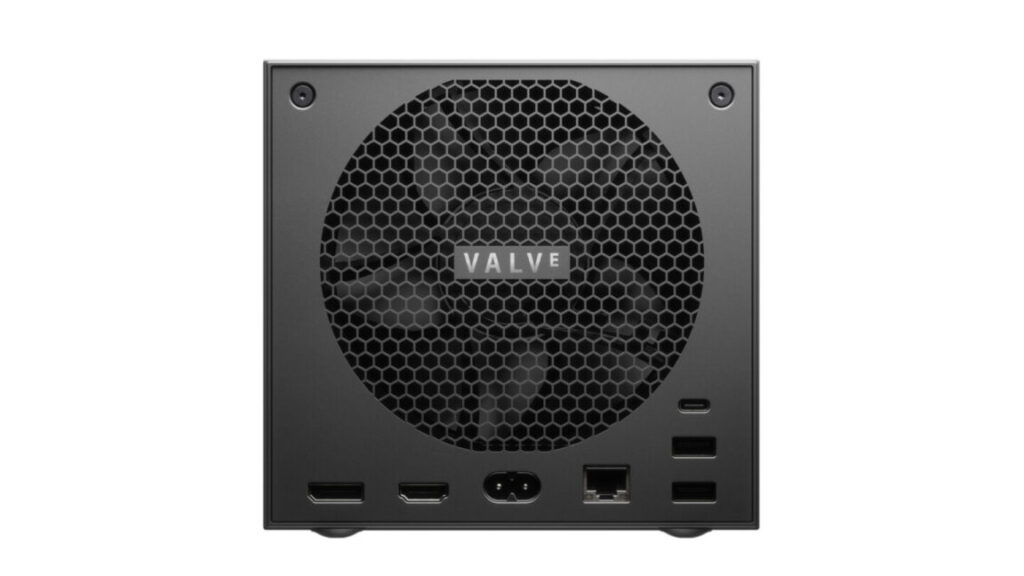
When Valve announced its upcoming Steam Machine hardware last month, some eagle-eyed gamers may have been surprised to see that the official spec sheet lists support for HDMI 2.0 output, rather than the updated, higher-bandwidth HDMI 2.1 standard introduced in 2017. Now, Valve tells Ars that, while the hardware itself actually supports HDMI 2.1, the company is struggling to offer full support for that standard due to Linux drivers that are “still a work-in-progress on the software side.”

As we noted last year, the HDMI Forum (which manages the official specifications for HDMI standards) has officially blocked any open source implementation of HDMI 2.1. That means the open source AMD drivers used by SteamOS can’t fully implement certain features that are specific to the updated output standard.

“At this time an open source HDMI 2.1 implementation is not possible without running afoul of the HDMI Forum requirements,” AMD engineer Alex Deucher said at the time.

Doing what they can

This situation has caused significant headaches for Valve, which tells Ars it has had to validate the Steam Machine’s HDMI 2.1 hardware via Windows during testing. And when it comes to HDMI performance via SteamOS, a Valve representative tells Ars that “we’ve been working on trying to unblock things there.”

That includes unblocking HDMI 2.0’s resolution and frame-rate limits, which max out at 60 Hz for a 4K output, according to the official standard. Valve tells Ars it has been able to increase that limit to the “4K @ 120Hz” listed on the Steam Machine spec sheet, though, thanks to a technique called chroma sub-sampling.

Why won’t Steam Machine support HDMI 2.1? Digging in on the display standard drama. Read More »
nvidia’s-new-app-doesn’t-require-you-to-log-in-to-update-your-gpu-driver

Nvidia’s new app doesn’t require you to log in to update your GPU driver

Some updates are good, actually —

Removing little-used features also improved responsiveness and shrank the size.

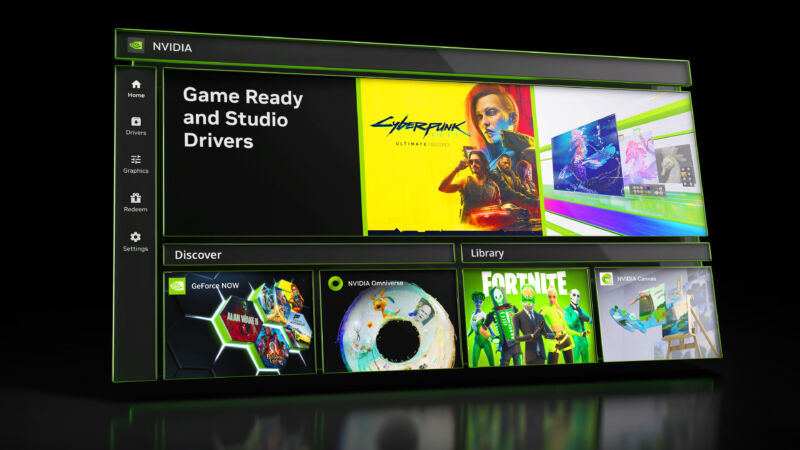
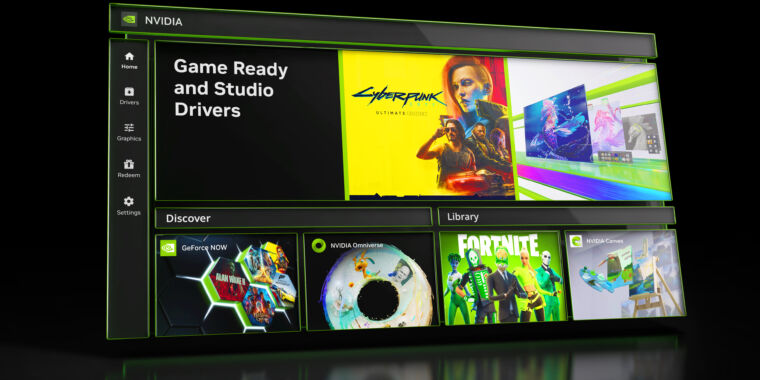
Nvidia app promo image

Nvidia

Nvidia has announced a public beta of a new app for Windows, one that does a few useful things and one big thing.

The new app combines the functions of three apps you’d previously have to hunt through—the Nvidia Control Panel, GeForce Experience, and RTX Experience—into one app. Setting display preferences on games and seeing exactly how each notch between “Performance” and “Quality” will affect its settings is far easier and more visible inside the new app. The old-fashioned control panel is still there if you right-click the Nvidia app’s notification panel icon. Installing the new beta upgrades and essentially removes the Experience and Control Panel apps, but they’re still available online.

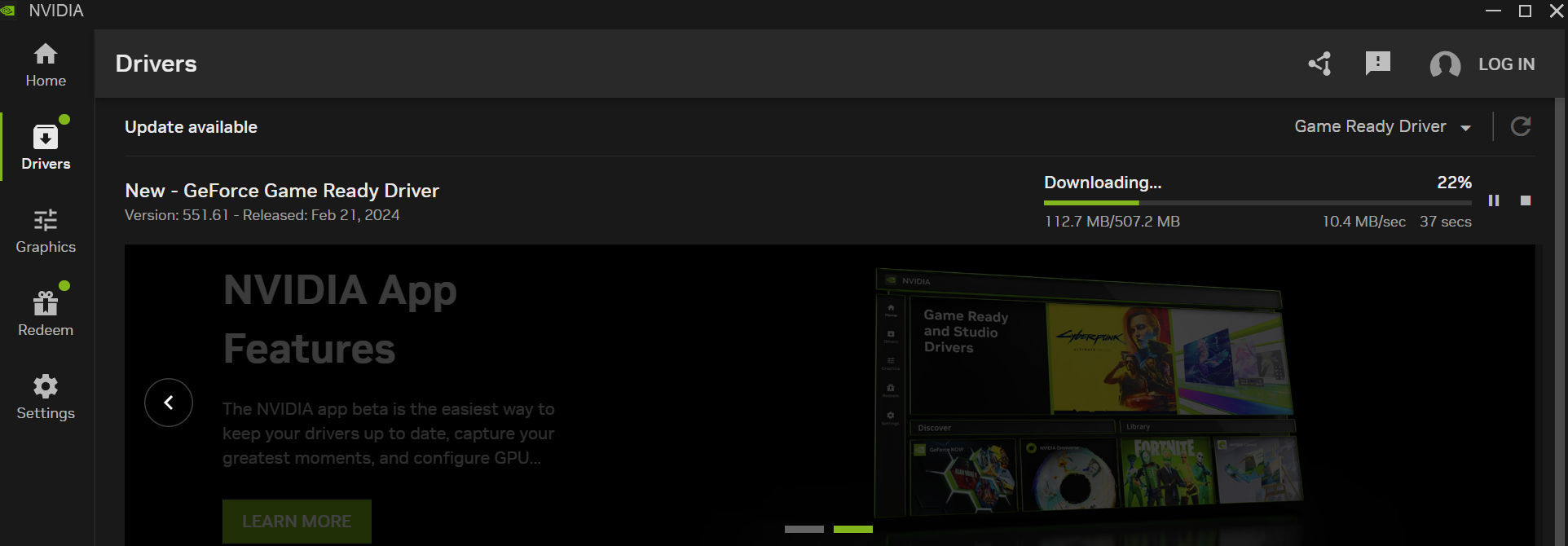
But perhaps most importantly, Nvidia’s new app allows you to update the driver for your graphics card, the one you paid for, without having to log in to an Nvidia account. I tested it, it worked, and I don’t know why I was surprised, but I’ve been conditioned that way. Given that driver updates are something people often do with new systems and the prior tendencies of Nvidia’s apps to log you out, this is a boon that will pay small but notable cumulative dividends for some time to come.

Proof that you can, miracle of miracles, download an Nvidia driver update in Nvidia's new app without having to sign in.

Proof that you can, miracle of miracles, download an Nvidia driver update in Nvidia’s new app without having to sign in.

Game performance tools are much easier to use, or at least understand, in the new Nvidia app. It depends on the game, but you get a slider to move between “Performance” and “Quality.” Some games don’t offer more than one or two notches to use, like Monster Train or Against the Storm. Some, like Hitman 3 or Deep Rock Galactic, offer so many notches that you could make a day out of adjusting and testing. Whenever you move the slider, you can see exactly what changed in a kind of diff display.

Changing the settings in <em>Elden Ring</em> with the more granular controls available in Nvidia’s new beta app.” height=”1009″ src=”https://cdn.arstechnica.net/wp-content/uploads/2024/02/Screenshot-2024-02-22-134416.png” width=”1282″></img><figcaption>
<p>Changing the settings in <em>Elden Ring</em> with the more granular controls available in Nvidia’s new beta app.</p>
<p>Nvidia/Kevin Purdy</p>
</figcaption></figure>
<p>If you use Nvidia’s in-game overlay, triggered with Alt+Z, you can test that out, see its new look and feel, set up performance metrics, and change its settings from Nvidia’s beta app. Driver updates now come with more information about what changed, rather than sending you to a website of release notes. On cards with AI-powered offerings, you’ll also get tools for Nvidia Freestyle, RTX Dynamic Vibrance, RTX HDR, and other such nit-picky options.</p>
<p>Not everything available in the prior apps is making it into this new all-in-one app, however. Nvidia notes that GPU overclocking and driver rollback are on the way. And the company says it has decided to “discontinue a few features that were underutilized,” including the ability to broadcast to Twitch and YouTube, share video or stills to Facebook and YouTube, and make Photo 360 and Stereo captures. Noting that “good alternatives exist,” Nvidia says culling these things halves the new app’s install time, improves responsiveness by 50 percent, and takes up 17 percent less disk space.</p>
</p></div>
</section></div>
			</div>
		<p class= Nvidia’s new app doesn’t require you to log in to update your GPU driver Read More »