Dart

asteroid-defense-mission-shifted-the-orbit-of-more-than-its-target

Asteroid defense mission shifted the orbit of more than its target


The binary asteroid’s orbit around the Sun was affected by the impact.

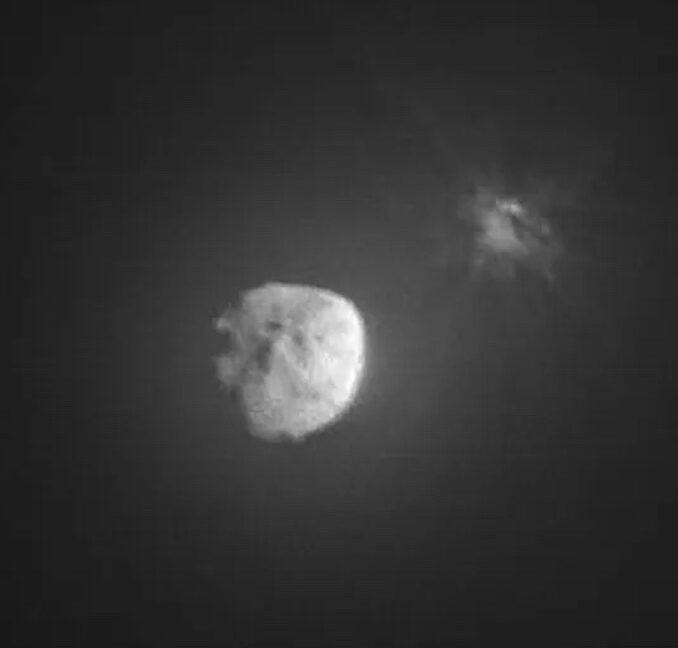
Italy’s LICIACube spacecraft snapped this image of asteroids Didymos (lower left) and Dimorphos (upper right) a few minutes after the impact of DART on September 26, 2022. Credit: ASI/NASA

On September 26, 2022, NASA’s Double Asteroid Redirection Test (DART) spacecraft crashed into a binary asteroid system. By intentionally ramming a probe into the 160-meter-wide moonlet named Dimorphos, the smaller of the two asteroids, humanity demonstrated that the kinetic impact method of planetary defense actually works. The immediate result was that Dimorphos’ orbital period around Didymos, its larger parent body, was slashed by 33 minutes.

Of course, altering a moonlet’s local orbit doesn’t seem like enough to safeguard Earth from civilization-ending impacts. But now, as long-term observational data has come in, it seems we accomplished more than that. DART actually changed the trajectory of the entire Didymos binary system, altering its orbit around the Sun.

Tracking space rocks

Measuring the orbital shift of a 780-meter-wide primary asteroid and its moonlet from millions of miles away isn’t trivial. When DART slammed into Dimorphos, it didn’t knock the binary system wildly off its trajectory around the Sun. The change in the system’s heliocentric trajectory was expected to be small, a minuscule nudge that would become apparent only after months or years of continuous observation. By analyzing enough painstakingly gathered data, a global team of researchers led by Rahil Makadia at the University of Illinois Urbana-Champaign has now determined the consequences of the DART impact.

To find the infinitesimal deviation DART created, Makadia’s team relied mostly on a technique called stellar occultation. When an asteroid passes in front of a distant star from the perspective of an observer on Earth, the star briefly blinks out. By precisely timing these blinks as they sweep across the globe, astronomers can pinpoint an asteroid’s position with astonishing accuracy.

Between October 2022 and March 2025, we captured 22 such stellar occultations of the Didymos system. Combined with a huge dataset publicly available at the Minor Planet Data Center that included nearly 6,000 ground-based astrometric measurements taken over 29 years, optical navigation data from the DART probe’s approach, and ground-based radar measurements, researchers finally had all they needed.

“Once we had enough measurements before and after the DART impact, we could discern how Didymos’ orbit has changed,” Makadia said.

When the vending-machine-sized DART probe crashed into Dimorphos at over 22,000 kilometers per hour, it decreased the along-track velocity of the entire Didymos system by roughly 11.7 micrometers per second. But the team thinks it’s still significant. “When you do it early enough, even a small impulse can accumulate over years and cause a meaningful shift,” Makadia explained.

Also, the DART impact itself was not the only force that changed Didymos’ orbit.

The ejecta engine

The pure kinetic energy of a 500-kilogram spacecraft hitting at hypersonic speeds is impressive, but on its own, it would not slow a huge asteroid that much. When DART struck Dimorphos, it blasted pulverized rock and dust out into the void. “The material kicked up off an asteroid surface acts like an extra rocket plume,” Makadia said.

Scientists call this effect the momentum enhancement factor, denoted by the Greek letter beta. If the spacecraft impact transferred exactly its own momentum and no debris was kicked up, beta would be exactly one.

Because Dimorphos orbits Didymos, some of the ejecta remained trapped in the system, where it altered the mutual orbit between the two rocks. But a crucial fraction of the ejecta achieved escape velocity from the entire binary system. The momentum carried away by the system-escaping debris is what ultimately contributed to shoving the center of mass of the whole Didymos-Dimorphos pair. “In our case, we found that the beta parameter due to DART impact was around two,” Makadia explained.

The debris blasted completely out of the Didymos system gave the asteroids a push roughly equal to the initial impact of the spacecraft itself.

To calculate how momentum was transferred, Makadia and his colleagues had to determine precisely how massive Didymos and Dimorphos are. By linking the heliocentric deflection to the previously known changes in Dimorphos’ local orbit, the researchers were able to perform a neat mathematical trick to uncover the bulk densities of both asteroids. And this revealed something a bit unexpected about the Didymos system.

“Most studies were going under the assumption that both asteroids have equal density—turns out that assumption was not correct,” Makadia said.

A rubble pile

Based on Makadia’s calculations, Didymos, the primary body, is relatively solid. It has a bulk density of around 2.6 tons per cubic meter, which aligns with standard estimates for siliceous asteroids. Dimorphos, however, is a different story. Its density is a surprisingly low 1.51 tons per cubic meter. This implies that the smaller asteroid targeted by DART is essentially a fluffy, loosely bound agglomeration of boulders, rocks, and dust, with empty voids between the rubble.

“This was a real surprise,” Makadia said. “We previously didn’t know anything about the density of Dimorphos.” The contrast in density tells the story of how this binary system formed.

Billions of years of uneven heating and radiation from the Sun can cause an irregularly shaped asteroid like Didymos to gradually spin faster, a phenomenon known as the YORP (Yarkovsky, O’Keefe, Radzievskii, Paddack) effect. Eventually, Didymos spun so fast that the centrifugal force overcame its gravity, and it began shedding loose material from its equator. That shed material eventually coalesced in orbit, gently clumping together to form the porous, fragile moonlet we now know as Dimorphos.

Overall, Didymos is nearly 200 times more massive than its smaller companion, which explains why shifting the larger asteroid system takes such an enormous amount of force. The sheer inertia of Didymos means that the barycenter deflection of its entire system was just a tiny fraction of the deflection felt locally by Dimorphos.

Planetary defense

Makadia’s findings confirm the models we used to estimate the consequences of the DART impact: The Didymos system still poses zero threat to us, at least for the next 100 years or so. “The pre-DART condition was that the closest the Didymos system can get to Earth was around 15 lunar distances, and this has not changed appreciably,” Makadia explained.

The goal of DART was primarily to take our planetary defense out of the realm of computer models and get us some hands-on, practical experience, and Makadia thinks we succeeded in doing that. “Our work proves that hitting the secondary asteroid is a viable path for deflecting a binary system away as long as the push is large enough,” he said. “This wasn’t the goal of DART, but we can always design a bigger spacecraft.”

This experience applies both to deflecting binary asteroid systems like Didymos and singular objects. “Our results definitely help us in all sorts of future kinetic impact endeavors,” Makadia added.

The final verification of the DART mission’s consequences, though, will come in late 2026, when the European Space Agency’s Hera spacecraft will arrive at the Didymos system.

By performing independent, in-situ measurements of things like the density of Didymos and Dimorphos, Hera will provide a lot of precise gravitational and physical data that Makadia hopes to use to refine his calculations.

“It’s a high-fidelity instrument that hopefully will give us confirmation of what we believe,” Makadia said. “Plus, there are always new things to be found out when we visit an asteroid. I’m very excited about when Hera gets there.”

Science Advances, 2026.  DOI: 10.1126/sciadv.aea4259

Photo of Jacek Krywko

Jacek Krywko is a freelance science and technology writer who covers space exploration, artificial intelligence research, computer science, and all sorts of engineering wizardry.

Asteroid defense mission shifted the orbit of more than its target Read More »

spacex-launches-europe’s-hera-asteroid-mission-ahead-of-hurricane-milton

SpaceX launches Europe’s Hera asteroid mission ahead of Hurricane Milton


The launch of another important mission, NASA’s Europa Clipper, is on hold due to Hurricane Milton.

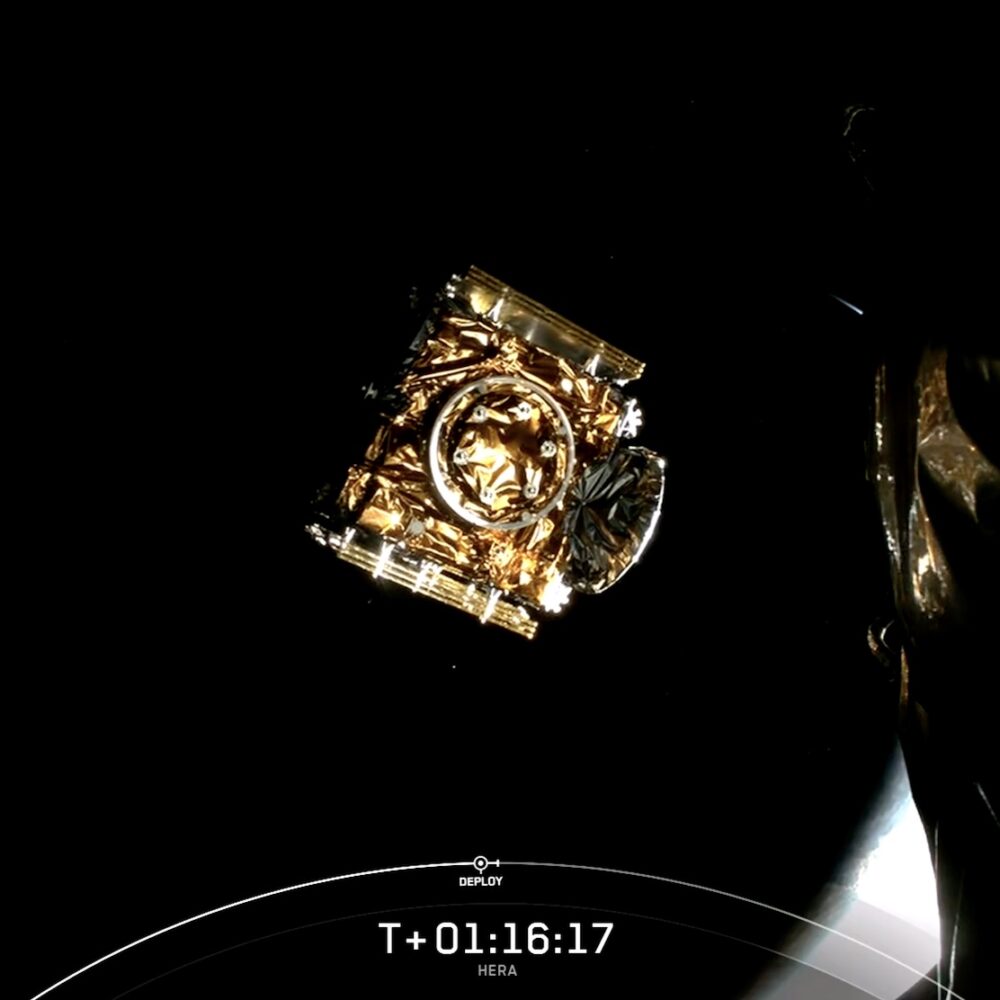
The European Space Agency’s Hera spacecraft flies away from the Falcon 9 rocket’s upper stage a little more than an hour after liftoff Monday. Credit: SpaceX

Two years ago, a NASA spacecraft smashed into a small asteroid millions of miles from Earth to test a technique that could one day prove useful to deflect an object off a collision course with Earth. The European Space Agency launched a follow-up mission Monday to go back to the crash site and see the damage done.

The nearly $400 million (363 million euro) Hera mission, named for the Greek goddess of marriage, will investigate the aftermath of a cosmic collision between NASA’s DART spacecraft and the skyscraper-size asteroid Dimorphos on September 26, 2022. NASA’s Double Asteroid Redirection Test mission was the first planetary defense experiment, and it worked, successfully nudging Dimorphos off its regular orbit around a larger companion asteroid named Didymos.

But NASA had to sacrifice the DART spacecraft in the deflection experiment. Its destruction meant there were no detailed images of the condition of the target asteroid after the impact. A small Italian CubeSat deployed by DART as it approached Dimorphos captured fuzzy long-range views of the collision, but Hera will perform a comprehensive survey when it arrives in late 2026.

“We are going to have a surprise to see what Dimorphos looks like, which is, first, scientifically exciting, but also important because if we want to validate the technique and validate the model that can reproduce the impact, we need to know the final outcome,” said Patrick Michel, principal investigator on the Hera mission from Côte d’Azur Observatory in Nice, France. “And we don’t have it. With Hera, it’s like a detective going back to the crime scene and telling us what really happened.”

Last ride before the storm

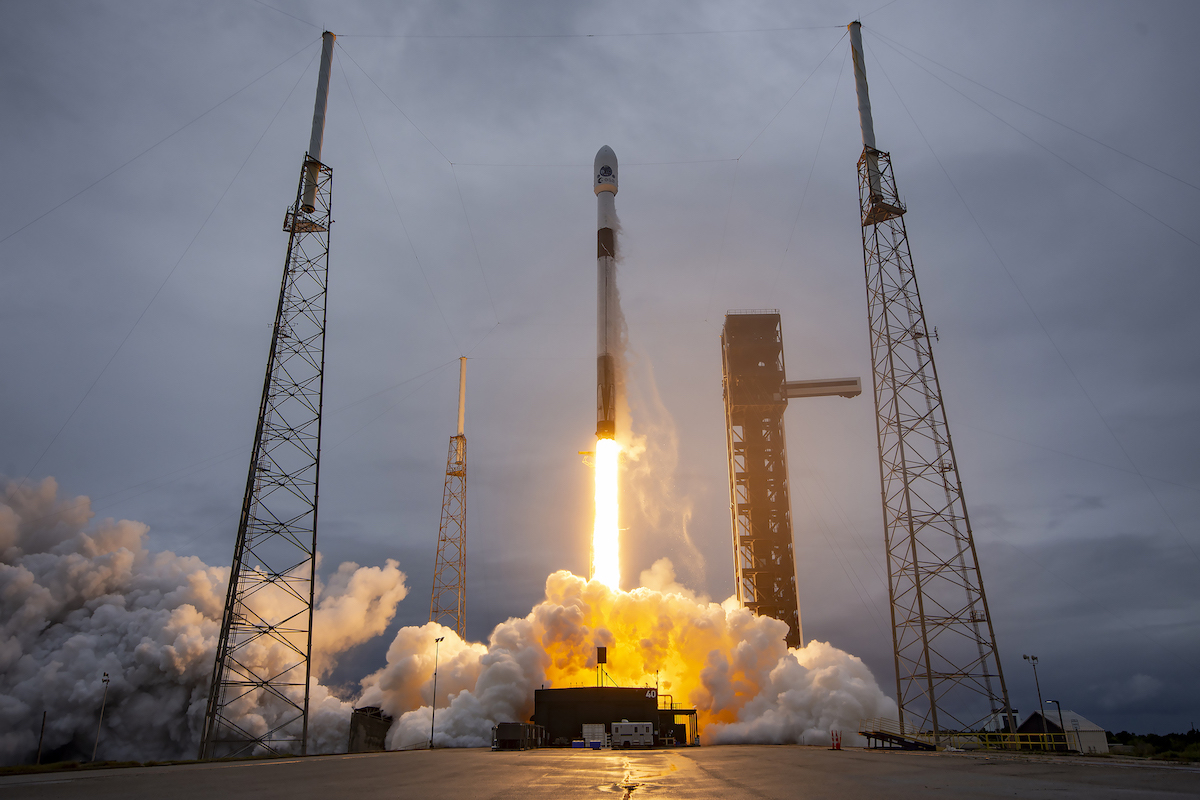
The Hera spacecraft, weighing in at 2,442 pounds (1,108 kilograms), lifted off on top of a SpaceX Falcon 9 rocket at 10: 52 am EDT (14: 52 UTC) Monday from Cape Canaveral Space Force Station, Florida.

Officials weren’t sure the weather conditions at Cape Canaveral would permit a launch Monday, with widespread rain showers and a blanket of cloud cover hanging over Florida’s Space Coast. But the conditions were just good enough to be acceptable for a rocket launch, and the Falcon 9 lit its nine kerosene-fueled engines to climb away from pad 40 after a smooth countdown.

SpaceX’s Falcon 9 rocket lifts off from Cape Canaveral Space Force Station, Florida, with ESA’s Hera mission.

Credit: SpaceX

SpaceX’s Falcon 9 rocket lifts off from Cape Canaveral Space Force Station, Florida, with ESA’s Hera mission. Credit: SpaceX

This was probably the final opportunity to launch Hera before the spaceport shutters in advance of Hurricane Milton, a dangerous Category 5 storm taking aim at the west coast of Florida. If the mission didn’t launch Monday, SpaceX was prepared to move the Falcon 9 rocket and the Hera spacecraft back inside a hangar for safekeeping until the storm passes.

Meanwhile, at NASA’s Kennedy Space Center a few miles away, SpaceX is securing a Falcon Heavy rocket with the Europa Clipper spacecraft to ride out Hurricane Milton inside a hangar at Launch Complex 39A. Europa Clipper is a $5.2 billion flagship mission to explore Jupiter’s most enigmatic icy moon, and it was supposed to launch Thursday, the same day Hurricane Milton will potentially move over Central Florida.

NASA announced Sunday that it is postponing Europa Clipper’s launch until after the storm.

“The safety of launch team personnel is our highest priority, and all precautions will be taken to protect the Europa Clipper spacecraft,” said Tim Dunn, senior launch director at NASA’s Launch Services Program. “Once we have the ‘all-clear’ followed by facility assessment and any recovery actions, we will determine the next launch opportunity for this NASA flagship mission.”

Europa Clipper must launch by November 6 in order to reach Jupiter and its moon Europa in 2030. ESA’s Hera mission had a similarly tight window to get off the ground in October and arrive at asteroids Didymos and Dimorphos in December 2026.

Returning to flight

The Falcon 9 did its job Monday, accelerating the Hera spacecraft to a blistering speed of 26,745 mph (43,042 km/hr) with successive burns by its first stage booster and upper stage engine. This was the highest-speed payload injection ever achieved by SpaceX.

SpaceX did not attempt to recover the Falcon 9’s reusable booster on Monday’s flight because Hera needed all of the rocket’s oomph to gain enough speed to escape the pull of Earth’s gravity.

“Good launch, good orbit, and good payload deploy,” wrote Kiko Dontchev, SpaceX’s vice president of launch, on X.

This was the first Falcon 9 launch in nine days—an unusually long gap between SpaceX missions—after the rocket’s upper stage misfired during a maneuver to steer itself out of orbit following an otherwise successful launch September 28 with a two-man crew heading for the International Space Station.

The upper stage engine apparently “over-burned,” and the rocket debris fell into the atmosphere short of its expected reentry corridor in the Pacific Ocean, sources said. The Federal Aviation Administration grounded the Falcon 9 rocket while SpaceX investigates the malfunction, but the FAA granted approval for SpaceX to launch the Hera mission because its trajectory would carry the rocket away from Earth, rather than back into the atmosphere for reentry.

“The FAA has determined that the absence of a second stage reentry for this mission adequately mitigates the primary risk to the public in the event of a reoccurrence of the mishap experienced with the Crew-9 mission,” the FAA said in a statement.

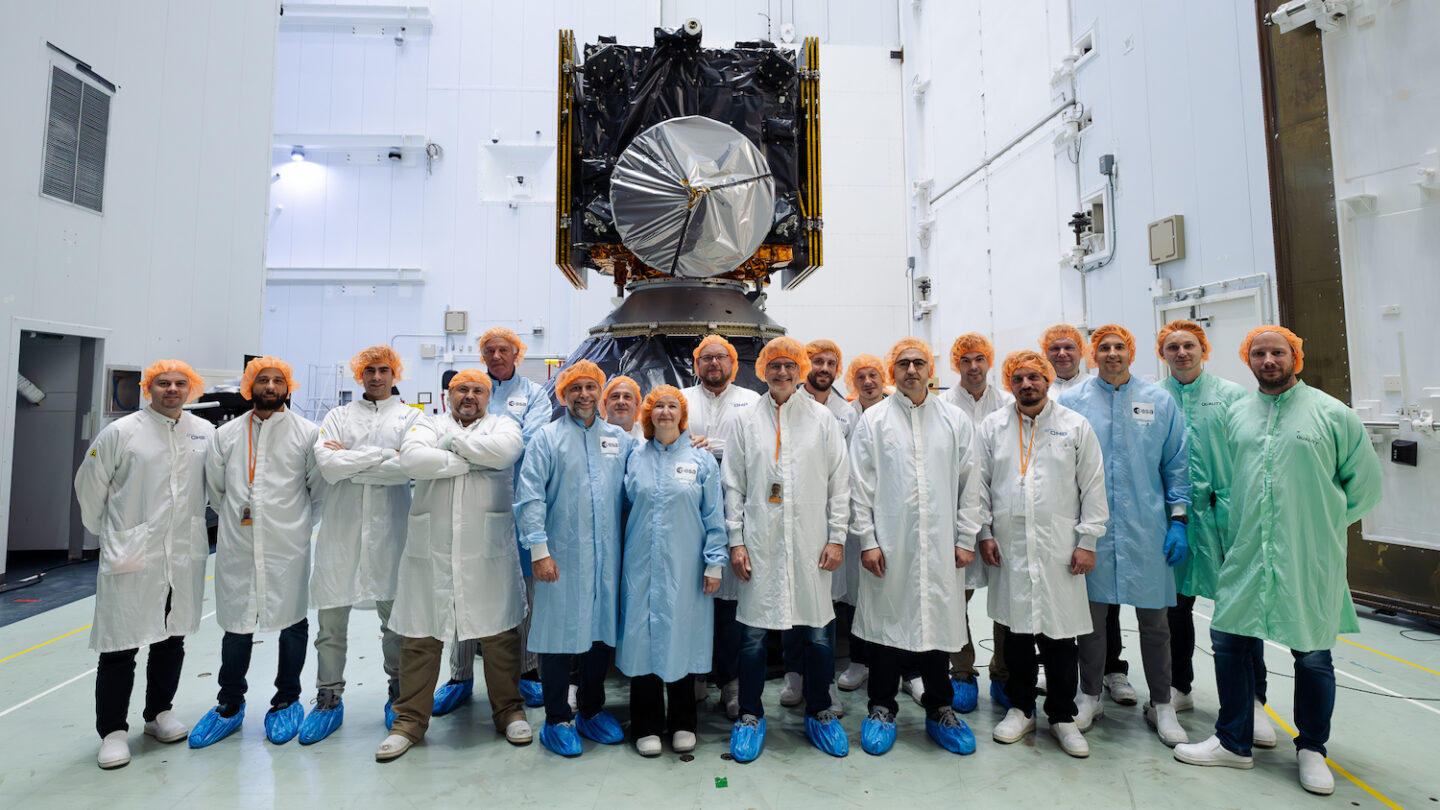
Members of the Hera team from ESA and its German prime contractor, OHB, pose with the spacecraft inside SpaceX’s payload processing facility in Florida.

Credit: SpaceX

Members of the Hera team from ESA and its German prime contractor, OHB, pose with the spacecraft inside SpaceX’s payload processing facility in Florida. Credit: SpaceX

This was the third time the FAA has grounded SpaceX’s Falcon 9 rocket fleet in less than three months, following another upper stage failure in July that caused the destruction of 20 Starlink Internet satellites and the crash-landing of a Falcon 9 booster on an offshore drone ship in August. Federal regulators are responsible for ensuring commercial rocket launches don’t endanger the public.

These were the first major anomalies on any Falcon 9 launch since 2021.

It’s not clear when the FAA will clear SpaceX to resume launching other Falcon 9 missions. However, the launch of the Europa Clipper mission on a Falcon Heavy rocket, which uses essentially the same upper stage as a Falcon 9, is not licensed by the FAA because it is managed by NASA, another government agency. NASA will have final authority on whether to give the green light for the launch of Europa Clipper.

Surveying the damage

ESA’s Hera spacecraft is on course for a flyby of Mars next March to take advantage of the red planet’s gravity to slingshot itself on a trajectory to intercept its twin target asteroids. Near Mars, Hera will zoom relatively close to the planet’s asteroid-like moon, Deimos, to obtain rare closeups.

Then, Hera will approach Didymos and Dimorphos a little more than two years from now, maneuvering around the binary asteroid system at a range of distances, eventually moving as close as about a half-mile (1 kilometer) away.

Italy’s LICIACube spacecraft snapped this image of asteroids Didymos (lower left) and Dimorphos (upper right) a few minutes after the impact of DART on September 26, 2022.

Credit: ASI/NASA

Italy’s LICIACube spacecraft snapped this image of asteroids Didymos (lower left) and Dimorphos (upper right) a few minutes after the impact of DART on September 26, 2022. Credit: ASI/NASA

Dimorphos orbits Didymos once every 11 hours and 23 minutes, roughly 32 minutes shorter than the orbital period before DART’s impact in 2022. This change in orbit proved the effectiveness of a kinetic impactor in deflecting an asteroid that threatens Earth.

Dimorphos, the smaller of the two asteroids, has a diameter of around 500 feet (150 meters), while Didymos measures approximately a half-mile (780 meters) wide. Neither asteroid poses a risk to Earth, so NASA chose them as the objective for DART.

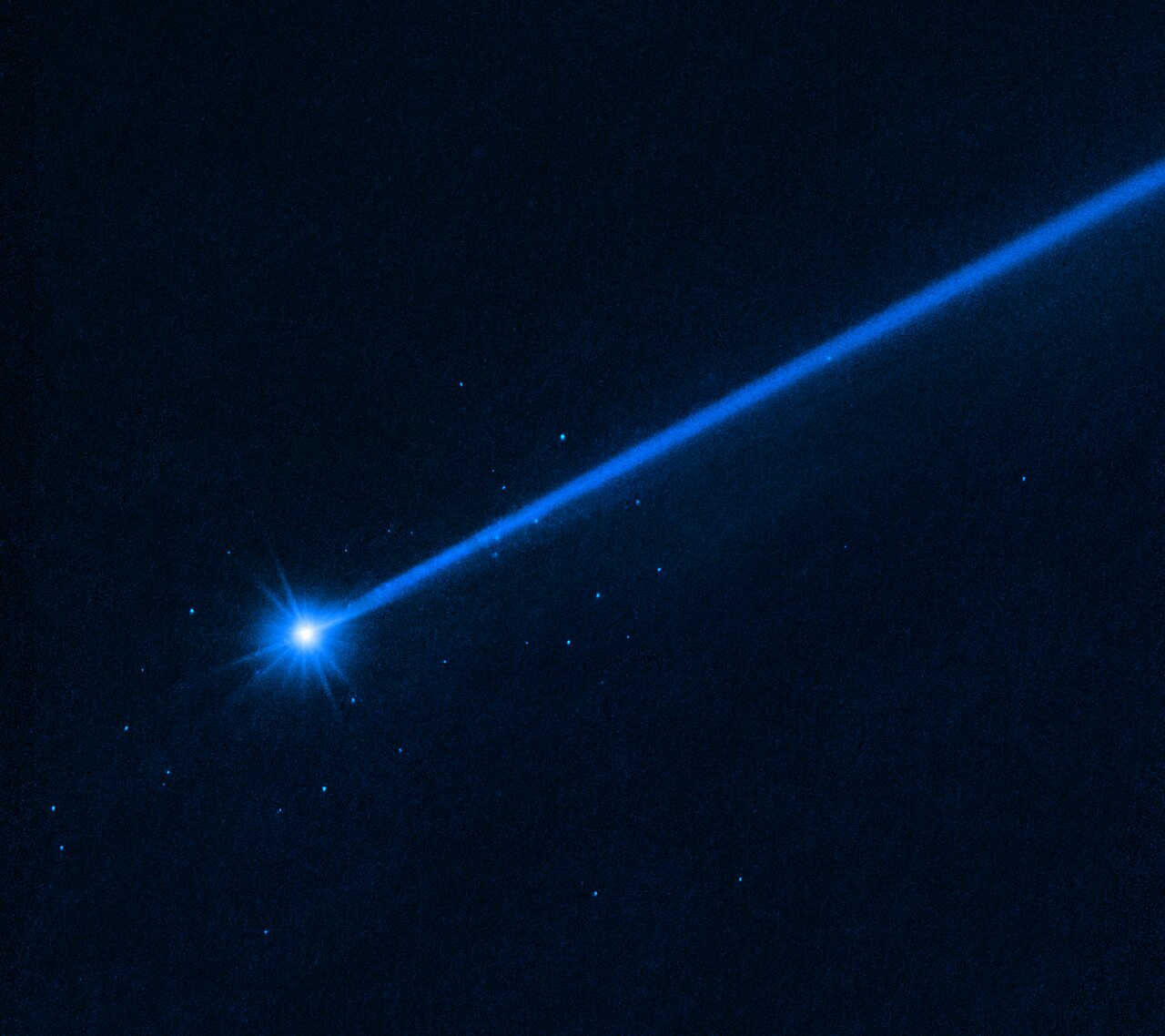
The Hubble Space Telescope spotted a debris field trailing the binary asteroid system after DART’s impact. Astronomers identified at least 37 boulders drifting away from the asteroids, material ejected when the DART spacecraft slammed into Dimorphos at a velocity of 14,000 mph (22,500 kmh).

Scientists will use Hera, with its suite of cameras and instruments, to study how the strike by DART changed the asteroid Dimorphos. Did the impact leave a crater, or did it reshape the entire asteroid? There are “tentative hints” that the asteroid’s shape changed after the collision, according to Michael Kueppers, Hera’s project scientist at ESA.

“If this is the case, it would also mean that the cohesion of Dimorphos is extremely low; that indeed, even an object the size of Dimorphos would be held together by its weight, by its gravity, and not by cohesion,” Kueppers said. “So it really would be a rubble pile.”

Hera will also measure the mass of Dimorphos, something DART was unable to do. “That is important to measure the efficiency of the impact… which was the momentum that was transferred from the impacting satellite to the asteroid,” Kueppers said.

This NASA/ESA Hubble Space Telescope image of the asteroid Dimorphos was taken on December 19, 2022, nearly three months after the asteroid was impacted by NASA’s DART mission. Hubble’s sensitivity reveals a few dozen boulders knocked off the asteroid by the force of the collision.

Credit: NASA, ESA, D. Jewitt (UCLA)

This NASA/ESA Hubble Space Telescope image of the asteroid Dimorphos was taken on December 19, 2022, nearly three months after the asteroid was impacted by NASA’s DART mission. Hubble’s sensitivity reveals a few dozen boulders knocked off the asteroid by the force of the collision. Credit: NASA, ESA, D. Jewitt (UCLA)

The central goal of Hera is to fill the gaps in knowledge about Didymos and Dimorphos. Precise measurements of DART’s momentum, coupled with a better understanding of the interior structure of the asteroids, will allow future mission planners to know how best to deflect a hazardous object threatening Earth.

“The third part is to generally investigate the two asteroids to know their physical properties, their interior properties, their strength, essentially to be able to extrapolate or to scale the outcome of DART to another impact should we really need it one day,” Kueppers said.

Hera will release two briefcase-size CubeSats, named Juventas and Milani, to work in concert with ESA’s mothership. Juventas carries a compact radar to probe the internal structure of the smaller asteroid and will eventually attempt a landing on Dimorphos. Milani will study the mineral composition of individual boulders around DART’s impact site.

“This is the first time that we send a spacecraft to a small body, which is actually a multi-satellite system, with one main spacecraft and two CubeSats doing closer proximity operations,” Michel said. “This has never been done.”

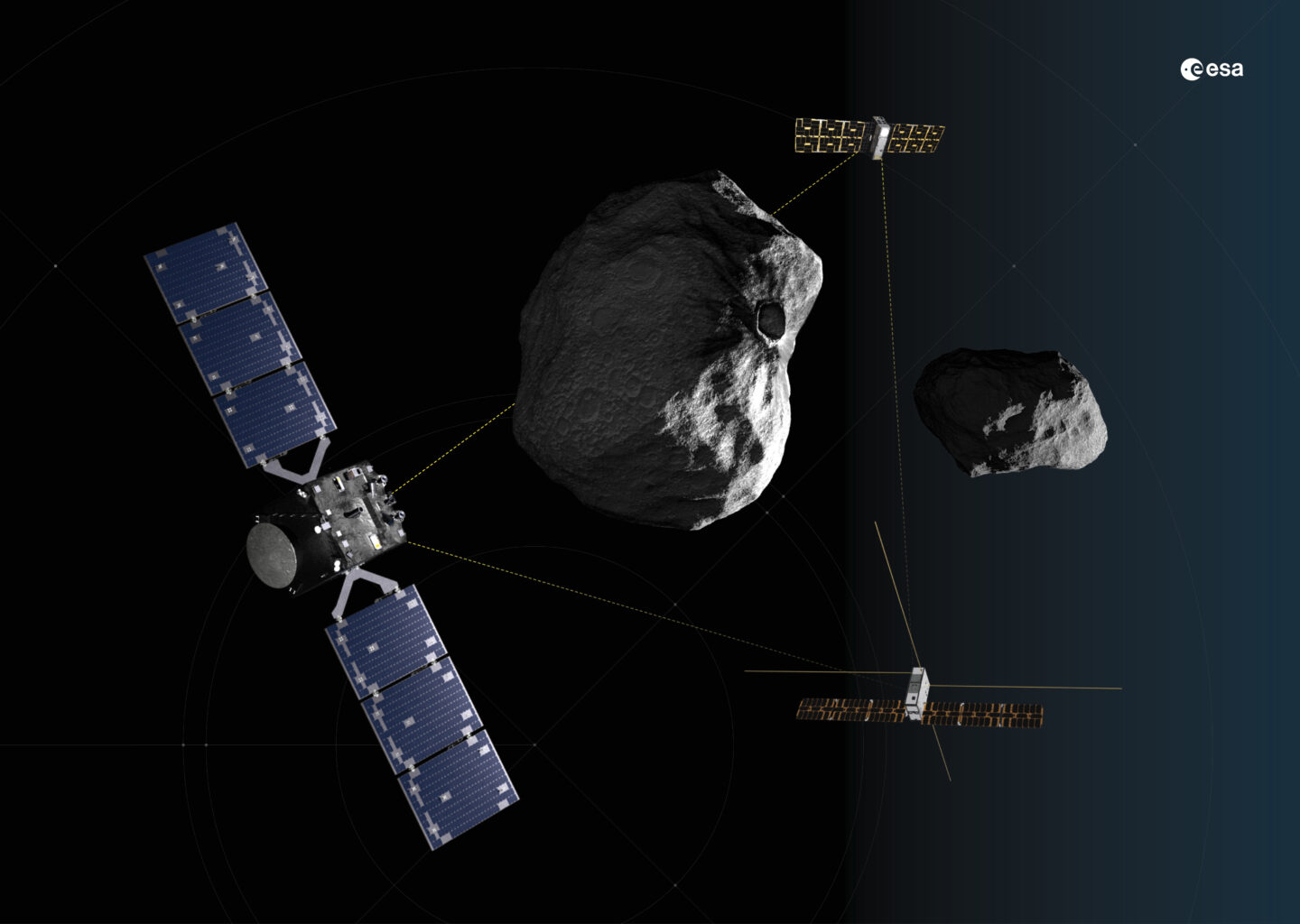
Artist’s illustration of the Hera spacecraft with its two deployable CubeSats, Juventas and Milani, in the vicinity of the Didymos binary asteroid system. The CubeSats will communicate with ground teams via radio links with the Hera mothership.

Credit: ESA-Science Office

Artist’s illustration of the Hera spacecraft with its two deployable CubeSats, Juventas and Milani, in the vicinity of the Didymos binary asteroid system. The CubeSats will communicate with ground teams via radio links with the Hera mothership. Credit: ESA-Science Office

One source of uncertainty, and perhaps worry, about the environment around Didymos and Dimorphos is the status of the debris field observed by Hubble a few months after DART’s impact. But this is not likely to be a problem, according to Kueppers.

“I’m not really worried about potential boulders at Didymos,” he said, recalling the relative ease with which ESA’s Rosetta spacecraft navigated around an active comet from 2014 through 2016.

Ignacio Tanco, ESA’s flight director for Hera, doesn’t share Kuepper’s optimism.

“We didn’t hit the comet with a hammer,” said Tanco, who is responsible for keeping the Hera spacecraft safe. “The debris question for me is actually a source of… I wouldn’t say concern, but certainly precaution. It’s something that we’ll need to approach carefully once we get there.”

“That’s the difference between an engineer and a scientist,” Kuepper joked.

Scientists originally wanted Hera to be in the vicinity of the Didymos binary asteroid system before DART’s arrival, allowing it to directly observe the impact and its fallout. But ESA’s member states did not approve funding for the Hera mission in time, and the space agency only signed the contract to build the Hera spacecraft in 2020.

ESA first studied a mission like DART and Hera more than 20 years ago, when scientists proposed a mission called Don Quijote to get an asteroid deflection. But other missions took priority in Europe’s space program. Now, Hera is on course to write the final chapter of the story of humanity’s first planetary defense test.

“This is our contribution of ESA to humanity to help us in the future protect our planet,” said Josef Aschbacher, ESA’s director general.

Photo of Stephen Clark

Stephen Clark is a space reporter at Ars Technica, covering private space companies and the world’s space agencies. Stephen writes about the nexus of technology, science, policy, and business on and off the planet.

SpaceX launches Europe’s Hera asteroid mission ahead of Hurricane Milton Read More »