You had us at “friendly alien space spider”: Netflix drops Spaceman trailer
There’s a star-spider waiting in the sky —
“Six months in isolation, you start thinking too much.”
Adam Sandler stars as a lonely astronaut on a solo mission who befriends an alien spider in Spaceman.
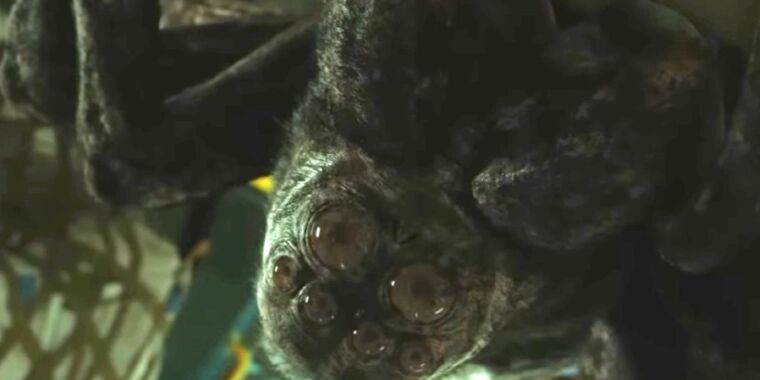
Some people were not pleased when Netflix and other streaming platforms began making feature films. But in an industry in which smaller or medium films tend to be squeezed out in favor of big-budget fare, there’s a solid argument to be made that Netflix and others could help fill that niche. That certainly seems to be the case with Netflix’s forthcoming sci-fi film, Spaceman, judging by the official trailer. Adam Sandler stars as an astronaut who is not coping well with the isolation and disintegration of his marriage while on an eight-month solo mission and strikes up a friendship with a friendly alien space spider who wants to help him work through his emotional distress. Honestly, Netflix had us at friendly alien space spider.
(Some spoilers for the 2017 novel below.)
Directed by Johan Renck (Chernobyl, Breaking Bad), the film is based on the 2017 novel, Spaceman of Bohemia, by Jaroslav Kalfař. Kalfař has said he was inspired to write his novel after a childhood experience of becoming briefly separated from his grandfather while on a nighttime walk through the woods. The “perfect darkness, with nothing but the stars” made a strong impression, as did the silence and sense of loneliness. Spaceman of Bohemia started as a short story about an astronaut stranded in orbit as his wife filed for divorce and eventually became a novel that incorporated not just the theme of loneliness, but also Kalfař’s formative experiences growing up in the Czech Republic.
In the novel, a Czech astrophysicist named Jakub Procházka accepts a solo mission to collect samples from a strange dust cloud called Chopra, believed to have been created by a comet lurking between the Earth and Venus. He hopes the high-profile mission will make him a national hero and redeem the family name following his father’s membership in the Communist Party of Czechoslovakia. But it means leaving his pregnant wife, Lenka, back on Earth, who feels abandoned and decides to end their marriage. Jakub becomes depressed and starts drinking excessively. His sanity comes into question when he begins hearing voices and then starts seeing a giant talking alien spider around the shuttle. The two gradually bond. But is the spider real or a figment of Jakub’s imagination?
The Netflix adaptation looks like it will follow that basic plot pretty closely. Per the official premise:
Six months into a solitary research mission to the edge of the solar system, an astronaut, Jakub (Adam Sandler), realizes that the marriage he left behind might not be waiting for him when he returns to Earth. Desperate to fix things with his wife, Lenka (Carey Mulligan), he is helped by a mysterious creature from the beginning of time he finds hiding in the bowels of his ship. Hanuš (voiced by Paul Dano) works with Jakub to make sense of what went wrong before it is too late.
The cast also includes Isabella Rossellini as Jakub’s commanding officer. Kunal Nayyar as a technician named Peter, and Lena Olin as Zdena.
Spaceman drops on Netflix on March 1, 2024. It will make its world premiere a few weeks earlier at the 74th Berlin International Film Festival.
Listing image by Netflix
You had us at “friendly alien space spider”: Netflix drops Spaceman trailer Read More »









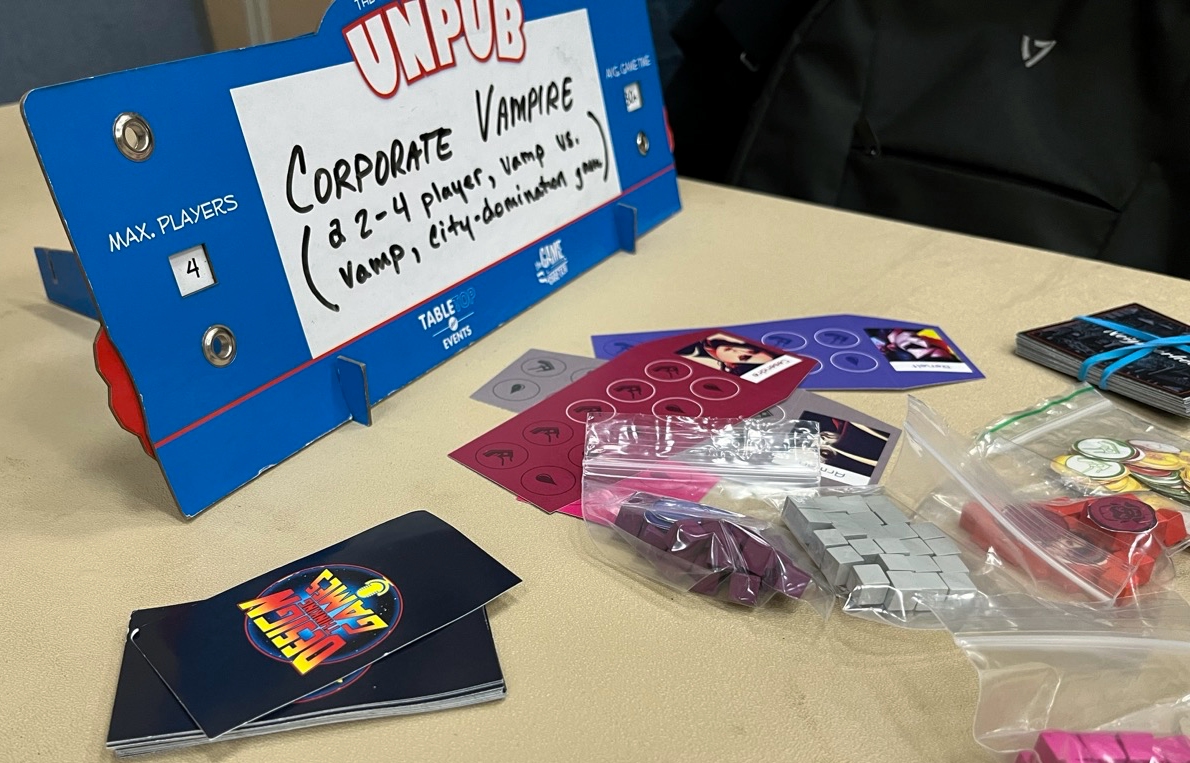
![Hand-cut tokens and make-do squares for an early version of <em>Thirst</em>.” height=”960″ src=”https://cdn.arstechnica.net/wp-content/uploads/2023/12/IMG_3964-Large.jpeg” width=”1280″></img><figcaption>
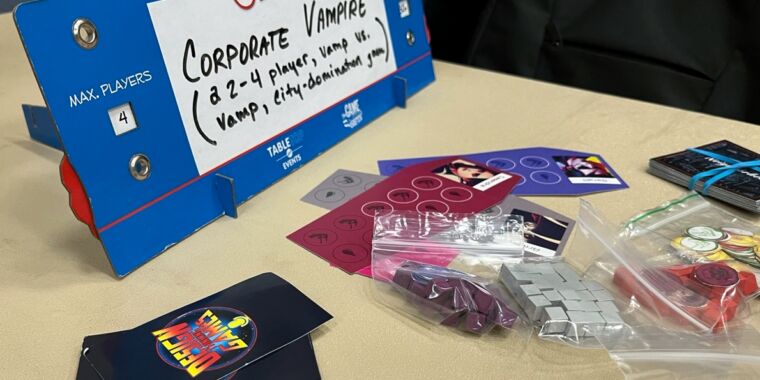
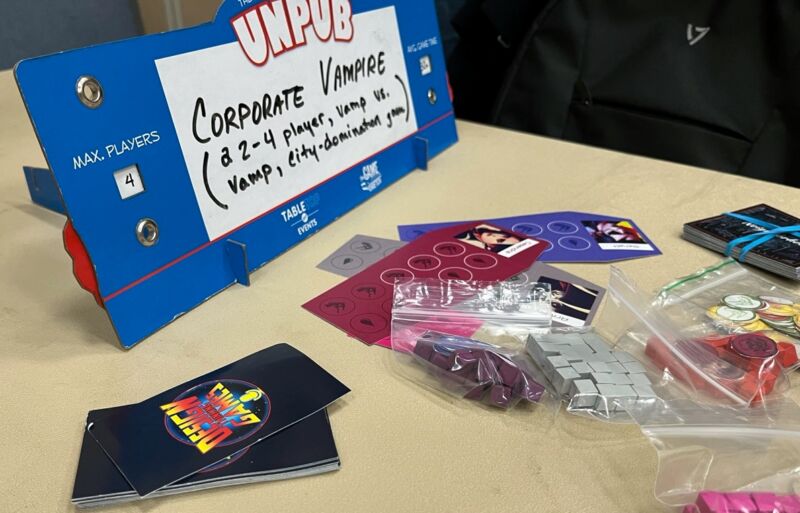
<p>Hand-cut tokens and make-do squares for an early version of <em>Thirst</em>.</p>
<p>Kevin Purdy</p>
</figcaption></figure>
<p>The way <i>CorpVamp</i>/<i>Thirst</i> should go is that each night, a vampire wakes up, loses a little blood, then sets out to get much more back by exploring a Victorian city. In populated neighborhoods, a vampire can feast on people—but doing so generates a board-altering Consequence, such as roving security guards or citizens discovering bodies. Vampires accumulate victims and hypnotize them for Influence, depending on who the victims are (“Judge” versus “Roustabout,” for example), turn them into “Baby Vampires,” or simply keep them as blood stock. You win by accruing victory points for various misdeeds and achievements.</p>
<p>One player, who told the designers that a different game’s play-test saw him “break the game in 10 minutes,” seemed bothered by how Consequences can be triggered by a single player’s actions but affect all players. Another has a hard time keeping track of the tokens for influence, movement, and blood, and when to move them on and off the board. That’s called “mess testing,” Schofield tells me, and he’s working on it. Some things will be easier to learn and use when the pieces have better designs and materials. But the <i>CorpVamp</i> team can’t jump to that stage until the mechanics are locked down.</p>
<p>As that group finishes a test, another group sits down immediately, having stood nearby to ensure their chance. Schofield and Broadwater won’t lack for players in their three-hour slot. That tells the team there’s “evidence of a market,” that their game has “stopping power” and “shelf value,” despite its obscurity, Schofield says. But there’s lots of work still to be done in alpha. “The costs of powers are too high, the powers aren’t <i>badass enough</i> [emphasis his], and the tactile movement of placing cubes and flipping tokens isn’t quite right,” he later tells me.</p>
<p>After more iterations and some “blind” play tests (players learning, playing, and finishing the game without creator guidance), the game will be in beta, and the team will get closer to pinning down the look and feel of the game with illustrators and designers. Since their schedules only afford them roughly three hours of dedicated collaboration time every week, they lean on what they’ve learned from their product-oriented day jobs. “Frequent iterations and small feedback loops will iron things out,” Schofield says. “Process wins.”</p>
<p>Then they can “enjoy the problems of production and distribution logistics.” After that, “We’ll sell copies of <i>Thirst</i> at the next PAX Unplugged.”</p>
<figure><img loading=](https://cdn.arstechnica.net/wp-content/uploads/2023/12/who_knew-scaled.jpg)