COVID-19

uncertainty-loomed-as-fda-advisors-met-to-discuss-this-year’s-covid-shot

Uncertainty loomed as FDA advisors met to discuss this year’s COVID shot

Calling it a “practical question,” he asked, “If we were to change strains, can we assume that age-specific licensure won’t change for any of these [vaccine] products?” Currently, COVID-19 boosters are accessible to those aged 6 months and up.

Weir reiterated that there was no answer. Another FDA official, David Kaslow, chimed in to say only, “Rest assured that we’re engaging with the manufacturers on this topic.”

As a follow-up to that exchange, VRBPAC member and infectious disease expert Eric Rubin of Harvard University shot down the FDA’s plan to use randomized placebo-controlled trials for licensure for healthy children and adults. The plethora of observational data—aka real-world data—on the boosters shows clear efficacy, Rubin pointed out. That suggests that requiring people in a trial to take placebos despite the availability of a clearly effective treatment could be unethical.

It suggests “that a randomized controlled trial (RCT) has no equipoise right now, and that you cannot do one,” Rubin said. “I don’t think the RCT is feasible,” he added.

The selection

While the pushback and the questions lingered, the committee still had to select a strain. For now, omicron still reigns, and variants in the JN.1 lineage are still dominant. That is largely unchanged from last year, when vaccine makers were advised to target their seasonal shots against the JN.1 lineage generally, or KP.2, the leading variant in the JN.1 lineage at the time, specifically.

This year, advisors unanimously voted to stick with vaccines that target the JN.1 lineage, in line with recommendations from the World Health Organization. The question of targeting the JN.1 lineage was the only voting question the FDA tasked them with. But there was open discussion on a more specific recommendation. Given the regulatory uncertainty, advisors were divided on whether to stick with the JN.1 and KP.2 formulations from last year or recommend switching to the latest leading variant in the JN.1 family, LP.8.1.

Shortly after the meeting, the FDA announced that it would essentially leave it up to manufacturers; they could stick with JN.1 or KP.2 but, if feasible, switch to LP.8.1.

“The COVID-19 vaccines for use in the United States beginning in fall 2025 should be monovalent JN.1-lineage-based COVID-19 vaccines (2025–2026 Formula), preferentially using the LP.8.1 strain,” it said.

Uncertainty loomed as FDA advisors met to discuss this year’s COVID shot Read More »

under-rfk-jr.,-covid-shots-will-only-be-available-to-people-65+,-high-risk-groups

Under RFK Jr., COVID shots will only be available to people 65+, high-risk groups


FDA will require big, pricy trials for approvals for healthy kids and adults

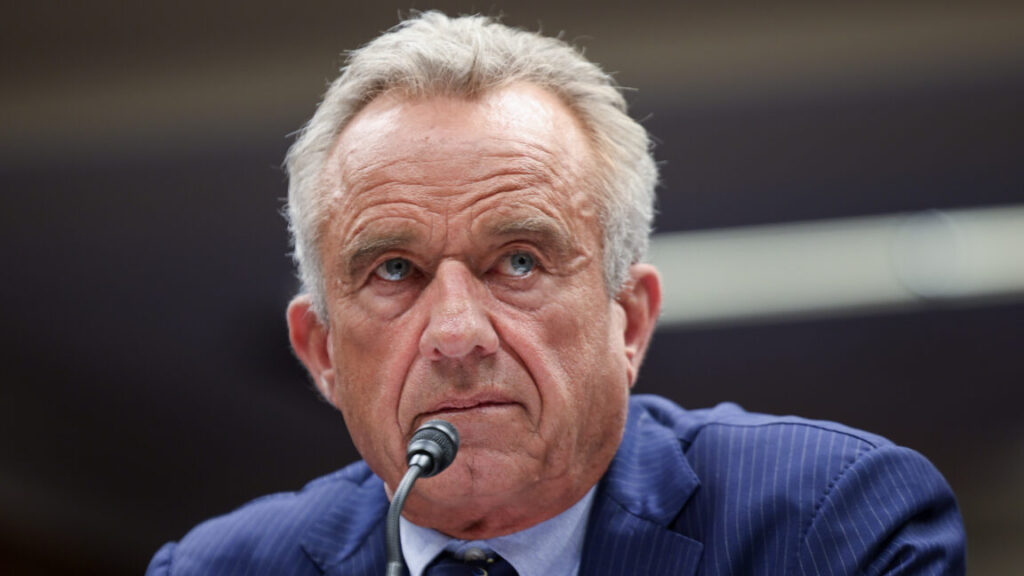
U.S. Secretary of Health and Human Services Robert F. Kennedy Jr. testifies before the Senate Committee on Health, Education, Labor, and Pensions on Capitol Hill on May 20, 2025 in Washington, DC. Credit: Getty | Tasos Katopodis

Under the control of anti-vaccine advocate Robert F. Kennedy Jr., the Food and Drug Administration is unilaterally terminating universal access to seasonal COVID-19 vaccines; instead, only people who are age 65 years and older and people with underlying conditions that put them at risk of severe COVID-19 will have access to seasonal boosters moving forward.

The move was laid out in a commentary article published today in the New England Journal of Medicine, written by Trump administration FDA Commissioner Martin Makary and the agency’s new top vaccine regulator, Vinay Prasad.

The article lays out a new framework for approving seasonal COVID-19 vaccines, as well as a rationale for the change—which was made without input from independent advisory committees for the Food and Drug Administration and the Centers for Disease Control and Prevention.

Normally, the FDA’s VRBPAC (Vaccines and Related Biological Products Advisory Committee) and the CDC’s ACIP (Advisory Committee on Immunization Practices) would publicly review, evaluate, and discuss vaccine approvals and recommendations. Typically, the FDA’s scope focuses on licensure decisions, made with strong influence from VRBPAC, while the CDC’s ACIP is principally responsible for influencing the CDC’s more nuanced recommendations on usage, such as for specific age or risk groups. These recommendations shape clinical practice and, importantly, health insurance coverage.

Makary and Prasad appear to have foregone those norms, even though VRBPAC is set to meet this Thursday to discuss COVID-19 vaccines for the upcoming season.

Restrictions

In the commentary, Markary and Prasad puzzlingly argue that the previous universal access to COVID-19 vaccines was patronizing to Americans. They describe the country’s approach to COVID boosters as a “one-size-fits-all” and write that “the US policy has sometimes been justified by arguing that the American people are not sophisticated enough to understand age- and risk-based recommendations. We reject this view.”

Previously, the seasonally updated vaccines were available to anyone age 6 months and up. Further, people age 65 and older and those at high risk were able to get two or more shots, based on their risk. So, while Makary and Prasad ostensibly reject the view of Americans as being too unsophisticated to understand risk-based usage, the pair are installing restrictions to force their own idea of risk-based usage.

Even more puzzlingly, in an April meeting of ACIP, the expert advisors expressed clear support for shifting from universal recommendations for COVID-19 boosters to recommendations based on risk. Specifically, advisors were supportive of urging boosters for people age 65 and older and people who are at risk of severe COVID-19—the same restrictions that Makary and Prasad are forcing. The two regulators do not mention this in their NEJM commentary. ACIP would also likely recommend a primary series of seasonally matched COVID-19 vaccines for very young children who have not been previously exposed to the virus or vaccinated.

ACIP will meet again in June, but without a permissive license from the FDA, ACIP’s recommendations for risk-based usage of this season’s COVID-19 shots are virtually irrelevant. And they cannot recommend usage in groups that the FDA licensure does not cover. It’s unclear if a primary series for young children will be available and, if so, how that will be handled moving forward.

New vaccine framework

Under Makary and Prasad’s new framework, seasonally updated COVID-19 vaccines can continue to be approved annually using only immunology studies—but the approvals will only be for people age 65 and over and people who are at high risk. These immunology studies look at antibody responses to boosters, which offer a shorthand for efficacy in updated vaccines that have already been through rigorous safety and efficacy trials. This is how seasonal flu shots are approved each year and how COVID boosters have been approved for all people age 6 months and up—until now.

Moving forward, if a vaccine maker wants to have their COVID-19 vaccine also approved for use in healthy children and healthy adults under age 65, they will have to conduct large, randomized, placebo-controlled studies. These may need to include tens of thousands of participants, especially with high levels of immunity in the population now. These trials can easily cost hundreds of millions of dollars, and they can take many months to complete. The requirement for such trials will make it difficult, if not impossible, for drug makers to conduct them each year and within a timeframe that will allow for seasonal shots to complete the trial, get regulatory approval, and be produced at scale in time for the start of the respiratory virus season.

Makary and Prasad did not provide any data analysis or evidence-based reasoning for why additional trials would be needed to continue seasonal approvals. In fact, the commentary had a total of only eight references, including an opinion piece Makary published in Newsweek and a New York Times article.

“We simply don’t know whether a healthy 52-year-old woman with a normal BMI who has had COVID-19 three times and has received six previous doses of a COVID-19 vaccine will benefit from the seventh dose,” they argue in their commentary.

Their new framework does not make any mention of what will happen if a more dangerous SARS-CoV-2 variant emerges. It also made no mention of vaccine usage in people who are in close contact with high-risk groups, such as ICU nurses or family members of immunocompromised people.

Context

Another lingering question from the framework is how easy it will be for people deemed at high risk to get access to seasonal shots. Makary and Prasad lay out a long list of conditions that would put people at risk of severe COVID-19 and therefore make them eligible for a seasonal booster. The list includes: obesity; asthma; lung diseases; HIV; diabetes; pregnancy; gestational diabetes; heart conditions; use of corticosteroids; dementia; physical inactivity; mental health conditions, including depression; and smoking, current or former. The FDA leaders estimate that between 100 million and 200 million Americans will fit into the category of being at high risk. It’s unclear what such a large group of Americans will need to do to establish eligibility every year.

In all, the FDA’s move to restrict and hinder access to seasonal COVID-19 vaccines is in line with Kennedy’s influential anti-vaccine advocacy work. In 2021, prior to taking the role of the country’s top health official, Kennedy and the anti-vaccine organization he founded, Children’s Health Defense, petitioned the FDA to revoke authorizations for COVID-19 vaccines and refrain from issuing any approvals.

Ironically, Makary and Prasad blame the country’s COVID-19 policies for helping to erode Americans’ trust in vaccines broadly.

“There may even be a ripple effect: public trust in vaccination in general has declined, resulting in a reluctance to vaccinate that is affecting even vital immunization programs such as that for measles–mumps–rubella (MMR) vaccination, which has been clearly established as safe and highly effective,” the two write, including the most full-throated endorsement of the MMR vaccine the Trump administration has issued yet. Kennedy continues to spread misinformation about the vaccine, including the false and debunked idea that it causes autism.

“Against this context, the Food and Drug Administration seeks to provide guidance and foster evidence generation,” Makary and Prasad write.

Photo of Beth Mole

Beth is Ars Technica’s Senior Health Reporter. Beth has a Ph.D. in microbiology from the University of North Carolina at Chapel Hill and attended the Science Communication program at the University of California, Santa Cruz. She specializes in covering infectious diseases, public health, and microbes.

Under RFK Jr., COVID shots will only be available to people 65+, high-risk groups Read More »

trump-admin-picks-covid-critic-to-be-top-fda-vaccine-regulator

Trump admin picks COVID critic to be top FDA vaccine regulator

Oncologist Vinay Prasad, a divisive critic of COVID-19 responses, will be the next top vaccine regulator at the Food and Drug Administration, agency Commissioner Martin Makary announced on social media Tuesday.

Prasad will head the FDA’s Center for Biologics Evaluation and Research (CBER), which is in charge of approving and regulating vaccines and other biologics products, such as gene therapies and blood products.

“Dr. Prasad brings the kind of scientific rigor, independence, and transparency we need at CBER—a significant step forward,” Makary wrote on social media.

Prasad, a professor in the department of epidemiology and biostatistics at the University of California, San Francisco, is perhaps best known for his combative social media postings and criticism of the mainstream medical community. He gained notoriety amid the COVID-19 pandemic for assailing public health responses, such as masking and vaccine mandates.

In an October 2021 newsletter, titled “How Democracy Ends,” Prasad compared the country’s pandemic responses to the rise of Adolf Hitler’s Third Reich. The post led New York University bioethicist Arthur Caplan to rebuke Prasad, writing in The Cancer Letter that the comparison is “ludicrous, dangerous, and offensive,” before adding “imbecilic.”

Prasad has also criticized the FDA for approving COVID-19 booster vaccines. Last year, he accused his predecessor as the head of the CBER, Peter Marks, of being “either incompetent or corrupt” for allowing the approvals.

“Absurd”

More recently, Prasad has heaped praise on new FDA Commissioner Makary, while continuing to criticize Marks. In early March, Prasad called Makary “smart, thoughtful, and disciplined” and “exactly what we need at the FDA.” Later in the month, he continued to take shots at Marks, writing: “You could replace Peter Marks with a bobblehead doll that just stamps approval and you would have the same outcome at FDA with lower administrative fees. Maybe something DOGE should consider.”

Trump admin picks COVID critic to be top FDA vaccine regulator Read More »

seasonal-covid-shots-may-no-longer-be-possible-under-trump-admin

Seasonal COVID shots may no longer be possible under Trump admin

Under President Trump, the Food and Drug Administration may no longer approve seasonal COVID-19 vaccines updated for the virus variants circulating that year, according to recent statements by Trump administration officials.

Since the acute phase of the pandemic, vaccine manufacturers have been subtly updating COVID-19 shots annually to precisely target the molecular signatures of the newest virus variants, which continually evolve to evade our immune responses. So far, the FDA has treated these tweaked vaccines the same way it treats seasonal flu shots, which have long been updated annually to match currently circulating strains of flu viruses.

The FDA does not consider seasonal flu shots brand-new vaccines. Rather, they’re just slightly altered versions of the approved vaccines. As such, the regulator does not require companies to conduct lengthy, expensive vaccine trials to prove that each slightly changed version is safe and effective. If they did, generating annual vaccines would be virtually impossible. Each year, from late February to early March, the FDA, the Centers for Disease Control and Prevention, and the World Health Organization direct flu shot makers on what tweaks they should make to shots for the upcoming flu season. That gives manufacturers just enough time to develop tweaks and start manufacturing massive supplies of doses in time for the start of the flu season.

So far, COVID-19 vaccines have been treated the exact same way, save for the fact that the vaccines that use mRNA technology do not need as much lead time for manufacturing. In recent years, the FDA decided on formulations for annual COVID shots around June, with doses rolled out in the fall alongside flu shots.

However, this process is now in question based on statements from Trump administration officials. The statements come amid a delay in a decision on whether to approve the COVID-19 vaccine made by Novavax, which uses a protein-based technology, not mRNA. The FDA was supposed to decide whether to grant the vaccine full approval by April 1. To this point, the vaccine has been used under an emergency use authorization by the agency.

Seasonal COVID shots may no longer be possible under Trump admin Read More »

“lab-leak”-marketing-page-replaces-federal-hub-for-covid-resources

“Lab leak” marketing page replaces federal hub for COVID resources

After obliterating the federal office on long COVID and clawing back billions in COVID funding from state health departments, the Trump administration has now entirely erased the online hub for federal COVID-19 resources. In its place now stands a site promoting the unproven idea that the pandemic virus SARS-CoV-2 was generated in and leaked from a lab in China, sparking the global health crisis.

Navigating to COVID.gov brings up a slick site with rich content that lays out arguments and allegations supporting a lab-based origin of the pandemic and subsequent cover-up by US health officials and Democrats.

Previously, the site provided unembellished quick references to COVID-19 resources, including links to information on vaccines, testing, treatments, and long COVID. It also provided a link to resources for addressing COVID-19 vaccine misconceptions and confronting misinformation. That all appears to be gone now, though some of the same information still remains on a separate COVID-19 page hosted by the Centers for Disease Control and Prevention.

While there remains no definitive answer on how the COVID-19 pandemic began, the scientific data available on the topic points to a spillover event from a live wild animal market in Wuhan, China. The scientific community largely sees this as the most likely scenario, given the data so far and knowledge of how previous outbreak viruses originated, including SARS-CoV-1. By contrast, the lab origin hypothesis largely relies on the proximity of a research lab to the first cases, conjecture, and distrust of the Chinese government, which has not been forthcoming with information on the early days of the health crisis. Overall, the question of SARS-CoV-2’s origin has become extremely politicized, as have most other aspects of the pandemic.

“Lab leak” marketing page replaces federal hub for COVID resources Read More »

rfk-jr-claws-back-$11.4b-in-cdc-funding-amid-wave-of-top-level-departures

RFK Jr. claws back $11.4B in CDC funding amid wave of top-level departures

Those departures follow Kevin Griffis, head of the CDC’s office of communications, who left last week; Robin Bailey, the agency’s chief operating officer, left late last month; and Nirav Shah, a former CDC principal deputy director.

Pulled funding

Meanwhile, NBC News reported this afternoon that the Department of Health and Human Services (HHS) is pulling back $11.4 billion in funding from the agency, which it allocated to state and local health departments as well as partners.

NBC reported that the funds were largely used for COVID-19 testing and vaccination, and to support community health workers and initiatives that address pandemic health disparities among high-risk and underserved populations, such as rural communities and minority populations. The funds also supported global COVID-19 projects.

“The COVID-19 pandemic is over, and HHS will no longer waste billions of taxpayer dollars responding to a non-existent pandemic that Americans moved on from years ago,” HHS Director of Communications Andrew Nixon said in a statement. “HHS is prioritizing funding projects that will deliver on President Trump’s mandate to address our chronic disease epidemic and Make America Healthy Again.”

State health departments told NBC News that they’re still evaluating the impact of the withdrawn funding. On Monday, some grantees received notices that read: “Now that the pandemic is over, the grants and cooperative agreements are no longer necessary as their limited purpose has run out.”

Since the public health emergency for COVID-19 was declared over in the US on May 11, 2023, over 92,000 Americans died from the pandemic virus, according to CDC data. In total, the pandemic killed over 1.2 million in the US.

RFK Jr. claws back $11.4B in CDC funding amid wave of top-level departures Read More »

covid-shots-protect-kids-from-long-covid—and-don’t-cause-sudden-death

COVID shots protect kids from long COVID—and don’t cause sudden death

Benefits and a non-existent risk

Using an adjusted odds ratio, the researchers found that vaccination reduced the likelihood of developing long COVID with one or more symptoms by 57 percent, and reduced the likelihood of developing long COVID with two or more symptoms by 73 percent. Vaccination prior to infection was also linked to a 75 percent reduction in risk of developing long COVID that impacted day-to-day functioning. The authors note that the estimates of protection are likely underestimates because the calculations do not account for the fact that vaccination prevented some children from getting infected in the first place.

“Our findings suggest that children should stay up to date with current COVID-19 vaccination recommendations as vaccination not only protects against severe COVID-19 illness but also protects against [long Covid],” the authors conclude.

In a second short report in JAMA Network Open, researchers helped dispel concern that the vaccines could cause sudden cardiac arrest or sudden cardiac death in young athletes. This is an unproven claim that was fueled by anti-vaccine advocates amid the pandemic, including the new US Health Secretary and long-time anti-vaccine advocate Robert F. Kennedy Jr.

While previous analyses have failed to find a link between COVID-19 vaccines and sudden cardiac deaths, the new study took a broader approach. The study, led by researchers at the University of Washington, looked at whether the number of sudden cardiac arrests (SCA) and sudden cardiac deaths (SCD) among young athletes changed at all during the pandemic (2020–2022) compared with prior years (2017–2019). The researchers drew records from the National Center for Catastrophic Sports Injury Research. They also collected medical records and autopsy reports on cases among competitive athletes from the youth, middle school, high school, club, college, or professional levels who experienced sudden cardiac arrest or death at any time.

In all, there were 387 cases, with no statistically significant difference in the number of cases in the years prior to the pandemic (203) compared with those during the pandemic (184).

“This cohort study found no increase in SCA/SCD in young competitive athletes in the US during the COVID-19 pandemic, suggesting that reports asserting otherwise were overestimating the cardiovascular risk of COVID-19 infection, vaccination, and myocarditis,” the authors conclude.

COVID shots protect kids from long COVID—and don’t cause sudden death Read More »

louisiana-officially-ends-mass-vaccinations-as-rfk-jr.-comes-to-power

Louisiana officially ends mass vaccinations as RFK Jr. comes to power

“Rather than instructing individuals to receive any and all vaccines, LDH staff should communicate data regarding the reduced risk of disease, hospitalization, and death associated with a vaccine and encourage individuals to discuss considerations for vaccination with their healthcare provider,” he wrote.

“Ripped in half”

Susan Hassig, an infectious disease epidemiologist and professor emerita at Tulane University’s School of Public Health, told the Times-Picayune that this is problematic advice. Many people don’t have primary care providers. “They go to an urgent care or a clinic,” Hassig said. “In Louisiana, they go to the emergency room.”

The memo lands amid widespread fear that Kennedy’s appointment will lead to further erosion of America’s trust in vaccination and its vaccination rates. Already, rates of routine childhood vaccination in kindergartners across the nation have slipped into the range of 92 percent, woefully below the 95 percent threshold to prevent onward disease spread. Exemptions from school vaccination requirements are at an all-time high.

Further, the country is also in the midst of the worst flu season in 15 years. The percent of doctor’s visits for influenza-like illnesses (a standard metric for flu season) hit 7.8 percent this week, a high not seen since the 2009–2010 season amid the emergence of the H1N1 swine flu. The Centers for Disease Control and Prevention estimates that there have been at least 29 million illnesses, 370,000 hospitalizations, and 16,000 deaths from flu so far this season. This week, 11 children died of flu, bringing the 2024–2025 pediatric death toll to 68.

Among the recent deaths was a healthy 9-year-old girl in North Carolina, who died from flu complications on January 29. “I literally feel like my heart has been ripped in half,” her mother told WRAL News.

Seasonal flu shots significantly reduce the risk of death, particularly in children.

Louisiana officially ends mass vaccinations as RFK Jr. comes to power Read More »

protection-from-covid-reinfections-plummeted-from-80%-to-5%-with-omicron

Protection from COVID reinfections plummeted from 80% to 5% with omicron

“The short-lived immunity leads to repeated waves of infection, mirroring patterns observed with common cold coronaviruses and influenza,” Hiam Chemaitelly, first author of the study and assistant professor of population health sciences at Weill Cornell Medicine-Qatar, said in a statement. “This virus is here to stay and will continue to reinfect us, much like other common cold coronaviruses. Regular vaccine updates are critical for renewing immunity and protecting vulnerable populations, particularly the elderly and those with underlying health conditions.”

Chemaitelly and colleagues speculate that the shift in the pandemic came from shifts in evolutionary pressures that the virus faced. In early stages of the global crisis, the virus evolved and spread by increasing its transmissibility. Then, as the virus lapped the globe and populations began building up immunity, the virus faced pressure to evade that immunity.

However, the fact that researchers did not find such diminished protection against severe, deadly COVID-19 suggests that the evasion is likely targeting only certain components of our immune system. Generally, neutralizing antibodies, which can block viral entry into cells, are the primary protection against non-severe infection. On the other hand, immunity against severe disease is through cellular mechanisms, such as memory T cells, which appear unaffected by the pandemic shift, the researchers write.

Overall, the study “highlights the dynamic interplay between viral evolution and host immunity, necessitating continued monitoring of the virus and its evolution, as well as periodic updates of SARS-CoV-2 vaccines to restore immunity and counter continuing viral immune evasion,” Chemaitelly and colleagues conclude.

In the US, the future of annual vaccine updates may be in question, however. Prominent anti-vaccine advocate and conspiracy theorist Robert F. Kennedy Jr. is poised to become the country’s top health official, pending Senate confirmation next week. In 2021, as omicron was rampaging through the country for the first time, Kennedy filed a petition with the Food and Drug Administration to revoke access and block approval of all current and future COVID-19 vaccines.

Protection from COVID reinfections plummeted from 80% to 5% with omicron Read More »

louisiana-bars-health-dept.-from-promoting-flu,-covid,-mpox-vaccines:-report

Louisiana bars health dept. from promoting flu, COVID, mpox vaccines: Report

Louisiana’s health department has been barred from advertising or promoting vaccines for flu, COVID-19, and mpox, according to reporting by NPR, KFF Health News, and New Orleans Public Radio WWNO.

Their investigative report—based on interviews with multiple health department employees who spoke on the condition of anonymity for fear of retaliation—revealed that employees were told of the startling policy change in meetings in October and November and that the policy would be implemented quietly and not put into writing.

Ars Technica has contacted the health department for comment and will update this post with any new information.

The health department provided a statement to NPR saying that it has been “reevaluating both the state’s public health priorities as well as our messaging around vaccine promotion, especially for COVID-19 and influenza.” The statement described the change as a move “away from one-size-fits-all paternalistic guidance” to a stance in which “immunization for any vaccine, along with practices like mask wearing and social distancing, are an individual’s personal choice.”

According to employees, the new policy cancelled standard fall flu vaccination events this year and affects every other aspect of the health department’s work, as NPR explained:

“Employees could not send out press releases, give interviews, hold vaccine events, give presentations or create social media posts encouraging the public to get the vaccines. They also could not put up signs at the department’s clinics that COVID, flu or mpox vaccines were available on site.”

“We’re really talking about deaths”

The change comes amid a dangerous swell of anti-vaccine sentiment and misinformation in Louisiana and across the country. President-elect Trump has picked Robert F. Kennedy Jr.—a high-profile anti-vaccine advocate and one of the most prolific spreaders of vaccine misinformation—to head the US Department of Health and Human Services.

Louisiana bars health dept. from promoting flu, COVID, mpox vaccines: Report Read More »

idaho-health-district-abandons-covid-shots-amid-flood-of-anti-vaccine-nonsense

Idaho health district abandons COVID shots amid flood of anti-vaccine nonsense

Slippery slope

In the hearing, board member Jennifer Riebe (who voted to keep COVID-19 vaccinations available) worried about the potential of a slippery slope.

“My concern with this is the process because if this board and six county commissioners and one physician is going to make determinations on every single vaccine and pharmaceutical that we administer, I’m not comfortable with that,” she said, according to Boise State Public Radio. “It may be COVID now, maybe we’ll go down the same road with the measles vaccine or the shingles vaccine coverage.”

Board Chair Kelly Aberasturi, who also voted to keep the vaccines, argued that it should be a choice by individuals and their doctors, who sometimes refer their patients to the district for COVID shots. “So now, you’re telling me that I have the right to override that doctor? Because I know more than he does?” Aberasturi said.

“It has to do with the right of the individual to make that decision on their own. Not for me to dictate to them what they will do. Sorry, but this pisses me off,” he added.

According to Boise State Public Radio, the district had already received 50 COVID-19 vaccines at the time of the vote, which were slated to go to residents of a skilled nursing facility.

The situation in the southwest district may not be surprising given the state’s overall standing on vaccination: Idaho has the lowest kindergarten vaccination rates in the country, with coverage of key vaccinations sitting at around 79 percent to 80 percent, according to a recent analysis by the Centers for Disease Control and Prevention. The coverage is far lower than the 95 percent target set by health experts. That’s the level that would block vaccine-preventable diseases from readily spreading through a population. The target is out of reach for Idaho as a whole, which also has the highest vaccination exemption rate in the country, at 14.3 percent. Even if the state managed to vaccinate all non-exempt children, the coverage rate would only reach 85.7 percent, missing the 95 percent target by nearly 10 percentage points.

Idaho health district abandons COVID shots amid flood of anti-vaccine nonsense Read More »

lab-owner-pleads-guilty-to-faking-covid-test-results-during-pandemic

Lab owner pleads guilty to faking COVID test results during pandemic

Justice —

Ill-gotten millions bought a Bentley, Lamborghini, Tesla X, and crypto, among other things.

Residents line up for COVID-19 testing on November 30, 2020 in Chicago.

Enlarge / Residents line up for COVID-19 testing on November 30, 2020 in Chicago.

The co-owner of a Chicago-based lab has pleaded guilty for his role in a COVID testing scam that raked in millions—which he used to buy stocks, cryptocurrency, and several luxury cars while still squirreling away over $6 million in his personal bank account.

Zishan Alvi, 45, of Inverness, Illinois, co-owned LabElite, which federal prosecutors say billed the federal government for COVID-19 tests that were either never performed or were performed with purposefully inadequate components to render them futile. Customers who sought testing from LabElite—sometimes for clearance to travel or have contact with vulnerable people—received either no results or results indicating they were negative for the deadly virus.

The scam, which ran from around February 2021 to about February 2022, made over $83 million total in fraudulent payments from the federal government’s Health Resources and Services Administration (HRSA), which covered the cost of COVID-19 testing for people without insurance during the height of the pandemic. Local media coverage indicated that people who sought testing at LabElite were discouraged from providing health insurance information.

In February 2022, the FBI raided LabElite’s Chicago testing site amid a crackdown on several large-scale fraudulent COVID testing schemes. In March 2023, Alvi was indicted by a federal grand jury on 10 counts of wire fraud and one count of theft of government funds. The indictment sought forfeiture of his ill-gotten riches, which were listed in the indictment.

The list included five vehicles: a 2021 Mercedes-Benz, a 2021 Land Rover Range Rover HSE, a  2021 Lamborghini Urus, A 2021 Bentley, and a 2022 Tesla X. There was also about $810,000 in an E*Trade account, approximately $500,000 in a Fidelity Investments account, and $245,814 in a Coinbase account. Last, there was $6,825,089 in Alvi’s personal bank account.

On Monday, the Department of Justice announced a deal in which Alvi pleaded guilty to one count of wire fraud, taking responsibility for $14 million worth of fraudulent HRSA claims. He now faces up to 20 years in prison and will be sentenced on February 7, 2025.

Lab owner pleads guilty to faking COVID test results during pandemic Read More »