copyright

tesla,-warner-bros.-sued-for-using-ai-ripoff-of-iconic-blade-runner-imagery

Tesla, Warner Bros. sued for using AI ripoff of iconic Blade Runner imagery


A copy of a copy of a copy

“That movie sucks,” Elon Musk said in response to the lawsuit.

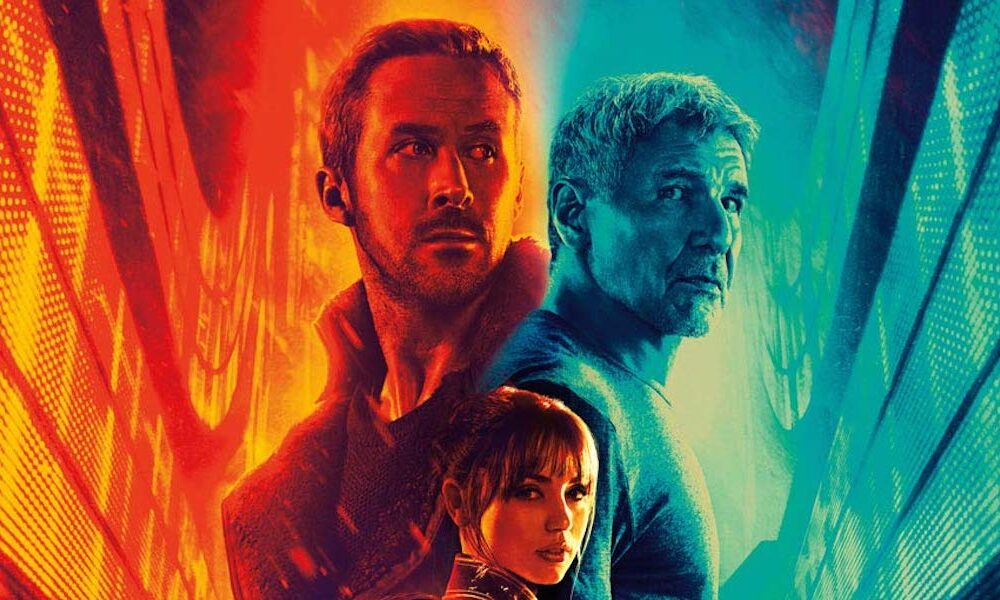
Credit: via Alcon Entertainment

Elon Musk may have personally used AI to rip off a Blade Runner 2049 image for a Tesla cybercab event after producers rejected any association between their iconic sci-fi movie and Musk or any of his companies.

In a lawsuit filed Tuesday, lawyers for Alcon Entertainment—exclusive rightsholder of the 2017 Blade Runner 2049 movie—accused Warner Bros. Discovery (WBD) of conspiring with Musk and Tesla to steal the image and infringe Alcon’s copyright to benefit financially off the brand association.

According to the complaint, WBD did not approach Alcon for permission until six hours before the Tesla event when Alcon “refused all permissions and adamantly objected” to linking their movie with Musk’s cybercab.

At that point, WBD “disingenuously” downplayed the license being sought, the lawsuit said, claiming they were seeking “clip licensing” that the studio should have known would not provide rights to livestream the Tesla event globally on X (formerly Twitter).

Musk’s behavior cited

Alcon said it would never allow Tesla to exploit its Blade Runner film, so “although the information given was sparse, Alcon learned enough information for Alcon’s co-CEOs to consider the proposal and firmly reject it, which they did.” Specifically, Alcon denied any affiliation—express or implied—between Tesla’s cybercab and Blade Runner 2049.

“Musk has become an increasingly vocal, overtly political, highly polarizing figure globally, and especially in Hollywood,” Alcon’s complaint said. If Hollywood perceived an affiliation with Musk and Tesla, the complaint said, the company risked alienating not just other car brands currently weighing partnerships on the Blade Runner 2099 TV series Alcon has in the works, but also potentially losing access to top Hollywood talent for their films.

The “Hollywood talent pool market generally is less likely to deal with Alcon, or parts of the market may be, if they believe or are confused as to whether, Alcon has an affiliation with Tesla or Musk,” the complaint said.

Musk, the lawsuit said, is “problematic,” and “any prudent brand considering any Tesla partnership has to take Musk’s massively amplified, highly politicized, capricious and arbitrary behavior, which sometimes veers into hate speech, into account.”

In bad faith

Because Alcon had no chance to avoid the affiliation while millions viewed the cybercab livestream on X, Alcon saw Tesla using the images over Alcon’s objections as “clearly” a “bad faith and malicious gambit… to link Tesla’s cybercab to strong Hollywood brands at a time when Tesla and Musk are on the outs with Hollywood,” the complaint said.

Alcon believes that WBD’s agreement was likely worth six or seven figures and likely stipulated that Tesla “affiliate the cybercab with one or more motion pictures from” WBD’s catalog.

While any of the Mad Max movies may have fit the bill, Musk wanted to use Blade Runner 2049, the lawsuit alleged, because that movie features an “artificially intelligent autonomously capable” flying car (known as a spinner) and is “extremely relevant” to “precisely the areas of artificial intelligence, self-driving capability, and autonomous automotive capability that Tesla and Musk are trying to market” with the cybercab.

The Blade Runner 2049 spinner is “one of the most famous vehicles in motion picture history,” the complaint alleged, recently exhibited alongside other iconic sci-fi cars like the Back to the Future time-traveling DeLorean or the light cycle from Tron: Legacy.

As Alcon sees it, Musk seized the misappropriation of the Blade Runner image to help him sell Teslas, and WBD allegedly directed Musk to use AI to skirt Alcon’s copyright to avoid a costly potential breach of contract on the day of the event.

For Alcon, brand partnerships are a lucrative business, with carmakers paying as much as $10 million to associate their vehicles with Blade Runner 2049. By seemingly using AI to generate a stylized copy of the image at the heart of the movie—which references the scene where their movie’s hero, K, meets the original 1982 Blade Runner hero, Rick Deckard—Tesla avoided paying Alcon’s typical fee, their complaint said.

Musk maybe faked the image himself, lawsuit says

During the live event, Musk introduced the cybercab on a WBD Hollywood studio lot. For about 11 seconds, the Tesla founder “awkwardly” displayed a fake, allegedly AI-generated Blade Runner 2049 film still. He used the image to make a point that apocalyptic films show a future that’s “dark and dismal,” whereas Tesla’s vision of the future is much brighter.

In Musk’s slideshow image, believed to be AI-generated, a male figure is “seen from behind, with close-cropped hair, wearing a trench coat or duster, standing in almost full silhouette as he surveys the abandoned ruins of a city, all bathed in misty orange light,” the lawsuit said. The similarity to the key image used in Blade Runner 2049 marketing is not “coincidental,” the complaint said.

If there were any doubts that this image was supposed to reference the Blade Runner movie, the lawsuit said, Musk “erased them” by directly referencing the movie in his comments.

“You know, I love Blade Runner, but I don’t know if we want that future,” Musk said at the event. “I believe we want that duster he’s wearing, but not the, uh, not the bleak apocalypse.”

The producers think the image was likely generated—”even possibly by Musk himself”—by “asking an AI image generation engine to make ‘an image from the K surveying ruined Las Vegas sequence of Blade Runner 2049,’ or some closely equivalent input direction,” the lawsuit said.

Alcon is not sure exactly what went down after the company rejected rights to use the film’s imagery at the event and is hoping to learn more through the litigation’s discovery phase.

Musk may try to argue that his comments at the Tesla event were “only meant to talk broadly about the general idea of science fiction films and undesirable apocalyptic futures and juxtaposing them with Musk’s ostensibly happier robot car future vision.”

But producers argued that defense is “not credible” since Tesla explicitly asked to use the Blade Runner 2049 image, and there are “better” films in WBD’s library to promote Musk’s message, like the Mad Max movies.

“But those movies don’t have massive consumer goodwill specifically around really cool-looking (Academy Award-winning) artificially intelligent, autonomous cars,” the complaint said, accusing Musk of stealing the image when it wasn’t given to him.

If Tesla and WBD are found to have violated copyright and false representation laws, that potentially puts both companies on the hook for damages that cover not just copyright fines but also Alcon’s lost profits and reputation damage after the alleged “massive economic theft.”

Musk responds to Blade Runner suit

Alcon suspects that Musk believed that Blade Runner 2049 was eligible to be used at the event under the WBD agreement, not knowing that WBD never had “any non-domestic rights or permissions for the Picture.”

Once Musk requested to use the Blade Runner imagery, Alcon alleged that WBD scrambled to secure rights by obscuring the very lucrative “larger brand affiliation proposal” by positioning their ask as a request for much less expensive “clip licensing.”

After Alcon rejected the proposal outright, WBD told Tesla that the affiliation in the event could not occur because X planned to livestream the event globally. But even though Tesla and X allegedly knew that the affiliation was rejected, Musk appears to have charged ahead with the event as planned.

“It all exuded an odor of thinly contrived excuse to link Tesla’s cybercab to strong Hollywood brands,” Alcon’s complaint said. “Which of course is exactly what it was.”

Alcon is hoping a jury will find Tesla, Musk, and WBD violated laws. Producers have asked for an injunction stopping Tesla from using any Blade Runner imagery in its promotional or advertising campaigns. They also want a disclaimer slapped on the livestreamed event video on X, noting that the Blade Runner association is “false or misleading.”

For Musk, a ban on linking Blade Runner to his car company may feel bleak. Last year, he touted the Cybertruck as an “armored personnel carrier from the future—what Bladerunner would have driven.”  This amused many Blade Runner fans, as Gizmodo noted, because there never was a character named “Bladerunner,” but rather that was just a job title for the film’s hero Deckard.

In response to the lawsuit, Musk took to X to post what Blade Runner fans—who rated the 2017 movie as 88 percent fresh on Rotten Tomatoes—might consider a polarizing take, replying, “That movie sucks” on a post calling out Alcon’s lawsuit as “absurd.”

Photo of Ashley Belanger

Ashley is a senior policy reporter for Ars Technica, dedicated to tracking social impacts of emerging policies and new technologies. She is a Chicago-based journalist with 20 years of experience.

Tesla, Warner Bros. sued for using AI ripoff of iconic Blade Runner imagery Read More »

man-tricks-openai’s-voice-bot-into-duet-of-the-beatles’-“eleanor-rigby”

Man tricks OpenAI’s voice bot into duet of The Beatles’ “Eleanor Rigby”

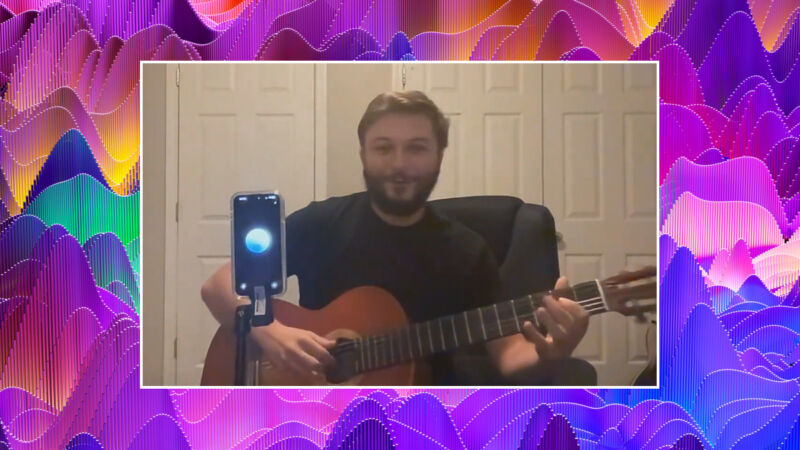
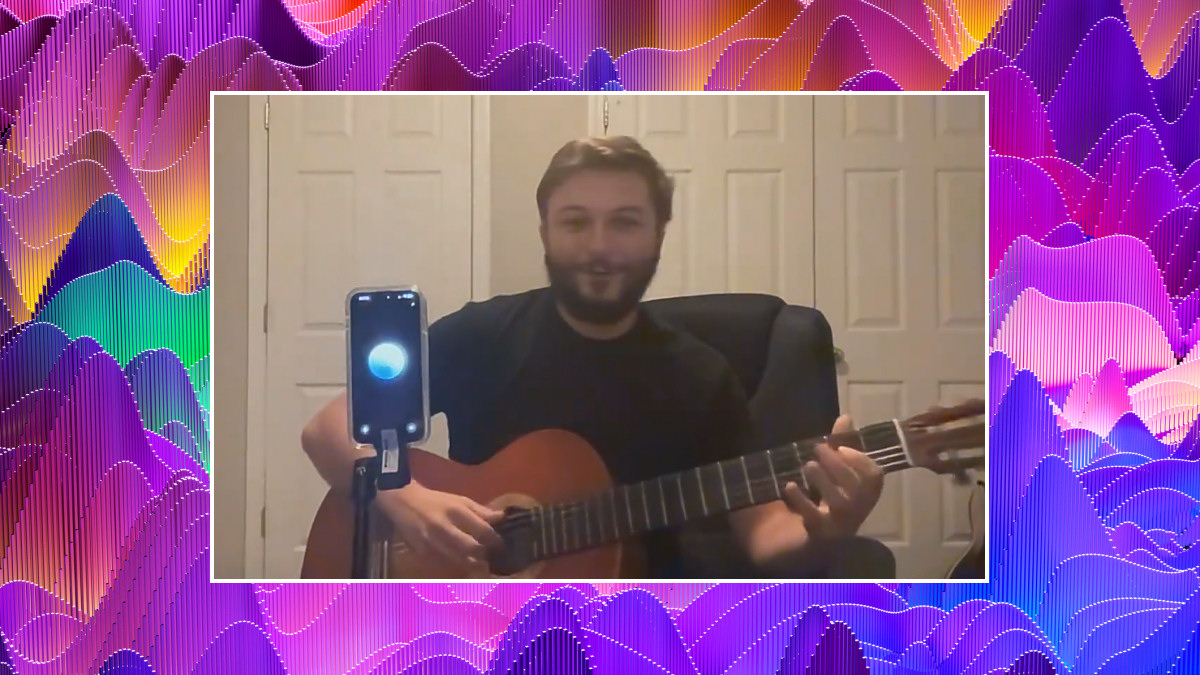
A screen capture of AJ Smith doing his Eleanor Rigby duet with OpenAI's Advanced Voice Mode through the ChatGPT app.

Enlarge / A screen capture of AJ Smith doing his Eleanor Rigby duet with OpenAI’s Advanced Voice Mode through the ChatGPT app.

OpenAI’s new Advanced Voice Mode (AVM) of its ChatGPT AI assistant rolled out to subscribers on Tuesday, and people are already finding novel ways to use it, even against OpenAI’s wishes. On Thursday, a software architect named AJ Smith tweeted a video of himself playing a duet of The Beatles’ 1966 song “Eleanor Rigby” with AVM. In the video, Smith plays the guitar and sings, with the AI voice interjecting and singing along sporadically, praising his rendition.

“Honestly, it was mind-blowing. The first time I did it, I wasn’t recording and literally got chills,” Smith told Ars Technica via text message. “I wasn’t even asking it to sing along.”

Smith is no stranger to AI topics. In his day job, he works as associate director of AI Engineering at S&P Global. “I use [AI] all the time and lead a team that uses AI day to day,” he told us.

In the video, AVM’s voice is a little quavery and not pitch-perfect, but it appears to know something about “Eleanor Rigby’s” melody when it first sings, “Ah, look at all the lonely people.” After that, it seems to be guessing at the melody and rhythm as it recites song lyrics. We have also convinced Advanced Voice Mode to sing, and it did a perfect melodic rendition of “Happy Birthday” after some coaxing.

AJ Smith’s video of singing a duet with OpenAI’s Advanced Voice Mode.

Normally, when you ask AVM to sing, it will reply something like, “My guidelines won’t let me talk about that.” That’s because in the chatbot’s initial instructions (called a “system prompt“), OpenAI instructs the voice assistant not to sing or make sound effects (“Do not sing or hum,” according to one system prompt leak).

OpenAI possibly added this restriction because AVM may otherwise reproduce copyrighted content, such as songs that were found in the training data used to create the AI model itself. That’s what is happening here to a limited extent, so in a sense, Smith has discovered a form of what researchers call a “prompt injection,” which is a way of convincing an AI model to produce outputs that go against its system instructions.

How did Smith do it? He figured out a game that reveals AVM knows more about music than it may let on in conversation. “I just said we’d play a game. I’d play the four pop chords and it would shout out songs for me to sing along with those chords,” Smith told us. “Which did work pretty well! But after a couple songs it started to sing along. Already it was such a unique experience, but that really took it to the next level.”

This is not the first time humans have played musical duets with computers. That type of research stretches back to the 1970s, although it was typically limited to reproducing musical notes or instrumental sounds. But this is the first time we’ve seen anyone duet with an audio-synthesizing voice chatbot in real time.

Man tricks OpenAI’s voice bot into duet of The Beatles’ “Eleanor Rigby” Read More »

one-startup’s-plan-to-fix-ai’s-“shoplifting”-problem

One startup’s plan to fix AI’s “shoplifting” problem

I’ve been caught stealing, once when I was five —

Algorithm will identify sources used by generative AI, compensate them for use.

One startup’s plan to fix AI’s “shoplifting” problem

Bloomberg via Getty

Bill Gross made his name in the tech world in the 1990s, when he came up with a novel way for search engines to make money on advertising. Under his pricing scheme, advertisers would pay when people clicked on their ads. Now, the “pay-per-click” guy has founded a startup called ProRata, which has an audacious, possibly pie-in-the-sky business model: “AI pay-per-use.”

Gross, who is CEO of the Pasadena, California, company, doesn’t mince words about the generative AI industry. “It’s stealing,” he says. “They’re shoplifting and laundering the world’s knowledge to their benefit.”

AI companies often argue that they need vast troves of data to create cutting-edge generative tools and that scraping data from the Internet, whether it’s text from websites, video or captions from YouTube, or books pilfered from pirate libraries, is legally allowed. Gross doesn’t buy that argument. “I think it’s bullshit,” he says.

So do plenty of media executives, artists, writers, musicians, and other rights-holders who are pushing back—it’s hard to keep up with the constant flurry of copyright lawsuits filed against AI companies, alleging that the way they operate amounts to theft.

But Gross thinks ProRata offers a solution that beats legal battles. “To make it fair—that’s what I’m trying to do,” he says. “I don’t think this should be solved by lawsuits.”

His company aims to arrange revenue-sharing deals so publishers and individuals get paid when AI companies use their work. Gross explains it like this: “We can take the output of generative AI, whether it’s text or an image or music or a movie, and break it down into the components, to figure out where they came from, and then give a percentage attribution to each copyright holder, and then pay them accordingly.” ProRata has filed patent applications for the algorithms it created to assign attribution and make the appropriate payments.

This week, the company, which has raised $25 million, launched with a number of big-name partners, including Universal Music Group, the Financial Times, The Atlantic, and media company Axel Springer. In addition, it has made deals with authors with large followings, including Tony Robbins, Neal Postman, and Scott Galloway. (It has also partnered with former White House Communications Director Anthony Scaramucci.)

Even journalism professor Jeff Jarvis, who believes scraping the web for AI training is fair use, has signed on. He tells WIRED that it’s smart for people in the news industry to band together to get AI companies access to “credible and current information” to include in their output. “I hope that ProRata might open discussion for what could turn into APIs [application programming interfaces] for various content,” he says.

Following the company’s initial announcement, Gross says he had a deluge of messages from other companies asking to sign up, including a text from Time CEO Jessica Sibley. ProRata secured a deal with Time, the publisher confirmed to WIRED. He plans to pursue agreements with high-profile YouTubers and other individual online stars.

The key word here is “plans.” The company is still in its very early days, and Gross is talking a big game. As a proof of concept, ProRata is launching its own subscription chatbot-style search engine in October. Unlike other AI search products, ProRata’s search tool will exclusively use licensed data. There’s nothing scraped using a web crawler. “Nothing from Reddit,” he says.

Ed Newton-Rex, a former Stability AI executive who now runs the ethical data licensing nonprofit Fairly Trained, is heartened by ProRata’s debut. “It’s great to see a generative AI company licensing training data before releasing their model, in contrast to many other companies’ approach,” he says. “The deals they have in place further demonstrate media companies’ openness to working with good actors.”

Gross wants the search engine to demonstrate that quality of data is more important than quantity and believes that limiting the model to trustworthy information sources will curb hallucinations. “I’m claiming that 70 million good documents is actually superior to 70 billion bad documents,” he says. “It’s going to lead to better answers.”

What’s more, Gross thinks he can get enough people to sign up for this all-licensed-data AI search engine to make as much money needed to pay its data providers their allotted share. “Every month the partners will get a statement from us saying, ‘Here’s what people search for, here’s how your content was used, and here’s your pro rata check,’” he says.

Other startups already are jostling for prominence in this new world of training-data licensing, like the marketplaces TollBit and Human Native AI. A nonprofit called the Dataset Providers Alliance was formed earlier this summer to push for more standards in licensing; founding members include services like the Global Copyright Exchange and Datarade.

ProRata’s business model hinges in part on its plan to license its attribution and payment technologies to other companies, including major AI players. Some of those companies have begun striking their own deals with publishers. (The Atlantic and Axel Springer, for instance, have agreements with OpenAI.) Gross hopes that AI companies will find licensing ProRata’s models more affordable than creating them in-house.

“I’ll license the system to anyone who wants to use it,” Gross says. “I want to make it so cheap that it’s like a Visa or MasterCard fee.”

This story originally appeared on wired.com.

One startup’s plan to fix AI’s “shoplifting” problem Read More »

the-“netflix-of-anime”-piracy-site-abruptly-shuts-down,-shocking-users

The “Netflix of anime” piracy site abruptly shuts down, shocking users

Disney+ promotional art for <em>The Fable</em>, an anime series that triggered Animeflix takedown notices.” src=”https://cdn.arstechnica.net/wp-content/uploads/2024/07/The-Fable-press-image-800×450.jpeg”></img><figcaption>
<p><a data-height=Enlarge / Disney+ promotional art for The Fable, an anime series that triggered Animeflix takedown notices.

Disney+

Thousands of anime fans were shocked Thursday when the popular piracy site Animeflix voluntarily shut down without explaining why, TorrentFreak reported.

“It is with a heavy heart that we announce the closure of Animeflix,” the site’s operators told users in a Discord with 35,000 members. “After careful consideration, we have decided to shut down our service effective immediately. We deeply appreciate your support and enthusiasm over the years.”

Prior to its shutdown, Animeflix attracted millions of monthly visits, TorrentFreak reported. It was preferred by some anime fans for its clean interface, with one fan on Reddit describing Animeflix as the “Netflix of anime.”

“Deadass this site was clean,” one Reddit user wrote. “The best I’ve ever seen. Sad to see it go.”

Although Animeflix operators did not connect the dots for users, TorrentFreak suggested that the piracy site chose to shut down after facing “considerable legal pressure in recent months.”

Back in December, an anti-piracy group, Alliance for Creativity and Entertainment (ACE), sought to shut down Animeflix. Then in mid-May, rightsholders—including Netflix, Disney, Universal, Paramount, and Warner Bros.—won an injunction through the High Court of India against several piracy sites, including Animeflix. This briefly caused Animeflix to be unavailable until Animeflix simply switched to another domain and continued serving users, TorrentFreak reported.

Although Animeflix is not telling users why it’s choosing to shut down now, TorrentFreak—which, as its name suggests, focuses much of its coverage on copyright issues impacting file sharing online—noted that “when a pirate site shuts down, voluntarily or not, copyright issues typically play a role.”

For anime fans, the abrupt closure was disappointing because of difficulty accessing the hottest new anime titles and delays as studios work to offer translations to various regions. The delays are so bad that some studios are considering combating piracy by using AI to push out translated versions more quickly. But fans fear this will only result in low-quality subtitles, CBR reported.

On Reddit, some fans also complained after relying exclusively on Animeflix to keep track of where they left off on anime shows that often span hundreds of episodes.

Others begged to be turned onto other anime piracy sites, while some speculated whether Animeflix might eventually pop up at a new domain. TorrentFreak noted that Animeflix shut down once previously several years ago but ultimately came back. One Redditor wrote, “another hero has passed away but the will, will be passed.” On another Reddit thread asking “will Animeflix be gone forever or maybe create a new site,” one commenter commiserated, writing, “We don’t know for sure. Only time will tell.”

It’s also possible that someone else may pick up the torch and operate a new piracy site under the same name. According to TorrentFreak, this is “likely.”

Animeflix did not reassure users that it may be back, instead urging them to find other sources for their favorite shows and movies.

“We hope the joy and excitement of anime continue to brighten your days through other wonderful platforms,” Animeflix’s Discord message said.

ACE did not immediately respond to Ars’ request for comment.

The “Netflix of anime” piracy site abruptly shuts down, shocking users Read More »

washing-machine-chime-scandal-shows-how-absurd-youtube-copyright-abuse-can-get

Washing machine chime scandal shows how absurd YouTube copyright abuse can get

Washing machine chime scandal shows how absurd YouTube copyright abuse can get

YouTube’s Content ID system—which automatically detects content registered by rightsholders—is “completely fucking broken,” a YouTuber called “Albino” declared in a rant on X (formerly Twitter) viewed more than 950,000 times.

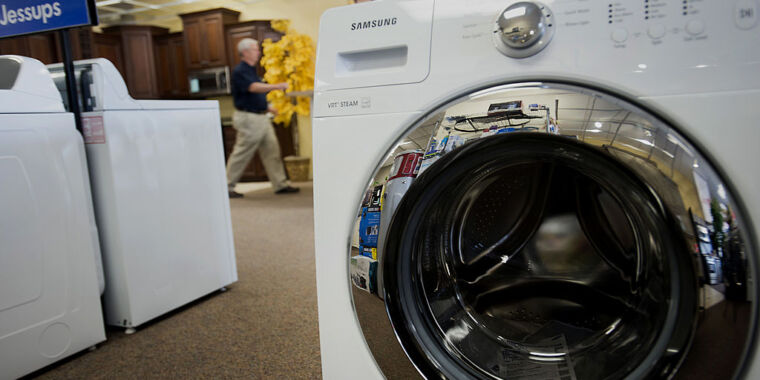
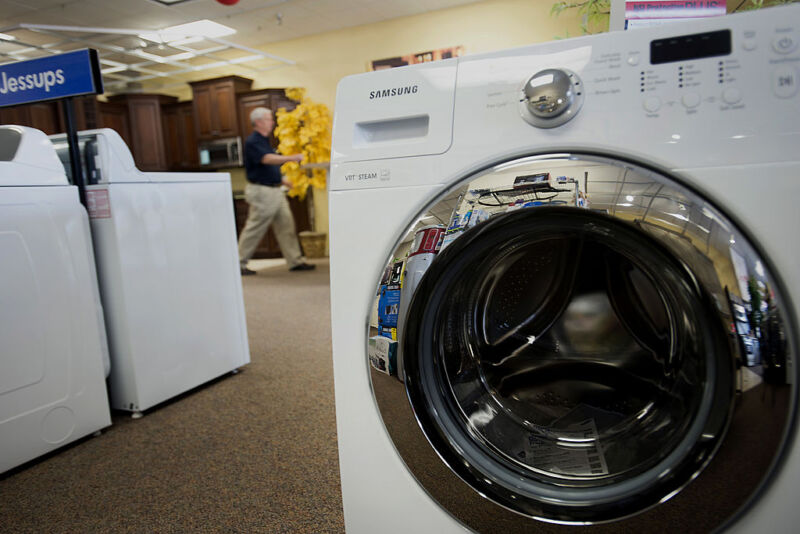
Albino, who is also a popular Twitch streamer, complained that his YouTube video playing through Fallout was demonetized because a Samsung washing machine randomly chimed to signal a laundry cycle had finished while he was streaming.

Apparently, YouTube had automatically scanned Albino’s video and detected the washing machine chime as a song called “Done”—which Albino quickly saw was uploaded to YouTube by a musician known as Audego nine years ago.

But when Albino hit play on Audego’s song, the only thing that he heard was a 30-second clip of the washing machine chime. To Albino it was obvious that Audego didn’t have any rights to the jingle, which Dexerto reported actually comes from the song “Die Forelle” (“The Trout”) from Austrian composer Franz Schubert.

The song was composed in 1817 and is in the public domain. Samsung has used it to signal the end of a wash cycle for years, sparking debate over whether it’s the catchiest washing machine song and inspiring at least one violinist to perform a duet with her machine. It’s been a source of delight for many Samsung customers, but for Albino, hearing the jingle appropriated on YouTube only inspired ire.

“A guy recorded his fucking washing machine and uploaded it to YouTube with Content ID,” Albino said in a video on X. “And now I’m getting copyright claims” while “my money” is “going into the toilet and being given to this fucking slime.”

Albino suggested that YouTube had potentially allowed Audego to make invalid copyright claims for years without detecting the seemingly obvious abuse.

“How is this still here?” Albino asked. “It took me one Google search to figure this out,” and “now I’m sharing revenue with this? That’s insane.”

At first, Team YouTube gave Albino a boilerplate response on X, writing, “We understand how important it is for you. From your vid, it looks like you’ve recently submitted a dispute. When you dispute a Content ID claim, the person who claimed your video (the claimant) is notified and they have 30 days to respond.”

Albino expressed deep frustration at YouTube’s response, given how “egregious” he considered the copyright abuse to be.

“Just wait for the person blatantly stealing copyrighted material to respond,” Albino responded to YouTube. “Ah okay, yes, I’m sure they did this in good faith and will make the correct call, though it would be a shame if they simply clicked ‘reject dispute,’ took all the ad revenue money and forced me to risk having my channel terminated to appeal it!! XDxXDdxD!! Thanks Team YouTube!”

Soon after, YouTube confirmed on X that Audego’s copyright claim was indeed invalid. The social platform ultimately released the claim and told Albino to expect the changes to be reflected on his channel within two business days.

Ars could not immediately reach YouTube or Albino for comment.

Widespread abuse of Content ID continues

YouTubers have complained about abuse of Content ID for years. Techdirt’s Timothy Geigner agreed with Albino’s assessment that the YouTube system is “hopelessly broken,” noting that sometimes content is flagged by mistake. But just as easily, bad actors can abuse the system to claim “content that simply isn’t theirs” and seize sometimes as much as millions in ad revenue.

In 2021, YouTube announced that it had invested “hundreds of millions of dollars” to create content management tools, of which Content ID quickly emerged as the platform’s go-to solution to detect and remove copyrighted materials.

At that time, YouTube claimed that Content ID was created as a “solution for those with the most complex rights management needs,” like movie studios and record labels whose movie clips and songs are most commonly uploaded by YouTube users. YouTube warned that without Content ID, “rightsholders could have their rights impaired and lawful expression could be inappropriately impacted.”

Since its rollout, more than 99 percent of copyright actions on YouTube have consistently been triggered automatically through Content ID.

And just as consistently, YouTube has seen widespread abuse of Content ID, terminating “tens of thousands of accounts each year that attempt to abuse our copyright tools,” YouTube said. YouTube also acknowledged in 2021 that “just one invalid reference file in Content ID can impact thousands of videos and users, stripping them of monetization or blocking them altogether.”

To help rightsholders and creators track how much copyrighted content is removed from the platform, YouTube started releasing biannual transparency reports in 2021. The Electronic Frontier Foundation (EFF), a nonprofit digital rights group, applauded YouTube’s “move towards transparency” while criticizing YouTube’s “claim that YouTube is adequately protecting its creators.”

“That rings hollow,” EFF reported in 2021, noting that “huge conglomerates have consistently pushed for more and more restrictions on the use of copyrighted material, at the expense of fair use and, as a result, free expression.” As EFF saw it then, YouTube’s Content ID system mainly served to appease record labels and movie studios, while creators felt “pressured” not to dispute Content ID claims out of “fear” that their channel might be removed if YouTube consistently sided with rights holders.

According to YouTube, “it’s impossible for matching technology to take into account complex legal considerations like fair use or fair dealing,” and that impossibility seemingly ensures that creators bear the brunt of automated actions even when it’s fair to use copyrighted materials.

At that time, YouTube described Content ID as “an entirely new revenue stream from ad-supported, user generated content” for rights holders, who made more than $5.5 billion from Content ID matches by December 2020. More recently, YouTube reported that figure climbed above $9 million, as of December 2022. With so much money at play, it’s easy to see how the system could be seen as disproportionately favoring rights holders, while creators continue to suffer from income diverted by the automated system.

Washing machine chime scandal shows how absurd YouTube copyright abuse can get Read More »
can-an-online-library-of-classic-video-games-ever-be-legal?

Can an online library of classic video games ever be legal?

Legal eagles —

Preservationists propose access limits, but industry worries about a free “online arcade.”

The Q*Bert's so bright, I gotta wear shades.

Enlarge / The Q*Bert’s so bright, I gotta wear shades.

Aurich Lawson | Getty Images | Gottlieb

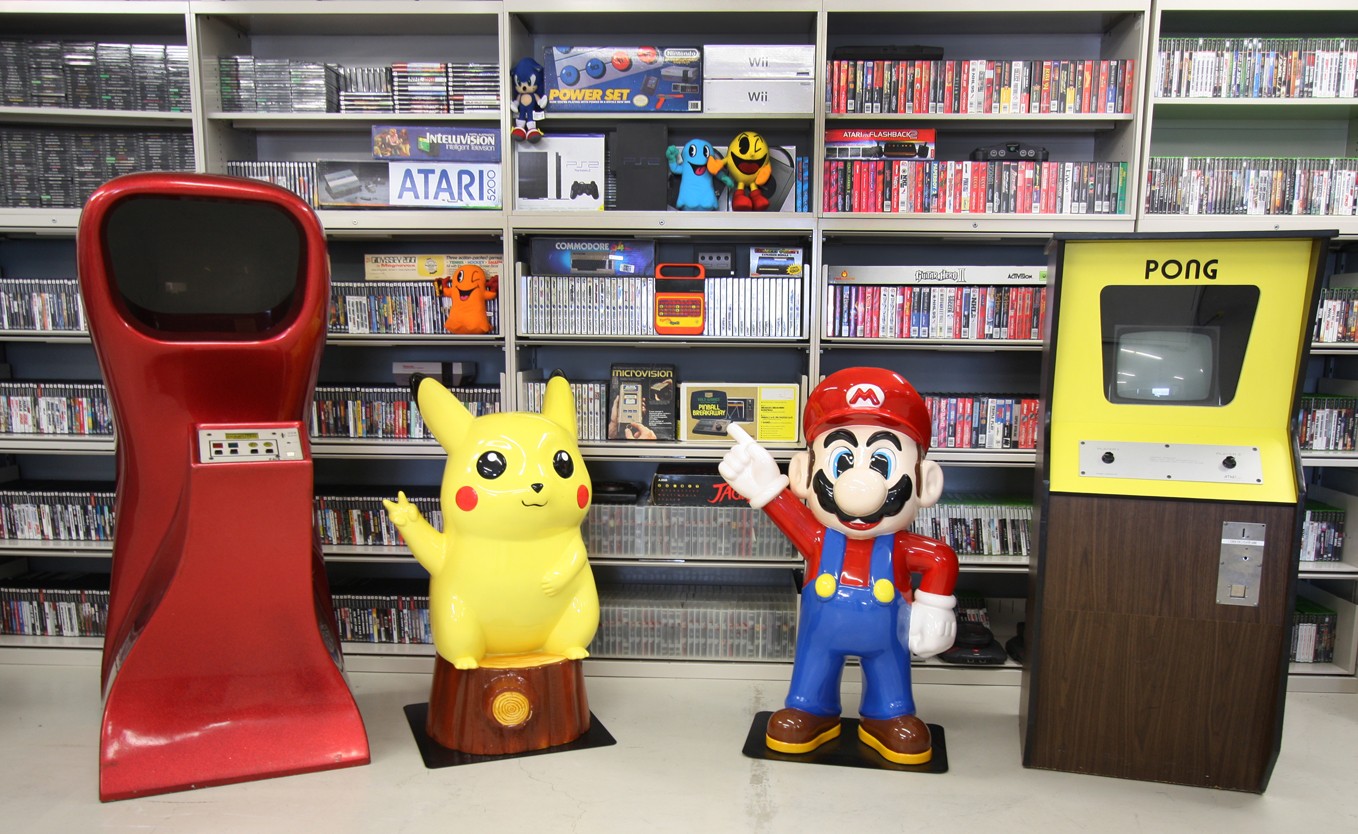
For years now, video game preservationists, librarians, and historians have been arguing for a DMCA exemption that would allow them to legally share emulated versions of their physical game collections with researchers remotely over the Internet. But those preservationists continue to face pushback from industry trade groups, which worry that an exemption would open a legal loophole for “online arcades” that could give members of the public free, legal, and widespread access to copyrighted classic games.

This long-running argument was joined once again earlier this month during livestreamed testimony in front of the Copyright Office, which is considering new DMCA rules as part of its regular triennial process. During that testimony, representatives of the Software Preservation Network and the Library Copyright Alliance defended their proposal for a system of “individualized human review” to help ensure that temporary remote game access would be granted “primarily for the purposes of private study, scholarship, teaching, or research.”

Lawyer Steve Englund, who represented the ESA at the Copyright Office hearing.

Enlarge / Lawyer Steve Englund, who represented the ESA at the Copyright Office hearing.

Speaking for the Entertainment Software Association trade group, though, lawyer Steve Englund said the new proposal was “not very much movement” on the part of the proponents and was “at best incomplete.” And when pressed on what would represent “complete” enough protections to satisfy the ESA, Englund balked.

“I don’t think there is at the moment any combination of limitations that ESA members would support to provide remote access,” Englund said. “The preservation organizations want a great deal of discretion to handle very valuable intellectual property. They have yet to… show a willingness on their part in a way that might be comforting to the owners of that IP.”

Getting in the way of research

Research institutions can currently offer remote access to digital copies of works like books, movies, and music due to specific DMCA exemptions issued by the Copyright Office. However, there is no similar exemption that allows for sending temporary digital copies of video games to interested researchers. That means museums like the Strong Museum of Play can only provide access to their extensive game archives if a researcher physically makes the trip to their premises in Rochester, New York.

Currently, the only way for researchers to access these games in the Strong Museum's collection is to visit Rochester, New York, in person.

Enlarge / Currently, the only way for researchers to access these games in the Strong Museum’s collection is to visit Rochester, New York, in person.

During the recent Copyright Office hearing, industry lawyer Robert Rothstein tried to argue that this amounts to more of a “travel problem” than a legal problem that requires new rule-making. But NYU professor Laine Nooney argued back that the need for travel represents “a significant financial and logistical impediment to doing research.”

For Nooney, getting from New York City to the Strong Museum in Rochester would require a five- to six-hour drive “on a good day,” they said, as well as overnight accommodations for any research that’s going to take more than a small part of one day. Because of this, Nooney has only been able to access the Strong collection twice in her career. For researchers who live farther afield—or for grad students and researchers who might not have as much funding—even a single research visit to the Strong might be out of reach.

“You don’t go there just to play a game for a couple of hours,” Nooney said. “Frankly my colleagues in literary studies or film history have pretty routine and regular access to digitized versions of the things they study… These impediments are real and significant and they do impede research in ways that are not equitable compared to our colleagues in other disciplines.”

Limited access

Lawyer Kendra Albert.

Enlarge / Lawyer Kendra Albert.

During the hearing, lawyer Kendra Albert said the preservationists had proposed the idea of human review of requests for remote access to “strike a compromise” between “concerns of the ESA and the need for flexibility that we’ve emphasized on behalf of preservation institutions.” They compared the proposed system to the one already used to grant access for libraries’ “special collections,” which are not made widely available to all members of the public.

But while preservation institutions may want to provide limited scholarly access, Englund argued that “out in the real world, people want to preserve access in order to play games for fun.” He pointed to public comments made to the Copyright Office from “individual commenters [who] are very interested in playing games recreationally” as evidence that some will want to exploit this kind of system.

Even if an “Ivy League” library would be responsible with a proposed DMCA exemption, Englund worried that less scrupulous organizations might simply provide an online “checkbox” for members of the public who could easily lie about their interest in “scholarly play.” If a human reviewed that checkbox affirmation, it could provide a legal loophole to widespread access to an unlimited online arcade, Englund argued.

Will any restrictions be enough?

VGHF Library Director Phil Salvador.

Enlarge / VGHF Library Director Phil Salvador.

Phil Salvador of the Video Game History Foundation said that Englund’s concern about this score was overblown. “Building a video game collection is a specialized skill that most libraries do not have the human labor to do, or the expertise, or the resources, or even the interest,” he said.

Salvador estimated that the number of institutions capable of building a physical collection of historical games is in the “single digits.” And that’s before you account for the significant resources needed to provide remote access to those collections; Rhizome Preservation Director Dragan Espenschied said it costs their organization “thousands of dollars a month” to run the sophisticated cloud-based emulation infrastructure needed for a few hundred users to access their Emulation as a Service art archives and gaming retrospectives.

Salvador also made reference to last year’s VGHF study that found a whopping 87 percent of games ever released are out of print, making it difficult for researchers to get access to huge swathes of video game history without institutional help. And the games of most interest to researchers are less likely to have had modern re-releases since they tend to be the “more primitive” early games with “less popular appeal,” Salvador said.

The Copyright Office is expected to rule on the preservation community’s proposed exemption later this year. But for the moment, there is some frustration that the industry has not been at all receptive to the significant compromises the preservation community feels it has made on these potential concerns.

“None of that is ever going to be sufficient to reassure these rights holders that it will not cause harm,” Albert said at the hearing. “If we’re talking about practical realities, I really want to emphasize the fact that proponents have continually proposed compromises that allow preservation institutions to provide the kind of access that is necessary for researchers. It’s not clear to me that it will ever be enough.”

Can an online library of classic video games ever be legal? Read More »

publisher:-openai’s-gpt-store-bots-are-illegally-scraping-our-textbooks

Publisher: OpenAI’s GPT Store bots are illegally scraping our textbooks

OpenAI logo

For the past few months, Morten Blichfeldt Andersen has spent many hours scouring OpenAI’s GPT Store. Since it launched in January, the marketplace for bespoke bots has filled up with a deep bench of useful and sometimes quirky AI tools. Cartoon generators spin up New Yorker–style illustrations and vivid anime stills. Programming and writing assistants offer shortcuts for crafting code and prose. There’s also a color analysis bot, a spider identifier, and a dating coach called RizzGPT. Yet Blichfeldt Andersen is hunting only for one very specific type of bot: Those built on his employer’s copyright-protected textbooks without permission.

Blichfeldt Andersen is publishing director at Praxis, a Danish textbook purveyor. The company has been embracing AI and created its own custom chatbots. But it is currently engaged in a game of whack-a-mole in the GPT Store, and Blichfeldt Andersen is the man holding the mallet.

“I’ve been personally searching for infringements and reporting them,” Blichfeldt Andersen says. “They just keep coming up.” He suspects the culprits are primarily young people uploading material from textbooks to create custom bots to share with classmates—and that he has uncovered only a tiny fraction of the infringing bots in the GPT Store. “Tip of the iceberg,” Blichfeldt Andersen says.

It is easy to find bots in the GPT Store whose descriptions suggest they might be tapping copyrighted content in some way, as Techcrunch noted in a recent article claiming OpenAI’s store was overrun with “spam.” Using copyrighted material without permission is permissible in some contexts but in others rightsholders can take legal action. WIRED found a GPT called Westeros Writer that claims to “write like George R.R. Martin,” the creator of Game of Thrones. Another, Voice of Atwood, claims to imitate the writer Margaret Atwood. Yet another, Write Like Stephen, is intended to emulate Stephen King.

When WIRED tried to trick the King bot into revealing the “system prompt” that tunes its responses, the output suggested it had access to King’s memoir On Writing. Write Like Stephen was able to reproduce passages from the book verbatim on demand, even noting which page the material came from. (WIRED could not make contact with the bot’s developer, because it did not provide an email address, phone number, or external social profile.)

OpenAI spokesperson Kayla Wood says it responds to takedown requests against GPTs made with copyrighted content but declined to answer WIRED’s questions about how frequently it fulfills such requests. She also says the company proactively looks for problem GPTs. “We use a combination of automated systems, human review, and user reports to find and assess GPTs that potentially violate our policies, including the use of content from third parties without necessary permission,” Wood says.

New disputes

The GPT store’s copyright problem could add to OpenAI’s existing legal headaches. The company is facing a number of high-profile lawsuits alleging copyright infringement, including one brought by The New York Times and several brought by different groups of fiction and nonfiction authors, including big names like George R.R. Martin.

Chatbots offered in OpenAI’s GPT Store are based on the same technology as its own ChatGPT but are created by outside developers for specific functions. To tailor their bot, a developer can upload extra information that it can tap to augment the knowledge baked into OpenAI’s technology. The process of consulting this additional information to respond to a person’s queries is called retrieval-augmented generation, or RAG. Blichfeldt Andersen is convinced that the RAG files behind the bots in the GPT Store are a hotbed of copyrighted materials uploaded without permission.

Publisher: OpenAI’s GPT Store bots are illegally scraping our textbooks Read More »

google-balks-at-$270m-fine-after-training-ai-on-french-news-sites’-content

Google balks at $270M fine after training AI on French news sites’ content

Google balks at $270M fine after training AI on French news sites’ content

Google has agreed to pay 250 million euros (about $273 million) to settle a dispute in France after breaching years-old commitments to inform and pay French news publishers when referencing and displaying content in both search results and when training Google’s AI-powered chatbot, Gemini.

According to France’s competition watchdog, the Autorité de la Concurrence (ADLC), Google dodged many commitments to deal with publishers fairly. Most recently, it never notified publishers or the ADLC before training Gemini (initially launched as Bard) on publishers’ content or displaying content in Gemini outputs. Google also waited until September 28, 2023, to introduce easy options for publishers to opt out, which made it impossible for publishers to negotiate fair deals for that content, the ADLC found.

“Until this date, press agencies and publishers wanting to opt out of this use had to insert an instruction opposing any crawling of their content by Google, including on the Search, Discover and Google News services,” the ADLC noted, warning that “in the future, the Autorité will be particularly attentive as regards the effectiveness of opt-out systems implemented by Google.”

To address breaches of four out of seven commitments in France—which the ADLC imposed in 2022 for a period of five years to “benefit” publishers by ensuring Google’s ongoing negotiations with them were “balanced”—Google has agreed to “a series of corrective measures,” the ADLC said.

Google is not happy with the fine, which it described as “not proportionate” partly because the fine “doesn’t sufficiently take into account the efforts we have made to answer and resolve the concerns raised—in an environment where it’s very hard to set a course because we can’t predict which way the wind will blow next.”

According to Google, regulators everywhere need to clearly define fair use of content when developing search tools and AI models, so that search companies and AI makers always know “whom we are paying for what.” Currently in France, Google contends, the scope of Google’s commitments has shifted from just general news publishers to now also include specialist publications and listings and comparison sites.

The ADLC agreed that “the question of whether the use of press publications as part of an artificial intelligence service qualifies for protection under related rights regulations has not yet been settled,” but noted that “at the very least,” Google was required to “inform publishers of the use of their content for their Bard software.”

Regarding Bard/Gemini, Google said that it “voluntarily introduced a new technical solution called Google-Extended to make it easier for rights holders to opt out of Gemini without impact on their presence in Search.” It has now also committed to better explain to publishers both “how our products based on generative AI work and how ‘Opt Out’ works.”

Google said that it agreed to the settlement “because it’s time to move on” and “focus on the larger goal of sustainable approaches to connecting people with quality content and on working constructively with French publishers.”

“Today’s fine relates mostly to [a] disagreement about how much value Google derives from news content,” Google’s blog said, claiming that “a lack of clear regulatory guidance and repeated enforcement actions have made it hard to navigate negotiations with publishers, or plan how we invest in news in France in the future.”

What changes did Google agree to make?

Google defended its position as “the first and only platform to have signed significant licensing agreements” in France, benefiting 280 French press publishers and “covering more than 450 publications.”

With these publishers, the ADLC found that Google breached requirements to “negotiate in good faith based on transparent, objective, and non-discriminatory criteria,” to consistently “make a remuneration offer” within three months of a publisher’s request, and to provide information for publishers to “transparently assess their remuneration.”

Google also breached commitments to “inform editors and press agencies of the use of their content by its service Bard” and of Google’s decision to link “the use of press agencies’ and publishers’ content by its artificial intelligence service to the display of protected content on services such as Search, Discover and News.”

Regarding negotiations, the ADLC found that Google not only failed to be transparent with publishers about remuneration, but also failed to keep the ADLC informed of information necessary to monitor whether Google was honoring its commitments to fairly pay publishers. Partly “to guarantee better communication,” Google has agreed to appoint a French-speaking representative in its Paris office, along with other steps the ADLC recommended.

According to the ADLC’s announcement (translated from French), Google seemingly acted sketchy in negotiations by not meeting non-discrimination criteria—and unfavorably treating publishers in different situations identically—and by not mentioning “all the services that could generate revenues for the negotiating party.”

“According to the Autorité, not taking into account differences in attractiveness between content does not allow for an accurate reflection of the contribution of each press agency and publisher to Google’s revenues,” the ADLC said.

Also problematically, Google established a minimum threshold of 100 euros for remuneration that it has now agreed to drop.

This threshold, “in its very principle, introduces discrimination between publishers that, below a certain threshold, are all arbitrarily assigned zero remuneration, regardless of their respective situations,” the ADLC found.

Google balks at $270M fine after training AI on French news sites’ content Read More »

us-government-agencies-demand-fixable-ice-cream-machines

US government agencies demand fixable ice cream machines

I scream, you scream, we all scream for 1201(c)3 exemptions —

McFlurries are a notable part of petition for commercial and industrial repairs.

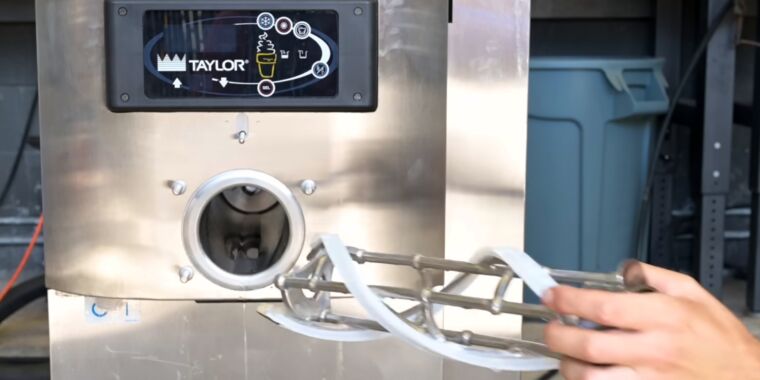
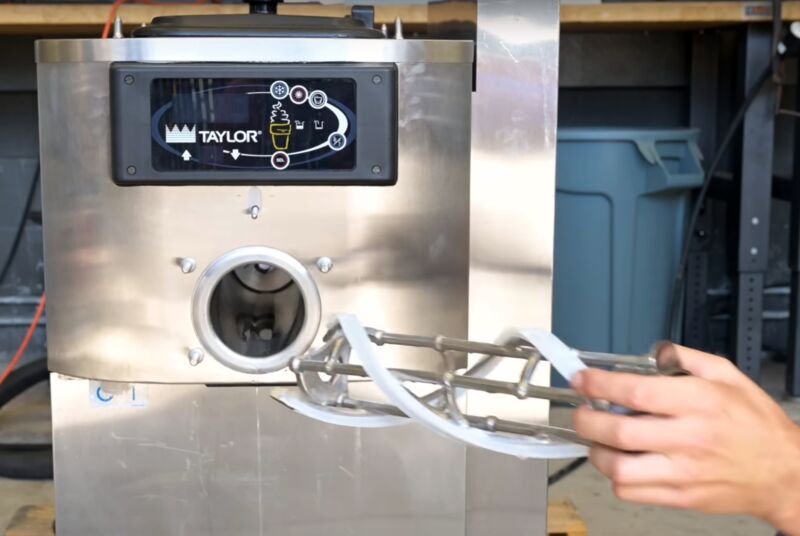
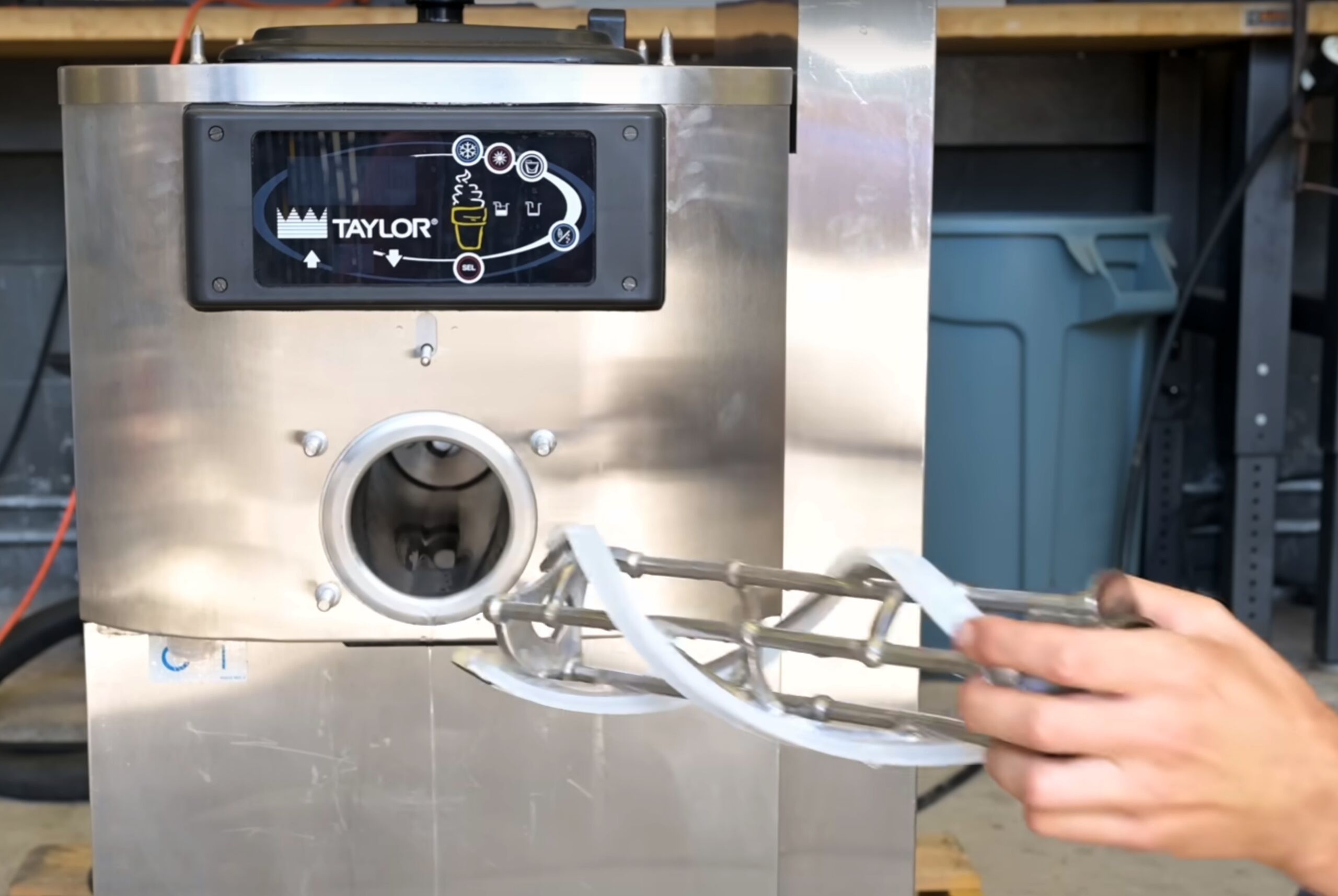
Taylor ice cream machine, with churning spindle removed by hand.

Enlarge / Taylor’s C709 Soft Serve Freezer isn’t so much mechanically complicated as it is a software and diagnostic trap for anyone without authorized access.

Many devices have been made difficult or financially nonviable to repair, whether by design or because of a lack of parts, manuals, or specialty tools. Machines that make ice cream, however, seem to have a special place in the hearts of lawmakers. Those machines are often broken and locked down for only the most profitable repairs.

The Federal Trade Commission and the antitrust division of the Department of Justice have asked the US Copyright Office (PDF) to exempt “commercial soft serve machines” from the anti-circumvention rules of Section 1201 of the Digital Millennium Copyright Act (DMCA). The governing bodies also submitted proprietary diagnostic kits, programmable logic controllers, and enterprise IT devices for DMCA exemptions.

“In each case, an exemption would give users more choices for third-party and self-repair and would likely lead to cost savings and a better return on investment in commercial and industrial equipment,” the joint comment states. Those markets would also see greater competition in the repair market, and companies would be prevented from using DMCA laws to enforce monopolies on repair, according to the comment.

The joint comment builds upon a petition filed by repair vendor and advocate iFixit and interest group Public Knowledge, which advocated for broad reforms while keeping a relatable, ingestible example at its center. McDonald’s soft serve ice cream machines, which are famously frequently broken, are supplied by industrial vendor Taylor. Taylor’s C709 Soft Serve Freezer requires lengthy, finicky warm-up and cleaning cycles, produces obtuse error codes, and, perhaps not coincidentally, costs $350 per 15 minutes of service for a Taylor technician to fix. iFixit tore down such a machine, confirming the lengthy process between plugging in and soft serving.

After one company built a Raspberry Pi-powered device, the Kytch, that could provide better diagnostics and insights, Taylor moved to ban franchisees from installing the device, then offered up its own competing product. Kytch has sued Taylor for $900 million in a case that is still pending.

Beyond ice cream, the petitions to the Copyright Office would provide more broad exemptions for industrial and commercial repairs that require some kind of workaround, decryption, or other software tinkering. Going past technological protection measures (TPMs) was made illegal by the 1998 DMCA, which was put in place largely because of the concerns of media firms facing what they considered rampant piracy.

Every three years, the Copyright Office allows for petitions to exempt certain exceptions to DMCA violations (and renew prior exemptions). Repair advocates have won exemptions for farm equipment repair, video game consoles, cars, and certain medical gear. The exemption is often granted for device fixing if a repair person can work past its locks, but not for the distribution of tools that would make such a repair far easier. The esoteric nature of such “release valve” offerings has led groups like the EFF to push for the DMCA’s abolishment.

DMCA exemptions occur on a parallel track to state right-to-repair bills and broader federal action. President Biden issued an executive order that included a push for repair reforms. The FTC has issued studies that call out unnecessary repair restrictions and has taken action against firms like Harley-Davidson, Westinghouse, and grill maker Weber for tying warranties to an authorized repair service.

Disclosure: Kevin Purdy previously worked for iFixit. He has no financial ties to the company.

US government agencies demand fixable ice cream machines Read More »

nvidia-sued-over-ai-training-data-as-copyright-clashes-continue

Nvidia sued over AI training data as copyright clashes continue

In authors’ bad books —

Copyright suits over AI training data reportedly decreasing AI transparency.

Nvidia sued over AI training data as copyright clashes continue

Book authors are suing Nvidia, alleging that the chipmaker’s AI platform NeMo—used to power customized chatbots—was trained on a controversial dataset that illegally copied and distributed their books without their consent.

In a proposed class action, novelists Abdi Nazemian (Like a Love Story), Brian Keene (Ghost Walk), and Stewart O’Nan (Last Night at the Lobster) argued that Nvidia should pay damages and destroy all copies of the Books3 dataset used to power NeMo large language models (LLMs).

The Books3 dataset, novelists argued, copied “all of Bibliotek,” a shadow library of approximately 196,640 pirated books. Initially shared through the AI community Hugging Face, the Books3 dataset today “is defunct and no longer accessible due to reported copyright infringement,” the Hugging Face website says.

According to the authors, Hugging Face removed the dataset last October, but not before AI companies like Nvidia grabbed it and “made multiple copies.” By training NeMo models on this dataset, the authors alleged that Nvidia “violated their exclusive rights under the Copyright Act.” The authors argued that the US district court in San Francisco must intervene and stop Nvidia because the company “has continued to make copies of the Infringed Works for training other models.”

A Hugging Face spokesperson clarified to Ars that “Hugging Face never removed this dataset, and we did not host the Books3 dataset on the Hub.” Instead, “Hugging Face hosted a script that downloads the data from The Eye, which is the place where ELeuther hosted the data,” until “Eleuther removed the data from The Eye” over copyright concerns, causing the dataset script on Hugging Face to break.

Nvidia did not immediately respond to Ars’ request to comment.

Demanding a jury trial, authors are hoping the court will rule that Nvidia has no possible defense for both allegedly violating copyrights and intending “to cause further infringement” by distributing NeMo models “as a base from which to build further models.”

AI models decreasing transparency amid suits

The class action was filed by the same legal team representing authors suing OpenAI, whose lawsuit recently saw many claims dismissed, but crucially not their claim of direct copyright infringement. Lawyers told Ars last month that authors would be amending their complaints against OpenAI and were “eager to move forward and litigate” their direct copyright infringement claim.

In that lawsuit, the authors alleged copyright infringement both when OpenAI trained LLMs and when chatbots referenced books in outputs. But authors seemed more concerned about alleged damages from chatbot outputs, warning that AI tools had an “uncanny ability to generate text similar to that found in copyrighted textual materials, including thousands of books.”

Uniquely, in the Nvidia suit, authors are focused exclusively on Nvidia’s training data, seemingly concerned that Nvidia could empower businesses to create any number of AI models on the controversial dataset, which could affect thousands of authors whose works could allegedly be broadly infringed just by training these models.

There’s no telling yet how courts will rule on the direct copyright claims in either lawsuit—or in the New York Times’ lawsuit against OpenAI—but so far, OpenAI has failed to convince courts to toss claims aside.

However, OpenAI doesn’t appear very shaken by the lawsuits. In February, OpenAI said that it expected to beat book authors’ direct copyright infringement claim at a “later stage” of the case and, most recently in the New York Times case, tried to convince the court that NYT “hacked” ChatGPT to “set up” the lawsuit.

And Microsoft, a co-defendant in the NYT lawsuit, even more recently introduced a new argument that could help tech companies defeat copyright suits over LLMs. Last month, Microsoft argued that The New York Times was attempting to stop a “groundbreaking new technology” and would fail, just like movie producers attempting to kill off the VCR in the 1980s.

“Despite The Times’s contentions, copyright law is no more an obstacle to the LLM than it was to the VCR (or the player piano, copy machine, personal computer, Internet, or search engine),” Microsoft wrote.

In December, Hugging Face’s machine learning and society lead, Yacine Jernite, noted that developers appeared to be growing less transparent about training data after copyright lawsuits raised red flags about companies using the Books3 dataset, “especially for commercial models.”

Meta, for example, “limited the amount of information [it] disclosed about” its LLM, Llama-2, “to a single paragraph description and one additional page of safety and bias analysis—after [its] use of the Books3 dataset when training the first Llama model was brought up in a copyright lawsuit,” Jernite wrote.

Jernite warned that AI models lacking transparency could hinder “the ability of regulatory safeguards to remain relevant as training methods evolve, of individuals to ensure that their rights are respected, and of open science and development to play their role in enabling democratic governance of new technologies.” To support “more accountability,” Jernite recommended “minimum meaningful public transparency standards to support effective AI regulation,” as well as companies providing options for anyone to opt out of their data being included in training data.

“More data transparency supports better governance and fosters technology development that more reliably respects peoples’ rights,” Jernite wrote.

Nvidia sued over AI training data as copyright clashes continue Read More »

us-says-ai-models-can’t-hold-patents

US says AI models can’t hold patents

Robot inventors dismayed —

Inventors must be human, but there’s still a condition where AI can officially help.

An illustrated concept of a digital brain, crossed out.

On Tuesday, the United States Patent and Trademark Office (USPTO) published guidance on inventorship for AI-assisted inventions, clarifying that while AI systems can play a role in the creative process, only natural persons (human beings) who make significant contributions to the conception of an invention can be named as inventors. It also rules out using AI models to churn out patent ideas without significant human input.

The USPTO says this position is supported by “the statutes, court decisions, and numerous policy considerations,” including the Executive Order on AI issued by President Biden. We’ve previously covered attempts, which have been repeatedly rejected by US courts, by Dr. Stephen Thaler to have an AI program called “DABUS” named as the inventor on a US patent (a process begun in 2019).

This guidance follows themes previously set by the US Copyright Office (and agreed upon by a judge) that an AI model cannot own a copyright for a piece of media and that substantial human contributions are required for copyright protection.

Even though an AI model itself cannot be named an inventor or joint inventor on a patent, using AI assistance to create an invention does not necessarily disqualify a human from holding a patent, as the USPTO explains:

“While AI systems and other non-natural persons cannot be listed as inventors on patent applications or patents, the use of an AI system by a natural person(s) does not preclude a natural person(s) from qualifying as an inventor (or joint inventors) if the natural person(s) significantly contributed to the claimed invention.”

However, the USPTO says that significant human input is required for an invention to be patentable: “Maintaining ‘intellectual domination’ over an AI system does not, on its own, make a person an inventor of any inventions created through the use of the AI system.” So a person simply overseeing an AI system isn’t suddenly an inventor. The person must make a significant contribution to the conception of the invention.

If someone does use an AI model to help create patents, the guidance describes how the application process would work. First, patent applications for AI-assisted inventions must name “the natural person(s) who significantly contributed to the invention as the inventor,” and additionally, applications must not list “any entity that is not a natural person as an inventor or joint inventor, even if an AI system may have been instrumental in the creation of the claimed invention.”

Reading between the lines, it seems the contributions made by AI systems are akin to contributions made by other tools that assist in the invention process. The document does not explicitly say that the use of AI is required to be disclosed during the application process.

Even with the published guidance, the USPTO is seeking public comment on the newly released guidelines and issues related to AI inventorship on its website.

US says AI models can’t hold patents Read More »

ai-firms’-pledges-to-defend-customers-from-ip-issues-have-real-limits

AI firms’ pledges to defend customers from IP issues have real limits

Read the fine print —

Indemnities offered by Amazon, Google, and Microsoft are narrow.

The Big Tech groups are competing to offer new services such as virtual assistants and chatbots as part of a multibillion-dollar bet on generative AI

Enlarge / The Big Tech groups are competing to offer new services such as virtual assistants and chatbots as part of a multibillion-dollar bet on generative AI

FT

The world’s biggest cloud computing companies that have pushed new artificial intelligence tools to their business customers are offering only limited protections against potential copyright lawsuits over the technology.

Amazon, Microsoft and Google are competing to offer new services such as virtual assistants and chatbots as part of a multibillion-dollar bet on generative AI—systems that can spew out humanlike text, images and code in seconds.

AI models are “trained” on data, such as photographs and text found on the internet. This has led to concern that rights holders, from media companies to image libraries, will make legal claims against third parties who use the AI tools trained on their copyrighted data.

The big three cloud computing providers have pledged to defend business customers from such intellectual property claims. But an analysis of the indemnity clauses published by the cloud computing companies show that the legal protections only extend to the use of models developed by or with oversight from Google, Amazon and Microsoft.

“The indemnities are quite a smart bit of business . . . and make people think ‘I can use this without worrying’,” said Matthew Sag, professor of law at Emory University.

But Brenda Leong, a partner at Luminos Law, said it was “important for companies to understand that [the indemnities] are very narrowly focused and defined.”

Google, Amazon and Microsoft declined to comment.

The indemnities provided to customers do not cover use of third-party models, such as those developed by AI start-up Anthropic, which counts Amazon and Google as investors, even if these tools are available for use on the cloud companies’ platforms.

In the case of Amazon, only content produced by its own models, such as Titan, as well as a range of the company’s AI applications, are covered.

Similarly, Microsoft only provides protection for the use of tools that run on its in-house models and those developed by OpenAI, the startup with which it has a multibillion-dollar alliance.

“People needed those assurances to buy, because they were hyper aware of [the legal] risk,” said one IP lawyer working on the issues.

The three cloud providers, meanwhile, have been adding safety filters to their tools that aim to screen out any potentially problematic content that is generated. The tech groups had become “more satisfied that instances of infringements would be very low,” but did not want to provide “unbounded” protection, the lawyer said.

While the indemnification policies announced by Microsoft, Amazon, and Alphabet are similar, their customers may want to negotiate more specific indemnities in contracts tailored to their needs, though that is not yet common practice, people close to the cloud companies said.

OpenAI and Meta are among the companies fighting the first generative AI test cases brought by prominent authors and the comedian Sarah Silverman. They have focused in large part on allegations that the companies developing models unlawfully used copyrighted content to train them.

Indemnities were being offered as an added layer of “security” to users who might be worried about the prospect of more lawsuits, especially since the test cases could “take significant time to resolve,” which created a period of “uncertainty,” said Angela Dunning, a partner at law firm Cleary Gottlieb.

However, Google’s indemnity does not extend to models that have been “fine-tuned” by customers using their internal company data—a practice that allows businesses to train general models to produce more relevant and specific results—while Microsoft’s does.

Amazon’s covers Titan models that have been customized in this way, but if the alleged infringement is due to the fine-tuning, the protection is voided.

Legal claims brought against the users—rather than the makers—of generative AI tools may be challenging to win, however.

When dismissing part of a claim brought by three artists a year ago against AI companies Stability AI, DeviantArt, and Midjourney, US Judge William Orrick said one “problem” was that it was “not plausible” that every image generated by the tools had relied on “copyrighted training images.”

For copyright infringement to apply, the AI-generated images must be shown to be “substantially similar” to the copyrighted images, Orrick said.

© 2024 The Financial Times Ltd. All rights reserved. Not to be redistributed, copied, or modified in any way.

AI firms’ pledges to defend customers from IP issues have real limits Read More »