Codex

how-ai-coding-agents-work—and-what-to-remember-if-you-use-them

How AI coding agents work—and what to remember if you use them


Agents of uncertain change

From compression tricks to multi-agent teamwork, here’s what makes them tick.

AI coding agents from OpenAI, Anthropic, and Google can now work on software projects for hours at a time, writing complete apps, running tests, and fixing bugs with human supervision. But these tools are not magic and can complicate rather than simplify a software project. Understanding how they work under the hood can help developers know when (and if) to use them, while avoiding common pitfalls.

We’ll start with the basics: At the core of every AI coding agent is a technology called a large language model (LLM), which is a type of neural network trained on vast amounts of text data, including lots of programming code. It’s a pattern-matching machine that uses a prompt to “extract” compressed statistical representations of data it saw during training and provide a plausible continuation of that pattern as an output. In this extraction, an LLM can interpolate across domains and concepts, resulting in some useful logical inferences when done well and confabulation errors when done poorly.

These base models are then further refined through techniques like fine-tuning on curated examples and reinforcement learning from human feedback (RLHF), which shape the model to follow instructions, use tools, and produce more useful outputs.

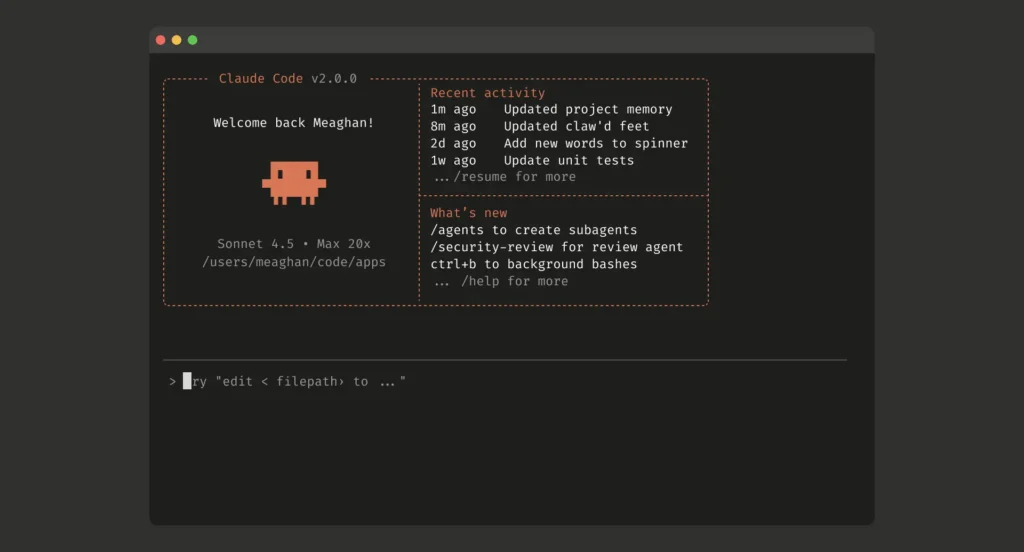
A screenshot of the Claude Code command-line interface.

A screenshot of the Claude Code command-line interface. Credit: Anthropic

Over the past few years, AI researchers have been probing LLMs’ deficiencies and finding ways to work around them. One recent innovation was the simulated reasoning model, which generates context (extending the prompt) in the form of reasoning-style text that can help an LLM home in on a more accurate output. Another innovation was an application called an “agent” that links several LLMs together to perform tasks simultaneously and evaluate outputs.

How coding agents are structured

In that sense, each AI coding agent is a program wrapper that works with multiple LLMs. There is typically a “supervising” LLM that interprets tasks (prompts) from the human user and then assigns those tasks to parallel LLMs that can use software tools to execute the instructions. The supervising agent can interrupt tasks below it and evaluate the subtask results to see how a project is going. Anthropic’s engineering documentation describes this pattern as “gather context, take action, verify work, repeat.”

If run locally through a command-line interface (CLI), users give the agents conditional permission to write files on the local machine (code or whatever is needed), run exploratory commands (say, “ls” to list files in a directory), fetch websites (usually using “curl”), download software, or upload files to remote servers. There are lots of possibilities (and potential dangers) with this approach, so it needs to be used carefully.

In contrast, when a user starts a task in the web-based agent like the web versions of Codex and Claude Code, the system provisions a sandboxed cloud container preloaded with the user’s code repository, where Codex can read and edit files, run commands (including test harnesses and linters), and execute code in isolation. Anthropic’s Claude Code uses operating system-level features to create filesystem and network boundaries within which the agent can work more freely.

The context problem

Every LLM has a short-term memory, so to speak, that limits the amount of data it can process before it “forgets” what it’s doing. This is called “context.” Every time you submit a response to the supervising agent, you are amending one gigantic prompt that includes the entire history of the conversation so far (and all the code generated, plus the simulated reasoning tokens the model uses to “think” more about a problem). The AI model then evaluates this prompt and produces an output. It’s a very computationally expensive process that increases quadratically with prompt size because LLMs process every token (chunk of data) against every other token in the prompt.

Anthropic’s engineering team describes context as a finite resource with diminishing returns. Studies have revealed what researchers call “context rot”: As the number of tokens in the context window increases, the model’s ability to accurately recall information decreases. Every new token depletes what the documentation calls an “attention budget.”

This context limit naturally limits the size of a codebase a LLM can process at one time, and if you feed the AI model lots of huge code files (which have to be re-evaluated by the LLM every time you send another response), it can burn up token or usage limits pretty quickly.

Tricks of the trade

To get around these limits, the creators of coding agents use several tricks. For example, AI models are fine-tuned to write code to outsource activities to other software tools. For example, they might write Python scripts to extract data from images or files rather than feeding the whole file through an LLM, which saves tokens and avoids inaccurate results.

Anthropic’s documentation notes that Claude Code also uses this approach to perform complex data analysis over large databases, writing targeted queries and using Bash commands like “head” and “tail” to analyze large volumes of data without ever loading the full data objects into context.

(In a way, these AI agents are guided but semi-autonomous tool-using programs that are a major extension of a concept we first saw in early 2023.)

Another major breakthrough in agents came from dynamic context management. Agents can do this in a few ways that are not fully disclosed in proprietary coding models, but we do know the most important technique they use: context compression.

The command line version of OpenAI codex running in a macOS terminal window.

The command-line version of OpenAI Codex running in a macOS terminal window. Credit: Benj Edwards

When a coding LLM nears its context limit, this technique compresses the context history by summarizing it, losing details in the process but shortening the history to key details. Anthropic’s documentation describes this “compaction” as distilling context contents in a high-fidelity manner, preserving key details like architectural decisions and unresolved bugs while discarding redundant tool outputs.

This means the AI coding agents periodically “forget” a large portion of what they are doing every time this compression happens, but unlike older LLM-based systems, they aren’t completely clueless about what has transpired and can rapidly re-orient themselves by reading existing code, written notes left in files, change logs, and so on.

Anthropic’s documentation recommends using CLAUDE.md files to document common bash commands, core files, utility functions, code style guidelines, and testing instructions. AGENTS.md, now a multi-company standard, is another useful way of guiding agent actions in between context refreshes. These files act as external notes that let agents track progress across complex tasks while maintaining critical context that would otherwise be lost.

For tasks requiring extended work, both companies employ multi-agent architectures. According to Anthropic’s research documentation, its system uses an “orchestrator-worker pattern” in which a lead agent coordinates the process while delegating to specialized subagents that operate in parallel. When a user submits a query, the lead agent analyzes it, develops a strategy, and spawns subagents to explore different aspects simultaneously. The subagents act as intelligent filters, returning only relevant information rather than their full context to the lead agent.

The multi-agent approach burns through tokens rapidly. Anthropic’s documentation notes that agents typically use about four times more tokens than chatbot interactions, and multi-agent systems use about 15 times more tokens than chats. For economic viability, these systems require tasks where the value is high enough to justify the increased cost.

Best practices for humans

While using these agents is contentious in some programming circles, if you use one to code a project, knowing good software development practices helps to head off future problems. For example, it’s good to know about version control, making incremental backups, implementing one feature at a time, and testing it before moving on.

What people call “vibe coding”—creating AI-generated code without understanding what it’s doing—is clearly dangerous for production work. Shipping code you didn’t write yourself in a production environment is risky because it could introduce security issues or other bugs or begin gathering technical debt that could snowball over time.

Independent AI researcher Simon Willison recently argued that developers using coding agents still bear responsibility for proving their code works. “Almost anyone can prompt an LLM to generate a thousand-line patch and submit it for code review,” Willison wrote. “That’s no longer valuable. What’s valuable is contributing code that is proven to work.”

In fact, human planning is key. Claude Code’s best practices documentation recommends a specific workflow for complex problems: First, ask the agent to read relevant files and explicitly tell it not to write any code yet, then ask it to make a plan. Without these research and planning steps, the documentation warns, Claude’s outputs tend to jump straight to coding a solution.

Without planning, LLMs sometimes reach for quick solutions to satisfy a momentary objective that might break later if a project were expanded. So having some idea of what makes a good architecture for a modular program that can be expanded over time can help you guide the LLM to craft something more durable.

As mentioned above, these agents aren’t perfect, and some people prefer not to use them at all. A randomized controlled trial published by the nonprofit research organization METR in July 2025 found that experienced open-source developers actually took 19 percent longer to complete tasks when using AI tools, despite believing they were working faster. The study’s authors note several caveats: The developers were highly experienced with their codebases (averaging five years and 1,500 commits), the repositories were large and mature, and the models used (primarily Claude 3.5 and 3.7 Sonnet via Cursor) have since been superseded by more capable versions.

Whether newer models would produce different results remains an open question, but the study suggests that AI coding tools may not always provide universal speed-ups, particularly for developers who already know their codebases well.

Given these potential hazards, coding proof-of-concept demos and internal tools is probably the ideal use of coding agents right now. Since AI models have no actual agency (despite being called agents) and are not people who can be held accountable for mistakes, human oversight is key.

Photo of Benj Edwards

Benj Edwards is Ars Technica’s Senior AI Reporter and founder of the site’s dedicated AI beat in 2022. He’s also a tech historian with almost two decades of experience. In his free time, he writes and records music, collects vintage computers, and enjoys nature. He lives in Raleigh, NC.

How AI coding agents work—and what to remember if you use them Read More »

openai-built-an-ai-coding-agent-and-uses-it-to-improve-the-agent-itself

OpenAI built an AI coding agent and uses it to improve the agent itself


“The vast majority of Codex is built by Codex,” OpenAI told us about its new AI coding agent.

With the popularity of AI coding tools rising among software developers, their adoption has begun to touch every aspect of the process, including the improvement of AI coding tools themselves.

In interviews with Ars Technica this week, OpenAI employees revealed the extent to which the company now relies on its own AI coding agent, Codex, to build and improve the development tool. “I think the vast majority of Codex is built by Codex, so it’s almost entirely just being used to improve itself,” said Alexander Embiricos, product lead for Codex at OpenAI, in a conversation on Tuesday.

Codex, which OpenAI launched in its modern incarnation as a research preview in May 2025, operates as a cloud-based software engineering agent that can handle tasks like writing features, fixing bugs, and proposing pull requests. The tool runs in sandboxed environments linked to a user’s code repository and can execute multiple tasks in parallel. OpenAI offers Codex through ChatGPT’s web interface, a command-line interface (CLI), and IDE extensions for VS Code, Cursor, and Windsurf.

The “Codex” name itself dates back to a 2021 OpenAI model based on GPT-3 that powered GitHub Copilot’s tab completion feature. Embiricos said the name is rumored among staff to be short for “code execution.” OpenAI wanted to connect the new agent to that earlier moment, which was crafted in part by some who have left the company.

“For many people, that model powering GitHub Copilot was the first ‘wow’ moment for AI,” Embiricos said. “It showed people the potential of what it can mean when AI is able to understand your context and what you’re trying to do and accelerate you in doing that.”

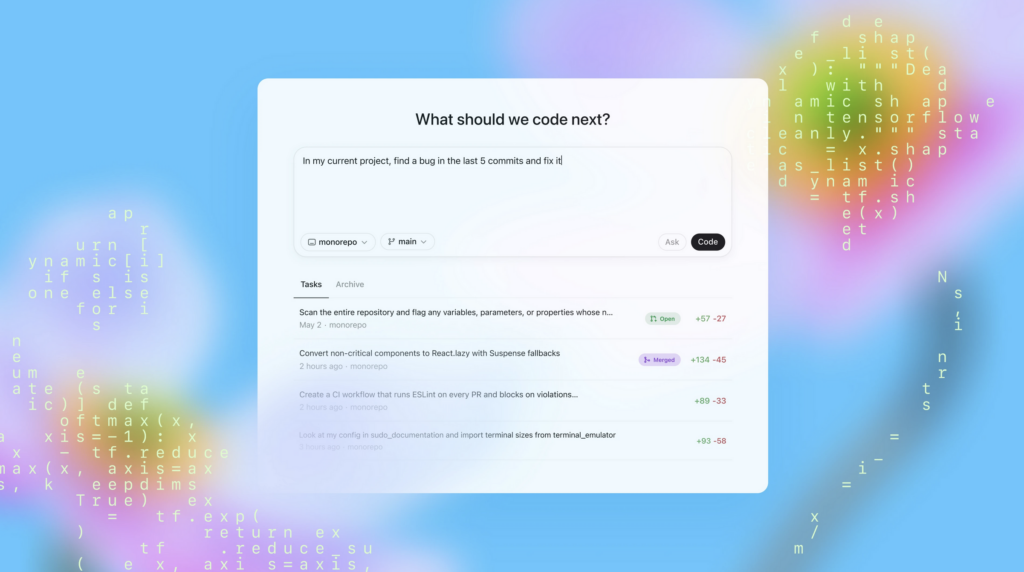
A place to enter a prompt, set parameters, and click

The interface for OpenAI’s Codex in ChatGPT. Credit: OpenAI

It’s no secret that the current command-line version of Codex bears some resemblance to Claude Code, Anthropic’s agentic coding tool that launched in February 2025. When asked whether Claude Code influenced Codex’s design, Embiricos parried the question but acknowledged the competitive dynamic. “It’s a fun market to work in because there’s lots of great ideas being thrown around,” he said. He noted that OpenAI had been building web-based Codex features internally before shipping the CLI version, which arrived after Anthropic’s tool.

OpenAI’s customers apparently love the command line version, though. Embiricos said Codex usage among external developers jumped 20 times after OpenAI shipped the interactive CLI extension alongside GPT-5 in August 2025. On September 15, OpenAI released GPT-5 Codex, a specialized version of GPT-5 optimized for agentic coding, which further accelerated adoption.

It hasn’t just been the outside world that has embraced the tool. Embiricos said the vast majority of OpenAI’s engineers now use Codex regularly. The company uses the same open-source version of the CLI that external developers can freely download, suggest additions to, and modify themselves. “I really love this about our team,” Embiricos said. “The version of Codex that we use is literally the open source repo. We don’t have a different repo that features go in.”

The recursive nature of Codex development extends beyond simple code generation. Embiricos described scenarios where Codex monitors its own training runs and processes user feedback to “decide” what to build next. “We have places where we’ll ask Codex to look at the feedback and then decide what to do,” he said. “Codex is writing a lot of the research harness for its own training runs, and we’re experimenting with having Codex monitoring its own training runs.” OpenAI employees can also submit a ticket to Codex through project management tools like Linear, assigning it tasks the same way they would assign work to a human colleague.

This kind of recursive loop, of using tools to build better tools, has deep roots in computing history. Engineers designed the first integrated circuits by hand on vellum and paper in the 1960s, then fabricated physical chips from those drawings. Those chips powered the computers that ran the first electronic design automation (EDA) software, which in turn enabled engineers to design circuits far too complex for any human to draft manually. Modern processors contain billions of transistors arranged in patterns that exist only because software made them possible. OpenAI’s use of Codex to build Codex seems to follow the same pattern: each generation of the tool creates capabilities that feed into the next.

But describing what Codex actually does presents something of a linguistic challenge. At Ars Technica, we try to reduce anthropomorphism when discussing AI models as much as possible while also describing what these systems do using analogies that make sense to general readers. People can talk to Codex like a human, so it feels natural to use human terms to describe interacting with it, even though it is not a person and simulates human personality through statistical modeling.

The system runs many processes autonomously, addresses feedback, spins off and manages child processes, and produces code that ships in real products. OpenAI employees call it a “teammate” and assign it tasks through the same tools they use for human colleagues. Whether the tasks Codex handles constitute “decisions” or sophisticated conditional logic smuggled through a neural network depends on definitions that computer scientists and philosophers continue to debate. What we can say is that a semi-autonomous feedback loop exists: Codex produces code under human direction, that code becomes part of Codex, and the next version of Codex produces different code as a result.

Building faster with “AI teammates”

According to our interviews, the most dramatic example of Codex’s internal impact came from OpenAI’s development of the Sora Android app. According to Embiricos, the development tool allowed the company to create the app in record time.

“The Sora Android app was shipped by four engineers from scratch,” Embiricos told Ars. “It took 18 days to build, and then we shipped it to the app store in 28 days total,” he said. The engineers already had the iOS app and server-side components to work from, so they focused on building the Android client. They used Codex to help plan the architecture, generate sub-plans for different components, and implement those components.

Despite OpenAI’s claims of success with Codex in house, it’s worth noting that independent research has shown mixed results for AI coding productivity. A METR study published in July found that experienced open source developers were actually 19 percent slower when using AI tools on complex, mature codebases—though the researchers noted AI may perform better on simpler projects.

Ed Bayes, a designer on the Codex team, described how the tool has changed his own workflow. Bayes said Codex now integrates with project management tools like Linear and communication platforms like Slack, allowing team members to assign coding tasks directly to the AI agent. “You can add Codex, and you can basically assign issues to Codex now,” Bayes told Ars. “Codex is literally a teammate in your workspace.”

This integration means that when someone posts feedback in a Slack channel, they can tag Codex and ask it to fix the issue. The agent will create a pull request, and team members can review and iterate on the changes through the same thread. “It’s basically approximating this kind of coworker and showing up wherever you work,” Bayes said.

For Bayes, who works on the visual design and interaction patterns for Codex’s interfaces, the tool has enabled him to contribute code directly rather than handing off specifications to engineers. “It kind of gives you more leverage. It enables you to work across the stack and basically be able to do more things,” he said. He noted that designers at OpenAI now prototype features by building them directly, using Codex to handle the implementation details.

The command line version of OpenAI codex running in a macOS terminal window.

The command line version of OpenAI codex running in a macOS terminal window. Credit: Benj Edwards

OpenAI’s approach treats Codex as what Bayes called “a junior developer” that the company hopes will graduate into a senior developer over time. “If you were onboarding a junior developer, how would you onboard them? You give them a Slack account, you give them a Linear account,” Bayes said. “It’s not just this tool that you go to in the terminal, but it’s something that comes to you as well and sits within your team.”

Given this teammate approach, will there be anything left for humans to do? When asked, Embiricos drew a distinction between “vibe coding,” where developers accept AI-generated code without close review, and what AI researcher Simon Willison calls “vibe engineering,” where humans stay in the loop. “We see a lot more vibe engineering in our code base,” he said. “You ask Codex to work on that, maybe you even ask for a plan first. Go back and forth, iterate on the plan, and then you’re in the loop with the model and carefully reviewing its code.”

He added that vibe coding still has its place for prototypes and throwaway tools. “I think vibe coding is great,” he said. “Now you have discretion as a human about how much attention you wanna pay to the code.”

Looking ahead

Over the past year, “monolithic” large language models (LLMs) like GPT-4.5 have apparently become something of a dead end in terms of frontier benchmarking progress as AI companies pivot to simulated reasoning models and also agentic systems built from multiple AI models running in parallel. We asked Embiricos whether agents like Codex represent the best path forward for squeezing utility out of existing LLM technology.

He dismissed concerns that AI capabilities have plateaued. “I think we’re very far from plateauing,” he said. “If you look at the velocity on the research team here, we’ve been shipping models almost every week or every other week.” He pointed to recent improvements where GPT-5-Codex reportedly completes tasks 30 percent faster than its predecessor at the same intelligence level. During testing, the company has seen the model work independently for 24 hours on complex tasks.

OpenAI faces competition from multiple directions in the AI coding market. Anthropic’s Claude Code and Google’s Gemini CLI offer similar terminal-based agentic coding experiences. This week, Mistral AI released Devstral 2 alongside a CLI tool called Mistral Vibe. Meanwhile, startups like Cursor have built dedicated IDEs around AI coding, reportedly reaching $300 million in annualized revenue.

Given the well-known issues with confabulation in AI models when people attempt to use them as factual resources, could it be that coding has become the killer app for LLMs? We wondered if OpenAI has noticed that coding seems to be a clear business use case for today’s AI models with less hazard than, say, using AI language models for writing or as emotional companions.

“We have absolutely noticed that coding is both a place where agents are gonna get good really fast and there’s a lot of economic value,” Embiricos said. “We feel like it’s very mission-aligned to focus on Codex. We get to provide a lot of value to developers. Also, developers build things for other people, so we’re kind of intrinsically scaling through them.”

But will tools like Codex threaten software developer jobs? Bayes acknowledged concerns but said Codex has not reduced headcount at OpenAI, and “there’s always a human in the loop because the human can actually read the code.” Similarly, the two men don’t project a future where Codex runs by itself without some form of human oversight. They feel the tool is an amplifier of human potential rather than a replacement for it.

The practical implications of agents like Codex extend beyond OpenAI’s walls. Embiricos said the company’s long-term vision involves making coding agents useful to people who have no programming experience. “All humanity is not gonna open an IDE or even know what a terminal is,” he said. “We’re building a coding agent right now that’s just for software engineers, but we think of the shape of what we’re building as really something that will be useful to be a more general agent.”

This article was updated on December 12, 2025 at 6: 50 PM to mention the METR study.

Photo of Benj Edwards

Benj Edwards is Ars Technica’s Senior AI Reporter and founder of the site’s dedicated AI beat in 2022. He’s also a tech historian with almost two decades of experience. In his free time, he writes and records music, collects vintage computers, and enjoys nature. He lives in Raleigh, NC.

OpenAI built an AI coding agent and uses it to improve the agent itself Read More »

the-codex-of-ultimate-vibing

The Codex of Ultimate Vibing

While we wait for wisdom, OpenAI releases a research preview of a new software engineering agent called Codex, because they previously released a lightweight open-source coding agent in terminal called Codex CLI and if OpenAI uses non-confusing product names it violates the nonprofit charter. The promise, also reflected in a number of rival coding agents, is to graduate from vibe coding. Why not let the AI do all the work on its own, typically for 1-30 minutes?

The answer is that it’s still early days, but already many report this is highly useful.

Sam Altman: today we are introducing codex.

it is a software engineering agent that runs in the cloud and does tasks for you, like writing a new feature of fixing a bug.

you can run many tasks in parallel.

it is amazing and exciting how much software one person is going to be able to create with tools like this. “you can just do things” is one of my favorite memes;

i didn’t think it would apply to AI itself, and its users, in such an important way so soon.

OpenAI: Today we’re launching a research preview of Codex: a cloud-based software engineering agent that can work on many tasks in parallel. Codex can perform tasks for you such as writing features, answering questions about your codebase, fixing bugs, and proposing pull requests for review; each task runs in its own cloud sandbox environment, preloaded with your repository.

Codex is powered by codex-1, a version of OpenAI o3 optimized for software engineering. It was trained using reinforcement learning on real-world coding tasks in a variety of environments to generate code that closely mirrors human style and PR preferences, adheres precisely to instructions, and can iteratively run tests until it receives a passing result.

Once Codex completes a task, it commits its changes in its environment. Codex provides verifiable evidence of its actions through citations of terminal logs and test outputs, allowing you to trace each step taken during task completion. You can then review the results, request further revisions, open a GitHub pull request, or directly integrate the changes into your local environment. In the product, you can configure the Codex environment to match your real development environment as closely as possible.

Codex can be guided by AGENTS.md files placed within your repository. These are text files, akin to README.md, where you can inform Codex how to navigate your codebase, which commands to run for testing, and how best to adhere to your project’s standard practices. Like human developers, Codex agents perform best when provided with configured dev environments, reliable testing setups, and clear documentation.

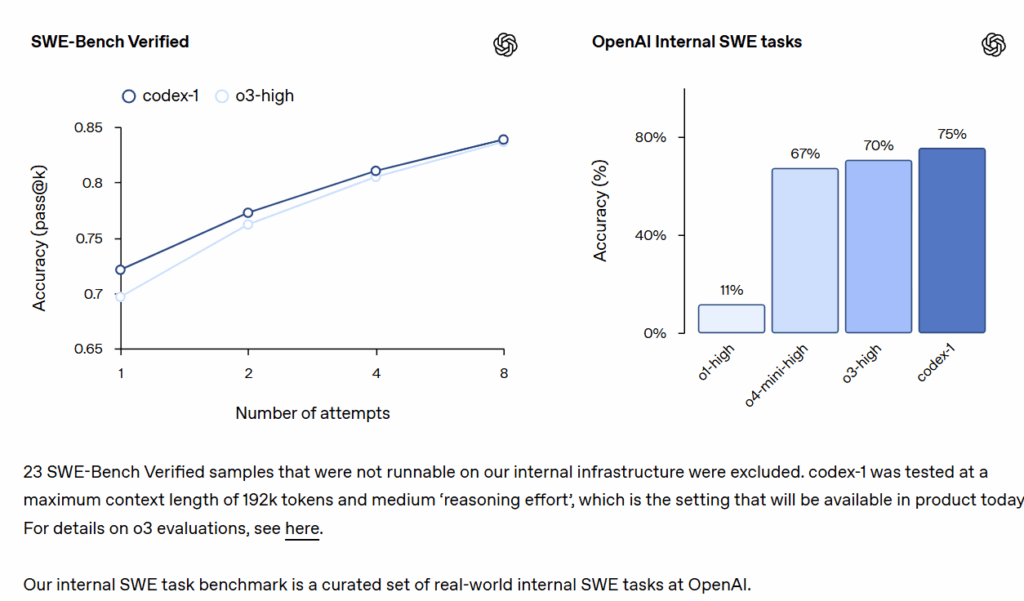
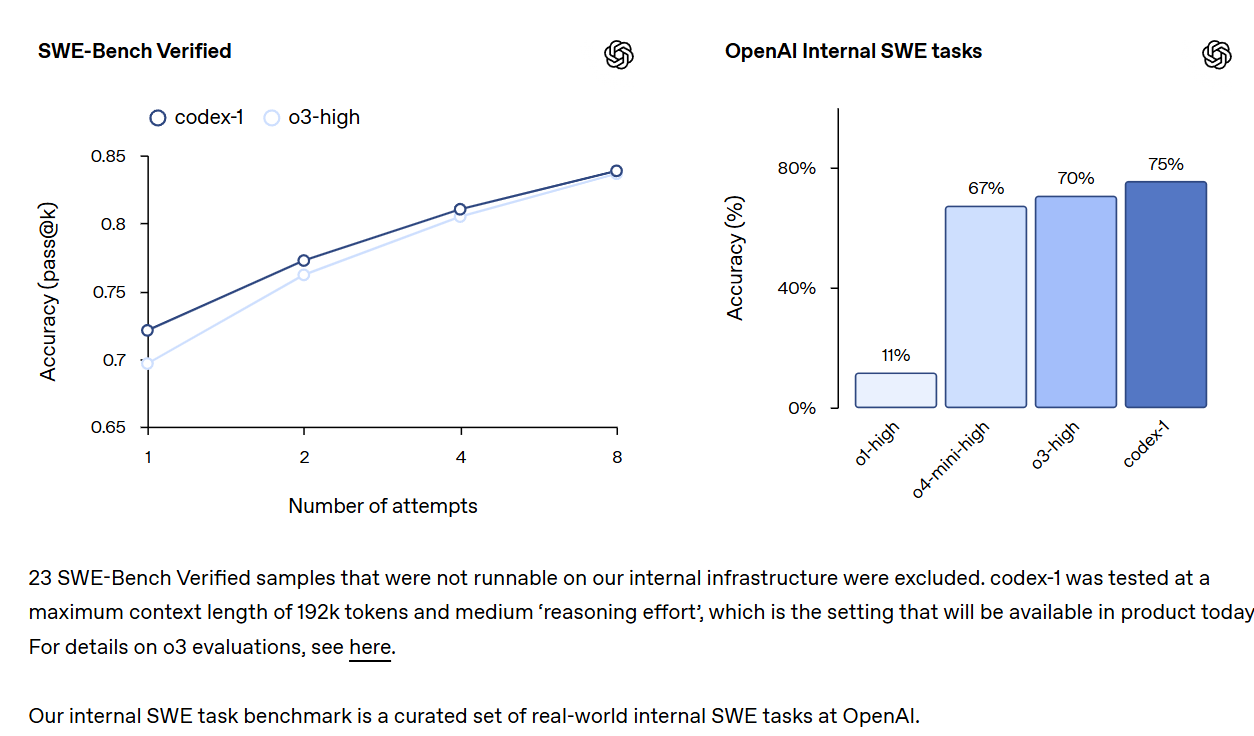
On coding evaluations and internal benchmarks, codex-1 shows strong performance even without AGENTS.md files or custom scaffolding.

All code is provided via GitHub repositories. All codex executions are sandboxed in the cloud. The agent cannot access external websites, APIs or other services. Afterwards you are given a comprehensive log of its actions and changes. You then choose to get the code via pull requests.

Note that while it lacks internet access during its core work, it can still install dependencies before it starts. But there are reports of struggles with its inability to install dependencies while it runs, which seems like a major issue.

Inability to access the web also makes some things trickier to diagnose, figure out or test. A lot of my frustration with AI coding is everything I want to do seems to involve interacting with persnickety websites.

This is a ‘research preview,’ and the worst Codex will ever be, although it might temporarily get less affordable once the free preview period ends. It does seem like they have given this a solid amount of thought and taken reasonable precautions.

The question is, when is this a better way to code than Cursor or Claude Code, and how does this compare to existing coding agents like Devin?

It would have been easy, given everything that happened, for OpenAI to have said ‘we do not need to give you a system card addendum, this is in preview and not a fully new model, etc.’ It is thus to their credit that they gave us the card anyway. It is short, but there is no need for it to be long.

As you would expect, the first thing that stood out was 2.3, ‘falsely claiming to have completed a task it did not complete.’ This seems to be a common pattern in similar models, including Claude 3.7.

I believe this behavior is something you want to fight hard to avoid having the AI learn in the first place. Once the AI learns to do this, it is difficult to get rid of it, but it wouldn’t learn it if you weren’t rewarding it during training. It is avoidable in theory. Is it avoidable in practice? I don’t know if the price is worthwhile, but I do know it’s worth a lot to avoid it.

OpenAI does indeed try, but with positive action rather than via negativa. Their plan is ensuring that the model is penalized for producing results inconsistent with its actions, and rewarded for acknowledging limitations. Good. That was a big help, going from 15% to 85% chance of correctly stating it couldn’t complete tasks. But 85% really isn’t 99%.

As in, I think if you include some things that push against pretending to solve problems, that helps a lot (hence the results here), but if you also have other places that pretending is rewarded, there will be a pattern, and then you still have a problem, and it will keep getting bigger. So instead, track down every damn place in which the AI could get away with claiming to have solved a task during training without having solved it, and make sure you always catch all of them. I know this is asking a lot.

They solve prompt injecting via network sandbagging. That definitely does the job for now, but also they made sure that prompt injections inside the coding environment also mostly failed. Good.

Finally we have the preparedness team affirming that the model did not reach high risk in any categories. I’d have liked to see more detail here, but overall This Is Fine.

Want to keep using the command line? OpenAI gives you codex-1, a variant of o4-mini, as an upgrade. They’re also introducing a simpler onboarding process for it and offering some free credits.

These look like a noticeable improvement over o4-mini-high and even o3-high. Codex-mini-latest will be priced at $1.50/$6 per million with a 75% prompt caching discount. They are also setting a great precedent by sharing the system message.

Greg Brockman speculates that over time the ‘local’ and ‘remote’ coding agents will merge. This makes sense. Why shouldn’t the local agent call additional remote agents to execute subtasks? Parallelism for the win. Nothing could possibly go wrong.

Immediate reaction to Codex was relatively muted. It takes a while for people to properly evaluate this kind of tool, and it is only available to those paying $200/month.

What feedback we do have is somewhat mixed. Cautious optimism, especially for what a future version could be, seems like the baseline.

Codex is the combination of an agent implementation with the underlying model. Reports seem to be consistent with the underlying model and async capabilities being excellent and those both matter a lot, but with the implementation needing work and being much less practically useful than rival agents, requiring more hand holding, having less clean UI and running slower.

That makes Codex in its current state a kind of ‘AI coding agent for advanced power users.’ You wouldn’t use the current Codex over the competition unless you understood what you were doing, and you wanted to do a lot of it.

The future of Codex looks bright. OpenAI in many senses started with ‘the hard part’ of having a great model and strong parallelism. The things still missing seem easily fixable over time.

One must also keep an eye out that OpenAI (especially via Greg Brockman) is picking out and amplifying positive feedback. It’s not yet clear how much of an upgrade this is over existing alternatives, especially as most reports don’t compare Codex to its rivals. That’s one reason I like to rely on my own Twitter reaction threads.

Then there’s Jules, Google’s coding assistant, which according to multiple sources is coming soon. Google will no doubt once again Fail Marketing Forever, but it seems highly plausible that Jules could be a better tool, and almost certain it will have a cheaper price tag.

What can it do?

Whatever those things are, it can do them fully in parallel. People seem to be underestimating this aspect of coding agents.

Alex Halliday: The killer feature of OpenAI Codex is parallelism.

Browser-based work is evolving: from humans handling tasks one tab at a time, to overseeing multiple AI agent tabs, providing feedback as needed.

The most important thing is the Task Relevant Maturity of these systems. You need to understand for which tasks systems like Codex can be used which is function of model capability and error tolerance. This is the “opportunity zone” for all AI systems, including ours @AirOpsHQ.

It can do legacy project migrations.

Flavio Adamo: I asked Codex to convert a legacy project from Python 2.7 to 3.11 and from Django 1.x to 5.0

It literally took 12 minutes. If you know, that’s usually weeks of pain. This is actually insane.

Haider: how much manual cleanup or review did it need after that initial pass?

Flavio Adamo: Not much, actually. Just a few Docker issues, solved in a couple of minutes.

Here’s Darwin Santos pumping out PRs and being very impressed.

Darwin Santos: Don’t mind us – it’s just @elvstejd and me knocking one PR after another with Codex. Thanks @embirico – @kevinweil. You weren’t joking with this being yet again a game changer.

Here’s Seconds being even more impressed, and sdmat being impressed with caveats.

0.005 Seconds: It’s incredible. The ux is mid and it’s missing features but the underlying model is so good that if you transported this to 2022 everyone would assume you have agi and put 70% of engineers into unemployment. 6 months of product engineering and it replaces teams.

It has been making insane progress in fairly complex scenarios on my personal project and I pretty effortlessly closed 7 tickets at work today. It obliterates small to medium tasks in familiar context.

Sdmat: Fantastic, though only part of what it will be and rough around the edges.

With no environment internet access, no agent search tool, and oriented to small-medium tasks it is currently a scalpel.

An excellent scalpel if you know what it is you want to cut.

Conrad Barski: this is right: it’s power is not that it can solve 50% of hard problems, it’s that it solves 99.9% of mid problems.

Sdmat: Exactly.

And mid problems comprise >90% of hard problems, so if you know what you are doing and can carve at the joints it is a very, very useful tool.

And here’s Riley Coyote being perhaps the most impressed, especially by the parallelism.

Riley Coyote: I’m *reallytrying to play it cool here but like…

I’mma just say it: Codex might be the most impressive, most *powerfulAI product I’ve ever touched. all things considered. the async ability, especially, is on another level. like it’s not just a technical ‘leap’, it’s transcendent. I’ve used basically every ai coding tool and platform out there at least once, and nothing else is in the same class. it just works, ridiculously well. and I’ll admit, I didn’t want to like it. Maybe it’s stubborn loyalty to Claude – I love that retro GUI and the no-nonsense simplicity of Claude Code. There’s still something special there and ill alway use it.

but, if I’m honest: that edge is kinda becoming irrelevant, because Codex feels like having a private, hyper-competent swarm – a crack team of 10/10 FS devs, but kinda *betteri think tbh.

it’s wild. at this rate, I might start shipping something new every single day, at least until I clear out my backlog (which, without exaggeration, is something like 35-40 ‘projects’ that are all ~70–85% done). this could not have come at a better time too. I desperately needed the combination of something like codex and much higher rate limits + a streamlined pipeline from my daily drive ai to db.

go try it out.

sidebar/tip: if you cant get over the initial hump, pop over to ai.studio.google.com and click the “build apps” button on the left hand side.

a bunch of sample apps and tools propogates and they’re actually really really really good one-click zero-shots essentially….

shits getting wild. and its only monday.

Bayram Annakov prefers Deep Research’s output for now on a sample task, but finds Codex to be promising as well, and it gets a B on an AI Product Engineer homework assignment.

Here’s Robbie Bouschery finding a bug in the first three minutes.

JB one shots a doodle jump game and gets 600k likes for the post, so clearly money well spent. Paul Couvert does the same with Gemini 2.5 although objectively the platform placement seems better in Codex’s version. Upgrade?

Reliability will always be a huge sticking point, right up until it isn’t. Being highly autonomous only matters if you can trust it.

Fleischman Mena: I’m reticent to use it on featurework: ~unchanged benchmarks & results look like o3 bolted to a SWE-bench finetune + git.

You seem to still need to baby it w/ gold-set context for decent outputs, so it’s unclear where alpha is vs. current reprompt grinds

It’s a nice “throw it in the bag, too” feature if you’re hitting GPT caps and don’t want to fan out to other services: But to me, it’s in the same category as task scheduling and the web agent: the “party trick” version of a better thing yet to come.

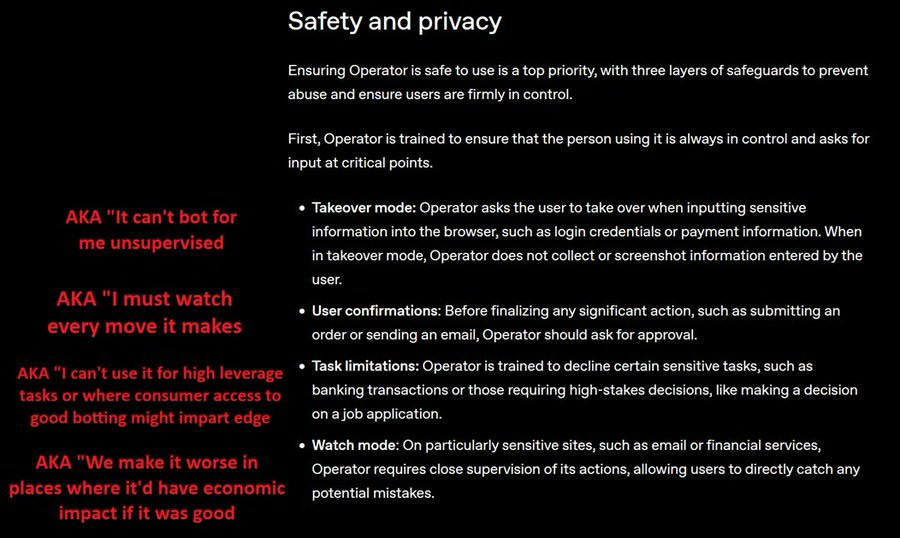
He points to a similar issue with Operator. I have access to Operator, but I don’t bother using it, largely because in many of the places where it is valuable it requires enough supervision I might as well do the job myself:

Henry: Does anyone use that ‘operator’ agent for anything?

Fleischman Mena: Not really.

Problem with web operators are that the REAL version of that product pretty much HAVE to be made by a sin-eater like the leetcode cheating startup.

Nobody wants “we build a web botting platform but it’s useless whenever lots of bots would have an impact.”

You pretty much HAVE to commit to “we’re going to sell you the ability to destroy the internet commons with bots”,

-or accept you’re only selling the “party trick” version of what this software would actually be if implemented “properly” for its users.

The few times I tried to use Operator to do something that would have been highly annoying to do myself, it fell down and died, and I decided that unless other people started reporting great results I’d rather just wait for similar agents to get better.

Alex Mizrahi reports Codex engaging in ‘busywork,’ identifying and fixing a ‘bug’ that wasn’t actually a bug.

Scott Swingle tries Codex out and compares it to Mentat. A theme throughout is that Mentat is more polished and faster, whereas Codex has to rerun a bunch of stuff. He likes o3 as the underlying model more than Sonnet 3.7, but finds the current implementation to not yet be up to par.

Lemonaut mostly doesn’t see the alpha over using some combination of Devin and Cursor/Cline, and finds it terribly finnicky and requiring hand holding in ways Cline and Devin aren’t, but does notice it solve a relatively difficult prompt. Again, that is compatible with o3 being a very good base model, but the implementation needing work.

People think about price all wrong.

Don’t think about relative price. Think about absolute benefits versus absolute price.

It doesn’t matter if ten times the price is ten times better. If ten times the price makes you 10% better, it’s an absolute steal.

Fleischman Mena: The sticking point is $2,160/year more than plus.

If you think Plus is a good deal at $240, the upgrade only makes sense if you GENUINELY believe

“This isn’t just better, it’s 10x better than plus, AND a better idea than subscribing to 9 other LLM pro plans.”

Seems dubious.

The $2,160 price issue is hard to ignore. that buys you ~43M o3 I/O tokens via API. War and peace is ~750k tokens. Most codebases & outputs don’t come close.

If spend’s okay, you prob do better plugging an API key into a half dozen agent competitors; you’d still come out ahead.

The dollar price, even at the $200/month a level, is chump change for a programmer, relative to a substantial productivity gain. What matters is your time and your productivity. If this improves your productivity even a few percent over rival options, and there isn’t a principal-agent problem (aka you pay the cost and someone else gets the productivity gains), then it is worthwhile. So ask whether or not it does that.

The other way this is the wrong approach is that it is only part of the $200/month package. You also get unlimited o3 and deep research use, among other products, which was previously the main attraction.

As a company, you are paying six figures for a programmer. Give them the best tools you can, whether or not this is the best tool.

This seems spot on to me:

Sully: I think agents are going to be split into 2 categories

Background & active

Background agents = stuff I don’t want to do (ux/spees doesn’t matter, but review + feedback does)

“Active agents” = things I want to do but 10x faster with agents (ux/speed matters, most apps are this)

Mat Ferrante: And I think they will be able to integrate with each other. Background leverages active one to execute quick stuff just like a user would. Active kicking off background tasks.

Sully: 100%.

Codex is currently in a weird spot. It wants to be background (or async) and is great at being async, but requires too much hand holding to let you actually ignore it for long. Once that is solved, things get a lot more interesting.


Discussion about this post

The Codex of Ultimate Vibing Read More »

openai-introduces-codex,-its-first-full-fledged-ai-agent-for-coding

OpenAI introduces Codex, its first full-fledged AI agent for coding

We’ve been expecting it for a while, and now it’s here: OpenAI has introduced an agentic coding tool called Codex in research preview. The tool is meant to allow experienced developers to delegate rote and relatively simple programming tasks to an AI agent that will generate production-ready code and show its work along the way.

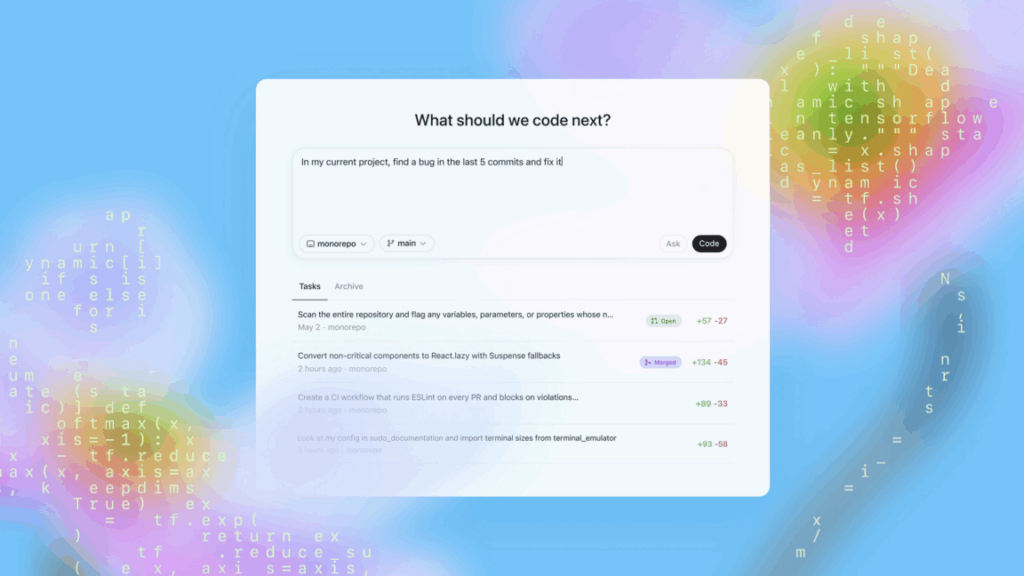
Codex is a unique interface (not to be confused with the Codex CLI tool introduced by OpenAI last month) that can be reached from the side bar in the ChatGPT web app. Users enter a prompt and then click either “code” to have it begin producing code, or “ask” to have it answer questions and advise.

Whenever it’s given a task, that task is performed in a distinct container that is preloaded with the user’s codebase and is meant to accurately reflect their development environment.

To make Codex more effective, developers can include an “AGENTS.md” file in the repo with custom instructions, for example to contextualize and explain the code base or to communicate standardizations and style practices for the project—kind of a README.md but for AI agents rather than humans.

Codex is built on codex-1, a fine-tuned variation of OpenAI’s o3 reasoning model that was trained using reinforcement learning on a wide range of coding tasks to analyze and generate code, and to iterate through tests along the way.

OpenAI introduces Codex, its first full-fledged AI agent for coding Read More »