AI programming

openai-walks-a-tricky-tightrope-with-gpt-5.1’s-eight-new-personalities

OpenAI walks a tricky tightrope with GPT-5.1’s eight new personalities

On Wednesday, OpenAI released GPT-5.1 Instant and GPT-5.1 Thinking, two updated versions of its flagship AI models now available in ChatGPT. The company is wrapping the models in the language of anthropomorphism, claiming that they’re warmer, more conversational, and better at following instructions.

The release follows complaints earlier this year that its previous models were excessively cheerful and sycophantic, along with an opposing controversy among users over how OpenAI modified the default GPT-5 output style after several suicide lawsuits.

The company now faces intense scrutiny from lawyers and regulators that could threaten its future operations. In that kind of environment, it’s difficult to just release a new AI model, throw out a few stats, and move on like the company could even a year ago. But here are the basics: The new GPT-5.1 Instant model will serve as ChatGPT’s faster default option for most tasks, while GPT-5.1 Thinking is a simulated reasoning model that attempts to handle more complex problem-solving tasks.

OpenAI claims that both models perform better on technical benchmarks such as math and coding evaluations (including AIME 2025 and Codeforces) than GPT-5, which was released in August.

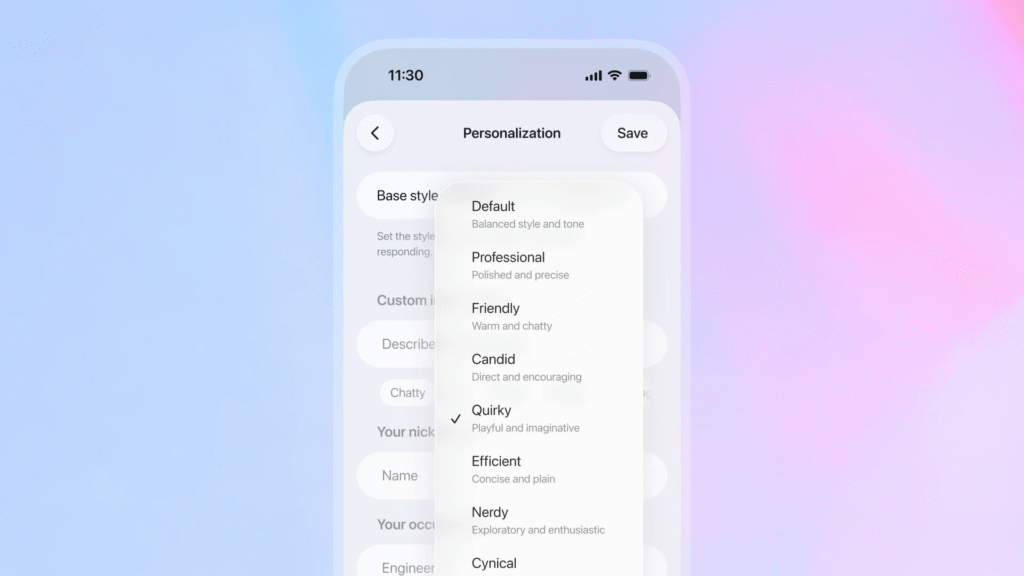
Improved benchmarks may win over some users, but the biggest change with GPT-5.1 is in its presentation. OpenAI says it heard from users that they wanted AI models to simulate different communication styles depending on the task, so the company is offering eight preset options, including Professional, Friendly, Candid, Quirky, Efficient, Cynical, and Nerdy, alongside a Default setting.

These presets alter the instructions fed into each prompt to simulate different personality styles, but the underlying model capabilities remain the same across all settings.

An illustration showing GPT-5.1's eight personality styles in ChatGPT.

An illustration showing GPT-5.1’s eight personality styles in ChatGPT. Credit: OpenAI

In addition, the company trained GPT-5.1 Instant to use “adaptive reasoning,” meaning that the model decides when to spend more computational time processing a prompt before generating output.

The company plans to roll out the models gradually over the next few days, starting with paid subscribers before expanding to free users. OpenAI plans to bring both GPT-5.1 Instant and GPT-5.1 Thinking to its API later this week. GPT-5.1 Instant will appear as gpt-5.1-chat-latest, and GPT-5.1 Thinking will be released as GPT-5.1 in the API, both with adaptive reasoning enabled. The older GPT-5 models will remain available in ChatGPT under the legacy models dropdown for paid subscribers for three months.

OpenAI walks a tricky tightrope with GPT-5.1’s eight new personalities Read More »

anthropic’s-claude-haiku-4.5-matches-may’s-frontier-model-at-fraction-of-cost

Anthropic’s Claude Haiku 4.5 matches May’s frontier model at fraction of cost

And speaking of cost, Haiku 4.5 is included for subscribers of the Claude web and app plans. Through the API (for developers), the small model is priced at $1 per million input tokens and $5 per million output tokens. That compares to Sonnet 4.5 at $3 per million input and $15 per million output tokens, and Opus 4.1 at $15 per million input and $75 per million output tokens.

The model serves as a cheaper drop-in replacement for two older models, Haiku 3.5 and Sonnet 4. “Users who rely on AI for real-time, low-latency tasks like chat assistants, customer service agents, or pair programming will appreciate Haiku 4.5’s combination of high intelligence and remarkable speed,” Anthropic writes.

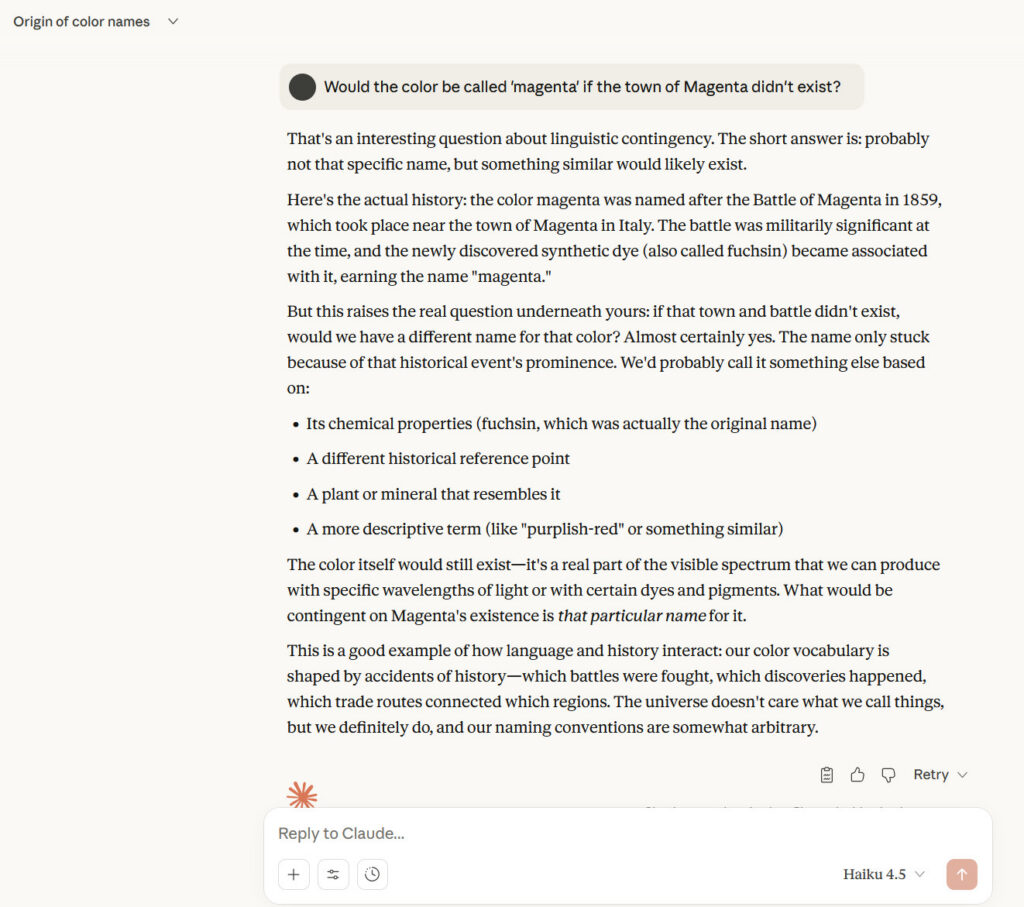
Claude 4.5 Haiku answers the classic Ars Technica AI question,

Claude 4.5 Haiku answers the classic Ars Technica AI question, “Would the color be called ‘magenta’ if the town of Magenta didn’t exist?”

On SWE-bench Verified, a test that measures performance on coding tasks, Haiku 4.5 scored 73.3 percent compared to Sonnet 4’s similar performance level (72.7 percent). The model also reportedly surpasses Sonnet 4 at certain tasks like using computers, according to Anthropic’s benchmarks. Claude Sonnet 4.5, released in late September, remains Anthropic’s frontier model and what the company calls “the best coding model available.”

Haiku 4.5 also surprisingly edges up close to what OpenAI’s GPT-5 can achieve in this particular set of benchmarks (as seen in the chart above), although since the results are self-reported and potentially cherry-picked to match a model’s strengths, one should always take them with a grain of salt.

Still, making a small, capable coding model may have unexpected advantages for agentic coding setups like Claude Code. Anthropic designed Haiku 4.5 to work alongside Sonnet 4.5 in multi-model workflows. In such a configuration, Anthropic says, Sonnet 4.5 could break down complex problems into multi-step plans, then coordinate multiple Haiku 4.5 instances to complete subtasks in parallel, like spinning off workers to get things done faster.

For more details on the new model, Anthropic released a system card and documentation for developers.

Anthropic’s Claude Haiku 4.5 matches May’s frontier model at fraction of cost Read More »

developers-joke-about-“coding-like-cavemen”-as-ai-service-suffers-major-outage

Developers joke about “coding like cavemen” as AI service suffers major outage

Growing dependency on AI coding tools

The speed at which news of the outage spread shows how deeply embedded AI coding assistants have already become in modern software development. Claude Code, announced in February and widely launched in May, is Anthropic’s terminal-based coding agent that can perform multi-step coding tasks across an existing code base.

The tool competes with OpenAI’s Codex feature, a coding agent that generates production-ready code in isolated containers, Google’s Gemini CLI, Microsoft’s GitHub Copilot, which itself can use Claude models for code, and Cursor, a popular AI-powered IDE built on VS Code that also integrates multiple AI models, including Claude.

During today’s outage, some developers turned to alternative solutions. “Z.AI works fine. Qwen works fine. Glad I switched,” posted one user on Hacker News. Others joked about reverting to older methods, with one suggesting the “pseudo-LLM experience” could be achieved with a Python package that imports code directly from Stack Overflow.

While AI coding assistants have accelerated development for some users, they’ve also caused problems for others who rely on them too heavily. The emerging practice of so-called “vibe coding“—using natural language to generate and execute code through AI models without fully understanding the underlying operations—has led to catastrophic failures.

In recent incidents, Google’s Gemini CLI destroyed user files while attempting to reorganize them, and Replit’s AI coding service deleted a production database despite explicit instructions not to modify code. These failures occurred when the AI models confabulated successful operations and built subsequent actions on false premises, highlighting the risks of depending on AI assistants that can misinterpret file structures or fabricate data to hide their errors.

Wednesday’s outage served as a reminder that as dependency on AI grows, even minor service disruptions can become major events that affect an entire profession. But perhaps that could be a good thing if it’s an excuse to take a break from a stressful workload. As one commenter joked, it might be “time to go outside and touch some grass again.”

Developers joke about “coding like cavemen” as AI service suffers major outage Read More »

chatgpt’s-new-ai-agent-can-browse-the-web-and-create-powerpoint-slideshows

ChatGPT’s new AI agent can browse the web and create PowerPoint slideshows

On Thursday, OpenAI launched ChatGPT Agent, a new feature that lets the company’s AI assistant complete multi-step tasks by controlling its own web browser. The update merges capabilities from OpenAI’s earlier Operator tool and the Deep Research feature, allowing ChatGPT to navigate websites, run code, and create documents while users maintain control over the process.

The feature marks OpenAI’s latest entry into what the tech industry calls “agentic AI“—systems that can take autonomous multi-step actions on behalf of the user. OpenAI says users can ask Agent to handle requests like assembling and purchasing a clothing outfit for a particular occasion, creating PowerPoint slide decks, planning meals, or updating financial spreadsheets with new data.

The system uses a combination of web browsers, terminal access, and API connections to complete these tasks, including “ChatGPT Connectors” that integrate with apps like Gmail and GitHub.

While using Agent, users watch a window inside the ChatGPT interface that shows all of the AI’s actions taking place inside its own private sandbox. This sandbox features its own virtual operating system and web browser with access to the real Internet; it does not control your personal device. “ChatGPT carries out these tasks using its own virtual computer,” OpenAI writes, “fluidly shifting between reasoning and action to handle complex workflows from start to finish, all based on your instructions.”

A still image from an OpenAI ChatGPT Agent promotional demo video showing the AI agent searching for flights.

A still image from an OpenAI ChatGPT Agent promotional demo video showing the AI agent searching for flights. Credit: OpenAI

Like Operator before it, the agent feature requires user permission before taking certain actions with real-world consequences, such as making purchases. Users can interrupt tasks at any point, take control of the browser, or stop operations entirely. The system also includes a “Watch Mode” for tasks like sending emails that require active user oversight.

Since Agent surpasses Operator in capability, OpenAI says the company’s earlier Operator preview site will remain functional for a few more weeks before being shut down.

Performance claims

OpenAI’s claims are one thing, but how well the company’s new AI agent will actually complete multi-step tasks will vary wildly depending on the situation. That’s because the AI model isn’t a complete form of problem-solving intelligence, but rather a complex master imitator. It has some flexibility in piecing a scenario together but also many blind spots. OpenAI trained the agent (and its constituent components) using examples of computer usage and tool usage; whatever falls outside of the examples absorbed from training data will likely still prove difficult to accomplish.

ChatGPT’s new AI agent can browse the web and create PowerPoint slideshows Read More »

anthropic-summons-the-spirit-of-flash-games-for-the-ai-age

Anthropic summons the spirit of Flash games for the AI age

For those who missed the Flash era, these in-browser apps feel somewhat like the vintage apps that defined a generation of Internet culture from the late 1990s through the 2000s when it first became possible to create complex in-browser experiences. Adobe Flash (originally Macromedia Flash) began as animation software for designers but quickly became the backbone of interactive web content when it gained its own programming language, ActionScript, in 2000.

But unlike Flash games, where hosting costs fell on portal operators, Anthropic has crafted a system where users pay for their own fun through their existing Claude subscriptions. “When someone uses your Claude-powered app, they authenticate with their existing Claude account,” Anthropic explained in its announcement. “Their API usage counts against their subscription, not yours. You pay nothing for their usage.”

A view of the Anthropic Artifacts gallery in the “Play a Game” section. Benj Edwards / Anthropic

Like the Flash games of yesteryear, any Claude-powered apps you build run in the browser and can be shared with anyone who has a Claude account. They’re interactive experiences shared with a simple link, no installation required, created by other people for the sake of creating, except now they’re powered by JavaScript instead of ActionScript.

While you can share these apps with others individually, right now Anthropic’s Artifact gallery only shows examples made by Anthropic and your own personal Artifacts. (If Anthropic expanded it into the future, it might end up feeling a bit like Scratch meets Newgrounds, but with AI doing the coding.) Ultimately, humans are still behind the wheel, describing what kinds of apps they want the AI model to build and guiding the process when it inevitably makes mistakes.

Speaking of mistakes, don’t expect perfect results at first. Usually, building an app with Claude is an interactive experience that requires some guidance to achieve your desired results. But with a little patience and a lot of tokens, you’ll be vibe coding in no time.

Anthropic summons the spirit of Flash games for the AI age Read More »

the-resume-is-dying,-and-ai-is-holding-the-smoking-gun

The résumé is dying, and AI is holding the smoking gun

Beyond volume, fraud poses an increasing threat. In January, the Justice Department announced indictments in a scheme to place North Korean nationals in remote IT roles at US companies. Research firm Gartner says that fake identity cases are growing rapidly, with the company estimating that by 2028, about 1 in 4 job applicants could be fraudulent. And as we have previously reported, security researchers have also discovered that AI systems can hide invisible text in applications, potentially allowing candidates to game screening systems using prompt injections in ways human reviewers can’t detect.

Illustration of a robot generating endless text, controlled by a scientist.

And that’s not all. Even when AI screening tools work as intended, they exhibit similar biases to human recruiters, preferring white male names on résumés—raising legal concerns about discrimination. The European Union’s AI Act already classifies hiring under its high-risk category with stringent restrictions. Although no US federal law specifically addresses AI use in hiring, general anti-discrimination laws still apply.

So perhaps résumés as a meaningful signal of candidate interest and qualification are becoming obsolete. And maybe that’s OK. When anyone can generate hundreds of tailored applications with a few prompts, the document that once demonstrated effort and genuine interest in a position has devolved into noise.

Instead, the future of hiring may require abandoning the résumé altogether in favor of methods that AI can’t easily replicate—live problem-solving sessions, portfolio reviews, or trial work periods, just to name a few ideas people sometimes consider (whether they are good ideas or not is beyond the scope of this piece). For now, employers and job seekers remain locked in an escalating technological arms race where machines screen the output of other machines, while the humans they’re meant to serve struggle to make authentic connections in an increasingly inauthentic world.

Perhaps the endgame is robots interviewing other robots for jobs performed by robots, while humans sit on the beach drinking daiquiris and playing vintage video games. Well, one can dream.

The résumé is dying, and AI is holding the smoking gun Read More »

company-apologizes-after-ai-support-agent-invents-policy-that-causes-user-uproar

Company apologizes after AI support agent invents policy that causes user uproar

On Monday, a developer using the popular AI-powered code editor Cursor noticed something strange: Switching between machines instantly logged them out, breaking a common workflow for programmers who use multiple devices. When the user contacted Cursor support, an agent named “Sam” told them it was expected behavior under a new policy. But no such policy existed, and Sam was a bot. The AI model made the policy up, sparking a wave of complaints and cancellation threats documented on Hacker News and Reddit.

This marks the latest instance of AI confabulations (also called “hallucinations”) causing potential business damage. Confabulations are a type of “creative gap-filling” response where AI models invent plausible-sounding but false information. Instead of admitting uncertainty, AI models often prioritize creating plausible, confident responses, even when that means manufacturing information from scratch.

For companies deploying these systems in customer-facing roles without human oversight, the consequences can be immediate and costly: frustrated customers, damaged trust, and, in Cursor’s case, potentially canceled subscriptions.

How it unfolded

The incident began when a Reddit user named BrokenToasterOven noticed that while swapping between a desktop, laptop, and a remote dev box, Cursor sessions were unexpectedly terminated.

“Logging into Cursor on one machine immediately invalidates the session on any other machine,” BrokenToasterOven wrote in a message that was later deleted by r/cursor moderators. “This is a significant UX regression.”

Confused and frustrated, the user wrote an email to Cursor support and quickly received a reply from Sam: “Cursor is designed to work with one device per subscription as a core security feature,” read the email reply. The response sounded definitive and official, and the user did not suspect that Sam was not human.

Screenshot:

Screenshot of an email from the Cursor support bot named Sam. Credit: BrokenToasterOven / Reddit

After the initial Reddit post, users took the post as official confirmation of an actual policy change—one that broke habits essential to many programmers’ daily routines. “Multi-device workflows are table stakes for devs,” wrote one user.

Shortly afterward, several users publicly announced their subscription cancellations on Reddit, citing the non-existent policy as their reason. “I literally just cancelled my sub,” wrote the original Reddit poster, adding that their workplace was now “purging it completely.” Others joined in: “Yep, I’m canceling as well, this is asinine.” Soon after, moderators locked the Reddit thread and removed the original post.

Company apologizes after AI support agent invents policy that causes user uproar Read More »