AI privacy

workers-report-watching-ray-ban-meta-shot-footage-of-people-using-the-bathroom

Workers report watching Ray-Ban Meta-shot footage of people using the bathroom


Meta accused of “concealing the facts” about smart glass users’ privacy.

A marketing image for Ray-Ban Meta smart glasses. Credit: Meta

Meta’s approach to user privacy is under renewed scrutiny following a Swedish report that employees of a Meta subcontractor have watched footage captured by Ray-Ban Meta smart glasses showing sensitive user content.

The workers reportedly work for Kenya-headquartered Sama and provide data annotation for Ray-Ban Metas.

The February report, a collaboration from Swedish newspapers Svenska Dagbladet, Göteborgs-Posten, and Kenya-based freelance journalist Naipanoi Lepapa, is, per a machine translation, based on interviews with over 30 employees at various levels of Sama, including several people who work with video, image, and speech annotation for Meta’s AI systems. Some of the people interviewed have worked on projects other than Meta’s smart glasses. The report’s authors said they did not gain access to the materials that Sama workers handle or the area where workers perform data annotation. The report is also based on interviews with former US Meta employees who have reportedly witnessed live data annotation for several Meta projects.

The report pointed to, per the translation, a “stream of privacy-sensitive data that is fed straight into the tech giant’s systems,” and that makes Sama workers uncomfortable. The authors said that several people interviewed for the report said they have seen footage shot with Ray-Ban Meta smart glasses that shows people having sex and using the bathroom.

“I saw a video where a man puts the glasses on the bedside table and leaves the room. Shortly afterwards, his wife comes in and changes her clothes,” an anonymous Sama employee reportedly said, per the machine translation.

Another anonymous employee said that they have seen users’ partners come out of the bathroom naked.

“You understand that it is someone’s private life you are looking at, but at the same time you are just expected to carry out the work,” an anonymous Sama employee reportedly said.

Meta confirms use of data annotators

In statements shared with the BBC on Wednesday, Meta confirmed that it “sometimes” shares content that users share with the Meta AI generative AI chatbot with contractors to review with “the purpose of improving people’s experience, as many other companies do.”

“This data is first filtered to protect people’s privacy,” the statement said, pointing to, as an example, blurring out faces in images.

Meta’s privacy policy for wearables says that photos and videos taken with its smart glasses are sent to Meta “when you turn on cloud processing on your AI Glasses, interact with the Meta AI service on your AI Glasses, or upload your media to certain services provided by Meta (i.e., Facebook or Instagram). You can change your choices about cloud processing of your Media at any time in Settings.”

The policy also says that video and audio from livestreams recorded with Ray-Ban Metas are sent to Meta, as are text transcripts and voice recordings created by Meta’s chatbot.

“We use machine learning and trained reviewers to process this data to improve, troubleshoot, and train our products. We share that information with third-party vendors and service providers to improve our products. You can access and delete recordings and related transcripts in the Meta AI App,” the policy says.

Meta’s broader privacy policy for the Meta AI chatbot adds: “In some cases, Meta will review your interactions with AIs, including the content of your conversations with or messages to AIs, and this review may be automated or manual (human).”

That policy also warns users against sharing “information that you don’t want the AIs to use and retain, such as information about sensitive topics.”

“When information is shared with AIs, the AIs will sometimes retain and use that information,” the Meta AI privacy policy says.

Notably, in August, Meta made “Meta AI with camera” on by default until a user turns off support for the “Hey Meta” voice command, per an email sent to users at the time. Meta spokesperson Albert Aydin told The Verge at the time that “photos and videos captured on Ray-Ban Meta are on your phone’s camera roll and not used by Meta for training.”

However, some Ray-Ban Meta users may not have read or understood the numerous privacy policies associated with Meta’s smart glasses.

Sama employees suggested that Ray-Ban Meta owners may be unaware that the devices are sometimes recording. Employees reportedly pointed to users recording their bank card or porn that they’re watching, seemingly inadvertently.

Meta’s smart glasses flash a red light when they are recording video or taking a photo, but there has been criticism that people may not notice the light or misinterpret its meaning.

“We see everything, from living rooms to naked bodies. Meta has that type of content in its databases. People can record themselves in the wrong way and not even know what they are recording,” an anonymous employee was quoted as saying.

When reached for comment by Ars Technica, a Sama representative shared a statement saying that Sama doesn’t “comment on specific client relationships or projects” but is GDPR and CCPA-compliant and uses “rigorously audited policies and procedures designed to protect all customer information, including personally identifiable information.”

Saama’s statement added:

This work is conducted in secure, access-controlled facilities. Personal devices are not permitted on production floors, and all team members undergo background checks and receive ongoing training in data protection, confidentiality, and responsible AI practices. Our teams receive living wages and full benefits, and have access to comprehensive wellness resources and on-site support.

Meta sued

The Swedish report has reignited concerns about the privacy of Meta’s smart glasses, including from the Information Commissioner’s Office, a UK data watchdog that has written to Meta about the report. The debate also comes as Meta is reportedly planning to add facial recognition to its Ray-Ban and Oakley-branded smart glasses “as soon as this year,” per a February report from The New York Times citing anonymous people “involved with the plans.”

The claims have also led to a proposed class-action lawsuit [PDF] filed yesterday against Meta and Luxottica of America, a subsidiary of Ray-Ban parent company EssilorLuxottica. The lawsuit challenges Meta’s slogan for the glasses, “designed for privacy, controlled by you,” saying:

No reasonable consumer would understand “designed for privacy, controlled by you” and similar promises like “built for your privacy” to mean that deeply personal footage from inside their homes would be viewed and catalogued by human workers overseas. Meta chose to make privacy the centerpiece of its pervasive marketing campaign while concealing the facts that reveal those promises to be false.

The lawsuit alleges that Meta has broken state consumer protection laws and seeks damages, punitive penalties, and an injunction requiring Meta to change business practices “to prevent or mitigate the risk of the consumer deception and violations of law.”

Ars Technica reached out to Meta for comment but didn’t hear back before publication. Meta has declined to comment on the lawsuit to other outlets.

Photo of Scharon Harding

Scharon is a Senior Technology Reporter at Ars Technica writing news, reviews, and analysis on consumer gadgets and services. She’s been reporting on technology for over 10 years, with bylines at Tom’s Hardware, Channelnomics, and CRN UK.

Workers report watching Ray-Ban Meta-shot footage of people using the bathroom Read More »

openai-holds-back-wide-release-of-voice-cloning-tech-due-to-misuse-concerns

OpenAI holds back wide release of voice-cloning tech due to misuse concerns

AI speaks letters, text-to-speech or TTS, text-to-voice, speech synthesis applications, generative Artificial Intelligence, futuristic technology in language and communication.

Voice synthesis has come a long way since 1978’s Speak & Spell toy, which once wowed people with its state-of-the-art ability to read words aloud using an electronic voice. Now, using deep-learning AI models, software can create not only realistic-sounding voices, but also convincingly imitate existing voices using small samples of audio.

Along those lines, OpenAI just announced Voice Engine, a text-to-speech AI model for creating synthetic voices based on a 15-second segment of recorded audio. It has provided audio samples of the Voice Engine in action on its website.

Once a voice is cloned, a user can input text into the Voice Engine and get an AI-generated voice result. But OpenAI is not ready to widely release its technology yet. The company initially planned to launch a pilot program for developers to sign up for the Voice Engine API earlier this month. But after more consideration about ethical implications, the company decided to scale back its ambitions for now.

“In line with our approach to AI safety and our voluntary commitments, we are choosing to preview but not widely release this technology at this time,” the company writes. “We hope this preview of Voice Engine both underscores its potential and also motivates the need to bolster societal resilience against the challenges brought by ever more convincing generative models.”

Voice cloning tech in general is not particularly new—we’ve covered several AI voice synthesis models since 2022, and the tech is active in the open source community with packages like OpenVoice and XTTSv2. But the idea that OpenAI is inching toward letting anyone use their particular brand of voice tech is notable. And in some ways, the company’s reticence to release it fully might be the bigger story.

OpenAI says that benefits of its voice technology include providing reading assistance through natural-sounding voices, enabling global reach for creators by translating content while preserving native accents, supporting non-verbal individuals with personalized speech options, and assisting patients in recovering their own voice after speech-impairing conditions.

But it also means that anyone with 15 seconds of someone’s recorded voice could effectively clone it, and that has obvious implications for potential misuse. Even if OpenAI never widely releases its Voice Engine, the ability to clone voices has already caused trouble in society through phone scams where someone imitates a loved one’s voice and election campaign robocalls featuring cloned voices from politicians like Joe Biden.

Also, researchers and reporters have shown that voice-cloning technology can be used to break into bank accounts that use voice authentication (such as Chase’s Voice ID), which prompted Sen. Sherrod Brown (D-Ohio), the chairman of the US Senate Committee on Banking, Housing, and Urban Affairs, to send a letter to the CEOs of several major banks in May 2023 to inquire about the security measures banks are taking to counteract AI-powered risks.

OpenAI holds back wide release of voice-cloning tech due to misuse concerns Read More »

dropbox-spooks-users-with-new-ai-features-that-send-data-to-openai-when-used

Dropbox spooks users with new AI features that send data to OpenAI when used

adventures in data consent —

AI feature turned on by default worries users; Dropbox responds to concerns.

Updated

Photo of a man looking into a box.

On Wednesday, news quickly spread on social media about a new enabled-by-default Dropbox setting that shares Dropbox data with OpenAI for an experimental AI-powered search feature, but Dropbox says data is only shared if the feature is actively being used. Dropbox says that user data shared with third-party AI partners isn’t used to train AI models and is deleted within 30 days.

Even with assurances of data privacy laid out by Dropbox on an AI privacy FAQ page, the discovery that the setting had been enabled by default upset some Dropbox users. The setting was first noticed by writer Winifred Burton, who shared information about the Third-party AI setting through Bluesky on Tuesday, and frequent AI critic Karla Ortiz shared more information about it on X.

Wednesday afternoon, Drew Houston, the CEO of Dropbox, apologized for customer confusion in a post on X and wrote, “The third-party AI toggle in the settings menu enables or disables access to DBX AI features and functionality. Neither this nor any other setting automatically or passively sends any Dropbox customer data to a third-party AI service.

Critics say that communication about the change could have been clearer. AI researcher Simon Willison wrote, “Great example here of how careful companies need to be in clearly communicating what’s going on with AI access to personal data.”

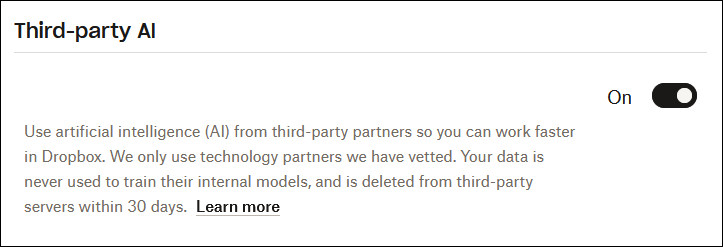
A screenshot of Dropbox's third-party AI feature switch.

Enlarge / A screenshot of Dropbox’s third-party AI feature switch.

Benj Edwards

So why would Dropbox ever send user data to OpenAI anyway? In July, the company announced an AI-powered feature called Dash that allows AI models to perform universal searches across platforms like Google Workspace and Microsoft Outlook.

According to the Dropbox privacy FAQ, the third-party AI opt-out setting is part of the “Dropbox AI alpha,” which is a conversational interface for exploring file contents that involves chatting with a ChatGPT-style bot using an “Ask something about this file” feature. To make it work, an AI language model similar to the one that powers ChatGPT (like GPT-4) needs access to your files.

According to the FAQ, the third-party AI toggle in your account settings is turned on by default if “you or your team” are participating in the Dropbox AI alpha. Still, multiple Ars Technica staff who had no knowledge of the Dropbox AI alpha found the setting enabled by default when they checked.

In a statement to Ars Technica, a Dropbox representative said, “The third-party AI toggle is only turned on to give all eligible customers the opportunity to view our new AI features and functionality, like Dropbox AI. It does not enable customers to use these features without notice. Any features that use third-party AI offer disclosure of third-party use, and link to settings that they can manage. Only after a customer sees the third-party AI transparency banner and chooses to proceed with asking a question about a file, will that file be sent to a third-party to generate answers. Our customers are still in control of when and how they use these features.”

Right now, the only third-party AI provider for Dropbox is OpenAI, writes Dropbox in the FAQ. “Open AI is an artificial intelligence research organization that develops cutting-edge language models and advanced AI technologies. Your data is never used to train their internal models, and is deleted from OpenAI’s servers within 30 days.” It also says, “Only the content relevant to an explicit request or command is sent to our third-party AI partners to generate an answer, summary, or transcript.”

Disabling the feature is easy if you prefer not to use Dropbox AI features. Log into your Dropbox account on a desktop web browser, then click your profile photo > Settings > Third-party AI. This link may take you to that page more quickly. On that page, click the switch beside “Use artificial intelligence (AI) from third-party partners so you can work faster in Dropbox” to toggle it into the “Off” position.

This story was updated on December 13, 2023, at 5: 35 pm ET with clarifications about when and how Dropbox shares data with OpenAI, as well as statements from Dropbox reps and its CEO.

Dropbox spooks users with new AI features that send data to OpenAI when used Read More »