AI bubble

openai-to-test-ads-in-chatgpt-as-it-burns-through-billions

OpenAI to test ads in ChatGPT as it burns through billions

Financial pressures and a changing tune

OpenAI’s advertising experiment reflects the enormous financial pressures facing the company. OpenAI does not expect to be profitable until 2030 and has committed to spend about $1.4 trillion on massive data centers and chips for AI.

According to financial documents obtained by The Wall Street Journal in November, OpenAI expects to burn through roughly $9 billion this year while generating $13 billion in revenue. Only about 5 percent of ChatGPT’s 800 million weekly users pay for subscriptions, so it’s not enough to cover all of OpenAI’s operating costs.

Not everyone is convinced ads will solve OpenAI’s financial problems. “I am extremely bearish on this ads product,” tech critic Ed Zitron wrote on Bluesky. “Even if this becomes a good business line, OpenAI’s services cost too much for it to matter!”

OpenAI’s embrace of ads appears to come reluctantly, since it runs counter to a “personal bias” against advertising that Altman has shared in earlier public statements. For example, during a fireside chat at Harvard University in 2024, Altman said he found the combination of ads and AI “uniquely unsettling,” implying that he would not like it if the chatbot itself changed its responses due to advertising pressure. He added: “When I think of like GPT writing me a response, if I had to go figure out exactly how much was who paying here to influence what I’m being shown, I don’t think I would like that.”

An example mock-up of an advertisement in ChatGPT provided by OpenAI.

An example mock-up of an advertisement in ChatGPT provided by OpenAI.

An example mock-up of an advertisement in ChatGPT provided by OpenAI. Credit: OpenAI

Along those lines, OpenAI’s approach appears to be a compromise between needing ad revenue and not wanting sponsored content to appear directly within ChatGPT’s written responses. By placing banner ads at the bottom of answers separated from the conversation history, OpenAI appears to be addressing Altman’s concern: The AI assistant’s actual output, the company says, will remain uninfluenced by advertisers.

Indeed, Simo wrote in a blog post that OpenAI’s ads will not influence ChatGPT’s conversational responses and that the company will not share conversations with advertisers and will not show ads on sensitive topics such as mental health and politics to users it determines to be under 18.

“As we introduce ads, it’s crucial we preserve what makes ChatGPT valuable in the first place,” Simo wrote. “That means you need to trust that ChatGPT’s responses are driven by what’s objectively useful, never by advertising.”

OpenAI to test ads in ChatGPT as it burns through billions Read More »
tech-giants-pour-billions-into-anthropic-as-circular-ai-investments-roll-on

Tech giants pour billions into Anthropic as circular AI investments roll on

On Tuesday, Microsoft and Nvidia announced plans to invest in Anthropic under a new partnership that includes a $30 billion commitment by the Claude maker to use Microsoft’s cloud services. Nvidia will commit up to $10 billion to Anthropic and Microsoft up to $5 billion, with both companies investing in Anthropic’s next funding round.

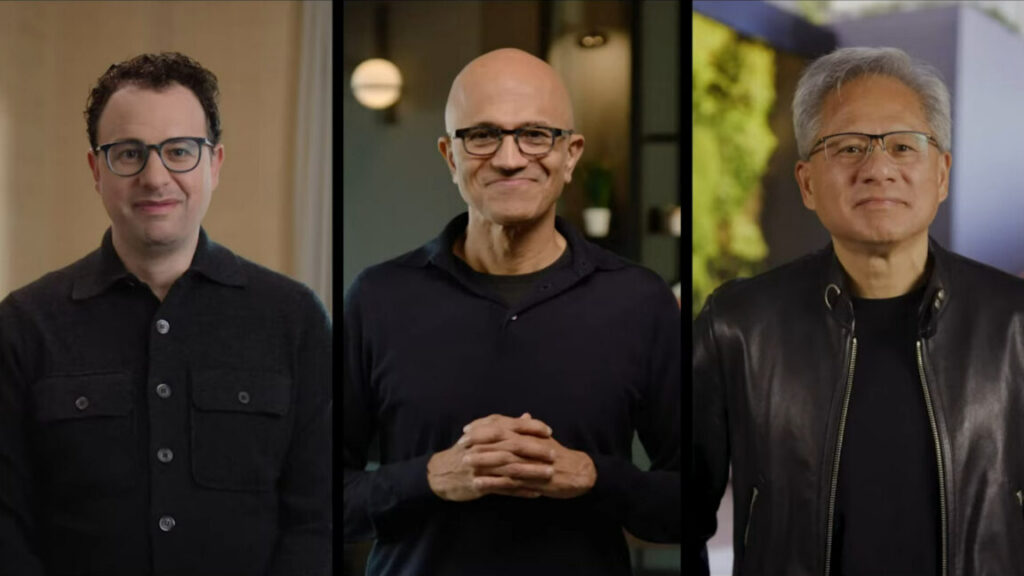
The deal brings together two companies that have backed OpenAI and connects them more closely to one of the ChatGPT maker’s main competitors. Microsoft CEO Satya Nadella said in a video that OpenAI “remains a critical partner,” while adding that the companies will increasingly be customers of each other.

“We will use Anthropic models, they will use our infrastructure, and we’ll go to market together,” Nadella said.

Anthropic, Microsoft, and NVIDIA announce partnerships.

The move follows OpenAI’s recent restructuring that gave the company greater distance from its non-profit origins. OpenAI has since announced a $38 billion deal to buy cloud services from Amazon.com as the company becomes less dependent on Microsoft. OpenAI CEO Sam Altman has said the company plans to spend $1.4 trillion to develop 30 gigawatts of computing resources.

Tech giants pour billions into Anthropic as circular AI investments roll on Read More »

ars-live:-is-the-ai-bubble-about-to-pop?-a-live-chat-with-ed-zitron.

Ars Live: Is the AI bubble about to pop? A live chat with Ed Zitron.

As generative AI has taken off since ChatGPT’s debut, inspiring hundreds of billions of dollars in investments and infrastructure developments, the top question on many people’s minds has been: Is generative AI a bubble, and if so, when will it pop?

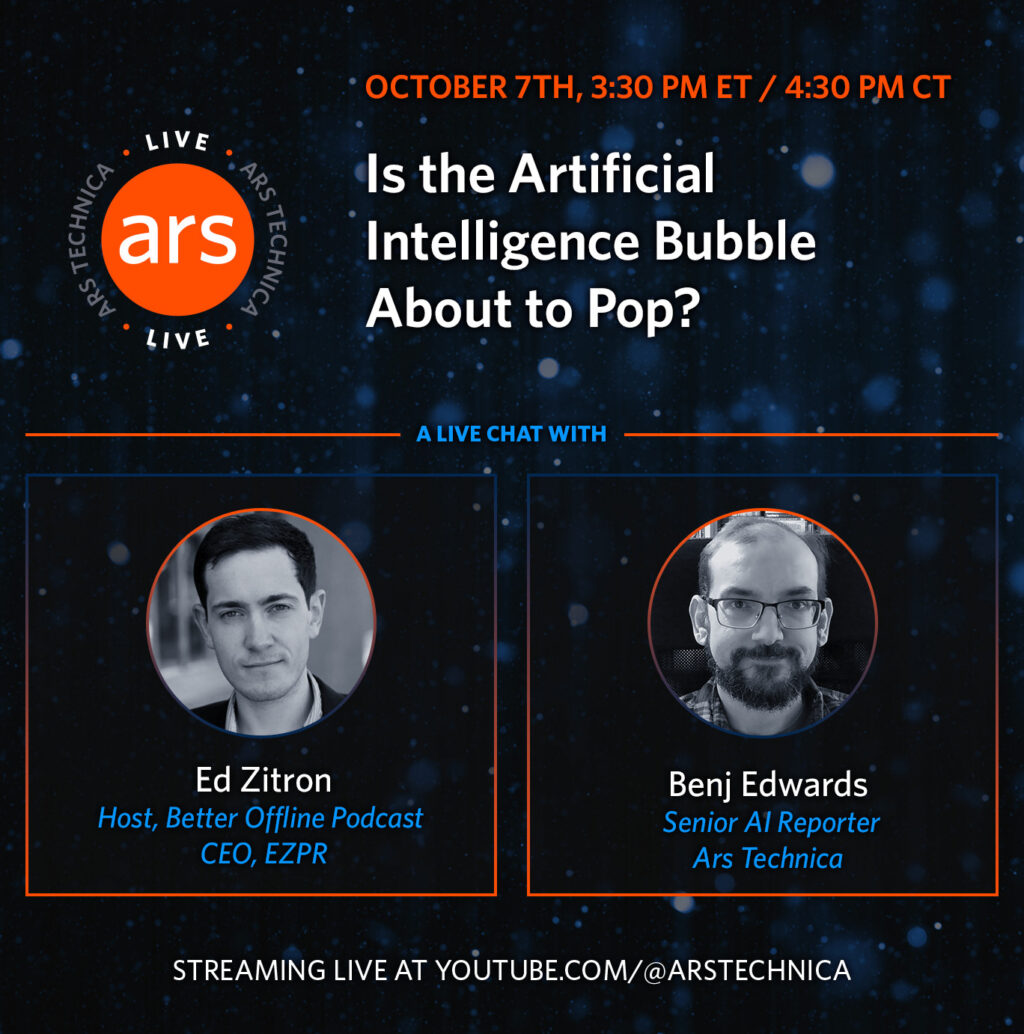
To help us potentially answer that question, I’ll be hosting a live conversation with prominent AI critic Ed Zitron on October 7 at 3: 30 pm ET as part of the Ars Live series. As Ars Technica’s senior AI reporter, I’ve been tracking both the explosive growth of this industry and the mounting skepticism about its sustainability.

You can watch the discussion live on YouTube when the time comes.

Zitron is the host of the Better Offline podcast and CEO of EZPR, a media relations company. He writes the newsletter Where’s Your Ed At, where he frequently dissects OpenAI’s finances and questions the actual utility of current AI products. His recent posts have examined whether companies are losing money on AI investments, the economics of GPU rentals, OpenAI’s trillion-dollar funding needs, and what he calls “The Subprime AI Crisis.”

Alt text for this image:

Credit: Ars Technica

During our conversation, we’ll dig into whether the current AI investment frenzy matches the actual business value being created, what happens when companies realize their AI spending isn’t generating returns, and whether we’re seeing signs of a peak in the current AI hype cycle. We’ll also discuss what it’s like to be a prominent and sometimes controversial AI critic amid the drumbeat of AI mania in the tech industry.

While Ed and I don’t see eye to eye on everything, his sharp criticism of the AI industry’s excesses should make for an engaging discussion about one of tech’s most consequential questions right now.

Please join us for what should be a lively conversation about the sustainability of the current AI boom.

Add to Google Calendar | Add to calendar (.ics download)

Ars Live: Is the AI bubble about to pop? A live chat with Ed Zitron. Read More »

is-the-ai-bubble-about-to-pop?-sam-altman-is-prepared-either-way.

Is the AI bubble about to pop? Sam Altman is prepared either way.

Still, the coincidence between Altman’s statement and the MIT report reportedly spooked tech stock investors earlier in the week, who have already been watching AI valuations climb to extraordinary heights. Palantir trades at 280 times forward earnings. During the dot-com peak, ratios of 30 to 40 times earnings marked bubble territory.

The apparent contradiction in Altman’s overall message is notable. This isn’t how you’d expect a tech executive to talk when they believe their industry faces imminent collapse. While warning about a bubble, he’s simultaneously seeking a valuation that would make OpenAI worth more than Walmart or ExxonMobil—companies with actual profits. OpenAI hit $1 billion in monthly revenue in July but is reportedly heading toward a $5 billion annual loss. So what’s going on here?

Looking at Altman’s statements over time reveals a potential multi-level strategy. He likes to talk big. In February 2024, he reportedly sought an audacious $5 trillion–7 trillion for AI chip fabrication—larger than the entire semiconductor industry—effectively normalizing astronomical numbers in AI discussions.

By August 2025, while warning of a bubble where someone will lose a “phenomenal amount of money,” he casually mentioned that OpenAI would “spend trillions on datacenter construction” and serve “billions daily.” This creates urgency while potentially insulating OpenAI from criticism—acknowledging the bubble exists while positioning his company’s infrastructure spending as different and necessary. When economists raised concerns, Altman dismissed them by saying, “Let us do our thing,” framing trillion-dollar investments as inevitable for human progress while making OpenAI’s $500 billion valuation seem almost small by comparison.

This dual messaging—catastrophic warnings paired with trillion-dollar ambitions—might seem contradictory, but it makes more sense when you consider the unique structure of today’s AI market, which is absolutely flush with cash.

A different kind of bubble

The current AI investment cycle differs from previous technology bubbles. Unlike dot-com era startups that burned through venture capital with no path to profitability, the largest AI investors—Microsoft, Google, Meta, and Amazon—generate hundreds of billions of dollars in annual profits from their core businesses.

Is the AI bubble about to pop? Sam Altman is prepared either way. Read More »