Rocket Report: ULA has a wild idea; Starliner crew will stay in orbit even longer
ULA’s Vulcan rocket is at least several months away from flying again, and Stoke names its engine.
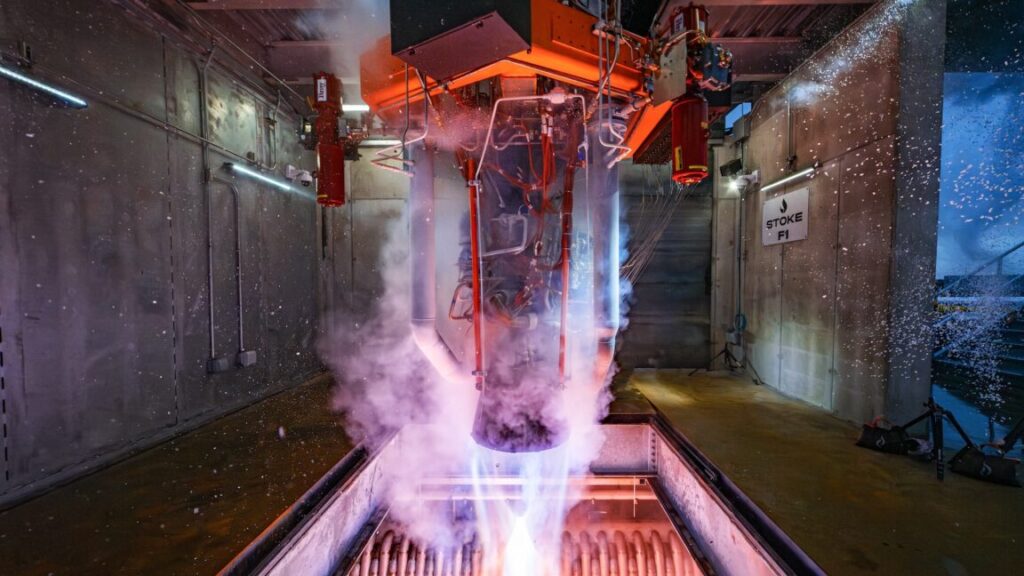
Stoke Space’s Zenith booster engine fires on a test stand at Moses Lake, Washington. Credit: Stoke Space
Welcome to Edition 7.24 of the Rocket Report! This is the last Rocket Report of the year, and what a year it’s been. So far, there have been 244 rocket launches to successfully reach orbit this year, a record for annual launch activity. And there are still a couple of weeks to go before the calendar turns to 2025. Time is running out for Blue Origin to launch its first heavy-lift New Glenn rocket this year, but if it flies before January 1, it will certainly be one of the top space stories of 2024.
As always, we welcome reader submissions. If you don’t want to miss an issue, please subscribe using the box below (the form will not appear on AMP-enabled versions of the site). Each report will include information on small-, medium-, and heavy-lift rockets as well as a quick look ahead at the next three launches on the calendar.

Corkscrew in the sky. A Japanese space startup said its second attempt to launch a rocket carrying small satellites into orbit had been terminated minutes after liftoff Wednesday and destroyed itself again, nine months after the company’s first launch attempt in an explosion, the Associated Press reports. The startup that developed the rocket, named Space One, launched the Kairos rocket from a privately owned coastal spaceport in Japan’s Kansai region. Company executive and space engineer Mamoru Endo said an abnormality in the first stage engine nozzle or its control system is likely to have caused an unstable flight of the rocket, which started spiraling in mid-flight and eventually destroyed itself about three minutes after liftoff, using its autonomous safety mechanism.
0-for-2 … The launch failure this week followed the first attempt to launch the Kairos rocket in March, when the launcher exploded just five seconds after liftoff. An investigation into the failed launch in March concluded the rocket’s autonomous destruct system activated after detecting its solid-fueled first stage wasn’t generating as much thrust as expected. The Kairos rocket is Japan’s first privately funded orbital-class rocket, capable of placing payloads up to 550 pounds (250 kilograms) into low-Earth orbit. (submitted by Jay500001, Ken the Bin, and EllPeaTea)
A fit check for Themis. ArianeGroup has brought the main elements of the Themis reusable booster demonstrator together for the first time in France during a “full-fit check,” European Spaceflight reports. This milestone paves the way for the demonstrator’s inaugural test, which is expected to take place in 2025. Themis, which is funded by the European Space Agency, is designed to test vertical launch and landing capabilities with a new methane-fueled rocket engine. According to ESA, the full-fit check is one of the final steps in the development phase of Themis.
Slow progress … ESA signed the contract with ArianeGroup for the Themis program in 2020, and at that time, the program’s schedule called for initial low-altitude hop tests in 2022. It’s now taken more than double the time officials originally projected to get the Themis rocket airborne. The first up-and-down hops will be based at the Esrange Space Center in Sweden, and will use the vehicle ArianeGroup is assembling now in France. A second Themis rocket will be built for medium-altitude tests from Esrange, and finally, a three-engine version of Themis will fly on high-altitude tests from the Guiana Space Center in South America. At the rate this program is proceeding, it’s fair to ask if Themis will complete a full-envelope launch and landing demonstration before the end of the decade, if it ever does. (submitted by Ken the Bin)
The easiest way to keep up with Eric Berger’s and Stephen Clark’s reporting on all things space is to sign up for our newsletter. We’ll collect their stories and deliver them straight to your inbox.
Baguette One is going critical. French launch startup HyPrSpace has announced that it has completed preliminary design reviews for its Baguette One and Orbital Baguette One (OB-1) rockets, European Spaceflight reports. Baguette One will be a suborbital demonstrator for the OB-1 rocket, designed to use a hybrid propulsion system that combines liquid and solid propellants and doesn’t require a turbopump. With the preliminary design complete, HyPrSpace said it is moving on to the critical design phase for both rockets, a stage of development where detailed engineering plans are finalized and components are prepared for manufacturing.
Heating the oven … HyPrSpace has previously stated the Orbital Baguette One rocket will be capable of delivering a payload of up to 550 pounds (250 kilograms) to low-Earth orbit. Last year, the startup announced it raised 35 million euros in funding, primarily from the French government, to complete the critical design phase of the OB-1 rocket and launch the Baguette One on a suborbital test flight. HyPrSpace has not provided an updated schedule for the first flight of either rocket. (submitted by Ken the Bin)
A new player on the scene. RTX weapons arm Raytheon and defense startup Ursa Major Technologies have completed two successful test flights of a missile propelled by a new solid rocket motor, Breaking Defense reports. The two test flights, held at Naval Air Weapons Station China Lake in California, involved a Raytheon-made missile propelled by an Ursa Major solid rocket motor measuring less than 10 inches in diameter, according to Dan Jablonsky, Ursa Major’s CEO. Details about the missile are shrouded in mystery, and Raytheon officials referred questions on the matter to the Army.
Joining the club … The US military is interested in fostering the development of a third supplier of solid rocket propulsion for weapons systems. Right now, only Northrop Grumman and L3Harris’s Aerojet Rocketdyne are available as solid rocket vendors, and they have struggled to keep up with the demand for weapons systems, especially to support the war in Ukraine. Ursa Major is one of several US-based startups entering the solid rocket propulsion market. “There is a new player on the scene in the solid rocket motor industry,” Jablonsky said. “This is an Army program that we’ve been working on with Raytheon. In this particular program, we went from concept and design to firing and flight on the range in just under four months, which is lightning fast.” (submitted by Ken the Bin)

SpaceX’s rapid response. In a mission veiled in secrecy, a SpaceX Falcon 9 rocket lifted off Monday from Cape Canaveral Space Force Station, Florida, sending a military Global Positioning System (GPS) satellite to a medium orbit about 12,000 miles above Earth, Space News reports. Named Rapid Response Trailblazer-1 (RRT-1), this mission was a US national security space launch and was also intended to demonstrate military capabilities to condense a typical two-year mission planning cycle to less than six months. The payload, GPS III SV-07, is the seventh satellite of the GPS III constellation, built by Lockheed Martin. The spacecraft was in storage awaiting a launch on United Launch Alliance’s Vulcan rocket.
Tightening the timeline … “We decided to pull SV-07 out of storage and try to get it to the launch pad as quickly as possible,” Col. James Horne, senior material leader for launch execution at the US Space Force’s Space Systems Command, told Space News. “It’s our way of demonstrating that we can be responsive to operator needs.” Rather than the typical mission cycle of two years, SpaceX, Lockheed Martin, and the Space Force worked together to prep this GPS satellite for launch in a handful of months. Military officials decided to launch SV-07 with SpaceX as ULA’s Vulcan rocket faced delays in becoming certified to launch national security payloads. According to Space News, Horne emphasized that this move was less about Vulcan delays and more about testing the boundaries of the NSSL program’s flexibility. “This is a way for us to demonstrate to adversaries that we can be responsive,” he said. Because SV-07 was switched to SpaceX, ULA will get to launch GPS III SV-10, originally assigned to SpaceX. (submitted by Ken the Bin and EllPeaTea)
An update on Butch and Suni. NASA has announced that it is delaying the SpaceX Crew-10 launch, a move that will keep astronauts Butch Wilmore and Suni Williams—who already had their stay aboard the International Space Station unexpectedly extended—in orbit even longer, CNN reports. Williams and Wilmore launched to space in June, piloting the first crewed test flight of Boeing’s Starliner spacecraft. Their trip, expected to last about a week, ballooned into a months-long assignment after their vehicle experienced technical issues en route to the space station and NASA determined it would be too risky to bring them home aboard the Starliner.
Nearly 10 months in orbit … The astronauts stayed aboard the space station as the Starliner spacecraft safely returned to Earth in September, and NASA shuffled the station’s schedule of visiting vehicles to allow Wilmore and Williams to come home on a SpaceX Dragon spacecraft with two crewmates to end the Crew-9 mission in February, soon after the arrival of Crew-10. Now, Crew-10 will get off the ground at least a month later than expected because NASA and SpaceX teams need “time to complete processing on a new Dragon spacecraft for the mission,” the space agency said. (submitted by Ken the Bin)
Stoke Space names its engine. Stoke Space, the only other company besides SpaceX developing a fully reusable orbital rocket, has revealed the name of the methane-fueled engine that will power the vehicle’s booster stage. “Say hello to Zenith, our full-flow staged-combustion booster engine, built to power Nova to orbit,” Stoke Space wrote in a post on X. The naming announcement came a few days after Stoke Space said it hot-fired the “Block 2” or “flight layout” version of the main engine on a test stand in Moses Lake, Washington.
Stoked by the progress … “As we build towards the future of space mobility, we’re building on top of the pinnacle–the zenith–of rocket engine cycles: full-flow staged combustion,” Stoke Space said. Only a handful of rocket engines have been designed to use the full-flow staged combustion cycle, and only one has actually flown on a rocket: SpaceX’s Raptor. Seven Zenith engines will power the first stage of the Nova rocket when it takes off from Cape Canaveral, Florida. A hydrogen-fueled propulsion system will power the second stage of Nova, which is designed to launch up to 5 metric tons (11,000 pounds) of payload to low-Earth orbit.
Upgrades coming for Vega. The European Space Agency (ESA) has signed 350 million euros in contracts with Avio to further evolve the Vega launcher family,” Aviation Week & Space Technology reports. The contracts cover the development of the Vega-E and upgrades to the current Vega-C’s ground infrastructure to increase the launch cadence. Vega-E, scheduled to debut in 2027, will replace the Vega-C rocket’s third and fourth stages with a single methane-fueled upper stage under development by Avio. It will also offer a 30 percent increase in Vega’s payload lift capability, and will launch from a new complex to be built on the former Ariane 5 launch pad at the European-run Guiana Space Center in South America.
Adaptations … The fresh tranche of funding from ESA will also pay for Avio’s work to “adapt” the former Ariane 5 integration building at the spaceport in French Guiana, according to ESA. “This will allow technicians to work on two rockets being assembled simultaneously–one on the launch pad and one in the new assembly building–and run two launch campaigns in parallel,” ESA said. (submitted by Ken the Bin and EllPeaTea)

New Glenn coming alive. In a widely anticipated test, Blue Origin will soon ignite the seven main engines on its New Glenn rocket at Launch Complex-36 in Florida, Ars reports. Sources indicated this hot-fire test might occur as soon as Thursday, but it didn’t happen. Instead, Blue Origin’s launch team loaded cryogenic propellants into the New Glenn rocket on the launch pad, but stopped short of igniting the main engines.
Racing the clock … The hot-fire is the final test the company must complete before verifying the massive rocket is ready for its debut flight, and it is the most dynamic. This will be the first time Blue Origin has ever test-fired the BE-7 engines altogether. Theoretically, at least, it remains possible that Blue Origin could launch New Glenn this year—and the company’s urgency certainly speaks to this. On social media this week, some Blue Origin employees noted that they were being asked to work on Christmas Day this year in Florida.
China begins building a new megaconstellation. The first batch of Internet satellites for China’s Guowang megaconstellation launched Monday on the country’s heavy-lift Long March 5B rocket, Ars reports. The satellites are the first of up to 13,000 spacecraft a consortium of Chinese companies plans to build and launch over the next decade. The Guowang fleet will beam low-latency high-speed Internet signals in an architecture similar to SpaceX’s Starlink network, although Chinese officials haven’t laid out any specifics, such as target markets, service specifications, or user terminals.
No falling debris, this time … China used its most powerful operational rocket, the Long March 5B, for the job of launching the first 10 Guowang satellites this week. The Long March 5B’s large core stage, which entered orbit on the rocket’s previous missions and triggered concerns about falling space debris, fell into a predetermined location in the sea downrange from the launch site. The difference for this mission was the addition of the Yuanzheng 2 upper stage, which gave the rocket’s payloads the extra oomph they needed to reach their targeted low-Earth orbit. (submitted by Ken the Bin and EllPeaTea)
Elon Musk’s security clearance under review. A new investigation from The New York Times suggests that SpaceX founder Elon Musk has not been reporting his travel activities and other information to the Department of Defense as required by his top-secret clearance, Ars reports. According to the newspaper, concerns about Musk’s reporting practices have led to reviews by three different bodies within the military: the Air Force, the Office of the Under Secretary of Defense for Intelligence and Security, and the Defense Department Office of Inspector General. However, none of the federal agencies cited in the Times article has accused Musk of disclosing classified material.
It won’t matter … Since 2021, Musk has failed to self-report details of his life, including travel activities, people he has met, and drug use, according to the Times. The government is also concerned that SpaceX did not ensure Musk’s compliance with the reporting rules. Musk’s national security profile has risen following his deep-pocketed and full-throated support of Donald Trump, who won the US presidential campaign in November and will be sworn into office next month. After this inauguration, Trump will have the power to grant security clearance to whomever he wishes.
ULA’s CEO has a pretty wild idea. Ars published a feature story last week examining the US Space Force’s new embrace of offensive weapons in space. In the story, Ars discusses concepts for different types of space weapons, including placing roving “defender” satellites into orbit, with the sole purpose of guarding high-value US satellites against an attack. Tory Bruno, CEO of United Launch Alliance, wrote about the defender concept in a Medium post earlier this month. He added more detail in a recent conversation with reporters, describing the defender concept as “a lightning-fast, long-range, lethal, if necessary, vehicle to defend our assets on orbit.” And guess what? The Centaur upper stage for ULA’s own Vulcan rocket could do the job just fine, according to Bruno.
Death throes or a smart pivot? … A space tug or upper stage like the Centaur could be left in orbit after a launch to respond to threats against US or allied satellites, Bruno said. These wouldn’t be able to effectively defend a spacecraft against a ground-based anti-satellite missile, which can launch without warning. But a space-based attack might involve an enemy satellite taking days or weeks to move close to a US satellite due to limitations in maneuverability and the tyranny of orbital mechanics. Several launch companies have recently pitched their rockets as solutions for weapons testing, including Rocket Lab and ABL. But the concept proposed by Bruno would take ULA far from its core business, where its efforts to compete with SpaceX have often fallen short. However, the competition is still alive, as shown by a comment from SpaceX’s vice president of Falcon launch vehicles, Jon Edwards. In response to Ars’s story, Edwards wrote on X: “The pivot to ‘interceptor’ or ‘target vehicle’ is a common final act of a launch vehicle in its death throes.” (submitted by Ken the Bin)
Vulcan is months away from flying again. Speaking of ULA, here’s an update on the next flight of the company’s Vulcan rocket. The first national security mission on Vulcan might not launch until April 2025 at the earliest, Spaceflight Now reports. This will be the third flight of a Vulcan rocket, following two test flights this year to gather data for the US Space Force to certify the rocket for national security missions. On the second flight, the nozzle fell off one of Vulcan’s solid rocket boosters shortly after liftoff, but the rocket successfully continued its climb into orbit. The anomaly prompted an investigation, and ULA says it is close to determining the root cause.
Stretching the timeline … The Space Force’s certification review of Vulcan is taking longer than anticipated. “The government team has not completed its technical evaluation of the certification criteria and is working closely with ULA on additional data required to complete this evaluation,” a Space Force spokesperson told Spaceflight Now. “The government anticipates completion of its evaluation and certification in the first quarter of calendar year 2025.” The spokesperson said this means the launch of a US military navigation test satellite on the third Vulcan rocket is now slated for the second quarter of next year. (submitted by Ken the Bin and EllPeaTea)
Next three launches
Dec. 21: Falcon 9 | “Astranis: From One to Many” | Cape Canaveral Space Force Station, Florida | 03: 39 UTC
Dec. 21: Falcon 9 | Bandwagon 2 | Vandenberg Space Force Base, California | 11: 34 UTC
Dec. 21: Electron | “Owl The Way Up” | Māhia Peninsula, New Zealand | 13: 00 UTC


Stephen Clark is a space reporter at Ars Technica, covering private space companies and the world’s space agencies. Stephen writes about the nexus of technology, science, policy, and business on and off the planet.
Rocket Report: ULA has a wild idea; Starliner crew will stay in orbit even longer Read More »