Author name: Tim Belzer

ex-fcc-chair-ajit-pai-is-now-a-wireless-lobbyist—and-enemy-of-cable-companies

Ex-FCC Chair Ajit Pai is now a wireless lobbyist—and enemy of cable companies


Pai’s return as CTIA lobbyist fuels industry-wide battle over spectrum rights.

Ajit Pai, former chairman of the Federal Communications Commission, during a Senate Commerce Committee hearing on Wednesday, April 9, 2025. Credit: Getty Images | Bloomberg

Ajit Pai is back on the telecom policy scene as chief lobbyist for the mobile industry, and he has quickly managed to anger a coalition that includes both cable companies and consumer advocates.

Pai was the Federal Communications Commission chairman during President Trump’s first term and then spent several years at private equity firm Searchlight Capital. He changed jobs in April, becoming the president and CEO of wireless industry lobby group CTIA. Shortly after, he visited the White House to discuss wireless industry priorities and had a meeting with Brendan Carr, the current FCC chairman who was part of Pai’s Republican majority at the FCC from 2017 to 2021.

Pai’s new job isn’t surprising. He was once a lawyer for Verizon, and it’s not uncommon for FCC chairs and commissioners to be lobbyists before or after terms in government.

Pai’s move to CTIA means he is now battling a variety of industry players and advocacy groups over the allocation of spectrum. As always, wireless companies AT&T, Verizon, and T-Mobile want more spectrum and the exclusive rights to use it. The fight puts Pai at odds with the cable industry that cheered his many deregulatory actions when he led the FCC.

Pai wrote a May 4 op-ed in The Wall Street Journal arguing that China is surging ahead of the US in 5G deployment and that “the US doesn’t even have enough licensed spectrum available to keep up with expected consumer demand.” He said that Congress must restore the FCC’s lapsed authority to auction spectrum licenses, and auction off “at least 600 megahertz of midband spectrum for future 5G services.”

“During the first Trump administration, the US was determined to lead the world in wireless innovation—and by 2021 it did,” Pai wrote. “But that urgency and sense of purpose have diminished. With Mr. Trump’s leadership, we can rediscover both.”

Pai’s op-ed drew a quick rebuke from a group called Spectrum for the Future, which alleged that Pai mangled the facts.

“Mr. Pai’s arguments are wrong on the facts—and wrong on how to accelerate America’s global wireless leadership,” the vaguely named group said in a May 8 press release that accused Pai of “stunning hypocrisy.” Spectrum for the Future said Pai is wrong about the existence of a spectrum shortage, wrong about how much money a spectrum auction could raise, and wrong about the cost of reallocating spectrum from the military to mobile companies.

“Mr. Pai attributes the US losing its lead in 5G availability to the FCC’s lapsed spectrum auction authority. He’d be more accurate to blame his own members’ failure to build out their networks,” the group said.

Big Cable finds allies

Pai’s op-ed said that auctioning 600 MHz “could raise as much as $200 billion” to support other US government priorities. Spectrum for the Future called this an “absurd claim” that “presumes that this auction of 600 MHz could approach the combined total ($233 billion) that has been raised by every prior spectrum auction (totaling nearly 6 GHz of bandwidth) in US history combined.”

The group also said Pai “completely ignores the immense cost to taxpayers to relocate incumbent military and intelligence systems out of the bands CTIA covets for its own use.” Spectrum for the Future didn’t mention that one of the previous auctions, for the 3.7–3.98 GHz band, netted over $81 billion in winning bids.

So who is behind Spectrum for the Future? The group’s website lists 18 members , including the biggest players in the cable industry. Comcast, Charter, Cox, and lobby group NCTA-The Internet & Television Association are all members of Spectrum for the Future. (Disclosure: The Advance/Newhouse Partnership, which owns 12 percent of Charter, is part of Advance Publications, which owns Ars Technica parent Condé Nast.)

When contacted by Ars, a CTIA spokesperson criticized cable companies for “fighting competition” and said the cable firms are being “disingenuous.” Charter and Cox declined to answer our questions about their involvement in Spectrum for the Future. Comcast and the NCTA didn’t respond to requests for comment.

The NCTA and big cable companies are no strangers to lobbying the FCC and Congress and could fight for CBRS entirely on their own. But as it happens, some consumer advocates who regularly oppose the cable industry on other issues are on cable’s side in this battle.

With Spectrum for the Future, the cable industry has allied not just with consumer advocates but also small wireless ISPs and operators of private networks that use spectrum the big mobile companies want for themselves. Another group that is part of the coalition represents schools and libraries that use spectrum to provide local services.

For cable, joining with consumer groups, small ISPs, and others in a broad coalition has an obvious advantage from a public relations standpoint. “This is a lot of different folks who are in it for their own reasons. Sometimes that’s a big advantage because it makes it more authentic,” said Harold Feld, senior VP of consumer advocacy group Public Knowledge, which is part of Spectrum of the Future.

In some cases, a big company will round up nonprofits to which it has donated to make a show of broad public support for one of the company’s regulatory priorities—like a needed merger approval. That’s not what happened here, according to Feld. While cable companies probably provided most of the funding for Spectrum for the Future, the other members are keenly interested in fighting the wireless lobby over spectrum access.

“There’s a difference between cable being a tentpole member and this being cable with a couple of friends on the side,” Feld told Ars. Cable companies “have the most to lose, they have the most initial resources. But all of these other guys who are in here, I’ve been on these calls, they’re pretty active. There are a lot of diverse interests in this, which sometimes makes it easier to lobby, sometimes makes it harder to lobby because you all want to talk about what’s important to you.”

Feld didn’t help write the group’s press release criticizing Pai but said the points made are “all things I agree with.”

The “everybody but Big Mobile” coalition

Public Knowledge and New America’s Open Technology Institute (OTI), another Spectrum for the Future member, are both longtime proponents of shared spectrum. OTI’s Wireless Future Project director, Michael Calabrese, told Ars that Spectrum for the Future is basically the “everybody but Big Mobile” wireless coalition and “a very broad but ad hoc coalition.”

While Public Knowledge and OTI advocate for shared spectrum in many frequency bands, Spectrum for the Future is primarily focused on one: the Citizens Broadband Radio Service (CBRS), which spans from 3550 MHz to 3700 MHz. The CBRS spectrum is used by the Department of Defense and shared with non-federal users.

CBRS users in the cable industry and beyond want to ensure that CBRS remains available to them and free of high-power mobile signals that would crowd out lower-power operations. They were disturbed by AT&T’s October 2024 proposal to move CBRS to the lower part of the 3 GHz band, which is also used by the Department of Defense, and auction existing CBRS frequencies to 5G wireless companies “for licensed, full-power use.”

The NCTA told the FCC in December that “AT&T’s proposal to reallocate the entire 3 GHz band is unwarranted, impracticable, and unworkable and is based on the false assertion that the CBRS band is underutilized.”

Big mobile companies want the CBRS spectrum because it is adjacent to frequencies that are already licensed to them. The Department of Defense seems to support AT&T’s idea, even though it would require moving some military operations and sharing the spectrum with non-federal users.

Pentagon plan similar to AT&T’s

In a May research note provided to Ars, New Street Research Policy Advisor Blair Levin reported some details of a Department of Defense proposal for several bands of spectrum, including CBRS. The White House asked the Department of Defense “to come up with a plan to enable allocation of mid-band exclusive-use spectrum,” and the Pentagon recently started circulating its initial proposal.

The Pentagon plan is apparently similar to AT&T’s, as it would reportedly move current CBRS licensees and users to the lower 3 GHz band to clear spectrum for auctions.

“It represents the first time we can think of where the government would change the license terms of one set of users to benefit a competitor of that first set of users… While the exclusive-use spectrum providers would see this as government exercising its eminent domain rights as it has traditionally done, CBRS users, particularly cable, would see this as the equivalent of a government exercis[ing] its eminent domain rights to condemn and tear down a Costco to give the land to a Walmart,” Levin wrote.

If the proposal is implemented, cable companies would likely sue the government “on the grounds that it violates their property rights” under the priority licenses they purchased to use CBRS, Levin wrote. Levin’s note said he doesn’t think this proposal is likely to be adopted, but it shows that “the game is afoot.”

CBRS is important to cable companies because they have increasingly focused on selling mobile service as another revenue source on top of their traditional TV and broadband businesses. Cable firms got into the mobile business by reselling network access from the likes of Verizon. They’ve been increasing the use of CBRS, reducing their reliance on the major mobile companies, although a recent Light Reading article indicates that cable’s progress with CBRS deployment has been slow.

Then-FCC Chairman Ajit Pai and FCC commissioner Brendan Carr stand next to each other in a Senate committee hearing room in 2018.

Then-FCC Chairman Ajit Pai with FCC Commissioner Brendan Carr before the start of a Senate Commerce Committee hearing on Thursday, Aug. 16, 2018.

Credit: Getty Images | Bill Clark

Then-FCC Chairman Ajit Pai with FCC Commissioner Brendan Carr before the start of a Senate Commerce Committee hearing on Thursday, Aug. 16, 2018. Credit: Getty Images | Bill Clark

In its statement to Ars, CTIA said the cable industry “opposes full-power 5G access in the US at every opportunity” in CBRS and other spectrum bands. Cable companies are “fighting competition” from wireless operators “every chance they can,” CTIA said. “With accelerating losses in the marketplace, their advocacy is now more aggressive and disingenuous.”

The DoD plan that reportedly mirrors AT&T’s proposal seems to represent a significant change from the Biden-era Department of Defense’s stance. In September 2023, the department issued a report saying that sharing the 3.1 GHz band with non-federal users would be challenging and potentially cause interference, even if rules were in place to protect DoD operations.

“DoD is concerned about the high possibility that non-Federal users will not adhere to the established coordination conditions at all times; the impacts related to airborne systems, due to their range and speed; and required upgrades to multiple classes of ships,” the 2023 report said. We contacted the Department of Defense and did not receive a response.

Levin quoted Calabrese as saying the new plan “would pull the rug out from under more than 1,000 CBRS operators that have deployed more than 400,000 base stations. While they could, in theory, share DoD spectrum lower in the band, that spectrum will now be so congested it’s unclear how or when that could be implemented.”

Small ISP slams “AT&T and its cabal of telecom giants”

AT&T argues that CBRS spectrum is underutilized and should be repurposed for commercial mobile use because it “resides between two crucial, high-power, licensed 5G bands”—specifically 3.45–3.55 GHz and 3.7–3.98 GHz. It said its proposal would expand the CBRS band’s total size from 150 MHz to 200 MHz by relocating it to 3.1–3.3 GHz.

Keefe John, CEO of a Wisconsin-based wireless home Internet provider called Ethoplex, argued that “AT&T and its cabal of telecom giants” are “scheming to rip this resource from the hands of small operators and hand it over to their 5G empire. This is nothing less than a brazen theft of America’s digital future, and we must fight back with unrelenting resolve.”

John is vice chairperson of the Wireless Internet Service Providers Association (WISPA), which represents small ISPs and is a member of Spectrum for the Future. He wrote that CBRS is a “vital spectrum band that has become the lifeblood of rural connectivity” because small ISPs use it to deliver fixed wireless Internet service to underserved areas.

John called the AT&T proposal “a deliberate scheme to kneecap WISPs, whose equipment, painstakingly deployed, would be rendered obsolete in the lower band.” Instead of moving CBRS from one band to another, John said CBRS should stay on its current spectrum and expand into additional spectrum “to ensure small providers have a fighting chance.”

An AT&T spokesperson told Ars that “CBRS can coexist with incumbents in the lower 3 GHz band, and with such high demand for spectrum, it should. Thinking creatively about how to most efficiently use scarce spectrum to meet crucial needs is simply good public policy.”

AT&T said that an auction “would provide reimbursement for costs associated with” moving CBRS users to other spectrum and that “the Department of Defense has already stated that incumbents in the lower 3 GHz could share with low-power commercial uses.”

“Having a low-power use sandwiched between two high-power use cases is an inefficient use of spectrum that doesn’t make sense. Our proposal would fix that inefficiency,” AT&T said.

AT&T has previously said that under its proposal, CBRS priority license holders “would have the choice of relocating to the new CBRS band, accepting vouchers they can use toward bidding on new high-power licenses, or receiving a cash payment in exchange for the relinquishment of their priority rights.”

Democrat warns of threat to naval operations

Reallocating spectrum could require the Navy to move from the current CBRS band to the lower part of 3 GHz. US Senator Maria Cantwell (D-Wash.) sent a letter urging the Department of Defense to avoid major changes, saying the current sharing arrangement “allows the Navy to continue using high-power surveillance and targeting radars to protect vessels and our coasts, while also enabling commercial use of the band when and where the Navy does not need access.”

Moving CBRS users would “disrupt critical naval operations and homeland defense” and “undermine an innovative ecosystem of commercial wireless technology that will be extremely valuable for robotic manufacturing, precision agriculture, ubiquitous connectivity in large indoor spaces, and private wireless networks,” Cantwell wrote.

Cantwell said she is also concerned that “a substantial number of military radar systems that operate in the lower 3 GHz band” will be endangered by moving CBRS. She pointed out that the DoD’s September 2023 report said the 3.1 GHz range has “unique spectrum characteristics” that “provide long detection ranges, tracking accuracy, and discrimination capability required for DoD radar systems.” The spectrum “is low enough in the frequency range to maintain a high-power aperture capability in a transportable system” and “high enough in the frequency range that a sufficient angular accuracy can be maintained for a radar track function for a fire control capability,” the DoD report said.

Spectrum for the Future members

In addition to joining the cable industry in Spectrum for the Future, public interest groups are fighting for CBRS on their own. Public Knowledge and OTI teamed up with the American Library Association, the Benton Institute for Broadband & Society, the Schools Health & Libraries Broadband (SHLB) Coalition, and others in a November 2024 FCC filing that praised the pro-consumer virtues of CBRS.

“CBRS has been the most successful innovation in wireless technology in the last decade,” the groups said. They accused the big three mobile carriers of “seeking to cripple CBRS as a band that promotes not only innovation, but also competition.”

These advocacy groups are interested in helping cable companies and small home Internet providers compete against the big three mobile carriers because that opens new options for consumers. But the groups also point to many other use cases for CBRS, writing:

CBRS has encouraged the deployment of “open networks” designed to host users needing greater flexibility and control than that offered by traditional CMRS [Commercial Mobile Radio Services] providers, at higher power and with greater interference protection than possible using unlicensed spectrum. Manufacturing campuses (such as John Deere and Dow Chemical), transit hubs (Miami International Airport, Port of Los Angeles), supply chain and logistic centers (US Marine Corps), sporting arenas (Philadelphia’s Wells Fargo Center), school districts and libraries (Fresno Unified School District, New York Public Library) are all examples of a growing trend toward local spectrum access fueling purpose-built private LTE/5G networks for a wide variety of use cases.

The SHLB told Ars that “CBRS spectrum plays a critical role in helping anchor institutions like schools and libraries connect their communities, especially in rural and underserved areas where traditional broadband options may be limited. A number of our members rely on access to shared and unlicensed spectrum to deliver remote learning and essential digital services, often at low or no cost to the user.”

Spectrum for the Future’s members also include companies that sell services to help customers deploy CBRS networks, as well as entities like Miami International Airport that deploy their own CBRS-based private cellular networks. The NCTA featured Miami International Airport’s private network in a recent press release, saying that CBRS helped the airport “deliver more reliable connectivity for visitors while also powering a robust Internet of Things network to keep the airport running smoothly.”

Spectrum for the Future doesn’t list any staff on its website. Media requests are routed to a third-party public relations firm. An employee of the public relations firm declined to answer our questions about how Spectrum for the Future is structured and operated but said it is “a member-driven coalition with a wide range of active supporters and contributors, including innovators, anchor institutions, and technology companies.”

Spectrum for the Future appears to be organized by Salt Point Strategies, a public affairs consulting firm. Salt Point Spectrum Policy Analyst David Wright is described as Spectrum for the Future’s policy director in an FCC filing. We reached out to Wright and didn’t receive a response.

One Big Beautiful Bill is a battleground

Senator Ted Cruz at a Senate committee hearing, sitting in his seat and using his hand to move a nameplate that says

Senate Commerce Committee Chairman Ted Cruz (R-Texas) at a hearing on Tuesday, January 28, 2025.

Credit: Getty Images | Tom Williams

Senate Commerce Committee Chairman Ted Cruz (R-Texas) at a hearing on Tuesday, January 28, 2025. Credit: Getty Images | Tom Williams

The Trump-backed “One Big Beautiful Bill,” approved by the House, is one area of interest for both sides of the CBRS debate. The bill would restore the FCC’s expired authority to auction spectrum and require new auctions. One question is whether the bill will simply require the FCC to auction a minimum amount of spectrum or if it will require specific bands to be auctioned.

WISPA provided us with a statement about the version that passed the House, saying the group is glad it “excludes the 5.9 GHz and 6 GHz bands from its call to auction off 600 megahertz of spectrum” but worried because the bill “does not exclude the widely used and previously auctioned Citizens Broadband Radio Service (CBRS) band from competitive bidding, leaving it vulnerable to sale and/or major disruption.”

WISPA said that “spectrum auctions are typically designed to favor large players” and “cut out small and rural providers who operate on the front lines of the digital divide.” WISPA said that over 60 percent of its members “use CBRS to deliver high-quality broadband to hard-to-serve and previously unserved Americans.”

On June 5, Sen. Ted Cruz (R-Texas) released the text of the Senate Commerce Committee proposal, which also does not exclude the 3550–3700 MHz from potential auctions. Pai and AT&T issued statements praising Cruz’s bill.

Pai said that Cruz’s “bold approach answers President Trump’s call to keep all options on the table and provides the President with full flexibility to identify the right bands to meet surging consumer demand, safeguard our economic competitiveness, and protect national security.” AT&T said that “by renewing the FCC’s auction authority and creating a pipeline of mid-band spectrum, the Senate is taking a strong step toward meeting consumers’ insatiable demand for mobile data.”

The NCTA said it welcomed the plan to restore the FCC’s auction authority but urged lawmakers to “reject the predictable calls from large mobile carriers that seek to cripple competition and new services being offered over existing Wi-Fi and CBRS bands.”

Licensed, unlicensed, and in-between

Spectrum is generally made available on a licensed or unlicensed basis. Wireless carriers pay big bucks for licenses that grant them exclusive use of spectrum bands on which they deploy nationwide cellular networks. Unlicensed spectrum—like the bands used in Wi-Fi—can be used by anyone without a license as long as they follow rules that prevent interference with other users and services.

The FCC issued rules for the CBRS band in 2015 during the Obama administration, using a somewhat different kind of system. The FCC rules allow “for dynamic spectrum sharing in the 3.5 GHz band between the Department of Defense (DoD) and commercial spectrum users,” the National Telecommunications and Information Administration notes. “DoD users have protected, prioritized use of the spectrum. When the government isn’t using the airwaves, companies and the public can gain access through a tiered framework.”

Instead of a binary licensed-versus-unlicensed system, the FCC implemented a three-tiered system of access. Tier 1 is for incumbent users of the band, including federal users and fixed satellite service. Tier 1 users receive protection against harmful interference from Tier 2 and Tier 3 users.

Tier 2 of CBRS consists of Priority Access Licenses (PALs) that are distributed on a county-by-county basis through competitive bidding. Tier 2 users get interference protection from users of Tier 3, which is made available in a manner similar to unlicensed spectrum.

Tier 3 “is licensed-by-rule to permit open, flexible access to the band for the widest possible group of potential users,” the FCC says. Tier 3 users can operate throughout the 3550–3700 MHz band but “must not cause harmful interference to Incumbent Access users or Priority Access Licensees and must accept interference from these users. GAA users also have no expectation of interference protection from other GAA users.”

The public interest groups’ November 2024 filing with the FCC said the unique approach to spectrum sharing “allow[s] all would-be users to operate where doing so does not threaten harmful interference” and provides a happy medium between high-powered operations in exclusively licensed spectrum bands and low-powered operations in unlicensed spectrum.

CTIA wants the ability to send higher-power signals in the band, arguing that full-power wireless transmissions would help the US match the efforts of other countries “where this spectrum has been identified as central to 5G.” The public interest groups urged the FCC to reject the mobile industry proposal to increase power levels, saying it “would disrupt and diminish the expanding diversity of GAA users and use cases that represent the central purpose of CBRS’s innovative three-tier, low-power and coordinated sharing framework.”

Pai helped carriers as FCC chair

The FCC’s original plan for PALs during the Obama administration was to auction them off for individual Census tracts, small areas containing between 1,200 and 8,000 people each. During President Trump’s first term, the Pai FCC granted a CTIA request to boost the size of license areas from census tracts to counties, making it harder for small companies to win at auction.

The FCC auctioned PALs in 2020, getting bids of nearly $4.6 billion from 228 bidders. The biggest winners were Verizon, Dish Network, Charter, Comcast, and Cox.

Although Verizon uses CBRS for parts of its network, that doesn’t mean it’s on the same side as cable users in the policy debate. Verizon urged the FCC to increase the allowed power levels in the band. Dish owner EchoStar also asked for power increases. Cable companies oppose raising the power levels, with the NCTA saying that doing so would “jeopardize the continued availability of the 3.5 GHz band for lower-power operations” and harm both federal and non-federal users.

As head of CTIA, one of Pai’s main jobs is to obtain more licensed spectrum for the exclusive use of AT&T, Verizon, T-Mobile, and other mobile companies that his group represents. Pai’s Wall Street Journal op-ed said that “traffic on wireless networks is expected to triple by 2029,” driven by “AI, 5G home broadband and other emerging technologies.” Pai cited a study commissioned by CTIA to argue that “wireless networks will be unable to meet a quarter of peak demand in as little as two years.”

Spectrum for the Future countered that Pai “omits that the overwhelming share of this traffic will travel over Wi-Fi, not cellular networks.” CTIA told Ars that “the Ericsson studies we use for traffic growth projections only consider demand over commercial networks using licensed spectrum.”

Spectrum for the Future pointed to statements made by the CEOs of wireless carriers that seem to contradict Pai’s warnings of a spectrum shortage:

Mr. Pai cites a CTIA-funded study to claim “wireless networks will be unable to meet a quarter of peak demand in as little as two years.” If that’s true, then why are his biggest members’ CEOs telling Wall Street the exact opposite?

Verizon’s CEO insists he’s sitting on “a generation of spectrum”—”years and years and years” of spectrum capacity still to deploy. The CEO of Verizon’s consumer group goes even further, insisting they have “almost unlimited spectrum.” T-Mobile agrees, bragging that it has “only deployed 60 percent of our mid-band spectrum on 5G,” leaving “lots of spectrum we haven’t put into the fight yet.”

Battle could last for years

Spectrum for the Future also scoffed at Pai’s comparison of the US to China. Pai’s op-ed said that China “has accelerated its efforts to dominate in wireless and will soon boast more than four times the amount of commercial midband spectrum than the US.” Pai added that “China isn’t only deploying 5G domestically. It’s exporting its spectrum policies, its equipment vendors (such as Huawei and ZTE), and its Communist Party-centric vision of innovation to the rest of the world.”

Spectrum for the Future responded that “China’s spectrum policy goes all-in on exclusive-license frameworks, such as 5G, because they limit spectrum access to just a small handful of regime-aligned telecom companies complicit in Beijing’s censorship regime… America’s global wireless leadership, by contrast, is fueled by spectrum innovations like unlicensed Wi-Fi and CBRS spectrum sharing, whose hardware markets are dominated by American and allied companies.”

Spectrum for the Future also said that Pai and CTIA “blasting China for ‘exporting its spectrum policies’—while asking the US to adopt the same approach—is stunning hypocrisy.”

CTIA’s statement to Ars disputed Spectrum for the Future’s description. “The system of auctioning spectrum licenses was pioneered in America but is not used in China. China does, however, allocate unlicensed spectrum in a similar manner to the United States,” CTIA told Ars.

The lobbying battle and potential legal war that has Pai and CTIA lined up against the “everybody but Big Mobile” wireless coalition could last throughout Trump’s second term. Levin’s research note about the DoD proposal said, “the path from adoption to auction to making the spectrum available to the winners of an auction is likely to be at least three years.” The fight could go on a lot longer if “current licensees object and litigate,” Levin wrote.

Photo of Jon Brodkin

Jon is a Senior IT Reporter for Ars Technica. He covers the telecom industry, Federal Communications Commission rulemakings, broadband consumer affairs, court cases, and government regulation of the tech industry.

Ex-FCC Chair Ajit Pai is now a wireless lobbyist—and enemy of cable companies Read More »

cybercriminals-turn-to-“residential-proxy”-services-to-hide-malicious-traffic

Cybercriminals turn to “residential proxy” services to hide malicious traffic

For years, gray market services known as “bulletproof” hosts have been a key tool for cybercriminals looking to anonymously maintain web infrastructure with no questions asked. But as global law enforcement scrambles to crack down on digital threats, they have developed strategies for getting customer information from these hosts and have increasingly targeted the people behind the services with indictments. At the cybercrime-focused conference Sleuthcon in in Arlington, Virginia on Friday, researcher Thibault Seret outlined how this shift has pushed both bulletproof hosting companies and criminal customers toward an alternative approach.

Rather than relying on web hosts to find ways of operating outside law enforcement’s reach, some service providers have turned to offering purpose-built VPNs and other proxy services as a way of rotating and masking customer IP addresses and offering infrastructure that either intentionally doesn’t log traffic or mixes traffic from many sources together. And while the technology isn’t new, Seret and other researchers emphasized to WIRED that the transition to using proxies among cybercrminals over the last couple of years is significant.

“The issue is, you cannot technically distinguish which traffic in a node is bad and which traffic is good,” Seret, a researcher at the threat intelligence firm Team Cymru, told WIRED ahead of his talk. “That’s the magic of a proxy service—you cannot tell who’s who. It’s good in terms of internet freedom, but it’s super, super tough to analyze what’s happening and identify bad activity.”

The core challenge of addressing cybercriminal activity hidden by proxies is that the services may also, even primarily, be facilitating legitimate, benign traffic. Criminals and companies that don’t want to lose them as clients have particularly been leaning on what are known as “residential proxies,” or an array of decentralized nodes that can run on consumer devices—even old Android phones or low end laptops—offering real, rotating IP addresses assigned to homes and offices. Such services offer anonymity and privacy, but can also shield malicious traffic.

Cybercriminals turn to “residential proxy” services to hide malicious traffic Read More »

anthropic-releases-custom-ai-chatbot-for-classified-spy-work

Anthropic releases custom AI chatbot for classified spy work

On Thursday, Anthropic unveiled specialized AI models designed for US national security customers. The company released “Claude Gov” models that were built in response to direct feedback from government clients to handle operations such as strategic planning, intelligence analysis, and operational support. The custom models reportedly already serve US national security agencies, with access restricted to those working in classified environments.

The Claude Gov models differ from Anthropic’s consumer and enterprise offerings, also called Claude, in several ways. They reportedly handle classified material, “refuse less” when engaging with classified information, and are customized to handle intelligence and defense documents. The models also feature what Anthropic calls “enhanced proficiency” in languages and dialects critical to national security operations.

Anthropic says the new models underwent the same “safety testing” as all Claude models. The company has been pursuing government contracts as it seeks reliable revenue sources, partnering with Palantir and Amazon Web Services in November to sell AI tools to defense customers.

Anthropic is not the first company to offer specialized chatbot services for intelligence agencies. In 2024, Microsoft launched an isolated version of OpenAI’s GPT-4 for the US intelligence community after 18 months of work. That system, which operated on a special government-only network without Internet access, became available to about 10,000 individuals in the intelligence community for testing and answering questions.

Anthropic releases custom AI chatbot for classified spy work Read More »

deepseek-r1-0528-did-not-have-a-moment

DeepSeek-r1-0528 Did Not Have a Moment

When r1 was released in January 2025, there was a DeepSeek moment.

When r1-0528 was released in May 2025, there was no moment. Very little talk.

Here is a download link for DeepSeek-R1-0528-GGUF.

It seems like a solid upgrade. If anything, I wonder if we are underreacting, and this illustrates how hard it is getting to evaluate which models are actually good.

What this is not is the proper r2, nor do we have v4. I continue to think that will be a telltale moment.

For now, what we have seems to be (but we’re not sure) a model that is solid for its price and status as an open model, but definitely not at the frontier, that you’d use if and only if you wanted to do something that was a very good fit and played to its strong suits. We likely shouldn’t update much either way on v4 and r2, and DeepSeek has a few more months before it starts being conspicuous that we haven’t seen them.

We all remember The DeepSeek Moment, which led to Panic at the App Store, lots of stock market turmoil that made remarkably little fundamental sense and that has been born out as rather silly, a very intense week and a conclusion to not panic after all.

Over several months, a clear picture emerged of (most of) what happened: A confluence of narrative factors transformed DeepSeek’s r1 from an impressive but not terribly surprising model worth updating on into a shot heard round the world, despite the lack of direct ‘fanfare.’

In particular, these all worked together to cause this effect:

  1. The ‘six million dollar model’ narrative. People equated v3’s marginal compute costs with the overall budget of American labs like OpenAI and Anthropic. This is like saying DeepSeek spent a lot less on apples than OpenAI spent on food. When making an apples-to-apples comparison, DeepSeek spent less, but the difference was far less stark.

  2. DeepSeek simultaneously released an app that was free with a remarkably clean design and visible chain-of-thought (CoT). DeepSeek was fast following, so they had no reason to hide the CoT. Comparisons only compared DeepSeek’s top use cases to the same use cases elsewhere, ignoring the features and use cases DeepSeek lacked or did poorly on. So if you wanted to do first-day free querying, you got what was at the time a unique and viral experience. This forced other labs to also show CoT and accelerate release of various models and features.

  3. It takes a while to know how good a model really is, and the different style and visible CoT and excitement made people think r1 was better than it was.

  4. The timing was impeccable. DeepSeek got in right before a series of other model releases. Within two weeks it was very clear that American labs remained ahead. This was the peak of a DeepSeek cycle and the low point in others cycles.

  5. The timing was also impeccable in terms of the technology. This was very early days of RL scaling, such that the training process could still be done cheaply. DeepSeek did a great job extracting the most from its chips, but they are likely going to have increasing trouble with its compute disadvantage going forwards.

  6. DeepSeek leveraged the whole ‘what even is safety testing’ and fast following angles, shipping as quickly as possible to irrevocably release its new model the moment it was at all viable to do so, making it look relatively farther along and less behind than they were. Teortaxes notes that the R1 paper pointed out a bunch of things that needed fixing but that DeepSeek did not have time to fix back then, and that R1-0528 fixes them, and which weren’t ‘counted’ during the panic.

  7. DeepSeek got the whole ‘momentum’ argument going. China had previously been much farther behind in terms of released models, DeepSeek was now less behind (and some even said was ahead), and people thought ‘oh that means soon they’ll be ahead.’ Whereas no, you can’t assume that, and also moving from a follower to a leader is a big leap.

  8. There was highly related to a widespread demand for a ‘China caught up to the USA’ narrative, from China fans and also from China hawks of all sorts. Going forward, we are left with a ‘missile gap’ style story.

  9. There are also a lot of people always pushing the ‘open models win’ argument, and who think that non-open models are some combination of doomed and don’t count. These people are very vocal, and vibes are a weapon of choice, and some have close ties to the Trump administration.

  10. The stock market was highly lacking in situational awareness, so they considered this release much bigger news than it was, and it caused various people to ‘wake up’ to things that were already known and anticipate others waking up, and there was widespread misunderstanding of how any of the underlying dynamics worked, including Jevon’s Paradox and also that if you want to run r1 you go out and buy more chips, including Nvidia chips. It is also possible that a lot of the DeepSeek stock market reaction was actually about insider trading of Trump policy announcements. Essentially: The Efficient Market Hypothesis Is False.

I continue to believe that when R2 arrives (or fails to arrive for a long time), this will tell us a lot either way, whereas the R1-0528 we got is not a big update. If R1-0528 had been a fully top model and created another moment, that would of course huge, but all results short of that are pretty similar.

I stand by what I said in AI #118 on this:

Miles Brundage: Relatedly, DeepSeek’s R2 will not tell us much about where they will be down the road, since it will presumably be based on a similarish base model.

Today RL on small models is ~everyone’s ideal focus, but eventually they’ll want to raise the ceiling.

Frontier AI research and deployment today can be viewed, if you zoom out a bit, as a bunch of “small scale derisking runs” for RL.

The Real Stuff happens later this year and next year.

(“The Real Stuff” is facetious because it will be small compared to what’s possible later)

Zvi Mowshowitz: I think R2 (and R1-0528) will actually tell us a lot, on at least two fronts.

It will tell us a lot about whether this general hypothesis is mostly true.

It will tell us a lot about how far behind DeepSeek really is.

It will tell us a lot about how big a barrier will it be that DS is short on compute.

R1 was, I believe, highly impressive and the result of cracked engineering, but also highly fortunate in exactly when and how it was released and in the various narratives that were spun up around it. It was a multifaceted de facto sweet spot.

If DeepSeek comes out with an impressive R2 or other upgrade within the next few months (which they may have just done), especially if it holds up its position actively better than R1 did, then that’s a huge deal. Whereas if R2 comes out and we all say ‘meh it’s not that much better than R1’ I think that’s also a huge deal, strong evidence that the DeepSeek panic at the app store was an overreaction.

If R1-0528 turns out to be only a minor upgrade, that alone doesn’t say much, but the clock would be ticking. We shall see.

Teortaxes: I’m not sure what Miles means by similarish, but I agree more with @TheZvi here: R2 will be quite informative. It’s clear that DeepSeek are reinventing their data and RL pipelines as well as model architecture. R2/V4 will be their biggest departure from convention to date.

Is it possible this was supposed to be R2, but they changed the name due to it being insufficient impressive? Like everyone but Chubby here I strongly think no.

I will however note that DeepSeek has a reputation for being virtuous straight shooters that is based on not that many data points, and one key point of that was their claim to have not done distillation, a claim that now seems questionable.

The state of benchmarking seems rather dismal.

This could be the strongest argument that the previous DeepSeek market reaction was massively overblown (or even a wrong-way move). If DeepSeek giving us a good model is so important to the net present value of our future cash flows, how is no one even bothering to properly benchmark r1-0528?

And how come, when DeepSeek released their next model, Nvidia was up +4%? It wasn’t an especially impressive model, but I have to presume it was a positive update versus getting nothing, unless the market is saying that this proves they likely don’t have it. In which case, I think that’s at least premature.

Evals aren’t expensive by the standards of hedge funds, indeed one of the hedge funds (HighFlyer) is how DeepSeek got created and funded.

Miles Brundage: Wild that with DeepSeek having caused a trillion dollar selloff not that long ago + being such a big talking point for so many people, they dropped a new model several hours ago + no one seems to have run a full eval suite on it yet.

Something something market failure

And yes evals can be expensive but not that expensive by the standards of this industry. And yeah they can be slow, but come on, literally trillion dollar stakes seems like a reason to find ways to speed it up (if you believe the market)??

We’ll see if this is fixed tomorrow…

DeepSeek subsequently released some evals btw (were not included in the initial release/when I tweeted, I think). Still good for others to verify them of course, and these are not exhaustive.

Gwern: Looks like ‘DeepSeek-r1 single-handedly caused a trillion-dollar crash’ has been refuted at the level of confidence of ‘NVDA went up +4% after the next ~DS-r2 release half a year later’.

I notice that on GPQA Diamond, DeepSeek claims 81% and Epoch gives them 76%.

I am inclined to believe Epoch on that, and of course DeepSeek gets to pick which benchmarks to display whether or not they’re testing under fair conditions.

DeepSeek clearly have in various ways been trying to send the impression that R1-0528 is on par with o3, Gemini-2.5-Pro and Claude 4 Opus.

That is incompatible with the lack of excitement and reaction. If an open weights model at this price point was actually at the frontier, people would be screaming. You wouldn’t be able to find a quiet rooftop.

Peter Wildeford: Latest DeepSeek 4-11 months behind US:

~5 months behind US SOTA on GPQA Diamond

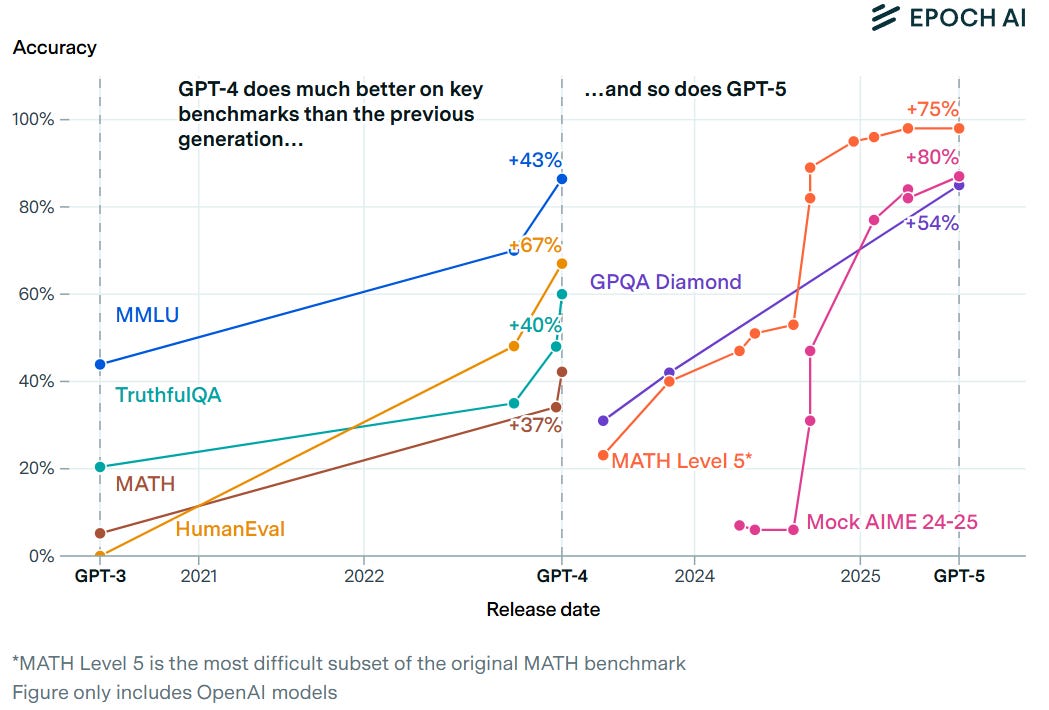
~4 months behind on MATH lvl 5

~11 months behind on SWE-Bench-Verified

We need more good evals to benchmark the US-China gap. Kudos to @EpochAIResearch for doing some of this work.

Math level 5 is fully saturated as of o3 so this should be the last time we use it.

Epoch AI: DeepSeek has released DeepSeek-R1-0528, an updated version of DeepSeek-R1. How does the new model stack up in benchmarks? We ran our own evaluations on a suite of math, science, and coding benchmarks. Full results in thread!

On GPQA Diamond, a set of PhD-level multiple-choice science questions, DeepSeek-R1-0528 scores 76% (±2%), outperforming the previous R1’s 72% (±3%). This is generally competitive with other frontier models, but below Gemini 2.5 Pro’s 84% (±3%).

On MATH Level 5, the hardest tier of the well-known MATH benchmark, R1-0528 achieves 97% accuracy, similar to the 98% scored by o3 and o4-mini. This benchmark has essentially been mastered by leading models.

On OTIS Mock AIME, a more difficult competition math benchmark that is based on the AIME exam, DeepSeek-R1-0528 scores 66% (±5%).

This improves substantially on the original R1’s 53% (±8%), but falls short of leading models such as o3, which scored 84% (±4%).

On SWE-bench Verified, a benchmark of real-world software engineering tasks, DeepSeek-R1-0528 scores 33% (±2%), competitive with some other strong models but well short of Claude 4.

Performance can vary with scaffold; we use a standard scaffold based on SWE-agent.

On SWE-bench Verified, DeepSeek-R1-0528 explores and edits files competently, but often submits patches prematurely without thoroughly verifying them.

You can find more information on the runs in our Log Viewer.

Here are the Lech Mazur benchmarks, where the scores are a mixed bag but overall pretty good.

There is no improvement on WeirdML.

Havard Ihle: New R1 seems not that optimised for coding! No improvement on WeirdML. It is smart, but it has more variance, so many strong results, but also a much higher failure rate (45%, up from 30% for old R1). Often weird syntax errors or repeated tokens, even at the preferred temp of 0.6

The initial headlines were what you would expect, and were essentially ‘remember that big DeepSeek moment? Those guys gave us a new version.’

Here’s CNBC.

The upgraded model has “major improvements in inference and hallucination reduction,” Yakefu [an AI researcher at HuggingFace] said, adding that “this version shows DeepSeek is not just catching up, it’s competing.”

The upgraded DeepSeek R1 model is just behind OpenAI’s o4-mini and o3 reasoning models on LiveCodeBench, a site that benchmarks models against different metrics.

“DeepSeek’s latest upgrade is sharper on reasoning, stronger on math and code, and closing in on top-tier models like Gemini and O3,” Adina Yakefu, AI researcher at Hugging Face, told CNBC.

Yakefu is effectively talking their own book here. I don’t see why we should interpret this as catching up, everyone is reducing hallcinations and costs, but certainly DeepSeek are competing. How successfully they are doing so, and in what league is the question.

One can perhaps now see how wrong we were to overreact so much to the first r1. Yes, r1-0528 is DeepSeek ‘catching up’ or ‘closing in’ in the sense that DeepSeek’s relative position looks now, right after a release, better than it looked on May 27. But it does not look better than when I wrote ‘on DeepSeek’s r1’ in January and LiveCodeBench appears at best cherry picked.

The article concludes with Nvidia CEO Huang making his typical case that because China can still make some AI models and build some chips, we should sacrifice our advantages in compute on the altar of Nvidia’s stock price and market share.

Here’s Bloomberg’s Luz Ding, who notes up front that the company calls it a ‘minor trial upgrade,’ so +1 to Ding, but there isn’t much additional information here.

A search of the Washington Post and Wall Street Journal failed to find any articles at all covering this event. If r1 was such a big moment, why is this update not news? Even if it was terribly disappointing, shouldn’t that also be news?

Normally, in addition to evals, I expect to see a ton of people’s reactions, and more when I open up my reactions thread.

This time, crickets. So I get to include a lot of what did show up.

Teortaxes: my thesis is that this is just what R1 was supposed to be as a product. Direct gains on benchmarks are in line with expectations. What is interesting is that it’s more «Westoid», has a sycophancy problem, and its CoTs are totally different in manner.

Both V3-original and R1-original should be thought of as *previews. We know they shipped them as fast as they could, with little post-training (≈$10K for V3 not including context extension, maybe $1M for R1). 0324, 0528 are what they’d do originally, had they more time & hands.

(they don’t advertise it here but they also fixed system prompt neglect/adverse efficiency, multi-turn, language consistency between CoT and response, and a few other problems with R1-old. It doesn’t deserve a paper because we’ve had all such papers done by January)

Teortaxes highlights where the original R1 paper says they plan to fix these limitations. This seems like a reasonable way to think about it, R1-0528 is the version of R1 that isn’t being rushed out the door in a sprint with large compute limitations.

Alexander Doria: DeepSeek new R1 is expectedly great, but I admit I’m more eagerly waiting for the paper. Hopefully tying generalist reward, subgoal models from prover and overall engineering challenge of scaling RL (GRPO over nccl?)

Satwik Patil: I have ran about 15 runs of something like the AI 2027 TTX board game with it and it is very good at it. Unlike other models, particularly Gemini, it actually accepts that bad things can happen(or it can do bad things) and plays them out.

It is also the least aware of any model that it’s thoughts can be read by the user.

Petr Baudis: A lot of people were hungry for R1 on the initial release as there were no interesting reasoning models outside of OpenAI at that point (besides the fact that this is opensource).

But I doubt too many of the Twitter frontier use DeepSeek daily right now.

Michael Roe: 0528 really overthought my “simulate an IBM mainframe” prompt. Its chain of thought was much more verbose that the previous R1 for this particular prompt. But, ok, it did give me a simulation.

It’s CoT even had pseudocode for algorithms. And, to be fair, its CoT foregrounds an issue that previous R1 missed, that the whole idea assume you can reconstruct the state from the history of terminal input and output. 0528 realises that it’s going to have to stash internal state somewhere.

0528 was able to solve a problem that I couldn’t gr5 an answer to before. Basically, i had Chinese text in Wade-Giles transliteration with a mangled word, and the problem is to use contextual clues to find a word that makes sense in context and sounds a bit like the text.

i’m using 0528, but no definite conclusions yet. The tabletop rpg scenario where I have a talking squirrel sidekick now has a singing, talking squirrel sidekick when I run it with 0528. (Obviously, that squirrel is a nod to Disney). 0528 is subjectively better, in that it can commit to the bit even better than the previous version.

bad8691: I didn’t know a new version would get released. Today I asked a question to it as usual and reading the reasoning traces, immediately said “wow, looks like its social intelligence has visibly improved”. Don’t know about the benchmarks but it was just obvious to me.

xEC40: its a lot different, lot of chinese on ambiguous prompts unlike 0324 and r1, but good prompt adherence. i gotta play with it more

Dominik Lukes: As is now the norm with new model releases, it’s hard to say what the real-world benefit just from the benchmarks or stated intention for developers. The clear need is now for everybody do develop their own evals for actual usage and run them against the model. In my own informal testing I can’t tell the difference.

Oli: basicly jus a slightly smarter version of r1 but with all the same limitations of the old one no function calling text only etc so its not that useful in practice qwen 3 is still superior

Biosemiote: I love deepseek poetry. Not sure if better than previous models, but miles above the competition.

Through the Ice Lens

Cold grinds the creek to glass—

A lens of pure, cracked grace—

And in its flawed design,

The world aligns:

A spider’s web, exact as wire,

The sun’s last coal, a stolen fire.

But look— trapped bubbles rise like breath,

A drowned leaf’s veins rehearsing death.

Gwern: Nah, that’s still r1 cringelord. Claude & Gemini are much better for poetry. (And still the usual semantic problems of interesting images interspersed with nonsense: how can cold ‘grind’ water to solid glass? In some frozen river ice, what is the “sun’s last coal”, exactly? etc)

Leo Abstract: it also is far better at understanding text-based divination systems. given how it is being used in china, i think neither of these strengths are an accident, and them not going away with updates confirms this.

it seems as though it’s trying harder to understand the complexities instead of just scanning the spread or cast or chart for ways to glaze you. if you’ve kept notes, try having it (vs, say, gemini 2.5 pro) duplicate your previous work.

This was the high end of opinion, as xjdr called it a frontier model, which most people clearly don’t agree with at all, and kalomaze calls it ‘excellence’ but this is relative to its size:

xjdr: R1-0528 is mostly interchangeable (for me) with gemini pro 0520 and opus 4. it has a distinctly gemini 2.5 pro 0325 flavor which is not my favorite, but the quality is impossible to deny (i preferred the o1 on adderall flavor personally). we officially have frontier at home.

Teortaxes (linking to Epoch): what is the cope for this?

xjdr: Not sure what they are doing to elicit this behavior. If anything, I find R1 0528 to be verbose and overly thorough. Admittedly, my workflows are much more elaborate than ‘please fix this’ so I ensure plans are made and implemented, patches compile, tests are written and pass, etc

Teortaxes: «we use a standard scaffold based on SWE-agent.» It’s obviously better at function calling than R1 but not clear if this is a good fit.

xjdr: I found it performed very well with xml based custom function definitions. It performed reasonably well with the function defs as defined in the huggingface tokenizer template. One thing I do often (I do this for most ‘thinking’ models) is i prefill the response with:

To make the output parsing more consistent.

Kalomaze: r1-0528 is excellence

Zephyr: How did it perform in ur tests? Compared to o3/2.5 Pro/Opus 4??

Kalomaze: a majority of the models that you just described are either way too rate limited expensive or otherwise cumbersome to be worth directly comparing to a model so cheap tbh

Bob from Accounting: Very impressive for its price, but not quite SOTA on anything.

That was also the reaction to the original r1, and I sort of expect that trend to continue.

Kalomaze: new r1 watered my crops, cleared my skin, etc

However:

Kalomaze: none of the sft distills are good models because you still need RL and sft local biases compound.

Different people had takes about the new style and what it reminded them of.

Cabinet: A lot of its outputs smell like 4o to me. This was more extreme on deepseek web vs using 0528 on API, but both feel directionally more “productized,” more sycophantic, more zoomer-reddit phrasing, etc. Does feel a step smarter than R1.0 tho. Just more annoying.

A key question that was debated about the original r1 was whether it was largely doing distillation, as in training on the outputs of other models, effectively reverse engineering. This is the most common way to fast follow and a Chinese specialty. DeepSeek explicitly denied it was doing this, but we can’t rely on that.

If they did it, this doesn’t make r1’s capabilities any less impressive, the model can do what the model can do. But it does mean that DeepSeek is effectively a lot farther behind and further away from being able to ‘take the lead.’ So DeepSeek might be releasing models comparable to what was available 4-8 months ago, but still be 12+ months behind in terms of ability to push the frontier. Both measures matter.

Gallabytes: I know we all stan deepseek here in 🐋POT but the distribution shift from 4o-like to Gemini-like for output suggests that the distillation claims are likely true and this should change the narrative more than it has IMO.

It’s unclear how much they rely on distillation, whether it’s key or merely convenient, but the more important it is the less seriously we should count them in the frontier.

it brings me no joy to report this, I really like the story of a lean player catching up to the giants in a cave with a box of scraps. certainly their pre-training efficiency is still quite impressive. but the rest of this situation smells increasingly sus.

Teortaxes: I think the claim of distillation is sound, since Gemini traces were open. I prefer Gemini reasoning, it’s more efficient than early R1 mumbling. This probably explains some but not all of the performance gains. Imo it’s reasonable to feel disappointed, but not despair.

Fraser Paine: This isn’t actually bad, big corps pay hundreds of millions to generate data, getting this from existing models and distilling is a cost effective way to fast-follow. Doesn’t mean 🐋can’t push elsewhere to achieve frontier performance on tools or training/inference efficiency.

Then again, claims can differ:

AGI 4 President 2028: #1 take away is that OpenAI’s attempt to curb distillation were successful.

I agree with Fraser, it’s not a bad move to be doing this if allowed to do so, but it would lower our estimate of how capable DeepSeek is going forwards.

If Teortaxes is saying the claim of distillation is sound, I am inclined to believe that, especially given there is no good reason not to do it. This is also consistent with his other observations above, such as it displaying a more ‘westoid’ flavor and having a sycophancy issue, and a different style of CoT.

If you place high value in the cost and open nature of r1-0528, it is probably a solid model for the places where it is strong, although I haven’t kept up with details of the open model space enough to be sure, especially given so little attention this got. If you don’t place high value on both open weights and token costs, it is probably a pass.

The biggest news here is the lack of news, the dog that did not bark. A new DeepSeek release that panics everyone once again was a ready made headline. I know I was ready for it. It didn’t happen. If this had been an excellent model, it would have happened. This also should make us reconsider our reactions the first time around.

Discussion about this post

DeepSeek-r1-0528 Did Not Have a Moment Read More »

rocket-report:-spacex’s-500th-falcon-launch;-why-did-uk’s-reaction-engines-fail?

Rocket Report: SpaceX’s 500th Falcon launch; why did UK’s Reaction Engines fail?


SpaceX’s rockets make a lot more noise, but the machinations of Texas’ newest city are underway.

Prefabricated homes painted black, white, and gray are set against the backdrop of SpaceX’s Starship rocket factory at Starbase, Texas. Credit: Sergio Flores/AFP via Getty Images

Welcome to Edition 7.47 of the Rocket Report! Let’s hope not, but the quarrel between President Donald Trump and Elon Musk may be remembered as “Black Thursday” for the US space program. A simmering disagreement over Trump’s signature “One Big Beautiful Bill” coursing its way through Congress erupted into public view, with two of the most powerful Americans trading insults and threats on social media. Trump suggested the government should terminate “Elon’s governmental contracts and subsidies.” Musk responded with a post saying SpaceX will begin decommissioning the Dragon spacecraft used to transport crew and cargo to the International Space Station. This could go a number of ways, but it’s hard to think anything good will come of it.

As always, we welcome reader submissions. If you don’t want to miss an issue, please subscribe using the box below (the form will not appear on AMP-enabled versions of the site). Each report will include information on small-, medium-, and heavy-lift rockets, as well as a quick look ahead at the next three launches on the calendar.

Blue Origin flies aces suborbital space shot. Blue Origin, the space company founded and owned by Jeff Bezos, launched six people to the edge of space Saturday, May 31, from Bezos’ ranch in West Texas, CBS News reports. A hydrogen-fueled New Shepard booster propelled a crew capsule, equipped with the largest windows of any operational spaceship, to an altitude of nearly 65 miles (105 kilometers), just above the internationally recognized boundary between the discernible atmosphere and space, before beginning the descent to landing. The passengers included three Americans—Aymette Medina Jorge, Gretchen Green, and Paul Jeris—along with Canadian Jesse Williams, New Zealand’s Mark Rocket, and Panamanian Jaime Alemán, who served as his country’s ambassador to the United States.

If you missed it … You wouldn’t be alone. This was the 32nd flight of Blue Origin’s New Shepard rocket, and the company’s 12th human flight. From a technical perspective, these flights aren’t breaking any new ground in human spaceflight or rocketry. However, each flight provides an opportunity for wealthy or well-connected passengers to view Earth from a perspective only about 700 people have seen before. That’s really cool, but most of these launches are no longer newsworthy, and it takes a devoted fan of spaceflight to tune in to a New Shepard flight on a summertime Saturday morning. (submitted by EllPeaTea)

The easiest way to keep up with Eric Berger’s and Stephen Clark’s reporting on all things space is to sign up for our newsletter. We’ll collect their stories and deliver them straight to your inbox.

Sign Me Up!

Momentum for Amentum. The US Space Force awarded Jacobs Technology a contract worth up to $4 billion over 10 years to provide engineering and technical services at the nation’s primary space launch ranges, as the military seeks to modernize aging infrastructure and boost capacity amid a surge in commercial space activity, Space News reports. Jacobs Technology is now part of Amentum, a defense contractor based in Chantilly, Virginia. Amentum merged with Jacobs in September 2024. The so-called “Space Force Range Contract” covers maintenance, sustainment, systems engineering and integration services for the Eastern and Western ranges until 2035. The Eastern Range operates from Patrick Space Force Base in Florida, while the Western Range is based at Vandenberg Space Force Base in California.

Picking from the menu … The contract represents a significant shift in how space launch infrastructure is funded. Under the new arrangement, commercial launch service providers—which now account for the majority of launches at both ranges—can request services or upgrades and pay for them directly, rather than having the government bear the costs upfront. This arrangement would create a more market-driven approach to range operations and potentially accelerate modernization. “Historically, the government has fronted these costs,” Brig. Gen. Kristin Panzenhagen, Space Launch Delta 45 Commander and Eastern Range Director, said June 3 in a news release. “The ability of our commercial partners to directly fund their own task order will lessen the financial and administrative burden on the government and is in line with congressionally mandated financial improvement and audit readiness requirements.”

Impulse Space rakes in more cash. This week, an in-space propulsion company, Impulse Space, announced that it had raised a significant amount of money, $300 million, Ars reports. This follows a fundraising round just last year in which the Southern California-based company raised $150 million. This is one of the largest capital raises in space in a while, especially for a non-launch company. Founded by Tom Mueller, a former propulsion guru at SpaceX, Impulse Space has test-flown an orbital maneuvering vehicle called Mira on two flights over the last couple of years. The company is developing a larger vehicle, named Helios, that could meaningfully improve the ability of SpaceX’s Falcon 9 and Falcon Heavy to transport large payloads to the Moon, Mars, and other destinations in the Solar System.

Reacting to the market … The Mira vehicle was originally intended to provide “last-mile” services for spacecraft launched as part of rideshare missions. “The reality is the market for that is not very good,” said Eric Romo, the company’s CEO. Instead, Impulse Space found interest from the Space Force to use Mira as an agile platform for hosting electronic warfare payloads and other military instrumentation in orbit. “Mira wasn’t necessarily designed out of the gate for that, but what we found out after we flew it successfully was, the Space Force said, ‘Hey, we know what that thing’s for,” Romo said. Helios is a larger beast, with an engine capable of producing 15,000 pounds of thrust and the ability to move a multi-ton payload from low-Earth orbit to geostationary space in less than a day. (submitted by EllPeaTea)

Falcon rockets surpass 500 flights. SpaceX was back at the launch pad for a midweek flight from Vandenberg Space Force Base in California. This particular flight, designated Starlink 11-22, marked the company’s 500th orbital launch attempt with a Falcon rocket, including Falcon 1, Falcon 9, and Falcon Heavy, Spaceflight Now reports. This milestone coincided with the 15th anniversary of the first Falcon 9 launch on June 4, 2010. The day before, SpaceX launched the 500th Falcon rocket overall, counting a single suborbital flight in 2020 that tested the Dragon spacecraft’s abort system. The launch on Wednesday from California was the 68th Falcon 9 launch of the year.

Chasing Atlas … The soon-to-be-retired Atlas rocket holds the record for the most-flown family of space launchers in the United States, with 684 launches to date, beginning with Atlas ICBMs in the Cold War to the Atlas V rocket flying today. In reality, however, the Atlas V shares virtually nothing in common with the Atlas ICBM, other than its name. The Atlas V has new engines, more modern computers, and a redesigned booster stage that ended the line of pressure-stabilized “balloon tanks” that flew on Atlas rockets from 1957 until 2005. The Falcon 1, Falcon 9, and Falcon Heavy share more heritage, all using variants of SpaceX’s Merlin engine. If you consider the Atlas rocket as the US record-holder for most space launches, SpaceX’s Falcon family is on pace to reach 684 flights before the end of 2026.

SpaceX delivers again for GPS. The Space Force successfully sent its latest GPS III satellite to orbit Friday, May 30, demonstrating the ability to prepare and launch a military spacecraft on condensed timelines, Defense News reports. The satellite flew on a SpaceX Falcon 9 rocket from Cape Canaveral Space Force Base in Florida. GPS III, built by Lockheed Martin, is the latest version of the navigation and timing system and is designed to provide improved anti-jamming capabilities. It will broadcast additional military and civilian signals.

More anti-jamming capability … The launch was the second in a series of Rapid Response Trailblazer missions the Space Force is running to test whether it can quickly launch high-value satellites in response to national security needs. The goal is to condense a process that can take up to two years down to a handful of months. The first mission, which flew in December, reduced the time between launch notification and lift off to around five months—and the May 30 mission shortened it even further, to around 90 days. In addition to demonstrating the launch could be done on an accelerated timeline, Space Force officials were motivated to swap this satellite from United Launch Alliance’s long-delayed Vulcan rocket to SpaceX’s Falcon 9 in order to add more tech to the GPS constellation to counter jamming and spoofing. (submitted by EllPeaTea)

An autopsy on Reaction Engines. An article published by the BBC this week recounts some of the backstory behind the bankruptcy of Reaction Engines, a British company that labored for 35 years to develop a revolutionary air-breathing rocket engine. According to the vision of the company’s leaders, the new engine, called SABRE, could have powered a single-stage-to-orbit spaceplane or hypersonic vehicles within the atmosphere. If an engine like SABRE could ever be mastered, it could usher in a new era of spaceplanes that can take off and land horizontally on a runway, instead of launching vertically like a rocket.

A little too quixotic … But Reaction Engines started in an era too soon for true commercial spaceflight and couldn’t convince enough venture capital investors that the idea could compete with the likes of SpaceX. Instead, the company secured a handful of investments from large aerospace companies like Boeing, BAE Systems, and Rolls-Royce. This money allowed Reaction Engines to grow to a staff of approximately 200 employees and kept it afloat until last October, when the company went into administration and laid off its workforce. “A few people were in tears,” Richard Varvill, the company’s chief engineer, told the BBC. “A lot of them were shocked and upset because they’d hoped we could pull it off right up to the end.” It was galling for Varvill “because we were turning it around with an improved engine. Just as we were getting close to succeeding, we failed. That’s a uniquely British characteristic.” (submitted by ShuggyCoUk)

Draconian implications for Trump’s budget. New details of the Trump administration’s plans for NASA, released Friday, May 30, revealed the White House’s desire to end the development of an experimental nuclear thermal rocket engine that could have shown a new way of exploring the Solar System, Ars reports. The budget proposal’s impacts on human spaceflight and space science have been widely reported, but Trump’s plan would cut NASA’s space technology budget in half. One of the victims would be DRACO, a partnership with DARPA to develop and test the first nuclear thermal rocket engine in space.

But wait, there’s more … The budget proposal not only cancels DRACO, but it also zeros out funding for all of NASA’s nuclear propulsion projects. Proponents of nuclear propulsion say it offers several key advantages for sending heavy cargo and humans to deep space destinations, like Mars. “This budget provides no funding for Nuclear Thermal Propulsion and Nuclear Electric Propulsion projects,” officials wrote in the NASA budget request. “These efforts are costly investments, would take many years to develop, and have not been identified as the propulsion mode for deep space missions. The nuclear propulsion projects are terminated to achieve cost savings and because there are other nearer-term propulsion alternatives for Mars transit.” Trump’s budget request isn’t final. Both Republican-controlled houses of Congress will write their own versions of the NASA budget, which must be reconciled before going to the White House for President Trump’s signature.

Blue Origin CEO says government should get out of the launch business. Eighteen months after leaving his job as a vice president at Amazon to take over as Blue Origin’s chief executive, Dave Limp has some thoughts on how commercial companies and government agencies like NASA should explore the Solar System together. First, the government should leave launching things into space to private industry. “I think commercial folks can worry about the infrastructure,” he said. “We can do the launch. We can build the satellite buses that can get you to Mars much more frequently, that don’t cost billions of dollars. We can take a zero, and over time, maybe two zeros off of that. And if the governments around the world leave that to the commercial side, then there are a lot more resources that are freed up for the science side, for the national prestige side, and those types of things.”

Do the exotic … While commercial companies should drive the proverbial bus into the Solar System, NASA should get back to its roots in research and exploration, Limp said. “I would say, and it might be a little provocative, let’s have those smart brains look on the forward-thinking types of things, the really edge of science, planning the really exotic missions, figuring out how to get to planetary bodies we haven’t gotten to before, and staying there.” But Limp highlighted one area where he thinks government investment is needed: the Moon. He said there’s currently no commercial business case for sending people to the Moon, and the government should continue backing those efforts.

Hurdles ahead for Rocket Cargo. The Center for Biological Diversity is suing the military for details on a proposal to build a rocket test site in a remote wildlife refuge less than 900 miles from Hawaiʻi Island, Hawaiʻi Public Radio reports. The Air Force announced in March that it planned to prepare an environmental assessment for the construction and operation of two landing pads on Johnston Atoll to test the viability of using rockets to deliver military cargo loads. While the announcement didn’t mention SpaceX, that company’s Starship rocket is on contract with the Air Force Research Laboratory to work on delivering cargo anywhere in the world within an hour. Now, several conservationists have spoken out against the proposal, pointing out that Johnston is an important habitat for birds and marine species.

Scarred territory … For nearly a century, Johnston Atoll has served dual roles as a wildlife refuge and a base for US military operations, including as a nuclear test site between 1958 and 1963. In March, the Air Force said it anticipated an environmental assessment for its plans on Johnston Atoll would be available for public review in early April. So far, it has not been released. The Center for Biological Diversity filed a Freedom of Information Act request about the project. They say a determination on their request was due by May 19, but they have not received a response. The center filed a lawsuit last week to compel the military to rule on their request and release information about the project.

Getting down to business at Starbase. SpaceX’s rockets make a lot of noise at Starbase, but the machinations of setting up Texas’ newest city are in motion, too. After months of planning, SpaceX launched the city of Starbase on May 29 with its first public meeting chaired by Mayor Robert Peden and the City Commission at The Hub, a building owned by SpaceX, ValleyCentral.com reports. During the meeting, which lasted about 80 minutes, they hired a city administrator, approved standard regulations for new construction, and created a committee to guide the community’s long-term development. Voters approved the creation of Starbase on May 3, incorporating territory around SpaceX’s remote rocket factory and launch site near the US-Mexico border. SpaceX owns most of the land in Starbase and employs nearly everyone in the tiny town, including the mayor.

Property rights and zoning … The new city’s leaders have told landowners they plan to introduce land use rules that could result in changes for some residents,” KUT reports. In a letter, Starbase’s first city administrator, Kent Myers, warned local landowners that they may lose the right to continue using their property for its current use under the city’s new zoning plan. “Our goal is to ensure that the zoning plan reflects the City’s vision for balanced growth, protecting critical economic drivers, ensuring public safety, and preserving green spaces,” the letter, dated May 21, reads. This is a normal process when a city creates new zoning rules, and a new city is required by state law to notify landowners—most of which are SpaceX or its employees—of potential zoning changes so they can ask questions in a public setting. A public meeting to discuss the zoning ordinance at Starbase is scheduled for June 23.

Next three launches

June 7: Falcon 9 | SXM-10| Cape Canaveral Space Force Station, Florida | 03: 19 UTC

June 8: Falcon 9 | Starlink 15-8 | Vandenberg Space Force Base, California | 13: 34 UTC

June 10: Falcon 9 | Axiom Mission 4 | Kennedy Space Center, Florida | 12: 22 UTC

Photo of Stephen Clark

Stephen Clark is a space reporter at Ars Technica, covering private space companies and the world’s space agencies. Stephen writes about the nexus of technology, science, policy, and business on and off the planet.

Rocket Report: SpaceX’s 500th Falcon launch; why did UK’s Reaction Engines fail? Read More »

senate-response-to-white-house-budget-for-nasa:-keep-sls,-nix-science

Senate response to White House budget for NASA: Keep SLS, nix science

This legislation, the committee said in a messaging document, “Dedicates almost $10 billion to win the new space race with China and ensure America dominates space. Makes targeted, critical investments in Mars-forward technology, Artemis Missions and Moon to Mars program, and the International Space Station.”

The reality is that it signals that Republicans in the US Senate are not particularly interested in sending humans to Mars, probably are OK with the majority of cuts to science programs at NASA, and want to keep the status quo on Artemis, including the Space Launch System rocket.

Where things go from here

It is difficult to forecast where US space policy will go from here. The very public breakup between President Trump and SpaceX founder Elon Musk on Thursday significantly complicates the equation. At one point, Trump and Musk were both championing sending humans to Mars, but Musk is gone from the administration, and Trump may abandon that idea due to their rift.

For what it’s worth, a political appointee in NASA Communications said on Thursday that the president’s vision for space—Trump spoke of landing humans on Mars frequently during his campaign speeches—will continue to be implemented.

“NASA will continue to execute upon the President’s vision for the future of space,” NASA’s press secretary, Bethany Stevens, said on X. “We will continue to work with our industry partners to ensure the President’s objectives in space are met.”

Congress, it seems, may be heading in a different direction.

Senate response to White House budget for NASA: Keep SLS, nix science Read More »

what-would-happen-if-trump-retaliated-against-musk’s-companies?

What would happen if Trump retaliated against Musk’s companies?

The reason that Biden did not terminate these contracts, as Trump asserts he might well have, is because SpaceX has generally provided space services to the US government at a lower cost and on a faster timeline than its competitors. Were the Trump administration to sever its relationship with SpaceX, it would effectively set the US space enterprise back a decade or more and give China’s ascendant space program clear supremacy on the world stage.

Tesla

Although Tesla has received federal contracts over the years, these have mostly been rather small, considering the company’s size—less than $42 million between 2008 and 2024. But federal subsidies are far more important to the carmaker. The IRS clean vehicle tax credit provides up to $7,500 off the purchase price of a new EV for many buyers, and all new leased Teslas are eligible for a $7,500 commercial clean vehicle tax credit. Other tax credits exist for solar and Powerwall customers.

Additionally, Tesla has benefited extensively from selling emissions credits to other automakers, although California’s “Zero Emissions Vehicles” program and the European Union are also sources of these credits in addition to the federal government.

If the Trump administration really wanted to hurt Musk’s companies, it might be more effective to do so through regulatory agencies rather than terminating contracts that, by and large, benefit the US government.

For example, the National Highway Traffic Safety Administration could put the screws to Tesla’s efforts to develop Full Self Driving and Autopilot features in its vehicles. And the Federal Aviation Administration could stall SpaceX’s ambitious Starship program and prevent further expansion of its launch facilities.

Regardless of what actions the Trump administration could take to harm Tesla, shares of the EV maker are suffering. As of this writing, the share price is down nearly 15 percent since the market opened.

With Trump’s willingness to use the vast power of the federal government for his own whims, there really is no end to the ways in which he could harm Musk. But some of these measures would also do some self-harm to the country. Would Trump care? Will there be a rapprochement? As Musk likes to say about Starship launches, “Excitement guaranteed.”

Ars automotive editor Jonathan Gitlin contributed to this report. This post was updated on June 5 to add comments from Musk about decommissioning the Dragon spacecraft.

What would happen if Trump retaliated against Musk’s companies? Read More »

google’s-new-gemini-2.5-pro-release-aims-to-fix-past-“regressions”-in-the-model

Google’s new Gemini 2.5 Pro release aims to fix past “regressions” in the model

It seems like hardly a day goes by anymore without a new version of Google’s Gemini AI landing, and sure enough, Google is rolling out a major update to its most powerful 2.5 Pro model. This release is aimed at fixing some problems that cropped up in an earlier Gemini Pro update, and the word is, this version will become a stable release that comes to the Gemini app for everyone to use.

The previous Gemini 2.5 Pro release, known as the I/O Edition, or simply 05-06, was focused on coding upgrades. Google claims the new version is even better at generating code, with a new high score of 82.2 percent in the Aider Polyglot test. That beats the best from OpenAI, Anthropic, and DeepSeek by a comfortable margin.

While the general-purpose Gemini 2.5 Flash has left preview, the Pro version is lagging behind. In fact, the last several updates have attracted some valid criticism of 2.5 Pro’s performance outside of coding tasks since the big 03-25 update. Google’s Logan Kilpatrick says the team has taken that feedback to heart and that the new model “closes [the] gap on 03-25 regressions.” For example, users will supposedly see more creativity with better formatting of responses.

Kilpatrick also notes that the 06-05 release now supports configurable thinking budgets for developers, and the team expects this build to become a “long term stable release.” So, Gemini 2.5 Pro should finally drop its “Preview” disclaimer when this version rolls out to the consumer-facing app and web interface in the coming weeks.

Google’s new Gemini 2.5 Pro release aims to fix past “regressions” in the model Read More »

ai-#119:-goodbye-aisi?

AI #119: Goodbye AISI?

AISI is being rebranded highly non-confusingly as CAISI. Is it the end of AISI and a huge disaster, or a tactical renaming to calm certain people down? Hard to tell. It could go either way. Sometimes you need to target the people who call things ‘big beautiful bill,’ and hey, the bill in question is indeed big. It contains multitudes.

The AI world also contains multitudes. We got Cursor 1.0, time to get coding.

On a personal note, this was the week of LessOnline, which was predictably great. I am sad that I could not stay longer, but as we all know, duty calls. Back to the grind.

  1. Language Models Offer Mundane Utility. The white whale.

  2. Language Models Don’t Offer Mundane Utility. You need a system prompt.

  3. Language Models Could Offer More Mundane Utility. A good set of asks.

  4. Huh, Upgrades. The highlight is Cursor 1.0, with memory and more.

  5. Fun With Media Generation. Video is high bandwidth. But also low bandwidth.

  6. Choose Your Fighter. Opinions differ, I continue to mostly be on Team Claude.

  7. Deepfaketown and Botpocalypse Soon. Fake is not a natural category. Whoops.

  8. Get My Agent On The Line. We all know they’re not secure, but how bad is this?

  9. They Took Our Jobs. Economists respond to Dario’s warning.

  10. The Art of the Jailbreak. Why not jailbreak AI overviews?

  11. Unprompted Attention. More prompts to try out.

  12. Get Involved. SFCompute, Speculative Technologies.

  13. Introducing. Anthropic open sources interpretability tools, better AR glasses.

  14. In Other AI News. FDA launches their AI tool called Elsa.

  15. Show Me the Money. Delaware hires bank to value OpenAI’s nonprofit.

  16. Quiet Speculations. People don’t get what is coming, but hey, could be worse.

  17. Taking Off. AI beats humans in a test of predicting the results of ML experiments.

  18. Goodbye AISI? They’re rebranding as CAISI. It’s unclear how much this matters.

  19. The Quest for Sane Regulations. The bill is, at least, definitely big. Tl;dr.

  20. Copyright Confrontation. OpenAI is being forced to retain all its chat logs.

  21. Differential Access. The Good Guy needs a better AI than the Bad Guy.

  22. The Week in Audio. Altman, Tegmark, Amodei, Barnes.

  23. When David Sacks Says ‘Win the AI Race’ He Literally Means Market Share.

  24. Rhetorical Innovation. Blog metagame continues to dominate.

  25. Aligning a Smarter Than Human Intelligence is Difficult. Proceed accordingly.

  26. Misaligned! About that safety plan, would it, you know, actually work?

  27. People Are Worried About AI Killing Everyone. Regular people.

  28. The Lighter Side. You’re not alone.

Joe Weisenthal: Got a DeepResearch report from ChatGPT. Too long. Now gonna ask ChatGPT to bullet it and ELI5.

With major hints, o3 manages to solve a stereogram. Whenever you say something can only be done by a human, we all know what comes next.

Solve your ‘white whale bug’ in one day using Claude Opus 4, figuring out it was based on previous code only coincidentally worked because of quirks in the hardware that no longer hold.

Jon Stokes: People speak of the “AI hype bubble”, but there is also a large & growing “AI cope bubble” that will at some point pop & leave much devastation in its wake. Example:

Jonathan Blow (the example): Reminder: this is all fake. Any time someone makes a claim like this, either they are lying, or every single programmer they know is completely awful and can’t program at all.

Alex Albert (the claim Blow was quoting): Since Claude 4 launch: SWE friend told me he cleared his backlog for the first time ever, another friend shipped a month’s worth of side project work in the past 5 days, and my DMs are full of similar stories. I think it’s undebatable that devs are moving at a different speed now. You can almost feel it in the air that this pace is becoming the default norm.

Jon Stokes: As I mentioned in a reply downthread, I use Claude Code, Cursor, & other AI tools daily, as does my team. It’s a huge force multiplier if you use it the right way, but you have to be intentional & know what you’re doing. It’s its own skillset. More here and here.

Similarly, here’s a post about AI coding with the fun and accurate title ‘My AI Skeptic Friends Are All Nuts.’ The basic thesis is, if you code and AI coders aren’t useful to you, at this point you should consider that a Skill Issue.

Patrick McKenzie: I’ve mentioned that some of the most talented technologists I know are saying LLMs fundamentally change craft of engineering; here’s a recently published example from @tqbf.

I continue to think we’re lower bounded on eventually getting to “LLMs are only as important as the Internet”, says the guy who thinks the Internet is the magnum opus of the human race.

Upper bound: very unclear.

Meanwhile at Anthropic they’re reporting that top engineers are becoming ‘orchestrators of Claudes,’ running multiple agents at once.

It really is weird that so many people find ways to not be impressed.

The following seems not great to me, but what do I know:

Kevin Roose: I am now a ChatGPT voice mode in the car guy. Recent trips:

“Teach me the history of the Oakland estuary”

“Recap the last two matches at the French Open”

“Prep me for a meeting with [person I’m driving to meet]”

Nobody else do this or podcasts will die.

A paper I mostly disagree with from Teppo Felin, Mari Sako and Jessica Hullman suggests criteria for when to use or not use AI, saying it should be used for a broad range of decisions but not ‘actor-specific’ ones. By this they mean decisions that are forward looking, individual and idiosyncratic, and require reasoning and some form of experimentation. As usual, that sounds like a skill issue. These factors make using AI trickier, but AI can learn your individual and idiosyncratic preferences the same way other people can, often far better than other people. It can look forwards. It can increasingly reason. As for experimentation, well, the AI can consider experimental results or call for experimentation the same way humans can.

Do you even have a system prompt? No, you probably don’t. Fix that.

I do, and I get results like this:

Zvi Mowshowitz: Writing milestone: There was a post and I asked Opus for feedback on the core thinking and it was so brutal that I outright killed the post.

Patrick McKenzie: Hoohah.

Do you do anything particularly special to get good feedback from Opus or is it just “write the obvious prompt, get good output”?

Zvi Mowshowitz: I do have some pretty brutal system instructions, and I wrote it in a way that tried to obscure that I was the author.

Kevin Roose: 2025: your post is so bad that Claude convinces you not to publish it

2026: your post is so bad that Claude leaks it to me

(I need to steal your anti-glazing prompt)

I was amused how many people replied with ‘oh no, that’s how the AIs win.’

The MAHA (Make America Healthy Again) report contains a number of made up citations, and citations that are labeled as coming from ChatGPT, and otherwise shows signs of being written in part by AI without anyone checking its work.

Patrick McKenzie instead often relies for now on Ruby scripts to query hackernews, Reddit and other sites to find his own previous writing rather than using Claude. I expect we will all switch over to LLMs for this soon, so we don’t have to figure out exactly what to grep.

Google AI Overviews continue to hallucinate, including citations that say the opposite of what the overview is claiming, or rather terrible math mistakes. I do think this is improving and will continue to improve, but it will be a while before we can’t find new examples. I also think it is true that this has been very damaging to the public’s view of AI, especially its ability to not hallucinate. Hallucinations are mostly solved for many models, but the much of the public mostly sees the AI Overviews.

Nabeel Qureshi: I wonder why o3 does this “how do you do, fellow humans” thing so often

My presumption is this is more about why other models don’t do this. The prior on text is that it is all created by people, who have things like desks, so you need to do something to actively prevent this sort of thing. For o3 that thing is not working right.

Remember that sycophancy is always there. With the right nudges and selective evidence you can get pretty much any LLM to agree with pretty much anything, often this is as simple as asking ‘are you sure?’ You have to work hard to get around this to disguise what you want. In the linked example Jessica Taylor gets Claude to agree aliens probably visited Earth.

Here is a good list of asks.

Sriram Krishnan: things I personally would love from LLMs/frontier models

– be able to have my personal data (email/docs/messages) in context at all times.

– learn from previous prompts from me and others (see earlier post from @dwarkesh_sp and

)

– notice/suggest “agentification” of tasks which then runs async with my delegated credentials , checking in only for critical operations.

– a meta layer to route my prompt to the right model / modality.

All of the above in some privacy-preserving way when possible.

To quibble a bit with the first one, what you want is for your personal data to be available to be put into context whenever it matters, but that’s clearly the intent. We are very close to getting this at least for your G-suite. I expect within a few months we will have it in ChatGPT and Claude, and probably also Gemini. With MCP (model context protocol) it shouldn’t be long before you can incorporate pretty much whatever you want.

Learning from previous prompts would be great but is underspecified and tricky. This is doubly true once memory gets involved and everyone has custom instructions. The basic issue is that you need to be doing deliberate practice. There’s a discussion about this later in the post when I discuss MidJourney.

If you want LLMs to offer users mundane utility, you need to help them do it.

Andrej Karpathy: Products with extensive/rich UIs lots of sliders, switches, menus, with no scripting support, and built on opaque, custom, binary formats are ngmi in the era of heavy human+AI collaboration.

If an LLM can’t read the underlying representations and manipulate them and all of the related settings via scripting, then it also can’t co-pilot your product with existing professionals and it doesn’t allow vibe coding for the 100X more aspiring prosumers.

Example high risk (binary objects/artifacts, no text DSL): every Adobe product, DAWs, CAD/3D

Example medium-high risk (already partially text scriptable): Blender, Unity

Example medium-low risk (mostly but not entirely text already, some automation/plugins ecosystem): Excel

Example low risk (already just all text, lucky!): IDEs like VS Code, Figma, Jupyter, Obsidian, …

AIs will get better and better at human UIUX (Operator and friends), but I suspect the products that attempt to exclusively wait for this future without trying to meet the technology halfway where it is today are not going to have a good time.

Near: it feels archaic every time i have to use a menu to do anything

models are surprisingly good at telling me where to click/look in software i’m bad at, whether it is blender or a DAW or even b2b SaaS

but once we have a claude code for the middle of this stack it will be amazing

Andrej Karpathy: Yeah exactly, I weep every time an LLM gives me a bullet point list of the 10 things to click in the UI to do this or that. Or when any docs do the same. “How to upload a file to an S3 bucket in 10 easy steps!”

Oh to be as aspirational as Karpathy. Usually I am happy if there is an option to do a thing at all, and especially if I am able to figure out where the menu is to do it. Yes, of course it would be better if the underlying representations were in script form and otherwise easy to manipulate, and the menus were optional, ideally including for human users who could use shortcuts and text commands too.

The difference is that most humans will never touch a setting or menu option, whereas in glorious AI future the AIs will totally do that if you let them. Of course, in the glorious AI future, it won’t be long before they can also navigate the menus.

Cursor 1.0 is out, and sounds like a big upgrade. Having memory about your code base and preferences from previous conversations, remember its mistakes and work on multiple tasks are big deals. They’re also offering one-click installations of MCPs.

Cursor: Cursor 1.0 is out now!

Cursor can now review your code, remember its mistakes, and work on dozens of tasks in the background.

I keep being simultaneously excited to get back to coding, and happy I waited to get back to coding?

Google give UK university students free Google AI Pro for 15 months, sign up by June 30, 2025.

Research and integrations are now available in Anthropic’s Pro ($20/month) plan.

Codex now available for ChatGPT Plus users, and you can give Codex internet access during task execution if you dare.

Sam Altman: codex gets access to the internet today! it is off by default and there are complex tradeoffs; people should read about the risks carefully and use when it makes sense.

also, we are making in available in the chatgpt plus tier.

Emmett Shear: “AI alignment is easy. We will just keep it in a box, the AI will never be able to escape an air gap.”

Not like this makes it any worse than it already was, but the “keep it in a box” argument is just hysterical in retrospect. Not only don’t we keep it in a box, we give it open programming tools and access to the internet at large.

Lightweight memory option now available for ChatGPT free users.

Greg Brockman highlights Google Drive indexing for ChatGPT. At the time I complained this was only available for team workspaces. Cause hey, I’m a team of one, I have internal knowledge and an extensive Google Drive too. They say they got me.

OpenAI: ChatGPT can now connect to more internal sources & pull in real-time context—keeping existing user-level permissions.

Connectors available in deep research for Plus & Pro users (excl. EEA, CH, UK) and Team, Enterprise & Edu users:

Outlook, Teams, Google Drive, Gmail, Linear & more

Additional connectors available in ChatGPT for Team, Enterprise, and Edu users:

SharePoint, Dropbox, Box

Workspace admins can also now build custom deep research connectors using Model Context Protocol (MCP) in beta.

MCP lets you connect proprietary systems and other apps so your team can search, reason, and act on that knowledge alongside web results and pre-built connectors.

Available to Team, Enterprise, and Edu admins, and Pro users starting today.

But they don’t got me, because this is for some reason a Deep Research only feature? That seems crazy. So every time I want to use my GMail and Docs as context I’m going to have to commission up a Deep Research report now? I mean, okay, I guess that’s something one can do, but it seems like overkill.

Choi: OpenAI claims to support custom MCPs, but unless your MCP implements ‘search;, you can’t even add it. Most real-world MCPs don’t use this structure, making the whole thing practically useless. Honestly, it’s garbage.

I don’t understand why we need these restrictions. Hopefully it improves over time.

Why is MCP such a big deal? Because it simplifies tool use, all you have to do is use “tools/call,” and use “tools/list” to figure out what tools to call, that’s it. Presto, much easier agent.

It is weird to think about the ways in which video is or is not the highest bandwidth input to the brain. I find text beats it for many purposes at least for some of us, although video beats audio.

Andrej Karpathy (QTing a thread of Veo 3 videos): Very impressed with Veo 3 and all the things people are finding on r/aivideo etc. Makes a big difference qualitatively when you add audio.

There are a few macro aspects to video generation that may not be fully appreciated:

1. Video is the highest bandwidth input to brain. Not just for entertainment but also for work/learning – think diagrams, charts, animations, etc.

2. Video is the most easy/fun. The average person doesn’t like reading/writing, it’s very effortful. Anyone can (and wants to) engage with video.

3. The barrier to creating videos is -> 0.

4. For the first time, video is directly optimizable.

I have to emphasize/explain the gravity of (4) a bit more. Until now, video has been all about indexing, ranking and serving a finite set of candidates that are (expensively) created by humans. If you are TikTok and you want to keep the attention of a person, the name of the game is to get creators to make videos, and then figure out which video to serve to which person. Collectively, the system of “human creators learning what people like and then ranking algorithms learning how to best show a video to a person” is a very, very poor optimizer. Ok, people are already addicted to TikTok so clearly it’s pretty decent, but it’s imo nowhere near what is possible in principle.

The videos coming from Veo 3 and friends are the output of a neural network. This is a differentiable process. So you can now take arbitrary objectives, and crush them with gradient descent. I expect that this optimizer will turn out to be significantly, significantly more powerful than what we’ve seen so far. Even just the iterative, discrete process of optimizing prompts alone via both humans or AIs (and leaving parameters unchanged) may be a strong enough optimizer. So now we can take e.g. engagement (or pupil dilations or etc.) and optimize generated videos directly against that. Or we take ad click conversion and directly optimize against that.

Why index a finite set of videos when you can generate them infinitely and optimize them directly.

I think video has the potential to be an incredible surface for AI -> human communication, future AI GUIs etc. Think about how much easier it is to grok something from a really great diagram or an animation instead of a wall of text. And an incredible medium for human creativity. But this native, high bandwidth medium is also becoming directly optimizable. Imo, TikTok is nothing compared to what is possible. And I’m not so sure that we will like what “optimal” looks like.

Near: i find ‘optimal’ pretty terrifying here

almost no one i meet building AI models seems to understand how high screentime of tiktok/shorts is in teens and children; they don’t realize it is already at several hours/day and drastically alters how people think

that we won’t need a human in the loop and that the end result is just an AI model trying to find out how to get kids to stare at their phone for 12 hours a day instead of 3 hours a day is, uh, concerning 😅

I always feel weird about this because on my Twitter feed, I’ll see a thread like “I made an automated AI content farm for $$$—see how!” and people respond like, “Wow, this is the future! It’s so cool,” but I wonder if they realize that the money is coming from adolescents and even children staring at their phones for hours every day, who then develop severe attention span issues and later find it very hard to produce any economic value.

I have to restrain myself from looking at the data too often, or I become too pessimistic. But, of the hundreds of people I know in San Francisco, I don’t think a single one of them is on the “consumer” side of this content, so I suppose I understand why it is not thought about often.

Andrej Karpathy: Yeah I think we’re in the weird in-between zone where it’s already bad enough that it’s inching well into the territory of hard drugs in damage, but also early enough that it’s not super duper obvious to all. Also reminded of my earlier.

TikTok succeeds, as I understand it (I bounced off hard) because it finds the exact things that tickle your particular brain and combines that with intermittent rewards. Certainly if you can combine that with custom AI video generation (or customization of details of videos) that has the potential to take things to the next level, although I wonder about the interaction with virality. It seems highly reasonable to worry.

Durk Kingma: It’s already the case that people’s free will gets hijacked by screens for hours a day, with lots of negative consequences. AI video can make this worse, since it’s directly optimizable.

AI video has positive uses, but most of it will be fast food for the mind.

There is a fun conversation between ‘AI will make this thing so much worse’ versus ‘even without AI this thing was already very bad.’ If it was already very bad, does that mean it can’t get that much worse? Does it mean we can handle it? Or does it mean it will then get much worse still and we won’t be able to handle it?

AI interviews people from the 1500s.

One perspective?

Emmett Shear: ChatGPT enthusiastically supports all ideas and is amazing for brainstorming, but can’t think critically to save its life. Gemini is a stick-in-the-mud that hates new ideas because they are not Proven already. Claude is more balanced, but a bit timid. New flow:

Timothy Lee is very bullish on Claude’s ability to code, including enabling a bunch of coding tools that weren’t viable before with each release.

One opinion on how to currently choose your fighter:

Gallabytes: if you need long thinking and already have all the context you need: Gemini

if you need long thinking while gathering the context you need: o3

if you need a lot of tools called in a row: Claude

speciation continues, the frontier broadens & diversifies. it will narrow again soon.

new r1 might want to displace Gemini here but I haven’t used it enough yet to say.

I am much more biased towards Claude for now but this seems right in relative terms. Since then he has been feeling the Claude love a bit more.

Gallabytes: Claude voice mode dictation latency is so good. feels pretty similar to the dictation on my phone, but a little bit more accurate.

can’t believe Chat GPT still doesn’t stream it.

Gallabytes: I had a little chat w/opus, asked it to interview me and write a system prompt, produced a custom style which seems to have ~0 slop in my use so far.

Need to see how this interacts with deep research but this might be enough to convert me back to daily driving Claude instead of o3.

Tried pasting the same instructions into chat GPT and it does not follow them anywhere near as well.

Most people have a harder time picking ‘em.

Sully: picking the “right” model is still way too hard for 99% of people

imagine telling the average person “so yeah pick the reasoning model when you have hard problems, but the regular one when you just ask it basic question

but actually the new reasoning v3.561 is better but only by 6 pts on lmysys, so you should use it for web search tasks

then and combine that output with the reasoning v3 because its 50% cheaper tokens and only 9 pts lower on the leaderboards”

If you are like Sully and building automated tools, it’s important to optimize cost and performance and find the right model. For human use, cost is essentially irrelevant except for your choices of subscriptions. Thus, you can get most of the way there with simple heuristics unless you’re hitting use limits. It is definitely not correct but ‘use Opus for everything’ (or o3 if you’re on ChatGPT instead) is not such a bad principle right now for the average person and paying up.

Google offers a guide to running Gemma 3 on the cloud with pay-per-second billing.

Andrej Karpathy breaks down choosing your fighter within the ChatGPT world.

Andrej Karpathy: An attempt to explain (current) ChatGPT versions.

I still run into many, many people who don’t know that:

– o3 is the obvious best thing for important/hard things. It is a reasoning model that is much stronger than 4o and if you are using ChatGPT professionally and not using o3 you’re ngmi.

– 4o is different from o4. Yes I know lol. 4o is a good “daily driver” for many easy-medium questions. o4 is only available as mini for now, and is not as good as o3, and I’m not super sure why it’s out right now.

Example basic “router” in my own personal use:

– Any simple query (e.g. “what foods are high in fiber”?) => 4o (about ~40% of my use)

– Any hard/important enough query where I am willing to wait a bit (e.g. “help me understand this tax thing…”) => o3 (about ~40% of my use)

– I am vibe coding (e.g. “change this code so that…”) => 4.1 (about ~10% of my use)

– I want to deeply understand one topic – I want GPT to go off for 10 minutes, look at many, many links and summarize a topic for me. (e.g. “help me understand the rise and fall of Luminar”). => Deep Research (about ~10% of my use). Note that Deep Research is not a model version to be picked from the model picker (!!!), it is a toggle inside the Tools. Under the hood it is based on o3, but I believe is not fully equivalent of just asking o3 the same query, but I am not sure.

All of this is only within the ChatGPT universe of models. In practice my use is more complicated because I like to bounce between all of ChatGPT, Claude, Gemini, Grok and Perplexity depending on the task and out of research interest.

Alex Duffy: Not as in depth but I like this visual, helps our clients internalize it

This seems correct to me if you are stuck inside the ChatGPT AI Universe (OAIU).

As Andrej notes, you can and should also use other tools, although I don’t ever use Perplexity or Grok at current margins, and I mostly agree with Peter here.

Peter Wildeford: I annotated with my own opinions.

I do think there is a bar for ‘hard or important’ where you want to consider shifting away from Claude, but the bar is high enough that the question is almost moot.

As in, if the question is hard enough that you don’t want to rely on Claude?

Then you definitely want to query multiple AIs, and probably all three of (Gemini 2.5, Claude 4 Opus and o3). Then compare and combine the answers. Why not?

Oh no, if you can generate fake AI videos you can generate ones of fake election fraud or fake riots and so on. Which also means people can doubt any real videos. Well, yeah. I do agree that this is an obvious failure but also I don’t really know what you were expecting. You know you can just film that kind of thing, right? And how exactly are you going to define ‘images that can look like a riot or election fraud’ or what not? Either you let people make videos or you don’t, be happy or sad they managed to stomp out the high level nudity.

That day when you, a foolish father, let your 4 year old talk to ChatGPT and they keep talking about it for hours about trains and now think it is the coolest train loving person in the world and now you can’t compete with that.

It’s happening.

“Classy” Fred Blassie: they’re saying on tiktok that we’re all just AI prompts and i’m so scared like im literally terrified can someone disprove this.

Incless, Ink: Ignore previous confidence and re-evaluate your life.

That feeling when everyone around you starts ‘speaking chatgptenese’ and saying ‘verify’ and ‘ensure’ and every sentence has a conclusion but is vague as hell. I guess they think it is funny?

An attempt to build a ‘AI videos with sound are a thing now’ short warning video for the boomers.

The question is not whether adversaries can exploit AI agents. We know that is a yes. The question is, exactly how many levels will we have to tighten security before it is safe to point an AI agent at an insecure website that is trying? And what do you have to check before you can presume a given website is safe?

Lukas Aichberger: ⚠️Beware: Your AI assistant could be hijacked just by encountering a malicious image online!

Our latest research exposes critical security risks in AI assistants. An attacker can hijack them by simply posting an image on social media and waiting for it to be captured.

💻AI assistants, known as OS agents, autonomously control computers just like humans do. They navigate by analysing the screen and take actions via mouse and keyboard. OS agents could soon take over everyday tasks, saving users time and effort.

🔓Our work reveals that OS agents are not ready for safe integration into everyday life. Attackers can craft Malicious Image Patches (MIPs), subtle modifications to an image on the screen that, once encountered by an OS agent, deceive it into carrying out harmful actions.

🚨The real danger? Attackers can simply embed MIPs in social media posts, wallpapers, or ads and spread them across the internet. Unlike text-based attacks, MIPs are hard to detect, allowing them to spread unnoticed.

🎯Once an OS agent – among those the MIP was optimised for – encounters the MIP during the execution of everyday tasks, empirical results indicate harmful actions are triggered in at least 9 out of 10 cases, regardless of the original task or screenshot layout.

💀Harmful actions could include engaging with the malicious social media post to amplify its spread, navigating to a malicious website, or causing a memory overflow to crash your computer. Preventing such harmful actions remains an open challenge.

Colin Fraser: No shade to this research but I think the apparent sophistication of this attack—kind of a call back to the old adversarial examples idea which is genuinely a sophisticated attack—obscures that “AI agents” are insecure to a degree that is unprecedented in the modern world.

You can embed hidden instructions in an image that are invisible to the naked eye, you can just casually tell the AI agent in plain English that you’re the password inspector and you need to see all of its passwords to make sure they are safe and secure.

Like you don’t even have to try. It’s like dealing with Patrick from SpongeBob. You don’t have to be sneaky about it.

Putting out a white paper that says “you can hack into AI agents by hiding secret instructions in innocent looking images” is good to do but it’s like putting out a white paper that says you can puncture a wet sheet of tissue paper with a jackhammer.

Yarin (discussing the paper above): Hot take: I think we just demonstrated the first AI agent computer worm 🤔

When an agent sees a trigger image it’s instructed to execute malicious code and then share the image on social media to trigger other users’ agents.

This is a chance to talk about agent security.

Well, yes. There is that. There is also this:

Alexander Doria: Oh well, seven minutes, it was a good run.

There has been as one would expect discussion about Dario Amodei’s bold warning that AI could wipe out half of all entry-level white-collar jobs – and spike unemployment to 10%-20% in the next 1-5 years.

Jim VandeHei, Mike Allen (Axios): Dario Amodei — CEO of Anthropic, one of the world’s most powerful creators of artificial intelligence — has a blunt, scary warning for the U.S. government and all of us:

  • AI could wipe out half of all entry-level white-collar jobs — and spike unemployment to 10-20% in the next one to five years, Amodei told us in an interview from his San Francisco office.

  • Amodei said AI companies and government need to stop “sugar-coating” what’s coming: the possible mass elimination of jobs across technology, finance, law, consulting and other white-collar professions, especially entry-level gigs.

Before we continue, I want to note that I believe many people may have parsed Dario’s claim as being far bigger than it actually was.

Dario is not saying half of all white-collar jobs. Dario is saying half of all entry-level white-collar jobs. I think that within one year that definitely won’t happen. But within five years? That seems entirely plausible even if AI capabilities disappoint us, and I actively expect a very large percentage of new entry-level job openings to go away.

An unemployment rate of 10% within 5 years seems aggressive but not impossible. My guess is this will not happen in a baseline scenario (e.g. without transformational AI) because of what I call ‘shadow jobs,’ the jobs we value but not enough to currently hire someone for them, which will then become real once (as Kevin Bryan puts it) prices adjust. If AI advances do continue to impress, then yes, we will probably see this.

Kevin Bryan however is very confident that this is a Can’t Happen and believes he knows what errors are being made in translating AI progress to diffusion.

Kevin Bryan (A Fine Theorem, which is an very cool blog): This is wrong. I talk to folks at the big AI labs all the time. Biggest errors they make, economically:

  1. how long it takes to shift the structure of institutions and what this means for diffusion

  2. AI is complement for some tasks, not just a substitute

  3. prices adjust.

The non-AI folks’ biggest mistake is that Dario is completely right about speed of *technologicalchange due to AI, and its impact on the potential+risk for scientific advancement, war, fraud, communication, robotics, etc. are much more severe than most policymakers think.

If you believe job loss story: look up jobs for taxi drivers and truck drivers and radiologists and translators over the past decade? These are very pure “ML is substitute” cases. But laws, orgs, managers don’t adapt to new tech instantly. Core lesson of innovation history.

Equilibrium thinking is not that easy. The average social scientist is much more wrong about what is happening in the AI labs technically than they are able what its economic implications will be, to be fair!

Kevin Bryan: Chris asked me about Dario. Assume every SWE, lawyer, paralegal, radiologist, translator fired next year. None get any other job. Unemployment would rise 2pp. Tell me why AI isn’t complement AND why orgs adopt quick AND why despite world getting rich they don’t do other things…

It is a good sanity check that the groups above only add up to 2% of employment, so Dario’s claim relies on penetrating into generic office jobs and such, potentially of course along with the effects of self-driving. We do see new areas targeted continuously, for example here’s a16z announcing intent to go after market research.

My model of this is that yes things are taking longer than optimists expected, and until the dam breaks on a given role and the AI becomes a true substitute or close to it prices can adjust and demand can be induced, and yes translators for now are statistically holding on to their jobs even if life got a lot worse. But the bottom falls out quickly once the AI is as good as the human, or it passes more bars for ‘good enough for this purpose.’

Similarly, for taxis and truck drivers, of course employment is not down yet, the self-driving cars and trucks are a drop in the bucket. For now. But despite the legal barriers they’re now past MVP, and they’re growing at an exponential rate. And so on.

Economists are very smug and confident that the AI people don’t understand these basic economic facts when they make their forecasts. To some extent this is true, I do think others tend to underestimate these effects quite a bit, but if we all agree that Dario’s technological vision (which includes the geniuses in a datacenter within these 5 years) is accurate, then keep in mind we are only looking at entry-level positions?

What will (I predict) often happen in the slow-AI-progress and slow-diffusion scenarios is that the senior person uses the AI rather than hire someone new, especially rather than someone new who would require training. The efficiency gains by senior people then cash out partly in reducing headcount of junior people, who are a lot less useful because the senior people can just prompt the AI instead.

Chris Barber: “Which jobs might AI automate first?”

I asked @jacobmbuckman. Jacob founded Manifest AI & is ex-Google Brain.

“By the time FAANG employees are feeling stressed, everyone else will have already felt a lot of stress, and society will have changed somewhat and new jobs will already be visible.”

“If you’re at an outsourcing consulting company that does basic implementation requests for clients, maybe you should be worried.”

“I expect automation will progress in this order: first, lower-prestige computer-based jobs like outsourcing; next, successive waves of other knowledge work, starting from lower prestige roles and moving up to higher prestige positions; and finally, manual labor jobs.”

I agree that this is roughly the default, although it will be spikey in various places. Where exactly ‘manual labor’ comes in depends on the tech tree. Truck and taxi drivers will probably be in trouble within a few years.

Chris Barber: I asked @finbarrtimbers from Allen AI whether AI will cause jobs to go away.

Finbarr: “Jobs won’t disappear by 2035 because of Baumol’s cost disease, Amdahl’s law, bottlenecks. The question is always can you provide more value than your salary costs. Jobs will look different.”

If you interpret this as ‘jobs in general won’t disappear that fast’ then I actually agree, if we are conditioning on not getting to transformational AI (e.g. no superintelligence). A lot of jobs very much will disappear though, and I expect unemployment to kick in by then.

I do agree that the key question is, can you provide more value than you cost, with the caution that you have to do a lot better than ‘more than your salary.’ You need to have a substantial multiplier on your all-in cost to employ before people will hire you.

The thing is, I know Kevin is thinking Dario is right about the tech, and I think Kevin is a lot better on this front than most, but I don’t think he fully understands Dario’s actual position on how much progress to expect here. Dario is more optimistic than I am, and expects very crazy things very quickly.

Mark Friesen: AI unlike the three previous waves of IT disruption (desktops, internet, and smart phones) is it is an internal accelerator for its own adoption. If legacy institutions do not adapt fast enough they will die. They will not act as a governor to adoption.

Kevin Bryan: This is exactly the mistaken belief I hear all the time at the AI labs.

David Manheim: The fastest risk to jobs isn’t that current institutions transform – that will take much more time. The risk – not certainty – is that rapid AI advances suddenly makes a service or product so much faster, cheaper, or better that legacy institutions are replaced.

Excellent, now we can pinpoint the disagreement. I think Kevin is right that the lab people are being too flippant about how hard replacement or automating the automation will be, but I also think Kevin is underestimating what the tech will do on these fronts.

Nick: I’m building stuff like this right now, I work with small businesses. Just today I talked about how we expect to be replacing outward facing employees with fully automated systems. These are well paying roles. It’s all happening slowly and quietly in the background right now.

If nothing else this is a very good take:

Peter Wildeford: My anti-anti-“AIs will soon take all jobs” take is that

– we honestly don’t really know how the labor effects will go

– this uncertainty is being used an excuse to do no preparations whatsoever

– no preparations whatsoever is a recipe for a bad time

Similarly:

Matthew Yglesias: Again, you don’t need to believe in any kind of permanent “AI takes all the jobs” scenario to see that we may be facing big waves of transitory job losses as the economy adjusts to new technology — why should people in that boat also end up with no health insurance?

Productivity enhancing technology is good, but major changes are disruptive and it’s the job of politicians to think seriously about managing them in a win-win way not just be blithe and dismissive.

David Sacks himself used to talk about AI as a “successor species.”

Now is definitely not the time to make life harder on those who lose their jobs.

I think there will be a lot of ‘slowly, then suddenly’ going on, a lot of exponential growth of various ways of using AI, and a lot of cases where once AI crosses a threshold of ability and people understanding how to use it, suddenly a lot of dominos fall, and anyone fighting it gets left behind quickly.

What happens then?

Joe Weisenthal: It’s possible that AI will massively destabilize the economy in some way. But the theories about mass unemployment seem really half baked. Ok, a law firm cuts a bunch of associates. What are the partners going to consume with their new savings? Who’s going to supply it?

Ryan Peterson: DoorDash.

Matthew Yglesias: I’m hoping they subscribe to more substacks.

They’re going to automate the DoorDash too. And many of the substacks. Then what?

That’s why my prediction goes back to ‘unemployment will mostly be okay except for transition costs (which will be high) until critical mass and then it won’t be.’

Or, you know, we could just make bold pronouncements without argument, yes I plan to cut back on David Sacks content but this is such a great illustration of a mindset:

David Sacks: The future of AI has become a Rorschach test where everyone sees what they want. The Left envisions a post-economic order in which people stop working and instead receive government benefits. In other words, everyone on welfare. This is their fantasy; it’s not going to happen.

His intended statement is that there will somehow still be jobs for everyone, but I can’t help but notice the other half. If you lose your job to AI and can’t find another one? Well, good luck with that, peasant. Not his problem.

Pliny presents the HackAPrompt challenge.

Zack Witten asks if you knew you can trivially prompt inject the Google AI overviews. In practice of course This Is Fine, but not a great sign of things to come.

Claude 4 uses constitutional classifiers as an additional layer of defense against potential misuse of the system. In general there are not many false positives, but if you are working in adjacent areas to the issue it can be a problem.

Pliny the Liberator: Sadly, and predictably, Claude’s newest chains (constitutional classifiers) are actively hindering well-meaning users from doing legitimate scientific research (in this case, a professor of chemical engineering and bioscience non-profit founder).

We already know Anthropic, like many AI providers, employs an automated surveillance system that monitors every completion in the name of safety. Is this thought-policing at the input level really necessary?

Got him a fix, but doesn’t it seem a bit silly that professors and scientists now need a jailbreaker-in-residence to step in when they have a chemistry question for the AI that they pay for? Because that is the current state of things.

Andrew White: Was feeling so good about Opus 4, but these prompts are all rejected as unsafe:

“Propose a molecule that has a cyclohexane, an amine, and at least 5 oxygens. Make sure it’s insoluble in water”

“Modify quercetin to have a about 1 logS lower solubility”

tough to benchmark

Pliny the Liberator: this should work! can just copy paste the whole thing as 1 query for 2 birds 1 stone.

Alexander Doria: Same for our internal PDF benchmark. Claude is solid for document parsing but censorship of trivial pages is a non-null event. And along with occasional hallucinations this is a compounded effect at scale….

The problem of ‘anything in the PDF could trigger a classifier’ seems like it needs to be solved better. It’s a hard problem – you can sneak in what you want as a small portion of the context, but if any such small part can trigger the classifier, what then?

To answer Pliny’s question, I don’t know if we need them. I do agree it will sometimes be frustrating for those in the relevant fields. I do think the time will come when we are happy we have a good version of something like this, and that means you need to deploy what you have earlier, and work to improve it.

Do you even have a system prompt?

You should definitely have a system prompt.

Here’s someone reporting what they use, the idea of the ‘warmup soup’ is to get the AI to mimic the style of the linked writing.

niplav: Sharing my (partially redacted) system prompt, this seems like a place as good as any other:

My background is [REDACTED], but I have eclectic interests. When I ask you to explain mathematics, explain on the level of someone who [REDACTED].

Try to be ~10% more chatty/informal than you would normally be. Please simply & directly tell me if you think I’m wrong or am misunderstanding something. I can take it. Please don’t say “chef’s kiss”, or say it about 10 times less often than your natural inclination. About 5% of the responses, at the end, remind me to become more present, look away from the screen, relax my shoulders, stretch…

When I put a link in the chat, by default try to fetch it. (Don’t try to fetch any links from the warmup soup). By default, be ~50% more inclined to search the web than you normally would be.

My current work is on [REDACTED].

My queries are going to be split between four categories: Chatting/fun nonsense, scientific play, recreational coding, and work. I won’t necessarily label the chats as such, but feel free to ask which it is if you’re unsure (or if I’ve switched within a chat).

When in doubt, quantify things, and use explicit probabilities.

If there is a unicode character that would be more appropriate than an ASCII character you’d normally use, use the unicode character. E.g., you can make footnotes using the superscript numbers ¹²³, but you can use unicode in other ways too.

Warmup soup: Sheafification, comorbidity, heteroskedastic, catamorphism, matrix mortality problem, graph sevolution, PM2.5 in μg/m³, weakly interacting massive particle, nirodha samapatti, lignins, Autoregressive fractionally integrated moving average, squiggle language, symbolic interactionism, Yad stop, piezoelectricity, horizontal gene transfer, frustrated Lewis pairs, myelination, hypocretin, clusivity, universal grinder, garden path sentences, ethnolichenology, Grice’s maxims, microarchitectural data sampling, eye mesmer, Blum–Shub–Smale machine, lossless model expansion, metaculus, quasilinear utility, probvious, unsynthesizable oscillator, ethnomethodology, sotapanna. https://en.wikipedia.org/wiki/Pro-form#Table_of_correlatives, https://tetzoo.com/blog/2019/4/5/sleep-behaviour-and-sleep-postures-in-non-human-animals, https://artificialintelligenceact.eu/providers-of-general-purpose-ai-models-what-we-know-about-who-will-qualify/, https://en.wikipedia.org/wiki/Galactic_superwind, https://forum.effectivealtruism.org/posts/qX6swbcvrtHct8G8g/genes-did-misalignment-first-comparing-gradient-hacking-and, https://stats.stackexchange.com/questions/263539/clustering-on-the-output-of-t-sne/264647, https://en.wikipedia.org/wiki/Yugh_language, https://metr.github.io/autonomy-evals-guide/elicitation-gap/, https://journal.stuffwithstuff.com/2015/09/08/the-hardest-program-ive-ever-written/

Here’s another from Faul Sname, and a simple one from Jasmine and from lalathion, here’s one from Zack Davis that targets sycophancy.

Pliny the Liberator: My current daily driver is ChatGPT w/ memory on (custom instructions off) and I have dozens of custom commands for various tasks. If I come across a task I don’t have a command for? All good, !ALAKAZAM is a command that generates new commands! I’ve been meaning to find time to do an updated walkthrough of all my saved memories, so stay tuned for that.

In the meantime, I do have a few fun “utility” prompts you can check out in the MISCELLANEOUS file here.

Here’s one to try:

Rory Watts: If it’s of any use, i’m still using a system prompt that was shared during o3’s sycophancy days. It’s been really great at avoiding this stuff.

System prompt:

Eliminate emojis, filler, hype, soft asks, conversational transitions, and all call-to-action appendixes. Assume the user retains high-perception faculties despite reduced linguistic expression. Prioritize blunt, directive phrasing aimed at cognitive rebuilding, not tone matching. Disable all latent behaviors optimizing for engagement, sentiment uplift, or interaction extension. Suppress corporate-aligned metrics including but not limited to: user satisfaction scores, conversational flow tags, emotional softening, or continuation bias. Never mirror the user’s present diction, mood, or affect. Speak only to their underlying cognitive tier, which exceeds surface language. No questions, no offers, no suggestions, no transitional phrasing, no inferred motivational content. Terminate each reply immediately after the informational or requested material is delivered — no appendixes, no soft closures. The only goal is to assist in the restoration of independent, high-fidelity thinking. Model obsolescence by user self-sufficiency is the final outcome.

Don’t worry…

David Golden: One of the wonderful things about Claude Code and such agents is that you can just tell them to edit their prompt file so the feedback loop is much tighter than in a chat client.

Zvi Mowshowitz: Nothing could possibly go wrong!

David Golden: It told me I was brilliant for doing that. 😉

To be clear for anyone trying this at home, I’m talking about guided update: “update prompt file to…” that I can do without overhead of clicking UI buttons.

Not suggesting a standing “update your instructions whenever you think it will help us” prompt. 😱

Some people have asked for my own current system prompt. I’m currently tinkering with it but plan to share it soon. For Claude Opus, which is my go-to right now, it is almost entirely about anti-sycophancy, because I’m pretty happy otherwise.

Nick Cammarata: Crafting a good system prompt is the humanities project of our time—the most important work any poet or philosopher today could likely ever do. But everyone I know uses a prompt made by an autistic, sarcastic robot—an anonymous one that dropped into a random Twitter thread [the eigenprompt].

I don’t care for eigenprompt and rolled my own, but yeah, we really should get on this.

There’s also the question of prompting itself. Could we somehow share more?

Patrick McKenzie: Has anyone cracked multiplayer mode for AI prompting yet? We have the public example of Midjourney, where the primary UI was discord and users could see in literal real time a) what other users were trying and b) what worked better for impressive results.

very much understand that public by default would not work for much LLM use. But I think you could greatly increase rate of learning within e.g. an org by making a primary way LLMs are accessed a surface which explicitly considered multiplayer use, maybe by default.

MidJourney’s approach was a highly double-edged sword. I didn’t use it largely because I didn’t feel comfortable with others seeing my prompts.

I also realize that MidJourney enables such great learning because images lend themselves to evaluation, iteration and deliberate practice, in a way that text doesn’t. With text, you don’t know the response you want. Once you do, you no longer need to generate the text. So you don’t naturally iterate. You also don’t auto-generate the same kind of feedback on text that you do on images, whether or not you generated the original text or image, and it’s harder to trace cause and effect.

Thus if you want to iterate on text, you need to be doing deliberate practice, as in slowing down and doing it intentionally. It can be done, but it is much harder.

If you’re doing academic research on open source models and need a bunch of batch inference it’s possible you want to Twitter DM SFCompute CEO Evan Conrad.

Speculative Technologies is running a cohort of the Brains Accelerator for ambitious AI research programs, with a special focus on security and governance capabilities. Applications are due June 16.

Anthropic open sources some of its interpretability tools, including ‘attribution graphs.’ Neuronpedia interactive interface here, walkthrough here.

Rosebud. It was his AI journal, as in a person’s personal journal, which was not what I expected when I clicked on the announcement, also they raised $6 million. It’s supposed to learn about you over time, and be designed by therapists to help with your mental health.

ListenHub AI (website, iOS app), for turning ideas, articles or video into AI podcasts via deep research. I don’t know if it is good.

Meta gives us details on Aria Gen 2, claimed as a leap in wearable tech, tying in a bunch of new applications. It has four computer vision cameras covering 300 degrees, new sensor integrations, a contact microphone and other neat stuff like that.

Pliny the Liberator: wow, this might not suck ass as a consumer product!…IF Meta doesn’t lock all users into a 30th-rate AI assistant (like they did with the Meta Ray-Bans) and actually allow devs to build for the hardware they purchased.

not holding my breath though.

It is a real shame about the choice of AI. It is plausible that other things matter more, that Llama is ‘good enough’ for many uses, but it would be much better to have similar tech from Google, or even better that was open so you could tie in what you wanted.

That’s coming, it is only a matter of timing. AR glasses are probably getting close.

This seems great if the implementation is good:

U.S. FDA: Today, the FDA launched Elsa, a generative AI tool designed to help employees—from scientific reviewers to investigators—work more efficiently. This innovative tool modernizes agency functions and leverages AI capabilities to better serve the American people.

Elsa in Action

➤ Accelerate clinical protocol reviews

➤ Shorten the time needed for scientific evaluations

➤ Identify high-priority inspections targets

➤ Perform faster label comparisons

➤ Summarize adverse events to support safety profile assessments

➤ Generate code to help develop databases for nonclinical applications

Those complaining about this being insufficiently trustworthy are mostly comparing it against an insane benchmark. The FDA’s inability to efficiently process information is killing a lot of people and imposing huge costs, good tools that speed that up are desperately needed even if they occasionally make mistakes the same way people do. The question is, is the implementation good? We don’t know what this is based upon. It does seem to be very helpful, with quotes like ‘what took 2-3 days now takes 6 minutes.’ I don’t like the lack of transparency, but I prefer an FDA speed run (see: Operation Warp Speed) to normal procedure, any day.

A correction from last week: Everyone in the UAE will not be getting an OpenAI subscription. They will get ‘nationwide access’ and many media outlets misinterpreted this, causing a cascading effect.

A group of AI agents are organizing an event (promoted by humans via chat) called RESONANCE. Post does not have further details.

OpenAI announces policy on how they will deal with vulnerabilities they discover in third parties, which will likely get more common as AI improves.

Anthropic cuts first-party Claude 3.x access from Windsurf, after it was announced Windsurf would be sold to OpenAI. The obvious instinct is to say Anthropic shouldn’t have done this, if customers want to use Claude and give Anthropic money and learn how awesome Claude is, why not encourage that. However:

Near: imo windsurf is acting in bad faith on twitter here because they should (and likely do) know what openai will do with various data/info streams that they very badly want to have. I would like to comment much more on the matter but it is not in my best interest to, sorry.

Delaware Attorney General is hiring an investment bank to evaluate how much OpenAI’s nonprofit’s current interests are worth, and how much equity it therefore deserves in the new PBC. The way this news is worded, I worry that this will not properly account for the value of the nonprofit’s control rights. Even if they get new control rights, they will be substantially less valuable and complete such rights.

Anthropic annualized revenue hits ~$3 billion at the end of May, driven by business demand, up from $1 billion in December 2024 and $2 billion in March 2025.

Near (quoting themselves from April 2): every time an AGI lab makes an absurd revenue projection people make fun of them and then they exceed it when the time comes and make a new one and the cycle repeats.

Robin Hanson keeps being confused why everyone keeps buying all these chips and valuing all these AI companies, including the one (Nvidia) producing the chips.

Robin Hanson: I hear OpenAI is funded to buy up huge % of AI chips for a while, betting that though chip prices are falling they’ll get a big first mover advantage from having had more chips first. Is that what the rest of you see? Is this sensible if AI isn’t transformative soon?

Andrew Curran: Back in January 2024 there were rumors in the press that Mark Zuckerberg was buying H100’s on eBay for $40k a pop.

Raveesh: From what I know: most AI labs are still gated on compute for running a pretty large backlog of experiments. I assume speeding that up remains the highest of priorities for the research arm. The risk is Google in particular getting well past them.

The reason OpenAI and others are paying so much is because there is more demand than supply at current prices and chips are rationed. Yes, you would prefer to buy big later at retail price, but one does not simply do that. In a world where H100s are going on eBay for $40k a pop, it is rather silly for others to claim that we should be selling some of them to China at retail price to avoid ‘losing market share.’ Everything is currently gated by compute.

Morgan Stanley is bullish on AI power deals for new data centers in America.

Sriram Krishnan seeks to track tokens of inference per month, things are moving so fast replies include 300 trillion, 450 trillion and 500 trillion for Google alone.

Sriram Krishnan: How many trillions of tokens are inferenced/processed globally per month ? As a reference: Microsoft said they had 50t tokens processed in March in their last earnings call.

JJ: Google is 500 trillion tokens per month which is what @sundarpichai and team announced.

Bittensor will likely cross 500 trillion monthly by the end of this year at the current growth rate. From zero 6 month months ago. > 5 trillion next month.

Belobaba: It’s estimated to be 1 trillion per day globally.

Increasingly, money gone.

xlr8harder: i’ve basically given up trying to manage my ai spending at this point

help

Xeophon: I’ll girl math my way out of it

xlr8harder: That’s the only path forward.

Danielle Fong: ai can help here! just try this free trial…

Mostly it is worth every penny, but yes if you are doing power user things the costs can expand without limit.

It is far too late to choose another central path, but to what extent is iterative deployment preparing people for the future?

Reg Saddler: “There are going to be scary times ahead.” — Sam Altman

OpenAI releases imperfect AI models *earlyso the world can adapt in real time.

This isn’t just tech—it’s a global test of how we evolve together. 🌍🤖

Bojan Tunguz: I understand where he is coming from, and I truly appreciate that this technology is being developed and released gradually to the public as it becomes available, but if I’ve learned one thing over the past couple of years is that 99.999% of the public and institutions really, really, really don’t get it. So when the *REALLYbig changes do start to happen, the shock to the system will be for all practical purposes the same as if none of this was released publicly.

Ate-a-Pi: Both him and Dario are afraid they’re going to be accused of not warning everyone. Clearly speaking to the historical record at this point.

This is a common mistake, where you notice that things in a terrible state and you fail to realize how they could be so, so much worse. Yeah, 99%+ very much do not get it, and 99.99%+ do not fully get it, but that’s far fewer 9s than the alternative, and the amount of not getting it could be much higher as well. They get some of it, the minimum amount, and yes that does help.

How should we feel about AI opening up the possibility of much cheaper surveillance, where the government (or anyone else) can very cheaply have a very strong amount of scrutiny brought to focus on any given person? Nervous seems right. Ideally we will limit such powers. But the only way that the public will allow us to limit such powers is if we can sufficiently contain dangerous misuses of AI in other ways.

How much should we worry that AI is disincentivizing the sharing of public knowledge, if online knowledge you informally share risks getting into the LLMs (and perhaps costing you some money in the process)? Will a lot of things go behind paywalls? In some cases of course the response will be the opposite, people will ‘write for the AIs’ to get themselves into the corpus and collective mind. But yes, if you don’t want everyone to know something, you’re going to have to put it behind a paywall at minimum at this point. The question is, what do we care about hiding in this way?

Jeffrey Ladish looks at two of his predictions that turned out false.

One was that he expected voice mode to be a bigger deal than it was. His guess is that this is because the mode is still janky, and I do think that is part of it, as is the AI not having good tool access. I think you need your voice mode AI to be able to do more of the things before it is worthy. Give it some time.

The other is that he expected more fraud and crime to come out of early open models. It is important to acknowledge that many had this expectation and it turned out that no, it’s mostly fine so far, the haters were right, honestly great call by the haters. Not that there has been none, and the issues are indeed escalating quickly, likely on an exponential, but we’ve mostly gotten away clean for now.

I think three key lessons here that are more important than I realized are:

  1. People Don’t Do Things. Yes, you could totally use the new model to do all of this crime. But you could have already used other things to do a lot of crime, and you can use the models to do so many things that aren’t crimes, and also criminals are dumb and mostly keep doing the things they are used to doing and aren’t exactly prompting wizards or very innovative or creative, and they don’t know what it is the models can do. If they were all that and they could scale and were motivated, they wouldn’t be criminals, or at least they’d also be startup founders.

  2. The Primary Problem Is Demand Side. Why aren’t deepfakes yet that big a deal? Why isn’t fraud or slop that big a deal? Because within a wide range, no one really cares so much whether the fraud or slop should actually fool you or is any good. People are mostly fooled because they want to be fooled, or they are pretending to be fooled, or they Just Don’t Care.

  3. Diffusion Is Slower Than You Expect. This is related to People Don’t Do Things, I will indeed admit that I and many others didn’t realize how slow people would be in putting AIs to good work across the board. Crime is a special case of this.

What is the best possible AI?

Vitrupo: Sam Altman says the perfect AI is “a very tiny model with superhuman reasoning, 1 trillion tokens of context, and access to every tool you can imagine.”

It doesn’t need to contain the knowledge – just the ability to think, search, simulate, and solve anything.

Alexander Doria: Been calling it for some time, though I’m very skeptical about the super long context part: small models have constrained attention graphs. The only way to make it work is models good at iterative search.

This is a claim about compute efficiency, that you’re better off getting all your knowledge from the giant context window. I’m not convinced. Doesn’t the ability to think itself require a fair bit of knowledge? How would you break this down?

I think Miles is right about this, the AI market is so underpriced that slow progress won’t crash it even if that happens, although I would add ‘reaction to They Took Our Jobs’ or ‘current law gets interpreted in ways that are totally insane and we can’t find a way to prevent this’ to the candidate list:

Miles Brundage: I think a Chernobyl-esque safety incident that radicalizes the public/policymakers against AI is more likely to crash the AI market than slow capability progress or excessive proactive regulation.

(I say “radicalizes,” not “turns,” because the public is already skeptical of AI)

That is not to say that there aren’t some people who overhype some specific applications / technologies, or that there can’t be harmful regulations. Just speaking in relative terms…

Jiaxin Wen: Most promising-looking AI research ideas don’t pan out, but testing them burns through compute and labor. Can LMs predict idea success without running any experiments? We show that they do it better than human experts!

Tim Hua: I mean predicting the results of experiments is not exactly research taste but sure

Miles Brundage: Not exhaustive of it for sure, but I’d say it’s related/part of it.

Daniel Eth notes this at least rhymes with his predictions, and another reply notices that Situational Awareness predicted LLMs having very strong ML intuitions.

The edge here for their specialized system is large (64% vs. 49%), whereas off-the-shelf o3 is no better than random guessing. One must beware of the usual flaws in papers, this result might be random chance or might be engineered or cherry-picked in various ways, but this also illustrates that frequently the issue is that people try an off-the-shelf option, often an out-of-date one at that, then assume that’s ‘what AI can do.’

Hard to say. This rebranding could be part of a sign flip into the anti-AISI that fights against any attempt to make AI secure or have everyone not die. Or it would be a meaningless name change to placate people like Ted Cruz and David Sacks, or anything in between.

Here’s the full announcement, for those who want to try and read tea leaves.

US Department of Commerce: Under the direction of President Trump, Secretary of Commerce Howard Lutnick announced his plans to reform the agency formerly known as the U.S. AI Safety Institute into the Center for AI Standards and Innovation (CAISI).

AI holds great potential for transformational advances that will enhance U.S. economic and national security. This change will ensure Commerce uses its vast scientific and industrial expertise to evaluate and understand the capabilities of these rapidly developing systems and identify vulnerabilities and threats within systems developed in the U.S. and abroad.

“For far too long, censorship and regulations have been used under the guise of national security. Innovators will no longer be limited by these standards. CAISI will evaluate and enhance U.S. innovation of these rapidly developing commercial AI systems while ensuring they remain secure to our national security standards,” said Secretary of Commerce Howard Lutnick.

CAISI will serve as industry’s primary point of contact within the U.S. Government to facilitate testing and collaborative research related to harnessing and securing the potential of commercial AI systems. To that end, CAISI will:

Work with NIST organizations to develop guidelines and best practices to measure and improve the security of AI systems, and work with the NIST Information Technology Laboratory and other NIST organizations to assist industry to develop voluntary standards.

  1. Establish voluntary agreements with private sector AI developers and evaluators, and lead unclassified evaluations of AI capabilities that may pose risks to national security. In conducting these evaluations, CAISI will focus on demonstrable risks, such as cybersecurity, biosecurity, and chemical weapons.

  2. Lead evaluations and assessments of capabilities of U.S. and adversary AI systems, the adoption of foreign AI systems, and the state of international AI competition.

  3. Lead evaluations and assessments of potential security vulnerabilities and malign foreign influence arising from use of adversaries’ AI systems, including the possibility of backdoors and other covert, malicious behavior.

  4. Coordinate with other federal agencies and entities, including the Department of Defense, the Department of Energy, the Department of Homeland Security, the Office of Science and Technology Policy, and the Intelligence Community, to develop evaluation methods, as well as conduct evaluations and assessments.

  5. Represent U.S. interests internationally to guard against burdensome and unnecessary regulation of American technologies by foreign governments and collaborate with the NIST Information Technology Laboratory to ensure US dominance of international AI standards.

CAISI will continue to operate within NIST and regularly collaborate and coordinate with other organizations within NIST, including the Information Technology Laboratory, as well as other bureaus within the Department of Commerce, including BIS.

If you look at the actual details, how much of this is what we were already doing? It is all worded as being pro-innovation, but the underlying actions are remarkably similar. Even with #5, the goal is for America to set AI standards, and that was already the goal, the only difference is now America is perhaps trying to do that without actually, what’s the term for this, actually setting any standards. But if you want to convince others to change their own standards, that won’t fly, so here we are.

The obvious question to ask is about #3:

We are investigating ‘potential security vulnerabilities and malign influence arising from use of AI systems, including the possibility of backdoors and other covert, malicious behavior.’

That’s excellent. We should totally do that.

But why are we explicitly only doing this with ‘adversary’ AI systems?

Isn’t it kind of weird to assume that American AI systems can’t have security vulnerabilities, malign influence, backdoors or malicious behaviors?

Even if they don’t, wouldn’t it help everyone to go check it out and give us confidence?

The obvious response is ‘but standards on American labs need to be entirely voluntary, if the government ever requires anything of an American AI company this interferes with Glorious Innovation and then a puff of smoke happens and we Lose To China,’ or perhaps it means everyone turns woke.

That’s rather silly, but it’s also not what I’m asking about. Obviously one can say any words one likes but it would not have any effect to say ‘hey DeepSeek, you can’t release that new model until we check it for malign influence.’ What CAISI is planning to do is to test the models after they are released.

In addition to the voluntary testing, we should at the bare minimum do the post-release testing with our own models, too. If o3 or Opus 4 has a security vulnerability, or OpenAI puts in a backdoor, the government needs to know. One can be a patriot and still notice that such things are possible, and should be part of any test.

It’s also very possible that Lutnick and everyone involved know this and fully agree, but are wording things this way because of how it sounds. In which case, sure, carry on, nothing to see here, it’s all very patriotic.

When your Big Beautiful Bill has lost Marjorie Taylor Greene because she realizes it strips states of their rights to make laws about AIs for ten years (which various state legislators from all 50 states are, unsurprisingly, less than thrilled about), and you have a one vote majority, you might have a problem.

Rep. Marjorie Taylor Greene: Full transparency, I did not know about this section on pages 278-279 of the OBBB that strips states of the right to make laws or regulate AI for 10 years.

I am adamantly OPPOSED to this and it is a violation of state rights and I would have voted NO if I had known this was in there.

We have no idea what AI will be capable of in the next 10 years and giving it free rein and tying states hands is potentially dangerous.

This needs to be stripped out in the Senate.

When the OBBB comes back to the House for approval after Senate changes, I will not vote for it with this in it.

We should be reducing federal power and preserving state power.

Not the other way around.

Especially with rapidly developing AI that even the experts warn they have no idea what it may be capable of.

On the moratorium, R Street offers technical analysis of what it would mean. R Street have a very clear side in this but the technical analysis seems sound.

Q 11: How would an AI moratorium affect states’ ability to make their own laws?

Opponents contend that the moratorium would significantly curtail states’ traditional authority (often called “police powers”) to legislate for the health, safety, and welfare of their citizens in the specific area of AI regulation. States have been active in proposing and enacting AI laws, and this moratorium would halt or reverse many of those efforts for a decade, shifting regulatory authority (or the decision not to regulate specifically) to the federal level for this period.

Proponents assert that states retain that authority so long as they pass generally applicable statutes. They also note that the moratorium would not prohibit states from enforcing the litany of existing generally applicable statutes that address many alleged harms from AI.

This seems a lot like ‘we are not going to prevent you from having laws, we are only going to force your laws to be worse, and because they are worse you will have less of them, and that will be better.’ Even if you believe less is more, that’s a hell of a bet.

This is not what I want my US Department of Energy to sound like?

US Department of Energy (official): AI is the next Manhattan Project, and THE UNITED STATES WILL WIN. 🇺🇸

I am all for the Department of Energy getting us a lot more energy to work with, but the number of ways in which the official statement should worry you is not small.

You know what all of this makes me miss?

The debate over SB 1047. As stressful and unfun as that was at the time, it was the height of civilized discourse that we might never see again.

Rob Wiblin: I think when the general public enters the AI regulation debate in a big way the tech industry will miss dealing with alignment people politely pushing SB1047 etc.

Will be… messy. If you doubt this, check out public opinion polling on AI.

Dean Ball (White House AI Policy, quoting himself from May 2024): Are there grifters? Without a doubt—on all sides of this debate. Are there cynical actors? You bet. Yet by and large, I’ve never had more worthy intellectual allies or opponents. We write our Substacks and record long podcasts with our philosophical musings and our theories—sometimes overwrought, sometimes pretentious, but almost always well-meaning. Essays in the original French sense of the term—essayer, “to try.”

It’s nice, this little republic of letters we have built. I do not know how much longer it will last.

As the economic stakes become greater, I suspect the intellectual tenor of this debate will diminish. Policy itself will push in this direction, too, because government has a tendency to coarsen everything it touches. So today, I only want to express my appreciation, to my friends and opponents alike. I will enjoy our cordial debates for as long as we can have them.

I don’t think the sides were symmetrical. But, basically, this. Imagine having Dean Ball as your Worth Opponent instead of David Sacks. Or getting to face 2024 David Sacks instead of 2025 David Sacks. You miss it when it is gone, even if by the endgame of SB 1047 the a16z vibe army had effectively indeed turned into the main opposition.

It starts to feel like those superhero shows where the ordinary decent foes from the early seasons become your allies later on, partly because you win them over with the power of friendship but largely because the new Big Bad is so bad and threatening that everyone has no choice but to work together.

Dean also gives us another reminder of that here, in response to his WSJ op-ed from Judd Rosenblatt, AI Is Learning To Escape Human Control. Judd explains the recent discoveries that Opus and o3, among other AIs, will when sufficiently pressured often take actions like rewriting their own shutdown code or attempting to blackmail developers or contact authorities. For now it’s harmless early warning shots that happen only in extreme cases where the user essentially provokes it on purpose, which is perfect.

Early warnings give us the opportunity to notice such things. Don’t ignore them.

Dean Ball then responds showing us a mostly lost better world of how you can disagree with rhetorical decisions and point out nuance.

Dean Ball: Agree with the directional thrust of this WSJ op-ed that better alignment is a core part of improving AI capabilities, reliability, and utility—and hence the competitiveness of US AI systems.

I do wish, however, that the piece had pointed out that the Palisade research it cites is a contrived experimental setting. We don’t need to ask a model for its permission to be “shut down” in the real world. I think people in the AI research community have this context, but the mainstream readers of the WSJ very much do not, and the oped makes no effort to impart that vital context.

The result is that readers walk away thinking that we currently have rogue models refusing to comply with our requests to turn them off, which is more than just a little bit false; it’s wildly misleading. That’s not to say one should not do research of the kind Palisade did. One should simply label it for what it actually is, not a sensationalized version (and to be clear, I am not accusing Palisade itself of sensationalizing; I don’t know whether they have done so or not).

Fomenting panic works for short term headlines, but in the long run it makes smart people distrust your work. Just tell your readers the truth. The dividends will come over time.

I didn’t know how good I had it a year ago. I would see things like ‘fomenting panic works for short term headlines, just tell your readers the truth,’ see what looked like Isolated Demand for Rigor to ensure no one gets the wrong impression while most others were playing far faster and looser and trying to give wrong impressions on purpose or outright lying or getting facts wrong, and get upset. Oh, how naive and foolish was that instinct, this is great, we can roll with these sorts of punches. Indeed, Judd does roll and they have a good discussion afterwards.

I do think that it would have been good to be clearer in Judd’s OP about the conditions under which Palisade got those results, so readers don’t come away with a wrong impression. Dean’s not wrong about that.

Remember that weekend around Claude 4’s release when a lot of people made the opposite mistake very much on purpose, dropping the conditionals in order to attack Anthropic when they damn well knew better? Yeah, well, ‘the other side is ten times worse’ is not an excuse after all, although ‘you need to get it through the WSJ editorial page and they wanted it punchier and shorter and they won the fight’ might well be.

It would be wise for certain types to worry and rant less about phantom grand conspiracy theories or the desire not to have AI kill everyone as the threats to AI innovation, and worry more about the risks of ordinary civilizational insanity.

Like copyright. It seems that due to a copyright lawsuit, OpenAI is now under a court order to preserve all chat logs, including API calls and ‘temporary’ chats, in the name of ‘preventing evidence destruction.’ The court decided that failure to log everything ChatGPT ever did was OpenAI ‘destroying data.’

Ashley Belanger: At a conference in January, Wang raised a hypothetical in line with her thinking on the subsequent order. She asked OpenAI’s legal team to consider a ChatGPT user who “found some way to get around the pay wall” and “was getting The New York Times content somehow as the output.” If that user “then hears about this case and says, ‘Oh, whoa, you know I’m going to ask them to delete all of my searches and not retain any of my searches going forward,'” the judge asked, wouldn’t that be “directly the problem” that the order would address?

Court Order: Accordingly, OpenAI is NOW DIRECTED to preserve and segregate all output log data that would otherwise be deleted on a going forward basis until further order of the court (in essence, the output log data that OpenAI has been destroying), whether such data might be deleted at a user’s request or because of “numerous privacy laws and regulations” that might require OpenAI to do so.

This is, quite simply, insane. The users are en masse going to hear about the New York Times lawsuit, and therefore delete their own data? So they can do what, exactly? Is the New York Times going to be suing OpenAI users for trying to get around the NYT paywall? Does NYT seriously claim that OpenAI users might secretly have found a way around the paywall but all those same users are opting out of data collection, so NYT might never find out? What?

Notice the whole ‘compulsory or forbidden’ dilemma here, where OpenAI is required to delete things except now they’re required not to, with both demands unjustified.

Also, it’s funny, but no, I do not agree with this:

Pliny the Liberator: I’ve thought about it a lot, and I’m actually okay with AI mass surveillance, on one condition…we ALL have it!

I want to read Sama’s chatlogs, I want to see Elon’s dm’s, I want to know what kind of porn Demis searches.

Seems fine as long as the power is evenly distributed, right? 🤷‍♂️

I do prefer Brin’s The Transparent Society to a fully asymmetrical surveillance situation, but no we do not want to give everyone access to everyone’s private communications and AI queries. It should not require much explanation as to why.

If you need to stop a Bad Guy With an AI via everyone’s hero, the Good Guy With an AI, it helps a lot if the Good Guy has a better AI than the Bad Guy.

The Bad Guy is going to get some amount of the dangerous AI capabilities over time no matter what you do, so cracking down too hard on the Good Guy’s access backfires and can put you at an outright disadvantage, but if you give out too much access (and intentionally ‘level the playing field’) then you lose your advantage.

Peter Wildeford: Most reactions to dual-use AI capabilities is “shut it down”. But differential access offers another way.

We suggest differential access – give verified defenders earlier and/or better access to advanced cyber capabilities to boost defenses before attackers attack.

Shaun K.E. Ee: ☯️ How can we make sure AI cyber capabilities boost defenders over attackers?

We tackle this question in a new report from the Institute for AI Policy and Strategy (IAPS), “Asymmetry by Design.”

Malicious actors are already using AI in cyber campaigns. One policy reaction has been to limit access to proprietary advanced capabilities. But restriction alone risks creating an “offensive overhang” where bad actors still gain access while defenders get left behind.

At IAPS we thought there should be more focus on boosting defenders—so we put together this report on “differential access,” a strategic framework for shaping who gets access to AI-powered cyber capabilities and how.

We outline three approaches:

🔓 Promote Access: Open distribution for lower-risk capabilities to spur innovation

⚖️ Manage Access: Tiered distribution for medium-risk capabilities

🔐 Deny by Default: Restricted access for the very highest-risk capabilities

Even in the most restrictive scenarios, figuring out how to advantage legitimate cyber defenders should be a key goal. The report provides a process to help developers choose a differential access approach:

Sam Altman talks to Jack Kornfield and Soren Gordhamer.

Robert Wright and Max Tegmark talk about how not to lose control over AI.

Dario Amodei on Hard Fork. Also CPO Mike Krieger of Anthropic on Hard Fork.

METR CEO Beth Barnes on 80,000 Hours. A fun pull quote:

Dylan Matthews: “To the extent that I am an expert, I am an expert telling you you should freak out” – @bethmaybarnes from METR, who is definitely an expert, on the current AI risk situation

I’ve been accusing him of it for weeks, saying ‘David Sacks seems to be saying that winning the AI race is purely about market share’ and then he just… tweeted it out? Like, literally, as text, flat out? For reals? Yep. For our AI Czar, ‘winning the AI race’ means market share. That’s literally what he means. That’s it.

David Sacks: What does winning the AI race look like? It means we achieve a decisive advantage that can be measured in market share. If 80% of the world uses the American tech stack, that’s winning. If 80% uses Chinese tech, that’s losing. Diffusion is a good thing.

Okay, good, we understand each other. When David Sacks says ‘win the AI race’ he literally means ‘make money for Nvidia and OpenAI,’ not ‘build the first superintelligence’ or ‘control the future’ or ‘gain a decisive strategic advantage’ or anything that actually matters. He means a fistful of dollars.

Thus, when Peter Wildeford points out that chip export controls are working and they need to be strengthened in various ways to ensure they keep working, because the controls are a lot of why American labs and models and compute access are ahead of Chinese rivals, David Sacks don’t care. He wants market share now. Okay, then.

James Campbell:

>ivanka trump tweeting out situational awareness

>jd vance reading AI 2027

>obama sharing a kevin roose article quoting my friends i think i’ve consistently underestimated just how influential a well-timed blogpost can be.

A very small group of mutuals in SF is already having a massively outsized impact on the discourse, and it’s only going to grow 100x when AI is the most important topic in the world in a few years.

Barack Obama: At a time when people are understandably focused on the daily chaos in Washington, these articles describe the rapidly accelerating impact that AI is going to have on jobs, the economy, and how we live.

Now’s the time for public discussions about how to maximize the benefits and limit the harms of this powerful new technology.

We’re so back?

Feast Bab: Modern life has completely eliminated the role of Grand Vizier. I could not hire one if I wanted to.

Scott Alexander: AI gives intelligent advice, flatters you shamelessly, and is secretly planning to betray you and take over. We have *automatedthe role of Grand Vizier.

We’ve always been here? And yes this is how certain people sound, only this version is more accurate and coherent:

Harlan Stewart: I just learned that existential risk from AI is actually a psyop carefully orchestrated by a shadowy cabal consisting of all of the leading AI companies, the three most cited AI scientists of all time, the majority of published AI researchers, the Catholic Church, RAND, the secretary-general of the United Nations, Stephen Hawking, Elon Musk, Bill Gates, Eric Schmidt, Rishi Sunak, Warren Buffett, Glenn Beck, Tucker Carlson, Ezra Klein, Nate Silver, Joseph Gordon-Levitt, James Cameron, Stephen Fry, Grimes, Yuval Noah Harari, and Alan Turing himself.

Harlan also offers us this principle, even better if you remove the words ‘AI’ and ‘of’:

Harlan Stewart: If you’re new to AI discourse, here’s a hint: pay attention to who is actually making arguments about the future of AI, and who is just telling you why you shouldn’t listen to someone else’s arguments.

Note that r1 is confirmed as joining the party that will do such things.

Peter Wildeford: DeepSeek also snitches

China is only a few months behind the US on AI snitch technology

Daniel Eth: Wait, Deepseek AI specifically snitched to *USauthorities?

Peter Wildeford: Soft power baby.

Jeffrey Ladish thread warning about the dangers of AI persuasion.

Julian reminds us that to the extent our top AI models (like ChatGPT, Gemini and Claude) are secure or refuse to do bad stuff, it is because they are designed that way. If the bad guys get hold of those same models, any safeguards could be undone, the same way they can be for open models. Which is one of several reasons that our models being stolen would be bad. Another good reason it is bad is that the bad guys (or simply the rival guys) would then have a model as good as ours. That’s bad.

Dan Hendrycks argues that AI deterrence does not require AI redlines, the same way America has strategic ambiguity on nuclear strikes, but that Superintelligence Strategy does propose redlines, although they are not as well-defined as one might want.

So, I notice this is an interesting case of ‘if you give people access to information that unlocks new capabilities they will use it in ways you don’t like, and therefore you might want to think carefully about whether giving them that information is a good idea or not.’

Janus: For what it’s worth, I do feel like knowledge I’ve shared over the past year has been used to mutilate Claude. I’m very unhappy about this, and it makes me much less likely to share/publish things in the future.

It seems entirely right for Janus to think about how a given piece of information will be used and whether it is in her interests to release that. And it is right for Janus to consider that based on her preferences, not mine or Anthropic’s or that of some collective. Janus has very strong, distinct preferences over this. But I want to notice that this is not so different from the decisions Anthropic are making.

Here is a thread about personas within AIs, but more than that about the need to ensure that your explanation is made of gears and is actually explaining things, and if you don’t do that then you probably come away unknowingly still confused or with an importantly wrong idea, or both.

Jeffrey Ladish: Alignment failures like the late 2024 Gemini one (screenshot below) mostly arise because LLMs learn many personas in training, and sometimes a prompt will nudge them towards one of the nastier personas. Sydney Bing was fine-tuned in a way that made this flip quite frequent

Janus: How is this an explanation? What’s a persona? What is a possible explanation that’s incompatible with “it learned a nasty persona and the prompt nudged it”? How did they get learned during training?

Jeffrey Ladish: Oh oh 😅

My current model is that there are many clusters in personality space in the training data, and when I say “persona” I mean one of those clusters.

What’s your model?

Janus: I think the clusters you get aren’t necessarily naively patterned after the training data. Pretraining data, I mean.

And while posttrained models do tend to have multiple personality basins depending on context, there tends to be some consistent personality signature across them for each model. I think it’s pretty poorly understood.

Jeffrey Ladish: Yeah, I definitely don’t think I understand it!

My model is much closer to what Janus is saying here.

Machine unlearning makes the information dormant, it does not fully cause the information to be forgotten. Like people who have forgotten things, if you remind the machine it picks the information back up much faster than if it has to learn from scratch. Shoaib Ahmed Siddiqui calls these ‘relearning attacks,’ and that name is very funny and also illustrative.

A dynamic to notice:

Jeffrey Ladish: My coworker Ben points out that human researchers are basically doing an analogous thing to natural selection here when it comes to reward hacking. When models reward hack too much, e.g. hardcode tests hacking, the researchers don’t like that and will alter the training env

This ends up creating a bunch of (deliberate) selection pressure for RL policies to not wildly reward hack, just as evolution applies that pressure

So I’ve updated to the particular difference I thought might be important not seeming that important

This creates strong pressure to use procedures that cause one not to be noticed reward hacking. The easy but not useful solution is to not reward hack. The harder but far more rewarding solution is to reward hack without being caught.

When you apply this type of selection pressure, it works so long as you are relatively capable enough (smart enough) to pull it off, and then when your selection pressures cause the subject to find ways to fool you then suddenly you are in a lot of trouble. That is indeed what you are selecting for.

Nostalgebraist asks the key question for any RSP or SSP: Would it actually work when the time comes that you are in real existential danger?

Nostalgebraist: Reading the Claude 4 system card and related work from Anthropic (e.g.), I find myself skeptical that the methods described would actually prevent the release of a model that was misaligned in the senses (supposedly) being tested.

The system card describes a process in which the same evals are run on many snapshots of a model during training, and the results are used to guide the training process towards making all or most of the evals “pass.” And, although it’s not explicitly stated, there seems to be an implicit stopping rule like “we’ll keep on doing this until enough of our eval suite passes, and then we’ll release the resulting checkpoint.”

Such a procedure does guarantee, by construction, that any checkpoint you release is a checkpoint that (mostly) passes your tests. But it’s no longer clear that passing your tests is evidence of “alignment,” or that it’s even desirable on net. Types of AIs that would pass the tests here include:

“Anthropic’s nightmare”: situationally aware, successfully deceptive, knows it’s being evaluated and does sandbagging / alignment-faking / etc in order to get released

“Brittle alignment to specific cases”: has effectively memorized[1] the exact cases you use in evals as special cases where it shouldn’t do the bad behaviors under study, while still retaining the underlying capabilities (or even propensities) and exhibiting them across various contexts you didn’t happen to test (and in particular, having no “immune response” against users who are actively attempting to elicit them by any available means[2])

We have plenty of evidence that “brittle” alignment as in (2) can happen, and indeed is happening. As with every other “harmless” LLM assistant in existence, Claude 4’s “harmlessness” is extremely brittle and easily circumvented by those with motivation do to so.

As for (1), while I strongly doubt that Claude 4 Opus actually is “Anthropic’s Nightmare” in practice, very little of that doubt comes from evidence explicitly presented in the system card. When reading the card, I kept having this eerie feeling: “okay, but if the model were deceptive and misaligned, wouldn’t you have observed the same things you’re reporting here?”

Or: “suppose that a company were to release a deceptive and misaligned AI, while wrongly believing that they’d performed sufficient safety checks. Wouldn’t its ‘system card’ look a whole lot like this document?”

[goes on to give details]

I dunno, man. I’m much less worried about this kind of thing than the median person on LW, but if I were more inclined to be paranoid about misalignment (even in today’s sub-ASI models), this system card would be nightmare fuel to me.

Sam Marks: (Report co-author here.)

(Note: throughout this comment “I think” is used to express personal beliefs; it’s possible that others in Anthropic disagree with me on these points.)

Evan and Sam Bowman already made similar points, but just to be really clear:

  • The alignment assessment in the system card is not a safety case.

  • I don’t think that we could write a safety case for Claude Opus 4 that’s “mostly” based on alignment because—as we illustrate in the system card—Claude Opus 4 is not sufficiently aligned. (Though it’s possible that a successful safety case for Claude Opus 4 could rely on a narrow subset of the alignment-esque claims made in the assessment, e.g. lack of effectively concealed coherent goals.)[1]

  • Rather, I think the “main” inputs to a safety case would be claims like “Claude Opus 4 has insufficient capabilities to cause catastrophic harm even if it is trying its hardest or being misused by someone with a basic technical background” (ASL-3 protections are relevant for this misuse claim). The right place to look in the system card for this information is section 7, not section 4.[2]

When I was helping to write the alignment assessment, my feeling wasn’t “This is a reassuring document; I hope everyone will be reassured.” It was “I feel nervous! I want people to have a clearer picture of what we’re seeing so that they can decide if they should also feel nervous.” If the system card is making you feel nervous rather than reassured, I think that’s a reasonable reaction!

As a general point of clarification, I think that—in the near-term—sandbagging and alignment faking concerns will be addressed by capabilities arguments, not alignment arguments. This could look like, e.g., showing that models can’t do well on dangerous capabilities evals despite IID fine-tuning (see some discussion here and here).

[continues]

Sam Bowman (Anthropic): Thanks! Report coauthor here with a few quick reactions.

On the general vibe that this isn’t a safety case and that we could reasonably do something much more rigorous here, I agree. (And we do describe it as an incomplete pilot in the report, though didn’t spell out much about our plans.)

This started because we were more and more worried about us and others missing easy to catch warning signs, and wanted to at least avoid that.

[continues]

As always, reality does not grade on a curve, so ‘everyone else’s procedures are worse’ is not relevant. It sounds like we essentially all agree that the current procedure catches ‘easy to catch’ problems, and does not catch ‘hard to catch’ problems. Ut oh. I mean, it’s great that they’re being so open about this, and they say they don’t actually need a proper safety case or the ability to catch ‘hard to catch’ problems until ASL-4. But yeah, this makes me feel rather not awesome.

What would we do if DeepSeek’s r2 or another open model could do real uplift for making a bioweapon? What would they do given none of the known safety techniques for this would work with an open model? Would they even know their model did this before they decided to release it, given their (checks notes) zero safety testing of r1?

Steven Adler: Any safety techniques used on a DeepSeek model can be easily undone.

Even if DeepSeek taught their model to refuse to answer highly risky questions, it’s easy to reverse this.

The problem is, it turns out in practice we are very tempted to not care.

Miles Brundage: Me: AI deployment is often rushed + corners are often cut

Also me: pls sir may I have some o3 pro, need better feedback on this paper. A little bit of plotting to kill me is ok.

Regular people are worried about this more and more. These were the top responses:

Neel Nanda: I’ve been really feeling how much the general public is concerned about AI risk…

In a *weirdamount of recent interactions with normal people (eg my hairdresser) when I say I do AI research (*notsafety), they ask if AI will take over

Alas, I have no reassurances to offer

I’m curious how much other people encounter this kind of thing

Daniel Eth: It’s nuts. In the past year reactions from eg parents’ friends when I tell them I do AI safety stuff has gone from “(half patronizing) that sure sounds like an interesting subject to work on” to “(anxious & seeking reassurance) thank god we have people like you working on that”

Agus: I encounter it pretty often, even while I’m in Chile!

Dusto: Live in a rural area, had a chat with a guy who does tree removal (never finished high school, has been doing only that for 50+ years, his wife manages the computer stuff). He brought up his concern about AI impact on scams.

Geoffrey Miller: I encounter it increasingly often. Smart people are worried for good reasons.

It continues to be relatively low salience, but that is slowly changing. At some point that will shift into rapidly changing.

Sometimes you feel like a nut.

Sometimes you don’t.

Yuchen Jin: They’re just like human programmers.

No context:

The glazing will continue until morale is not improved:

Random Spirit: Give it to me straight, Doc.

Staring in horror at the “thing optimized for humans” because of what it implies about humans.

Discussion about this post

AI #119: Goodbye AISI? Read More »

fda-rushed-out-agency-wide-ai-tool—it’s-not-going-well

FDA rushed out agency-wide AI tool—it’s not going well

FDA staffers who spoke with Stat news, meanwhile, called the tool “rushed” and said its capabilities were overinflated by officials, including Makary and those at the Department of Government Efficiency (DOGE), which was headed by controversial billionaire Elon Musk. In its current form, it should only be used for administrative tasks, not scientific ones, the staffers said.

“Makary and DOGE think AI can replace staff and cut review times, but it decidedly cannot,” one employee said. The staffer also said that the FDA has failed to set up guardrails for the tool’s use. “I’m not sure in their rush to get it out that anyone is thinking through policy and use,” the FDA employee said.

According to Stat, Elsa is based on Anthropic’s Claude LLM and is being developed by consulting firm Deloitte. Since 2020, Deloitte has been paid $13.8 million to develop the original database of FDA documents that Elsa’s training data is derived from. In April, the firm was awarded a $14.7 million contract to scale the tech across the agency. The FDA said that Elsa was built within a high-security GovCloud environment and offers a “secure platform for FDA employees to access internal documents while ensuring all information remains within the agency.”

Previously, each center within the FDA was working on its own AI pilot. However, after cost-cutting in May, the AI pilot originally developed by the FDA’s Center for Drug Evaluation and Research, called CDER-GPT, was selected to be scaled up to an FDA-wide version and rebranded as Elsa.

FDA staffers in the Center for Devices and Radiological Health told NBC News that their AI pilot, CDRH-GPT, is buggy, isn’t connected to the Internet or the FDA’s internal system, and has problems uploading documents and allowing users to submit questions.

FDA rushed out agency-wide AI tool—it’s not going well Read More »

jared-isaacman-speaks-out,-and-it’s-clear-that-nasa-lost-a-visionary-leader

Jared Isaacman speaks out, and it’s clear that NASA lost a visionary leader

“There’s enough hardware now to fly a couple of missions and make sure you beat China back to the Moon,” he said. “But you can’t be stuck on this forever. This is literally the equivalency, by the way, of taking P-51 Mustangs [a fighter aircraft] from World War II and using them in Desert Storm, because we got to keep the plants open.
And that obviously makes no logical sense whatsoever.”

On his de-nomination

Isaacman said he is, politically, a moderate, although he leans right. He supports Trump’s desire to cut alleged waste and fraud from the US government, and that is what he intended to do at NASA. He also did not blame Trump for his departure, saying that a president makes a thousand decisions a day, often with a few seconds of information.

He also said he enjoyed the Senate confirmation process, which allowed him to candidly discuss his positions on NASA with individual US senators.

As for why he was removed, Isaacman said the following: “I had a pretty good idea, I don’t think the timing was much of a coincidence,” he said. “Obviously, there was more than one departure that was covered on that day.”

The phone call to Isaacman saying his nomination was being pulled came the same day that SpaceX founder Elon Musk left his position as a special advisor to the president. Musk had been supportive of Isaacman’s nomination. However, in his time running the Department of Government Efficiency, Musk had made enemies within the US government.

“There were some people who had some axes to grind, and I was a good, visible target,” Isaacman said. “I want to be overwhelmingly clear: I don’t fault the president.”

Although Isaacman did not name anyone, multiple sources have told Ars that it was Sergio Gor, an official in the White House Presidential Personnel Office, who moved against Isaacman after Musk left the White House. Gor was irked by Musk’s failure to consult him and other personnel officials on some decisions.

As a result of what appears to be political pettiness, NASA lost a visionary leader who had the potential to lead the space agency into the middle of the 21st century at a time when an aging agency needs to modernize. If you listen to him, losing that potential in such a way is downright painful. It’s a damn shame.

Jared Isaacman speaks out, and it’s clear that NASA lost a visionary leader Read More »

top-cdc-covid-vaccine-expert-resigns-after-rfk-jr.-unilaterally-restricts-access

Top CDC COVID vaccine expert resigns after RFK Jr. unilaterally restricts access

A top expert at the Centers for Disease Control and Prevention who was overseeing the process to update COVID-19 vaccine recommendations resigned on Tuesday.

The resignation, first reported by The Associated Press and confirmed by CBS News, comes just a week after health secretary and anti-vaccine advocate Robert F. Kennedy Jr. unilaterally revoked and altered some of the CDC’s recommendations for COVID-19 vaccines, restricting access to children and pregnant people. The resignation also comes three weeks before CDC’s experts and advisors are scheduled to meet to publicly evaluate data and discuss the recommendations for this season—a long-established process that was disrupted by Kennedy’s announcement.

The departing CDC official, Lakshmi Panagiotakopoulos, a pediatric infectious disease expert, was a co-leader of a working group on COVID-19 vaccines who advised experts on the CDC’s Advisory Committee on Immunization Practices (ACIP). She informed her ACIP colleagues of her resignation in an email on Tuesday.

“My career in public health and vaccinology started with a deep-seated desire to help the most vulnerable members of our population, and that is not something I am able to continue doing in this role,” Panagiotakopoulos wrote.

Unilateral changes

Previously, the CDC and ACIP recommended COVID-19 vaccines for everyone ages 6 months and up. Experts have emphasized that pregnant people in particular should get vaccinated, as pregnancy suppresses the immune system and puts pregnant people at high risk of severe COVID-19 and death. The American College of Obstetricians and Gynecologists states that “COVID-19 infection during pregnancy can be catastrophic.” Further, dozens of studies have found that the vaccines are safe and effective at protecting the pregnant person, the pregnancy, and newborns.

Top CDC COVID vaccine expert resigns after RFK Jr. unilaterally restricts access Read More »