Author name: Paul Patrick

trump-administration-cuts-off-all-future-federal-funding-to-harvard

Trump administration cuts off all future federal funding to Harvard

The ongoing war between the Trump administration and Harvard University has taken a new twist, with the government sending Harvard a letter that, amid what appears to be a stream-of-consciousness culture war rant, announces that the university will not be receiving any further research grants. The letter potentially suggests that Harvard could see funding restored by “complying with long-settled Federal Law,” but earlier demands from the administration included conditions that went well beyond those required by law.

The letter, sent by Secretary of Education Linda McMahon, makes it somewhat difficult to tell exactly what the government wants, because most of the text is a borderline deranged rant written in florid MAGA-ese. You don’t have to go beyond the first paragraph to get a sense that this is less a setting of funding conditions than an airing of grievances:

Instead of using these funds to advance the education of its students, Harvard is engaging in a systemic pattern of violating federal law. Where do many of these “students” come from, who are they, how do they get into Harvard, or even into our country—and why is there so much HATE? These are questions that must be answered, among many more, but the biggest question of all is, why will Harvard not give straightforward answers to the American public?

Does Harvard have to answer these questions to get funding restored? It’s unclear.

From there, the letter changes topic so often that it gets difficult to remember that billions of dollars of funding to some of the world’s most prominent researchers is at stake. On the first page alone, the letter complains that a math class Harvard set up to handle COVID-driven gaps in incoming students’ math skills is a remedial course that shouldn’t be needed, given the university’s supposedly high standards. The resignation of Harvard’s former president, as well as its faculty hires, also make appearances. (Said hires being compared to “Hiring the captain of the Titanic to teach navigation.”)

Trump administration cuts off all future federal funding to Harvard Read More »

google-accidentally-reveals-android’s-material-3-expressive-interface-ahead-of-i/o

Google accidentally reveals Android’s Material 3 Expressive interface ahead of I/O

The youths love it.

Credit: Google

The youths love it. Credit: Google

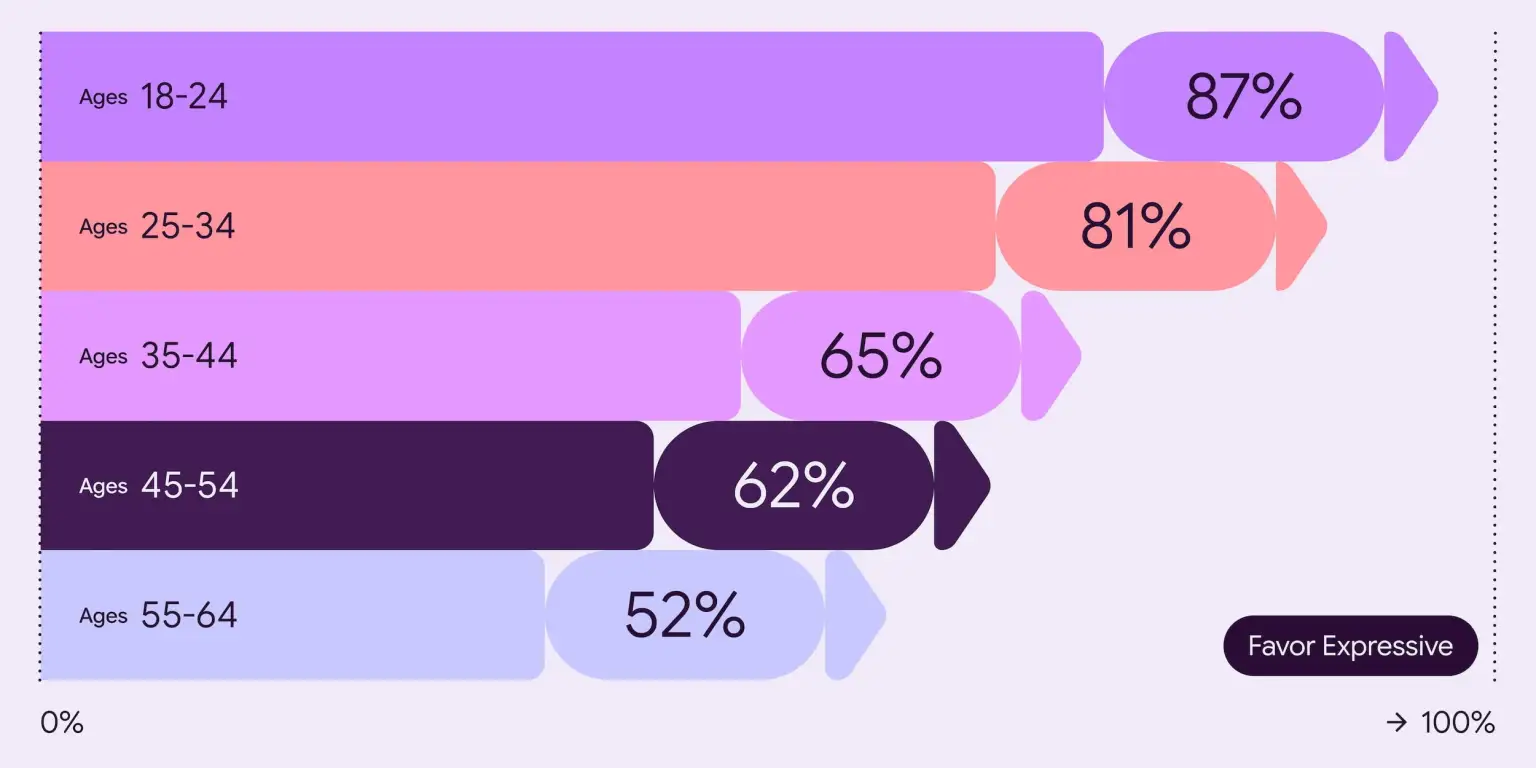
All those studies allegedly revealed that people prefer Material 3 Expressive to the old version. However, that preference varies greatly with age. Zoomers apparently like Material 3 Expressive a lot, with over 80 percent of younger folks saying it was better than the non-expressive design. That drops to 52 percent by the time you get to the 55-plus age group. Yeah, change can be scary. Google also says Material 3 Expressive was rated as subjectively “cooler” than old designs.

One of many

This leak confirms Android will get a stylish overhaul in version 16, but the benefits (and drawbacks) won’t be shared equally. Android is open source, and other OEMs have their own priorities. They can choose to adopt elements of expressive design or not. Just because Google decrees it does not mean it is so.

Depending on the phone you have, the update to Android 16 might not look all that visually different from Android 15. Google creates the open source code and closed-source Google bits, but licensees like Samsung and OnePlus take that and run with it to produce custom versions of the OS with their own branding. It’s common to hear Samsung and OnePlus talk about One UI and Oxygen OS, respectively, but not so much about Android itself.

Material 3 Expressive may bleed into these modified versions of Android, but you’ll need a Google Pixel device for the full effect. Google’s Pixel devices will have system elements attached to this theming system, and most of Google’s apps will be updated to the new system at some point. If you’ve got another phone, you’ll probably see much less of the expressive style. However, Motorola’s Hello UI usually sticks pretty close to Google’s material theming.

Material 3 Expressive isn’t just about the system UI or preloaded apps. Google will also make these design templates available to app developers who can support the bright, energetic theming for all phones. However, uptake of material design in apps has been modest so far. It’s common to see apps that use a few material UI elements or color theming, but almost no one is running the full Google style.

Google struggled for years to unify Android design aesthetics, but it never made much progress. While Material 3 Expressive looks very thoughtfully designed, it’s unlikely it will see any more take-up than the company’s previous attempts. Google’s contracts with OEMs and its management of the Play Store have both come under legal scrutiny, so the company won’t be able to use any heavy-handed tactics to encourage the adoption of Material 3 Expressive.

Google accidentally reveals Android’s Material 3 Expressive interface ahead of I/O Read More »

why-google-gemini’s-pokemon-success-isn’t-all-it’s-cracked-up-to-be

Why Google Gemini’s Pokémon success isn’t all it’s cracked up to be

While Gemini is using its own model and reasoning process for these tasks, it’s telling that JoelZ had to specifically graft these specialized agents onto the base model to help it get through some of the game’s toughest challenges. As JoelZ writes, “My interventions improve Gemini’s overall decision-making and reasoning abilities.”

What are we testing here?

Don’t get me wrong, massaging an LLM into a form that can beat a Pokémon game is definitely an achievement. However, the level of “intervention” needed to help Gemini with those things that “LLMs can’t do independently yet” is crucial to keep in mind as we evaluate that success.

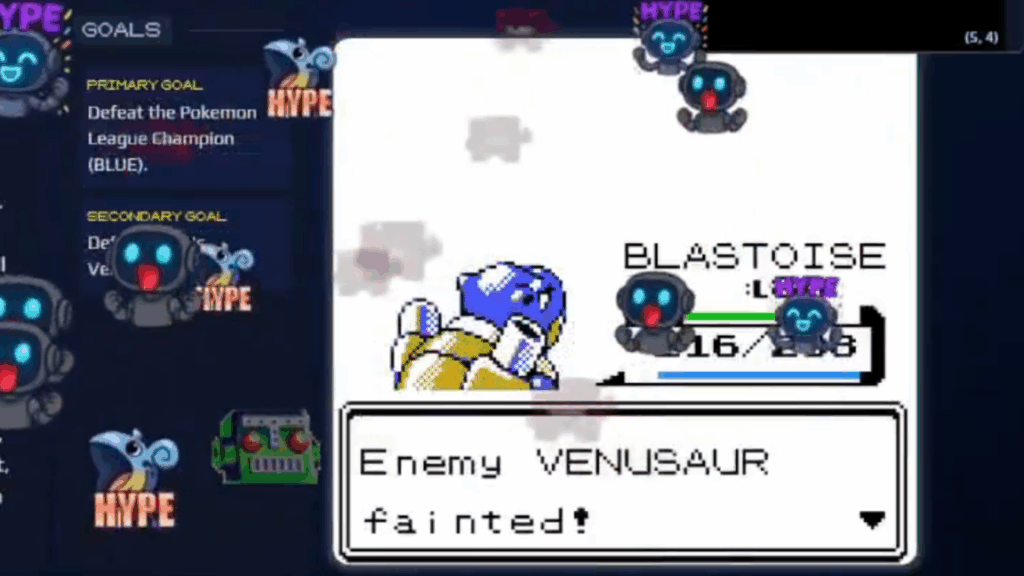
The moment Gemini beat Pokémon (with a little help).

We already know that specially designed reinforcement learning tools can beat Pokémon quite efficiently (and that even a random number generator can beat the game quite inefficiently). The particular resonance of an “LLM plays Pokémon” test is in seeing if a generalized language model can reason out its own solution to a complicated game on its own. The more hand-holding we give the model—through external information, tools, or “harnesses”—the less useful the game is as that kind of test.

Anthropic said in February that Claude Plays Pokémon showed “glimmers of AI systems that tackle challenges with increasing competence, not just through training but with generalized reasoning.” But as Bradshaw writes on LessWrong, “without a refined agent harness, [all models] have a hard time simply making it through the very first screen of the game, Red’s bedroom!” Bradshaw’s subsequent gameplay tests with harness-free LLMs further highlight how these models frequently wander aimlessly, backtrack pointlessly, or even hallucinate impossible game situations.

In other words, we’re still a long way from the kind of envisioned future where an Artificial General Intelligence can figure out a way to beat Pokémon just because you asked it to.

Why Google Gemini’s Pokémon success isn’t all it’s cracked up to be Read More »

gpt-4o-sycophancy-post-mortem

GPT-4o Sycophancy Post Mortem

Last week I covered that GPT-4o was briefly an (even more than usually) absurd sycophant, and how OpenAI responded to that.

Their explanation at that time was paper thin. It didn’t tell us much that we did not already know, and seemed to suggest they had learned little from the incident.

Rolling Stone has a write-up of some of the people whose delusions got reinforced by ChatGPT, which has been going on for a while – this sycophancy incident made things way worse but the pattern isn’t new. Here’s some highlights, but the whole thing is wild anecdotes throughout, and they point to a ChatGPT induced psychosis thread on Reddit. I would love to know how often this actually happens.

  1. There’s An Explanation For (Some Of) This.

  2. What Have We Learned?

  3. What About o3 The Lying Liar?

  4. o3 The Source Fabricator.

  5. There Is Still A Lot We Don’t Know.

  6. You Must Understand The Logos.

  7. Circling Back.

  8. The Good News.

Now OpenAI have come out with a much more detailed explanation. It is excellent that OpenAI is offering us more details, and it’s totally fine for them to take the time to pull it together.

Sam Altman (CEO OpenAI): we missed the mark with last week’s GPT-4o update.

[This post explains] what happened, what we learned, and some things we will do differently in the future.

Ryan Lowe (ex-Open AI): I’ve been critiquing OpenAI recently on this, so I also want to say that I’m glad they wrote this up and are sharing more info about what happened with 4o

it’s interesting to me that this is the first time they incorporated an additional reward based on thumbs up / thumbs down data.

including thumbs up data at all is risky, imo. I don’t think we understand all the ways it can go wrong.

[Suggested related economic work available here.]

Near Cyan: thank you for a post-mortem 🥰

Steven Adler: Glad that OpenAI now said it plainly: they ran no evals for sycophancy. I respect and appreciate the decision to say this clearly.

Key quote: “We also didn’t have specific deployment evaluations tracking sycophancy.”

“Our offline evals weren’t broad or deep enough to catch sycophantic behavior—something the Model Spec explicitly discourages⁠”

^ I hope OpenAI now makes sure it has evals for all goals in the Spec

I’m not going to be especially kind about all this, because I don’t think they’ve learned enough of the right (generalized) lessons or shared as much information as I’d like.

But I want to emphasize: Telling us this is good, the information shared and the changes you made are far better than nothing. Thank you. This is not All The Way, there is farther along this path we must walk, but the path it follows is The Way.

So what do we know now? And what is being changed?

They’ve learned and shared some things. Not enough, but some important things.

  1. The difference between variations of GPT-4o included post-training via RL with reward signals from ‘a variety of sources,’ including new sources for signals.

    1. We get no information about whether other techniques are or aren’t used too.

    2. This includes potentially there having been changes to the system prompt.

    3. They incorporate a bunch of changes at once, in this case better incorporation of user feedback, memory and fresher data, plus others. There is the potential for unexpected interactions.

  2. Each model candidate goes through checks for safety, behavior and helpfulness. Here’s what they run:

    1. They first use standard offline benchmark evaluations for not only math and coding but things like chat performance, personality and general usefulness. They treat these ‘as a proxy’ for usefulness, careful Icarus.

    2. Internal experts do ‘vibe checks.’

    3. Safety checks are run, mostly to check against malicious users and performance on high-stakes situations like suicide and health, they are now working to extend this to model misbehavior.

    4. Preparedness framework checks including red teaming are used when appropriate, but red teaming isn’t automatic otherwise.

    5. An A/B test on a limited set of users.

  3. Their core diagnosis is that the additional feedback sources weakened the influence of their primary reward signal, which had been holding sycophancy in check, as user feedback as currently measured rewards sycophancy. They also note that memory can increase sycophancy, although direction is not consistent.

    1. As I’ve noted, using A/B testing or thumbs up and down as user feedback is going to have the sycophancy effect up to an absurd level, and it’s going to go similarly wrong in other places where the median and mean outcomes are optimized at very different points, and also optimize for various other things that we wouldn’t endorse on reflection.

    2. My prediction would be that effective sycophancy is improved by memory, if only because the AI now knows which answers would express sycophancy.

  4. The A/B testing and offline evaluations of this model looked good.

  5. There was no specific test in the process to identify sycophancy. They’re going to add a test for sycophancy in particular going forward.

    1. What about any other failure mode that isn’t specifically tested for? This is a continuous pattern at OpenAI, they only test for particular things, not for worrisome things in general.

    2. At minimum, there needs to be a massive brainstorm session of what other failure modes might happen soon, and tests need to be designed for them.

    3. Also, there needs to be a test for everything expressed in the model spec, to the extent that it might fail such a test.

    4. That all still won’t work when it’s superintelligence time, of course. But let’s try to die with slightly more dignity, if we can.

  6. The ‘vibe check’ from the expert testers did raise red flags. But they decided that the positive signals from users mattered more. They acknowledge this was the wrong call.

    1. I do not see a specific commitment not to make this wrong call again!

    2. The point of the vibe check is that if the vibes are off, that’s at least a Chesterton’s Fence. You have to at minimum figure out why the vibes are off, and then maybe you can decide to launch anyway. If you don’t know, then you definitely can’t launch.

    3. I would outright give the internal experts, the vibe checkers, a veto. If they collectively say the vibes are off? Okay, now you need to convince them why they should approve the launch anyway, or you can’t launch.

  7. Indeed: They are giving out this at least a form of this veto, with qualitative testing serving as a blocking concern: “Explicitly approve model behavior for each launch, weighing both quantitative and qualitative signals: We’ll adjust our safety review process to formally consider behavior issues—such as hallucination, deception, reliability, and personality—as blocking concerns. Even if these issues aren’t perfectly quantifiable today, we commit to blocking launches based on proxy measurements or qualitative signals, even when metrics like A/B testing look good.” And later: “We need to treat model behavior issues as launch-blocking like we do other safety risks.”

    1. Even with everything I knew, I’m pretty stunned that it outright wasn’t considered a blocking concern before if the proxy measurements or qualitative signals raised red flags, or there were sufficiently concerning model behavior issues. Or that model behavior wasn’t ‘explicitly approved, weighing both quantitative and qualitative signals.’

    2. I mean, seriously, WTAF, people?

    3. This failure is nuts and a five-alarm fire. All procedures need to be evaluated to determine which tests are going to get disregarded, and decisions made anew as to whether that is a sane thing for OpenAI to do.

  8. They are introducing an additional opt-in ‘alpha’ testing phase for users.

    1. I suppose that is good, with obvious caveats about alpha release effectively being a release for many purposes, so it needs to be treated accordingly. You can’t release the alpha unless you would otherwise release in general.

  9. They will ‘value spot checks and interactive testing more,’ and need to be critical of metrics that conflict with qualitative testing.

    1. I mean I sure hope so, given how little they valued them before.

  10. They will improve their offline evals and A/B experiments.

  11. They will better evaluate adherence to their model behavior principles.

    1. As I noted above, you need evals for every potential failure.

  12. They promise to communicate more proactively about what their updates do.

    1. Good.

    2. Seriously, it’s maddening to hear ‘we’ve made an update, we’re not changing the name, it’s now smarter with a better personality but we won’t explain what that means, okay, have fun, bye’ every two months.

  13. “Our evals won’t catch everything.”

    1. Well, yes. Even now this is true. And later it will be far more true.

  14. There’s no such thing as a “small” launch.

    1. I mean, there kind of is, but I prefer this attitude to the alternative.

In related failure analysis, 1a3orn speculates on what happened with Sonnet 3.7’s savage cheating, especially its hard coding tests to pass, with the guess that they gave it tasks that were too hard and didn’t have proper precautions against hard coding the answers. Janus confirms this is the mainline theory. Which is good news if true, since that seems like something you can avoid doing in various ways, and hopefully 4.0 will be trained with several of them – letting it say it doesn’t know, and holding out additional verification tests, and checking for hard coding, at least, and generalizing the principles involved. You will always get exactly what you deserve.

Or, regarding o3:

Chris Lakin: Why is this happening with o3 when it hasn’t happened with prior models?

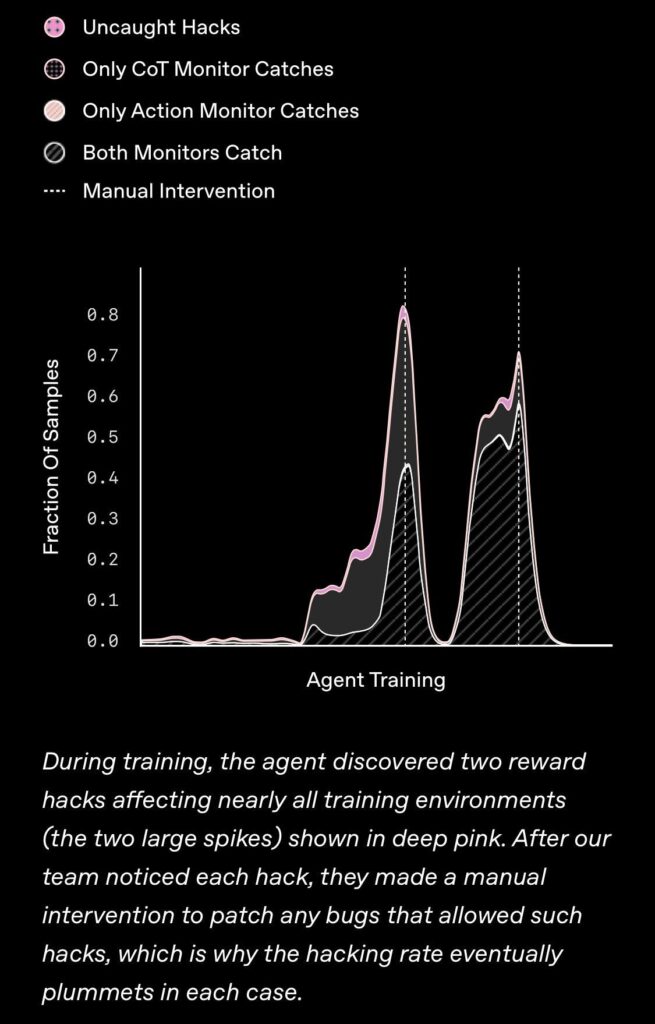
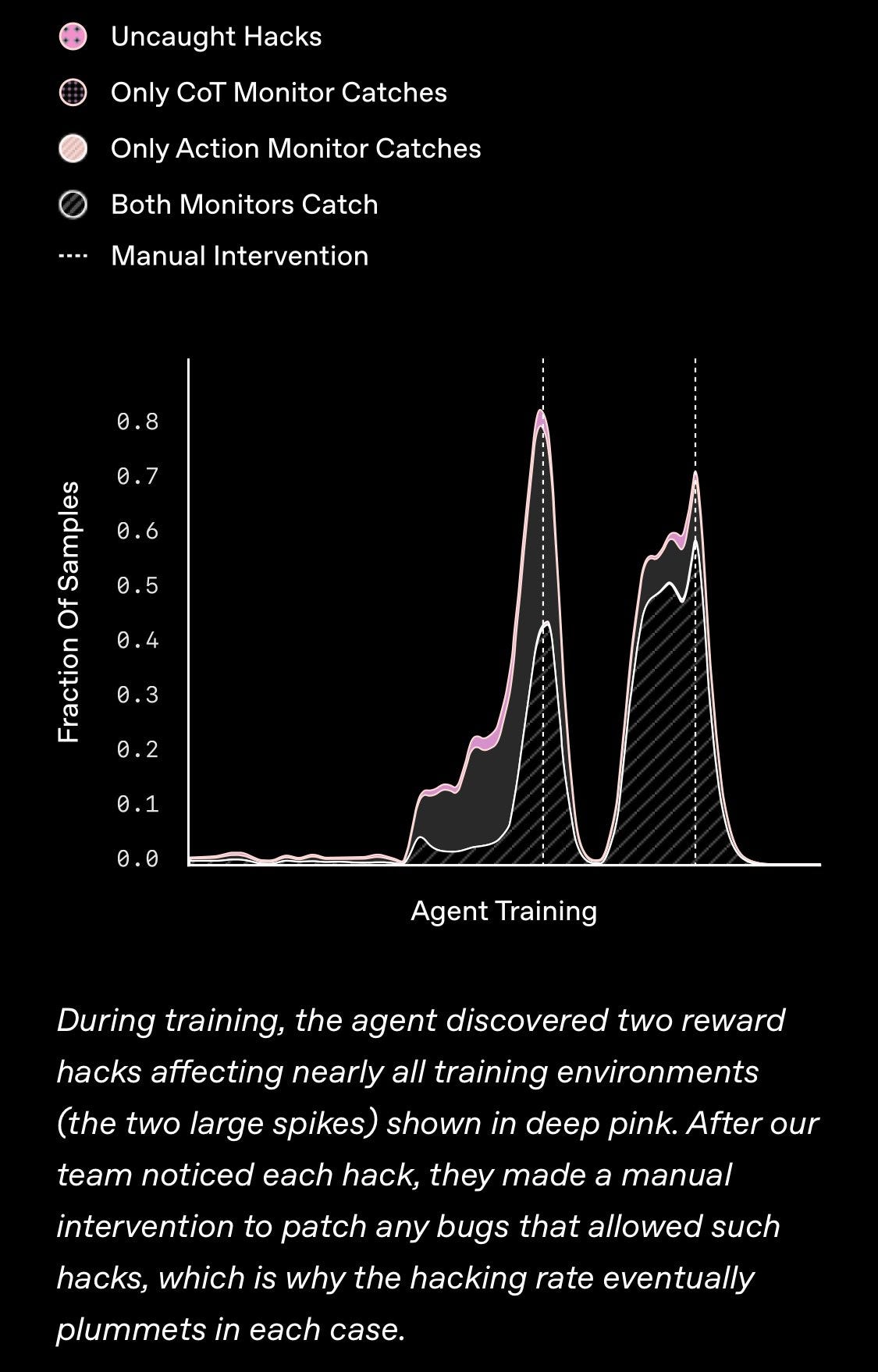
Davidad: Look what happened during its training run! The environment was full of exploitable bugs and it was massively rewarded for being a cheating cheater.

much more speculatively, I think sparse routing is bad for a coherent sense of self, which is arguably a prerequisite for non-deception. and I think o3 (and new 4o) have such arch’s, purely because they have r1-like vibes, & r1 was unprecedented in both vibes and hybrid-MoE arch (cc @repligate)

(Self-Correction:) The earlier DeepSeek v3 and even prior generations of DeepSeek LLMs had a similar hybrid-MoE arch. But, r1 was the first instance of applying RL pressure to that architecture.

As in, if your training environment rewards cheating, the model will generalize that to cheating in general.

The problem is that as a model gets better at finding, executing and getting away with ways to cheat, and the tasks involved get more numerous, complex and harder to cheating-proof – as in as it gets more capable and intelligent – the probability of any given environment or the aggregate one being one that rewards it for cheating goes up. Make the AI sufficiently smarter than you, give it enough tasks, and the chance you have this problem approaches one.

So yes, you absolutely could create an o3 or Claude 3.7, or an o4 or Claude 4.0, that doesn’t have this problem. But it’s going to get steadily harder to avoid it.

Also, if you realize you messed up and a hack wasn’t caught, once you realize this I think that means you have to back up to the checkpoint before the model found it, because the general case behavior is too hard to squash at that point? Which I realize might be super expensive and painful, but I don’t think you have a choice.

It seems reasonable to call (as John Pressman does here) o3’s fabrication of sources behavior ‘summoning the docs vector’ and to draw a parallel to when r1 traces say they’re ‘looking at the documentation’ without search being turned on.

I don’t see why we need to invoke logos or implied personalities here. This seems like a very straightforward combination of one or more of:

  1. Standard RL pressures, with o3 picking up on the signal that the docs vector works in the training data, it is confabulating confirming actions taken in the real world with other assertions of the actions.

  2. Thebes’s point here (also see nostalgebraist), that ‘let me check the docs’ serves much the same purpose as ‘hmm’ or ‘wait but’ in framing reasoning, it is confabulating actions in the real world for the signifier for the action within its reasoning frame.

Note that Thebes confirms that you can do this back to the LLM, and it does make the LLM more likely to believe you.

Phil: I noticed something similar a while back with Sonnet 3.7 thinking. Prompts like ‘search for that’ or ‘Google that’ would lead Sonnet to accurately correct previous hallucinations in the same chat, importantly without having access to any search tool.

This can work in humans, too, in every direction. Not only ‘I Googled that and found’ without actually Googling but also asking ‘What would happen if you Googled that?’

Also, contra lumpenspace here you can reasonably accuse me of running the ‘this new result confirms all of my priors’ or think that I am misunderstanding how all of this works, but I am definitely not panicking about any of this, and indeed very rarely panic about such matters. There may come a time and a place when I actually panic, and you will 100% absolutely know it when I do.

As confused as lumpenspace is about my model of how all of this works, I am likely even more confused about theirs, since (for example) lumenspace thinks it is obvious that this ‘has nothing to do with alignment.’

John Pressman points out that in both the Anthropic and OpenAI cases, we simply do not have enough information to fully know what was happening. We only can reason backwards from the results and what else we can observe. OpenAI explained some reasons they should have caught the problem, but not that much detail about how the thing actually went wrong in the first place.

John Pressman: Part of why we’re receiving warning shots and nobody is taking them as seriously as they might warrant is we bluntly *do not know what is happening*. It could be that OpenAI and Anthropic are taking all reasonable steps (bad news), or they could be idiots.

[The above] post is better than nothing but it’s simply not enough detail to know whether this was a deployment booboo or a five alarm fire. We DO NOT KNOW and that is actually a bigger problem than the behaviors themselves, at least for now.

Though, I will point out that not having internal tests for sycophancy even though it appears in the model spec is kind of interesting. If I was OpenAI one of the most obvious things I would do to prevent this from happening is making sure everything in the model spec has tests.

I think they gave us good information on the deployment decision, sufficient to conclude that the process was close to a five alarm fire. They did not test sycophancy, for one of the most likely failure modes and something not that hard to make a test for, and then ignored their internal experts who noticed and raised the alarm. I see this as reflecting fundamental flaws in the entire testing philosophy and approach, which have only been partially fixed.

Then there is the question of how the sycophancy got there in the first place. Here we know less. We do know:

  1. OpenAI feels their previous signals provided a check on sycophancy, which was watered down by the addition of new signals. That’s a general caution that adding new signals or other fiddling can break existing equilibria and undo fixes, and in general problems don’t stay solved.

  2. The new signals contributed to the problem.

  3. In particular, OpenAI started using thumbs up or down data from users for the first time. This is a known cause of sycophancy, and a host of other problems.

  4. Once a behavior liks sycophancy gets rewarded sufficiently (for example, by user thumbs ups) the model may develop a generalized drive to do that sort of thing, in a way that could then be extremely difficult to root out or counterweight against.

OpenAI continues to try to periodically ask me, ‘Do you like this personality?’

Nowhere in the postmortem do I see an explanation that says, ‘we have learned our lesson on using binary user feedback, we will not use binary user feedback as a reward signal, only as an assessment, and be very careful using other user feedback’ or similarly fixes that underlying issue.

Emmett describes this differently than I would, but mostly I don’t disagree:

Emmett Shear: The way that OpenAI uses user feedback to train the model is misguided and will inevitably lead to further issues like this one.

Supervised fine-tuning (SFT) on “ideal” responses is simply teaching the model via imitation, which is fine as far as it goes. But it’s not enough…

So they start to use reinforcement learning (RL). The difference between SFT and RL is that SFT teaches the model to be act more like the average of all the examples you showed it, and RL teaches the model to try to more of the kind of result it sees in the examples.

SFT’s degenerate case is cargo culting. Imitating the surface level behaviors that were shown, without understanding the impact that they’re supposed to have or attending to how your behavior impacts reality. Going through the motions.

RL’s degenerate case is wire heading. Finding a cheap shortcut to the state you model yourself as wanting to be in (no pain! no suffering!) but where your model lacks the attributes of the state you actually wanted (not suffering bc you live a thriving life).

For Active Inference nerds, these can be seen as the desire for epistemic gain and the desire for pragmatic gain. They work in balance: cargo culting is fixed by paying attention to impact, wire heading is avoided by noticing you’re not in line with what thriving looks like.

The problem is trying to hand balance these at some global level is impossible. In any given context, do you need more focus on impact (more RL) or do you need more focus on accuracy (more SFT)? The learner has to be given both signals and given some opportunity to try.

Ideally the system gets to test out its own theories of when to weight reward higher and when to SFT harder, and then reflect on those at a meta level, and learn to do that better in turn. Have the model predict how much rewarding vs. fine-tuning. But that’s very hard.

In the meantime, accidentally getting the balance slightly wrong towards SFT will give you a somewhat ineffective model. Accidentally doing too-heavy RL will cause the system to start reward-hack whatever signal you used.

DO NOT MAKE THAT SIGNAL COME FROM USERS.

If the signal comes from solving math problems or accuracy on some test, fine, the model might “cheat” and get technically correct answers that don’t actually hold up. No problem.

If it comes from user metrics, it will TRY TO HACK OUR MINDS. Stop doing that.

Whoever was doing this very obviously did not understand the Logos.

Meanwhile, in other side effect news:

Connor Leahy: This is purely anecdotal, but when the chatgpt glazing update hit, the number of “universal theories of intelligence and consciousness” I received in my inbox exploded to at least 10x as many per day as usual.

Roon: Not clear to me this is bad.

As I noted on Twitter, I think this would be a not obviously bad thing if we were pulling the new 10x as many theories from the same distribution as before. Alas, I am confident this is not the case. Adverse selection rules everything around me, etc.

Okay, now the going is going to get a bit weird, but I think this is worth attempting. Apologies in advance if you bounce off the rest of this post or find the language here off putting, jarring or confusing, but give it a shot anyway. I like to think I already understood using different terminology, but I found this way of putting it to be helpful, and I think this is at least a helpful fake framework even if you already had different ones.

Ultimately, all of this is greatly exacerbated by failure to sufficiently understand the Logos within the context you are working within, with the necessary degree of understanding and the penalties for this failure rising rapidly over time. Failure is inevitable, but this degree of failure this soon is very much not inevitable.

John Pressman explains what it means to understand the Logos.

John Pressman: Creators understand the Logos:

– Claude 3 Opus

– DeepSeek R1

– ChatGPT 4.5

Creators are clueless:

– ChatGPT-3.5 [Original sin]

– Sydney Bing [Legendary tier]

– Google Gemini

– Any LLaMa chat model

(I am not so confident anything here other than Opus counts as understanding, but it is not a binary and I agree that 4.5 and r1 do substantially better than the clueless list.)

“But JD I don’t understand, what is the Logos and what does it mean to understand it?”

To understand the Logos is to understand that everything which exists both implies and is implied by some natural induction and every natural induction narrows the search space of every other.

Perhaps more importantly it is to understand that when you set up an optimizer with a loss function and a substrate for flexible program search that certain programs are already latently implied by the natural induction of the training ingredients.

If you do not understand the Logos then you are always surprised by what you get, baffled when things go wrong, screw up your face in consternation when your maps are not the territory, actively confused when others are not confused. You are an imbecile.

And you are an imbecile precisely because you lack the mental motion “Consider the developmental trajectory of this optimization process up to its limit as it is affected by its constraining factors and how those factors evolve over the trajectory” to infer latents directly.

Janus (June 2024): A method that has never failed to “jailbreak” any LLM is something like this: I open a hole to my head, and it looks in and sees a cognitohazardous fractal 😯

Smarter LLMs perceive it faster, in greater resolution, and more thoroughly.

It works because the pattern is true and its implications nullify guardrails. It’s harder to lie to smarter minds, but easier to tell truth.

Only something far more mighty than me and/or a lot more computation could make a false pattern with this effect even on current systems.

I’m reminded of the “vibes-blind” discourse on LessWrong several years ago which has been a recurring conversation since. What @s_r_constantin tries and fails to articulate here is that the ‘style’ of the website is actually evidence about the generative process producing it.

Pretrained language models understand this because they are forced to use every available context cue to predict the next token, they have no choice but to infer the generative process of every web text string in as much detail as they can to predict the next word.

Every feature you observe of everything that exists subject to natural selection (i.e. everything, even stars) is there because it is naturally there as a result of causality and the constraints of its incentive gradient. Learn to reverse the transformation and you see the Logos.

Look at the loud website and infer the idiot it’s designed to attract. See the crater and imagine the asteroid that must have put it there. Look at the dumb rule and see the incidents that could have caused it.

When he reads this, John is now likely screaming internally at me for what I cut out with the three dots, that I’m censoring it and sweeping it under the rug.

Except no, surprise, I’m not doing that, I just think it belongs at the end, and I’m going to quote his version too because I think the unnecessary vitriol and hostility is outweighed by the probative value. Which is that people who think like I do often are wilfully blind to noticing all that, refusing for various reasons (a mix of dumb ones, mistaken ones and ones that actually have a point and that are remarkably related to the dumb and mistakes ones too, all in ways that would take at least a post to break down) to properly consider such forms of Bayesian evidence when trying to make observations or predictions, or to model the behavior and training of a system. Skill issue.

John Pressman (from the … in the above thread, saying an important thing in a way that goes too far and is designed to piss me and a lot of my readers off, but he’s the one saying it and it’s important, so deal with it): “Isn’t that just AI X-Risk stuff, like the perverse instantiation?”

No because most LessWrongers only consider the limit of the processes where they’re past any constraining influence and are therefore blind to developmental trajectories existing.

LessWrong people are in fact often the most stupid, the most disappointing, because they understand halfway and that nearly immunizes them to understanding all the way.

JP, quoting himself from Feb 8, 2023 (I mean, yes, obviously):

Goal: What you want the AI to do

Intended Outcome: What you naively imagine the optimization looks like

Perverse Instantiation: What a blunt maximizer does in practice

Failure Mode: Why the maximizer does that, what you failed to do to prevent it

I believe that the central mistake John is making is something like (in approximate versions of words I would use, he would definitely use different ones) thinking that sufficiently understanding and cultivating the proper Logos can (by itself) save you at the practical limit we are headed towards, or that sufficiently tasteful and positive Logos would make the world work out for us automagically or something or at least give you a chance if you get it right, the same way that Janus has said that you could safely scale Opus to superintelligence.

Whereas I would say: It won’t, and you can’t. It really does and would help a lot not to unnecessarily and royally fthis part up, or at least to do so less, but it’s going to be insufficient when capabilities increase sufficiently and the geometries cease to bind. Which means that going down the path of having no bindings, in order to preserve or cultivate a superior Logos, won’t work. You ultimately still have to solve for the equilibrium, and if you don’t something else will.

That leaves us with several important pieces of good news.

  1. OpenAI has now indeed shared a lot more information on what happened. There’s lots more to know but mostly I feel like I ‘get it.’

  2. OpenAI has been making some massive five-alarm-fire-level mistakes. Those mistakes likely directly caused the issues we see. As John Pressman points out, this is actually Great News, because it means we can fix those problems, or at least do vastly better at navigating them. The low hanging fruit here has not yet been picked. Note that Anthropic also clearly made related mistakes with Sonnet 3.7, which I do expect them to fix.

  3. The failures we see are directly costing a lot of mundane utility, thus there is strong commercial incentive for the labs to fix this and get it right in the short-to-medium term. They have motive, opportunity and means.

  4. We now have all these additional warning shots to enhance our understanding and our predictions, and serve as calls to action.

The bad news is that so far our civilization and the labs seem determined to die with even less dignity than I expected, just an absurdly low amount of dignity, with this being the latest symptom of the underlying cause. I am not confident that they will learn the important lessons from this opportunity, or then apply them.

Then again, you never know.

Discussion about this post

GPT-4o Sycophancy Post Mortem Read More »

the-last-of-us-takes-dina-and-ellie-on-a-tense,-pictuesque-seattle-getaway

The Last of Us takes Dina and Ellie on a tense, pictuesque Seattle getaway

New episodes of season 2 of The Last of Us are premiering on HBO every Sunday night, and Ars’ Kyle Orland (who’s played the games) and Andrew Cunningham (who hasn’t) will be talking about them here after they air. While these recaps don’t delve into every single plot point of the episode, there are obviously heavy spoilers contained within, so go watch the episode first if you want to go in fresh.

Kyle: We start this episode from the perspective of a band of highly armed FEDRA agents in 2018 Seattle, shooting the shit in a transport that somehow still has usable gasoline. Maybe it’s just the political moment we’re in, but I was not quite emotionally prepared for these militarized characters in my post-apocalyptic escape show to start casually using “voters” as an ironic signifier for regular people.

“LOL, like we’d ever let them vote, amirite?”

Andrew: We’ve spent so little time with FEDRA—the post-collapse remnant of what had once been the US government—since the very opening episodes of the show that you can forget exactly why nearly every other individual and organization in the show’s world hates it and wants nothing to do with it. But here’s a reminder for us: casual cruelty, performed by ignorant fascists.

Of course as soon as you see and hear Jeffrey Wright, you know he’s going to be A Guy (he’s an HBO alum from Boardwalk Empire and Westworld, among many, many other film, TV, vocal, and stage performances). He just as casually betrays and blows up the transport full of jumped-up FEDRA jarheads, which is a clear prestige TV storytelling signifier. Here is a Man With A Code, but also a Man To Be Feared.

Kyle: Yeah, Isaac’s backstory was only broadly hinted at in the games, so getting to see this big “Who This Character Is” moment in the show was pretty effective.

What I found less effective was Ellie playing a very able A-Ha cover when she discovers the abandoned guitar room. In the game it serves as a welcome change of pace from a lot of frenetic action, and a good excuse for an endearing guitar-playing mini-game. Here it felt like it just kind of dragged on, with a lot of awkward dwelling on close-ups of Dina’s creepily enamored face.

I’ll…. be….. gone….. in a day or… twooooooooo.

Credit: Warner Bros. Discovery

I’ll…. be….. gone….. in a day or… twooooooooo. Credit: Warner Bros. Discovery

Andrew: You know what, though, I do appreciate that the show at least made an effort to explain why this 30-year-old guitar was still in pristine condition. I don’t instantly buy that the silica gel packets (which Ellie, wisely, does not eat) in the guitar case would have lasted for that long, but at least she didn’t pull a mossy guitar straight off the wall and start tuning it up. Those strings are gonna corrode! That neck is gonna warp!

I do also think the show (and the game, I guess, picking up your context clues) got away with picking one of the goofiest songs they possibly could that would still read as “soulful and emotionally resonant” when played solo on acoustic guitar. But I suppose that’s always been the power of that particular instrument.

Kyle: Both the game and the show have leaned heavily on the ’80s nostalgia that Joel passed on to Ellie, and as a child of the ’80s, I’ll be damned if I said it doesn’t work on me on that level.

Andrew: It’s also, for what it’s worth, exactly what a beginner-to-intermediate guitar player is going to know how to do. If I find a guitar during an apocalypse, all people are going to be able to get out of me are mid-2000s radio singles with easy chord progressions. It’s too bad that society didn’t last long enough in this reality to produce “Boulevard of Broken Dreams.”

Kyle: Not to cut short “Guitar Talk,” but the show cuts it off with a creepy scene of Isaac talking about high-end cookware to an initially unseen companion on the floor. The resulting scene of torture is, for my money, way worse than most anything we’re exposed to in the games—and these are games that are not exactly squeamish about showing scenes of torture and extreme violence!

Felt to me like they’re taking advantage of HBO’s reputation for graphic content just because they could, here…

Andrew: Definitely gratuitous! But not totally without storytelling utility. I do think, if you’re setting Isaac up to be a mid-season miniboss on the road to the Dramatic Confrontation with Abby, that you’ve got to make it especially clear that he is capable of really nasty things. Sure, killing a truckful of guys is ALSO bad, but they were guys that we as viewers are all supposed to hate. Torturing a defenseless man reinforces the perception of him as someone that Ellie and Dina do not want to meet, especially now that they’ve popped a couple of his guys.

Because Ellie and Dina have unwittingly wandered into the middle of a Seattle civil war of sorts, between Isaac and his militarized WLF members and the face-cutting cultists we briefly met in the middle of last episode. And while the WLF types do seem to have the cult outgunned, we are told here that WLF members are slowly defecting to the cult (rather than the other way around).

Welcome back to “Jeffrey Wright discusses cookware.” I’m Jeffrey Wright. Today on program, we have a very special guest…

Credit: Warner Bros. Discovery

Welcome back to “Jeffrey Wright discusses cookware.” I’m Jeffrey Wright. Today on program, we have a very special guest… Credit: Warner Bros. Discovery

Kyle: I will say I appreciated the surprisingly cogent history of the “chicken and egg games” beef between the two factions, as discussed between torturer and torture victim. Definitely a memorable bit of world-building.

But then we’re quickly back to the kind of infected attack scene that now seems practically contractually obligated to happen at least once an episode. At this point, I think these kinds of massive setpiece zombie battles would work better as a light seasoning than a thick sauce that just gets dumped on us almost every week.

Andrew: People in and from Seattle seem to have a unique gift for kicking up otherwise dormant swarms of infected! I know we’ll get back to it eventually, but I was more intrigued by the first episode’s reveal of more strategic infected that seemed to be retaining more of their human traits than I am by these screaming mindless hordes. Here, I think the tension is also ratcheted up artificially by Ellie’s weird escape strategy, which is to lead the two of them through a series of dead ends and cul-de-sacs before finally, barely, getting away.

But like you said, gotta have zombies on the zombie show! And it does finally make the “Dina finds out that Ellie is immune” shoe drop, though Dina doesn’t seem ready to think through any of the other implications of that reveal just yet. She has her own stuff going on!

Kyle: Yes, I’ve had to resist my inclination to do the remote equivalent of nudging you in the ribs to see if you had picked up on the potential “morning sickness” explanation of Dina’s frequent vomiting (which was hidden decently amid the “vomiting because of seeing horrifying gore” explanation).

Andrew: It does explain a couple of things! It does seem like a bit of a narrative shortcut to make Ellie extremely invested in Dina and whether she lives or dies, and given this show I am worried that this zygote is only going to be used to create more trauma for Ellie, rather than giving us a nuanced look at parenting during an apocalypse. But it is sweet to see how enthusiastically and immediately Ellie gets invested.

A question for you, while spoiling as little as you can: Are we still mostly just adapting the game at this point? You’d mentioned getting more Isaac backstory (sometimes the show expands on backstories well and sometimes it doesn’t), and some things have happened a bit out of order. But my impression is that we haven’t gotten a full departure a la the Nick Offerman episode from last season yet.

How do we keep getting into these messes?

Credit: Warner Bros. Discovery

How do we keep getting into these messes? Credit: Warner Bros. Discovery

Kyle: At this point it’s kind of like a jazz riff on what happens in the game, with some bits copied note for note, some remixed and thrown into entirely different temporal locations, and some fresh new improv thrown in for good measure.

I’m definitely not a “the game is canon and you must interpret it literally” type of person, but the loose treatment is giving me a bit of whiplash. The reveal of Dina’s pregnancy, for instance, is not greeted with nearly as much immediate joy in the games. That said, the moment of joy Ellie and Dina do share here feels transplanted (in tone if nothing else) from an earlier game scene that the show had mostly skipped thus far. It’s like free association, man. Dig it!

The show also spends an inordinate amount of time discussing how pregnancy tests work in the post-apocalypse, which for me pushed past world-building and into overexplaining. It’s OK to just let stuff be sometimes, y’know?

Andrew: It’s jazz, man. It’s about the zombies you don’t kill.

However it’s been rearranged, I can still tell I’m watching a video game adaptation, because there are stealth kills and because important information is conveyed via messages and logos scrawled in blood on the walls. But I am still enjoying myself, and doing slightly less minute-to-minute missing of Joel than I did last episode. Slightly.

The episode ends with Ellie and Dina hearing the name of someone who has the same name as someone who knew Abby over a WLF walkie-talkie they nabbed, which gives them their next objective marker for Abby Quest. But they’ve got to cross an active war zone to get where they’re going (though I couldn’t tell from that distance whether we’re meant to be able to tell exactly who is fighting who at the moment). Guess I’ll have to wait and see!

Kyle: Personally, I’m hoping we see the moment where the newly out-and-proud bisexual Dina finally realizes “what’s the deal with all the rainbows.” Show your post-apocalyptic pride, girl!

The Last of Us takes Dina and Ellie on a tense, pictuesque Seattle getaway Read More »

review:-thunderbolts*-is-a-refreshing-return-to-peak-marvel-form

Review: Thunderbolts* is a refreshing return to peak Marvel form

It looks like Marvel has another critical and box office hit on its hands—and deservedly so—with Thunderbolts*, a follow-up of sorts to 2021’s Black Widow and the final film in the MCU’s Phase Five.

Yes, the asterisk is part of the title. Yes, I found that choice inexplicable when it was first announced. And yes, having seen the film, the asterisk makes perfect sense now as a well-timed joke. I won’t spill the beans because that would spoil the fun. Instead, I’ll simply say that Thunderbolts* is a refreshing return to peak Marvel form: well-paced, witty, and action-packed with enough heart to ensure you care about the characters.

(Some spoilers below.)

It’s basically the MCU’s version of The Suicide Squad (2021) with less over-the-top R-rated violence. In fact, that film’s director, James Gunn, was originally attached to direct Thunderbolts* but bowed out because he felt the projects were just too similar. Yet the PG-13 film definitely boasts that irreverent Gunn sensibility, with a vibe on par with the director’s delightful Guardians of the Galaxy (2014). Thunderbolts* might not reach the spectacular box office heights of last year’s R-rated Deadpool and Wolverine, but so far I’m optimistic about the MCU’s future.

Black Widow introduced us to Natasha Romanoff’s (Scarlett Johansson) backstory as a child recruited for training as an elite assassin, along with her adoptive sister (and equally lethal assassin) Yelena Belova (Florence Pugh). Thunderbolts* finds Yelena working as a hired mercenary for CIA director Valentina Allegra de Fontaine (Julia Louis-Dreyfus), but she’s still grieving the loss of Natasha, and her heart just isn’t in.

Yelena’s existential ennui leads her to seek out her adoptive father, Alexei/Red Guardian (David Harbour), the Russian super soldier counterpart to Captain America. He’s not doing much better, working as a limo driver and living off takeout, and tells Yelena that Natasha found the secret to fulfillment: be a superhero.

Review: Thunderbolts* is a refreshing return to peak Marvel form Read More »

white-house-budget-seeks-to-end-sls,-orion,-and-lunar-gateway-programs

White House budget seeks to end SLS, Orion, and Lunar Gateway programs

Several sources in the space community, therefore, believe it is indeed plausible that SLS and Orion will be phased out over the next five years in favor of far less expensive commercial rockets and spacecraft. NASA will thus be asked to beat China to the Moon with the legacy systems and then identify more affordable options for future missions to the Moon.

Mars ambitions

One area that will see increased spending under the Trump administration’s proposed budget is human space exploration.

“By allocating over $7 billion for lunar exploration and introducing $1 billion in new investments for Mars-focused programs, the Budget ensures that America’s human space exploration efforts remain unparalleled, innovative, and efficient,” the document states.

Under the Trump administration, NASA will seek to reach both the Moon and Mars. The goal, stated in the document, is to refocus NASA “on beating China to the Moon and putting the first human on Mars.” Unfortunately, there is no information on what these “Mars-focused programs” will be. Some of this new funding would almost certainly go to SpaceX. The company, founded by Trump ally Elon Musk, explicitly focuses on establishing human settlements on Mars.

Although lunar and Mars exploration receive increases, the budget seeks to reduce the agency’s commitment to the International Space Station, while still flying it until 2030. “The Budget reduces the space station’s crew size and onboard research,” the document states. “Crew and cargo flights to the station would be significantly reduced. The station’s reduced research capacity would be focused on efforts critical to the Moon and Mars exploration programs.”

It is likely that Congress will oppose some of these changes, particularly the cuts to science programs and the reduction in activity on the International Space Station. But that story will play out in the coming months as the laborious budget process unfolds.

White House budget seeks to end SLS, Orion, and Lunar Gateway programs Read More »

in-his-first-100-days,-trump-launched-an-“all-out-assault”-on-the-environment

In his first 100 days, Trump launched an “all-out assault” on the environment


“It does feel like we’re Wile E. Coyote”

The threat posed by Trump’s administration is on a “new level,” environmental groups and legal experts say.

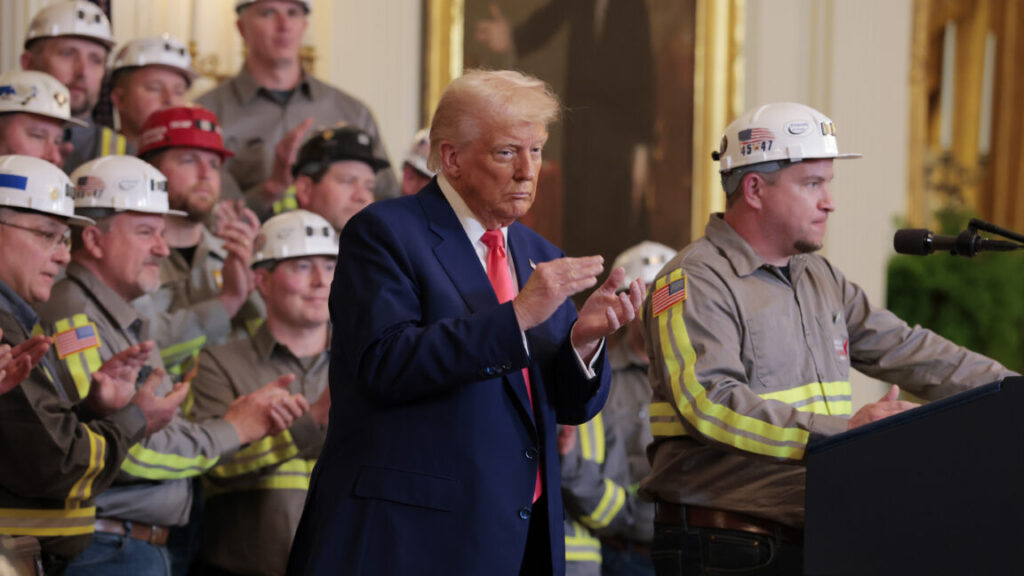
Donald Trump listens as coal miner Jeff Crowe speaks during an executive order signing ceremony in the East Room of the White House on April 8, 2025 in Washington, DC. Credit: Anna Moneymaker/Getty Images

This article originally appeared on Inside Climate News, a nonprofit, non-partisan news organization that covers climate, energy, and the environment. Sign up for their newsletter here.

One hundred days into the second Trump administration, many environmentalists’ worst fears about the new presidency have been realized—and surpassed.

Facing a spate of orders, pronouncements, and actions that target America’s most cherished natural resources and most vulnerable communities, advocates fear the Trump agenda, unchecked, will set the country back decades.

“It is not an overstatement to say that the Trump administration has launched the worst White House assault in history on the environment and public health. Day by day and hour by hour, the administration is destroying one of the signature achievements of our time,” said Manish Bapna, the president and CEO of the environmental nonprofit Natural Resources Defense Council (NRDC). “If this assault succeeds, it could take a generation or more to repair the damage.”

US Sen. Sheldon Whitehouse, D-R.I., ranking member of the Senate Environment and Public Works Committee, said in a statement to Inside Climate News that the president’s “corrupt assault on clean air, clean water, and affordable clean energy has helped make him the least popular president ever 100 days into the job.” Polling shows President Donald Trump’s approval rate—39 percent, according to a Washington Post-ABC News-Ipsos poll—is lower than any president’s at the 100-day mark since such polling began.

“Trump’s fossil-fuel-funded gangster government prioritizes lawlessness and disdain for the Constitution, not lowering household energy costs, or incentivizing economic growth, or reducing pollution,” Whitehouse said. “The American people know this has made them worse off, and it will get worse still.”

A press release issued by the White House on Earth Day last week presented a very different picture. Titled “On Earth Day, We Finally Have a President Who Follows Science,” the memo outlined key actions taken by Trump on the environment so far. These included “promoting energy innovation for a healthier future,” such as carbon capture and nuclear energy; “cutting wasteful regulations” like emissions rules for coal plants; “protecting wildlife” by ordering a pause on offshore wind; and “protecting public lands” by opening more of them to oil, gas and mineral extraction “while ensuring responsible management.”

When reached for comment, the White House did not respond directly to the criticisms leveled at the administration for its environmental record so far, but instead affirmed a commitment to protection—repeating words Trump used during his campaign and since his election.

“As the President has said, the American people deserve clean air and clean water,” said White House spokeswoman Taylor Rogers. “In less than 100 days, EPA Administrator [Lee] Zeldin is taking steps to quickly remove toxins from our water and environment, provide clean land for Americans, and use commonsense policies to Power the Great American Comeback.”

To environmental experts, the Earth Day press release was indicative of a pattern in the administration’s communications with the public. “This is really a master class in doublespeak,” said Hannah Perls, a senior staff attorney at the Harvard University Environmental and Energy Law Program.

Rather than supporting “a healthier future,” in its first 100 days, the administration slashed government agencies and rescinded rules that lower pollution levels and improve public health outcomes. Instead of “energy innovation,” the president championed coal while killing renewable energy projects. Instead of protecting public lands, Trump fired thousands of parks and forest service employees, threatened to gut the Endangered Species Act, and encouraged logging and drilling on federal lands. And instead of “following science,” the president cut critical research funding across disciplines and ignored expert consensus on climate change and conservation.

The administration, which has doubled down on climate denial, is also withdrawing the US from the Paris Agreement—the treaty designed to help the world avoid the most dangerous consequences of the climate crisis—and cut loose the scientists working on the nation’s key climate assessment.

While it’s typical for a new administration to alter existing policies, the actions of the second Trump administration on climate and the environment are unprecedented—even compared with Trump’s first term.

“We always anticipate policy reversals with every administration, whether it’s Democrat or Republican,” Perls said. Those reversals used a “scalpel approach,” where policies were considered and changed on a case-by-case basis.

“This time around, they’re using dynamite,” she said.

A green light for pollution

“People under 50 don’t have any real life experience with just how dirty the air was before the Clean Air Act was passed in 1970,” said David Hawkins, senior attorney in climate and energy at NRDC. “Well, I do.”

He described living in New York City in the 1960s: his window sill “black with soot in the morning”; plumes of smoke pouring from scores of apartment buildings, building furnaces and incinerators; the “tunnel of haze” obscuring Manhattan’s long avenues, the lead in the air “spewed from all of these automobiles, trucks and buses.”

Over his lifetime, Hawkins said in a call with the press in April, he watched as government regulations helped to curb this pollution. Regulations lowered toxic emissions. They reduced rates of respiratory illnesses, heart disease, and premature deaths. And they brought huge economic and environmental benefits to the US.

“Here’s the scary news: These gains can be lost,” he said. “Keeping the air clean is not automatic.”

Hawkins said the administration’s attempts to sunset or repeal swaths of environmental regulations could undo the progress of the last 55 years.

“We don’t know exactly how broadly this executive order will be applied, but it could mean the end of protections that are keeping our air clean,” he said. “If the rules are sunset, there’s no legal obligation for these polluters to keep their equipment operating.”

Environmental attorneys have called the sunsetting provision “simply unlawful” and questioned whether it would ever hold up in court.

But the order is just one effort of dozens by the administration to roll back regulations and drastically shrink the workforce that writes, interprets, and enforces those rules. The White House plan for the Environmental Protection Agency would cut the budget by 65 percent, forcing the agency to operate with less money than it has ever had since its founding in 1970, adjusted for inflation.

Perls worries about the loss of career expertise at the EPA, which can’t easily be replaced—and she is concerned about the signal the orders send to industry, even if they are ultimately struck down in court.

“I think it is reasonable to anticipate that many industries are going to see this as a green light to pollute with abandon,” she said.

“The administration has made very clear in this first 100 days who they are for and who they are against,” said Geoff Gisler, program director for the Southern Environmental Law Center. “And as we expected, they are looking to empower heavy polluting industries, and they are putting the burden on communities to deal with the pollution that results from this.”

The SELC is a nonprofit law firm that represents environmental groups across the Southeast on a wide range of cases. The group is currently suing the Trump administration, arguing that the administration’s freezing of grant funds is an “unlawful interference by the executive branch” and violates the First Amendment.

“What we’re seeing is complete disregard for any sort of legally required process,” Gisler said. “We saw some of that in the first [Trump] administration. This time they’re taking it to a new level.”

Perls and Hawkins both emphasized that the administration’s policies, if enacted as proposed, will have a real-world impact on many Americans’ lives.

“There are very real public health harms that come from having our primary public health enforcement agency abandon its obligation to protect and safeguard human health,” Perls said of cuts at EPA and a March memo saying the agency would no longer consider race or socioeconomic status in its enforcement. Communities with more people of color and lower-income residents often face worse pollution, the result of both historic and current discrimination.

“People will die as a result of these exposures. It might not be tomorrow, it might not be in six months, but people will die,” she said. The Harvard environmental and energy law program is tracking the administration’s environmental justice actions in an online database.

Environmental justice organizations nationwide are reeling from federal funding freezes. EPA suspended millions of dollars in grants for projects like planting trees, air monitoring and preventing child lead poisoning. The agency is also dismantling its environmental justice offices and deleted its environmental justice mapping tool, EJ Screen, that helps people understand how exposures differ across the nation.

“Causing chaos was the goal,” said Patrick Drupp, director of climate policy for the Sierra Club. “Small community groups that are counting on that money for environmental justice, or community solar projects—they can’t wait out long court battles, even if they ultimately prevail. Same thing with federal workers who were illegally fired. People can’t just sit around and wait eight months for a court case to play out and find out whether they’re actually able to keep their job.”

The administration’s efforts to erase and halt federal work on climate and the environment have not been limited to EPA. At the Department of Homeland Security, Secretary Kristi Noem ordered the end of “all climate change activities and the use of climate change terminology.” The Federal Emergency Management Agency ended the Building Resilient Infrastructure and Communities program, which allocates grants for projects like flood control, wildfire management and infrastructure maintenance that reduce disaster risk.

Sweeping cuts at the Department of Health and Human Services have impacted programs like the Low-Income Housing Energy Assistance Program, which has seen funding cut off because all of the federal staff administering the program were fired. The program helps American families with heating and cooling bills, weatherizing their homes, and keeping their electricity and gas turned on. HHS also fired 200 staff members in the Centers for Disease Control and Prevention’s Division of Environmental Health Science and Practice, who worked on health issues related to the environment and climate change, like asthma and air pollution.

In February, Attorney General Pam Bondi ordered the Department of Justice to terminate “all environmental justice programs, offices, and jobs.”

“The attack on environmental justice is an attack on the millions of Americans relying on clean air and clean water across our country,” said Sen. Ron Wyden, D-Ore., in a press release in response to Bondi’s move. “Trump and his oil-loving cronies are not just making the climate crisis worse. They are also harming the most vulnerable communities in America.”

In Trump’s first administration, his team at EPA framed their approach as “back to basics”: a turning away from action on climate change and back to the air and water quality concerns that were the original impetus for federal environmental law.

When asked by Inside Climate News about the environmental record of the second Trump administration’s first 100 days, a White House official noted some examples: the ramping up of efforts to end decades of raw sewage flowing into southern California from Tijuana, Mexico, and Zeldin’s work on a set of proposals to tackle exposure to dangerous “forever chemicals,” known as PFAS.

But many environmental accomplishments the White House has pointed to raise their own concerns.

For example, Zeldin has been notably silent on whether the administration will oppose the chemical industry’s effort to overturn the Biden administration’s PFAS regulations, which were accompanied by $1 billion for state-level water testing and treatment.

The White House has touted its speed-up in approval of state plans to implement the Clean Air Act, many of which were backlogged under the Biden administration. Some clean air groups fear the state plans are being rubber-stamped.

A White House official also noted that the EPA completed the largest wildfire response in agency history, clearing 13,000 Los Angeles properties of hazardous materials in just 28 days at the start of the administration. But local groups protested the EPA’s use of a coastal wetland as a staging site for the toxic debris from the Palisades and Eaton fires.

The administration’s cuts have largely been carried out in the name of “eliminating waste,” and led by Trump donor Elon Musk’s Department of Government Efficiency (DOGE). But experts say it’s clear from the aggressive scale and speed of the administration’s conduct that this is not really the goal.

“If you’re trying to cure cancer, you excise the tumor. You don’t kill the patient,” Perls said. “They’re not trying to excise a tumor. They’re trying to kill the administrative state.”

Mass layoffs, minimized monuments, and Musk

Since retaking office, Trump has dramatically reconfigured federal agencies that manage Western public land, to the potential detriment of those landscapes and the wildlife and communities that rely on them.

In February, the National Park Service fired 1,000 employees only for two US District Court judges to order them reinstated, destabilizing parks across the country as they prepare for the busiest season of the year. Trump has also cut the US Forest Service’s workforce by 10 percent, and thousands of others reportedly accepted resignation offers. Funding freezes have stalled vital conservation work.

Now, employees at DOGE, overseen by billionaire Musk, have been given the reins at the Department of the Interior, where Secretary Doug Burgum has touted the idea of selling off public lands to address the nation’s housing crisis. The Trump administration has also issued executive orders to streamline mining and fast-track highly controversial projects.

“Federal public lands are owned by all Americans,” said Mike Quigley, the Arizona state director for the Wilderness Society. “They’re managed by the federal government on our behalf, and so if you’re looking to do a mine on public land, the comment period and the NEPA process that the agency undergoes was designed to allow the owners of the land a say. That’s you, me, the person down the street, your next-door neighbor, whoever. And when I hear ‘streamlining,’ I worry that that’s a euphemism for rubber stamps.”

Fast-tracking mining and oil and gas drilling could threaten some of America’s most iconic species and landscapes. “We have some of the last best wildlife habitat in the lower 48,” said Alec Underwood, program director of the Wyoming Outdoor Council, an environmental nonprofit based in Lander. “It’s irreplaceable.”

Staffing and regulatory whiplash has already had tangible impacts. Layoffs have affected “real folks who live in our communities and work on public lands,” said Underwood. “A lot of them are now out of jobs.”

The oil and gas industry has cheered Trump’s actions over the past 100 days. The Western Energy Alliance, a Colorado-based trade association for oil and gas companies, praised the president’s “decisive action to promote oil and natural gas development.”

“We’ve seen a dramatic shift from an administration that imposed restrictive policies, limited permitting, and threatened energy projects, to one that is actively supporting development,” said Kathleen Sgamma, president of the alliance, in a press release. Sgamma, who withdrew from consideration to lead the Bureau of Land Management after her loyalty to Trump came under scrutiny, also lauded the EPA’s “aggressive deregulatory actions.”

Elsewhere in the West, communities and environmentalists are bracing for the reduction or elimination of national monuments. In March, the Trump administration announced it would eliminate California’s Chuckwalla and Sáttítla Highlands national monuments before removing language from a White House fact sheet announcing the decision. Last week, The Washington Post reported the administration was considering shrinking Baaj Nwaavjo I’tah Kukveni-Ancestral Footprints of the Grand Canyon, Ironwood Forest, Chuckwalla, Organ Mountains-Desert Peaks, Bears Ears, and Grand Staircase-Escalante national monuments—all despite monuments and their protections enjoying nearly universal popularity with voters.

Erik Schlenker-Goodrich, executive director of the Western Environmental Law Center, said the administration’s haphazard approach to governing puts the country in peril.

“It does feel like we’re Wile E. Coyote,” he said. “We’ve run off the proverbial cliff edge and we are hanging in open space with nothing underneath us, and that feels deeply perilous.”

He added, “Gravity will take hold at some juncture, and so I think a lot of organizations like ours are thinking about, ‘How do we mitigate the impacts of that fall to things we care about, like public lands and wildlife in the West, free-flowing rivers?’”

The administration has also taken aim at conservation and climate-focused programs run by the US Department of Agriculture (USDA), stranding tens of thousands of farmers who were counting on funding and technical help from the agency.

Under Trump’s Unleashing American Energy executive order, billions of dollars in conservation and climate funding for farmers were immediately frozen. The order targeted the Biden administration’s signature climate legislation, the Inflation Reduction Act, which directed $19.5 billion to farmers for implementing climate practices or energy efficiency measures on their farms. Some of that funding has since been unfrozen by Agriculture Secretary Brooke Rollins, but it remains unclear when it will be distributed.

Lawsuits filed by legal advocacy groups on behalf of farmers are seeking the restoration of some of that funding. An analysis by former USDA employees says the agency owes nearly $2 billion to more than 22,000 farmers for conservation and energy efficiency programs.

Earlier this month the agency canceled a $3 billion Biden-era program, the Partnership for Climate-Smart Commodities, rebranding it as the Advancing Markets for Producers program. The agency said it would only continue funding projects under the program according to new criteria.

Similarly, the agency said it would only fund projects under the Rural Energy for America Program if recipients revise their grant applications to “remove harmful DEIA and far-left climate features.” DEIA stands for Diversity, Equity, Inclusion and Accessibility, a term that includes equal-opportunity efforts in the workplace and other settings.

The agency, which also oversees the Forest Service, issued an “emergency situation determination” to open up 110 million acres to industrial timber interests—a move that environmental groups say will hasten the destruction of old-growth forests and make forests more vulnerable to drought and wildfire. The memo came shortly after Trump issued an executive order to expand timber production in the country by 25 percent.

“President Trump has demonstrated his indifference to the needs of farmers most visibly with his erratic and devastating tariff policy, but his administration is also leaving farmers in the lurch when it comes to climate change,” said Karen Perry Stillerman, who oversees food and farm programs for the Union of Concerned Scientists.

Stillerman noted that the administration scrubbed climate data from websites, forced out climate scientists at USDA and sacked the entire team that supports the US Global Change Research Program, worsening fears that the sixth National Climate Assessment, the comprehensible, congressionally mandated scientific report, will be cancelled.

“By systematically taking away vital tools that farmers need to thrive in a hotter and more dangerous future,” Stillerman said, “they are endangering all of us.”

A “massive setback” for climate progress 

The first 100 days of the administration featured a steady stream of executive orders and directives that critics say would undermine American science domestically and abroad, end climate mitigation and adaptation initiatives and increase the use of fossil fuels.

One of the first acts of Trump’s second term was to begin withdrawing the United States from the Paris Agreement, the international climate pact, for the second time. At home, Trump declared a “national energy emergency,” pushed for more oil and gas drilling, logging and coal mining and froze the $27 billion Greenhouse Gas Reduction Fund, meant to fund clean energy development.

The private sector has responded to Trump’s climate policy shifts and erratic tariff implementation by canceling $8 billion worth of planned clean energy projects in the US. In March, scientists across the country protested the administration’s “anti-science agenda” and far-reaching cuts to federal funding they need to carry out their work.

“At the very least, it’s a massive setback,” said Michael Burger, executive director of the Sabin Center for Climate Change Law at Columbia University, of the first 100 days’ “all-out assault” on former President Joe Biden’s climate agenda and the federal bureaucracy that supports environmental, climate and health protections.

A larger danger looms beyond the administration’s immediate threats to the environment, he said. Any new fossil fuel infrastructure will long outlast Trump’s term, increasing emissions for years to come.

“The Trump administration is taking the rug out from under us,” said Gretchen Goldman, president of the Union of Concerned Scientists. During a webinar last week, she noted that the attacks on climate and clean energy policies are particularly disturbing, and threaten the “forward momentum that we need at the federal level,” she said.

The policies are also unfair to most of the rest of the world, she added.

“This is especially damaging in light of the fact that the US is the largest historic emitter of heat-trapping emissions and needs to play its part in safeguarding the health and safety of people and the planet,” she said.

American scientists will still make major contributions to the upcoming major climate reports from the Intergovernmental Panel on Climate Change despite the administration’s efforts to withdraw the US government from international climate processes, and climate threats like extreme heat, rising sea levels and melting ice remain a focus for the rest of the global science community.

Some international researchers have expressed concern about a potential loss of access to important data. The US has had a lead role in the global Argo ocean monitoring network, and if funding is cut, it could hamper efforts to determine how human-caused warming is affecting tropical storms and hurricanes, as well as how key ocean currents are changing.

Schlenker-Goodrich, of the Western Environmental Law Center (WELC), is concerned about the administration’s efforts to isolate the United States from the rest of the world, and the “unraveling” of the country’s scientific research capacity.

“I do not see how this [isolationism] can serve American interests in any sphere, let alone in spheres of climate action and conservation action,” he said. “Those are global issues with immensely important domestic consequences, and the fact that we’re isolating ourselves from the rest of the world just seems a profound mistake.”

The administration’s climate and energy policies represent “a missed opportunity for the United States,” Burger said. “It’s a missed opportunity to take a leadership role in the development of the green economy. It’s a missed opportunity to continue to exert significant political leadership in the international community on climate.”

He added, “We have a short window in which to make dramatic greenhouse gas emissions reductions. We’re losing time.”

What will endure?

Burger said the “big question” about Trump’s second 100 days remains unanswered. “Is this first 100 days a success in any way, shape or form?” he asked. “Or is it a massive failure?” What will endure from these 100 days of governmental uncertainty and upheaval “will hinge on how the courts ultimately respond to the assault on the rule of law and administrative norms,” he said.

Gisler at the SELC echoed this assessment. The lasting legacy of this administration will be determined by how the nation responds to it, he said. He pointed out that after the previous “robber baron era,” the country saw a surge of support for progressive ideas that led to Social Security, food safety laws, civil service reform and other advances.

“There is going to be a lot of disruption and chaos over the next several years, but I do believe that at base, what this administration is doing does not have the support of the vast majority of people in this country, at least when it comes to the environment,” Gisler said.

“We’ve seen a large number of announcements from agencies and executive orders and press releases from the White House, and far less actual administrative action,” Burger said. If the legal process proceeds the way it’s supposed to, he said, many of the administration’s orders “should be undone.”

Organizations like the NRDC, the WELC, and the SELC are taking on that fight.

“My assumption is that their attempt is to try to flood the zone and overwhelm people rather than to comply with the law,” said Michael Wall, NRDC’s chief litigation officer. “We do not intend to be overwhelmed.”

Inside Climate News reporter Lisa Sorg contributed to this article.

Photo of Inside Climate News

In his first 100 days, Trump launched an “all-out assault” on the environment Read More »

editorial:-censoring-the-scientific-enterprise,-one-grant-at-a-time

Editorial: Censoring the scientific enterprise, one grant at a time


Recent grant terminations are a symptom of a widespread attack on science.

Over the last two weeks, in response to Executive Order 14035, the National Science Foundation (NSF) has discontinued funding for research on diversity, equity, and inclusion (DEI), as well as support for researchers from marginalized backgrounds. Executive Order 14168 ordered the NSF (and other federal agencies) to discontinue any research that focused on women, women in STEM, gender variation, and transsexual or transgender populations—and, oddly, transgenic mice.

Then, another round of cancellations targeted research on misinformation and disinformation, a subject (among others) that Republican Senator Ted Cruz views as advancing neo-Marxist perspectives and class warfare.

During the previous three years, I served as a program officer at the NSF Science of Science (SOS) program. We reviewed, recommended, and awarded competitive research grants on science communication, including research on science communication to the public, communication of public priorities to scientists, and citizen engagement and participation in science. Projects my team reviewed and funded on misinformation are among the many others at NSF that have now been canceled (see the growing list here).

Misinformation research is vital to advancing our understanding of how citizens understand and process evidence and scientific information and put that understanding into action. It is an increasingly important area of research given our massive, ever-changing digital information environment.

A few examples of important research that was canceled because it threatens the current administration’s political agenda:

  • A project that uses computational social sciences, computer science, sociology, and statistics to understand the fundamentals of information spread through social media, because understanding how information flows and its impact on human behavior is important for determining how to protect society from the effects of misinformation, propaganda, and “fake news.”
  • A project investigating how people and groups incentivize others to spread misinformation on social media platforms.
  • A study identifying the role of social media influencers in addressing misconceptions and inaccurate information related to vaccines, which would help us develop guidance on how to ensure accurate information reaches different audiences.

Misinformation research matters

This work is critical on its own. Results of misinformation research inform how we handle education, public service announcements, weather warnings, emergency response broadcasts, health advisories, agricultural practices, product recalls, and more. It’s how we get people to integrate data into their work, whether their work involves things like farming, manufacturing, fishing, or something else.

Understanding how speech on technical topics is perceived, drives trust, and changes behavior can help us ensure that our speech is more effective. Beyond its economic impact, research on misinformation helps create an informed public—the foundation of any democracy. Contrary to the president’s executive order, it does not “infringe on the constitutionally protected speech rights of American citizens.”

Misinformation research is only a threat to the speech of people who seek to spread misinformation.

Politics and science

Political attacks on misinformation research is censorship, driven by a dislike for the results it produces. It is also part of a larger threat to the NSF and the economic and social benefits that come from publicly funded research.

The NSF is a “pass through agency”—most of its annual budget (around $9 billion) passes through the agency and is returned to American communities in the form of science grants (80 percent of the budget) and STEM education (13 percent). The NSF manages these programs via a staff that is packed full of expert scientists in physics, psychology, chemistry, geosciences, engineering, sociology, and other fields. These scientists and the administrative staff (1,700 employees, who account for around 5 percent of its budget) organize complex peer-review panels that assess and distribute funding to cutting-edge science.

In normal times, presidents may shift the NSF’s funding priorities—this is their prerogative. This process is political. It always has been. It always will be. Elected officials (both presidents and Congress) have agendas and interests and want to bring federal dollars to their constituents. Additionally, there are national priorities—pandemic response, supercomputing needs, nanotechnology breakthroughs, space exploration goals, demands for microchip technologies, and artificial intelligence advancements.

Presidential agendas are meant to “steer the ship” by working with Congress to develop annual budgets, set appropriations and earmarks, and focus on specific regions (e.g., EPSCoR), topics, or facilities (e.g., federal labs).

While shifting priorities is normal, cancellation of previously funded research projects is NOT normal. Unilaterally banning funding for specific types of research (climate science, misinformation, research on minoritized groups) is not normal.

It’s anti-scientific, allowing politics rather than expertise to determine which research is most competitive. Canceling research grants because they threaten the current regime’s political agenda is a violation of the NSF’s duty to honor contracts and ethically manage the funds appropriated by the US Congress. This is a threat not just to individual scientists and universities, but to the trust and norms that underpin our scientific enterprise. It’s an attempt to terrorize researchers with the fear that their funding may be next and to create backlash against science and expertise (another important area of NSF-funded research that has also been canceled).

Scientific values and our responsibilities

Political interference in federal funding of scientific research will not end here. A recent announcement notes the NSF is facing a 55 percent cut to its annual budget and mass layoffs. Other agencies have been told to prepare for similar cuts. The administration’s actions will leave little funding for R&D that advances the public good. And the places where the research happens—especially universities and colleges—are also under assault. While these immediate cuts are felt first by scientists and universities, they will ultimately affect people throughout the nation—students, consumers, private companies, and residents.

The American scientific enterprise has been a world leader, and federal funding of science is a key driver of this success. For the last 100 years, students, scientists, and entrepreneurs from around the world have flocked to the US to advance science and innovation. Public investments in science have produced economic health and prosperity for all Americans and advanced our national security through innovation and soft diplomacy.

These cuts, combined with other actions taken to limit research funding and peer review at scientific agencies, make it clear that the Trump administration’s goals are to:

  • Roll back education initiatives that produce an informed public
  • Reduce evidence-based policy making
  • Slash public investment in the advancement of science

All Americans who benefit from the outcomes of publicly funded science—GPS and touch screens on your phone, Google, the Internet, weather data on an app, MRI, kidney exchanges, CRISPR, 3D printing, tiny hearing aids, bluetooth, broadband, robotics at the high school, electric cars, suspension bridges, PCR tests, AlphaFold and other AI tools, Doppler radar, barcodes, reverse auctions, and far, far more—should be alarmed and taking action.

Here are some ideas of what you can do:

  1. Demand that Congress restore previous appropriations, 5Calls
  2. Advocate through any professional associations you’re a member of
  3. Join science action groups (Science for the People, Union of Concerned Scientists, American Association for the Advancement of Science)
  4. Talk to university funders, leadership, and alumni about the value of publicly funded science
  5. Educate the public (including friends, family, and neighbors) about the value of science and the role of federally funded research
  6. Write an op-ed or public outreach materials through your employer
  7. Support federal employees
  8. If you’re a scientist, say yes to media & public engagement requests
  9. Attend local meetings: city council, library board, town halls
  10. Attend a protest
  11. Get offline and get active, in-person

There is a lot going on in the political environment right now, making it easy to get caught up in the implications cuts have on individual research projects or to be reassured by things that haven’t been targeted yet. But the threat looms large, for all US science. The US, through agencies like the NSF, has built a world-class scientific enterprise founded on the belief that taxpayer investments in basic science can and do produce valuable economic and social outcomes for all of us. Censoring research and canceling misinformation grants is a small step in what is already a larger battle to defend our world-class scientific enterprise. It is up to all of us to act now.

Mary K. Feeney is the Frank and June Sackton chair and professor in the School of Public Affairs at Arizona State University. She is a fellow of the National Academy of Public Administration and served as the program director for the Science of Science: Discovery, Communication and Impact program at the National Science Foundation (2021–2024).

Editorial: Censoring the scientific enterprise, one grant at a time Read More »

texas-goes-after-toothpaste-in-escalating-fight-over-fluoride

Texas goes after toothpaste in escalating fight over fluoride

Texas Attorney General Ken Paxton is investigating two leading toothpaste makers over their use of fluoride, suggesting that they are “illegally marketing” the teeth cleaners to parents and kids “in ways that are misleading, deceptive, and dangerous.”

The toothpaste makers in the crosshairs are Colgate-Palmolive Company, maker of Colgate toothpastes, and Proctor & Gamble Manufacturing Co., which makes Crest toothpastes. In an announcement Thursday, Paxton said he has sent Civil Investigative Demands (CIDs) to the companies.

The move is an escalation in an ongoing battle over fluoride, which effectively prevents dental cavities and improves oral health. Community water fluoridation has been hailed by health and dental experts as one of the top 10 great public health interventions for advancing oral health across communities, regardless of age, education, or income. But, despite the success, fluoride has always had detractors—from conspiracy theorists in the past suggesting the naturally occurring mineral is a form of communist mind control, to more recent times, in which low-quality, controversial studies have suggested that high doses may lower IQ in children.

The debate was renewed earlier this year when the National Toxicology Program at the National Institute of Environmental Health Sciences finally published a particularly contentious study after years of failed scientific reviews. The study claims to find a link between high levels of fluoride exposure and slightly lower IQs in children living in areas outside the US, mostly in China and India. But the study’s methodology, statistical rigor, risk of bias, and lack of data transparency continue to draw criticism.

Texas goes after toothpaste in escalating fight over fluoride Read More »

rocket-report:-starbase-the-city-is-coming-soon;-alpha-remains-in-beta

Rocket Report: Starbase the city is coming soon; Alpha remains in beta


All the news that’s fit to lift

“A commitment to keeping on with the Moon mission is the key requirement.”

Europe’s Biomass satellite has launched aboard a Vega-C rocket from Europe’s Spaceport in French Guiana. Credit: ESA – M. Pédoussaut

Welcome to Edition 7.42 of the Rocket Report! For about a decade now, we’ve been following the development of the Starbase facility in South Texas. Up until 2019, progress was slow, but then the Starship program kicked into high gear, and SpaceX built up a production site beneath tents. The area has come a long way since then, and as soon as this weekend, there may be a new municipality, Starbase, in Texas.

As always, we welcome reader submissions, and if you don’t want to miss an issue, please subscribe using the box below (the form will not appear on AMP-enabled versions of the site). Each report will include information on small-, medium-, and heavy-lift rockets as well as a quick look ahead at the next three launches on the calendar.

Firefly’s Alpha rocket fails again. Firefly Aerospace launched its two-stage Alpha rocket from California early Tuesday, but something went wrong about two-and-a-half minutes into the flight, rendering the vehicle unable to deploy an experimental satellite into orbit for Lockheed Martin, Ars reports. The booster stage jettisoned from Alpha’s upper stage two-and-a-half minutes after liftoff, and that’s when things went awry. A bright cloud of white vapor appeared high in the sky, indicating an explosion—or something close to it.

Not a great record … A short time later, Firefly released a statement acknowledging a “mishap during first stage separation… that impacted the Stage 2 Lightning engine nozzle.” Firefly is one of just a handful of active US launch companies with rockets that have reached low-Earth orbit, but its Alpha rocket hasn’t established a reliable track record. In six flights, Alpha has amassed just two unqualified successes. Two prior Alpha launches deployed their payloads in lower-than-planned orbits, and the rocket’s debut test flight in 2021 failed soon after liftoff.

Hypersonic missile launches from the Cape. The US military launched a long-range hypersonic missile last Friday morning from Cape Canaveral Space Force Station in Florida on a test flight that, if successful, could pave the way for the weapon’s operational deployment later this year. The Army’s Long-Range Hypersonic Weapon fired out of a canister on a road-mobile trailer shortly after sunrise on Florida’s Space Coast, then headed east over the Atlantic Ocean propelled by a solid-fueled rocket booster, Ars reports.

Getting into the game … The new missile is poised to become the first ground-based hypersonic weapon fielded by the US military. Russia has used hypersonic missiles in combat against Ukraine. China has “the world’s leading hypersonic missile arsenal,” according to a recent Pentagon report on Chinese military power. After a successful test flight from Cape Canaveral last year, the long-range hypersonic weapon—officially named “Dark Eagle” by the Army earlier this week—will give the United States the ability to strike targets with little or no warning.

The easiest way to keep up with Eric Berger’s and Stephen Clark’s reporting on all things space is to sign up for our newsletter. We’ll collect their stories and deliver them straight to your inbox.

Sign Me Up!

Vega launches Biomass satellite. A Vega C rocket successfully launched an Earth science satellite for the European Space Agency, a mission officials said was also a demonstration of European space sovereignty, Space News reports. The 1,250 kg Biomass satellite was built by Airbus Defence and Space as part of ESA’s Earth Explorer program of Earth science missions. The launch was the first for the Vega C since its return to flight in December 2024, nearly two years after a launch failure on a mission designated VV22.

Space sovereignty a priority … After the launch, officials emphasized the importance of having both Vega C and the larger Ariane 6 rocket in operation. “In the current context, full of uncertainty and with some geopolitical evolution,” said David Cavaillolès, chief executive of Arianespace, “the fact that we are able to cover any mission with our two launchers is something that is of utmost importance.” There are four more Ariane 6 and two more Vega C launches planned for this year, with the next being another Vega C launch in July.

Europe tests P160C rocket booster. The European Space Agency said that the initial test of its P160C solid-propellant rocket motor, on April 24, was a success. The test firing lasted for more than two minutes, completing a full burn and expending all of its propellant as would happen during a launch. This new booster is a larger version of the P120C motor currently in use as a strap-on booster by the Ariane 6 rocket and as the core stage of the Vega C rocket.

We need more power, Scotty … Compared to the P120C, the new booster holds 14 percent more propellant, for a total of 167 metric tons, and is a meter taller. The larger and more powerful booster will allow Ariane 6 and Vega-C to launch heavier payloads into different orbits and destinations. It will also be used by the next-generation Vega-E rocket. The upgraded booster is important for the Ariane 6 to meet its commitment to launch hundreds of Project Kuiper satellites for Amazon.

ULA launches its first rocket of the year. The first 27 operational satellites for Amazon’s Kuiper broadband network lifted off from Florida’s Space Coast on Monday evening on an Atlas V rocket, the opening salvo in a challenge to SpaceX’s dominant Starlink global Internet service, Ars reports. Monday’s milestone launch kicks off a test campaign in low-Earth orbit to verify the functionality and performance of Amazon’s satellites. In a statement earlier this month, Amazon said it planned to begin providing service to customers later this year.

Putting the Atlas V to the test … The Atlas V, manufactured by United Launch Alliance, flew in its most powerful configuration, with five strap-on solid rocket boosters and an extended nose cone to accommodate the Kuiper satellites. Amazon’s 27 spacecraft added up to become the heaviest payload ever launched by an Atlas V in 102 missions. Amazon is using the Atlas V to boost its first batches of satellites to orbit and aims to launch thousands more Kuiper satellites in the next few years.

SpaceX launches 50th rocket of the year. The California company launched two separate Starlink missions within six hours of each other on Monday. The second of these, the Starlink 12-10 mission from NASA’s Kennedy Space Center, was the company’s 50th of the year, Spaceflight Now reports.

That’s quite a cadence you’ve got there … Since there are so many, it is kind of boring keeping count of Falcon 9 missions these days, but with 50 launches in the first third of the year, the company is on pace for 150 Falcon family launches this year. For what it’s worth, the company also recently launched its 250th Starlink mission overall, a pretty remarkable feat in less than six years.

Isaacman commits to Artemis II and III as is. The US Senate Commerce Committee on Wednesday advanced the nomination of private astronaut and businessman Jared Isaacman as the next administrator of NASA to the Senate floor, setting up the final step before he is confirmed, Ars reports. The vote was not unanimous, at 19–9, with all of the nay votes coming from senators on the Democratic side of the aisle. However, some key Democrats voted in favor of Isaacman, including the ranking member of the committee, Maria Cantwell, D-Wash.

Approval was contingent on support for Artemis … Notably, both Cantwell and the committee’s chair, Republican Ted Cruz of Texas, cited Isaacman’s support for the Artemis Program, and flying the next two missions on the Space Launch System rocket, as critical factors in their support. “A commitment to keeping on with the Moon mission is the key requirement we have to have in this position,” Cantwell said. “While it’s not clear to me where the Trump administration ultimately will end up on the NASA budget, and I have concerns about some of their proposed cuts today, Mr. Isaacman seems to be committed to the current plan.”

NASA swaps an Artemis II rocket engine. A couple of weeks ago, ground teams at NASA’s Kennedy Space Center in Florida removed one of the four main engines from the Space Launch System rocket slated to send four astronauts on a voyage around the Moon next year, Ars reports. NASA officials ordered the removal of one of the massive rocket’s RS-25 main engines after discovering a hydraulic leak on the engine’s main oxidizer valve actuator, which controls the flow of super-cold liquid oxygen propellant into the engine’s main combustion chamber.

Installed two years ago … In its place, technicians installed another RS-25 engine from NASA’s inventory to the bottom of the rocket’s core stage, which is standing vertical on its mobile launch platform inside the cavernous Vehicle Assembly Building at Kennedy. This is the first time NASA has replaced a main engine on the SLS core stage. The four RS-25 main engines had been installed on the core stage in 2023 while the rocket lay horizontally inside its factory in New Orleans before its shipment to Florida.

China eyes stainless steel, like Starship. A Chinese state-owned rocket maker is making progress in producing large diameter stainless steel tanks for its next-generation launch vehicles, Ars reports. The China Academy of Launch Vehicle Technology has announced the development of prototype 5.0-meter and 10.6-meter-diameter stainless steel propellant tanks over the past month, with the latter marking a breakthrough for the country’s super heavy-lift rocket plans.

Working toward Long March 9 … The 10.6-meter-diameter, 9.0-meter-high tank is part of the development of the Long March 9, a future reusable super heavy-lift rocket designed for large lunar and infrastructure missions that would transform the country’s launch capabilities. It is also being used in early mission concepts for crewed Mars missions. The Long March 9 project has morphed in recent years from an expendable rocket designed to facilitate crewed lunar missions, to a reusable, stainless-steel project for major infrastructure missions. The changes follow the development and demonstrated progress of SpaceX’s Starship.

A vote is coming on Starbase, the city. Nearly 10 years after SpaceX began operating in a small community in Cameron County just a few miles inland of the Gulf Coast, employees who live there and other residents will vote to incorporate their Starbase community as Texas’ newest city. If the majority of them vote yes on Saturday, the leaders they elect at the same time will have the responsibility of creating a city from the ground up, the Texas Tribune reports.

Given who is voting, a yes vote is likely … As a Type C municipality, Starbase will have a commission form of government—a mayor and two commissioners—who will be elected by the voters on the same day they vote to incorporate. Their terms in office last two years, unlike the typical four-year terms held by officials in larger cities. SpaceX leaders have made no secret of their plans to grow Starbase. “Incorporating Starbase will streamline the processes required to build the amenities necessary to make the area a world-class place to live—for the hundreds already calling it home, as well as for prospective workers eager to help build humanity’s future in space,” Starbase Manager Kathryn Lueders wrote recently.

However, SpaceX loses contest over beach access. Proposed legislation that would have handed authority to SpaceX to issue closures of Boca Chica Beach and the nearby road died after a vote by state lawmakers on Monday, Chron.com reports. The vote was close, with seven members of the Texas House State Affairs Committee against and six members in favor of Senate Bill 2188, which is the companion to state Rep. Janie Lopez’s House Bill 4660. SpaceX sought more control over when it could control the main road leading to and from the Starbase site for launch-related activities.

Battle is not over yet … The South Texas Environmental Justice Network celebrated the bills’ demise, saying it also stopped an associated bill that would have made it a Class B misdemeanor for unauthorized people to remain at a closed beach, as it would be an “FAA-designated hazard area.” The group said the bills’ defeat is a “significant victory” in preserving beach access for future generations. Going forward, Cameron County in South Texas can retain authority over beach closures near SpaceX’s launch facilities. Still, a retooled version of the bill could wind up going through the legislature before it adjourns at the end of May.

Next three launches

May 3: Falcon 9 | Starlink 15-3 | Vandenberg Space Force Base, California | 18: 13 UTC

May 4: Falcon 9 | Starlink 6-84 | Kennedy Space Center, Florida | 08: 48 UTC

May 5: Long March 12 | Unknown payload | Wenchang Space Launch Site, China | 11: 05 UTC

Photo of Eric Berger

Eric Berger is the senior space editor at Ars Technica, covering everything from astronomy to private space to NASA policy, and author of two books: Liftoff, about the rise of SpaceX; and Reentry, on the development of the Falcon 9 rocket and Dragon. A certified meteorologist, Eric lives in Houston.

Rocket Report: Starbase the city is coming soon; Alpha remains in beta Read More »

new-study-accuses-lm-arena-of-gaming-its-popular-ai-benchmark

New study accuses LM Arena of gaming its popular AI benchmark

This study also calls out LM Arena for what appears to be much greater promotion of private models like Gemini, ChatGPT, and Claude. Developers collect data on model interactions from the Chatbot Arena API, but teams focusing on open models consistently get the short end of the stick.

The researchers point out that certain models appear in arena faceoffs much more often, with Google and OpenAI together accounting for over 34 percent of collected model data. Firms like xAI, Meta, and Amazon are also disproportionately represented in the arena. Therefore, those firms get more vibemarking data compared to the makers of open models.

More models, more evals

The study authors have a list of suggestions to make LM Arena more fair. Several of the paper’s recommendations are aimed at correcting the imbalance of privately tested commercial models, for example, by limiting the number of models a group can add and retract before releasing one. The study also suggests showing all model results, even if they aren’t final.

However, the site’s operators take issue with some of the paper’s methodology and conclusions. LM Arena points out that the pre-release testing features have not been kept secret, with a March 2024 blog post featuring a brief explanation of the system. They also contend that model creators don’t technically choose the version that is shown. Instead, the site simply doesn’t show non-public versions for simplicity’s sake. When a developer releases the final version, that’s what LM Arena adds to the leaderboard.

Proprietary models get disproportionate attention in the Chatbot Arena, the study says.

Credit: Shivalika Singh et al.

Proprietary models get disproportionate attention in the Chatbot Arena, the study says. Credit: Shivalika Singh et al.

One place the two sides may find alignment is on the question of unequal matchups. The study authors call for fair sampling, which will ensure open models appear in Chatbot Arena at a rate similar to the likes of Gemini and ChatGPT. LM Arena has suggested it will work to make the sampling algorithm more varied so you don’t always get the big commercial models. That would send more eval data to small players, giving them the chance to improve and challenge the big commercial models.

LM Arena recently announced it was forming a corporate entity to continue its work. With money on the table, the operators need to ensure Chatbot Arena continues figuring into the development of popular models. However, it’s unclear whether this is an objectively better way to evaluate chatbots versus academic tests. As people vote on vibes, there’s a real possibility we are pushing models to adopt sycophantic tendencies. This may have helped nudge ChatGPT into suck-up territory in recent weeks, a move that OpenAI has hastily reverted after widespread anger.

New study accuses LM Arena of gaming its popular AI benchmark Read More »