Author name: Rejus Almole

isps-worry-that-killing-fcc-net-neutrality-rules-will-come-back-to-haunt-them

ISPs worry that killing FCC net neutrality rules will come back to haunt them

Illustration of ones and zeroes overlaid on a US map.

Getty Images | Matt Anderson Photography

ISPs asked the US Supreme Court to strike down a New York law that requires broadband providers to offer $15-per-month service to people with low incomes. On Monday, a Supreme Court petition challenging the state law was filed by six trade groups representing the cable, telecom, mobile, and satellite industries.

Although ISPs were recently able to block the FCC’s net neutrality rules, this week’s petition shows the firms are worried about states stepping into the regulatory vacuum with various kinds of laws targeting broadband prices and practices. A broadband-industry victory over federal regulation could bolster the authority of New York and other states to regulate broadband. To prevent that, ISPs said the Supreme Court should strike down both the New York law and the FCC’s broadband regulation, although the rulings would have to be made in two different cases.

A situation in which the New York law is upheld while federal rules are struck down “will likely lead to more rate regulation absent the Court’s intervention,” ISPs told the Supreme Court. “Other States are likely to copy New York once the Attorney General begins enforcing the ABA [Affordable Broadband Act] and New York consumers can buy broadband at below-market rates. As petitioners’ members have shown, New York’s price cap will require them to sell broadband at a loss and deter them from investing in expanding their broadband networks. As rate regulation proliferates, those harms will as well, stifling critical investment in bringing broadband to unserved and underserved areas.”

The New York law was upheld in April by the US Court of Appeals for the 2nd Circuit, which reversed a 2021 District Court ruling. New York Attorney General Letitia James agreed last week not to enforce the $15 broadband law while the Supreme Court considers whether to take up the case.

“Although New York has agreed not to enforce its rate-regulation law while the Court resolves this petition, New York continues to assert that it has the right to do what the FCC cannot,” ISPs wrote. “This case thus presents the question whether broadband services will remain protected from common-carrier treatment and rate regulation by individual States.”

NY law’s fate tied to FCC regulation

The fate of the New York law is tied in part to the Federal Communications Commission’s April 2024 decision to revive net neutrality rules and regulate ISPs as common carriers under Title II of the Communications Act. When New York enacted its affordability law, the FCC was not regulating ISPs under Title II. The lack of federal regulation gave states more leeway to implement their own laws.

When judges at the 2nd Circuit upheld the New York law, they wrote that “a federal agency cannot exclude states from regulating in an area where the agency itself lacks regulatory authority.” If the FCC’s revived common-carrier regulations are upheld, ISPs would have a better chance at overturning the New York law.

But ISPs are trying to get the net neutrality and common-carrier regulations overturned—and having success on that front. The US Court of Appeals for the 6th Circuit stayed enforcement of the FCC regulations while litigation is pending, and a panel of judges said that ISPs are likely to win the case. The “broadband providers have shown that they are likely to succeed on the merits,” 6th Circuit judges wrote.

ISPs are worried that if they succeed in killing the FCC regulation, they will be subject to many state laws like New York’s. “The upshot of the Sixth Circuit and Second Circuit decisions is that each State can now do what the FCC cannot—subject an interstate information service to common-carrier regulation, including rate regulation,” ISP lobby groups said in their Supreme Court petition. This will be “to the detriment of providers, consumers, and the nation,” they claimed.

ISPs asked the Supreme Court to “confirm that the federal Communications Act—not a patchwork of state laws—governs the regulation of interstate communications services such as broadband.”

ISPs worry that killing FCC net neutrality rules will come back to haunt them Read More »

self-driving-waymo-cars-keep-sf-residents-awake-all-night-by-honking-at-each-other

Self-driving Waymo cars keep SF residents awake all night by honking at each other

The ghost in the machine —

Haunted by glitching algorithms, self-driving cars disturb the peace in San Francisco.

A Waymo self-driving car in front of Google's San Francisco headquarters, San Francisco, California, June 7, 2024.

Enlarge / A Waymo self-driving car in front of Google’s San Francisco headquarters, San Francisco, California, June 7, 2024.

Silicon Valley’s latest disruption? Your sleep schedule. On Saturday, NBC Bay Area reported that San Francisco’s South of Market residents are being awakened throughout the night by Waymo self-driving cars honking at each other in a parking lot. No one is inside the cars, and they appear to be automatically reacting to each other’s presence.

Videos provided by residents to NBC show Waymo cars filing into the parking lot and attempting to back into spots, which seems to trigger honking from other Waymo vehicles. The automatic nature of these interactions—which seem to peak around 4 am every night—has left neighbors bewildered and sleep-deprived.

NBC Bay Area’s report: “Waymo cars keep SF neighborhood awake.”

According to NBC, the disturbances began several weeks ago when Waymo vehicles started using a parking lot off 2nd Street near Harrison Street. Residents in nearby high-rise buildings have observed the autonomous vehicles entering the lot to pause between rides, but the cars’ behavior has become a source of frustration for the neighborhood.

Christopher Cherry, who lives in an adjacent building, told NBC Bay Area that he initially welcomed Waymo’s presence, expecting it to enhance local security and tranquility. However, his optimism waned as the frequency of honking incidents increased. “We started out with a couple of honks here and there, and then as more and more cars started to arrive, the situation got worse,” he told NBC.

The lack of human operators in the vehicles has complicated efforts to address the issue directly since there is no one they can ask to stop honking. That lack of accountability forced residents to report their concerns to Waymo’s corporate headquarters, which had not responded to the incidents until NBC inquired as part of its report. A Waymo spokesperson told NBC, “We are aware that in some scenarios our vehicles may briefly honk while navigating our parking lots. We have identified the cause and are in the process of implementing a fix.”

The absurdity of the situation prompted tech author and journalist James Vincent to write on X, “current tech trends are resistant to satire precisely because they satirize themselves. a car park of empty cars, honking at one another, nudging back and forth to drop off nobody, is a perfect image of tech serving its own prerogatives rather than humanity’s.”

Self-driving Waymo cars keep SF residents awake all night by honking at each other Read More »

i-trust-nasa’s-safety-culture-this-time-around,-and-so-should-you

I trust NASA’s safety culture this time around, and so should you

Through a cloud-washed blue sky above Launch Pad 39A, Space Shuttle <em>Columbia</em> hurtles toward space on mission STS-107. ” src=”https://cdn.arstechnica.net/wp-content/uploads/2016/01/16271647815_f0b8187e11_o-640×474.jpg”></img><figcaption>
<p>Through a cloud-washed blue sky above Launch Pad 39A, Space Shuttle <em>Columbia</em> hurtles toward space on mission STS-107. </p>
<p>NASA</p>
</figcaption></figure>
<p>My first real taste of space journalism came on the morning of February 1, 2003. An editor at the Houston Chronicle telephoned me at home on a Saturday morning and asked me to hurry to Johnson Space Center to help cover the loss of Space Shuttle <em>Columbia</em>.</p>
<p>At the time, I did not realize this tragedy would set the course for the rest of my professional life, that of thinking and writing about spaceflight. This would become the consuming passion of my career.</p>
<p>I’ve naturally been thinking a lot about <em>Columbia</em> in recent weeks. While the parallels between that Space Shuttle mission and the first crewed flight of Boeing’s Starliner spacecraft are not exact, there are similarities. Most significantly, after the Space Shuttle launched, there were questions about the safety of the vehicle’s return home due to foam striking the leading edge of the spacecraft’s wing.</p>
<p>Two decades later, there are many more questions, both in public and private, about the viability of Starliner’s propulsion system after irregularities during the vehicle’s flight to the space station in June. NASA officials made the wrong decision during the <em>Columbia</em> accident. So, facing another <a href=hugely consequential decision now, is there any reason to believe they’ll make the correct call with the lives of Starliner astronauts Butch Wilmore and Suni Williams on the line?

A poor safety culture

To understand Columbia, we need to go back to 1986 and the first Space Shuttle accident involving Challenger. After that catastrophic launch failure, the Rogers Commission investigated and identified the technical cause of the accident while also concluding that it was rooted in a flawed safety culture.

This report prompted sweeping changes in NASA’s culture that were designed to allow lower-level engineers the freedom to raise safety concerns about spaceflight vehicles and be heard. And for a time, this worked. However, by the time of Columbia, when the shuttle had flown many dozens of successful missions, NASA’s culture had reverted to Challenger-like attitudes.

Because foam strikes had been seen during previous shuttle missions without consequence, observations of foam loss from the external tank during Columbia‘s launch were not a significant cause of concern. There were a few dissenting voices who said the issue deserved more analysis. However, the chair of the Mission Management Team overseeing the flight, Linda Ham, blocked a request to obtain imagery of the possibly damaged orbiter from US Department of Defense assets in space. The message from the top was clear: The shuttle was fine to come home.

The loss of Columbia resulted in another investigatory commission, known as the Columbia Accident Investigation Board. One of its members was John Logsdon, an eminent space historian at George Washington University. “We observed that there had been changes after Challenger and that they had gone away, and they didn’t persist,” Logsdon told me in an interview this weekend. “NASA fell back into the pattern that it had been in before Challenger.”

Essentially, then, antibodies within the NASA culture had rebounded to limit dissent.

Advantages for decision-makers today

If it does not precisely repeat itself, history certainly echoes. Two decades after Columbia, Starliner is presently docked to the International Space Station. As with foam strikes, issues with reaction-control system thrusters are not unique to this flight; they were also observed during the previous test flight in 2022. So once again, engineers at NASA are attempting to decide whether they can be comfortable with a “known” issue and all of its implications for a safe return to Earth.

NASA is the customer for this mission rather than the operator—the space agency is buying transportation services to the International Space Station for its astronauts from Boeing. However, as the customer, NASA still has the final say. Boeing engineers will have input, but the final decisions will be made by NASA engineers such as Steve Stich, Ken Bowersox, and Jim Free. Ultimately, NASA Administrator Bill Nelson could have the final say.

I trust NASA’s safety culture this time around, and so should you Read More »

the-witch’s-road-might-take-everything-in-agatha-all-along-d23-trailer

The Witch’s Road might take everything in Agatha All Along D23 trailer

witchy women —

“The Witch’s Road will give you the thing you want most… if you make it to the end.”

Kathryn Hahn seeks a new witchy coven in Agatha All Along.

Disney introduced the poster and first full trailer for Agatha All Along during its annual D23 Expo this weekend. The nine-episode series, starring Kathryn Hahn, is one of the TV series in the MCU’s Phase Five, coming on the heels of Secret Invasion, Loki S2, What If…? S2, and Echo.

(Spoilers for WandaVision below.)

As reported previously, Agatha All Along has been in the works since 2021, officially announced in November of that year, inspired by Hahn’s breakout performance in WandaVision as nosy neighbor Agnes—but secretly a powerful witch named Agatha Harkness who was conspiring to steal Wanda’s power. The plot twist even inspired a meta-jingle that went viral. That series ended with Wanda victorious and Agatha robbed of all her powers, trapped in her nosy neighbor persona.

Head writer Jac Schaeffer (who also created WandaVision) has said that the series would follow Agatha as she forms her own coven with “a disparate mixed bag of witches… defined by deception, treachery, villainy, and selfishness” who must learn to work together. And apparently we can expect a few more catchy tunes—one of which is front and center in the new trailer. This new series picks up where WandaVision left Agatha. Per the official premise:

The infamous Agatha Harkness finds herself down and out of power after a suspicious goth teen helps break her free from a distorted spell. Her interest is piqued when he begs her to take him on the legendary Witches’ Road, a magical gauntlet of trials that, if survived, rewards a witch with what they’re missing. Together, Agatha and this mysterious teen pull together a desperate coven, and set off down, down, down The Road…

In addition to Hahn, the cast includes Aubrey Plaza as warrior witch Rio Vidal; Joe Locke as Billy, a gay teenage familiar; Patti LuPone as a 450-year-old Sicilian witch named Lilia Calderu; Sasheer Zamata as sorceress Jennifer Kale; Ali Ahn as a witch named Alice; and Miles Gutierrez-Riley as Billy’s boyfriend.

Debra Jo Rupp reprises her WandaVision role as Sharon Davis (“Mrs. Hart” in the meta-sitcom), here becoming a member of Agatha’s coven. Also reprising their WandaVision roles: Emma Caulfield Ford as Sarah Proctor (aka “Dottie Jones”); David Payton as John Collins (“Herb”); David Lengel as Harold Proctor (“Phil Jones”); Asif Ali as Abilash Tandon (“Norm”); Amos Glick (pizza delivery man “Dennis”); Kate Forbes as Agatha’s mother, Evanora; and Brian Brightman as the Eastview, New Jersey, sheriff.

The first two episodes of Agatha All Along drop on September 18, 2024, on Disney+, with episodes airing weekly after that through November 6.

Disney+

Listing image by YouTube/Disney+

The Witch’s Road might take everything in Agatha All Along D23 trailer Read More »

520-million-year-old-larva-fossil-reveals-the-origins-of-arthropods

520-million-year-old larva fossil reveals the origins of arthropods

Loads of lobopods —

Early arthropod development illuminated by a microscopic fossil.

Image of a small grey object, curved around its abdomen, with a series of small appendages on the bottom.

Enlarge / The fossil in question, oriented with its head to the left.

Yang Jie / Zhang Xiguang

Around half a billion years ago, in what is now the Yunnan Province of China, a tiny larva was trapped in mud. Hundreds of millions of years later, after the mud had long since become the black shales of the Yuan’shan formation, the larva surfaced again, a meticulously preserved time capsule that would unearth more about the evolution of arthropods.

Youti yuanshi is barely visible to the naked eye. Roughly the size of a poppy seed, it is preserved so well that its exoskeleton is almost completely intact, and even the outlines of what were once its internal organs can be seen through the lens of a microscope. Durham University researchers who examined it were able to see features of both ancient and modern arthropods. Some of these features told them how the simpler, more wormlike ancestors of living arthropods evolved into more complex organisms.

The research team also found that Y. yuanshi, which existed during the Cambrian Explosion (when most of the main animal groups started to appear on the fossil record), has certain features in common with extant arthropods, such as crabs, velvet worms, and tardigrades. “The deep evolutionary position of Youti yuanshi… illuminat[es] the internal anatomical changes that propelled the rise and diversification of [arthropods],” they said in a study recently published in Nature.

Inside out and outside in

While many fossils preserved in muddy environments like the Yuan’shan formation are flattened by compression, Y. yuanshi remained three-dimensional, making it easier to examine. So what exactly did this larva look like on the outside and inside?

The research team could immediately tell that Y. yuanshi was a lobopodian. Lobopodians are a group of extinct arthropods with long bodies and stubby legs, or lobopods. There is a pair of lobopods in the middle of each of its twenty segments, and these segments also get progressively shorter from the front to back of the body. Though soft tissue was not preserved, spherical outlines suggest an eye on each side of the head, though whether these were compound eyes is unknown. This creature had a stomodeum—the precursor to a mouth—but no anus. It would have had to both take in food and dispose of waste through its mouth.

Youti yuanshi has a cavity, known as the perivisceral cavity, that surrounds the outline of a tube that is thought to have once been the gut. The creature’s gut ends without an opening, which explains its lack of an anus. Inside each segment, there is a pair of voids toward the middle. The researchers think these are evidence of digestive glands, especially after comparing them to digestive glands in the fossils of other arthropods from the same era.

A ring around the mouth of the larva was once a circumoral nerve ring, which connected with nerves that extend to eyes and appendages in the first segment. Inside its head is a void that contained the brain. The shape of this empty chamber gives some insight into how the brain was structured. From what the researchers could see, the brain of Y. yuanshi had wedge-shaped frontal portion, and the rest of the brain was divided into two sections, as evidenced by the outline of a membrane in between them.

Way, way, way back then and now

Given its physical characteristics, the researchers think that Y. yuanshi displays features of both extinct and extant arthropods. Some are ancestral characteristics present in all arthropods, living and extinct. Others are ancestral characteristics that may have been present in extinct arthropods but are only present in some living arthropods.

Among the features present in all arthropods today is the protocerebrum; its evolutionary precursor was the circumoral nerve ring present in Y. yuanshi. The protocerebrum is the first segment of the arthropod brain, which controls the eyes and appendages, such as antennae in velvet worms and the mouthparts in tardigrades. Another feature of Y. yuanshi present in extant and extinct arthropods is its circulatory system, which is similar to that of modern arthropods, especially crustaceans.

Lobopods are a morphological feature of Y. yuanshi that are now found only in some arthropods—tardigrades and velvet worms. Many more species of lobopodians existed during the Cambrian. The lobopodians also had a distinctively structured circulatory system in their legs and other appendages, which is closest to that of velvet worms.

“The architecture of the nervous system informs the early configuration of the [arthropod] brain and its associated appendages and sensory organs, clarifying homologies across [arthropods],” the researchers said in the same study.

Yuti yuanshi is still holding on to some mysteries. They mostly have to do with the fact that it is a larva—what it looked like as an adult can only be guessed at, and it’s possible that this species developed compound eyes or flaps for swimming by the time it reached adulthood. Whether it is the larva of an already-known species of extinct lobopod is an open question. Maybe the answers are buried somewhere in the Yuan’shan shale.

Nature, 2024. DOI: 10.1038/s41586-024-07756-8

520-million-year-old larva fossil reveals the origins of arthropods Read More »

more-than-greenwashing?-sustainable-aviation-fuels-struggle-to-take-off

More than greenwashing? Sustainable aviation fuels struggle to take off

Contrails from a jet

Enlarge / Sustainable aviation fuels could help cut carbon emissions from commercial flights.

Costfoto/NurPhoto via Getty Images

Last November, Virgin Atlantic Airways made headlines for completing the world’s first transatlantic flight using “100 percent sustainable aviation fuel.”

This week, the Advertising Standard Authority (ASA) of the U.K. banned a Virgin radio ad released prior to the flight, in which they touted their “unique flight mission.” While Virgin did use fuel that releases fewer emissions than traditional supplies, the regulatory agency deemed the company’s sustainability claim “misleading” because it failed to give a full picture of the adverse environmental and climate impacts of fuel.

“It’s important that claims for sustainable aviation fuel spell out what the reality is, so consumers aren’t misled into thinking that the flight they are taking is greener than it really is,” Miles Lockwood, director of complaints and investigations at the ASA, said in a statement.

The ruling is the latest in a string of greenwashing crackdowns against sustainable aviation fuels (SAFs), which are made of components other than fossil fuels. In recent years, the U.K. and U.S. governments and private sector have offered incentives and funds to help ramp up SAF production. But skeptics say the alternative fuels will hardly make a dent in the airline industry’s large carbon footprint.

Plant-powered flights

Aviation accounts for roughly 2.5 percent of global emissions, largely from the burning of petroleum-based fuels. Sustainable aviation fuels have been made with a number of alternative ingredients—from worn-out tires to plastic waste (though my colleague James Bruggers has previously covered some setbacks in the plastic-to-jet-fuel field).

The majority of SAFs are made using materials already found in the environment, such as cooking fats or plant oils. These alternative fuels still emit carbon dioxide when they burn, but they typically have lower “lifecycle” emissions than petroleum-based fuels due to the way they are harvested. SAFs tap into renewable resources found in the environment instead of fossil fuels that have trapped carbon underground for millions of years.

Currently, international standards require SAFs to be mixed with conventional fuels, which enables airlines to continue using the same infrastructure rather than developing new aircraft that can handle exclusively bio-based accelerants. To qualify as “sustainable” for U.S. tax credits, though, the mixture must cut net emissions by at least 50 percent compared with exclusively oil-based fuels.

More than greenwashing? Sustainable aviation fuels struggle to take off Read More »
infamous-$30-logitech-f710-called-out-in-$50m-lawsuit-over-titan-sub-implosion

Infamous $30 Logitech F710 called out in $50M lawsuit over Titan sub implosion

what could go wrong? —

Family of dead Titanic expert blasts “hip” electronics.

Stockton Rush shows David Pogue the game controller that pilots the OceanGate Titan sub during a CBS Sunday Morning segment broadcast in November 2022.

Enlarge / OceanGate CEO Stockton Rush shows David Pogue the 2010-era game controller that pilots the Titan sub during a CBS Sunday Morning segment broadcast in November 2022.

CBS Sunday Morning

In a 2022 CBS Sunday Morning segment, CEO Stockton Rush of deep-water submersible company OceanGate gave journalist David Pogue a fun reveal. “We run the whole thing with this game controller,” Rush said, holding up a Logitech F710 controller with 3D-printed thumbstick extensions. The controller was wireless, and it was the primary method for controlling the Titan submersible, which would soon make a visit to the wreck of the Titanic. Pogue laughed. “Come on!” he said, covering his eyes with his hand.

Journalists loved the controller story, covering the inexpensive F710 and the ways that video game controllers have become common control solutions in various military and spaceflight applications in recent years. After all, if your engineers and pilots grew up using two-stick controllers to waste their friends in Halo multiplayer, why not use that built-in muscle memory for other purposes?

So the use of a video game controller was not in itself a crazy decision. But after the Titan sub imploded on a June 2023 dive to the Titanic site, killing all five passengers including Stockton Rush, the use of a wireless $30 control interface began to look less “cool!” and more “isn’t that kind of risky?” The only question at that point was how long it would take the Logitech F710 to show up in a lawsuit.

This week, we got our answer. In the first Titan wrongful death lawsuit, filed this week by the estate of Paul-Henri Louis Emile Nargeolet, the Logitech controller comes in for some prominent criticism.

“Hip, contemporary, wireless”

Nargeolet “was known worldwide as ‘Mr. Titanic,'” says the new lawsuit (PDF) against OceanGate, Rush’s estate, and various companies that helped build the Titan. Nargeolet had been on 37 dives to the Titanic wreckage and, on his final dive, was working with OceanGate as a Titan crewmember who would “guide other crewmembers and assist with navigation through the Titanic wreckage, which he knew so well.”

The lawsuit reiterates all the main criticisms of the Titan.

First, the sub was not made from titanium (as most submersibles are), which gets stronger under compression; it was made instead from carbon fiber, which can crack under repeated compression. Rush, who saw himself as an innovator like “Steve Jobs or Elon Musk,” the complaint says, once told Pogue, “At some point, safety just is pure waste.” Rush thought he had found a lighter way to build subs.

Second, the complaint singles out the Titan’s “hip, contemporary, wireless electronics systems.” (Those adjectives are not compliments).

TITAN was piloted using a mass-produced Logitech video game controller (normally used with a PlayStation or Xbox) rather than a controller custom-made for TITAN’s design and operation. Moreover, the controller worked via Bluetooth, rather than being hardwired. TITAN also had only “one button” (for power) within its main chamber—the remainder of its controls (for lights, ballast and so on) and gauges (for depth, oxygen level and so forth) were touchscreen. RUSH stated that TITAN was “to other submersibles what the iPhone was to the BlackBerry.” As with an iPhone, however, none of the controller, controls or gauges would work without a constant source of power and a wireless signal.

OceanGate’s previous submersible, the Cyclops I, had also used a video game controller (a Sony DualShock 3) and some other wireless tech.

The DualShock 3 controller used to run the Cyclops I.

Enlarge / The DualShock 3 controller used to run the Cyclops I.

The complaint quotes an expert saying that such systems provided “multiple points of failure” and that “‘every sub in the world has hardwired controls for a reason,’ namely that a loss of signal would not imperil the vessel.” But such issues were “disregarded by OceanGate, as Titan employed nearly identical systems to Cyclops I,” says the complaint.

The lawsuit also attacks the engineering team that designed and integrated all the electronics systems into Titan, saying that the team was made up mostly of current or recent Washington State University grads with “virtually no real-world experience and no prior exposure to the deep-sea diving industry.”

The complaint does not allege that the Logitech wireless controller, the carbon fiber construction, Titan’s innovative porthole, or the use of disparate materials with differing expansion/compression coefficients—four main areas of criticism—were individually responsible for the sub’s implosion. But it does suggest that these systems could have together contributed to a “daisy chain of failures of multiple improperly designed or constructed parts or systems.” The complaint says that Nargeolet’s estate is entitled to at least $50 million in damages.

Too good to be true

A final investigatory report from various government agencies has been in process for over a year and has not yet been completed, but it seems likely that the Logitech controller—along with the five people on the sub—is gone forever.

But the prospect of a cheap piece of plastic surviving the catastrophic implosion was just too good for social media to ignore. Shortly after the Titan disaster, people began “sharing a photo that purports to show the controller resting on the bottom of the sea,” according to a 2023 AP fact check. “The image shows a sandy ocean bottom with a part of the photo magnified to supposedly show a close up of the controller.”

“The cheapest part survived,” one X (Twitter) user posted.

Alas, it did not; the photo was a fake.

Infamous $30 Logitech F710 called out in $50M lawsuit over Titan sub implosion Read More »

ars-asks:-what-was-the-last-cd-or-dvd-you-burned?

Ars asks: What was the last CD or DVD you burned?

i like my alcohol at 120% —

With the demise of Apple’s SuperDrive, we reminisce on our final homemade optical discs.

Photograph of a CD-R disc on fire

Enlarge / This is one method of burning a disc.

1001slide / Getty Images

We noted earlier this week that time seems to have run out for Apple’s venerable SuperDrive, which was the last (OEM) option available for folks who still needed to read or create optical media on modern Macs. Andrew’s write-up got me thinking: When was the last time any Ars staffers actually burned an optical disc?

Lee Hutchinson, Senior Technology Editor

It used to be one of the most common tasks I’d do with a computer. As a child of the ’90s, my college years were spent filling and then lugging around giant binders stuffed with home-burned CDs in my car to make sure I had exactly the right music on hand for any possible eventuality. The discs in these binders were all labeled with names like “METAL MIX XVIII” and “ULTRA MIX IV” and “MY MIX XIX,” and part of the fun was trying to remember which songs I’d put on which disc. (There was always a bit of danger that I’d put on “CAR RIDE JAMS XV” to set the mood for a Friday night trip to the movies with all the boys, but I should have popped on “CAR RIDE JAMS XIV” because “CAR RIDE JAMS XV” opens with Britney Spears’ “Lucky”—look, it’s a good song, and she cries in her lonely heart, OK?!—thus setting the stage for an evening of ridicule. Those were just the kinds of risks we took back in those ancient days.)

It took a while to try to figure out what the very last time I burned a disc was, but I’ve narrowed it down to two possibilities. The first (and less likely) option is that the last disc I burned was a Windows 7 install disc because I’ve had a Windows 7 install disc sitting in a paper envelope on my shelf for so long that I can’t remember how it got there. The label is in my handwriting, and it has a CD key written on it. Some quick searching shows I have the same CD key stored in 1Password with an “MSDN/Technet” label on it, which means I probably downloaded the image from good ol’ TechNet, to which I maintained an active subscription for years until MS finally killed the affordable version.

But I think the actual last disc I burned is still sitting in my car’s CD changer. It’s been in there so long that I’d completely forgotten about it, and it startled the crap out of me a few weeks back when I hopped in the car and accidentally pressed the “CD” button instead of the “USB” button. It’s an MP3 CD instead of an audio CD, with about 120 songs on it, mostly picked from my iTunes “’80s/’90s” playlist. It’s pretty eclectic, bouncing through a bunch of songs that were the backdrop of my teenage years—there’s some Nena, some Stone Temple Pilots, some Michael Jackson, some Tool, some Stabbing Westward, some Natalie Merchant, and then the entire back half of the CD is just a giant block of like 40 Cure songs, probably because I got lazy and just started lasso-selecting.

It turns out I left CDs the same way I came to them—with a giant mess of a mixtape.

Connor McInerney, Social Media Manager

Like many people, physical media for me is deeply embedded with sentimentality; half the records in my vinyl collection are hand-me-downs from my parents, and every time I put one on, their aged hiss reminds me that my folks were once my age experiencing this music in the same way. This goes doubly so for CDs as someone whose teen years ended with the advent of streaming, and the last CD I burned is perhaps the most syrupy, saccharine example of this media you can imagine—it was a mixtape for the girl I was dating during the summer of 2013, right before we both went to college.

In hindsight this mix feels particularly of its time. I burned it using my MacBook Pro (the mid-2012 model was the last to feature a CD/DVD drive) and made the artwork by physically cutting and pasting a collage together (which I made the mix’s digital artwork by scanning and adding in iTunes). I still make mixes for people I care about using Spotify—and I often make custom artwork for said playlists with the help of Photoshop—but considering the effort that used to be required, the process feels unsurprisingly unsatisfying in comparison.

As for the musical contents of the mix, imagine what an 18-year-old Pitchfork reader was listening to in 2013 (Vampire Weekend, Postal Service, Fleet Foxes, Bon Iver, and anything else you might hear playing while shopping at an Urban Outfitters) and you’ve got a pretty close approximation.

Ars asks: What was the last CD or DVD you burned? Read More »

doom-+-doom-ii-is-a-great-excuse-to-jump-back-into-hell,-for-free-or-for-$10

Doom + Doom II is a great excuse to jump back into Hell, for free or for $10

My critical opinion is that this absolutely whips —

Just how you remember it, but through a 4K, 120 fps accessible lens.

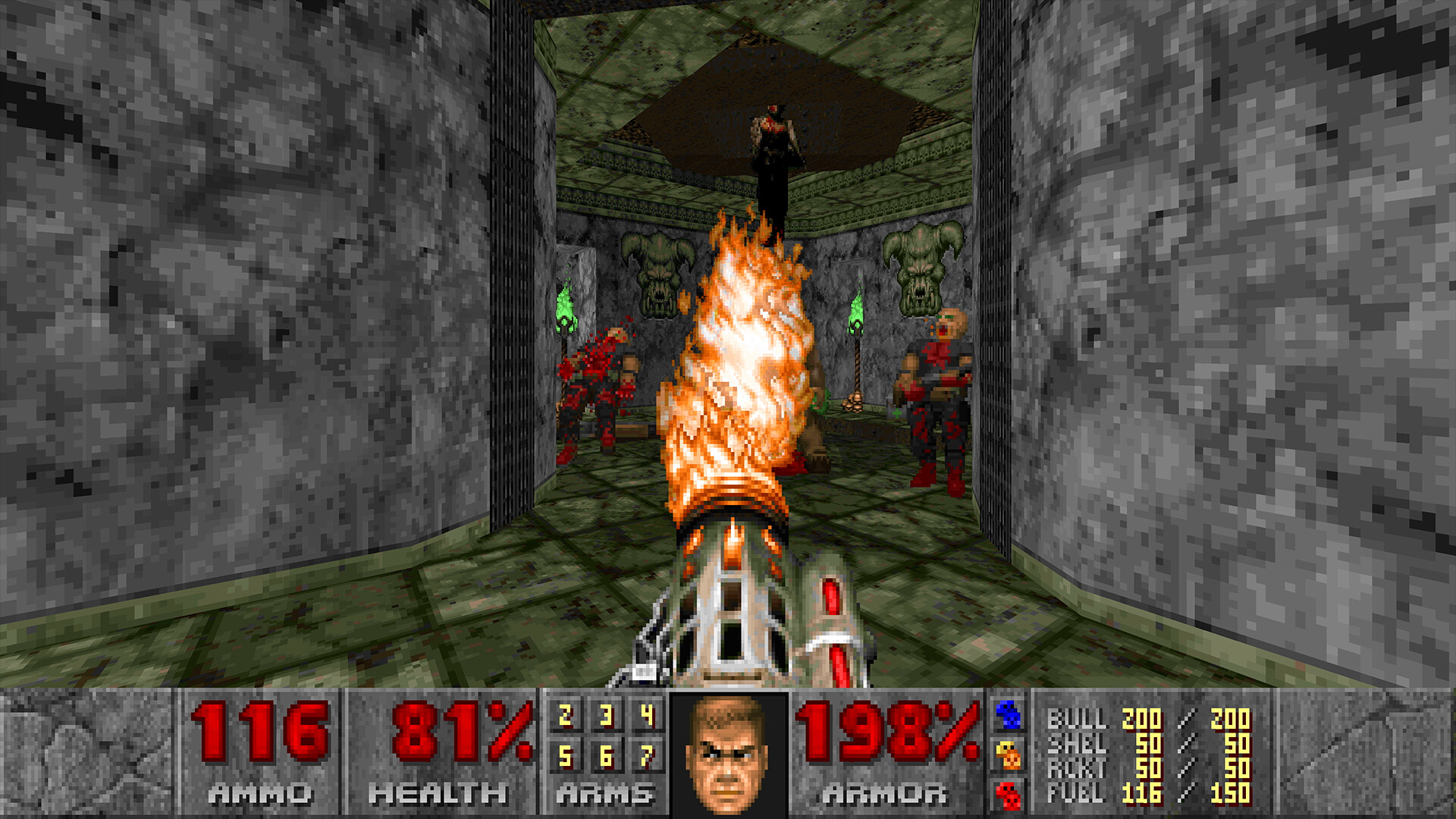
Some kind of huge gun, laying waste to a bunch of demons in a brown-ish Doom level from Legacy of Rust

Enlarge / I don’t know what this flame crossbow (?) is from the Legacy of Rust campaign, but I am going to keep running and gunning until I get it.

Bethesda Softworks

I have only one criticism of the “definitive, newly enhanced versions” of Doom and Doom II you can now pick up in a $10 package or as a free upgrade if you already owned one of those two games. My gripe is that it is entirely your own fault when you get hit by enemies.

On a PC, Xbox X or S, or PlayStation 5, you can play Doom at 120 fps at 4K. You are moving so ridiculously fast, speed-skating across those Marine bases and/or hellscapes, that the imps tossing fireballs at you feel like they’re a parent gently coaxing their kid to catch a softball. Even the enemies with instant-hitting guns feel like they’re winding up a tree sap cannon. The one time I died inside the first three levels of classic Doom was when I jet-walked right off a circular path and into an inescapable poison moat.

Does a flame thrower work against creatures that literally live in Hell? Only one way to find out.

Does a flame thrower work against creatures that literally live in Hell? Only one way to find out.

Bethesda Game Studios

It’s easy to recommend this newly packed-up and enhanced edition of these two first-person icons, released Thursday as part of QuakeCon. For one thing, it’s being offered by Nightdive Studios, which has been turning out fan-favorite (and generally Ars-approved) remasters of games like Dark ForcesSystem Shock, Quake, and Quake II. For another, it’s a real bundle, with both games, a huge number of classic add-on maps (including John Romero’s Sigil), and an entirely new episode, Legacy of Rust, made by folks from Nightdive, id Software, and Wolfenstein auteurs MachineGames.

And then there’s how playing these levels feels, which to me is as close as I can get to the caffeine-pulsing, speed-metal-blasting flow state I remember from much younger days. I’ve installed Doom and played a few levels now and then, but this is the first time I’ve made plans to keep going after the first session. After sprinting through a well-trod Hell, I’ll be eager to keep going in Legacy of Rust, where I saw quite a few cool design tricks in just a couple levels. Further along, new weapons await me, and I am eager to pick them up.

Doom + Doom II release trailer.

Wonderful, optional options

It helps that this version incorporates the rearranged, real-instruments “IDKFA” soundtrack from Andrew Hulshult, first made available in 2016 and now officially putting some heavy crunch into the classic tunes, along with some new Doom II tracks. It deserves its place in this official package, because it rips. As with almost everything else, the upgrade is optional—you can stick with MIDI if you like.

There are lots of accessibility options now—high-contrast text, text-to-speech in chat, and more—along with quality-of-life stuff. I was wary of having the crosshairs light up when an enemy (or barrel) would be hit, but given the sometimes unfair 2.5-D nature of the level design, and the spread of some of the bullet weapons, I’m keeping it on.

Cacodemons, chain guns, high-school-notebook Satanism—but in 4K, at 120Hz, and incredibly loud, if you like.

Cacodemons, chain guns, high-school-notebook Satanism—but in 4K, at 120Hz, and incredibly loud, if you like.

Bethesda Game Studios

If all that wasn’t enough for you, there’s 16-player co-op and deathmatch, with cross-platform play across Steam, Windows, Epic, and GOG on PC, and on Xbox, PlayStation, and Switch consoles, using room codes to connect everybody (and, it must be noted, a Bethesda account). There’s even split-screen multiplayer, with up to eight people on a (very big) PC screen. Nightdive’s port of the code to its KEX engine should make it easier for mods to be brought forward to this edition.

A caveat here that while the author is broadly aware of the many, many upgrades, mods, and other good things made possible by the open-source code and ports of Doom games (including ZDoom), he can’t say exactly how they compare to this bundle. While Bethesda and Nightdive seem to have created a space for uploading mods and levels, and keeping the basic DOS version available, it remains to be seen how they work out over the long run. If open-source Doom was always good enough for you, or you don’t like the idea of rebundling stuff that started out in the open, by all means, save yourself the $10 here. For many, though, this is just a far easier way to get at all the good stuff now possible in demon-shooting land.

If you haven’t checked out Doom in a while, whether sitting in your library or just $10 away now, this is too easy an excuse to check in on it again. Do it soon. Hell devours the indolent, you know.

This post was updated at 8: 40 a.m. to note the potential tension of Bethesda’s rebundling of Doom against its open-source community.

Doom + Doom II is a great excuse to jump back into Hell, for free or for $10 Read More »

ad-industry-initiative-abruptly-shuts-down-after-lawsuit-filed-by-elon-musk’s-x

Ad industry initiative abruptly shuts down after lawsuit filed by Elon Musk’s X

Lawsuit fallout —

Global Alliance for Responsible Media disputes X lawsuit but stops operations.

The X logo displayed on a smartphone next to Elon Musk's profile picture

Getty Images | SOPA Images

An advertising industry initiative targeted by an Elon Musk lawsuit is “discontinuing” its activities and has deleted the member list from its website.

On Tuesday, Musk’s X Corp. sued the World Federation of Advertisers (WFA) over what X claims is an illegal boycott spearheaded by a WFA initiative called the Global Alliance for Responsible Media (GARM). The WFA isn’t disbanding but is halting GARM’s activities, and the GARM member page now produces a 404 error. An archived version of the page from yesterday shows the initiative members, including X.

X’s antitrust lawsuit has drawn skeptical responses from law professors, who say it will be difficult to prove that companies violated antitrust laws by stopping advertisements. But while X may never obtain financial damages from the advertising group or corporations like CVS and Unilever that it also named as defendants, fighting the lawsuit could be costly.

Business Insider reported on the GARM shutdown today:

The advertising trade group The World Federation of Advertisers told its members on Thursday that it was “discontinuing” activities for its Global Alliance for Responsible Media initiative following an antitrust lawsuit filed by Elon Musk’s X against the company earlier this week.

Stephan Loerke, the CEO of the WFA, wrote in an email to members, seen by Business Insider, that the decision was “not made lightly” but that GARM is a not-for-profit organization with limited resources. Loerke said that the WFA and GARM intended to contest the allegations in X’s suit in court and were confident the outcome of the case would “demonstrate our full adherence to competition rules in all our activities.”

A WFA spokesperson told Ars that the group plans to issue a statement, and we’ll update this article when the statement is available.

The GARM shutdown was also confirmed by a New York Times report. The NYT paraphrased Loerke’s email as saying that “GARM would shut down its operations immediately.”

Group says work is being misrepresented

The WFA was founded in 1953 and is headquartered in Belgium. The WFA started the GARM initiative in 2019. GARM has two full-time staff members, Business Insider wrote. The WFA was also sued by Rumble, the maker of a video platform that is popular with conservatives.

A GARM webpage that was still online today, and which responds to recent criticism, said the group was created “to help the industry address the challenge of illegal or harmful content on digital media platforms and its monetization via advertising.” Members can “use GARM’s resources and information about best practices to learn where their advertising investments go, and to avoid placement next to illegal or harmful content that could damage their brands’ reputation,” the page says.

GARM says it provides “voluntary frameworks” to help brands make advertising decisions and “does not interfere with a member’s decision as to whether or not to invest advertising resources on a particular website or channel.”

“Suggestions that GARM practices may impinge on free speech are a deliberate misrepresentation of GARM’s work. GARM is not a watchdog or lobby. GARM does not participate in or advocate for boycotts of any kind,” the group says.

X has had an on-again, off-again relationship with GARM. Musk’s social network rejoined GARM little more than a month ago, but the reunion didn’t last long. “X is committed to the safety of our global town square and proud to be part of the GARM community!” X wrote on July 1.

House Republicans celebrate

GARM has also faced attacks from congressional Republicans. The House Judiciary Committee issued a report last month claiming that “the extent to which GARM has organized its trade association and coordinates actions that rob consumers of choices is likely illegal under the antitrust laws and threatens fundamental American freedoms.”

Today, the House Judiciary GOP’s official account on X called GARM being discontinued a “big win for the First Amendment” and a “big win for oversight.” X CEO Linda Yaccarino also applauded the news.

“No small group should be able to monopolize what gets monetized,” she wrote. “This is an important acknowledgement and a necessary step in the right direction. I am hopeful that it means ecosystem-wide reform is coming.”

X’s lawsuit against the WFA objected to GARM’s attempt to enforce “brand safety standards.”

“This is an antitrust action relating to a group boycott by competing advertisers of one of the most popular social media platforms in the United States… Concerned that Twitter might deviate from certain brand safety standards for advertising on social media platforms set through GARM, the conspirators collectively acted to enforce Twitter’s adherence to those standards through the boycott,” X’s lawsuit said.

An advertising industry watchdog group called the Check My Ads Institute predicted that X will only lose more advertisers after the lawsuit and its fallout.

“The reality is today’s decision [by GARM] means even more advertisers will flee X, and quickly so they’re not targeted in the future. Everyone can see that advertising on X is a treacherous business relationship for advertisers,” Check My Ads co-founder Claire Atkin said in a statement emailed to reporters.

Ad industry initiative abruptly shuts down after lawsuit filed by Elon Musk’s X Read More »

man-vs.-machine:-deepmind’s-new-robot-serves-up-a-table-tennis-triumph

Man vs. machine: DeepMind’s new robot serves up a table tennis triumph

John Henry was a steel-driving man —

Human-beating ping-pong AI learned to play in a simulated environment.

A blue illustration of a robotic arm playing table tennis.

Benj Edwards / Google DeepMind

On Wednesday, researchers at Google DeepMind revealed the first AI-powered robotic table tennis player capable of competing at an amateur human level. The system combines an industrial robot arm called the ABB IRB 1100 and custom AI software from DeepMind. While an expert human player can still defeat the bot, the system demonstrates the potential for machines to master complex physical tasks that require split-second decision-making and adaptability.

“This is the first robot agent capable of playing a sport with humans at human level,” the researchers wrote in a preprint paper listed on arXiv. “It represents a milestone in robot learning and control.”

The unnamed robot agent (we suggest “AlphaPong”), developed by a team that includes David B. D’Ambrosio, Saminda Abeyruwan, and Laura Graesser, showed notable performance in a series of matches against human players of varying skill levels. In a study involving 29 participants, the AI-powered robot won 45 percent of its matches, demonstrating solid amateur-level play. Most notably, it achieved a 100 percent win rate against beginners and a 55 percent win rate against intermediate players, though it struggled against advanced opponents.

A Google DeepMind video of the AI agent rallying with a human table tennis player.

The physical setup consists of the aforementioned IRB 1100, a 6-degree-of-freedom robotic arm, mounted on two linear tracks, allowing it to move freely in a 2D plane. High-speed cameras track the ball’s position, while a motion-capture system monitors the human opponent’s paddle movements.

AI at the core

To create the brains that power the robotic arm, DeepMind researchers developed a two-level approach that allows the robot to execute specific table tennis techniques while adapting its strategy in real time to each opponent’s playing style. In other words, it’s adaptable enough to play any amateur human at table tennis without requiring specific per-player training.

The system’s architecture combines low-level skill controllers (neural network policies trained to execute specific table tennis techniques like forehand shots, backhand returns, or serve responses) with a high-level strategic decision-maker (a more complex AI system that analyzes the game state, adapts to the opponent’s style, and selects which low-level skill policy to activate for each incoming ball).

The researchers state that one of the key innovations of this project was the method used to train the AI models. The researchers chose a hybrid approach that used reinforcement learning in a simulated physics environment, while grounding the training data in real-world examples. This technique allowed the robot to learn from around 17,500 real-world ball trajectories—a fairly small dataset for a complex task.

A Google DeepMind video showing an illustration of how the AI agent analyzes human players.

The researchers used an iterative process to refine the robot’s skills. They started with a small dataset of human-vs-human gameplay, then let the AI loose against real opponents. Each match generated new data on ball trajectories and human strategies, which the team fed back into the simulation for further training. This process, repeated over seven cycles, allowed the robot to continuously adapt to increasingly skilled opponents and diverse play styles. By the final round, the AI had learned from over 14,000 rally balls and 3,000 serves, creating a body of table tennis knowledge that helped it bridge the gap between simulation and reality.

Interestingly, Nvidia has also been experimenting with similar simulated physics systems, such as Eureka, that allow an AI model to rapidly learn to control a robotic arm in simulated space instead of the real world (since the physics can be accelerated inside the simulation, and thousands of simultaneous trials can take place). This method is likely to dramatically reduce the time and resources needed to train robots for complex interactions in the future.

Humans enjoyed playing against it

Beyond its technical achievements, the study also explored the human experience of playing against an AI opponent. Surprisingly, even players who lost to the robot reported enjoying the experience. “Across all skill groups and win rates, players agreed that playing with the robot was ‘fun’ and ‘engaging,'” the researchers noted. This positive reception suggests potential applications for AI in sports training and entertainment.

However, the system is not without limitations. It struggles with extremely fast or high balls, has difficulty reading intense spin, and shows weaker performance in backhand plays. Google DeepMind shared an example video of the AI agent losing a point to an advanced player due to what appears to be difficulty reacting to a speedy hit, as you can see below.

A Google DeepMind video of the AI agent playing against an advanced human player.

The implications of this robotic ping-pong prodigy extend beyond the world of table tennis, according to the researchers. The techniques developed for this project could be applied to a wide range of robotic tasks that require quick reactions and adaptation to unpredictable human behavior. From manufacturing to health care (or just spanking someone with a paddle repeatedly), the potential applications seem large indeed.

The research team at Google DeepMind emphasizes that with further refinement, they believe the system could potentially compete with advanced table tennis players in the future. DeepMind is no stranger to creating AI models that can defeat human game players, including AlphaZero and AlphaGo. With this latest robot agent, it’s looking like the research company is moving beyond board games and into physical sports. Chess and Jeopardy have already fallen to AI-powered victors—perhaps table tennis is next.

Man vs. machine: DeepMind’s new robot serves up a table tennis triumph Read More »

string-of-record-hot-months-came-to-an-end-in-july

String of record hot months came to an end in July

Hot, but not that hot —

July had the two hottest days recorded but fell 0.04° Celsius short of last year.

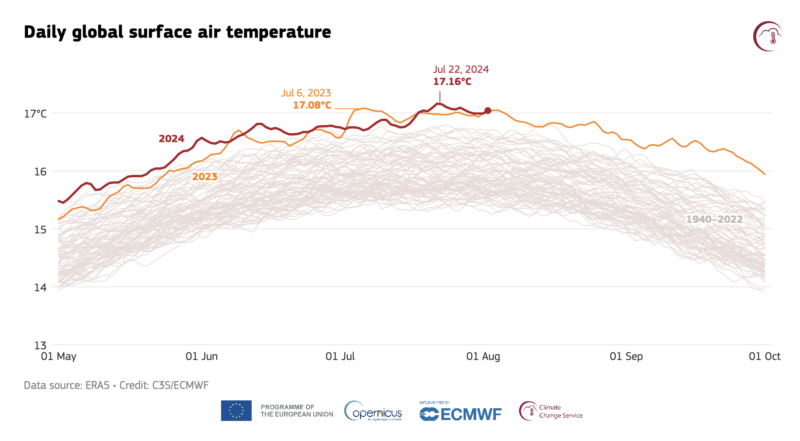
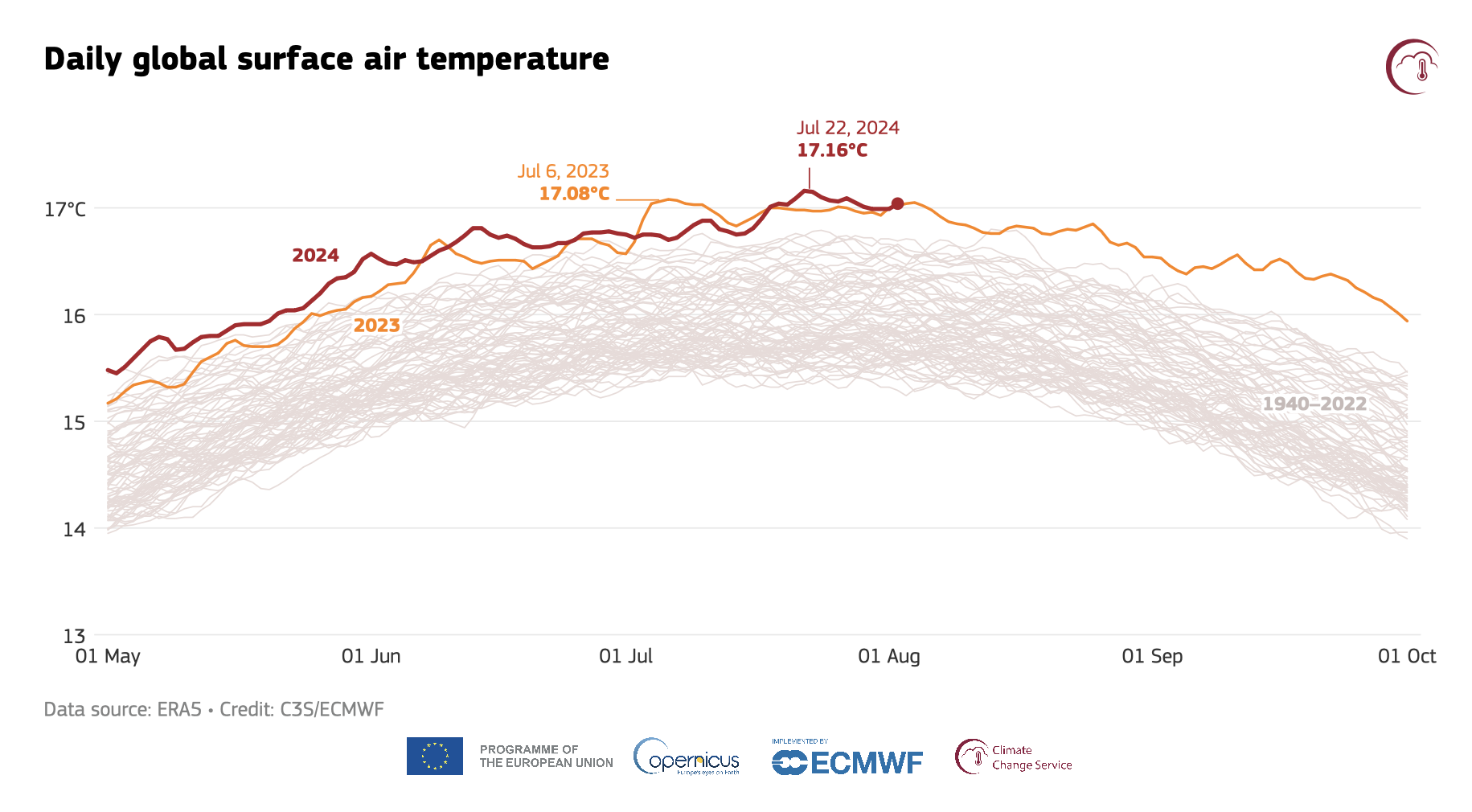
Image of a chart with many dull grey squiggly lines running left to right, with an orange and red line significantly above the rest.

Enlarge / Absolute temperatures show how similar July 2023 and 2024 were.

The past several years have been absolute scorchers, with 2023 being the warmest year ever recorded. And things did not slow down in 2024. As a result, we entered a stretch where every month set a new record as the warmest iteration of that month that we’ve ever recorded. Last month, that pattern stretched out for a full 12 months, as June of 2024 once again became the warmest June ever recorded. But, despite some exceptional temperatures in July, it fell just short of last July’s monthly temperature record, bringing the streak to a close.

Europe’s Copernicus system was first to announce that July of 2024 was ever so slightly cooler than July of 2023, missing out on setting a new record by just 0.04° C. So far, none of the other major climate trackers, such as Berkeley Earth or NASA GISS, have come out with data for July. These each have slightly different approaches to tracking temperatures, and, with a margin that small, it’s possible we’ll see one of them register last month as warmer or statistically indistinguishable.

How exceptional are the temperatures of the last few years? The EU averaged every July from 1991 to 2020—a period well after climate change had warmed the planet significantly—and July of 2024 was still 0.68° C above that average.

While it didn’t set a record, both the EU’s Copernicus climate service and NASA’s GISS found that it contained the warmest day ever recorded. In the EU’s case, they were the two hottest days recorded, as the temperatures on the 21st and 22nd were statistically indistinguishable, with only 0.01° C separating them. Late July and early August tend to be the warmest times of the year for surface air temperatures, so we’re likely past the point where any daily records will be set in 2024.

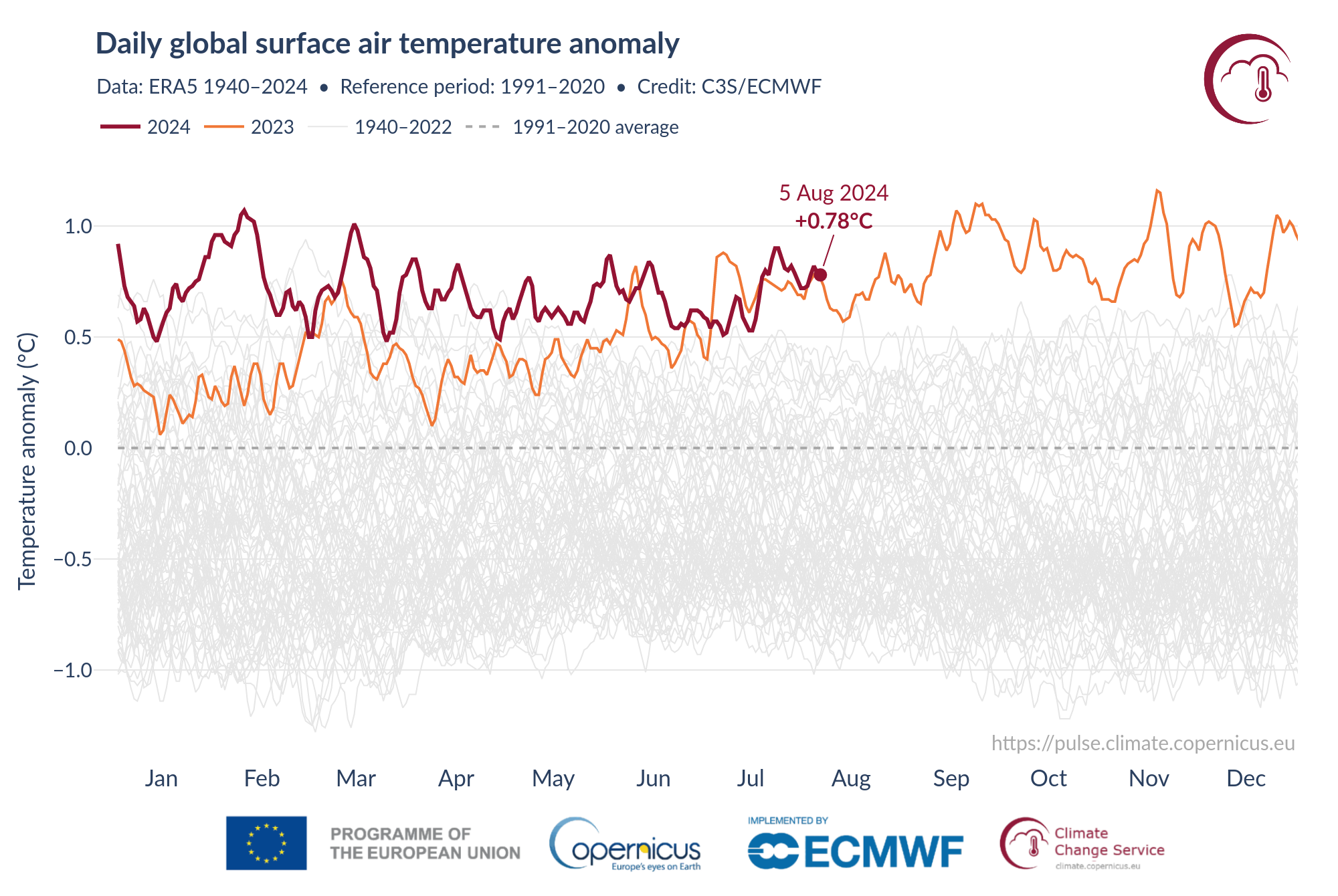
That’s all in terms of absolute temperatures. If you compare each day of the year only to instances of that day in the past, there have been far more anomalous days in the temperature record.

In terms of anomalies over years past, both 2023 (orange) and 2024 (red) have been exceptionally warm.

Enlarge / In terms of anomalies over years past, both 2023 (orange) and 2024 (red) have been exceptionally warm.

That image also shows how exceptional the past year’s temperatures have been and makes it clear that 2024 is only falling out of record territory because the second half of 2023 was so exceptionally warm. It’s unlikely that 2024 will be quite as extreme, as the El Niño event that helped drive warming appears to have faded after peaking in December of 2023. NOAA’s latest forecast expects that the Pacific will remain in neutral for another month or two before starting to shift into cooler La Niña conditions before the year is out. (This is based on the August 8 ENSO forecast obtained here.)

In terms of anomalies, July also represents the first time in a year that a month had been less than 1.5° C above preindustrial temperatures (with preindustrial defined as the average over 1850–1900). Capping our modern temperatures at 1.5° C above preindustrial levels is recognized as a target that, while difficult to achieve, would help avoid some of the worst impacts we’ll see at 2° C of warming, and a number of countries have committed to that goal.

Listing image by Dmitriy83

String of record hot months came to an end in July Read More »