Balsa’s most ambitious goal is a repeal-and-replace, foundational reform of NEPA.
NEPA, the National Environmental Policy Act, has increasingly been a disaster, paralyzing America’s ability to build or do physical things of all kinds. This increasingly includes green energy projects like solar and wind, as well as the infrastructure necessary to connect them to the grid.
The fundamental problem lies in the core design.
A wise law would do a cost-benefit analysis, and ask: Is this project net helpful or harmful to the Earth, and does that consideration outweigh other economic and social benefits?
NEPA instead asks: Did you file all the proper paperwork, taking into account an absurd and growing list of detailed considerations and procedures? Can someone sue you, claiming you missed something or handled some detail inexactly, holding up your project indefinitely? Is there any tiny thing that should act as a veto point? And the courts continuously make it easier to halt a project, and impose ever-expanding requirements on any attempt to do almost anything at all. No amount of benefit to the Earth, under NEPA makes up for even the slightest bit of potential technical harm. So we sit back, and the planet boils.
Current reform efforts can be helpful on the margin. Granting various categorical exceptions, statutes of limitations and other restrictions on NEPA can in practice mitigate some of the damage. But as long as we have a lawsuit-based, technical-violation-veto-point method of determining what is allowed to proceed, the core problems are only going to get worse.
Balsa’s plan, when we are ready to proceed to the cause area, is instead to figure out a path to a replacement framework that is based on cost-benefit analysis. When a new project or action is proposed, commission an analysis of the costs and benefits, allow proposals to compensate the losers or address the issues, assemble the stakeholders, and determine whether the proposed project is net beneficial and thus should proceed. Let those who are harmed sue for damages, but not injunctions – don’t leave the decision on whether to proceed up to a court.
Is that a long shot? Oh, absolutely. But if you want to actually do things, or you want to keep the planet from boiling, it’s the only way to be sure.
In the meantime, the bulk of this post is a summary of various current efforts to reform NEPA and otherwise get things moving, so we can actually build and do the physical things we need to build and get done, most of which would be to the benefit of the climate.
This edition includes me clearing out a backlog of older stuff that I’d never gotten to, and pulling out what is still on point. Alas, a lot of it still remains relevant, but apologies if some items I did not catch have become obsolete.
In addition to these: From Noah Smith, The Big NEPA Roundup is full of links. At some point I should do a deep dive into what’s there, but I haven’t yet.
The house dropped a permitting bill, and it looks pretty great.
Thomas Hochman:
-
The bill would exclude the provision of federal funds — grants, loans, and other funding — from NEPA review. This is huge. Think CHIPS, IIJA, etc — no longer subject to NEPA!
-
Limits On Injunctions: The bill does not impose a specific time limit, but it states that an injunction can only be applied if the NEPA action poses a risk of “proximate and substantial harm.” That’s an enormous improvement.
-
There’s a ton more in here, especially around the “remand” section, but I’m at a conference all day and will defer to @AidanRMackenzie for the mega-thread.
Aidan MacKenzie: Major news for NEPA reform! 🚨🚨
Chair Westerman’s discussion draft is out!
This is important because the Manchin-Barrasso permitting bill did not address NEPA and this draft may become the basis for House-led bipartisan NEPA reform.
-
The bill proposes to amend the goals of NEPA to specify that NEPA is a procedural statute. This is in-keeping with the original goals of NEPA and is a rebuttal to CEQ’s recent phase 2 NEPA rule-making (see the second picture). Fine change, doesn’t make a huge difference.
-
The bill limits analysis of alternatives in NEPA reviews to those within the lead agency’s jurisdiction. This would shorten reviews by limiting how many alternatives agencies have to consider. -Good to have but needs strong judicial review reform to be effective!
-
The bill exempts agencies from NEPA review *IFthe agency is already obligated to conduct another review that has the same functional purpose. The idea here is that agencies shouldn’t have to do redundant reviews as is often the case. This reform could be helpful but in practice there aren’t many reviews as burdensome as NEPA. The text could also be more specific: instead of just saying “similar function”, policymakers could explicitly reference examples/statutes of functionally equivalent reviews.
-
Agencies would not be legally required to consider scientific info published after the initiation of NEPA (they still can if they want!). This change will help prevent abusive litigation tactics (e.g. publishing new info after a review). Small but good change!
-
Next, the bill makes some changes to what “federal action” means, which is the condition for triggering the NEPA process. The bill specifies that the allocation of federal funds, loans, or loan guarantees is not sufficient to trigger NEPA. However…. his does *NOTmean that all grants, loans and loan guarantees are necessarily exempt from NEPA. It means that the giving of a grant, loan or loan guarantee is not enough to trigger NEPA — other aspects of a project still can. E.g unclear if LPO projects would be exempt.
-
The real meat of the bill is what it does on judicial reform. All of NEPA’s problems tie back to how vulnerable NEPA is to lawsuits. Fixing judicial reform is IMO >80% of fixing NEPA.
-
The bill addresses judicial reform by:
-
120 day statute of limitations (fine)
-
Limiting standing to those who participated in the public comment period (good)
-
Putting deadlines on supplemental review (whatever)
-
Limiting injunctive relief and court remand (BIG if true)
-
For my money, all the action is in limiting injunctive relief and remand. It is far too easy to get a NEPA decision enjoined or vacated. Billions of public dollars can be held up for years if a court decides a 1,600 page NEPA review contains a single tiny error.
-
The bill limits injunctive relief and remand by requiring courts to find that the proposed action moving forward would cause “proximate and substantial environmental harm”. This would let construction on some projects with small NEPA errors to move forward.
-
This reform has the right idea but does not go far enough. “Proximate and substantial” do not set a high enough bar. Almost all major projects pose some risk of proximate and substantial harm — meaning this won’t disincentivize litigation and won’t protect agencies.
…
This bill has good stuff! This is a serious draft that should be appealing to both parties. Chair @RepWesterman deserves credit! But IMO getting judicial reform right is the end-all-be-all for fixing NEPA and this draft hasn’t gotten the details right yet. More to do!
That all indeed sounds like marginal improvements, that will help on the margin, but that will at best dent the problem. The core issue is the central design of NEPA, and without judicial reform or a full reimagining of the mechanisms, we’re out of luck.
The NEPA reform for CHIPS bill passes the house on September 23, 2024 by 257-125, and has already passed the senate, and Biden says he’ll sign it, so presumably it will soon be law. Law was proposed back in 2023. It has a lot of helpful targeted reforms in it, so it’s very good, but it also highlights the need for a more general fix.
The week of September 23 certainly was quite a permitting reform week.
Alec Stapp: Insane week for permitting reform (really feels like we’ve reached a tipping point):
1. NEPA exemption for chip fabs passed Congress
2. NEPA reform for wildfire prevention passed House
3. NEPA catex for geothermal passed House
4. And now Harris calls for permitting reform
It’s great that we’re making progress on all those bills and calling for reform. That there are so many is a sign we’re going about this in a not ideal way, but it’s far better than not doing anything.
The Manchin/Barrasso bipartisan permitting reform bill is by all accounts excellent, and centrally a pro-clean-energy bill.
So here are the 360+ ‘climate groups’ determined to oppose it. Take note, indeed.
Christopher Barnard: 360+ climate groups just signed a letter opposing the Manchin/Barrasso bipartisan permitting bill.
We have the opportunity to pass one of the most consequential pro-clean energy bills in American history, and these crazies are trying to kill it.
Here they are. Take note.
New Liberals: This is a letter of endorsement.
Tim Walz appears to be a permitting reform champion at the state level, signing permitting reform that will cut overall project approval time by 50%. That’s huge. And he’s talking the talk as well. And he pushed to lift the ban on nuclear power (although no luck yet) and is throwing his weight behind a study to build new reactors. As a bonus, he’s legalizing single stair housing. I do wonder how much influence governors have over what their states pass, and wonder more how much a vice president could impact such questions if he gets elected, but these are certainly good signs.
Another old post on how permitting reform is increasingly the barrier to green energy.
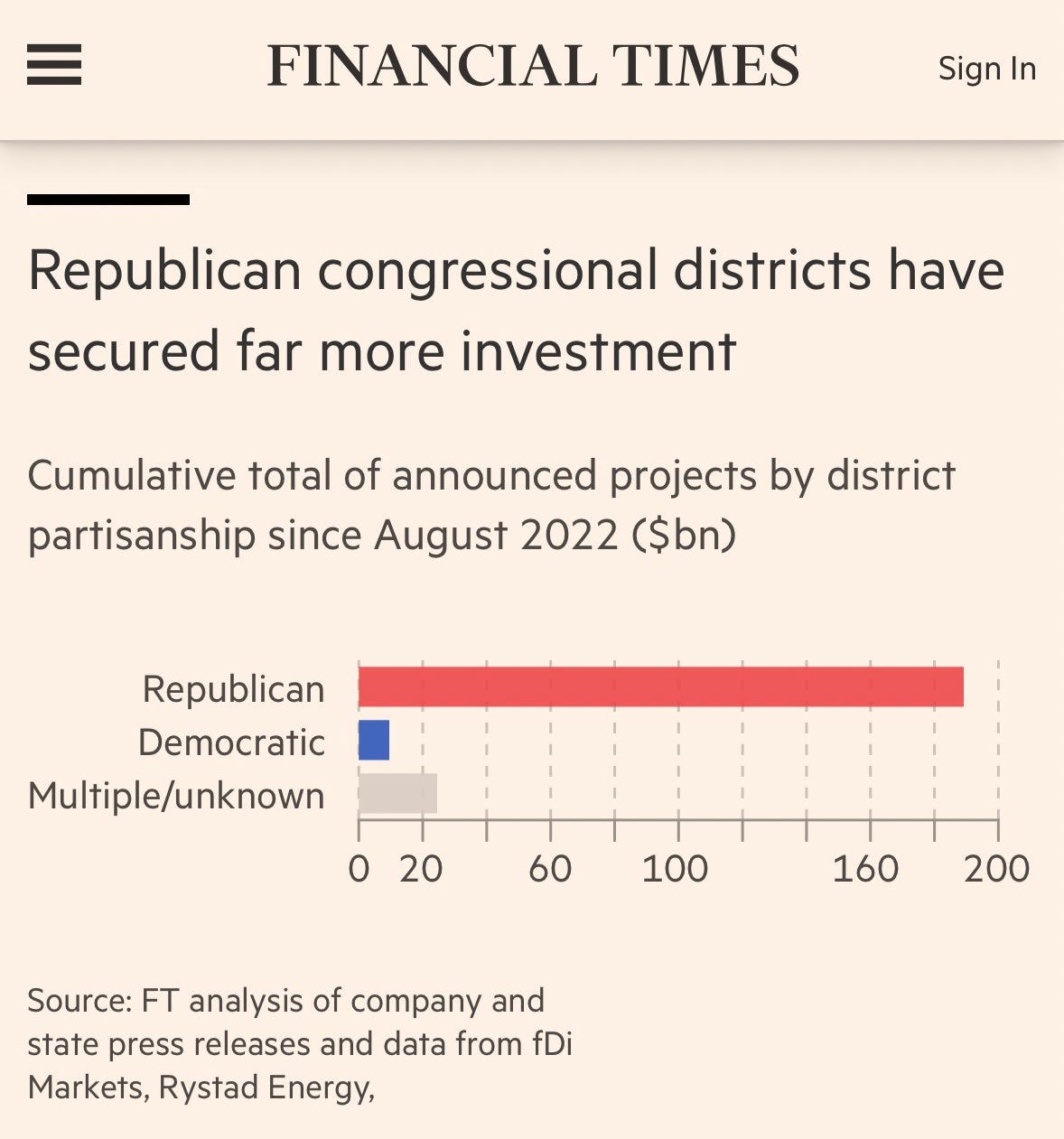
For some mysterious reason, perhaps some esoteric regulatory issue, the clean energy investment boom only goes to red districts. Stats here include both IRA and Chips Act.
Matt Yglesias points out the basic fact that community meetings are very much not democracy. They are the opposite of democracy.
What the majority of the people want, or what the key stakeholders want, does not determine outcomes. Various veto points and lawsuits do. Like NEPA they have no actual standards, and instead are procedural fetishes.
Is it good that there are forms and ways for regular citizens to stand up and have their voices heard? Of course, but what we do with that in practice has become absurd. As Yglesias suggests, the solution is to have elections, which we use to choose officials.
One issue with NEPA is that it requires constant checks for potential disruptions of cultural heritage and historic preservation. Which means that a lack of archeologists, yes archeologists, got to hamstring Biden’s climate initiatives.
There is flat out no one to hire. Yes the market could in theory fix this by training more people but that process would take decades and require expectations of well-paid and steady work. Even then, it would be a huge expense and source of delays, which would almost always be of minimal value at best.
Any common sense analysis would say that if you want to preserve things, this is the opposite of what you would do.
Mostly, I’ll come out and say it, concerns like this are overblown and dumb. We shouldn’t worry about them unless we have reason for particular unusual concern. I can and will put a number on such issues and that number will not be so high. Perhaps we can use some form of insurance?
Progress Institute weighs in on Environmental Assessment [EA] Reform.
The present predicament is that the vast majority of all NEPA delays and paperwork (30 times more than EIS review) are spent reviewing projects that pose no environmental threat and do not necessitate NEPA review. This is further complicated by the fact that EAs are being used to solve a problem that has already been addressed; agencies are fully capable of identifying significant environmental impacts before preparing an EA.
This is one of those trivially easy solutions. Three ways out. First, the way proposed:
Congress should reform EAs to function as internal agency documents that are not required in procedural law. This shift would return EAs to their original purpose of being concise public documents, freeing agencies to focus on reviewing projects that truly pose a substantial environmental risk.
To achieve this, Congress should override CEQ guidelines and assert that FONSI determinations do not necessitate the preparation of an EA. This change would transform EAs from legally required documents to optional internal agency guides for making EIS/FONSI decisions.
This reform would remove an unnecessary layer of bureaucratic review without affecting agency incentives or the review of environmentally impactful actions. Agency FONSI decisions could still be reviewed and challenged in the courts, but plaintiffs would need to demonstrate that the FONSI decision itself was inaccurate on the substance of the matter, rather than pointing to procedural omissions or errors by the agency.
Second method, in theory, is that this sounds like a job for… prediction markets, of course. You create a market for whether there will be a finding of impact at all if a robust assessment is made, if it sticks around at 1% or whatever then that’s that, no need to do an assessment.
Or alternatively, does anyone want to post any sort of bond or otherwise signal that someone, somewhere, cares at all? As in, rather than always require these documents, only require these documents if someone actually brings a challenge – and make that person pay at least the costs of preparation, if they lose their challenge (or at least, if they lose their challenge and the court rules that the challenge was unreasonable).
Even these simpler Environmental Impact Reports most projects have to fill out are rather nightmarish. Despite being most of the paperwork, they aren’t exactly being useful.
Californians for Electric Rail: The 190 page EIR for the SBCTA environmental impact report spends as much space on the aesthetic impacts of a facility next to a rail yard as it does the risks from storing large amounts of hydrogen, a flammable, leak-prone gas.
There is 0 analysis of the environmental effects of hydrogen supply chains, and hydrogen fuel being net positive for the environment is taken as a given without further analysis. The majority of discussed impacts are those caused by construction.
You can read the report here, though very little new or useful knowledge about environmental issues is contained within.
Ian Moore: EIRs are always like this. We hired a bunch of wordcel lawyers and judges to run our environmental review system so they are very biased towards issues which require no expertise, like views and historical preservation.
They also don’t stop the project, so what’s the point?
That’s the core thesis: Any given paperwork should either have real value of information, telling you whether or not do something, or it shouldn’t be required.
Roots of Progress generalizes the point and comes out against the entire principle of review-and-approval behind such disasters as the NRC, IRBs and the FDA, along with NEPA. And also, it is speculated, Google? Seems remarkably plausible.
Alec Stapp: New report from @TheBTI has some alarming data about NEPA litigation:
– 56% increase in NEPA appeals cases over the last decade
– federal agencies win 80% of the time, but litigation still delays projects
– on average delays add >4 years after review is already completed
Key Report Findings:
-
Between 2013 and 2022, circuit courts heard approximately 39 NEPA appeals cases per year, a 56% increase over the rate from 2001 to 2015.
-
Agencies won about 80% of the 2013-2022 appeals cases, 11% more per year than from 2001 to 2004, 8% more than from 2001 to 2008, and 4% less than from 2009 to 2015. The rate at which agencies’ reviews are upheld is high, meaning these environmental reviews are seldom changed as a result of litigation.
-
On average, 4.2 years elapsed between publication of an environmental impact statement or environmental assessment and conclusion of the corresponding legal challenge at the appellate level. Of these appealed cases, 84% were closed less than six years after the contested permit was published, and 39% were closed in less than three.
-
Among the challenges, 42% contested environmental impact statements, and 36% contested environmental assessments. Agencies won about 80% of challenges to both.
-
NGOs instigated 72% of the total challenges. Of those, just 10 organizations initiated 35% and had a success rate of just 26%, merely 6% higher than the average for all types of plaintiffs.
-
Only 2.8% of NEPA litigations pertained to agency assessment of environmental justice issues.
-
Public lands management projects were the most common subject of litigation (37%), the greatest share of which (47%) challenged forest management projects. Just 10 groups filed 67% of the challenges to forest management projects and collectively won only 23% of those cases, adding 3.7 years on average to the process of implementing the 77% of projects on cases they lost.
-
Energy projects were the second most common subject of litigation (29%). Litigation delayed fossil fuel and clean energy project implementation by 3.9 years on average, despite the fact that agencies won 71% of those challenges. NGOs filed 74% of energy cases, with just 10 organizations responsible for 48% of challenges.
-
The burden of NEPA litigation has increased while its impact on environmental outcomes has decreased.
-
NEPA litigation added 3.9 years on average to energy project development.
One can separate the issue into the 4.2 years of time, versus the chance there will actually be a challenge upheld (sometimes even for good reasons). Certainly we can do this in a lot less than 4.2 (or 3.9) years?
Looking forward, the key variable will be, of course, AI.
For the plaintiffs looking to prevent anyone from ever doing anything, the AI lets them file mountains of extra paperwork fast and cheap.
For the courts and those trying to do something, they can use it in return.
Who ends up ahead? That depends on whether the plaintiffs are close to covering the space of potential actions and timings, I think?
If plaintiffs are already doing most of what they are capable of doing, since they impose lots of asymmetric costs and time favors them, then they can only gain so much from AI. You can’t ‘play better than perfect’ as it were.
Whereas the defenses and courts have limited resources and face asymmetric costs dealing with this. They are the ones producing thousands of pages of documentation, and who have to deal with every single complaint, and so on. So that suggests they are favored.
A concern on that is that the plaintiffs often rely on the ‘pounce on the one mistake’ strategy. There was one public comment you didn’t respond to properly, let’s hold the project. Generative AI will make mistakes. But then so will people. If you are wise, you can do various error checks by AIs and also humans, and should be able to get a much reduced error rate while also gaining speed.
So overall I think I’m optimistic, if everyone involved were to use AI properly. The worry is, will courts be able to keep up? Or will they be unable to properly use their own AIs, and thus become drowned in paperwork?
Even if they do get there eventually, how unevenly distributed will that future be? How many years delay might be involved?
You can download the full Breakthrough report directly here.
Alec Stapp: California’s environmental regulations make it nearly impossible to build clean energy infrastructure.
One 117-mile powerline project required:
– 5 years for review
– 11,000-page impact report evaluating >100 project “alternatives”
– 70 permits issued by >24 state agencies
Every part of this is of course absurd.
I would focus this time on the need for ‘alternatives.’ This is the very definition of letting the perfect be the enemy of the good. Under no circumstances should anyone ever have to prove there are no superior alternatives, and until then do nothing.
You should of course compare to ‘no project.’ What other alternatives should be considered? I would say, whichever ones someone is willing to pay for you to consider. The current rule of ‘all reasonable alternatives’ is a recipe for obvious nonsense.
So, yeah. You apply for a project, and note the alternatives you intend to consider. Anyone can suggest an additional alternative and pay a fee, for it to be considered, within a fixed time window.
Then you have to consider exactly those alternatives (or justify why you are excluding them), and perhaps reasonable combinations thereof, and that is it. Perhaps if your alternative is selected, you win a bounty, to reward good alternatives.
That way, you don’t have anyone retroactively say ‘what about this other alternative’ or otherwise stall the project on that basis.
As I hope we all know, nuclear power is safe reliable clean green energy. It often is expensive, but that is mostly because regulations impose absurd requirements and costs upon it, and the resulting lack of practical experience and moving down the learning curves. Nuclear waste is a trivial concern compared to the air pollution associated with traditional power plants, which kills people on the regular. We should be embracing nuclear power as much as possible, and most of those opposed to it essentially want humanity to perish, or have been fooled by those who want that or by the vibes around the term nuclear.
Josh Shapiro asks that Three Mile Island be fast tracked so it can be turned back on without waiting the usual years for a regulatory queue. Otherwise, paperwork processing delays will keep it offline at least four additional years. Great move by Shapiro, but also perhaps we should fix this more generally?
Three Mile Island is being restarted exclusively to sell the energy to Microsoft, who has agreed to invest $1.6 billion and then pay $16 billion over 20 years.
Inside Paper: US nuclear plant Three Mile Island, the site of the worst nuclear accident in American history, is to restart operations in a deal to sell power to Microsoft.
Alex Krause: Lol wait what? It’s not even the actual meltdown siite? It’s been providing power up until 2019!!!???
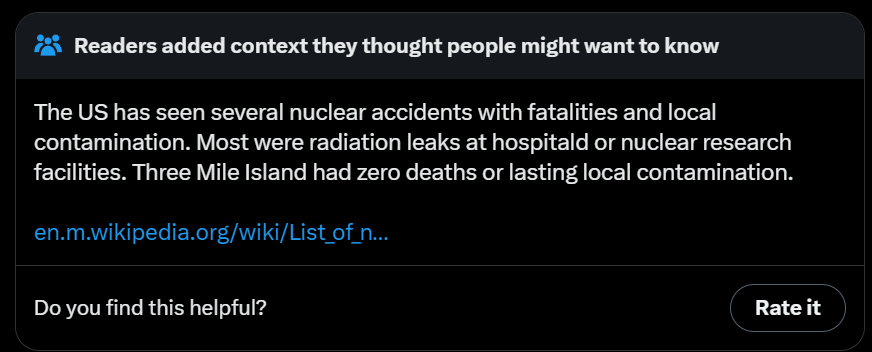
Lulu Cheng Meservey: The nuclear fearmongering would have us forget that the Three Mile Island accident caused zero deaths, zero injuries, and no known health effects.
Headways Matter: Every time they say “worst nuclear accident in American history” they should add “comparable to the 47th worst industrial accident in Guangdong Province in Sept 2024 month to date.”
You don’t hate the media enough.
“Bad instrumentation and a failure to directly measure and display important parameters, combined with some fairly elementary errors, led operators to acquire a faulty understanding of plant state, which caused billions in facility damage and 0 deaths.”
This isn’t an excuse! It’s bad when safety critical systems don’t exhibit resilience as to human error and single-point instrument malfunction. And everyone knows this was bad. So it was fixed!
How 101-level was the error? Well, when there was the equivalent of a shift change, and a new person walked into the control room, the instant reaction was along the lines of “WTAF are you doing?!?!” and proper steps were immediately taken.
So (among many other changes), there are now people whose specific role in the event of a non-normal situation is to *notbe directly involved in manipulating controls and reacting/responding.
Meanwhile, remember (from December 2023):
Andrew Curran: Microsoft is training a custom, narrow-focus LLM specifically on the regulatory process for small nuclear plants. They need to build SMRs to power Bing’s brain. MS expects the LLM to eliminate 90% of the costs and human hours involved.
The reason they are doing this is getting a small modular reactor design successfully approved by the NRC currently takes about a half a billion dollars, a 12,000 page application, and two million pages of support materials.
Jason Crawford: But that will only eliminate the cost of preparing the report. You still have to pay the NRC for the time they spend reviewing your report (yes, really).
Andrew Curran: Seems like the NRC needs a review LLM.
Korea wins $22 billion nuclear power plant order from the Czech Republic.
Poland commits $1.2 billion in initial nuclear plant funding, 10 year time horizon.
Sweden announces it will start building nuclear reactors by 2026.
Thread claims India is building nuclear reactors super cheap, cheaper than solar.
How are they so cheap?
– These IPHWR 700 reactors have almost all of the supply chain within the country, reducing expensive imports & making use of low labour costs
– Learning by doing: Continuous builds of smaller IPHWR-220 since the 1970s made sure skills were not lost
Japanese support for restarting their nuclear reactors is up to 70% based on the fact that nuclear energy from existing plants is carbon free, low cost and secure. Oh, that.
World’s biggest banks pledge support for nuclear power, as part of NYC climate week. This shouldn’t be necessary, but in today’s worlds it is indeed effectively necessary, simply to get fair financing.
Jigar Shah explains some of the ways this administration is moving nuclear power forward, including a $1.5 billion loan to Holtec Palisades in Michigan, who will also build two new reactors. He has a new Odd Lots on the subject. My concern with this administration is that it wants to do things like this, but fails to understand the permitting and regulatory issues that are the most important barriers – money helps but the core issues are not about the money.
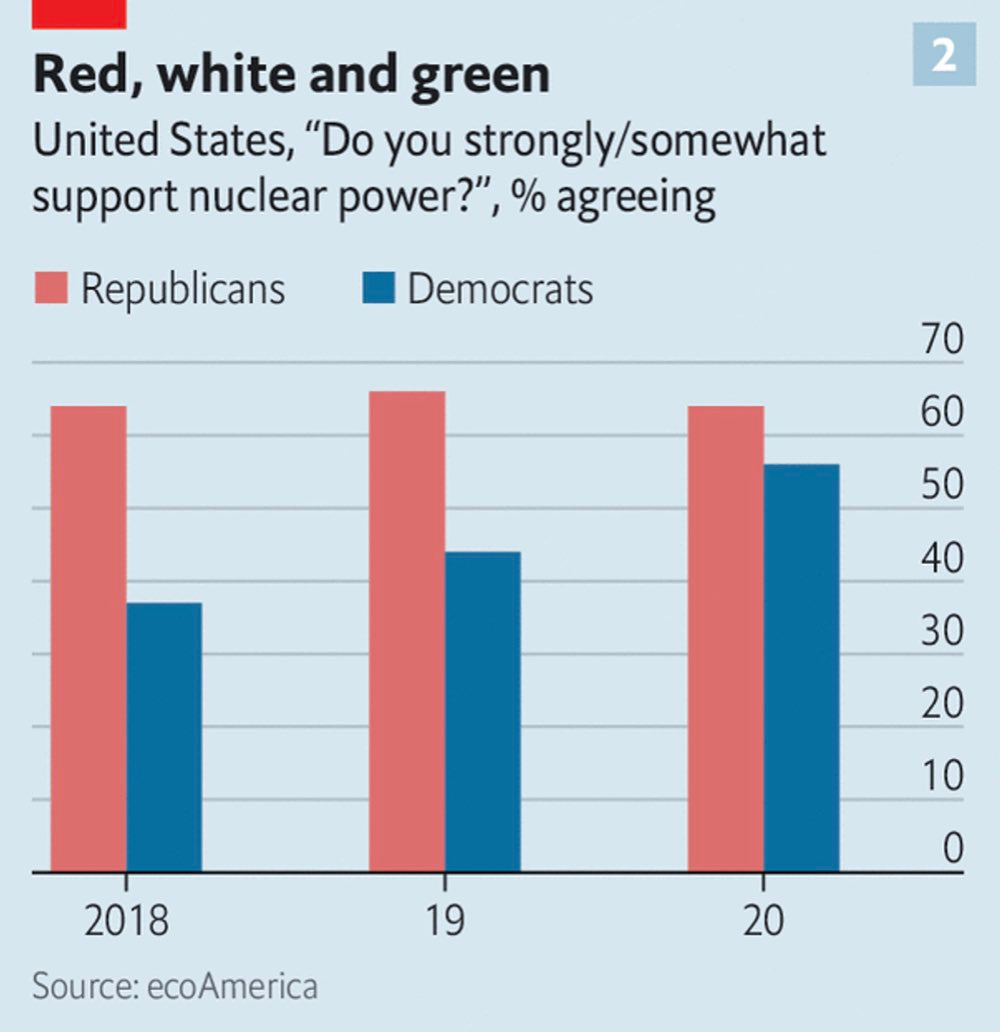
Nov 2023: Democrats now in favor of nuclear power. It’s only gotten better since then. Remember when AOC came around to nuclear power, once again showing that she actually has a model of physical reality?
Can we have more nuclear power now? Sounds like perhaps we can.
How do you get people to support nuclear power? Well, you see, it’s for electricity.
Alex Trembath: When you ask people if they’re in favor of nuclear power *for generating electricity,as opposed to just asking if they’re in favor of nuclear power, their approval jumps substantially.
Nov 2023: Canada accepts nuclear as green. Very good.
David Wallace-Wells: “The United States is preparing to announce a pledge to triple the world’s production of nuclear energy by 2050, with more than 10 countries on four continents already signed on to the agreement.”
Why are we not doing so great? Is it because nuclear costs so much?
Matthew Yglesias: tHe reAl pROblEm wiTh nUCleAr iS iT’s toO sLOw aNd eXPenSive.
Omar Wasow: “NuScale started working toward regulatory approval in 2008. In 2020, when it received a design approval for its reactor, the company said the regulatory process had cost half a billion dollars, and that it had provided about 2 million pages of supporting documents to the NRC.”
MIT Technology Review: For over a decade, we’ve heard that small modular reactors could make nuclear power plants easier to build and safer to operate. They recently reached a major milestone.
Nuclear Regulatory Commission (NRC) hopes to winnow the approval process for identical small reactors down to a year, despite facing blowback. Which might let us actually build reactors. An obvious question is why they will still need the year.
Why do nuclear power plants cost such large and increasing amounts? The Institute for Progress has a report. A long report boils down to: Regulation, regulation, regulation. At first we had a situation where they wouldn’t tell you if the plant was acceptable until after you built it. Now, you get approval for the exact plant before you build it, which means nothing in your design is allowed to change. Everything involved is super regulated, doing anything requires tons of approvals, every change you want to make requires tons of approvals, tons of expensive requirements are imposed on every level.
It is easy to see why the best response to such a regime is modular design. If you can repeatedly create the exact same nuclear reactor design that is already approved and that you know works, then you can do that over and over again, and a lot of things get much cheaper, faster and easier. Anything customized or bespoke is prohibitively difficult. Thus, the modern attempts to do exactly this type of modular design.
In response to Congress ordering the Nuclear Regulatory Commission to provide a feasible pathway for licensing new reactors in January 2019, by a House vote of 361-10, the NRC decided to instead make the process more burdensome? And then, it seems, Congress simply let them do that.
Matt Yglesias slightly contra Noah Smith on nuclear power, where Noah Smith thinks nuclear is great but it’s basically not going to matter much going forward so we should focus elsewhere on solar and wind and such, whereas Matt, I think correctly, advocates pushing hard for NRC reform and pushing ahead with nuclear as well.
Alas, Taiwan continues to work to shut down its nuclear power plants, with the only replacement being imported fossil fuels, potentially endangering the world’s chip manufacturing. As Noah Smith put it, this is not what a nation trying to continue to exist would do in this spot.
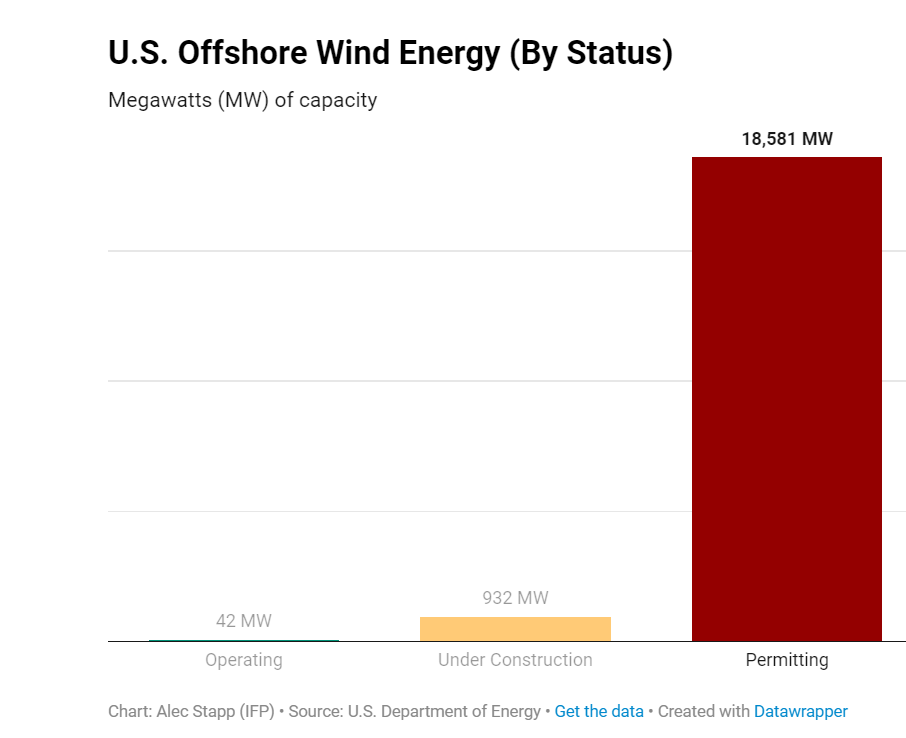
Offshore wind continues to have various cost problems, many of which are permitting problems. Construction Physics goes into detail. Here’s a taste.
BOEM also delayed the licensing of the now under-construction Vineyard wind project to perform a supplemental EIS that looked at the potential cumulative impacts from subsequent offshore wind projects.
This action is Obvious Nonsense. You can review the effect of future projects while constructing the current project. If you don’t like it, you can hold back future projects.
At best, we are talking multi-year processes to deal with EIS and NEPA, despite the whole thing being done largely to benefit the environment and also on the ocean.
There is also the issue where people sue to stop the projects to protect their view. How about we tax all coastal real estate, and use the proceeds to compensate the specific losers whose precious views get hurt?
Look at what our slowness is holding back, or causing people to give up on, then consider it would be even better than this if people considering starting projects expected to complete them.
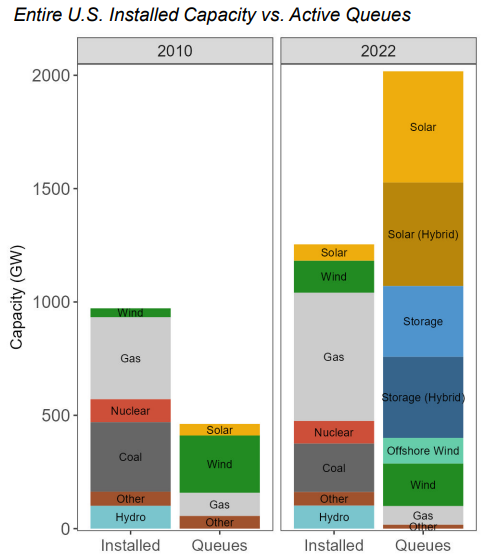
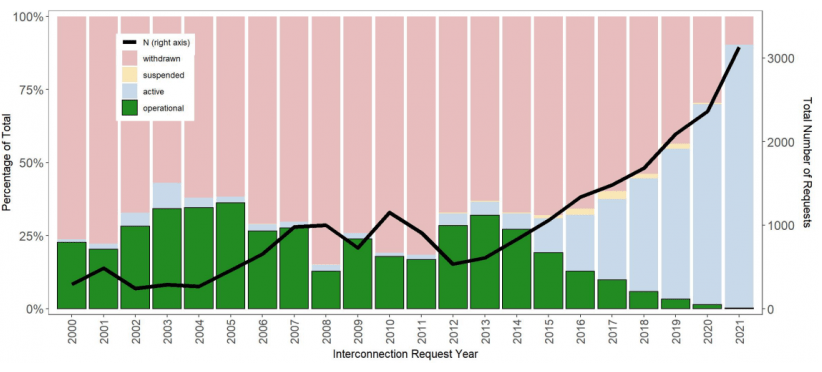
Brian Potter (author of Construction Physics): The amount of electricity generation capacity sitting in the interconnection queue and waiting to get built is greater than the capacity of all existing US power plants.
Most of these projects will ultimately be withdrawn before they get built though.
If you don’t get approval, eventually you give up.
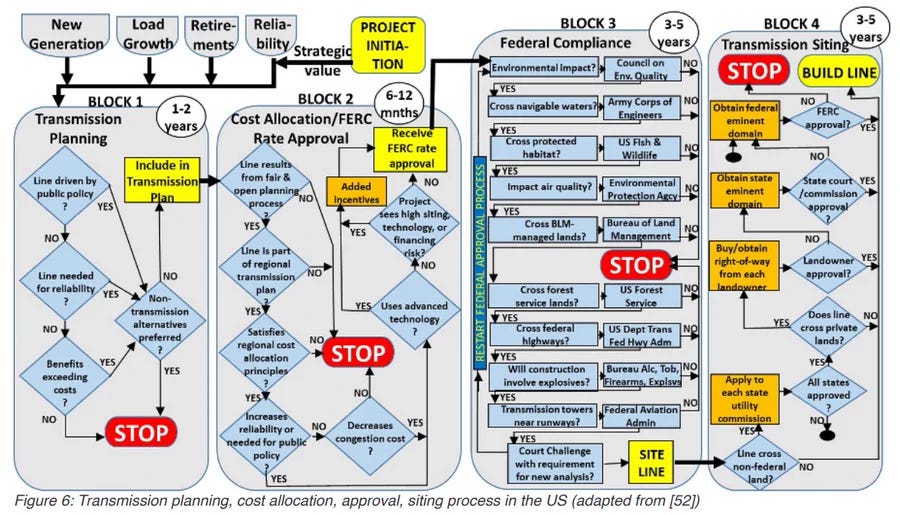
If we don’t build massively more transmission lines, that our permitting rules make all but impossible to build, decarbonizing the grid will be impossible.
James Hewett: Reposting the 10+ year permitting process for an interregional transmission line below. It’s about a lot more than just the environmental review. The grid solutions we need will require rethinking over a century of transmission policy.
Fossil fuel projects often get categorical exclusions from NEPA review, while similar clean energy projects don’t. Our ‘environmental’ rules are often favoring fossil fuels.
China hits its 2030 solar and wind target, in 2024.
Largest solar-plus-storage project in America now operational in Nevada, 690 MW solar plus 380 MW/1,520 MWh storage. 10% of peek needs.
Tyler Cowen offers Your Periodic Reminder that subsidizing solar and wind power is much more effective than subsidizing EVs. Even better than subsidies, of course, is reforming the permitting process. The EV subsidies have of course been quite the boondoggle, since buyer ability to pay hasn’t been much of a limiting factor in the first place.
Wind power cannot get any respect. The latest is Builders in Germany report being unable to get permits to transport the heavy turbines on the country’s roads, with a 15,000 application backlog. Hence all the new coal.
In Maine, Governor points out that proposed legislation to ensure union capture of jobs building offshore wind would cripple production of offshore wind, not because of the higher price but because there literally aren’t enough union workers to do the jobs. Unions could solve such problems by growing the unions in question to demand, except that is not why individual unions exist, so they do not do this. It is one thing to require union labor despite increased costs, it is another if unions can’t fill demand at any price.
Noah Smith reminds us that no, NEPA really is a problem for clean energy, and that this will become much more important in the future, risking an ‘invisible graveyard of clean energy infrastructure,’ which is an excellent and highly accurate description.
Even simply approving the various energy projects waiting in line would make a huge difference, since they promise to offer more electric capacity than that of all current power plants combined? (WaPo)
Getting the okay to connect has gotten harder and harder. According to Rand’s research, between 2000 and 2010 it took around two years for a project to make it through the queue. Now, it’s taking almost twice as long. At the end of 2021, there were 8,100 projects sitting in line, waiting for permission to get connected. Together, they represent more than the combined power capacity of all U.S. electricity plants.
And 93 percent of those projects are solar, wind, or battery storage. One transmission authority, PJM — which covers Pennsylvania, West Virginia, D.C., and other areas on the Eastern Seaboard — accounts for nearly a third of the delays.
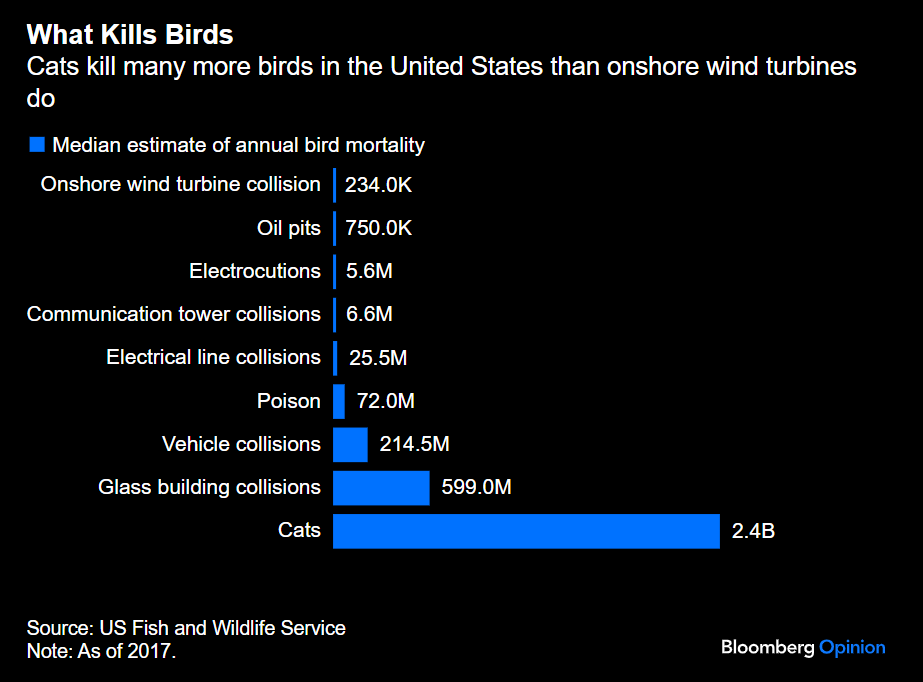
If we care about the killing of birds, don’t fight wind turbines. Ban cats.
This comes up a lot when I read about or look into such matters: Matthew Yglesias points out that permitting rules give an unfair advantage to oil and gas and put geothermal in particular at a disadvantage. It needs the categorical exemption from NEPA that we give to oil and gas wells, especially since it needs room to experiment and iterate. It would really help if the people who claim to care about pumping too much carbon in the atmosphere were in favor of things like this that helped us pump less carbon into the atmosphere.
So, excellent news: The house has passed HR 6474, which would expand the oil and gas categorical exemptions to include geothermal.
The IRA offers subsidy for climate friendly actions like installing heat pumps. Installing heat pumps is something we definitely want to encourage, and ideally subsidize. The problem is that the revealed preference in such programs is ‘ensure no one too rich gets a check’ rather than ‘get heat pumps installed.’ Rebates that do income testing are, in practice, a large barrier to implementation and use, pushing back things by a year and likely resulting in little contractor uptake.
Yay Transmission Lines
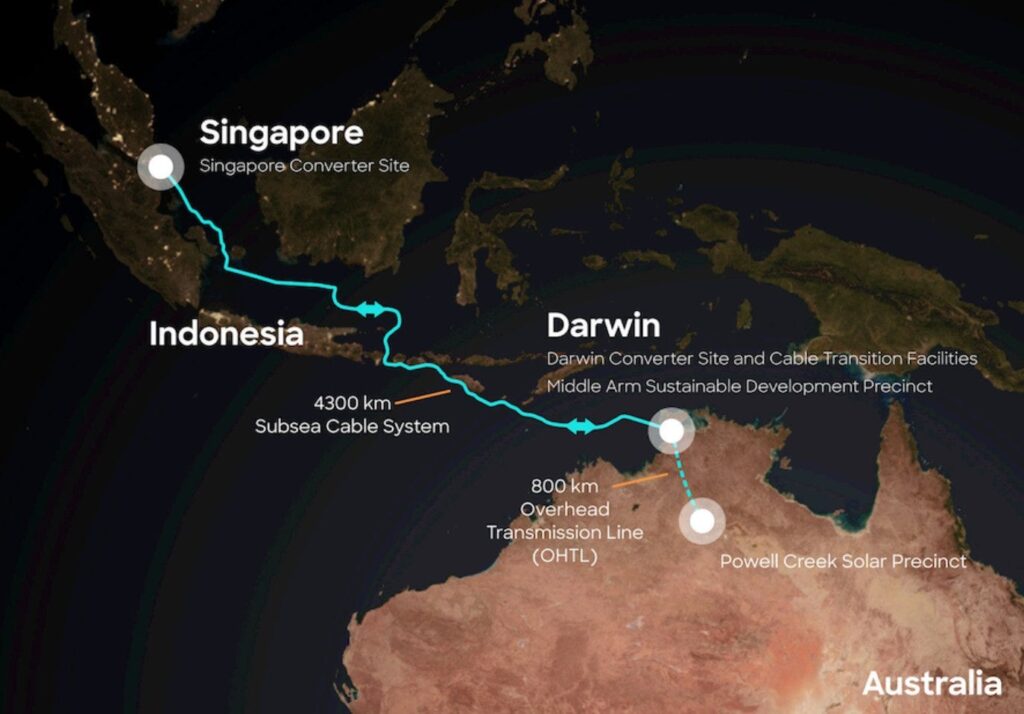
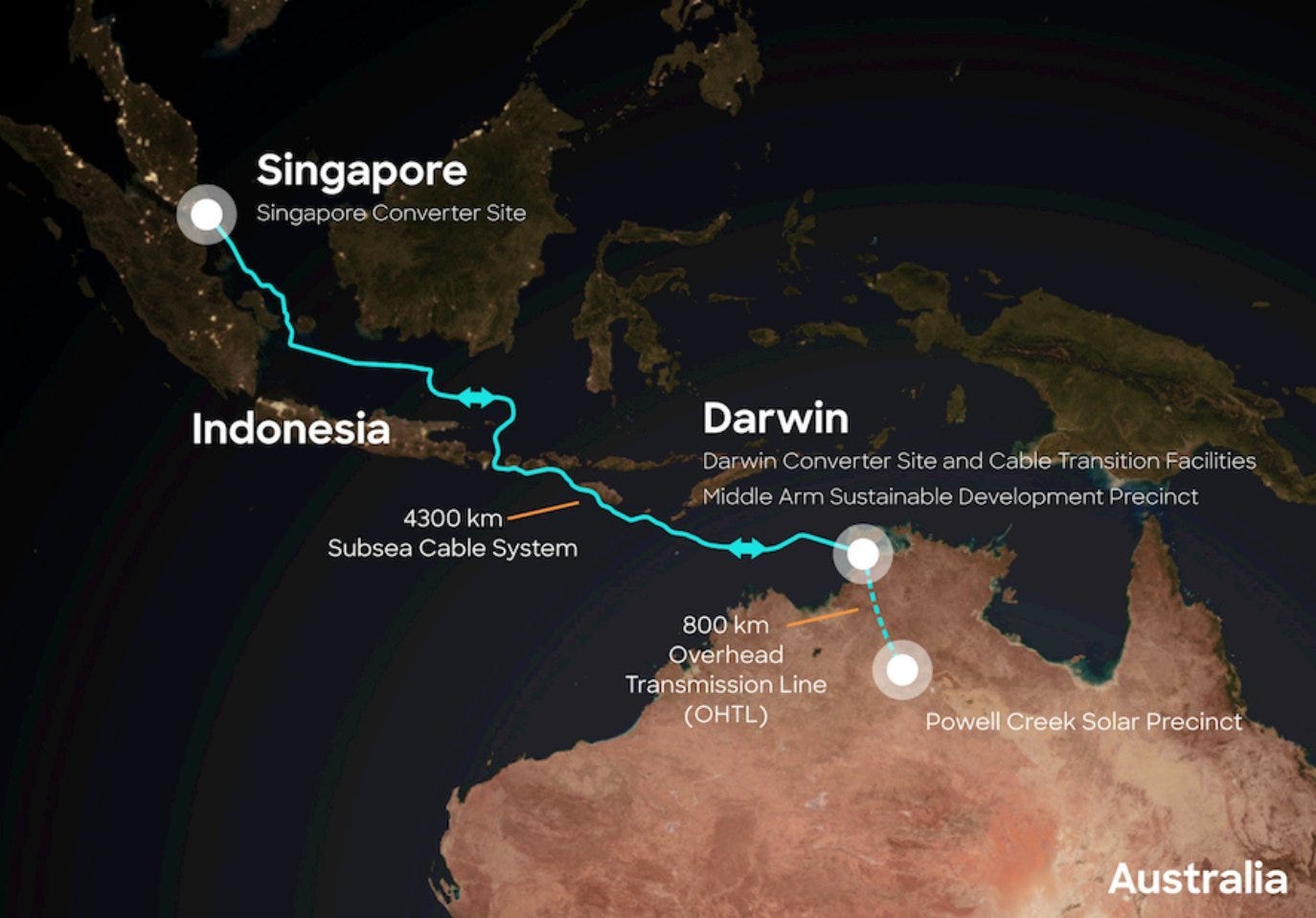
Others can do it: A transmission project with 4,300km of undersea cables, total investment $8 billion.
Tyler Cowen in Bloomberg argues that the EU’s carbon tariffs on imports, which essentially extend their internal carbon tax outside of the EU, have a good chance of making the climate actively worse in the medium or even long term. He seems at core to have three arguments.
-
Europe is so short on energy it is burning coal and not being very green internally, so shifting production from elsewhere to the EU will make the climate worse.
-
Protectionist policies impoverish the third world and prevent development, and countries need to develop first before they can in practice clean up their carbon emissions. And that these effects can overwhelm the positive incentive effects from the tax.
-
Europe should prioritize getting rid of coal, at least on the margin.
The second argument I mostly do not buy. This is leveling the playing field, if you charge for carbon internally but not externally than you are exporting your carbon emissions elsewhere and favoring foreign competition. I don’t see how it is efficient, likely to accomplish your goals, or politically sustainable, to not extend the policy overseas.
The first effect is a dramatic indictment, saying that the EU is so bad on climate that it is even worse on the margin than the world norm, and isn’t getting its own house in order. Alas, this seems right – any marginal energy use there is going to be from coal. Alas again, the implication is that the solution is to shift energy use out of the EU in the name of climate, and actively subsidize imports until their energy situation improves. Which is not a practical thing to hope will happen.
The third argument is obviously correct. If Europe’s obsession with climate was about doing things that were good for the climate they would be focusing on reducing their coal consumption and not doing things like shutting down nuclear plants.
The fact that they are not doing this shows that their talk about the climate is primarily about something other than improving future physical conditions. Which is a shame.
I don’t generally buy the ‘you should be doing X first, therefore it’s bad to do Y’ arguments, where Y in no way prevents doing X. This feels like an exception, something so egregious, that so dominates the entire calculus, that it is valid.
A great illustration of how silly our rules are is that we waive them in an emergency, and no one screams how awful that is.
Justin George: Stunning news- Collapsed stretch of I-95 to reopen within 2 weeks, Pennsylvania governor says. Initial projection was months, even up to 6 months.
Donpaul Stephens: This should get the same environmental review nonsense we have everywhere else… The decimation it would cause to the Philly region… might (sadly probably not) make people rethink the NIMBY religion
The response of ‘you want to review building a bridge where we already built a bridge?’ raises questions that existing NEPA reviews already raise all the time.
No, we can’t actually do other things as fast and directly as ‘rebuild an existing bridge.’
We can still do things quickly and well, when we care to do so.
Alex Trembath: It took 19 years to complete the bus rapid transit lane on Van Ness Avenue in San Francisco.
Alec Stapp: The highway overpass collapsed just 9 days ago. Policy is a choice.
Governor Josh Shapiro: Based on the tremendous progress these crews made over the weekend, I can now say: We will have I-95 back open this weekend.
We have worked around the clock to get this done, and we’ve completed each phase safely and ahead of schedule.
Nate Silver: This has been a significant event for calling out misaligned incentives (and sometimes outright corruption) in US public works projects. They can happen much faster. Media and voters should hold decision-makers to account for expensive and slow taxpayer projects.
Andrea E: Not to mention competition with a certain GOP governor now running for president who managed to repair a bridge very quickly. This is obviously a bridge rebuilding competition.
Seriously. We can repair a collapsed bridge in two weeks, with no warning or preparation time. We don’t want to move that fast in general, that would involve extra costs, but we can totally do the things we need to do.
Also, I love the idea of a bridge rebuilding competition. That’s exactly how you make America great, you compete with the other side to quickly create valuable public goods. How about a new bridge building competition next? Or subway construction?
Joel Wertheimer: America if we had as much willingness (lack of obstacles/NEPA/etc) to build electric lines, clean energy, mass transit, and housing as we do to rebuild highways that have collapsed.
A standard proposal for NEPA are time and page limits.
Periodically those with experience warn such limits won’t work. Here is the latest.
Thomas Hochman: Time and page limits for NEPA are useless.
The devil’s in the details. Re: time limits, the “start date” for EISs is the notice of intent (NOI) — so NEPA practitioners now just do the majority of their work before officially announcing it. The real timeline doesn’t change.
Re: page limits, the page limit does *not include appendices*. So, as you might expect, the average length of appendices has shot up since page limits were introduced.
To quote one NEPA practitioner: “it’s a shell game.”
Finally, there’s no hammer to enforce NEPA timelines.
The Clean Air Act’s statutory time limit for EPA review is consistently missed. Similarly, agencies that miss NEPA timelines face no repercussions. Very little incentive to stop the inevitable drift…
The time it takes to complete NEPA is the time it takes to complete NEPA. If you want to fix that, you need to fix the law. Everything else is window dressing.
You could impose such limits usefully, if you did it correctly. But you have to do it in a way the courts will allow, and that ensures the time limits are meaningful and bind, and that everything still gets done, and so on. Or you can fix the damn law rather than trying to patch it.
I do still think time limits on challenges or other hostile actors should do some work?
Good news, there is one way to sometimes get around NEPA, via ‘NEPA assignment’ that allows states to self-assess projects. Can we expand this to all states and all reviews? The project the post says is terrible is a road expansion, with the objection being that if they grow the road then the area around it might grow and people might more often use the road. The road might be useful. Seriously. That’s the objection.
New Mexico passed a state-level NEPA in 1971. One lawsuit later, they realized their mistake and repealed it. New Mexico remains the third least-polluted state in the nation. It’s not too late for your state to admit its mistake.
Aidan MacKenzie reports on the ‘real costs’ of NEPA, especially for green energy.
Here is his summary thread:
Aiden MacKenzie: NEPA gets headlines for pages and years of delay but the law’s biggest costs are the uncertainty it creates for developers and its downstream harms on state capacity.
NEPA’s harm to clean energy is backed up in the data:
-From 2010-2018, 60% of energy EISs were for clean energy projects. Only 24% were for fossil fuel projects.
-62% of ongoing energy EISs were for clean energy and only 16% were for fossil fuels.
Clean energy is at a fundamental disadvantage in the NEPA process:
-Most fossil fuel projects are low footprint and receive streamlined EAs or categorical exclusions.
– But, large, utility-scale clean energy projects are much more likely to need EIS review.
Some have pointed out that few utility-scale wind and solar projects require review under NEPA. However, this is a selection effect that actually show NEPA’s high cost:
Developers find project locations away from federal lands in order to avoid going through NEPA review. Clean energy proponents should welcome technology-neutral permitting reform that reduces NEPA litigation. Clean energy is disadvantaged in the NEPA process compared to fossil fuels. NEPA’s tax on building new things will naturally harm the side that has more to build.
The clean energy transition will require an enormous amount of new infrastructure. If we are serious about hitting our climate targets, small improvements won’t cut it: NEPA needs significant reform to cut off litigation and shorten reviews.
Reforming litigation is the only way to let agencies write shorter, more efficient reviews. Agencies should have greater discretion over which details to include in environmental reviews without being hauled into court.
I do not disagree with any of that. One thing to keep in mind is that to many, many of whom call themselves ‘environmentalists,’ it is a feature not a bug that NEPA interferes with such projects.
If everyone agreed it was a bug, it would be solved by now.
Instead, as with most such cases, the true costs are not only the direct costs, that’s relatively minor, but mainly the invisible graveyard of projects never started. Our grid will remain crippled if we do not address this.
Reminder, when I say ‘enemies of the people’ I mean that literally – people who oppose the people, and want the people to be worse off. It’s a preference.
A busy transit rail line, that already exists? Nope, ‘environmentalists’ say it ‘interferes with the coast’ and we should instead allow it to be washed away.
On the recent permitting reform bill, I’m willing to put bill opponents here.
Armand Domalewski: I think it is very telling that literally everyone involved in actually implementing the clean energy provisions of the IRA is desperate for permitting reform and everyone who makes a living filing NEPA lawsuits is desperate to stop it.
Are environmentalists largely responsible for our inability to do things that would help the environment? Or is it a bunch of local interests?
Jamie Henn: These articles keep saying “environmentalists” are blocking clean energy when they really mean local NIMBY groups, often fueled by outside fossil fuel money. The nation’s biggest “environmental” groups — Sierra Club, NRDC, LCV, etc — are all fighting hard for clean energy.
Sure, there are local folks who don’t want wind turbines in their back yard who see themselves as environmentalists, but that doesn’t represent the broader climate movement that has advocated for clean energy for years.
Armand Domalewski: The Sierra Club, NRDC, and LVC all campaigned against Governor Newsom’s proposal to very modestly make it easier to get renewable energy to get permitted in California. All of those groups have also been less than helpful in permitting reform discussions at the national level.
Santi Ruiz: the Sierra Club just successfully lobbied to kill new nuclear in Illinois. The Sierra Club, Wilderness Society, and the National Resource Defense Council all oppose making geothermal easily accessible.
motte: legacy green groups are for clean energy!
bailey: legacy green groups are for subsidies for wind and solar and against everything else
Alex Stapp: I regret to report that the Sierra Club is at it again [AP: They sue Puerto Rico government over location of renewable energy projects.]
Ezra Klein: More than 100 environmental groups – including the Sierra Club of California and The Environmental Defense Center – are joining to fight a package Newsome designed to make it easier to build infrastructure in California.
Gavin Newsom (Gov. of California): This is ridiculous. These guys write reports and they protest. But we need to build. You can’t be serious about climate and the environment without reforming permitting and procurement in this state.
Even that in many cases is a motte. One does not simply approve a wind farm, or even a solar farm. I will always remember that time Greta Thunberg joined a protest against a wind farm. That does not make it representative. What I do see is a continuous pattern of non-local groups suing under NEPA and similar laws, and otherwise seeking to block a wide variety of projects including many green energy projects, and often seeing green groups choosing local concerns over much larger overall climate concerns. Whereas I see no evidence of such green groups working productively on permitting reform, even permitting reform that would apply only to explicitly green projects.
But lo, we have good news. A young girl is here to show us the way.
From the Guardian, Swedish teenager Ia Anstoot: “Greenpeace is stuck in the past fighting clean, carbon-free nuclear energy while the world is literally burning. We need to be using all the tools available to address climate change and nuclear is one of them. I’m tired of having to fight my fellow environmentalists about this when we should be fighting fossil fuels together.”
Danielle Fong: anti nuclear is like, so over.
Thank you Ia. Every little bit helps.
What this is of course not, in any way, is so over. Every time something like this happens (say, the latter on extinction risk from AI, which was a much bigger deal and sign) there will always be someone saying things like this, and many who expect Everything Will Change. It is always a safe bet to say no, everything will not change, opinion will shift only slowly, the fight is far from over. We certainly have an existence proof from Greta Thunberg that a young voice can make a big difference in the discourse. That does not mean it applies to anyone who speaks truth in The Guardian.
The groups opposing offshore wind claiming to be local environmentalists are often funded, surprise surprise, by oil and gas interests.
Agreed with Andrew Hammel: It’s never a bad time to remind everyone that in 1987, the German Green party opposed electronic record-keeping, digital telephony, ISDN, fiber-optic cables, *andcable and satellite television.
Dale Wen: Once they also opposed insulin, because it is made by genetically modified bacteria.
Yet another solar project defeated by a coalition of local interests, this time in Willamsport, Ohio. Opponents were seemingly galvanized by the threat that ‘there would not be any farmland left to develop.’ I fail to see the issue, if the land has a better use, or why one would need to develop additional farmland. Is there a shortage? Is farming an inherent good? My favorite line is ‘we do not need additional tax revenue.’ Must be nice.
A good principle (article link): If you are talking about the need for some form of ‘justice’ for group X, and group X says they want Y, and you continue to oppose Y in the name of justice for X? What you are doing is not about X, or about justice.
In other ‘we need a new word for what we currently refer to as environmentalist’ here is The New York Times complaining about ‘fast furniture’ because it is mass produced. If you are against mass production and the division of labor (the couple that ‘has a change of heart’ starts literally crafting their own furniture) you are against civilization, and against the existence of humans. Which is a position.
Burning Man supports burning planet (direct link).
California is the latest to ban plastic bags, despite knowing that despite decreasing bag usage (and thus making everyone’s lives worse) this will reliably make consumption of plastic rise, because the alternative bags use plastics too and don’t actually get reused as much as one would hope. It also spreads disease. Yet they do it anyway, because it means people will suffer, which sends the right message.
At least it’s not as fundamentally stupid as banning plastic straws. Cardboard straws are not functional products, and for want of a straw large amounts of utility and economic activity are lost. If you don’t like plastic straws, figure out how much you don’t like each straw and impose a tax like a normal person. As in, a reasonable estimate of the impact cost is on the order of $0.02 per straw, a price I am confident almost all customers would pay without blinking, whereas:
Kelsey Piper: I don’t like plastics bans because the plastic straw rule legitimately made my life dramatically worse and I don’t think they address the real environmental issues which are mostly not consumer-end (taxes/fees for plastics fine by me). I admit most CA voters in favor though.
I used to go to a coffee shop near my house and write my articles there, and I straight up cannot do this any more because the cardboard straw gets too soggy after about ten minutes. I feel a strong temptation to be a single issue voter on this, though in practice I am not.
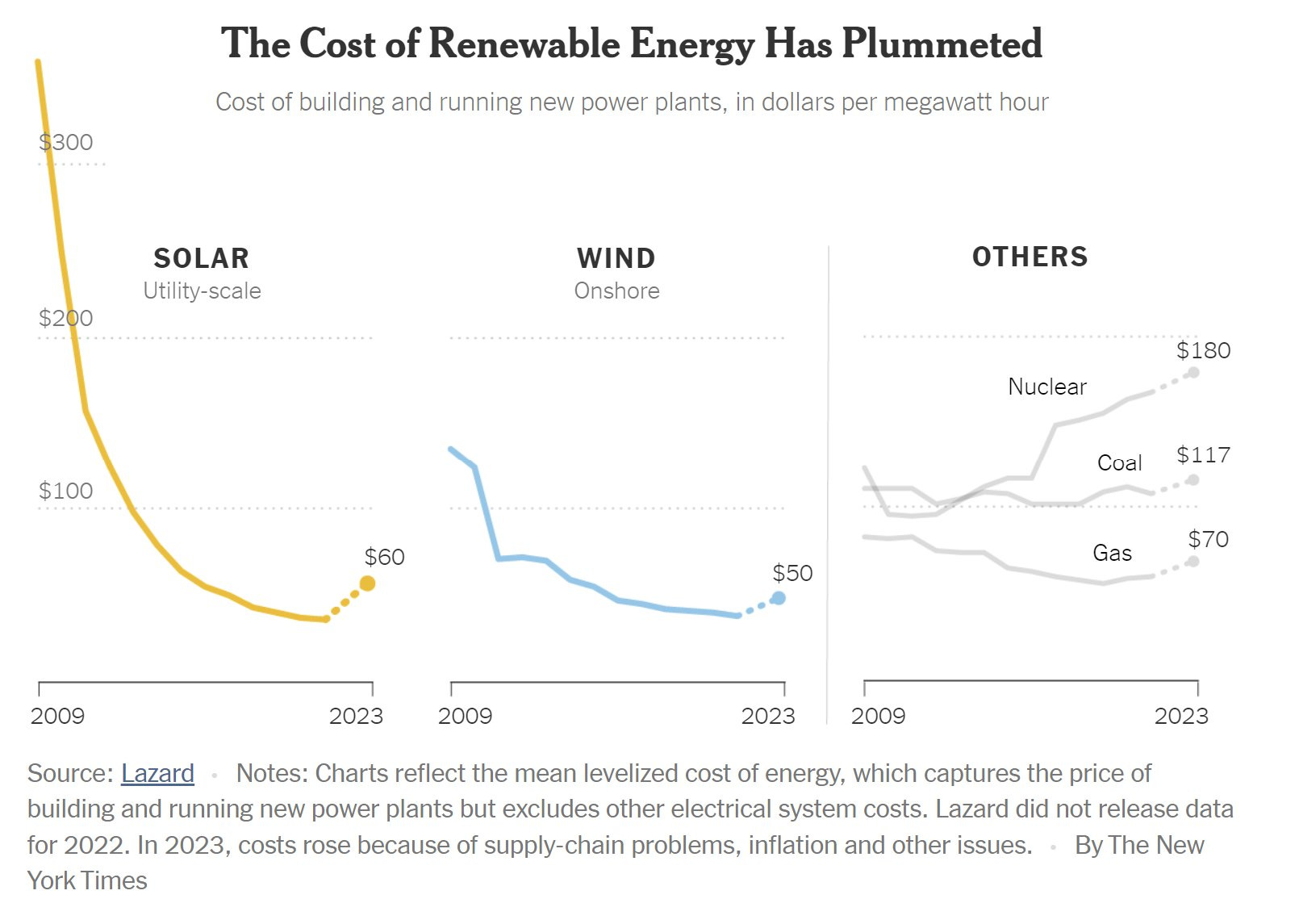
John Arnold speculates that we will no longer see exponentially shrinking costs for renewable energy going forward.
John Arnold: People keep saying things like the NYT does today: “the cost of generating electricity from the sun and wind is falling fast.” A quick look at the graphs below suggests the story is more complicated, with 3 distinct phases.
Phase 1: Introduction, 2000-early 2010s. Sharp cost declines that happened as the industry went from near zero to commercial scale. Significant tech and manufacturing advancements, economies of scale, cost of capital declines, new vendor and developer competition
Phase 2: Growth, early 2010s-2019. Smaller cost declines as industry matures. Technology improvements slow, gains from economies of scale and vendor competition plateaue, credit spreads tighten, but labor costs increase.
Phase 3: Maturity, 2020-now. Costs increase as the deflationary aspects either plateau or have become a small % of total costs. Technology advancements start hitting against physical constraints, materials and labor costs increase, top tier acreage near demand centers is already developed, interconnection delays, interest rate increase severely raises cost of capital, disruption from tariffs on Chinese solar panels, intense vendor competition eases, more accurate pricing of congestion risk, wind turbine manufacturers reprice after losing billions and, also, COVID supply chain interruptions. The NYT writes that, “in 2023, costs rose because of supply-chain problems, inflation and other issues,” as if it’s a one-time event this year that will quickly reverse. I worry this cost increase is more structural.
I would think a model of the cost curve over time of an industry that had the following characteristics would look similar to what we have seen in renewables: 1) went from effectively zero to high growth to mature 2) had components that were intrinsically deflationary (tech advancement and scaling) and inflationary (labor, materials, and siting) 3) the largest deflationary aspect (tech) had the constraint of a maximum theoretical efficiency 4) mathematically, the deflationary components made up a smaller % of total costs each year and the inflationary components a larger % I’m interested in why @Noahpinion disagrees.
I do not know if this is true but it seems scarily plausible. Early on, the primary costs of renewable energy were physical goods where innovation was permitted, so we saw dramatic cost improvements.
We will continue to see improvements there, but now the primary remaining costs could indeed increasingly be regulatory and legal and logistical, and things like endpoint labor, that we are not allowed to innovate our way around. Alternatively, while we had high technology and manufacturing costs the rent-seeking costs were contained. Now that there is a surplus, the rent seekers are here to take it.
The unavoidable actual physical costs, after all, cannot go below $0.
Carbon and climate change are a magnitude game, if you want to make personal changes to help then focus exclusively on the big stuff like your car, your flights and if desired your diet. Moving to a city is implied, if you don’t do that then you’re clearly not serious. All the time we spend sweating the small stuff is not impactful.
A consideration when pushing towards greater use of the electric grid is whether or not that grid is sufficiently reliable. If, as California is doing, you increasingly ban things not being fully electrified, you are going to have a bad time when the power goes out. It seems buildings are being designed in ways that break down when the electricity goes out – in the example here, not only would there be no backup power and no heat, but the door to re-enter the apartment complex is electric and won’t work if the power is out. So residents can’t get back in. Whoops.
I will conclude with a reminder of what I opened with: In the end the core problem is that our entire approach is flawed. We will need to fix it.
As Alec Stapp points out, if you want to reform NEPA, either you get rid of or reform the principle of judicial review where anyone who wants can sue over any little thing and hold things up indefinitely, or you’re not going to be helping much.
He asks for a judicial shot clock. I think that’s a good start and doesn’t go far enough.