Author name: Rejus Almole

removal-of-russian-coders-spurs-debate-about-linux-kernel’s-politics

Removal of Russian coders spurs debate about Linux kernel’s politics

“Remove some entries due to various compliance requirements. They can come back in the future if sufficient documentation is provided.”

That two-line comment, submitted by major Linux kernel maintainer Greg Kroah-Hartman, accompanied a patch that removed about a dozen names from the kernle’s MAINTAINERS file. “Some entries” notably had either Russian names or .ru email addresses. “Various compliance requirements” was, in this case, sanctions against Russia and Russian companies, stemming from that country’s invasion of Ukraine.

This merge did not go unnoticed. Replies on the kernel mailing list asked about this “very vague” patch. Kernel developer James Bottomley wrote that “we” (seemingly speaking for Linux maintainers) had “actual advice” from Linux Foundation counsel. Employees of companies on the Treasury Department’s Office of Foreign Assets Control list of Specially Designated Nationals and Blocked Persons (OFAC SDN), or connected to them, will have their collaborations “subject to restrictions,” and “cannot be in the MAINTAINERS file.” “Sufficient documentation” would mean evidence that someone does not work for an OFAC SDN entity, Bottomley wrote.

There followed a number of messages questioning the legitimacy, suddenness, potentially US-forced, and non-reviewed nature of the commit, along with broader questions about the separation of open source code from international politics. Linux creator Linus Torvalds entered the thread with, “Ok, lots of Russian trolls out and about.” He wrote: “It’s entirely clear why the change was done” and noted that “Russian troll factories” will not revert it and that “the ‘various compliance requirements’ are not just a US thing.

Removal of Russian coders spurs debate about Linux kernel’s politics Read More »

san-francisco-to-pay-$212-million-to-end-reliance-on-5.25-inch-floppy-disks

San Francisco to pay $212 million to end reliance on 5.25-inch floppy disks

The San Francisco Municipal Transportation Agency (SFMTA) board has agreed to spend $212 million to get its Muni Metro light rail off floppy disks.

The Muni Metro’s Automatic Train Control System (ATCS) has required 5¼-inch floppy disks since 1998, when it was installed at San Francisco’s Market Street subway station. The system uses three floppy disks for loading DOS software that controls the system’s central servers. Michael Roccaforte, an SFMTA spokesperson, gave further details on how the light rail operates to Ars Technica in April, saying: “When a train enters the subway, its onboard computer connects to the train control system to run the train in automatic mode, where the trains drive themselves while the operators supervise. When they exit the subway, they disconnect from the ATCS and return to manual operation on the street.” After starting initial planning in 2018, the SFMTA originally expected to move to a floppy-disk-free train control system by 2028. But with COVID-19 preventing work for 18 months, the estimated completion date was delayed.

On October 15, the SFMTA moved closer to ditching floppies when its board approved a contract with Hitachi Rail for implementing a new train control system that doesn’t use floppy disks, the San Francisco Chronicle reported. Hitachi Rail tech is said to power train systems, including Japan’s bullet train, in more than 50 countries. The $212 million contract includes support services from Hitachi for “20 to 25 years,” the Chronicle said.

The new control system is supposed to be five generations ahead of what Muni is using now, Muni director Julie Kirschbaum said, per the Chronicle. Further illustrating the light rail’s dated tech, the current ATCS was designed to last 20 to 25 years, meaning its expected expiration date was in 2023. The system still works fine, but the risk of floppy disk data degradation and challenges in maintaining expertise in 1990s programming languages have further encouraged the SFMTA to seek upgrades.

San Francisco to pay $212 million to end reliance on 5.25-inch floppy disks Read More »

shady-drugmaker-used-code-words-to-sell-knockoff-weight-loss-drug:-lawsuit

Shady drugmaker used code words to sell knockoff weight-loss drug: lawsuit

Starts with a T

Pivotal Peptides—which is not a licensed pharmacy or dispensary—did not respond to the letter. Instead, its website was modified to indicate that it was “down for maintenance,” and the company instructed customers to email directly. About 10 days later, Pivotal Peptides’ registered agent, Elizabeth Gately, then sent an email (which Lilly obtained) instructing customers to place tirzepatide orders using coded language.

“Good News,” the email read, “Pivotal Peptides … is still in business!”

“If a favorite product (starting with T) was your go-to, that name can’t be used in any correspondence with me or listed on my price sheet anymore,” Gately allegedly wrote. “Therefore, I need another identifier and decided (for now) to call this peptide ’11mg.'”

Gately went on to say that the codenamed product “is Pivotal Peptide’s [sic] bestseller,” and “it is the only T size available from PP right now except by special order.” The letter ended with: “Remember to order ’11 mg’ with the latest price to identify the product you want, if applicable, and no longer use T in our communication.”

Pivotal Peptides did not respond to Ars’ request for comment.

In a statement emailed to Ars, a Lilly spokesperson said Pivotal Peptides and the other companies Lilly is suing are engaging in “conduct that poses serious risks to patient safety.” In the lawsuit, Lilly notes that even children could be ordering this DIY, research-grade drug.

“No one should ever be allowed to sell these untested, non-human grade or manipulated drugs to American consumers,” the statement continued.

Lilly’s lawsuits come amid a legal storm over compounded versions of the tirzepatide, which can be legally made by licensed pharmacies as long as tirzepatide is in shortage. On October 2, the Food and Drug Administration announced that the shortage had ended but then decided to reconsider the decision after being sued by compounding pharmacies.

On several occasions, the FDA has warned of safety concerns related to compounded versions of GLP-1 weight-loss drugs.

Shady drugmaker used code words to sell knockoff weight-loss drug: lawsuit Read More »

meet-the-winners-of-nikon’s-2024-photomicrography-contest

Meet the winners of Nikon’s 2024 photomicrography contest

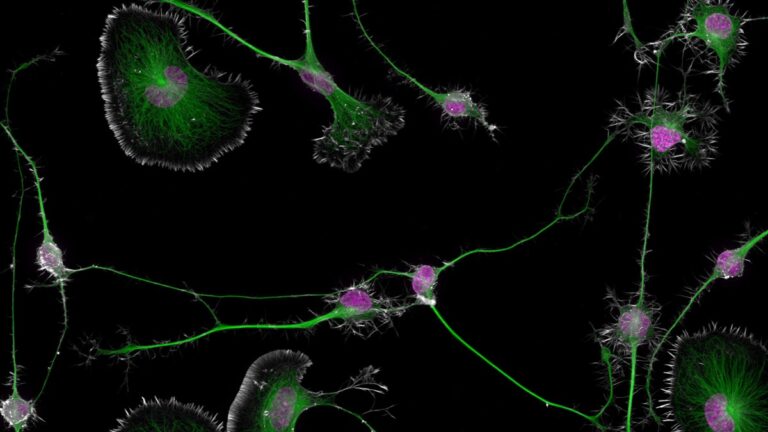
This year’s winning entry arose from Cisterna’s research into a protein crucial for building brain cell structure (profilin 1, or PFN1); that structure is essential for functional cellular transport. He found that when the protein and related processes are disrupted, the microtubule highways can malfunction and cause damage to the cells. Capturing the actin, microtubules, and nuclei with photomicroscopy was a painstaking process that took about three months just to perfect the staining process. Cisterna and Vitriol paid particular attention to getting just the right field of view and got the image they were waiting for after three hours of observation.

“At 50 years, Nikon Small World is more than just an imaging competition—it’s become a gallery that pays tribute to the extraordinary individuals who make it possible,” said Nikon Instruments rep Eric Flem. “They are the driving force behind this event, masterfully blending science and art to reveal the wonders of the microscopic world and what we can learn from it to the public. Sometimes, we overlook the tiny details of the world around us. Nikon Small World serves as a reminder to pause, appreciate the power and beauty of the little things, and to cultivate a deeper curiosity to explore and question.”

Here are the remaining top 20 winners of this year’s contest, ranging from close-up views of octopus eggs, green crab spider eyes, and slime molds to capturing the electric arc between a pin and wire, and an insect egg that has been parasitized by a wasp. You can check out the full list of winners, as well as several honorable mentions, here.

And the winners are …

Second place: Electrical arc between a pin and a wire. Marcel Clemens/Nikon Small World

Meet the winners of Nikon’s 2024 photomicrography contest Read More »

lawsuit:-city-cameras-make-it-impossible-to-drive-anywhere-without-being-tracked

Lawsuit: City cameras make it impossible to drive anywhere without being tracked


“Every passing car is captured,” says 4th Amendment lawsuit against Norfolk, Va.

A license plate reader camera mounted on a pole

An automated license plate reader is seen mounted on a pole on June 13, 2024 in San Francisco, California.

Police use of automated license-plate reader cameras is being challenged in a lawsuit alleging that the cameras enable warrantless surveillance in violation of the Fourth Amendment. The city of Norfolk, Virginia, was sued yesterday by plaintiffs represented by the Institute for Justice, a nonprofit public-interest law firm.

Norfolk, a city with about 238,000 residents, “has installed a network of cameras that make it functionally impossible for people to drive anywhere without having their movements tracked, photographed, and stored in an AI-assisted database that enables the warrantless surveillance of their every move. This civil rights lawsuit seeks to end this dragnet surveillance program,” said the complaint filed in US District Court for the Eastern District of Virginia.

Like many other cities, Norfolk uses cameras made by the company Flock Safety. A 404 Media article said Institute for Justice lawyer Robert Frommer “told 404 Media that the lawsuit could have easily been filed in any of the more than 5,000 communities where Flock is active, but that Norfolk made sense because the Fourth Circuit of Appeals—which Norfolk is part of—recently held that persistent, warrantless drone surveillance in Baltimore is unconstitutional under the Fourth Amendment in a case called Beautiful Struggle v Baltimore Police Department.”

The Norfolk lawsuit seeks a declaration “that Defendants’ policies and customs described in this Complaint are unlawful and violate the Fourth Amendment,” and a permanent injunction prohibiting the city from operating the Flock cameras. They also want an order requiring the city “to delete all images, records, and other data generated by the Flock Cameras.”

If the use of Flock cameras does continue, the lawsuit aims to require that officers obtain a warrant based on probable cause before using the cameras to collect images and before accessing any images.

Flock: Case law supports license plate readers

Flock Safety is not a defendant in the case, but the company disputed the legal claims in a statement provided to Ars today. “Fourth Amendment case law overwhelmingly shows that license plate readers do not constitute a warrantless search because they take photos of cars in public and cannot continuously track the movements of any individual,” Flock Safety said.

The warrantless drone surveillance case cited in the lawsuit was decided in November 2020 by the US Court of Appeals for the 4th Circuit. The appeals court “struck down an aerial surveillance program precisely because it created record of where everyone in the city of Baltimore had gone over the past 45 days,” the lawsuit against Norfolk said. “Norfolk is trying to accomplish from the ground what the Fourth Circuit has already held a city could not do from the air.”

The plaintiffs are Norfolk resident Lee Schmidt and Portsmouth resident Crystal Arrington, who both frequently drive through areas monitored by the cameras. They sued the city, the Norfolk police department, and Police Chief Mark Talbot.

The city contracted with Flock Safety “to blanket Norfolk with 172 advanced automatic license plate reader cameras… Every passing car is captured, and its license plate and other features are analyzed using proprietary machine learning programs, like Flock’s ‘Vehicle Fingerprint.'”

The lawsuit said that “Flock also offers its customers the ability to pool their data into a centralized database,” giving police departments access to over 1 billion license plate reads in 5,000 communities every month. “Flock thus gives police departments the ability to track drivers not just within their own jurisdiction, but potentially across the entire nation,” the lawsuit said.

“Crystal finds all of this deeply intrusive”

Schmidt, a 42-year-old who recently retired from the Navy after 21 years, passes Flock cameras when he leaves his neighborhood and at many other points in town, the lawsuit said. Police officers can “follow Lee’s movements throughout the City, and even throughout other jurisdictions that let Flock pool their data,” the lawsuit said.

Arrington, a certified nursing assistant with many elderly clients in Norfolk, “makes frequent trips to Norfolk to take her clients to doctors’ offices and other appointments,” the lawsuit said. Flock cameras may capture images of her car in Norfolk and when she returns home to Portsmouth, which is also a Flock customer.

“Crystal finds all of this deeply intrusive… Crystal worries about how the Flock Cameras are eroding not just her privacy, but her clients’ privacy, too,” the complaint said.

In a press release, the Institute for Justice claimed that “Norfolk has created a dragnet that allows the government to monitor everyone’s day-to-day movements without a warrant or probable cause. This type of mass surveillance is a blatant violation of the Fourth Amendment.”

The group says that Flock’s cameras aren’t like “traditional traffic cameras… [which] capture an image only when they sense speeding or someone running a red light.” Instead, Flock’s system captures images of every car and retains the images for at least 30 days, the group said.

“It’s no surprise that surveillance systems like Norfolk’s have been repeatedly abused,” the group said. “In Kansas, officials were caught using Flock to stalk their exes, including one police chief who used Flock 228 times over four months to track his ex-girlfriend and her new boyfriend’s vehicles. In California, several police departments violated California law by sharing data from their license plate reader database with other departments across the country.”

Flock’s Vehicle Fingerprint tech

Flock’s Vehicle Fingerprint technology “includes the color and make of the car and any distinctive features, like a bumper sticker or roof rack” and makes those details searchable in the database, the lawsuit said. The complaint describes how officers can use the Flock technology:

All of that surveillance creates a detailed record of where every driver in Norfolk has gone. Anyone with access to the database can go back in time and see where a car was on any given day. And they can track its movements across at least the past 30 days, creating a detailed map of the driver’s movements. Indeed, the City’s police chief has boasted that “it would be difficult to drive anywhere of any distance without running into a camera somewhere.” In Norfolk, no one can escape the government’s 172 unblinking eyes. And the City’s dragnet is only expanding: On September 24, 2024, the Chief of Police announced plans to acquire 65 more cameras in the future.

The cameras make this surveillance not just possible, but easy. Flock provides advanced search and artificial intelligence functions. The sort of tracking that would have taken days of effort, multiple officers, and significant resources just a decade ago now takes just a few mouse clicks. City officers can output a list of locations a car has been seen, create lists of cars that visited specific locations, and even track cars that are often seen together.

In its statement today, Flock said that “appellate and federal district courts in at least fourteen states have upheld the use of evidence from license plate readers as constitutional without requiring a warrant, as well as the 9th and 11th circuits.”

Flock cited several Virginia rulings, including one earlier this month in which a federal judge wrote, “There is simply no expectation of privacy in the exterior of one’s vehicle, or while driving it on public thoroughfares.” The ruling denied a motion to suppress evidence derived from the Flock camera system.

“License plates are issued by the government for the express purpose of identifying vehicles in public places for safety reasons,” Flock said in its statement to Ars. “Courts have consistently found that there is no reasonable expectation of privacy in a license plate on a vehicle on a public road, and photographing one is not a Fourth Amendment search.”

Lawsuit: “No meaningful restrictions” on camera use

The lawsuit against Norfolk alleges that the city’s use of Flock cameras “violates a subjective expectation of privacy that society recognizes as reasonable.”

The plaintiffs have a reasonable expectation that “neither an ordinary person nor the NPD could create a long-term record of their movements throughout the City and other Flock jurisdictions,” the lawsuit said. “They do not expect, for instance, that a group of people or even officers would post themselves at various points throughout the City—day and night—to catalogue every time they and everyone else drove past. Nor do they expect that the police or anyone else would have the capability to reconstruct their movements over the past 30 days or more.”

The lawsuit alleges that there are “no meaningful restrictions on City officers’ access to this information. Officers need only watch Flock’s orientation video and create login credentials to get access,” and the officers “can search the database whenever they want for whatever they want” with “no need to seek advance approval.”

“All of this is done without a warrant. No officer ever has to establish probable cause, swear to the facts in a warrant application, and await the approval of a neutral judge,” the lawsuit said.

City: Cameras “enhance citizen safety”

The lawsuit said that while photos and vehicle details are saved for 30 days by default, officers can keep the photos and information longer if they download them during the 30-day window.

“Worse still, Flock maintains a centralized database with over one billion license plate reads every month,” the complaint said. “So, even after a driver leaves the City, officers can potentially keep following them in the more than 5,000 communities where Flock currently has cameras. Likewise, any person with access to Flock’s centralized database can access the City’s information, potentially without the City even knowing about it. Ominously, the City’s police chief has said this ‘creates a nice curtain of technology’ for the City and surrounding area.”

We contacted the city of Norfolk’s communications department and the police department today. A police spokesperson said all questions about the lawsuit must be sent to the city communications department. The city declined comment on the lawsuit but defended the use of Flock cameras.

“While the City of Norfolk cannot comment on pending litigation, the City’s intent in implementing the use of Flock cameras (which are automatic license plate readers) is to enhance citizen safety while also protecting citizen privacy,” a Norfolk city spokesperson said.

Photo of Jon Brodkin

Jon is a Senior IT Reporter for Ars Technica. He covers the telecom industry, Federal Communications Commission rulemakings, broadband consumer affairs, court cases, and government regulation of the tech industry.

Lawsuit: City cameras make it impossible to drive anywhere without being tracked Read More »

qualcomm-brings-laptop-class-cpu-cores-to-phones-with-snapdragon-8-elite

Qualcomm brings laptop-class CPU cores to phones with Snapdragon 8 Elite

Qualcomm has a new chip for flagship phones, and the best part is that it uses an improved version of the Oryon CPU architecture that the Snapdragon X Elite chips brought to Windows PCs earlier this year.

The Snapdragon 8 Elite is the follow-up to last year’s Snapdragon 8 Gen 3—yet another change to the naming convention that Qualcomm uses for its high-end phone chips, though, as usual, the number 8 is still involved. The 8 Elite uses a “brand-new, 2nd-generation Qualcomm Oryon CPU” with clock speeds up to 4.32 GHz, which Qualcomm says will improve performance by about 45 percent compared to the Snapdragon 8 Gen 3.

Rather than a mix of large, medium, and small CPU cores as it has used in the past, the 8 Elite has two “Prime” cores for hitting that high peak clock speed, while the other six are all “Performance” cores that peak at a lower 3.53 GHz. But it doesn’t look like Qualcomm is using a mix of different CPU architectures anymore, choosing to distinguish the higher-performing core from the lower-performing ones by clock speed alone.

Qualcomm promises a similar 40 percent performance boost from the new Adreno 830 GPU. The chip also includes a marginally improved Snapdragon X80 5G modem, up from an X75 modem in the Snapdragon 8 Gen 3—its main improvement appears to be support for additional antennas, for a total of six, but the download speed still tops out at a theoretical 10Gbps. Wi-Fi 7 support appears to be the same as in the 8 Gen 3, but the 8 Elite does support the Bluetooth 6.0 standard, up from Bluetooth 5.4 in the 8 Gen 3.

Qualcomm brings laptop-class CPU cores to phones with Snapdragon 8 Elite Read More »

after-seeing-hundreds-of-launches,-spacex’s-rocket-catch-was-a-new-thrill

After seeing hundreds of launches, SpaceX’s rocket catch was a new thrill


For a few moments, my viewing angle made it look like the rocket was coming right at me.

Coming in for the catch. Credit: Stephen Clark/Ars Technica

BOCA CHICA BEACH, Texas—I’ve taken some time to process what happened on the mudflats of South Texas a little more than a week ago and relived the scene in my mind countless times.

With each replay, it’s still as astonishing as it was when I saw it on October 13, standing on an elevated platform less than 4 miles away. It was surreal watching SpaceX’s enormous 20-story-tall Super Heavy rocket booster plummeting through the sky before being caught back at its launch pad by giant mechanical arms.

This is the way, according to SpaceX, to enable a future where it’s possible to rapidly reuse rockets, not too different from the way airlines turn around their planes between flights. This is required for SpaceX to accomplish the company’s mission, set out by Elon Musk two decades ago, of building a settlement on Mars.

Of course, SpaceX’s cameras got much better views of the catch than mine. This is one of my favorite video clips.

The final phase of Super Heavy’s landing burn used the three center Raptor engines to precisely steer into catch position pic.twitter.com/BxQbOmT4yk

— SpaceX (@SpaceX) October 14, 2024

In the near-term future, regularly launching and landing Super Heavy boosters, and eventually the Starship upper stage that goes into orbit, will make it possible for SpaceX to achieve the rapid-fire launch cadence the company needs to fulfill its contracts with NASA. The space agency is paying SpaceX roughly $4 billion to develop a human-rated version of Starship to land astronauts on the Moon under the umbrella of the Artemis program.

To make that happen, SpaceX must launch numerous Starship tankers over the course of a few weeks to a few months to refuel the Moon-bound Starship lander in low-Earth orbit. Rapid reuse is fundamental to the lunar lander architecture NASA chose for the first two Artemis landing missions.

SpaceX, which is funding most of Starship’s development costs, says upgraded versions will be capable of hauling 200 metric tons of payload to low-Earth orbit while flying often at a relatively low cost. This would unlock innumerable other potential applications for the US military and commercial industry.

Here’s a sampling of the photos I captured of SpaceX’s launch and catch, followed by the story of how I got them.

The fifth full-scale test flight of SpaceX’s new-generation Starship rocket lifted off from South Texas at sunrise Sunday morning. Stephen Clark/Ars Technica

Some context

I probably spent too much time watching last week’s flight through my camera’s viewfinder, but I suspect I’ll see it many more times. After all, SpaceX wants to make this a routine occurrence, more common than the landings of the smaller Falcon 9 booster now happening several times per week.

Nine years ago, I watched from 7 miles away as SpaceX landed a Falcon 9 for the first time. This was the closest anyone not directly involved in the mission could watch as the Falcon 9’s first stage returned to Cape Canaveral Space Force Station in Florida, a few minutes after lifting off with a batch of commercial communications satellites.

Citing safety concerns, NASA and the US Air Force closed large swaths of the spaceport for the flight. Journalists and VIPs were kept far away, and the locations on the base where employees or special guests typically watch a launch were off-limits. The landing happened at night and played out like a launch in reverse, with the Falcon 9 booster settling to a smooth touchdown on a concrete landing pad a few miles from the launch site.

The Falcon 9 landing on December 21, 2015, came after several missed landings on SpaceX’s floating offshore drone ship. With the Super Heavy booster, SpaceX nailed the catch on the first try.

The catch method means the rocket doesn’t need to carry landing legs, as the Falcon 9 does. This reduces the rocket’s weight and complexity, and theoretically reduces the amount of time and money needed to prepare the rocket to fly again.

I witnessed the first catch of SpaceX’s Super Heavy booster last week from just outside the restricted zone around the company’s sprawling Starbase launch site in South Texas. Deputies from the local sheriff’s office patrolled the area to ensure no one strayed inside the keep-out area and set up roadblocks to turn away anyone who wasn’t supposed to be there.

The launch was early in the morning, so I arrived late the night before at a viewing site run by Rocket Ranch, a campground that caters to SpaceX fans seeking a front-row seat to the goings-on at Starbase. Some SpaceX employees, several other reporters, and media photographers were there, too.

There are other places to view a Starship launch. Condominium and hotel towers on South Padre Island roughly 6 miles from the launch pad, a little farther than my post, offer commanding aerial views of Starbase, which is situated on Boca Chica Beach a few miles north of the US-Mexico border. The closest publicly accessible place to watch a Starship launch is on the south shore of the mouth of the Rio Grande River, but if you’re coming from the United States, getting there requires crossing the border and driving off-road.

People gather at the Rocket Ranch viewing site near Boca Chica Beach, Texas, before the third Starship test flight in March.

People gather at the Rocket Ranch viewing site near Boca Chica Beach, Texas, before the third Starship test flight in March. Credit: Brandon Bell/Getty Images

I chose a location with an ambiance somewhere in between the hustle and bustle of South Padre Island and the isolated beach just across the border in Mexico. The vibe on the eve of the launch had the mix of a rave and a pilgrimage of SpaceX true believers.

A laser light show projected the outline of a Starship against a tree as uptempo EDM tracks blared from speakers. Meanwhile, dark skies above revealed cosmic wonders invisible to most city dwellers, and behind us, the Rio Grande inexorably flowed toward the sea. Those of us who were there to work got a few hours of sleep, but I’m not sure I can say the same for everyone.

At first light, a few scattered yucca plants sticking up from the chaparral were the only things between us and SpaceX’s sky-scraping Starship rocket on the horizon. We got word the launch time would slip 25 minutes. SpaceX chose the perfect time to fly, with a crystal-clear sky hued by the rising Sun.

First, you see it

I was at Starbase for all four previous Starship test flights and have covered more than 300 rocket launches in person. I’ve been privileged to witness a lot of history, but after hundreds of launches, some of the novelty has worn off. Don’t get me wrong—I still feel a lump in my throat every time I see a rocket leave the planet. Prelaunch jitters are a real thing. But I no longer view every launch as a newsworthy event.

October 13 was different.

Those prelaunch anxieties were present as SpaceX counted off the final seconds to liftoff. First, you see it. A blast of orange flashed from the bottom of the gleaming, frosty rocket filled with super-cold propellants. Then, the 11 million-pound vehicle began a glacial climb from the launch pad. About 20 seconds later, the rumble from the rocket’s 33 methane-fueled engines reached our location.

Our viewing platform shook from the vibrations for over a minute as Starship and the Super Heavy booster soared into the stratosphere. Two-and-a-half minutes into the flight, the rocket was just a point of bluish-white light as it accelerated east over the Gulf of Mexico.

Another burst of orange encircled the rocket during the so-called hot-staging maneuver, when the Starship upper stage lit its engines at the moment the Super Heavy booster detached to begin the return to Starbase. Flying at the edge of space more than 300,000 feet over the Gulf, the booster flipped around and fired its engines to cancel out its downrange velocity and propel itself back toward the coastline.

The engines shut down, and the booster plunged deeper into the atmosphere. Eventually, the booster transformed from a dot in the sky back into the shape of a rocket as it approached Starbase at supersonic speed. The rocket’s velocity became more evident as it got closer. For a few moments, my viewing angle made it look like the rocket—bigger than the fuselage of a 747 jumbo jet—was coming right at me.

The descending booster zoomed through the contrail cloud it left behind during launch, then reappeared into clear air. With the naked eye, I could see a glow inside the rocket’s engine bay as it dived toward the launch pad, presumably from heat generated as the vehicle slammed into ever-denser air on the way back to Earth. This phenomenon made the rocket resemble a lit cigar.

Finally, the rocket hit the brakes by igniting 13 of its 33 engines, then downshifted to three engines for the final maneuver to slide in between the launch tower’s two catch arms. Like balancing a pencil on the tip of your finger, the Raptor engines vectored their thrust to steady the booster, which, for a moment, appeared to be floating next to the tower.

The Super Heavy booster, more than 20 stories tall, rights itself over the launch pad in Texas, moments before two mechanical arms grabbed it in mid-air.

Credit: Stephen Clark/Ars Technica

The Super Heavy booster, more than 20 stories tall, rights itself over the launch pad in Texas, moments before two mechanical arms grabbed it in mid-air. Credit: Stephen Clark/Ars Technica

A double-clap sonic boom jolted spectators from their slack-jawed awe. Only then could we hear the roar from the start of the Super Heavy booster’s landing burn. This sound reached us just as the rocket settled into the grasp of the launch tower, with its so-called catch fittings coming into contact with the metallic beams of the catch arms.

The engines switched off, and there it was. Many of the spectators lucky enough to be there jumped up and down with joy, hugged their friends, or let out an ecstatic yell. I snapped a few final photos and returned to his laptop, grinning, speechless, and started wondering how I could put this all into words.

Once the smoke cleared, at first glance, the rocket looked as good as new. There was no soot on the outside of the booster, as it is on the Falcon 9 rocket after returning from space. This is because the Super Heavy booster and Starship use cleaner-burning methane fuel instead of kerosene.

Elon Musk, SpaceX’s founder and CEO, later said the outer ring of engine nozzles on the bottom of the rocket showed signs of heating damage. This, he said, would be “easily addressed.”

What’s not so easy to address is how SpaceX can top this. A landing on the Moon or Mars? Sure, but realistically, those milestones are years off. There’s something that’ll happen before then.

Sometime soon, SpaceX will try to catch a Starship back at the launch pad at the end of an orbital flight. This will be an extraordinarily difficult feat, far exceeding the challenge of catching the Super Heavy booster.

Super Heavy only reaches a fraction of the altitude and speed of the Starship upper stage, and while the booster’s size and the catch method add degrees of difficulty, the rocket follows much the same up-and-down flight profile pioneered by the Falcon 9. Starship, on the other hand, will reenter the atmosphere from orbital velocity, streak through the sky surrounded by super-heated plasma, then shift itself into a horizontal orientation for a final descent SpaceX likes to call the “belly flop.”

In the last few seconds, Starship will reignite three of its engines, flip itself vertical, and come down for a precision landing. SpaceX demonstrated the ship could do this on the test flight last week, when the vehicle made a controlled on-target splashdown in the Indian Ocean after traveling halfway around the world from Texas.

If everything goes according to plan, SpaceX could be ready to try to catch a Starship for real next year. Stay tuned.

Photo of Stephen Clark

Stephen Clark is a space reporter at Ars Technica, covering private space companies and the world’s space agencies. Stephen writes about the nexus of technology, science, policy, and business on and off the planet.

After seeing hundreds of launches, SpaceX’s rocket catch was a new thrill Read More »

bizarre-fish-has-sensory-“legs”-it-uses-for-walking-and-tasting

Bizarre fish has sensory “legs” it uses for walking and tasting

Finding out what controls the formation of sensory legs meant growing sea robins from eggs. The research team observed that the legs of sea robins develop from the three pectoral fin rays that are around the stomach area of the fish, then separate from the fin as they continue to develop. Among the most active genes in the developing legs is the transcription factor (a protein that binds to DNA and turns genes on and off) known as tbx3a. When genetically engineered sea robins had tbx3a edited out with CRISPR-Cas9, it resulted in fewer legs, deformed legs, or both.

“Disruption of tbx3a results in upregulation of pectoral fin markers prior to leg separation, indicating that leg rays become more similar to fins in the absence of tbx3a,” the researchers said in a second study, also published in Current Biology.

To see whether genes for sensory legs are a dominant feature, the research team also tried creating sea robin hybrids, crossing species with and without sensory legs. This resulted in offspring with legs that had sensory capabilities, indicating that it’s a genetically dominant trait.

Exactly why sea robins evolved the way they did is still unknown, but the research team came up with a hypothesis. They think the legs of sea robin ancestors were originally intended for locomotion, but they gradually started gaining some sensory utility, allowing the animal to search the visible surface of the seafloor for food. Those fish that needed to search deeper for food developed sensory legs that allowed them to taste and dig for hidden prey.

“Future work will leverage the remarkable biodiversity of sea robins to understand the genetic basis of novel trait formation and diversification in vertebrates,” the team also said in the first study. “Our work represents a basis for understanding how novel traits evolve.”

Current Biology, 2024. DOI:  10.1016/j.cub.2024.08.014, 10.1016/j.cub.2024.08.042

Bizarre fish has sensory “legs” it uses for walking and tasting Read More »

openai-releases-chatgpt-app-for-windows

OpenAI releases ChatGPT app for Windows

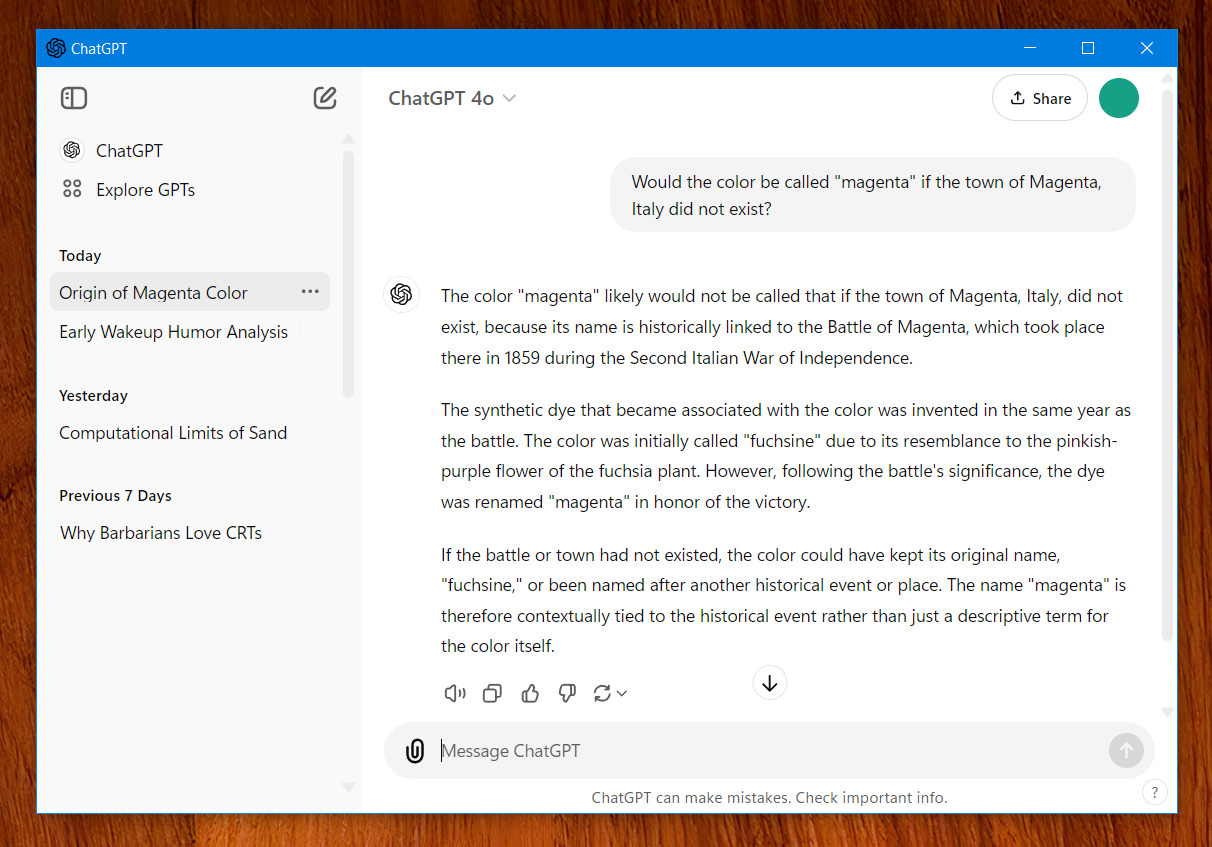
On Thursday, OpenAI released an early Windows version of its first ChatGPT app for Windows, following a Mac version that launched in May. Currently, it’s only available to subscribers of Plus, Team, Enterprise, and Edu versions of ChatGPT, and users can download it for free in the Microsoft Store for Windows.

OpenAI is positioning the release as a beta test. “This is an early version, and we plan to bring the full experience to all users later this year,” OpenAI writes on the Microsoft Store entry for the app. (Interestingly, ChatGPT shows up as being rated “T for Teen” by the ESRB in the Windows store, despite not being a video game.)

A screenshot of the new Windows ChatGPT app captured on October 18, 2024.

A screenshot of the new Windows ChatGPT app captured on October 18, 2024.

Credit: Benj Edwards

A screenshot of the new Windows ChatGPT app captured on October 18, 2024. Credit: Benj Edwards

Upon opening the app, OpenAI requires users to log into a paying ChatGPT account, and from there, the app is basically identical to the web browser version of ChatGPT. You can currently use it to access several models: GPT-4o, GPT-4o with Canvas, 01-preview, 01-mini, GPT-4o mini, and GPT-4. Also, it can generate images using DALL-E 3 or analyze uploaded files and images.

If you’re running Windows 11, you can instantly call up a small ChatGPT window when the app is open using an Alt+Space shortcut (it did not work in Windows 10 when we tried). That could be handy for asking ChatGPT a quick question at any time.

A screenshot of the new Windows ChatGPT app listing in the Microsoft Store captured on October 18, 2024.

Credit: Benj Edwards

A screenshot of the new Windows ChatGPT app listing in the Microsoft Store captured on October 18, 2024. Credit: Benj Edwards

And just like the web version, all the AI processing takes place in the cloud on OpenAI’s servers, which means an Internet connection is required.

So as usual, chat like somebody’s watching, and don’t rely on ChatGPT as a factual reference for important decisions—GPT-4o in particular is great at telling you what you want to hear, whether it’s correct or not. As OpenAI says in a small disclaimer at the bottom of the app window: “ChatGPT can make mistakes.”

OpenAI releases ChatGPT app for Windows Read More »

how-the-malleus-maleficarum-fueled-the-witch-trial-craze

How the Malleus maleficarum fueled the witch trial craze


Invention of printing press, influence of nearby cities created perfect conditions for social contagion.

Between 1400 and 1775, a significant upsurge of witch trials swept across early-modern Europe, resulting in the execution of an estimated 40,000–60,000 accused witches. Historians and social scientists have long studied this period in hopes of learning more about how large-scale social changes occur. Some have pointed to the invention of the printing press and the publication of witch-hunting manuals—most notably the highly influential Malleus maleficarum—as a major factor, making it easier for the witch-hunting hysteria to spread across the continent.

The abrupt emergence of the craze and its rapid spread, resulting in a pronounced shift in social behaviors—namely, the often brutal persecution of suspected witches—is consistent with a theory of social change dubbed “ideational diffusion,” according to a new paper published in the journal Theory and Society. There is the introduction of new ideas, reinforced by social networks, that eventually take root and lead to widespread behavioral changes in a society.

The authors had already been thinking about cultural change and the driving forces by which it occurs, including social contagion—especially large cultural shifts like the Reformation and the Counter-Reformation, for example. One co-author, Steve Pfaff, a sociologist at Chapman University, was working on a project about witch trials in Scotland and was particularly interested in the role the Malleus maleficarum might have played.

“Plenty of other people have written about witch trials, specific trials or places or histories,” co-author Kerice Doten-Snitker, a social scientist with the Santa Fe Institute, told Ars. “We’re interested in building a general theory about change and wanted to use that as a particular opportunity. We realized that the printing of the Mallleus maleficarum was something we could measure, which is useful when you want to do empirical work, not just theoretical work.”

Ch-ch-ch-changes…

The Witch, No. 1, c. 1892 lithograph by Joseph E. Baker. shows a woman in a courtroom, in the dock with arms outstretched before a judge and jury.

The Witch, No. 1, c. 1892 lithograph by Joseph E. Baker.

Credit: Public domain

The Witch, No. 1, c. 1892 lithograph by Joseph E. Baker. Credit: Public domain

Modeling how sweeping cultural change happens has been a hot research topic for decades, hitting the cultural mainstream with the publication of Malcolm Gladwell’s 2000 bestseller The Tipping Point. Researchers continue to make advances in this area. University of Pennsylvania sociologist Damon Centola, for instance, published How Behavior Spreads: the Science of Complex Contagions in 2018, in which he applied new lessons learned in epidemiology—on how viral epidemics spread—to our understanding of how social networks can broadly alter human behavior. But while epidemiological modeling might be useful for certain simple forms of social contagion—people come into contact with something and it spreads rapidly, like a viral meme or hit song—other forms of social contagion are more complicated, per Doten-Snitker.

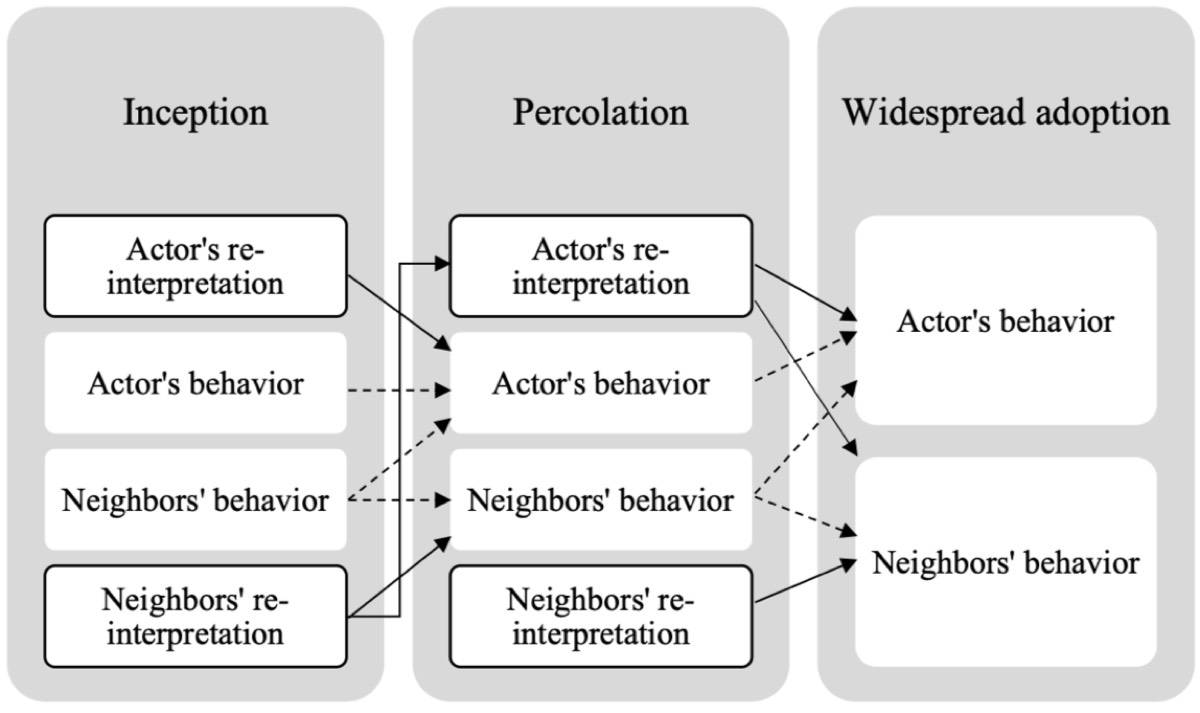
Doten-Snitker et al.’s ideational diffusion model differs from Centola’s in some critical respects. For cases like the spread of witch trials, “It’s not just that people are coming into contact with a new idea, but that there has to be something cognitively that is happening,” said Doten-Snitker. “People have to grapple with the ideas and undergo some kind of idea adoption. We talk about this as reinterpreting the social world. They have to rethink what’s happening around them in ways that make them think that not only are these attractive new ideas, but also those new ideas prescribe different types of behavior. You have to act differently because of what you’re encountering.”

The authors chose to focus on social networks and trade routes for their analysis of the witch trials, building on prior research that prioritized broader economic and environmental factors. Cultural elites were already exchanging ideas through letters, but published books added a new dimension to those exchanges. Researchers studying 21st century social contagion can download massive amounts of online data from social networks. That kind of data is sparse from the medieval era. “We don’t have the same archives of communication,” said Doten-Snitker. “There’s this dual thing happening: the book itself, and people sharing information, arguing back and forth with each other” about new ideas.

Graph showing the stages of the ideation diffusion model

The stages of the ideation diffusion model.

Credit: K. Dooten-Snitker et al., 2024

The stages of the ideation diffusion model. Credit: K. Dooten-Snitker et al., 2024

So she and her co-authors et al. turned to trade routes to determine which cities were more central and thus more likely to be focal points of new ideas and information. “The places that are more central in these trade networks have more stuff passing through and are more likely to come into contact with new ideas from multiple directions—specifically ideas about witchcraft,” said Doten-Snitker. Then they looked at which of 553 cities in Central Europe held their first witch trials, and when, as well as those where the Malleus maleficarum and similar manuals had been published.

Social contagion

They found that each new published edition of the Malleus maleficarum corresponded with a subsequent increase in witch trials. But that wasn’t the only contributing factor; trends in neighboring cities also influenced the increase, resulting in a slow-moving ripple effect that spread across the continent. “What’s the behavior of neighboring cities?” said Doten-Snitker. “Are they having witch trials? That makes your city more likely to have a witch trial when you have the opportunity.”

In epidemiological models like Centola’s, the pattern of change is a slow start with early adoption that then picks up speed and spreads before slowing down again as a saturation point is reached, because most people have now adopted the new idea or technology. That doesn’t happen with witch trials or other complex social processes such as the spread of medieval antisemitism. “Most things don’t actually spread that widely; they don’t reach complete saturation,” said Doten-Snitker. “So we need to have theories that build that in as well.”

In the case of witch trials, the publication of the Malleus maleficarum helped shift medieval attitudes toward witchcraft, from something that wasn’t viewed as a particularly pressing problem to something evil that was menacing society. The tome also offered practical advice on what should be done about it. “So there’s changing ideas about witchcraft and this gets coupled with, well, you need to do something about it,” said Doten-Snitker. “Not only is witchcraft bad, but it’s a threat. So you have a responsibility as a community to do something about witches.”

The term “witch hunt” gets bandied about frequently in modern times, particularly on social media, and is generally understood to reference a mob mentality unleashed on a given target. But Doten-Snitker emphasizes that medieval witch trials were not “mob justice”; they were organized affairs, with official accusations to an organized local judiciary that collected and evaluated evidence, using the Malleus malficarum and similar treatises as a guide. The process, she said, is similar to how today’s governments adopt new policies.

Why conspiracy theories take hold

Graphic showing cities where witch trials did and did not take place in Central EuropeWitch trials in Central Europe, 1400–1679, as well as those that printed the Malleus Maleficarum.

Cities where witch trials did and did not take place in Central Europe, 1400–1679, as well as those with printed copies of the Malleus Maleficarum.

Credit: K. Doten-Snitker et al., 2024

Cities where witch trials did and did not take place in Central Europe, 1400–1679, as well as those with printed copies of the Malleus Maleficarum. Credit: K. Doten-Snitker et al., 2024

The authors developed their model using the witch trials as a useful framework, but there are contemporary implications, particularly with regard to the rampant spread of misinformation and conspiracy theories via social media. These can also lead to changes in real-world behavior, including violent outbreaks like the January 6, 2021, attack on the US Capitol or, more recently, threats aimed at FEMA workers in the wake of Hurricane Helene. Doten-Snitker thinks their model could help identify the emergence of certain telltale patterns, notably the combination of the spread of misinformation or conspiracy theories on social media along with practical guidelines for responding.

“People have talked about the ways that certain conspiracy theories end up making sense to people,” said Doten-Snitker. “It’s because they’re constructing new ways of thinking about their world. This is why people start with one conspiracy theory belief that is then correlated with belief in others. It’s because you’ve already started rebuilding your image of what’s happening in the world around you and that serves as a basis for how you should act.”

On the plus side, “It’s actually hard for something that feels compelling to certain people to spread throughout the whole population,” she said. “We should still be concerned about ideas that spread that could be socially harmful. We just need to figure out where it might be most likely to happen and focus our efforts in those places rather than assuming it is a global threat.”

There was a noticeable sharp decline in both the frequency and intensity of witch trial persecutions in 1679 and onward, raising the question of how such cultural shifts eventually ran their course. That aspect is not directly addressed by their model, according to Doten-Snitker, but it does provide a framework for the kinds of things that might signal a similar major shift, such as people starting to push back against extreme responses or practices.  In the case of the tail end of the witch trials craze, for instance, there was increased pressure to prioritize clear and consistent judicial practices that excluded extreme measures such as extracting confessions via torture, for example, or excluding dreams as evidence of witchcraft.

“That then supplants older ideas about what is appropriate and how you should behave in the world and you could have a de-escalation of some of the more extremist tendencies,” said Doten-Snitker. “It’s not enough to simply say those ideas or practices are wrong. You have to actually replace it with something. And that is something that is in our model. You have to get people to re-interpret what’s happening around them and what they should do in response. If you do that, then you are undermining a worldview rather than just criticizing it.”

Theory and Society, 2024. DOI: 10.1007/s11186-024-09576-1  (About DOIs).

Photo of Jennifer Ouellette

Jennifer is a senior reporter at Ars Technica with a particular focus on where science meets culture, covering everything from physics and related interdisciplinary topics to her favorite films and TV series. Jennifer lives in Baltimore with her spouse, physicist Sean M. Carroll, and their two cats, Ariel and Caliban.

How the Malleus maleficarum fueled the witch trial craze Read More »

android-15’s-security-and-privacy-features-are-the-update’s-highlight

Android 15’s security and privacy features are the update’s highlight

Android 15 started rolling out to Pixel devices Tuesday and will arrive, through various third-party efforts, on other Android devices at some point. There is always a bunch of little changes to discover in an Android release, whether by reading, poking around, or letting your phone show you 25 new things after it restarts.

In Android 15, some of the most notable involve making your device less appealing to snoops and thieves and more secure against the kids to whom you hand your phone to keep them quiet at dinner. There are also smart fixes for screen sharing, OTP codes, and cellular hacking prevention, but details about them are spread across Google’s own docs and blogs and various news site’s reports.

Here’s what is notable and new in how Android 15 handles privacy and security.

Private Space for apps

In the Android 15 settings, you can find “Private Space,” where you can set up a separate PIN code, password, biometric check, and optional Google account for apps you don’t want to be available to anybody who happens to have your phone. This could add a layer of protection onto sensitive apps, like banking and shopping apps, or hide other apps for whatever reason.

In your list of apps, drag any app down to the lock space that now appears in the bottom right. It will only be shown as a lock until you unlock it; you will then see the apps available in your new Private Space. After that, you should probably delete it from the main app list. Dave Taylor has a rundown of the process and its quirks.

It’s obviously more involved than Apple’s “Hide and Require Face ID” tap option but with potentially more robust hiding of the app.

Hiding passwords and OTP codes

A second form of authentication is good security, but allowing apps to access the notification text with the code in it? Not so good. In Android 15, a new permission, likely to be given only to the most critical apps, prevents the leaking of one-time passcodes (OTPs) to other apps waiting for them. Sharing your screen will also hide OTP notifications, along with usernames, passwords, and credit card numbers.

Android 15’s security and privacy features are the update’s highlight Read More »

there’s-another-massive-meat-recall-over-listeria—and-it’s-a-doozy

There’s another massive meat recall over Listeria—and it’s a doozy

Another nationwide meat recall is underway over Listeria contamination—and its far more formidable than the last.

As of October 15, meat supplier BrucePac, of Durant, Oklahoma, is recalling 11.8 million pounds of ready-to-eat meat and poultry products after routine federal safety testing found Listeria monocytogenes, a potentially deadly bacterium, in samples of the company’s poultry. The finding triggered an immediate recall, which was first issued on October 9. But, officials are still working to understand the extent of the contamination—and struggling to identify the hundreds of potentially contaminated products.

“Because we sell to other companies who resell, repackage, or use our products as ingredients in other foods, we do not have a list of retail products that contain our recalled items,” BrucePac said in a statement updated October 15.

Depending on the packaging, the products may have establishment numbers 51205 or P-51205 inside or under the USDA mark of inspection. But, for now, consumers’ best chance of determining whether they’ve purchased any of the affected products is to look through a 342-page list of products identified by the US Department of Agriculture so far.

The unorganized document lists fresh and frozen foods sold at common retailers, including 7-Eleven, Aldi, Amazon Fresh, Giant Eagle, Kroger, Target, Trader Joe’s, Walmart, and Wegmans. Affected products carry well-known brand names, such as Atkins, Boston Market, Dole, Fresh Express, Jenny Craig, Michelina’s, Taylor Farms, and stores’ brands, such as Target’s Good & Gather. The recalled products were made between May 31, 2024 and October 8, 2024.

In the latest update, the USDA noted that some of the recalled products were also distributed to schools, but the agency hasn’t identified the schools that received the products. Restaurants and other institutions also received the products.

There’s another massive meat recall over Listeria—and it’s a doozy Read More »