Ioanna is a writer at TNW. She covers the full spectrum of the European tech ecosystem, with a particular interest in startups, sustainabili Ioanna is a writer at TNW. She covers the full spectrum of the European tech ecosystem, with a particular interest in startups, sustainability, green tech, AI, and EU policy. With a background in the humanities, she has a soft spot for social impact-enabling technologies.
A new EU-backed project aims to help quantum tech startups and SMEs move faster to hardware production, enter this very competitive field early, and remain within the union’s borders.
Dubbed Qu-Pilot, the €19m project aspires to solve a pressing challenge of the European industry: transitioning innovation from lab to market. The ultimate goal is to accelerate the time-to-market of the bloc’s industrial innovation in quantum technology and help establish a trusted supply chain.
Qu-Pilot will remove a significant barrier for companies, namely piloting, which requires considerable cost, infrastructure, and time investments.
The project will leverage existing piloting infrastructure, primarily spread across European research and technology organisations (RTOs). It will also facilitate product development loops in collaboration with the union’s hardware sector. This will result in the first federated European production capabilities for quantum technologies, which will contribute to setting standards in the field and be accessible to startups and SMEs.
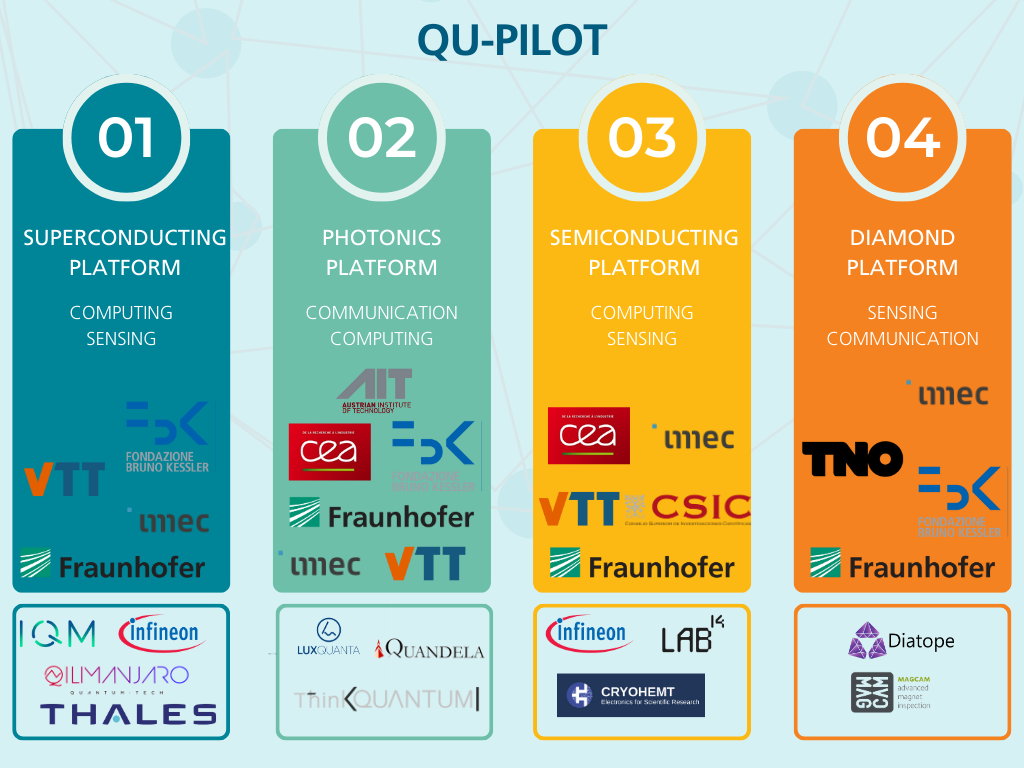
These federated pilot lines will focus on four technology platforms: superconducting, photonics, semiconducting, and diamond technologies, enabling applications in quantum computing, communication, and sensing.
The technology platforms within Qu-Pilot and the main application areas where they’re currently used in. Credit: Qu-Pilot
Qu-Pilot consists of 21 partners from nine different countries, including the Netherlands Organisation for Applied Scientific Research (TNO), Belgium’s Interuniversity Microelectronics Centre (IMEC), and Fraunhofer Society in Germany. The project started this month and will run for 3.5 years.
Alongside the Quantum Technologies Flagship, the newly-launched Qu-Pilot is part of the EU’s strategic plan to boost quantum development in the bloc, convert research into commercial applications, and secure its technological sovereignty in the field.
Get the TNW newsletter
Get the most important tech news in your inbox each week.
Ioanna is a writer at TNW. She covers the full spectrum of the European tech ecosystem, with a particular interest in startups, sustainabili Ioanna is a writer at TNW. She covers the full spectrum of the European tech ecosystem, with a particular interest in startups, sustainability, green tech, AI, and EU policy. With a background in the humanities, she has a soft spot for social impact-enabling technologies.
Following its European expansion in Dublin, London, and Berlin in the past few years, Reddit is now opening its first regional sales hub in Amsterdam.
Centrally located in the wider European market, adjacent to countries with a strong customer base such as Germany and France, and breeding a competitive talent pool, the Dutch capital emerged as the perfect location to further drive the growth the US-based company has seen in Western Europe.
The hub’s mission is to bring together the platform’s EMEA markets in a central location and support a wide array of customers spread across Europe in meeting their advertising goals. It will house over 50 employees in sales and engineering, and serve as the home base for the EMEA Ads Engineering team as well.
According to Susanne Mostertman, EMEA Head of Mid-Market and Small Business (SMB) Sales, who will be leading the hub, the company plans to significantly growth both the sales and engineering teams by the end of 2023, and Amsterdam will be Reddit’s largest office in continental Europe by employee number.
“We know from our research that Reddit users in Europe are open to seeing ads or content from brands on the platform, and are more likely to trust a brand that participates on Reddit than brands they see advertising on other platforms,” Mosterstman told TNW. “By expanding our footprint in Amsterdam — and Europe more broadly — we’re able to better connect Reddit’s audience with brands they’re interested in and care about.”
This new chapter of Reddit in Europe, Mostertman added, enables the platform to focus on the teams and resources that can best attend to its advertisers in the region “with local and country-specific experts ready to provide tailored guidance.”
These efforts will not only support large advertisers such as Google, Warner Bros., and reMarkable, but European startups as well. The Amsterdam hub is already working together with a number of existing partners, including payment provider Klarna and refurbished device marketplace Back Market.
“Partnering with Reddit has allowed us to reach out to a wide variety of communities — from tech to fashion and everything in between — to encourage responsible shopping at the right time,” said Salah Said, Head of Sustainability at Klarna.
Reddit’s new European office will located in Amsterdam’s Plantage neighbourhood in the city centre. Hiring is still ongoing and the company plans to host a recruiting event later this spring.
Get the TNW newsletter
Get the most important tech news in your inbox each week.
ChatGPT has had anything but a triumphant welcome tour around Europe. Following grumbling regulators in Italy and the European Parliament, the turn has come for German trade unions to express their concerns over potential copyright infringement.
No less than 42 trade organisations representing over 140,000 of the country’s authors and performers have signed a letter urging the EU to impose strict rules for the AI’s use of copyrighted material.
As reported first by Reuters, the letter, which underlined increasing concerns about copyright and privacy issues stemming from the material used to train the large language model (LLM), stated,
“The unauthorised usage of protected training material, its non-transparent processing, and the foreseeable substitution of the sources by the output of generative AI raise fundamental questions of accountability, liability and remuneration, which need to be addressed before irreversible harm occurs.”
Signatories include major German trade unions Verdi and DGB, as well as other associations for photographers, designers, journalists and illustrators. The letter’s authors further added that,
“Generative AI needs to be at the centre of any meaningful AI market regulation.”
ChatGPT is not the only target of copyright contention. In January, visual media company Getty Images filed a copyright claim against Stability AI. According to the lawsuit, the image making tool developer allegedly copied over 12 million photos, captions, and metadata without permission.
LLM training offers diminishing returns
The arrival of OpenAI’s ChatGPT has sparked a flurry of concerns. Thus far, these have covered everything from aggressive development due to a commercially motivated AI “arms race,” to matters of privacy, data protection and copyright. The latest model, GPT-4, was trained using over a trillion words.
Meanwhile, one of the originators of the controversy, the company’s CEO Sam Altman, stated last week that the amplified machine learning strategy behind ChatGPT has run its course. Indeed, OpenAI forecasts diminishing returns on scaling up model size. The company trained its latest model, GPT-4, using over a trillion words at the cost of about $100 million.
At the same time, the EU’s Artificial Intelligence Act is nearing its home stretch. While it may well set a global regulatory standard, the question is how well it will be able to adapt as developers find other new and innovative ways of making algorithms more efficient.
Get the TNW newsletter
Get the most important tech news in your inbox each week.
True crime has become a national pastime. From documentaries and dramatized biopics to endless podcasts and YouTube channels, folks can’t get enough of diving into real-life murders and missing person cases – some solved, some apparently never to be solved. And now, you can explore a new file of cases in augmented reality with CrimeTrip.
Taking a CrimeTrip
CrimeTrip is a true crime AR game for iOS and Android from developer studio Prologue. The experience, viewed and navigated entirely through a mobile phone, puts you in the middle of painstakingly reproduced crime scenes from six unsolved crimes from the seventies and eighties including heists, mob hits, and more. Three are available now, with three coming soon.
The app download is free, but, after playing through a free “prologue” and tutorial, you have the option to buy an individual story for $3.99, or bundles of stories going up to the complete game for $12.99. According to the app, this allows the platform to be supported entirely ad-free.
Hands-On the Game
If you have enough open space, you can navigate within the game by walking to some degree. However, the game worlds are big enough that no matter how big and clean your living room is you’ll have to use the on-screen controls eventually. (My biggest issue with the game was accidentally holding my phone in a way that covered the camera and lost my tracking.)
CrimeTrip is split between crime scenes and a pretty expansive police department office. The office includes resources that you will need to dive into the case, including the cork board where you put it all together.
“[CrimeTrip] revisits the podcast genre, following non-linear routes, constantly shifting between the present and the past,” Prologue founder and creative director Jonathan Rouxel said in a Medium post. “Designers elevate the status of the audience who is no longer perceived as a community of passive listeners but as active participants.”
On-screen controls don’t do all the work. Sometimes the best way to view a scene or the only way to find an item is by physically getting on your hands and knees. A good portion of the game might be “played” on the various online communities as you compare notes with other true crime enthusiasts.
While scenes and clues are accurately created with great detail, the characters and events in the stories appear as luminous point clouds – so there’s no unsettling blood and gore to deal with. The cheeky, fourth-wall-breaking game narration should be amusing to true crime enthusiasts and not too stressful for people new to the genre.
A Careful Handling of a Touchy Subject
True crime is a sensitive subject – and people can be very sensitive to it. Stories can be emotionally challenging to hear and research, and living people are sometimes affected by true crime commentators jumping on a story still in development. CrimeTrip avoids both of these problems in two important ways.
First, the graphical style and the narration style of the game keep things from being too heavy. We saw a similar approach with USA Today’s Accused experience last year. Second, the cases in this experience are old enough that all of the suspects have passed away so players can enjoy the puzzling stories without stressing the impact on survivors too much.
The fact that the cases are so old and so cold helps add allure to the game as well. There are no bad guys left to catch so it’s okay that even AR-enabled sleuths aren’t able to conclusively agree on whodunit. In ongoing cases, it would be great if the culprit could be caught and taken off the streets. But these forty and fifty-year-old tales can remain unfinished puzzles forever.
Check it Out if You Dare
So, is CrimeTrip worth your money? Check it out. The free app includes free previews to all available episodes – and that’s not just gameplay videos, you get to play the game. Still not sure? You can buy the cases one at a time. So, if you’re even remotely interested in true crime, it can’t hurt to check out.
Thomas is a senior reporter at TNW. He covers European tech, with a focus on deeptech, startups, and government policy. Thomas is a senior reporter at TNW. He covers European tech, with a focus on deeptech, startups, and government policy.
It’s been a tough start to the year for tech investments. According to a new report, European VC fundraising is on pace for its lowest annual total since 2015.
Research by PitchBook, a financial data firm, found that European VC funds raised over €20bn in each of the past four years — but only €3.4bn in Q1 2023. Total VC deal value fell 32% quarter-over-quarter (QoQ) to €11.8bn. Deal count, meanwhile, dropped 19%.
Pitchbook called the quarter “the first substantial decline” from the pace set in the past four years.
“The VC ecosystem could finally be displaying the effects of the challenging fundraising conditions,” the study authors wrote. “Capital investment into startups has slowed, and if muted exits markets persist, returns will be stifled and long-term capital commitments could be harmed.”
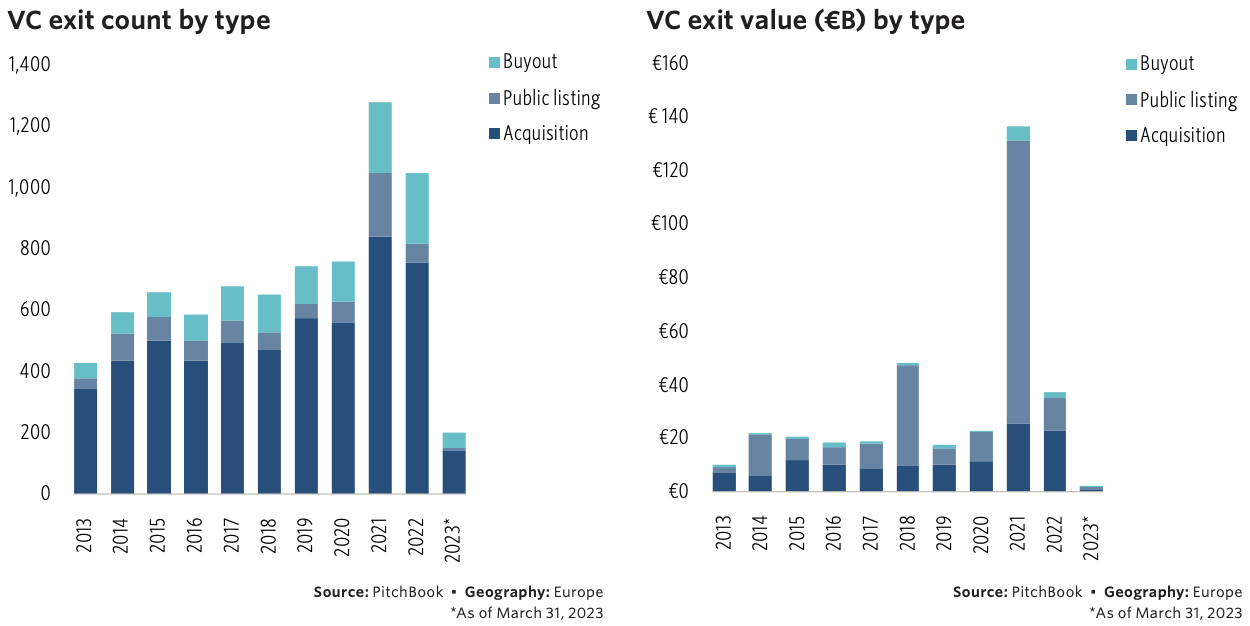
The analysts found that exit activity had also plummeted. Amid adverse macroeconomic conditions and weaker valuations, substantial VC exits effectively ceased in Q1. Pitchbook expects the activity to remain quiet for the next few quarters.
In Q1, the preferred route to exit was via mergers and acquisitions (M&A). Four out of the five largest exits in the quarter were through M&A. Such exits tend to be smaller, but they offer increased security and synergies — which can be crucial for startups facing economic uncertainty.
Public listings, meanwhile, have lost appeal due to the dangers of choppy markets. According to Pitchbook, they’re unlikely to pick up until inflation cools, interest rate hikes cease, and business confidence re-emerges.
In Q1 2023, European VC activity generated only €1.6 billion in exit value — a 69.6% QoQ decline.
Pitchbook’s report echoes the findings of other analysts. According to research by Dealroom, just over 2,300 European funding rounds closed in Q1 2023 — the lowest number since 2016.
The decline comes amid concerns over high inflation, monetary policy tightening, and the stability of the financial system. In these challenging economic times, investors and operators are prioritising capital efficiency and robust paths to profitability.
With focuses shifting from growth to cost bases, layoffs became extensive in Q1. Pitchbook expects this trend to continue as companies seek to extend runways during 2023.
Despite the gloom, there are signs of hope in emerging areas of tech. Notably, Europe surpassed the US in private spacetech investment during Q1, while quantum computing raised a continental record $220m, according to Dealroom.
Pitchbook is also confident about the prospects for the resurgent energy sector. Near-term interest and long-term climate targets in Europe are creating new opportunities for backers and startups in the industry.
“We believe deal activity in the clean energy subsector will continue to grow as renewable energy sources are developed globally,” said Pitchbook’s analysts.
Get the TNW newsletter
Get the most important tech news in your inbox each week.
Not too far in the future, camper lovers could be going on holidays that are much kinder to the very nature they are looking to enjoy. At the beginning of this week, London and Vancouver-based startup First Hydrogen revealed the design for its next-generation zero-emission Recreational Vehicle (RV).
The concept has been developed in collaboration with Switzerland-headquartered EDAG Group. Its introduction follows the presentation of First Hydrogen’s next-generation light commercial vehicle (LCV), also a result of a partnership with the global mobility expert.
The company states that the first generation of its fuel cell electric vehicles (FCEV) have already entered road trials with members of the UK Aggregated Hydrogen Freight Consortium (AHFC), starting with fleet management company Rivus.
They will be tested for several different use cases, including delivery of groceries and parcels, health care and roadside assistance. First Hydrogen will then use data and feedback from the road trials to inform the development of its Generation II vehicle.
Hydrogen fuel cells superior to battery EVs?
The <3 of EU tech
The latest rumblings from the EU tech scene, a story from our wise ol’ founder Boris, and some questionable AI art. It’s free, every week, in your inbox. Sign up now!
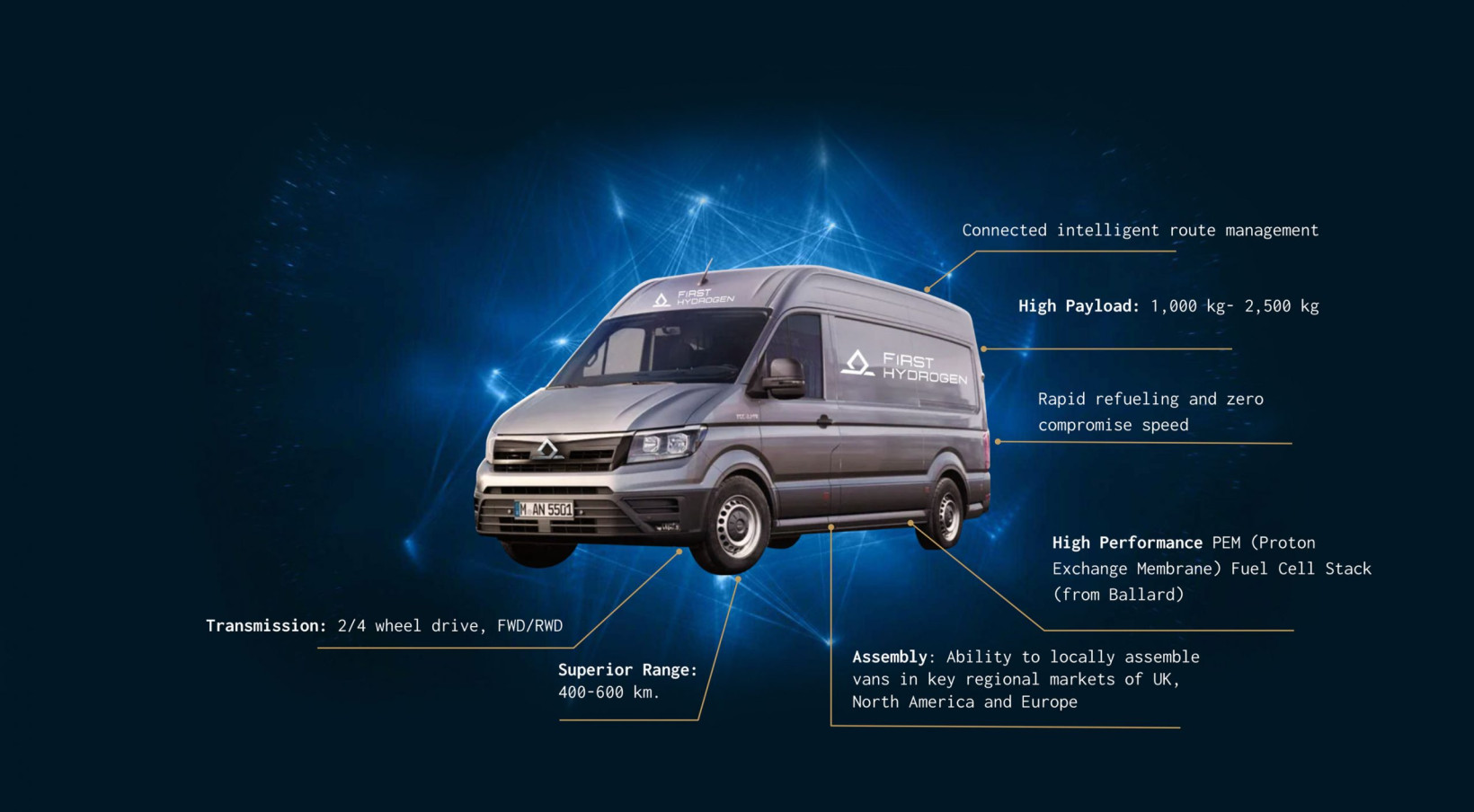
First Hydrogen’s vehicles are powered by high performance Proton Exchange Membrane (PEM) fuel cell stacks supplied by Ballard Power. This generates electricity by converting chemical energy stored in hydrogen fuel into electrical energy, using a proton-conducting polymer membrane as the electrolyte. They operate at relatively low temperatures (50 to 100 °C) and can quickly vary output to meet shifting demand, which makes them a good fuel cell choice for the automotive industry.
The company says this gives it a leg up on regular EVs as the hydrogen FCEV can carry heavier payloads. Furthermore, it takes much less time to refuel the hydrogen than it takes to recharge an electrical battery. The next-generation LCV range is projected at 500+ km.
“These concept vehicles provide a glimpse of our company’s future and give a clear indication of our brand direction within the LCV space,” said Steve Gill, CEO of Automotive for First Hydrogen.
First Hydrogen’s next-generation fuel cell LCV will be informed by data from Generation I vehicles currently in road trials. Credit: First Hydrogen
While the quest to decarbonise road transport is admirable in and of itself, there is also a solid financial foundation for the product: the global LCV market is projected to reach €686 billion by 2030. For the RV market, the corresponding prediction for the end of the decade is just under €107 billion.
In Europe, RV sales hit an all-time high in 2021 with 260,000 new vehicles sold, very likely spurred by restrictions following the global health crisis. Here, First Hydrogen identifies particular opportunities with an often eco-conscious campervan crowd.
“The First Hydrogen campervan is an example of how we see hydrogen fuel cell and other electric vehicle technologies having wider applications,” Gill added.
Looking to increase green hydrogen production
As with most startups working with hydrogen, First Hydrogen has to ensure that there will be enough to supply its products. No one will purchase a vehicle that cannot be powered after all, no matter how zero-emission it may be.
Furthermore, the hydrogen needs to be green, meaning produced using renewable energy, otherwise the eco-friendly concept goes out the window. In summer last year, First Hydrogen applied for funding from the UK Government’s £240 million (€272 million) Net-Zero Hydrogen Fund (NZHF).
The company’s two green hydrogen production projects will have an initial capacity of 40MW each and be situated in the Greater Manchester area and the Thames Estuary. The second round of NZHF competition is currently underway for both development and capital expenditure.
Get the TNW newsletter
Get the most important tech news in your inbox each week.
Thomas is a senior reporter at TNW. He covers European tech, with a focus on deeptech, startups, and government policy. Thomas is a senior reporter at TNW. He covers European tech, with a focus on deeptech, startups, and government policy.
The UK has been told it won’t have to pay for the two years it had been out of the EU’s Horizon research programme — removing a big barrier to rejoining the €95.5bn scheme.
Britain had been locked out of Horizon because of a post-Brexit dispute over trade in Northern Ireland. The recent Windsor Framework deal had opened the door to reentry, but talks have stalled over the financial terms.
The British government argues that its contributions to the seven-year innovation scheme should be cut, because its late entry has reduced the potential returns.
A key concern involved the payments for 2021 and 2022, when the UK was blocked from Horizon. Officials were reportedly concerned that Britain would still have to pay for those two years. According to the European Commission, that will not be the case.
The <3 of EU tech
The latest rumblings from the EU tech scene, a story from our wise ol’ founder Boris, and some questionable AI art. It’s free, every week, in your inbox. Sign up now!
“We are not being unreasonable. We are not asking them to pay for the years they were not associated,” an EU official told the Guardian.
“We are ready to work on it very quickly. But there is still that doubt about the willingness of the UK to take part.”
More at stake than money
Despite the EU’s officials, there may be further roadblocks ahead. Prime Minister Rishi Sunak is said to be “sceptical” about Horizon’s value. The British government has also unveiled a backup R&D funding scheme, which will be activated if negotiations to rejoin the EU programme fall apart.
However, among UK scientists and technologists, support for rejoining Horizon is widespread. In addition to €95.5bn funding pot, they point to the benefits of international collaboration, common rules, and established research cycles.
“The government must also remember there is more at stake here than money,” Tony McBride, Director of Policy and Public Affairs at the Institute of Physics, said last week.
“Should it be needed, any alternative to Horizon must also make up for the loss of the established networks, partnerships, and infrastructure the UK has benefitted from over many, many years, as well as for the disruption and uncertainty caused by these years of delay.”
Get the TNW newsletter
Get the most important tech news in your inbox each week.
When Russia invaded Ukraine in February last year, work stopped at thousands of Ukrainian businesses – including carbon capture-focused startup Carbominer.
As tanks approached the capital Kyiv, inhabitants of the city, including employees of the company, were forced to flee for their own safety.
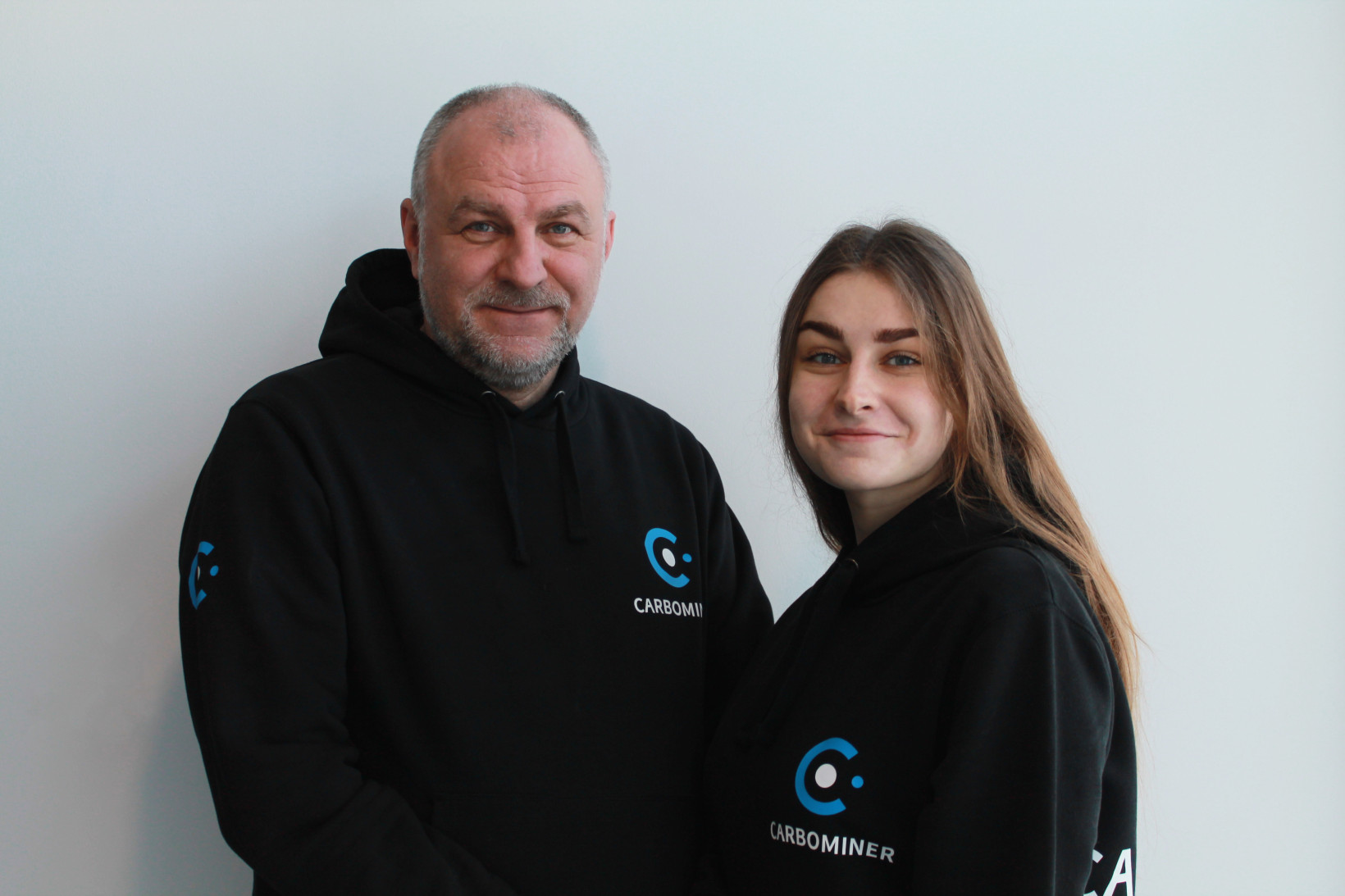
Among them was Viktoria Oseyko, chief marketing officer, and her father Nick, founder and chief executive officer of Carbominer. But Ukraine soon retook control of the area.
“When the Russian forces were kicked out of the Kyiv region, it was like three or four weeks and the managing team decided to get back,” explains Oseyko.
Nick and Victoria Oseyko. Credit: Carbominer
The <3 of EU tech
The latest rumblings from the EU tech scene, a story from our wise ol’ founder Boris, and some questionable AI art. It’s free, every week, in your inbox. Sign up now!
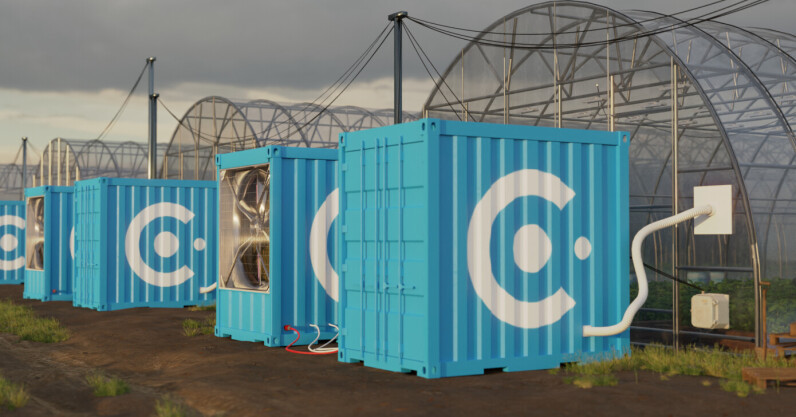
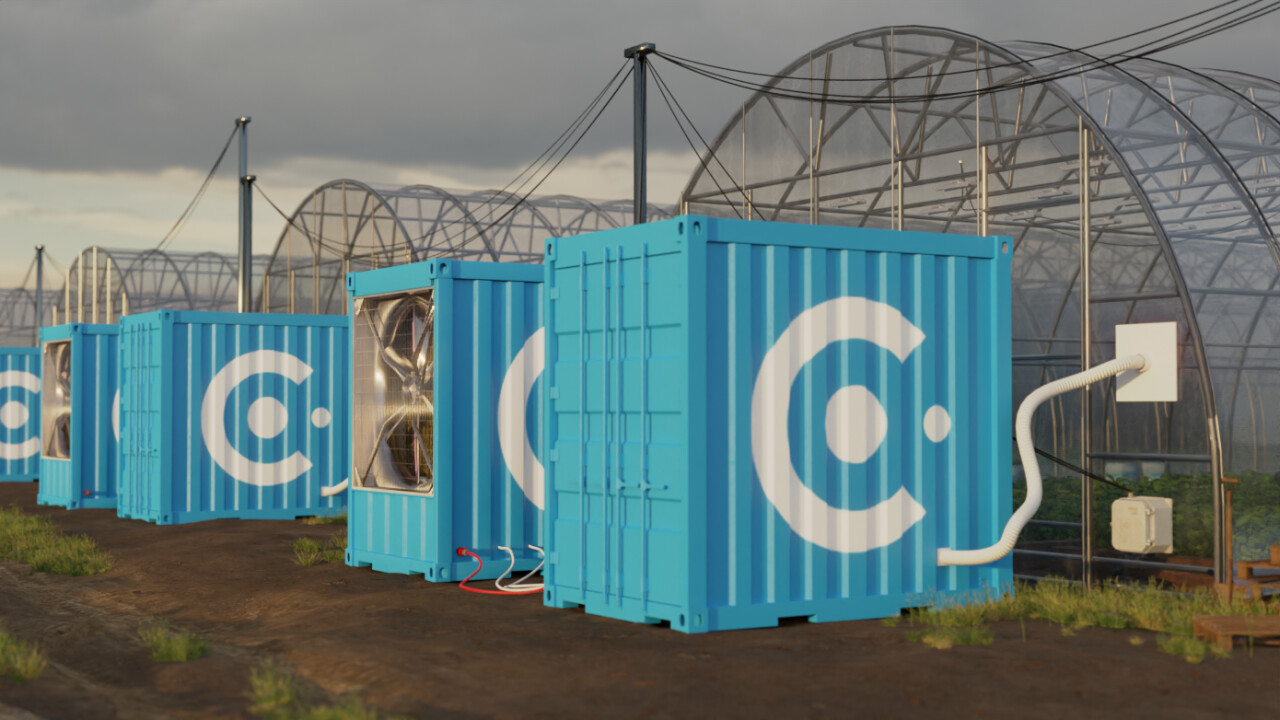
She and her colleagues have since completed a pilot trial of their machine that can capture CO₂ from the air so that it can be piped into greenhouses. This heightens plant photosynthesis, which helps farmers grow crops.
Carbon capture could prove essential component to halt pipeline warming
Carbominer is just one among many eclectic startups in Europe racing to develop technology that can capture carbon dioxide, a greenhouse gas that accounts for66% of global warming.
Although reducing emissions is generally viewed as the key to tackling climate change, the UN, in a report published last month, highlighted that CO₂ removal might be necessary if the world is to achieve net zero emissions and limit warming to 1.5˚C above pre-industrial levels. This is due to what is called committed warming – the future warming in the pipeline as a result of the greenhouse gases we have already emitted.
It takes time for a shift in energy balance to show up. This means that even if we were to stop emitting CO₂ and methane – the leading contributors to climate change – tomorrow, global temperatures would still keep rising as the gases linger in the atmosphere.
New EU location to circumvent geopolitical challenges
The machines designed by the 10-strong team at Carbominer are still in development but Oseyko says that, by the end of the year, they hope to have a device that can capture 46 tonnes of CO₂ annually.
This is fairly small-scale but the firm, which has raised $900,000 (€822,000) in funding to date, hopes that it will be able to provide captured CO₂ to agricultural customers at a relatively low cost.
“We are going to place the machine on site and then bill per usage of CO₂,” explains Oseyko.
The team at Carbominer aims for their machine to capture 46 tonnes of CO₂ per year. Credit: Carbominer
She adds that among the challenges faced by Carbominer, and many other Ukrainian companies, is the difficulty of importing materials into the country at present. And the fact that, under martial law, male members of staffcannot currently leave Ukraine, which makes engaging with the industry and visiting potential clients difficult. To mitigate this, the firm plans to open an office in neighbouring Poland this year, where Oseyko will be based.
Carbominer’s device consists of two linked machines. One has a large fan that draws air towards a sorbent, which captures the CO₂, and the other machine uses electrochemistry to release the CO₂ again when needed.
But one of the key difficulties with direct air capture systems is the need to move air around in order to get at the CO₂ within it – this requires energy. Oseyko says that, when fossil fuel-based electricity is used to power Carbominer’s system, it stops being carbon negative — but the firm intends to use renewable energy only.
Hitching a ride on existing air flow
In Finland, the team at Soletair Power has been thinking about how to get around the energy consumption issue.
“You need to move quite a lot of air in order to capture the CO₂. In buildings, that air is already moving,” says chief executive officer Petri Laakso.
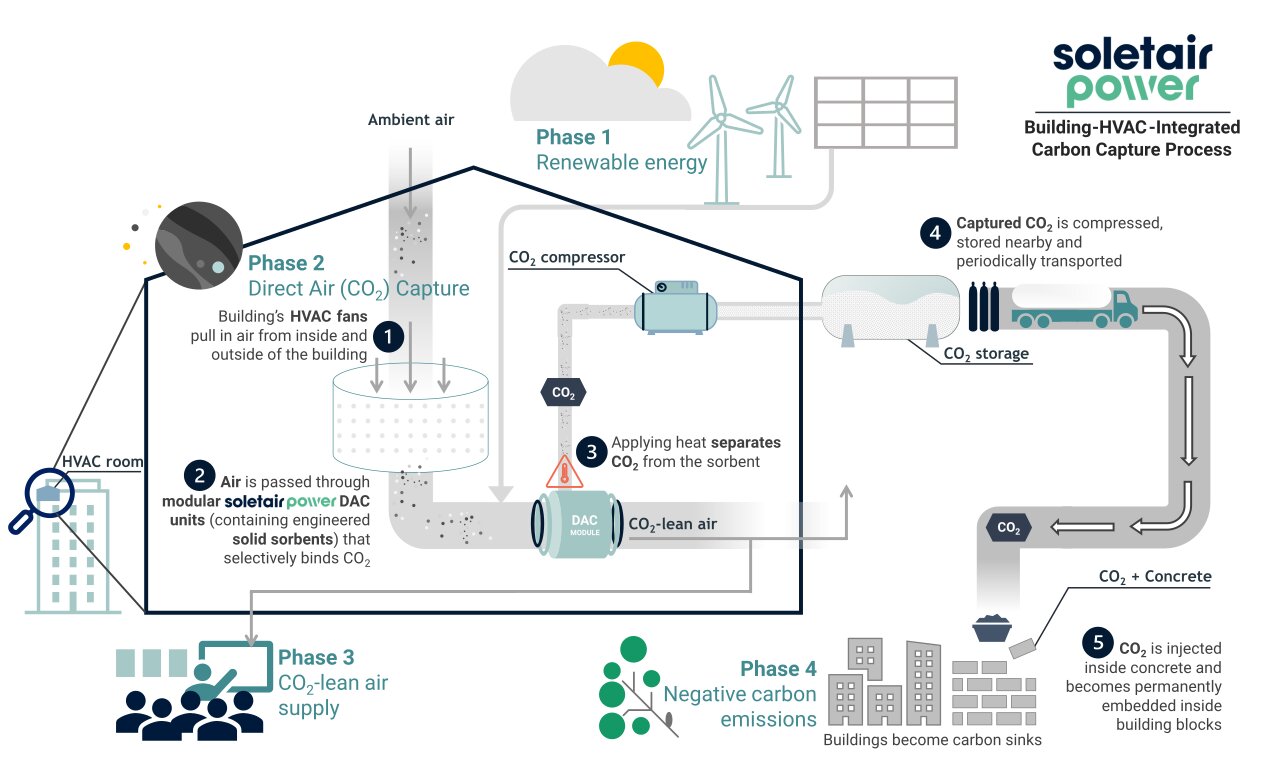
Soletair Power’s carbon capture tech essentially piggybacks on existing ventilation systems in buildings, which transport indoor air – rich in CO₂ breathed out by occupants. The firm has 10 employees and has received €1.5 million in funding to date, besides an undisclosed amount in grants.
The amount of CO₂ captured depends on various factors including the volume of air moved in each case but Laakso says systems already installed by the firm capture on the order of tens of kilos of CO₂ per day.
Will net-zero plans drive deployment?
Again, industry values the captured CO₂. Soletair Powerhas installed its technology in an office in the city of Vaasa, Finland, where the trapped CO₂ is eventually used in the manufacture of concrete so that it can be embedded permanently in building blocks.
“This is a valid technology,” says Dawid Hanak at Cranfield University. “It’s just how much you can capture and how scalable that is.”
Credit: Soletair Power
Laakso says his firm has already installed systems in Finland and Germany and will install another this summer. While individual deployments will not capture enormous amounts of CO₂, he adds, hundreds or thousands of buildings might eventually use the tech, vastly increasing its impact.
“There are many real estate companies promising that they will be carbon net zero by 2028 and they are turning to us,” says Laakso.
The cost? It varies depending on the installation but currently a large system can remove CO₂ for about €500 to €1,000 per tonne. Many firms are hoping to slash the cost of removal to $100 (€91) per tonne or below, eventually, so that CO₂ capture becomes affordable at the scales required to reach net zero.
Competitive advantage despite efficiency concerns
Carbon capture tech has its pros and cons. Stuart Haszeldine at the University of Edinburgh notes that there are easier methods of reducing humanity’s climate impact.
“The simplest way of addressing the climate issue is actually to become more efficient and get more value out of the same energy,” he says. Insulate buildings, for instance, so they require less energy to heat.
However, reducing one’s carbon footprint will become increasingly attractive commercially, argues Haszeldine as he suggests that firms able to lower their overall CO₂ output will have an advantage in terms of revenue and perception.
Plus, direct air capture helps to address CO₂ emitters that are spread over large areas and therefore hard to control, such as farming. If you can’t catch the CO₂ reliably at source, at least you can pull it out of the atmosphere later.
Using existing farming techniques to store carbon for millenia
Even some difficult-to-decarbonise industries could soon play a bigger role in seizing CO₂. In Ireland, a startup called Silicate has come up with a way of treating agricultural land so that it draws carbon out of the air and into the ground where a chemical reaction takes place, locking it down.
Silicate currently employs ten people and has not yet raised funding other than via grants, including $100,000 (€91,000) as a winner of the Thrive / Shell Climate-Smart Agriculture Challenge.
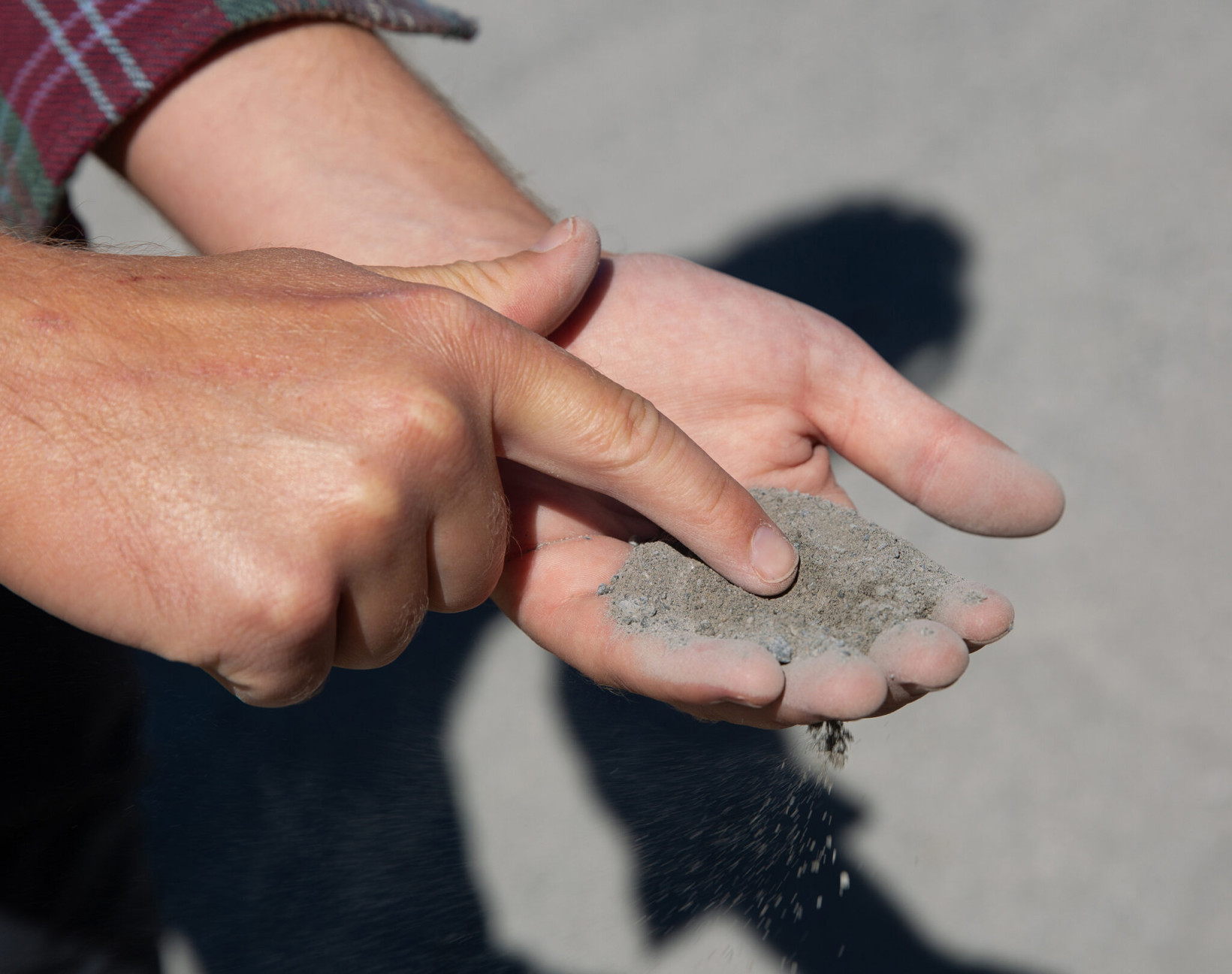
Surplus concrete is ground to dust before applying it to farmland. Credit: Silicate Carbon
Maurice Bryson, founder, explains that the process relies on unwanted or waste concrete, which can be crushed into a powdery material – “like a fine snowdust”, he says. By spreading this over a field, say every four years, farmers can maintain a high (more alkaline) soil pH, which is better for growing crops.
Farmers already de-acidify their soil usinga technique called liming but the difference with Silicate’s approach is that the concrete reacts withcarbonic acid in the soil, removing CO₂ from the air. The substances formed by this process, bicarbonate and calcite, ought to store carbon for many thousands of years.
Reduced costs with increased investment?
The firm aims to achieve removal rates of two tonnes of CO₂ per hectare, per 10 tonnes of crushed concrete applied to such an area – during the course of one year.
“The process is very passive, once you apply it to the field it gets to work itself,” says Bryson. “A key win, we think, for us is there is a possibility for the cost to fall below that $100 per tonne [of CO₂] price point.”
While direct air carbon capture technology is still in its infancy, investment in carbon capture and storage more than doubled over the past year, reaching an all time high of nearly €6 billion in 2022. With so many startups ploughing this field, and rising urgency over reaching net zero globally, these technologies will likely have a noticeably bigger role to play in the coming years.
Get the TNW newsletter
Get the most important tech news in your inbox each week.
Virbela has grown a lot over time but they’ve had the same avatar system for nearly a decade. If you open the app today, you’ll see a whole new avatar system. As impressive as it is, it might still have some growing to do.
Long in the Making
Virbela is a platform for remote work, education, and events. The platform consists of an open campus that anyone can download and use for free, and private campuses co-created with clients.
There was nothing wrong with the old campus, but it got a whole lot of new features as well as a beautiful graphics upgrade showcased at the Hands In Enterprise Metaverse Summit last year. An upcoming avatar system was teased at the summit, but no release date was given.
“Avatars are important to the virtual experience because they add fidelity to the world,” Virbela Art Team Manager Nicole Galinato said at the event. “Our users love the playfulness of the current avatars, but they want more features that they can identify with.”
Since the summit, the old avatars roamed the new world. It wasn’t a glaring mismatch, but the avatars were definitely from a different generation. The new avatars certainly fit into the graphically updated virtual world a lot better.
Old avatar (left) vs new avatar (right)
The New You for the New Virbela
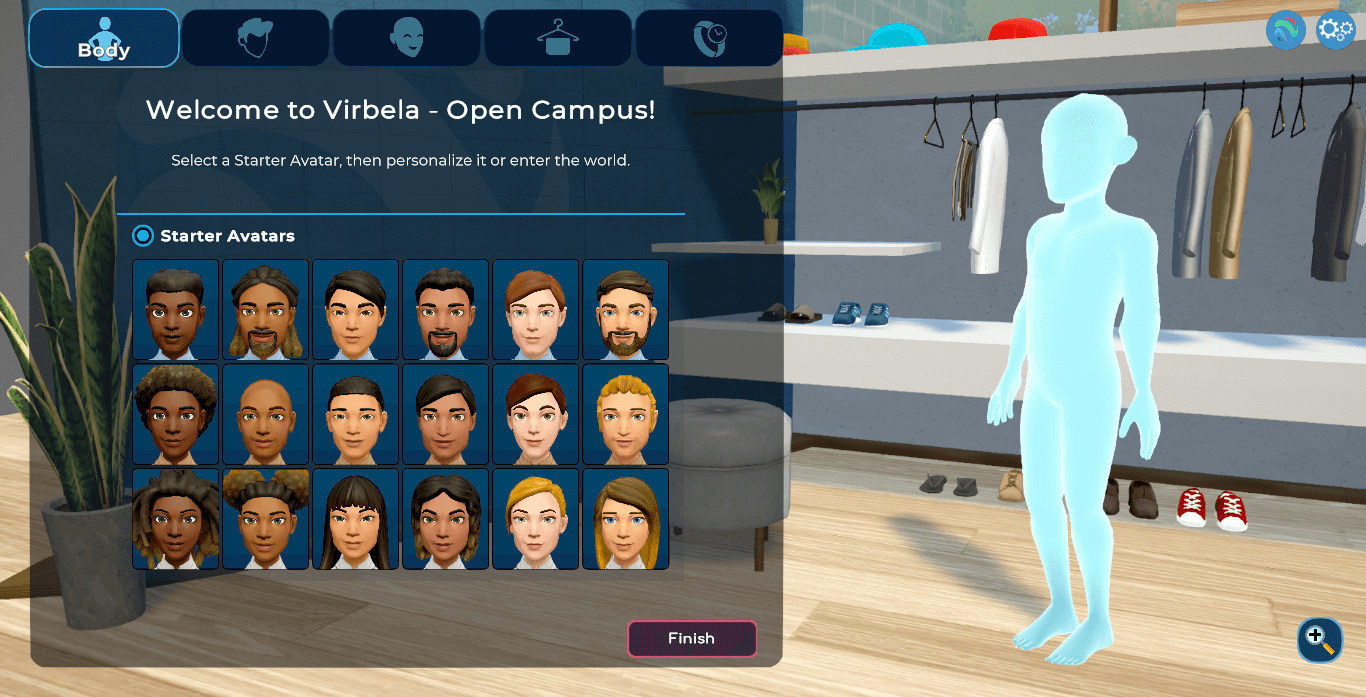
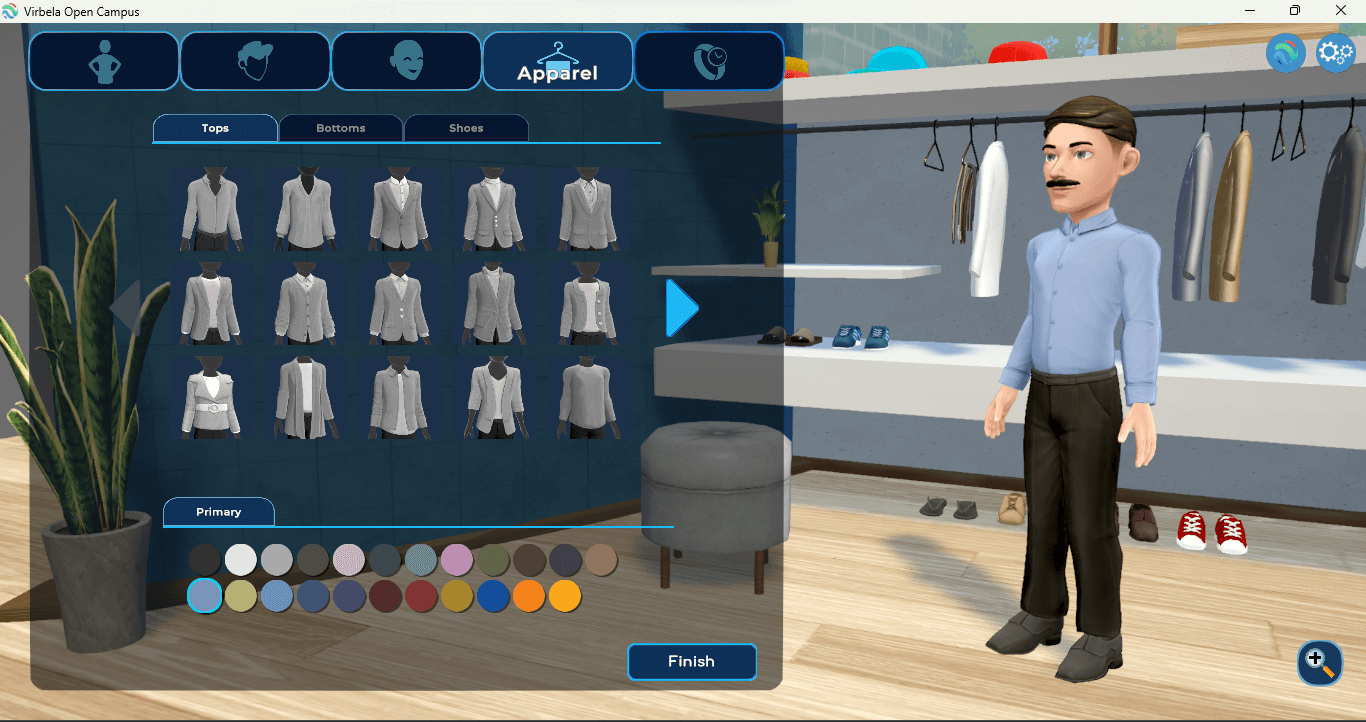
The next time that you boot up Virbela, whether you’re a first-time user or just returning after a while, you will be greeted by the first page of the new avatar generator. Just like with the old system, you can join immediately with a default avatar and personalize it later if you want. If you’re not in that much of a hurry, you have a lot of playing to do.
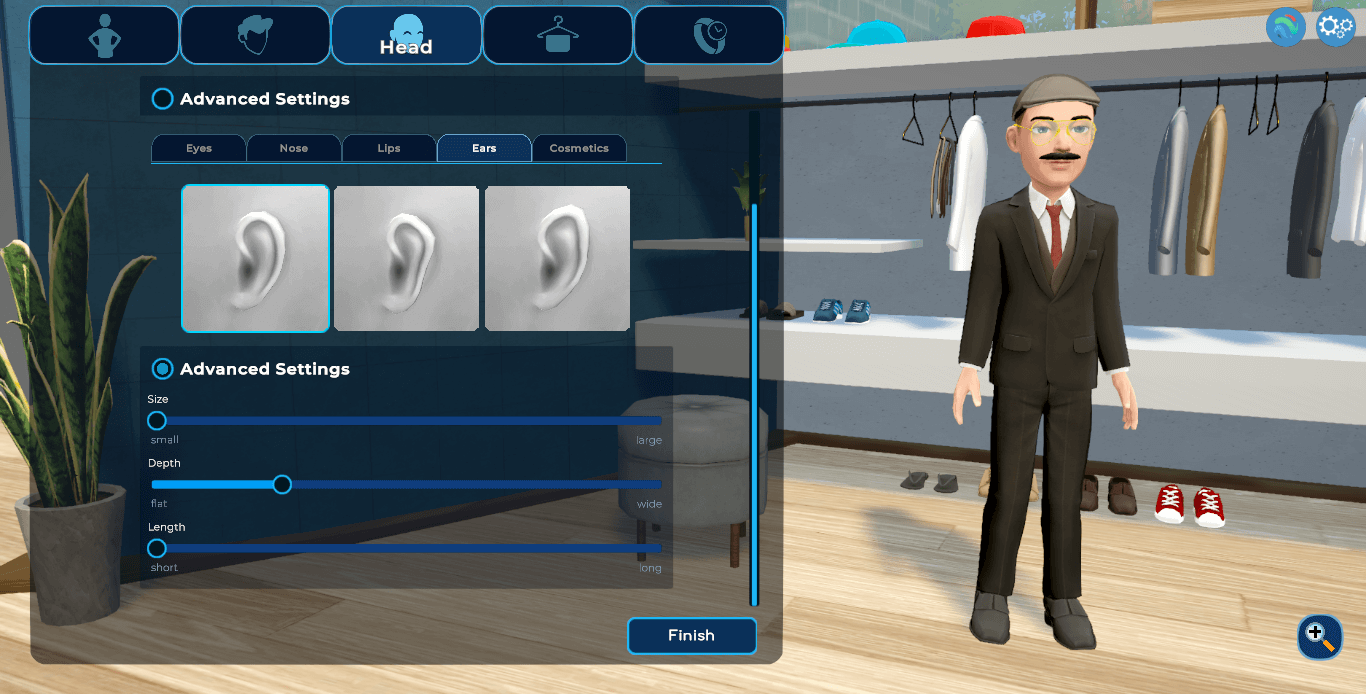
You select one of three “body types” rather than gender, so all clothing and cosmetic options are open to all users. There’s also a custom gradient for specific skin tones and a number of features have an “advanced settings” button that opens up menus of highly customizable sliders. The update also brings several more hair and facial hair options.
“What really pushed us to create this new avatar system was more about this idea of inclusion and equity,” Virbela co-founder and President Alex Howland told me on the XR Talks podcast. “We are working with a very global population of users and we know the importance of the avatar for people to express themselves and explore their identity through their avatar.”
The update also brings new clothing options and customizations. Many outfits consist of a “top” and a “bottom,” with the top consisting of several layers each with their own color combinations, similar to the system that AltspaceVR used (RIP Altspace). I went with the three-piece suite, which means color options for the jacket, vest, and shirt. (Neckties are under “Accessories”.)
“We also wanted much more variability in terms of the ability to customize the avatar because we sometimes have populations of many thousands in the same space and you’d find too many avatars that looked too similar to one another,” said Howland.
Even after you’ve toured your new avatar through the campus, you can change it at any time by selecting the gear icon in the upper right corner to open the settings dropdown menu and selecting the “change avatar” item at the top. And do keep checking back. According to Howland, more is coming.
“This is what I’ll call the [minimal viable product] of this new system. It’s a system that we can build upon and continue to add assets to, whether that be more hairstyles, more clothing options, more cultural garb, that folks can use over time – eventually leading to things like more facial expressions,” said Howland.
The Complete Package
To return to Galinato’s concept that the avatars contribute to the immersion of the world itself, the more detailed and more personal avatars do seem more at home in the more detailed and responsive Virbela campus. I haven’t yet had the opportunity to attend a large event with the new avatars, but I’m sure that they’ll be a lot more colorful now.
The European Commission has announced the results of the second round of Women TechEU — a programme designed to help women-founded deep tech startups scale.
The round, which has a budget of €10m, saw applications from 467 women-founded deep tech startups from across Europe, 134 of which have been selected to participate. It follows on from a successful pilot in 2021 which featured 50 startups.
The startups selected for the second round will now each receive an individual grant of€75,000. The female founders will also be offered mentoring and coaching under the European Innovation Council (EIC) Women Leadership Programme, and be afforded access to EU networking opportunities.
The startups operate in 16 different deep tech sectors, and have developed solutions ranging from new medical drugs and carbon capture technologies, to digital learning and autonomous robotics.
Among the participants is Sweden-based Norbite, which uses insects to recycle plastic waste, Netherlands-based Agurotech, which digitises farming using AI, and Lithuania-based Inobiostar, which has developed a waste paper-based material for removing oil spills.
The <3 of EU tech
The latest rumblings from the EU tech scene, a story from our wise ol’ founder Boris, and some questionable AI art. It’s free, every week, in your inbox. Sign up now!
“By combining innovative ideas, female entrepreneurship, and excellent research and development, this year’s companies selected for WomenTechEU will contribute to enhancing the quality of life for the citizens of the EU and beyond,” said the European Innovation Council.
Deep tech makes up over a quarter of Europe’s startup ecosystem, with European deep tech companies valued at a combined €700bn in 2021.
Yet women remain chronically underrepresented: last year only 3% of VC funding in European deep tech went to women-founded startups.
These inequities are prevalent across the industry, but magnified in the deep tech sector. Deep tech startups tend to have longer R&D cycles, and require higher capital outlay than traditional startups, which makes it even harder for women-led and women-founded teams to scale up.
This is not just bad practice, it’s also bad for business. According to consulting firm McKinsey, the European tech ecosystem will only be able to remain competitive if it manages to attract and retain more female talent.
And investors seem to agree: “Diversity of thought, opinion and creativity is essential for our deep tech ecosystem to thrive,” said Christina Franzeskides, deep tech investor at Lakestar, in the 2023 European Deep Tech Report.
“To that end, we must strive towards inclusivity, across all backgrounds and genders, for the space to reach its full potential,” she added.
The European Commission believes that giving women-founded startups the right support and investment early on can help bridge deep tech’s gender gap, and strengthen the ecosystem as a whole.
Get the TNW newsletter
Get the most important tech news in your inbox each week.
Martin Bryant is founder of Big Revolution, where he helps tech companies refine their proposition and positioning, and develops high-qualit Martin Bryant is founder of Big Revolution, where he helps tech companies refine their proposition and positioning, and develops high-quality, compelling content for them. He previously served in several roles at TNW, including Editor-in-Chief. He left the company in April 2016 for pastures new.
This story is syndicated from the premium edition of PreSeed Now, a newsletter that digs into the product, market, and founder story of UK-founded startups so you can understand how they fit into what’s happening in the wider world and startup ecosystem.
The burgeoning industry around space technology is based heavily on hardware, but the materials that hardware is built from need to undergo rigorous testing on Earth before they’re sent out into orbit and beyond.
Space DOTS is a startup that wants to transform material testing in the space industry by skipping the tests down here, and sending the materials straight up into space.
“What we do is a smartphone-sized version of a testing lab that anyone would use on ground to test materials’ properties before actually going into space. We have shrunk everything down so that it can be launched very quickly and easily at a lower cost, directly into orbit,” explains co-founder and CEO Bianca Cefalo.
“Instead of going through the entire process of iteration, failure, and iteration on the ground, you can just ‘fail fast, iterate’ faster, directly in space at a cost that is not going to break the bank of anybody doing so.”
The <3 of EU tech
The latest rumblings from the EU tech scene, a story from our wise ol’ founder Boris, and some questionable AI art. It’s free, every week, in your inbox. Sign up now!
Space DOTS co-founder and CEO, Bianca Cefalo
Cefalo gives the example of graphene, the light, strong, and thin material that has excited a lot of people since it was first discovered in Manchester 20 years ago. Before it could be used in, for example, the panels of a spacecraft, you would need to understand its properties (for example its reaction to heat) and how they perform in space.
She explains that this tends to be done first via simulation software, and then in labs that simulate the conditions of space. These tests help to understand the material’s performance in a vacuum, in reaction to the radiation in space, and the like.
“All these different environmental conditions are all simulated on the ground, then you cross-correlate the results. And you have an estimated understanding of what’s going to happen to this material once it goes into space… However, the last mile of validation is to actually test it in space to see how it really behaves under real space conditions.”
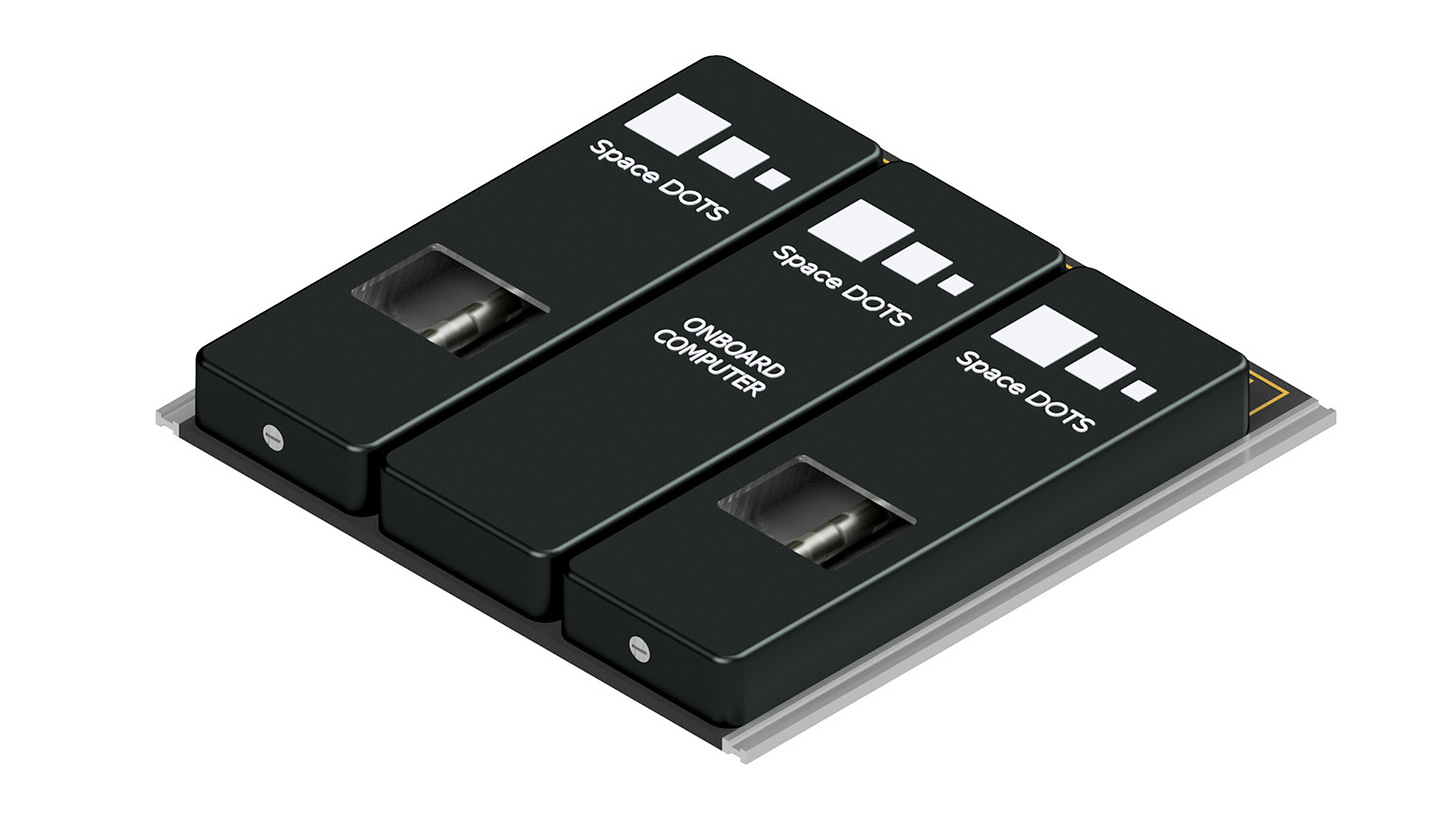
London-based Space DOTS wants to cut out all the ground-based estimations with the 10x10x1 centimeter laboratory it is developing, inside which tests can be conducted onboard spacecraft.
A render of the tiny Space DOTS laboratory
The first test the startup has developed is a tensile test, where a small sample of a material can be stressed to breaking point.
“That’s going to tell us what happened to it from a structural perspective in the exact environment, with the cumulative effects of the vacuum of space, radiation, the atomic oxygen, everything. That’s something that you wouldn’t get on Earth.”
Cefalo says the alternative on Earth would be to test each of these conditions separately in washing-machine sized tensile testing machines. But separate tests create a cumulative margin of error for how the material would really behave under all those conditions at once.
Cefalo is understandably guarded about the secret sauce behind exactly how they have minaturised a materials testing lab to such a small size.
“All I can say is it’s a mechanism that doesn’t use any gears, motors, or bearings, because they wouldn’t work in space, they would freeze. What we’re doing is just based on pure physics.”
Cefalo argues that the impact Space DOTS technology could have on the industry is huge, as it’d reduce the cost and time of certifying a material for use in space.
Whereas a traditional approach could cost millions of pounds and take years, Space DOTS hopes to charge much less, with the specific pricing depending on many variables. “And you know, certainly, how it’s going to work and you don’t have to repeat anything again on the ground because you’ve been to space, which is the ultimate validation.”
So that companies no longer have to get in line to eventually get a testing slot on the International Space Station, or shop around the difficult-to-penetrate space industry to find someone else willing to carry their experiment, Space DOTS plans to become a full service testing provider.
Cefalo says they are partnering with commercial space companies so anyone who needs a material tested in space can simply engage with Space DOTS and not have to worry about how the material actually gets up there and how it gets back.
“We take that load off the customer and we say ‘okay, tell us what do you need to do, tell us what kind of materials you want to test, what kind of orbital conditions or applications you have in mind. And we do everything for you, from mission requirements to sending it into space, and you don’t have to talk with anybody else.”
The plan is to allow customers to get into space “in a framework of months rather than years.”
And Cefalo hopes the Space DOTS approach can help the space industry catch up with progress in materials science. She says many newer materials aren’t covered by bodies such as NASA and the European Cooperation for Space Standardization (ECSS).
“You will find aluminium alloys, titanium, some plastics – a very basic database of materials. There are a whole lot of other materials and for those ones, there isn’t really a standardisation of how you should test them to be applied in space.
“Material sciences move very fast, and the space industry isn’t catching up quite as quickly as the material sciences moved. And we should be, because we think that space tech is sci-fi, but actually a Formula One car is more sci-fi than a spacecraft.”
The Space DOTS team. Photo provided by the startup
Cefalo grew up in Naples, Italy, where she studied aerospace engineering . She then interned with a German company where she assessed the impact of Martian dust devils on an instrument that was eventually sent to Mars.
From there she spent several years in Berlin as a thermal engineer in the space industry, before moving on to work for Airbus Defence and Space in the UK as a space systems thermal product manager.
“I had to look at methods, solutions, and materials that would make the next generation of telecommunication spacecraft lighter, more powerful, smaller, and cheaper,” she says.
But despite there being plenty of opportunity to use cutting-edge materials, customers baulked at the idea of being the first to use a material in their very expensive new spacecraft.
Cefalo and a colleague, James Sheppard-Alden, realised this was a common issue in the industry and identified ‘direct orbital qualification’ as a solution.
“As much as you wouldn’t test a rain jacket in the sun, you would not test materials for space on Earth. They need to be tested directly there.”
Cefalo saw this issue again in her next role with aerospace materials company Carbice, so she and Sheppard-Alden teamed up to address the problem. They founded Space DOTS in 2021.
They have signed up customers under memorandum of understanding agreements, as they work towards the target of initial commercialisation in 2025, following their first-in-orbit demonstration next year.
Cefalo says Space DOTS has been bootstrapped to date, with the exception of some financial support as part of the ESA Business Incubation Centre’s incubation programme.
The company is currently in the process of raising a £1.5 million pre-seed round.
Cefalo sees Space DOTS’ future as filling an essential gap to fulfil the space industry’s potential.
“If you’re thinking about where the space industry is going, it’s going well beyond spacecraft and rockets. It’s going to commercial space stations, it’s going to an ecosystem in space, habitats on other planets, manufacturing in space…”
She says this will require recycling debris from space, and even creating new materials or manufacturing from zero in space.
“The one thing that is missing at the moment is how to make sure that what’s being recycled in space or is being manufactured in space can be used in space without having a protocol or a quality control system in place. So far, nobody’s really thought about that.”
So Space DOTS aims to become the way materials are tested in orbit, on the Moon, on Mars, or beyond.
Aside from the obvious technical challenges of proving this thing works (yes, in-space testing needs in-space testing), Cefalo recognises the need to ensure the perceptions of what they’re doing are right.
“[We need to make sure] that what we’re doing is not seen as going against the status quo of qualification and testing in rounds.”
She doesn’t want Space DOTS to be seen as revolutionary.
“This creates a resistance with everything that has been done so far, especially when you go into the sales cycle. You may piss off people that think ‘oh, you’re coming in with this new technology with this new way of qualifying, or do you mean that everything I’ve done in my career so far is invalidated?’
“No. What we’re saying is that Space DOTS is just the organic evolution of where the industry is going and how we have to make sure to use the resources that we have, directly in space. We will never be the ones removing what has been done so far.
“The software simulation and the lab simulation will always need to happen. We want to facilitate the time to market of advanced materials by giving the extra mile of the validation in an easier, cheaper, and better way and making sure that these will be sustainable once an entire in-space ecosystem is built.”
“There are other companies who are doing very easy access to space high frequency testing, but they are focused on biotech, pharma, drugs, which is something that we don’t do because it’s that’s not our area of expertise, and it’s not something that we intend to do in the long term,” says Cefalo.
“So I think again, our main competitor is the status quo, which is how do we make sure that we are not going against them, but we’re actually helping them just as the next step of the evolution?”
The article you just read is from the premium edition of PreSeed Now. This is a newsletter that digs into the product, market, and story of startups that were founded in the UK. The goal is to help you understand how these businesses fit into what’s happening in the wider world and startup ecosystem.
Get the TNW newsletter
Get the most important tech news in your inbox each week.
Linda Rosencrance is a freelance writer/editor/author. She has written about information technology since 1999. She is also the author of s Linda Rosencrance is a freelance writer/editor/author. She has written about information technology since 1999. She is also the author of six true crime books.
The DMA also requires these online platforms to permit sideloading, i.e., letting users install software that they download from the Internet. These platforms have until 2024 to comply with the DMA.
Passed in 2022, the goal is to prevent dominance of so-called “gatekeepers” within the market and ensure a level playing field for all EU businesses.
In particular, EU regulators have been concerned about the advantage Apple currently has in the market as it doesn’t allow the use of third-party app stores on iOS devices, as such Apple sets the rules and prices for app developers who want to reach its users (currently they have 34% of market share in Europe). In the past, developers who violated these rules have been banned from the App Store.
The <3 of EU tech
The latest rumblings from the EU tech scene, a story from our wise ol’ founder Boris, and some questionable AI art. It’s free, every week, in your inbox. Sign up now!
While the consensus is that this provision of the law is good for users and even Apple, it’s unclear how the regulation will affect application developers.
The question is what do app developers think about these new regulations? Will they actually be beneficial to EU based developers and what will be the short and long term impact on the EU’s app market? We spoke with a few to find out.
More opportunities to innovate
Strict rules can be a barrier to innovation and not getting accepted into the Apple App Store can break a business, said Markus Müller-Simhofer, CEO of IdeasonCanvas, creator of MindNode, a visual brainstorming and mind mapping app.
“So developers are cautious and avoid crossing the lines defined by the App Store rules,” he said. “[Consequently], many interesting new features or apps will never get developed.”
Max Seelemann, co-founder and executive director at Ulysses, a writing app for Mac, iPad, and iPhone, agreed that Apple does impose a lot of rules on developers — rules that developers may be tempted to break. However, doing so could get them expelled from the App Store.
For example, in August 2020, Apple removed Epic Games’ Fortnite from its App Store because the developer tried to get around paying Apple’s 30% commission on in-app purchases.
How regulators and Apple decide to address security could have a major impact on user experience.
However, with third-party stores, developers will have a plan B if the Apple App Store doesn’t work out, Müller-Simhofer said. “This adds a much-needed safety net for developers who try to strive for more innovative features,” he said. “In the end, the App Store will also benefit from this.”
The DMA, therefore, allows developers to try out new business models and ways of selling/marketing their apps without the risk of losing Apple users. Mykola Savin, product lead at Setapp, a third-party app store that offers subscription-based access to a curated collection of apps on its platform, said that this provision of the DMA will create many more opportunities for developers to innovate.
“They will have the creative freedom to develop products,” Savin said. “And this will open up a system that will provide developers with more chances to experiment and to find what works for their users.”
For example, a number of app developers on Setapp (for macOS) who are focused on creative professionals have found new ways to attract users when offered as part of a suite of productivity apps, rather than as a standalone application. This reach could expand as the platform becomes available on iOS.
Müller-Simhofer said, “What I like about Setapp is that it offers a curated selection of quality apps. When we first joined [in 2018], it was also an excellent way for us to try out a subscription model for our app. As a result, we’ve moved our App Store version to a subscription business model.”
Security and privacy concerns
Müller-Simhofer added that he has some concerns about security and privacy related to this change — issues that Apple has also raised.
“Apple does a lot of good things in this area,” he said. “They don’t catch every scam or malicious app, but at least they try to uncover most of them and remove them once they’re uncovered.”
Philip Young, founder of Session, a pomodoro style productivity app that blocks distractions and tracks progress, shares these security and privacy concerns as they relate to third-party app stores.
“While the App Store isn’t perfect, it does shield end users from low-quality apps, predatory pricing from bad developers who target vulnerable demographics, and user tracking without consent,” he said.
As we discussed previously with experts on EU and tech policy, how regulators and Apple decide to address security when implementing the provisions could have a major impact on usability and user experience.
It took me over six months and more than 30 tries to register.
Overall, Young’s opinion is that opening up Apple devices to third-party app stores will have a big impact on the EU’s app marketplace. He said that more developers will be willing to release their apps on third-party stores on iOS devices so they won’t have to deal with the Apple App Store’s arduous review process.
The issue is about money, not security and privacy
Not having to rely on Apple’s App Store, will also allow app developers to shop the market for app stores that will provide better customer service and more beneficial pricing options. This could help push both Apple and third party stores to improve their offering to developers.
“Bug fixes can be released faster compared to when they’re released on the App Store,” he said. “Waiting up to 20 days for bug fixes is frustrating, especially when it’s out of my control and I can’t contact Apple about it,” Young said.
In addition, developers won’t have to pay the 15%-30% Apple tax any longer.
“Imagine losing 30% of your gross revenue, then losing another 10%-60% of your net profit to pay the state tax wherever you live,” Young said. “You end up with almost nothing.”
Seelemann noted that many developers are also upset about the transaction fees that Apple charges.
“[Money] is at the core of the battle,” he said. “I can imagine that Apple is concerned that they’re going to lose a significant amount of revenue. They say it’s about safety, security, user experience, and what have you. But I would say these are only secondary concerns.”
It’s unlikely to topple the dominance of the App Store.
Seelemann said that he’ll likely put Ulysses on all the platforms that make sense for his company.
“And if the transaction fees are low on other platforms, we might even direct the users that come through our channels to the alternative [app stores] because they’re cheaper for us,” Seelemann said.
Young also said that some developers have had bad experiences with the App Store and as such have avoided building on the platform.
“My previous experience came from building web apps that are permissionless,” he said. “The App Store review has been a painful experience for me.”
Young explained that it took him three months to build Session, but he couldn’t release it because he couldn’t register for the Apple Developer Program.
“I couldn’t contact [Apple] for any reason, and it took me over six months and more than 30 tries to register,” he said. “Multiple calls to Apple Singapore proved useless. I was only able to register when I emailed them with my credit card and CVV number, so they could bill me directly. I know that’s not safe, but it worked, and now I’m registered.”
The long-term impact on the EU’s app market
While Apple initially seemed to be somewhat resistant to the requirements of the DMA, experts believe it’s unlikely to topple the dominance of the App Store.
And Seelemann said he isn’t even sure that this will be a major change for developers — at least in the short term.
“The [Apple] App Store right now is such an essential place,” he said. “And I don’t see that alternative app stores will overtake it in a short time. Maybe in [a few years] or even a decade things might change but, even when alternative app stores are installed, people will still go to the Apple App Store first to find apps. I don’t think when the gates open, there will be a flood coming.”
It remains to be seen what the full impact of the DMA will be on the EU’s app market but what we can say is that Apple isn’t going anywhere. As the App Store continues to be preinstalled on Apple’s devices, to reach these users, app developers will still need to contend with the company’s rules. However, more options may give newbie app developers more room to experiment, innovate, and grow their user base.
Get the TNW newsletter
Get the most important tech news in your inbox each week.