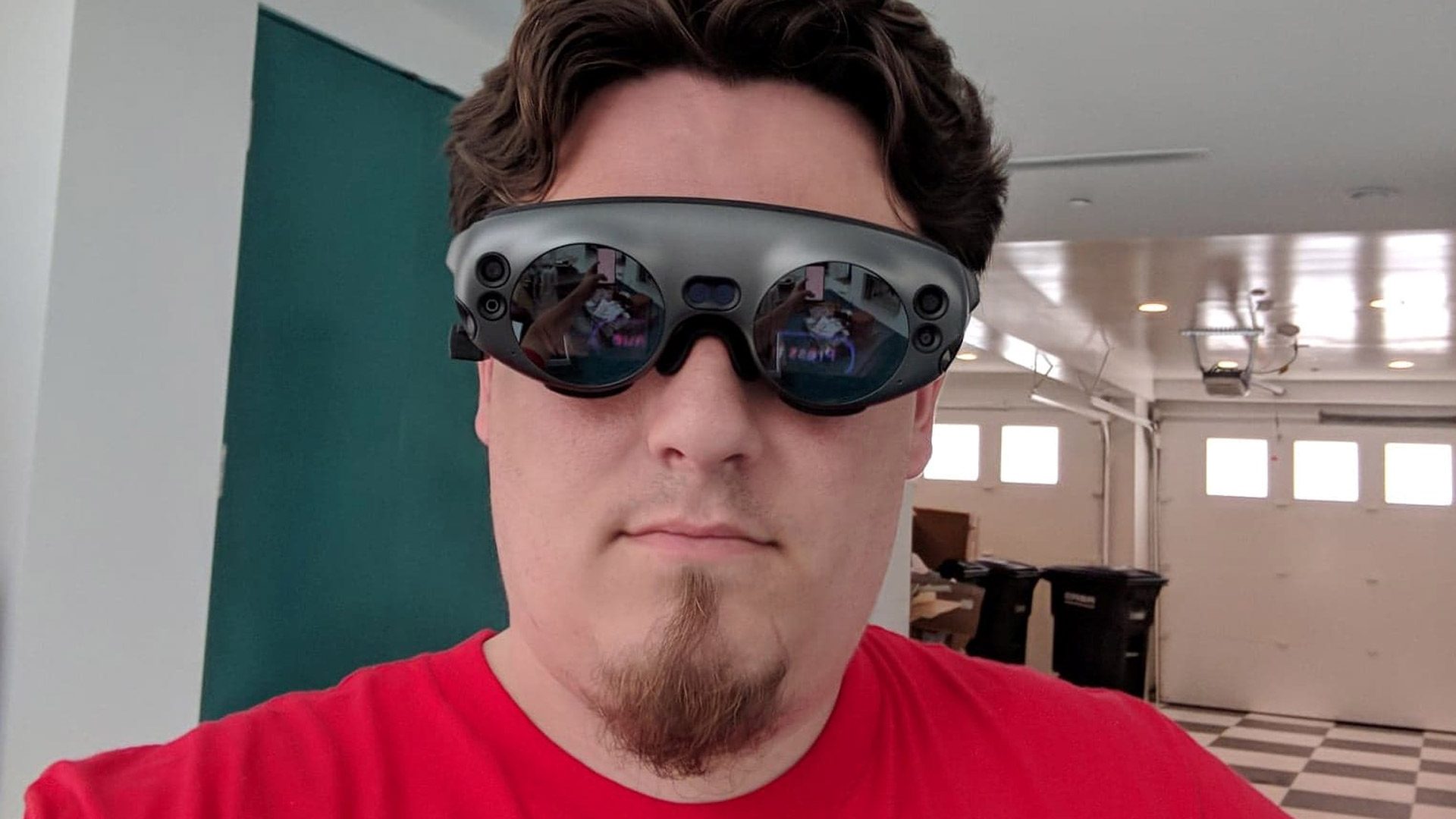
Palmer Luckey, the founder of Oculus who left the company in 2017, appears to have insider knowledge of the upcoming Apple XR headset, which is expected to be unveiled at its Worldwide Developers Conference (WWDC) next month. To Luckey, Apple’s hotly awaited entrance into the space is apparently “so good.”
Luckey hasn’t quantified his experience beyond this, or even said that his impressions indeed come from a personal demo of Apple’s long-rumored mixed reality headset, which, like Meta Quest Pro, is thought to be capable of both virtual reality and passthrough augmented reality thanks to outward facing cameras. Whatever the case, the VR pioneer is sufficiently impressed with whatever the fruit company has in store.
Luckey, who founded defense company Anduril after his 2017 Facebook departure, is no stranger to candidly voicing his opinions on headset design. When unicorn AR startup Magic Leap released its ML1 headset in mid-2018, he called it a “tragic heap,” further stating the AR headset was “a tragedy in the classical sense.”
At the time, Magic Leap was just as secretive about its hardware as Apple is today. And Luckey’s opinion was undoubtedly tinged by the company’s self-generated hype which grew in the shadow of that secrecy.
“Magic Leap needed to really blow people away to justify the last few years,” Luckey wrote in his review of the headset. “The product they put out is reasonably solid, but is nowhere close to what they had hyped up, and has several flaws that prevent it from becoming a broadly useful tool for development of AR applications. That is not good for the XR industry.”
Does this mean Apple is actually delivering on the hype and pushing the ball forward with the reported $3,000 headset? Even with an avalanche of patently unverifiable leaks to go on and Luckey’s word, we truly won’t know until that ‘one more thing’ is announced on stage. Then again, you simply never can tell with Apple. We have our calendars marked for the June 5th WWDC keynote, so join us then to find out.
Organs-on-chips, recyclable wind turbine blades, and robotic farmers — these are just some of the technologies earmarked for funding under a new growth programme approved by the Dutch government last week.
NXTGEN HIGHTECH will invest €1 billion over the next seven years in an effort to make the Netherlands Europe’s leading high-tech cluster.
The programme is the initiative of prominent Dutch innovation accelerators including Holland High Tech, TNO, and FME, along with a number of universities and regional development agencies.
Most of the 260 participating companies are SMEs (190) and startups (70) that will use the funding to further develop and scale their solutions.
“The urgency of new technology applications is high and we need solutions now,” Marc Hendrikse, board chairman of NXTGEN HIGHTECH, commented. “The strength lies in the breadth of the programme. It not only works on new applications and technologies but also on digitising factories and the supply chain,” he said.
While the Netherlands is an international leader in ultra-precise high-tech equipment, this position is “threatened by political interests and growing competition from other continents,” the organisation said in a press release. Furthermore, R&D investments are significantly lower than in other knowledge-based countries, costing growth, it added.
In an effort to cement the country’s place at the top of European high-tech, the programme will invest across six core areas: agrifood, biomedical production technology, energy, composites, laser-satellite communication, and semiconductors.
Within the agrifood domain, selected companies include those that use smart solutions, sensor technology, and robotics to improve the efficiency of farming, a sector that struggles with labour shortages and soaring costs. One of these startups is BioScope, which helps farmers find abnormalities in their crops using data gathered from drones and satellites.
Among other startups already selected by the programme is Hydraloop, which has developed a smart water-saving device for homes. The list also includes Lionvolt, a Eindhoven University of Technology spin-off developing 3D solid-state batteries that charge extremely quickly, and Single Quantum, which is developing superconducting single-photon detectors — crucial components in optical imaging and telecommunication systems.
By 2030, NXTGEN HIGHTECH aims to have developed a fully certified system for operating factories autonomously, in order to boost the productivity of the Dutch manufacturing industry.
What’s more, the programme hopes to boost the country’s share of semiconductor production using the expertise of its members, which include the likes of chip giant and Europe’s most valuable tech firm ASML.
Bringing all of this together, say the partners, is education. In collaboration with universities and colleges, the programme looks to embed the Dutch ‘systems engineering’ approach in the education system by 2030.
Systems engineering analyses complex systems, like cars or batteries, to find more efficient ways of operating them. The discipline better equips students with the knowledge they need to excel in high-tech industries and adapt to the rapidly changing job market.
“Only by continuing to invest in technical knowledge and skills will the Netherlands become future-proof,” the organisation concluded.
Get the TNW newsletter
Get the most important tech news in your inbox each week.
This profile is part of the main prize of the Pitch Battle at TNW Valencia 2023 won by Crowmie. Want your company to get featured as well? You’ve only got a few days to join the startup contest at TNW Conference in Amsterdam on June 15 & 16!
Valencia’s hottest green-fintech startup is on a mission to break down the high barriers to investment in the energy sector and make it easy for everyone to fund renewable projects.
Crowmie, which launched February last year, is jumping into the micro-investing space by allowing anyone with as little as €100 to spend the chance to invest directly into renewable energy projects in Spain, and see monthly returns.
Tech-wise, Crowmie has built a platform to create digital security tokens (STO, Security Token Offerings) for the total amount of each project they want to finance. This automated process means all investment transactions are registered in the blockchain.
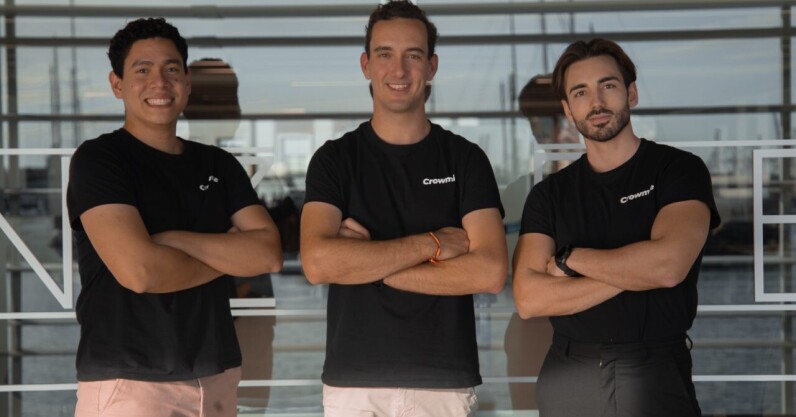
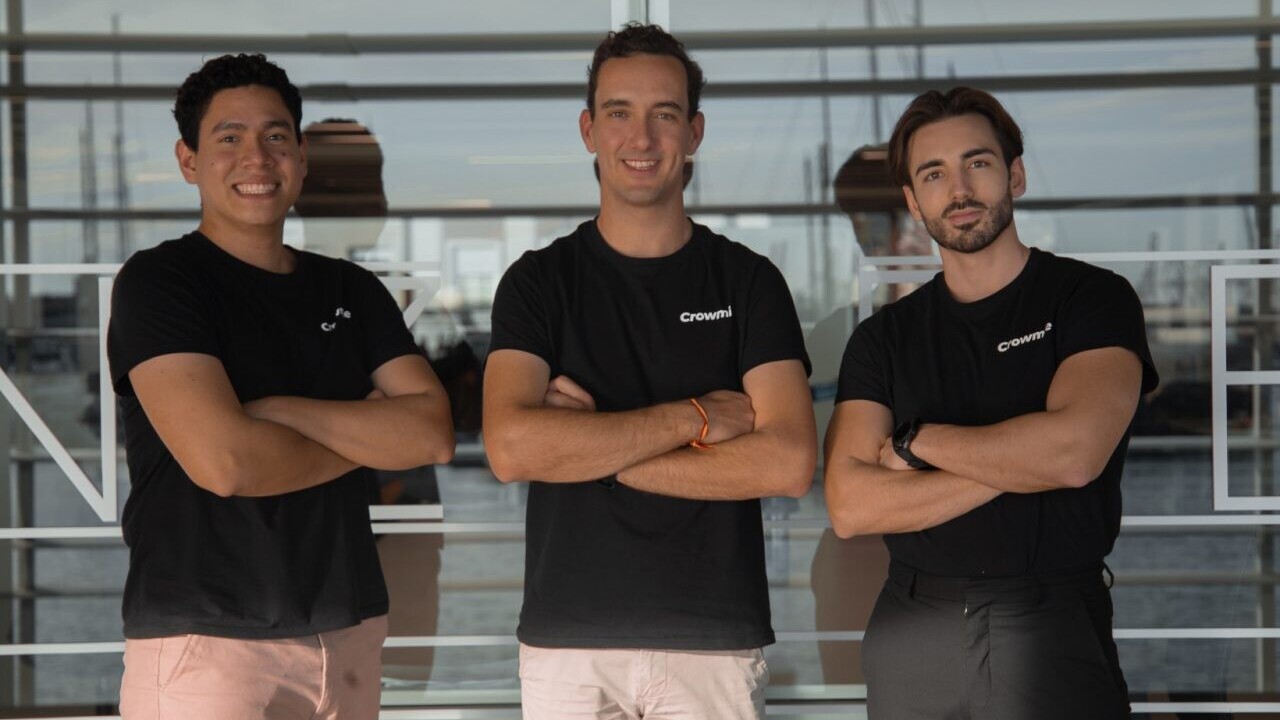
The 12-person startup, led by founders Fernando Dávila (26), Pablo Valverde (29) and Joshua Cleveland (29) won the Pitch Battle at TNW Valencia in March this year.
“The jury was impressed with the team’s vision and goal of making it easier to invest in renewable energy,” said Boris Veldhuijzen van Zanten, co-founder of TNW and jury member of the Pitch Battle. “This is such an amazing opportunity that people like you and I can now finally get active in. This is one of those startups that you hope become very successful, not just for the team, or the investors but for the whole world.”
Crowmie (the name is a mashup of “crowd” and “homie”) has received €300,000 in pre-seed funding so far and is going after a €1.5 million seed round this year. The company will deploy the funds towards marketing, tech, opening up the investment platform to people in the US and building a presence in Mexico and Colombia.
Tokenised investment inspiration
CEO Dávila, who studied astro-engineering in Valencia before becoming a founder, told TNW that innovation in property tech was one of their main inspirations.
“The idea came about because we saw an incredible trend in the tokenisation world, especially in the real estate sector,” Dávila said, citing RealT in the US and Reental in Spain as two pioneering companies in real-estate tokenised investments.
The trio thought that the same model of fractional, tokenised investment could totally work in the renewable energy sector too — and no one was doing it in Spain.
“Right now only those with high amounts of capital can invest in the renewable energy vertical, and we want to do it with tokenisation, because impact investment is growing now and will grow much more in the future,” Dávila added.
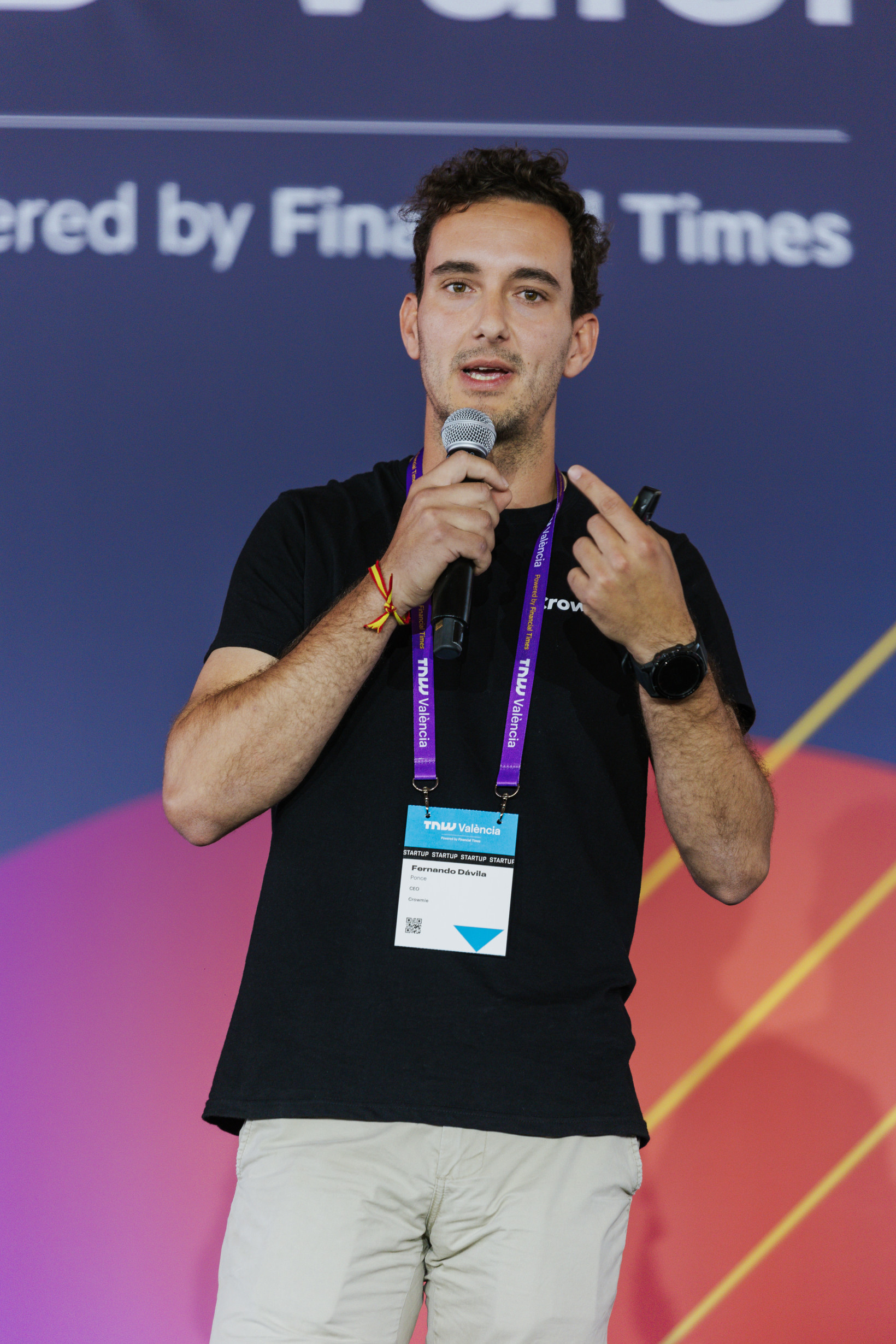
Crowmie’s CEO on stage during the TNW Valencia pitch battle. Credit: TNW
“We are really digitising a completely traditional sector like investment, using blockchain technology that allows us to open the doors to anyone from anywhere in the world, making it easy to invest in renewable energies, which until now was completely impossible.”
Spain is a promising base for green-energy initiatives. Just over 42% of the country’s electricity was generated from renewable sources in 2022, and it wants to increase this share to 74% by 2030.
According to a Reuters report from December 2022, Spain has the largest solar pipeline in Europe, with so many solar projects in planning that the government is struggling to get all the permits issued.
Zero-hassle investing
Getting up and running on the Crowmie app is simple, according to Dávila. Once someone signs up and completes the legal verification steps, they just need to select which of the Crowmie energy projects they want to invest in, and how much.
They then receive a minted token for that monetary value giving them economic rights to the project. They can resell their tokens with one click any time.
Crucially, Crowmie’s business model is not purely about facilitating investment and financing the projects, as they actually own the installations and plants themselves. Once they’ve built an energy plant, typically for a large company or factory, they sell the energy from it to the customer, and distribute the money to all investors.
Two solar plants are up and running so far, with, Dávila says, a total of 66 investors from multiple countries on board, with an average investment ticket of €2,000.
Crowmie’s photovoltaic plant supplying the TYPSA factory in Zaragoza was financed with €114,000 and started operating in February this year. Investors started getting dividends from the first month of operations and it is expected to deliver a return of 7.5% per year for five years for investors, and save 1,365 tonnes of CO₂ per year.
The startup also makes money by taking 5% of the value of tokens that they mint on the platform (giving them 5% of the economic rights of any one project) and a 2% processing fee.
Chickens and eggs
“Our biggest challenge is to balance the projects and the investors – it is chicken and egg,” said Dávila. “You have to balance the volume of investors on the platform, and the volume of projects that you have, in order to finance that project fast, really timing when the projects are coming, then creating FOMO among those investors that they are going to miss this opportunity.”
“We have three kinds of investors,” he added. “On one side, we have professional investors, who invest between €10,000 and €50,000. Then there are retail investors, who go in for about €2,000 a ticket. The third level is those who put in between €100 and €2,000.”
Compliance and due diligence across finance, technical and legal before they sign contracts with clients for the energy projects is the expensive part of doing business for Crowmie, and needs to be outsourced.
For now, the founders are cutting their teeth on projects in Spain, but they’re already looking at expanding into Mexico and Colombia, where their partners have other energy projects. These 25 partners, Dávila said, have already created a pipeline of 40 potential projects for Crowmie to the value of €20 million.
Get the TNW newsletter
Get the most important tech news in your inbox each week.
The use of VR training for mental health awareness is not a new concept. This technology has become a powerful tool that enhances the professional development and overall well-being of employees in the workplace.
With Mental Health Awareness Month serving as a crucial reminder of the importance of addressing mental health concerns, we once again go through the role immersive technologies play in promoting mental health awareness and providing support.
The Prevalence of Mental Health Issues
In the United States alone, approximately 50 million adults are experiencing a mental illness. But what’s more alarming is that over 55% of them receive no treatment. That’s 28 million individuals struggling with mental health issues on their own.
In the workplace, employees experiencing poor mental health are more likely to face absenteeism, lower job satisfaction, and burnout. The impact of these issues extends beyond individual employees, affecting overall productivity, morale, and employee retention within organizations. Fortunately, business leaders are now realizing the need to address mental health concerns in the workplace.
Harnessing Immersive Technologies for Mental Health Support
XR technologies, including VR training, have emerged as powerful tools for addressing mental health concerns and fostering a supportive workplace environment. Companies like Moth+Flame have been at the forefront, developing immersive training solutions that promote mental health in the workplace.
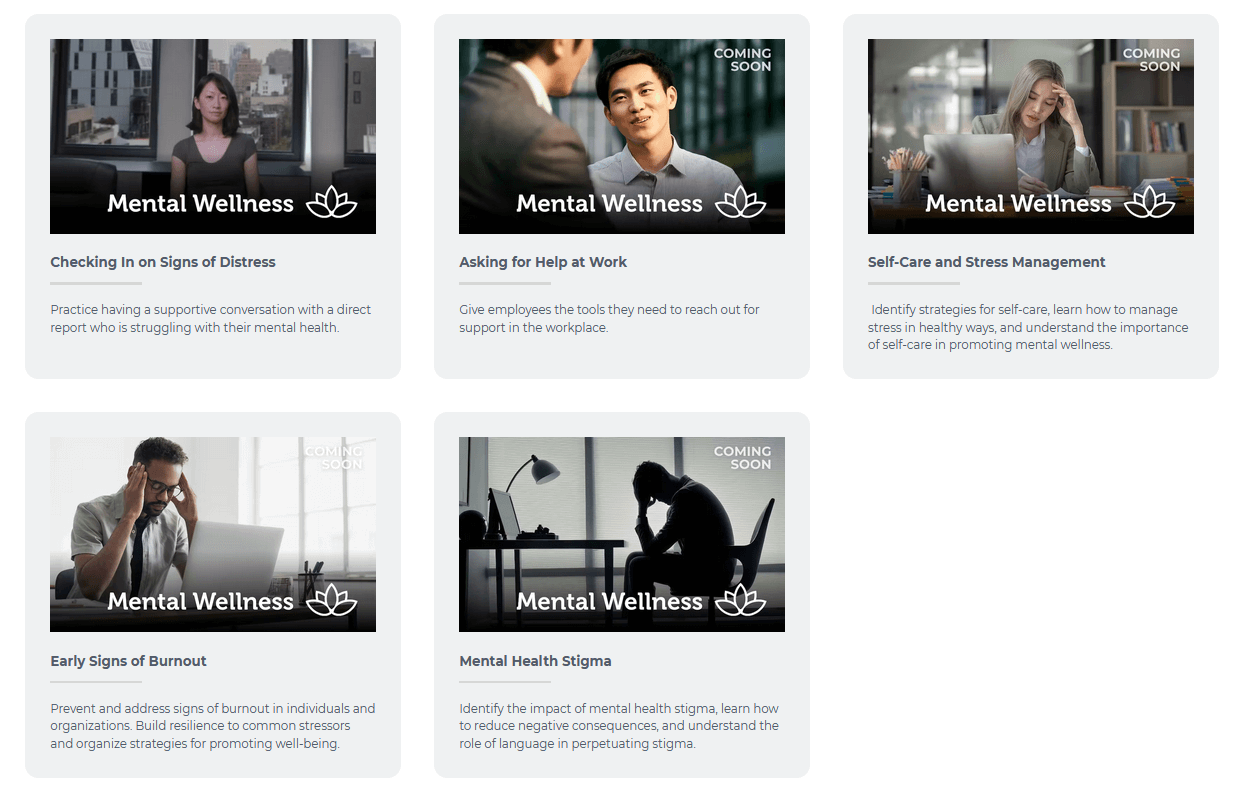
This month, they launched a Mental Wellness library to facilitate open conversations on mental health concerns. Through this library, individuals can engage in realistic scenarios, practice meaningful conversations, and acquire the necessary skills to provide appropriate support.
According to Kevin Cornish, founder and CEO of Moth+Flame, developing the library was a big commitment they made in support of mental health awareness. Their goal is to get more people comfortable with talking about mental health at work so that, ultimately, people know how to ask for help and how to offer help. “We believe that the more people who are trained on how to handle these conversations, the more people will ultimately get help,” says Cornish. “If one person gets the support they need by using this conversation and being prepared for a tough conversation, then we have succeeded.”
Collaborative Efforts in VR Training for Mental Health Awareness
Moth+Flame is not alone in recognizing the potential of XR technologies for mental health training. Several companies and organizations are utilizing VR to improve mental health awareness and support in the workplace.
PsyTechVR is also empowering organizations by giving them access to VR apps with guided meditations and art therapies that enhance mental wellness. The company, which launches new therapy content every two weeks, offers both self-guiding VR courses as well as courses with a specialist, where the doctor has access to user’s training in real-time and guides them through all the training.
Penumbra’s REAL Vision VR Wellness offers over 100 immersive experiences designed specifically for improving employee mental wellness. The company’s REAL i-Series is designed to offer VR-enabled tools for cognitive activation, distraction therapy, reminiscence therapy, mindfulness therapy, and relaxation therapy.
Collaborations among tech, health, and business sectors are paving the way for better VR experiences tailored to mental health. The National Institute of Mental Health for one has been funding research on virtual reality exposure therapy and other immersive applications.
The Impact of VR-Based Mental Health Training Programs
Although specific case studies on VR-based mental health training programs are still emerging, the potential impact is significant. Moth+Flame, for instance, partnered with the US Air Force to provide VR training specifically for suicide prevention, demonstrating the efficacy of immersive experiences in sensitive topics.
They have seen firsthand the transformative effect of VR in military suicide prevention training. By expanding access to these training programs and empowering more individuals to handle difficult conversations, the hope is that more people will feel comfortable seeking help and offering support.
Looking Ahead: Empowering a Supportive Work Environment
VR training for mental health awareness has the potential to revolutionize workplace well-being. As more organizations recognize the significance of addressing mental health concerns, the demand for immersive XR experiences will continue to grow.
As Mental Health Awareness Month highlights the importance of open dialogue, companies across various industries are embracing VR training as part of their mental health initiatives. By incorporating XR technologies into their employee development programs, organizations demonstrate a commitment to fostering a supportive work environment that prioritizes mental well-being.
It’s not just Moth+Flame, PsyTechVR, and Penumbra leading the way in utilizing XR technologies for mental health support. Other companies have also recognized the value of immersive experiences in promoting mental health awareness. From mindfulness apps to virtual therapy sessions, the potential applications of XR in mental health care are vast. Collaborative initiatives between industry leaders and mental health professionals further amplify the impact of XR in promoting mental health awareness.
tinyBuild Games and Steel Wool Studios announced their upcoming VR take on viral indie hit Hello Neighbor is landing on PSVR 2, Quest 2, and SteamVR headsets later this month.
Update (May 12th, 2023): tinyBuild and Steel Wool revealed Hello Neighbor VR is coming on May 25th to all major VR headsets. Pre-orders are already available on Quest. You can also wishlist on Steam and PSVR.
In the meantime, the studios have released a new gameplay trailer. The original article announcing Hello Neighbor VR follows below:
Original Article (November 7th, 2022): If you haven’t played before, Hello Neighbor is a stealth horror game all about sneaking into your neighbor’s house to figure out what horrible secrets he’s hiding in the basement. The neighbor’s AI learns from your every move, so when you find a nice window to habitually climb through, you’ll probably find a bear trap there next go-around.
In franchise’s first VR game, you take on the role of six neighborhood heroes as they “confront their fears to free their friend, who is held captive in a bizarre basement prison,” the studios say.
“You’ll need to learn and master each of their unique abilities to solve puzzles, uncover mysteries, and make it out of the neighbor’s house in one piece, all while trying to avoid capture by the creepy Neighbor himself! Just the thought of it sends our heartbeats racing!”
Here’s how tinyBuild and Steel Wool describe the action:
Multiple playable characters: Switch between characters to outsmart the AI. Each unique character has their own key items and skills. Switch between the perspectives of the Rescue Squad team members at will, solving puzzles and avoiding the Neighbor as you attempt to reach the creepy basement!
Environmental puzzles require creative solutions: You will have to increasingly use your wits to find alternate solutions to a dynamic range of puzzles and challenging environmental obstacles. Many puzzles that may seem unsolvable at first glance require you to use the perspectives of multiple characters in conjunction to overcome them.
Non-linear exploration: Use your own approach to infiltrate Mr. Peterson’s house by alternating perspectives, combining character’s skills to dynamically solve puzzles, uncover hidden mysteries, and reveal new pathways through your environment.
Confront your fears: Experience nightmarish dream sequences and learn more about the secrets of the Hello Neighbor universe!
To create the game, Hello Neighbor developers tinyBuild is working with VR developers Steel Wool Studios, which is best known for the breakout-hit Five Nights at Freddy’s and the VR adaptation Five Nights at Freddy’s: Help Wanted.
Google has announced an upcoming AR game, Space Invaders: World Defense, which is built as a showcase of the company’s latest AR tool.
Over the last few years Google has been steadily working on its AR developer toolset, ARCore. This week at Google IO 2023, the company added a brand new tool to its kit called Geospatial Creator.
Geospatial Creator gives developers the ability to create world-anchored digital content that will appear in the same location for all users. Built on a foundation of both ARCore and 3D data from Google Maps, it’s competes with Niantic’s Lightship AR platform, and is getting integrations for both Unity and Adobe Aero.
To showcase the latest capabilities of ARCore, Google has teamed up with Taito Corporation, the original developer of arcade hit Space Invaders (1978), to build a brand new city-scale AR game called Space Invaders: World Defense.
Planned to launch later this Summer—fittingly aligned with the 45 year anniversary of the original game—Space Invaders: World Defense will purportedly have players “defend the earth from Space Invaders in their neighborhood,” and will “combine AR and 3D gameplay to deliver a fully contextual and highly engaging immersive experience that connects multi-generations of players.”
Sadly we’ve yet to see a glimpse of any real gameplay, so it isn’t clear just how the game will work, but with any luck we’ll eventually find more information from the game’s official website.
Thomas is a senior reporter at TNW. He covers European tech, with a focus on deeptech, startups, and government policy. Thomas is a senior reporter at TNW. He covers European tech, with a focus on deeptech, startups, and government policy.
The EU is edging closer to a landmark ban on predictive policing and facial recognition.
At a crunch vote today on the bloc’s flagship AI Act, two committees of MEPs overwhelmingly endorsed sweeping new rules on artificial intelligence. The text now moves to a vote by the entire European Parliament in June. Once approved, the regulation will become the world’s first comprehensive AI law.
At Thursday’s vote, MEPs approved a strengthened version of the rulebook. The Act now prohibits predictive policing and facial recognition in public spaces.
The amendments also introduce new restrictions on generative models, such as ChatGPT, and emotion recognition.
Civil liberties campaigners have welcomed the move. Fair Trials, a criminal justice watchdog, described the vote as “a landmark result” for human rights.
“These systems automate injustice, exacerbating and reinforcing racism and discrimination in policing and the criminal justice system, and feeding systemic inequality in society,” said Griff Ferris, Senior Legal and Policy Officer at Fair Trials.
“The EU Parliament has taken an important step in voting for a ban on these systems, and we urge them to finish the job at the final vote in June.”
The industry responds
In the tech sector, reactions to the vote were mixed. The Software Alliance (BSA), a lobby group that represents the likes of Microsoft and IBM, has called for further clarification.
“The enterprise software industry remains concerned about the allocation of responsibilities in the AI value chain and the treatment of foundation models,” said Matteo Quattrocchi, BSA’s policy director.
“The rules as currently written are not tailored to reflect companies’ roles in theAI ecosystem, or differences in business models andAI uses, and likely will not address some of the concerns raised by specific applications of some foundation models.”
“Organisations will have to increasingly rely on their privacy teams to operationalize AI because their data stewardship expertise is highly transferrable and extremely relevant to AI governance,” she said.
Get the TNW newsletter
Get the most important tech news in your inbox each week.
German drone solution startup Wingcopter announced today it had landed €40 million in funding from the European Investment Bank (EIB) to scale up services and ramp up production of its latest model.
According to its developers, the Wingcopter 198 introduces a “new era for drone delivery.” Additions to the latest version of Wingcopter’s aircraft, “the world’s first triple-drop delivery drone,” include delivery of up to three packages to multiple locations during one flight.
What’s more, a single operator can fly up to 10 units simultaneously and beyond visual line of sight. The model also features an AI-based visual detect-and-avoid solution and smart precision landing capabilities.
The Wingcopter 198 has a wingspan of, you guessed it, 198 cm, and stretches 152 cm from front to tail. It can carry up to 6 kg and when carrying a 5 kg payload, it has a range of 75 km. Without any cargo, it can fly for up to 110 km.
The drone’s default cruise speed is 100 km/h, but it has a maximum speed of 144 km/h. Additionally, its developers say it can withstand strong winds due to a patented tilt-rotor technology – 15 m/s average, 20 m/s gusts.
Creating jobs at home and abroad
The €40 million investment is backed by the European Commission’s InvestEU programme under its sustainable infrastructure window, and the funds are provided as a quasi-equity investment, meaning that it ranks between equity and debt.
Of course, EIB, the lending arm of the European Union, does not splurge on projects simply because it features some cool tech. It also looks for broader social and environmental benefits when deciding whether or not to fund a project.
“Our goal is also to improve lives by creating many jobs — in R&D and manufacturing at our headquarters in Europe, as well as in the countries where we provide services, where we train and qualify local young people to operate our drone delivery networks,” said co-founder and CEO Tom Plümmer.
Credit: Wingcopter
Furthermore, replacing carbon-intensive modes of light cargo transport with electric drones will reduce emissions and help further the bloc’s climate agenda.
“Backing European cleantech pioneers with global reach like Wingcopter is central to our mission,” said EIB Vice-President Ambroise Fayolle. “Electric cargo drones are an important vertical segment for a future of sustainable transport and logistics.”
Bringing it home
Wingcopter expects to operate its flagship model for the first time in Germany this summer. It will launch in a pilot project that will test the potential of on-demand transport of groceries and consumer goods.
The project, in turn funded by the German Federal Ministry for Digital and Transport and conducted together with the Frankfurt University of Applied Sciences, is intended to improve local supply in rural German communities through a sustainable delivery service
Wingcopter was founded in 2017, by Tom Plümmer, Jonathan Hesselbarth and Ansgar Kadura. To date, the advanced air mobility startup has raised over €100 million over nine funding rounds. Investors include European retailer REWE Group, ITOCHU, Xplorer Capital and Uber co-founder Garrett Camp’s investment arm Expa.
The Darmstadt-based developer is both a manufacturer of aviation-grade drone technology and a service provider for a wide range of drone operations. It has already deployed its unmanned aircraft, such as the Wingcopter 178, to deliver goods across small-scale commercial and humanitarian missions, as well as carry out geological surveys and infrastructure inspection in difficult to reach terrain.
One of the major advantages of drones in cargo operations in hard-to-reach and rural environments is that they require no additional infrastructure for take off and landing. Last summer, the company raised close to €40 million to deploy some of its drones in Sub-Saharan Africa.
Wingcopter has also participated in a joint project between UNICEF and the German Federal Ministry for Economic Cooperation and Development (BMZ) in Malawi, delivering life-saving medicines and medical supplies.
Get the TNW newsletter
Get the most important tech news in your inbox each week.
Thomas is a senior reporter at TNW. He covers European tech, with a focus on deeptech, startups, and government policy. Thomas is a senior reporter at TNW. He covers European tech, with a focus on deeptech, startups, and government policy.
This article features an interview with Joe Fitzsimons, the CEO and founder of Horizon Quantum Computing. At TNW Conference on June 16, Fitzsimons will be speaking at a session titled, “Is quantum computing the future of finance?” If you want to experience the event (and say hi to our editorial team!), we’ve got something special for our loyal readers. Use the promo codeREAD-TNW-25and get a 25% discount on your business pass for TNW Conference. See you in Amsterdam!
Quantum computing is fiendishly complicated to commercialise. Despite claims that it will save the planet and cure cancer, real-world applications are yet to emerge from the hype.
For startups, this offers both promise and peril. Ominously, any practical use cases may not emerge for years — if at all. But when they do emerge, the potential applications and revenues are unimaginable — and untapped.
With untold riches beckoning, budding leaders in the sector are prepared to play the long game.
“With quantum computing, there’s not a real-world advantage today,” Joe Fitzsimons, CEO and founder of Horizon Quantum Computing tells TNW.
“It’s a milestone that’s coming — and hopefully, quite soon — but we still haven’t reached that point. For everyone in the space, it’s still about pushing technological progress as much as possible.”
Fitzsimons has been pushing this progress for his entire career. After baby steps into the quantum realm at Oxford University, Fitzsimons moved to Singapore for a stint in quantum research, before pivoting from academia to industry.
Fitzsimons (right) and Si-Hui Tan, Chief Science Officer at Horizon Quantum Computing.
In 2018, Fitzsimons founded Horizon. The startup is currently developing a system that automatically constructs quantum algorithms from classical code.
In November, the company announced a major step in its mission to become a quantum computer powerhouse: its first European hub — and first office outside Singapore — will soon open in Dublin.
The expansion aims to tap the impressive talent and prospective customer base in Europe —one of the world’s major markets for quantum computing.
Fitzsimons had numerous reasons for picking Europe — and Dublin — as the first stop on Horizon’s global expansion. They include a propitious tech ecosystem, the ease of doing business, and supportive legal structures. But perhaps the biggest pull is the potential to plug the quantum talent gap.
Ireland offers a unique solution to this problem. An enticing tax regime has attracted many of Silicon Valley’s biggest names to make the emerald isle their European home. Adding their influx to a young population that’s among the world’s most-educated and a pioneering quantum programme at Trinity College Dublin has produced a deep pool of engineering talent.
“You can hire from both the UK and the EU.
Since Brexit, Dublin’s pipeline has only become more alluring. Ireland is now the biggest English-speaking country in the EU — and retains an incomparable connection to the UK.
“You have the advantage of being able to hire both from the UK and from the EU, visa-free,” says Fitzsimons. “And that’s really a big advantage, because quantum computing talent is spread out globally.”
In Europe, that talent has spread across a flourishing array of quantum computing leaders. They encompass quantum internet experiments at TU Delft in the Netherlands; ion-trapping at Austria’s AQT; control systems at Zurich Instruments; quantum algorithms at the UK’s Phasecraft; dilution refrigerators at BlueFors in Helsinki; and quantum processing units at Finland’s IQM Quantum Computers.
It’s a formidable range of pioneers, but they still have immense barriers to hurdle.
Across the globe, quantum computing startups face a range of challenges, from crippling computation errors to eye-watering costs. In Europe, some further obstacles have been thrown into the path to profitability
One of the problems is ubiquitous across tech articles: access to late-stage capital. While Europe is renowned for scientific research, it lacks the growth funding to develop global tech leaders.
In quantum computing, the fundraising problem has an extra dimension: investors need to be unusually patient. In time, their rewards could be incredible. Analysts expect the quantum advantage to extend across all aspects of society — but it won’t get there overnight.
“It takes a lot of work, so you need patient capital,” says Fitzsimons.
Fitzimons recently raised over $18m to expand Horizon’s engineering team and accelerate product development.
Regrettably, funding isn’t Europe’s only shortcoming. A recent report by Boston Consulting Group (BCG) highlighted three further issues: national siloes, a dearth of tech titans to consolidate the sector, and struggles turning academic talent into quantum professionals.
To mitigate these issues, BCG advises the EU to foster a private sector that can scale, create business-oriented quantum talent, and interconnect all of the bloc’s quantum computing efforts.
It’s a daunting entreaty to EU leaders. In the infamously weird world of quantum computing, the impacts of investments are hard to predict. Nonetheless, Fitzsimons is confident that they’ll pay off.
“Essentially, you’re talking about what could be computing all over again — and the upside of that is tremendous.”
Joe Fitzsimons is one of many tech luminaries speaking at TNW Conference on June 15-16. Use the promo codeREAD-TNW-25and get a 25% discount on your business pass for TNW Conference.
Get the TNW newsletter
Get the most important tech news in your inbox each week.
During its I/O 2023 event yesterday, Google announced it had officially removed the waitlist for its AI-powered chatbot Bard and made the service available in 180 countries and territories.
Sadly for most Europeans keen on testing the tech giant’s contribution to the generative AI race, the countries of the European Union are not included in the list.
The company has not made any comments on why the EU has been left out. However, it would not be too far-fetched to assume it has something to do with how members of the bloc have reacted to the introduction of OpenAI’s ChatGPT. In all likelihood, Google is also waiting for the finalisation of the EU’s much-anticipated AI Act, before unleashing Bard across the continent. The leading European Parliament committees gave their approval for the act earlier today, with a tentative plenary adoption date scheduled for 14 June.
While not offering any specific plans for increased geographical access, Google says it will “gradually expand to more countries and territories in a way that is consistent with local regulations and our AI principles.”
Trained on Google’s new model
Along with the release of Bard to much of the world (and sharp VPN wielders), Google also introduced a range of new features to the chatbot. First of all, it is now powered by Google’s newest large language model: PaLM2, an upgraded version of PaLM, released in April. Meanwhile, Bard was still introduced as a “conversational AI experiment.”
According to Sissie Hsiao, Google VP and General Manager for Google Assistant and Bard, the chatbot has now been trained in 20 programming languages. This means that users can ask it to produce, debug and improve code in, for instance, C++, Python, and JavaScript.
In addition, users can now switch to the apparently much-requested dark mode. But what’s more, they can also create images through Bard, using Adobe’s AI art generator Firefly via an extension feature that allows it to integrate with third party apps and platforms.
Soon you can ask Bard/Firefly to generate unicorns and cakes for you. Credit: Google
Thus far, Bard is available in English, Japanese, and Korean, but Google says it is on track to support 40 languages.
Will it be up to snuff?
In a move generally considered to have been premature, Bard was released two months ago for select users in the US and the UK. Consensus has been that in effort to keep up with competitors, Google rushed the introduction of the chatbot before it was ready.
As a result, the company faced the ridicule of not only tech savvy commentators, but also its own employees. As reported by Bloomberg, phrases such as “pathological liar” and “cringe-worthy” were thrown about on internal messaging boards. But what is one of the big five to do when its very core business is under threat?
To say that Google is enamoured by artificial intelligence at the moment would be something of an understatement. For I/O 2023, it came armed with a ton of new AI announcements, beyond Bard. In fact, Sundar Pichai opened the event by once more stating that Google has “reimagined” all its core products.
And speaking of core businesses, Google Search is getting something the company calls “AI-powered snapshots.” When users opt in for the brand new Search Generative Experience, the search engine will produce AI-powered answers at the top of the results.
Other products that are getting an AI makeover are Gmail and Docs, where you can prompt AI to “help me write” things such as potentially tricky emails or job applications. Sheets now has a function called “help me create” to help you set up tables with anything you may need when it comes to, say, running a business (dog walking was the example offered by Google during the presentation probably because, well, dogs).
Maps is getting something called Immersive View, which will allow you to visually walk, cycle, or drive a specific route complete with predicted weather conditions, before you actually get out the door. It will be rolled out across 15 cities, including Amsterdam, Berlin, Dublin, Florence, London, Paris, and Venice by the end of the year.
Whether or not much of Europe will get to test the mettle of the ‘new and improved’ Bard by then is another matter.
Get the TNW newsletter
Get the most important tech news in your inbox each week.
Augmented reality (AR) transforms how we view the world and do things. Since its first introduction in the 1960s, it has rapidly developed and been used extensively in fashion, marketing, the military, aviation, manufacturing, tourism, and many others.
Consumers are increasingly becoming adept at using augmented reality apps to try on products, learn new things, and discover information about their surroundings. Research shows that 56% of shoppers cite AR as giving them more confidence about a product’s quality, and 61% prefer to shop with retailers with AR experiences.
Aside from its impact on brands, AR is also transforming how companies operate internally by introducing better ways to perform jobs, train employees, and develop new designs.
No-Code Platform for Creating Your Own Immersive Experience
Creating AR experiences is no walk in the park. Firms that want to implement their own augmented reality apps require working with talented in-house app builders or purchasing from third-party app builders, with costs ranging from tens to hundreds of thousands of dollars.
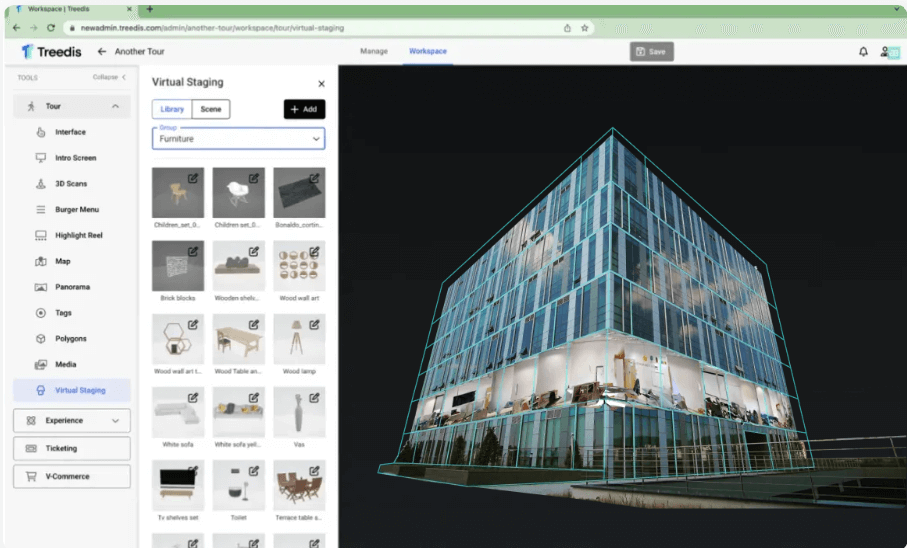
Treedis makes the process simple with its Software-as-a-Service platform, which helps users create immersive experiences using a no-code drag-and-drop visual editor. Users can create digital, virtual reality, and augmented reality dimensions of their digital twin with just a single scan.
Digital twins are immersive, interactive, and accurate 3D models of physical spaces. They’re a digital replica of devices, people, processes, and systems whose purpose is to create cost-effective simulations that help decision-makers make data-driven choices.
Powered by Matterport technology, Treedis helps companies create these immersive experiences for retail, training, marketing, onboarding, games, and more.
Enhancing Digital Twins With an Augmented Reality App
According to Treedis CEO Omer Shamay, the Treedis augmented reality app helps you “view enhanced versions of your digital twins within their physical counterparts.” You can visualize any changes or modifications in real time and view all the 3D objects, tags, directions, and content in the digital twin.
“Any changes made to your digital twin will be instantly visible in AR, ensuring seamless collaboration and communication across your team,” Shamay adds.
The platform helps 3D creators and enterprises create an immersive and powerful digital experience for their users, so they can fully harness the benefits of AR solutions without huge developmental costs or challenges.
It can be used extensively for creating unique shopping experiences that incorporate elements of virtual commerce and gamification features. It’s ideal for developing immersive learning experiences to help learners grasp concepts better through physical interaction with their environment. The app can also be used to provide indoor navigation for guiding visitors to different access points and key locations within a space.
The app is already available for Treedis’ enterprise users and promises to be “an accessible app with low prices and an easy-to-use AR solution,” according to Shamay.
With AR becoming more accessible, it won’t be long before more brands and firms adapt the technology and provide better and enhanced experiences to their audiences.
We’re back for another dose of mind-bending puzzles à la Bob the Fisherman. The sequel offers up a longer, more emotionally complex story while packing in a ton of new puzzle mechanics that makes Another Fisherman’s Tale feel leagues ahead of the original in almost every sense.
Another Fisherman’s Tale Details:
Available On: SteamVR, Quest 2, PSVR 2 Release Date: May 11th, 2023 Price: $30 Developer: Innerspace VR Publisher: Vertigo Games Reviewed On: Quest 2
Gameplay
Bob’s tall tales are taller than ever this time around, as the adventure swells to scale up to new emotional depths which reveal more about the real Bob and his family. I won’t spoil the story behind Another Fisherman’s Tale, because it’s really something you should unfold yourself. It talks about love, loss, responsibility, freedom—it’s way heavier than the first, and often strays outside of original’s safe storybook narration. Where you might have ignored some of the angsty Dad drama of the original Fisherman’s Tale, and just got on with the game’s smorgasbord of mind-bending puzzles, this time around the narrative takes more of a center stage, all while presenting new and innovative mechanics to keep you guessing.
The most prominent mechanic on display is the new ability to detach, replace and control your hands—like physically pop off your hands, trade them for more useful ones, and shoot them out to solve a variety of puzzles that only a little crawling (or swimming) remote controlled hand-beast might. Although you really only have two other hand styles regularly at your disposal besides your wooden digits, a hook for climbing and a claw for snipping, the puzzle variations are impressively wide.
Image courtesy Innerspace VR, Vertigo Games
While there are a ton of one-off puzzles to compliment, a constant throughout the game is the need remotely control your hands, which is done by twisting your motion controller in the correct relative direction and pressing the trigger to move them forward. You’ll be pulling levers, crawling your digits through circuitous routes, and grabbing key items before snapping them back to your arms where they belong. This took some getting used to, as oftentimes you’ll need to control your hands from afar while actually moving your body to different locations to get a better viewpoint, which can be confusing at times since your body’s relative position changes and your hands sort of wig out.
And with separable hands, you might as well be able to pop your head off too. Simply press two buttons (‘B’ and ‘Y’ on Quest) and you’ll launch your head forward to reach far flung areas for a better point of view. It’s basically plays out like a dash teleportation that follows a predictable arch as opposed to physically picking up your head and tossing it around, which wouldn’t be terribly comfortable. More on comfort below though.
Image courtesy Innerspace VR, Vertigo Games
While I wouldn’t call any of the puzzles particularly hard, they’re always creative and rewarding. I had hints enabled, although you can turn them off in the settings, which mutes a few of Bob’s timely and helpful lines. Still, Bob isn’t overbearing in how or when he delivers hints, making him feel much more like a dad who wants you to figure something out on your own than a ‘helpful robot’ that just wants you to get on with the puzzle already.
My personal playtime was just under four hours, which puts it nearly four times longer than the original game. I didn’t feel like any of it was filler either, which is a testament to the game’s deeper story and puzzle variations that require the player to develop skills that are useful throughout—essentially everything I wanted from the original but didn’t get when it initially released in early 2019.
Immersion
The star of the show is undoubtedly Bob, who is brought to life by the whisky-soaked tones of the probably never-not-smoking French comedian Augustin Jacob. In my review of the first game, I called Jacob’s interpretation more akin to a kitschy short that you typically see before a proper Pixar movie—charming, but not enough.
Image courtesy Innerspace VR, Vertigo Games
Here we get a full-fat dose of Bob as well as a new cast of characters that are equally engaging, making it feel more like that Pixar adventure I wished it could have been in the first place. One thing that hasn’t changed though is the inclusion of a sweeping score, which perfectly frames the game’s linear, sometimes storybook style adventure.
While the story goes off the rails at points, snapping you back to reality, it isn’t a large, open world with a ton of freedom of movement, or even puzzle creativity. Another Fisherman’s Tale is compartmentalized into chapters, each of which have a number of linear areas to unlock. The physical variety of the spaces though makes it feel less like a long series of closed escape rooms, which might otherwise feel a little too repetitive. That’s simply not the case here, as you’re always left guessing at what your next adventure will be, and where you’ll go next.
Image courtesy Innerspace VR, Vertigo Games
Set pieces are thoughtfully designed, and the cartoony nature of the game looks generally very good, even on the game’s most humble target platform, Quest 2. Object interaction is very basic, although that doesn’t detract too much since it’s mostly levers and a smaller momentary puzzle bits we’re dealing with here. As a result, there’s no inventory to speak of since all tools will be presented to you as needed, and thoughtfully poofed back into existence in case you lose them.
Comfort
Another Fisherman’s Tale has what we’d now consider the standard swath of comfort settings, which will let most anyone play with relative ease. There are moments though that personally make me feel a little iffy—not ‘hang my head in the toilet bad, but I’ve played VR long enough to know my triggers.
In lieu of cutscenes, the game loves to do sweep your POV around slowly, which is mostly fine, although much of the time you’re being shrunk down so scenes can appear bigger. I generally dislike this lack of control, even if it only happens maybe once per chapter. There are also moments when your POV will be upside-down, however this too is a pretty rare occurrence. All things considered, it’s a pretty comfortable game that basically anyone can play without feeling anything but few momentary bits of weirdness.
‘Another Fisherman’s Tale’ Comfort Settings – May 11th, 2023
Turning
Artificial turning
Snap-turn
✔
Quick-turn
✔
Smooth-turn
✔
Movement
Artificial movement
Teleport-move
✔
Dash-move
✖
Smooth-move
✔
Blinders
✔
Head-based
✔
Controller-based
✔
Swappable movement hand
✔
Posture
Standing mode
✔
Seated mode
✔
Artificial crouch
✖
Real crouch
✔
Accessibility
Subtitles
Languages
English, Italian, German, French, Spanish, Japanese, Korean, Traditional Chinese, Simplified Chinese