Author name: Rejus Almole

not-ready-for-a-4-day-work-week?-the-nine-day-fortnight-could-be-for-you

Not ready for a 4-day work week? The nine-day fortnight could be for you

Not ready for a 4-day work week? The nine-day fortnight could be for you

Suzie Coen

Story by

Suzie Coen

Suzie Coen is a Dubin-based writer with over 25 years of experience in the media industry. She is widely recognised for her work in the life Suzie Coen is a Dubin-based writer with over 25 years of experience in the media industry. She is widely recognised for her work in the lifestyle pages of prominent national and international publications and a host of luxury retail print and digital magazines.

You’ve heard of the four day week. Now, meet its slightly less fun but still a good time younger brother: the nine-day fortnight. It’s taking workplaces by storm, with leaders lauding this new model as a happy medium between burnout and excessive time off.

Its growing popularity is not surprising. The need for a dynamic approach to the changing landscape of the workplace isn’t just advisable, it’s a necessity.

According to an Economist report, 59% of people say they would consider taking a job with a company that offers better well-being benefits than their current employer. But, if the last few years have taught us anything, it’s that there isn’t a blueprint for flexible working policies.

Companies have experimented and continue to experiment with the models that seem best suited to their individual organisations — from the new nine day fortnight to complete location flexibility; a remote-first policy to offering employees flexibility around when they work.

What is a nine-day fortnight?

The nine-day fortnight working pattern effectively means that across 14 calendar days, nine of them are working days and five are days off.

Every other week, employees get an extra day off, often a Friday. Some companies ask employees to work longer hours on the days they’re working to allow for the extra day off, or to take a small pay cut—typically around 10%. Others say this isn’t important to them as long as their output remains consistent.

What are the benefits?

The idea is that it isn’t only a sweet deal for workers, but for employers too. Many of the benefits are similar to those of the four-day week, according to those who have tested it.

Studies have shown that reduced working hours can actually lead to higher productivity, meaning increased company profits, and improved well being among workers.

It could also help to reduce carbon emissions, improve gender equality in the workplace, help tackle unemployment and lead to a better work-life balance.

Where has it gotten substantial buzz?

Worldwide trials of flexible working models have been in operation post-Covid with mostly positive results. In Australia for instance, many workers moved to the nine-day format and took 10% pay cuts in the recession,

The model is also very common in the UK’s public sector bodies. At London Councils, a 9-day fortnight is based on a compressed working week, and allows staff to work nine working days instead of ten over a two week period—as long as the total number of hours worked meets contractual working hours.

And Public Practice, a company delivering services to support the public sector, has just concluded a six-month 9-day fortnight study where it trialled a number of approaches. These included a 10% reduction of working hours, benefits adjustments and flexibility. Once the body conducts an analysis on the impact of the trial, it will take a decision on whether it will be implemented formally.

Why should companies consider a 9-day fortnight?

Bottom line, it’s going to be hard to attract talent if you’re not offering some flexibility. Even for companies that haven’t considered four-day weeks, nine-day fortnights might work best in the long term anyway.

For some workers, four day weeks can feel quite intense. Alternating four and five-day weeks creates a better balance. With a nine-day fortnight, employees are able to switch between working styles and can adapt to how they work based on how many days their working week has, as well as enjoying quality of life improvements.

Businesses should think creatively about what type of adjusted work week works for them. Too often the options are presented as binary (a five-day or a four-day week), but there are lots of potential routes in between.

If you’re striving for a proper work-life balance this year, it’s time to explore new ambitious career paths that also offer more attractive flexible working opportunities.

Employers offering flexibility

If flexibility is key for you, or indeed new to you, it’s worth checking out roles at progressive companies like Improbable on The House of Talent Job Board.

Flexibility is deeply rooted in this British metaverse technology company’s values and culture and the majority of its workforce is hybrid. Right now it has exciting open positions on offer such as Senior Backend Engineer and a Senior Producer, both of which are entirely remote.

If you’re looking to work for a company that’s particularly focused on a hybrid work model, look no further than the European ecommerce platform Zalando with current openings in Berlin for a Senior MicroStrategy Developer and a Project & Talent Development Manager in Ansbach.

Zalando’s hybrid working model is 60% remote per week, as well as a commitment to flexible working hours. The cherry on the cake here is the opportunity to work from abroad for 30 (working) days per calendar year.

Other leading firms like the German engineer company Bertrandt AG are similarly dedicated to promoting a great work-life balance model. Open roles for Squad Lead Software Development in both Ehningen and in Hamburg come with options for mobile and flexible working hours as a standard, plus an attractive assurance of a high degree of freedom in team construction and leadership.

Head to The House of Talent Job Board where you can browse hundreds of jobs right now.

Get the TNW newsletter

Get the most important tech news in your inbox each week.

Not ready for a 4-day work week? The nine-day fortnight could be for you Read More »

eu-set-to-embrace-open-access-research-and-rein-in-scientific-publishings-‘racket’

EU set to embrace open access research and rein in scientific publishings ‘racket’

EU set to embrace open access research and rein in scientific publishings ‘racket’

Thomas Macaulay

Story by

Thomas Macaulay

Senior reporter

Thomas is a senior reporter at TNW. He covers European tech, with a focus on deeptech, startups, and government policy. Thomas is a senior reporter at TNW. He covers European tech, with a focus on deeptech, startups, and government policy.

The EU is set to rein in the “racket” of scientific publishing by backing open access to publicly-funded research papers.

The proposals, first reported by Research Professional News, emerged in a new document from the Council of the EU.

In draft conclusions due to be adopted later this month, the council called for open access to be the default in scholarly publishing. It also wants to end the controversial practice of charging fees to authors.

“Immediate and unrestricted open access should be the norm in publishing research involving public funds, with transparent pricing commensurate with the publication services and where costs are not covered by individual authors or readers,” reads the text.

The position has been agreed “at technical level,” according to the document. They will now be submitted for approval by research ministers at a 23 May 2023 meeting.

Publicly funded research should be publicly available for free.

The EU’s move could have sweeping implications for a divisive industry. Academic publishers can charge thousands of euros to access single articles — despite the papers being based on taxpayer-funded research. Furthermore, the study author often has to pay the publisher to issue the paper.

The EU’s proposals could upend this staggeringly profitable business model. Unsurprisingly, tech entrepreneurs that harness research have welcomed the move.

“I don’t know why it took so long to rein in the scientific publishings racket, but it looks like the EU is finally making it happen,” tweeted Mikko Alasaarela, a serial startup founder based in Helsinki. “Publicly funded research should be publicly available for free. It is finally becoming a reality!”

Get the TNW newsletter

Get the most important tech news in your inbox each week.

Also tagged with


EU set to embrace open access research and rein in scientific publishings ‘racket’ Read More »

wonderland-engine-is-here-to-make-webxr-development-faster-and-easier

Wonderland Engine Is Here to Make WebXR Development Faster and Easier

WebXR development is increasingly popular. Developers want to create content that users can enjoy without having to install apps or check the compatibility of their devices.

One of the companies working for the advancement of immersive technologies, Wonderland GmbH, based in Cologne, Germany, has recently announced one giant leap forward in this process. They have recently released Wonderland Engine 1.0.0, a WebXR development platform already vouched for by top content creators.

Wonderland Engine 1.0.0 – Bringing Native XR Performance to WebXR Development

What is special about the new engine launched by Wonderland? Its first benefit is the ability to mimic native XR performance. Before its launch, Wonderland Engine 1.0.0 passed the test of content creators.

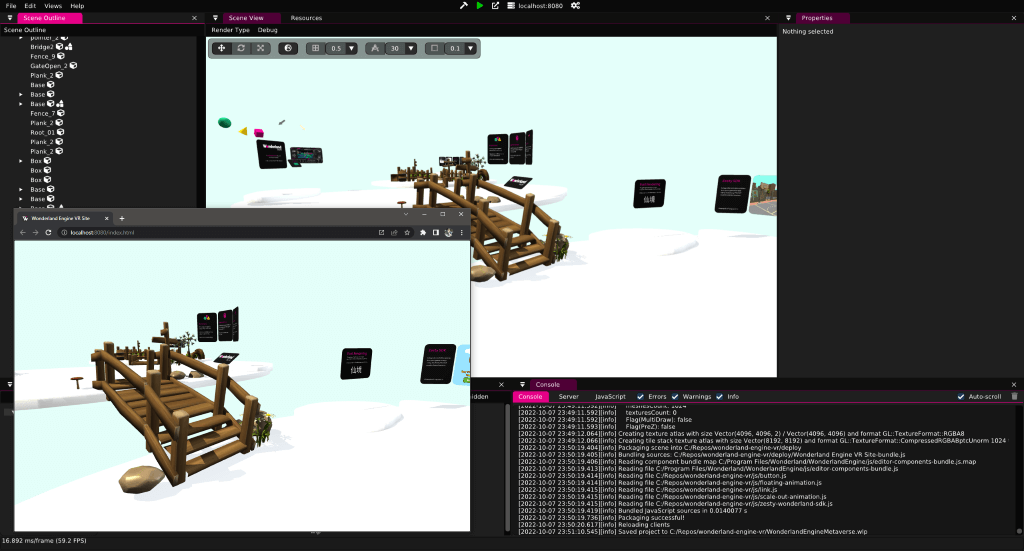
WebXR development platform Wonderland Engine editor vr website with browser

Vhite Rabbit XR and Paradowski Creative, two companies creating XR games, used the engine to develop content. The Escape Artist, an upcoming title by Paradowski Creative, is created with Wonderland Engine 1.0.p0, and its developers say that it matches native games in terms of polish and quality.

“We’re excited to announce this foundational version of Wonderland Engine, as we seek to bridge the gap between native XR app development and WebXR,” said the CEO and founder of Wonderland, Jonathan Hale, in a press release shared with ARPost. “We see a bright future for the WebXR community, for its developers, hardware, support, and content.”

Top Features of Wonderland Engine 1.0.0

The developers who choose Wonderland GmbH’s WebXR development platform to create content will be able to use the following:

  • Full 8th Wall integration – complete integration of 8th Wall AR tracking features such as face tracking, image tracking, SLAM, and VPS;
  • Runtime API rewrite – better code completion, static checks for bugs before running the code, and complete isolation for integration with other libraries;
  • Translation tools – necessary for the localization of WebXR content;
  • Benchmarking framework – to check for content performance on various devices.

Developers can find the complete list of features and bug fixes on the official release page.

According to the company, Wonderland Engine users can launch their first running app into the browser in less than two minutes. With a bit of experience, users can build a multi-user environment that supports VR, AR, and 3D in 10 minutes, as demonstrated in this video.

The XR Development Platform Is Optimized for VR Browsers

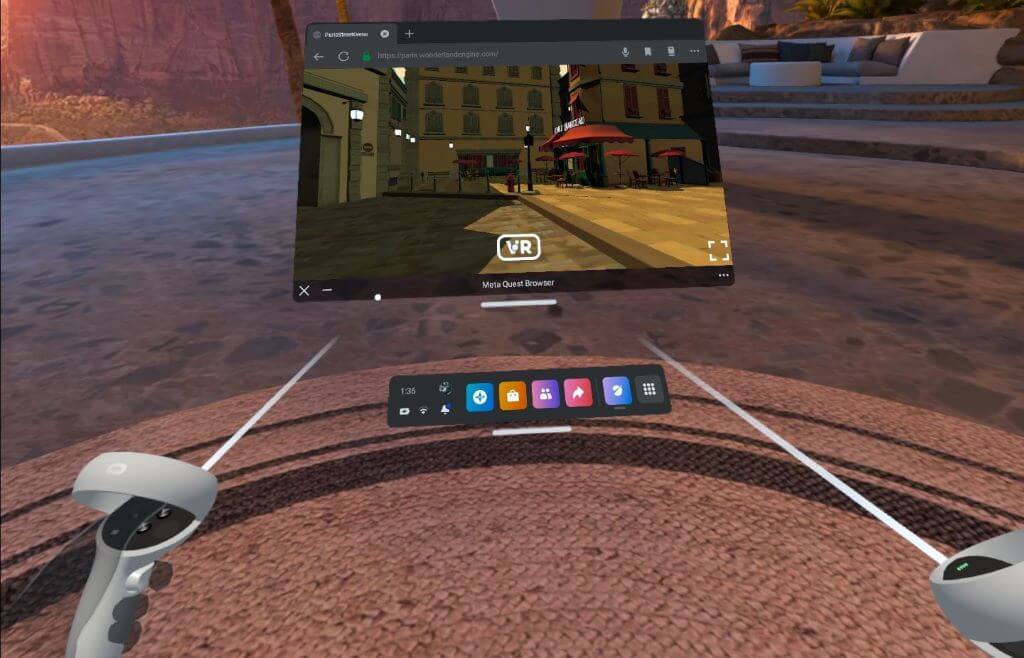
To indicate their commitment to helping content creators, Wonderland GmbH is optimizing their tool specifically for the most popular VR browsers: Meta Quest Browser, Pico Browser, and Wolvic.  

Wonderland Engine WebXR meta browser

Wonderland Engine-based apps support any headset that has a browser available. Also, any headset released in the future will automatically be supported, if it has a browser. Apps created with Wonderland Engine can also run on mobile devices through the browser, as Progressive Web Apps (PWA), which also allows them to run offline.

Apart from the two game development companies mentioned above, the company is also working with various content creators.

“It was crucial to bring the whole ecosystem with us to test and validate the changes we made. This resulted in a highly reliable base to build upon in upcoming versions,” Hale said. “By making it easier to build XR on the web we hope to attract developers and content creators to WebXR. We see WebXR truly being able to rival native apps and offer consumers a rich world of rapidly accessible content to enjoy.”

Meet the Wonderland Team at AWE USA 2023

The creators of Wonderland Engine 1.0.0 will present the WebXR development platform at AWE USA 2023 (use ARPost’s discount code 23ARPOSTD for 20% off your ticket), which is taking place in Santa Clara, CA between May 31 and June 2.

The company is one of the sponsors of the event and will also be present at the event in booth no. 605.

Wonderland Engine Is Here to Make WebXR Development Faster and Easier Read More »

aruvr-releases-no-code-content-creation-platform-for-xr-headsets

ARuVR Releases No-Code Content Creation Platform for XR Headsets

UK-based ARuVR (formerly VRtuoso) enterprise XR training platform has recently announced that it supports no-code content creation, distribution, and management for XR headsets. Thus, companies can now create extended reality training programs for VIVE XR Elite, Meta Quest Pro, and Pico 4 Enterprise without writing a single line of code.

Accessibility of AR/VR Creation Is the Latest Industry Trend

For some time now, creating AR/VR content is no longer conditioned by having coding skills. While developers are still very much in demand for high-end games and applications, there is a movement towards making the creation process accessible for all.

ARuVR puts another important building block to the foundation of this process with its no-code XR platform. Users can rely on the simple drag-and-drop process to create immersive training for employees, which can now also be experienced on extended reality headsets.

Immersive Training Is the New Norm

So far, ARuVR has attracted a roster of top clients, such as PwC, Coca-Cola, BT, and BAE Systems. These companies, and many others, rely on ARuVR’s training platform to create onboarding presentations for employees and ongoing training for staff.

The nature of AR/VR training makes it possible for international companies to create and deploy the same training for teams in various places around the globe. This ensures consistent compliance with the latest policies and best practices. Any other training method is subject to errors, human or otherwise.

With the no-code XR platform, any professional in charge of employee training can create interactive programs, test them and deploy them without a developer’s assistance.

The No-Code XR Platform Is Optimized for Enterprise Headsets

ARuVR is working together with headset producers who supply companies with enterprise-grade devices. Thus, the no-code XR platform is fully compatible with the most popular devices for corporate training, namely: HTC VIVE XR Elite, Meta Quest Pro, and Pico 4 Enterprise.

Speaking about the importance of the new training platform, Nathan Gaydhani, the Enterprise Product Owner EMEA at HTC VIVE said in a press release shared with ARPost:

“XR has the power to change how a business operates, creating and delivering highly realistic experiences to recruit, engage, upskill, or retain its workforce. Combining the great hardware of VIVE XR Elite, and powerful software like ARuVR’s platform means that advanced transformative technology is accessible to any organization.”

The Ultimate Goal: Facilitating Learning

For ARuVR, their new product is one step forward towards the goal of making training and transfer of knowledge faster and more accurate. This will ensure the success of companies, through more consistent training of their employees.

“As the first training platform to add no-code capability to our patented platform for the world’s leading XR headsets, we are ensuring that technical expertise is not a limiting factor to the roll-out of XR training programs,” said the founder and CEO of ARuVR, Frank Furnari. “Now anyone within an organization can easily become a creator of powerful and immersive training and deploy to anyone, anywhere throughout the enterprise.”

ARuVR Releases No-Code Content Creation Platform for XR Headsets Read More »

arcade-boxer-‘creed:-rise-to-glory’-takes-top-spot-in-psvr-2-download-chart

Arcade Boxer ‘Creed: Rise to Glory’ Takes Top Spot in PSVR 2 Download Chart

PlayStation VR 2 is a little over two months old now, and the charts are still very much in flux thanks to a rash of new and upgraded games. Last month, Survios’ high-profile boxing title took the top spot in the US and Canada, and fared pretty well across other regions too.

Creed: Rise to Glory – Championship Edition is an overhauled version of Creed: Rise to Glory (2018) for PSVR 2, bringing new characters and a new location from the Creed III film in addition to new features, quality of life upgrades and PvP cross-platform support.

There’s a ton of movement in the charts, so we’ve included some new symbols to help show just how the games are faring month-to-month.

The chart below is counting PS Store purchases and not bundled or upgraded content, which notably includes big titles such as Horizon Call of the MountainGran Turismo 7, and Resident Evil Village.

PSVR 2 April Top Downloads

US/Canada EU Japan
1 Creed: Rise to Glory – Championship Edition (new) Pavlov (≡)

Kayak VR: Mirage (≡)

2 Pavlov (↓1) Creed: Rise to Glory – Championship Edition (new)

Creed: Rise to Glory – Championship Edition (new)

3 The Walking Dead: Saints & Sinners – Chapter 2: Retribution (↑1) Kayak VR: Mirage (↓1)

Onogoro Monogatari ~The Tale of Onogoro~ (↑4)

4 Job Simulator (↑6) The Walking Dead: Saints & Sinners – Chapter 2: Retribution (↓1)

LES MILLS BODYCOMBAT (↑?)

5 Kayak VR: Mirage (↓2) Job Simulator (↑5)

Horizon Call of the Mountain (↓2)

6 The Dark Pictures: Switchback (↓4) The Dark Pictures: Switchback (↑?)

The Dark Pictures: Switchback VR (↓4)

7 Star Wars: Tales from the Galaxy’s Edge (↓2) Star Wars: Tales from the Galaxy’s Edge (↓3)

After the Fall – Complete Edition (↑?)

8 Synth Riders (↑?) Synth Riders (↓1)

Dyschronia:Chronos Alternate Episode I (↓4)

9 PISTOL WHIP (↓3) Swordsman VR (↓1) Swordsman VR (↑1)
10 Swordsman VR (↓2) PISTOL WHIP (↓4) Drums Rock (↓6)

Arcade Boxer ‘Creed: Rise to Glory’ Takes Top Spot in PSVR 2 Download Chart Read More »

revitalising-european-democracy:-ai-supported-civic-tech-on-the-rise

Revitalising European democracy: AI-supported civic tech on the rise

Revitalising European democracy: AI-supported civic tech on the rise

Linnea Ahlgren

Story by

Linnea Ahlgren

According to a study by the International Institute for Democracy and Electoral Assistance (IDEA) released late last week, digital technologies will become an increasing factor in European democracy in the coming decade. This is perhaps not entirely surprising; after all, the pandemic shifted much of our lives into the digital realm, why shouldn’t our political participation?

The report, based on interviews with more than 50 government and industry representatives, finds that the market for online participation and deliberation in Europe is expected to grow to €300mn in the next five years, whereas the market for e-voting will grow to €500mn. The respondents also state that there is a “window of opportunity” for European providers of democracy technology to expand beyond Europe.

Authors of the report further believe that digital democracy technology can support outreach to demographics that may otherwise be difficult to reach, such as youth and immigrant communities. This also includes broader populations under difficult circumstances, such as those brought on by the pandemic and Russia’s war of aggression against Ukraine. 

“In case of war, electronic democracy tools have to be even stronger. Because we understand we have to live for the society and give citizens tools,” said Oleg Polovynko, Director of IT at Kyiv Digital, City Council of Kyiv, and one of the speakers at the TNW Conference 2023

Not without controversy

Digital democracy refers to the use of digital technologies and platforms to enhance democratic processes and increase citizens’ participation in government decision-making. This is also referred to as civic tech (not to be confused with govtech, which focuses on technologies that help governments perform their functions more efficiently).

Examples of tools include online petitions, open data portals, and participatory budgeting systems, where citizens come together to discuss community needs and priorities and then allocate public funds accordingly. 

In a best-case scenario, it has the potential to reinvigorate democracy by allowing citizens to participate from anywhere at any time. In a worst-case scenario, it could be used for disinformation or just plain good old online toxic behaviour. 

Furthermore, the discussion of a potential ‘digital divide – who will benefit and who will be excluded due to access or lack thereof to technology – is not one that is easily settled. 

Inviting AI into collective decision making

IDEA states that there are more than 100 vendors in Europe in the online participation, deliberation and voting sector, most of whom are active on a national level. The majority of those operating internationally are startups with between 10 and 60 employees, but expanding quickly.

Many of these democracy technology platforms have already begun taking advantage of the recent step-change developments in artificial intelligence to introduce new features or enhance existing ones. 

“We foresee a future where citizens and AI collaboratively engage with governments to address intricate social issues by merging collective intelligence with artificial intelligence,” Robert Bjarnason, co-founder and President of Citizens.is tells TNW. 

We advocate for a model in which citizens work alongside powerful AI systems to help shape policy, rather than allowing centralised government AI models to exert excessive influence.

Following the collapse of Icelandic banks in 2008, distrust of politicians was at an all-time high in the Nordic island nation. Together with a fellow programmer, Gunnar Grímsson, Bjarnasson created a software platform called Your Priorities that allows citizens to suggest laws and policies that can then be up- or down-voted by other users. 

Just before local elections in 2010, the open-source software was used to set up the Better Reykjavik portal. Five years later, a poll on the site managed to name a street in the Icelandic capital after Darth Vader (well, his Icelandic moniker of Svarthöfði, or Black-cape, which already fitted well with the names of the streets in the area). 

Of course, there have been much ‘weightier’ decisions influenced by the platform, such as crowdsourcing ideas on how to prioritise the City’s educational objectives.

Thus far, over 70,000 of the capital’s inhabitants have engaged with Better Reykjavik. Pretty impressive for a population of 120,000. Furthermore, Your Priorities has been trialled in Malta, Norway, Scotland, and Estonia. 

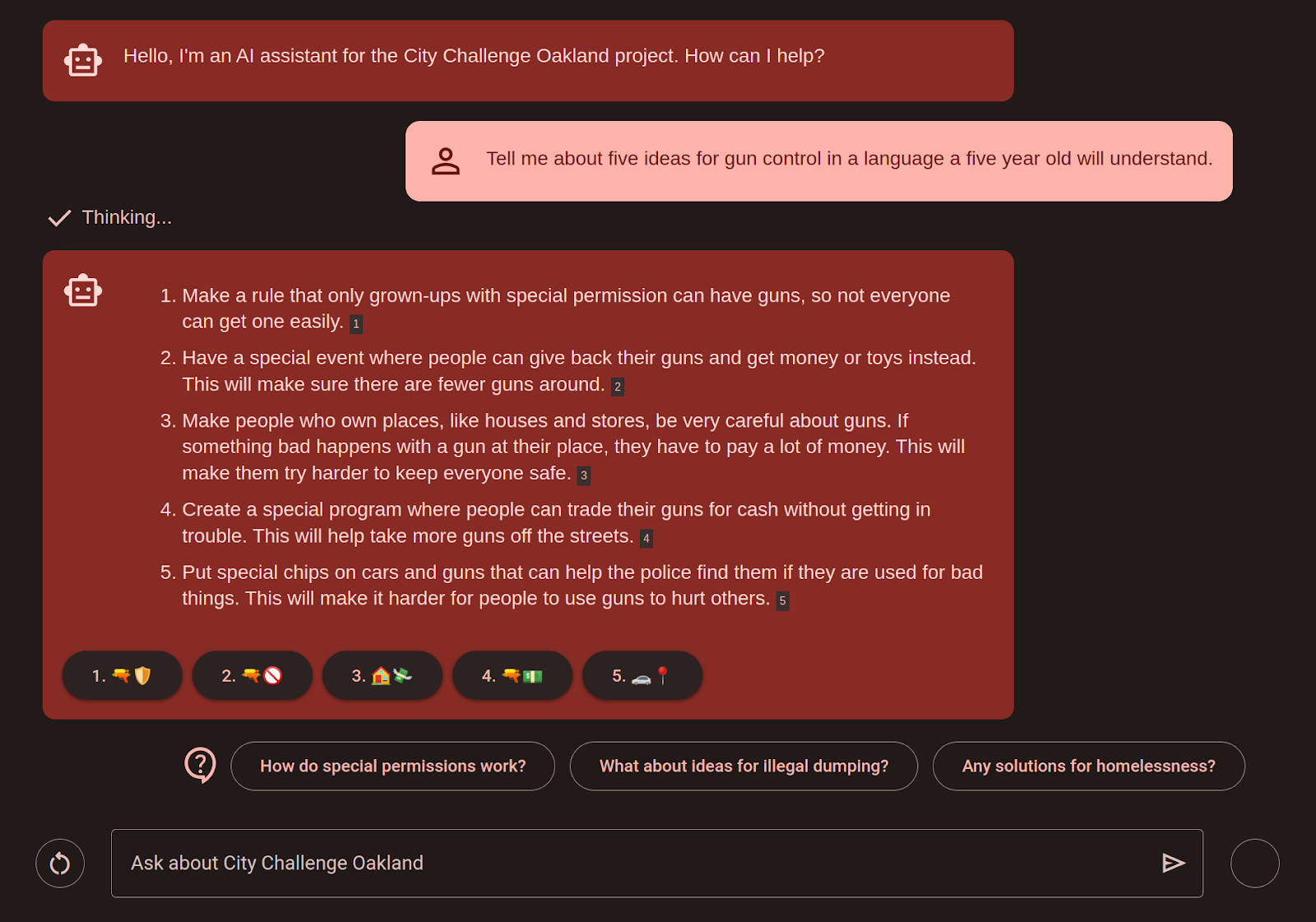
The Baltic tech-forward nation has adopted several laws suggested through the platform, which features a unique debating system, crowdsourcing of content and prioritisation, a ‘toxicity sensor’ to alert admins about potentially abusive content – and extensive use of AI. In fact, Citizens.is recently entered into collaboration with OpenAI, and has deployed GPT-4 for its AI assistant – in Icelandic. 

GPT-4 now empowers digital democracy and collective intelligence in Iceland 🤖❤️ Thnx to a collaboration btw @OpenAI, the government, and Miðeind, we’re launching our AI assistant in Icelandic. Thanks @sama, @gdb, @vthorsteinsson, @cohere, @langchain, @weaviate_io & @buildWithLit pic.twitter.com/LNxAAFe2nf

— Citizens Foundation (@CitizensFNDN) March 19, 2023

Don’t worry if the language barrier felt a little steep. Citizens.is has been kind enough to provide TNW with a screenshot of the company’s AI assistant in action from a project in Oakland, California. 

Screenshot of OpenAI chatbot conversation
Credit: Citizens.is

Other examples of civic tech focused companies in Europe include Belgium-founded scaleup CitizenLab, which now works with more than 300 local governments and organisations across 18 countries, and Berlin-based non-profit Liquid Democracy. Liquid’s open source deliberation and collaborative decision-making Adhocracy+ software platform also helps facilitate face-to-face meetings throughout the timeline of participation projects. 

Gaining the trust of the citizen

The main product trends identified in the IDEA study are: artificial intelligence, voting, and administration and reporting. Meanwhile, it also found that it is important to address issues around inclusiveness, data usage, accountability and transparency, and to develop security standards for end-to-end verified voting.

One solution proposed is the introduction of a Europe-wide quality trust mark for democracy technologies. 

“If a citizen can trust the banking application to make transactions, then equivalently our service can be trusted to make the citizen’s voice heard,” stated Nicholas Tsounis, CEO of online voting platform Electobox. “We want people to trust this application because we know that it is there for them to protect the right to speak and vote.” 

Get the TNW newsletter

Get the most important tech news in your inbox each week.

Also tagged with


Revitalising European democracy: AI-supported civic tech on the rise Read More »

spanish-island-builds-‘giant-water-battery’-to-boost-energy-security

Spanish island builds ‘giant water battery’ to boost energy security

Spanish island builds ‘giant water battery’ to boost energy security

Siôn Geschwindt

Story by

Siôn Geschwindt

Gran Canaria is perhaps best known for its sandy beaches, eternal sunshine, and volcanic past. But isolated far from the European mainland, the island relies heavily on imported fossil fuels to power its growing economy — 76% of its electricity comes from burning oil. 

In an effort to decarbonise, the government has been investing heavily in renewable energies to harness the island’s abundant wind and solar resources. In 2022, renewables made up 24% of the island’s energy mix, up from just 12% in 2018. But as more renewables come online, the island faces another problem: storage.   

Last year, the government invested €400m in the Canary Islands’ first-ever energy storage scheme, to stabilise the grid when the wind isn’t blowing or the sun isn’t shining. This project won’t build battery packs, however, but convert two existing dams into one giant water battery.

Salto de Chira, as the ‘pumped hydro’ project is known, will pump water from the Soria dam into the Chira dam — which sits at a higher elevation — during periods of low energy demand. During periods of high energy demand, water will be released from Chira, down a tunnel, over a set of turbines, and back into Soria. And the cycle continues.

How pumped hydro works. Credit: MBIE

Pumped hydro is often referred to as a ‘giant water battery’ because it can store and release power on demand. According to the International Energy Agency, it is still the most widely deployed storage technology today, accounting for over 90% of global energy storage capacity. 

When it comes online in 2027, the Salto de Chira project is expected to generate up to 200MW of power at times of high demand, equivalent to more than a third of the island’s needs. Last week, Spain’s grid operator Red Eléctrica selected GE Energy to supply the turbines for the plant, in another step forward for the scheme. 

According to Red Eléctrica,  the project will increase the island’s share of renewables from 24% to 51% and save €122m a year in imported fossil fuel. It is also expected to create more than 4,300 jobs, of which around 3,500 will be on Gran Canaria itself.  

President of the Canary Islands, Ángel Víctor Torres, called the project a “great boost” to the archipelago’s ambitions of fully decarbonising its economy by 2040, ten years ahead of the targets set by the EU. 

“Energy storage is going to be one of the key elements in the energy transition, both for its contribution to electrification and for its capacity to enable enhanced management of renewable energy, which is especially important in non-interconnected systems such as the islands,” he said.  

The Soria dam is the only arch dam built on the Canary Archipelago, and standing at a lofty 132 metres is among the highest dams in Spain.

The Canary Islands has ramped up its decarbonisation efforts significantly in the last five years. The archipelago’s largest renewable energy complex, comprising eight wind farms and 12 solar plants, was inaugurated in 2022 and provides enough energy for around 54,000 households. 

Spain’s government and the European Union also recently announced plans to provide 20m in funding to support the development of 65 new solar projects across the Canary Islands by the end of next year. The archipelago is also exploring alternatives such as wave energy, with the first such pilot project launched in February,led by Danish startup Wavepiston.

Key to the success of all these projects, says one study, will be the deployment of sufficient energy storage solutions to stabilise the grid during peak demand, and the construction of sea cables to connect the islands. Pumped hydro seems to be taking care of the former, while the latter is gaining momentum with the first of many power links now under construction to connect Tenerife and La Gomera. The links are expected to decrease the cost of electricity for taxpayers and improve energy security in the archipelago.  

As European countries decarbonise their energy systems, adopting energy storage solutions to balance the intermittent supply of renewable energy and increase energy security is becoming increasingly urgent. According to the European Association for Storage of Energy (EASE), the EU will need 200GW of energy storage by the end of the decade and 600GW by 2050.  

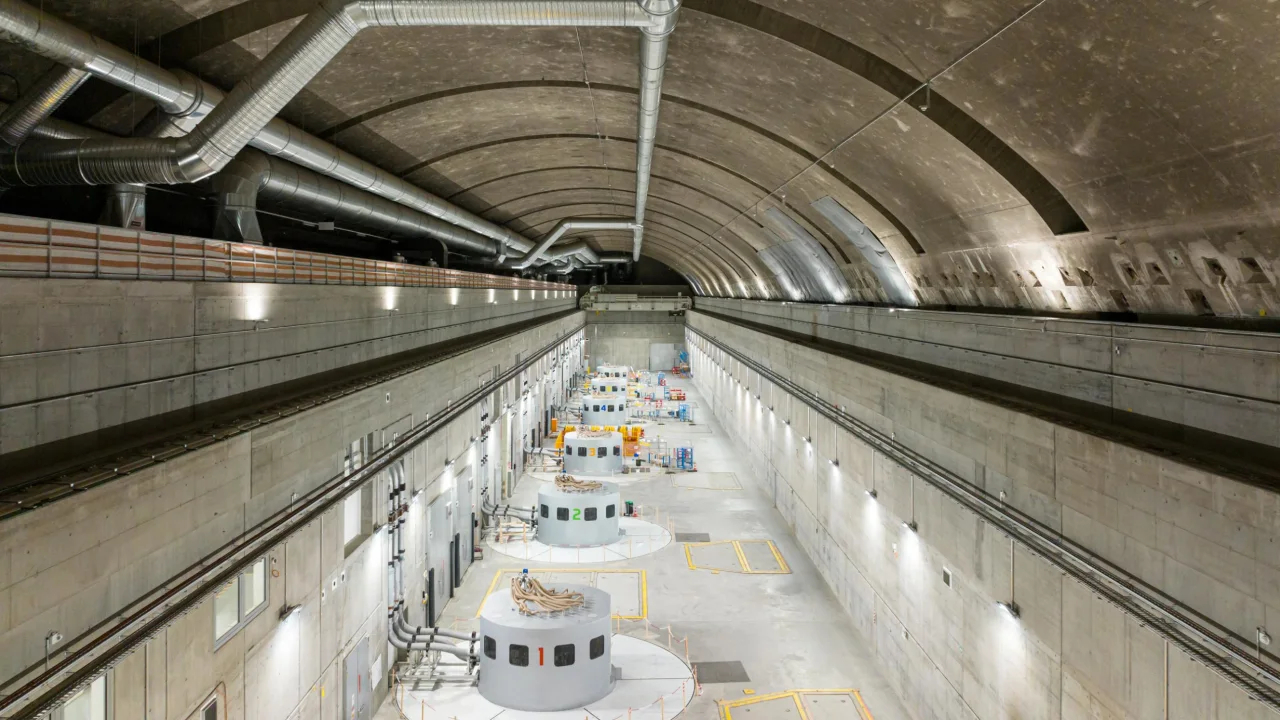
Switzerland is one of Europe’s leaders in pumped hydro technology. This is a view from inside its latest plant, which opened at the end of 2022. The turbines are stored in an underground cavern the length of two football fields. Credit: Nant de Drance/Sébastien Moret

A new industry coalition launched last week aims to promote sustainable energy storage technologies like batteries, hydrogen, and pumped hydro in order to reach these targets. 

“Energy storage is key to building a future-proof, resilient, and decarbonised energy system,” said EU energy chief Kadri Simson at the launch. 

Pumped hydro projects can be controversial, however, particularly when they involve dams on rivers that flood land to create new reservoirs and affect ecosystems. But as highlighted in an article published in The Conversation last year, most pumped hydro projects do not require the building of new dams, but the retrofitting of existing ones, as is the case with the Gran Canaria project.  

Either way, the IEA’s landmark 2021 Net Zero by 2050 report estimates that an additional 1300GW of hydropower is required if we are to meet the climate targets outlined in the Paris Agreement. This is double the current global capacity.

Get the TNW newsletter

Get the most important tech news in your inbox each week.

Also tagged with


Spanish island builds ‘giant water battery’ to boost energy security Read More »

talespin-releases-ai-powered,-web-accessible-no-code-creator-platform

Talespin Releases AI-powered, Web-Accessible No-Code Creator Platform

To prepare professionals for tomorrow’s workplace, you need to be able to leverage tomorrow’s technology. Talespin was already doing this with their immersive AI-powered VR simulation and training modules.

Now, they’re taking it a step further by turning over a web-based no-code creator tool. To learn more, we reconnected with Talespin CEO Kyle Jackson to talk about the future of his company and the future of work.

The Road So Far

Talespin has existed as an idea for about ten years. That includes a few years before they started turning out experiences in 2015. In 2019, the company started leveraging AI technology for more nuanced storytelling and more believable virtual characters.

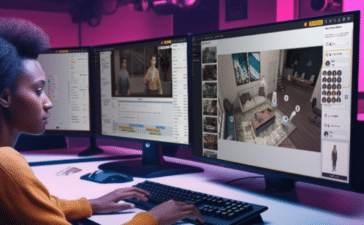
CoPilot Designer 3.0 Talespin

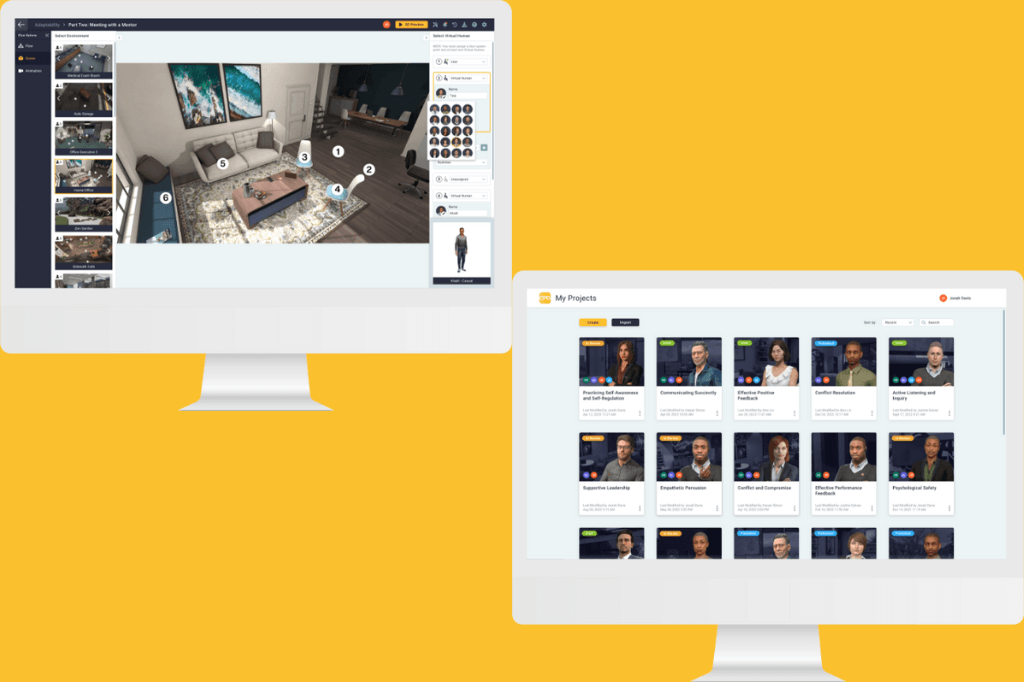
CoPilot Designer, the company’s content creation platform, released in 2021. Since then, it’s gone through big and small updates.

That brings us to the release of CoPilot Designer 3.0 – probably the biggest single change that’s come to the platform so far. This third major version of the tool is accessible on the web rather than as a downloaded app. We’ve already seen what the designer can do, as Talespin has been using it internally, including in its recent intricate story world in partnership with Pearson.

“Our North Star was how do you get the ability to create content into the hands of people who have the knowledge,” Jackson told ARPost this March. “The no-code platform was built in service of that but we decided we had to eat our own dogfood.”

In addition to being completely no-code, CoPilot Designer 3.0 has more AI tools than ever. It also features direct publishing to Quest 2, PC VR headsets, and Mac devices via streaming with support for Lenovo ThinkReality headsets and the Quest Pro coming soon.

Understanding AI in the Designer

The AI that powers CoPilot Designer 3.0 comes in two flavors – the tools that help the creator build the experience, and the tools that help the learner become immersed in the experience.

More generative 3D tools (tools that help the creator build environments and characters) is coming soon. The tools really developing in this iteration of CoPilot Designer are large language models (LLMs) and neural voices.

Talespin CoPilot Designer 3.0

Jackson described LLMs as the context of the content and neural voices as the expression of the content. After all, the average Talespin module could exist as a text-only interaction. But, an experience meant to teach soft skills is a lot more impactful when the situations and characters feel real. That means that the content can’t just be good, it has to be delivered in a moving way.

The Future of Work – and Talespin

While AI develops, Jackson said that the thing that he’s waiting for the most isn’t a new capability of AI. It’s trust.

“Right now, I would say that there’s not much trust in enterprise for this stuff, so we’re working very diligently,” Jackson told ARPost. “Learning and marketing have been two areas that are more flexible … I think that’s going to be where we really see this stuff break out first.”

Right now, that diligence includes maintaining the human component and limiting AI involvement where necessary. Where AI might help creators apply learning material, that learning material is still originally authored by human experts. One day AI might help to write the content too, but that isn’t happening so far.

“If our goal is achieved where we’re actually developing learning on the fly,” said Jackson, “we need to be sure that what it’s producing is good.”

Much of the inspiration behind Talespin in the first place was that as more manual jobs get automated, necessary workplace skills will pivot to soft skills. In short, humans won’t be replaced by machines, but the work that humans do will change.

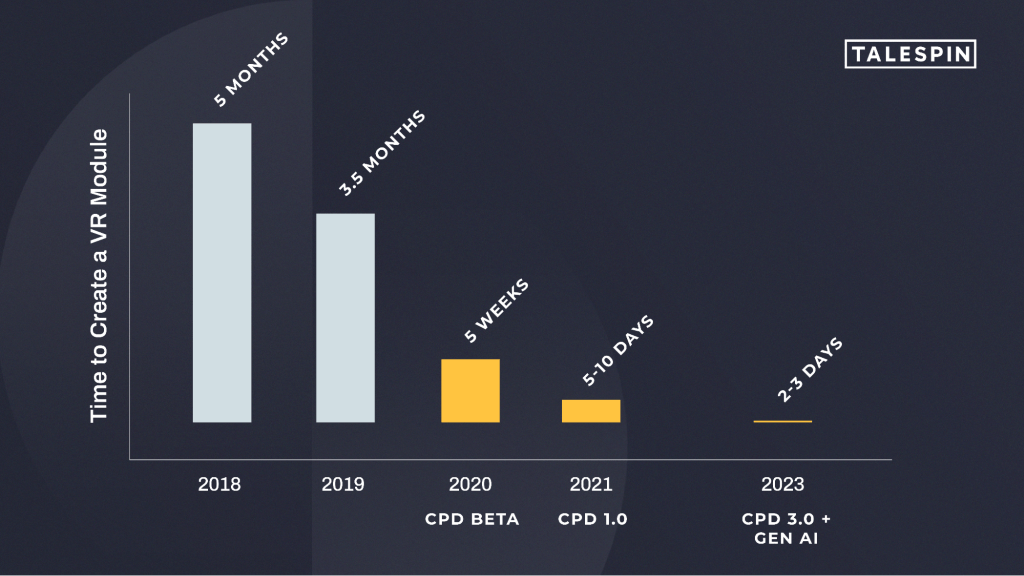
As his own company relies more on AI for content generation, Jackson has already seen this prediction coming true for his team. As they’ve exponentially decreased the time that it takes for them to create content, they’re more able to work with customers and partners as opposed to largely serving as a platform to create and host content that companies made themselves.

Talepsin CoPilot Designer 3.0 - XR Content Creation Time Graph

Solving the Content Problem

To some degree, Talespin being a pioneer in the AI space is a necessary evolution of the company’s having been an XR pioneer. Some aspects of XR’s frontier struggles are already a thing of the past, but others have a lot to gain from leaning on other emerging technologies.

“At least on the enterprise side, there’s really no one doubting the validity of this technology anymore … Now it’s just a question of how we get that content more distributed,” said Jackson. “It feels like there’s a confluence of major events that are driving us along.”

Talespin Releases AI-powered, Web-Accessible No-Code Creator Platform Read More »

an-effort-to-hack-psvr-2-to-support-pc-vr-has-been-put-on-indefinite-hold

An Effort to Hack PSVR 2 to Support PC VR Has Been Put on Indefinite Hold

The creator of a PC VR driver which includes support for the original PSVR 1 headset says it is are stepping away from hacking PSVR 2 to work with PC VR, citing frustrating technical, financial, and social challenges.

Mediator Software, the developer of a PSVR-to-PC SteamVR driver called iVRy, says it is putting efforts to hack PSVR 2 for PC VR compatibility on hold. Just days after saying it had managed to authenticate PSVR 2 on PC, the developer says the project is now on ice.

“I’m walking away from this project for the time being. Between spiralling costs, a never ending set of obstacles put forward by the PSVR2, unrealistic hype in blogs, abusive commenters and accusations of fraud, it has ceased to be fun. I’ll be back. Some time,” reads the announcement.

The creators also shared screenshots showing what kind of social media strife they were facing, apparently with regards to Mediator Software seeking financial support for the project from the community.

Aside from the social challenges, struggling to get PSVR 2 working on SteamVR isn’t surprising. Despite their best efforts, the iVRy developers themselves previously said it was “unlikely” that PSVR 2 would be useable for PC VR “within five years of its release,” if ever.

That’s a shame considering PSVR 2 is one of the market’s best consumer headsets to date, and even has the basic ability to act like a proper display when plugged into a PC.

While we’d love to see PSVR 2 work with PC VR, the reality is that Sony has little incentive to let it happen.


Thanks to our pal Daniel Fearon for the tip!

An Effort to Hack PSVR 2 to Support PC VR Has Been Put on Indefinite Hold Read More »

ea’s-‘f1-23’-racer-coming-to-pc-vr-headsets-next-month,-psvr-2-still-uncertain

EA’s ‘F1 23’ Racer Coming to PC VR Headsets Next Month, PSVR 2 Still Uncertain

Codemasters, the EA-owned developer behind the F1 racing franchise, announced F1 23 is coming to consoles and PC next month, again bringing its high-profile racing game to VR.

F1 23 is coming to PlayStation 4|5, Xbox Series X|S, Xbox One and PC on June 16th, which is confirmed to include VR support on PC.

Codemasters hasn’t said whether it’s also coming to PSVR 2 on PS5, so we’ll just have to wait and see. As it is now, F1 22 only supports PC VR headsets, and not PSVR.

Here’s how the studio describes the upcoming installment:

A new chapter in the thrilling “Braking Point” story mode delivers high-speed drama and heated rivalries. Race wheel-to-wheel at new Las Vegas and Qatar circuits, and earn rewards and upgrades in F1 World. New Red Flags add an authentic strategic element, and the 35% Race Distance feature delivers more action and excitement. Drive updated 2023 cars with the official F1 lineup of your favorite 20 drivers and 10 teams. Create your dream team and race to win in My Team Career Mode, compete in split-screen or in the expanded cross-platform multiplayer, and be more social with new Racenet Leagues.

Preorders are now available, priced at $70 across Steam, Epic Games, and EA Play.

EA’s ‘F1 23’ Racer Coming to PC VR Headsets Next Month, PSVR 2 Still Uncertain Read More »

one-of-vr’s-most-hardcore-apocalyptic-survival-games-is-getting-a-sequel

One of VR’s Most Hardcore Apocalyptic Survival Games is Getting a Sequel

Into the Radius is a cult favorite for a reason, as it offers up some of the most hardcore gameplay in a very Stalker-inspired post-apocalyptic world, making for an absolutely unforgiving experience in the anomaly-ridden wasteland. Now developers CM Games say a sequel is in the works.

In a community update, CM Games says a second chapter to Into the Radius is currently being developed.

“We are in the pre-production phase, and will follow an Early Access development model like before when the time is right,” the studio says. “The original [Into the Radius] is a testament to how much our community has helped us in developing the game, and we want to continue this trend in the sequel.”

The studio says many user suggestions and ideas are currently being considered for the newest installment, although they’re not revealing anything beyond that right now. Into the Radius is currently available on SteamVR and Quest 2. The developers have said in the past that it’s also in development for other headsets, although there’s still no word on whether it’s coming to PSVR 2.

We’ll be following Into the Radius and its upcoming seqeuel via the game’s Discord (invite link), as CM Games is due to publish an FAQ soon that may answer more questions about the next chapter.

One of VR’s Most Hardcore Apocalyptic Survival Games is Getting a Sequel Read More »

‘propagation:-paradise-hotel’-review-–-a-pretty-ok-impression-of-‘resident-evil’

‘Propagation: Paradise Hotel’ Review – A Pretty Ok Impression of ‘Resident Evil’

Propagation: Paradise Hotel offers some patently terrifying moments of horror, but between the ever-lingering danger of zombified attacks and a few giant bosses—making for a very Resident Evil-inspired experience—there’s a bit of clunk that tarnishes what could have been a more memorable and cohesive experience. Still, it’s functionally a pretty solid zombie adventure that makes a clear departure from the franchise’s roots as a static wave shooter.

Propagation: Paradise Hotel Details:

Available On:  SteamVR, Quest

Release Date:  May 4th, 2023

Price: $20

Developer: WanadevStudio

Reviewed On:  Quest 2 via PC Link

Gameplay

It’s the zombie apocalypse, and you’re bumming around the bowels of a non-descript hotel in some non-descript part of the world. You won’t have a lot of time to hang with your fatherly security guard pal though because you have to go and find your sister, who is gone for some reason. Okay, so the setup isn’t spectacular, but at least the zombie kill’n is pretty good, right? I’ll lead with an emphatic “yeah, mostly!”

Rule number one of zombies: shoot them in the head. That’s the ironclad directive you’re probably most familiar with, but there are some caveats in Propagation: Paradise Hotel. Shooting zombies in the head multiple times with a pistol makes them very sleepy. No, really. Shoot a zombie three times in the head and they’ll quietly lay down on the ground for a while. Sometime later, usually when you’ve tripped another lurch forward in the narrative, he’ll pop back up at a patently inopportune time to bother you once again.

As clear of a departure from zombie orthodoxy this is, the effect it had on me was something I can’t say I’ve felt in a zombie shooter before. Instead of worrying about walkers popping out from the ceiling (there are a few) or shambolically oozing out from closed doors or windows, you become much more fixated on every single corpse laying in the hallway, of which there are many. You aren’t roaming through an infinite hellscape either, as you’ll be backtracking, learning the layout of the hotel, and tip-toeing around zombies whilst pointing a gun in their face, lest they reawaken and start harassing you again.

Image courtesy WanadevStudio

In effect, any one of them could be waiting for you to lower your guard, open their eyes and grab onto your ankle. Sadly, a preemptive shot in the head is completely ineffectual, which is a letdown in the Immersion department, but more on that below. Just the same, you’ll be cautious because you can’t discount a single corpse, which is a new type of creepy that really kept me on edge. Knowing this, I would have loved the option to cut off some heads to put an end to the contant revisitations, but that’s just not in the cards.

That’s basically the case until you get a shotgun in the latter half of the game, and then those walkers lay down for good because you’ve effectively stumpified their infected brains (finally). What was previously one-on-one battles ramp up to three-on-one battles, putting the game’s only other gun (and most powerful) to the test. You’ll also start to rush through a few new classes of zombie in addition to some more difficult baddies, which offers some interesting variety in difficulty. Will you run into three walkers? One scorpion-style zombie? A ripped dude that can take a ton of shots to the face?

Image courtesy WanadevStudio

While there are a few difficult and unique zombies, there’s really only one true boss in the game. Full disclosure: I disliked it, and while I won’t spoil anything here, rest assured you’ll probably be frustrated too with how to take him down. He is ultra lame, and you’ll want to mute the game just so you don’t have to hear your character constantly shout ad nauseum “I need to knock him out!”

Ok. No. I will spoil the boss. Skip this paragraph if you want to avoid the spoiler: What does “I need to knock him out” even mean?? Don’t I need to kill this bastard? Do I need to knock him out before I kill him? Is that a hint? Do I need something to do that? Maybe I need to call the elevator and rig up something to knock him out? Maybe I need to escape the lobby and head up the stairs to get something I missed? Maybe I need to explode a fire extinguisher in his face to knock him out? Nope. My hand phases right through those, so it can’t be that. Maybe I need to die a dozen times before I learn he has a specific attack pattern with a singular weak point, hit it three times and meander my way to sequel-bait then the end credits? Yup, that’s it.

Anyway, many of the mechanical bits of Propagation: Paradise Hotel are very functional, and work well. The body-based inventory system isn’t overloaded, so you always have what you need, like a medical spray on your left flank, a flashlight that you can clip to your chest or hold in your hand, your 9mm pistol on your right, or the shogun over your shoulder. It’s all there and easy to grab. This compliments a 2D menu that you can pull up, which as mission-essential items, the map, settings, etc.

It’s not easy changing up a user’s expectation of level design when we all know what to expect more or less in a space as familiar as a hotel. Still, the game throws a few curveballs your way to keep you from mechanically looking through every room in the hotel, which spans seven levels. Still, the story itself didn’t feel like a compelling enough driver to keep you moving forward. The found notes add a little flavor, but don’t do enough to flesh out the background of what’s actually going on, leaving you to mostly just bump your head against each task until its complete so you can move onto the next.

Finally, the game, which took me around 3.5 hours to complete, also includes a few puzzles, although all solutions are published in found notes, so you just have to be thorough in your shelf-opening game.

Immersion

Everything about Propagation looks the part, but very little is actually interactable, making it feel more like a flatscreen game than it probably should. There are a few key items you can pick up and use, but everything else is pure set dressing. I don’t want to underplay just how good the game looks, as it offers a visual acuity and variety that makes each room unique, and not at all the sort of copy-paste experience you’d logically expect from a motif that is basically supposed to look extremely uniform. Still, you can’t grab that fire extinguisher, or even pick up a bottle of detergent. You can only open doors and drawers, and interact with keys, key cards, and important notes.

That already feels pretty gamey enough, but just as things start getting good, you grab for an item and a big achievement pops up to ruin the atmosphere—because apparently you need to be constantly reminded that you just collected nine out of 30 secret items. I’d like my full field of view please, since I’m under constant threat of death and everything.

Image captured by Road to VR

One of the big narrative drivers is the game’s found notes, and I generally like the mechanic for its ability to either drive the narrative or unobtrusively flavor its back story. In VR, they can be especially immersive since you’re handling something that’s more of a physical artifact than just a bunch of text on a screen. This is where Propagation fails somewhat, as all notes feature a physical ‘next’ button at the bottom that you have to click, making it more like interacting with an eReader than something that was actually written by someone who lived, survived, and maybe even died in the hotel.

Maybe the notes could be shorter? Maybe they could have used the back of the paper? Maybe a different font? Whatever the case, interacting with a piece of paper shouldn’t feel this unnatural in a VR game.

Image captured by Road to VR

And the wacky unorthodoxy doesn’t stop there. While reloading weapons is a pretty standard experience, the gun’s ammo counter system is definitely not standard. The number indicated isn’t how many bullets you have in the gun, it’s how many are in the magazine. So, if you have 15 bullets in a fresh mag, as soon as you chamber one, the counter says 14.

That’s all well and good for the pistol, but if you forget it when using the shotgun, you may find yourself in deep dog doo-doo as you unintentionally cycle a live round out of the weapon by mistake. Provided you’ve loaded up the shotgun and chambered a round, you may have 3/4 rounds displayed. Once you’re in a tense battle though, and you’re displaying 0/4, you simply can’t be sure whether that 0/4 means you still have one in the chamber, or you don’t. You’ll load back up, shell by shell, until you’re at 4/4 again, but you don’t have any discernible visual indication whether you still have an empty chamber or not, so you cycle the pump just in case. An unspent shell flies out, lands on the floor, and disappears.

While it’s visually interesting and a mostly serviceable shooter despite those inherent flaws, the cherry on the cake is undoubtedly the game’s voice acting, which was clearly farmed out to native French speakers putting on their best American accents. This ranges from “I went to high school in Ohio for a year and picked up the accent pretty well,” to “How do you do, fellow American?” It’s more of an eccentricity than a knock per se, but it leaves me questioning where the hell I am on planet Earth.

Comfort

As a 100 percent walking-based experience that doesn’t include forced locomotion, like on a rollercoaster or similar vehicle, the game proves to be very comfortable, save a single moment when there is some camera shaking. With a wide range of standard comfort options, most everyone will be able to play Propagation: Paradise Hotel without too much issue.

Propagation: Paradise Hotel’ Comfort Settings – May 8th, 2023

Turning
Artificial turning
Snap-turn
Quick-turn
Smooth-turn
Movement
Artificial movement
Teleport-move
Dash-move
Smooth-move
Blinders
Head-based
Controller-based
Swappable movement hand
Posture
Standing mode
Seated mode
Artificial crouch
Real crouch
Accessibility
Subtitles Yes
Languages

English, Italian, German, French, Spanish, Japanese, Korean, Portuguese, Russian, Simplified Chinese, Polish

Dialogue audio Yes
Languages English
Adjustable difficulty
Two hands required
Real crouch required
Hearing required
Adjustable player height

‘Propagation: Paradise Hotel’ Review – A Pretty Ok Impression of ‘Resident Evil’ Read More »