Author name: Rejus Almole

wingcopter-bags-e40m-from-eu-to-scale-‘new-era-for-drone-delivery’

Wingcopter bags €40M from EU to scale ‘new era for drone delivery’

Wingcopter bags €40M from EU to scale ‘new era for drone delivery’

Linnea Ahlgren

Story by

Linnea Ahlgren

German drone solution startup Wingcopter announced today it had landed €40 million in funding from the European Investment Bank (EIB) to scale up services and ramp up production of its latest model.

According to its developers, the Wingcopter 198 introduces a “new era for drone delivery.” Additions to the latest version of Wingcopter’s aircraft, “the world’s first triple-drop delivery drone,” include delivery of up to three packages to multiple locations during one flight. 

What’s more, a single operator can fly up to 10 units simultaneously and beyond visual line of sight. The model also features an AI-based visual detect-and-avoid solution and smart precision landing capabilities. 

The Wingcopter 198 has a wingspan of, you guessed it, 198 cm, and stretches 152 cm from front to tail. It can carry up to 6 kg and when carrying a 5 kg payload, it has a range of 75 km. Without any cargo, it can fly for up to 110 km.

The drone’s default cruise speed is 100 km/h, but it has a maximum speed of 144 km/h. Additionally, its developers say it can withstand strong winds due to a patented tilt-rotor technology – 15 m/s average, 20 m/s gusts. 

Creating jobs at home and abroad

The €40 million investment is backed by the European Commission’s InvestEU programme under its sustainable infrastructure window, and the funds are provided as a quasi-equity investment, meaning that it ranks between equity and debt.

Of course, EIB, the lending arm of the European Union, does not splurge on projects simply because it features some cool tech. It also looks for broader social and environmental benefits when deciding whether or not to fund a project. 

“Our goal is also to improve lives by creating many jobs — in R&D and manufacturing at our headquarters in Europe, as well as in the countries where we provide services, where we train and qualify local young people to operate our drone delivery networks,” said co-founder and CEO Tom Plümmer. 

Woman servicing the Wingcopter drone
Credit: Wingcopter

Furthermore, replacing carbon-intensive modes of light cargo transport with electric drones will reduce emissions and help further the bloc’s climate agenda. 

“Backing European cleantech pioneers with global reach like Wingcopter is central to our mission,” said EIB Vice-President Ambroise Fayolle. “Electric cargo drones are an important vertical segment for a future of sustainable transport and logistics.”

Bringing it home

Wingcopter expects to operate its flagship model for the first time in Germany this summer. It will launch in a pilot project that will test the potential of on-demand transport of groceries and consumer goods. 

The project, in turn funded by the German Federal Ministry for Digital and Transport and conducted together with the Frankfurt University of Applied Sciences, is intended to improve local supply in rural German communities through a sustainable delivery service

Wingcopter was founded in 2017, by Tom Plümmer, Jonathan Hesselbarth and Ansgar Kadura. To date, the advanced air mobility startup has raised over €100 million over nine funding rounds. Investors include European retailer REWE Group, ITOCHU, Xplorer Capital and Uber co-founder Garrett Camp’s investment arm Expa.

The Darmstadt-based developer is both a manufacturer of aviation-grade drone technology and a service provider for a wide range of drone operations. It has already deployed its unmanned aircraft, such as the Wingcopter 178, to deliver goods across small-scale commercial and humanitarian missions, as well as carry out geological surveys and infrastructure inspection in difficult to reach terrain. 

One of the major advantages of drones in cargo operations in hard-to-reach and rural environments is that they require no additional infrastructure for take off and landing. Last summer, the company raised close to €40 million to deploy some of its drones in Sub-Saharan Africa. 

Wingcopter has also participated in a joint project between UNICEF and the German Federal Ministry for Economic Cooperation and Development (BMZ) in Malawi, delivering life-saving medicines and medical supplies. 

Get the TNW newsletter

Get the most important tech news in your inbox each week.

Also tagged with


Wingcopter bags €40M from EU to scale ‘new era for drone delivery’ Read More »

europe’s-precarious-path-to-quantum-computing-supremacy

Europe’s precarious path to quantum computing supremacy

Europe’s precarious path to quantum computing supremacy

Thomas Macaulay

Story by

Thomas Macaulay

Senior reporter

Thomas is a senior reporter at TNW. He covers European tech, with a focus on deeptech, startups, and government policy. Thomas is a senior reporter at TNW. He covers European tech, with a focus on deeptech, startups, and government policy.

This article features an interview with Joe Fitzsimons, the CEO and founder of Horizon Quantum Computing. At TNW Conference on June 16, Fitzsimons will be speaking at a session titled, “Is quantum computing the future of finance?” If you want to experience the event (and say hi to our editorial team!), we’ve got something special for our loyal readers. Use the promo code READ-TNW-25 and get a 25% discount on your business pass for TNW Conference. See you in Amsterdam!

Quantum computing is fiendishly complicated to commercialise. Despite claims that it will save the planet and cure cancer, real-world applications are yet to emerge from the hype.

For startups, this offers both promise and peril. Ominously, any practical use cases may not emerge for years — if at all. But when they do emerge, the potential applications and revenues are unimaginable — and untapped.

With untold riches beckoning, budding leaders in the sector are prepared to play the long game.

“With quantum computing, there’s not a real-world advantage today,” Joe Fitzsimons, CEO and founder of Horizon Quantum Computing tells TNW.

“It’s a milestone that’s coming — and hopefully, quite soon — but we still haven’t reached that point. For everyone in the space, it’s still about pushing technological progress as much as possible.”

Fitzsimons has been pushing this progress for his entire career. After baby steps into the quantum realm at Oxford University, Fitzsimons moved to Singapore for a stint in quantum research, before pivoting from academia to industry.

Fitzsimons (right) and Si-Hui Tan, Chief Science Officer at Horizon Quantum Computing
Fitzsimons (right) and Si-Hui Tan, Chief Science Officer at Horizon Quantum Computing.

In 2018, Fitzsimons founded Horizon. The startup is currently developing a system that automatically constructs quantum algorithms from classical code.

In November, the company announced a major step in its mission to become a quantum computer powerhouse: its first  European hub — and first office outside Singapore — will soon open in Dublin.

The expansion aims to tap the impressive talent and prospective customer base in Europe —one of the world’s major markets for quantum computing.

Fitzsimons had numerous reasons for picking Europe — and Dublin — as the first stop on Horizon’s global expansion. They include a propitious tech ecosystem, the ease of doing business, and supportive legal structures. But perhaps the biggest pull is the potential to plug the quantum talent gap.

It’s a major constraint on the sector. According to research by McKinsey, there’s only one qualified quantum candidate available for every three quantum job openings. By 2025, the consulting firm predicts that less than 50% of quantum computing jobs may be filled.

Ireland offers a unique solution to this problem. An enticing tax regime has attracted many of Silicon Valley’s biggest names to make the emerald isle their European home. Adding their influx to a young population that’s among the world’s most-educated and a pioneering quantum programme at Trinity College Dublin has produced a deep pool of engineering talent.

“You can hire from both the UK and the EU.

Since Brexit, Dublin’s pipeline has only become more alluring. Ireland is now the biggest English-speaking country in the EU — and retains an incomparable connection to the UK.

“You have the advantage of being able to hire both from the UK and from the EU, visa-free,” says Fitzsimons. “And that’s really a big advantage, because quantum computing talent is spread out globally.”

In Europe, that talent has spread across a flourishing array of quantum computing leaders. They encompass quantum internet experiments at TU Delft in the Netherlands; ion-trapping at Austria’s AQT; control systems at Zurich Instruments; quantum algorithms at the UK’s Phasecraft; dilution refrigerators at BlueFors in Helsinki; and quantum processing units at Finland’s IQM Quantum Computers.

It’s a formidable range of pioneers, but they still have immense barriers to hurdle.

Across the globe, quantum computing startups face a range of challenges, from crippling computation errors to eye-watering costs. In Europe, some further obstacles have been thrown into the path to profitability

One of the problems is ubiquitous across tech articles: access to late-stage capital. While Europe is renowned for scientific research, it lacks the growth funding to develop global tech leaders.

In quantum computing, the fundraising problem has an extra dimension: investors need to be unusually patient. In time, their rewards could be incredible. Analysts expect the quantum advantage to extend across all aspects of society — but it won’t get there overnight.

“It takes a lot of work, so you need patient capital,” says Fitzsimons.

Joe Fitzsimons is the founder and CEO of Horizon Quantum Computing
Fitzimons recently raised over $18m to expand Horizon’s engineering team and accelerate product development.

Regrettably, funding isn’t Europe’s only shortcoming. A recent report by Boston Consulting Group (BCG) highlighted three further issues: national siloes, a dearth of tech titans to consolidate the sector, and struggles turning academic talent into quantum professionals.

To mitigate these issues, BCG advises the EU to foster a private sector that can scale, create business-oriented quantum talent, and interconnect all of the bloc’s quantum computing efforts.

It’s a daunting entreaty to EU leaders. In the infamously weird world of quantum computing, the impacts of investments are hard to predict. Nonetheless, Fitzsimons is confident that they’ll pay off.

“Essentially, you’re talking about what could be computing all over again — and the upside of that is tremendous.”

Joe Fitzsimons is one of many tech luminaries speaking at TNW Conference on June 15-16. Use the promo code READ-TNW-25 and get a 25% discount on your business pass for TNW Conference. 

Get the TNW newsletter

Get the most important tech news in your inbox each week.

Also tagged with


Europe’s precarious path to quantum computing supremacy Read More »
google-releases-bard-to-the-world-–-but-leaves-the-eu-behind

Google releases Bard to the world – but leaves the EU behind

Google releases Bard to the world – but leaves the EU behind

Linnea Ahlgren

Story by

Linnea Ahlgren

During its I/O 2023 event yesterday, Google announced it had officially removed the waitlist for its AI-powered chatbot Bard and made the service available in 180 countries and territories.

Sadly for most Europeans keen on testing the tech giant’s contribution to the generative AI race, the countries of the European Union are not included in the list. 

The company has not made any comments on why the EU has been left out. However, it would not be too far-fetched to assume it has something to do with how members of the bloc have reacted to the introduction of OpenAI’s ChatGPT.


In all likelihood, Google is also waiting for the finalisation of the EU’s much-anticipated AI Act, before unleashing Bard across the continent. The leading European Parliament committees gave their approval for the act earlier today, with a tentative plenary adoption date scheduled for 14 June. 

While not offering any specific plans for increased geographical access, Google says it will “gradually expand to more countries and territories in a way that is consistent with local regulations and our AI principles.” 

Trained on Google’s new model

Along with the release of Bard to much of the world (and sharp VPN wielders), Google also introduced a range of new features to the chatbot. First of all, it is now powered by Google’s newest large language model: PaLM2, an upgraded version of PaLM, released in April. Meanwhile, Bard was still introduced as a “conversational AI experiment.”

According to Sissie Hsiao, Google VP and General Manager for Google Assistant and Bard, the chatbot has now been trained in 20 programming languages. This means that users can ask it to produce, debug and improve code in, for instance, C++, Python, and JavaScript. 

In addition, users can now switch to the apparently much-requested dark mode. But what’s more, they can also create images through Bard, using Adobe’s AI art generator Firefly via an extension feature that allows it to integrate with third party apps and platforms. 

An image of a unicorn at a kids birthday party
Soon you can ask Bard/Firefly to generate unicorns and cakes for you. Credit: Google

Thus far, Bard is available in English, Japanese, and Korean, but Google says it is on track to support 40 languages. 

Will it be up to snuff?

In a move generally considered to have been premature, Bard was released two months ago for select users in the US and the UK. Consensus has been that in effort to keep up with competitors, Google rushed the introduction of the chatbot before it was ready. 

As a result, the company faced the ridicule of not only tech savvy commentators, but also its own employees. As reported by Bloomberg, phrases such as “pathological liar” and “cringe-worthy” were thrown about on internal messaging boards. But what is one of the big five to do when its very core business is under threat

To say that Google is enamoured by artificial intelligence at the moment would be something of an understatement. For I/O 2023, it came armed with a ton of new AI announcements, beyond Bard. In fact, Sundar Pichai opened the event by once more stating that Google has “reimagined” all its core products. 

Pretty sure Google is focusing on AI at this year’s I/O. #GoogleIO pic.twitter.com/RxlFQw2l8b

— The Verge (@verge) May 10, 2023

And speaking of core businesses, Google Search is getting something the company calls “AI-powered snapshots.” When users opt in for the brand new Search Generative Experience, the search engine will produce AI-powered answers at the top of the results. 

Other products that are getting an AI makeover are Gmail and Docs, where you can prompt AI to “help me write” things such as potentially tricky emails or job applications. Sheets now has a function called “help me create” to help you set up tables with anything you may need when it comes to, say, running a business (dog walking was the example offered by Google during the presentation probably because, well, dogs). 

Maps is getting something called Immersive View, which will allow you to visually walk, cycle, or drive a specific route complete with predicted weather conditions, before you actually get out the door. It will be rolled out across 15 cities, including Amsterdam, Berlin, Dublin, Florence, London, Paris, and Venice by the end of the year.

Whether or not much of Europe will get to test the mettle of the ‘new and improved’ Bard by then is another matter. 

Get the TNW newsletter

Get the most important tech news in your inbox each week.

Also tagged with


Google releases Bard to the world – but leaves the EU behind Read More »

treedis-transforms-physical-spaces-into-hybrid-experiences-with-a-new-augmented-reality-app

Treedis Transforms Physical Spaces Into Hybrid Experiences With a New Augmented Reality App

Augmented reality (AR) transforms how we view the world and do things. Since its first introduction in the 1960s, it has rapidly developed and been used extensively in fashion, marketing, the military, aviation, manufacturing, tourism, and many others.

Consumers are increasingly becoming adept at using augmented reality apps to try on products, learn new things, and discover information about their surroundings. Research shows that 56% of shoppers cite AR as giving them more confidence about a product’s quality, and 61% prefer to shop with retailers with AR experiences.

Aside from its impact on brands, AR is also transforming how companies operate internally by introducing better ways to perform jobs, train employees, and develop new designs.

No-Code Platform for Creating Your Own Immersive Experience

Creating AR experiences is no walk in the park. Firms that want to implement their own augmented reality apps require working with talented in-house app builders or purchasing from third-party app builders, with costs ranging from tens to hundreds of thousands of dollars.

Treedis platform

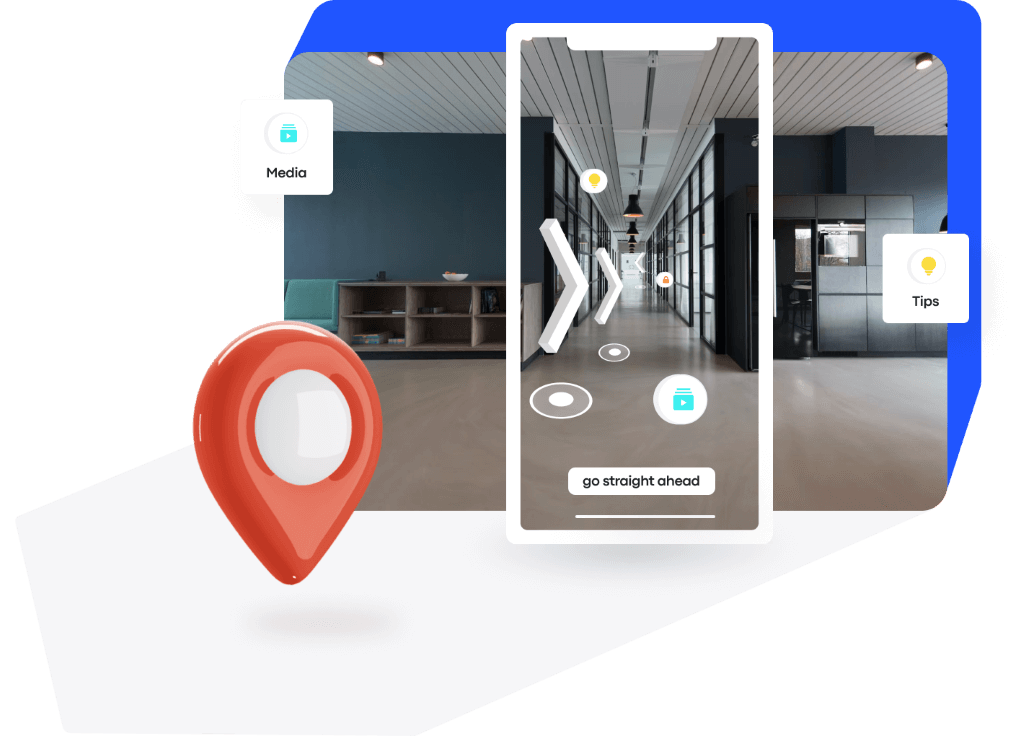
Treedis makes the process simple with its Software-as-a-Service platform, which helps users create immersive experiences using a no-code drag-and-drop visual editor. Users can create digital, virtual reality, and augmented reality dimensions of their digital twin with just a single scan.

Digital twins are immersive, interactive, and accurate 3D models of physical spaces. They’re a digital replica of devices, people, processes, and systems whose purpose is to create cost-effective simulations that help decision-makers make data-driven choices.

Powered by Matterport technology, Treedis helps companies create these immersive experiences for retail, training, marketing, onboarding, games, and more.

Enhancing Digital Twins With an Augmented Reality App

According to Treedis CEO Omer Shamay, the Treedis augmented reality app helps you “view enhanced versions of your digital twins within their physical counterparts.” You can visualize any changes or modifications in real time and view all the 3D objects, tags, directions, and content in the digital twin.

“Any changes made to your digital twin will be instantly visible in AR, ensuring seamless collaboration and communication across your team,” Shamay adds.

The platform helps 3D creators and enterprises create an immersive and powerful digital experience for their users, so they can fully harness the benefits of AR solutions without huge developmental costs or challenges.

It can be used extensively for creating unique shopping experiences that incorporate elements of virtual commerce and gamification features. It’s ideal for developing immersive learning experiences to help learners grasp concepts better through physical interaction with their environment. The app can also be used to provide indoor navigation for guiding visitors to different access points and key locations within a space.

Treedis augmented reality app

The app is already available for Treedis’ enterprise users and promises to be “an accessible app with low prices and an easy-to-use AR solution,” according to Shamay.

With AR becoming more accessible, it won’t be long before more brands and firms adapt the technology and provide better and enhanced experiences to their audiences.

Treedis Transforms Physical Spaces Into Hybrid Experiences With a New Augmented Reality App Read More »

‘another-fisherman’s-tale’-review-–-a-captivating-sequel-with-more-of-everything

‘Another Fisherman’s Tale’ Review – A Captivating Sequel with More of Everything

We’re back for another dose of mind-bending puzzles à la Bob the Fisherman. The sequel offers up a longer, more emotionally complex story while packing in a ton of new puzzle mechanics that makes Another Fisherman’s Tale feel leagues ahead of the original in almost every sense.

Another Fisherman’s Tale Details:

Available On:  SteamVRQuest 2, PSVR 2

Release Date:  May 11th, 2023

Price: $30

Developer: Innerspace VR

Publisher: Vertigo Games

Reviewed On:  Quest 2

Gameplay

Bob’s tall tales are taller than ever this time around, as the adventure swells to scale up to new emotional depths which reveal more about the real Bob and his family. I won’t spoil the story behind Another Fisherman’s Tale, because it’s really something you should unfold yourself. It talks about love, loss, responsibility, freedom—it’s way heavier than the first, and often strays outside of original’s safe storybook narration. Where you might have ignored some of the angsty Dad drama of the original Fisherman’s Tale, and just got on with the game’s smorgasbord of mind-bending puzzles, this time around the narrative takes more of a center stage, all while presenting new and innovative mechanics to keep you guessing.

The most prominent mechanic on display is the new ability to detach, replace and control your hands—like physically pop off your hands, trade them for more useful ones, and shoot them out to solve a variety of puzzles that only a little crawling (or swimming) remote controlled hand-beast might. Although you really only have two other hand styles regularly at your disposal besides your wooden digits, a hook for climbing and a claw for snipping, the puzzle variations are impressively wide.

Image courtesy Innerspace VR, Vertigo Games

While there are a ton of one-off puzzles to compliment, a constant throughout the game is the need remotely control your hands, which is done by twisting your motion controller in the correct relative direction and pressing the trigger to move them forward. You’ll be pulling levers, crawling your digits through circuitous routes, and grabbing key items before snapping them back to your arms where they belong. This took some getting used to, as oftentimes you’ll need to control your hands from afar while actually moving your body to different locations to get a better viewpoint, which can be confusing at times since your body’s relative position changes and your hands sort of wig out.

And with separable hands, you might as well be able to pop your head off too. Simply press two buttons (‘B’ and ‘Y’ on Quest) and you’ll launch your head forward to reach far flung areas for a better point of view. It’s basically plays out like a dash teleportation that follows a predictable arch as opposed to physically picking up your head and tossing it around, which wouldn’t be terribly comfortable. More on comfort below though.

Image courtesy Innerspace VR, Vertigo Games

While I wouldn’t call any of the puzzles particularly hard, they’re always creative and rewarding. I had hints enabled, although you can turn them off in the settings, which mutes a few of Bob’s timely and helpful lines. Still, Bob isn’t overbearing in how or when he delivers hints, making him feel much more like a dad who wants you to figure something out on your own than a ‘helpful robot’ that just wants you to get on with the puzzle already.

My personal playtime was just under four hours, which puts it nearly four times longer than the original game. I didn’t feel like any of it was filler either, which is a testament to the game’s deeper story and puzzle variations that require the player to develop skills that are useful throughout—essentially everything I wanted from the original but didn’t get when it initially released in early 2019.

Immersion

The star of the show is undoubtedly Bob, who is brought to life by the whisky-soaked tones of the probably never-not-smoking French comedian Augustin Jacob. In my review of the first game, I called Jacob’s interpretation more akin to a kitschy short that you typically see before a proper Pixar movie—charming, but not enough.

Image courtesy Innerspace VR, Vertigo Games

Here we get a full-fat dose of Bob as well as a new cast of characters that are equally engaging, making it feel more like that Pixar adventure I wished it could have been in the first place. One thing that hasn’t changed though is the inclusion of a sweeping score, which perfectly frames the game’s linear, sometimes storybook style adventure.

While the story goes off the rails at points, snapping you back to reality, it isn’t a large, open world with a ton of freedom of movement, or even puzzle creativity. Another Fisherman’s Tale is compartmentalized into chapters, each of which have a number of linear areas to unlock. The physical variety of the spaces though makes it feel less like a long series of closed escape rooms, which might otherwise feel a little too repetitive. That’s simply not the case here, as you’re always left guessing at what your next adventure will be, and where you’ll go next.

Image courtesy Innerspace VR, Vertigo Games

Set pieces are thoughtfully designed, and the cartoony nature of the game looks generally very good, even on the game’s most humble target platform, Quest 2. Object interaction is very basic, although that doesn’t detract too much since it’s mostly levers and a smaller momentary puzzle bits we’re dealing with here. As a result, there’s no inventory to speak of since all tools will be presented to you as needed, and thoughtfully poofed back into existence in case you lose them.

Comfort

Another Fisherman’s Tale has what we’d now consider the standard swath of comfort settings, which will let most anyone play with relative ease. There are moments though that personally make me feel a little iffy—not ‘hang my head in the toilet bad, but I’ve played VR long enough to know my triggers.

In lieu of cutscenes, the game loves to do sweep your POV around slowly, which is mostly fine, although much of the time you’re being shrunk down so scenes can appear bigger. I generally dislike this lack of control, even if it only happens maybe once per chapter. There are also moments when your POV will be upside-down, however this too is a pretty rare occurrence. All things considered, it’s a pretty comfortable game that basically anyone can play without feeling anything but few momentary bits of weirdness.

‘Another Fisherman’s Tale’ Comfort Settings – May 11th, 2023

Turning
Artificial turning
Snap-turn
Quick-turn
Smooth-turn
Movement
Artificial movement
Teleport-move
Dash-move
Smooth-move
Blinders
Head-based
Controller-based
Swappable movement hand
Posture
Standing mode
Seated mode
Artificial crouch
Real crouch
Accessibility
Subtitles
Languages

English, Italian, German, French, Spanish, Japanese, Korean, Traditional Chinese, Simplified Chinese

Dialogue audio
Languages English, French
Adjustable difficulty
Two hands required
Real crouch required
Hearing required
Adjustable player height

‘Another Fisherman’s Tale’ Review – A Captivating Sequel with More of Everything Read More »

social-vr-platform-‘vrchat’-to-lose-quest-1-support-next-month

Social VR Platform ‘VRChat’ to Lose Quest 1 Support Next Month

As a part of its big send off, Meta has already deprecated first-party social features on the original 2019 Quest, which includes access to Parties and Meta Horizon Home. If you thought you could keep using Quest 1 with other social VR platforms though, your choices are about to get even more limited, as VRChat is soon dropping support too.

The studio announced it was dropping support in a recent developer update, stating that VRChat will no longer provide support for the Meta Quest 1 headset after June 30th, 2023.

“This is primarily due to Meta’s deprecation of the Quest 1 SDK, which will prevent us from keeping VRChat updated properly on the device,” the studio says. “You can continue to use Quest 1 with Quest Link, Virtual Desktop, ALVR, or other tethering methods to connect your Quest 1 to a Windows PC. Please note that those other applications may also be deprecating the Quest 1, so keep an eye on their announcements and news posts.”

VRChat isn’t the only app losing Quest support. One of the first to go, Meta’s BigBox VR already dropped Quest 1 support for its battle royale shooter Population: One late last year. Then followed Rec Room in early January 2023.

Meta’s Downpour Interactive announced in February its mil-sim shooter Onward will be dropping Quest 1 support on July 31st. Other games seeing upcoming support freezes include Myst, Zenith: The Lost City, and Synth Riders. We expect to see many more in the coming months, as the back catalogue of games is slowly phased or completely dropped.

Social VR Platform ‘VRChat’ to Lose Quest 1 Support Next Month Read More »

sweden-to-pave-world’s-first-permanent-e-road-for-ev-charging-while-driving

Sweden to pave world’s first permanent e-road for EV charging while driving

Sweden to pave world’s first permanent e-road for EV charging while driving

Ioanna Lykiardopoulou

Story by

Ioanna Lykiardopoulou

Ioanna is a writer at TNW. She covers the full spectrum of the European tech ecosystem, with a particular interest in startups, sustainabili Ioanna is a writer at TNW. She covers the full spectrum of the European tech ecosystem, with a particular interest in startups, sustainability, green tech, AI, and EU policy. With a background in the humanities, she has a soft spot for social impact-enabling technologies.

As countries across Europe scale up efforts towards fossil fuel-free mobility, Sweden is working on the world’s first permanent electric road — allowing electric cars and trucks to charge while driving.

The project is led by the Swedish Transport Administration, Trafikverket, which has selected the E20 highway. Specifically, it will build the electric road system (ERS) on the 21km route from Hallsberg to Örebro, located between the country’s two largest cities, Stockholm and Gothenburg.

The e-road is now at the procurement and final planning stage, while Trafikverket expects to complete and introduce it to the public in 2025/2026.

How will it work?

Trafikverket has yet to determine which technology it will use for the ERS. Currently, there are three types available: overhead conductive, ground-based conductive, and ground-based inductive charging.

In the first type of charging, power is transferred from overhead wires to a vehicle through a pantograph — much like how trams operate. This technology, however, is only suitable for heavy-duty vehicles that are high enough to reach the electric lines.

The other two ground-based options work in a similar way. In conductive charging, power is transferred from special rails or tracks placed below or on the road. The vehicles charge with the help of a mechanical arm or stick that touches the rails. In the inductive system, the power transfer takes place between coils embedded in the road and the vehicles.

Sweden’s bet on electric roads

The ambitious electrification of E20 follows a series of successful ERS pilot projects in the country. From 2016 to date, Trafikverket has tested all three road charging technologies in various parts of the country, including Lund, Gotland, and Sandviken.

Most of the focus has been on trucks and buses and for a good reason. Electrifying the road network that connects the country’s biggest cities would reduce emissions of heavy duty vehicles by 1.2m tonnes in 2030, research estimates.

But, in 2018, Sweden began testing road charging for both commercial and passenger EVs as well on a 2km route between Stockholm’s Arlanda airport and a logistics area in Rosenberg.

The government’s plan is to deploy 2,000km of ERS on public roads by 2030 — the same year it has proposed to ban new fossil fuel-powered cars. But whether betting on e-roads constitutes a fruitful strategy remains a controversial topic.

On the one hand, electric road systems will enable longer distances to be traveled between charging station visits, increasing the adoption rate of EVs and, in turn, reducing carbon emissions.

A recent study by the Chalmers University of Technology in Gothenburg has further found that e-roads would also lower the demand on the grid during peak times, working as an alternative to home charging. The team also suggested that combining home (static) and on-the-go (dynamic) charging can reduce the battery size by up to 70%.

“This would reduce the need for raw materials for batteries, and an electric car could also become cheaper for the consumer,” said Sten Karlsson, co-author of the study.

There is, however, an important counterargument: the lofty investment and maintenance costs for a nascent type of infrastructure that, in the long run, may prove obsolete as battery development accelerates.

But according to the study’s findings, the risk doesn’t seem that high. The team estimates that only 25% of the national and European roads would need to be electrified for the system to work.

Sweden is not alone in developing e-roads, with Italy, France, Germany, and the UK testing the technology as well. In fact, Europe’s interconnectivity might indeed give a winning chance to an electric road network.

Get the TNW newsletter

Get the most important tech news in your inbox each week.

Also tagged with


Sweden to pave world’s first permanent e-road for EV charging while driving Read More »

spring-has-sprung-for-niantic-and-8th-wall

Spring Has Sprung for Niantic and 8th Wall

It’s already been a year since Niantic acquired 8th Wall. While acquisitions can be a scary thing in the tech world, both companies are growing and strengthening through their partnership.

Pillars of the Earth

Niantic and 8th Wall are both AR companies that might be bigger and more important than some realize. However, they both come at AR architecture and accessibility from different perspectives. Their coming together was a game changer that’s hard to understate.

Niantic Senior Director of AR Product Marketing, Caitlin Lacey, helps us understand what the companies are doing in their own products and projects as well as how they are helping each other grow and develop.

“I joined Niantic a year ago primarily to focus on Lightship, and one of the things that I was really excited about coming in was the acquisition,” said Lacey. “Having 8th Wall as part of the Niantic family has definitely made it better.”

Niantic

For some readers, Niantic is synonymous with Pokémon Go. If you Ctrl+K “Niantic”, Google Docs suggests the Pokémon Go website as a link option. Other readers will recognize this as a gross misrepresentation. Pokémon Go may have made Niantic a household name, but it only scratches the surface of what the historic and storied company actually does.

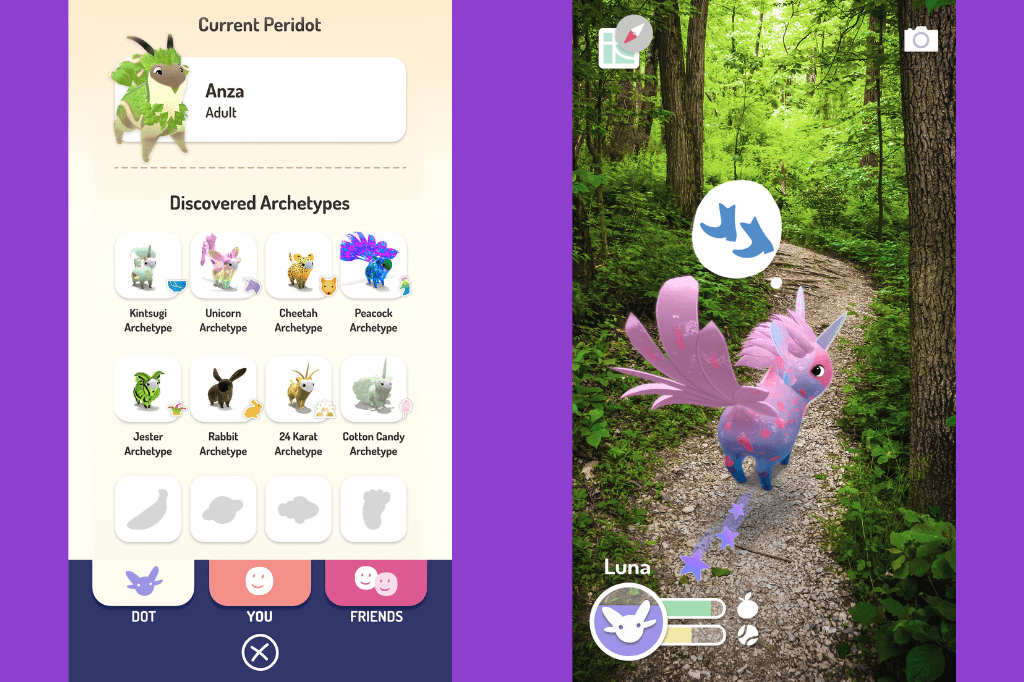
In addition to games (including the just released AR real-world pet game Peridot), Niantic has probably the largest and most detailed working virtual map of the world ever. A few years ago, that was a neat trick. As devices become more powerful and AR gains traction, it’s increasingly becoming something a lot more.

Niantic Peridot AR pet game

Niantic games gather data for this virtual map of the world, but they also have a dedicated platform called Lightship that developers use to fill in the empty spots, add detail, and create their own experiences. Whether you’re building or playing, you’re using an app.

8th Wall

Like its parent company, readers have probably seen the 8th Wall logo on an AR experience but might not realize the magnitude of the operation. Also like its parent company, users can experience 8th Wall both through experiences that they enjoy or through developer tools.

Over the years, 8th Wall has been building out their developer tools and experiences making them easier to use and accessible on more devices. The company has tools for augmenting the world around a user, as well as for augmenting users themselves through lenses and filters.

8th Wall’s experiences and developer tools are web-based. No app installation required, they’re well-positioned to run on pretty much any connected device.

Web and Apps

Apps have a certain gravity bringing obstacles and opportunities. People know how apps work and they know what to expect. Apps can run larger and more in-depth experiences, but they only do one thing at a time. These two necessary strengths are at odds when people expect an experience to do everything and do it well – an unrealistic expectation called “the metaverse.”

“It took a long time to train people how to use apps, but now they’re trained,” said Lacey. However, as she points out, “if you’re thinking about a future where all of these mobile technologies have AR capabilities”, opening and switching apps can become a hassle.

WebAR is getting better all the time, but it’s still limited in terms of the experiences it can run. Thinking about being out and about, this compounds as people are away from stable home networks and relying on burdened public networks or potentially spotty data coverage.

“There are still limitations to experience and file size that the web just can’t handle,” said Lacey. “As computing power continues to grow and get stronger, we’ll see better experiences across platforms.”

In the meantime, both companies are working on leveraging their strengths in app and webAR respectively trying to achieve the best of both worlds in both worlds.

“On the Lightship side, there was tons of tech that was very app-based … we took that and asked, ‘What do you want, and how do we bring it to the web?’” said Lacey. “And then, on the other side, bringing things from the web to Lightship.”

Updates and Releases From Niantic and 8th Wall

In the last few weeks, some exciting changes have come for developers using both developer platforms – including some of those updates that look a lot like a cross-pollination between the two platforms.

Sky and World Effects

First, Sky Effects and World Tracking came to 8th Wall. These are two separate developer tools that allow an AR experience to augment the sky itself, or to help AR elements realistically appear in the physical world. However, when used together, a single experience can bridge the earth and heavens in new and immersive ways.

“With sky and world effects, an object drops from the sky, recognizes the environment, and can interact with that environment,” said Lacey. “We’re seeing that happen across the board and there’s more coming.”

To celebrate the launch, 8th Wall held the “Sky Effects Challenge” which invited developers to use the new technology in interesting and inventive ways. Creators turned the sky into a canvas, mapped the planets, and more.

“We are consistently amazed by what our community builds,” said Lacey.

A Cross-Device Scanning Framework

A new Scanning Framework for Lightship AR Developer’s Kit 2.5 allows users to virtually reconstruct physical spaces and objects without LiDAR. LiDAR is one of two common methods for capturing spatial data on mobile devices, but it’s only available on higher-end iOS devices. Opening the Scanning Framework to other methods greatly increases accessibility.

“We’ve continually heard the feedback, and we’re listening,” said Lacey. “We really want to be a consistent partner to developers in the AR space. We do believe that AR can help make the world more interesting and fun.”

Two New Games

8th Wall doesn’t do so much in the games category – again, games still work better as full apps for now. However, a big theme in this article is that the line between the two companies can be a little foggy these days – at least in terms of user experience. These apps likely benefited from 8th Wall technology and 8th Wall will likely benefit from what the apps learn and earn for Niantic.

Early this year, Niantic launched NBA All World. The app includes basketball mechanics and an NBA partnership, and grows to incorporate elements that make it more than just a game.

“Our version of an NBA basketball game starts with exciting one-on-one gameplay and expands from there to include the major elements of basketball culture, including music, fashion, sneakers, and more, all of which are integrated into real-world locations,” Niantic founder and CEO John Hanke said in a blog post.

If that wasn’t enough, by the time you read this, Peridot will be live. The highly anticipated game encourages players to nurture an AI-powered virtual pet, including feeding it, petting it, and playing with it. Players can also use Niantic’s social platform Campfire to meet with other players and breed new and unique Peridots (or Dots).

Spring Has Sprung for Niantic and 8th Wall

I’m not a huge basketball fan and Pokémon is a chapter of my life that closed a long time ago, but I’ve had my Dot Erin for a few days now. Erin mainly hangs out by my desk eating sandwiches, but was pretty excited to see the spring flowers in my backyard the other day.

Peridot AR pet game Niantic - Jon's Dot Erin

Much More to Come

Lacey advised that a lot more updates to Niantic and 8th Wall will continue to reinforce both platforms for the benefit of developers and end-users alike. There are also some interesting artistic activations coming in the next few weeks. And, of course, we’re excited about Peridot becoming publicly available. There’s definitely a lot more to come from this power pair.

Spring Has Sprung for Niantic and 8th Wall Read More »

swiss-startup-edges-closer-to-first-ever-space-trash-collection

Swiss startup edges closer to first-ever space trash collection

Swiss startup edges closer to first-ever space trash collection

Thomas Macaulay

Story by

Thomas Macaulay

Senior reporter

Thomas is a senior reporter at TNW. He covers European tech, with a focus on deeptech, startups, and government policy. Thomas is a senior reporter at TNW. He covers European tech, with a focus on deeptech, startups, and government policy.

The first active removal of space debris has moved closer to lift-off after a new deal was inked on the landmark mission.

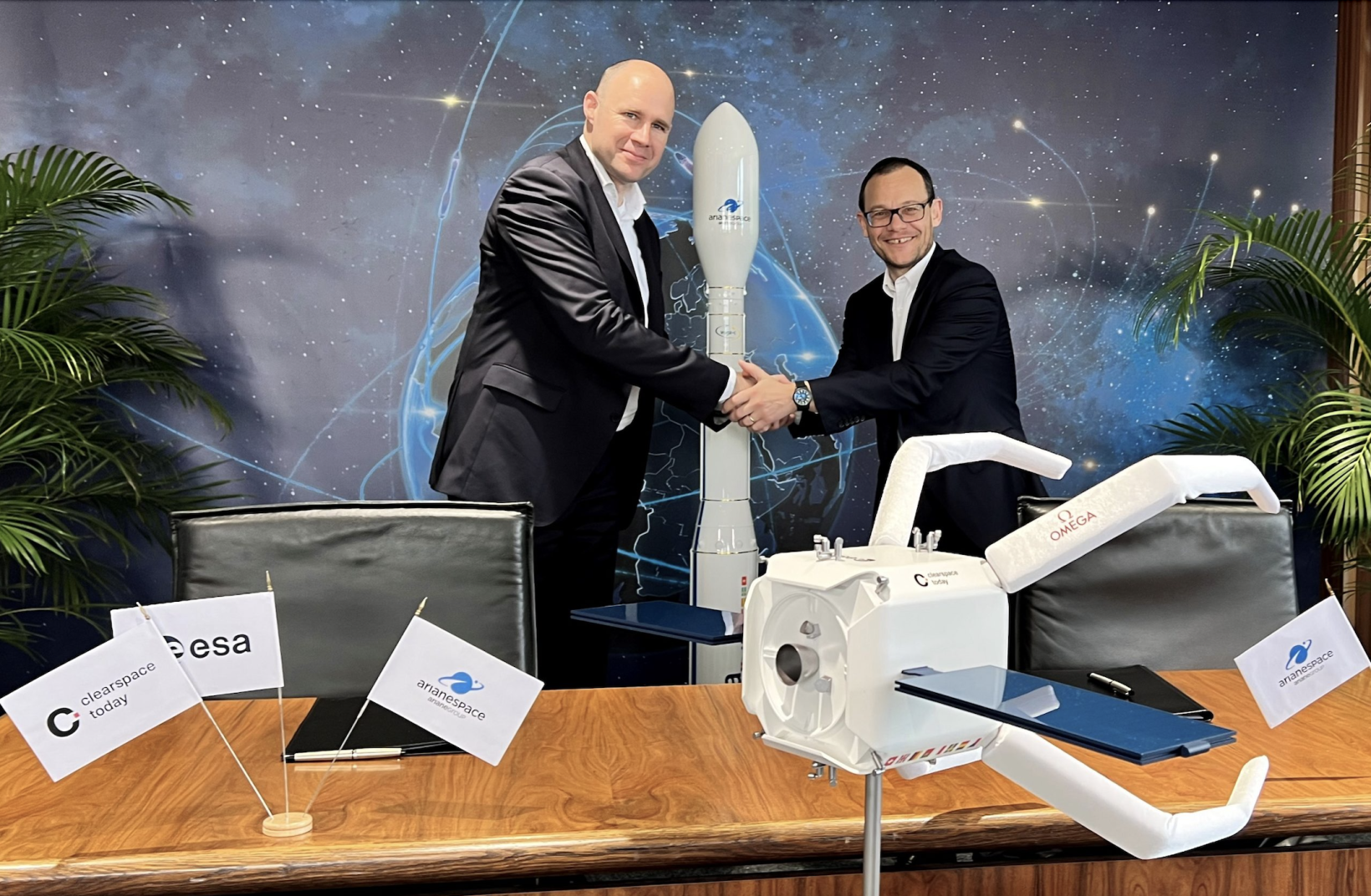
Swiss startup ClearSpace and French rocket giant Arianespace today announced that a launch contract has been signed for the assignment.

The mission, named ClearSpace-1, aims to capture and deorbit a chunk of garbage weighing over 100 kg. To start, the trash-collecting spacecraft will be released into a sun-synchronous orbit by the new European light launcher Vega C.

After commissioning and critical tests, the spacecraft will be raised to the target litter, which will be disposed of through an atmospheric reentry.  

The launch is scheduled for no earlier than the second half of 2026.

Artist's impression of Vega C launching ClearSpace-1
Artist’s impression of Vega C launching ClearSpace-1. Credit: ClearSpace/Arianespace

Luc Piguet, the CEO and co-founder of ClearSpace, hailed the new deal as a crucial step for the project.

“This secures ClearSpace’s access to space for our trailblazing space debris removal mission,” Piguet said in a statement.

“The ClearSpace-1 mission demonstrates a turning point in the space industry as we urgently need to bring solutions to a fundamental problem: we are putting objects into space quicker than they are being removed.”

Luc Piguet, ClearSpace CEO and co-founder, and Stéphane Israël, Arianespace CEO, signing a contract for the launch of the ClearSpace-1 mission, due in 2026. Credit: Arianespace, ClearSpace
Piguet (left) and Stéphane Israël, Arianespace CEO, signed the contract for the launch of ClearSpace-1. Credit: Arianespace/ClearSpace

The deal between two European players also marks another milestone for the continent’s space ambitions. It comes a month after Europe was found to have surpassed the US in private spacetech investment for the first time.

More importantly, the contract brings us closer to solving a growing problem in space. At present, there are over 34,000 pieces of space debris larger than 10 centimetres — as well as about 6,500 operational satellites in orbit, a number expected to exceed 27,000 by the decade’s end.

All these objects are increasing the risk of collisions with satellites or space stations. If the build-up of trash continues at this rate, some regions of space could become unusable. And for those of us on Earth, the litter’s ruining our views of the cosmos.

If all goes to plan, ClearSpace-1 will set a benchmark for making our solar system a cleaner place.

Get the TNW newsletter

Get the most important tech news in your inbox each week.

Also tagged with


Swiss startup edges closer to first-ever space trash collection Read More »

king’s-coronation:-controversial-ai-tech-deployed-alongside-record-setting-5g-network

King’s coronation: Controversial AI tech deployed alongside record-setting 5G network

King’s coronation: Controversial AI tech deployed alongside record-setting 5G network

Siôn Geschwindt

Story by

Siôn Geschwindt

Last week Saturday, over 20 million viewers from across the UK tuned in to watch the coronation of King Charles III, making it the country’s most-watched TV event of the year. Another approximately two million took to the streets of London, under the close watch of AI. 

In the lead-up to the coronation, the Metropolitan Police confirmed that it would deploy live facial recognition technology — which scans faces and matches them against a list of people wanted for alleged crimes — across central London to identify potentially dangerous individuals mingling in the crowds. 

During the event, the software scanned footage from central London’s almost 1 million CCTV cameras and analysed it using an AI algorithm to identify faces that might match those on the Met’s watchlist. The sheer scale of the deployment made it the largest-ever use of live facial recognition technology in public spaces in British history. 

Live facial recognition technology has been a topic of controversy in the UK in recent years due to concerns about privacy, civil liberties, and the potential for the technology to be misused.

One of the main issues is the lack of clear legal regulation around its use. “Live facial recognition is not referenced in a single UK law, has never been debated in parliament, and is one of the most privacy-intrusive technologies ever used in British policing,” said Madeleine Stone, legal and policy officer at British civil liberties campaign group Big Brother Watch.

Critics argue that the use of live facial recognition could lead to false positives, where innocent people are wrongly identified as suspects. There are also concerns that the technology may disproportionately impact certain groups, such as people of colour or those with disabilities, due to the potential for bias in the algorithms used to analyse the images. 

Staying safe over the Coronation weekend – Coronation of Their Majesties The King & Queen Camilla
The UK police resumed the use of live facial recognition last month. Credit: HM Government

As a result of these concerns, there have been calls for a moratorium on the use of live facial recognition technology until clear legal guidelines and ethical standards can be established. While some European countries have limited its use by private companies, they are reluctant to extend these restrictions to public authorities and law enforcement. 

Last month, the UK police resumed the use of live facial recognition technology following  research showing a ‘substantial improvement’ in its accuracy. A report from the National Physical Laboratory found that the chances of a false match were 1 in 6000. This is still far too inaccurate, say campaigners. 

While the tensions around live facial recognition were on full show during the coronation, there was another emerging technology setting records: 5G. 

5G is the latest wireless technology that provides faster and more reliable connectivity than its predecessor 4G and has the potential to revolutionise how we use the internet, especially for data-intensive applications like self-driving cars, gaming, and live media streaming. 

While there has been a significant concern (and misinformation) surrounding 5G — from beliefs that it causes radiation to more outlandish claims that it could spread the coronavirus — unlike live facial recognition, most experts agree it poses little harm. 

‘World’s largest temporary private 5G network’

Of the 20 million plus viewers that tuned into the royal action on Saturday, the majority watched the coverage on the BBC, which broadcast the event live. 

In recent years, news crews have relied on mobile networks to capture footage from hard-to-reach locations that can’t be accessed with satellite trucks or cables. This approach can cause issues during large events as the networks become congested with social media users uploading content and journalists competing to send their images back to news channels.  

To ensure a reliable connection for live broadcasting BBC R&D, the technical research arm of the British news company, deployed the world’s largest temporary private 5G network across The Mall — the 1km grand red road leading from Admiralty Arch to Buckingham Palace, where hundreds of thousands of people gathered for the King’s procession. 

5G-network-coronation
Denmark’s TV2 News going live from outside Buckingham Palace with support from the world’s first temporary private 5G network. Credit: BBC R&D

Streaming large amounts of professional video requires a high uplink capacity, which public networks are not designed for. To handle the traffic, the BBC set up a separate, private network using UK comms regulator Ofcom’s shared access spectrum which secured 80 MHz of radio capacity centred on 3855MHz. Mobile bonding devices such as LiveU’s LU300 with 5G modems and dedicated SIMS moved the video traffic away from the public networks and onto the private network. 

In plain English, this meant that 60 devices could stream large data rate video from any point along The Mall, without interfering with the speed of public mobile networks. 

“The beauty of this system is that for operators and broadcasters, the workflow is pretty much the same as they use every day, but we can be confident that their units will work no matter how busy the public network becomes,” said BBC R&D in a blog post

Unlike live facial recognition, the future of 5G is more certain, with half of all mobile subscriptions predicted to be connected to 5G networks in just four years time. 

Get the TNW newsletter

Get the most important tech news in your inbox each week.

Also tagged with


King’s coronation: Controversial AI tech deployed alongside record-setting 5G network Read More »

8-in-10-german-companies-still-fax,-study-finds-—-but,-umm,-why?

8 in 10 German companies still fax, study finds — but, umm, why?

8 in 10 German companies still fax, study finds — but, umm, why?

Ioanna Lykiardopoulou

Story by

Ioanna Lykiardopoulou

Ioanna is a writer at TNW. She covers the full spectrum of the European tech ecosystem, with a particular interest in startups, sustainabili Ioanna is a writer at TNW. She covers the full spectrum of the European tech ecosystem, with a particular interest in startups, sustainability, green tech, AI, and EU policy. With a background in the humanities, she has a soft spot for social impact-enabling technologies.

In the age of digital communication, fax machines seem as outdated as using a rotary dial phone or a cassette tape. Think about it: if a colleague asked you to fax them a document, you’d probably give them an incredulous look. But in Germany, fax machines haven’t been relegated to the history books just yet, research shows.

Digital advocacy group Bitkom surveyed 505 companies across the country and found that a whopping 82% of them still fax. Notably, one-third of the respondents said their use of the 180-year old technology is “frequent” or “very frequent.”

The intensity of use, however, is gradually declining. Last year, it was at 40%, down from 62% in 2018. Correspondingly, half of the companies now send faxes only rarely or occasionally, while 16% have stopped altogether. According to Bitkom, this data shows that faxing is — slowly but surely — nearing its end in the business world.

To fax or not to fax?

But regardless of the declining trend in use, one question still remains: why use fax machines — well beyond their heyday — instead of simply emailing or cloud sharing?

“What is most valued about the classic fax machine is above all its ability to clearly trace whether something has been sent,” said Nils Britze, Bitkom’s head of digital business processes.

Britze pointed to another factor as well: “Once a channel of communication has been established, it usually takes a while before it is completely replaced — even when much more comfortable and safer means of communication have emerged.”

From a business perspective this translates to the challenge of digitisation. According to Bitkom’s previous research, larger companies find it easier to go fully digital compared to small ones with less than 100 employees. Specifically, 42% of large companies surveyed had digitised their business processes in 2021, while 94% of smaller companies were still using paper.

From a personal perspective, postponing the fax machine replacement refers to what Jonathan Coopersmith, History Professor at Texas A&M University, calls “comfortable inertia.” That is, the people’s tendency to stick to the familiar, and in turn, their reluctance to change technologies.

So it seems that classic ol’ faxing still has some good years before becoming a relic of the past — at least in Germany.

Get the TNW newsletter

Get the most important tech news in your inbox each week.

Also tagged with


8 in 10 German companies still fax, study finds — but, umm, why? Read More »

spotify-cracks-down-on-ai-generated-music-streaming-fraud

Spotify cracks down on AI-generated music streaming fraud

Spotify cracks down on AI-generated music streaming fraud

Linnea Ahlgren

Story by

Linnea Ahlgren

According to Spotify founder Daniel Ek, the value of a company is “the sum of the problems you solve.”

The problem of bot farms playing the same tracks over and over to manipulate streaming data may not be entirely new. However, as generative AI tools become increasingly mainstream, it is taking on a new dimension for the music industry. 

This will require streaming service providers to vigilantly predict and plan ahead not to be left playing a game of reactive whac-a-mole, desperately beating down issues as they arise. Otherwise, apart from dealing with obvious copyright controversies, they may end up paying large sums of money for millions of bot-boosted “fake streams.” 

According to a report in the Financial Times, Universal Music Group (UMG), which controls about a third of the global music market, has been sending takedown requests “left and right.” Stockholm-headquartered Spotify has obliged – at least to some degree. 

Last week, the music streaming giant temporarily ousted hundreds of thousands of songs generated on the AI platform Boomy. The California-based startup’s tool lets users create tracks by picking from a selection of styles, such as Lo-Fi or EDM, and then customise them and either record or add vocals, before uploading them to streaming services. 

However, this is not a case of making Drake rap on your track – the vocals must belong to the user. As such, the tracks were not greyed out because of copyright infringement concerns, but due to the discovery of widespread “suspicious listening activity.” 

Meanwhile, this does not mean that Spotify has completely blocked Boomy users and forbidden them from uploading new tracks. Indeed, the AI platform announced this weekend that “Boomy artists” had their curated delivery to the streaming giant re-enabled.

We are pleased to share that curated delivery to Spotify of new releases by Boomy artists has been re-enabled.

Supporting our artists and creators who use the Boomy platform is our top priority, and we greatly appreciate your patience these past few days.

— Boomy – Create AI Music (@boomy) May 6, 2023

Reportedly, the two sides are still in negotiations over the reinstatement of the rest of Boomy’s catalogue. 

Fake stream farms an industry-wide issue

Spotify’s crackdown is part of an ongoing battle against bot streaming farms. Essentially, this is when a bunch of digital devices are logged in on various platforms, and simply play music 24 hours a day, often playing the same track over and over again. 

Obviously, this impacts the number of listens, directly generating revenue for the owner of the track. Meanwhile, it also affects data driven features such as charts and playlists. 

According to the streaming giant, “Artificial streaming is a longstanding, industry-wide issue that Spotify is working to stamp out across our service.”

Earlier this year, France’s Centre National de la Musique (CNM) released a study on music streaming fraud, in which Spotify participated. However, CNM called out other major streaming platforms Apple, Amazon, and YouTube as “unable or unwilling” to take part in the study.

The first-of-its-kind study established that, in France, in 2021, between one and three billion streams, at least, were false, i.e. between 1% and 3% of total listening. Of course, plenty has happened since.

The CNM says it will launch a new study into the matter in 2024, which may better reveal the implications of the recent revolution in access to generative AI  – and the ability of Spotify to mitigate it.

Grimes stands alone in the pro-AI camp

Over the past few months, the music streaming market has experienced a significant rise in AI-generated tracks. According to Boomy, its users have already “created” more than 14 million songs. 

Services such as those provided by Boomy, Aiva, and Soundful leverage machine learning to allow users to generate unlimited tracks and even monetise their creations on streaming platforms, to the chagrin of artists, producers, distributors, and other industry stakeholders. 

Grimes has launched an AI platform specifically for people to use her voice to make new music, stating that “Copyright sucks. Art is a conversation with everyone that has come before us. Intertwining it with the ego is a modern concept. The music industry has been defined by lawyers, and that strangles creativity.”

Needless to say, she is quite the exception in her pro-generative AI stance in the global artist community. 

Get the TNW newsletter

Get the most important tech news in your inbox each week.

Also tagged with


Spotify cracks down on AI-generated music streaming fraud Read More »