
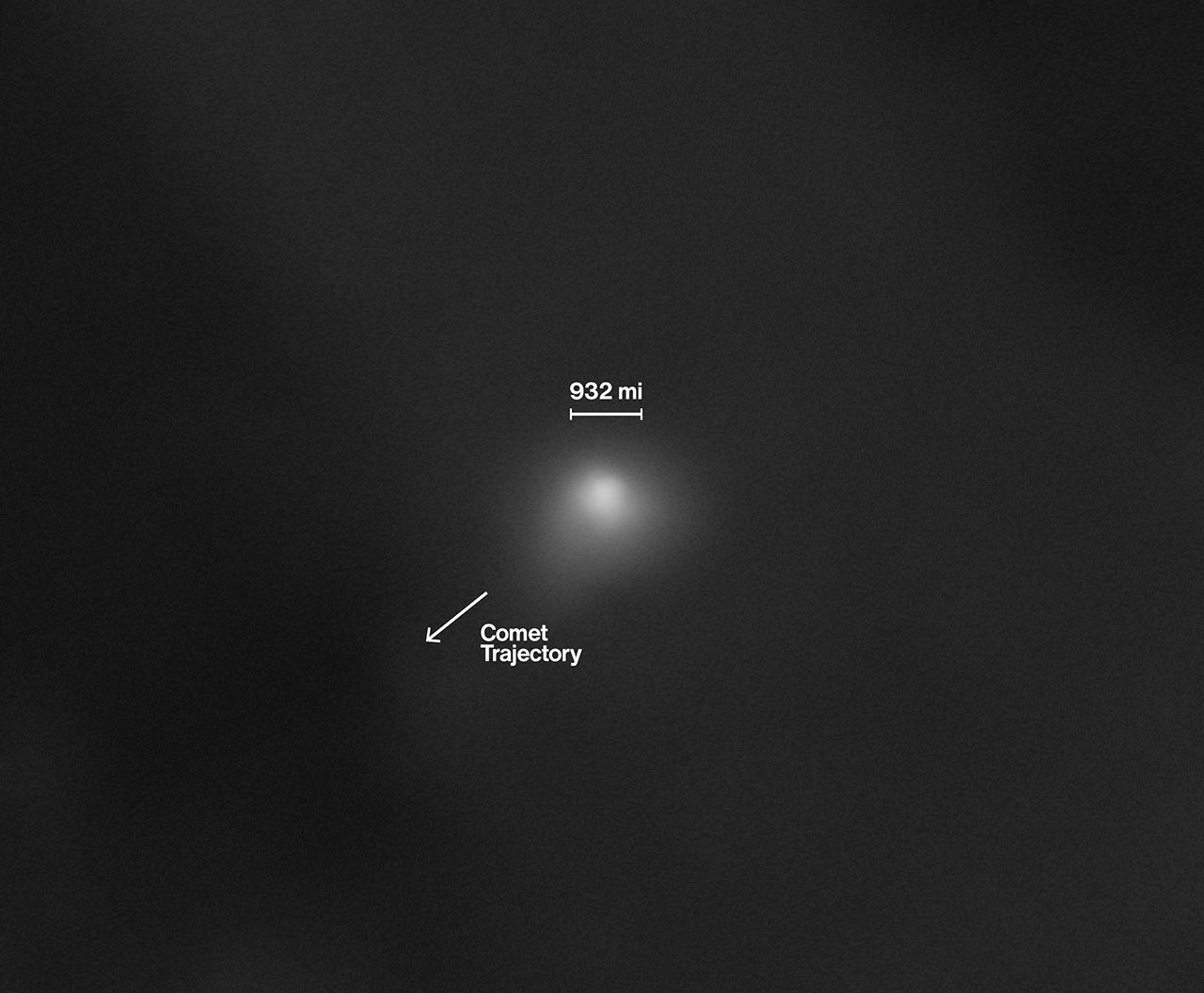
The HiRISE camera, meant to image Mars’ surface, was repurposed to capture 3I/ATLAS. Credit: NASA/JPL-Caltech/University of Arizona
As eccentricity continues to rise from there, the question shifts from “what shape is its trajectory?” to “how much does the Sun alter its path through the Solar System?” For 3I/Atlas, with an eccentricity of over six, the answer is “not very much at all.” The object has approached the inner Solar System along a reasonable approximation of a straight line, experienced a gentle bend around the Sun near Mars’ orbit, and now will be zipping straight out of the Solar System again.
So, the object clearly did not originate here, which means getting a better look at it is a high priority. Unfortunately, 3I/ATLAS’s closest approach to Earth’s orbit happened when it was on the far side of the Sun from Earth. We’ve been getting closer to it since, but the hardware that got the best views was all orbiting Mars and is designed largely to point down. NASA’s Nicky Fox, the associate administrator for Science, praised the operators for getting NASA’s hardware “pushed beyond their designed capabilities” when imaging the object.
That includes using the MAVEN mission (designed to study Mars’ atmosphere) to get spectral information, and the HiRISE camera, which captured the image below. Other images came from a solar observatory and two separate missions that are on their way to visit asteroids. Other hardware that can normally image objects like this, such as the Hubble and JWST, pivoted to image 3I/ATLAS as well.
What we now know
Hubble has gotten the best view of 3I/ATLAS; its data suggests that the comet is, at most, just a couple of kilometers across. It doesn’t show much variability over time, suggesting that, if it’s rotating, it’s doing so very slowly. It has shown some differences as it warmed up, first producing a jet of material on its side facing the Sun before radiation pressure pushed that behind it to form a tail. There is some indication that, as we saw during the Rosetta mission’s visit to one of our Solar System’s comets, most of the material may be jetting out of distinct “hotspots” on the comet’s surface.