white dwarf

new-evidence-that-some-supernovae-may-be-a-“double-detonation”

New evidence that some supernovae may be a “double detonation”

Type Ia supernovae are critical tools in astronomy, since they all appear to explode with the same intensity, allowing us to use their brightness as a measure of distance. The distance measures they’ve given us have been critical to tracking the expansion of the Universe, which led to the recognition that there’s some sort of dark energy hastening the Universe’s expansion. Yet there are ongoing arguments over exactly how these events are triggered.

There’s widespread agreement that type Ia supernovae are the explosions of white dwarf stars. Normally, these stars are composed primarily of moderately heavy elements like carbon and oxygen, and lack the mass to trigger additional fusion. But if some additional material is added, the white dwarf can reach a critical mass and reignite a runaway fusion reaction, blowing the star apart. But the source of the additional mass has been somewhat controversial.

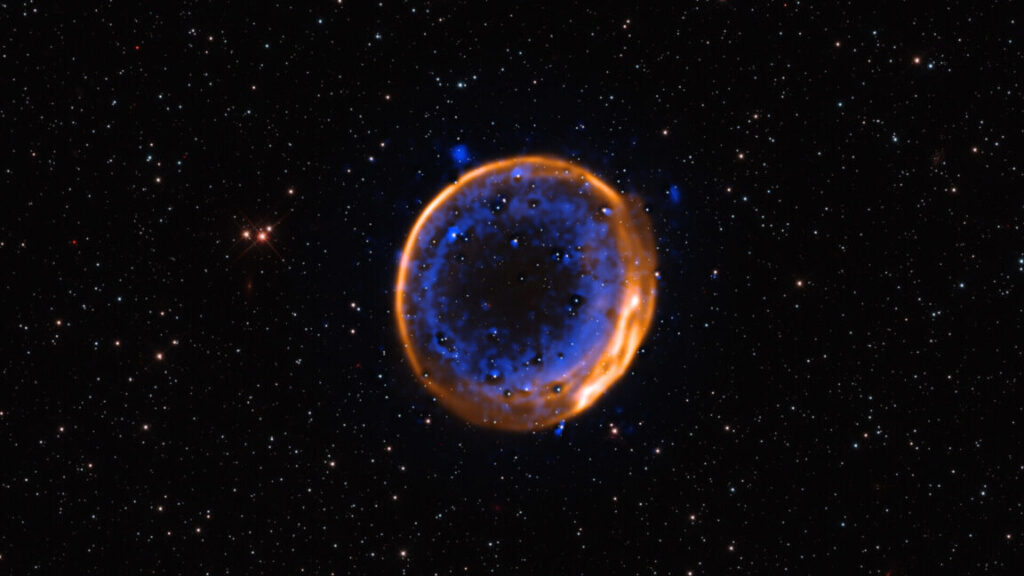
But there’s an additional hypothesis that doesn’t require as much mass: a relatively small explosion on a white dwarf’s surface can compress the interior enough to restart fusion in stars that haven’t yet reached a critical mass. Now, observations of the remains of a supernova provide some evidence of the existence of these so-called “double detonation” supernovae.

Deconstructing white dwarfs

White dwarfs are the remains of stars with a similar mass to our Sun. After having gone through periods during which hydrogen and helium were fused, these tend to end up as carbon and oxygen-rich embers: hot due to their history, but incapable of reaching the densities needed to fuse these elements. Left on their own, these stellar remnants will gradually cool.

But many stars are not left on their own; they exist in binary systems with a companion, or even larger systems. These companions can provide the material needed to boost white dwarfs to the masses that can restart fusion. There are two potential pathways for this to happen. Many stars go through periods where they are so large that their gravitational pull is barely enough to hold on to their outer layers. If the white dwarf orbits closely enough, it can pull in material from the other star, boosting its mass until it passes a critical threshold, at which point fusion can restart.

New evidence that some supernovae may be a “double detonation” Read More »
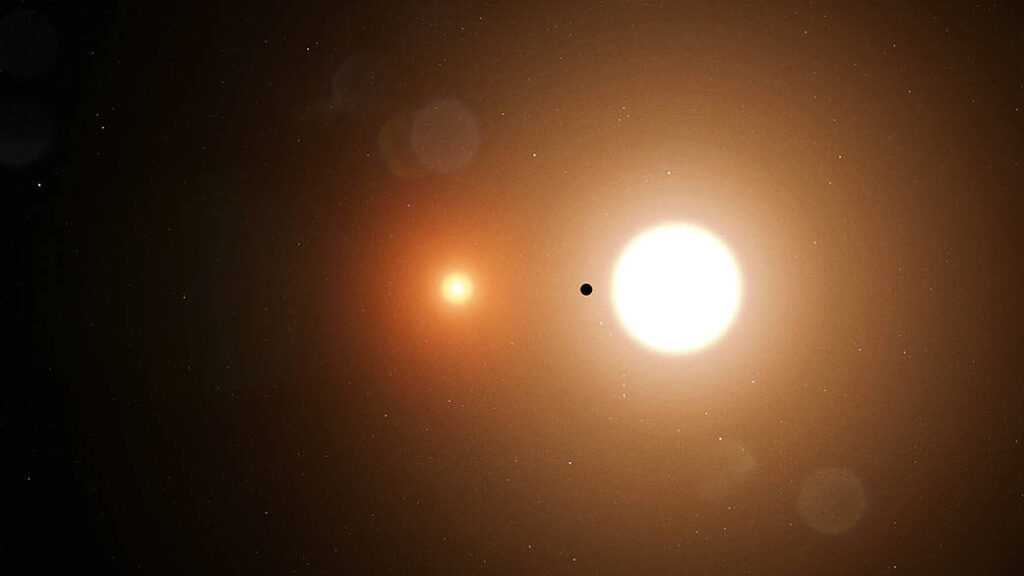
new-data-confirms:-there-really-is-a-planet-squeezed-in-between-two-stars

New data confirms: There really is a planet squeezed in between two stars

And, critically, the entire orbit is within the orbit of the smaller companion star. The gravitational forces of a tight binary should prevent any planets from forming within this space early in the system’s history. So, how did the planet end up in such an unusual configuration?

A confused past

The fact that one of the stars present in ν Octantis is a white dwarf suggests some possible explanations. White dwarfs are formed by Sun-like stars that have advanced through a late helium-burning period that causes them to swell considerably, leaving the outer surface of the star weakly bound to the rest of its mass. At the distances within ν Octantis, that would allow considerable material to be drawn off the outer companion and pulled onto the surface of what’s now the central star. The net result is a considerable mass transfer.

This could have done one of two things to place a planet in the interior of the system. One is that the transferred material isn’t likely to make an immediate dive onto the surface of the nearby star. If the process is slow enough, it could have produced a planet-forming disk for a brief period—long enough to produce a planet on the interior of the system.

Alternatively, if there were planets orbiting exterior to both stars, the change in the mass distribution of the system could have potentially destabilized their orbits. That might be enough to cause interactions among the planets to send one of them spiraling inward, where it was eventually captured in the stable retrograde orbit we now find it.

Either case, the authors emphasize, should be pretty rare, meaning we’re unlikely to have imaged many other systems like this at this stage of our study of exoplanets. They do point to another tight binary, HD 59686, that appears to have a planet in a retrograde orbit. But, as with ν Octantis, the data isn’t clear enough to rule out alternative configurations yet. So, once again, more data is needed.

Nature, 2025. DOI: 10.1038/s41586-025-09006-x  (About DOIs).

New data confirms: There really is a planet squeezed in between two stars Read More »

nova-explosion-visible-to-the-naked-eye-expected-any-day-now

Nova explosion visible to the naked eye expected any day now

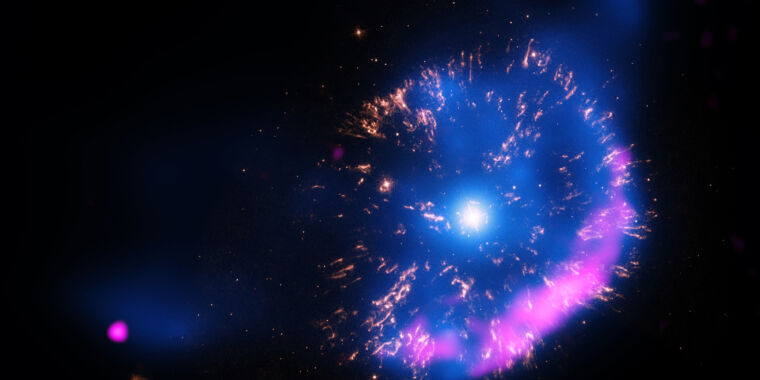
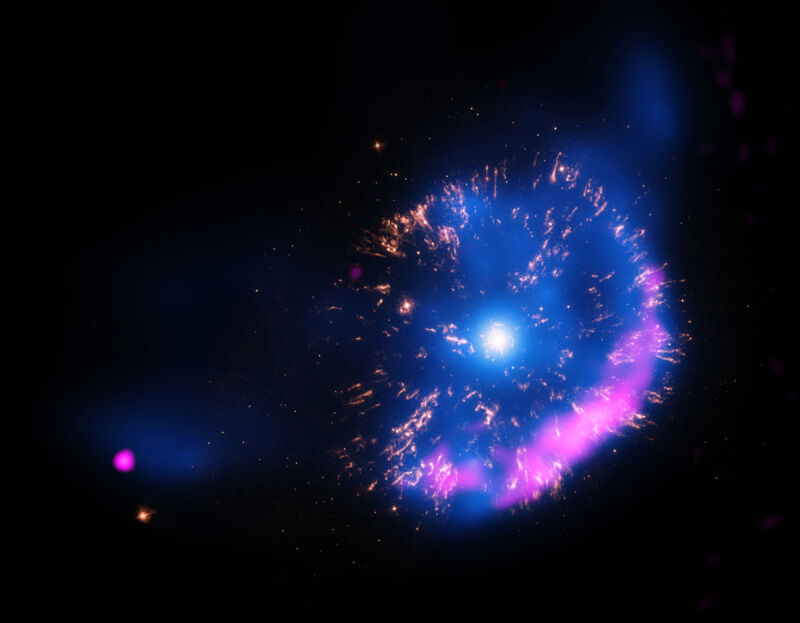
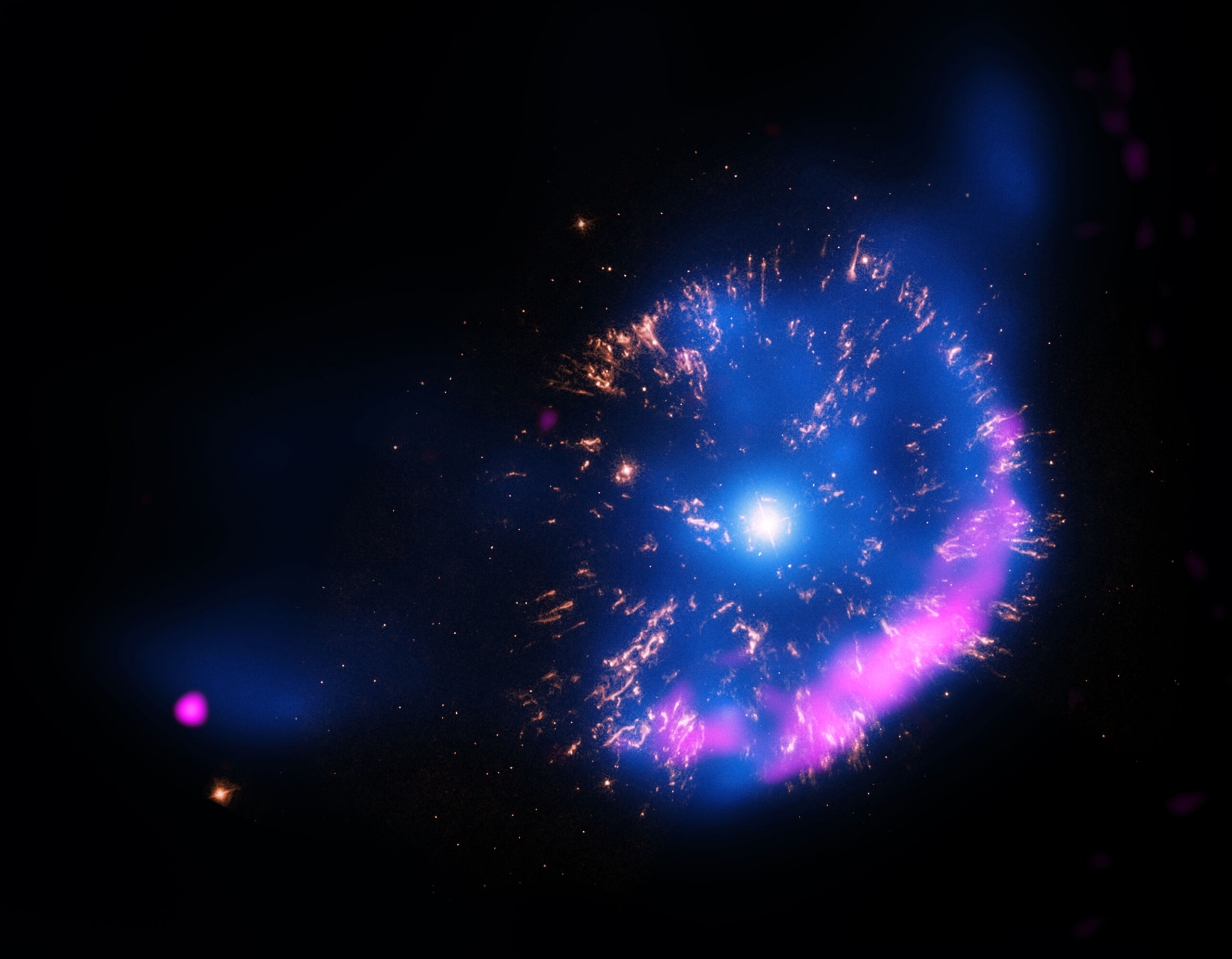
Image of a blue sphere, surrounded by blue filaments, and enclosed in a partial sphere of pink specks.s

Enlarge / Aftermath of a nova at the star GK Persei.

When you look at the northern sky, you can follow the arm of the Big Dipper as it arcs around toward the bright star called Arcturus. Roughly in the middle of that arc, you’ll find the Northern Crown constellation, which looks a bit like a smiley face. Sometime between now and September, if you look to the left-hand side of the Northern Crown, what will look like a new star will shine for five days or so.

This star system is called T. Coronae Borealis, also known as the Blaze Star, and most of the time, it is way too dim to be visible to the naked eye. But once roughly every 80 years, a violent thermonuclear explosion makes it over 10,000 times brighter. The last time it happened was in 1946, so now it’s our turn to see it.

Neighborhood litterbug

“The T. Coronae Borealis is a binary system. It is actually two stars,” said Gerard Van Belle, the director of science at Lowell Observatory in Flagstaff, Arizona. One of these stars is a white dwarf, an old star that has already been through its fusion-powered lifecycle. “It’s gone from being a main sequence star to being a giant star. And in the case of giant stars, what happens is their outer parts eventually get kind of pushed into outer space. What’s left behind is a leftover core of the star—that’s called a white dwarf,” Van Belle explained.

The white dwarf stage is normally a super peaceful retirement period for stars. The nuclear fusion reaction no longer takes place, which makes white dwarfs very dim. They are still pretty hot, though, and they’re super dense, with a mass comparable to our Sun squeezed into a volume resembling the Earth.

But the retirement of the white dwarf in T. Coronae Borealis is hardly peaceful, as it has a neighbor prone to littering. “Its companion star is in the red giant phase, where it is puffed up. Its outer parts are getting sloughed off and pushed into space. The material that is coming off the red giant is now falling onto the white dwarf,” Van Belle said.

Ticking time bomb

And it doesn’t take much littering to make the white dwarf explode. “The material from the red giant will accumulate on the white dwarf’s surface until it forms a layer that’s actually not that thick. Just a few meters—the depth of a deep swimming pool,” Van Belle explained. Most of the material coming off the red giant is hydrogen. And since the red dwarf is still hot, there will eventually be a spark that triggers a runaway nuclear fusion reaction. “That is what causes the explosion,” Van Belle said.

The explosion is a nova, which means it doesn’t kill either the white dwarf or the red giant as a supernova would. “Only about 5 percent of the hydrogen layer fuses into heavier elements like helium, and the rest just gets ejected into space. Then the process starts all over again because the explosion isn’t large enough to disrupt the red giant, the donor of all this hydrogen, so it just keeps doing its thing,” Van Belle told Ars. This is why we can predict this event with such precision.

Nova explosion visible to the naked eye expected any day now Read More »