Tech

reddit-will-lock-some-content-behind-a-paywall-this-year,-ceo-says

Reddit will lock some content behind a paywall this year, CEO says

Reddit is planning to introduce a paywall this year, CEO Steve Huffman said during a videotaped Ask Me Anything (AMA) session on Thursday.

Huffman previously showed interest in potentially introducing a new type of subreddit with “exclusive content or private areas” that Reddit users would pay to access.

When asked this week about plans for some Redditors to create “content that only paid members can see,” Huffman said:

It’s a work in progress right now, so that one’s coming… We’re working on it as we speak.

When asked about “new, key features that you plan to roll out for Reddit in 2025,” Huffman responded, in part: “Paid subreddits, yes.”

Reddit’s paywall would ostensibly only apply to certain new subreddit types, not any subreddits currently available. In August, Huffman said that even with paywalled content, free Reddit would “continue to exist and grow and thrive.”

A critical aspect of any potential plan to make Reddit users pay to access subreddit content is determining how related Reddit users will be compensated. Reddit may have a harder time getting volunteer moderators to wrangle discussions on paid-for subreddits—if it uses volunteer mods at all. Balancing paid and free content would also be necessary to avoid polarizing much of Reddit’s current user base.

Reddit has had paid-for premium versions of community features before, like r/Lounge, a subreddit that only people with Reddit Gold, which you have to buy with real money, can access.

Reddit would also need to consider how it might compensate people for user-generated content that people pay to access, as Reddit’s business is largely built on free, user-generated content. The Reddit Contributor Program, launched in September 2023, could be a foundation; it lets users “earn money for their qualifying contributions to the Reddit community, including awards and karma, collectible avatars, and developer apps,” according to Reddit. Reddit says it pays up to $0.01 per 1 Gold received, depending on how much karma the user has earned over the past year. For someone to pay out, they need at least 1,000 Gold, which is equivalent to $10.

Reddit will lock some content behind a paywall this year, CEO says Read More »
arm-to-start-making-server-cpus-in-house

Arm to start making server CPUs in-house

Cambridge-headquartered Arm has more than doubled in value to $160 billion since it listed on Nasdaq in 2023, carried higher by explosive investor interest in AI. Arm’s partnerships with Nvidia and Amazon have driven its rapid growth in the data centers that power AI assistants from OpenAI, Meta, and Anthropic.

Meta is the latest big tech company to turn to Arm for server chips, displacing those traditionally provided by Intel and AMD.

During last month’s earnings call, Meta’s finance chief Susan Li said it would be “extending our custom silicon efforts to [AI] training workloads” to drive greater efficiency and performance by tuning its chips to its particular computing needs.

Meanwhile, an Arm-produced chip is also likely to eventually play a role in Sir Jony Ive’s secretive plans to build a new kind of AI-powered personal device, which is a collaboration between the iPhone designer’s firm LoveFrom, OpenAI’s Sam Altman, and SoftBank.

Arm’s designs have been used in more than 300 billion chips, including almost all of the world’s smartphones. Its power-efficient designs have made its CPUs, the general-purpose workhorse that sits at the heart of any computer, an increasingly attractive alternative to Intel’s chips in PCs and servers at a time when AI is making data centers much more energy-intensive.

Arm, which started out in a converted turkey barn in Cambridgeshire 35 years ago, became ubiquitous in the mobile market by licensing its designs to Apple for its iPhone chips, as well as Android suppliers such as Qualcomm and MediaTek. Maintaining its unique position in the center of the fiercely competitive mobile market has required a careful balancing act for Arm.

But Son has long pushed for Arm to make more money from its intellectual property. Under Haas, who became chief executive in 2022, Arm’s business model began to evolve, with a focus on driving higher royalties from customers as the company designs more of the building blocks needed to make a chip.

Going a step further by building and selling its own complete chip is a bold move by Haas that risks putting it on a collision course with customers such as Qualcomm, which is already locked in a legal battle with Arm over licensing terms, and Nvidia, the world’s most valuable chipmaker.

Arm, SoftBank, and Meta declined to comment.

Additional reporting by Hannah Murphy.

© 2025 The Financial Times Ltd. All rights reserved. Not to be redistributed, copied, or modified in any way.

Arm to start making server CPUs in-house Read More »

asahi-linux-lead-resigns-from-mac-based-distro-after-tumultuous-kernel-debate

Asahi Linux lead resigns from Mac-based distro after tumultuous kernel debate

Working at the intersection of Apple’s newest hardware and Linux kernel development, for the benefit of a free distribution, was never going to be easy. But it’s been an especially hard couple of weeks for Hector Martin, project lead for Asahi Linux, capping off years of what he describes as burnout, user entitlement, and political battles within the Linux kernel community about Rust code.

In a post on his site, “Resigning as Asahi Linux project lead,” Martin summarizes his history with hardware hacking projects, including his time with the Wii homebrew scene (Team Twiizers/fail0verflow), which had its share of insistent users desperate to play pirated games. Martin shifted his focus, and when Apple unveiled its own silicon with the M1 series, Martin writes, “I realized that making it run Linux was my dream project.” This time, there was no jailbreaking and a relatively open, if tricky, platform.

Support and donations came quickly. The first two years saw rapid advancement of a platform built “from scratch, with zero vendor support or documentation.” Upstreaming code to the Linux kernel, across “practically every Linux subsystem,” was an “incredibly frustrating experience” (emphasis Martin’s).

Then came the users demanding to know when Thunderbolt, monitors over USB-C, M3/M4 support, and even CPU temperature checking would appear. Donations and pledges slowly decreased while demands increased. “It seemed the more things we accomplished, the less support we had,” Martin writes.

Martin cites personal complications, along with stalking and harassment, as slowing down work through 2024, while Vulkan drivers and an emulation stack still shipped. Simultaneously, issues with pushing Rust code into the Linux kernel were brewing. Rust was “the entire reason our GPU driver was able to succeed in the time it did,” Martin writes. Citing the Nova driver for Nvidia GPUs as an example, Martin writes that “More modern programming languages are better suited to writing drivers for more modern hardware with more complexity and novel challenges, unsurprisingly.”

Asahi Linux lead resigns from Mac-based distro after tumultuous kernel debate Read More »

streaming-used-to-make-stuff-networks-wouldn’t-now-it-wants-safer-bets.

Streaming used to make stuff networks wouldn’t. Now it wants safer bets.


Opinion: Streaming gets more cable-like with new focus on live events, mainstream content.

A scene from The OA. Credit: Netflix

There was a time when it felt like you needed a streaming subscription in order to contribute to watercooler conversations. Without Netflix, you couldn’t react to House of Cards’ latest twist. Without Hulu, you couldn’t comment on how realistic The Handmaid’s Tale felt, and you needed Prime Video to prefer The Boys over the latest Marvel movies. In the earlier days of streaming, when streaming providers were still tasked with convincing customers that streaming was viable, streaming companies strived to deliver original content that lured customers.

But today, the majority of streaming services are struggling with profitability, and the Peak TV era, a time when TV programming budgets kept exploding and led to iconic original series like Game of Thrones, is over. This year, streaming companies are pinching pennies. This means they’re trying harder to extract more money from current subscribers through ads and changes to programming strategies that put less emphasis on original content.

What does that mean for streaming subscribers, who are increasingly paying more? And what does it mean for watercooler chat and media culture when the future of TV increasingly looks like TV’s past, with a heightened focus on live events, mainstream content, and commercials?

Streaming offered new types of shows and movies—from the wonderfully weird to uniquely diverse stories—to anyone with a web connection and a few dollars a month. However, more conservative approaches to original content may cause subscribers to miss out on more unique, niche programs that speak to diverse audiences and broader viewers’ quirkier interests.

Streaming companies are getting more stingy

To be clear, streaming services are expected to spend more on content this year than last year. Ampere Analysis predicted in January that streaming services’ programming budgets will increase by 0.4 percent in 2025 to $248 billion. That’s slower growth than what occurred in 2024 (2 percent), which was fueled by major events, including the 2024 Summer Olympics and US presidential election. Ampere also expects streaming providers to spend more than linear TV channels will on content for the first time ever this year. But streaming firms are expected to change how they distribute their content budgets, too.

Peter Ingram, research manager at Ampere Analysis, expects that streaming services will spend about 35 percent on original scripted programming in 2025, down from 45 percent in 2022, per Ampere’s calculations.

Amazon Prime Video is reportedly “buying fewer film and TV projects than they have in the past,” according to a January report from The Information citing eight unnamed producers who are either working with or have worked with Amazon in the last two years. The streaming service has made some of the most expensive original series ever and is reportedly under pressure from Amazon CEO Andy Jassy to reach profitability by the end of 2025, The Information said, citing two unnamed sources. Prime Video will reportedly focus more on live sports events, which brings revenue from massive viewership and ads (that even subscribers to Prime Video’s ad-free tier will see).

Amazon has denied The Information’s reporting, with a spokesperson claiming that the number of Prime Video projects “grew from 2023 to 2024” and that Prime Video expects “the same level of growth” in 2025. But after expensive moves, like Amazon’s $8.5 billion MGM acquisition and projects with disproportionate initial returns, like Citadel, it’s not hard to see why Prime Video might want to reduce content spending, at least temporarily.

Prime Video joins other streaming services in the push for live sports to reach or improve profitability. Sports rights accounted for 4 percent of streaming services’ content spending in 2021, and Ampere expects that to reach 11 percent in 2025, Ingram told Ars:

These events offer services new sources of content that have pre-built fan followings, (helping to bring in new users to a platform) while also providing existing audiences with a steady stream of weekly content installments to help them remain engaged long-term.

Similarly, Disney, whose content budget includes theatrical releases and content for networks like The Disney Channel in addition to what’s on Disney+, has been decreasing content spending since 2022, when it spent $33 billion. In 2025, Disney plans to spend about $23 billion on content. Discussing the budget cut with investors earlier this month, CFO Hugh Johnston said Disney’s focused “on identifying opportunities where we’re spending money perhaps less efficiently and looking for opportunities to do it more efficiently.”

Further heightening the importance of strategic content spending for streaming businesses is the growing number of services competing for subscription dollars.

“There has been an overall contraction within the industry, including layoffs,” Dan Green, director of the Master of Entertainment Industry Management program at Carnegie Mellon University’s Heinz College & College of Fine Arts, told Ars. “Budgets are looked at more closely and have been reined in.”

Peacock, for example, has seen its biggest differentiator come not from original series (pop quiz: what’s your favorite Peacock original?) but from the Summer Olympics. A smaller streaming service compared to Netflix or Prime Video, Peacock’s spending on content went from tripling from 2021 to 2023 to an expected 12 percent growth rate this year and 3 percent next year, per S&P Global Market Intelligence. The research firm estimated last year that original content will represent less than 25 percent of Peacock’s programming budget over the next five years.

Tyler Aquilina, a media analyst at the Variety Intelligence Platform (VIP+) research firm, told me that smaller services are more likely to reduce original content spending but added:

Legacy media companies like Disney, NBCUniversal, Paramount, and Warner Bros. Discovery are, to a certain degree, in the same boat as Netflix: the costs of sports rights keep rising, so they will need to spend less on other content in order to keep their content budgets flat or trim them.

Streaming services are getting less original

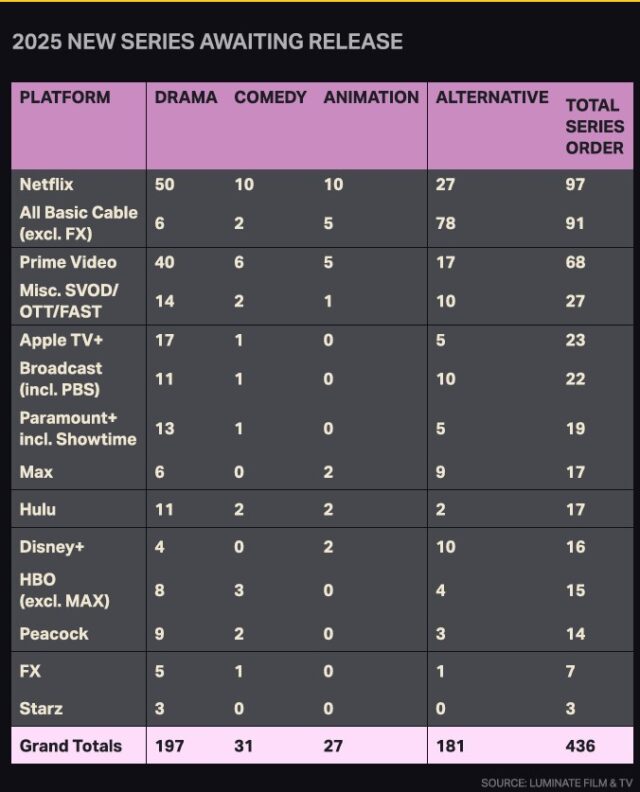
Data from entertainment research firm Luminate’s 2024 Year-End Film & TV Report found a general decline in the number of drama series ordered by streaming services and linear channels between 2019 (304) and 2024 (285). The report also noted a 27 percent drop in the number of drama series episodes ordered from 2019 (3,393) to 2024 (2,492).

Beyond dramas, comedy series orders have been declining the past two years, per Luminate’s data. From 2019 to 2024, “the number of total series has declined by 39 percent, while the number of episodes/hours is down by 47 percent,” Luminate’s report says.

And animated series “have been pummeled over the past few years to an all-time low” with the volume of cartoons down 31 percent in 2024 compared to 2023, per the report.

The expected number of new series releases this year, per Luminate. Credit: Luminate Film & TV

Aquilina at VIP+, a Luminate sister company, said: “As far as appealing to customers, the reality is that the enormous output of the Peak TV era was not a successful business strategy; Luminate data has shown original series viewership on most platforms (other than Netflix) is often concentrated among a small handful of shows.” While Netflix is slightly increasing content spending from 2024 to 2025, it’s expected that “less money will be going toward scripted originals as the company spends more on sports rights and other live events,” the analyst said.

Streaming services struggle to make money with original content

The streaming industry is still young, meaning companies are still determining the best way to turn streaming subscriptions into successful businesses. The obvious formula of providing great content so that streamers get more subscribers and make more money isn’t as direct as it seems. One need only look at Apple TV+’s critically acclaimed $20 billion library that only earned 0.3 percent of US TV screen viewing time in June 2024, per Nielsen, to understand the complexities of making money off of quality content.

When it comes to what is being viewed on streaming services, the top hits are often things that came out years ago or are old network hits, such as Suits, a USA Network original series that ended in 2019 and was the most-streamed show in 2023, per Nielsen, or The Big Bang Theory, a CBS show that ended in 2019 and was the most binged show in 2024, per Nielsen, or Little House on the Prairie, which ended in 1983 and Nielsen said was streamed for 13.25 billion minutes on Peacock last year.

There’s also an argument for streaming services to make money off low-budget (often old) content streamed idly in the background. Perceived demand for background content is considered a driver for growing adoption of free ad-supported streaming TV (FAST) channels like Tubi and the generative AI movies that TCL’s pushing on its FAST channels.

Meanwhile, TVs aren’t watched the way they used to be. Social media and YouTube have gotten younger audiences accustomed to low-budget, short videos, including videos summarizing events from full-length original series and movies. Viral video culture has impacted streaming and TV viewing, with YouTube consistently dominating streaming viewing time in the US and revealing this week that TVs are the primary device used to watch YouTube. Companies looking to capitalize on these trends may find less interest in original, high-budget scripted productions.

The wonderfully weird at risk

Streaming opened the door for many shows and movies to thrive that would likely not have been made or had much visibility through traditional distribution means. From the wonderfully weird like The OA and Big Mouth, to experimental projects like Black Mirror: Bandersnatch, to shows from overseas, like Squid Game, and programs that didn’t survive on network TV, like Futurama, streaming led to more diverse content availability and surprise hits than what many found on broadcast TV.

If streaming services are more particular about original content, the result could be that subscribers miss out on more of the artistic, unique, and outlandish projects that helped make streaming feel so exciting at first. Paramount, for example, said in 2024 that a reduced programming budget would mean less local-language content in foreign markets and more focus on domestic hits with global appeal.

Carnegie Mellon University’s Green agreed that tighter budgets could potentially lead to “less diverse storytelling being available.”

“What will it take for a new, unproven storyteller (writer) to break through without as many opportunities available? Instead, there may be more emphasis on outside licensed content, and perhaps some creators will be drawn to bigger checks from some of the larger streamers,” he added.

Elizabeth Parks, president and CMO at Parks Associates, a research firm focused on IoT, consumer electronics, and entertainment, noted that “many platforms are shifting focus toward content creation rather than new curated, must-watch originals,” which could create a”more fragmented, less compelling viewer experience with diminishing differentiation between platforms.”

As streaming services more aggressively seek live events, like award shows and sporting events, and scripted content with broader appeal, they may increasingly mirror broadcast TV.

“The decision by studios to distribute their own content to competitors… shows how content is being monetized beyond just driving direct subscriptions,” Parks said. “This approach borrows from traditional TV syndication models and signals a shift toward maximizing content value over time, instead of exclusive content.”

Over the next couple of years, we can expect streaming services to be more cautious about content investments. Services will be less interested in providing a bounty of original exclusives and more focused on bottom lines. They will need “to ensure that spend does not outpace revenues, and platforms can maintain attractive profit margins,” Ampere’s Ingram explained. Original hit shows will still be important, but we’ll likely see fewer gambles and more concerted efforts toward safer bets at mainstream appeal.

For streaming customers who are fatigued with the number of services available and dissatisfied with content quality, it’s a critical time for streaming services to prove that they’re an improvement over other traditional TV and not just giving us the same ol’, same ol’.

“The streaming services that most appeal to customers host robust libraries of content that people want to watch, and as long as that’s the case, they’ll continue to do so. That’s why Netflix and Disney are still the top streamers,” Ingram said.

Photo of Scharon Harding

Scharon is a Senior Technology Reporter at Ars Technica writing news, reviews, and analysis on consumer gadgets and services. She’s been reporting on technology for over 10 years, with bylines at Tom’s Hardware, Channelnomics, and CRN UK.

Streaming used to make stuff networks wouldn’t. Now it wants safer bets. Read More »

apple-now-lets-you-move-purchases-between-your-25-years-of-accounts

Apple now lets you move purchases between your 25 years of accounts

Last night, Apple posted a new support document about migrating purchases between accounts, something that Apple users with long online histories have been waiting on for years, if not decades. If you have movies, music, or apps orphaned on various iTools/.Mac/MobileMe/iTunes accounts that preceded what you’re using now, you can start the fairly involved process of moving them over.

“You can choose to migrate apps, music, and other content you’ve purchased from Apple on a secondary Apple Account to a primary Apple Account,” the document reads, suggesting that people might have older accounts tied primarily to just certain movies, music, or other purchases that they can now bring forward to their primary, device-linked account. The process takes place on an iPhone or iPad inside the Settings app, in the “Media & Purchases” section in your named account section.

There are a few hitches to note. You can’t migrate purchases from or into a child’s account that exists inside Family Sharing. You can only migrate purchases to an account once a year. There are some complications if you have music libraries on both accounts and also if you have never used the primary account for purchases or downloads. And migration is not available in the EU, UK, or India.

Apple now lets you move purchases between your 25 years of accounts Read More »

when-software-updates-actually-improve—instead-of-ruin—our-favorite-devices

When software updates actually improve—instead of ruin—our favorite devices


Opinion: These tech products have gotten better over time.

The Hatch Restore 2 smart alarm clock. Credit: Scharon Harding

For many, there’s a feeling of dread associated with software updates to your favorite gadget. Updates to a beloved gadget can frequently result in outrage, from obligatory complaints around bugs to selective aversions to change from Luddites and tech enthusiasts.

In addition to those frustrations, there are times when gadget makers use software updates to manipulate product functionality and seriously upend owners’ abilities to use their property as expected. We’ve all seen software updates render gadgets absolutely horrible: Printers have nearly become a four-letter word as the industry infamously issues updates that brick third-party ink and scanning capabilities. We’ve also seen companies update products that caused features to be behind a paywall or removed entirely. This type of behavior has contributed to some users feeling wary of software updates in fear of them diminishing the value of already-purchased hardware.

On the other hand, there are times when software updates enrich the capabilities of smart gadgets. These updates are the types of things that can help devices retain or improve their value, last longer, and become less likely to turn into e-waste.

For example, I’ve been using the Hatch Restore 2 sunrise alarm clock since July. In that time, updates to its companion app have enabled me to extract significantly more value from the clock and explore its large library of sounds, lights, and customization options.

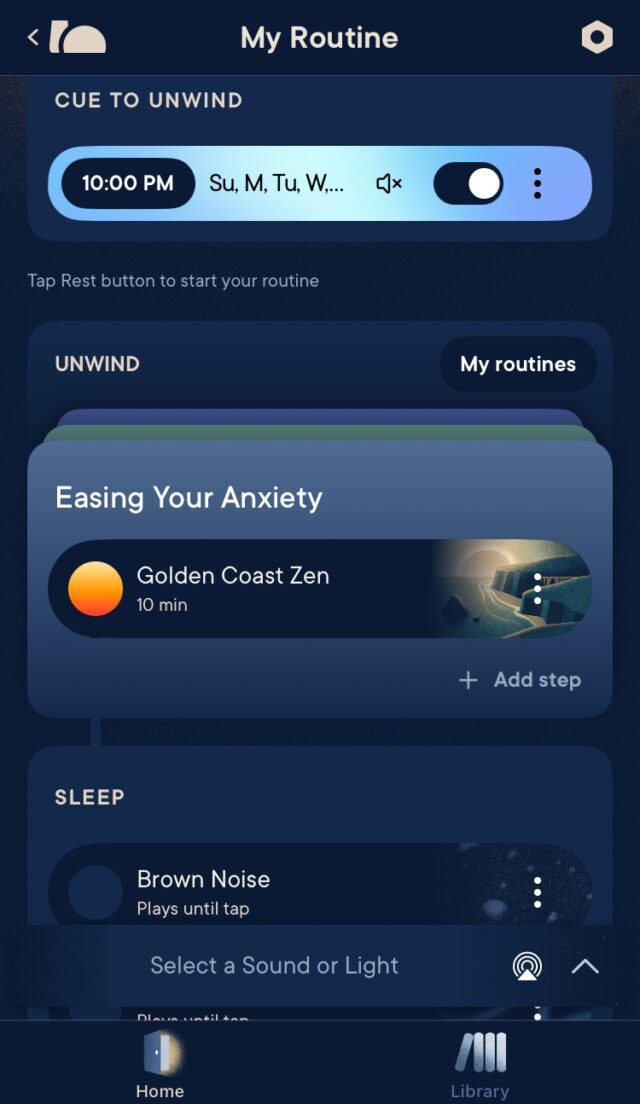
The Hatch Sleep iOS app used to have tabs on the bottom for Rest, for setting how the clock looks and sounds when you’re sleeping; Library, for accessing the clock’s library of sounds and colors; and Rise, for setting how the clock looks and sounds when you’re waking up. Today, the bottom of the app just has Library and Home tabs, with Home featuring all the settings for Rest and Rise, as well as for Cue (the clock’s settings for reminding you it’s time to unwind for the night) and Unwind (sounds and settings that the clock uses during the time period leading up to sleep).

A screenshot of the Home section of the Hatch Sleep app.

Hatch’s app has generally become cleaner after hiding things like its notification section. Hatch also updated the app to store multiple Unwind settings you can swap around. Overall, these changes have made customizing my settings less tedious, which means I’ve been more inclined to try them. Before the updates, I mostly used the app to set my alarm and change my Rest settings. I often exited the app prematurely after getting overwhelmed by all the different tabs I had to toggle through (toggling through tabs was also more time-consuming).

Additionally, Hatch has updated the app since I started using it so that disabled alarms are placed under an expanding drawer. This has reduced the chances of me misreading the app and thinking I have an alarm set when it’s not currently enabled while providing a clearer view of which alarms actually are enabled.

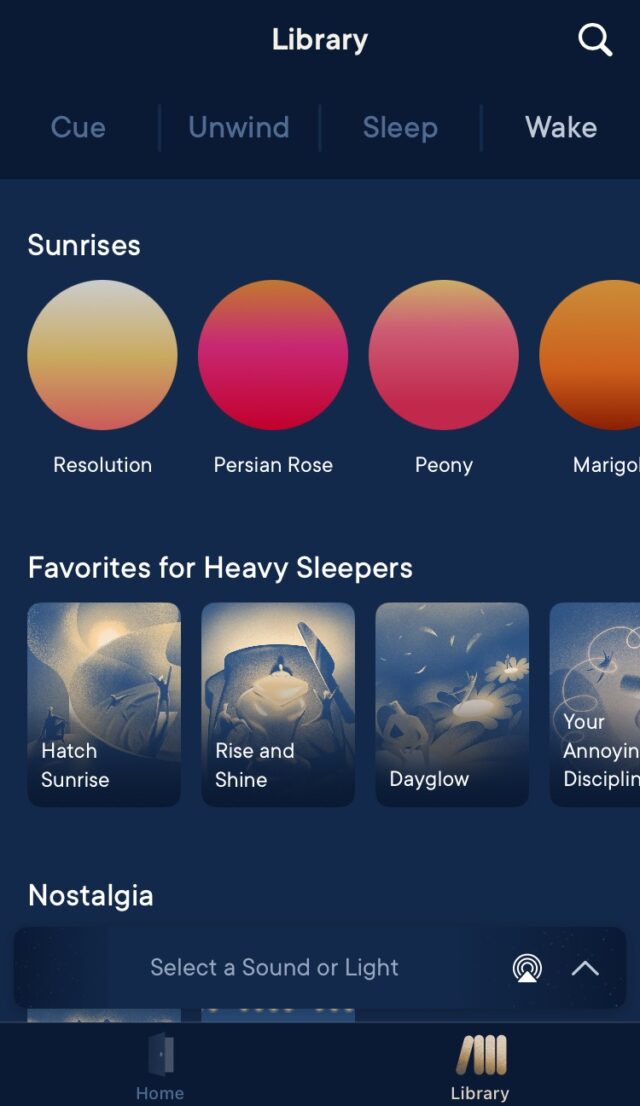
The Library tab was also recently updated to group lights and sounds under Cue, Unwind, Sleep, and Wake, making it easier to find the type of setting I’m interested in.

The app also started providing more helpful recommendations, such as “favorites for heavy sleepers.”

Better over time

Software updates have made it easier for me to enjoy the Restore 2 hardware. Honestly, I don’t know if I’d still use the clock without these app improvements. What was primarily a noise machine this summer has become a multi-purpose device with much more value.

Now, you might argue that Hatch could’ve implemented these features from the beginning. That may have been more sensible, but as a tech enthusiast, I still find something inherently cool about watching a gadget improve in ways that affect how I use the hardware and align with what I thought my gadget needed. I agree that some tech gadgets are released prematurely and overly rely on updates to earn their initial prices. But it’s also advantageous for devices to improve over time.

The Steam Deck is another good example. Early adopters might have been disappointed to see missing features like overclocking controls, per-game power profiles, or Windows drivers. Valve has since added those features.

Valve only had a few dozen Hardware department employees in the run up to the launch of the Steam Deck. Credit: Sam Machkovech

Valve has also added more control over the Steam Deck since its release, including the power to adjust resolution and refresh rates for connected external displays. It’s also upped performance via an October update that Valve claimed could improve the battery life of LCD models by up to 10 percent in “light load situations.”

These are the kinds of updates that still allowed the Steam Deck to be playable for months, but the features were exciting additions once they arrived. When companies issue updates reliably and in ways that improve the user experience, people are less averse to updating their gadgets, which could also be critical for device functionality and security.

Adding new features via software updates can make devices more valuable to owners. Updates that address accessibility needs go even further by opening up the gadgets to more people.

Apple, for example, demonstrated the power that software updates can have on accessibility by adding a hearing aid feature to the AirPods Pro 2 in October, about two years after the earbuds came out. Similarly, Amazon updated some Fire TV models in December to support simultaneous audio broadcasting from internal speakers and hearing aids. It also expanded the number of hearing aids supported by some Fire TV models as well as its Fire TV Cube streaming device.

For some, these updates had a dramatic impact on how they could use the devices, demonstrating a focus on user, rather than corporate, needs.

Update upswings

We all know that corporations sometimes leverage software updates to manipulate products in ways that prioritize internal or partner needs over those of users. Unfortunately, this seems like something we have to get used to, as an increasing number of devices join the Internet of Things and rely on software updates.

Innovations also mean that some companies are among the first to try to make sustainable business models for their products. Sometimes our favorite gadgets are made by young companies or startups with unstable funding that are forced to adapt amid challenging economics or inadequate business strategy. Sometimes, the companies behind our favorite tech products are beholden to investors and pressure for growth. These can lead to projects being abandoned or to software updates that look to squeeze more money out of customers.

As happy as I am to find my smart alarm clock increasingly easy to use, those same software updates could one day lock the features I’ve grown fond of behind a paywall (Hatch already has a subscription option available). Having my alarm clock lose functionality overnight without physical damage isn’t the type of thing I’d have to worry about with a dumb alarm clock, of course.

But that’s the gamble that tech fans take, which makes those privy to the problematic tactics used by smart device manufacturers stay clear from certain products.

Still, when updates provide noticeable, meaningful changes to how people can use their devices, technology feels futuristic, groundbreaking, and exciting. With many companies using updates for their own gain, it’s nice to see some firms take the opportunity to give customers more.

Photo of Scharon Harding

Scharon is a Senior Technology Reporter at Ars Technica writing news, reviews, and analysis on consumer gadgets and services. She’s been reporting on technology for over 10 years, with bylines at Tom’s Hardware, Channelnomics, and CRN UK.

When software updates actually improve—instead of ruin—our favorite devices Read More »

google-chrome-may-soon-use-“ai”-to-replace-compromised-passwords

Google Chrome may soon use “AI” to replace compromised passwords

Google’s Chrome browser might soon get a useful security upgrade: detecting passwords used in data breaches and then generating and storing a better replacement. Google’s preliminary copy suggests it’s an “AI innovation,” though exactly how is unclear.

Noted software digger Leopeva64 on X found a new offering in the AI settings of a very early build of Chrome. The option, “Automated password Change” (so, early stages—as to not yet get a copyedit), is described as, “When Chrome finds one of your passwords in a data breach, it can offer to change your password for you when you sign in.”

Chrome already has a feature that warns users if the passwords they enter have been identified in a breach and will prompt them to change it. As noted by Windows Report, the change is that now Google will offer to change it for you on the spot rather than simply prompting you to handle that elsewhere. The password is automatically saved in Google’s Password Manager and “is encrypted and never seen by anyone,” the settings page claims.

If you want to see how this works, you need to download a Canary version of Chrome. In the flags settings (navigate to “chrome://flags” in the address bar), you’ll need to enable two features: “Improved password change service” and “Mark all credential as leaked,” the latter to force the change notification because, presumably, it’s not hooked up to actual leaked password databases yet. Go to almost any non-Google site, enter in any user/password combination to try to log in, and after it fails or you navigate elsewhere, a prompt will ask you to consider changing your password.

Google Chrome may soon use “AI” to replace compromised passwords Read More »

what-you-need-to-know-about-the-t-mobile-starlink-mobile-service

What you need to know about the T-Mobile Starlink mobile service


Starlink for your smartphone

Details on beta registration, prices, compatible phones, and technical limits.

T-Mobile marketing image for its Starlink texting service. Credit: T-Mobile

T-Mobile yesterday announced more details of its new service powered by Starlink and said Verizon and AT&T customers can use the satellite offering, too. The standard price will be $15 a month as an add-on for T-Mobile customers, and $20 a month for people who don’t have T-Mobile as their primary carrier.

While we’ve written numerous articles about the Starlink/T-Mobile collaboration over the past two and a half years, the service’s beta test and a Super Bowl commercial are raising awareness that it exists. In this article we’ll answer some questions you might have about T-Mobile Starlink (yes, T-Mobile Starlink is the official name of the service).

What is this thing anyway?

Over the past 13 months, SpaceX’s Starlink division has launched about 450 Direct to Cell satellites that can provide service to mobile phones in areas where there are no cell towers. Starlink is partnering with cellular carriers in multiple countries, and T-Mobile is its primary commercial partner in the US.

T-Mobile says the goal is to provide telecom service in dead zones, the 500,000 square miles of the US that aren’t reached by any terrestrial cell tower. When a user crosses into a dead zone, their phone is supposed to automatically connect to Starlink satellites. T-Mobile Starlink only supports texting for now, but T-Mobile says voice calls and data service will be available eventually.

Who can use it

T-Mobile Starlink is obviously available to T-Mobile customers, but the carrier said that Verizon and AT&T customers can also use it on their existing phones without switching entirely to T-Mobile. Verizon and AT&T customers will need an unlocked phone with eSIM technology, which lets users activate a cellular plan without a physical SIM card.

A Verizon or AT&T customer can use T-Mobile Starlink by activating a second eSIM on their device. “They will technically be assigned a T-Mobile number, but that’s just to provision the device to access the constellation. And then the second eSIM can connect whenever the user loses coverage,” a T-Mobile spokesperson told Mobile World Live.

T-Mobile suggested that international roaming will be available with other carriers that also partner with Starlink. T-Mobile said a “growing alliance” of telcos “aims to provide reciprocal roaming for all participating carriers.” Participating carriers so far include ones in Japan, Australia, New Zealand, Switzerland, Chile, Peru, Canada, and Ukraine.

How to sign up

To use T-Mobile Starlink now, you need to register for a beta trial and hope you get in quickly. “The beta test is free and open to anyone—on any carrier—until July,” T-Mobile said.

There is a short registration form in which you’ll provide your name, email address, and mobile phone number, and agree that T-Mobile can contact you with marketing offers by email or phone. “We’ll admit people on a rolling first-come, first-served basis, so we encourage everyone to sign up as soon as possible,” T-Mobile said.

T-Mobile said it is enrolling users “on an ongoing basis to help test the system and provide feedback before launching in July.” Beta registration began in December. Early reports from beta testers suggest the service usually does what T-Mobile claims—enabling texting in areas with no cellular access—but that users still can’t get connections in some areas.

What it costs

When the free beta trial ends, T-Mobile customers will be able to add Starlink service to their plan for an extra charge of $15 per month for each line. If you sign up for the beta during February or if you signed up before then, T-Mobile says you’ll get a $5 discount for early adopters once the service transitions from a free beta to a paid add-on. T-Mobile users with the early adopter discount will pay $10 a month starting in July 2025, the company said.

Go5G Next, T-Mobile’s priciest plan at $100 a month for a single line, will include Starlink access at no extra cost. “The beta is free until July at which point T-Mobile Starlink will be included at no extra cost on Go5G Next (including variations like Go5G Next 55+), T-Mobile’s best plan,” the company said. “Business customers will also get T-Mobile Starlink at no extra cost on Go5G Business Next, first responder agencies on T-Priority plans and other select premium rate plans. T-Mobile customers on any other plan can add the service for $15/month per line.”

After the beta trial ends, Verizon and AT&T customers can purchase T-Mobile Starlink for $20 per month for each line. There was no mention of an early adopter discount for customers who don’t use T-Mobile as their primary carrier.

Users who aren’t subscribers of any of the big three carriers can also take advantage of the $20 offer. We asked T-Mobile if it would be available to people on other carriers, such as regional wireless providers or resellers. “Yes, any wireless user with an unlocked eSIM phone can sign up for service, regardless of provider,” T-Mobile told us.

Which phones it works on

T-Mobile Starlink works on recent iPhones and certain phones made by Google, Motorola, Samsung, and a T-Mobile brand called REVVL. T-Mobile said more phones will be added over time, and the current list of supported devices is as follows:

    • Apple iPhone 14 and later (including Plus, Pro & Pro Max)
    • Google Pixel 9 (including Pro, Pro Fold, & Pro XL)
    • Motorola 2024 and later (including razr, razr+, edge and g series)
    • Samsung Galaxy A14, A15, A16, A35, A53, A54
    • Samsung Galaxy S21 and later (including Plus, Ultra and Fan Edition)
    • Samsung Galaxy X Cover6 Pro
    • Samsung Galaxy Z Flip3 and later
    • Samsung Galaxy Z Fold3 and later
    • REVVL 7 (including Pro)

Going beyond text

Moving from text messages to voice and data requires more bandwidth, and SpaceX needs another government approval to use the full capabilities of its satellites. To that end, SpaceX is seeking a waiver of Federal Communications Commission rules regarding out-of-band emission limits.

Verizon and AT&T urged the FCC to deny the waiver request, alleging that Starlink’s plan would interfere with services provided over networks using adjacent spectrum bands. SpaceX has described the waiver as being crucial to its future plans, telling the FCC that the “out-of-band emission restriction will be most detrimental for real-time communications such as voice and video, rendering such communications unreliable both in critical and in common circumstances, increasing risk in emergency situations.”

The FCC approved Starlink’s plan for cellular phone service in November but deferred making a decision on the waiver request.

Verizon and AT&T plan similar service

AT&T and Verizon both intend to offer similar service through deals with satellite operator AST SpaceMobile. But AST SpaceMobile isn’t as far along as SpaceX’s Starlink, which is why AT&T was rebuked by an advertising industry self-regulatory board in August for claiming that it already offered cellular coverage from space.

AST SpaceMobile launched its first five commercial satellites in September 2024. In late January, AST SpaceMobile said it obtained FCC approval to test the service “with unmodified smartphones in AT&T and Verizon premium low-band wireless spectrum supporting voice, full data, and video applications.” The company also announced plans to launch up to 60 more satellites in 2025 and 2026.

Photo of Jon Brodkin

Jon is a Senior IT Reporter for Ars Technica. He covers the telecom industry, Federal Communications Commission rulemakings, broadband consumer affairs, court cases, and government regulation of the tech industry.

What you need to know about the T-Mobile Starlink mobile service Read More »

handful-of-users-claim-new-nvidia-gpus-are-melting-power-cables-again

Handful of users claim new Nvidia GPUs are melting power cables again

The 12VHPWR and 12V-2×6 connectors are both designed to solve a real problem: delivering hundreds of watts of power to high-end GPUs over a single cable rather than trying to fit multiple 8-pin power connectors onto these GPUs. In theory, swapping two to four 8-pin connectors for a single 12V-2×6 or 12VHPWR connector cuts down on the amount of board space OEMs must reserve for these connectors in their designs and the number of cables that users have to snake through the inside of their gaming PCs.

But while Nvidia, Intel, AMD, Qualcomm, Arm, and other companies are all PCI-SIG members and all had a hand in the design of the new standards, Nvidia is the only GPU company to use the 12VHPWR and 12V-2×6 connectors in most of its GPUs. AMD and Intel have continued to use the 8-pin power connector, and even some of Nvidia’s partners have stuck with 8-pin connectors for lower-end, lower-power cards like the RTX 4060 and 4070 series.

Both of the reported 5090 incidents involved third-party cables, one from custom PC part manufacturer MODDIY and one included with an FSP power supply, rather than the first-party 8-pin adapter that Nvidia supplies with GeForce GPUs. It’s much too early to say whether these cables (or Nvidia, or the design of the connector, or the affected users) caused the problem or whether this was just a coincidence.

We’ve contacted Nvidia to see whether it’s aware of and investigating the reports and will update this piece if we receive a response.

Handful of users claim new Nvidia GPUs are melting power cables again Read More »

report:-iphone-se-could-shed-its-10-year-old-design-“as-early-as-next-week”

Report: iPhone SE could shed its 10-year-old design “as early as next week”

Gurman suggests that Apple could raise the $429 starting price of the new iPhone SE to reflect the updated design. He also says that Apple’s supplies of the $599 iPhone 14 are running low at Apple’s stores—the 14 has already been discontinued in some countries over its lack of USB-C port, and it’s possible Apple could be planning to replace both the iPhone 14 and the old SE with the new SE.

Apple’s third-generation iPhone SE is nearly three years old, but its design (including its dimensions, screen size, Home button, and Lightning port) hearkens all the way back to 2014’s iPhone 6. Put 2017’s iPhone 8 and 2022’s iPhone SE on a table next to each other, and almost no one could tell the difference. These days, it feels like a thoroughly second-class iPhone experience, and a newer design is overdue.

Other Apple products allegedly due for an early 2025 release include the M4 MacBook Airs and a next-generation Apple TV, which, like the iPhone SE, was also last refreshed in 2022. Gurman has also said that a low-end iPad and a new iPad Air will arrive “during the first half of 2025” and updated Mac Pro and Mac Studio models are to arrive sometime this year as well. Apple is also said to be making progress on its own smart display, expanding its smart speaker efforts beyond the aging HomePod and HomePod mini.

Report: iPhone SE could shed its 10-year-old design “as early as next week” Read More »

developer-creates-endless-wikipedia-feed-to-fight-algorithm-addiction

Developer creates endless Wikipedia feed to fight algorithm addiction

On a recent WikiTok browsing run, I ran across entries on topics like SX-Window (a GUI for the Sharp X68000 series of computers), Xantocillin (“the first reported natural product found to contain the isocyanide functional group), Lorenzo Ghiberti (an Italian Renaissance sculptor from Florence), the William Wheeler House in Texas, and the city of Krautheim, Germany—none of which I knew existed before the session started.

How WikiTok took off

The original idea for WikiTok originated from developer Tyler Angert on Monday evening when he tweeted, “insane project idea: all of wikipedia on a single, scrollable page.” Bloomberg Beta VC James Cham replied, “Even better, an infinitely scrolling Wikipedia page based on whatever you are interested in next?” and Angert coined “WikiTok” in a follow-up post.

Early the next morning, at 12: 28 am, writer Grant Slatton quote-tweeted the WikiTok discussion, and that’s where Gemal came in. “I saw it from [Slatton’s] quote retweet,” he told Ars. “I immediately thought, ‘Wow I can build an MVP [minimum viable product] and this could take off.'”

Gemal started his project at 12: 30 am, and with help from AI coding tools like Anthropic’s Claude and Cursor, he finished a prototype by 2 am and posted the results on X. Someone later announced WikiTok on ycombinator’s Hacker News, where it topped the site’s list of daily news items.

A screenshot of the WikiTok web app running in a desktop web browser.

A screenshot of the WikiTok web app running in a desktop web browser. Credit: Benj Edwards

“The entire thing is only several hundred lines of code, and Claude wrote the vast majority of it,” Gemal told Ars. “AI helped me ship really really fast and just capitalize on the initial viral tweet asking for Wikipedia with scrolling.”

Gemal posted the code for WikiTok on GitHub, so anyone can modify or contribute to the project. Right now, the web app supports 14 languages, article previews, and article sharing on both desktop and mobile browsers. New features may arrive as contributors add them. It’s based on a tech stack that includes React 18, TypeScript, Tailwind CSS, and Vite.

And so far, he is sticking to his vision of a free way to enjoy Wikipedia without being tracked and targeted. “I have no grand plans for some sort of insane monetized hyper-calculating TikTok algorithm,” Gemal told us. “It is anti-algorithmic, if anything.

Developer creates endless Wikipedia feed to fight algorithm addiction Read More »

amd-promises-“mainstream”-4k-gaming-with-next-gen-gpus-as-current-gen-gpu-sales-tank

AMD promises “mainstream” 4K gaming with next-gen GPUs as current-gen GPU sales tank

AMD announced its fourth-quarter earnings yesterday, and the numbers were mostly rosy: $7.7 billion in revenue and a 51 percent profit margin, compared to $6.2 billion and 47 percent a year ago. The biggest winner was the data center division, which made $3.9 billion thanks to Epyc server processors and Instinct AI accelerators, and Ryzen CPUs are also selling well, helping the company’s client segment earn $2.3 billion.

But if you were looking for a dark spot, you’d find it in the company’s gaming division, which earned a relatively small $563 million, down 59 percent from a year ago. AMD’s Lisa Su blamed this on both dedicated graphics card sales and sales from the company’s “semi-custom” chips (that is, the ones created specifically for game consoles like the Xbox and PlayStation).

Other data sources suggest that the response from GPU buyers to AMD’s Radeon RX 7000 series, launched between late 2022 and early 2024, has been lackluster. The Steam Hardware Survey, a noisy but broadly useful barometer for GPU market share, shows no RX 7000-series models in the top 50; only two of the GPUs (the 7900 XTX and 7700 XT) are used in enough gaming PCs to be mentioned on the list at all, with the others all getting lumped into the “other” category. Jon Peddie Research recently estimated that AMD was selling roughly one dedicated GPU for every seven or eight sold by Nvidia.

But hope springs eternal. Su confirmed on AMD’s earnings call that the new Radeon RX 9000-series cards, announced at CES last month, would be launching in early March. The Radeon RX 9070 and 9070 XT are both aimed toward the middle of the graphics card market, and Su said that both would bring “high-quality gaming to mainstream players.”

An opportunity, maybe

“Mainstream” could mean a lot of things. AMD’s CES slide deck positioned the 9070 series alongside Nvidia’s RTX 4070 Ti ($799) and 4070 Super ($599) and its own RTX 7900 XT, 7900 GRE, and 7800 XT (between $500 and $730 as of this writing), a pretty wide price spread that is still more expensive than an entire high-end console. The GPUs could still rely heavily on upscaling algorithms like AMD’s Fidelity Super Resolution (FSR) to hit playable frame rates at those resolutions, rather than targeting native 4K.

AMD promises “mainstream” 4K gaming with next-gen GPUs as current-gen GPU sales tank Read More »