SR model

openai-ceo-declares-“code-red”-as-gemini-gains-200-million-users-in-3-months

OpenAI CEO declares “code red” as Gemini gains 200 million users in 3 months

In addition to buzz about Gemini on social media, Google is quickly catching up to ChatGPT in user numbers. ChatGPT has more than 800 million weekly users, according to OpenAI, while Google’s Gemini app has grown from 450 million monthly active users in July to 650 million in October, according to Business Insider.

Financial stakes run high

Not everyone views OpenAI’s “code red” as a genuine alarm. Reuters columnist Robert Cyran wrote on Tuesday that OpenAI’s announcement added “to the impression that OpenAI is trying to do too much at once with technology that still requires a great deal of development and funding.” On the same day Altman’s memo circulated, OpenAI announced an ownership stake in a Thrive Capital venture and a collaboration with Accenture. “The only thing bigger than the company’s attention deficit is its appetite for capital,” Cyran wrote.

In fact, OpenAI faces an unusual competitive disadvantage: Unlike Google, which subsidizes its AI ventures through search advertising revenue, OpenAI does not turn a profit and relies on fundraising to survive. According to The Information, the company, now valued at around $500 billion, has committed more than $1 trillion in financial obligations to cloud computing providers and chipmakers that supply the computing power needed to train and run its AI models.

But the tech industry never stands still, and things can change quickly. Altman’s memo also reportedly stated that OpenAI plans to release a new simulated reasoning model next week that may beat Gemini 3 in internal evaluations. In AI, the back-and-forth cycle of one-upmanship is expected to continue as long as the dollars keep flowing.

OpenAI CEO declares “code red” as Gemini gains 200 million users in 3 months Read More »

openai-walks-a-tricky-tightrope-with-gpt-5.1’s-eight-new-personalities

OpenAI walks a tricky tightrope with GPT-5.1’s eight new personalities

On Wednesday, OpenAI released GPT-5.1 Instant and GPT-5.1 Thinking, two updated versions of its flagship AI models now available in ChatGPT. The company is wrapping the models in the language of anthropomorphism, claiming that they’re warmer, more conversational, and better at following instructions.

The release follows complaints earlier this year that its previous models were excessively cheerful and sycophantic, along with an opposing controversy among users over how OpenAI modified the default GPT-5 output style after several suicide lawsuits.

The company now faces intense scrutiny from lawyers and regulators that could threaten its future operations. In that kind of environment, it’s difficult to just release a new AI model, throw out a few stats, and move on like the company could even a year ago. But here are the basics: The new GPT-5.1 Instant model will serve as ChatGPT’s faster default option for most tasks, while GPT-5.1 Thinking is a simulated reasoning model that attempts to handle more complex problem-solving tasks.

OpenAI claims that both models perform better on technical benchmarks such as math and coding evaluations (including AIME 2025 and Codeforces) than GPT-5, which was released in August.

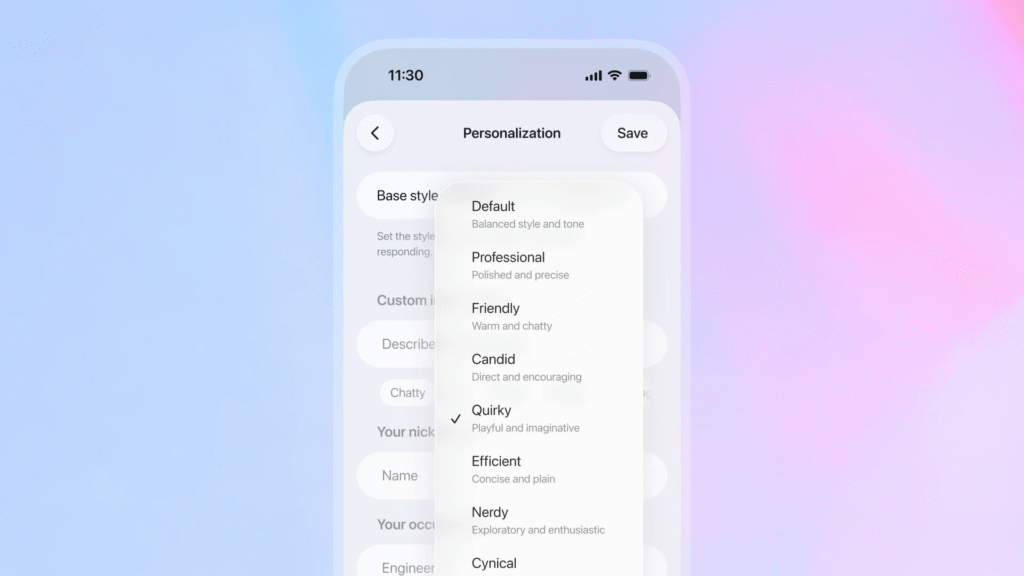
Improved benchmarks may win over some users, but the biggest change with GPT-5.1 is in its presentation. OpenAI says it heard from users that they wanted AI models to simulate different communication styles depending on the task, so the company is offering eight preset options, including Professional, Friendly, Candid, Quirky, Efficient, Cynical, and Nerdy, alongside a Default setting.

These presets alter the instructions fed into each prompt to simulate different personality styles, but the underlying model capabilities remain the same across all settings.

An illustration showing GPT-5.1's eight personality styles in ChatGPT.

An illustration showing GPT-5.1’s eight personality styles in ChatGPT. Credit: OpenAI

In addition, the company trained GPT-5.1 Instant to use “adaptive reasoning,” meaning that the model decides when to spend more computational time processing a prompt before generating output.

The company plans to roll out the models gradually over the next few days, starting with paid subscribers before expanding to free users. OpenAI plans to bring both GPT-5.1 Instant and GPT-5.1 Thinking to its API later this week. GPT-5.1 Instant will appear as gpt-5.1-chat-latest, and GPT-5.1 Thinking will be released as GPT-5.1 in the API, both with adaptive reasoning enabled. The older GPT-5 models will remain available in ChatGPT under the legacy models dropdown for paid subscribers for three months.

OpenAI walks a tricky tightrope with GPT-5.1’s eight new personalities Read More »