retrotech

inventor-of-ntp-protocol-that-keeps-time-on-billions-of-devices-dies-at-age-85

Inventor of NTP protocol that keeps time on billions of devices dies at age 85

A legend in his own time —

Dave Mills created NTP, the protocol that holds the temporal Internet together, in 1985.

A photo of David L. Mills taken by David Woolley on April 27, 2005.

Enlarge / A photo of David L. Mills taken by David Woolley on April 27, 2005.

David Woolley / Benj Edwards / Getty Images

On Thursday, Internet pioneer Vint Cerf announced that Dr. David L. Mills, the inventor of Network Time Protocol (NTP), died peacefully at age 85 on January 17, 2024. The announcement came in a post on the Internet Society mailing list after Cerf was informed of David’s death by Mills’ daughter, Leigh.

“He was such an iconic element of the early Internet,” wrote Cerf.

Dr. Mills created the Network Time Protocol (NTP) in 1985 to address a crucial challenge in the online world: the synchronization of time across different computer systems and networks. In a digital environment where computers and servers are located all over the world, each with its own internal clock, there’s a significant need for a standardized and accurate timekeeping system.

NTP provides the solution by allowing clocks of computers over a network to synchronize to a common time source. This synchronization is vital for everything from data integrity to network security. For example, NTP keeps network financial transaction timestamps accurate, and it ensures accurate and synchronized timestamps for logging and monitoring network activities.

In the 1970s, during his tenure at COMSAT and involvement with ARPANET (the precursor to the Internet), Mills first identified the need for synchronized time across computer networks. His solution aligned computers to within tens of milliseconds. NTP now operates on billions of devices worldwide, coordinating time across every continent, and has become a cornerstone of modern digital infrastructure.

As detailed in an excellent 2022 New Yorker profile by Nate Hopper, Mills faced significant challenges in maintaining and evolving the protocol, especially as the Internet grew in scale and complexity. His work highlighted the often under-appreciated role of key open source software developers (a topic explored quite well in a 2020 xkcd comic). Mills was born with glaucoma and lost his sight, eventually becoming completely blind. Due to difficulties with his sight, Mills turned over control of the protocol to Harlan Stenn in the 2000s.
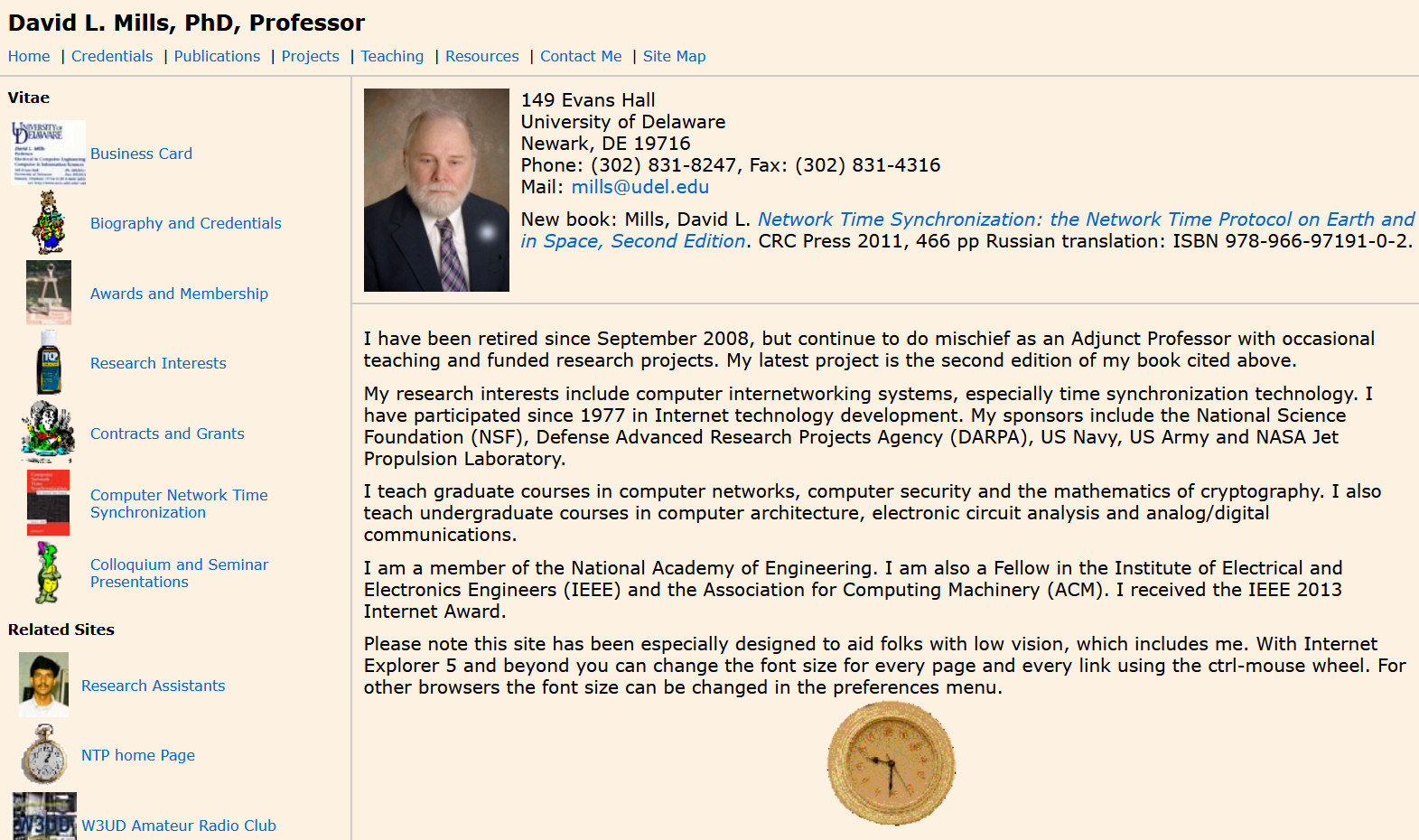
A screenshot of Dr. David L. Mills' website at the University of Delaware captured on January 19, 2024.

Enlarge / A screenshot of Dr. David L. Mills’ website at the University of Delaware captured on January 19, 2024.

Aside from his work on NTP, Mills also invented the first “Fuzzball router” for NSFNET (one of the first modern routers, based on the DEC PDP-11 computer), created one of the first implementations of FTP, inspired the creation of “ping,” and played a key role in Internet architecture as the first chairman of the Internet Architecture Task Force.

Mills was widely recognized for his work, becoming a Fellow of the Association for Computing Machinery in 1999 and the Institute of Electrical and Electronics Engineers in 2002, as well as receiving the IEEE Internet Award in 2013 for contributions to network protocols and timekeeping in the development of the Internet.

Mills received his PhD in Computer and Communication Sciences from the University of Michigan in 1971. At the time of his death, Mills was an emeritus professor at the University of Delaware, having retired in 2008 after teaching there for 22 years.

Inventor of NTP protocol that keeps time on billions of devices dies at age 85 Read More »
why-i-hope-the-atari-400-mini-will-bring-respect-to-atari’s-most-underrated-platform

Why I hope the Atari 400 Mini will bring respect to Atari’s most underrated platform

Have you played Atari today? —

Can USB, HDMI, and built-in games raise awareness for a platform overshadowed by the C64?

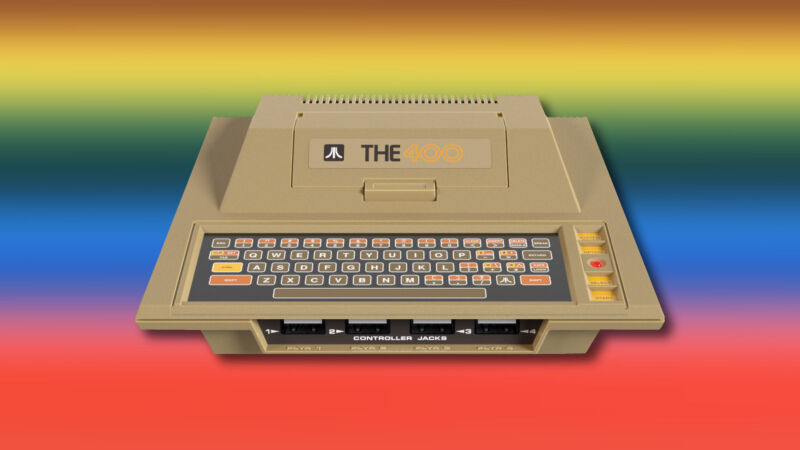
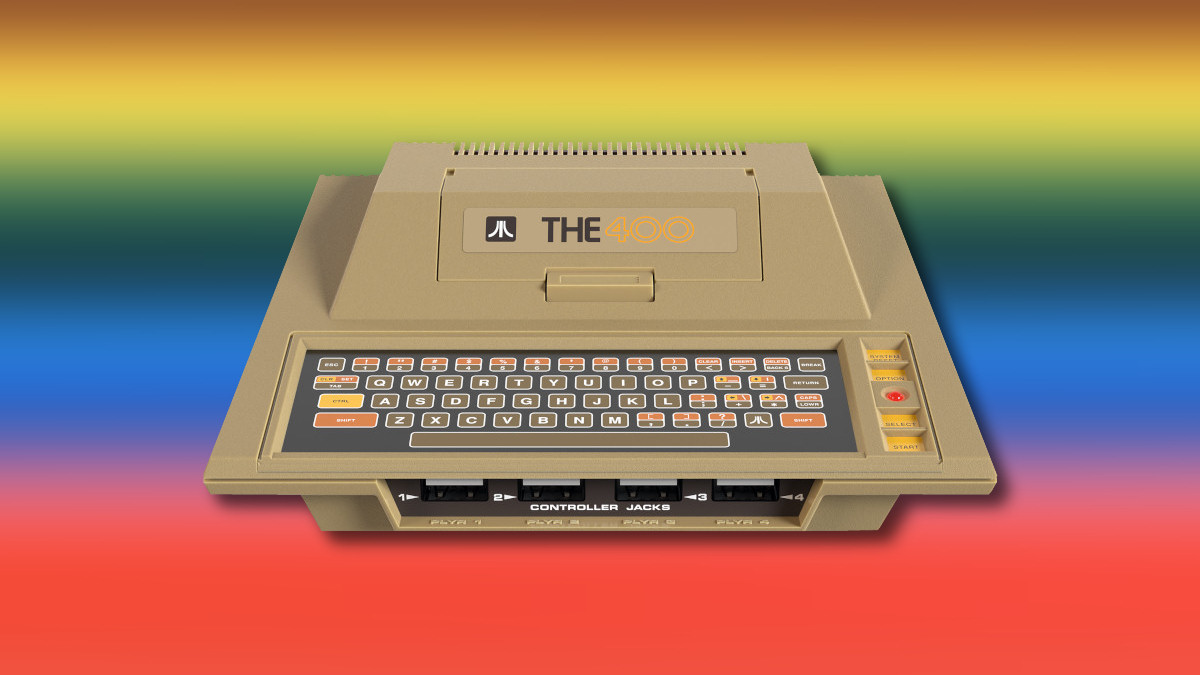
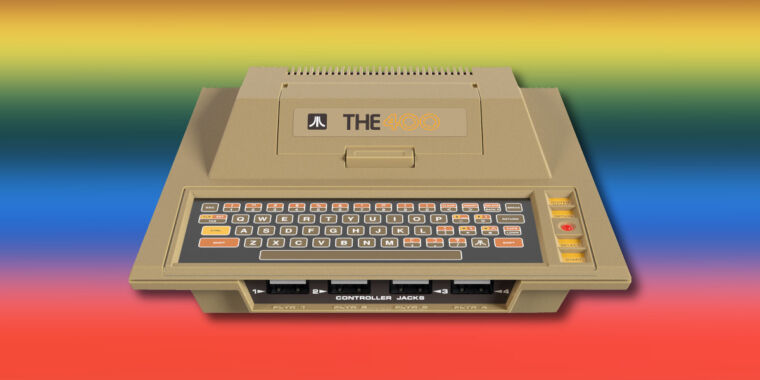
Retro Games' THE400 Mini console.

Enlarge / Retro Games’ THE400 Mini console.

Retro Games / Benj Edwards

Last week, UK-based Retro Games, Ltd. announced a mini console version of the Atari 400 home computer, first released in 1979. It’s called “THE400 Mini,” and it includes HDMI video output, 25 built-in games, a USB version of Atari’s famous joystick, and it retails for $120. But this release means something more to me personally because my first computer was an Atari 400—and as any other Atari 8-bit computer fan can tell you, the platform often doesn’t get the respect it should. This will be the first time Atari’s 8-bit computer line has received a major retro-remake release.

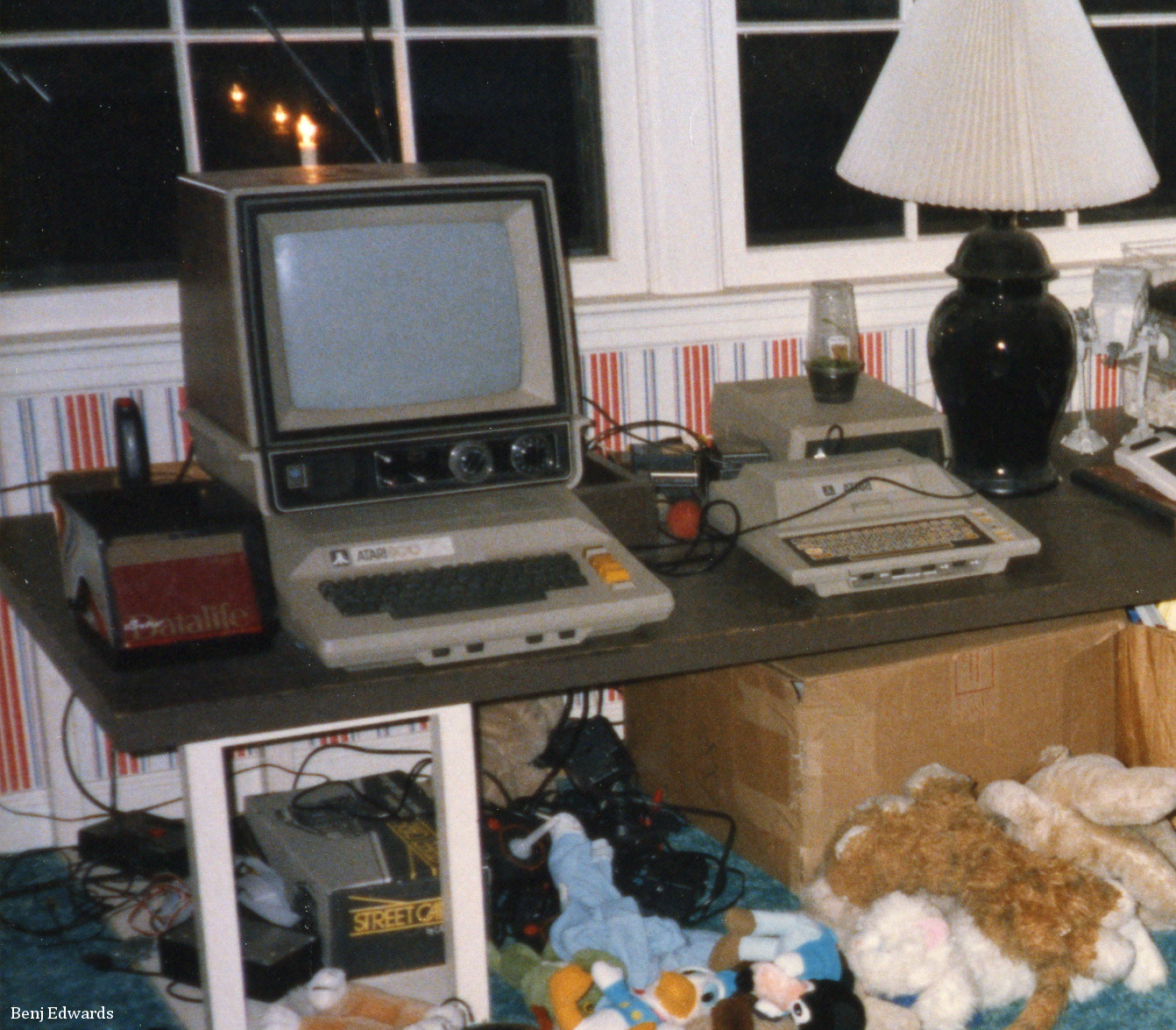
My Atari 400 story goes a little something like this. Around the time I was born in 1981, my dad bought my older brother (then 5 years old) an Atari 400 so he could play games and learn to program. My brother almost immediately found its flat membrane keyboard frustrating and the Atari 410 cassette drive too slow, so my dad ordered an Atari 800 and an Atari 810 disk drive instead. This began our family’s golden age of Atari 800 gaming, which I’ve written about elsewhere.

I’ve often said if a modern game designer wants to learn how to make games, just dive into the Atari 400/800 game library. There are some priceless gems there you can’t find anywhere else, plus others that play best on the platform. OK, I’ll name a few: The Seven Cities of Gold, Archon, M.U.L.E., Wizard of Wor, Salmon Run, Star Raiders, The Halley Project, and so much more.

A photo of Benj Edwards' family Atari 800 and Atari 400 in his brother's room, Christmas 1985.

Enlarge / A photo of Benj Edwards’ family Atari 800 and Atari 400 in his brother’s room, Christmas 1985.

Even with the new 800, it seems that my dad must have kept the original Atari 400, because by the time I grew up more and wanted “my own computer” in the late 1980s, he gave me the Atari 400. The 800 was still my brother’s baby and typically remained in his bedroom. When I wasn’t playing more complex games like M.U.L.E. and Archon on the 800 with my brother, I hooked up the 400 to a small black-and-white TV set in my room and mostly played Galaxian, Pac-Man, and Donkey Kong on a cartridge. Not long after, I got an Apple II Plus and learned BASIC on that, but the Atari 400 always got pride of place in my growing computer collection.

A snippet from a 1988 to-do list written by Benj Edwards' dad that says

Enlarge / A snippet from a 1988 to-do list written by Benj Edwards’ dad that says “Get TV/monitor for Benj’s Atari 400 computer,” completed 4/14/88.

But enough about me. Let’s talk about the new Atari 400 Mini. I haven’t used it myself yet, so all we have to go on is the information provided by the company—and the company’s reputation. Retro Games has previously released full-sized remakes of the Commodore VIC-20 and the Commodore 64, and mini consoles of the Amiga 500 and the Commodore 64. In 2020, Engadget gave the company’s “THE64 Mini” mixed reviews, praising its looks but complaining about its joystick and poor game selection. We’ll admit preconceived bias and hope the 400 Mini fares much better. Even if the joystick ends up a dud, Retro Games says you can provide your own USB stick or controller.

I also hope THE400 does well because Atari 8-bit fans have a tough time with group identity in the span of retro tech history. Few Americans aside from Atari 400/800 owners have heard of the platform (though the platform did very well in Eastern Europe). The Atari 8-bit series didn’t sell nearly as well as competitors like the Commodore 64 in the US (although Sean Lennon had an Atari 400 as a kid—cool trivia).

And even though the Atari 400/800 series provided the template for Commodore to imitate with the VIC-20 and C64, Commodore undercut Atari in price with cheaper parts, which contributed to Atari’s crash in 1983 and drove Texas Instruments out of the home computer business. More recently, the Commodore 64 has had several retro re-releases since the Commodore 64 Direct-to-TV in 2004. The Atari 400/800 platform has had none until now.

Why I hope the Atari 400 Mini will bring respect to Atari’s most underrated platform Read More »