Meta

zuckerberg-gives-his-first-reaction-to-apple’s-vision-pro

Zuckerberg Gives His First Reaction to Apple’s Vision Pro

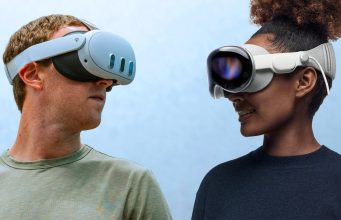
Meta founder and CEO Mark Zuckerberg hasn’t been shy about addressing the elephant in the room: with Apple Vision Pro, the Cupertino tech giant is officially entering a market that, up until now, Meta has basically owned. In a meeting with Meta employees, Zuckerberg thinks that while Apple Vision Pro “could be the vision of the future of computing […] it’s not the one that I want”

As reported by The Verge, Zuckerberg seems very confident in the company’s XR offerings, and is less impressed with Apple’s design tradeoffs. During a companywide meeting, Zuckerberg said that with Vision Pro, Appe has “no kind of magical solutions” and that they haven’t bypassed “any of the constraints on laws of physics that our teams haven’t already explored and thought of.” He calls that “the good news.”

Largely, Zuckerberg says Apple is making some telling design tradeoffs, as its higher resolution displays, advanced software, and external battery comes alongside a $3,500 price tag—or seven times more than Meta’s upcoming Quest 3 mixed reality standalone.

Photo by Road to VR

But it’s also about ethos. Zuckerberg says the companies’ respective headsets represent a divide in company philosophy, as Apple products are typically developed to appeal to high income consumers. “We innovate to make sure that our products are as accessible and affordable to everyone as possible, and that is a core part of what we do. And we have sold tens of millions of Quests,” he said.

“More importantly, our vision for the metaverse and presence is fundamentally social. It’s about people interacting in new ways and feeling closer in new ways,” Zuckerberg continued. “Our device is also about being active and doing things. By contrast, every demo that they showed was a person sitting on a couch by themself. I mean, that could be the vision of the future of computing, but like, it’s not the one that I want.”

The Meta chief echoed some of these statements on the Lex Fridman podcast where he spoke about his opinions on Apple Vision Pro, noting that Apple’s mixed reality headset offers a “certain level of validation for the category.” Because Vision Pro will cost so much though, Zuckerberg maintains Quest 3 will overall benefit as people inevitably gravitate to towards the cheaper, more consumer-friendly option.

Here’s Zuckerberg’s full statement, sourced from the companywide address:

Apple finally announced their headset, so I want to talk about that for a second. I was really curious to see what they were gonna ship. And obviously I haven’t seen it yet, so I’ll learn more as we get to play with it and see what happens and how people use it.

From what I’ve seen initially, I’d say the good news is that there’s no kind of magical solutions that they have to any of the constraints on laws of physics that our teams haven’t already explored and thought of. They went with a higher resolution display, and between that and all the technology they put in there to power it, it costs seven times more and now requires so much energy that now you need a battery and a wire attached to it to use it. They made that design trade-off and it might make sense for the cases that they’re going for.

But look, I think that their announcement really showcases the difference in the values and the vision that our companies bring to this in a way that I think is really important. We innovate to make sure that our products are as accessible and affordable to everyone as possible, and that is a core part of what we do. And we have sold tens of millions of Quests.

More importantly, our vision for the metaverse and presence is fundamentally social. It’s about people interacting in new ways and feeling closer in new ways. Our device is also about being active and doing things. By contrast, every demo that they showed was a person sitting on a couch by themself. I mean, that could be the vision of the future of computing, but like, it’s not the one that I want. There’s a real philosophical difference in terms of how we’re approaching this. And seeing what they put out there and how they’re going to compete just made me even more excited and in a lot of ways optimistic that what we’re doing matters and is going to succeed. But it’s going to be a fun journey.

Zuckerberg Gives His First Reaction to Apple’s Vision Pro Read More »

awe-usa-2023-day-three:-eyes-on-apple

AWE USA 2023 Day Three: Eyes on Apple

The last, third day of AWE USA 2023 took place on Friday, June 2. The first day of AWE is largely dominated by keynotes. A lot of air on the second day is taken up by the expo floor opening. By the third day, the keynotes are done, the expo floor starts to get packed away, and panel discussions and developer talks rule the day. And Apple ruled a lot of those talks.

Bracing for Impact From Apple

A big shift is expected this week as Apple is expected to announce its entrance into the XR market. The writing has been on the wall for a long time.

Rumors have probably been circulating for longer than many readers have even been watching XR. ARPost started speculating in 2018 on a 2019 release. Five years of radio silence later and we had reports that the product would be delayed indefinitely.

The rumor mill is back in operation with an expected launch this week (Apple’s WWDC23 starts today) – with many suggesting that Meta’s sudden announcement of the Quest 3 is a harbinger. Whether an Apple entrance is real this time or not, AWE is bracing itself.

Suspicion on Standards

Let’s take a step back and look at a conversation that happened on AWE USA 2023 Day Two, but is very pertinent to the emerging Apple narrative.

The “Building Open Standards for the Metaverse” panel moderated by Moor Insights and Strategy Senior Analyst Anshel Sag brought together XR Safety Initiative (XRSI) founder and CEO Kavya Pearlman, XRSI Advisor Elizabeth Rothman, and Khronos Group President Neil Trevett.

Apple’s tendency to operate outside of standards was discussed. Even prior to their entrance into the market, this has caused problems for XR app developers – Apple devices even have a different way of sensing depth than Android devices. XR glasses tend to come out first or only on Android in part because of Android’s more open ecosystem.

“Apple currently holds so much power that they could say ‘This is the way we’re going to go.’ and the Metaverse Standards Forum could stand up and say ‘No.’,” said Pearlman, expressing concern over accessibility of “the next generation of the internet”.

Trevett expressed a different approach, saying that standards should present the best option, not the only option. While standards are more useful the more groups use them, competition is helpful and shows diversity in the industry. And diversity in the industry is what sets Apple apart.

“If Apple does announce something, they’ll do a lot of education … it will progress how people use the tech whether they use open standards or not,” said Trevett. “If you don’t have a competitor on the proprietary end of the spectrum, that’s when you should start to worry because it means that no one cares enough about what you’re doing.”

Hope for New Displays

On Day Three, KGOn Tech LLC’s resident optics expert Karl Guttag presented an early morning developer session on “Optical Versus Passthrough Mixed Reality.” Guttag has been justifiably critical of Meta Quest Pro’s passthrough in particular. Even for optical XR, he expressed skepticism about a screen replacement, which is what the Apple headset is largely rumored to be.

karl guttag AWE 2023 Day 3
Karl Guttag

“One of our biggest issues in the market is expectations vs. reality,” said Guttag. “What is hard in optical AR is easy in passthrough and vice versa. I see very little overlap in applications … there is also very little overlap in device requirements.”

A New Generation of Interaction

“The Quest 3 has finally been announced, which is great for everyone in the industry,” 3lbXR and 3lb Games CEO Robin Moulder said in her talk “Expand Your Reach: Ditch the Controllers and Jump into Mixed Reality.” “Next week is going to be a whole new level when Apple announces something – hopefully.”

robin moulder AWE 2023 Day 3
Robin Moulder

Moulder presented the next round of headsets as the first of a generation that will hopefully be user-friendly enough to increase adoption and deployment bringing more users and creators into the XR ecosystem.

“By the time we have the Apple headset and the new Quest 3, everybody is going to be freaking out about how great hand tracking is and moving into this new world of possibilities,” said Moulder.

More on AI

AI isn’t distracting anyone from XR and Apple isn’t distracting anyone from AI. Apple appearing as a conference theme doesn’t mean that anyone was done talking about AI. If you’re sick of reading about AI, at least read the first section below.

Lucid Realities: A Glimpse Into the Current State of Generative AI

After two full days of people talking about how AI is a magical world generator that’s going to take the task of content creation off of the shoulders of builders, Microsoft Research Engineer Jasmine Roberts set the record straight.

jasmine roberts AWE 2023
Jasmine Roberts

“We’ve passed through this techno-optimist state into dystopia and neither of those are good,” said Roberts. “When people think that [AI] can replace writers, it’s not really meant to do that. You still need human supervisors.”

AI not being able to do everything that a lot of people think it can isn’t the end of the world. A lot of the things that people want AI to do is already possible through other less glamorous tools.

“A lot of what people want from generative AI, they can actually get from procedural generation,” said Roberts. “There are some situations where you need bespoke assets so generative AI wouldn’t really cut it.”

Roberts isn’t against AI – her presentation was simply illustrating that it doesn’t work the way that some industry outsiders are being led to believe. That isn’t the same as saying that it doesn’t work. In fact, she brought a demo of an upcoming AI-powered Clippy. (You remember Clippy, right?)

Augmented Ecologies

Roberts was talking about the limitations of AI. The “Augmented Ecologies” panel moderated by AWE co-founder Tish Shute, saw Three Dog Labs founder Sean White,  Morpheus XR CTO Anselm Hook, and Croquet founder and CTO David A. Smith talking about what happens when AI is the new dominant life form on planet Earth.

Tish Shute, Sean White, Anselm Hook, and David Smith - AWE 2023 Day 3
From left to right: Tish Shute, Sean White, Anselm Hook, and David Smith

“We’re kind of moving to a probabilistic model, it’s less deterministic, which is much more in line with ecological models,” said White.

This talk presented the scenario in which developers are no longer the ones running the show. AI takes on a life of its own, and that life is more capable than ours.

“In an ecology, we’re not necessarily at the center, we’re part of the system,” said Hook. “We’re not necessarily able to dominate the technologies that are out there anymore.”

This might scare you, but it doesn’t scare Smith. Smith described a future in which AI becomes the legacy that can live in environments that humans never can, like the reaches of space.

“The metaverse and AI are going to redefine what it means to be human,” said Smith. “Ecosystems are not healthy if they are not evolving.”

“No Longer the Apex”

On the morning of Day Two, the Virtual World Society and the VR/AR Association hosted a very special breakfast. Invited were some of the most influential leaders in the immersive technology space. The goal was to discuss the health and future of the XR industry.

The findings will be presented in a report, but some of the concepts were also presented at “Spatial Computing for All” – a fireside chat with Virtual World Society Founder Tom Furness, HTC China President Alvin Graylin, and moderated by technology consultant Linda Ricci.

The major takeaway was that the industry insiders aren’t particularly worried about the next few years. After that, the way in which we do work might start to change and that might have to change the ways that we think about ourselves and value our identities in a changing society.

AWE Is Changing Too

During the show wrap-up, Ori Inbar had some big news. “AWE is leveling up to LA.” This was the fourteenth AWE. Every AWE, except for one year when the entire conference was virtual because of the COVID-19 pandemic, has been in Santa Clara. But, the conference has grown so much that it’s time to move.

AWE 2024 in LA

“I think we realized this year that we were kind of busting at the seams,” said Inbar. “We need a lot more space.”

The conference, which will take place from June 18-20 will be in Long Beach, with “super, super early bird tickets” available for the next few weeks.

Yes, There’s Still More

Most of the Auggie Awards and the winners of Inbar’s climate challenge were announced during a ceremony on the evening of Day Two. During the event wrap-up, the final three Auggies were awarded. We didn’t forget, we just didn’t have room for them in our coverage.

So, there is one final piece of AWE coverage just on the Auggies. Keep an eye out. Spoiler alert, Apple wasn’t nominated in any of the categories.

AWE USA 2023 Day Three: Eyes on Apple Read More »

‘beat-saber’-finally-comes-to-psvr-2-as-free-upgrade,-queen-music-pack-released

‘Beat Saber’ Finally Comes to PSVR 2 as Free Upgrade, Queen Music Pack Released

We expected Beat Saber as a day-one title on PSVR 2 when the headset launched in February, but it seems Meta had different ideas. Better late than never though, as everyone’s favorite block-slashing rhythm game is now available on PSVR 2 as a free upgrade from the PSVR version, coming alongside a paid music pack featuring the ever-iconic band Queen.

The Queen music pack is available across all supported platforms, including Quest, PSVR/2, and PC VR headsets, priced at $14.

It includes the 11 tracks listed below:

  • “Another One Bites the Dust”
  • “Bohemian Rhapsody”
  • “Crazy Little Thing Called Love”
  • “Don’t Stop Me Now”
  • “I Want It All”
  • “Killer Queen”
  • “One Vision”
  • “Somebody to Love”
  • “Stone Cold Crazy”
  • “We Are The Champions”
  • “We Will Rock You”

If you already own Beat Saber on PSVR, you can upgrade to the PSVR 2 version for free. This will also allow you to transfer any music packs previously purchased on PSVR at no extra cost.

‘Beat Saber’ Finally Comes to PSVR 2 as Free Upgrade, Queen Music Pack Released Read More »

report:-meta-in-talks-with-magic-leap-for-multiyear-ar-headset-tech-deal

Report: Meta in Talks with Magic Leap for Multiyear AR Headset Tech Deal

A report from the Financial Times maintains Meta is currently in talks with AR headset creator Magic Leap to strike a multiyear deal, which could include intellectual property licensing and contract manufacturing of AR headsets in North America.

The AR unicorn is said to possess valuable IP regarding custom components, including its optics, waveguides, and software.

It’s said a potential deal may also allow Meta to lessen its reliance on China for component manufacturing. In 2019, Magic Leap partnered with manufacturing solutions company Jabil to create a Guadalajara, Mexico plant which the report maintains can assemble headsets in “the tens of thousands a year.”

Magic Leap 2 | Photo by Road to VR

Citing people with knowledge of the talks, the report maintains however a specific joint Meta-Magic Leap headset isn’t expected.

While both companies didn’t comment on a potential partnership, Magic Leap said this to the Financial Times:

“Given the complexities of developing true augmented reality technologies and the intricacies involved with manufacturing these optics, as well as the issues many companies experience with overseas supply chain dependencies, we have entered into several non-exclusive IP licensing and manufacturing partnerships with companies looking to enter the AR market or expand their current position.”

Since it exited stealth in 2014, Magic Leap has released two AR headsets, Magic Leap 1 and Magic Leap 2, which have been compared in functionality to Microsoft’s HoloLens AR headsets.

The company has raised over $4 billion, with minority investors including Google, Alibaba, Qualcomm, AT&T, and Axel Springer. Its majority stakeholder is Saudi Arabia’s state-owned sovereign wealth fund.

In addition to Quest Pro mixed reality headset, Meta has confirmed it’s currently working on its next iteration of Quest, likely Quest 3, as well as its own AR glasses. Meta started real-world testing of Project Aria in 2020, a platform for training its AR perception systems and asses public perception of the technology.

Report: Meta in Talks with Magic Leap for Multiyear AR Headset Tech Deal Read More »

meta-to-host-quest-gaming-showcase-just-days-ahead-of-rumored-apple-headset-announcement

Meta to Host Quest Gaming Showcase Just Days Ahead of Rumored Apple Headset Announcement

Meta announced its third annual Quest Gaming Showcase is arriving next month, coming only a few days before Apple’s rumored XR headset announcement at Worldwide Developers Conference (WWDC).

Meta is livestreaming the Quest Gaming Showcase on June 1st, a bit unusual for the company, as it traditionally holds the annual event in late April.

Calling it their “biggest celebration of the depth and breadth of content across the Meta Quest Platform yet,” Meta is slated to share over 40 minutes of content, including a brand-new pre-show covering game updates and debut trailers, starting 15 minutes before the show begins.

Meta says to expect new game announcements, gameplay first-looks, updates to existing games, and more. There’s also set to be a post-show developer roundtable, which will feature conversation around upcoming games.

There could be at least one clue to what’s in store, as we get a brief glimpse at a horned helmet in the showcase’s promo video, which seems very much like Loki’s helmet from Rift exclusive Asgard’s Wrath (2019). Maybe Meta’s Sanzaru Games has slimmed down the Norse-inspired RPG?

Meanwhile, previous reports maintain Apple is finally set to unveil its long rumored mixed reality headset during the company’s WWDC keynote, taking place on Monday, June 5th.

Provided Apple indeed plans to announce its headset at WWDC, Meta could be looking to generate so called ‘strategic noise’ to better manage market reactions, and potentially offset any negative sentiment prior to Apple’s expected announcement—undoubtedly slated to be a pivotal moment for the entire XR industry.

Meta recently released its Q1 2023 earnings report, showing a consistent investment of around $4 billion per quarter into its XR division Reality Labs. With Apple rumored to be unveiling their own XR headset and a host of apps, reportedly set to include everything from fitness to VR/AR gaming, Meta may want to showcase where some of that investment is going.

Who knows? We may even hear more about Meta’s promised Quest 3 at the gaming showcase, which the company has confirmed will “fire up enthusiasts” when its released at some point this year, notably targeting a higher price point than its Quest 2 headset.

To find out, tune into the Quest Gaming Showcase on June 1st at 10AM PT (local time here), livestreamed across the company’s various channels, including TwitchFacebookYouTube, and in Meta Horizon Worlds.

Meta to Host Quest Gaming Showcase Just Days Ahead of Rumored Apple Headset Announcement Read More »

meta-reaffirms-commitment-to-metaverse-vision,-has-no-plans-to-slow-billions-in-reality-labs-investments

Meta Reaffirms Commitment to Metaverse Vision, Has No Plans to Slow Billions in Reality Labs Investments

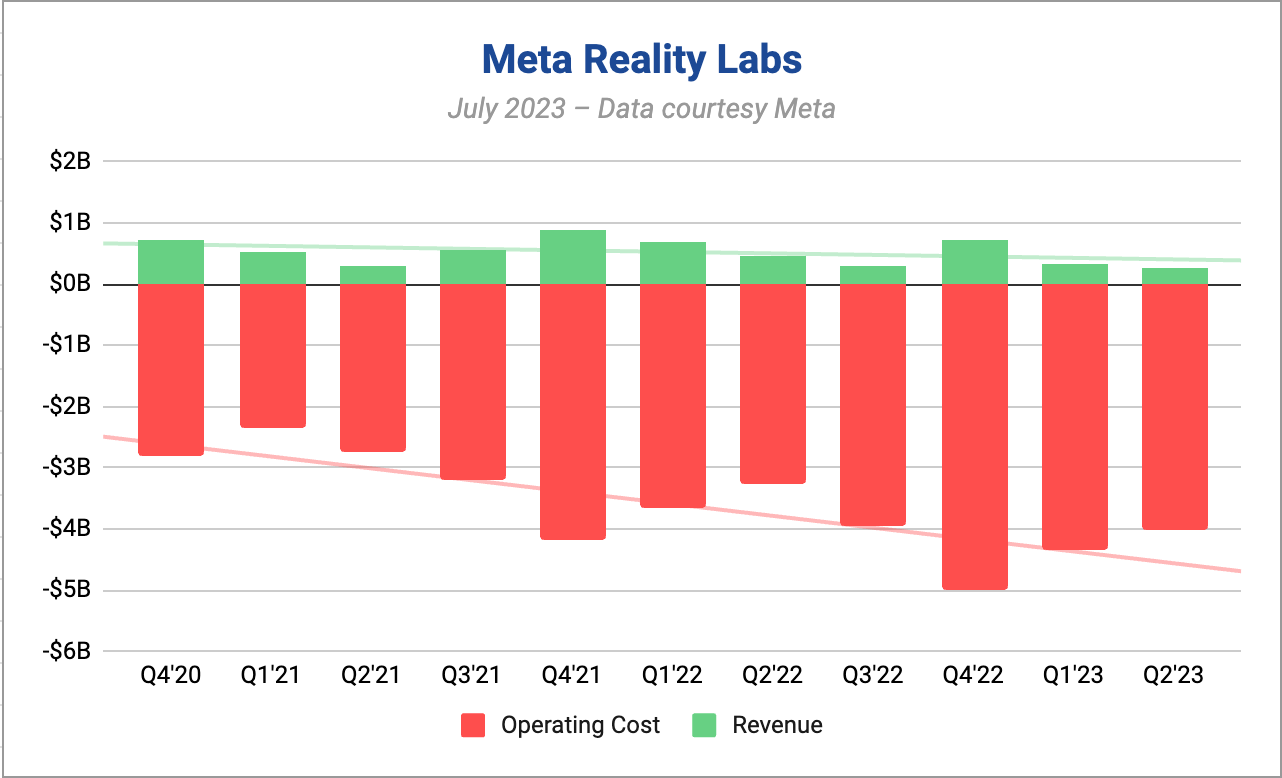
Meta announced its latest quarterly results, revealing that the company’s Reality Labs metaverse division is again reporting a loss of nearly $4 billion. The bright side? Meta’s still investing billions into XR, and it’s not showing any signs of stopping.

Meta revealed in its Q1 2023 financial results that its family of apps is now being used by over 3 billion people, an increase of 5% year-over-year, but its metaverse investments are still operating at heavy losses.

Reality Labs is responsible for R&D for its most forward-looking projects, including the Quest virtual reality headset platform, and its work in augmented reality and artificial intelligence. Meta CEO Mark Zuckerberg has warned shareholders in the past that Meta’s XR investments may not flourish until 2030.

Here’s a look at the related income losses and revenue for Reality Labs since it was formed as a distinct entity in Q4 2020:

Image created by Road to VR using data courtesy Meta

Meta reports Reality Labs generated $339 million in revenue during its first quarter of the year, a small fraction of the company’s 28.65 billion quarterly revenue. The bulk of that was generated from its family of apps—Facebook, Messenger, Instagram, and WhatsApp.

While the $3.99 billion loss may show the company is tightening its belt in contrast to Q4 2022, which was at an eye-watering $4.28 billion, Meta says we should still expect those losses to continue to increase year-over-year in 2023.

This follows the company’s second big round of layoffs, the most recent of which this month has affected VR teams at Reality Labs, Downpour Interactive (Onward) and Ready at Dawn (Lone Echo, Echo VR). The company says a third round is due to come in May, which will affect the company’s business groups.

Dubbed by Zuckerberg as the company’s “year of efficiency,” the Meta founder and chief said this during the earning call regarding the company’s layoffs:

“This has been a difficult process. But after this is done, I think we’re going to have a much more stable environment for our employees. For the rest of the year, I expect us to focus on improving our distributed work model, delivering AI tools to improve productivity, and removing unnecessary processes across the company.”

Beyond its investment in AI, Zuckerberg says the recent characterization claiming the company has somehow moved away from focusing on the metaverse is “not accurate.”

“We’ve been focusing on both AI and the metaverse for years now, and we will continue to focus on both,” Zuckerberg says, noting that breakthroughs in both areas are essentially shared, such as computer vision, procedurally generated virtual worlds, and its work on AR glasses.

Notably, Zuckerberg says the number of titles in the Quest store with at least $25 million in revenue has doubled since last year, with more than half of Quest daily actives now spend more than an hour using their device.

The company previously confirmed a Quest 3 headset is set to release this year, which is said to be slightly pricier than the $400 Quest 2 headset with features “designed to appeal to VR enthusiasts.”

Meta Reaffirms Commitment to Metaverse Vision, Has No Plans to Slow Billions in Reality Labs Investments Read More »

meta-quest-reportedly-had-over-6-million-monthly-active-users-last-october

Meta Quest Reportedly Had Over 6 Million Monthly Active Users Last October

A Wall Street Journal report maintains Meta’s Quest platform had 6.37 million monthly active users as of October 2022.

The report doesn’t include a breakdown of which headset is seeing the most engagement, however it’s likely a majority of those users come from Quest 2. The original Quest, which was released in 2019, is currently on its way out. The company’s enthusiast-grade headset Quest Pro costs $1,000, a $500 drop from its original $1,500 launch price.

Meta hasn’t officially detailed just how many Quest headsets it’s sold since the company released the standalone in 2019, or its Quest 2 follow-up a year later for that matter, however a report by The Verge last month alleged the company has sold nearly 20 million Quest headsets. Although not confirmed, this figure likely includes all Quest headsets.

It’s nowhere near what traditional game consoles have achieved, however for VR it’s fairly impressive. For scale, Sony has shipped over 32 million PlayStation 5 units and over 117 million PS4 units to date; the PlayStation platform as a whole garnered 112 million monthly active users in Q3 2022.

For the still-nascent industry, Meta is far and ahead the leader of the space. Of its 500+ titles on the Meta Quest Store, 40 have grossed over $10 million in revenue. According to the Wall Street Journal, the Quest platform has now seen more than 200 apps make over $1 million as of February 2023, an increase of 44% from the previous year.

This comes alongside the news that Meta’s best-performing app, the block-slashing rhythm game Beat Saber, has generated over a quarter billion dollars in sales since launch in 2018.

Meta Quest Reportedly Had Over 6 Million Monthly Active Users Last October Read More »

meta-layoffs-affect-vr-teams-at-‘lone-echo’-&-‘onward’-studios

Meta Layoffs Affect VR Teams at ‘Lone Echo’ & ‘Onward’ Studios

Meta is the midst of a second large round of layoffs, and this time a number of employees in its internal VR studios have been affected.

Business Insider reported earlier this week that Meta was increasing its focus on gaming-related projects within its Reality Labs division. As other teams were expected to be dissolved in layoffs, the report held that gaming-focused teams would be safe.

However that report is now being rebuffed by a number of self-reported layoffs which have affecting Meta’s VR teams, including Ready at Dawn, known for the Lone Echo series, and Onward studio Downpour Interactive.

Meta CEO Mark Zuckerberg announced in March that 10,000 employees would be laid off. At the time, Zuckerberg said that, in addition to a hiring freeze, the April round of layoffs would affect tech roles, while a third in late May will affect business roles—all of it in service of what Zuckerberg dubbed the company’s “year of efficiency.”

As mentioned by MIXED, Ready at Dawn Senior Engine Programmer Thomas Griebel tweeted that around 40 people, or around a third of the studio, were laid off. This also included studio head Mark Almeida, who has been with Ready at Dawn since August 2016.

Acquired by Meta in 2020, Ready at Dawn announced in January it planned to shut down its popular free-to-play multiplayer game Echo VR, with plans to turn off severs come August 1st. At the time, the studio said the decision to shut down the game was “made for many good reasons and chief among them is the studio coming together to focus on our next project.”

Downpour Interactive, the studio behind VR mil-sim shooter Onward, is also seeing wide-ranging layoffs. We haven’t found a precise count of Downpour employees affected by the layoff round, however Producer Kaspar Nahuijsen called losing his colleagues to the purge “the toughest day” of his career.

Today is the toughest day in my career

— KasperVld (@KasperVld) April 19, 2023

Founded by Dante Buckley in 2015, and then acquired by Meta in 2021, Downpour Interactive’s latest claim to fame was porting the previously PC VR-only title to Quest and Quest 2. As a part of a wider transition by Meta to sunset the original 2019 Quest, Downpour announced Onward would no longer be playable on Quest 1 in any capacity after the July 31st, 2023.

As noted by UploadVR, founder and CEO Dante Buckely left Downpour/Meta last month.

The Guardian reports the latest round of Meta layoffs are affecting 4,000 employees immediately, which is a part of the 10,000 previously announced in March.

Meta Layoffs Affect VR Teams at ‘Lone Echo’ & ‘Onward’ Studios Read More »

meta-to-open-‘horizon-worlds’-social-vr-platform-to-kids-ages-13+

Meta to Open ‘Horizon Worlds’ Social VR Platform to Kids Ages 13+

Horizon Worlds, Meta’s social VR platform for Quest, is only open to 18+ users for now, however the company says it’s expanding to include teens aged 13 to 17 in the US and Canada.

Meta says the new policy will go into effect in “the coming weeks,” effectively opening the company’s first-party social platform to its entire user base in those countries; Meta only allows users 13+ to actually use Quest devices.

To prepare for the wave of younger users, the company is also releasing some age-appropriate protections and safety defaults.

Safety features will include the ability for teens to control who they follow and who can follow them back. Profiles are also set to private by default, which obscures active status and location. Worlds and events will have content ratings, so younger teens can’t get in.

A new voice mode feature is also rolling out to everyone, which garbles voices of both unknown people and teen’s voices by default. Raising your hand to your ear temporarily lets you hear other users when voice mode is switched on, Meta says.

“We’re rolling out to teens slowly, so that we can carefully examine usage and are taking a phased approach before expanding more broadly,” the company says in a blogpost. “We can’t wait to see everything these new members of the community bring to Worlds.”

Parents and guardians can use the parental supervision tools to manage their teen’s experience and “support healthy conversations about safety in VR,” Meta says. To learn more, check out the new Family Center.

The company also released a safety tutorial to see the new features in action:

While Meta only just released official word of those changes to Horizon Worlds, the news was actually first reported by The Wall Street Journal in February, which was based on an internal memo that alleged the social VR platform was under performing and needed to increase user retention to keep up with the competition. According to the memo seen by WSJ, Horizon Worlds’ weekly retention rate was 11% in January 2023, which the company aimed to increase to 20%.

A goal outlined in the memo maintained Worlds needed to reach 500,000 monthly active users (MAU) in the first half of 2023, ultimately reaching the one million mark by year’s end. At the time, it was reported the platform was hovering around 200,000 MAUs, or just below the December peak.

There’s no telling when the flatscreen version of Horizon Worlds is due to arrive, however Meta maintained it would be opening the Quest-only social platform to Web and mobile devices “soon.”

Meta to Open ‘Horizon Worlds’ Social VR Platform to Kids Ages 13+ Read More »

meta-shows-new-progress-on-key-tech-for-making-ar-genuinely-useful

Meta Shows New Progress on Key Tech for Making AR Genuinely Useful

Meta has introduced the Segment Anything Model, which aims to set a new bar for computer-vision-based ‘object segmentation’—the ability for computers to understand the difference between individual objects in an image or video. Segmentation will be key for making AR genuinely useful by enabling a comprehensive understanding of the world around the user.

Object segmentation is the process of identifying and separating objects in an image or video. With the help of AI, this process can be automated, making it possible to identify and isolate objects in real-time. This technology will be critical for creating a more useful AR experience by giving the system an awareness of various objects in the world around the user.

The Challenge

Imagine, for instance, that you’re wearing a pair of AR glasses and you’d like to have two floating virtual monitors on the left and right of your real monitor. Unless you’re going to manually tell the system where your real monitor is, it must be able to understand what a monitor looks like so that when it sees your monitor it can place the virtual monitors accordingly.

But monitors come in all shapes, sizes, and colors. Sometimes reflections or occluded objects make it even harder for a computer-vision system to recognize.

Having a fast and reliable segmentation system that can identify each object in the room around you (like your monitor) will be key to unlocking tons of AR use-cases so the tech can be genuinely useful.

Computer-vision based object segmentation has been an ongoing area of research for many years now, but one of the key issues is that in order to help computers understand what they’re looking at, you need to train an AI model by giving it lots images to learn from.

Such models can be quite effective at identifying the objects they were trained on, but if they will struggle on objects they haven’t seen before. That means that one of the biggest challenges for object segmentation is simply having a large enough set of images for the systems to learn from, but collecting those images and annotating them in a way that makes them useful for training is no small task.

SAM I Am

Meta recently published work on a new project called the Segment Anything Model (SAM). It’s both a segmentation model and a massive set of training images the company is releasing for others to build upon.

The project aims to reduce the need for task-specific modeling expertise. SAM is a general segmentation model that can identify any object in any image or video, even for objects and image types that it didn’t see during training.

SAM allows for both automatic and interactive segmentation, allowing it to identify individual objects in a scene with simple inputs from the user. SAM can be ‘prompted’ with clicks, boxes, and other prompts, giving users control over what the system is attempting to identifying at any given moment.

It’s easy to see how this point-based prompting could work great if coupled with eye-tracking on an AR headset. In fact that’s exactly one of the use-cases that Meta has demonstrated with the system:

Here’s another example of SAM being used on first-person video captured by Meta’s Project Aria glasses:

You can try SAM for yourself in your browser right now.

How SAM Knows So Much

Part of SAM’s impressive abilities come from its training data which contains a massive 10 million images and 1 billion identified object shapes.  It’s far more comprehensive than contemporary datasets, according to Meta, giving SAM much more experience in the learning process and enabling it to segment a broad range of objects.

Image courtesy Meta

Meta calls the SAM dataset SA-1B, and the company is releasing the entire set for other researchers to build upon.

Meta hopes this work on promptable segmentation, and the release of this massive training dataset, will accelerate research into image and video understanding. The company expects the SAM model can be used as a component in larger systems, enabling versatile applications in areas like AR, content creation, scientific domains, and general AI systems.

Meta Shows New Progress on Key Tech for Making AR Genuinely Useful Read More »

40-quest-titles-report-over-$10m-in-revenue,-meta-says-“giant-correlation”-between-quality-&-sales

40 Quest Titles Report Over $10M in Revenue, Meta Says “giant correlation” Between Quality & Sales

Meta today revealed at Game Developers Conference (GDC) a fresh bit of insight into Quest Store stats.

The company says in a developer blog post there are now 500+ titles available on the Meta Quest Store, 40 of which have grossed over $10 million in revenue.

At Connect 2022 in October, the company reported that 33 titles out of the 400 apps on the Quest Store at the time had tipped over the $10 million mark. Since then, the Quest Store has ostensibly added around 100 games in the time span of around five months.

And it seems those high-earning games are picking up steam too. The number of titles at the $20-million mark has doubled year over year, Meta says.

As far as today’s stats tease go, Meta is most certainly counting all Quest apps and games on the store, and not just those targeting Quest 2 or Quest Pro. Notably, the company is sunsetting the original 2019 Quest soon.

Photo by Road to VR

Chris Pruett, Meta Director of Content Ecosystem and Head of Third-party Games, outlined a few key metrics in what’s performing best on Quest:

Top game genres include multiplayer competitive, physics combat, horror adventure, fitness and workout, social collaborative, and shooters.

Growth categories include single-player narrative adventure, boxing/golf and sports, RPG, simulation, and survival.

Referring to game revenue, Pruett says there’s a “giant correlation between quality and sales.”

“The cohorts of Quest customers over time, the ones coming in recently, look very different than the early enthusiasts,” Pruett said to the GDC crowd. “Their expectations are like those of a modern game console.’

Pruett doesn’t think we’re “anywhere close to the upper-bound for visual quality and game complexity on Quest 2—partially because we have some awesome tech that most of you aren’t using yet.” Continuing, Pruett concludes that “increased revenue potential on the platform is what’s going to drive quality.”

Despite the blogpost announce, the company hasn’t revealed any change in gross app revenue since Connect 2022. Meta is still stating it’s generated “over $1.5 billion” in revenue from Quest games, tallied from the platform’s founding in 2019 to October 2022.


We have boots on the ground at GDC 2023 in San Francisco, so we’re sure to learn more while we’re there. Make sure to check back soon for all things VR/AR gaming from this year’s GDC,

40 Quest Titles Report Over $10M in Revenue, Meta Says “giant correlation” Between Quality & Sales Read More »

meta-keeps-the-oculus-name-alive-as-third-party-vr-publisher-becomes-‘oculus-publishing’

Meta Keeps the Oculus Name Alive as Third-party VR Publisher Becomes ‘Oculus Publishing’

Meta has nearly scrubbed all of its products of the Oculus name, however the company today announced its third-party publishing wing is getting a sort of rebrand that will see the Oculus name live on.

Meta announced at the Game Developers Conference (GDC) that it’s naming its third-party publishing arm Oculus Publishing. The company tells us Oculus Studios, its first-party studio, will continue to exist.

To date, Meta’s growing fleet of acquired first-party studios includes Beat Games (Beat Saber), Sanzaru Games (Asgard’s Wrath), Ready at Dawn (Lone Echo & Echo VR), Downpour Interactive (Onward), BigBox VR (Population: One), and Within (Supernatural).

Third-party titles under Oculus Publishing include Among Us VR (Innersloth, Schell Games), Bonelab (Stress Level Zero), The Walking Dead: Saints & Sinners (Skydance Interactive), and Blade & Sorcery: Nomad (Warpfrog).

Notably, there’s little left that sports the Oculus brand since the company made its big metaverse pivot in October 2021. Besides older hardware, the only things most people see with the ‘Oculus’ moniker is the Oculus PC app and Meta’s Oculus web portal, where the company still lists game libraries for Quest, Rift, Go, and Gear VR.

“This year marks a full decade since the inception of the original Oculus Content Team,” the company says in a developer blog post. “From Kickstarter to Quest, Meta has committed hundreds of millions of dollars in third-party content funding and specialized development support to help make the VR games landscape what it is today. Now, we’re excited to unveil an official name for one of the world’s largest VR games programs for developers: Oculus Publishing.”

The company says Oculus Publishing will continue to directly partner with development teams on conceptualization, funding, production, technology advancement, game engineering, promotion and merchandising.

The company says it’s contributed funding to “more than 300 titles,” and that there are another 150 titles in active development today.

Meta Keeps the Oculus Name Alive as Third-party VR Publisher Becomes ‘Oculus Publishing’ Read More »