And Oxycyte was ideal for the group’s 2021 Ig Nobel-winning efforts. The experiments involved intra-anally administering oxygen gas or a liquid oxygenated perfluorocarbon to the unfortunate rodents and porcines. Yes, they gave the animals enemas. They then induced respiratory failure and evaluated the effectiveness of the intra-anal treatment. The result: Both treatments were pretty darned effective at staving off respiratory failure with no major complications.
Credit: Cincinnati Children’s/Med
So far, so good. The next logical step was to determine if EVA could work in human patients, too. “Patients with severe respiratory failure often need mechanical ventilation to survive, but these therapies can cause further lung injury,” the authors wrote in this latest paper. EVA “could give the lungs a chance to rest and heal.”
The team recruited 27 healthy adult men in Japan, each of whom received a dose of non-oxygenated perfluorodecalin via the anus. They were asked to retain the liquid for a full hour as the dosage slowly increased from 25 to 1,500 mL. Twenty of the men successfully completed the experiment. Apart from mild temporary abdominal bloating and discomfort—which proved to be dosage dependent and resolved with no need for medical attention—they experienced no adverse effects.
“This is the first human data and the results are limited solely to demonstrating the safety of the procedure and not its effectiveness,” said co-author Takanori Takebe of Cincinnati Children’s Hospital and the University of Osaka in Japan. “But now that we have established tolerance, the next step will be to evaluate how effective the process is for delivering oxygen to the bloodstream.”
Enlarge/ The Ig Nobel Prizes honor “achievements that first make people laugh and then make them think.”
Aurich Lawson / Getty Images
Curiosity is the driving force behind all science, which may explain why so many scientists sometimes find themselves going in some decidedly eccentric research directions. Did you hear about the WWII plan to train pigeons as missile guidance systems? How about experiments on the swimming ability of a dead rainbow trout or that time biologists tried to startle cows by popping paper bags by their heads? These and other unusual research endeavors were honored tonight in a virtual ceremony to announce the 2024 recipients of the annual Ig Nobel Prizes. Yes, it’s that time of year again, when the serious and the silly converge—for science.
Established in 1991, the Ig Nobels are a good-natured parody of the Nobel Prizes; they honor “achievements that first make people laugh and then make them think.” The unapologetically campy awards ceremony features miniature operas, scientific demos, and the 24/7 lectures whereby experts must explain their work twice: once in 24 seconds and the second in just seven words. Acceptance speeches are limited to 60 seconds. And as the motto implies, the research being honored might seem ridiculous at first glance, but that doesn’t mean it’s devoid of scientific merit.
Viewers can tune in for the usual 24/7 lectures, as well as the premiere of a “non-opera” featuring various songs about water, in keeping with the evening’s theme. In the weeks following the ceremony, the winners will also give free public talks, which will be posted on the Improbable Research website.
Without further ado, here are the winners of the 2023 Ig Nobel prizes.
Peace
Citation: B.F. Skinner, for experiments to see the feasibility of housing live pigeons inside missiles to guide the flight paths of the missiles.
This entertaining 1960 paper by American psychologist B.F. Skinner is kind of a personal memoir relating “the history of a crackpot idea, born on the wrong side of the tracks intellectually speaking but eventually vindicated in a sort of middle class respectability.” Project Pigeon was a World War II research program at the Naval Research Laboratory with the objective of training pigeons to serve as missile guidance systems. At the time, in the early 1940s, the machinery required to guide Pelican missiles was so bulky that there wasn’t much room left for actual explosives—hence the name, since it resembled a pelican “whose beak can hold more than its belly can.”
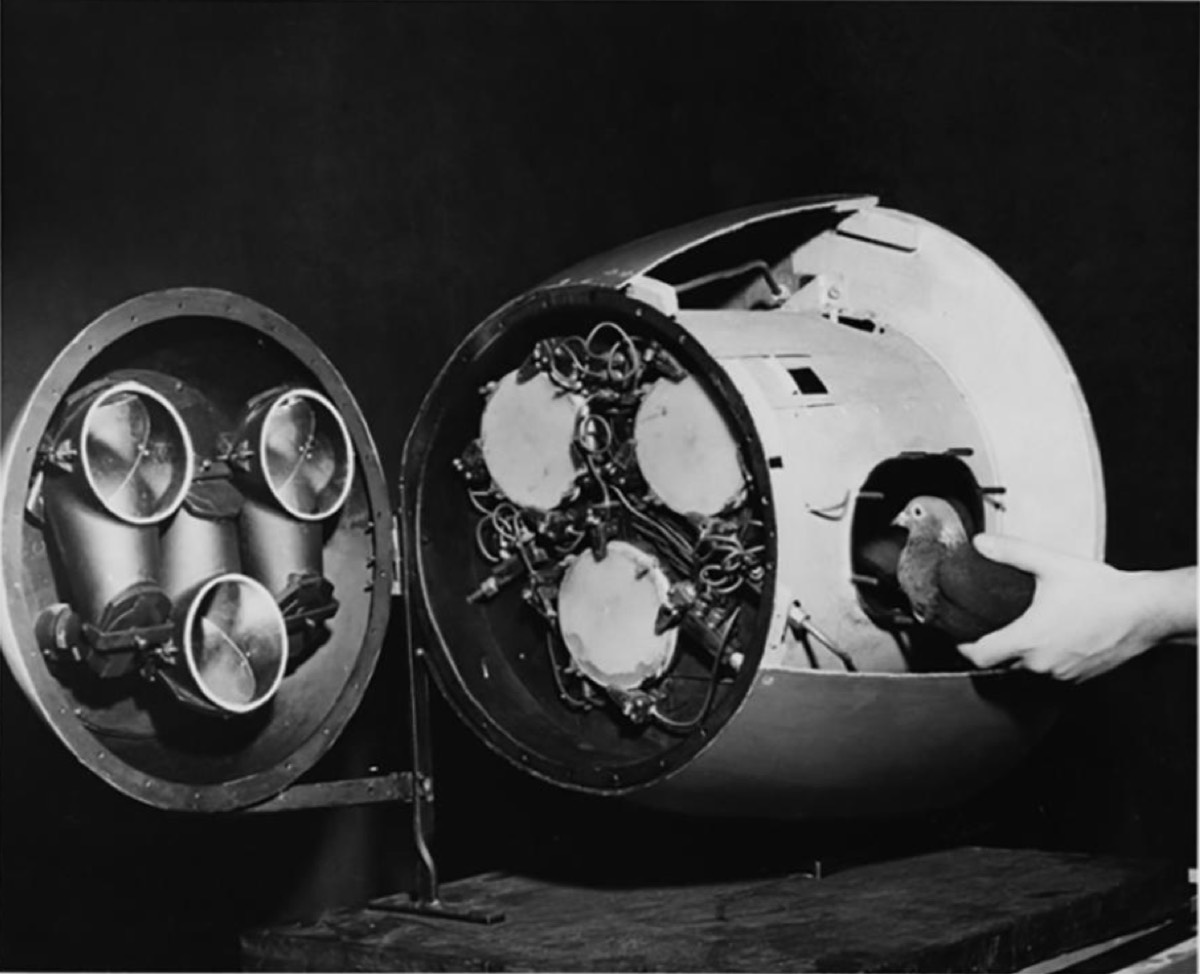
Skinner reasoned that pigeons could be a cheaper, more compact solution since the birds are especially good at responding to patterns. (He dismissed the ethical questions as a “peacetime luxury,” given the high global stakes of WWII.) His lab devised a novel harnessing system for the birds, positioned them vertically above a translucent plastic plate (screen), and trained them to “peck” at a projected image of a target somewhere along the New Jersey coast on the screen—a camera obscura effect. “The guiding signal was picked up from the point of contact of screen and beak,” Skinner wrote. Eventually, they created a version that used three pigeons to make the system more robust—just in case a pigeon got distracted at a key moment or something.
Enlarge/ Nose cone of NIST glide bomb showing the three-pigeon guidance system.
American Psychological Association/B.F. Skinner Foundation
There was understandably a great deal of skepticism about the viability of using pigeons for missile guidance; at one point, Skinner lamented, his team “realized that a pigeon was more easily controlled than a physical scientist serving on a committee.” But Skinner’s team persisted, and in 1944, they finally got the chance to demonstrate Project Pigeon for a committee of top scientists and show that the birds’ behavior could be controlled. The sample pigeon behaved perfectly. “But the spectacle of a living pigeon carrying out its assignment, no matter how beautifully, simply reminded the committee of how utterly fantastic our proposal was.” Apparently, there was much “restrained merriment.”
Even though this novel homing device was resistant to jamming, could react to a wide variety of target practice, needed no scarce materials, and was so simple to make that production could start in 30 days, the committee nixed the project. (By this point, as we now know, military focus had shifted to the Manhattan Project.) Skinner was left with “a loftful of curiously useless equipment and a few dozen pigeons with a strange interest in a feature of the New Jersey coast.” But vindication came in the early 1950s when the project was briefly revived as Project ORCON at the Naval Research Laboratory, which refined the general idea and led to the development of a Pick-off Display Converter for radar operators. Skinner himself never lost faith in this particular “crackpot idea.”