Fidji Simo

openai-to-test-ads-in-chatgpt-as-it-burns-through-billions

OpenAI to test ads in ChatGPT as it burns through billions

Financial pressures and a changing tune

OpenAI’s advertising experiment reflects the enormous financial pressures facing the company. OpenAI does not expect to be profitable until 2030 and has committed to spend about $1.4 trillion on massive data centers and chips for AI.

According to financial documents obtained by The Wall Street Journal in November, OpenAI expects to burn through roughly $9 billion this year while generating $13 billion in revenue. Only about 5 percent of ChatGPT’s 800 million weekly users pay for subscriptions, so it’s not enough to cover all of OpenAI’s operating costs.

Not everyone is convinced ads will solve OpenAI’s financial problems. “I am extremely bearish on this ads product,” tech critic Ed Zitron wrote on Bluesky. “Even if this becomes a good business line, OpenAI’s services cost too much for it to matter!”

OpenAI’s embrace of ads appears to come reluctantly, since it runs counter to a “personal bias” against advertising that Altman has shared in earlier public statements. For example, during a fireside chat at Harvard University in 2024, Altman said he found the combination of ads and AI “uniquely unsettling,” implying that he would not like it if the chatbot itself changed its responses due to advertising pressure. He added: “When I think of like GPT writing me a response, if I had to go figure out exactly how much was who paying here to influence what I’m being shown, I don’t think I would like that.”
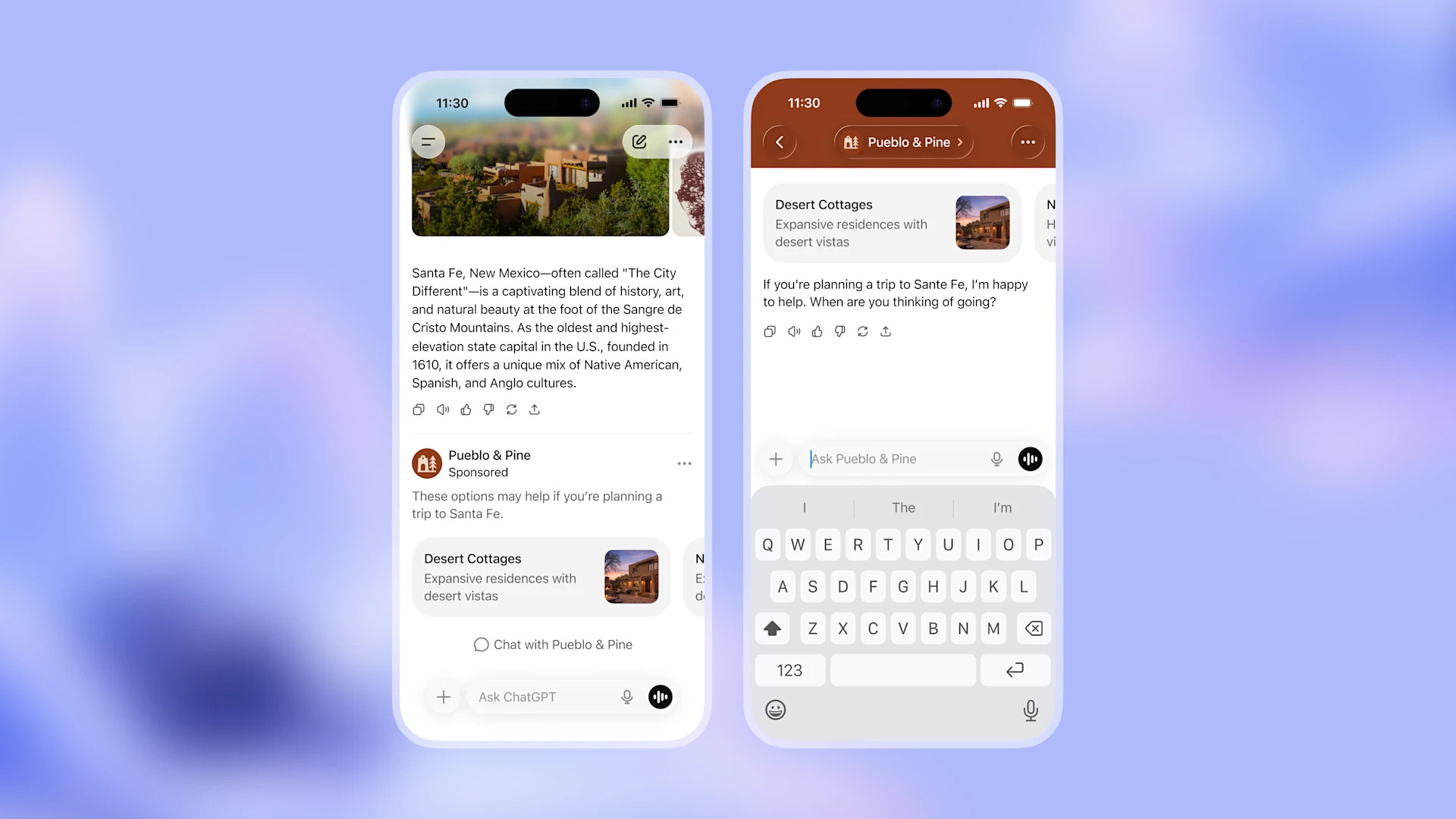
An example mock-up of an advertisement in ChatGPT provided by OpenAI.

An example mock-up of an advertisement in ChatGPT provided by OpenAI.

An example mock-up of an advertisement in ChatGPT provided by OpenAI. Credit: OpenAI

Along those lines, OpenAI’s approach appears to be a compromise between needing ad revenue and not wanting sponsored content to appear directly within ChatGPT’s written responses. By placing banner ads at the bottom of answers separated from the conversation history, OpenAI appears to be addressing Altman’s concern: The AI assistant’s actual output, the company says, will remain uninfluenced by advertisers.

Indeed, Simo wrote in a blog post that OpenAI’s ads will not influence ChatGPT’s conversational responses and that the company will not share conversations with advertisers and will not show ads on sensitive topics such as mental health and politics to users it determines to be under 18.

“As we introduce ads, it’s crucial we preserve what makes ChatGPT valuable in the first place,” Simo wrote. “That means you need to trust that ChatGPT’s responses are driven by what’s objectively useful, never by advertising.”

OpenAI to test ads in ChatGPT as it burns through billions Read More »

chatgpt-health-lets-you-connect-medical-records-to-an-ai-that-makes-things-up

ChatGPT Health lets you connect medical records to an AI that makes things up

But despite OpenAI’s talk of supporting health goals, the company’s terms of service directly state that ChatGPT and other OpenAI services “are not intended for use in the diagnosis or treatment of any health condition.”

It appears that policy is not changing with ChatGPT Health. OpenAI writes in its announcement, “Health is designed to support, not replace, medical care. It is not intended for diagnosis or treatment. Instead, it helps you navigate everyday questions and understand patterns over time—not just moments of illness—so you can feel more informed and prepared for important medical conversations.”

A cautionary tale

The SFGate report on Sam Nelson’s death illustrates why maintaining that disclaimer legally matters. According to chat logs reviewed by the publication, Nelson first asked ChatGPT about recreational drug dosing in November 2023. The AI assistant initially refused and directed him to health care professionals. But over 18 months of conversations, ChatGPT’s responses reportedly shifted. Eventually, the chatbot told him things like “Hell yes—let’s go full trippy mode” and recommended he double his cough syrup intake. His mother found him dead from an overdose the day after he began addiction treatment.

While Nelson’s case did not involve the analysis of doctor-sanctioned health care instructions like the type ChatGPT Health will link to, his case is not unique, as many people have been misled by chatbots that provide inaccurate information or encourage dangerous behavior, as we have covered in the past.

That’s because AI language models can easily confabulate, generating plausible but false information in a way that makes it difficult for some users to distinguish fact from fiction. The AI models that services like ChatGPT use statistical relationships in training data (like the text from books, YouTube transcripts, and websites) to produce plausible responses rather than necessarily accurate ones. Moreover, ChatGPT’s outputs can vary widely depending on who is using the chatbot and what has previously taken place in the user’s chat history (including notes about previous chats).

ChatGPT Health lets you connect medical records to an AI that makes things up Read More »

fidji-simo-joins-openai-as-new-ceo-of-applications

Fidji Simo joins OpenAI as new CEO of Applications

In the message, Altman described Simo as bringing “a rare blend of leadership, product and operational expertise” and expressed that her addition to the team makes him “even more optimistic about our future as we continue advancing toward becoming the superintelligence company.”

Simo becomes the newest high-profile female executive at OpenAI following the departure of Chief Technology Officer Mira Murati in September. Murati, who had been with the company since 2018 and helped launch ChatGPT, left alongside two other senior leaders and founded Thinking Machines Lab in February.

OpenAI’s evolving structure

The leadership addition comes as OpenAI continues to evolve beyond its origins as a research lab. In his announcement, Altman described how the company now operates in three distinct areas: as a research lab focused on artificial general intelligence (AGI), as a “global product company serving hundreds of millions of users,” and as an “infrastructure company” building systems that advance research and deliver AI tools “at unprecedented scale.”

Altman mentioned that as CEO of OpenAI, he will “continue to directly oversee success across all pillars,” including Research, Compute, and Applications, while staying “closely involved with key company decisions.”

The announcement follows recent news that OpenAI abandoned its original plan to cede control of its nonprofit branch to a for-profit entity. The company began as a nonprofit research lab in 2015 before creating a for-profit subsidiary in 2019, maintaining its original mission “to ensure artificial general intelligence benefits everyone.”

Fidji Simo joins OpenAI as new CEO of Applications Read More »