eye

four-inch-worm-hatches-in-woman’s-forehead,-wriggles-to-her-eyelid

Four-inch worm hatches in woman’s forehead, wriggles to her eyelid

Creeping

For anyone enjoying—or at least trying to enjoy—Thanksgiving in America, you can be thankful that these worms are not present in the US; they are exclusive to the “Old World,” that is Europe, Africa, and Asia, according to the Centers for Disease Control and Prevention. They’re often found in the Mediterranean region, but reports in recent years have noted that they seem to be expanding into new areas of Europe—particularly eastward and northward. In a report earlier this year of cases in Estonia, researchers noted that it is also emerging in Lithuania, Latvia, and Finland.

Researchers attribute the worm’s creep to climate change and globalization. But in another report this year of a case in Austria (thought to be acquired while the patient was vacationing in Greece), researchers also raised the speculation that the worms may be adapting to use humans as a true host. Researchers in Serbia suggested this in a 2023 case report, in which an infection led to microfilariae in the patient’s blood. The researchers speculated that such cases, considered rare, could be increasing.

For now, people in America have less to worry about. D. repens has not been found in the US, but it does have some relatives here that occasionally show up in humans, including D. immitis, the cause of dog heartworm, and D. tenuis. The latter can cause similar cases to D. repens, with worms wandering under the skin, particularly around the eye. So far, this worm has mainly been found in raccoons in Florida.

For those who do find a worm noodling through their skin, the outlook is generally good. Treatment includes surgical removal of the worm, which largely takes care of the problem, as well as anti-parasitic or antibiotic drugs to be sure to stamp out the infection or any co-infections. In the woman’s case, her symptoms disappeared after doctors pulled the worm from her eyelid.

Four-inch worm hatches in woman’s forehead, wriggles to her eyelid Read More »

man-suffers-rare-bee-sting-directly-to-the-eyeball—it-didn’t-go-well

Man suffers rare bee sting directly to the eyeball—it didn’t go well

Nightmare fuel —

He did recover. No disturbing images in the article, but a link for those who dare.

Bees fly to their hive.

Enlarge / Bees fly to their hive.

In what may be the biological equivalent to getting struck by lightning, a very unlucky man in the Philadelphia area took a very rare bee sting directly to the eyeball—and things went badly from there.

As one might expect, the 55-year-old went to the emergency department, where doctors tried to extract the injurious insect’s stinger from the man’s right eye. But it soon became apparent that they didn’t get it all.

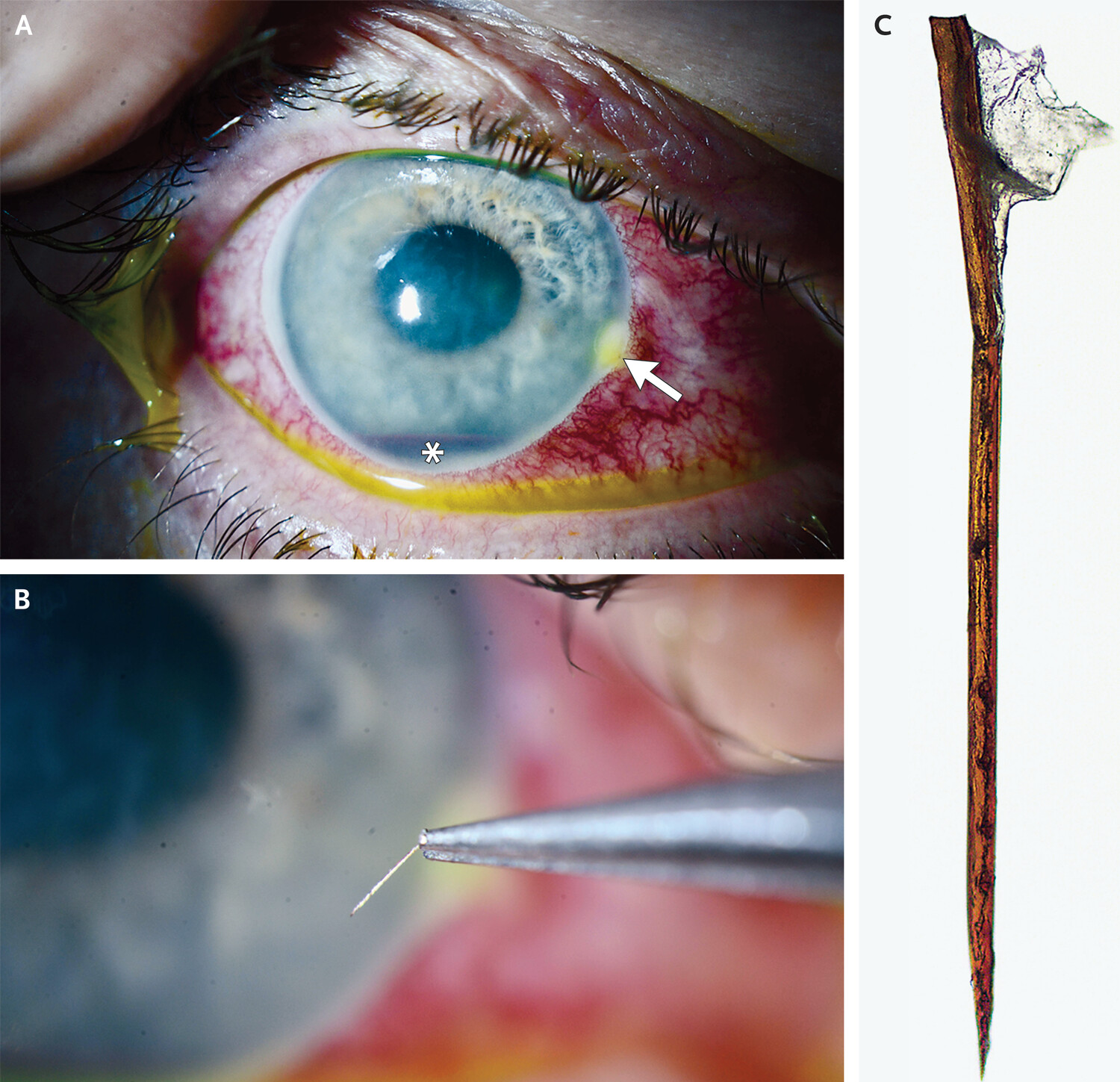
Two days after the bee attack, the man went to the Wills Eye Hospital with worsening vision and pain in the pierced eye. At that point, the vision in his right eye had deteriorated to only being able to count fingers. The eye was swollen, inflamed, and bloodshot. Blood was visibly pooling at the bottom of his iris. And right at the border between the man’s cornea and the white of his eye, ophthalmologists spotted the problem: a teeny spear-like fragment of the bee’s stinger still stuck in place.

(Images of the eye and stinger fragment are here for those who aren’t squeamish. The white arrow in Panel A shows the location of the stinger fragment while the asterisk marks the pooled blood.)

Get thee to an ophthalmologist

In a report published recently in the New England Journal of Medicine, treating ophthalmology experts Talia Shoshany and Zeba Syed made a critical recommendation: If you happen to be among the ill-fated few who are stung in the eye by a bee, you should make sure to see an eye doctor specifically.

“I am not surprised that the ER missed a small fragment,” Shoshany told Ars over email. “They pulled out the majority of the stinger, but the small fragment was only able to be visualized at a slit lamp,” she said, referring to a microscope with a bright light used in eye exams. In this case, they visualized the stinger at 10X or 16X magnification with the additional help of a fluorescent dye. Moreover, after spotting it, the stinger fragment “needed to be pulled out with ophthalmic-specific micro-forceps.”

After finally getting the entirety of the wee dagger out, Shoshany and Syed prescribed a topical antibacterial and prednisolone eye drops (a steroid for inflammation). At a five-month follow-up, the patient had recovered and the vision in his right eye had improved to 20/25.

For those now in fear of eye stings, Soshany has some comforting words: “Ocular bee stings are very rare.” She noted this was the first one she had seen in her career. Although there are documented cases in the scientific literature, the incidence rate is unknown. The odds of getting struck by lightning, meanwhile, are 1 in 15,300, according to the National Weather Service.

But one troubling aspect of this case is that it’s unclear why the man was stung to begin with. According to Shoshany, the man worked on a property with a beehive, but he didn’t work with the insects himself. “He reports he was just walking by and several bees flew up to him; one stung him in the eye,” she said. It’s unclear what provoked them.

Man suffers rare bee sting directly to the eyeball—it didn’t go well Read More »