cycling

you’ll-enjoy-the-specialized-turbo-vado-sl-2-6.0-carbon-even-without-assist

You’ll enjoy the Specialized Turbo Vado SL 2 6.0 Carbon even without assist


It’s an investment, certainly of money, but also in long, fast rides.

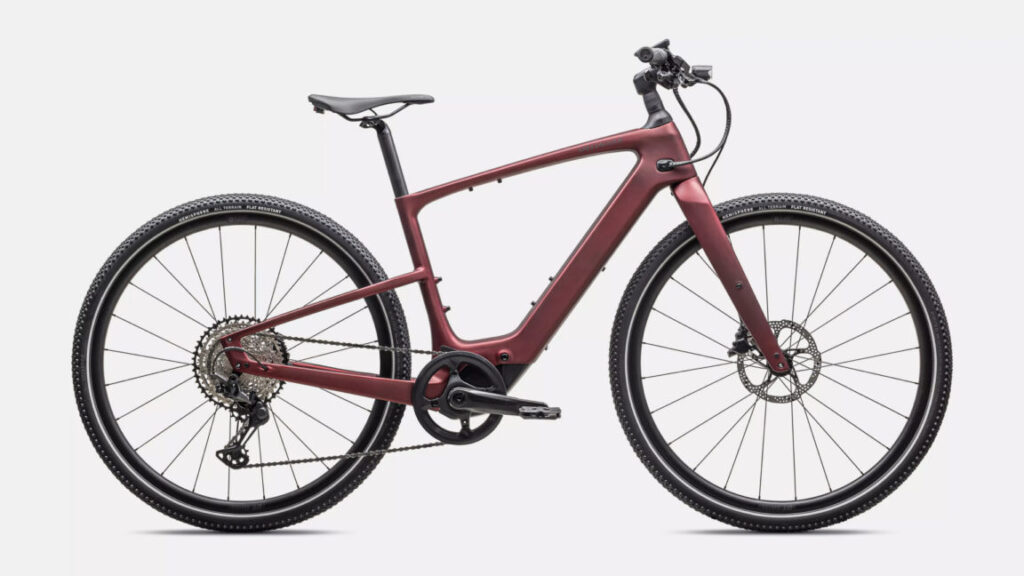
The Specialized Turbo Vado SL 2 6.0 Carbon Credit: Specialized

Two things about the Specialized Turbo Vado SL 2 6.0 Carbon are hard to fathom: One is how light and lithe it feels as an e-bike, even with the battery off; the other is how hard it is to recite its full name when other riders ask you about the bike at stop lights and pit stops.

I’ve tested about a half-dozen e-bikes for Ars Technica. Each test period has included a ride with my regular group for about 30 miles. Nobody else in my group rides electric, so I try riding with no assist, at least part of the way. Usually I give up after a mile or two, realizing that most e-bikes are not designed for unpowered rides.

On the Carbon (as I’ll call it for the rest of this review), you can ride without power. At 35 pounds, it’s no gram-conscious road bike, but it feels lighter than that number implies. My daily ride is an aluminum-framed model with an internal geared hub that weighs about the same, so I might be a soft target. But it’s a remarkable thing to ride an e-bike that starts with a good unpowered ride and lets you build on that with power.

Once you actually crank up the juice, the Carbon is pretty great, too. Deciding whether this bike fits your riding goals is a lot tougher than using and enjoying it.

Specialized’s own system

It’s tough to compare this Carbon to other e-bikes, because it’s using hardly any of the same standard components as all the others.

The 320-watt mid-drive motor is unique to Specialized models, as is its control system, its handlebar display, its charge ports, and its software. On every other e-bike I’ve ridden, you can usually futz around with the controls or app or do some Internet searching to figure out a way to, say, turn off an always-on headlamp. On this Carbon, there is not. You are riding with the lights on, because that’s how it was designed (likely with European regulations in mind).

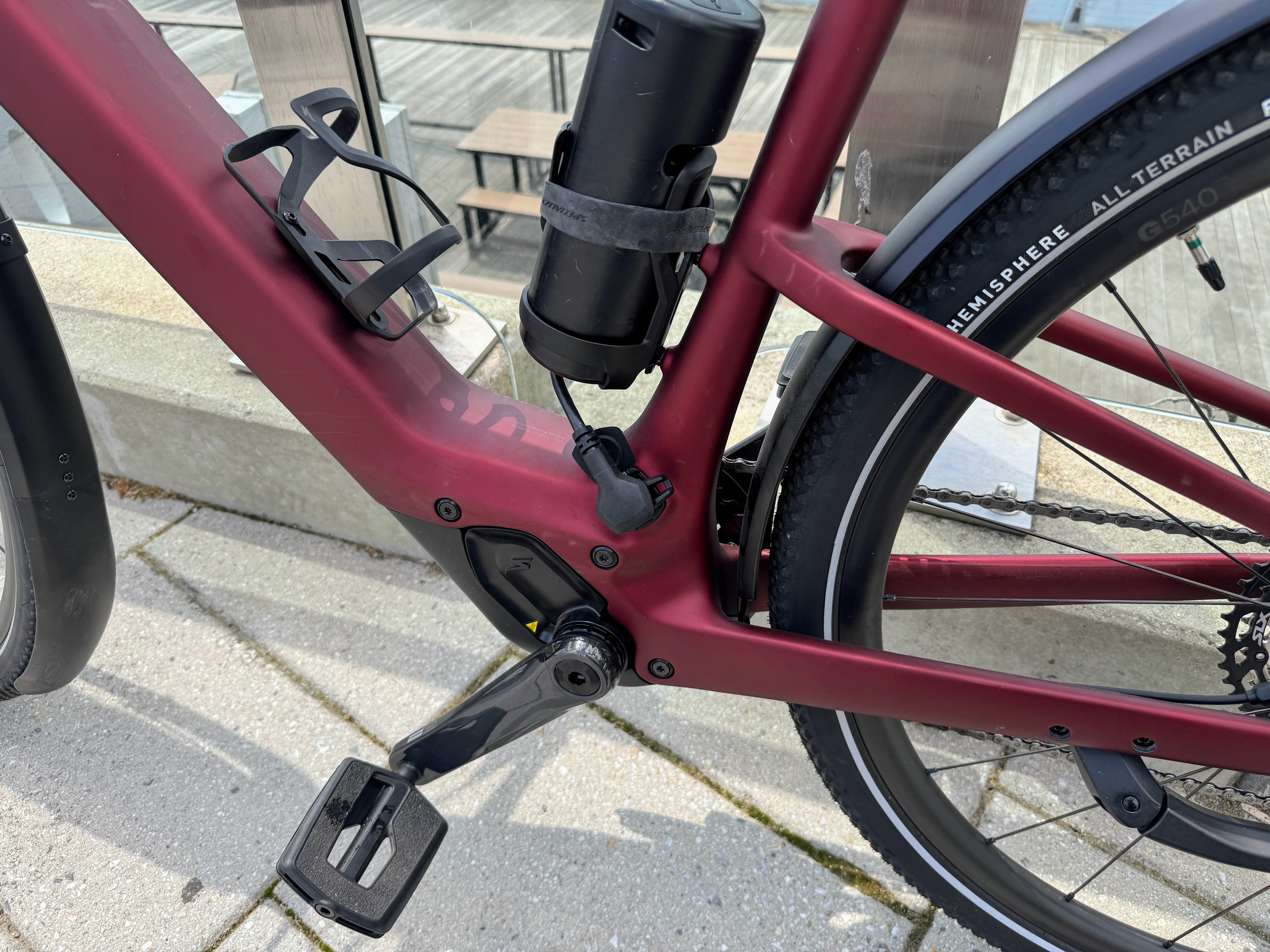
The bottom half of the Carbon, with its just-powerful-enough mid-drive motor, charging port, bottle cages, and a range-extending battery. Watch your stance if you’ve got wide-ranging feet, like the author.

Credit: Kevin Purdy

The bottom half of the Carbon, with its just-powerful-enough mid-drive motor, charging port, bottle cages, and a range-extending battery. Watch your stance if you’ve got wide-ranging feet, like the author. Credit: Kevin Purdy

Specialized has also carved out a very unique customer profile with this bike. It’s not the bike to get if you’re the type who likes to tinker, mod, or upgrade (or charge the battery outside the bike). It is the bike to get if you are the type who wants to absolutely wreck a decent commute, to power through some long climbs with electric confidence, or simply have a premier e-bike commute or exercise experience. It’s not an entirely exercise-minded carbon model, but it’s not a chill, throttle-based e-bike, either.

The ride

I spent probably a quarter as much time thinking about riding the Carbon as I did actually riding it. This bike costs a minimum of $6,000; where can you ride it and never let it out of your sight for even one moment? The Carbon offers Apple Find My tracker integration and has its own Turbo System Lock that kills the motor and (optionally) sets off lights and siren alarms when the bike is moved while disabled. That’s all good, but the Carbon remains a bike that demands full situational awareness, wherever you leave it.

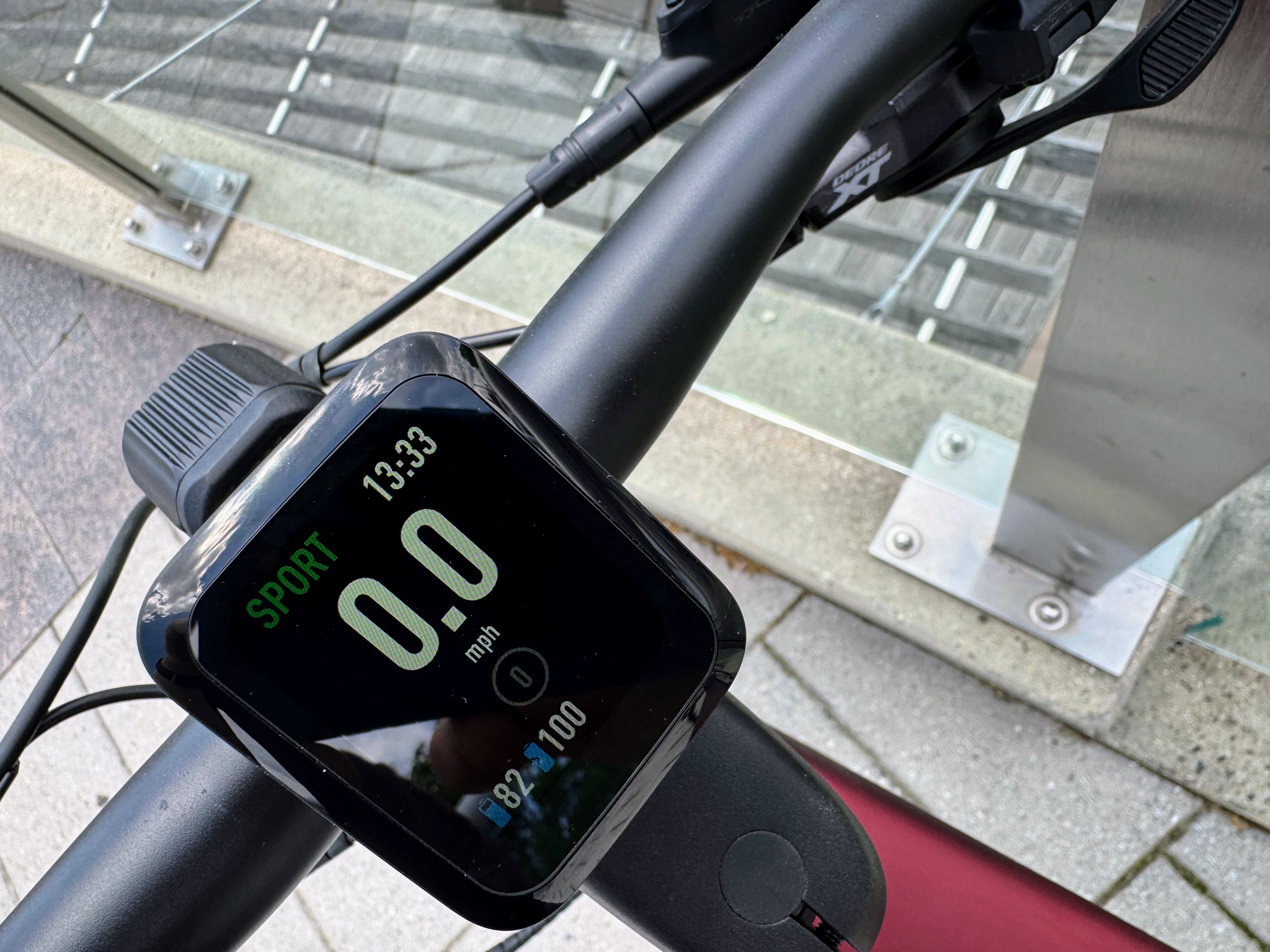
The handlebar display on the Carbon. There are a few modes, but this is the relative display density: big numbers, basic information, refer to the phone app if you want more.

Credit: Kevin Purdy

The handlebar display on the Carbon. There are a few modes, but this is the relative display density: big numbers, basic information, refer to the phone app if you want more. Credit: Kevin Purdy

You unlock the bike with either the Specialized smartphone app or a PIN code, entered with an up/down/press switch. The 2.1-inch screen only has a few display options but can provide the basics (speed, pedal cadence, wattage, gear/assist levels), or, if you dig into Specialized’s app and training programs and connect ANT+ gear, your heart rate and effort.

Once you’re done plotting, unlocking, and data-picking, you can ride the Carbon and feel its real value. Specialized, a company that seems deeply committed to version control, claims that the Future Shock 3.2 front suspension on this 6.0 Carbon reduces impact by 53 percent or more, versus a bike with no suspension. Combined with the 47 mm knobby tires and the TRP hydraulic disc brakes, I had no trouble switching from road to gravel, taking grassy shortcuts, hopping off standard rubes, or facing down city streets with inconsistent upkeep.

I’ve been spoiled by the automatic assist available on Bosch mid-drive motors. The next best thing is probably something like the Shimano Devore XT/SLX shifters on this Carbon, paired with the power monitoring. The 12-speed system, with a 10-51t cassette range, shifted at the speed of thought. Your handlebar display gives you a color-coded guide when you should probably shift up or down, based on your cadence and wattage output.

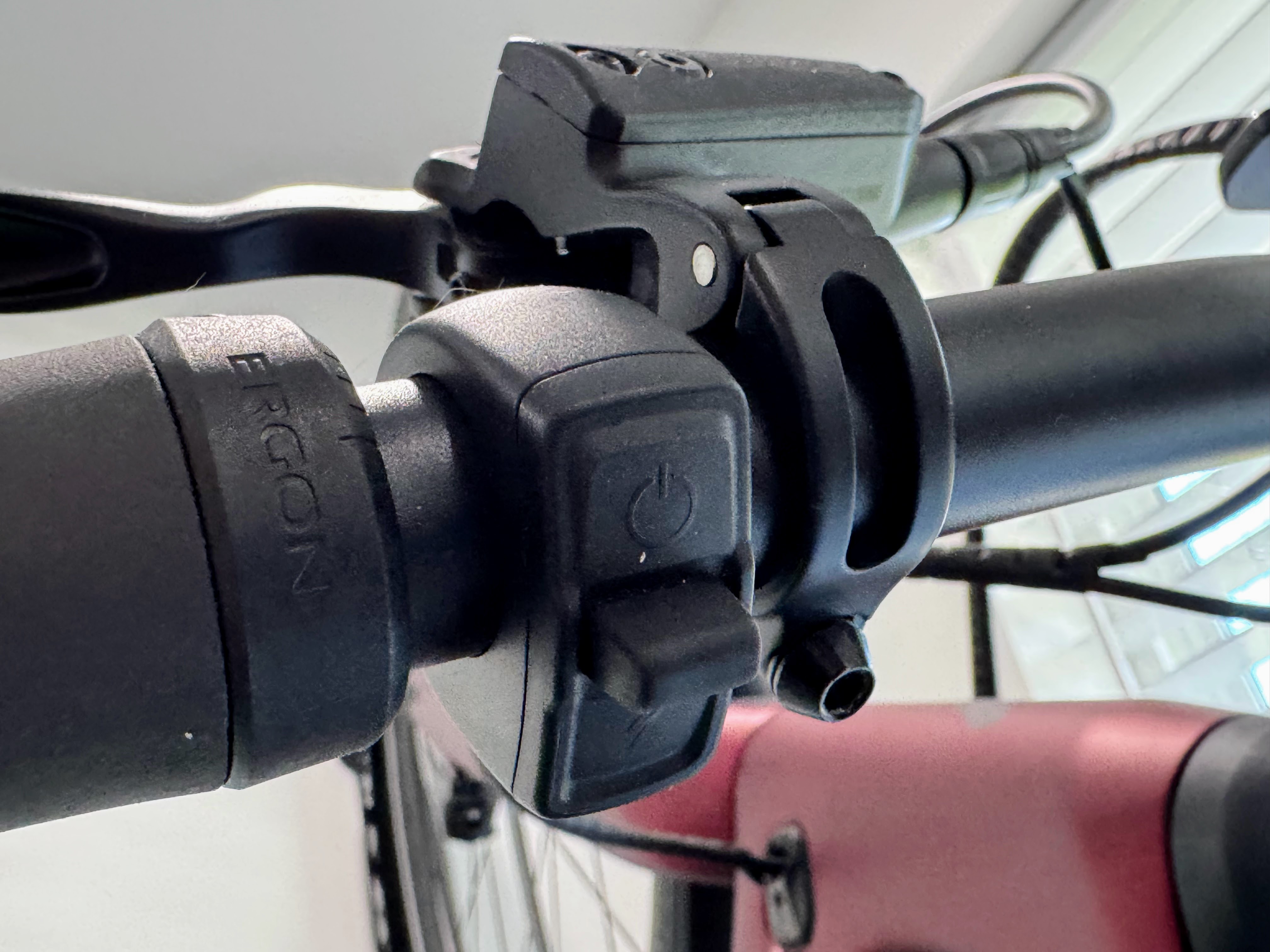
The controls for the Carbon’s display, power, and switch are just this little switch, with three places to press and an up/down switch. Sometimes I thought it was clever and efficient; other times, I wish I had picked a more simple unlock code.

Credit: Kevin Purdy

The controls for the Carbon’s display, power, and switch are just this little switch, with three places to press and an up/down switch. Sometimes I thought it was clever and efficient; other times, I wish I had picked a more simple unlock code. Credit: Kevin Purdy

That battery range, as reported by Specialized, is “up to 5 hours,” a number that few people are going to verify. It’s a 520-watt-hour battery in a 48-volt system that can turn out a rated 320 watts of power. You can adjust the output of all three assist levels in the Specialized app. And you can buy a $450 water-bottle-sized range extender battery that adds another 160 Wh to your system if you sacrifice a bottle cage (leaving two others).

But nobody should ride this bike, or its cousins, like a juice miser on a cargo run. This bike is meant to move, whether to speed through a commute, push an exercise ride a bit farther, or tackle that one hill that ruins your otherwise enjoyable route. The Carbon felt good on straightaways, on curves, starting from a dead stop, and pretty much whenever I was in the zone, forgetting about the bike itself and just pedaling.

I don’t have many points of comparison, because most e-bikes that cost this much are bulky, intensely powerful, or haul a lot of cargo. The Carbon and its many cousins that Specialized sells cost more because they take things away from your ride: weight, frame, and complex systems. The Carbon provides a rack, lights, three bottle cages, and mounting points, so it can do more than just boost your ride. But that’s what it does better than most e-bikes out there: provide an agile, lightweight athletic ride, upgraded with a balanced amount of battery power and weight to make that ride go faster or farther.

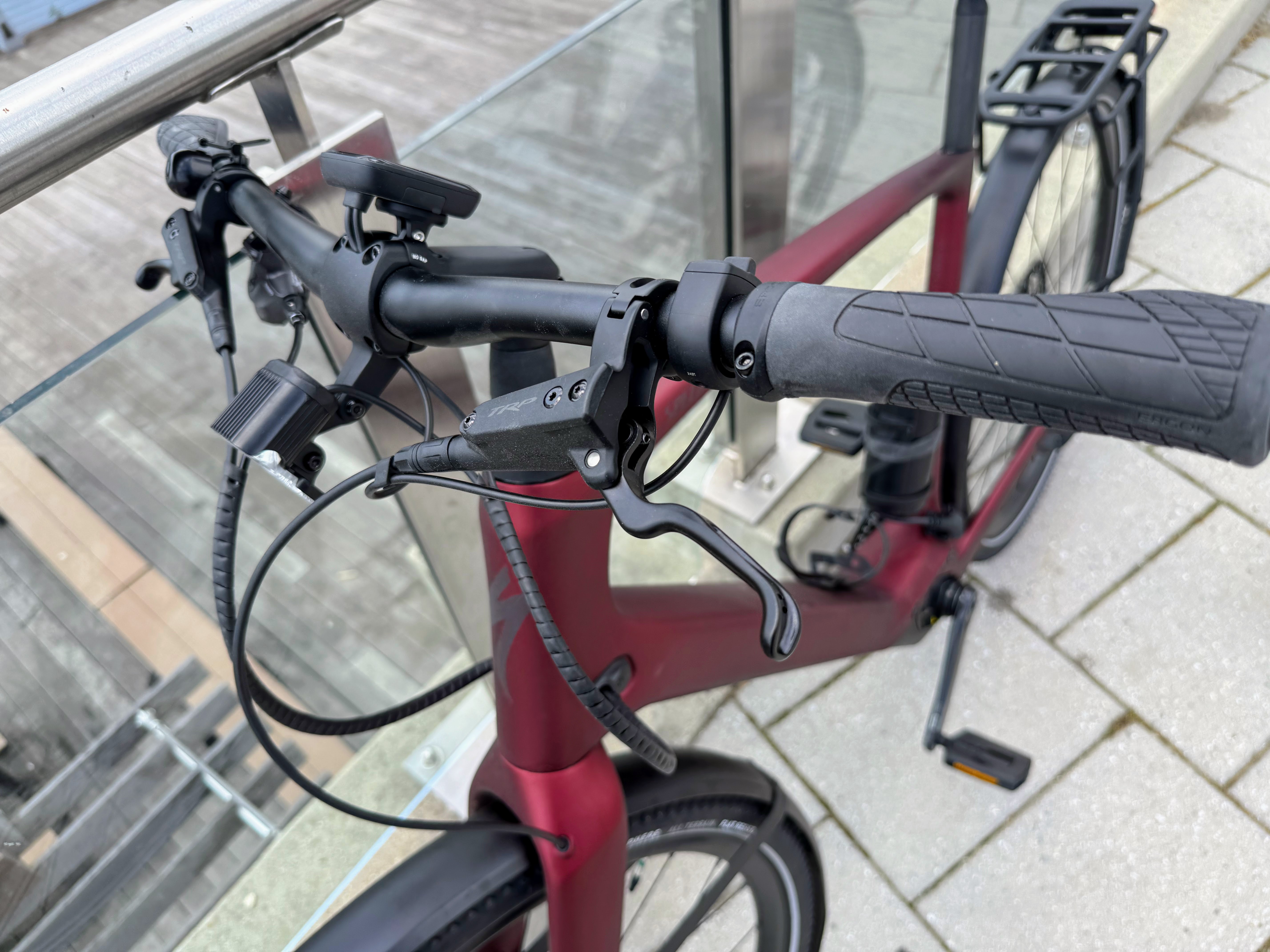
The handlebar, fork, and wiring on the front of the Carbon.

Credit: Kevin Purdy

The handlebar, fork, and wiring on the front of the Carbon. Credit: Kevin Purdy

Always room to improve

I’ve said only nice things about this $6,000 bike, so allow me to pick a few nits. I’ve got big feet (size 12 wide) and a somewhat sloppy pedal position when I’m not using clips. Using the bottle-sized battery, with its plug on the side of the downtube, led to a couple of fat-footed disconnections while riding. When the Carbon notices that even its supplemental battery has disconnected, it locks out its display system; I had to enter a PIN code and re-plug the battery to get going again. This probably won’t be an issue for most people, but it’s worth noting if you’re looking at that battery as a range solution.

The on-board display and system seem a bit underdeveloped for the bike’s cost, too. Having a switch with three controls (up, down, push-in) makes navigating menus and customizing information tiresome. You can see Specialized pushing you to the smartphone for deeper data and configuration and keeping control space on the handlebars to a minimum. But I’ve found the display and configuration systems on many cheaper bikes more helpful and intuitive.

The Specialized Turbo Vado SL 2 6.0 Carbon (whew!) provided some of the most enjoyable rides I could imagine out of a bike I had no intention of keeping. It’s an investment, certainly of money, but also to long, fast rides, whether to get somewhere or nowhere in particular. Maybe you want more battery range, more utility, or more rugged and raw power for the price. But it is hard to beat this bike in the particular race it is running.

You’ll enjoy the Specialized Turbo Vado SL 2 6.0 Carbon even without assist Read More »

rad-power’s-radster:-a-very-non-radical-commuter-bike

Rad Power’s Radster: A very non-radical commuter bike


The Radster is great as a Class 2 e-bike, but not quite as strong as a Class 3.

With e-bike manufacturing in China having expanded considerably, the number of companies offering affordable e-bikes over the last five years has exploded. But the market for cycles with an electric assist has existed for considerably longer, and a number of companies predate the recent surge. One of them, Rad Power, has been around long enough that it was already an established presence when we first reviewed its hardware four years ago.

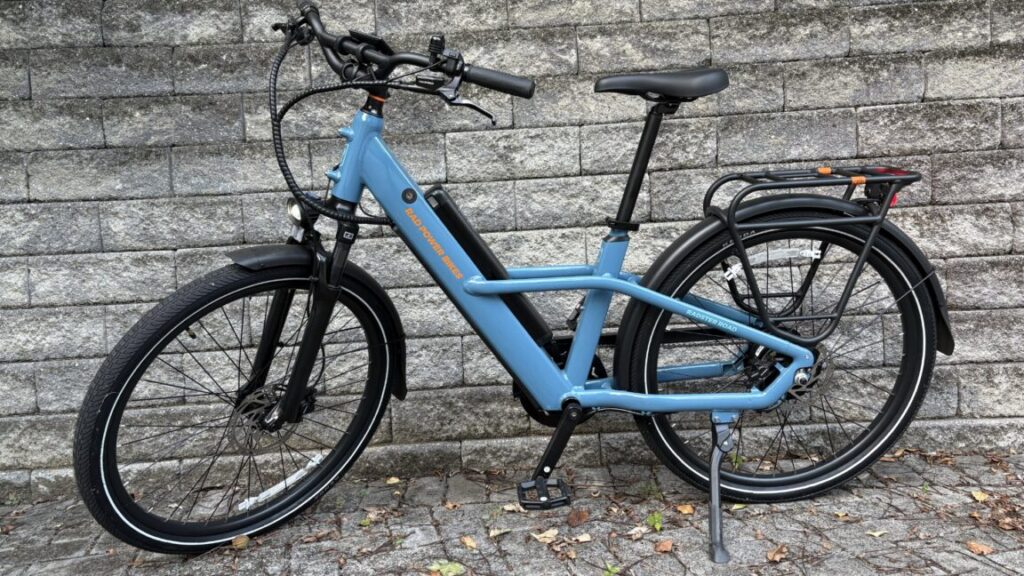
The company offers a mix of cargo, folding, and commuter bikes, all with electric assists. Having looked at a cargo version last time around, we decided to try out one of the commuter bikes this time. The Radster comes in road and trail versions (we tried the road). It’s an incredibly solidly made bike with equally solid components, and it has very good implementations of a few things that other manufacturers haven’t handled all that well. It also can switch among the three classes of e-bikes using a menu option; unfortunately, nothing else about the bike’s performance seems to change with the switch.

The Radster is priced a bit higher than a lot of its budget competitors. So, if you’re shopping, you’ll have to think a bit about whether some of these features matter to you.

A solid option

One thing that is very clear early: The Radster is a very solid bike with a robust frame. While the frame is step-through, it has some added bracing just above the cranks. These two bars, one on each side of the frame, link the down tube to the seat tube and extend to form part of the rear triangle. While this means you’ll have to step a bit higher to get in a position to mount the bike, they contribute to the sense that this is a frame that will withstand years of daily use.

Another nice feature: The battery is mounted on top of the frame, so if you release it for charging elsewhere, you don’t have to do anything special to keep it from dropping onto the floor. A chain guard and fenders also come standard, something that’s a big plus for commuters. And the fork has adjustable cushioning to smooth out some of the bumps.

The front fork comes with a bump-smoothing suspension. John Timmer

The one complaint I have is a common one for me: sizing. I’m just short of 190 cm tall (about 6 feet, 2 inches), and a lot of my height is in my legs (I typically go for 35/36-inch inseams). I’ve found that most of the frames rated as “large” still feel a bit short for me. The Radster was no exception, despite being rated for people up to 5 centimeters (2 inches) taller than I am. It was very close to being comfortable but still forced me to raise my thighs above horizontal while pedaling, even with the seat at its maximum height. The geometry of the seat-to-handlebar distance was fine, though.

Also in the “solidly built” category: the rack and kickstand. The rack is rated for 25 kg (55 lbs), so it should be capable of handling a fair amount of errand running. Rad Power will sell you a large cage-style basket to fit there, and there’s everything you need to attach a front basket as well. So, while the Radster is not designated as a cargo bike, it’s flexible enough and well constructed that I wouldn’t hesitate to use it as one.

The Radster doesn’t have internal cable routing, but placing the battery on top of the down tube gave its designers an unusual option. There’s a channel that runs down the bottom of the down tube that the cables sit in, held in place by a plastic cover that’s screwed onto the frame. Should you ever need to do maintenance that involves replacing one of the cables or the hydraulic tubes, it should be a simple matter of removing the cover.

Nice electronics

The basics of the drive system are pretty typical for bikes like this. There’s a Shimano Altus derailleur controlled by a dual-trigger shifter, with a decent spread of eight gears in back. Tektro hydraulic brakes bring things to a stop effectively.

The basic electronics are similarly what you’d expect to see. It’s powered with a 720-watt-hour battery, which Rad Power estimates will get you to over 100 km (65 miles) of range at low assist settings. It’s paired with a rear hub motor rated for 750 watts and 100 Nm of torque, which is more than enough to get even a heavy bike moving quickly. It also features a throttle that will take you to 32 km/hr (20 mph). The electric motor is delightfully quiet most of the time, so you can ride free of any whine unless you’re pushing the speed.

All of the electric components are UL-certified, so you can charge it with minimal worries about the sorts of battery fires that have plagued some no-name e-bike brands.

The electronics are also where you’ll find some of Rad Power’s better features. One of these is the rear light, which also acts as a brake light and includes directionals for signaling turns. The brake light is a nice touch on a commuter bike like this, and Rad Power’s directionals actually work effectively. On the bikes we’ve tried in the past, the directionals were triggered by a small three-way toggle switch, which made it impossible to tell if you left them on, or even which direction you might have left them signaling. And that’s a major problem for anyone who’s not used to having turn signals on their bike (meaning almost everyone).

Rad Power’s system uses large, orange arrows on the display to tell you when the directionals are on, and which direction is being signaled. It takes a little while to get used to shutting them off, since you do so by hitting the same switch that activated them—hitting the opposite switch simply activates the opposite turn light. But the display at least makes it easy to tell when you’ve done something wrong.

In general, the display is also bright, easy to read, and displays everything you’d expect it to. It also comes paired with enough buttons to make navigating among settings simple, but not so many that you’re unsure of what button to use in any given context.

One last positive about the electronics: there is a torque sensor, which helps set the assist based on how much force you’re exerting on the cranks, rather than simply determining whether the cranks are turning. While these tend to be a bit more expensive, they provide an assist that’s much better integrated into the cycling you’re doing, which helps with getting started on hills where it might be difficult to get the pedals turning enough to register with a cadence sensor.

On the road

All the stats in the world can’t tell you what it’s going to be like to ride an e-bike, because software plays a critical role. The software can be set up to sacrifice range and battery life to give you effortless pedaling, or it can integrate in a way that simply makes it feel like your leg muscles are more effective than they have any right to be.

The Radster’s software allows it to be switched between a Class 2 and Class 3 assist. Class 2 is intended to have the assist cut out once the bike hits 32 km/hr (20 mph). With a Class 3, that limit rises to 45 km/hour (28 mph). Different states allow different classes, and Rad Power lets you switch between them using on-screen controls, which quite sensibly avoids having to make different models for different states.

As a Class 2, the Radster feels like a very well-rounded e-bike. At the low-assist settings, it’ll make you work to get it up to speed; you’ll bike faster but will still be getting a fair bit of exercise, especially on the hills. And at these settings, it would require a fair amount of effort to get to the point where the speed limit would cause the motor to cut out. Boost the settings to the maximum of the five levels of assist, and you only have to put in minimal effort to get to that limit. You’ll end up going a bit slower than suburban traffic, which can be less than ideal for some commutes, but you’ll get a lot of range in return.

Things are a bit different when the Radster is switched into Class 3 mode. Here, while pedaling with a roughly equal amount of force on flat ground, each level of assist would bring you to a different maximum speed. On setting one, that speed would end up being a bit above 20 km/hour (13 mph)—it was possible to go faster, but it took some work given the heavy frame. By the middle of the assist range, the same amount of effort would get the bike in the neighborhood of 30 kilometers an hour (20 mph). But even with the assist maxed out, it was very difficult to reach the legal 45 km/hour limit (28 mph) for a Class 3 on flat ground—the assist and gearing couldn’t overcome the weight of the bike, even for a regular cyclist like myself.

In the end, I felt the Radster’s electronics and drivetrain provided a more seamless cycling experience in Class 2 mode.

That may be perfectly fine for the sort of biking you’re looking to do. At the same time, if your point in buying a Class 3-capable bike is to be riding it at its maximum assist speed without it feeling like an exercise challenge, then the Rad Power might not be the bike for you. (You may interpret that desire as “I want to be lazy,” but there are a lot of commutes where being able to match the prevailing speed of car traffic would be considerably safer and getting sweaty during the commute is non-ideal.)

The other notable thing about the Radster is its price, which is in the neighborhood of $2,000 ($1,999, to be precise). That places it above city bikes from a variety of competitors, including big-name brands like Trek. And it’s far above the price of some of the recent budget entries in this segment. The case for the Radster is that it has a number of things those others may lack—brake lights and directions, a heavy-duty rack, Class 3 capabilities—and some of those features are also very well implemented. Furthermore, not one component on it made me think: “They went with cheap hardware to meet a price point.” But, given the resulting price, you’ll have to do some careful comparison shopping to determine whether these are things that make a difference for you.

The good

  • Solidly built frame with a top-mounted battery.
  • Easy switching between Class 2 and Class 3 lets you match local laws anywhere in the US.
  • Great info screen and intuitive controls, including the first useful turn signals I’ve tried.
  • Didn’t cheap out on any components.

The bad

  • It’s hard to take full advantage of its Class 3 abilities.
  • Even the large frame won’t be great for taller riders.
  • Price means you’ll want to do some comparison shopping.

The ugly

  • Even the worst aspects fall more under “disappointing” than “ugly.”

Photo of John Timmer

John is Ars Technica’s science editor. He has a Bachelor of Arts in Biochemistry from Columbia University, and a Ph.D. in Molecular and Cell Biology from the University of California, Berkeley. When physically separated from his keyboard, he tends to seek out a bicycle, or a scenic location for communing with his hiking boots.

Rad Power’s Radster: A very non-radical commuter bike Read More »

fitness-app-strava-is-tightening-third-party-access-to-user-data

Fitness app Strava is tightening third-party access to user data

AI, while having potential, “must be handled responsibly and with a firm focus on user control,” and third-party developers may not take “such a deliberate approach,” Strava wrote. And the firm expects the API changes will “affect only a small fraction (less than 0.1 percent) of the applications on the Strava platform” and that “the overwhelming majority of existing use cases are still allowed,” including coaching platforms “focused on providing feedback to users.”

Ars has contacted Strava and will update this post if we receive a response.

DC Rainmaker’s post about Strava’s changes points out that while the simplest workaround for apps would be to take fitness data directly from users, that’s not how fitness devices work. Other than “a Garmin or other big-name device with a proper and well-documented” API, most devices default to Strava as a way to get training data to other apps, wrote Ray Maker, the blogger behind the DC Rainmaker alias.

Beyond day-to-day fitness data, Strava’s API agreement now states more precisely that an app cannot process a user’s Strava data “in an aggregated or de-identified manner” for the purposes of “analytics, analyses, customer insights generation,” or similar uses. Maker writes that the training apps he contacted had been “completely broadsided” by the API shift, having been given 30 days’ notice to change their apps.

Strava notes in a post on its forum in the Developers & API section that, per its guidelines, “posts requesting or attempting to have Strava revert business decisions will not be permitted.”

Fitness app Strava is tightening third-party access to user data Read More »

the-trek-checkpoint-sl-7-axs-gen-3-may-be-the-perfect-gravel-bike

The Trek Checkpoint SL 7 AXS Gen 3 may be the perfect gravel bike

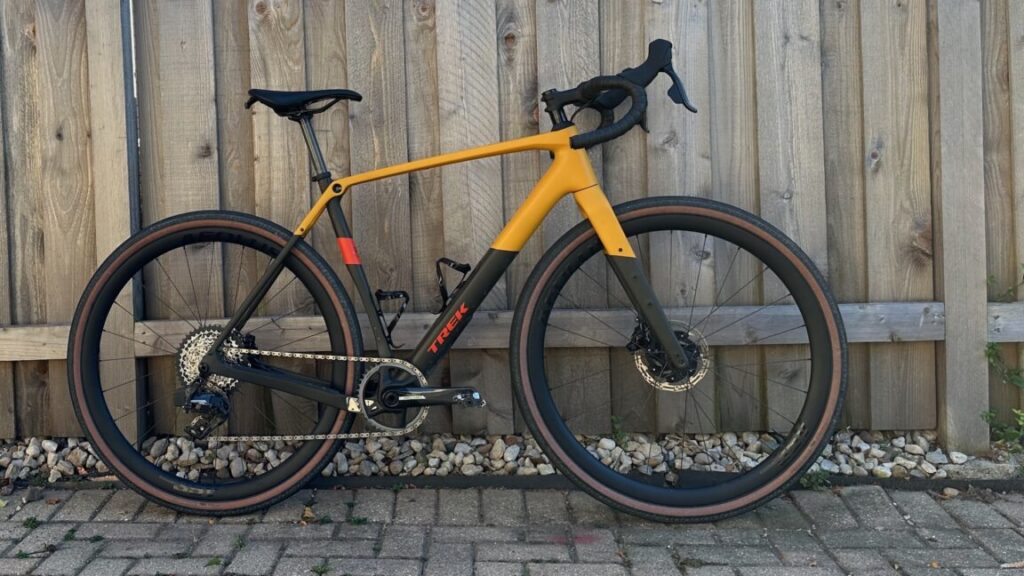
As I followed a friend down a flow-y, undulating single-track trail, I started laughing. Unlike my mountain bike-riding companion, I was on a gravel bike, the new Trek Checkpoint SL 7 AXS Gen 3. You might be wondering why a review of a gravel bike is starting with such a ride. The answer is simple—the Checkpoint had excelled everywhere else I rode it, so I was curious to see how it would fare on a non-technical MTB track. Amazingly well, as it turns out.

Unlike every other bike Ars has reviewed to this point, the Checkpoint SL 7 Gen 3 has no battery and no motor—there’s no e- in this bike. As is the case with our other bike reviews, sometimes we ask for a specific model, but manufacturers tend to contact us when we’ve already got a garage full of bikes we’ve not finished the reviews for (there are currently 12 bikes in my garage, some of which belong to other family members).

Launched in 2018, the Checkpoint is Trek’s gravel-centric bike. For 2025, Trek has split its gravel lineup into the third-generation Checkpoint Trek and the Checkmate SLR 9 AXS. The latter features a lighter-weight frame, a power meter, and SRAM’s new Red XPLR groupset. Selling for $11,999, the Checkmate is a gravel racer. Priced several thousand less at $5,699, the Checkpoint SL 7 AXS is now Trek’s top gravel bike for those looking for a fun day out on the trails.

With the Gen 3 Checkpoint, Trek has added mounts all over the frame, tweaked the geometry to make it more comfortable for long rides, improved ride comfort by reworking the rear IsoSpeed decoupler (which softens the bumpiness from rough trails and pavement), and increased the tire clearance to 50 mm (42 mm with fenders). Trek uses three different types of carbon on its drop handlebar bikes. The top-of-the-line OCLV 900 shows up on the racing-focused Madone road bike, while the OCLV 800 is used in the Domane endurance bike lineup as well as the Checkmate. The SL 7 uses Trek’s 500 Series OCLV carbon, and the bike weighs in at 19.85 lb (9.0 kg)—about 100 g heavier than the Gen 2. The drivetrain comes from SRAM, with a SRAM Force XPLR AXS D2 groupset.

The Trek Checkpoint SL 7 AXS Gen 3 may be the perfect gravel bike Read More »

trek-carback-bike-radar-lets-you-know-when-cars-are-approaching

Trek CarBack bike radar lets you know when cars are approaching

“Car back!”

If you’ve ever been on a group bike ride, you’ve no doubt heard these two words shouted by a nearby rider. It’s also the name of Trek’s new bike radar.

For safety-conscious cyclists, bike radars have been a game-changer. Usually mounted on the seat post, the radar units alert cyclists to cars approaching from behind. While they will work on any bike on any road, bike radar is most useful in suburban and rural settings. After all, if you’re doing some urban bike commuting, you’ll just assume cars are behind you because that’s how it is. But on more open roads with higher speed limits or free-flowing traffic, bike radars are fantastic.

While a handful of companies make them, the Garmin Varia is the best-known and most popular option. The Varia is so popular that it is nearing the proprietary eponym status of Kleenex and Taser among cyclists. Trek hopes to change that with its new CarBack bike radar.

Like other bike radars, the CarBack can be used with either a cycling computer or your smartphone. Mounted either on a seat post or the back of a Bontrager saddle, the CarBack can detect vehicles approaching from as far away as 150 meters, beeping at you once one is in its range.

The CarBack plays just as nicely with Garmin bike computers as the Varia does. When a car comes within range, your bike computer will chirp, the edges of the screen turn orange, and a dot showing the car’s relative position travels up the right side of the screen—exactly the same as riding with a Varia.

Speaking of the Varia, there are three significant differences between it and the CarBack. The first is the effective range, 140 meters for the Varia versus the CarBack’s 150 meters. While riding, I didn’t have the feeling that I was getting alerts sooner. But testing on a busy street demonstrated that the CarBack does have at least a few more meters of range than the Varia.

Trek CarBack bike radar lets you know when cars are approaching Read More »

the-world’s-toughest-race-starts-saturday,-and-it’s-delightfully-hard-to-call-this-year

The world’s toughest race starts Saturday, and it’s delightfully hard to call this year

Is it Saturday yet? —

Setting the stage for what could be a wild ride across France.

The peloton passing through a sunflowers field during the stage eight of the 110th Tour de France in 2023.

Enlarge / The peloton passing through a sunflowers field during the stage eight of the 110th Tour de France in 2023.

David Ramos/Getty Images

Most readers probably did not anticipate seeing a Tour de France preview on Ars Technica, but here we are. Cycling is a huge passion of mine and several other staffers, and this year, a ton of intrigue surrounds the race, which has a fantastic route. So we’re here to spread Tour fever.

The three-week race starts Saturday, paradoxically in the Italian region of Tuscany. Usually, there is a dominant rider, or at most two, and a clear sense of who is likely to win the demanding race. But this year, due to rider schedules, a terrible crash in early April, and new contenders, there is more uncertainty than usual. A solid case could be made for at least four riders to win this year’s Tour de France.

For people who aren’t fans of pro road cycling—which has to be at least 99 percent of the United States—there’s a great series on Netflix called Unchained to help get you up to speed. The second season, just released, covers last year’s Tour de France and introduces you to most of the protagonists in the forthcoming edition. If this article sparks your interest, I recommend checking it out.

Anyway, for those who are cycling curious, I want to set the stage for this year’s race by saying a little bit about the four main contenders, from most likely to least likely to win, and provide some of the backstory to what could very well be a dramatic race this year.

Tadej Pogačar

Tadej Pogacar of Slovenia and UAE Team Emirates won the Giro d'Italia in May.

Enlarge / Tadej Pogacar of Slovenia and UAE Team Emirates won the Giro d’Italia in May.

Tim de Waele/Getty Images

  • Slovenia
  • 25 years old
  • UAE Team Emirates
  • Odds: -190

Pogačar burst onto the scene in 2019 at the very young age of 20 by finishing third in the Vuelta a España, one of the three grand tours of cycling. He then went on to win the 2020 and 2021 Tours de France, first by surprising fellow countryman Primož Roglič (more on him below) in 2020 and then utterly dominating in 2021. Given his youth, it seemed he would be the premiere grand tour competitor for the next decade.

But then another slightly older rider, a teammate of Roglič’s named Jonas Vingegaard, emerged in 2022 and won the next two races. Last year, in fact, Vingegaard cracked Pogačar by 7 minutes and 29 seconds in the Tour, a huge winning margin, especially for two riders of relatively close talent. This established Vingegaard as the alpha male of grand tour cyclists, having proven himself a better climber and time trialist than Pogačar, especially in the highest and hardest stages.

So this year, Pogačar decided to change up his strategy. Instead of focusing on the Tour de France, Pogačar participated in the first grand tour of the season, the Giro d’Italia, which occurred in May. He likely did so for a couple of reasons. First of all, he almost certainly received a generous appearance fee from the Italian organizers. And secondly, riding the Giro would give him a ready excuse for not beating Vingegaard in France.

Why is this? Because there are just five weeks between the end of the Giro and the start of the Tour. So if a rider peaks for the Giro and exerts himself in winning the race, it is generally thought that he can’t arrive at the Tour in winning form. He will be a few percent off, not having ideal preparation.

Predictably, Pogačar smashed the lesser competition at the Giro and won the race by 9 minutes and 56 seconds. Because he was so far ahead, he was able to take the final week of the race a bit easier. The general thinking in the cycling community is that Pogačar is arriving at the Tour in excellent but not peak form. But given everything else that has happened so far this season, the bettors believe that will be enough for him to win. Maybe.

The world’s toughest race starts Saturday, and it’s delightfully hard to call this year Read More »