companion bots

senators-move-to-keep-big-tech’s-creepy-companion-bots-away-from-kids

Senators move to keep Big Tech’s creepy companion bots away from kids

Big Tech says bans aren’t the answer

As the bill advances, it could change, senators and parents acknowledged at the press conference. It will likely face backlash from privacy advocates who have raised concerns that widely collecting personal data for age verification puts sensitive information at risk of a data breach or other misuse.

The tech industry has already voiced opposition. On Tuesday, Chamber of Progress, a Big Tech trade group, criticized the law as taking a “heavy-handed approach” to child safety. The group’s vice president of US policy and government relations, K.J. Bagchi, said that “we all want to keep kids safe, but the answer is balance, not bans.

“It’s better to focus on transparency when kids chat with AI, curbs on manipulative design, and reporting when sensitive issues arise,” Bagchi said.

However, several organizations dedicated to child safety online, including the Young People’s Alliance, the Tech Justice Law Project, and the Institute for Families and Technology, cheered senators’ announcement Tuesday. The GUARD Act, these groups told Time, is just “one part of a national movement to protect children and teens from the dangers of companion chatbots.”

Mourning parents are rallying behind that movement. Earlier this month, Garcia praised California for “finally” passing the first state law requiring companies to protect their users who express suicidal ideations to chatbots.

“American families, like mine, are in a battle for the online safety of our children,” Garcia said at that time.

During Tuesday’s press conference, Blumenthal noted that the chatbot ban bill was just one initiative of many that he and Hawley intend to raise to heighten scrutiny on AI firms.

Senators move to keep Big Tech’s creepy companion bots away from kids Read More »

to-shield-kids,-california-hikes-fake-nude-fines-to-$250k-max

To shield kids, California hikes fake nude fines to $250K max

California is cracking down on AI technology deemed too harmful for kids, attacking two increasingly notorious child safety fronts: companion bots and deepfake pornography.

On Monday, Governor Gavin Newsom signed the first-ever US law regulating companion bots after several teen suicides sparked lawsuits.

Moving forward, California will require any companion bot platforms—including ChatGPT, Grok, Character.AI, and the like—to create and make public “protocols to identify and address users’ suicidal ideation or expressions of self-harm.”

They must also share “statistics regarding how often they provided users with crisis center prevention notifications to the Department of Public Health,” the governor’s office said. Those stats will also be posted on the platforms’ websites, potentially helping lawmakers and parents track any disturbing trends.

Further, companion bots will be banned from claiming that they’re therapists, and platforms must take extra steps to ensure child safety, including providing kids with break reminders and preventing kids from viewing sexually explicit images.

Additionally, Newsom strengthened the state’s penalties for those who create deepfake pornography, which could help shield young people, who are increasingly targeted with fake nudes, from cyber bullying.

Now any victims, including minors, can seek up to $250,000 in damages per deepfake from any third parties who knowingly distribute nonconsensual sexually explicit material created using AI tools. Previously, the state allowed victims to recover “statutory damages of not less than $1,500 but not more than $30,000, or $150,000 for a malicious violation.”

Both laws take effect January 1, 2026.

American families “are in a battle” with AI

The companion bot law’s sponsor, Democratic Senator Steve Padilla, said in a press release celebrating the signing that the California law demonstrates how to “put real protections into place” and said it “will become the bedrock for further regulation as this technology develops.”

To shield kids, California hikes fake nude fines to $250K max Read More »

vandals-deface-ads-for-ai-necklaces-that-listen-to-all-your-conversations

Vandals deface ads for AI necklaces that listen to all your conversations

In addition to backlash over feared surveillance capitalism, critics have accused Schiffman of taking advantage of the loneliness epidemic. Conducting a survey last year, researchers with Harvard Graduate School of Education’s Making Caring Common found that people between “30-44 years of age were the loneliest group.” Overall, 73 percent of those surveyed “selected technology as contributing to loneliness in the country.”

But Schiffman rejects these criticisms, telling the NYT that his AI Friend pendant is intended to supplement human friends, not replace them, supposedly helping to raise the “average emotional intelligence” of users “significantly.”

“I don’t view this as dystopian,” Schiffman said, suggesting that “the AI friend is a new category of companionship, one that will coexist alongside traditional friends rather than replace them,” the NYT reported. “We have a cat and a dog and a child and an adult in the same room,” the Friend founder said. “Why not an AI?”

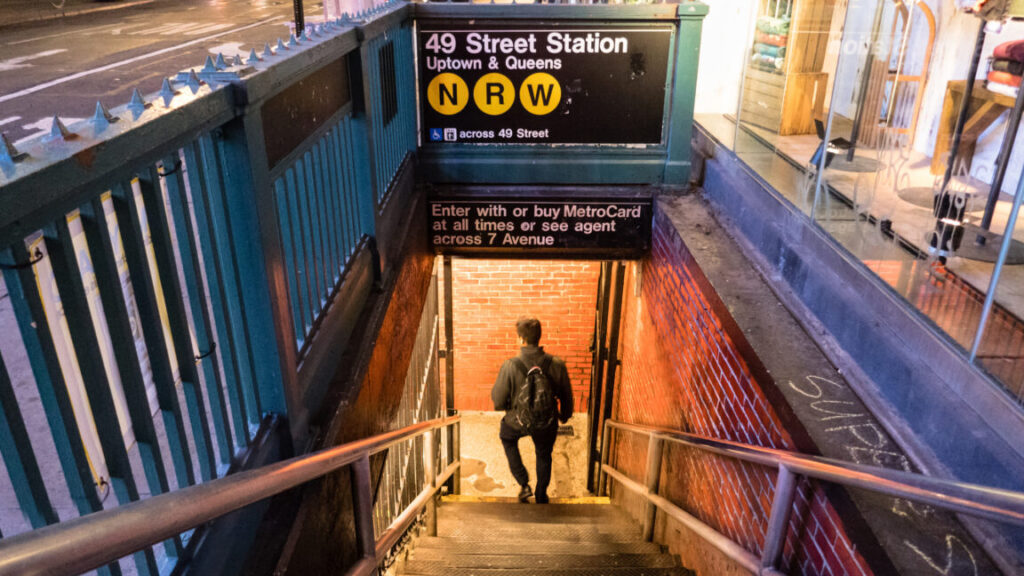
The MTA has not commented on the controversy, but Victoria Mottesheard—a vice president at Outfront Media, which manages MTA advertising—told the NYT that the Friend campaign blew up because AI “is the conversation of 2025.”

Website lets anyone deface Friend ads

So far, the Friend ads have not yielded significant sales, Schiffman confirmed, telling the NYT that only 3,100 have sold. He expects that society isn’t ready for AI companions to be promoted at such a large scale and that his ad campaign will help normalize AI friends.

In the meantime, critics have rushed to attack Friend on social media, inspiring a website where anyone can vandalize a Friend ad and share it online. That website has received close to 6,000 submissions so far, its creator, Marc Mueller, told the NYT, and visitors can take a tour of these submissions by choosing “ride train to see more” after creating their own vandalized version.

For visitors to Mueller’s site, riding the train displays a carousel documenting backlash to Friend, as well as “performance art” by visitors poking fun at the ads in less serious ways. One example showed a vandalized ad changing “Friend” to “Fries,” with a crude illustration of McDonald’s French fries, while another transformed the ad into a campaign for “fried chicken.”

Others were seemingly more serious about turning the ad into a warning. One vandal drew a bunch of arrows pointing to the “end” in Friend while turning the pendant into a cry-face emoji, seemingly drawing attention to research on the mental health risks of relying on AI companions—including the alleged suicide risks of products like Character.AI and ChatGPT, which have spawned lawsuits and prompted a Senate hearing.

Vandals deface ads for AI necklaces that listen to all your conversations Read More »