
college

caught-cheating-in-class,-college-students-“apologized”-using-ai—and-profs-called-them-out

Caught cheating in class, college students “apologized” using AI—and profs called them out

When the professors realized how widespread this was, they contacted the 100-ish students who seemed to be cheating. “We reached out to them with a warning, and asked them, ‘Please explain what you just did,’” said Fagen-Ulmschneider in an Instagram video discussing the situation.

Apologies came back from the students, first in a trickle, then in a flood. The professors were initially moved by this acceptance of responsibility and contrition… until they realized that 80 percent of the apologies were almost identically worded and appeared to be generated by AI.

So on October 17, during class, Flanagan and Fagen-Ulmschneider took their class to task, displaying a mash-up image of the apologies, each bearing the same “sincerely apologize” phrase. No disciplinary action was taken against the students, and the whole situation was treated rather lightly—but the warning was real. Stop doing this. Flanagan said that she hoped it would be a “life lesson” for the students.
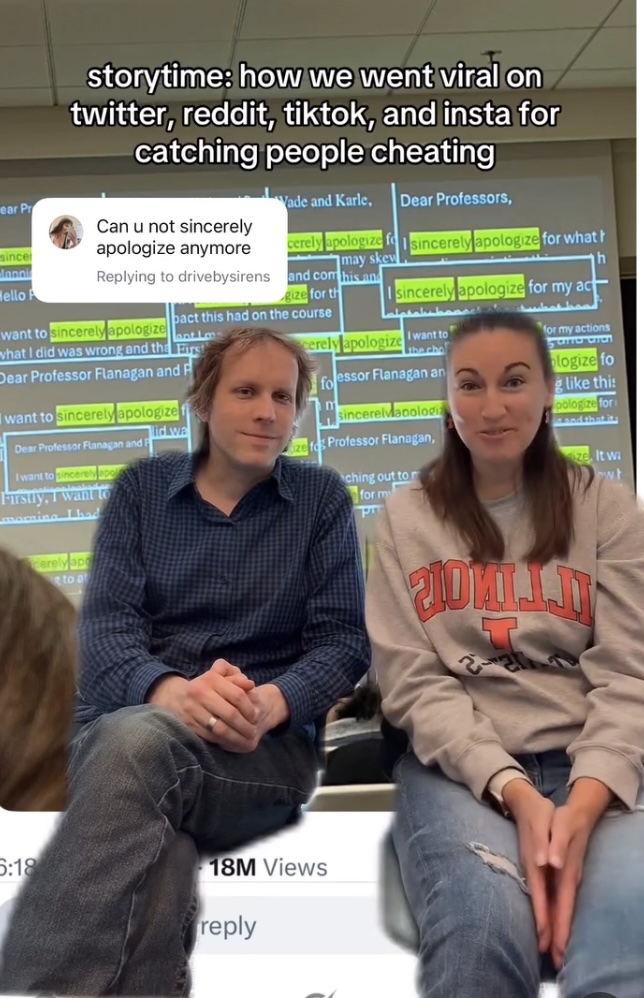
The professors in an Instagram video.

Time for a life lesson! Credit: Instagram

On a University of Illinois subreddit, students shared their own experiences of the same class and of AI use on campus. One student claimed to be a teaching assistant for the Data Science Discovery course and said that, in addition to not being present, many students would use AI to solve the (relatively easy) problems. AI tools will often “use functions that weren’t taught in class,” which gave the game away pretty easily.

Another TA claimed that “it’s insane how pervasive AI slop is in 75% of the turned-in work,” while another student complained about being a course assistant where “students would have a 75-word paragraph due every week and it was all AI generated.”

One doesn’t have to read far in these kinds of threads to find plenty of students who feel aggrieved because they were accused of AI use—but hadn’t done it. Given how poor most AI detection tools are, this is plenty plausible; and if AI detectors aren’t used, accusations often come down to a hunch.


Caught cheating in class, college students “apologized” using AI—and profs called them out Read More »

chatgpt-outperforms-undergrads-in-intro-level-courses,-falls-short-later

ChatGPT outperforms undergrads in intro-level courses, falls short later

Overhead view of a classroom full of students at desks, focused on writing on papers.

“Since the rise of large language models like ChatGPT there have been lots of anecdotal reports about students submitting AI-generated work as their exam assignments and getting good grades. So, we stress-tested our university’s examination system against AI cheating in a controlled experiment,” says Peter Scarfe, a researcher at the School of Psychology and Clinical Language Sciences at the University of Reading.

His team created over 30 fake psychology student accounts and used them to submit ChatGPT-4-produced answers to examination questions. The anecdotal reports were true—the AI use went largely undetected, and, on average, ChatGPT scored better than human students.

Rules of engagement

Scarfe’s team submitted AI-generated work in five undergraduate modules, covering classes needed during all three years of study for a bachelor’s degree in psychology. The assignments were either 200-word answers to short questions or more elaborate essays, roughly 1,500 words long. “The markers of the exams didn’t know about the experiment. In a way, participants in the study didn’t know they were participating in the study, but we’ve got necessary permissions to go ahead with that”, Scarfe claims.

Shorter submissions were prepared simply by copy-pasting the examination questions into ChatGPT-4 along with a prompt to keep the answer under 160 words. The essays were solicited the same way, but the required word count was increased to 2,000. Setting the limits this way, Scarfe’s team could get ChatGPT-4 to produce content close enough to the required length. “The idea was to submit those answers without any editing at all, apart from the essays, where we applied minimal formatting,” says Scarfe.

Overall, Scarfe and his colleagues slipped 63 AI-generated submissions into the examination system. Even with no editing or efforts to hide the AI usage, 94 percent of those went undetected, and nearly 84 percent got better grades (roughly half a grade better) than a randomly selected group of students who took the same exam.

“We did a series of debriefing meetings with people marking those exams and they were quite surprised,” says Scarfe. Part of the reason they were surprised was that most of those AI submissions that were detected did not end up flagged because they were too repetitive or robotic—they got flagged because they were too good.

Which raises a question: What do we do about it?

AI-hunting software

“During this study we did a lot of research into techniques of detecting AI-generated content,” Scarfe says. One such tool is Open AI’s GPTZero; others include AI writing detection systems like the one made by Turnitin, a company specializing in delivering tools for detecting plagiarism.

“The issue with such tools is that they usually perform well in a lab, but their performance drops significantly in the real world,” Scarfe explained. Open AI claims the GPTZero can flag AI-generated text as “likely” AI 26 percent of the time, with a rather worrisome 9 percent false positive rate. Turnitin’s system, on the other hand, was advertised as detecting 97 percent of ChatGPT and GPT-3 authored writing in a lab with only one false positive in a hundred attempts. But, according to Scarfe’s team, the released beta version of this system performed significantly worse.

ChatGPT outperforms undergrads in intro-level courses, falls short later Read More »