cards against humanity

cards-against-humanity-lawsuit-forced-spacex-to-vacate-land-on-us/mexico-border

Cards Against Humanity lawsuit forced SpaceX to vacate land on US/Mexico border

A year after suing SpaceX for “invading” a plot of land on the US/Mexico border, Cards Against Humanity says it has obtained a settlement and will provide supporters with a new pack of cards about Elon Musk.

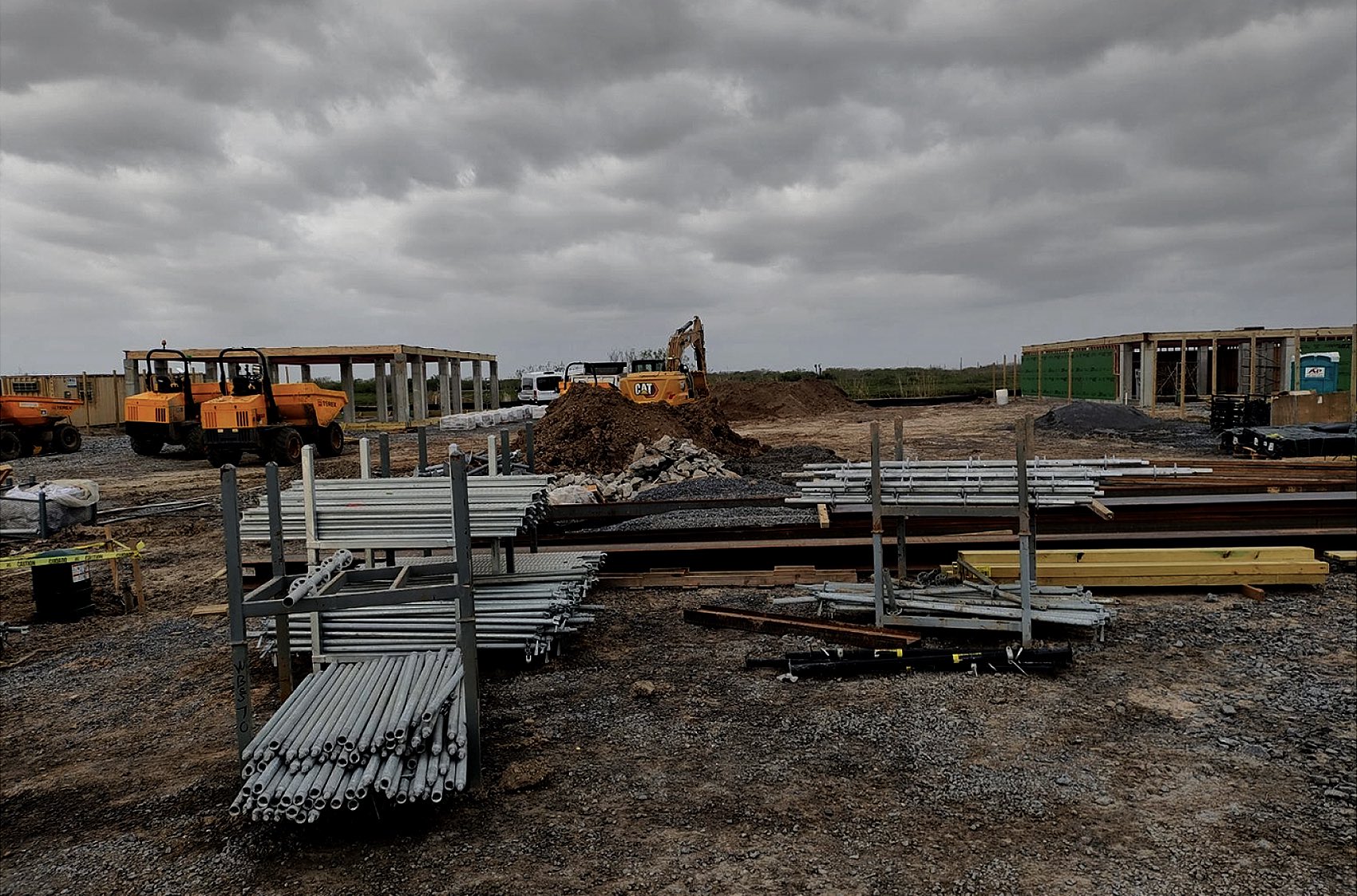
The party-game company bought the land in 2017 in an attempt to stymie President Trump’s wall-building project, but alleged that SpaceX illegally took over the land and filled it with construction equipment and materials. A September 2024 lawsuit filed against SpaceX in Cameron County District Court in Texas sought up to $15 million to cover the cost of restoring the property and other damages.

Cards Against Humanity, which bought the property with donations from supporters, told Ars today that “we’ve been in negotiations with SpaceX for much of the last year. We held out for the best settlement we could get—almost until the trial was supposed to start—and unfortunately part of that negotiation was that we’re not allowed to discuss specific settlement terms. They did admit to trespassing during the discovery phase, which was very validating.”

A court document shows that SpaceX admitted it did not ask for or receive permission to use the property. SpaceX admitted that its “contractors cleared the lot and put down gravel,” parked vehicles on the property, and stored construction materials. An Associated Press article yesterday said that “Texas court records show a settlement was reached in the case last month, just weeks before a jury trial was scheduled to begin on Nov. 3.”

The game company said a victory at trial wouldn’t have resulted in a better outcome. “A trial would have cost more than what we were likely to win from SpaceX,” the company’s statement to Ars said. “Under Texas law, even if we had won at trial (and we would have, given their admission to trespassing), we likely wouldn’t have been able to recoup our legal fees. And SpaceX certainly seemed ready to dramatically outspend us on lawyers.”

“They packed up the space garbage”

The company also provided this update to donors:

Dear Horrible Friends,

Remember last year, when we sued Elon Musk for dumping space garbage all over your land, and then you signed up to collect your share of the proceeds? Also, remember how we warned you that we’d “probably only be able to get you like two dollars or most likely nothing”?

Well, Elon Musk’s team admitted on the record that they illegally trespassed on your land, and then they packed up the space garbage and fucked off. But when it comes to paying you all, he did the legal equivalent of throwing dust in our eyes and kicking us in the balls.

Instead of money, Cards Against Humanity said it will provide its “best, sexiest customers” with a comedic “mini-pack of exclusive cards all about Elon Musk” that can be obtained via this sign-up link. “P.S. Soon, the land will be returned to its natural state: no space garbage, and still completely free of pointless fucking border walls,” the company said.

Cards Against Humanity lawsuit forced SpaceX to vacate land on US/Mexico border Read More »
why-doesn’t-cards-against-humanity-print-its-game-in-the-us?-it’s-complicated.

Why doesn’t Cards Against Humanity print its game in the US? It’s complicated.

Or take Meredith Placko, the CEO of Steve Jackson Games, which produces games like Munchkin. “Some people ask, ‘Why not manufacture in the US?’ I wish we could,” she wrote. “But the infrastructure to support full-scale board game production—specialty dice making, die-cutting, custom plastic and wood components—doesn’t meaningfully exist here yet. I’ve gotten quotes. I’ve talked to factories. Even when the willingness is there, the equipment, labor, and timelines simply aren’t.”

But surely, you say, a box of cards should be possible. And it is. But CAH tells me that the downsides of US manufacturing for its game are still significant.

“We actually tried diversifying our suppliers by working with a US factory several years ago, but they were twice as expensive, three times slower, and much lower quality—something like 20 percent of games were unsellable due to production errors,” said a spokesperson for the company.

And although it is possible to print card games in the US, CAH makes other products too and would prefer to work with a single manufacturer who can handle all of it. Newer CAH games like Head Trip use “wooden tokens and a round folding board,” while another title called Tales “has a bound book and 20 tiny matchboxes of prompts.”

In the end, though, it’s not just about dollars and sense. It’s also about relationships and trust. CAH has “used the same factory in China since 2010, and they’ve grown alongside us from a small business to a huge operation,” I was told. “They do great work, we like them, and we feel a moral obligation to stand by them through Trump’s insanity.”

(If you want to produce Cards Against Humanity in the US, however, you can always download the free files for the game [PDF] and print it yourself. Be warned that it is quite vulgar!)

Board and card games are not one of the major pillars of the US economy, of course, but looking into how complicated it can be to get a game made does illuminate complex issues around globalization and manufacturing that are too often turned into simple soundbites.

Why doesn’t Cards Against Humanity print its game in the US? It’s complicated. Read More »

not-a-game:-cards-against-humanity-avoids-tariffs-by-ditching-rules,-adding-explanations

Not a game: Cards Against Humanity avoids tariffs by ditching rules, adding explanations

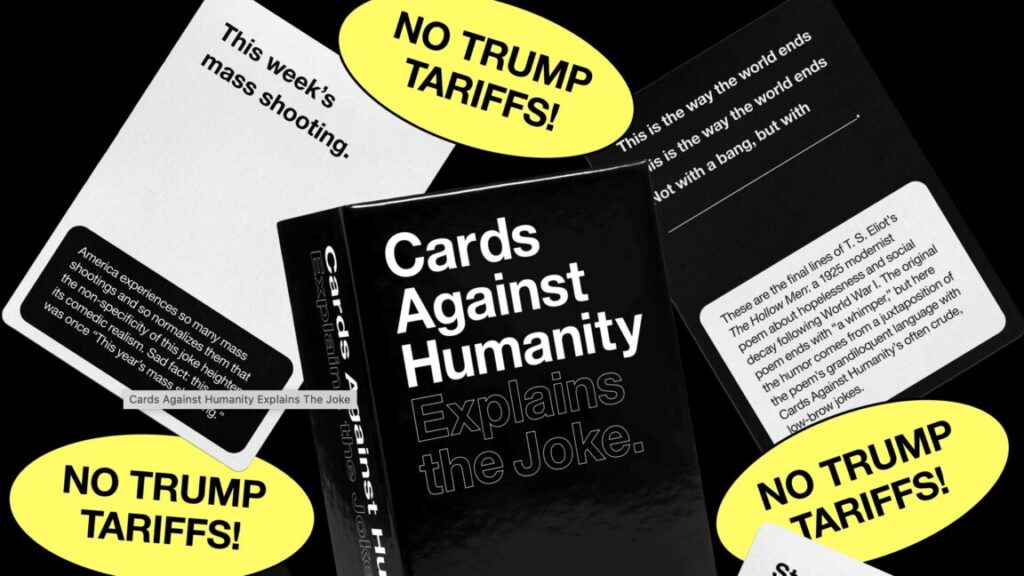
Cards Against Humanity, the often-vulgar card game, has launched a limited edition of its namesake product without any instructions and with a detailed explanation of each joke, “why it’s funny, and any relevant social, political, or historical context.”

Why? Because, produced in this form, “Cards Against Humanity Explains the Joke” is not a game at all, which would be subject to tariffs as the cards are produced overseas. Instead, the product is “information material” and thus not sanctionable under the law Trump has been using—and CAH says it has obtained a ruling to this effect from Customs and Border Patrol.

“What if DHS Secretary and Dog Murderer Kristi Noem gets mad and decides that Cards Against Humanity Explains the Joke is not informational material?” the company asks in an FAQ about the new edition. (If you don’t follow US politics, Noem really did kill her dog Cricket.) Answer: “She can fuck right off, because we got a binding ruling from Trump’s own government that confirms this product is informational and 100% exempt from his stupid tariffs.”

Pre-orders for the $25 product end on October 15, and it will allegedly never be reprinted. All profits will be donated to the American Library Association “to fight censorship.”

This is the way

Now, I would never claim that Cards Against Humanity is a particularly highbrow form of entertainment; for instance, the website promoting the new edition opens with “Trump is Going to Fuck Christmas” in giant white letters. (That headline refers to Trump’s tariffs… I hope.)

“This holiday season, give your loved ones the gift of knowledge, give America’s libraries the gift of cash, and don’t give Donald Trump a fucking cent,” the site says.

Not a game: Cards Against Humanity avoids tariffs by ditching rules, adding explanations Read More »

cards-against-humanity-sues-spacex,-alleges-“invasion”-of-land-on-us/mexico-border

Cards Against Humanity sues SpaceX, alleges “invasion” of land on US/Mexico border

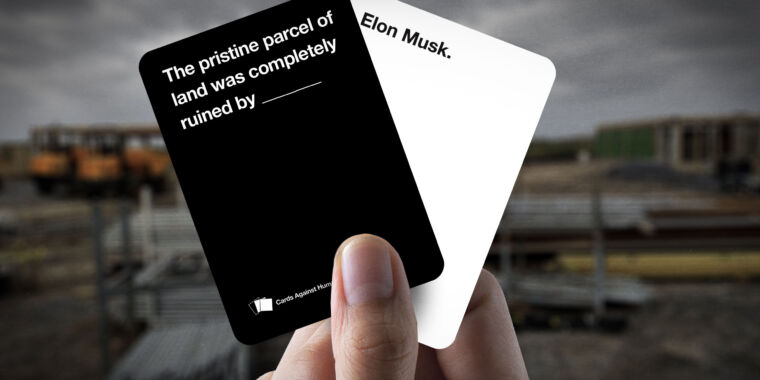
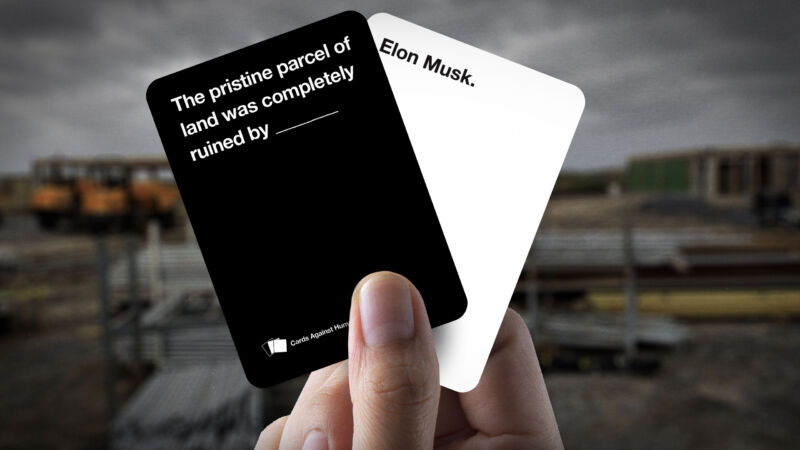
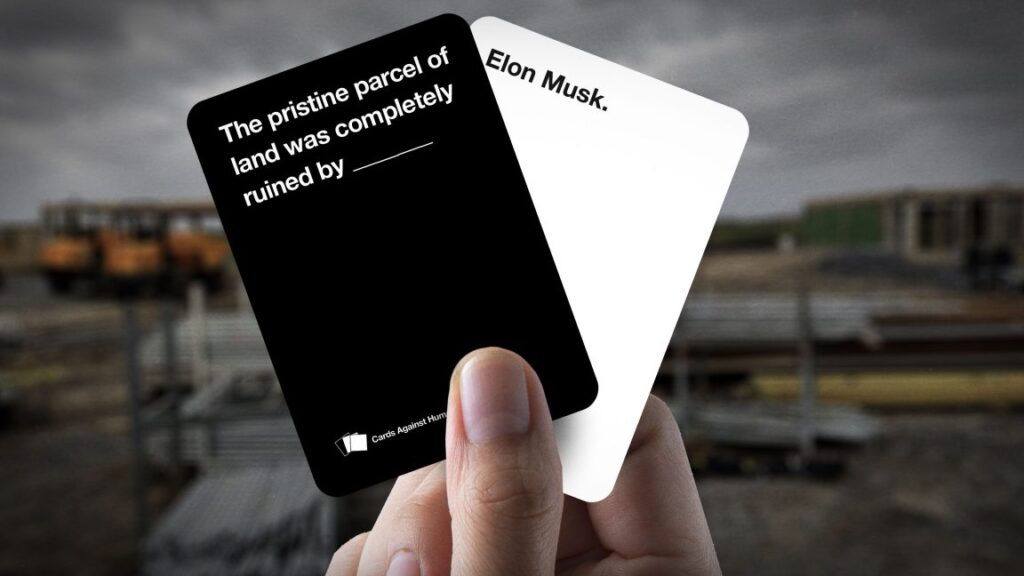
A mockup of two cards in the style of the Cards Against Humanity game. One card says

Aurich Lawson | Cards Against Humanity

Cards Against Humanity sued SpaceX yesterday, alleging that Elon Musk’s firm illegally took over a plot of land on the US/Mexico border that the party-game company bought in 2017 in an attempt to stymie then-President Trump’s attempt to build a wall.

“As part of CAH’s 2017 holiday campaign, while Donald Trump was President, CAH created a supporter-funded campaign to take a stand against the building of a Border Wall,” said the lawsuit filed in Cameron County District Court in Texas. Cards Against Humanity says it received $15 donations from 150,000 people and used part of that money to buy “a plot of vacant land in Cameron County based upon CAH’s promise to ‘make it as time-consuming and expensive as possible for Trump to build his wall.'”

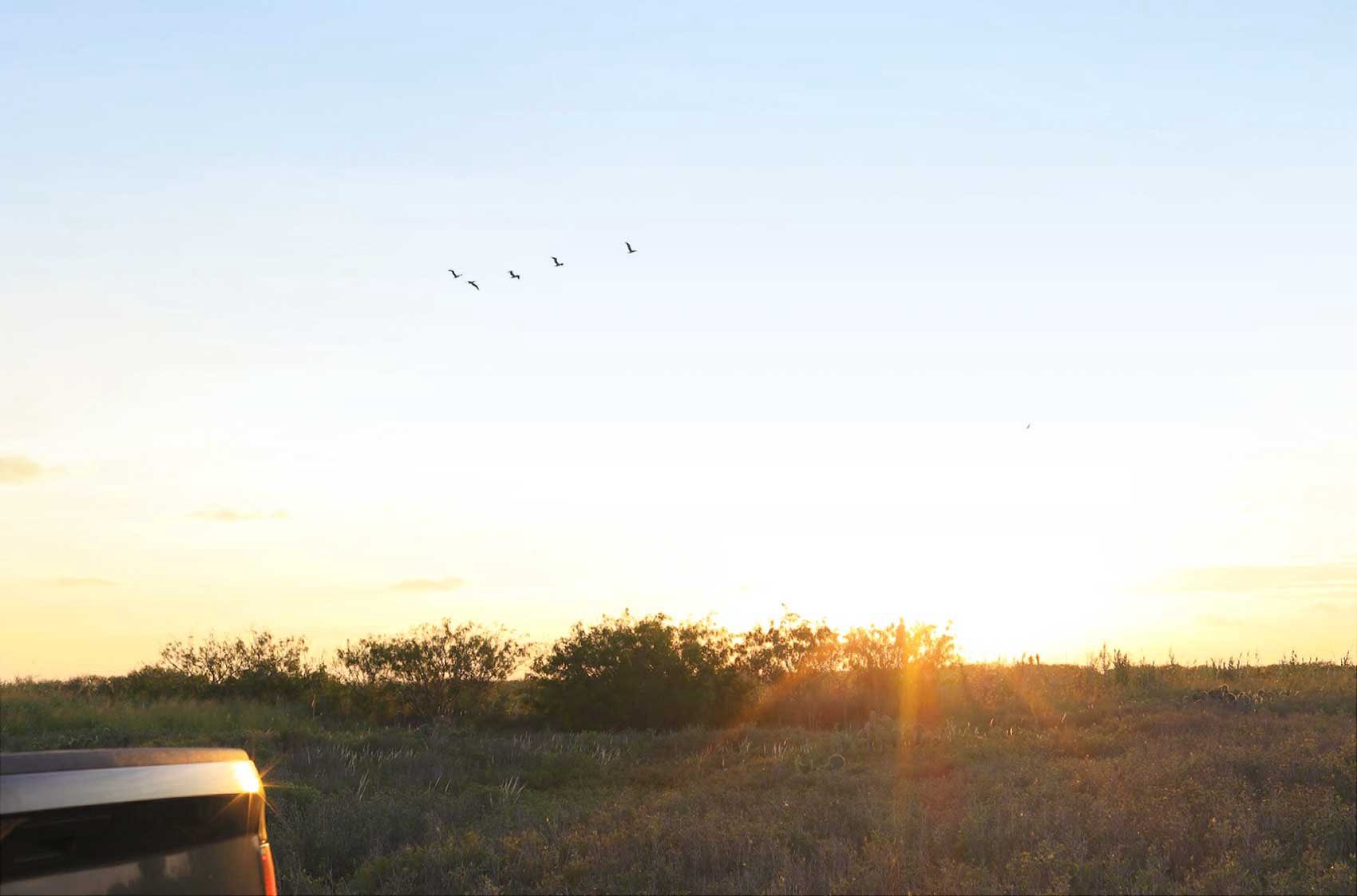
Cards Against Humanity says it mowed the land “and maintained it in its natural state, marking the edge of the lot with a fence and a ‘No Trespassing’ sign.” But instead of Trump taking over the land, Cards Against Humanity says the parcel was “interfered with and invaded” by Musk’s space company. The lawsuit includes pictures that, according to Cards Against Humanity, show the land when it was first purchased and after SpaceX construction equipment and materials were placed on the land.

This picture was taken in 2017, according to Cards Against Humanity:

Cards Against Humanity

Cards Against Humanity says this picture of SpaceX equipment and materials on the same land was taken in 2024:

Cards Against Humanity

The lawsuit seeks up to $15 million to cover “the cost to restore and repair the Property, the diminution in the Property’s fair market value, the reasonable value of SpaceX’s use of the Property, the loss of goodwill, damages to CAH’s reputation, and other pecuniary loss and actual damages suffered by CAH.” The suit also seeks punitive damages.

Lawsuit: SpaceX “never asked for permission”

The lawsuit said that SpaceX “acquired many of the vacant lots along the road on which the Property is situated,” and started using the Cards Against Humanity property as its own:

SpaceX and/or its contractors entered the Property and, after erecting posts to mark the property line, proceeded to ignore any distinction based upon property ownership. The site was cleared of vegetation, and the soil was compacted with gravel or other substance to allow SpaceX and its contractors to run and park its vehicles all over the Property. Generators were brought in to run equipment and lights while work was being performed before and after daylight. An enormous mound of gravel was unloaded onto the Property; the gravel is being stored and used for the construction of buildings by SpaceX’s contractors along the road.

Large pieces of construction equipment and numerous construction-related vehicles are utilized and stored on the Property continuously. And, of course, workers are present performing construction work and staging materials and vehicles for work to be performed on other tracts. In short, SpaceX has treated the Property as its own for at least six (6) months without regard for CAH’s property rights nor the safety of anyone entering what has become a worksite that is presumably governed by OSHA safety requirements.

The lawsuit said that “SpaceX has never asked for permission to use the Property, much less for the egregious appropriation of the Property for its own profit-making purposes,” and “never reached out to CAH to explain or apologize for the damage caused to the Property and CAH’s ownership interest therein.”

We contacted SpaceX about the lawsuit and will update this article if it provides a response.

Cards Against Humanity sues SpaceX, alleges “invasion” of land on US/Mexico border Read More »