brad smith

microsoft-vows-to-cover-full-power-costs-for-energy-hungry-ai-data-centers

Microsoft vows to cover full power costs for energy-hungry AI data centers

Taking responsibility for power usage

In the Microsoft blog post, Smith acknowledged that residential electricity rates have recently risen in dozens of states, driven partly by inflation, supply chain constraints, and grid upgrades. He wrote that communities “value new jobs and property tax revenue, but not if they come with higher power bills or tighter water supplies.”

Microsoft says it will ask utilities and public commissions to set rates high enough to cover the full electricity costs for its data centers, including infrastructure additions. In Wisconsin, the company is supporting a new rate structure that would charge “Very Large Customers,” including data centers, the cost of the electricity required to serve them.

Smith wrote that while some have suggested the public should help pay for the added electricity needed for AI, Microsoft disagrees. He stated, “Especially when tech companies are so profitable, we believe that it’s both unfair and politically unrealistic for our industry to ask the public to shoulder added electricity costs for AI.”

On water usage for cooling, Microsoft plans a 40 percent improvement in data center water-use intensity by 2030. A recent environmental audit from AI model-maker Mistral found that training and running its Large 2 model over 18 months produced 20.4 kilotons of CO2 emissions and evaporated enough water to fill 112 Olympic-size swimming pools, illustrating the aggregate environmental impact of AI operations at scale.

To solve some of these issues, Microsoft says it has launched a new AI data center design using a closed-loop system that constantly recirculates cooling liquid, dramatically cutting water usage. In this design, already deployed in Wisconsin and Georgia, potable water is no longer needed for cooling.

On property taxes, Smith stated in the blog post that the company will not ask local municipalities to reduce their rates. The company says it will pay its full share of local property taxes. Smith wrote that Microsoft’s goal is to bring these commitments to life in the first half of 2026. Of course, these are PR-aligned company goals and not realities yet, so we’ll have to check back in later to see whether Microsoft has been following through on its promises.

Microsoft vows to cover full power costs for energy-hungry AI data centers Read More »
world’s-first-global-ai-resolution-unanimously-adopted-by-united-nations

World’s first global AI resolution unanimously adopted by United Nations

We hold these seeds to be self-evident —

Nonbinding agreement seeks to protect personal data and safeguard human rights.

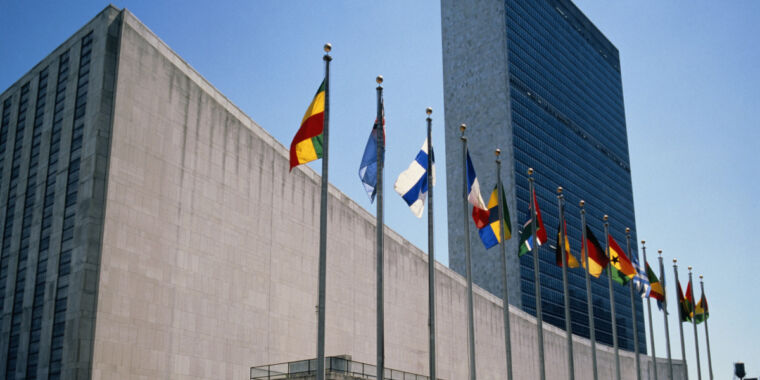
The United Nations building in New York.

Enlarge / The United Nations building in New York.

On Thursday, the United Nations General Assembly unanimously consented to adopt what some call the first global resolution on AI, reports Reuters. The resolution aims to foster the protection of personal data, enhance privacy policies, ensure close monitoring of AI for potential risks, and uphold human rights. It emerged from a proposal by the United States and received backing from China and 121 other countries.

Being a nonbinding agreement and thus effectively toothless, the resolution seems broadly popular in the AI industry. On X, Microsoft Vice Chair and President Brad Smith wrote, “We fully support the @UN’s adoption of the comprehensive AI resolution. The consensus reached today marks a critical step towards establishing international guardrails for the ethical and sustainable development of AI, ensuring this technology serves the needs of everyone.”

The resolution, titled “Seizing the opportunities of safe, secure and trustworthy artificial intelligence systems for sustainable development,” resulted from three months of negotiation, and the stakeholders involved seem pleased at the level of international cooperation. “We’re sailing in choppy waters with the fast-changing technology, which means that it’s more important than ever to steer by the light of our values,” one senior US administration official told Reuters, highlighting the significance of this “first-ever truly global consensus document on AI.”

In the UN, adoption by consensus means that all members agree to adopt the resolution without a vote. “Consensus is reached when all Member States agree on a text, but it does not mean that they all agree on every element of a draft document,” writes the UN in a FAQ found online. “They can agree to adopt a draft resolution without a vote, but still have reservations about certain parts of the text.”

The initiative joins a series of efforts by governments worldwide to influence the trajectory of AI development following the launch of ChatGPT and GPT-4, and the enormous hype raised by certain members of the tech industry in a public worldwide campaign waged last year. Critics fear that AI may undermine democratic processes, amplify fraudulent activities, or contribute to significant job displacement, among other issues. The resolution seeks to address the dangers associated with the irresponsible or malicious application of AI systems, which the UN says could jeopardize human rights and fundamental freedoms.

Resistance from nations such as Russia and China was anticipated, and US officials acknowledged the presence of “lots of heated conversations” during the negotiation process, according to Reuters. However, they also emphasized successful engagement with these countries and others typically at odds with the US on various issues, agreeing on a draft resolution that sought to maintain a delicate balance between promoting development and safeguarding human rights.

The new UN agreement may be the first “global” agreement, in the sense of having the participation of every UN country, but it wasn’t the first multi-state international AI agreement. That honor seems to fall to the Bletchley Declaration signed in November by the 28 nations attending the UK’s first AI Summit.

Also in November, the US, Britain, and other nations unveiled an agreement focusing on the creation of AI systems that are “secure by design” to protect against misuse by rogue actors. Europe is slowly moving forward with provisional agreements to regulate AI and is close to implementing the world’s first comprehensive AI regulations. Meanwhile, the US government still lacks consensus on legislative action related to AI regulation, with the Biden administration advocating for measures to mitigate AI risks while enhancing national security.

World’s first global AI resolution unanimously adopted by United Nations Read More »