
bonobos

watch-kanzi-the-bonobo-pretend-to-have-a-tea-party

Watch Kanzi the bonobo pretend to have a tea party

Such studies have nonetheless been met with skepticism when it comes to interpreting the behavior as evidence of animals’ ability to engage in make-believe. For instance, it’s possible the animals are responding to behavioral cues, like the direction of a gaze, to solve such tasks.

“Kanzi, let’s play a game!”

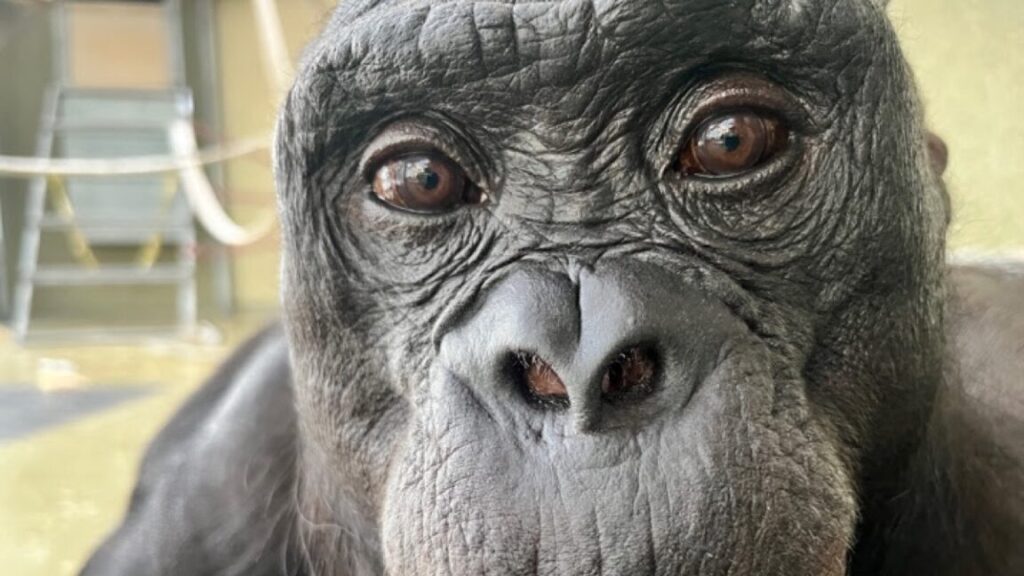
Enter Kanzi, a 43-year-old bonobo who lives at the Ape Initiative and is capable of responding to verbal prompts, either by pointing or using a lexigram of more than 300 symbols. There had also been anecdotal observations of Kanzi engaging in pretense. Krupenye et al. conducted three distinct experiments with Kanzi, each involving an 18-trial session.

In the first experiment, a scientist would offer a verbal prompt: “Kanzi, let’s play a game! Let’s find the juice!” They would then place two empty transparent cups on a table and pretend to fill them from an empty transparent pitcher, with another verbal prompt (“Kanzi, look!”). The scientist would pretend to pour the “juice” in one of the cups back into the pitcher, placing the pitcher under the table. Then they asked, “Kanzi, where’s the juice?” and recorded which cup the bonobo pointed to first.

“If Kanzi could only track reality (that both cups were empty), he should have chosen at chance between the two options, whereas if his choices were guided by stimulus enhancement, he should have selected the incorrect cup that had been ‘emptied’ above chance,” the authors wrote. “In contrast, if Kanzi could represent the pretend juice, he should have chosen above chance the cup containing the ‘imaginary’ juice, the empty cup that had not been ‘poured’ back into the pitcher. That is exactly what Kanzi did.” Kanzi selected the correct cup 34 out of 50 times (68 percent).

Watch Kanzi the bonobo pretend to have a tea party Read More »
bonobos’-calls-may-be-the-closest-thing-to-animal-language-we’ve-seen

Bonobos’ calls may be the closest thing to animal language we’ve seen

Bonobos, great apes related to us and chimpanzees that live in the Republic of Congo, communicate with vocal calls including peeps, hoots, yelps, grunts, and whistles. Now, a team of Swiss scientists led by Melissa Berthet, an evolutionary anthropologist at the University of Zurich, discovered bonobos can combine these basic sounds into larger semantic structures. In these communications, meaning is something more than just a sum of individual calls—a trait known as non-trivial compositionality, which we once thought was uniquely human.

To do this, Berthet and her colleagues built a database of 700 bonobo calls and deciphered them using methods drawn from distributional semantics, the methodology we’ve relied on in reconstructing long-lost languages like Etruscan or Rongorongo. For the first time, we have a glimpse into what bonobos mean when they call to each other in the wild.

Context is everything

The key idea behind distributional semantics is that when words appear in similar contexts, they tend to have similar meanings. To decipher an unknown language, you need to collect a large corpus of words and turn those words into vectors—mathematical representations that let you place them in a multidimensional semantic space. The second thing you need is context data, which tells you the circumstances in which these words were used (that gets vectorized, too). When you map your word vectors onto context vectors in this multidimensional space, what usually happens is that words with similar meaning end up close to each other. Berthet and her colleagues wanted to apply the same trick to bonobos’ calls. That seemed straightforward at first glance, but proved painfully hard to execute.

“We worked at a camp in the forest, got up super early at 3: 30 in the morning, walked one or two hours to get to the bonobos’ nest. At [the] time they would wake up, I would switch my microphone on for the whole day to collect as many vocalizations as I could,” Berthet says. Each recorded call then had to be annotated with a horribly long list of contextual parameters. Berthet had a questionnaire filled with queries like: is there a neighboring group around; are there predators around; is the caller feeding, resting, or grooming; is another individual approaching the caller, etc. There were 300 questions that had to be answered for each of the 700 recorded calls.

Bonobos’ calls may be the closest thing to animal language we’ve seen Read More »