
animal tool use

meet-veronika,-the-tool-using-cow

Meet Veronika, the tool-using cow

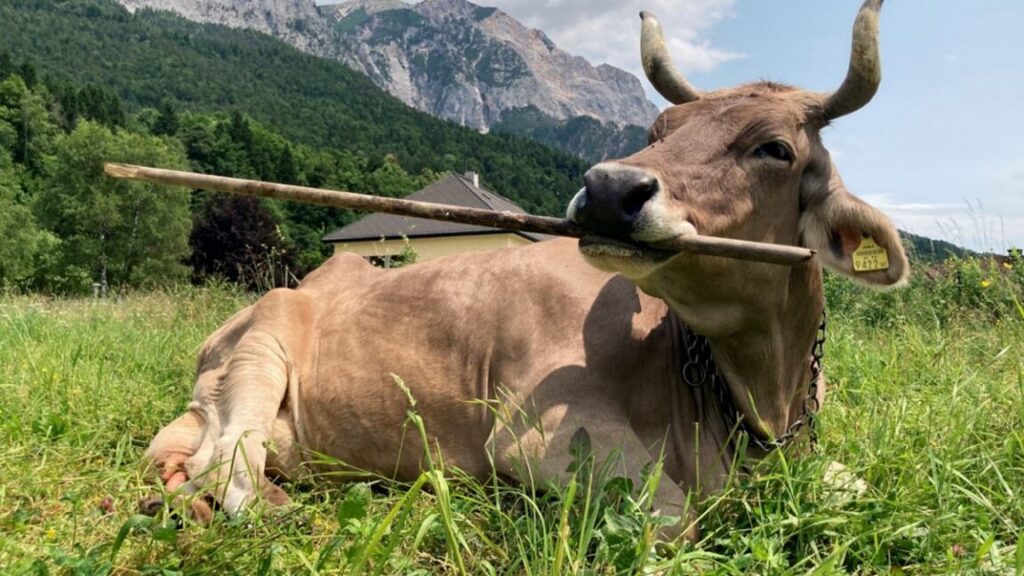
Each time, Veronika used her tongue to lift and position the broom in her mouth, clamping down with her teeth for a stable grip. This enabled her to use the broom to scratch otherwise hard-to-reach areas on the rear half of her body. Veronika seemed to prefer the brush end to the stick end (i.e., the exploitation of distinct properties of a single object for different functions) although which end she used depended on body area. For example, she used the brush end to scratch her upper body using a scrubbing motion, while using the stick end to scratch more sensitive lower areas like her udders and belly skin flaps using precisely targeted gentle forward pushes. She also anticipated the need to adjust her grip.

The authors conclude that this behavior demonstrates “goal-directed, context-sensitive tooling,” as well as versatility in her tool-use anticipation, and fine-motor targeting. Veronika’s scratching behavior is likely motivated by the desire to relieve itching from insect bites, but her open, complex environment, compared to most livestock, and regular interactions with humans enabled her unusual cognitive abilities to emerge.

The implication is that this kind of technical problem-solving is not confined to species with large brains and hands or beaks. “[Veronika] did not fashion tools like the cow in Gary Larson’s cartoon, but she selected, adjusted, and used one with notable dexterity and flexibility,” the authors wrote. “Perhaps the real absurdity lies not in imagining a tool-using cow, but in assuming such a thing could never exist.”

DOI: Current Biology, 2025. 10.1016/j.cub.2025.11.059 (About DOIs).

Meet Veronika, the tool-using cow Read More »
this-elephant-figured-out-how-to-use-a-hose-to-shower

This elephant figured out how to use a hose to shower

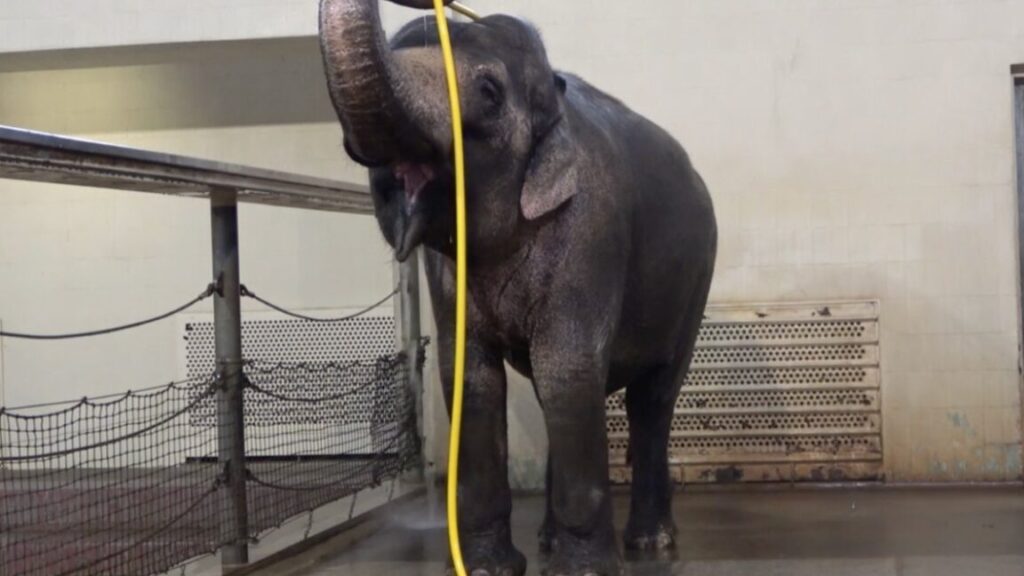
And the hose-showering behavior was “lateralized,” that is, Mary preferred targeting her left body side more than her right. (Yes, Mary is a “left-trunker.”) Mary even adapted her showering behavior depending on the diameter of the hose: she preferred showering with a 24-mm hose over a 13-mm hose and preferred to use her trunk to shower rather than a 32-mm hose.

It’s not known where Mary learned to use a hose, but the authors suggest that elephants might have an intuitive understanding of how hoses work because of the similarity to their trunks. “Bathing and spraying themselves with water, mud, or dust are very common behaviors in elephants and important for body temperature regulation as well as skin care,” they wrote. “Mary’s behavior fits with other instances of tool use in elephants related to body care.”

Perhaps even more intriguing was Anchali’s behavior. While Anchali did not use the hose to shower, she nonetheless exhibited complex behavior in manipulating the hose: lifting it, kinking the hose, regrasping the kink, and compressing the kink. The latter, in particular, often resulted in reduced water flow while Mary was showering. Anchali eventually figured out how to further disrupt the water flow by placing her trunk on the hose and lowering her body onto it. Control experiments were inconclusive about whether Anchali was deliberately sabotaging Mary’s shower; the two elephants had been at odds and behaved aggressively toward each other at shower times. But similar cognitively complex behavior has been observed in elephants.

“When Anchali came up with a second behavior that disrupted water flow to Mary, I became pretty convinced that she is trying to sabotage Mary,” Brecht said. “Do elephants play tricks on each other in the wild? When I saw Anchali’s kink and clamp for the first time, I broke out in laughter. So, I wonder, does Anchali also think this is funny, or is she just being mean?

Current Biology, 2024. DOI: 10.1016/j.cub.2024.10.017  (About DOIs).

This elephant figured out how to use a hose to shower Read More »