
animal perception

do-animals-fall-for-optical-illusions?-it’s-complicated.

Do animals fall for optical illusions? It’s complicated.

A tale of two species
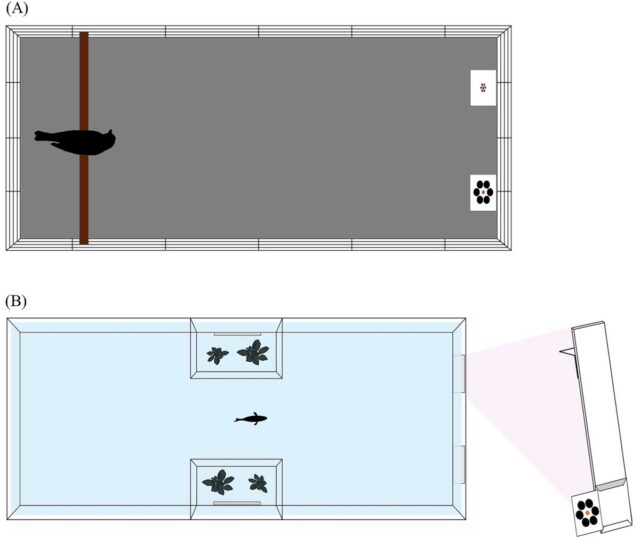
View from above of the apparatuses used for ring doves (A) and guppies (B).

View from above of the apparatuses used for ring doves (A) and guppies (B). Credit: M. Santaca et al., 2025

The authors tested 38 ring doves and 19 guppies (of the “snakeskin cobra green” ornamental strain) for their experiments. The doves were placed in a testing cage with the bottom covered with an anti-slip wooden panel and a branch serving as a perch and starting point; the feeding station was at the opposite end of the cage. The guppies were tested in single tanks with a gravel bottom.

In both cases, the test subjects were presented with visual stimuli in the form of two white plastic cards. Sizes differed for the doves and the guppies, but each card showed an array of six black circles with a bit of food serving as the center “circle”: red millet seeds for the doves and commercial flake food for the guppies. The circles were smaller on one of the cards and larger on the other. The subjects were free to choose food from one of the cards, and the card with the unchosen food was removed promptly. If no choice was made after 15 minutes, the trial was null and the team tried again after a 15-minute interval.

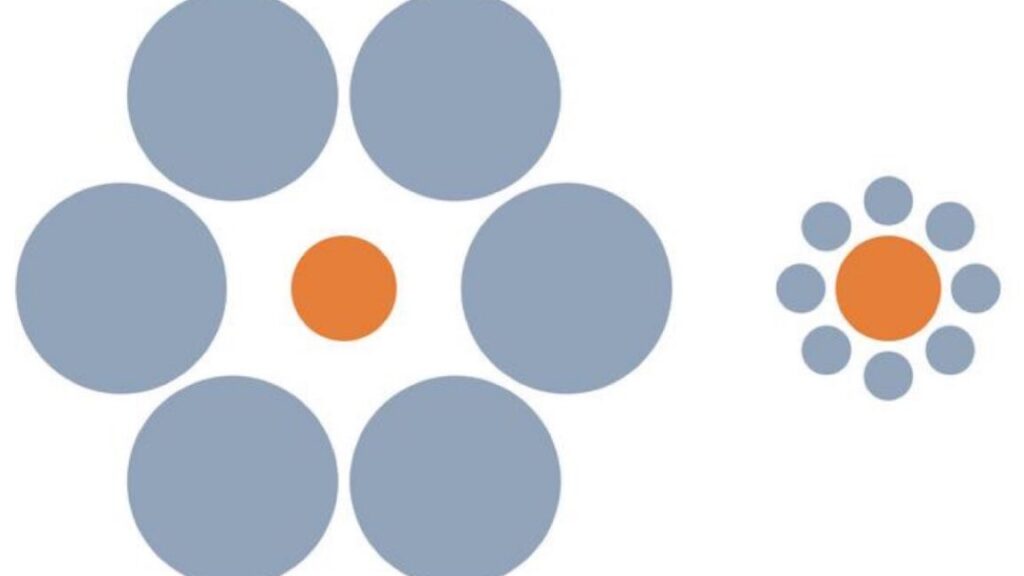
The authors found that the guppies were indeed highly susceptible to the Ebbinghaus illusion, choosing food surrounded by smaller circles much more frequently, suggesting they perceived it as larger and hence more desirable. The results for ring doves were more mixed, however: some of the doves seemed to be susceptible while others were not, suggesting that their perceptual strategies are more local, detail-oriented, and less influenced by their surrounding context.

“The doves’ mixed responses suggest that individual experience or innate bias can strongly shape how an animal interprets illusions,” the authors concluded. “Just like in humans, where some people are strongly fooled by illusions and others hardly at all, animal perception is not uniform.”

The authors acknowledge that their study has limitations. For instance, guppies and ring doves diverged hundreds of millions of years ago and hence are phylogenetically distant, so the perceptual differences between them could be due not just to ecological pressures, but also to evolutionary traits gained or lost via natural selection. Future experiments involving more closely related species with different sensory environments would better isolate the role of ecological factors in animal perception.

Frontiers in Psychology, 2025. DOI: 10.3389/fpsyg.2025.1653695 (About DOIs).

Do animals fall for optical illusions? It’s complicated. Read More »
novel-camera-system-lets-us-see-the-world-through-eyes-of-birds-and-bees

Novel camera system lets us see the world through eyes of birds and bees

A fresh perspective —

It captures natural animal-view moving images with over 90 percent accuracy.

A new camera system and software package allows researchers and filmmakers to capture animal-view videos. Credit: Vasas et al., 2024.

Who among us hasn’t wondered about how animals perceive the world, which is often different from how humans do so? There are various methods by which scientists, photographers, filmmakers, and others attempt to reconstruct, say, the colors that a bee sees as it hunts for a flower ripe for pollinating. Now an interdisciplinary team has developed an innovative camera system that is faster and more flexible in terms of lighting conditions than existing systems, allowing it to capture moving images of animals in their natural setting, according to a new paper published in the journal PLoS Biology.

“We’ve long been fascinated by how animals see the world. Modern techniques in sensory ecology allow us to infer how static scenes might appear to an animal,” said co-author Daniel Hanley, a biologist at George Mason University in Fairfax, Virginia. “However, animals often make crucial decisions on moving targets (e.g., detecting food items, evaluating a potential mate’s display, etc.). Here, we introduce hardware and software tools for ecologists and filmmakers that can capture and display animal-perceived colors in motion.”

Per Hanley and his co-authors, different animal species possess unique sets of photoreceptors that are sensitive to a wide range of wavelengths, from ultraviolet to the infrared, dependent on each animal’s specific ecological needs. Some animals can even detect polarized light. So every species will perceive color a bit differently. Honeybees and birds, for instance, are sensitive to UV light, which isn’t visible to human eyes. “As neither our eyes nor commercial cameras capture such variations in light, wide swaths of visual domains remain unexplored,” the authors wrote. “This makes false color imagery of animal vision powerful and compelling.”

However, the authors contend that current techniques for producing false color imagery can’t quantify the colors animals see while in motion, an important factor since movement is crucial to how different animals communicate and navigate the world around them via color appearance and signal detection. Traditional spectrophotometry, for instance, relies on object-reflected light to estimate how a given animal’s photoreceptors will process that light, but it’s a time-consuming method, and much spatial and temporal information is lost.

Peacock feathers through eyes of four different animals: (a) a peafowl; (b) humans; (c) honeybees; and (d) dogs. Credit: Vasas et al., 2024.

Multispectral photography takes a series of photos across various wavelengths (including UV and infrared) and stacks them into different color channels to derive camera-independent measurements of color. This method trades some accuracy for better spatial information and is well-suited for studying animal signals, for instance, but it only works on still objects, so temporal information is lacking.

That’s a shortcoming because “animals present and perceive signals from complex shapes that cast shadows and generate highlights,” the authors wrote. ‘These signals vary under continuously changing illumination and vantage points. Information on this interplay among background, illumination, and dynamic signals is scarce. Yet it forms a crucial aspect of the ways colors are used, and therefore perceived, by free-living organisms in natural settings.”

So Hanley and his co-authors set out to develop a camera system capable of producing high-precision animal-view videos that capture the full complexity of visual signals as they would be perceived by an animal in a natural setting. They combined existing methods of multispectral photography with new hardware and software designs. The camera records video in four color channels simultaneously (blue, green, red, and UV). Once that data has been processed into “perceptual units,” the result is an accurate video of how a colorful scene would be perceived by various animals, based on what we know about which photoreceptors they possess. The team’s system predicts the perceived colors with 92 percent accuracy. The cameras are commercially available, and the software is open source so that others can freely use and build on it.

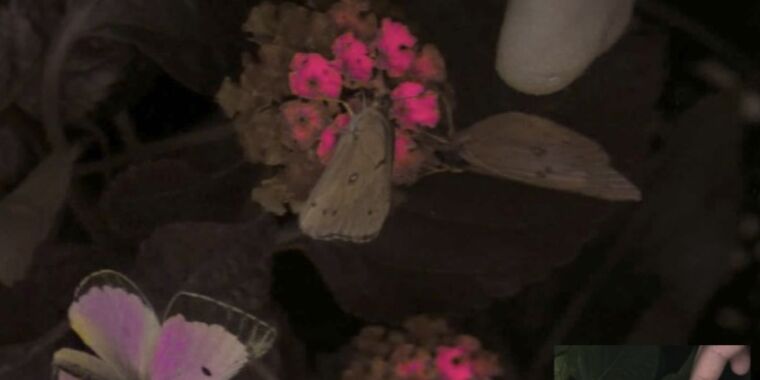
The video at the top of this article depicts the colors perceived by honeybees watching fellow bees foraging and interacting (even fighting) on flowers—an example of the camera system’s ability to capture behavior in a natural setting. Below, Hanley applies UV-blocking sunscreen in the field. His light-toned skin looks roughly the same in human vision and honeybee false color vision “because skin reflectance increases progressively at longer wavelengths,” the authors wrote.

Novel camera system lets us see the world through eyes of birds and bees Read More »