Author name: Mike M.

companies-issuing-rto-mandates-“lose-their-best-talent”:-study

Companies issuing RTO mandates “lose their best talent”: Study


Despite the risks, firms and Trump are eager to get people back into offices.

Return-to-office (RTO) mandates have caused companies to lose some of their best workers, a study tracking over 3 million workers at 54 “high-tech and financial” firms at the S&P 500 index has found. These companies also have greater challenges finding new talent, the report concluded.

The paper, Return-to-Office Mandates and Brain Drain [PDF], comes from researchers from the University of Pittsburgh, as well as Baylor University, The Chinese University of Hong Kong, and Cheung Kong Graduate School of Business. The study, which was published in November, spotted this month by human resources publication HR Dive, and cites Ars Technica reporting, was conducted by collecting information on RTO announcements and sourcing data from LinkedIn. The researchers said they only examined companies with data available for at least two quarters before and after they issued RTO mandates. The researchers explained:

To collect employee turnover data, we follow prior literature … and obtain the employment history information of over 3 million employees of the 54 RTO firms from Revelio Labs, a leading data provider that extracts information from employee LinkedIn profiles. We manually identify employees who left a firm during each period, then calculate the firm’s turnover rate by dividing the number of departing employees by the total employee headcount at the beginning of the period. We also obtain information about employees’ gender, seniority, and the number of skills listed on their individual LinkedIn profiles, which serves as a proxy for employees’ skill level.

There are limits to the study, however. The researchers noted that the study “cannot draw causal inferences based on our setting.” Further, smaller firms and firms outside of the high-tech and financial industries may show different results. Although not mentioned in the report, relying on data from a social media platform could also yield inaccuracies, and the number of skills listed on a LinkedIn profile may not accurately depict a worker’s skill level.

Still, the study provides insight into how employees respond to RTO mandates and the effect it has on corporations and available talent at a time when entities like Dell, Amazon, and the US government are getting stricter about in-office work.

Higher turnover rates

The researchers concluded that the average turnover rates for firms increased by 14 percent after issuing return-to-office policies.

“We expect the effect of RTO mandates on employee turnover to be even higher for other firms” the paper says.

The researchers included testing to ensure that the results stemmed from RTO mandates “rather than time trends.” For example, the researchers found that “there were no significant increases in turnover rates during any of the five quarters prior to the RTO announcement quarter.”

Potentially alarming for employers is the study finding that senior and skilled employees were more likely to leave following RTO mandates. This aligns with a study from University of Chicago and University of Michigan researchers published in May that found that Apple and Microsoft saw senior-level employee bases decrease by 5 percentage points and SpaceX a decrease of 5 percentage points. (For its part, Microsoft told Ars that the report did not align with internal data.)

Senior employees are expected to be more likely to leave, the new report argues, because such workers have “more connections with other companies” and have easier times finding new jobs. Further, senior, skilled employees are “dissatisfied” when management blames remote work for low productivity.

Similarly, the report supports concerns from some RTO-resistant employees that back-to-office mandates have a disproportionate impact on certain groups, like women, which the researchers said show “more pronounced” attrition rates following RTO mandates:

Importantly, the effect on female employee turnover is almost three times as high as that on male employees … One possible reason for these results is that female employees are more affected by RTO mandates due to their greater family responsibilities, which increases their demand for workplace flexibility and work-life balance.

Trouble finding talent

RTO mandates also have a negative impact on companies’ ability to find new employees, the study found. After examining over 2 million job postings, the researchers concluded that companies with RTO mandates take longer to fill job vacancies than before:

On average, the time it takes for an RTO firm to fill its job vacancies increases by approximately 23 percent, and the hire rate decreases by 17 percent after RTO mandates.

The researchers also found “significantly higher hiring costs induced by RTO mandates” and concluded that the findings combined “suggest that firms lose their best talent after RTO mandates and face significant difficulties replacing them.”

“The weakest form of management”

RTO mandates can obviously drive away workers who prioritize work-life balance, avoiding commutes and associated costs, and who feel more productive working in a self-controlled environment. The study, however, points to additional reasons RTO mandates make some people quit.

One reason cited is RTO rules communicating “a culture of distrust that encourages management through monitoring.” The researchers noted that Brian Elliott, CEO at Work Forward and a leadership adviser, described this as the “weakest form of management—and one that drives down employee engagement” in a November column for MIT Sloan Management Review.

Indeed, RTO mandates have led to companies like Dell performing VPN tracking, and companies like Amazon, Google, JP Morgan Chase, Meta, and TikTok reportedly tracking badge swipes, resulting in employee backlash.

The new study also pointed to RTO mandates making employees question company leadership and management’s decision-making abilities. We saw this with Amazon, when over 500 employees sent a letter to Amazon Web Services (AWS) CEO Matt Garman, saying that they were “appalled to hear the non-data-driven explanation you gave for Amazon imposing a five-day in-office mandate.”

Employees are also put off by the drama that follows an aggressive RTO policy, the report says:

An RTO announcement can be a big and sudden event that is distasteful to most employees, especially when the decision has not been well communicated, potentially triggering an immediate response of employees searching for and switching to new jobs.

After Amazon announced it would kill remote work in early 2025, a study by online community Blind found that 73 percent of 2,285 Amazon employees surveyed were “considering looking for another job” in response to the mandate.

“A wave of voluntary terminations”

The paper points to reasons that employees may opt to stay with a company post-RTO mandates. Those reasons include competitive job markets, personal costs associated with switching jobs, loyalty, and interest in the collaborative and social aspects of working in-office.

However, with the amount of evidence that RTO mandates drive employees away, some question if return-to-office mandates are subtle ways to reduce headcount without layoffs. Comments like AWS’s Garman reportedly telling workers that if they don’t like working in an office, “there are other companies around” have fueled this theory, as has Dell saying remote workers can’t get promoted. A BambooHR survey of 1,504 full-time US employees, including 504 HR managers or higher, in March found that 25 percent of VP and C-suite executives and 18 percent of HR pros examined “admit they hoped for some voluntary turnover during an RTO.”

Yesterday, President-elect Donald Trump said he plans to do away with a deal that allowed the Social Security Administration’s union to work remotely into 2029 and that those who don’t come back into the office will “be dismissed.” Similarly, Elon Musk and Vivek Ramaswamy, who Trump announced will head a new Department of Government Efficiency, wrote in a November op-ed that “requiring federal employees to come to the office five days a week would result in a wave of voluntary terminations that we welcome.”

Helen D. (Heidi) Reavis, managing partner at Reavis Page Jump LLP, an employment, dispute resolution, and media law firm, previously told Ars that employees “can face an array of legal consequences for encouraging workers to quit via their RTO policies.” Still, RTO mandates are set to continue being a point of debate and tension at workplaces into the new year.

Photo of Scharon Harding

Scharon is Ars Technica’s Senior Product Reviewer writing news, reviews, and analysis on consumer technology, including laptops, mechanical keyboards, and monitors. She’s based in Brooklyn.

Companies issuing RTO mandates “lose their best talent”: Study Read More »

facing-ban-next-month,-tiktok-begs-scotus-for-help

Facing ban next month, TikTok begs SCOTUS for help

TikTok: Ban is slippery slope to broad US censorship

According to TikTok, the government’s defense of the ban to prevent China from wielding a “covert” influence over Americans is a farce invented by lawyers to cover up the true mission of censorship. If the lower court’s verdict stands, TikTok alleged, “then Congress will have free rein to ban any American from speaking simply by identifying some risk that the speech is influenced by a foreign entity.”

TikTok doesn’t want to post big disclaimers on the app warning of “covert” influence, claiming that the government relied on “secret evidence” to prove this influence occurs on TikTok. But if the Supreme Court agrees that the government needed to show more than “bare factual assertions” to back national security claims the lower court said justified any potential speech restrictions, then the court will also likely agree to reverse the lower court’s decision, TikTok suggested.

It will become much clearer by January 6 whether the January 19 ban will take effect, at which point TikTok would shut down, booting all US users from the app. TikTok urged the Supreme Court to agree it is in the public interest to delay the ban and review the constitutional claims to prevent any “extreme” harms to both TikTok and US users who depend on the app for news, community, and income.

If SCOTUS doesn’t intervene, TikTok said that the lower court’s “flawed legal rationales would open the door to upholding content-based speech bans in contexts far different than this one.”

“Fearmongering about national security cannot obscure the threat that the Act itself poses to all Americans,” TikTok alleged, while suggesting that even Congress would agree that a “modest delay” in enforcing the law wouldn’t pose any immediate risk to US national security. Congress is also aware that a sale would not be technically, commercially, or legally possible in the timeframe provided, TikTok said. A temporary injunction would prevent irreparable harms, TikTok said, including the irreparable harm courts have long held is caused by restricting speech of Americans for any amount of time.

“An interim injunction is also appropriate because it will give the incoming Administration time to determine its position, as the President-elect and his advisors have voiced support for saving TikTok,” TikTok argued.

Ars could not immediately reach TikTok for comment.

Facing ban next month, TikTok begs SCOTUS for help Read More »

critical-wordpress-plugin-vulnerability-under-active-exploit-threatens-thousands

Critical WordPress plugin vulnerability under active exploit threatens thousands

Thousands of sites running WordPress remain unpatched against a critical security flaw in a widely used plugin that was being actively exploited in attacks that allow for unauthenticated execution of malicious code, security researchers said.

The vulnerability, tracked as CVE-2024-11972, is found in Hunk Companion, a plugin that runs on 10,000 sites that use the WordPress content management system. The vulnerability, which carries a severity rating of 9.8 out of a possible 10, was patched earlier this week. At the time this post went live on Ars, figures provided on the Hunk Companion page indicated that less than 12 percent of users had installed the patch, meaning nearly 9,000 sites could be next to be targeted.

Significant, multifaceted threat

“This vulnerability represents a significant and multifaceted threat, targeting sites that use both a ThemeHunk theme and the Hunk Companion plugin,” Daniel Rodriguez, a researcher with WordPress security firm WP Scan, wrote. “With over 10,000 active installations, this exposed thousands of websites to anonymous, unauthenticated attacks capable of severely compromising their integrity.”

Rodriquez said WP Scan discovered the vulnerability while analyzing the compromise of a customer’s site. The firm found that the initial vector was CVE-2024-11972. The exploit allowed the hackers behind the attack to cause vulnerable sites to automatically navigate to wordpress.org and download WP Query Console, a plugin that hasn’t been updated in years.

Critical WordPress plugin vulnerability under active exploit threatens thousands Read More »

google-steps-into-“extended-reality”-once-again-with-android-xr

Google steps into “extended reality” once again with Android XR

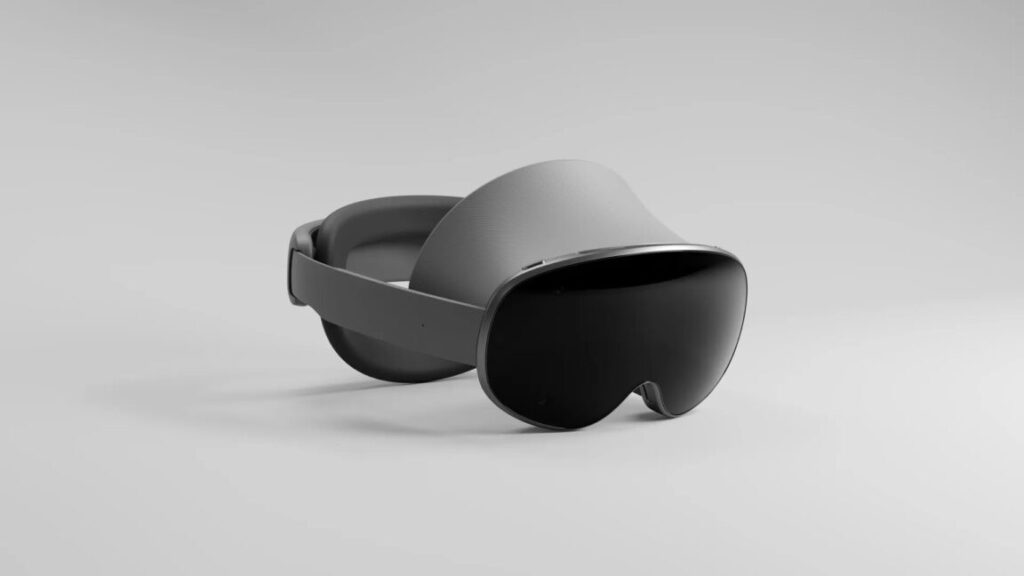
Citing “years of investment in AI, AR, and VR,” Google is stepping into the augmented reality market once more with Android XR. It’s an operating system that Google says will power future headsets and glasses that “transform how you watch, work, and explore.”

The first version you’ll see is Project Moohan, a mixed-reality headset built by Samsung. It will be available for purchase next year, and not much more is known about it. Developers have access to the new XR version of Android now.

“We’ve been in this space since Google Glass, and we have not stopped,” said Juston Payne, director of product at Google for XR in Android XR’s launch video. Citing established projects like Google Lens, Live View for Maps, instant camera translation, and, of course, Google’s general-purpose Gemini AI, XR promises to offer such overlays in both dedicated headsets and casual glasses.

Android XR announcement video.

There are few additional details right now beyond a headset rendering, examples in Google’s video labeled as “visualization for concept purposes.” Google’s list of things that will likely be on board includes Gemini, Maps, Photos, Translate, Chrome, Circle to Search, and Messages. And existing Android apps, or at least those updated to do so, should make the jump, too.

Google steps into “extended reality” once again with Android XR Read More »

intel-arc-b580-review:-a-$249-rtx-4060-killer,-one-and-a-half-years-later

Intel Arc B580 review: A $249 RTX 4060 killer, one-and-a-half years later


Intel has solved the biggest problems with its Arc GPUs, but not the timing.

Intel’s Arc B580 design doesn’t include LEDs or other frills, but it’s a clean-looking design. Credit: Andrew Cunningham

Intel’s Arc B580 design doesn’t include LEDs or other frills, but it’s a clean-looking design. Credit: Andrew Cunningham

Intel doesn’t have a ton to show for its dedicated GPU efforts yet.

After much anticipation, many delays, and an anticipatory apology tour for its software quality, Intel launched its first Arc GPUs at the end of 2022. There were things to like about the A770 and A750, but buggy drivers, poor performance in older games, and relatively high power use made them difficult to recommend. They were more notable as curiosities than as consumer graphics cards.

The result, after more than two years on the market, is that Arc GPUs remain a statistical nonentity in the GPU market, according to analysts and the Steam Hardware Survey. But it was always going to take time—and probably a couple of hardware generations—for Intel to make meaningful headway against entrenched competitors.

Intel’s reference design is pretty by the book, with two fans, a single 8-pin power connector, and a long heatsink and fan shroud that extends several inches beyond the end of the PCB. Andrew Cunningham

The new Arc B580 card, the first dedicated GPU based on the new “Battlemage” architecture, launches into the exact same “sub-$300 value-for-money” graphics card segment that the A770 and A750 are already stuck in. But it’s a major improvement over those cards in just about every way, and Intel has gone a long way toward fixing drivers and other issues that plagued the first Arc cards at launch. If nothing else, the B580 suggests that Intel has some staying power and that the B700-series GPUs could be genuinely exciting if Intel can get one out relatively soon.

Specs and testbed notes

Specs for the Arc B580 and B570. Credit: Intel

The Arc B580 and Arc B570 lead the charge for the Battlemage generation. Both are based on the same GPU silicon, but the B580 has a few more execution resources, slightly higher clock speeds, a 192-bit memory bus instead of 160-bit, and 12GB of memory instead of 10GB.

Intel positions both cards as entry-level 1440p options because they have a bit more RAM than the 8GB baseline of the GeForce RTX 4060 and Radeon RX 7600. These 8GB cards are still generally fine at 1080p, but more memory does make the Arc cards feel a little more future-proof, especially since they’re fast enough to actually hit 60 fps in a lot of games at 1440p.

Our testbed remains largely the same as it has been for a while, though we’ve swapped the ASRock X670E board for an Asus model. The Ryzen 7 7800X3D remains the heart of the system, with more than enough performance to avoid bottlenecking midrange and high-end GPUs.

We haven’t done extensive re-testing of most older GPUs—the GeForce and Radeon numbers here are the same ones we used in the RX 7600 XT review earlier this year. We wouldn’t expect new drivers to change the scores in our games much since they’re mostly a bit older—we still use a mix of DirectX 11 and DirectX 12 games, including a few with and without ray-tracing effects enabled. We have re-tested the older Arc cards with recent drivers since Intel does still occasionally make changes that can have a noticeable impact on older games.

As with the Arc A-series cards, Intel emphatically recommends that resizable BAR be enabled for your motherboard to get optimal performance. This is sometimes called Smart Access Memory or SAM, depending on your board; most AMD AM4 and 8th-gen Intel Core systems should support it after a BIOS update, and newer PCs should mostly have it on by default. Our test system had it enabled for the B580 and for all the other GPUs we tested.

Performance and power

As a competitor to the RTX 4060, the Arc B580 is actually pretty appealing, whether you’re talking about 1080p or 1440p, in games with ray-tracing on or off. Even older DirectX 11 titles in our suite, like Grand Theft Auto V and Assassin’s Creed Odyssey, don’t seem to take the same performance hit as they did on older Arc cards.

Intel is essentially making a slightly stronger version of the argument that AMD has been trying to make with the RX 7600. AMD’s cards always come with the caveat of significantly worse performance in games with heavy ray-tracing effects, but the performance hit for Intel cards in ray-traced games looks a lot more like Nvidia’s than AMD’s. Playable ray-traced 1080p is well within reach for the Intel card, and in both Cyberpunk 2077 and Returnal, its performance came closer to the 8GB 4060 Ti’s.

The 12GB of RAM is also enough to put more space between the B580 and the 8GB versions of the 4060 and 7600. Forza Horizon 5 performs significantly better at 1440p on cards with more memory, like the B580 and the 16GB RX 7600 XT, and it’s a safe bet that the 8GB limit will become more of a factor for high-end games at higher resolutions as the years go on.

We experienced just one performance anomaly in our testing. Forza Horizon 5 actually runs a bit worse with XeSS enabled, with a smooth average frame rate but frequent stutters that make it less playable overall (though it’s worth noting that Forza Horizon 5 never benefits much from upscaling algorithms on any GPUs we’ve tested, for whatever reason). Intel also alerted us to a possible issue with Cyberpunk 2077 when enabling ray-tracing but recommended a workaround that involved pressing F1 to reset the game’s settings; the benchmark ran fine on our testbed.

GPU power consumption numbers under load. Credit: Andrew Cunningham

Power consumption is another place where the Battlemage GPU plays a lot of catch-up with Nvidia. With the caveat that software-measured power usage numbers like ours are less accurate than numbers captured with hardware tools, it looks like the B580’s power consumption, when fully loaded, consumes somewhere between 120 and 130 W in Hitman and Borderlands. This is a tad higher than the 4060, but it’s lower than either Radeon RX 7600.

It’s not the top of the class, but looking at the A750’s power consumption shows how far Intel has come—the B580 beats the A750’s performance every single time while consuming about 60 W less power.

A strong contender, a late arrival

The Intel Arc B580. Credit: Andrew Cunningham

Intel is explicitly targeting Nvidia’s GeForce RTX 4060 with the Arc B580, a role it fills well for a low starting price. But the B580 is perhaps more damaging to AMD, which positions both of its 7600-series cards (and the remaining 6600-series stuff that’s hanging around) in the same cheaper-than-Nvidia-with-caveats niche.

In fact, I’d probably recommend the B580 to a budget GPU buyer over any of the Radeon RX 7600 cards at this point. For the same street price as the RX 7600, Intel is providing better performance in most games and much better performance in ray-traced games. The 16GB 7600 XT has more RAM, but it’s $90 to $100 more expensive, and a 12GB card is still reasonably future-proof and decent at 1440p.

All of that said, Intel is putting out a great competitor to the RTX 4060 and RX 7600 a year and a half after those cards both launched—and within just a few months of a possible RTX 5060. Intel is selling mid-2023’s midrange GPU performance in late 2024. There are actually good arguments for building a budget gaming PC right this minute, before potential Trump-administration tariffs can affect prices or supply chains, but assuming the tech industry can maintain its normal patterns, it would be smartest to wait and see what Nvidia does next.

Nvidia also has some important structural benefits. DLSS upscaling support is nearly ubiquitous in high-end games, Nvidia’s drivers are more battle-tested, and it’s extremely unlikely that Nvidia will decide to pull out of the GPU market and stop driver development any time soon (Intel has published a roadmap encompassing multiple GPU generations, which is reassuring, but the company’s recent financial distress has seen it shed several money-losing hobby projects).

If there’s a saving grace for Intel and the B580, it’s that Nvidia has signaled, both through its statements and its behavior, that it’s mostly uninterested in aggressively lowering GPU prices, either over time (Nvidia GPUs tend not to stray far from MSRP, barring supply issues) or between generations. An RTX 5060 is highly unlikely to be cheaper than a 4060 and could easily be more expensive. Depending on how good a hypothetical RTX 5060 is, Intel still has a lot of room to offer good performance for the price in a $200-to-$250-ish GPU market that doesn’t get a ton of attention.

The other issue for Intel is that for a second straight GPU generation, the company is launching late with a part that is forced by its performance to play in a budget-oriented, low-margin area of the GPU market. I don’t think I’m expecting a 4090 or 5090-killer out of Intel any time soon, but based on the B580, I’m at least a little optimistic that Intel can offer a B700-series card that can credibly compete with the likes of Nvidia’s 4070-series or AMD’s 7800 XT and 7900 GRE. Performance-wise, that’s the current sweet spot of the GPU market, but you’ll spend more than you would on a PS5 to buy most of those cards. If Intel can shake up that part of the business, it could help put Arc on the map.

The good

  • Solid midrange 1080p and 1440p performance at a good starting price
  • More RAM than the competition
  • Much-improved power efficiency compared to Arc A-series GPUs
  • Unlike the A-series, we noticed no outliers where performance was disproportionately bad
  • Simple, clean-looking reference design from Intel

The bad

  • Competing with cards that launched a year and a half ago
  • New Nvidia and AMD competitors are likely within a few months
  • Intel still can’t compete at the high end of the GPU market, or even the medium-high end

The ugly

  • So far, Arc cards have not been successful enough to guarantee their long-term existence

Photo of Andrew Cunningham

Andrew is a Senior Technology Reporter at Ars Technica, with a focus on consumer tech including computer hardware and in-depth reviews of operating systems like Windows and macOS. Andrew lives in Philadelphia and co-hosts a weekly book podcast called Overdue.

Intel Arc B580 review: A $249 RTX 4060 killer, one-and-a-half years later Read More »

teen-creates-memecoin,-dumps-it,-earns-$50,000

Teen creates memecoin, dumps it, earns $50,000


dontbuy. Seriously, don’t buy it

Unsurprisingly, he and his family were doxed by angry traders.

On the evening of November 19, art adviser Adam Biesk was finishing work at his California home when he overheard a conversation between his wife and son, who had just come downstairs. The son, a kid in his early teens, was saying he had made a ton of money on a cryptocurrency that he himself had created.

Initially, Biesk ignored it. He knew that his son played around with crypto, but to have turned a small fortune before bedtime was too far-fetched. “We didn’t really believe it,” says Biesk. But when the phone started to ring off the hook and his wife was flooded with angry messages on Instagram, Biesk realized that his son was telling the truth—if not quite the full story.

Earlier that evening, at 7: 48 pm PT, Biesk’s son had released into the wild 1 billion units of a new crypto coin, which he named Gen Z Quant. Simultaneously, he spent about $350 to purchase 51 million tokens, about 5 percent of the total supply, for himself.

Then he started to livestream himself on Pump.Fun, the website he had used to launch the coin. As people tuned in to see what he was doing, they started to buy into Gen Z Quant, leading the price to pitch sharply upward.

By 7: 56 pm PT, a whirlwind eight minutes later, Biesk’s son’s tokens were worth almost $30,000—and he cashed out. “No way. Holy fuck! Holy fuck!” he said, flipping two middle fingers to the webcam, with tongue sticking out of his mouth. “Holy fuck! Thanks for the twenty bandos.” After he dumped the tokens, the price of the coin plummeted, so large was his single trade.

To the normie ear, all this might sound impossible. But in the realm of memecoins, a type of cryptocurrency with no purpose or utility beyond financial speculation, it’s relatively routine. Although many people lose money, a few have been known to make a lot—and fast.

In this case, Biesk’s son had seemingly performed what is known as a soft rug pull, whereby somebody creates a new crypto token, promotes it online, then sells off their entire holdings either swiftly or over time, sinking its price. These maneuvers occupy something of a legal gray area, lawyers say, but are roundly condemned in the cryptosphere as ethically dubious at the least.

After dumping Gen Z Quant, Biesk’s son did the same thing with two more coins—one called im sorry and another called my dog lucy—bringing his takings for the evening to more than $50,000.

The backlash was swift and ferocious. A torrent of abuse began to pour into the chat log on Pump.Fun, from traders who felt they had been swindled. “You little fucking scammer,” wrote one commenter. Soon, the names and pictures of Biesk, his son, and other family members were circulating on X. They had been doxed. “Our phone started blowing up. Just phone call after phone call,” says Biesk. “It was a very frightening situation.”

As part of their revenge campaign, crypto traders continued to buy into Gen Z Quant, driving the coin’s price far higher than the level at which Biesk’s son had cashed out. At its peak, around 3 am PT the following morning, the coin had a theoretical total value of $72 million; the tokens the teenager had initially held were worth more than $3 million. Even now, the trading frenzy has died down, and they continue to be valued at twice the amount he received.

“In the end, a lot of people made money on his coin. But for us, caught in the middle, there was a lot of emotion,” says Biesk. “The online backlash became so frighteningly scary that the realization that he made money was kind of tempered down with the fact that people became angry and started bullying.”

Biesk concedes to a limited understanding of crypto. But he sees little distinction between what his son did and, say, playing the stock market or winning at a casino. Though under California law, someone must be at least 18 years old to gamble or invest in stocks, the unregulated memecoin market, which has been compared to a “casino” in risk profile, had given Biesk’s teenage son early access to a similar arena, in which some must lose for others to profit. “The way I understand it is he made money and he cashed out, which to me seems like that’s what anybody would’ve done,” says Biesk. “You get people who are cheering at the craps table, or angry at the craps table.”

Memecoins have been around since 2013, when Dogecoin was released. In the following years, a few developers tried to replicate the success of Dogecoin, making play of popular internet memes or tapping into the zeitgeist in some other way in a bid to encourage people to invest. But the cost and complexity of development generally limited the number of memecoins that came to market.

That equation was flipped in January with the launch of Pump.Fun, which lets people release new memecoins instantly, at no cost. The idea was to give people a safer way to trade memecoins by standardizing the underlying code, which prevents developers from building in malicious mechanisms to steal funds, in what’s known as a hard rug pull.

“Buying into memecoins was a very unsafe thing to do. Programmers could create systems that would obfuscate what you are buying into and, basically, behave as malicious actors. Everything was designed to suck money out of people,” one of the three anonymous cofounders of Pump.Fun, who goes by Sapijiju, told WIRED earlier in the year. “The idea with Pump was to build something where everyone was on the same playing field.”

Since Pump.Fun launched, millions of unique memecoins have entered the market through the platform. By some metrics, Pump.Fun is the fastest-growing crypto application ever, taking in more than $250 million in revenue—as a 1 percent cut of trades on the platform—in less than a year in operation.

However, Pump.Fun has found it impossible to insulate users from soft rug pulls. Though the platform gives users access to information to help assess risk—like the proportion of a coin belonging to the largest few holders—soft rug pulls are difficult to prevent by technical means, claims Sapijiju.

“People say there’s a bunch of different stuff you can do to block [soft rug pulls]—maybe a sell tax or lock up the people who create the coin. Truthfully, all of this is very easy to manipulate,” he says. “Whatever we do to stop people doing this, there’s always a way to circumnavigate if you’re smart enough. The important thing is creating an interface that is as simple as possible and giving the tools for users to see if a coin is legitimate or not.”

The “overwhelming majority” of new crypto tokens entering the market are scams of one form or another, designed expressly to squeeze money from buyers, not to hold a sustained value in the long term, according to crypto security company Blockaid. In the period since memecoin launchpads like Pump.Fun began to gain traction, the volume of soft rug pulls has increased in lockstep, says Ido Ben-Natan, Blockaid founder.

“I generally agree that it is kind of impossible to prevent holistically. It’s a game of cat and mouse,” says Ben-Natan. “It’s definitely impossible to cover a hundred percent of these things. But it definitely is possible to detect repeat offenders, looking at metadata and different kinds of patterns.”

Now memecoin trading has been popularized, there can be no putting the genie back in the bottle, says Ben-Natan. But traders are perhaps uniquely vulnerable at present, he says, in a period when many are newly infatuated with memecoins, yet before the fledgling platforms have figured out the best way to protect them. “The space is immature,” says Ben-Natan.

Whether it is legal to perform a rug pull is also something of a gray area. It depends on both jurisdiction and whether explicit promises are made to prospective investors, experts say. The absence of bespoke crypto regulations in countries like the US, meanwhile, inadvertently creates cloud cover for acts that are perhaps not overtly illegal.

“These actions exploit the gaps in existing regulatory frameworks, where unethical behavior—like developers hyping a project and later abandoning it—might not explicitly violate laws if no fraudulent misrepresentation, contractual breach, or other violations occur,” says Ronghui Gu, cofounder of crypto security firm CertiK and associate professor of computer science at Columbia University.

The Gen Z Quant broadcast is no longer available to view in full, but in the clips reviewed by WIRED, at no point does Biesk’s son promise to hold his tokens for any specific period. Neither do the Pump.Fun terms of use require people to refrain from selling tokens they create. (Sapijiju, the Pump.Fun cofounder, declined to comment on the Gen Z Quant incident. They say that Pump.Fun will be “introducing age restrictions in future,” but declined to elaborate.)

But even then, under the laws of numerous US states, among them California, “the developer likely still owes heightened legal duties to the investors, so may be liable for breaching obligations that result in loss of value,” says Geoffrey Berg, partner at law firm Berg Plummer & Johnson. “The developer is in a position of trust and must place the interests of his investors over his own.”

To clarify whether these legal duties apply to people who release memecoins through websites like Pump.Fun—who buy into their coins like everyone else, albeit at the moment of launch and therefore at a discount and in potentially market-swinging quantities—new laws may be required.

In July 2026, a new regime will take effect in California, where Biesk’s family lives, requiring residents to obtain a license to take part in “digital financial asset business activity,” including exchanging, transferring, storing or administering certain crypto assets. President-elect Donald Trump has also promised new crypto regulations. But for now, there are no crypto-specific laws in place.

“We are in a legal vacuum where there are no clear laws,” says Andrew Gordon, partner at law firm Gordon Law. “Once we know what is ‘in bounds,’ we will also know what is ‘out of bounds.’ This will hopefully create a climate where rug pulls don’t happen, or when they do they are seen as a criminal violation.”

On November 19, as the evening wore on, angry messages continued to tumble in, says Biesk. Though some celebrated his son’s antics, calling for him to return and create another coin, others were threatening or aggressive. “Your son stole my fucking money,” wrote one person over Instagram.

Biesk and his wife were still trying to understand quite how their son was able to make so much money, so fast. “I was trying to get an understanding of exactly how this meme crypto trading works,” says Biesk.

Some memecoin traders, sensing there could be money in riffing off the turn of events, created new coins on Pump.Fun inspired by Biesk and his wife: QUANT DAD and QUANTS MOM. (Both are now practically worthless.)

Equally disturbed and bewildered, Biesk and his wife formed a provisional plan: to make all public social media accounts private, stop answering the phone, and, generally, hunker down until things blew over. (Biesk’s account is active at the time of writing.) Biesk declined to comment on whether the family made contact with law enforcement or what would happen to the funds, saying only that his son would “put the money away.”

A few hours later, an X account under the name of Biesk’s son posted on X, pleading for people to stop contacting his parents. “Im sorry about Quant, I didnt realize I get so much money. Please dont write to my parents, I wiill pay you back [sic],” read the post. Biesk claims the account is not operated by his son.

Though alarmed by the backlash, Biesk is impressed by the entrepreneurial spirit and technical capability his son displayed. “It’s actually sort of a sophisticated trading platform,” he says. “He obviously learned it on his own.”

That his teenager was capable of making $50,000 in an evening, Biesk theorizes, speaks to the fundamentally different relationship kids of that age have with money and investing, characterized by an urgency and hyperactivity that rubs up against traditional wisdom.

“To me, crypto can be hard to grasp, because there is nothing there behind it—it’s not anything tangible. But I think kids relate to this intangible digital world more than adults do,” says Biesk. “This has an immediacy to him. It’s almost like he understands this better.”

On December 1, after a two-week hiatus, Biesk’s son returned to Pump.Fun to launch five new memecoins, apparently undeterred by the abuse. Disregarding the warnings built into the very names of some of the new coins—one was named test and another dontbuy—people bought in. Biesk’s son made another $5,000.

This story originally appeared on wired.com.

Photo of WIRED

Wired.com is your essential daily guide to what’s next, delivering the most original and complete take you’ll find anywhere on innovation’s impact on technology, science, business and culture.

Teen creates memecoin, dumps it, earns $50,000 Read More »

new-drone-has-legs-for-landing-gear,-enabling-efficient-launches

New drone has legs for landing gear, enabling efficient launches


The RAVEN walks, it flies, it hops over obstacles, and it’s efficient.

The RAVEN in action. Credit: EPFL/Alain Herzog

Most drones on the market are rotary-wing quadcopters, which can conveniently land and take off almost anywhere. The problem is they are less energy-efficient than fixed-wing aircraft, which can fly greater distances and stay airborne for longer but need a runway, a dedicated launcher, or at least a good-fashioned throw to get to the skies.

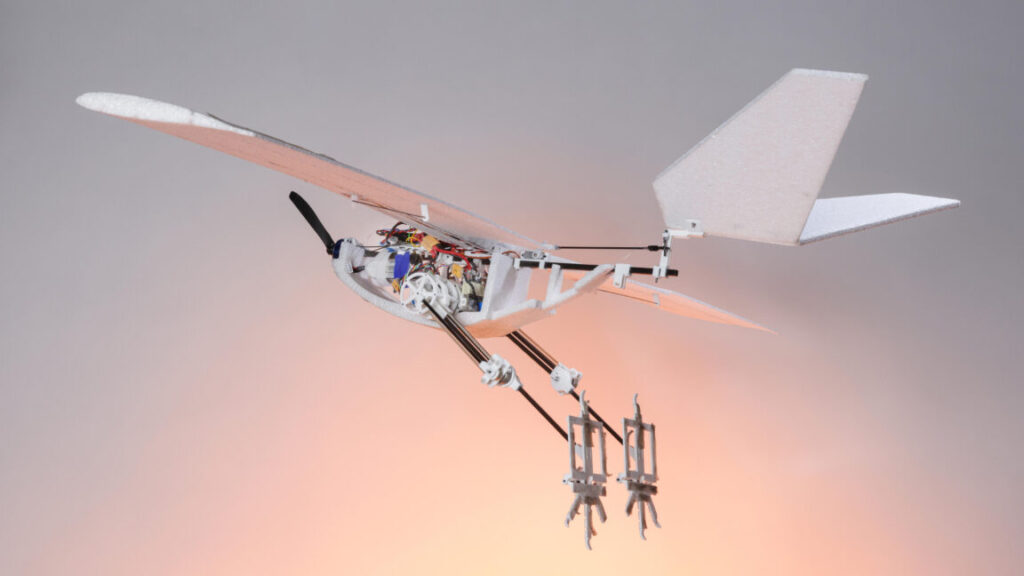
To get past this limit, a team of Swiss researchers at the École Polytechnique Fédérale de Lausanne built a fixed-wing flying robot called RAVEN (Robotic Avian-inspired Vehicle for multiple ENvironments) with a peculiar bio-inspired landing gear: a pair of robotic bird-like legs. “The RAVEN robot can walk, hop over obstacles, and do a jumping takeoff like real birds,” says Won Dong Shin, an engineer leading the project.

Smart investments

The key challenge in attaching legs to drones was that they significantly increased mass and complexity. State-of-the-art robotic legs were designed for robots walking on the ground and were too bulky and heavy to even think about using on a flying machine. So, Shin’s team started their work by taking a closer look at what the leg mass budget looked like in various species of birds.

It turned out that the ratio of leg mass to the total body weight generally increased with size in birds. A carrion crow had legs weighing around 100 grams, which the team took as their point of reference.

The robotic legs built by Shin and his colleagues resembled a real bird’s legs quite closely. Simplifications introduced to save weight included skipping the knee joint and actuated toe joints, resulting in a two-segmented limb with 64 percent of the weight placed around the hip joint. The mechanism was powered by a standard drone propeller, with the ankle joint actuated through a system of pulleys and a timing belt. The robotic leg ended with a foot with three forward-facing toes and a single backward-facing hallux.

There were some more sophisticated bird-inspired design features, too. “I embedded a torsional spring in the ankle joint. When the robot’s leg is crouching, it stores the energy in that spring, and then when the leg stretches out, the spring works together with the motor to generate higher jumping speed,” says Shin. A real bird can store elastic energy in its muscle-tendon system during flexion and release it very rapidly during extension for a jumping takeoff. The spring’s job was to emulate this mechanism, and it worked pretty well—“It actually increased the jumping speed by 25 percent,” Shin says.

In the end, the robotic legs weighed around 230 grams, way more than the real ones in a carrion crow, but it turned out that was good enough for the RAVEN robot to walk, jump, take off, and fly.

Crow’s efficiency

The team calculated the necessary takeoff speed for two birds with body masses of 490 grams and a hair over 780 grams; these were 1.85 and 3.21 meters per second, respectively. Based on that, Shin figured the RAVEN robot would need to reach 2.5 meters per second to get airborne. Using the bird-like jumping takeoff strategy, it could reach that speed in just 0.17 seconds.

How did nature’s go-to takeoff procedure stack up against other ways to get to the skies? Other options included a falling takeoff, where you just push your aircraft off a cliff and let gravity do its thing, or standing takeoff, where you position the craft vertically and rely on the propeller to lift it upward. “When I was designing the experiments, I thought the jumping takeoff would be the least energy-efficient because it used extra juice from the battery to activate the legs,” Shin says. But he was in for a surprise.

“What we meant by energy efficiency was calculating the energy input and energy output. The energy output was the kinetic energy and the potential energy at the moment of takeoff, defined as the moment when the feet of the robot stop touching the ground,” Shin explains. The energy input was calculated by measuring the power used during takeoff.

The RAVEN takes flight.

“It turned out that the jumping takeoff was actually the most energy-efficient strategy. I didn’t expect that result. It was quite surprising”, Shin says.

The energy cost of the jumping takeoff was slightly higher than that of the other two strategies, but not by much. It required 7.9 percent more juice than the standing takeoff and 6.9 percent more than the falling takeoff. At the same time, it generated much higher acceleration, so you got way better bang for the buck (at least as far as energy was concerned). Overall, jumping with bird-like legs was 9.7 times more efficient than standing takeoff and 4.9 times more efficient than falling takeoff.

One caveat with the team’s calculations was that a fixed-wing drone with a more conventional design, one using wheels or a launcher, would be much more efficient in traditional takeoff strategies than a legged RAVEN robot. “But when you think about it, birds, too, would fly much better without legs. And yet they need them to move on the ground or hunt their prey. You trade some of the in-flight efficiency for more functions,” Shin claims. And the legs offered plenty of functions.

Obstacles ahead

To demonstrate the versatility of their legged flying robot, Shin’s team put it through a series of tasks that would be impossible to complete with a standard drone. Their benchmark mission scenario involved traversing a path with a low ceiling, jumping over a gap, and hopping onto an obstacle. “Assuming an erect position with the tail touching the ground, the robot could walk and remain stable even without advanced controllers,” Shin claims. Walking solved the problem of moving under low ceilings. Jumping over gaps and onto obstacles was done by using the mechanism used for takeoff: torsion springs and actuators. RAVEN could jump over an 11-centimeter-wide gap and onto an obstacle 26-centimeter-high.

But Shin says RAVEN will need way more work before it truly shines. “At this stage, the robot cannot clear all those obstacles in one go. We had to reprogram it for each of the obstacles separately,” Shin says. The problem is the control system in RAVEN is not adaptive; the actuators in the legs perform predefined sets of motions to send the robot on a trajectory the team figured out through computer simulations. If there was something blocking the way, RAVEN would have crashed into it.

Another, perhaps more striking limitation is that RAVEN can’t use its legs to land. But this is something Shin and his colleagues want to work on in the future.

“We want to implement some sensors, perhaps vision or haptic sensors. This way, we’re going to know where the landing site is, how many meters away from it we are, and so on,” Shin says. Another modification that’s on the way for RAVEN is foldable wings that the robot will use to squeeze through tight spaces. “Flapping wings would also be a very interesting topic. They are very important for landing, too, because birds decelerate first with their wings, not with their legs. With flapping wings, this is going to be a really bird-like robot,” Shin claims.

All this is intended to prepare RAVEN for search and rescue missions. The idea is legged flying robots would reach disaster-struck areas quickly, land, traverse difficult terrain on foot if necessary, and then take off like birds. “Another application is delivering parcels. Here in Switzerland, I often see helicopters delivering them to people living high up in the mountains, which I think is quite costly. A bird-like drone could do that more efficiently,” Shin suggested.

Nature, 2024.  DOI: 10.1038/s41586-024-08228-9

Photo of John Timmer

John is Ars Technica’s science editor. He has a Bachelor of Arts in Biochemistry from Columbia University, and a Ph.D. in Molecular and Cell Biology from the University of California, Berkeley. When physically separated from his keyboard, he tends to seek out a bicycle, or a scenic location for communing with his hiking boots.

New drone has legs for landing gear, enabling efficient launches Read More »

openai-announces-full-“o1”-reasoning-model,-$200-chatgpt-pro-tier

OpenAI announces full “o1” reasoning model, $200 ChatGPT Pro tier

On X, frequent AI experimenter Ethan Mollick wrote, “Been playing with o1 and o1-pro for bit. They are very good & a little weird. They are also not for most people most of the time. You really need to have particular hard problems to solve in order to get value out of it. But if you have those problems, this is a very big deal.”

OpenAI claims improved reliability

OpenAI is touting pro mode’s improved reliability, which is evaluated internally based on whether it can solve a question correctly in four out of four attempts rather than just a single attempt.

“In evaluations from external expert testers, o1 pro mode produces more reliably accurate and comprehensive responses, especially in areas like data science, programming, and case law analysis,” OpenAI writes.

Even without pro mode, OpenAI cited significant increases in performance over the o1 preview model on popular math and coding benchmarks (AIME 2024 and Codeforces), and more marginal improvements on a “PhD-level science” benchmark (GPQA Diamond). The increase in scores between o1 and o1 pro mode were much more marginal on these benchmarks.

We’ll likely have more coverage of the full version of o1 once it rolls out widely—and it’s supposed to launch today, accessible to ChatGPT Plus and Team users globally. Enterprise and Edu users will have access next week. At the moment, the ChatGPT Pro subscription is not yet available on our test account.

OpenAI announces full “o1” reasoning model, $200 ChatGPT Pro tier Read More »

dog-domestication-happened-many-times,-but-most-didn’t-pan-out

Dog domestication happened many times, but most didn’t pan out

The story that data reveals is complicated—but somehow very human.

Until about 13,600 years ago, any wolf living in what is now Alaska would have lived on the usual wolf diet: rabbits, moose, and a whole range of other land animals. But starting around 13,600 years ago, the nitrogen isotopes locked in ancient wolves’ bones suggest that something changed. Some wolves still made their living solely by hunting wild game, but others started living almost entirely on fish. Since it’s unlikely that Alaskan wolves had suddenly taken up fly fishing, the sudden change probably suggests that some wolves had started getting food from people.

They’re good dogs, Brent

The fact that we kept trying to befriend wolves is starkly clear at a site called Hollembaek Hill, where archaeologists unearthed the 8,100-year-old remains of four canines. Their diets (according to the nitrogen isotopes locked in their bones) consisted mostly of salmon, so it’s tempting to assume these were domesticated dogs. But their DNA reveals that all four—including a newborn puppy—are most closely related to modern wolves.

On the other hand, the Hollembaek Hill canines didn’t all look like wild wolves. At least one of them had the large stature of a modern wolf, but others were smaller, like early dogs. And some of their DNA suggests that they may be at least part dog but not actually related to modern dogs. Lanoë and his colleagues suggest that people at Hollembaek Hill 8,000 years ago were living alongside a mix of pet wolves (do not try this at home) and wolf-dog hybrids.

All modern dogs trace their roots to a single group of wolves (now extinct) that lived in Siberia around 23,000 years ago. But sometime between 11,300 and 12,800 years ago, the canines from Hollembaek Hill and another Alaskan site called Swan Point had dog DNA that doesn’t seem related to modern dogs at all. That may suggest that dog domestication was a process that happened several times in different places, creating several branches of a dog family tree, but only one stuck around in the long run.

In other words, long after humans “invented” dogs, it seems that people just kept repeating the process, doing the things that created dogs in the first place: allowing the friendliest, least aggressive wild canids to live near their villages and maybe adopting and feeding them.

Dog domestication happened many times, but most didn’t pan out Read More »

a-peek-inside-the-restoration-of-the-iconic-notre-dame-cathedral

A peek inside the restoration of the iconic Notre Dame cathedral


Tomas van Houtyryve’s striking photographs for National Geographic capture the restoration process.

Notre Dame’s nave is clean and bright thanks to a latex application that peeled away soot and lead. Credit: Tomas van Houtryve for National Geographic

On April 15, 2019, the world watched in transfixed horror as a fire ravaged the famed Cathedral of Notre Dame in Paris, collapsing the spire and melting the lead roof. After years of painstaking restoration costing around $740 million, the cathedral reopens to the public this weekend. The December issue of National Geographic features an exclusive look inside the restored cathedral, accompanied by striking photographs by Paris-based photographer and visual artist Tomas van Houtryve.

For several hours, it seemed as if the flames would utterly destroy the 800-year-old cathedral. But after a long night of work by more than 400 Paris firefighters, the fire finally began to cool and attention began to shift to what could be salvaged and rebuilt. French President Emmanuel Macron vowed to restore Notre Dame to its former glory and set a five-year deadline. The COVID-19 pandemic caused some delays, but France nearly met that deadline regardless.

Those reconstruction efforts were helped by the fact that, a few years before the fire, scientist Andrew Tallon had used laser scanning to create precisely detailed maps of the interior and exterior of the cathedral—an invaluable aid as Paris rebuilds this landmark structure. French acousticians had also made detailed measurements of Notre Dame’s “soundscape” that were instrumental in helping architects factor acoustics into their reconstruction plans. The resulting model even enabled Brian FG Katz, research director of the National Center for Scientific Research (CNRS) at Sorbonne University, to create a virtual reality version of Notre Dame with all the acoustical parameters in place.

A devastating fire

Flames and smoke billowing from the roof of Notre Dame cathedral in Paris, France, on April 15, 2019.

Flames and smoke billowing from the roof of Notre Dame cathedral in Paris on April 15, 2019. Credit: Pierre Suu/Getty Images

As we previously reported, Notre Dame’s roof and its support structure of 800-year-old oak timbers had almost completely succumbed to the flames. Firefighters reported the cathedral’s bell towers safe and said that many works of art had been rescued or were already stored in areas believed to be safe from the fire. The main spire—750 tons of oak lined with lead—collapsed in flames, landing on the wooden roof, which was destroyed. The trees that made up the roof’s wooden structure were cut down around 1160.

Thanks to the efforts of preservationists like Philippe Villeneuve, chief architect of historic monuments, the cathedral has been rebuilt nearly exactly as it was before the fire. The interior is most transformed since the walls, stained glass, paintings, and sculptures were all cleaned and restored for the first time since the 19th century. All the furnishings have been replaced, and sculptor and designer Guillaume Bardet was committed to creating a new altar and various liturgical items, including a new baptismal font and massive bronze altar. (The original stone altar was crushed as the collapsing spire plunged to the main floor.)

Much of the structural repairs will not be readily apparent to visitors, most notably the cathedral’s attic and roof, which were rebuilt with new hand-hewed timber trusses fixed in place by pegged mortise-and-tenon joints. One modern improvement: “Fire-resistant trusses at the crossing will isolate the spire and the two transept arms from the nave and the choir, so a fire can never again race through the entire attic,” Robert Kunzig wrote in the NatGeo article. “Should flames break out in this space, misters distributed throughout the attic will help suppress them until firefighters can climb hundreds of stairs.”

A photographer speaks

National Geographic was granted special access throughout the reconstruction process and tapped van Houtryve to capture everything in photographs and video footage. Ars caught up with him to learn more.

Designer Guillaume Bardet was hired to create a new bronze altar and pulpit, among other new liturgical furnishings.

Designer Guillaume Bardet was hired to create a new bronze altar and pulpit, among other new liturgical furnishings. Credit: Tomas van Houtryve for National Geographic

Ars Technica: How did you get involved in documenting the cathedral’s restoration in photos/video?

Tomas van Houtryve: My journey in documenting the restoration of Notre-Dame de Paris began with an incredible opportunity through National Geographic’s partnership with Rebâtir Notre-Dame de Paris. I’ve always been drawn to the intersection of history and architecture, and I immediately knew I wanted to be a part of this project. It just so happened that through National Geographic and Rebâtir, I was able to perfectly combine my passion for visual storytelling with my deep connection to the city. Being entrusted to capture such a monumental effort felt like a natural progression in my career as a photographer—challenging, inspiring, and deeply meaningful.

Ars Technica: What were the biggest challenges in capturing this years-long process on camera?

Tomas van Houtryve: From a working standpoint, one of the biggest challenges was the high level of lead contamination. To be on-site, I had to wear a hazmat suit and often a respirator mask, which added a layer of physical difficulty to the work. Another significant hurdle was the heights. Thankfully, my background in rock climbing and the rope access training I completed with technicians proved invaluable. Once on-site, this assignment demanded every skill I’ve ever learned as a photographer. From flying drones in sensitive areas and mastering architectural photography to conducting the historic wet plate process with a 19th-century wooden camera, I applied everything in my visual toolbox. It was an all-encompassing challenge, but also an incredibly rewarding one.

Ars Technica: Was there any special equipment (lenses, cranes, etc.) needed to capture the photos and footage?

Tomas van Houtryve: It’s difficult to convey just how awe-inspiring the Notre-Dame de Paris restoration site is unless you see it in person. Stepping inside felt almost like entering a space station. There was an otherworldly blend of towering scaffolding, echoing sounds of the craftsmen at work, and the unique atmosphere of the cathedral itself. To document the restoration, I used a combination of modern and historic technology. Drones allowed me to navigate the intricate scaffolding and capture aerial perspectives that most people wouldn’t normally be able to see. And I also used a 19th-century wooden camera and portable darkroom to create glass plate photographs using the historic wet plate process. It was an incredible merging of the old and the new—a perfect representation of what Notre-Dame is and how it’s being restored.

Credit: Tomas van Houtryve for National Geographic

Ars Technica: What were some of the particular highlights for you as part of this long process?

Tomas van Houtryve: One of the standout highlights for me was witnessing the incredible craftsmanship that went into every detail of the restoration. Seeing the artisans, stonemasons, and carpenters recreate original elements with such precision and care was something that was very special. It gave me a deep appreciation for the skill and dedication involved in bringing Notre Dame back to life.

Another remarkable highlight was witnessing the transformation of the cathedral itself. Many people don’t realize that Gothic cathedrals like Notre-Dame de Paris were originally designed to be light, bright, and vibrant spaces of worship. Over centuries, time and human interaction dulled their appearance, creating the more imposing image we often associate with them. Seeing the cathedral fully cleaned, with its light stone walls restored to their original brilliance, felt like stepping back in time to another world. It was awe-inspiring to see the cathedral as it was meant to be, a true testament to its enduring beauty.

Ars Technica: As a Parisian, what has it meant to you to see Notre Dame restored to its former glory?

Tomas van Houtryve: Although I wasn’t born a Parisian, the years I’ve spent living here have made me feel deeply connected to this city—it’s my true home. On the night of the fire in 2019, every Parisian, including myself, watched in horror as our geographical epicenter—Notre-Dame de Paris—went up in flames. I’ll never forget it, and we’ve been haunted in some ways since then. Being trusted to photograph this monumental restoration, a feat of both engineering and unwavering passion, was not only a once-in-a-lifetime opportunity, but it was cathartic. Contributing, even in a small way, to preserving the legacy of such an iconic symbol was both humbling and profoundly inspiring.

Cover of the December 2024 issue of National Geographic magazine

Credit: National Geographic

Photo of Jennifer Ouellette

Jennifer is a senior reporter at Ars Technica with a particular focus on where science meets culture, covering everything from physics and related interdisciplinary topics to her favorite films and TV series. Jennifer lives in Baltimore with her spouse, physicist Sean M. Carroll, and their two cats, Ariel and Caliban.

A peek inside the restoration of the iconic Notre Dame cathedral Read More »

researchers-finally-identify-the-ocean’s-“mystery-mollusk”

Researchers finally identify the ocean’s “mystery mollusk”

Some of the most bizarre lifeforms on Earth lurk in the deeper realms of the ocean. There was so little known about one of these creatures that it took 20 years just to figure out what exactly it was. Things only got weirder from there.

The organism’s distinctive, glowing presence was observed by multiple deep-sea missions between 2000 to 2021 but was simply referred to as “mystery mollusk.” A team of Monterey Bay Aquarium Research Institute (MBARI) researchers has now reviewed extensive footage of past mystery mollusk sightings and used MBARI’s remotely operated vehicles (ROVs) to observe it and collect samples. They’ve given it a name and have finally confirmed that it is a nudibranch—the first and only nudibranch known to live at such depths.

Bathydevius caudactylus, as this nudibranch is now called, lives 1,000–4,000 meters (3,300–13,100 feet) deep in the ocean’s bathypelagic or midnight zone. It moves like a jellyfish, eats like a Venus flytrap, and is bioluminescent, and its genes are distinct enough for it to be classified as the first member of a new phylogenetic family.

“Anatomy, diet, behavior, bioluminescence, and habitat distinguish this surprising nudibranch from all previously described species, and genetic evidence supports its placement in a new family,” the MBARI research team said in a study recently published in Deep Sea Research. 

Is that a…?

Nudibranchs are gastropods, which literally translates to “stomach foot” since the “foot” they crawl around on when not swimming is right below their guts. They are part of a larger group that includes terrestrial and aquatic snails and slugs. B. caudactylus, however, seems to get around more like a jellyfish than a sea slug. It mostly swims using an oral hood that opens and closes to propel itself backward through the water in a manner similar to many jellyfish.

The hood of B. caudactylus can also act something like a Venus flytrap. While it is not a hinged structure like the leaves of the plant, it is used to trap prey. Typically small crustaceans, the prey are then pushed to the mouth at the back of the hood.

The mystery mollusk.

The nudibranch also seems to have a unique way of avoiding becoming food itself. Projections at the end of its tail, known as dactyls, can detach if needed, much like the tails of some lizard species. The MBARI team thinks that these dactyls are possibly a lure meant to trick predators while the nudibranch swims away. They later regenerate.

Researchers finally identify the ocean’s “mystery mollusk” Read More »

elon-musk-asks-court-to-block-openai-conversion-from-nonprofit-to-for-profit

Elon Musk asks court to block OpenAI conversion from nonprofit to for-profit

OpenAI provided a statement to Ars today saying that “Elon’s fourth attempt, which again recycles the same baseless complaints, continues to be utterly without merit.” OpenAI referred to a longer statement that it made in March after Musk filed an earlier version of his lawsuit.

The March statement disputes Musk’s version of events. “In late 2017, we and Elon decided the next step for the mission was to create a for-profit entity,” OpenAI said. “Elon wanted majority equity, initial board control, and to be CEO. In the middle of these discussions, he withheld funding. Reid Hoffman bridged the gap to cover salaries and operations.”

OpenAI cited Musk’s desire for Tesla merger

OpenAI’s statement in March continued:

We couldn’t agree to terms on a for-profit with Elon because we felt it was against the mission for any individual to have absolute control over OpenAI. He then suggested instead merging OpenAI into Tesla. In early February 2018, Elon forwarded us an email suggesting that OpenAI should “attach to Tesla as its cash cow,” commenting that it was “exactly right… Tesla is the only path that could even hope to hold a candle to Google. Even then, the probability of being a counterweight to Google is small. It just isn’t zero.”

Elon soon chose to leave OpenAI, saying that our probability of success was 0, and that he planned to build an AGI competitor within Tesla. When he left in late February 2018, he told our team he was supportive of us finding our own path to raising billions of dollars. In December 2018, Elon sent us an email saying “Even raising several hundred million won’t be enough. This needs billions per year immediately or forget it.”

Now, Musk says the public interest would be served by his request for a preliminary injunction. Preserving competitive markets is particularly important in AI because of the technology’s “profound implications for society,” he wrote.

Musk’s motion said the public “has a strong interest in ensuring that charitable assets are not diverted for private gain. This interest is particularly acute here given the substantial tax benefits OpenAI, Inc. received as a non-profit, the organization’s repeated public commitments to developing AI technology for the benefit of humanity, and the serious safety concerns raised by former OpenAI employees regarding the organization’s rush to market potentially dangerous products in pursuit of profit.”

Elon Musk asks court to block OpenAI conversion from nonprofit to for-profit Read More »