A number of the world’s largest media organisations have assembled to call for greater transparency in regard to the training of generative AI models. In an open letter to policymakers published yesterday, they ask to be involved in creating standards for the use of artificial intelligence, especially as it relates to intellectual property rights.
With generative AI, it is now possible to produce and distribute synthetic content at a previously unimagined pace and scale. The threat, the letter states, is that the irresponsible use of the technology could come to endanger the media ecosystem as a whole by eroding the public’s trust in the independence and quality of content.
The signatories of the letter say that they support the responsible advancement and deployment of generative AI technology. However, they also believe that “a legal framework must be developed to protect the content that powers AI applications as well as maintain public trust in the media that promotes facts and fuels our democracies.”
Guidelines for AI training and disclosure
In the letter, titled “Preserving public trust in media through unified AI regulation and practices,” they also lay out priorities when it comes to regulating the rapidly advancing technology.
These include transparency as to the makeup of all training sets used to create AI models, consent of intellectual property rights holders for the use of their material, and the collective negotiation between media groups and AI model operators and developers.
Several media companies and artists have sued AI developers for copyright infringement. For instance, Getty Images filed a case against Stability AI in February, and comedian Sarah Silverman against OpenAI last month.
But there is also a precedent for collaboration. In July, OpenAI and The Associated Press made a deal for the GPT developer to licence AP’s archive of news stories. The parties did not reveal the financial details of the deal.
The letter writers also demand that generative AI models and users “clearly, specifically, and consistently identify their outputs and interactions as including AI-generated content,” and take steps to eliminate bias and misinformation from their services.
Far-reaching implications of unchecked AI deployment
Generative AI has been hailed as the next frontier in productivity, and studies suggest it could add up to $4.4 trillion (€3.99 trillion) of value to the global economy yearly. Meanwhile, concerns of its applications range from fake online reviews to dissemination of disinformation, mass surveillance and discrimination, job losses, and even the eventual extinction of the human race.
Among the organisations behind the letter is the European Publishers’ Council (EPC), a high level group of Chairpeople and CEOs of leading European media corporations. Since 1991, the group has lobbied on over 250 different EU proposals and directives.
Agence France-Presse, European Pressphoto Agency, Gannett | USA TODAY Network, Getty Images, National Press Photographers Association, National Writers Union, News Media Alliance, The Associated Press, and the Authors Guild also signed the letter.
Social media influencers are facilitating the trade in counterfeit goods, according to new research by Portsmouth University.
After analysing surveys of 2,000 people in the UK, the study team found around 22% of consumers who are active on social media have bought counterfeits endorsed by influencers. The researchers believe it’s the first-ever estimate of its kind. They warn that counterfeiters are exploiting the popularity of influencers to peddle harmful products.
“Counterfeit products injure and kill hundreds of thousands of people across the world,” Dr David Shepherd, the study’s lead author, said in a statement. “The working conditions in the counterfeit factories are unsafe with subsistence-level wages. Don’t be fooled by social media influencers.”
Their dubious charms are particularly appealing to young people and males. According to the study, people between 16 and 13 years old are three times as likely to purchase endorsed counterfeits as those aged 34 to 60. Males, meanwhile, accounted for 70% of all the buyers.
The <3 of EU tech
The latest rumblings from the EU tech scene, a story from our wise ol’ founder Boris, and some questionable AI art. It’s free, every week, in your inbox. Sign up now!
The researchers attribute these inclinations to specific characteristics.
The consumers tended to have a low-risk awareness, a high-risk appetite, and a propensity to morally justify counterfeit purchases, due to factors such as the high prices of genuine brands. They also had a broader vulnerability to influence. Buyers of endorsed counterfeits were twice as susceptible to the influence of friends and social media.
“Social commerce is the new frontier for marketing, and the social media influencers are the new royalty,” Professor Mark Button, the study’s co-author, said. “Consumers in this marketplace often rely on remote recommendations by third parties, and these influencers have increasingly replaced the customers’ own evaluations of purchasing risk.”
While the new research only covers the UK, the findings highlight an international problem.
Influencers and e-commerce have made social media a global catalogue for counterfeit goods, with deep social and economic impacts. According to a study by the EU’s Intellectual Property Office counterfeits such as bags, clothing, and electrical goods cost the bloc €60bn and 434,000 job losses every year.
“This study raises serious concerns about the impact of deviant influencer marketing on consumer behaviour, particularly among vulnerable demographics,” said Button. “It is crucial for brands, regulators, and law enforcement agencies to take action and disrupt the activities of these illicit influencers and the networks that support them.”
On Wednesday, US President Joe Biden unveiled an executive order banning new investments in certain tech sectors in China, citing security risks. The order is set to come into effect next year, and the US will be waiting to see if its closest ally will follow suit. However, for now, the UK says it will consider the measures taken by its transatlantic partner, as it continues to evaluate security implications.
“This executive order on outward investment gives important clarity on the US approach,” a spokesperson for the government said in a statement shared with the Financial Times earlier today. “The UK will consider these new measures closely as we continue to assess potential national security risks attached to some investments.”
The forthcoming ban includes new private-equity, venture-capital and joint-venture investments in advanced computer chips, quantum computers, and certain AI systems. Furthermore, companies already doing business in China will need to notify the government of new investments in the sectors. The goal is to hinder the Chinese military from obtaining both US technology and money.
Needless to say, China did not respond kindly to the order, stating it considered the measures to be “blatant economic coercion and technological bullying.”
Tech trade balancing act
This leaves Rishi Sunak and his government with a bit of a diplomatic conundrum. In the declaration on cooperation on export controls between the US and the UK signed in June, the parties agreed to undertake a review of export control, focusing on “end users of concern.” Britain further said it would update its control regime to better “tackle sensitive technology transfers.”
The UK has also stated it is ready to remain closely tied to the approach of the US, especially when it comes to military technologies, and “respond effectively” to any impact British capital and technology could have on shared security concerns.
Mainland China is not a huge destination for UK foreign investment, attracting £10.7bn (€12.4bn) in 2021, compared to the £461.4bn (€537.5bn) that flowed westward across the Atlantic. However, in an update on the government’s foreign policy plan from May, Britain says it will endeavour to shield critical supply chains, but also emphasises the importance of UK-China trade for the British economy.
As technology, economics, and national security is becoming ever increasingly intertwined, it seems we are going to need a whole new school of high-stakes tech diplomacy.
The European Space Agency’s next-generation heavy-lift rocket, Ariane 6, definitely won’t launch until at least 2024, the agency’s director general confirmed this week.
Ariane 6 was first scheduled to launch four years ago. However, the rocket has suffered a series of delays, attributed to technical issues, COVID-19, and design changes.
The ESA said the most recent setback was because it failed to complete a short hot firing test,, mimicking the environment in space to provide data to operators,of Ariane’s engine system in a July attempt. The ESA wants to reattempt the test on August 29, with tentative plans for a long hot fire test on September 26, at the agency’s spaceport in French Guiana.
With Ariane 5 officially decommissioned and Italy’s Vega C rocket grounded following launch failure in December, Europe is now without independent access to space satellites. Until Ariane 6 gets up and running, the EU will be forced to contract the work to Elon Musk’s SpaceX — the company’s Falcon rocket is the only viable alternative for hauling large satellites into orbit.
Exactly when Ariane 6 will embark on its maiden voyage is uncertain. A press briefing with the Ariane 6 Launcher Task Force is scheduled for September 4 to provide an update on the launcher, ESA announcedon Tuesday.
The <3 of EU tech
The latest rumblings from the EU tech scene, a story from our wise ol’ founder Boris, and some questionable AI art. It’s free, every week, in your inbox. Sign up now!
Arianespace CEO Stéphane Israël tweeted a timeline on Tuesday laying out the next steps for Ariane 6 testing ahead of an inaugural flight in 2024.
[1/5] Here below please find the updated schedule for #Ariane6 development. With this, @ESA, @ArianeGroup, @Arianespace and @CNES confirm that the inaugural launch is now targeted for 2024.
Despite its setbacks, Ariane 6 has a number of institutional launches to carry out, and it has been attracting commercial contracts, including 18 launches for Amazon’s Kuiper broadband megaconstellation project.
Immersive technologies bridging the gap between the physical and digital worlds can create new business opportunities. However, it also gives rise to new challenges in regulation and applying real-world laws to XR spaces. According to a World Economic Forum report, we are relatively slow in innovating new legal frameworks for emerging technologies like AR and VR.
Common Challenges of Applying Laws to AR and VR
XR technologies like AR and VR are already considered beneficial and are used in industries like medicine and education. However, XR still harbors risks to human rights, according to an Electronic Frontier Foundation (EFF) article.
Issues like data harvesting and online harassment pose real threats to users, and self-regulation when it comes to data protection and ethical guidelines is insufficient in mitigating such risks. Some common challenges that crop up when applying real-world laws to AR and VR include intellectual property, virtual privacy and security, and product liability.
There’s also the need for a new framework tailored to fit emerging technologies, but legislative attempts at regulation may face several hurdles. It’s also worth noting that while regulation can help keep users safe, it may also potentially hamper the development of such technologies, according to Digikonn co-founder Chirag Prajapati.
Can Real-World Laws Be Applied to XR Spaces?
In an interview with IEEE Spectrum in 2018, Robyn Chatwood, an intellectual property and information technology partner at Dentons Australia, gave an example of an incident that occurred in a VR space where a user experienced sexual assault. Unfortunately, Chatwood remarked that there are no laws saying that sexual assault in VR is the same as in the real world. When asked when she thinks these issues will be addressed, Chatwood remarked that, in several years, another incident could draw more widespread attention to the problems in XR spaces. It’s also possible that, through increased adoption, society will begin to recognize the need to develop regulations for XR spaces.
On a more positive note, the trend toward regulations for XR spaces has been changing recently. For instance, Meta has rolled out a minimum distance between avatars in Horizon Worlds, its VR social media platform. This boundary prevents other avatars from getting into your avatar’s personal space. This system works by halting a user’s forward movement as they get closer to the said boundary.
There are also new laws being drafted to protect users in online spaces. In particular, the UK’s Online Safety Bill, which had its second reading in the House of Commons in April 2022, aims to protect users by ensuring that online platforms have safety measures in place against harmful and illegal content and covers four new criminal offenses.
In the paper, The Law and Ethics of Virtual Assault, author John Danaher proposes a broader definition of virtual sexual assault, which allows for what he calls the different “sub-types of virtual sexual assault.” Danaher also provides suggestions on when virtual acts should be criminalized and how virtual sexual assault can be criminalized. The paper also touches on topics like consent and criminal responsibility for such crimes.
There’s even a short film that brings to light pressing metaverse concerns. Privacy Lost aims to educate policymakers about the potential dangers, such as manipulation, that come with emerging technologies.
While many legal issues in the virtual world are resolved through criminal courts and tort systems, according to Gamma Law’s David B. Hoppe, these approaches lack the necessary nuance and context to resolve such legal disputes. Hoppe remarks that real-world laws may not have the specificity that will allow them to tackle new privacy issues in XR spaces and shares that there is a need for a more nuanced legal strategy and tailored legal documents to help protect users in XR spaces.
Issues with Existing Cyber Laws
The novelty of AR and VR technologies makes it challenging to implement legislation. However, for users to maximize the benefits of such technologies, their needs should be considered by developers, policymakers, and organizations that implement them. While cyber laws are in place, persistent issues still need to be tackled, such as challenges in executing sanctions for offenders and the lack of adequate responses.
The United Nations Office on Drugs and Crime (UNODC) also cites several obstacles to cybercrime investigations, such as user anonymity from technologies, attribution, which determines who or what is responsible for the crime, and traceback, which can be time-consuming. The UNODC also notes that the lack of coordinated national cybercrime laws and international standards for evidence can hamper cybercrime investigations.
Creating Safer XR Spaces for Users
Based on guidelines provided by the World Economic Forum, there are several key considerations that legislators should consider. These include how laws and regulations apply to XR conduct governed by private platforms and how rules can potentially apply when an XR user’s activities have direct, real-world effects.
The XR Association (XRA) has also provided guidelines to help create safe and inclusive immersive spaces. Its conduct policy tips to address abuse include creating tailored policies that align with a business’ product and community and including notifications of possible violations. Moreover, the XRA has been proactive in rolling out measures for the responsible development and adoption of XR. For instance, it has held discussions on user privacy and safety in mixed reality spaces, zeroing in on how developers, policymakers, and organizations can better promote privacy, safety, and inclusion, as well as tackle issues that are unique to XR spaces. It also works with XRA member companies to create guidelines for age-appropriate use of XR technology, helping develop safer virtual spaces for younger users.
Other Key Players in XR Safety
Aside from the XRA, other organizations are also taking steps to create safer XR spaces. X Reality Safety Intelligence (XRSI), formerly known as X Reality Safety Initiative, is one of the world’s leading organizations focused on providing intelligence and advisory services to promote the safety and well-being of ecosystems for emerging technologies.
It has created a number of programs that help tackle critical issues and risks in the metaverse focusing on aspects like diversity and inclusion, trustworthy journalism, and child safety. For instance, the organization has shown support for the Kids PRIVACY Act, a legislation that aims to implement more robust measures to protect younger users online.
XRSI has also published research and shared guidelines to create standards for XR spaces. It has partnered with Standards Australia to create the first-ever Metaverse Standards whitepaper, which serves as a guide for standards in the metaverse to protect users against risks unique to the metaverse. These are categorized as Human Risks, Regulatory Risks, Financial Risks, and Legal Risks, among other metaverse-unique risks.
The whitepaper is a collaborative effort that brings together cybersecurity experts, VR and AR pioneers, strategists, and AI and metaverse specialists. One of its authors, Dr. Catriona Wallace, is the founder of the social enterprise The Responsible Metaverse Alliance. Cybersecurity professional Kavya Pearlman, the founder and CEO of XRSI, is also one of its authors. Pearlman works with various organizations and governments, advising on policymaking and cybersecurity to help keep users safe in emerging technology ecosystems.
One such issue that’s being highlighted by the XRSI is the risks that come with XR data collection in three areas: medical XR and healthcare, learning and education, and employment and work. The report highlights how emerging technologies create new privacy and safety concerns, risks such as the lack of inclusivity, the lack of equality in education, and the lack of experience in using data collected in XR spaces are cropping up.
In light of these issues, the XRSI has created goals and guidelines to help address these risks. Some of the goals include establishing a standards-based workflow to manage XR-collected data and adopting a new approach to classifying such data.
The EU is also taking steps to ensure data protection in emerging technologies, with new EU laws aiming to complement the GDPR’s requirements for XR technologies and services. Moreover, the EU data protection law applies to most XR technologies, particularly for commercial applications. It’s possible that a user’s explicit consent may be required to make data processing operations legitimate.
According to the Information Technology & Innovation Foundation (ITIF), policymakers need to mitigate so-called regulatory uncertainty by making it clear how and when laws apply to AR and VR technologies. The same ITIF report stresses that they need to collaborate with stakeholder communities and industry leaders to create and implement comprehensive guidelines and clear standards for AR and VR use.
However, while creating safer XR spaces is of utmost importance, the ITIF also highlights the risks of over-regulation, which can stifle the development of new technologies. To mitigate this risk, policymakers can instead focus on developing regulations that help promote innovation in the field, such as creating best practices for law enforcement agencies to tackle cybercrime and focusing on funding for user safety research.
Moreover, the ITIF also provides some guidelines regarding privacy concerns from AR in public spaces, as well as what steps leaders and policymakers could take to mitigate the risks and challenges that come with the use of immersive technologies.
The EFF also shares that governments need to execute or update data protection legislation to protect users and their data.
There is still a long way to go when applying real-world laws to XR spaces. However, many organizations, policymakers, and stakeholders are already taking steps to help make such spaces safer for users.
Imaging company Almalence has released a trial plugin for its Digital Lens technology which makes use of eye-tracking to purportedly increase the resolving power and clarity of XR headsets.
Almalense argues that the lenses on most XR headsets today aren’t being used to their fullest potential. By taking advantage of eye-tracking and smarter calibration, the company says its image pre-processing technology can actually increase the resolving power of a headset, including expanding the ‘sweet spot’ (the part of the lens with the highest visual fidelity).
The company has released a trial version of its technology through a plugin that works with Pico 3 Neo Pro Eye, HP Reverb G2 Omnicept, and HTC Vive Pro Eye. The plugin works with OpenXR compatible content, and even allows users to switch back and forth between each headset’s built-in image processing and the Almalence Digital Lens processing.
Based on through-the-lens demonstrations by the company, the technology does objectively increase the resolving power of the headsets. The company focuses on doing more advanced pre-processing to account for artifacts introduced by the lens, like chromatic aberration and image distortion. In essence the software increases the sharpness of the image by making the light passing through the lens land more precisely where it’s supposed to.
Almalence has shared heat maps comparing the changes in visual quality with and without its image technology, along with a broader explanation of how it works.
Another big advantage over the status quo, Almalence says, is the Digital Lens tech uses eye-tracking to perform these corrections in real-time, meaning that as you move your eyes around the scene (and off-axis from the center of the lens), the corrections are updated to account for the new angles. This can expand the ‘sweet spot’ of the lens and ‘pupil swim’ by making adjustments to account for the position of the pupil relative to the center of the lens. This video demonstrates the pupil swim correction:
The plugin, which anyone can use until January 2024, aims to demonstrate the company’s claims. Ultimately it appears the company wants to license its technology to headset makers to improve image quality out of the box.
Developers across the world are mourning the loss of Bram Moolenaar, renowned Dutch software engineer and creator of the Vim text editor.
Moolenaar passed away on August 3, 2023, after suffering from a medical condition that “rapidly progressed over the last few weeks,” according to a statement shared by his family on the Vim-announce Google Group.
Vim, short for “Vi IMproved,” is a free and open-source, screen-based text editor that has been at the forefront of many software developments since its release in 1991.
Vim is a modal editor, boasting both command-line and graphical user interface forms, and has been a lifesaver for countless developers over the years, offering an efficient and sophisticated platform for coding.
The <3 of EU tech
The latest rumblings from the EU tech scene, a story from our wise ol’ founder Boris, and some questionable AI art. It’s free, every week, in your inbox. Sign up now!
Besides Linux, where Vim is the default editor in many distros, the programme is also available for Unix, macOS, OS/2, DOS, and Windows.
“I can say without a shadow of a doubt that the speed and fluidity of Vim has given me a major edge in my career. I will always have a deep appreciation for what Bram did for the world. RIP,” said one Reddit user.
“Vim is a legendary bit of kit, its name known to everyone even outside the ‘nix and open source worlds,” said another.
Beyond creating an industry standard for text editing software, Moolenaar also pioneered an open-source and community-driven approach to its development.
He was the first to coin the term “charityware.” Although users may use and copy Vim for free, they are encouraged to donate to the International Child Care Fund Holland to help children in Uganda.
“I have never wanted to make money from Vim,” said Moolenaar in an interview last year. “It started as a hobby and most of the time I had a job that paid well enough.”
Rest in peace Bram Moolenaar, creator of Vim and one of the best free and open source developers of our times. Your legacy will survive for ages, but your modesty and kind attitude in sharing will be hardly matched by anyone. https://t.co/f0I6UuIFfBpic.twitter.com/pV3bea4Is4
Donations amount to around €30,000 per year — enough to help about 50 children finish their education, from primary school to university.
Moolenaar, who was based in the Netherlands, spent much of his life dedicated to Vim — creating, maintaining, and consistently improving the software.
The last full version of Vim is 9.0, which appeared more than a year ago. However, until a month ago, Moolenaar was still making updates to the tool.
During his career, Moolenaar also worked on a variety of projects that included a system for distributed software development called A-A-P, a programming language called Zimbu, and his latest stint was at Google working on modernising the Merchant Center.
While he might have logged off from this world for good, Moolenaar’s legacy and Vim — a text editor that continues to empower developers across the globe — lives on.
Meta’s Sanzaru Games released a new look at Asgard’s Wrath 2 in a developer diary video that, in addition to showing off more of the upcoming action RPG, teases an opportunity to put your combat skills to the test against other players.
The studio says that in addition to its main narrative-driven quest, Asgard’s Wrath 2 is going to feature an “asynchronously social dungeon-crawling mode” where you as the Cosmic Guardian will “take part in an ongoing battle that evolves over time,” the studio says in a blogpost.
We’re due to learn more about the newly teased dungeon mode in the game’s next deep dive video, where the studio says it will further explore the so-called ‘Uncharted Rifts’.
Announced during the Quest Gaming Showcase in June, the Asgard’s Wrath sequel is headed exclusively to the Quest platform, which includes Quest 2, Quest Pro, and the upcoming Quest 3 headset.
In it, you travel across the realms in pursuit of the trickster god Loki, taking on the role of four mortal heroes with various weapons and playstyles. Like the first, which was a Rift exclusive, the new Quest-only title is said to be packed with creatures, quests, puzzles, and the ability to convert loyal animals into fierce warrior companions. The studio says we can expect “60 hours of exploration [and] viscous combat” when the game launches in Winter 2023.
You can also now pre-order the game, priced at $60. Pre-orders include exclusive in-game weapon and armor set, a free download of Asgard’s Wrath 1 on PC, a Meta Quest home environment, and an exclusive Asgard’s Wrath 2 character bundle for battle royale shooter POPULATION: ONE.
The 2023 edition of AWE USA not only lived up to its reputation but also reached new heights, reportedly marking its largest event to date. From cutting-edge hardware to new, groundbreaking technology and software solutions, this year had it all.
3 Trends That Will Shape the Future of XR
Let’s dive in and explore the main three trends that stood out and are bound to shape the narrative for the future of XR.
Main Focus on AR
There was a lot of discussion this year about artificial intelligence and how it will enable XR rather than replace it. Just like with the metaverse last year, AI became a new hot topic, but in terms of hardware, the spotlight was clearly on AR.
There were, of course, some notable VR-first devices presented: Lenovo announced their new ThinkReality VRX headset, which is now available for purchase ($1,299). I had a chance to give it a try and was impressed with its large sweet spot, visual clarity, and a high degree of comfort. The headset includes a cooling system that takes the heat away from your face and makes the inside feel almost air-conditioned.
ThinkReality VRX
HTC presented their modular HTC Vive XR Elite ($1,099) for which they had won a “Best Headworn Device” award. It can be worn both like a traditional headset with a head strap or akin to glasses with an external power source instead of the battery in the back. In detached form, the Vive XR Elite weighs only 270 grams.
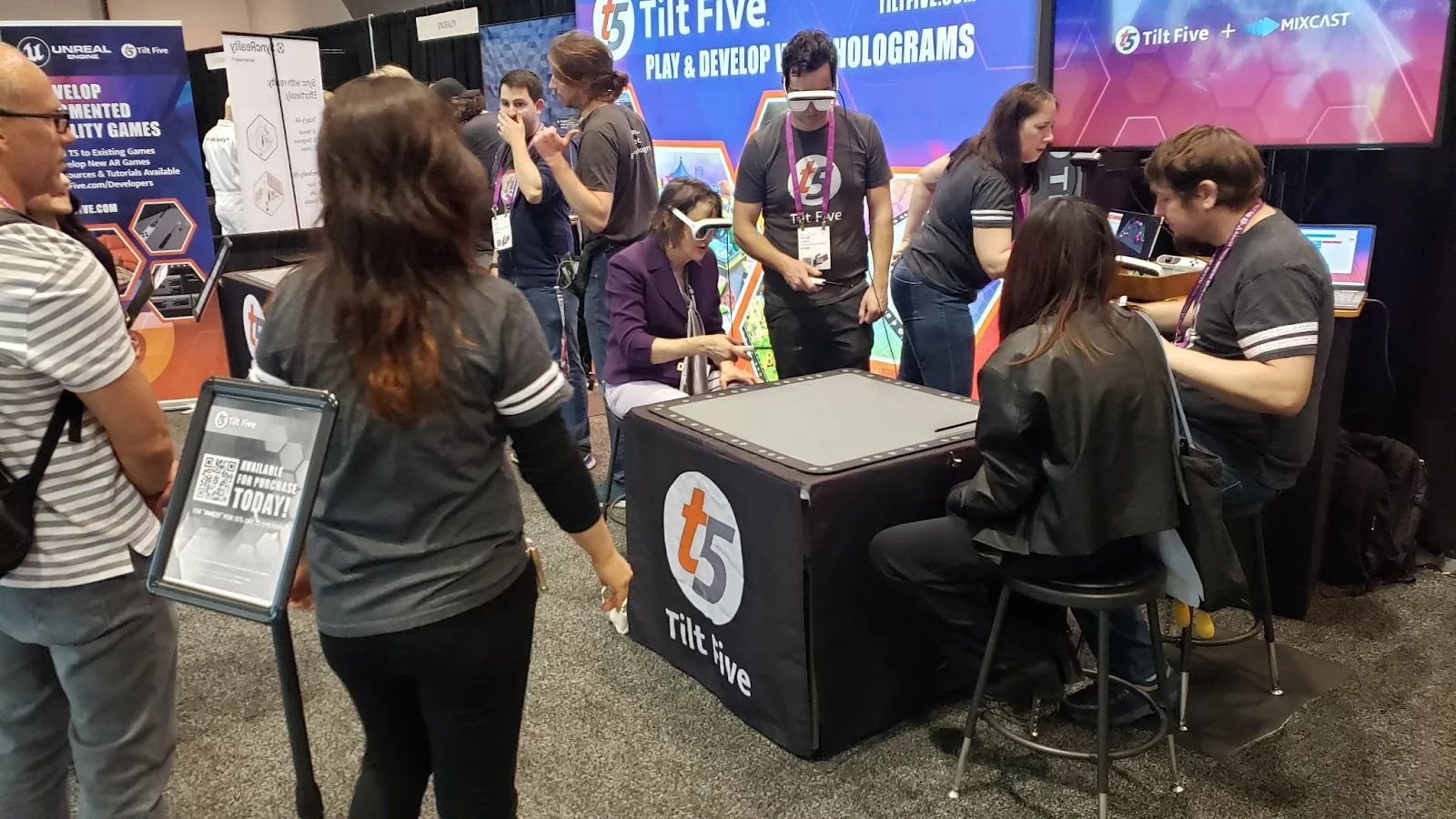
These devices were more of an exception rather than the rule, however, and pale in comparison to the amount of AR devices showcased this year. Just on the main floor, we had Vuzix promoting their Ultralite turnkey AR solution, Sightful with a screenless Spacetop AR laptop, XREAL presenting XREAL Air glasses, and Magic Leap returning with Magic Leap 2. Right next to those was C-Real with their unique light field display and Tilt Five. In the lobby, Zappar was demonstrating its $75 Cardboard-inspired device.
And that’s just the hardware, the list doesn’t include smartphone-based solutions like Snapchat’s SnapAR and Snap Lenses or Ffface.me digital clothing. Many software providers were experimenting with AR as well. Whether it was enterprise and training applications or entertainment like a laser-tag-inspired Laser Limbo, the focus on augmented reality was prevalent.
Laser-tag-inspired Laser Limbo
Subjectively, I found the XREAL and Tilt Five glasses to be the most promising choices in terms of their usefulness and affordability. Tilt Five ($359) offers six degrees of freedom and a wide 110° field of view, plus a whole range of tabletop applications and games. It also comes with a tracked controller.
Tilt Five
The XREAL Air ($488 with XReal Beam) might only have three degrees of freedom and a smaller FOV of 46°, but makes up for it with its versatility. It weighs only 79 grams and is compatible with phones, consoles, and laptops. Almost any device with a screen can be beamed into the glasses. For those looking to start experimenting with AR, both offer a good and inexpensive entry point.
The Renaissance of Haptics
It was hard to ignore the sheer volume of haptic-related products at AWE. There was a surge of novel startups and original concepts along with many industry veterans returning to show off their latest progress.
I did not expect haptics to have such a strong showing and was positively taken aback. Bhaptics were busy presenting their new TactGlove and Contact CI came out with a new product called Maestro. The most established player in the space, HaptX, was there as well.
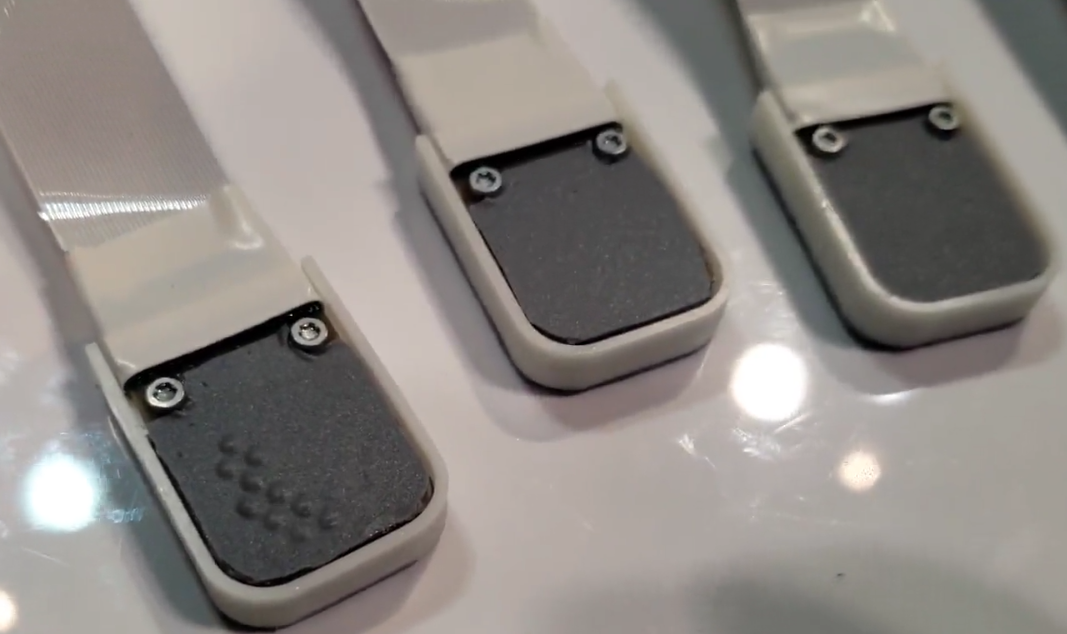
Among newer entrants, SenseGlove was celebrating their €3.25M Series A funding with a newly updated Nova 2 haptic glove. Weart demoed their TouchDIVER glove capable of not only feedback but also temperature variations, while OWO showed off their latest haptic vest that uses electrical impulses to simulate sensations. Fluid Reality stole the show with its electroosmotic device that uses an electric field to create feedback.
Fluid Reality
There were too many to list but even this short rundown underscores how noticeable haptics were this year. Most of these products target industrial and business markets, with the notable exceptions being the OWO vest ($499) and Bhaptics (also $499). Both devices have their strengths and weaknesses, though I have to give extra points to OWO for taking a bold, unique approach and allowing users to configure the vest so that it can simulate discomfort as well as other unpleasant feedback. This can result in a significantly more visceral experience and a heightened feeling of presence that’s hard to replicate using other methods.
OWO Haptic Vest
Seeing all the new and creative ways to model and recreate tactile data left me impressed with what’s to come, but at the same time, underwhelmed with the more conventional approaches.
Full resistance feedback, which restricts your movement, felt detached and did not properly mirror what I was seeing inside the headset. That was the case for both SenseGlove Nova and the high-end HaptX.
Their feedback, while indeed powerful, felt very mechanical and arbitrary. There are two paradigms here at play, one is trying to nail the fidelity but approximate the sensation, while the other one is trying to provide the exact, realistic sensation at the cost of fidelity.
New Optics Solutions Are Coming
There were a number of booths dealing with optics and display solutions this year. It’s possible the latest push into AR helped supercharge this progress in optics. Many booths had some kind of developer kit or proof-of-concept ready. Visitors would come and literally peer into the future through these stationary prototypes.
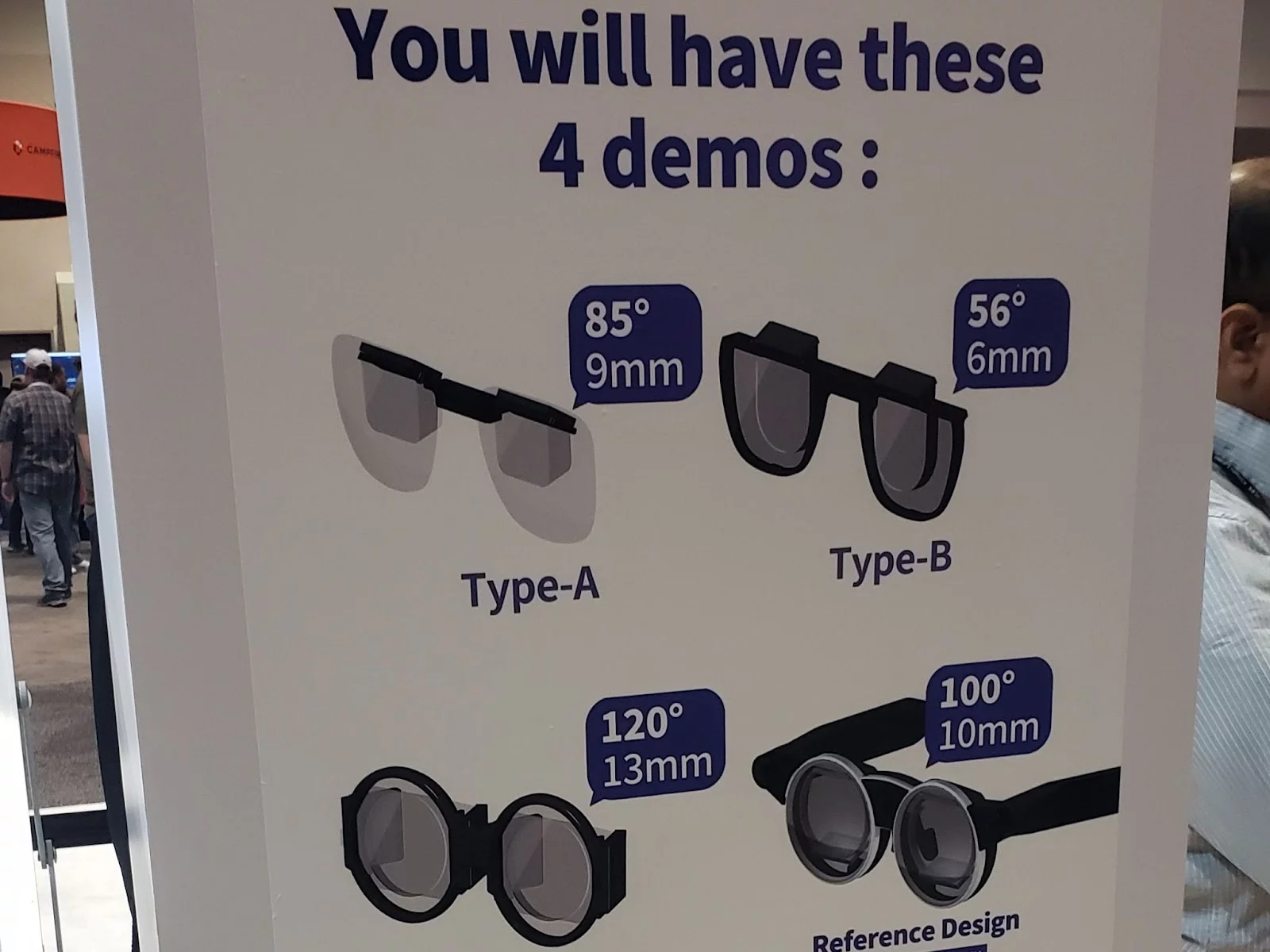
One example was Ant Reality demonstrating their mixed waveguide solution called Crossfire. While the displays (ranging in field of view from 56° to 120°) were impressive, what made them unique was their ability to do both AR and VR. At a press of a button, the surroundings would go completely dark, turning the augmented overlay into an immersive experience. Magic Leap 2 is known for offering what is called segmented dimming, but in the case of the Crossfire, the glasses would become completely opaque despite the AWE show floor being exceptionally bright.
Ant Display demonstrating their prototypes
Another never-before-achieved breakthrough was a light field display incorporated into an AR headset, courtesy of CREAL. Light field displays promise to solve a lot of issues, the most common one being correct focal depth. Harnessing the direction of light can produce outstanding results, but shrinking light field tech to fit into a glasses form factor still proves tricky. CREAL’s headset is an important, pioneering step in this field.
CREAL’s LFD headset
Another interesting innovation came from a company called Hypervision. Their claim to fame is their ultra-wide display capable of achieving a human vision 240° field of view. To make this happen, Hypervision used not one, not two, but four pancake lenses. Vertically, the screen has 95° so it doesn’t quite match the human eye top to bottom, but horizontally there’s full peripheral vision. While the stitching between the screens was slightly perceptible, the ability to achieve human FOV in such a small form factor is a massive step forward.
Hypervision
Overall, this means that the future generations of XR devices will have access to a wide variety of new, next-gen optics and display solutions, most of which are not even known to the general public. Display tech doesn’t follow Moore’s Law so it’s always difficult to make any specific predictions, but there’s clearly no stagnation in the field and some of the breakthroughs we saw this year are truly exciting.
This forms part of a larger trend of broadening the definition of spatial computing, which is sometimes expanded to include other real-world tools and technologies like visualizations, projection mapping, and 3D screens.
What also caught my eye was a noticeable reduction in locomotion solutions. Gone are the days of omnidirectional treadmills or big simulator seats. The only two exceptions were the unconventional EXIT SUIT, which suspends the wearer slightly above the ground allowing them to run in the air, sit, fly, and do a range of other motions (for which the team had won this year “AWEsome” award) and the Freeaim shoes that act like rollers, pushing the wearer backward as they walk.
This was the last AWE hosted in Santa Clara. From next year on, the event is moving to the Long Beach Convention Center. This shift to a new, bigger venue highlights the constant growth of the XR space and that’s one trend that speaks for itself.
Guest Post
About the Guest Author(s)
Mat Pawluczuk
Mat Pawluczuk is an XR / VR writer and content creator.
Meta introduced a new game called ‘Super Rumble‘ to Horizon Worlds, something the company hopes will showcase a new generation of improved experiences on its own social VR platform.
Released after a successful beta weekend in May, the free-for-all first-person shooter is said to highlight new improvements to Horizon Worlds, such as “better graphics, deeper gameplay, and a variety of quests and rewards.”
Players can choose from six superpowers before each session, allowing them to outmaneuver opponents and develop their playstyles. Here’s how Meta describes each power:
Super Dash gives you super speed
Super Jump lets you launch into the air with explosive force
Super Ammosaves you from having to reload
Super Tough reduces the damage you’ll take from each hit
Super Net lets you immobilize other players
Super Punch lets you attack with a powerful punch
Super Rumble is aiming to offer a fast-paced experience, which serves up to two to six players, with each match lasting five minutes. The game also serves as a launching point for a new integrated system of player levels, quests, rewards, the latter of which includes avatar clothing, emotes, and nameplate titles.
Check out the action below:
We’ve seen a few first-party worlds alongside a number of third-party brand engagement experiences on Horizon Worlds since the platform launched in late 2021, however going the ‘full featured’ minigame route is a fairly recent move that has more potential to attract and keep users. It’s certainly helped Rec Room to become one of the most prolific social VR platforms to thrive on both VR headsets and traditional flatscreen devices.
Interestingly enough, this comes only one day after Meta opened Quest up the online gaming powerhouse Roblox, which is in direct competition with Horizon Worlds. Now, Quest users can choose between Roblox, Rec Room, VRChat, Horizon Worlds, and Gym Class to name a few of the top free social VR platforms.
According to WHO, people with disabilities represent 16% of the world population. They also find transportation 15 times more challenging than non-disabled individuals. But for mobility to truly be sustainable, it has to go beyond reducing emissions; it has to be inclusive and cater for every member of society.
To this end, technology represents a beacon of hope as much as an invaluable tool. To find out more about its role in enabling universally accessible transportation, I spoke with Jonathan Chacón Barbero, Senior Accessibility Software Engineer at Cabify.
“Technology helps us overcome our limits.
Chacón Barbero joined the ride-hailing scaleup in 2019 and is the person behind the accessibility menu of its app. He has led a multi-year-long career in the design and development of accessible applications, and has worked as an accessibility consultant and lecturer. He is also amongst the few blind software engineers in Europe.
The <3 of EU tech
The latest rumblings from the EU tech scene, a story from our wise ol’ founder Boris, and some questionable AI art. It’s free, every week, in your inbox. Sign up now!
“The first time I got a personal computer as a child, it was love at first sight,” Chacón Barbero says. “That’s when I decided I wanted to be a computer scientist.”At the age of five he built his first software programme, and at the age of nine, he decided to focus on hardware.
Chacón Barbero could see with his right eye until he was 15 years old, at which point he fully lost his vision, leading him to work on software instead.
Jonathan Chacón Barbero. Credit: Cabify
“The worst moment in my life was when I became blind and I had to be out of technology for three months,” he recalls. “I didn’t know braille. I didn’t understand computers for blind people. I didn’t know anything about the blind world. I had to understand and study everything. I think at that moment, I set my mind for the rest of my life.”
He emphasises that from this point onwards, technology acquired a double meaning in his life: it was no longer just a passion, but also a tool to address challenges related to his condition.
“Technology helps us overcome our limits,” he adds. and And that’s what he set out to do.
Accessibility barriers and impact
The transportation challenges people with disabilities face go far beyond the lack of accessible ramps. Among others, they include inaccessible vehicles; poorly designed curbs, crosswalks, and sidewalks; and non-existent or inaccessible signage, wayfinding, and journey planning information.
Furthermore, studies have shown that social and infrastructural barriers render specific transport modes unavailable to travellers with disabilities and increase journey time. As a result, people with disabilities make fewer trips and travel shorter distances.
“Disability isn’t recognised by all of society yet.
In the UK, for instance, a 2022 survey found that one in five disabled individuals are unable to travel due to the lack of appropriate transport options, while one in four said that negative attitudes from other passengers prevent them from using public transport.
Chacón Barbero shares an example from his experience with using taxi services.
“I have to call a taxi company. I hold on the call as I’m waiting for the driver to arrive. But there is a problem: he doesn’t know that I can’t see the car and I can’t know where the car is. I waste time and money because there hasn’t been direct communication between the driver and the user.”
Putting tech to work
Optimistically, the past few years have seen an increasing number of both public and private initiatives employing new technologies to rise to the challenge of universal accessibility.
For instance, the city of Lyon has developed a public transport app that uses real-time data to assist disabled individuals in getting around, including a feature that helps them identify the most accessible itinerary and the shortest routes.
European startups are also getting active in the field. Think of London-based Wayfindr, which helps vision impaired people travel independently using audio navigation. Or Noteabox whose Button App enables users to press buttons — such as those on pedestrian crossings — through their smartphone.
“Technology is the solution to many accessibility aspects.
Cabify presents another example of how technology can increase inclusiveness in ride-hailing services.
When Chacón Barbero joined the Spanish scaleup, his first step was to build a semantic basement for the app’s digital interface to enable the gradual addition of multiple accessibility features and disability profiles. During the same year, Cabify’s app became 100% accessible for blind people.
In 2020, the company launched its accessibility menu. Since then, it has been adding functionalities and expanding its target groups, such as the hearing impaired, individuals with cognitive disabilities, and the elderly.
“We created a special menu for accessibility in our journey to offer the user the possibility to identify their special needs,” says Chacón Barbero.
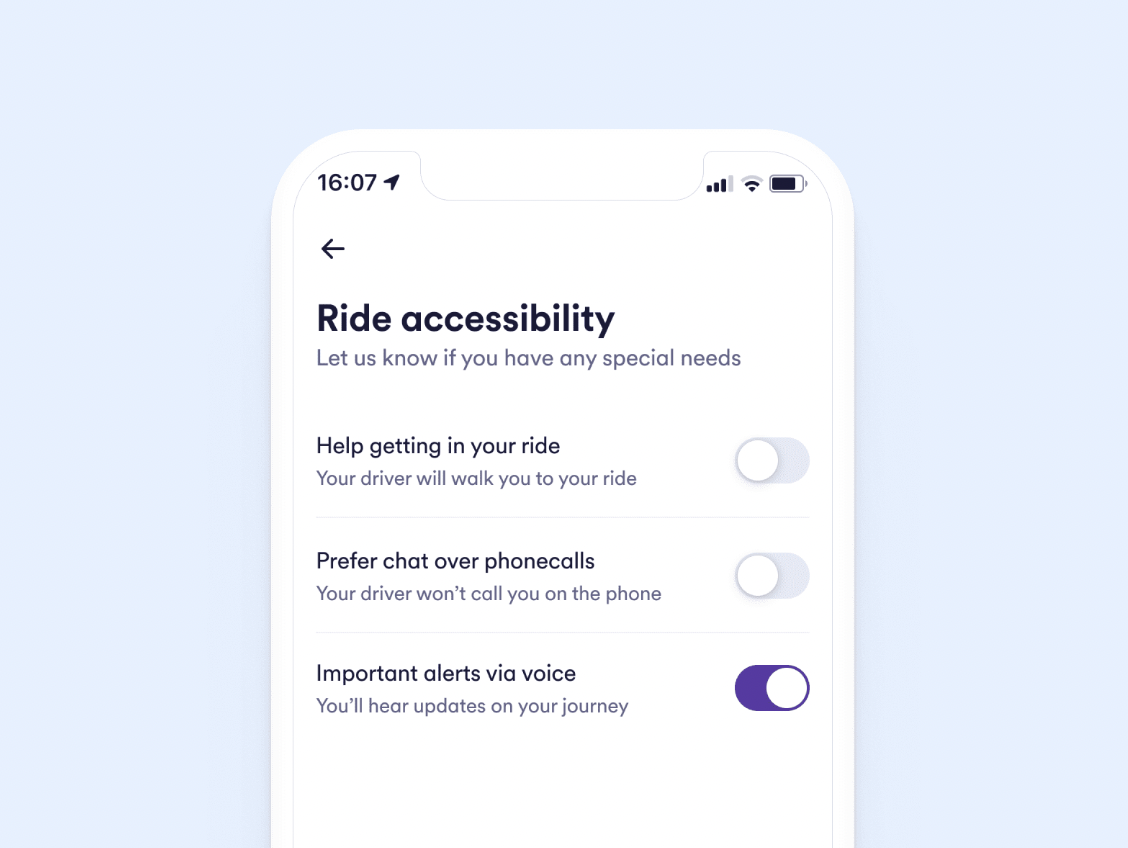
Users can choose between the three options displayed in the image below:
Cabify’s accessibility menu. Credit: Cabify
The first option is designed to help the visually impaired, the elderly, and people with reduced mobility inform drivers that they need help reaching the vehicle.
For users with a hearing impairment, the second accessibility option offers the possibility to chat instead of calling. Finally, receiving and playing back important alerts via voice caters for multiple groups, such as the elderly, the visually impaired, and individuals with cognitive impairments.
According to Cabify, by the end of 2022, over 99,000 users had activated at least one of the accessibility menu functionalities. Now, this number exceeds 110,000 users worldwide.
Chacón Barbero says that non-disabled users have also activated the accessibility features as they feel they optimise the experience. He mentions the preference for a bigger font size and the option to chat instead of calling “simply because many people hate phone calls.”
But for Chacón Barbero his work is far from over — on the contrary, he champions the need for continuous improvement. His future plans include adding new in-app functionalities, extending the disability user profiles, and increasing the number of accessible cars.
The biggest barrier to break
For Chacón Barbero the biggest barrier to inclusive mobility is the lack of awareness and social acceptance.
“Accessibility is unknown, because disability is not recognised by all of society yet. Only when you have a friend, a parent, or someone in your environment with disabilities, do you understand what accessibility is. And that’s the problem,” he says.
Eurostat’s numbers are telling: in 2022, 29.7% of the EU population with disabilities aged over 16 were at higher risk from poverty or social exclusion.
Chacón Barbero hopes that, in the future, society will be more inclusive and recognise that people with disabilities are, above all, people. He believes that the younger generations can drive change forward by further embracing individuals who are different and diverse.
“Technology is the solution to many aspects related to accessibility, but it has its limits,” Chacón Barbero concludes, pointing to the need for human action as well. “The solution isn’t only technology. The solution is technology for people and with people.”
On a typical visit to a sports stadium, you don’t bump into 20-metre-tall giants outside the gates. But this isn’t your typical sports stadium. It’s the MLB virtual ballpark — the first metaverse for a pro sports league.
The venue opened on July 8, for a watch party during Major League Baseball’s All-Star Weekend. Hosting the event were the aforementioned giants, who begin the festivities with a tease:
“Who knows what prizes will be up for grabs? Make sure you explore and have fun.”
The incentives for engagement are accentuated. Sure, you could just chat with fellow fans and watch the game on the venue’s jumbotrons, which flick into full-screen mode on your device. But the giants really want you to collect points for prizes. They offer myriad ways of winning them: traversing the site, playing mini-games, doing quizzes, collecting baseball cards, or just staying till the final whistle.
The friendly giants kindly shrunk down to human size before entering the stadium. Credit: Improbable
As a purist, it can’t compare with the traditional matchday experience of pre-match beers, expletive-laden chants, and good old-fashioned hooliganism. But this isn’t a traditional matchday experience. The target audience is fans watching in homes around the world — and there are big opportunities to monetise them.
Surveys show that most TV viewers are also using second screens. Among Gen Z and Millenials, the percentage is as high as 95%. While watching sports, they’re also using social media, shopping, texting, and gaming. Gen Z is also twice as likely to pay for sports content than boomers are. But they’re far less likely to watch entire live events.
“We know that the older generations are still consuming the full event in a more traditional experience,” said Luis Vicente, chairman of Apex Capital, a sports and entertainment investment company. “For the younger audience, you need to be more innovative and keep delivering them content in new and fresh ways that fit with how they naturally want to consume their favourite sporting moments”
The MLB virtual ballpark promises to integrate these methods of consumption. But more proof is needed that it’s more than just a gimmick or a Second Life knock-off.
“Then the value propositions of what that space enables come to life.
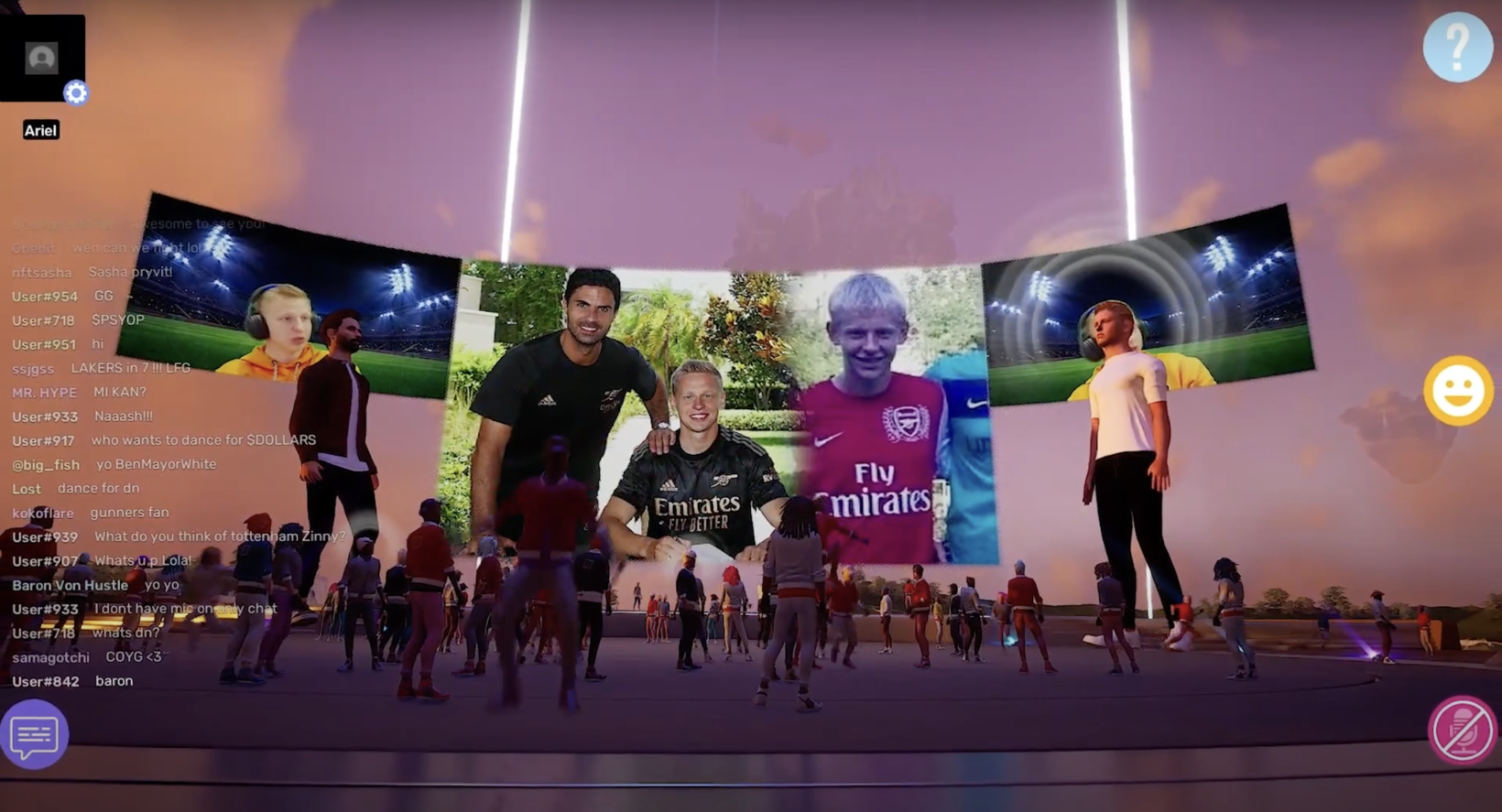
A few days later, there’s a new attempt to convert the cynics. Another virtual world has opened for a very difficult sporting experience: a Q&A with Nwankwo Kanu, an iconic former footballer for English side Arsenal.
In this virtual world, the focus shifts from leagues and teams to athletes and communities. Over 1,100 attendees could interact with one another and Kanu. Adding a sprinkle of stardust to the session was Oleksandr Zinchenko, a stalwart of the current Arsenal team, who popped by to ask a question. There was also a more formal interview, hosted by Robbie Lyle, the founder of Arsenal fan platform AFTV.
“Football is all about opinions and these experiences allow for fans to come and converse about football,” said Lyle. “I see the metaverse becoming another platform like Twitter, TikTok, YouTube where fans can engage and have fun together.”
Both the ballpark and the Kanu Q&A were developed by Improbable, a London-based tech firm. Founded in 2012, the company’s massive simulations have attracted a $3bn (€2.7bn) valuation, but the path to profitability has been a rocky one. In 2021, the company recorded losses of £152mn.
The following January, Improbable unveiled a new strategy: a pivot away from multiplayer games and towards tech’s latest obsession: the metaverse.
Moving to a new world
After the announcement, Improbable sold its stakes in game studios Midwinter and Inflexion, as well as its defence and national security business. In their place was a new focus on critical infrastructure for virtual worlds — the plumbing of the metaverse.
The bedrock of the project is Improbable’s Morpheus technology. A descendant of the company’s earlier SpatialOS product, Morpheus provides a sense of presence and social interactions for over 10,000 people in dense virtual spaces.
Morpheus also powers the centrepiece of Improbable’s strategy: MSquared (M2) — a network of interoperable metaverses. Launched in June, the network combines technologies, services, and standards — as well as $150mn (€138mn) in funding — to provide and interlink digital experiences.
Among the early users is the MLB virtual ballpark, which can tap M2 to interconnect with other virtual worlds.
“Now that baseball fans can technically hang out with football fans on M2, you might find some very strange crossovers and connections,” Herman Narula, the CEO and co-founder of Improbable, tells TNW.
Narula initially ran Improbable from his parent’s house in Hertfordshire, England. Credit: Improbable
Despite growing scepticism about the metaverse, Narula, remains bullish about his ambition. He argues that clearer use cases are emerging.
“I think it’s a lot like the dot-com boom,” Narula tells TNW over Zoom. “We all remember the crash, but what happened after the crash was really amazing companies formed. Because the world had the right idea. Yes, online experiences were going to matter a lot. But it took time for the technology, the consumer awareness, and the experiences to catch up.”
Narula recalls a famous Bill Gates appearance on the Late Show with David Letterman. It was 1995, and Microsoft had just launched Internet Explorer — its first online tool. Patiently, Gates told his host about the internet’s potential.
Letterman was unimpressed. Derisively, he referenced a “breakthrough” about a baseball game being streamed online. “You could listen to a baseball game on your computer. And just thought to myself, does radio ring a bell?” he scoffed.
Undeterred, Gates explained that fans could watch the game whenever they wanted. ″Do tape recorders ring a bell?” Letterman quipped.
Narula thinks we’re at a similar moment for sports in the metaverse. Initially, he admits, most fans don’t recognise the possibilities.
“But then the value propositions of what that space enables come to life. You could meet football players, interact with them or see their interviews, but to have the entire crowd seen by them — that ended up being the killer feature. That completely changed everything. That changes everyone’s attitude, that changes everyone’s reactions, that provides more fulfilment.”
Sport enters the metaverse
Metaverse boosters have high hopes for sports. Analysts at investment firm Web3 Studios predict that the value of the sports metaverse could hit $80bn (€72.3bn) by 2030.
Naturally, such optimistic estimates will provoke cynicism — particularly when they serve a vested interest. But sports are notoriously undermonetised.
Take the football club Manchester United. The English side is estimated to have 1.1 billion fans — the most of any team in the world. In the financial year ending June 2022, the club recorded revenues of £583.2mn (€674.9mn), which means United effectively generated just €0.61 per fan that year.
Amazon, by contrast, has previously reported 200 million unique monthly visitors in the US alone. Across a year, they’re monetised at an annual revenue of over €902 per visitor.
“What keeps people on the platform is each other.
Gaming also gets more money from users. In 2020, Blizzard Entertainment, the maker of World of Warcraft, generated $62 in revenue per monthly active user. That money comes through sales of games and in-game spending — two avenues that sports can capitalise on.
Improbable is betting that the metaverse can close the gap for sports. The company envisions various new revenue streams for the sector, from virtual experiences and digital apparel to broadcast models and advertising services.
“In terms of economics, it’s really simple,” says Narula. “If the metaverse succeeds, it will vastly increase the value of sport.”
The ballpark experience extends from inside the stadium to the surrounding area. Credit: Improbable
The metaverse is often described as an extension of gaming. Improbable, however, has pitched a very different business model. At its core is interoperable virtual worlds.
The plan dramatically expands an immensely popular feature of Fortnite and Roblox. Both gaming platforms — sometimes described as “proto-metaverses” — allow creators to build and monetise their own content. But the content remains economically locked to the platform.
Evidently, the proposition is still attracting interest from the sports sector. The NFL, for instance, has produced a Roblox experience, where fans can build stadiums, draft teams, and roleplay as franchise owners.
“Suddenly, my business has more value.
With over 66 million daily Roblox users, the project has obvious promotional appeal. The product, however, is trapped in Roblox — which limits its scope.
“You can’t really build a business on someone else’s business where they’re taking a ridiculous percentage. But more importantly, they control the relationship with the user,” says Narula.
The MLB ballpark, by contrast, is a white-label product. Users enter by clicking a link on the Major League Baseball website. There’s no M2 logo in the experience, but the network allows digital assets to move between virtual worlds, which opens up cross-platform opportunities. A Red Bull Salzburg sports kit, for instance, could be sold and worn in multiple arenas — and give you wings in all of them.
“You’re building a strong network effect, because what keeps people on the platform is each other,” says Narula. “It’s the cross-referencing of their content; it’s the fact that I can take my Kanu-signed shirt to a baseball match, that makes it more valuable.”
Cross-marketing is a key revenue stream for the sports metaverse. Credit: Improbable
Network effects are integral to the sports metaverse. In current virtual worlds — such as Meta’s — assets can’t be used outside the platform, which inhibits the network effects. Improbable, however, applies a more decentralised strategy.
The company designed M2 as a utility, with profit captured by using the service. After a business creates an experience, it can spread the asset across the entire network.
“By being part of the network, I get users from baseball, I get users from football, and I get to sell items that can be more valuable in other places,” says Narula. “Suddenly, my business has more value.”
Another crucial concept is “intimacy at scale.” In essence, this transmits the atmosphere and interactions from physical events to online spaces. To make this feeling accessible, the technical requirements must be minimised.
Improbable takes a dual approach to the issue. One option provides access to the metaverse via an internet connection and a basic smartphone, laptop, or desktop. But if users don’t have fast broadband, an AI-powered bandwidth compressor can condense a virtual world into only the specific updates that they need to see.
According to Narula, the system can condense the requirements of some cases to under 1Mbps.
“It’s vitally important that we get away from the idea that the metaverse requires a $3,000 headset,” he says. ”I want to reach an Arsenal fan on 3G anywhere in the world.”










![highlighting-the-top-3-xr-trends-of-2023-[insights-from-this-year’s-awe-usa]](https://theverysoon.com/wp-content/uploads/2023/08/79832-highlighting-the-top-3-xr-trends-of-2023-insights-from-this-years-awe-usa-1024x576.webp)