Author name: Tim Belzer

netflix-plans-to-bring-streaming-into-the-$1-trillion-club-by-2030

Netflix plans to bring streaming into the $1 trillion club by 2030

Netflix doesn’t plan to disclose subscriber counts anymore, but one of WSJ’s anonymous sources said that the streaming leader wants to have 410 million subscribers by 2030. That would require Netflix to add 108.4 million more subscribers than it reported at the end of 2024, or about 21.7 million per year, and expand its global reach. In 2024, Netflix added 41.36 million subscribers, including a record number of new subscribers in Q4 2024.

Netflix plans to release its Q1 2025 earnings report on April 17.

$1 trillion club hopeful

Should Netflix achieve its reported goals, it would be the first to join the $1 trillion club solely through streaming-related business. The club is currently populated mostly by tech brands, including two companies that own Netflix rivals: Apple and Amazon.

Netflix is, by far, the most likely streaming candidate to potentially enter the lucrative club. It’s currently beating all other video-streaming providers, including Amazon Prime Video and Disney+, in terms of revenue and profits. Some streaming businesses, including Apple TV+ and Peacock, still aren’t profitable yet.

Netflix’s reported striving for a $1 trillion market cap exemplifies the meteoric rise of streaming since Netflix launched its streaming service in 2007. As linear TV keeps shrinking, and streaming companies continue learning how to mimic the ads, live TV, and content strategies of their predecessors, the door is open for streaming firms to evolve into some of the world’s most highly valued media entities.

The potential for Netflix to have a trillion-dollar market cap also has notable implications for rivals Apple and Amazon, which both earned membership into the $1 trillion club without their streaming services.

Whether Netflix will reach the goals reported by WSJ is not guaranteed, but it will be interesting to watch how Netflix’s strategy for reaching that lofty goal affects subscribers. Further, with streaming set to be more central to the viewing of TV shows, movies, and live events by 2030, efforts around things like ads, pricing, and content libraries could impact media consumption as we head toward 2030.

Netflix plans to bring streaming into the $1 trillion club by 2030 Read More »

here’s-how-a-satellite-ended-up-as-a-ghostly-apparition-on-google-earth

Here’s how a satellite ended up as a ghostly apparition on Google Earth

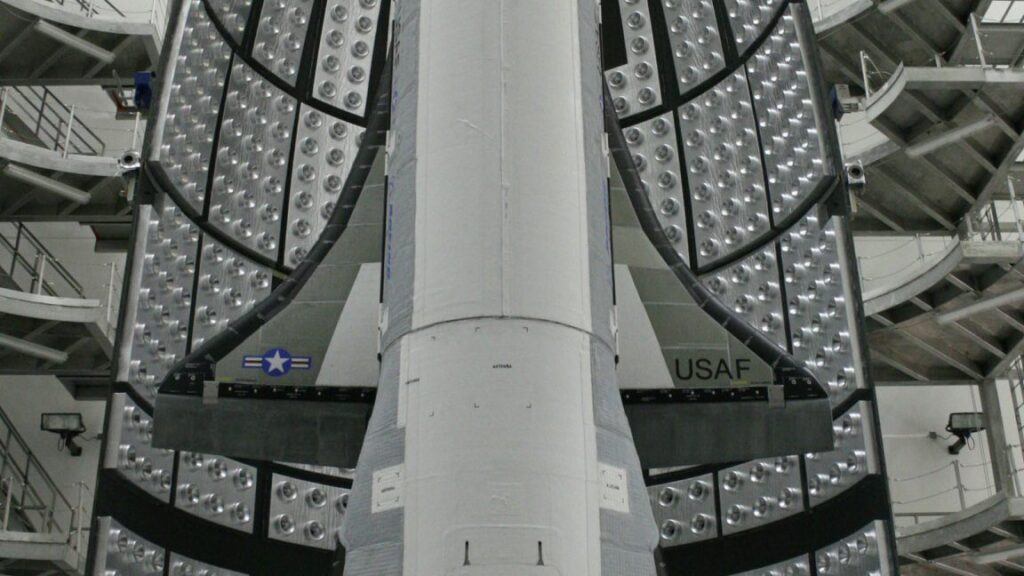
Regardless of the identity of the satellite, this image is remarkable for several reasons.

First, despite so many satellites flying in space, it’s still rare to see a real picture—not just an artist’s illustration—of what one actually looks like in orbit. For example, SpaceX has released photos of Starlink satellites in launch configuration, where dozens of the spacecraft are stacked together to fit inside the payload compartment of the Falcon 9 rocket. But there are fewer well-resolved views of a satellite in its operational environment, with solar arrays extended like the wings of a bird.

This is changing as commercial companies place more and more imaging satellites in orbit. Several companies provide “non-Earth imaging” services by repurposing Earth observation cameras to view other objects in space. These views can reveal information that can be useful in military or corporate espionage.

Secondly, the Google Earth capture offers a tangible depiction of a satellite’s speed. An object in low-Earth orbit must travel at more than 17,000 mph (more than 27,000 km per hour) to keep from falling back into the atmosphere.

While the B-2’s motion caused it to appear a little smeared in the Google Earth image a few years ago, the satellite’s velocity created a different artifact. The satellite appears five times in different colors, which tells us something about how the image was made. Airbus’ Pleiades satellites take pictures in multiple spectral bands: blue, green, red, panchromatic, and near-infrared.

At lower left, the black outline of the satellite is the near-infrared capture. Moving up, you can see the satellite in red, blue, and green, followed by the panchromatic, or black-and-white, snapshot with the sharpest resolution. Typically, the Pleiades satellites record these images a split-second apart and combine the colors to generate an accurate representation of what the human eye might see. But this doesn’t work so well for a target moving at nearly 5 miles per second.

Here’s how a satellite ended up as a ghostly apparition on Google Earth Read More »

after-harvard-says-no-to-feds,-$2.2-billion-of-research-funding-put-on-hold

After Harvard says no to feds, $2.2 billion of research funding put on hold

The Trump administration has been using federal research funding as a cudgel. The government has blocked billions of dollars in research funds and threatened to put a hold on even more in order to compel universities to adopt what it presents as essential reforms. In the case of Columbia University, that includes changes in the leadership of individual academic departments.

On Friday, the government sent a list of demands that it presented as necessary to “maintain Harvard’s financial relationship with the federal government.” On Monday, Harvard responded that accepting these demands would “allow itself to be taken over by the federal government.” The university also changed its home page into an extensive tribute to the research that would be eliminated if the funds were withheld.

In response, the Trump administration later put $2.2 billion of Harvard’s research funding on hold.

Diversity, but only the right kind

Harvard posted the letter it received from federal officials, listing their demands. Some of it is what you expect, given the Trump administration’s interests. The admissions and hiring departments would be required to drop all diversity efforts, with data on faculty and students to be handed over to the federal government for auditing. As at other institutions, there are also some demands presented as efforts against antisemitism, such as the defunding of pro-Palestinian groups. More generally, it demands that university officials “prevent admitting students hostile to the American values and institutions.”

There are also a bunch of basic culture war items, such as a demand for a mask ban, and a ban on “de-platforming” speakers on campus. In addition, the government wants the university to screen all faculty hires for plagiarism issues, which is what caused Harvard’s former president to resign after she gave testimony to Congress. Any violation of these updated conduct codes by a non-citizen would require an immediate report to the Department of Homeland Security and State Department, presumably so they can prepare to deport them.

After Harvard says no to feds, $2.2 billion of research funding put on hold Read More »

monthly-roundup-#29:-april-2025

Monthly Roundup #29: April 2025

In Monthly Roundup #28 I made clear I intend to leave the Trump administration out of my monthly roundups, for both better and worse, outside of my focus areas. Again, this does not mean I don’t have a lot to say or that those questions don’t matter. It means you should not rely on me as your only source of news and I pick my battles.

They are not making this easy.

I am going to stick to my guns. Trade and trading very much inside my focus areas, but for economics roundups, and in extreme cases AI roundups. Besides, you don’t need me to tell you that tariffs not only impose immense economic costs but also fail to achieve their primary policy aims and foster political dysfunction along the way. That question should already be answered by my t-shift. I do have a word about things related to a potential expansion (I can’t believe I’m typing this!) of the Jones Act. And I’ll deal with certain crime-related things when I do my first crime roundup.

  1. Bad News.

  2. Antisocial Media.

  3. Technology Advances.

  4. Variously Effective Altruism.

  5. Government Working.

  6. Jones Act Watch.

  7. While I Cannot Condone This.

  8. Architectural Musings.

  9. Quickly, There’s No Time.

  10. Don’t Sell Your Soul, You Won’t Get Paid.

  11. What To Do Instead.

  12. Good News, Everyone.

  13. We’re Elite, You’re Not.

  14. Enjoy It While It Lasts.

  15. For Your Entertainment.

  16. An Economist Gets Lunch.

  17. I Was Promised Flying Self-Driving Cars and Supersonic Jets.

  18. Gamers Gonna Game Game Game Game Game.

  19. Sports Go Sports.

  20. The Lighter Side.

23andMe is going into bankruptcy. It would seem a wise precaution to download and then delete your data if it’s there, which takes a few days to do, in case the data falls into the wrong hands or is lost forever.

Young men who make 9 figures by default get driven crazy, all checks and balances on them now gone.

This graphic is quite good.

That’s a variation on this classic, worth revisiting periodically as a reminder:

A claim that banning smoking in bars increases alcohol consumption by ~5% without decreasing smoking. I presume the increased alcohol consumption is because the bar became a much better experience without all the smoking? It seems bizarre that this wouldn’t decrease smoking, especially over the long term.

Beware communities that encourage irresponsible risk taking and dismiss those who do not endanger themselves. It can be good if targeted well: There are places, like founding startups and putting yourself out there for romance, where people take far too little risk and it is often good to encourage people to take more. But this very much doesn’t apply to, for example, talk about financial investments.

If you use Twitter via the For You page, You Fool. Yet many of you do exactly that.

I even hear people complaining about ‘the algorithm’ without doing the obvious and switching to chronological feeds and lists. That’s on you.

As far as I know this is the size-adjusted record, yes, and well earned.

Kelsey Piper suggests Twitter’s conversational meta favors long tweets because they attract thoughtful people, plus you get the bonus of QTs saying tldr. That hasn’t been my experience, but I also try to have those conversations elsewhere.

Twitter is restricting the ability to see who other people are following. This is not obviously bad. I would like to be able to follow people without worrying about what it looks like. In practice I don’t care but there are people for whom this matters.

A great question, why is there such huge variance in self-checkout system quality? We have essentially solved self-checkout technology yet half of stores have multiple employees whose job is to fix errors because their terrible software doesn’t work. So yeah, diffusion can be hard.

I don’t want to zipline, unless it’s this zipline:

Ryan Peterson: While everyone in business is busy losing their minds about tariffs, @zipline just quietly launched a logistics revolution in Dallas, TX. You can now get anything at a Walmart delivered to your front door by drone, with a flight time under 2 minutes for most orders.

@DanielLurie We gotta legalize drone delivery in San Francisco.

If you live in Dallas download the app here and starting buying stuff from Walmart before the prices go up!

Nearcyan rants about how awful the developer experience is on Google Play, someone from Google reaches out and the related problems get instantly solved. This can directly be linked to Google’s incentive structures not rewarding anyone for making existing products work properly.

Andrej Karpathy provides ‘no-brainer’ suggestions for personal security, such as having a distinct credit card for every online transaction and using a virtual mail service.

The full agenda he spells out as the baseline minimum seems like an obviously massive overkill level of security for almost anyone. What is Andrej’s hourly rate? Some of this is worthwhile, but as Patrick McKenzie reminds us, the optimal rate of fraud is not zero.

It actually did make me feel better about Signal until everyone saying that caused me to learn about all the ways various other apps compromising your phone can also compromise Signal.

Alice Maz: the good part of the signal leak is it implies a bunch of people with ts/sci access don’t know anything we don’t that would make them distrust signal.

My current model is that Signal is the best low-effort secure communication method, but not on its own good enough that you should assume that using Signal on a normal phone is an actually secure communication method against someone who cares.

Signulll warns against artificial scarcity. I am a lot less skeptical.

Signulll: one of the most common mistakes in product thinking is the belief that you can reintroduce artificial scarcity to improve something that has already been made abundant—especially by the internet (& the internet makes almost everything feel abundant). after people have experienced the infinite, you can’t shove them into a box & expect them to enjoy it. the brain doesn’t forget oxygen.
this shows up in products that add fake constraints: one post a day, one profile at a time, one action per hour. the assumption is that limiting access will restore value or mystery. it doesn’t. once the user has tasted abundance, constraint doesn’t feel elegant or intentional—it feels broken. worse, it feels patronizing.
artificial scarcity almost never works unless it’s intrinsic to the product. you either have to make abundance feel valuable (curated, contextual, high signal), or find a new mechanic entirely. nostalgia for constraint is not strategy. it’s just denial of the current physics of the medium.

this is an extension to this. i see this type of thinking all the time, particularly when people who are frustrated at the current dynamics of any given network (e.g. a dating app etc.)

Nogard: Agree and great point. Modern dating apps unleashed an irrational level of abundance and optionality—so much that it bled into the physical world, warping its constraints. You can’t trick anyone with artificial scarcity; they’ve already tasted the forbidden fruit. It’s like trying to enjoy tap water after a decade of chugging Monster Energy.

Games, especially free mobile games, are chocked full of artificial scarcity. For the most successful games, everything is limited or on a timer. People find this highly addictive. They eat it up. And often they also pay quite a lot to get around those restrictions, that’s often the entire business model. So there’s a big existence proof.

What games try to do is justify the artificial scarcity. When this is done well it works great. So the question now becomes, can you make the artificial scarcity fun and interesting? Can you make it addictive, even? A maximization problem of sorts? Or tie it into your ‘game mechanics’?

I think you absolutely can do all that in many cases, including in dating apps.

First of all, limited actions really do restore value to that action. The frictions and value this introduces can do many useful things. The ideal friction in many cases is money, the amounts can be quite small and refundable and still work. But in cases where you cannot use money, and there are many good reasons to not want to do that, using an artificially scarce currency seems great?

If I was dating, I would rather be on a dating app where I can only match once a day and those I match with know this, than one in which I don’t have that restriction.

Scott Alexander can’t let go of the drowning child argument, going highly technical around various details of hypothetical variations in remarkably dense fashion without seeming that actually interested in what is centrally going on.

Kelsey Piper discusses the administrative nightmare that is trying to use your home to do essentially anything in America. There is no reason for this. If people could easily run microschools and tea shops out of their homes America would be a much better place.

Massachusetts bans heavy-duty truck sales until the trucks can go electric.

Claim that TSA employees are actively happy about the attacks on their union, because the union was preventing the purging of bad actors. I wouldn’t have predicted this, but it shouldn’t be discounted as a possibility. Many comments confirmed that this has recently improved the TSA experience quite a bit. Yes, we shouldn’t need the service they provide, but we’ve decided that we do so better to do a decent job of it.

RFK Jr. proposes banning cell phones in schools… because of the ‘electric magnetic radiation’ he hallucinates they give off.

Jesse Singal: hopefully just the start of RFK Jr making good proposals for hilarious reasons

“We should promote whole grains, because the Illuminati has a stranglehold on processed carbs”

“Everyone should get 30 mins of exercise a day to stay a few steps ahead of your own shadow-daemon”

A word of warning, in case you think the tariffs were not great, that we might be about to not only not repeal the Jones Act but to do things that are vastly worse:

Ryan Peterson: On April 17th the U.S. Trade Representative’s office is expected to impose fees of up to $1.5M per port call for ships made in China and for $500k to $1M if the ocean carrier owns a single ship made in China or even has one on order from a Chinese shipyard.

Ocean carriers have announced that to reduce the fees they will skip the smaller ports like Seattle, Oakland, Boston, Mobile, Baltimore, New Orleans, etc. Some carriers have said they’ll just move the capacity serving the U.S. to other trade lanes altogether.

This would be horrible for jobs in and around those ports, and really bad for companies, both importers and exporters, using those ports. Huge extra costs will be incurred as trucks and trains run hundreds of extra miles to the main ports on each cost.

Similarly the major ports (LA, Long Beach, Houston, and New York) will be unable to keep up with the flood of extra volumes and are likely to become congested, similar to what we saw during Covid.

The craziest part of the original proposal is a requirement that within 7 years 15% of U.S. exports must travel on a ship that’s made in America and crewed by Americans.

There are only 23 of American made and crewed container ships in the world today, and they all service domestic ocean freight (Alaska, Hawaii, Guam, Puerto Rico, etc). They’re all tiny compared to today’s mega ships, and they’re not even sailing to overseas ports.

The U.S. did not produce any container ships in 2024. And the number we produce in any given year rounds to zero. The reason is that American made container ships of 3,000 TEUs cost the same price as the modern container ships from China of 24,000 TEUs.

Colin Grabow: The last time a US shipyard built Suezmax tankers (2004-2006) the price was $210 million each. Now we’re apparently at $500 million with a 6x delta versus the foreign price.

The Jones Act is caught in a vicious circle. Costs spiral, leading to lowered demand for new ships, which drives costs even higher. There’s very little appetite for ships at these prices. The law is self-destructing.

The full proposal to require US ships would drastically reduce American exports (and even more drastically reduce American imports). As in, we’d have to go without most of them, for many years. There’s no way to quickly ramp up our shipyards sufficiently for this task, even if price was not a factor. The port of call fees are a profoundly terrible idea, but the ship origin requirements are riot-in-the-streets-level terrible.

The rhetoric is largely about Chinese-built vessels being terrible or a security risk. Even if one buys that, what one could do, both here and for the original Jones Act, is simply to restrict the specific thing you don’t like: Chinese-built, Chinese-flagged or Chinese-owned ships. Or even require the ships come from our allies. It wouldn’t be a free action, but we could substitute into Japanese, South Korean or European ships. Whereas if you demand American ships? They don’t exist. And having 100 years of such restrictions domestically has only ensured that.

It seems highly reasonable to be confused as to why this happened:

Maxwell Tabarrok: This is actually pretty confusing to me. The Jones Act should be a subsidy to domestic shipbuilding but the industry is completely dead.

I’ve written before that this might happen when protection creates a domestic monopoly, but I’m not so convinced by my own explanation.

The answer is that when you create a domestic monopoly or oligopoly without export discipline, you allow domestic industry to not compete on the international market, and instead they find it more profitable to service only the domestic protected market. We can’t compete on the international market even if we want to, because others offer large subsidizes and are already more efficient in various ways, so no one wants our ships and we can’t use that to improve or scale.

Unfortunately, the domestic market is not large enough to generate robust competition that creates reasonably priced ships, which decreases demand and causes shipbuilders to get less competitive still, pushing prices even higher, until the point where domestic ships are so expensive that more than a handful of Jones Act ships aren’t profitable. So at the end of the death spiral, we don’t make them anymore.

If you decide we need a domestic shipbuilding industry, there is a known playbook in these spots, which is to offer large subsidies and also enforce export discipline, as for example South Korea did during its development. No one seems to want to do that.

A discussion about many things, but the later more interesting part is about dealing with cognitive decline. In particular, a sadly common pattern is that you have someone who used to be unusually intelligent and capable. Then, for a variety of reasons including getting older and a toxic information and reward environment, and because having to ‘act dumb’ in various ways actually makes you dumb over time, and often probably drug use, they lose a step, and then they lose another step.

Now they are still well above average for intelligence and capability, but their self-image and habits and strategies are designed for their old selves. So they take on too much, in the wrong ways, and lose the thread.

Tantum has a mostly excellent thread about the difference between a rival and an enemy, or between positive-sum rivalry and competition versus zero-sum hostility, although I disagree with the emphasis he chosen for the conclusion.

Megan McArdle reminds us that Levels of Friction are required elements of many of civilization’s core systems, and without sufficient frictions, those systems break.

Dilan Esper: i think people don’t realize the extent to which easier and cheaper travel, the Internet, and fake asylum applications have wrecked the international asylum system carefully built after the Holocaust. Poland is a particularly sobering indicator of this.

Megan McArdle: We underestimate how many policies are only feasible because various frictions prevent abuse. When the frictions are lubricated, the policies collapse.

Alex Tabarrok asks, if we were confident Covid-19 was a lab leak, what then? His first conclusion is we should expect more pandemics going forward. That’s not obvious to me, because it means less natural pandemics and higher risk of lab-originated pandemics. It is within our power to prevent lab-originated pandemics but not natural pandemics, and indeed Alex’s core suggestions are about ensuring that we at least do our research under sufficiently safe conditions – I’d prefer that we not do it at all. Note that Alex would be right about expectations if we already had confidence in the rate of natural pandemics, but I think we largely don’t know and it may be changing.

The kind of study one instinctively assumes won’t replicate says that those who believe in the malleability specifically of beauty will therefore take more risk, as in if you give people articles showing this then they’ll take more risk, but malleability of intelligence doesn’t have the same impact. The theory is that this is mediated through optimism?

Matt Lakeman asks, quite literally from a real example: How Much Would You Need to be Paid to Live on a Deserted Island for 1.5 Years and Do Nothing but Kill Seals? Plus another year in transit to boot. He estimated $2-4 million, and the real workers were clearly paid far less. But that’s the thing about such jobs – you don’t have to pay anything like what the median person would need to take the job. Someone will do it for a lot less than that, and I’m guessing the median young person would come in well under $2 million already.

The ‘vibe shift’ arrives at Princeton, and certainly on Twitter.

Paul Graham: If Princeton students think the “vibe shift” is real, it is, because if it has reached them, it has reached pretty much everyone.

I don’t buy that this means it has reached everyone. The Ivies and Twitter are both places where the future is more highly distributed, that respond more to vibe shifts. It would make perfect sense for such places to feel a vibe shift, while students at (let’s say) Ohio State or other residents of Columbus felt relatively little change.

Are Monte Carlo algorithms hacks to be avoided? They are hacks, and randomization is dangerous, this is true. But sometimes, they’re the only way to get an estimate given the amount of complexity. There is also an underused variation, which I call the Probability Map. This is where you can simplify the set of relevant considerations sufficiently that you can track the probability of every possible intermediate state. To work this usually requires not caring about path dependence, but this simplification is more accurate more often than you would think.

A cool note from Christopher Alexander, I’m still a little bummed I never got to properly review A Pattern Language and it’s probably too late now.

A Pattern Language:

179. Alcoves

180. Window Place

181. The Fire

185. Sitting Circle

188. Bed Alcove

191. The Shape of Indoor Space

205. Structure Follows Social Spaces

A Time to Keep: “Make bedrooms small, and shared spaces big.” – CA

If you want a family to be together, don’t isolate them in giant bedrooms. Draw them toward the hearth, the table, the common room.

I keep my bedroom large, but that is because I work and exercise there. The isolation effect is intentional in those spots. In general, you want the bedroom to be the minimum size to accomplish its specific goals, and to spend the rest of your space on the common areas.

We definitely need a word for this. Claude suggested ‘attention saturation’ or ‘bid overflow’ but they’re two words and also not quite right.

Nick Cammarata: I’m surprised we don’t have a word for the shift when the bids for your time goes above your supply for time vs before, it feels like a pretty fundamental life shift where it changes your default mode of operation.

like if you get 200 bids for your time a week vs 2 the set of things you need to do to thrive are pretty different, different risks and ways to play your hand, need to defend energy in new ways

it ofc depends on your psychology too, you might be built to handle X amount of bids per week, it’s less about the absolute amount of bids and more the ratio of bids to what you can easily handle.

I’ve gone through this a number of times. I have a system where I determine how to allocate time, and how to respond to bids for time, both from people and from things. Then suddenly you realize your system doesn’t work, quickly, there’s no time. There needs to be a substantial shift and a lot of things get reconsidered.

I kind of want to call this a ‘repricing,’ or for full a Time Repricing Event? As with other things, you have menu costs, so you only want to reprice in general when things are sufficiently out of whack.

My experience matches Kelsey Piper’s here.

Kelsey Piper: every single time I have witnessed people decide to compromise on character and overlook major red flags because ‘hey, he’s good at winning’, they have regretted it very dearly and in very short order

cutting corners, lying, and cheating will get you ahead in the short run, and sometimes even in the long run, but tying your own fortunes to someone who behaves this way will go very badly for you.

if you sell your soul to the devil you’ll pay more than you intended to, and buy less.

Pursuing all-in soulless strategies can ‘work,’ although of course what does it profit a man if he should gain the whole world and all that. The person doing the lying and cheating will sometimes win out, in terms of ‘success.’ If you are also centrally in the lying and cheating business, it can sometimes work out for you too, in those same terms.

However. If you are not that, and you hitch your wagon to someone who is that in order to ‘win’? Disaster, almost without exception. It won’t work, not on any level.

I know that sounds like the kind of thing we all want to be true when it isn’t. So yes, you are right to be suspicious of such claims. The thing is, I think it really is true.

Paul Graham’s latest essay is What To Do. His answer, in addition to ‘help people’ and ‘take care of the world’ is ‘make good new things.’ Agreed.

Paul Graham: So there’s my guess at a set of principles to live by: take care of people and the world, and make good new things. Different people will do these to varying degrees. There will presumably be lots who focus entirely on taking care of people. There will be a few who focus mostly on making new things.

But even if you’re one of those, you should at least make sure that the new things you make don’t net harm people or the world. And if you go a step further and try to make things that help them, you may find you’re ahead on the trade. You’ll be more constrained in what you can make, but you’ll make it with more energy.

On the other hand, if you make something amazing, you’ll often be helping people or the world even if you didn’t mean to. Newton was driven by curiosity and ambition, not by any practical effect his work might have, and yet the practical effect of his work has been enormous. And this seems the rule rather than the exception. So if you think you can make something amazing, you should probably just go ahead and do it.

I’m not even sure it’s on you to make sure that you don’t do net harm. I’ll settle for ensuring you’re not going catastrophic harm, or at minimum that you’re not creating existential risks, say by creating things smarter and more capable than humans without knowing how to retain control over the resulting future. Oh, right, that.

Dean Ball writes about his intellectual background and process. It’s a completely different process from mine, focusing on absorbing lots of background knowledge and understanding intellectual figures through reading, especially books. It reminded me of Tyler Cowen’s approach. One thing we all have in common is we intentionally play to our strengths. If I tried to do what they do, it wouldn’t work.

Connections follow power laws and the best ones are insanely valuable.

Alessandro: I believed the quote in Caplan’s tweet [that rich kids mostly succeed because of genetics], and then I ended up ~doubling my lifetime expected earnings because of a lucky personal connection.

It would be unBayesian of me not to update my prior!

Properly optimizing for the actions that maximize chances of making the most valuable connections is difficult, but highly valuable. Blogging definitely helps.

Federal complaint alleges that construction equipment rental firms have engaged for 15 years in a widespread cartel to limit capacity and drive up construction costs. I file this under Good News because we know how expensive it is to build and this could mean there is an easy way to make that number go down.

In developing countries, for those with college degrees, having low-skill job experience makes employers 10% more interested in hiring you versus not having any experience at all. Work it.

Acid rain is the classic example of a problem that was solved by coordination, thus proving that such coordination only solves imaginary problems. Many such cases.

A great question:

Patrick Collison: In which domains are elite practitioners celebrating the kids being better than ever before? Would love to read about a few instances. (Not just where there’s one particular genius, such as Ashwin Sah’s recent success, but where “the kids” as some kind of aggregate appear to be improving.)

The first category, which had a lot of responses, was that ‘the kids’ are better in particular bounded domains with largely fixed rules. My model agrees with this. If it’s a bounded domain with clear rules where one can be better by following standard practices and working harder, the kids are alright, and better than ever.

Tyler Cowen: The kids are clearly better in chess.

Ulkar: definitely in classical music. the sheer number of outstanding young musicians is probably higher than ever before in history

Patrick McKenzie: Japanese language acquisition for non-heritage speakers. (I non-ironically think it’s primarily YouTube’s doing.)

Eric Gilliam: In American wrestling, high schoolers are getting *waybetter. This year at Olympic trials, a few ~16-year-olds took out some NCAA champs. And those guys still lose some hs matches! Guesses why include more kids getting elite coaching early and internet instructionals.

The second category was founders, and Dwarkesh Patel said ‘big picture thinkers.’ Paul Graham was the most obvious one to say it but there were also others.

Paul Graham: Young startup founders seem better than ever, though I realize this is a bold claim to make to you.

Patrick Collison: Who’s the best founder under 28? I’m deliberately choosing an arbitrary age to exclude Alex Wang, who is extremely impressive, but I feel like years past usually had a super young (<28) clear industry leader. (Zuckerberg, Dell, Jobs, Gates, Andreessen, etc.)

My hypothesis there is that we have systematized VC-backed YC-style founders. The rules are a lot easier to discover and follow, the track record there makes it a career path one can essentially plan on in a way that it wasn’t before, and the people who gate progress with money are there to reward those who internalize and follow those principles.

This makes Dwarkesh the only one I saw whose answer didn’t fit into the model that ‘kids these days’ are excellent at rule learning and following and working hard on that basis, but this has left little room for much else. I don’t know how this would lead to there being more or better big picture thinkers. Also I’m not at all convinced Dwarkesh is right about this, I suspect it’s that the current crop is easy for him to pick up upon and we forget about many from older crops.

As I mentioned when I wrote about taste, it is usually better to like and enjoy things.

Aprii: enjoying things rules

  1. it is good to enjoy things

  2. it is not bad to enjoy things

  3. it is okay, though usually not ideal, to not enjoy things

There are some things i will look down on someone for enjoying but most of the time i do that i think it’s a failing in my part.

Anna Magpie: Counterpoint: Enjoying things that are bad for you often results in them displacing things that are good for you but slightly less enjoyable (for example I am currently on Twitter instead of reading a novel)

Aprii: in an ideal world this is solved by enjoying novels more.

The cases where you want to not like things is where liking them would cause you to make bad choices, which are more expensive than the value you would get, and you are unable to adjust for this effect because of bias or because it gives you a bad world model.

The canonical example of the first case is heroin. The common pattern, which also applies to novels versus Twitter, tends to be hyperbolic discounting. You want to like things that have long term benefits relatively more, and this often rises to the point where it would be better to like other things less. Another risk is that you end up doing too little exploring and too much exploiting.

The second case is where the value is in choosing, so liking everything can muddle your ability to choose. It doesn’t have to, if you can differentiate between what you like and what you predict others will like. But that can be tricky.

Don’t say you weren’t warned, as Roku tests autoplay ads on its home screen.

I find it mind boggling to think such ads are efficient. They are beyond obnoxious, and there are many customers who would act similarly to Leah:

Leah Libresco Sargeant: I have kids and a @Roku TV

If they autoplay video ads on boot up, we will absolutely ditch it and find a new tv. I’m not using any device or service with the potential to autoplay violent tv or movie ads the second you hit the power button.

Even without that concern, such obnoxiousness in your face is unacceptable. My current LG TVs do have some ads on the home screen, but they’re always silent, they never stop you from navigation, and even then I hate them so much. If they forced me to interact with the ad in order to proceed? Yep, TV straight in the trash, or down to goodwill. If the ads are so bad people don’t want your TV for $0, how much are the ads worth to you, exacctly?

We also need to have a word about certain highly obnoxious autoplay and ad settings inside TV apps. As in, every time I go to Paramount+, I am careful to actively mute the television first, or I know I am going to regret it. Then you have to be sure to skip other ads. Why would you make opening your own app this stressful? Yet this seems to be how much I will endure to keep watching Taylor Tomlinson.

And then there’s Prime Video, which will have multi-minute blocks of unskippable obnoxiousness during movies, and doesn’t even use caution with who gets to do that:

Sarah Constantin: I’ve been unpleasantly surprised to see the ads on @PrimeVideo include what I’d normally think of as “vice” or “trashy” products.

Sketchy weight loss supplements, shady-looking finance apps marketed in a gambling-esque “surprise free money” way, etc.

I would have assumed that somebody buying ads on what is now the equivalent of a major television network would have a certain amount of “taste” such that they wouldn’t be willing to advertise exploitative products to a super-broad audience.

Differing opinions about Severance. I am on the side of masterpiece, I think Blow’s objection here is wrong and expect it to stick the landing and be my 8th Tier 1 show.

I’ve also been watching The White Lotus for the first time, which is also excellent and I expect to put it in Tier 2.

I still have a few Beli invites if anyone wants one. Beli lets you rank restaurants via Elo, tracks your preferences and gives you predictive ratings. I am a little worried they still haven’t integrated Beli with web or any good export mechanism so I can’t easily feed everything into an LLM or save it elsewhere, but I’ve found it to be useful for research and search and also for note taking.

Looks Mapping, a service that tells you how hot the people reviewing a restaurant on Google Maps tend to be. There was not an obvious correlation here with which restaurants are worth going to.

This list of the best croissants in NYC is unusually good, many excellent picks, including my current top two of Tall Poppy and Alf Bakery (in that order).

It’s happening! Eventually. Probably. I hope?

Bigad Shaban:

  1. Waymo gets green light to start “mapping” San Francisco airport in hopes of ultimately using its driverless cars to pick up and drop off passengers at SFO. Mapping process will train fleet where to go and will be done with human safety drivers behind the wheel.

  2. After mapping, cars will then need to go on test drives at SFO without a driver. An official decision on ultimately granting SFO access to Waymo’s driverless cars still hasn’t been made.

  3. This mapping process could take weeks or even months and allows for two cars to be at the airport at a time. No passengers can be inside — just the safety driver. If Waymo gets approved to pick up & drop off passengers, there’s still no timeline on when that could begin.

Paula: as someone who either walks or takes a waymo, these announcements are like when you unlock a new area in an open-world game.

Waymo: We’re pleased to share that the CA DMV gave Waymo approval to operate fully autonomously in expanded South Bay areas, including almost all of San Jose!

While the public won’t have access at this time, we’re working closely with local officials, emergency responders, and communities to safely expand driving operations.

It’s happening in Washington, DC too, coming in 2026.

I say this utterly seriously: Whoever runs for mayor on the ‘bring Waymo to NYC whatever it takes’ platform gets my vote, even if it’s Andrew Cuomo, I don’t care. Single issue voter.

They’re also making progress on being less insane about age requirements? They’re trying out ‘teen accounts’ for ages 14-17, ‘with parental permission.’

Timothy Lee: I hope they lower the minimum age over time. There’s no reason a 12 year old shouldn’t be able to ride in a Waymo alone.

Parents (especially of girls) might feel more comfortable if there is no driver. Also in the long run Waymos will hopefully be much cheaper than a conventional taxi.

I suppose you need some age requirement but I also presume it should be, like, 6.

As he periodically does, Timothy Lee also checks Waymo’s few crashes. There were 38 between July 2024 and February 2025. Not only are Waymos crashing and injuring people far less often than human drivers, with about 90 percent fewer insurance claims, when there is an incident it is almost always unambiguously a human driver’s fault. The question even more than before is not whether to allow Waymos everywhere all the time, it is whether humans should be driving at all.

Timothy Lee: A large majority of serious Waymo crashes are “Waymo scrupulously following the law, lunatic human driver breaks the law and crashes into the Waymo.”

Waymo still has one big problem. It obeys traffic laws and drives ‘too safely,’ which means that the drive that takes 41 minutes in an Uber or Lyft can take 57 in a Waymo. This example might also be geofencing, but the problem is real. There probably isn’t anything we can do about it while we are holding self-driving cars to insanely higher safety standards than human drivers.

In the social media age, the red card rule applies to attention, if you’re innovative everything works the first time. Thus, we have tech workers leaving notes in Waymos, looking to hire software engineers or find hot dates. That’s a great idea, but the reason it scaled was social media, and that presumably won’t work again, not unless your notes are increasingly bespoke. If I was Waymo, my policy would be to allow this and even have a protocol, but restrict it to handwritten notes.

Sandy Peterson has been having fun looking back on Age of Empires.

Famed King of Kong (which is a great movie) villain and by all accounts notorious video game cheater Billy Mitchell won a defamation lawsuit against YouTuber Karl Jobst in Australia. It turns out that if you incorporate a specific false claim into an attack narrative and general crusade, you can get sued for it even if you did begrudgingly take that particular fact back at some point.

In a Magic match, is it okay to not kill your opponent in order to take time off the clock, if you’re sure it would work and there’s no in-game advantage to waiting?

Discussions ensue. I see a big difference between being illegal versus unethical. As I understand the rules, this is technically legal.

The argument for it being fine is that you are never forced to play your cards, and they are welcome to concede at any time, although they have no way of knowing that they can safely concede.

But you are making a play, that is otherwise to your disadvantage, in order to bleed the clock. I think that’s basically never okay. And when I see people broadly thinking it is okay, it makes me much less interested in playing. It’s a miserable experience.

After reflection and debate, my position is that:

  1. It is always honorable to make a play to make the game finish faster.

  2. You are under no obligation to sacrifice even a tiny amount of win percentage in the game or match to make the game finish faster, if you don’t want to do that.

  3. You are dishonorable scum if you play in order to make the game finish slower, in a way you would not behave if this was a fully untimed round.

  4. That is different from what is punishable cheating. Which is fine.

Also making me much less interested is the lack of a banned list. As I understand it, cheating is rather rampant, as you would expect without a banned list.

Yankees invent a new type of bat, thanks that one guy who worked on it.

Will Manidis: the yankees hired a single smart guy to think about baseball bats for a year and he fundamentally changed the game forever

the efficient market hypothesis is an total lie. the most important problems in the world go unsolved because no one spends the time to think about them

“I’m sure someone has thought about this before and found out it’s impossible”

no they haven’t, no one has spent the time. most “hard work” is spent on stamp collecting, neat little procedural iterations on things that we already know are possible. just spend the time thinking

Chinese TikTok claims to spill the tea on a bunch of ‘luxury’ brands producing their products in China, then slapping ‘Made in Italy’ style tags on them. I mean, everyone who is surprised raise your hand, that’s what I thought, but also why would the Chinese want to be talking about it if it was true? I get it feels good in the moment but you want brands to be able to count on your discretion.

A Twitter thread of great wholesome replies, recommended, more please. Here’s a note on #12:

Lindsay Eagar (this was #12): I brought my four-year-old to meet my boyfriend at the aquarium. She said, “I love you and want you to be my dad.”

I nearly died, but he said, “How about I pretend to be your dad for today?” and then they held hands the whole day.

We got married, he adopted her, he’s her dad.

Visakan Veerasamy: great example of someone receiving a large ask and appropriately right-sizing it into something smaller (and eventually delivering on the large ask too, but that one day was perfect even and especially if he couldn’t follow through for whatever reason)

simply existing as a person like this is a public service to everyone around you. people learn to get better at asking for help + helping others when everyone can correct/transmute/scale requests appropriately. this then allows the rate-of-help to increase, which is wealth

if you look up any unusually successful scene, IME you’ll always find some behind-the-scene manager who was the de-facto mayor who’s like this, that everyone goes to for counsel, to resolve disputes, etc. people like this keep scenes and communities together longer than normal

A good question.

Whole thing feels kind of sus.

Speaking of which…

More Perfect Union: DoorDash and Klarna have signed a deal where customers can choose to pay for food deliveries in interest-free installments or deferred options aligned with payday schedules.

Axial Wanderer: We are selling pad thai in installments to willing buyers at the current fair market price

OldWorld Marc: But John, if we do that, no one will ever finance his kung pao chicken through us ever again!!

Maselaw: They can slow you down. But they can’t stop you. It’s your burrito to sell.

0xtopfloor: “Here’s Margot Robbie in a bubble bath to explain”

Checks out.

New fingerprint lock can literally be opened in 15 seconds with a screwdriver, by straight taking off its screws.

You’d think so, but I am highly confident you would be wrong:

Andy Kaczynski: This is quite the quote

Scott Lincicome:

Discussion about this post

Monthly Roundup #29: April 2025 Read More »

a-history-of-the-internet,-part-1:-an-arpa-dream-takes-form

A history of the Internet, part 1: An ARPA dream takes form


Intergalactic Computer Network

In our new 3-part series, we remember the people and ideas that made the Internet.

A collage of vintage computer elements

Credit: Collage by Aurich Lawson

Credit: Collage by Aurich Lawson

In a very real sense, the Internet, this marvelous worldwide digital communications network that you’re using right now, was created because one man was annoyed at having too many computer terminals in his office.

The year was 1966. Robert Taylor was the director of the Advanced Research Projects Agency’s Information Processing Techniques Office. The agency was created in 1958 by President Eisenhower in response to the launch of Sputnik. So Taylor was in the Pentagon, a great place for acronyms like ARPA and IPTO. He had three massive terminals crammed into a room next to his office. Each one was connected to a different mainframe computer. They all worked slightly differently, and it was frustrating to remember multiple procedures to log in and retrieve information.

Author’s re-creation of Bob Taylor’s office with three teletypes. Credit: Rama & Musée Bolo (Wikipedia/Creative Commons), steve lodefink (Wikipedia/Creative Commons), The Computer Museum @ System Source

In those days, computers took up entire rooms, and users accessed them through teletype terminals—electric typewriters hooked up to either a serial cable or a modem and a phone line. ARPA was funding multiple research projects across the United States, but users of these different systems had no way to share their resources with each other. Wouldn’t it be great if there was a network that connected all these computers?

The dream is given form

Taylor’s predecessor, Joseph “J.C.R.” Licklider, had released a memo in 1963 that whimsically described an “Intergalactic Computer Network” that would allow users of different computers to collaborate and share information. The idea was mostly aspirational, and Licklider wasn’t able to turn it into a real project. But Taylor knew that he could.

In a 1998 interview, Taylor explained: “In most government funding, there are committees that decide who gets what and who does what. In ARPA, that was not the way it worked. The person who was responsible for the office that was concerned with that particular technology—in my case, computer technology—was the person who made the decision about what to fund and what to do and what not to do. The decision to start the ARPANET was mine, with very little or no red tape.”

Taylor marched into the office of his boss, Charles Herzfeld. He described how a network could save ARPA time and money by allowing different institutions to share resources. He suggested starting with a small network of four computers as a proof of concept.

“Is it going to be hard to do?” Herzfeld asked.

“Oh no. We already know how to do it,” Taylor replied.

“Great idea,” Herzfeld said. “Get it going. You’ve got a million dollars more in your budget right now. Go.”

Taylor wasn’t lying—at least, not completely. At the time, there were multiple people around the world thinking about computer networking. Paul Baran, working for RAND, published a paper in 1964 describing how a distributed military networking system could be made resilient even if some nodes were destroyed in a nuclear attack. Over in the UK, Donald Davies independently came up with a similar concept (minus the nukes) and invented a term for the way these types of networks would communicate. He called it “packet switching.”

On a regular phone network, after some circuit switching, a caller and answerer would be connected via a dedicated wire. They had exclusive use of that wire until the call was completed. Computers communicated in short bursts and didn’t require pauses the way humans did. So it would be a waste for two computers to tie up a whole line for extended periods. But how could many computers talk at the same time without their messages getting mixed up?

Packet switching was the answer. Messages were divided into multiple snippets. The order and destination were included with each message packet. The network could then route the packets in any way that made sense. At the destination, all the appropriate packets were put into the correct order and reassembled. It was like moving a house across the country: It was more efficient to send all the parts in separate trucks, each taking their own route to avoid congestion.

A simplified diagram of how packet switching works. Credit: Jeremy Reimer

By the end of 1966, Taylor had hired a program director, Larry Roberts. Roberts sketched a diagram of a possible network on a napkin and met with his team to propose a design. One problem was that each computer on the network would need to use a big chunk of its resources to manage the packets. In a meeting, Wes Clark passed a note to Roberts saying, “You have the network inside-out.” Clark’s alternative plan was to ship a bunch of smaller computers to connect to each host. These dedicated machines would do all the hard work of creating, moving, and reassembling packets.

With the design complete, Roberts sent out a request for proposals for constructing the ARPANET. All they had to do now was pick the winning bid, and the project could begin.

BB&N and the IMPs

IBM, Control Data Corporation, and AT&T were among the first to respond to the request. They all turned it down. Their reasons were the same: None of these giant companies believed the network could be built. IBM and CDC thought the dedicated computers would be too expensive, but AT&T flat-out said that packet switching wouldn’t work on its phone network.

In late 1968, ARPA announced a winner for the bid: Bolt Beranek and Newman. It seemed like an odd choice. BB&N had started as a consulting firm that calculated acoustics for theaters. But the need for calculations led to the creation of a computing division, and its first manager had been none other than J.C.R. Licklider. In fact, some BB&N employees had been working on a plan to build a network even before the ARPA bid was sent out. Robert Kahn led the team that drafted BB&N’s proposal.

Their plan was to create a network of “Interface Message Processors,” or IMPs, out of Honeywell 516 computers. They were ruggedized versions of the DDP-516 16-bit minicomputer. Each had 24 kilobytes of core memory and no mass storage other than a paper tape reader, and each cost $80,000 (about $700,000 today). In comparison, an IBM 360 mainframe cost between $7 million and $12 million at the time.

An original IMP, the world’s first router. It was the size of a large refrigerator. Credit: Steve Jurvetson (CC BY 2.0)

The 516’s rugged appearance appealed to BB&N, who didn’t want a bunch of university students tampering with its IMPs. The computer came with no operating system, but it didn’t really have enough RAM for one. The software to control the IMPs was written on bare metal using the 516’s assembly language. One of the developers was Will Crowther, who went on to create the first computer adventure game.

One other hurdle remained before the IMPs could be put to use: The Honeywell design was missing certain components needed to handle input and output. BB&N employees were dismayed that the first 516, which they named IMP-0, didn’t have working versions of the hardware additions they had requested.

It fell on Ben Barker, a brilliant undergrad student interning at BB&N, to manually fix the machine. Barker was the best choice, even though he had slight palsy in his hands. After several stressful 16-hour days wrapping and unwrapping wires, all the changes were complete and working. IMP-0 was ready.

In the meantime, Steve Crocker at the University of California, Los Angeles, was working on a set of software specifications for the host computers. It wouldn’t matter if the IMPs were perfect at sending and receiving messages if the computers themselves didn’t know what to do with them. Because the host computers were part of important academic research, Crocker didn’t want to seem like he was a dictator telling people what to do with their machines. So he titled his draft a “Request for Comments,” or RFC.

This one act of politeness forever changed the nature of computing. Every change since has been done as an RFC, and the culture of asking for comments pervades the tech industry even today.

RFC No. 1 proposed two types of host software. The first was the simplest possible interface, in which a computer pretended to be a dumb terminal. This was dubbed a “terminal emulator,” and if you’ve ever done any administration on a server, you’ve probably used one. The second was a more complex protocol that could be used to transfer large files. This became FTP, which is still used today.

A single IMP connected to one computer wasn’t much of a network. So it was very exciting in September 1969 when IMP-1 was delivered to BB&N and then shipped via air freight to UCLA. The first test of the ARPANET was done with simultaneous phone support. The plan was to type “LOGIN” to start a login sequence. This was the exchange:

“Did you get the L?”

“I got the L!”

“Did you get the O?”

“I got the O!”

“Did you get the G?”

“Oh no, the computer crashed!”

It was an inauspicious beginning. The computer on the other end was helpfully filling in the “GIN” part of “LOGIN,” but the terminal emulator wasn’t expecting three characters at once and locked up. It was the first time that autocomplete had ruined someone’s day. The bug was fixed, and the test completed successfully.

IMP-2, IMP-3, and IMP-4 were delivered to the Stanford Research Institute (where Doug Engelbart was keen to expand his vision of connecting people), UC Santa Barbara, and the University of Utah.

Now that the four-node test network was complete, the team at BB&N could work with the researchers at each node to put the ARPANET through its paces. They deliberately created the first ever denial of service attack in January 1970, flooding the network with packets until it screeched to a halt.

The original ARPANET, predecessor of the Internet. Circles are IMPs, and rectangles are computers. Credit: DARPA

Surprisingly, many of the administrators of the early ARPANET nodes weren’t keen to join the network.  They didn’t like the idea of anyone else being able to use resources on “their” computers. Taylor reminded them that their hardware and software projects were mostly ARPA-funded, so they couldn’t opt out.

The next month, Stephen Carr, Stephen Crocker, and Vint Cerf released RFC No. 33. It described a Network Control Protocol (NCP) that standardized how the hosts would communicate with each other. After this was adopted, the network was off and running.

J.C.R. Licklider, Bob Taylor, Larry Roberts, Steve Crocker, and Vint Cerf. Credit: US National Library of Medicine, WIRED, Computer Timeline, Steve Crocker, Vint Cerf

The ARPANET grew significantly over the next few years. Important events included the first ever email between two different computers, sent by Roy Tomlinson in July 1972. Another groundbreaking demonstration involved a PDP-10 in Harvard simulating, in real-time, an aircraft landing on a carrier. The data was sent over the ARPANET to a MIT-based graphics terminal, and the wireframe graphical view was shipped back to a PDP-1 at Harvard and displayed on a screen. Although it was primitive and slow, it was technically the first gaming stream.

A big moment came in October 1972 at the International Conference on Computer Communication. This was the first time the network had been demonstrated to the public. Interest in the ARPANET was growing, and people were excited. A group of AT&T executives noticed a brief crash and laughed, confident that they were correct in thinking that packet switching would never work. Overall, however, the demonstration was a resounding success.

But the ARPANET was no longer the only network out there.

The two keystrokes on a Model 33 Teletype that changed history. Credit: Marcin Wichary (CC BY 2.0)

A network of networks

The rest of the world had not been standing still. In Hawaii, Norman Abramson and Franklin Kuo created ALOHAnet, which connected computers on the islands using radio. It was the first public demonstration of a wireless packet switching network. In the UK, Donald Davies’ team developed the National Physical Laboratory (NPL) network. It seemed like a good idea to start connecting these networks together, but they all used different protocols, packet formats, and transmission rates. In 1972, the heads of several national networking projects created an International Networking Working Group. Cerf was chosen to lead it.

The first attempt to bridge this gap was SATNET, also known as the Atlantic Packet Satellite Network. Using satellite links, it connected the US-based ARPANET with networks in the UK. Unfortunately, SATNET itself used its own set of protocols. In true tech fashion, an attempt to make a universal standard had created one more standard instead.

Robert Kahn asked Vint Cerf to try and fix these problems once and for all. They came up with a new plan called the Transmission Control Protocol, or TCP. The idea was to connect different networks through specialized computers, called “gateways,” that translated and forwarded packets. TCP was like an envelope for packets, making sure they got to the right destination on the correct network. Because some networks were not guaranteed to be reliable, when one computer successfully received a complete and undamaged message, it would send an acknowledgement (ACK) back to the sender. If the ACK wasn’t received in a certain amount of time, the message was retransmitted.

In December 1974, Cerf, Yogen Dalal, and Carl Sunshine wrote a complete specification for TCP. Two years later, Cerf and Kahn, along with a dozen others, demonstrated the first three-network system. The demo connected packet radio, the ARPANET, and SATNET, all using TCP. Afterward, Cerf, Jon Postel, and Danny Cohen suggested a small but important change: They should take out all the routing information and put it into a new protocol, called the Internet Protocol (IP). All the remaining stuff, like breaking and reassembling messages, detecting errors, and retransmission, would stay in TCP. Thus, in 1978, the protocol officially became known as, and was forever thereafter, TCP/IP.

A map of the Internet in 1977. White dots are IMPs, and rectangles are host computers. Jagged lines connect to other networks. Credit: The Computer History Museum

If the story of creating the Internet was a movie, the release of TCP/IP would have been the triumphant conclusion. But things weren’t so simple. The world was changing, and the path ahead was murky at best.

At the time, joining the ARPANET required leasing high-speed phone lines for $100,000 per year. This limited it to large universities, research companies, and defense contractors. The situation led the National Science Foundation (NSF) to propose a new network that would be cheaper to operate. Other educational networks arose at around the same time. While it made sense to connect these networks to the growing Internet, there was no guarantee that this would continue. And there were other, larger forces at work.

By the end of the 1970s, computers had improved significantly. The invention of the microprocessor set the stage for smaller, cheaper computers that were just beginning to enter people’s homes. Bulky teletypes were being replaced with sleek, TV-like terminals. The first commercial online service, CompuServe, was released to the public in 1979. For just $5 per hour, you could connect to a private network, get weather and financial reports, and trade gossip with other users. At first, these systems were completely separate from the Internet. But they grew quickly. By 1987, CompuServe had 380,000 subscribers.

A magazine ad for CompuServe from 1980. Credit: marbleriver

Meanwhile, the adoption of TCP/IP was not guaranteed. At the beginning of the 1980s, the Open Systems Interconnection (OSI) group at the International Standardization Organization (ISO) decided that what the world needed was more acronyms—and also a new, global, standardized networking model.

The OSI model was first drafted in 1980, but it wasn’t published until 1984. Nevertheless, many European governments, and even the US Department of Defense, planned to transition from TCP/IP to OSI. It seemed like this new standard was inevitable.

The seven-layer OSI model. If you ever thought there were too many layers, you’re not alone. Credit: BlueCat Networks

While the world waited for OSI, the Internet continued to grow and evolve. In 1981, the fourth version of the IP protocol, IPv4, was released. On January 1, 1983, the ARPANET itself fully transitioned to using TCP/IP. This date is sometimes referred to as the “birth of the Internet,” although from a user’s perspective, the network still functioned the same way it had for years.

A map of the Internet from 1982. Ovals are networks, and rectangles are gateways. Hosts are not shown, but number in the hundreds. Note the appearance of modern-looking IPv4 addresses. Credit: Jon Postel

In 1986, the NFSNET came online, running under TCP/IP and connected to the rest of the Internet. It also used a new standard, the Domain Name System (DNS). This system, still in use today, used easy-to-remember names to point to a machine’s individual IP address. Computer names were assigned “top-level” domains based on their purpose, so you could connect to “frodo.edu” at an educational institution, or “frodo.gov” at a governmental one.

The NFSNET grew rapidly, dwarfing the ARPANET in size. In 1989, the original ARPANET was decommissioned. The IMPs, long since obsolete, were retired. However, all the ARPANET hosts were successfully migrated to other Internet networks. Like a Ship of Theseus, the ARPANET lived on even after every component of it was replaced.

The exponential growth of the ARPANET/Internet during its first two decades. Credit: Jeremy Reimer

Still, the experts and pundits predicted that all of these systems would eventually have to transfer over to the OSI model. The people who had built the Internet were not impressed. In 1987, writing RFC No. 1,000, Crocker said, “If we had only consulted the ancient mystics, we would have seen immediately that seven layers were required.”

The Internet pioneers felt they had spent many years refining and improving a working system. But now, OSI had arrived with a bunch of complicated standards and expected everyone to adopt their new design. Vint Cerf had a more pragmatic outlook. In 1982, he left ARPA for a new job at MCI, where he helped build the first commercial email system (MCI Mail) that was connected to the Internet. While at MCI, he contacted researchers at IBM, Digital, and Hewlett-Packard and convinced them to experiment with TCP/IP. Leadership at these companies still officially supported OSI, however.

The debate raged on through the latter half of the 1980s and into the early 1990s. Tired of the endless arguments, Cerf contacted the head of the National Institute of Standards and Technology (NIST) and asked him to write a blue ribbon report comparing OSI and TCP/IP. Meanwhile, while planning a successor to IPv4, the Internet Advisory Board (IAB) was looking at the OSI Connectionless Network Protocol and its 128-bit addressing for inspiration. In an interview with Ars, Vint Cerf explained what happened next.

“It was deliberately misunderstood by firebrands in the IETF [Internet Engineering Task Force] that we are traitors by adopting OSI,” he said. “They raised a gigantic hoo-hah. The IAB was deposed, and the authority in the system flipped. IAB used to be the decision makers, but the fight flips it, and IETF becomes the standard maker.”

To calm everybody down, Cerf performed a striptease at a meeting of the IETF in 1992. He revealed a T-shirt that said “IP ON EVERYTHING.” At the same meeting, David Clark summarized the feelings of the IETF by saying, “We reject kings, presidents, and voting. We believe in rough consensus and running code.”

Vint Cerf strips down to the bare essentials. Credit: Boardwatch and Light Reading

The fate of the Internet

The split design of TCP/IP, which was a small technical choice at the time, had long-lasting political implications. In 2001, David Clark and Marjory Blumenthal wrote a paper that looked back on the Protocol War. They noted that the Internet’s complex functions were performed at the endpoints, while the network itself ran only the IP part and was concerned simply with moving data from place to place. These “end-to-end principles” formed the basis of “… the ‘Internet Philosophy’: freedom of action, user empowerment, end-user responsibility for actions undertaken, and lack of controls ‘in’ the Net that limit or regulate what users can do,” they said.

In other words, the battle between TCP/IP and OSI wasn’t just about two competing sets of acronyms. On the one hand, you had a small group of computer scientists who had spent many years building a relatively open network and wanted to see it continue under their own benevolent guidance. On the other hand, you had a huge collective of powerful organizations that believed they should be in charge of the future of the Internet—and maybe the behavior of everyone on it.

But this impossible argument and the ultimate fate of the Internet was about to be decided, and not by governments, committees, or even the IETF. The world was changed forever by the actions of one man. He was a mild-mannered computer scientist, born in England and working for a physics research institute in Switzerland.

That’s the story covered in the next article in our series.

Photo of Jeremy Reimer

I’m a writer and web developer. I specialize in the obscure and beautiful, like the Amiga and newLISP.

A history of the Internet, part 1: An ARPA dream takes form Read More »

“what-the-hell-are-you-doing?”-how-i-learned-to-interview-astronauts,-scientists,-and-billionaires

“What the hell are you doing?” How I learned to interview astronauts, scientists, and billionaires


The best part about journalism is not collecting information. It’s sharing it.

Inside NASA's rare Moon rocks vault (2016)

Sometimes the best place to do an interview is in a clean room. Credit: Lee Hutchinson

Sometimes the best place to do an interview is in a clean room. Credit: Lee Hutchinson

I recently wrote a story about the wild ride of the Starliner spacecraft to the International Space Station last summer. It was based largely on an interview with the commander of the mission, NASA astronaut Butch Wilmore.

His account of Starliner’s thruster failures—and his desperate efforts to keep the vehicle flying on course—was riveting. In the aftermath of the story, many readers, people on social media, and real-life friends congratulated me on conducting a great interview. But truth be told, it was pretty much all Wilmore.

Essentially, when I came into the room, he was primed to talk. I’m not sure if Wilmore was waiting for me specifically to talk to, but he pretty clearly wanted to speak with someone about his experiences aboard the Starliner spacecraft. And he chose me.

So was it luck? I’ve been thinking about that. As an interviewer, I certainly don’t have the emotive power of some of the great television interviewers, who are masters of confrontation and drama. It’s my nature to avoid confrontation where possible. But what I do have on my side is experience, more than 25 years now, as well as preparation. I am also genuinely and completely interested in space. And as it happens, these values are important, too.

Interviewing is a craft one does not pick up overnight. During my career, I have had some funny, instructive, and embarrassing moments. Without wanting to seem pretentious or self-indulgent, I thought it might be fun to share some of those stories so you can really understand what it’s like on a reporter’s side of the cassette tape.

March 2003: Stephen Hawking

I had only been working professionally as a reporter at the Houston Chronicle for a few years (and as the newspaper’s science writer for less time still) when the opportunity to interview Stephen Hawking fell into my lap.

What a coup! He was only the world’s most famous living scientist, and he was visiting Texas at the invitation of a local billionaire named George Mitchell. A wildcatter and oilman, Mitchell had grown up in Galveston along the upper Texas coast, marveling at the stars as a kid. He studied petroleum engineering and later developed the controversial practice of fracking. In his later years, Mitchell spent some of his largesse on the pursuits of his youth, including astronomy and astrophysics. This included bringing Hawking to Texas more than half a dozen times in the 1990s and early 2000s.

For an interview with Hawking, one submitted questions in advance. That’s because Hawking was afflicted with Lou Gehrig’s disease and lost the ability to speak in 1985. A computer attached to his wheelchair cycled through letters and sounds, and Hawking clicked a button to make a selection, forming words and then sentences, which were sent to a voice synthesizer. For unprepared responses, it took a few minutes to form a single sentence.

George Mitchell and Stephen Hawking during a Texas visit.

Credit: Texas A&M University

George Mitchell and Stephen Hawking during a Texas visit. Credit: Texas A&M University

What to ask him? I had a decent understanding of astronomy, having majored in it as an undergraduate. But the readership of a metro newspaper was not interested in the Hubble constant or the Schwarzschild radius. I asked him about recent discoveries of the cosmic microwave background radiation anyway. Perhaps the most enduring response was about the war in Iraq, a prominent topic of the day. “It will be far more difficult to get out of Iraq than to get in,” he said. He was right.

When I met him at Texas A&M University, Hawking was gracious and polite. He answered a couple of questions in person. But truly, it was awkward. Hawking’s time on Earth was limited and his health failing, so it required an age to tap out even short answers. I can only imagine his frustration at the task of communication, which the vast majority of humans take for granted, especially because he had such a brilliant mind and so many deep ideas to share. And here I was, with my banal questions, stealing his time. As I stood there, I wondered whether I should stare at him while he composed a response. Should I look away? I felt truly unworthy.

In the end, it was fine. I even met Hawking a few more times, including at a memorable dinner at Mitchell’s ranch north of Houston, which spans tens of thousands of acres. A handful of the world’s most brilliant theoretical physicists were there. We would all be sitting around chatting, and Hawking would periodically chime in with a response to something brought up earlier. Later on that evening, Mitchell and Hawking took a chariot ride around the grounds. I wonder what they talked about?

Spring 2011: Jane Goodall and Sylvia Earle

By this point, I had written about science for nearly a decade at the Chronicle. In the early part of the year, I had the opportunity to interview noted chimpanzee scientist Jane Goodall and one of the world’s leading oceanographers, Sylvia Earle. Both were coming to Houston to talk about their research and their passion for conservation.

I spoke with Goodall by phone in advance of her visit, and she was so pleasant, so regal. By then, Goodall was 76 years old and had been studying chimpanzees in Gombe Stream National Park in Tanzania for five decades. Looking back over the questions I asked, they’re not bad. They’re just pretty basic. She gave great answers regardless. But there is only so much chemistry you can build with a person over the telephone (or Zoom, for that matter, these days). Being in person really matters in interviewing because you can read cues, and it’s easier to know when to let a pause go. The comfort level is higher. When you’re speaking with someone you don’t know that well, establishing a basic level of comfort is essential to making an all-important connection.

A couple of months later, I spoke with Earle in person at the Houston Museum of Natural Science. I took my older daughter, then nine years old, because I wanted her to hear Earle speak later in the evening. This turned out to be a lucky move for a couple of different reasons. First, my kid was inspired by Earle to pursue studies in marine biology. And more immediately, the presence of a curious 9-year-old quickly warmed Earle to the interview. We had a great discussion about many things beyond just oceanography.

President Barack Obama talks with Dr. Sylvia Earle during a visit to Midway Atoll on September 1, 2016.

Credit: Barack Obama Presidential Library

President Barack Obama talks with Dr. Sylvia Earle during a visit to Midway Atoll on September 1, 2016. Credit: Barack Obama Presidential Library

The bottom line is that I remained a fairly pedestrian interviewer back in 2011. That was partly because I did not have deep expertise in chimpanzees or oceanography. And that leads me to another key for a good interview and establishing a rapport. It’s great if a person already knows you, but even if they don’t, you can overcome that by showing genuine interest or demonstrating your deep knowledge about a subject. I would come to learn this as I started to cover space more exclusively and got to know the industry and its key players better.

September 2014: Scott Kelly

To be clear, this was not much of an interview. But it is a fun story.

I spent much of 2014 focused on space for the Houston Chronicle. I pitched the idea of an in-depth series on the sorry state of NASA’s human spaceflight program, which was eventually titled “Adrift.” By immersing myself in spaceflight for months on end, I discovered a passion for the topic and knew that writing about space was what I wanted to do for the rest of my life. I was 40 years old, so it was high time I found my calling.

As part of the series, I traveled to Kazakhstan with a photographer from the Chronicle, Smiley Pool. He is a wonderful guy who had strengths in chatting up sources that I, an introvert, lacked. During the 13-day trip to Russia and Kazakhstan, we traveled with a reporter from Esquire named Chris Jones, who was working on a long project about NASA astronaut Scott Kelly. Kelly was then training for a yearlong mission to the International Space Station, and he was a big deal.

Jones was a tremendous raconteur and an even better writer—his words, my goodness. We had so much fun over those two weeks, sharing beer, vodka, and Kazakh food. The capstone of the trip was seeing the Soyuz TMA-14M mission launch from the Baikonur Cosmodrome. Kelly was NASA’s backup astronaut for the flight, so he was in quarantine alongside the mission’s primary astronaut. (This was Butch Wilmore, as it turns out). The launch, from a little more than a kilometer away, was still the most spectacular moment of spaceflight I’ve ever observed in person. Like, holy hell, the rocket was right on top of you.

Expedition 43 NASA Astronaut Scott Kelly walks from the Zvjozdnyj Hotel to the Cosmonaut Hotel for additional training, Thursday, March 19, 2015, in Baikonur, Kazakhstan.

Credit: NASA/Bill Ingalls

Expedition 43 NASA Astronaut Scott Kelly walks from the Zvjozdnyj Hotel to the Cosmonaut Hotel for additional training, Thursday, March 19, 2015, in Baikonur, Kazakhstan. Credit: NASA/Bill Ingalls

Immediately after the launch, which took place at 1: 25 am local time, Kelly was freed from quarantine. This must have been liberating because he headed straight to the bar at the Hotel Baikonur, the nicest watering hole in the small, Soviet-era town. Jones, Pool, and I were staying at a different hotel. Jones got a text from Kelly inviting us to meet him at the bar. Our NASA minders were uncomfortable with this, as the last thing they want is to have astronauts presented to the world as anything but sharp, sober-minded people who represent the best of the best. But this was too good to resist.

By the time we got to the bar, Kelly and his companion, the commander of his forthcoming Soyuz flight, Gennady Padalka, were several whiskeys deep. The three of us sat across from Kelly and Padalka, and as one does at 3 am in Baikonur, we started taking shots. The astronauts were swapping stories and talking out of school. At one point, Jones took out his notebook and said that he had a couple of questions. To this, Kelly responded heatedly, “What the hell are you doing?”

Not conducting an interview, apparently. We were off the record. Well, until today at least.

We drank and talked for another hour or so, and it was incredibly memorable. At the time, Kelly was probably the most famous active US astronaut, and here I was throwing down whiskey with him shortly after watching a rocket lift off from the very spot where the Soviets launched the Space Age six decades earlier. In retrospect, this offered a good lesson that the best interviews are often not, in fact, interviews. To get the good information, you need to develop relationships with people, and you do that by talking with them person to person, without a microphone, often with alcohol.

Scott Kelly is a real one for that night.

September 2019: Elon Musk

I have spoken with Elon Musk a number of times over the years, but none was nearly so memorable as a long interview we did for my first book on SpaceX, called Liftoff. That summer, I made a couple of visits to SpaceX’s headquarters in Hawthorne, California, interviewing the company’s early employees and sitting in on meetings in Musk’s conference room with various teams. Because SpaceX is such a closed-up company, it was fascinating to get an inside look at how the sausage was made.

It’s worth noting that this all went down a few months before the onset of the COVID-19 pandemic. In some ways, Musk is the same person he was before the outbreak. But in other ways, he is profoundly different, his actions and words far more political and polemical.

Anyway, I was supposed to interview Musk on a Friday evening at the factory at the end of one of these trips. As usual, Musk was late. Eventually, his assistant texted, saying something had come up. She was desperately sorry, but we would have to do the interview later. I returned to my hotel, downbeat. I had an early flight the next morning back to Houston. But after about an hour, the assistant messaged me again. Musk had to travel to South Texas to get the Starship program moving. Did I want to travel with him and do the interview on the plane?

As I sat on his private jet the next day, late morning, my mind swirled. There would be no one else on the plane but Musk, his three sons (triplets, then 13 years old) and two bodyguards, and me. When Musk is in a good mood, an interview can be a delight. He is funny, sharp, and a good storyteller. When Musk is in a bad mood, well, an interview is usually counterproductive. So I fretted. What if Musk was in a bad mood? It would be a super-awkward three and a half hours on the small jet.

Two Teslas drove up to the plane, the first with Musk driving his boys and the second with two security guys. Musk strode onto the jet, saw me, and said he didn’t realize I was going to be on the plane. (A great start to things!) Musk then took out his phone and started a heated conversation about digging tunnels. By this point, I was willing myself to disappear. I just wanted to melt into the leather seat I was sitting in about three feet from Musk.

So much for a good mood for the interview.

As the jet climbed, the phone conversation got worse, but then Musk lost his connection. He put away his phone and turned to me, saying he was free to talk. His mood, almost as if by magic, changed. Since we were discussing the early days of SpaceX at Kwajalein, he gathered the boys around so they could hear about their dad’s earlier days. The interview went shockingly well, and at least part of the reason has to be that I knew the subject matter deeply, had prepared, and was passionate about it. We spoke for nearly two hours before Musk asked if he might have some time with his kids. They spent the rest of the flight playing video games, yucking it up.

April 2025: Butch Wilmore

When they’re on the record, astronauts mostly stick to a script. As a reporter, you’re just not going to get too much from them. (Off the record is a completely different story, of course, as astronauts are generally delightful, hilarious, and earnest people.)

Last week, dozens of journalists were allotted 10-minute interviews with Wilmore and, separately, Suni Williams. It was the first time they had spoken in depth with the media since their launch on Starliner and return to Earth aboard a Crew Dragon vehicle. As I waited outside Studio A at Johnson Space Center, I overheard Wilmore completing an interview with a Tennessee-based outlet, where he is from. As they wrapped up, the public affairs officer said he had just one more interview left and said my name. Wilmore said something like, “Oh good, I’ve been waiting to talk with him.”

That was a good sign. Out of all the interviews that day, it was good to know he wanted to speak with me. The easy thing for him to do would have been to use “astronaut speak” for 10 minutes and then go home. I was the last interview of the day.

As I prepared to speak with Wilmore and Williams, I didn’t want to ask the obvious questions they’d answered many times earlier. If you ask, “What was it like to spend nine months in space when you were expecting only a short trip?” you’re going to get a boring answer. Similarly, although the end of the mission was highly politicized by the Trump White House, two veteran NASA astronauts were not going to step on that landmine.

I wanted to go back to the root cause of all this, the problems with Starliner’s propulsion system. My strategy was simply to ask what it was like to fly inside the spacecraft. Williams gave me some solid answers. But Wilmore had actually been at the controls. And he apparently had been holding in one heck of a story for nine months. Because when I asked about the launch, and then what it was like to fly Starliner, he took off without much prompting.

Butch Wilmore has flown on four spacecraft: the Space Shuttle, Soyuz, Starliner, and Crew Dragon.

Credit: NASA/Emmett Given

Butch Wilmore has flown on four spacecraft: the Space Shuttle, Soyuz, Starliner, and Crew Dragon. Credit: NASA/Emmett Given

I don’t know exactly why Wilmore shared so much with me. We are not particularly close and have never interacted outside of an official NASA setting. But he knows of my work and interest in spaceflight. Not everyone at the space agency appreciates my journalism, but they know I’m deeply interested in what they’re doing. They know I care about NASA and Johnson Space Center. So I asked Wilmore a few smart questions, and he must have trusted that I would tell his story honestly and accurately, and with appropriate context. I certainly tried my best. After a quarter of a century, I have learned well that the most sensational stories are best told without sensationalism.

Even as we spoke, I knew the interview with Wilmore was one of the best I had ever done. A great scientist once told me that the best feeling in the world is making some little discovery in a lab and for a short time knowing something about the natural world that no one else knows. The equivalent, for me, is doing an interview and knowing I’ve got gold. And for a little while, before sharing it with the world, I’ve got that little piece of gold all to myself.

But I’ll tell you what. It’s even more fun to let the cat out of the bag. The best part about journalism is not collecting information. It’s sharing that information with the world.

Photo of Eric Berger

Eric Berger is the senior space editor at Ars Technica, covering everything from astronomy to private space to NASA policy, and author of two books: Liftoff, about the rise of SpaceX; and Reentry, on the development of the Falcon 9 rocket and Dragon. A certified meteorologist, Eric lives in Houston.

“What the hell are you doing?” How I learned to interview astronauts, scientists, and billionaires Read More »

rocket-report:-“no-man’s-land”-in-rocket-wars;-isaacman-lukewarm-on-sls

Rocket Report: “No man’s land” in rocket wars; Isaacman lukewarm on SLS


China’s approach to space junk is worrisome as it begins launching its own megaconstellations.

A United Launch Alliance Atlas V rocket rolls to its launch pad in Florida in preparation for liftoff with 27 satellites for Amazon’s Kuiper broadband network. Credit: United Launch Alliance

Welcome to Edition 7.39 of the Rocket Report! Not getting your launch fix? Buckle up. We’re on the cusp of a boom in rocket launches as three new megaconstellations have either just begun or will soon begin deploying thousands of satellites to enable broadband connectivity from space. If the megaconstellations come to fruition, this will require more than a thousand launches in the next few years, on top of SpaceX’s blistering Starlink launch cadence. We discuss the topic of megaconstellations in this week’s Rocket Report.

As always, we welcome reader submissions. If you don’t want to miss an issue, please subscribe using the box below (the form will not appear on AMP-enabled versions of the site). Each report will include information on small-, medium-, and heavy-lift rockets as well as a quick look ahead at the next three launches on the calendar.

So, what is SpinLaunch doing now? Ars Technica has mentioned SpinLaunch, the company that literally wants to yeet satellites into space, in previous Rocket Report newsletters. This company enjoyed some success in raising money for its so-crazy-it-just-might-work idea of catapulting rockets and satellites into the sky, a concept SpinLaunch calls “kinetic launch.” But SpinLaunch is now making a hard pivot to small satellites, a move that, on its face, seems puzzling after going all-in on kinetic launch and even performing several impressive hardware tests, throwing a projectile to altitudes of up to 30,000 feet. Ars got the scoop, with the company’s CEO detailing why and how it plans to build a low-Earth orbit telecommunications constellation with 280 satellites.

Traditional versus kinetic … The planned constellation, named Meridian, is an opportunity for SpinLaunch to diversify away from being solely a launch company, according to David Wrenn, the company’s CEO. We’ve observed this in a number of companies that started out as rocket developers before branching out to satellite manufacturing or space services. Wrenn said SpinLaunch could loft all of the Meridian satellites on a single large conventional rocket, or perhaps two medium-lift rockets, and then maintain the constellation with its own kinetic launch system. A satellite communications network presents a better opportunity for profit, Wrenn said. “The launch market is relatively small compared to the economic potential of satellite communication,” he said. “Launch has generally been more of a cost center than a profit center. Satcom will be a much larger piece of the overall industry.”

The easiest way to keep up with Eric Berger’s and Stephen Clark’s reporting on all things space is to sign up for our newsletter. We’ll collect their stories and deliver them straight to your inbox.

Sign Me Up!

Peter Beck suggests Electron is here to stay. The conventional wisdom is that the small launch vehicle business isn’t a big moneymaker. There is really only one company, Rocket Lab, that has gained traction in selling dedicated rides to orbit for small satellites. Rocket Lab’s launcher, Electron, can place payloads of up to a few hundred pounds into orbit. As soon as Rocket Lab had some success, SpaceX began launching rideshare missions on its much larger Falcon 9 rocket, cobbling together dozens of satellites on a single vehicle to spread the cost of the mission among many customers. This offers customers a lower price point than buying a dedicated launch on Electron. But Peter Beck, Rocket Lab’s founder and CEO, says his company has found a successful market providing dedicated launches for small satellites, despite price pressure from SpaceX, Space News reports. “Dedicated small launch is a real market, and it should not be confused with rideshare,” he argued. “It’s totally different.”

No man’s land … Some small satellite companies that can afford the extra cost of a dedicated launch realize the value of controlling their schedule and orbit, traits that a dedicated launch offers over a rideshare, Beck said. It’s easy to blame SpaceX for undercutting the prices of Rocket Lab and other players in this segment of the launch business, but Beck said companies that have failed or withdrawn from the small launch market didn’t have a good business plan, a good product, or good engineering. He added that the capacity of the Electron vehicle is well-suited for dedicated launch, whereas slightly larger rockets in the one-ton-to-orbit class—a category that includes Firefly Aerospace’s Alpha and Isar Aerospace’s Spectrum rockets—are an ill fit. The one-ton performance range is “no man’s land” in the market, Beck said. “It’s too small to be a useful rideshare mission, and it’s too big to be a useful dedicated rocket” for smallsats. (submitted by EllPeaTea)

ULA scrubs first full-on Kuiper launch. A band of offshore thunderstorms near Florida’s Space Coast on Wednesday night forced United Launch Alliance to scrub a launch attempt of the first of dozens of missions on behalf of its largest commercial customer, Amazon, Spaceflight Now reports. The mission will use an Atlas V rocket to deploy 27 satellites for Amazon’s Project Kuiper network. It’s the first launch of what will eventually be more than 3,200 operational Kuiper satellites beaming broadband connectivity from space, a market currently dominated by SpaceX’s Starlink. As of Thursday, ULA hadn’t confirmed a new launch date, but airspace warning notices released by the FAA suggest the next attempt might occur Monday, April 14.

What’s a few more days? … This mission has been a long time coming. Amazon announced the Kuiper megaconstellation in 2019, and the company says it’s investing at least $10 billion in the project (the real number may be double that). Problems in manufacturing the Kuiper satellites, which Amazon is building in-house, delayed the program’s first full-on launch by a couple of years. Amazon launched a pair of prototype satellites in 2023, but the operational versions are different, and this mission fills the capacity of ULA’s Atlas V rocket. Amazon has booked more than 80 launches with ULA, Arianespace, Blue Origin, and SpaceX to populate the Kuiper network. (submitted by EllPeaTea)

Space Force swaps ULA for SpaceX. For the second time in six months, SpaceX will deploy a US military satellite that was sitting in storage, waiting for a slot on United Launch Alliance’s launch schedule, Ars reports. Space Systems Command, which oversees the military’s launch program, announced Monday that it is reassigning the launch of a Global Positioning System satellite from ULA’s Vulcan rocket to SpaceX’s Falcon 9. This satellite, designated GPS III SV-08 (Space Vehicle-08), will join the Space Force’s fleet of navigation satellites beaming positioning and timing signals for military and civilian users around the world. The move allows the GPS satellite to launch as soon as the end of May, the Space Force said. The military executed a similar rocket swap for a GPS mission that launched on a Falcon 9 in December.

Making ULA whole … The Space Force formally certified ULA’s Vulcan rocket for national security missions last month, so Vulcan may finally be on the cusp of delivering for the military. But there are several military payloads in the queue to launch on Vulcan before GPS III SV-08, which was already completed and in storage at its Lockheed Martin factory in Colorado. Meanwhile, SpaceX is regularly launching Falcon 9 rockets with ample capacity to add the GPS mission to the manifest. In exchange for losing the contract to launch this particular GPS satellite, the Space Force swapped a future GPS mission that was assigned to SpaceX to fly on ULA’s Vulcan instead.

Russia launches a former Navy SEAL to space. Jonny Kim, a former Navy SEAL, Harvard Medical School graduate, and now a NASA astronaut, blasted off with two cosmonaut crewmates aboard a Russian Soyuz rocket early Tuesday, CBS News reports. Three hours later, Kim and his Russian crewmates—Sergey Ryzhikov and Alexey Zubritsky—chased down the International Space Station and moved in for a picture-perfect docking aboard their Soyuz MS-27 spacecraft. “It was the trip of a lifetime and an honor to be here,” Kim told flight controllers during a traditional post-docking video conference.

Rotating back to Earth … Ryzhikov, Zubritsky, and Kim joined a crew of seven living aboard the International Space Station, temporarily raising the lab’s crew complement to 10 people. The new station residents are replacing an outgoing Soyuz crew—Alexey Ovchinin, Ivan Wagner, and Don Pettit—who launched to the ISS last September and who plan to return to Earth aboard their own spacecraft April 19 to wrap up a 219-day stay in space. This flight continues the practice of launching US astronauts on Russian Soyuz missions, part of a barter agreement between NASA and the Russian space agency that also reserves a seat on SpaceX Dragon missions for Russian cosmonauts.

China is littering in LEO. China’s construction of a pair of communications megaconstellations could cloud low Earth orbit with large spent rocket stages for decades or beyond, Space News reports. Launches for the government’s Guowang and Shanghai-backed but more commercially oriented Qianfan (Thousand Sails) constellation began in the second half of 2024, with each planned to consist of over 10,000 satellites, demanding more than a thousand launches in the coming years. Placing this number of satellites is enough to cause concern about space debris because China hasn’t disclosed its plans for removing the spacecraft from orbit at the end of their missions. It turns out there’s another big worry: upper stages.

An orbital time bomb … While Western launch providers typically deorbit their upper stages after dropping off megaconstellation satellites in space, China does not. This means China is leaving rockets in orbits high enough to persist in space for more than a century, according to Jim Shell, a space domain awareness and orbital debris expert at Novarum Tech. Space News reported on Shell’s commentary in a social media post, where he wrote that orbital debris mass in low-Earth orbit “will be dominated by PRC [People’s Republic of China] upper stages in short order unless something changes (sigh).” So far, China has launched five dedicated missions to deliver 90 Qianfan satellites into orbit. Four of these missions used China’s Long March 6A rocket, with an upper stage that has a history of breaking up in orbit, exacerbating the space debris problem. (submitted by EllPeaTea)

SpaceX wins another lunar lander launch deal. Intuitive Machines has selected a SpaceX Falcon 9 rocket to launch a lunar delivery mission scheduled for 2027, the Houston Chronicle reports. The upcoming IM-4 mission will carry six NASA payloads, including a European Space Agency-led drill suite designed to search for water at the lunar south pole. It will also include the launch of two lunar data relay satellites that support NASA’s so-called Near Space Network Services program. This will be the fourth lunar lander mission for Houston-based Intuitive Machines under the auspices of NASA’s Commercial Lunar Payload Services program.

Falcon 9 has the inside track … SpaceX almost certainly offered Intuitive Machines the best deal for this launch. The flight-proven Falcon 9 rocket is reliable and inexpensive compared to competitors and has already launched two Intuitive Machines missions, with a third one set to fly late this year. However, there’s another factor that made SpaceX a shoe-in for this contract. SpaceX has outfitted one of its launch pads in Florida with a unique cryogenic loading system to pump liquid methane and liquid oxygen propellants into the Intuitive Machines lunar lander as it sits on top of its rocket just before liftoff. The lander from Intuitive Machines uses these super-cold propellants to feed its main engine, and SpaceX’s infrastructure for loading it makes the Falcon 9 rocket the clear choice for launching it.

Time may finally be running out for SLS. Jared Isaacman, President Trump’s nominee for NASA administrator, said Wednesday in a Senate confirmation hearing that he wants the space agency to pursue human missions to the Moon and Mars at the same time, an effort that will undoubtedly require major changes to how NASA spends its money. My colleague Eric Berger was in Washington for the hearing and reported on it for Ars. Senators repeatedly sought Isaacman’s opinion on the Space Launch System, the NASA heavy-lifter designed to send astronauts to the Moon. The next SLS mission, Artemis II, is slated to launch a crew of four astronauts around the far side of the Moon next year. NASA’s official plans call for the Artemis III mission to launch on an SLS rocket later this decade and attempt a landing at the Moon’s south pole.

Limited runway … Isaacman sounded as if he were on board with flying the Artemis II mission as envisioned—no surprise, then, that the four Artemis II astronauts were in the audience—and said he wanted to get a crew of Artemis III to the lunar surface as quickly as possible. But he questioned why it has taken NASA so long, and at such great expense, to get its deep space human exploration plans moving. In one notable exchange, Isaacman said NASA’s current architecture for the Artemis lunar plans, based on the SLS rocket and Orion spacecraft, is probably not the ideal “long-term” solution to NASA’s deep space transportation plans. The smart reading of this is that Isaacman may be willing to fly the Artemis II and Artemis III missions as conceived, given that much of the hardware is already built. But everything that comes after this, including SLS rocket upgrades and the Lunar Gateway, could be on the chopping block.

Welcome to the club, Blue Origin. Finally, the Space Force has signaled it’s ready to trust Jeff Bezos’ space company, Blue Origin, for launching the military’s most precious satellites, Ars reports. Blue Origin received a contract on April 4 to launch seven national security missions for the Space Force between 2027 and 2032, an opening that could pave the way for more launch deals in the future. These missions will launch on Blue Origin’s heavy-lift New Glenn rocket, which had a successful debut test flight in January. The Space Force hasn’t certified New Glenn for national security launches, but military officials expect to do so sometime next year. Blue Origin joins SpaceX and United Launch Alliance in the Space Force’s mix of most-trusted launch providers.

A different class … The contract Blue Origin received last week covers launch services for the Space Force’s most critical space missions, requiring rocket certification and a heavy dose of military oversight to ensure reliability. Blue Origin was already eligible to launch a separate batch of missions the Space Force set aside to fly on newer rockets. The military is more tolerant of risk on these lower-priority missions, which include launches of “cookie-cutter” satellites for the Pentagon’s large fleet of missile-tracking satellites and a range of experimental payloads.

Why is SpaceX winning so many Space Force contracts? In less than a week, the US Space Force awarded SpaceX a $5.9 billion deal to make Elon Musk’s space company the Pentagon’s leading launch provider, replacing United Launch Alliance in the top position. Then, the Space Force assigned most of this year’s most lucrative launch contracts to SpaceX. As we mentioned earlier in the Rocket Report, the military also swapped a ULA rocket for a SpaceX launch vehicle for an upcoming GPS mission. So, is SpaceX’s main competitor worried Elon Musk is tipping the playing field for lucrative government contracts by cozying up to President Trump?

It’s all good, man … Tory Bruno, ULA’s chief executive, doesn’t seem too worried in his public statements, Ars reports. In a roundtable with reporters this week at the annual Space Symposium conference in Colorado, Bruno was asked about Musk’s ties with Trump. “We have not been impacted by our competitor’s position advising the president, certainly not yet,” Bruno said. “I expect that the government will follow all the rules and be fair and follow all the laws, and so we’re behaving that way.” The reason Bruno can say Musk’s involvement in the Trump administration so far hasn’t affected ULA is simple. SpaceX is cheaper and has a ready-made line of Falcon 9 and Falcon Heavy rockets available to launch the Pentagon’s satellites. ULA’s Vulcan rocket is now certified to launch military payloads, but it reached this important milestone years behind schedule.

Two Texas lawmakers are still fighting the last war. NASA has a lot to figure out in the next couple of years. Moon or Mars? Should, or when should, the Space Launch System be canceled? Can the agency absorb a potential 50 percent cut to its science budget? If Senators John Cornyn and Ted Cruz get their way, NASA can add moving a space shuttle to its list. The Lone Star State’s two Republican senators introduced the “Bring the Space Shuttle Home Act” on Thursday, CollectSpace reports. If passed by Congress and signed into law, the bill would direct NASA to take the space shuttle Discovery from the national collection at the Smithsonian National Air and Space Museum and transport it to Space Center Houston, a museum and visitor attraction next to Johnson Space Center, home to mission control and NASA’s astronaut training base. Discovery has been on display at the Smithsonian since 2012. NASA awarded museums in California, Florida, and New York the other three surviving shuttle orbiters.

Dollars and nonsense … Moving a space shuttle from Virginia to Texas would be a logistical nightmare, cost an untold amount of money, and would create a distraction for NASA when its focus should be on future space exploration. In a statement, Cruz said Houston deserves one of NASA’s space shuttles because of the city’s “unique relationship” with the program. Cornyn alleged in a statement that the Obama administration blocked Houston from receiving a space shuttle for political reasons. NASA’s inspector general found no evidence of this. On the contrary, transferring a space shuttle to Texas now would be an unequivocal example of political influence. The Boeing 747s that NASA used to move space shuttles across the country are no longer flightworthy, and NASA scrapped the handling equipment needed to prepare a shuttle for transport. Moving the shuttle by land or sea would come with its own challenges. “I can easily see this costing a billion dollars,” Dennis Jenkins, a former shuttle engineer who directed NASA’s shuttle transition and retirement program more than a decade ago, told CollectSpace in an interview. On a personal note, the presentation of Discovery at the Smithsonian is remarkable to see in person, with aerospace icons like the Concorde and the SR-71 spy plane under the same roof. Space Center Houston can’t match that.

Next three launches

April 12: Falcon 9 | Starlink 12-17 | Kennedy Space Center, Florida | 01: 15 UTC

April 12: Falcon 9 | NROL-192 | Vandenberg Space Force Base, California | 12: 17 UTC

April 14: Falcon 9 | Starlink 6-73 | Cape Canaveral Space Force Station, Florida | 01: 59 UTC

Photo of Stephen Clark

Stephen Clark is a space reporter at Ars Technica, covering private space companies and the world’s space agencies. Stephen writes about the nexus of technology, science, policy, and business on and off the planet.

Rocket Report: “No man’s land” in rocket wars; Isaacman lukewarm on SLS Read More »

five-standout-games-revealed-at-today’s-triple-i-showcase

Five standout games revealed at today’s Triple-i Showcase

“No ads, no hosts, no sponsors, just games.” The Triple-i Initiative‘s pitch for its now-annual showcase of games, crafted by studios working somewhere between “Solo dev or very small team” and “Investor-minded conglomerate with international offices,” promises a lot of peeks at games without a lot of chatter, and once again it delivered.

Last year’s showcase debuted titles like Norland, Slay the Spire 2, and The Rogue Prince of Persia, along with updates from Darkest Dungeon 2Palworld, and Vampire Survivors. This year featured looks at titles from the Deep Rock universe, the cloning-yourself-to-survive curiosity The Alters, an Endless Legend 2 that continues tweaking the 4X formula, and more.

Below are five selected highlights for the Ars crowd, along with some notable other announcements. The full list is not yet up on the Triple-i site, but you can see what jumped out from the full showcase.

Deep Rock Galactic: Rogue Core

Deep Rock Galactic: Rogue Core gameplay reveal.

Ghost Ship Games and its publishing arm advanced two of its Deep Rock Galactic (DRG) spinoffs at the showcase, one of them with real gameplay. DRG: Rogue Core, the run-based, shoot-ier game set in the same dwarven universe as DRG, showed off a new trailer with actual play and announced a closed alpha test, accessible on the game’s Steam pageDRG: Survivor, a fine entry into the burgeoning “Survivor-like” genre (it still needs a name), now has a 1.0 date set for September 17. The trailer shows off some of the new content updates, biomes, systems, and quirky little “overclocks” and artifacts that make the number of run variations nearly incalculable.

Endless Legend 2

Endless Legend 2 early access announcement trailer.

The sequel to the game that expertly incorporated randomness into a 4X strategy framework is getting a sequel, and it hits early access this summer. The game will add more factions as the summer approaches, and the sequel promises more disasters and strategy options to come. You can sign up for early access through Amplitude Studios’ Insider Program.

Heroes of Might & Magic: Olden Era

Heroes of Might & Magic: Olden Era trailer.

It’s been a minute since a turn-based game set in the Might & Magic world of Enroth came around—about 10 years, actually, not counting spiritual successorsOlden Era takes players to the continent of Jadame, never before explored in the game universe. Woodland spirits fight medieval armies, zombies spawn from the battlefield, demons get into the mix—there’s a lot going on. You can sign up for a playtest at the game’s Steam page, and it’s due out in early access in Q2 2025.

Five standout games revealed at today’s Triple-i Showcase Read More »

hands-on:-handwriting-recognition-app-brings-sticky-notes-into-the-21st-century

Hands-on: Handwriting recognition app brings sticky notes into the 21st century


Rocketbook Reusable Sticky Notes are an excessive solution for too many sticky notes.

For quick reminders and can’t-miss memos, sticky notes are effective tools, and I’d argue that the simplicity of the sticky note is its best attribute. But the ease behind propping up sticky notes also means that it’s easy for people to find their desks covered in the things, making it difficult to glean critical information quickly.

Rocketbook, a Boston-based company that also makes reusable notebooks, thinks it has a solution for sticky note overload in the form of an app that interprets handwriting and organizes reusable sticky notes. But not everyone has the need—or time—for a dedicated sticky notes app.

Rocketbook’s Reusable Sticky Notes

Like Rocketbook’s flagship notebooks, its Reusable Sticky Notes rely on erasable pens that allow you to use the paper repeatedly. The Reusable Sticky Notes work with the Rocketbook app (available for iOS or Android), which transforms the sticky notes into images that are automatically stored in the app and can be emailed to specified people (as a PDF) or shared with third-party apps.

The $30 starter kit I used comes with weeks’, if not months’, worth of materials: That includes 15 3×3-inch reusable sticky notes, a case for said notes, a small microfiber towel for wiping the text off of the sticky notes, and a pen from Pilot’s FriXion line of erasable pens, markers, and highlighters. Rocketbook claims that any FriXion writing utensil will write and erase on its sticky notes. I only tried the pen included in the starter kit, a FriXion Ball gel pen with a 0.7 mm tip. Using the built-in eraser, I could usually remove enough ink from the notes so that only a faint imprint of what I wrote remained. For total clarity, I’d need to whip out the included microfiber cloth and some water. The notes seemed able to withstand water well and without getting flimsy.

The Pilot Frixion pen.

The gray tip on the right side of the open pen is the eraser.

Credit: Scharon Harding

The gray tip on the right side of the open pen is the eraser. Credit: Scharon Harding

Rocketbook claims that the adhesive on its sticky notes is so strong that they can be stuck and re-stuck hundreds of times. I didn’t get to put that to the test but can confirm that the notes’ adhesive area is thicker than that of a normal sticky note. The paper is thicker and smoother than a normal sticky note, too, while still being lightweight and comfortable enough to write on.

A picture of the back of an unsued Reusable Sticky Note (left) and used one with the adhesive covering removed (right).

A picture of the back of an unused Reusable Sticky Note (left) and the back of a used one with the adhesive covering removed (right).

Credit: Scharon Harding

A picture of the back of an unused Reusable Sticky Note (left) and the back of a used one with the adhesive covering removed (right). Credit: Scharon Harding

Sticky note software

The Reusable Sticky Notes are among the most technologically advanced scraps of paper you can find. In my experience, the technology, including the optical character recognition, worked reliably.

For example, scanning a sticky note was seamless. The camera in the iOS app quickly identified any sticky notes in the shot and snapped an image (or images) without me having to do much aligning or pressing more buttons.

Afterward, it was easy to share the image. I could send it to frequently used emails I saved in the app or send it to other apps, like AirDrop, Google Drive, ToDoist, or a search engine. The app can read the sticky note images as text, but it doesn’t convert the images to text. So, while Google could interpret an image of a sticky note as text via Google Lens, for example, ToDoist only saw a JPEG.

The app uses optical character recognition to convert handwriting into machine-readable text. This enables you to use the app to search uploaded sticky notes for specific words or phrases. I initially feared that the app wouldn’t be able to read my cursive, but even when I scribbled quickly and deviated from writing in a straight line, the app understood my writing. Don’t expect it to pick up chicken scratch, though. My handwriting didn’t need to be perfect for the app to understand it, but the app couldn’t comprehend my sloppiest notes—the type that only I could read, or ones that are common when someone is quickly jotting something on a sticky note.

Further, I didn’t always notice which notes I wrote neatly enough for the app to read. That made it confusing when I searched for terms that I knew I wrote on scanned notes but that were scrawled, per the app, illegibly.

A screenshot of the Rocketbook app.

A screenshot of the Rocketbook app. Credit: Scharon Harding/Rocketbook

Perhaps most useful for sticky note aficionados is the app’s ability to quickly group sticky notes. Sure, you could put sticky notes with to-do list items on the left side of your computer monitor and place notes with appointments to remember on the right side of your monitor. However, the app offers superior organization by letting you add tags to each scanned note. Then, it’s easy to look at all notes with the same tag on one page. But because each scanned note shown on a tag page is shown as a thumbnail, you can’t read everything written on all notes with the same tag simultaneously. That’s a con for people who prefer seeing all relevant notes and their contents at once.

There are additional ways that the Rocketbook app can help bring order to workstations containing so many posted sticky notes that they look like evidence boards. Typically, I denote titles on sticky notes by trying to write the title larger than the rest of the text and then underlining it. In the Rocketbook app, you can manually add titles to each sticky note. Alternatively, if you physically write “##” before and after the title on the actual Sticky Note, the app will automatically read the words in between the pound signs as a title and name the image as such. This is a neat trick, but I also found it distracting to have four pound signs written on my notes.

Another Reusable Sticky Notes feature lets you turn scanned notes into to-do lists that are accessible via the companion app. If you write a list on a note using square boxes at the start of each line, the app will read it as a “Smart List.” Once scanned, the app converts this into a to-do list with boxes that you can check off as you complete tasks. This is easier than trying to check off items on a sticky note that’s, for example, dangling on your computer screen. But it’s not always possible to fit every to-do list item on one line. And numerous times, the app failed to read my Smart List properly, as you can see in the gallery below. This could be due to my handwriting being unclear or misaligned. But as someone merely trying to write down a to-do list quickly, I lack the time or patience for thorough troubleshooting.

Organizing your organizational tools

Sticky notes can help you stay on schedule, but it’s easy to accumulate so many that the memos become a distracting crutch rather than handy organizational tools. For people who live by sticky notes, Rocketbook’s solution is excellent for grouping related tasks, appointments, and reminders and preventing things from getting overlooked.

However, leveraging Reusable Sticky Notes to their maximum potential requires scanning notes into the app. This doesn’t take long, but it is an extra step that detracts from the instant gratification of writing something down on a note and slapping it somewhere visible. For people who just like to write it down and post it, the Rocketbook app can feel cumbersome and unnecessary. The problems I had using Smart Lists hindered the product’s helpfulness, simplicity, and productivity as well.

Rocketbook’s sticky notes are also more beneficial to people who are more likely to look at an app on their phone than a bunch of papers surrounding them. There’s also a distinct advantage to being able to read your notes via an app when you’re not near the physical pieces of paper. Going further, it would be beneficial if the app could further leverage the phones that it’s on by being able to set alarms, for example, to correspond with scanned notes.

Much like with their app-free counterparts, for me, the best part of Rocketbook’s Reusable Sticky notes lies within its simpler features. The ability to easily reuse notes is more helpful than the ability to catalogue and archive memos. And while the handwriting recognition was mostly impressive, it seems more advantageous in something like a reusable notebook than a sticky memo.

But if you find yourself drowning in crumpled, flailing pieces of sticky paper, Rocketbook offers an option for organizing your organizational tools.

Photo of Scharon Harding

Scharon is a Senior Technology Reporter at Ars Technica writing news, reviews, and analysis on consumer gadgets and services. She’s been reporting on technology for over 10 years, with bylines at Tom’s Hardware, Channelnomics, and CRN UK.

Hands-on: Handwriting recognition app brings sticky notes into the 21st century Read More »

google-announces-faster,-more-efficient-gemini-ai-model

Google announces faster, more efficient Gemini AI model

We recently spoke with Google’s Tulsee Doshi, who noted that the 2.5 Pro (Experimental) release was still prone to “overthinking” its responses to simple queries. However, the plan was to further improve dynamic thinking for the final release, and the team also hoped to give developers more control over the feature. That appears to be happening with Gemini 2.5 Flash, which includes “dynamic and controllable reasoning.”

The newest Gemini models will choose a “thinking budget” based on the complexity of the prompt. This helps reduce wait times and processing for 2.5 Flash. Developers even get granular control over the budget to lower costs and speed things along where appropriate. Gemini 2.5 models are also getting supervised tuning and context caching for Vertex AI in the coming weeks.

In addition to the arrival of Gemini 2.5 Flash, the larger Pro model has picked up a new gig. Google’s largest Gemini model is now powering its Deep Research tool, which was previously running Gemini 2.0 Pro. Deep Research lets you explore a topic in greater detail simply by entering a prompt. The agent then goes out into the Internet to collect data and synthesize a lengthy report.

Gemini vs. ChatGPT chart

Credit: Google

Google says that the move to Gemini 2.5 has boosted the accuracy and usefulness of Deep Research. The graphic above shows Google’s alleged advantage compared to OpenAI’s deep research tool. These stats are based on user evaluations (not synthetic benchmarks) and show a greater than 2-to-1 preference for Gemini 2.5 Pro reports.

Deep Research is available for limited use on non-paid accounts, but you won’t get the latest model. Deep Research with 2.5 Pro is currently limited to Gemini Advanced subscribers. However, we expect before long that all models in the Gemini app will move to the 2.5 branch. With dynamic reasoning and new TPUs, Google could begin lowering the sky-high costs that have thus far made generative AI unprofitable.

Google announces faster, more efficient Gemini AI model Read More »

victory-for-doge-as-appeals-court-reinstates-access-to-personal-data

Victory for DOGE as appeals court reinstates access to personal data

A US appeals court ruled yesterday that DOGE can access personal data held by the US Department of Education and Office of Personnel Management (OPM), overturning an order issued by a lower-court judge.

The US government has “met its burden of a strong showing that it is likely to succeed on the merits of their appeal,” said yesterday’s ruling by the US Court of Appeals for the 4th Circuit. In a 2-1 decision, a panel of judges granted the Trump administration’s motion to stay the lower-court ruling pending appeal.

“The Supreme Court has told us that, unlike a private party, the government suffers an irreparable harm when it cannot carry out the orders of its elected representatives… Judicial management of agency operations offends the Executive Branch’s exclusive authority to enforce federal law,” wrote Court of Appeals Judge Steven Agee, a George W. Bush appointee.

Agee was joined by Judge Julius Richardson, a Trump appointee, in voting to grant the motion to stay pending appeal. Judge Robert King, a Clinton appointee, voted to deny the motion.

Judge “strongly” dissents

In a separate 8-7 vote, the full court denied King’s request for an en banc hearing. King’s dissent said:

Given the exceptional importance of this matter, I sought initial en banc consideration of the government’s motion for a stay pending appeal of the district court’s award of preliminary injunctive relief—an injunction that bars the defendant federal agencies and officials from disclosing to affiliates of the President’s new Department of Government Efficiency, or “DOGE,” highly sensitive personal information belonging to millions of Americans. Regrettably, my request for initial hearing en banc has been denied on an 8-7 vote, and the panel majority has granted the government’s motion for a stay pending appeal on a 2-1 vote. I strongly dissent from both decisions.

At stake is some of the most sensitive personal information imaginable—including Social Security numbers, income and assets, federal tax records, disciplinary and other personnel actions, physical and mental health histories, driver’s license information, bank account numbers, and demographic and family details. This information was entrusted to the government, which for many decades had a record of largely adhering to the Privacy Act of 1974 and keeping the information safe. And then suddenly, the defendants began disclosing the information to DOGE affiliates without substantiating that they have any need to access such highly sensitive materials.

Yesterday’s decision overturned a ruling by US District Judge Deborah Boardman in the District of Maryland. Plaintiffs include the American Federation of Teachers; the International Association of Machinists and Aerospace Workers; the National Active and Retired Federal Employees Association; the National Federation of Federal Employees; and the International Federation of Professional & Technical Engineers. There are also six individual plaintiffs who are military veterans.

Victory for DOGE as appeals court reinstates access to personal data Read More »

97%-of-drivers-want-in-car-payment-system-for-tolls,-parking,-charging

97% of drivers want in-car payment system for tolls, parking, charging

Nearly everyone questioned as part of the research study would probably be OK with that, as long as it translated to a discount for using the in-car payment system; while this was a motivating factor, the time-savings and efficiency of frictionless in-car payments were the main draw. And a single platform that can pay for parking, charging, and fueling would be valuable, according to 97 percent of drivers.

People would even be prepared to pay extra, apparently. According to DriveResearch, 7 in 10 drivers would pay more for a car with in-car payment tech than a car without; some of them (36 percent) would be OK paying $700 or more for such functionality across the lifetime of the car, with more people (47 percent) preferring the cost be a one-time payment rather than a recurring fee (30 percent).

Not everyone is trusted to look after those payment details, however. Apple’s and Google’s payment services come out on top, with 83 percent trusting them to securely manage their card info in their cars. Only 63 percent trust the actual credit card companies, and only 57 percent trust the automakers. That’s still better than the parking app (47 percent) or parking operator (43 percent). Only 7 percent trusted local municipalities.

DriveResearch says that the growing acceptance of in-car payment systems is happening faster thanks to the spread of EVs, many of which have what’s known as “plug and charge,” in which the car exchanges payment or billing information with a charger during the handshake process.

97% of drivers want in-car payment system for tolls, parking, charging Read More »