Enlarge/ Converting this street from two lanes in either direction to one lane in each direction with a turning lane in-between would make it much safer.
Getty Images
Although driving is a privilege, some Americans treat it more like a right. This entitlement leads them to get upset with policy proposals that try to increase road safety by prioritizing vulnerable road users over the wants of drivers. But a new study suggests that a common complaint—taking away lanes from cars makes emergency response times go up—about traffic calming isn’t actually true.
Which is where road diets come in—they’re a relatively cheap and simple way to slow traffic and significantly cut the accident rate along a stretch of road. You take a four-lane (two-way road) and repaint it so there are now three lanes for cars: one in each direction, with a center lane in the middle for turning. The remaining space on either side becomes bike lanes (physically protected ones, please).
The study, conducted by a group of researchers at the University of Iowa led by Nicole Corcoran (now at Arizona State University) and published in Transportation Research Interdisciplinary Perspectives, sought to do a couple of things: First, survey emergency responders to find out how they feel about road diets, and secondly actually quantify the effect of road diets on EMS response time.
The emergency responders were all from Iowa, which was an early adopter of road diets, stretching back to 1996, and all had to have responded to emergencies both before and after the introduction of 4-to-3 road diets in a number of specific locations around the state. Just over half (52 percent) of the responders thought that their response times were the same both before and after the introduction of road diets, with a third saying times got slower and 16 percent saying they became faster.
What does the stopwatch say?
To quantify the actual effect of 4-to-3 road diets on emergency response times, the researchers looked at response times to certain emergency calls—”fires, overpressure ruptures, explosions, overheat-no fires, and rescue and EMS calls, as these incidents require a fast response where lights and sirens would be activated”—from three Cedar Rapids fire districts, each of which received a road diet during a six-year period between 2014–2020.
In total, they identified 1,202 emergency response trips that occurred before the road diets and 2,665 trips that occurred on roads that had been converted down to three lanes. And in doing so, they found that there was virtually no difference between emergency response travel time (in min/km) after a road conversion compared to before, both in total and when they looked at specific road diets.
Enlarge/ The Super Heavy booster for Flight 5 of Starship undergoes a static fire test earlier this month.
SpaceX
After SpaceX decided to launch orbital missions of its Starship rocket from Texas about five years ago, the company had to undergo a federal environmental review of the site to ensure it was safe to do so.
As a part of this multi-year process, the Federal Aviation Administration completed a Final Programmatic Environmental Assessment in June 2022. Following that review, SpaceX received approval to conduct up to five Starship launches from South Texas annually.
SpaceX has since launched Starship four times from its launch site in South Texas, known as Starbase, and is planning a fifth launch within the next two months. However, as it continues to test Starship and make plans for regular flights, SpaceX will need a higher flight rate. This is especially true as the company is unlikely to activate additional launch pads for Starship in Florida until at least 2026.
To that end, SpaceX has asked the FAA for permission for up to 25 flights a year from South Texas, as well as the capability to land both the Starship upper stage and Super Heavy booster stage back at the launch site. On Monday, the FAA signaled that it is inclined to grant permission for this.
A solid step for SpaceX
The federal agency released a 154-page “Draft Tiered Environmental Assessment” for an increased cadence of Starship launches from South Texas. In conclusion, the document stated: “The FAA has concluded that the modification of SpaceX’s existing vehicle operator license for Starship/Super Heavy operations conforms to the prior environmental documentation, consistent with the data contained in the 2022 PEA, that there are no significant environmental changes, and all pertinent conditions and requirements of the prior approval have been met or will be met in the current action.”
Effectively, then, the FAA is saying that its extensive 2022 analysis of Starship activities on the environment, wildlife, local communities, and more was sufficient to account for SpaceX’s proposed modifications.
This is not the final word. In the parlance of the FAA, this is just milestone No. 3 in the seven-part process that results in a final determination. Up next are a series of public meetings, both in person in South Texas and online, during the month of August. The public comment period will then close on August 29.
Although the process is not yet complete, this document indicates the current thinking of federal regulators, who appear inclined to be permissive of an increased scope of activities. This is no small finding, as SpaceX is not only seeking to launch more rockets, but also to land them back at Starbase, as well as significantly increase the thrust of the vehicles.
SpaceX asked the FAA—which has federal authority to regulate such activities in order to protect life and property on the ground—for 25 annual launches and 50 total landings, 25 for Starship and 25 for Super Heavy. The company is also seeking to conduct up to 90 seconds of daytime Starship static fire tests, and 70 seconds of daytime Super Heavy static fire tests a year.
Bigger rockets, more propellant
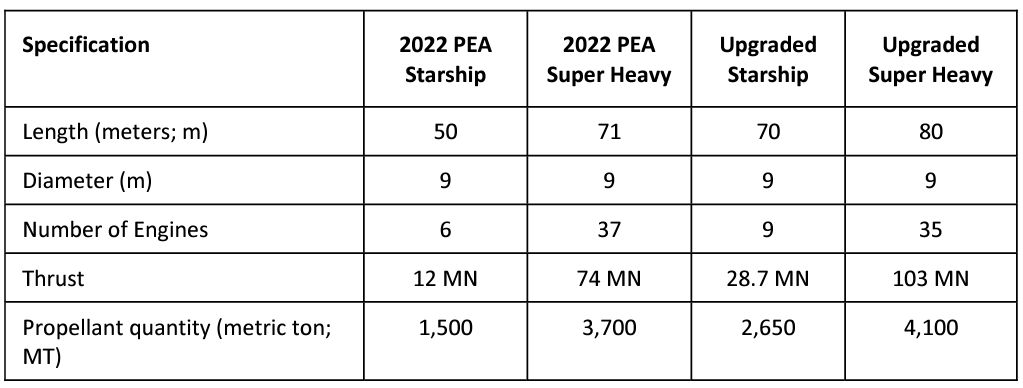
SpaceX also is developing more powerful variants of its rocket, and the launch of these vehicles would also be permitted. Under the environmental assessment completed in 2022, SpaceX’s plans called for a 50-meter-tall Starship and a 71-meter-tall Super Heavy booster stage. Its upgraded Starship would be 70 meters tall, atop an 80-meter boost stage, for a total stack height of 150 meters.
The company is contemplating a far greater thrust for each of the vehicles, more than doubling Starship’s thrust to 6.5 million pounds and substantially increasing Super Heavy’s thrust to 2.3 million pounds. A bigger, more powerful launch system will require more than 1,500 tons of liquid oxygen and methane propellant.
Enlarge/ Upgrade plans for Starship and Super Heavy.
FAA
One change that may have helped sell this increased flight rate is that SpaceX is not seeking any additional increases in road closures of State Highway 4, which leads from Brownsville to Boca Chica Beach. This road passes right by the launch site and is closed during launches and static fire tests. SpaceX has moved much of its pre-launch testing to a new location nearby that does not require road closures.
“SpaceX has dramatically reduced the duration of operations and the number of access restrictions through engineering analysis and improvements,” the FAA draft document states. “There has been an 85% reduction in the number of access restrictions from Flight 1 to Flight 3. Additionally, a majority of the testing that required access restrictions has been moved to SpaceX’s Massey’s Test Site, approximately 4 miles away.”
After the public comment period, the FAA will prepare a final environmental assessment and render a decision on the request.
Enlarge/ Apple Intelligence was unveiled at WWDC 2024.
Apple
As was just rumored, the iOS 18.1, iPadOS 18.1, and macOS Sequoia 15.1 developer betas are rolling out today, and they include the first opportunity to try out Apple Intelligence, the company’s suite of generative AI features.
Initially announced for iOS 18, Apple Intelligence is expected to launch for the public this fall. Typically, Apple also releases a public beta (the developer one requires a developer account) for new OS updates, but it hasn’t announced any specifics about that just yet.
Not all the Apple Intelligence features will be part of this beta. It will include writing tools, like the ability to rewrite, proofread, or summarize text throughout the OS in first-party and most third-party apps. It will also include new Siri improvements, such as moving seamlessly between voice and typing, the ability to follow when you stumble over your words, and maintaining context from one request to the next. (It will not, however, include ChatGPT integration; Apple says that’s coming later.)
New natural language search features, support for creating memory movies, transcription summaries, and several new Mail features will also be available.
Developers who download the beta will be able to request access to Apple Intelligence features by navigating to the Settings app, tapping Apple Intelligence & Siri, and then tapping “Join the Apple Intelligence waitlist.” The waitlist is in place because some features are demanding on Apple’s servers, and staggering access is meant to stave off any server issues when developers are first trying it out.
Enlarge/ As female macaques age, the size of their social network shrinks.
Walnut was born on June 3, 1995, at the start of what would become an unusually hot summer, on an island called Rum (pronounced room), the largest of the Small Isles off the west coast of Scotland. We know this because since 1974, researchers have diligently recorded the births of red deer like her, and caught, weighed and marked every calf they could get their hands on—about 9 out of every 10.
Near the cottage in Kilmory on the northern side of the island where the researchers are based, there has been no hunting since the project began, which allowed the deer to relax and get used to human observers. Walnut was a regular there, grazing the invariably short-clipped grass in this popular spot. “She would always just be there in the group, with her sisters and their families,” says biologist Alison Morris, who has lived on Rum for more than 23 years and studies the deer year-round.
Walnut raised 14 offspring, the last one in 2013, when she was 18 years old. In her later years, Morris recalls, Walnut would spend most of her time away from the herd, usually with Vanity, another female (called a hind) of the same age who had never calved. “They were often seen affectionately grooming each other, and after Walnut died of old age in October 2016, at the age of 21—quite extraordinary for a hind—Vanity spent most of her time alone. She died two years later, at the grand age of 23.”
Are old hinds left behind?
Such a shift in social life is common in aging red deer females, says ecologist Gregory Albery, now at Georgetown University in Washington, DC, who spent months on the island studying the deer during his PhD training. (Males roam around more and associate less consistently with others, so they are harder to study.) “Older females tend to be observed in the company of fewer others. That was easy to establish,” he says. “The more difficult question to answer has been why we are seeing this pattern, and what it means.”
The first question one should ask, Albery says, is whether individual deer alter their behavior to associate with fewer others as they age, or whether individuals that associate with fewer others tend to live to an older age. This is the kind of question that many researchers are unable to answer when simply comparing individuals of different ages. But long-term studies like the one at Rum can do so through long-term tracking of populations. Forty times a year, the deer are censused by fieldworkers like Morris who recognize the deer on sight and meticulously note where they are and with whom.
When they accounted for the age and survival of the deer in their analysis, Albery and colleagues found that the link between age and number of associates remained solid: Social connections do, indeed, decrease as individuals age. Might this be because many of the older deer’s friends have died? On the contrary, Albery and colleagues found that older deer who had recently lost friends tended to hang out with others more often.
So why do old hinds have fewer contacts? Part of the explanation may be that they don’t range as widely as they grow older. Studying the deer for a couple of months would not have exposed this trend, says Albery: It was only revealed by tracking the same individuals through time. “Deer with a larger home range generally live longer,” he explains, so an analysis at any single point in time would show larger ranges for older deer and suggest that home ranges expand with age. Tracking individuals through time reveals the opposite is true. “Their home ranges decrease in size as they age,” Albery says.
It is unlikely that older deer move around less because they are concentrating on the core of their favorite habitat, says Albery. The center of their range shifts with age, and they are observed more often in taller and probably less nutritious vegetation, away from the most popular spots. This indicates there might be some kind of competitive exclusion going on: Perhaps more energetic, younger deer with offspring to feed are colonizing the best grazing patches.
On the other hand, older deer may also have different preferences. “Perhaps the longer grasses are easier to eat when your incisors are too worn to clip the short grass everyone else is after,” Albery says. Plus the deer don’t have to bend over as far to reach the longer grass.
A recent study by Albery and colleagues in Nature Ecology & Evolution found that older deer reduce their contacts more than you’d expect if their shrinking range was the only cause. That suggests the behavior may have evolved for a reason—one that Albery prosaically summarizes as, “Deer shit where they eat.”
Gastrointestinal worms are rampant on the island. And though the deer do not get infected through direct contact with others, being at the same place at the same time probably does increase their risk of ingesting eggs or larvae in the still-warm droppings of one of their associates.
“Younger animals need to put themselves out there to make friends, but perhaps when you’re older and you already have some, the risk of disease just isn’t worth it,” says study coauthor Josh Firth, a behavioral ecologist at the University of Oxford.
In addition, says ecologist Daniel Nussey of the University of Edinburgh, another coauthor, “there are indications that the immune system of aging deer is less effective in suppressing worm infections, so they might be more likely to die from them.”
Enlarge/ Wegovy is an injectable prescription weight-loss medicine that has helped people with obesity.
The US Food and Drug Administration has approved two injectable versions of the blockbuster weight-loss and diabetes drug, semaglutide (Wegovy and Ozempic). Both come in pre-filled pens with pre-set doses, clear instructions, and information about overdoses. But, given the drugs’ daunting prices and supply shortages, many patients are turning to imitations—and those don’t always come with the same safety guardrails.
In an alert Friday, the FDA warned that people are overdosing on off-brand injections of semaglutide, which are dispensed from compounding pharmacies in a variety of concentrations, labeled with various units of measurement, administered with improperly sized syringes, and prescribed with bad dosage math. The errors are leading some patients to take up to 20 times the amount of intended semaglutide, the FDA reports.
Though the agency doesn’t offer a tally of overdose cases that have been reported, it suggests it has received multiple reports of people sickened by dosing errors, with some requiring hospitalizations. Semaglutide overdoses cause nausea, vomiting, abdominal pain, fainting, headache, migraine, dehydration, acute pancreatitis, and gallstones, the agency reports.
Bad math
In typical situations, compounding pharmacies provide personalized formulations of FDA-approved drugs, for instance, if a patient is allergic to a specific ingredient, requires a special dosage, or needs a liquid version of a drug instead of a pill form. But, when commercially available drugs are in short supply—as semaglutide drugs currently are—then compound pharmacies can legally step in to make their own versions if certain conditions are met. However, these imitations are not FDA-approved and, as such, don’t come with the same safety, quality, and effectiveness assurances as approved drugs.
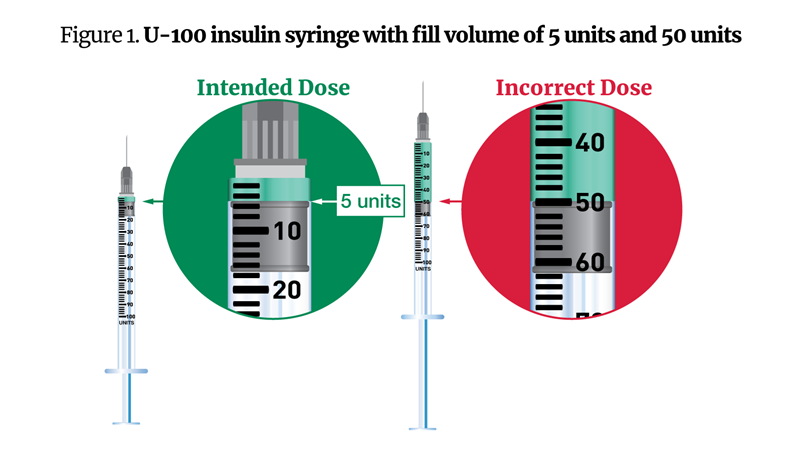
In the warning Friday, the FDA said that some patients received confusing instructions from compounding pharmacies, which indicated they inject themselves with a certain number of “units” of semaglutide—the volume of which may vary depending on the concentration—rather than milligrams or milliliters. In other instances, patients received U-100 (1-milliliter) syringes to administer 0.05-milliliter doses of the drug, or five units. The relatively large syringe size compared with the dose led some patients to administer 50 units instead of five.
Enlarge/ The figure demonstrates how syringe size could lead some to an incorrect dosage.
FDA-approved semaglutide drugs, meanwhile, are dosed in milligrams and come in standardized concentrations. The agency received several reports of health care providers incorrectly converting from milligrams to units or milliliters, leading them to calculate the wrong dosages. With these math errors, some patients administered five to 10 times more semaglutide than intended.
“FDA recognizes the substantial consumer interest in using compounded semaglutide products for weight loss,” the agency wrote. “However, compounded drugs pose a higher risk to patients than FDA-approved drugs.” The agency urged patients and prescribers to only use compounded versions when absolutely necessary.
Enlarge/ NASA’s SLS rocket core stage for Artemis II is moved to the VAB.
NASA/Ben Smegelsky
Welcome to Edition 7.04 of the Rocket Report! Probably the most striking news this week came from ABL, which said in a terse social media statement that it had lost its second RS1 rocket during pre-flight testing. This is unfortunate, since the company had been so careful and meticulous in working toward this second launch attempt. It’s a reminder of how demanding this industry remains.
As always, we welcome reader submissions, and if you don’t want to miss an issue, please subscribe using the box below (the form will not appear on AMP-enabled versions of the site). Each report will include information on small-, medium-, and heavy-lift rockets as well as a quick look ahead at the next three launches on the calendar.
ABL loses rocket after static fire test. ABL Space Systems said Monday that its next rocket had suffered “irrecoverable” damage during preparations for launch. “After a pre-flight static fire test on Friday, a residual pad fire caused irrecoverable damage to RS1,” the company said on the social media site X. “The team is investigating root cause and will provide updates as the investigation progresses.” As of the writing of this report three days later, the company has not posted any additional information.
Not particularly promising … This is a serious setback for the launch company, which attempted the debut flight of its RS1 vehicle 18 months ago and had been preparing for this second attempt for a long time. The California-based company had been keeping a low profile and had not made a social media posting since May. The RS1 vehicle is advertised as having a lift capacity of 1.35 metric tons at a price of $12 million. During ABL’s initial launch attempt in January 2023, an anomaly in the rocket caused all nine of the RS1’s first-stage engines to shut down. (submitted by Ken the Bin)
Point-to-point company test-fires engine. A space transportation startup with visions of high-speed point-to-point travel has started tests of the engine that will power their vehicle, Space News reports. Frontier Aerospace test-fired its Mjölnir engine on July 18, its chairman, Alex Tai, said during a panel discussion at the Farnborough International Airshow. Mjölnir is a full-flow staged combustion engine. The firing lasted less than a second but demonstrated the startup of the turbopumps and successful ignition.
Starting with a smaller version … The company plans to do longer engine burns as part of the testing program. The version of Mjölnir currently being tested produces less than 3,000 pounds-force of thrust. New Frontier plans to use a much more powerful version of the engine on a vehicle called the Intercontinental Rocketliner, a suborbital vehicle intended to carry 100 people on high-speed flights around the planet at hypersonic speeds. (submitted by Ken the Bin and EllPeaTea)
The easiest way to keep up with Eric Berger’s space reporting is to sign up for his newsletter, we’ll collect his stories in your inbox.
Ursa Major invests in Ohio. Ursa Major will buy several industrial 3D printers and hire 15 new employees for a research and development center in Youngstown, Ohio, focused on additive manufacturing, Payload reports. The Colorado-based rocket engine maker will contribute $10.5 million in capital investment alongside a $4 million grant from JobsOhio, a privately funded economic development nonprofit. The expansion of a small existing facility will enable the company to step up its development of solid rocket motors—a top priority for the Department of Defense.
The war needs what it needs … In April, Ursa won a contract of undisclosed value from the Navy to develop a lower-cost manufacturing approach for the standardized solid rocket motors used across a range of missiles. The US supply chains for those motors—mainly provided by Northrop Grumman and L3Harris—have been stressed by US support for Ukraine’s defense against Russian invaders.In November, Ursa raised $138 million to support its push into solid rocket motor manufacturing in a round that reportedly valued the company at $750 million.
The central piece of NASA’s second Space Launch System rocket arrived at Kennedy Space Center in Florida this week. Agency officials intend to start stacking the towering launcher in the next couple of months for a mission late next year carrying a team of four astronauts around the Moon.
The Artemis II mission, officially scheduled for September 2025, will be the first voyage by humans to the vicinity of the Moon since the last Apollo lunar landing mission in 1972. NASA astronauts Reid Wiseman, Victor Glover, Christina Koch, and Canadian mission specialist Jeremy Hansen will ride the SLS rocket away from Earth, then fly around the far side of the Moon and return home inside NASA’s Orion spacecraft.
“The core is the backbone of SLS, and it’s the backbone of the Artemis mission,” said Matthew Ramsey, NASA’s mission manager for Artemis II. “We’ve been waiting for the core to get here because all the integrated tests and checkouts that we do have to have the core stage. It has the flight avionics that drive the whole system. The boosters are also important, but the core is really the backbone for Artemis. So it’s a big day.”
The core stage rolled off of NASA’s Pegasus barge at Kennedy early Wednesday, following a weeklong ocean voyage from New Orleans, where Boeing builds the rocket under contract to NASA.
Ramsey told Ars that ground teams hope to begin stacking the rocket’s two powerful solid rocket boosters on NASA’s mobile launcher platform in September. Each booster, supplied by Northrop Grumman, is made of five segments with pre-packed solid propellant and a nose cone. All the pieces for the SLS boosters are at Kennedy and ready for stacking, Ramsey said.
The SLS upper stage, built by United Launch Alliance, is also at the Florida launch site. Now, the core stage is at Kennedy. In August or September, NASA plans to deliver the two remaining elements of the SLS rocket to Florida. These are the adapter structures that will connect the core stage to the upper stage, and the upper stage to the Orion spacecraft.
A heavy-duty crane inside the cavernous Vehicle Assembly Building (VAB) will hoist each segment of the SLS boosters into place on the launch platform. Once the boosters are fully stacked, ground teams will lift the 212-foot (65-meter) core stage vertical in the transfer aisle running through the center of the VAB. A crane will then lower the core stage between the boosters. That could happen as soon as December, according to Ramsey.
Then comes the launch vehicle stage adapter, the upper stage, the Orion stage adapter, and finally, the Orion spacecraft itself.
Moving toward operations
NASA’s inspector general reported in 2022 that NASA’s first four Artemis missions will each cost $4.1 billion. Subsequent documents, including a Government Accountability Office report last year, suggest the expendable SLS core stage is responsible for at least a quarter of the cost for each Artemis flight.
The core stage for Artemis II is powered by four hydrogen-fueled RS-25 engines produced by Aerojet Rocketdyne. Two of the reusable engines for Artemis II have flown on the space shuttle, and the other two RS-25s were built in the shuttle era but never flew. Each SLS launch will put the core stage and its engines in the Atlantic Ocean.
Steve Wofford, who manages the stages office for the SLS program at NASA’s Marshall Space Flight Center, told Ars there are “no major configuration differences” between the core stages for Artemis I and Artemis II. The only minor differences involve instrumentation that NASA wanted on Artemis I to measure pressures, accelerations, vibrations, temperatures, and other parameters on the first flight of the Space Launch System.
“We are still working off some flight observations that we made on Artemis I, but no showstoppers,” Wofford said. “On the first article, the test flight, Artemis I, we really loaded it up. That’s a golden opportunity to learn as much as you can about the vehicle and the flight regime, and anchor all your models… As you progress, you need less and less of that. So Core Stage 2 will have less development flight instrumentation than Core Stage 1, and then Core Stage 3 will have less still.”
On Thursday, Google DeepMind announced that AI systems called AlphaProof and AlphaGeometry 2 reportedly solved four out of six problems from this year’s International Mathematical Olympiad (IMO), achieving a score equivalent to a silver medal. The tech giant claims this marks the first time an AI has reached this level of performance in the prestigious math competition—but as usual in AI, the claims aren’t as clear-cut as they seem.
Google says AlphaProof uses reinforcement learning to prove mathematical statements in the formal language called Lean. The system trains itself by generating and verifying millions of proofs, progressively tackling more difficult problems. Meanwhile, AlphaGeometry 2 is described as an upgraded version of Google’s previous geometry-solving AI modeI, now powered by a Gemini-based language model trained on significantly more data.
According to Google, prominent mathematicians Sir Timothy Gowers and Dr. Joseph Myers scored the AI model’s solutions using official IMO rules. The company reports its combined system earned 28 out of 42 possible points, just shy of the 29-point gold medal threshold. This included a perfect score on the competition’s hardest problem, which Google claims only five human contestants solved this year.
A math contest unlike any other
The IMO, held annually since 1959, pits elite pre-college mathematicians against exceptionally difficult problems in algebra, combinatorics, geometry, and number theory. Performance on IMO problems has become a recognized benchmark for assessing an AI system’s mathematical reasoning capabilities.
Google states that AlphaProof solved two algebra problems and one number theory problem, while AlphaGeometry 2 tackled the geometry question. The AI model reportedly failed to solve the two combinatorics problems. The company claims its systems solved one problem within minutes, while others took up to three days.
Google says it first translated the IMO problems into formal mathematical language for its AI model to process. This step differs from the official competition, where human contestants work directly with the problem statements during two 4.5-hour sessions.
Google reports that before this year’s competition, AlphaGeometry 2 could solve 83 percent of historical IMO geometry problems from the past 25 years, up from its predecessor’s 53 percent success rate. The company claims the new system solved this year’s geometry problem in 19 seconds after receiving the formalized version.
Limitations
Despite Google’s claims, Sir Timothy Gowers offered a more nuanced perspective on the Google DeepMind models in a thread posted on X. While acknowledging the achievement as “well beyond what automatic theorem provers could do before,” Gowers pointed out several key qualifications.
“The main qualification is that the program needed a lot longer than the human competitors—for some of the problems over 60 hours—and of course much faster processing speed than the poor old human brain,” Gowers wrote. “If the human competitors had been allowed that sort of time per problem they would undoubtedly have scored higher.”
Gowers also noted that humans manually translated the problems into the formal language Lean before the AI model began its work. He emphasized that while the AI performed the core mathematical reasoning, this “autoformalization” step was done by humans.
Regarding the broader implications for mathematical research, Gowers expressed uncertainty. “Are we close to the point where mathematicians are redundant? It’s hard to say. I would guess that we’re still a breakthrough or two short of that,” he wrote. He suggested that the system’s long processing times indicate it hasn’t “solved mathematics” but acknowledged that “there is clearly something interesting going on when it operates.”
Even with these limitations, Gowers speculated that such AI systems could become valuable research tools. “So we might be close to having a program that would enable mathematicians to get answers to a wide range of questions, provided those questions weren’t too difficult—the kind of thing one can do in a couple of hours. That would be massively useful as a research tool, even if it wasn’t itself capable of solving open problems.”
Internet service providers are eager to get money from a $42.45 billion government fund, but are trying to convince the Biden administration to drop demands that Internet service providers offer broadband service for as little as $30 a month to people with low incomes.
The Broadband Equity, Access, and Deployment (BEAD) program was created by a US law that requires Internet providers receiving federal funds to offer at least one “low-cost broadband service option for eligible subscribers.” The Biden administration says it is merely enforcing that legal requirement, but a July 23 letter sent by over 30 broadband industry trade groups claims that the administration is illegally regulating broadband prices.
The fund is administered by the National Telecommunications and Information Administration (NTIA). The NTIA is distributing money to states, which will then distribute it to ISPs. Before obtaining money from the NTIA, each state must get approval for a plan that includes a low-cost option. Nearly half of US states have already gotten approvals.
Although the law requires ISPs receiving grants to offer a low-cost plan, it also says the US may not “regulate the rates charged for broadband service.” In the letter sent to US Secretary of Commerce Gina Raimondo, ISPs claim that the NTIA’s demands for specific prices violate the ban on rate regulation:
We have also heard from stakeholders of specific instances in which certain State broadband offices have faced the prospect of political pressure unless they acceded to a $30 rate for the low-cost service option. This contravenes the clear language of the Infrastructure Act, which states that “[n]othing in this title may be construed to authorize [NTIA] to regulate the rates charged for broadband service.”
ISPs want to upend approved state plans
Funds like BEAD are intended to help ISPs build broadband networks in areas where it would otherwise not be economically feasible. In other words, the government giving money to ISPs directly lets the telcos make a decent profit on network-construction projects in areas where subscriber fees alone wouldn’t be enough.
ISPs receiving funds don’t have to offer the low-cost broadband plan to everyone. They only have to offer it to eligible subscribers who meet low-income requirements, as detailed in the NTIA’s Notice of Funding Opportunity.
Despite that, ISPs claim that prices for the low-cost option should be calculated based on “the economic realities of deploying and operating networks in the highest cost, hardest-to-reach areas.” The letter said:
While NTIA purports to give States the flexibility to choose a low-cost program that meets their particular needs, the reality is much different. According to NTIA’s own program guidance, it has “strongly encouraged” States to set a fixed rate of $30 per month for the low-cost service option. For a broad cross-section of America’s rural broadband providers, the $30 rate is completely unmoored from the economic realities of deploying and operating networks in the highest cost, hardest-to-reach areas that BEAD funding is precisely designed to reach.
Groups signing the letter include USTelecom, which represents AT&T, Verizon, CenturyLink/Lumen, and many other telcos. It was also signed by lobby groups for small cable firms and rural telcos, and numerous lobby groups for ISPs in specific states. The state-specific lobby groups signing the letter are from Alaska, Alabama, North Dakota, Montana, North Carolina, Kansas, Georgia, Illinois, Indiana, Iowa, Michigan, Minnesota, Nebraska, Nevada, New York, Ohio, Oregon, Oklahoma, Pennsylvania, South Carolina, South Dakota, Texas, Utah, Washington, and Wisconsin.
Many states have already received approval for their grant plans, including plans for requiring low-cost options. The NTIA today announced approval of New Mexico and Virginia’s initial proposals, bringing the total count to 22 states plus the Northern Mariana Islands, the District of Columbia, Puerto Rico, and the US Virgin Islands. Another 30 states and territories are waiting for approval after having submitted initial proposals by December 2023.
The lobby groups want the NTIA to reverse approvals for existing states’ plans. Their letter said the agency should “require each State to revise the low-cost service option rate proposed or approved in its Initial Proposal so that the rate is more reasonably tied to providers’ realistic costs, such as by using the FCC’s Urban Rate Survey benchmark.”
Enlarge/ A digital advertisement board displaying a Barbie movie poster is seen in New York on July 24, 2023.
This post contains spoilers—for the movie and women’s health care.
There’s nothing like stirrups and a speculum to welcome one to womanhood, but for some, the recent Barbie movie apparently offered its own kind of eye-opening introduction.
The smash-hit film ends with the titular character making the brave decision to exit Barbieland and enter the real world as a bona fide woman. The film’s final scene follows her as she fully unfurls her new reality, attending her first woman’s health appointment. “I’m here to see my gynecologist,” she enthusiastically states to a medical receptionist. For many, the line prompted a wry chuckle, given her unsuspecting eagerness and enigmatic anatomy. But for others, it apparently raised some fundamental questions.
Online searches in the US for “gynecologist”—or alternate spellings, such as “gynaecologist”—rose an estimated 51 percent over baseline in the week following Barbie‘s July 21, 2023 release, according to a study published Thursday in JAMA Network Open. Moreover, searches related to the definition of gynecology spiked 154 percent. Those search terms included “gynecologist meaning,” “what is a gynecologist,” “what does a gynecologist do,” “why see a gynecologist,” and the weightiest of questions: “do I need a gynecologist.”
The “Barbie effect”
The study’s authors, led by researchers at Harvard Medical School, assessed 34 query terms that fit into six categories of searches, including “gynecologist,” “gynecologist definition,” “gynecologist appointment,” “doctors,” “doctor’s appointment,” and “women’s health.” The last three served as controls for more general interest in medical information. As the authors put it, the three control searches helped establish “whether unobserved contemporaneous factors influencing health-seeking behavior more generally may have contributed to gynecologic-related search volume.”
While the researchers noted clear spikes in “gynecologist” and “gynecologist definition” searches, they saw no changes in search trends for the three control search categories during the week after the movie’s release: “doctors,” “doctor’s appointment,” and “women’s health.” This suggested that the increase in gynecology-related searches may, in fact, be linked to the movie rather than some increased interest in health care generally.
The researchers also did not see a corresponding increase in searches related to gynecology appointments, suggesting that the transient online interest in gynecology didn’t translate to online searches for actual gynecological care, with queries such as “gynecologist near me.” The researchers speculate that two factors might explain this. For one, there’s the possibility that the data couldn’t capture care-seeking decisions. It may be that there’s a longer, variable time gap between newfound awareness of gynecology and the decision to seek care. The second possibility is that the people searching for basic information about gynecology may not need gynecological care themselves.
Overall, the authors conclude that “Barbie’s closing line may have spurred interest in gynecology.” The finding is supported by earlier work that also suggests popular culture can have measurable influences on health literacy and awareness among the general public, the authors conclude. For instance, when journalist Katie Couric live streamed her colonoscopy, there was a transient 21 percent increase in colonoscopies, and when actress Angelina Jolie penned an editorial about her experience with breast cancer, there was a transient 64 percent increase in genetic testing for breast cancer risk (BRCA testing). But while the “Barbie effect” seems to have raised some awareness of gynecology, it remains unclear if it will lead to a measurable improvement in health outcomes.
Enlarge/ Police observe the Eiffel Tower from Trocadero ahead of the Paris 2024 Olympic Games on July 22, 2024.
On the eve of the Olympics opening ceremony, Paris is a city swamped in security. Forty thousand barriers divide the French capital. Packs of police officers wearing stab vests patrol pretty, cobbled streets. The river Seine is out of bounds to anyone who has not already been vetted and issued a personal QR code. Khaki-clad soldiers, present since the 2015 terrorist attacks, linger near a canal-side boulangerie, wearing berets and clutching large guns to their chests.
French interior minister Gérald Darmanin has spent the past week justifying these measures as vigilance—not overkill. France is facing the “biggest security challenge any country has ever had to organize in a time of peace,” he told reporters on Tuesday. In an interview with weekly newspaper Le Journal du Dimanche, he explained that “potentially dangerous individuals” have been caught applying to work or volunteer at the Olympics, including 257 radical Islamists, 181 members of the far left, and 95 from the far right. Yesterday, he told French news broadcaster BFM that a Russian citizen had been arrested on suspicion of plotting “large scale” acts of “destabilization” during the Games.
Parisians are still grumbling about road closures and bike lanes that abruptly end without warning, while human rights groups are denouncing “unacceptable risks to fundamental rights.” For the Games, this is nothing new. Complaints about dystopian security are almost an Olympics tradition. Previous iterations have been characterized as Lockdown London, Fortress Tokyo, and the “arms race” in Rio. This time, it is the least-visible security measures that have emerged as some of the most controversial. Security measures in Paris have been turbocharged by a new type of AI, as the city enables controversial algorithms to crawl CCTV footage of transport stations looking for threats. The system was first tested in Paris back in March at two Depeche Mode concerts.
For critics and supporters alike, algorithmic oversight of CCTV footage offers a glimpse of the security systems of the future, where there is simply too much surveillance footage for human operators to physically watch. “The software is an extension of the police,” says Noémie Levain, a member of the activist group La Quadrature du Net, which opposes AI surveillance. “It’s the eyes of the police multiplied.”
Near the entrance of the Porte de Pantin metro station, surveillance cameras are bolted to the ceiling, encased in an easily overlooked gray metal box. A small sign is pinned to the wall above the bin, informing anyone willing to stop and read that they are part of a “video surveillance analysis experiment.” The company which runs the Paris metro RATP “is likely” to use “automated analysis in real time” of the CCTV images “in which you can appear,” the sign explains to the oblivious passengers rushing past. The experiment, it says, runs until March 2025.
Porte de Pantin is on the edge of the park La Villette, home to the Olympics’ Park of Nations, where fans can eat or drink in pavilions dedicated to 15 different countries. The Metro stop is also one of 46 train and metro stations where the CCTV algorithms will be deployed during the Olympics, according to an announcement by the Prefecture du Paris, a unit of the interior ministry. City representatives did not reply to WIRED’s questions on whether there are plans to use AI surveillance outside the transport network. Under a March 2023 law, algorithms are allowed to search CCTV footage in real-time for eight “events,” including crowd surges, abnormally large groups of people, abandoned objects, weapons, or a person falling to the ground.
“What we’re doing is transforming CCTV cameras into a powerful monitoring tool,” says Matthias Houllier, cofounder of Wintics, one of four French companies that won contracts to have their algorithms deployed at the Olympics. “With thousands of cameras, it’s impossible for police officers [to react to every camera].”
Enlarge/ Rembrandt’s The Night Watch underwent many chemical and mechanical alterations over the last 400 years.
Public domain
Since 2019, researchers have been analyzing the chemical composition of the materials used to create Rembrandt’s masterpiece, The Night Watch, as part of the Rijksmuseum’s ongoing Operation Night Watch, devoted to its long-term preservation. Chemists at the Rijksmuseum and the University of Amsterdam have now detected unusual arsenic-based yellow and orange/red pigments used to paint the duff coat of one of the central figures in the painting, according to a recent paper in the journal Heritage Science. It’s a new addition to Rembrandt’s known pigment palette that further adds to our growing body of knowledge about the materials he used.
As previously reported, past analyses of Rembrandt’s paintings identified many pigments the Dutch master used in his work, including lead white, multiple ochres, bone black, vermilion, madder lake, azurite, ultramarine, yellow lake, and lead-tin yellow, among others. The artist rarely used pure blue or green pigments, with Belshazzar’s Feast being a notable exception. (The Rembrandt Database is the best resource for a comprehensive chronicling of the many different investigative reports.)
Early last year, the researchers at Operation Night Watch found rare traces of a compound called lead formate in the painting—surprising in itself, but the team also identified those formates in areas where there was no lead pigment, white or yellow. It’s possible that lead formates disappear fairly quickly, which could explain why they have not been detected in paintings by the Dutch Masters until now. But if that is the case, why didn’t the lead formate disappear in The Night Watch? And where did it come from in the first place?
Hoping to answer these questions, the team whipped up a model of “cooked oils” from a 17th-century recipe and analyzed those model oils with synchrotron radiation. The results supported their hypothesis that the oil used for light parts of the painting was treated with an alkaline lead drier. The fact that The Night Watch was revarnished with an oil-based varnish in the 18th century complicates matters, as this may have provided a fresh source of formic acid, such that different regions of the painting rich in lead formates may have formed at different times in the painting’s history.
Last December, the team turned its attention to the preparatory layers applied to the canvas. It’s known that Rembrandt used a quartz-clay ground for The Night Watch—the first time he had done so, perhaps because the colossal size of the painting “motivated him to look for a cheaper, less heavy and more flexible alternative for the ground layer” than the red earth, lead white, and cerussite he was known to use on earlier paintings.
Enlarge/ (a) Rembrandt’s The Night Watch. (b) Detail of figure’s embroidered gold buff coat. (c) X-ray diffraction image of coat detail showing arsenic. (d) Stereomicroscope image showing arsenic hot spot.
N. De Keyser et al., 2024
They used 3D X-ray methods to capture more detail, revealing the presence of an unknown (and unexpected) lead-containing layer located just underneath the ground layer. This could be due to using a lead compound added to the oil used to prepare the canvas as a drying additive—perhaps to protect the painting from the damaging effects of humidity. (Usually a glue sizing was used before applying the ground layer.) The lead layer discovered last year could be the reason for the unusual lead protrusions in areas of The Night Watch, since there are no other lead-containing compounds in the paint. It’s possible that lead migrated into the painting’s ground layer from the lead-oil preparatory layer below.
An intentional combination
The presence of arsenic sulfides in The Night Watch appears to be an intentional pigment combination by Rembrandt, according to the authors of this latest paper. Artists throughout history have used naturally occurring orpiment and realgar, as well as artificial arsenic sulfide pigments, to get yellow, orange, and red hues in their paints. Orpiment was also used for medicinal purposes, in hair removal creams and oils, in wax seals, yellow ink, bookbinder green (mixed with indigo), and for the treatment or coating of metals like silver.
However, the use of artificial arsenic sulfides has rarely been reported in artworks, although they are mentioned in multiple artists’ treatises dating back to the 15th century. Earlier work using advanced analytical techniques such as Raman spectroscopy and X-ray powder diffraction revealed that Rembrandt used arsenic sulfide pigments (artificial orpiment) in two late paintings: The Jewish Bride (c 1665) and The Man in a Red Cap (c 1665).
For this latest work, Nouchka De Keyser of the Rijksmuseum and co-authors used macroscopic X-ray fluorescence imaging to map The Night Watch, which revealed the presence of arsenic and sulfur in the doublet sleeves and embroidered buff coat worn by Lt. Willem Van Ruytenburch, i.e., the central figure to the right of Captain Frans Bannick Cocq in the painting. The researchers initially assumed that this was due to Rembrandt’s use of orpiment for yellow hues and realgar for red hues.
Enlarge/ (a, b) Pages from Johann Kunckel’s Ars Vitraria Experimentalis, 1679. (c) Page from the Weimar taxa of 1674 including prices for white, yellow, and red arsenic.
N. De Keyser et al., 2024
To learn more, they took tiny samples and analyzed them with light microscopy, micro-Raman spectroscopy, electron microscopy, and X-ray powder diffraction. They found the yellow particles were actually pararealgar while the orange to red particles were semi-amorphous pararealgar. These are more unusual arsenic sulfide components, typically associated with degradation products from either the natural minerals or their artificial equivalents as they age.
But De Keyser et al. concluded that the presence of these components was actually an intentional mixture, based on their perusal of multiple historical sources and catalogs of collection cabinets with long lists of various arsenic sulfides. There was clearly contemporary knowledge of manipulating both natural and artificial arsenic sulfides to get different shades of yellow, orange, and red.
They also found vermilion and lead-tin yellow in the paint mixture; Rembrandt was known to use these to add brightness and intensity to his paintings. In the case of The Night Watch, “Rembrandt clearly aimed for a bright orange tone with a high color strength that allowed him to create an illusion of the gold thread embroidery in Van Ruytenburch’s costume,” the authors wrote. “The artificial orange to red arsenic sulfide might have offered different optical and rheological paint properties as compared to the mineral form of orpiment and realgar.”
In addition, the team examined paint samples from different artists known to use arsenic sulfides—whose works are also part of the Rijksmuseum collection—and found a similar mixture of pigments in a painting by Rembrandt’s contemporary, Willem Kalf. “It is evidence that a variety of natural and artificial arsenic sulfides were manufactured and traded during Rembrandt’s time and were available in Amsterdam,” the authors wrote—most likely imported, since the Dutch Republic did not have considerable mining resources.