Author name: Paul Patrick

faced-with-a-tight-deadline,-nasa-and-blue-origin-agree-to-delay-new-glenn-debut

Faced with a tight deadline, NASA and Blue Origin agree to delay New Glenn debut

Glenn wen? —

“We can’t take our foot off the pedal here.”

The second stage of the New Glenn rocket rolled to the launch site this week.

Enlarge / The second stage of the New Glenn rocket rolled to the launch site this week.

Blue Origin

NASA and Blue Origin announced Friday that they have agreed to delay the launch of the ESCAPADE mission to Mars until at least the spring of 2025.

The decision to stand down from a launch attempt in mid-October was driven by a deadline to begin loading hypergolic propellant on the two small ESCAPADE (Escape and Plasma Acceleration and Dynamics Explorers) spacecraft. While it is theoretically possible to offload fuel from these vehicles for a future launch attempt, multiple sources told Ars that such an activity would incur significant risk to the spacecraft.

Forced to make a call on whether to fuel, NASA decided not to. Although the two spacecraft were otherwise ready for launch, it was not clear the New Glenn rocket would be similarly ready to go.

Waiting on the rocket

NASA procured the debut launch of the New Glenn rocket, which was developed by Blue Origin, for a significant discount. The mission’s managers, University of California, Berkeley’s Space Sciences Laboratory, always understood there were timeline risks with launching on New Glenn.

Blue Origin appears to have worked with some urgency this year to prepare the massive rocket for its initial launch. However, when the company missed a key target of hot firing the rocket’s upper stage by the end of August, NASA delayed fueling of the ESCAPADE mission. Now, with the closing of a Mars launch window next month, NASA will not fuel the spacecraft until next spring, at the earliest.

Founded by Amazon’s Jeff Bezos, Blue Origin successfully rolled the New Glenn second stage to its launch pad at Launch Complex-36 in Florida on Tuesday. The company is now targeting Monday, September 9, for a hot fire test of the second stage.

At the same time, preparations for the rocket’s first stage are nearing completion. All seven of the rocket’s BE-7 engines have arrived at the launch site following acceptance testing. Engineers and technicians are presently attaching the engines to the first stage of the vehicle.

Blue Origin will now pivot to launching a prototype of its Blue Ring transfer vehicle on the debut launch of New Glenn, with the intent of testing the electronics, avionics, and other systems on the vehicle. Blue Origin is targeting the first half of November for this launch. This test flight will also serve as the first of three “certification” flights for New Glenn, which will allow the vehicle to become eligible to carry national security payloads for the US Space Force.

A sense of urgency

It’s nearly been a year since Bezos tapped a former Amazon executive, Dave Limp, to lead Blue Origin. Bezos tasked the company’s new chief executive with injecting a sense of purpose toward getting New Glenn flying as soon as possible. Bezos has made a launch this year a high priority.

In an email to Blue Origin employees on Friday, Limp expressed that sense of urgency.

“We can’t take our foot off the pedal here,” Limp wrote. “Everyone’s work to get us to NG-1 flight this year is critical and I’m so appreciative of everyone’s relentless dedication to make this happen.”

As for ESCAPADE, the mission could launch in the spring of 2025. Although the “Mars window” only opens every 18 to 24 months, there are complex trajectories by which a payload launched in the spring of 2025 could reach the red planet. It’s also possible that NASA and Blue Origin could ultimately wait until the next Mars window opens in November 2026 to launch the mission.

Faced with a tight deadline, NASA and Blue Origin agree to delay New Glenn debut Read More »

adhd-med-shortages-push-dea-to-up-drug-allotment-by-23.5%

ADHD med shortages push DEA to up drug allotment by 23.5%

drug boost —

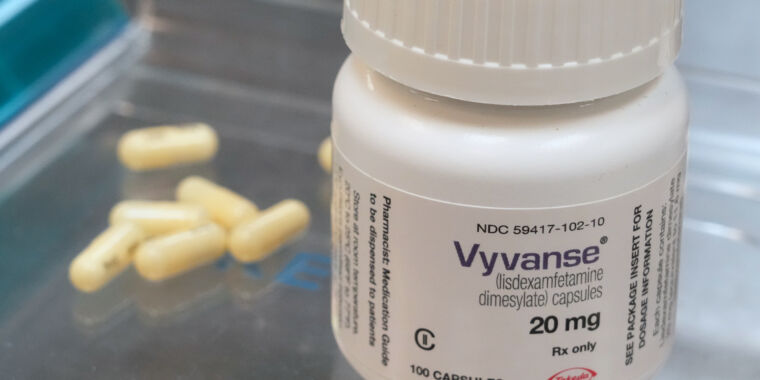
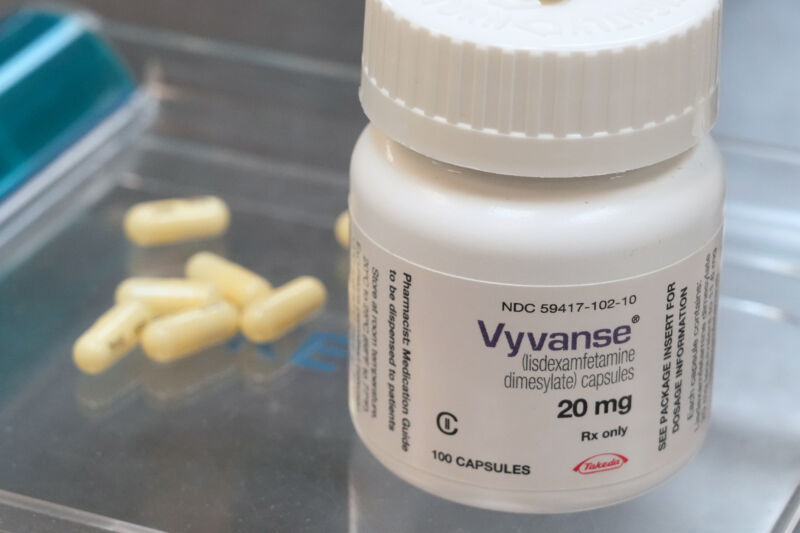
The DEA’s quota increase is for Vyvanse and its generic forms.

ADHD med shortages push DEA to up drug allotment by 23.5%

While supplies of Adderall and its generic versions are finally recovering after a yearslong shortage, the Drug Enforcement Administration is now working to curb the short supply of another drug for attention-deficit/hyperactivity disorder: Vyvanse (lisdexamfetamine) and its generic versions.

This week, the DEA said it will increase the allowed production amount of lisdexamfetamine by roughly 23.5 percent, increasing the current 26,500 kg quota by 6,236 kg, for a new total of 32,736 kg. The DEA also allowed for a corresponding increase in d-amphetamine, which is needed for production of lisdexamfetamine.

“These adjustments are necessary to ensure that the United States has an adequate and uninterrupted supply of lisdexamfetamine to meet legitimate patient needs both domestically and globally,” the DEA said.

Quotas

Just like Adderall (amphetamine/dextroamphetamine salts), Vyvanse (lisdexamfetamine) is an amphetamine-class stimulant classified by the DEA as a Schedule II drug. As such, the DEA controls its production levels to ensure demand is met while preventing excess supply that could find its way to the black market. The administration does this by setting an “aggregate production quota”—which is what the DEA adjusted for lisdexamfetamine this week—and doling out undisclosed allotments to drug manufacturers.

While various factors have contributed to the shortages of ADHD medications, some medical and industry groups have placed blame on the DEA’s quota system for underestimating demand and choking supply. For instance, the Adderall shortage began in 2022 following a labor shortage on the product’s production line at Teva, Adderall’s maker. But, while that production snag was resolved, prescription rates increased significantly, in part due to increased awareness of ADHD, broadening diagnosis criteria, and an increase in access with the rise of telehealth services, which boomed during the COVID-19 pandemic. In a report earlier this year, the American Society of Health-System Pharmacists pointed to the DEA’s quotas, saying they’re “exacerbating” shortages.

In an August 2023 joint letter, the DEA and the FDA responded to such criticism, suggesting that the quotas aren’t to blame. Rather, it’s that some manufacturers are not using up their allotment of controlled drugs.

“Based on DEA’s internal analysis of inventory, manufacturing, and sales data submitted by manufacturers of amphetamine products [which include the two ADHD drugs], manufacturers only sold approximately 70 percent of their allotted quota for the year, and there were approximately 1 billion more doses that they could have produced but did not make or ship. Data for 2023 so far show a similar trend,” the FDA and DEA wrote.

The FDA and DEA said they would work with manufacturers to ensure they would ramp up production of drugs in short supply or relinquish their remaining allotments.

Vyvanse shortage

A similarly complicated situation is seen with the current shortfall of Vyvanse and its generics. The DEA raised the quota after prodding from the Food and Drug Administration. In July, the FDA sent the DEA a letter requesting a quota increase. However, the shortage had actually begun in June 2023. At that time, Vyvanse’s maker, Takeda, said that a “manufacturing delay compounded by increased demand” had led to low inventory.

In August 2023, the FDA approved multiple generic versions of Vyvanse after Takeda’s patent exclusivity expired, raising hopes that the shortage would ease with the injection of new generics. But supply problems have persisted. In November, the Association for Accessible Medicines, which represents generic drugmakers, sent a letter to the DEA saying that generic manufacturers weren’t able to obtain enough raw material to “launch their products at full commercial scale,” because the quotas were standing in the way, according to reporting by Bloomberg.

FiercePharma reported another potential factor raised by lawmakers and industry watchers. Those onlookers took note of the timing of Takeda’s “manufacturing delays” just months before generics entered the market. With the significantly thinner profit margin of generic and off-patent drugs, there’s concern that manufacturers may de-prioritize production.

Last, the DEA flagged yet another factor in the supply chain: exports to foreign markets. While the FDA estimated a 6 percent increase in the domestic need for lisdexamfetamine between 2023 and 2024, the DEA’s export data showed a 34 percent increase in exports of lisdexamfetamine between 2022 and 2023, with expectations that exports would continue to increase this year and beyond. As such, the current 23.5 percent quota increase for lisdexamfetamine is only partly for domestic production. In fact, only a quarter of the 6,236 kg is intended for the US. Of the increased allotment, 1,558 kg is for domestic drug production, while the other 4,678 kg addresses increases in foreign demand, the DEA said.

ADHD med shortages push DEA to up drug allotment by 23.5% Read More »

study:-playing-dungeons-&-dragons-helps-autistic-players-in-social-interactions

Study: Playing Dungeons & Dragons helps autistic players in social interactions

We can be heroes —

“I can make a character quite different from how I interact with people in real life.”

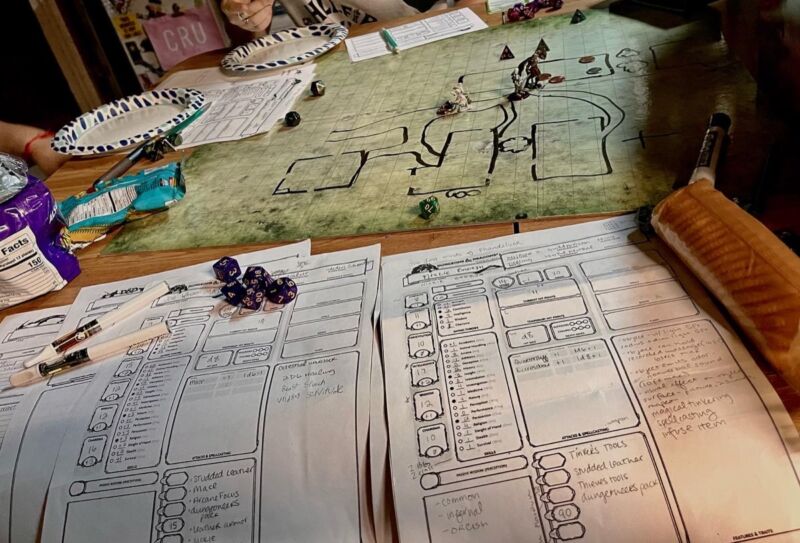
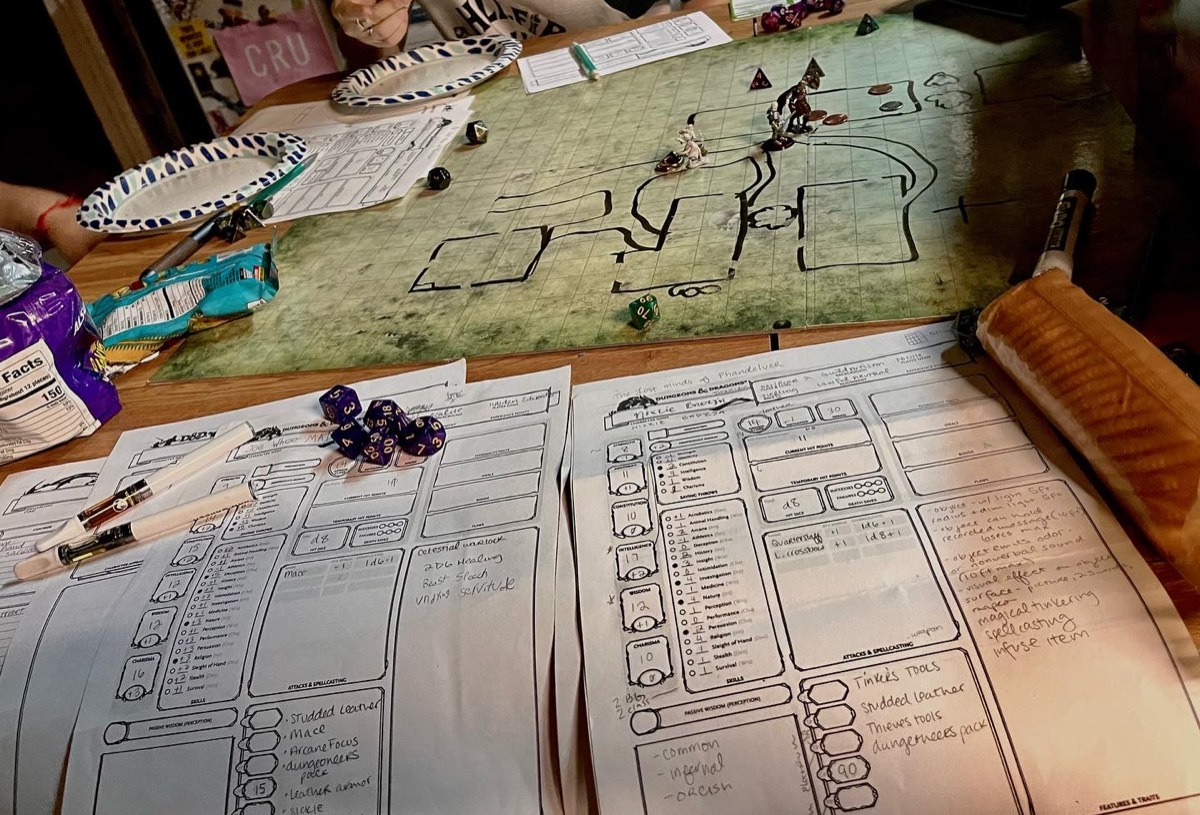
A Dungeons & Dragons game session featuring a map, miniatures, dice, and character sheets

Enlarge / Researchers say that Dungeons & Dragons can give autistic players a way to engage in low-risk social interactions.

Since its introduction in the 1970s, Dungeons & Dragons has become one of the most influential tabletop role-playing games (TRPGs) in popular culture, featuring heavily in Stranger Things, for example, and spawning a blockbuster movie released last year. Over the last decade or so, researchers have turned their focus more heavily to the ways in which D&D and other TRPGs can help people with autism form healthy social connections, in part because the gaming environment offers clear rules around social interactions. According to the authors of a new paper published in the journal Autism, D&D helped boost players’ confidence with autism, giving them a strong sense of kinship or belonging, among other benefits.

“There are many myths and misconceptions about autism, with some of the biggest suggesting that those with it aren’t socially motivated, or don’t have any imagination,” said co-author Gray Atherton, a psychologist at the University of Plymouth. “Dungeons & Dragons goes against all that, centering around working together in a team, all of which takes place in a completely imaginary environment. Those taking part in our study saw the game as a breath of fresh air, a chance to take on a different persona and share experiences outside of an often challenging reality. That sense of escapism made them feel incredibly comfortable, and many of them said they were now trying to apply aspects of it in their daily lives.”

Prior research has shown that autistic people are more likely to feel lonely, have smaller social networks, and often experience anxiety in social settings. Their desire for social connection leads many to “mask” their neurodivergent traits in public for fear of being rejected as a result of social gaffes. “I think every autistic person has had multiple instances of social rejection and loss of relationships,” one of the study participants said when Atherton et al. interviewed them about their experiences. “You’ve done something wrong. You don’t know what it is. They don’t tell you, and you find out when you’ve been just, you know, left shunned in relationships, left out…. It’s traumatic.”

TPRGs like D&D can serve as a social lubricant for autistic players, according to a year-long study published earlier this year co-authored by Atherton, because there is less uncertainty around how to behave in-game—unlike the plethora of unwritten social rules that make navigating social settings so anxiety-inducing. Such games immerse players in a fantastical world where they create their characters with unique backstories, strengths, and weaknesses and cooperate with others to complete campaigns. A game master guides the overall campaign, but the game itself evolves according to the various choices different players make throughout.

A critical hit

Small wonder, then, that there tend to be higher percentages of autistic TRPG players than in the general populace. For this latest study. Atherton et al. wanted to specifically investigate how autistic players experience D&D when playing in groups with other autistic players. It’s essentially a case study with a small sample size—just eight participants—and qualitative in nature, since the post-play analysis focused on semistructured interviews with each player after the conclusion of the online campaign, the better to highlight their individual voices.

The players were recruited through social media advertisements within the D&D, Reddit and Discord online communities; all had received an autism diagnosis by a medical professional. They were split into two groups of four players, with one of the researchers (who’s been playing D&D for years) acting as the dungeon master. The online sessions featured in the study was the Waterdeep: Dragonheist campaign. The campaign ran for six weeks, with sessions lasting between two and four hours (including breaks).

Participants spoke repeatedly about the positive benefits they received from playing D&D, providing a friendly environment that helped them relax about social pressures. “When you’re interacting with people over D&D, you’re more likely to understand what’s going on,” one participant said in their study interview. “That’s because the method you’ll use to interact is written out. You can see what you’re meant to do. There’s an actual sort of reference sheet for some social interactions.” That, in turn, helped foster a sense of belonging and kinship with their fellow players.

Participants also reported feeling emotionally invested and close to their characters, with some preferring to separate themselves from their character in order to explore other aspects of their personality or even an entirely new persona, thus broadening their perspectives. “I can make a character quite different from how I interact with people in real-life interactions,” one participant said. “It helps you put yourself in the other person’s perspective because you are technically entering a persona that is your character. You can then try to see how it feels to be in that interaction or in that scenario through another lens.” And some participants said they were able to “rewrite” their own personal stories outside the game by adopting some of their characters’ traits—a psychological phenomenon known as “bleed.”

“Autism comes with several stigmas, and that can lead to people being met with judgment or disdain,” said co-author Liam Cross, also of the University of Plymouth. “We also hear from lots of families who have concerns about whether teenagers with autism are spending too much time playing things like video games. A lot of the time that is because people have a picture in their minds of how a person with autism should behave, but that is based on neurotypical experiences. Our studies have shown that there are everyday games and hobbies that autistic people do not simply enjoy but also gain confidence and other skills from. It might not be the case for everyone with autism, but our work suggests it can enable people to have positive experiences that are worth celebrating.”

Autism, 2024. DOI: 10.1177/13623613241275260  (About DOIs).

Study: Playing Dungeons & Dragons helps autistic players in social interactions Read More »

the-moon-had-volcanic-activity-much-more-recently-than-we-knew

The Moon had volcanic activity much more recently than we knew

New Moon —

Eruptions seem to have continued long after widespread volcanism had ended.

Image of the face of the Moon.

Enlarge / The eruptions that produced the dark mare on the lunar surface ended billions of years ago.

Signs of volcanic activity on the Moon can be viewed simply by looking up at the night-time sky: The large, dark plains called “maria” are the product of massive outbursts of volcanic material. But these were put in place relatively early in the Moon’s history, with their formation ending roughly 3 billion years ago. Smaller-scale additions may have continued until roughly 2 billion years ago. Evidence of that activity includes samples obtained by China’s Chang’e-5 lander.

But there are hints that small-scale volcanism continued until much more recent times. Observations from space have identified terrain that seems to be the product of eruptions, but only has a limited number of craters, suggesting a relatively young age. But there’s considerable uncertainty about these deposits.

Now, further data from samples returned to Earth by the Chang’e-5 mission show clear evidence of volcanism that is truly recent in the context of the history of the Solar System. Small beads that formed during an eruption have been dated to just 125 million years ago.

Counting beads

Obviously, some of the samples returned by Chang’e-5 are solid rock. But it also returned a lot of loose material from the lunar regolith. And that includes a decent number of rounded, glassy beads formed from molten material. There are two potential sources of those beads: volcanic activity and impacts.

The Moon is constantly bombarded by particles ranging in size from individual atoms to small rocks, and many of these arrive with enough energy to melt whatever it is they smash into. Some of that molten material will form these beads, which may then be scattered widely by further impacts. The composition of these beads can vary wildly, as they’re composed of either whatever smashed into the Moon or whatever was on the Moon that got smashed. So, the relative concentrations of different materials will be all over the map.

By contrast, any relatively recent volcanism on the Moon will be extremely rare, so is likely to be from a single site and have a single composition. And, conveniently, the Apollo missions already returned samples of volcanic lunar rocks, which provide a model for what that composition might look like. So, the challenge was one of sorting through the beads returned from the Chang’e-5 landing site, and figuring out which ones looked volcanic.

And it really was a challenge, as there were over 3,000 beads returned, and the vast majority of them would have originated in impacts.

As a first cutoff, the team behind the new work got rid of anything that had a mixed composition, such as unmelted material embedded in the bead, or obvious compositional variation. This took the 3,000 beads down to 764. Those remaining beads were then subject to a technique that could determine what chemicals were present. (The team used an electron probe microanalyzer, which bombards the sample with electrons and uses the photons that are emitted to determine what elements are present.) As expected, compositions were all over the map. Some beads were less than 1 percent magnesium oxide; others nearly 30 percent. Silicon dioxide ranged from 16 to 60 percent.

Based on the Apollo samples, the researchers selected for beads that were high in magnesium oxide relative to calcium and aluminum oxides. That got them down to 13 potentially volcanic samples. They also looked for low nickel, as that’s found in many impactors, which got the number down to six. The final step was to look at sulfur isotopes, as impact melting tends to preferentially release the lighter isotope, altering the ratio compared to intact lunar rocks.

After all that, the researchers were left with three of the glassy beads, which is a big step down from the 3,000 they started with.

Erupted

Those three were then used to perform uranium-based radioactive dating, and they all produced numbers that were relatively close to each other. Based on the overlapping uncertainties, the researchers conclude that all were the product of an eruption that took place about 123 million years ago, give or take 15 million years. Considering that the most recent confirmed eruptions were about 2 billion years ago, that’s a major step forward in timing.

And that’s quite a bit of a surprise, as the Moon has had plenty of time to cool, and that cooling would have increased the distance between its surface and any molten material left in the interior. So it’s not obvious what could be creating sufficient heating to generate molten material at present. The researchers note that the Moon has a lot of material called KREEP (potassium, rare earth elements, phosphorus) that is high in radioactive isotopes and might lead to localized heating in some circumstances.

Unfortunately, it will be tough to associate this with any local geology, since there’s no indication of where the eruption occurred. Material this small can travel quite a distance in the Moon’s weak gravitational field and then could be scattered even farther by impacts. So, it’s possible that these belong to features that have been identified as potentially volcanic through orbital images.

In the meantime, the increased exploration of the Moon planned for the next few decades should get us more opportunities to see whether similar materials are widespread on the lunar surface. Eventually, that might potentially allow us to identify an area with higher concentrations of volcanic material than one particle in a thousand.

Science, 2024. DOI: 10.1126/science.adk6635  (About DOIs).

The Moon had volcanic activity much more recently than we knew Read More »

parenting-nightmare:-kiss-on-the-cheek-causes-child’s-incurable-infection

Parenting nightmare: Kiss on the cheek causes child’s incurable infection

Stress of parenting —

Puzzle of child’s misdiagnosed cheek lesion solved with one look at dad

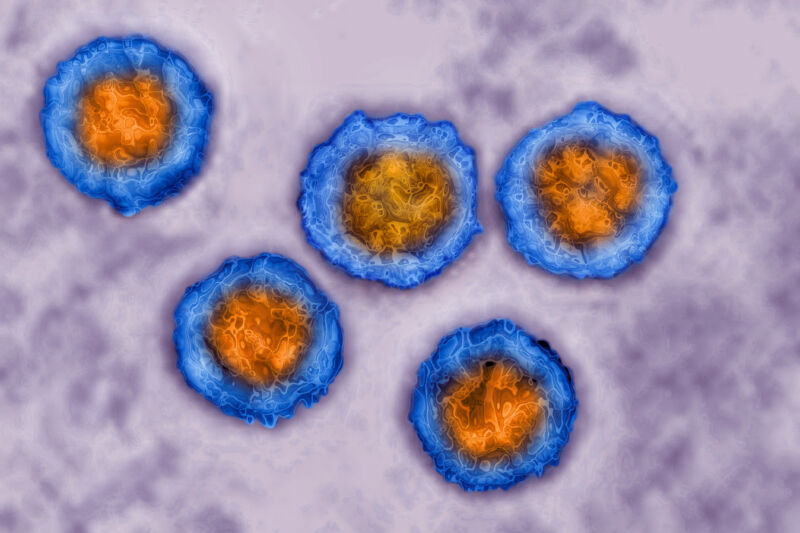
Herpes simplex virus, (HSV). Image taken with transmission electron microscopy.

Enlarge / Herpes simplex virus, (HSV). Image taken with transmission electron microscopy.

As the US Surgeon General recently highlighted, parenting is stressful. From navigating social media to facing a youth mental health crisis, challenges abound. But, for one father in Spain, even the simple, loving, everyday act of giving your child a peck on the cheek has turned to nightmare fuel.

According to a case report in the New England Journal of Medicine, the man’s 9-year-old daughter developed a fever along with a crusty, blistering lesion on her left cheek. Doctors initially diagnosed the blotch as impetigo, a bacterial infection on the skin’s surface layers that is fairly common in children. It’s often caused by Staphylococcus aureus or Streptococcus bacteria and is generally easily treated with antibiotics.

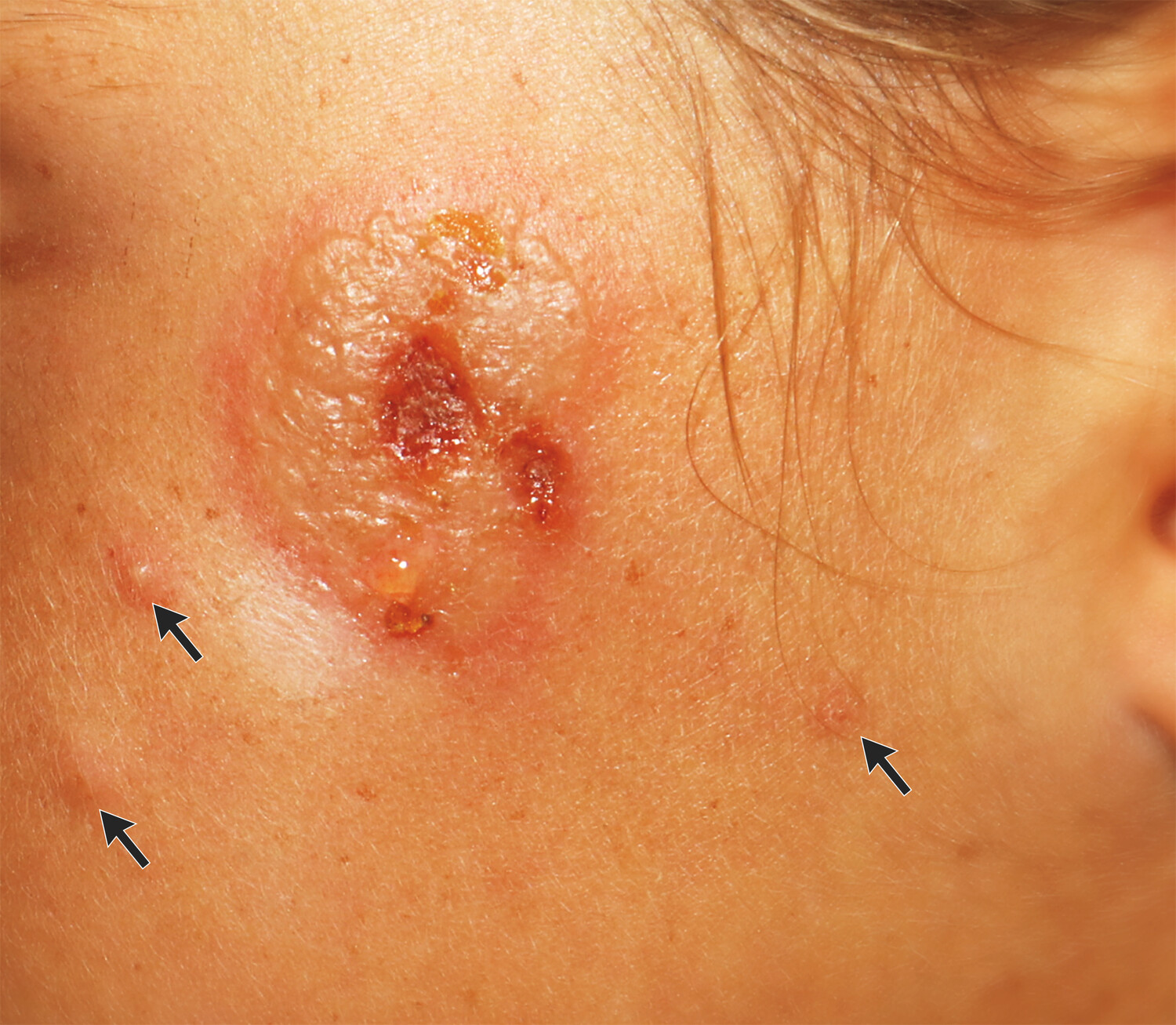
The lesion on the girl's cheek with satellite blisters noted by arrows.

Enlarge / The lesion on the girl’s cheek with satellite blisters noted by arrows.

But, after several days of treatment for impetigo, the child’s symptoms weren’t getting better. At that point, it had been seven days since the lesion erupted, and it was 3 centimeters in diameter on the side of her face. So, he took her to a dermatology clinic. There, specialists closely examined the lesion, noting the red, raised area with blisters and a “honey-crusted appearance,” which is a classic sign of impetigo. They also noted smaller “satellite” blisters around the cheek, as well as swollen lymph nodes on the left side of her neck, the same side as the lesion. All of the symptoms still lined up with impetigo. But then the specialists looked over at her dad.

The doctors took note of a crusting on her father’s lower lip, which he said had started 10 days earlier. It looked like a classic case of common cold sores, aka oral herpes. And the doctors made a connection.

Stress begets stress

Cold sores are caused by herpes simplex virus type 1 (HSV-1), a highly contagious virus that is estimated to infect 3.7 billion people under the age of 50 globally. (There’s also HSV-2, which causes genital herpes). In an initial infection, herpes viruses invade cells on the body’s surfaces, but then go into hiding in nerve cells. From there, they can occasionally reactivate and produce new lesions and infections. For HSV-1, that usually means cold sores around the mouth.

There is no cure for herpes infections; the virus will lurk in a person’s nerve cells for the rest of their lives, with the potential to spur recurring outbreaks. However, there are antiviral treatments that can ease the symptoms of outbreaks and help them clear up a little faster.

When a cold sore develops, the lesions are highly infectious. It’s often transmitted through oral-oral contact, but any direct contact or contact with contaminated saliva can spread the virus. (HSV-2 primarily spreads through sexual contact.) And, while HSV-1 lesions typically erupt around the mouth and on mucosal surfaces, they can sometimes also flare elsewhere on the skin.

The dermatologists treating the 9-year-old ran a test for HSV-1, confirming the genetic traces of the virus were present. They started the girl on an oral antiviral drug. They also noted that there was no concern for sexual abuse. The lesion cleared without scarring.

In their report on the case, they end with a note of caution for other doctors: “When HSV-1 infection manifests in children as cutaneous lesions without mucosal involvement, it may be confused with the honey-crusted appearance of impetigo.”

For parents, the lesson is to be careful not to kiss your child (or anyone else) when you have a cold sore flare up. While those viral reactivations can be sparked by many things, one notable factor will likely strike home for parents: stress.

Parenting nightmare: Kiss on the cheek causes child’s incurable infection Read More »

verizon-to-buy-frontier-for-$9.6-billion,-says-it-will-expand-fiber-network

Verizon to buy Frontier for $9.6 billion, says it will expand fiber network

Verizon/Frontier merger —

Verizon once sold part of its network to Frontier; now it’s buying the company.

A Verizon FiOS box truck on a street in New York City.

Enlarge / A Verizon FiOS truck in Manhattan on September 15, 2017.

Verizon today announced a deal to acquire Frontier Communications, an Internet service provider with about 3 million customers in 25 states. Verizon said the all-cash transaction is valued at $20 billion.

Verizon agreed to pay $9.6 billion and is taking on over $10 billion in debt held by Frontier. Verizon said the deal is subject to regulatory approval and a vote by Frontier shareholders and is expected to be completed in 18 months.

“Under the terms of the agreement, Verizon will acquire Frontier for $38.50 per share in cash, representing a premium of 43.7 percent to Frontier’s 90-Day volume-weighted average share price (VWAP) on September 3, 2024, the last trading day prior to media reports regarding a potential acquisition of Frontier,” Verizon said.

Assuming regulatory and shareholder approval, Verizon will be buying back a former portion of its network that it sold to Frontier eight years ago. In 2016, Frontier bought Verizon’s FiOS and DSL operations in Florida, California, and Texas. The 2016 changeover was marred by technical problems that caused weeks of outages for tens of thousands of customers.

Frontier, which had also purchased the Connecticut portion of AT&T’s network, struggled for many years and filed for bankruptcy in April 2020. It was criticized by regulators for not properly maintaining its copper phone network. Frontier emerged from bankruptcy in 2021 with a plan to upgrade many of its outdated copper DSL locations with fiber-to-the-home service.

“Frontier’s 2.2 million fiber subscribers across 25 states will join Verizon’s approximately 7.4 million FiOS connections in 9 states and Washington, D.C.,” Verizon said. “In addition to Frontier’s 7.2 million fiber locations, the company is committed to its plan to build out an additional 2.8 million fiber locations by the end of 2026.”

Combined, the Verizon and Frontier fiber networks pass over 25 million premises in 31 states and the District of Columbia, the companies said. Verizon and Frontier both “expect to increase their fiber penetration between now and closing,” they said.

Frontier “complementary” to Verizon’s Northeast market

Frontier has 2.05 million residential fiber customers and 721,000 residential copper DSL customers, according to an earnings report. In the business and wholesale category, Frontier has 134,000 fiber customers and 102,000 copper customers. Frontier reported $1.48 billion in revenue in Q2 2024 and a net loss of $123 million.

Verizon said Frontier’s recent investment in fiber made it a more attractive acquisition target. “Over approximately four years, Frontier has invested $4.1 billion upgrading and expanding its fiber network, and now derives more than 50 percent of its revenue from fiber products,” Verizon said.

Verizon FiOS is available in parts of Connecticut, Delaware, Maryland, Massachusetts, New York, New Jersey, Virginia, Rhode Island, Pennsylvania, and the District of Columbia. Verizon said Frontier’s footprint is “highly complementary to Verizon’s core Northeast and Mid-Atlantic markets,” and will help grow the number of customers who purchase both home Internet and mobile service.

Frontier is available in parts of Alabama, Arizona, California, Connecticut, Florida, Georgia, Illinois, Indiana, Iowa, Michigan, Minnesota, Mississippi, Nebraska, Nevada, New Mexico, New York, North Carolina, Ohio, Pennsylvania, South Carolina, Tennessee, Texas, Utah, West Virginia, and Wisconsin.

Verizon to buy Frontier for $9.6 billion, says it will expand fiber network Read More »

zyxel-warns-of-vulnerabilities-in-a-wide-range-of-its-products

Zyxel warns of vulnerabilities in a wide range of its products

GET YER PATCHING ON —

Most serious vulnerabilities carry severity ratings of 9.8 and 8.1 out of a possible 10.

Zyxel warns of vulnerabilities in a wide range of its products

Getty Images

Networking hardware-maker Zyxel is warning of nearly a dozen vulnerabilities in a wide array of its products. If left unpatched, some of them could enable the complete takeover of the devices, which can be targeted as an initial point of entry into large networks.

The most serious vulnerability, tracked as CVE-2024-7261, can be exploited to “allow an unauthenticated attacker to execute OS commands by sending a crafted cookie to a vulnerable device,” Zyxel warned. The flaw, with a severity rating of 9.8 out of 10, stems from the “improper neutralization of special elements in the parameter ‘host’ in the CGI program” of vulnerable access points and security routers. Nearly 30 Zyxel devices are affected. As is the case with the remaining vulnerabilities in this post, Zyxel is urging customers to patch them as soon as possible.

But wait… there’s more

The hardware manufacturer warned of seven additional vulnerabilities affecting firewall series including the ATP, USG-FLEX, and USG FLEX 50(W)/USG20(W)-VPN. The vulnerabilities carry severity ratings ranging from 4.9 to 8.1. The vulnerabilities are:

CVE-2024-6343: a buffer overflow vulnerability in the CGI program that could allow an authenticated attacker with administrator privileges to wage denial-of-service by sending crafted HTTP requests.

CVE-2024-7203: A post-authentication command injection vulnerability that could allow an authenticated attacker with administrator privileges to run OS commands by executing a crafted CLI command.

CVE-2024-42057: A command injection vulnerability in the IPSec VPN feature that could allow an unauthenticated attacker to run OS commands by sending a crafted username. The attack would be successful only if the device was configured in User-Based-PSK authentication mode and a valid user with a long username exceeding 28 characters exists.

CVE-2024-42058: A null pointer dereference vulnerability in some firewall versions that could allow an unauthenticated attacker to wage DoS attacks by sending crafted packets.

CVE-2024-42059: A post-authentication command injection vulnerability that could allow an authenticated attacker with administrator privileges to run OS commands on an affected device by uploading a crafted compressed language file via FTP.

CVE-2024-42060: A post-authentication command injection vulnerability that could allow an authenticated attacker with administrator privileges to execute OS commands by uploading a crafted internal user agreement file to the vulnerable device.

CVE-2024-42061: A reflected cross-site scripting vulnerability in the CGI program “dynamic_script.cgi” that could allow an attacker to trick a user into visiting a crafted URL with the XSS payload. The attacker could obtain browser-based information if the malicious script is executed on the victim’s browser.

The remaining vulnerability is CVE-2024-5412 with a severity rating of 7.5. It resides in 50 Zyxel product models, including a range of customer premises equipment, fiber optical network terminals, and security routers. A buffer overflow vulnerability in the “libclinkc” library of affected devices could allow an unauthenticated attacker to wage denial-of-service attacks by sending a crafted HTTP request.

In recent years, vulnerabilities in Zyxel devices have regularly come under active attack. Many of the patches are available for download at links listed in the advisories. In a small number of cases, the patches are available through the cloud. Patches for some products are available only by privately contacting the company’s support team.

Zyxel warns of vulnerabilities in a wide range of its products Read More »

ukrainian-drones-now-spray-2,500°-c-thermite-streams-right-into-russian-trenches

Ukrainian drones now spray 2,500° C thermite streams right into Russian trenches

dragon’s fire —

Mechanical dragons now deliver fire on command.

Ukrainian drones now spray 2,500° C thermite streams right into Russian trenches

Wars of necessity spawn weapons innovation as each side tries to counter the other’s tactics and punch through defenses. For instance—as the Russian invasion of Ukraine has made drone warfare real, both sides have developed ways to bring down drones more easily. One recent Ukrainian innovation has been building counter-drone ramming drones that literally knock Russian drones from the sky.

In the case of the trench warfare that currently dominates the Russian invasion of eastern Ukraine, the Ukrainians have another new tactic: dragon’s fire. Delivered by drone.

Videos have begun to circulate on Telegram and X this week from Ukrainian units showing their new weapon. (You can see three of them below.) The videos each show a drone moving deliberately along a trench line as it releases a continuous stream of incendiary material, which often starts fires on the ground below (and ignites nearby ammunition).

The most terrifying development in drone warfare I’ve seen thus far. Makes FPVs with unitary warheads look like a walk in the park.

The POV videos of incendiary rockets cascading burning magnesium and thermite were horrifying, but this is next level. pic.twitter.com/muF2kbHPqJ

— Artoir (@ItsArtoir) September 2, 2024


Ukrainian thermite dropping drones continue to rapidly proliferate through various drone units.

Seen here, a Ukrainian drone from the 60th Mechanized Brigade drops a stream of molten thermite on a Russian-held treeline. pic.twitter.com/o20diLuN1L

— OSINTtechnical (@Osinttechnical) September 4, 2024


This drone type is allegedly called “Dragon” and is said to feature thermite, a mixture of metal powder (usually aluminum) and metal oxide (in this case, said to be iron). When a thermite mixture is ignited, it undergoes a redox reaction that releases an enormous amount of heat energy and can burn anywhere. It can get really, really hot.

Wikipedia offers a nice description of the advantages of thermite:

The products emerge as liquids due to the high temperatures reached (up to 2,500° C [4,532° F] with iron(III) oxide)—although the actual temperature reached depends on how quickly heat can escape to the surrounding environment. Thermite contains its own supply of oxygen and does not require any external source of air. Consequently, it cannot be smothered, and may ignite in any environment given sufficient initial heat. It burns well while wet, and cannot be easily extinguished with water—though enough water to remove sufficient heat may stop the reaction.

Whether such weapons make any difference on the battlefield remains unclear, but the devices are a reminder of how much industrial and chemical engineering talent in Ukraine is currently being directed into new methods of destruction.

Ukrainian drones now spray 2,500° C thermite streams right into Russian trenches Read More »

metal-bats-have-pluses-for-young-players,-but-in-the-end-it-comes-down-to-skill

Metal bats have pluses for young players, but in the end it comes down to skill

four different kinds of wood and metal bats laid flat on baseball diamond grass

Enlarge / Washington State University scientists conducted batting cage tests of wood and metal bats with young players.

There’s long been a debate in baseball circles about the respective benefits and drawbacks of using wood bats versus metal bats. However, there are relatively few scientific studies on the topic that focus specifically on young athletes, who are most likely to use metal bats. Scientists at Washington State University (WSU) conducted their own tests of wood and metal bats with young players. They found that while there are indeed performance differences between wooden and metal bats, a batter’s skill is still the biggest factor affecting how fast the ball comes off the bat, according to a new paper published in the Journal of Sports Engineering and Technology.

According to physicist and acoustician Daniel Russell of Penn State University—who was not involved in the study but has a long-standing interest in the physics of baseball ever since his faculty days at Kettering University in Michigan—metal bats were first introduced in 1974 and soon dominated NCAA college baseball, youth baseball, and adult amateur softball. Those programs liked the metal bats because they were less likely to break than traditional wooden bats, reducing costs.

Players liked them because it can be easier to control metal bats and swing faster, as the center of mass is closer to the balance point in the bat’s handle, resulting in a lower moment of inertia (or “swing weight”). A faster swing doesn’t mean that a hit ball will travel faster, however, since the lower moment of inertia is countered by a decreased collision efficiency. Metal bats are also more forgiving if players happen to hit the ball away from the proverbial “sweet spot” of the bat. (The definition of the sweet spot is a bit fuzzy because it is sometimes defined in different ways, but it’s commonly understood to be the area on the bat’s barrel that results in the highest batted ball speeds.)

“There’s more of a penalty when you’re not on the sweet spot with wood bats than with the other metal bats,” said Lloyd Smith, director of WSU’s Sport Science Laboratory and a co-author of the latest study. “[And] wood is still heavy. Part of baseball is hitting the ball far, but the other part is just hitting the ball. If you have a heavy bat, you’re going to have a harder time making contact because it’s harder to control.”

Metal bats may also improve performance via a kind of “trampoline effect.” Metal bats are hollow, while wood bats are solid. When a ball hits a wood bat, the bat barrel compresses by as much as 75 percent, such that internal friction forces decrease the initial energy by as much as 75 percent. A metal bat barrel behaves more like a spring when it compresses in response to a ball’s impact, so there is much less energy loss. Based on his own research back in 2004, Russell has found that improved performance of metal bats is linked to the frequency of the barrel’s mode of vibration, aka the “hoop mode.” (Bats with the lowest hoop frequency will have the highest performance.)

Metal bats have pluses for young players, but in the end it comes down to skill Read More »

rust-in-linux-lead-retires-rather-than-deal-with-more-“nontechnical-nonsense”

Rust in Linux lead retires rather than deal with more “nontechnical nonsense”

Oxidation consternation —

How long can the C languages maintain their primacy in the kernel?

Rusty links of a chain, against an also-rusted metal background.

Enlarge / Rust never sleeps. But Rust, the programming language, can be held at bay if enough kernel programmers aren’t interested in seeing it implemented.

Getty Images

The Linux kernel is not a place to work if you’re not ready for some, shall we say, spirited argument. Still, one key developer in the project to expand Rust’s place inside the largely C-based kernel feels the “nontechnical nonsense” is too much, so he’s retiring.

Wedson Almeida Filho, a leader in the Rust for Linux project, wrote to the Linux kernel mailing list last week to remove himself as the project’s maintainer. “After almost 4 years, I find myself lacking the energy and enthusiasm I once had to respond to some of the nontechnical nonsense, so it’s best to leave it up to those who still have it in them,” Filho wrote. While thanking his teammates, he noted that he believed the future of kernels “is with memory-safe languages,” such as Rust. “I am no visionary but if Linux doesn’t internalize this, I’m afraid some other kernel will do to it what it did to Unix,” Filho wrote.

Filho also left a “sample for context,” a link to a moment during a Linux conference talk in which an off-camera voice, identified by Filho in a Register interview as kernel maintainer Ted Ts’o, emphatically interjects: “Here’s the thing: you’re not going to force all of us to learn Rust.” In the context of Filho’s request that Linux’s file system implement Rust bindings, Ts’o says that while he knows he must fix all the C code for any change he makes, he cannot or will not fix the Rust bindings that may be affected.

“They just want to keep their C code”

Asahi Lina, developer on the Asahi Linux project, posted on Mastodon late last week: “I regretfully completely understand Wedson’s frustrations.” Noting that “a subset of C kernel developers just seem determined to make the lives of Rust maintainers as difficult as possible,” Lina detailed the memory safety issues they ran into writing Direct Rendering Manager (DRM) scheduler abstractions. Lina tried to push small fixes that would make the C code “more robust and the lifetime requirements sensible,” but was blocked by the maintainer. Bugs in that DRM scheduler’s C code are the only causes of kernel panics in Lina’s Apple GPU driver, she wrote—”Because I wrote it in Rust.”

“But I get the feeling that some Linux kernel maintainers just don’t care about future code quality, or about stability or security any more,” Lina wrote. “They just want to keep their C code and wish us Rust folks would go away. And that’s really sad… and isn’t helping make Linux better.”

Drew DeVault, founder of SourceHut, blogged about Rust’s attempts to find a place inside the Kernel. In theory the kernel should welcome enthusiastic input from motivated newcomers. “In practice, the Linux community is the wild wild west, and sweeping changes are infamously difficult to achieve consensus on, and this is by far the broadest sweeping change ever proposed for the project,” DeVault writes. “Every subsystem is a private fiefdom, subject to the whims of each one of Linux’s 1,700+ maintainers, almost all of whom have a dog in this race. It’s herding cats: introducing Rust effectively is one part coding work and ninety-nine parts political work – and it’s a lot of coding work.”

Rather than test their patience with the kernel’s politics, DeVault suggests Rust developers build a Linux-compatible kernel from scratch. “Freeing yourselves of the [Linux Kernel Mailing List] political battles would probably be a big win for the ambitions of bringing Rust into kernel space,” DeVault writes.

Torvalds understands why Rust uptake is slow

You might be wondering what lead maintainer Linus Torvalds thinks about all this. He took a “wait and see” approach in 2021, hoping Rust would first make itself known in relatively isolated device drivers. At an appearance late last month, Torvalds… essentially agreed with the Rust-minded developer complaints, albeit from a much greater remove.

“I was expecting [Rust] updates to be faster, but part of the problem is that old-time kernel developers are used to C and don’t know Rust,” Torvalds said. “They’re not exactly excited about having to learn a new language that is, in some respects, very different. So there’s been some pushback on Rust.” Torvalds added, however, that “another reason has been the Rust infrastructure itself has not been super stable.”

The Linux kernel is a high-stakes project in which hundreds or thousands of developers have a stake; conflict is perhaps inevitable. Time will tell how long C will remain the primary way of coding for, and thinking about, such a large yet always-moving, codebase.

Ars has reached out to both Filho and Ts’o for comment and will update this post with response.

Rust in Linux lead retires rather than deal with more “nontechnical nonsense” Read More »

hyundai-updates-ioniq-5-with-bigger-battery,-tesla-style-port

Hyundai updates Ioniq 5 with bigger battery, Tesla-style port

still good —

There’s also an off-road focused variant called the Ioniq 5 XRT.

A white Hyundai Ioniq 5 XLT drives across the desert, kicking up sand

Enlarge / The lifted, rugged, off-road version-of-normal trend has come to the Ioniq 5 with the new XLT.

Hyundai

The Hyundai Ioniq 5 is one of our favorite electric vehicles. It offers excellent efficiency and really rapid charging, all wrapped up in a shape that exudes late-’80s hatchback vibes. Today, Hyundai revealed details about the Ioniq 5’s update for model year 2025 (MY25), and it’s noteworthy for a number of reasons.

For starters, when MY25 Ioniq 5s start appearing on dealer lots in Q4, they’ll arrive with J3400 ports concealed underneath their charger port flaps. Once known as the North American Charging Standard (NACS), this is the Tesla-style charger plug, which means MY25 Ioniq 5s should be able to fast charge at more than 17,000 Tesla Superchargers throughout the US and Canada.

The flip side is that a MY25 Ioniq 5 will require an adapter if the driver wants to charge it with a CCS1 charger, although Hyundai will include that dongle with a new car. The automaker says that as it refreshes other EVs in Q4, they will also only come with J3400 ports. For existing Hyundai EVs with CCS1 ports, J3400 adapters are supposed to be available in Q1 2025.

Another benefit of starting production at Hyundai’s new plant in Georgia is that US-made Ioniq 5s will be eligible for some of the IRS clean vehicle tax credit. This is now linked to domestic battery content, and Hyundai says that, initially, it expects US-made Ioniq 5s (and other EVs from the Georgia factory) to be eligible for at least $3,750. (Leased Ioniq 5s qualify for the full $7,500 tax credit.)

  • Hyundai says that model-year 2025 Ioniq 5s will come from the factory with native Tesla-style J3400 ports.

    Hyundai

  • This is the XRT interior, and unless I’m mistaken, it’s the same as MY24 Ioniq 5s. (Hyundai’s press materials say the new interior tweaks are for non-XRT models.)

    Hyundai

  • Hyundai might encroach on some Rivian sales with the XRT.

    Hyundai

A bigger battery

The Ioniq 5 is also getting a battery capacity bump for MY25. The standard-range Ioniq 5 increases from 58 kWh to 63 kWh, boosting the range by 20 miles (32 km) to 240 miles (385 km). The long-range models see capacity grow from 77.4 kWh to 84 kWh—this adds seven miles to the range of the longest-range Ioniq 5, which will be able to travel 310 miles (489 km) on a single charge.

Not all of the longer-range Ioniq 5s can go that far; as EV aficionados know, fitting bigger wheels to one does deleterious things to its range.

That definitely applies to a new addition to the Ioniq 5 lineup, a lifted black-bumper-clad off-road-capable variant called the XRT. The XRT combines an all-wheel-drive powertrain with new 18-inch wheels and all-terrain tires, new suspension tuning, including a 0.9-inch (23 mm) lift, and a whole lot of black trim.

All the other Ioniq 5s (barring the bonkers Ioniq 5 N) get some interior and exterior tweaks for MY25, including new front and rear bumpers, a new rear spoiler, a redesigned center console and new climate control panel, wireless Apple CarPlay and Android Auto, and some new safety-focused driver assists.

Pricing for the refreshed Ioniq 5 range should be available closer to the cars’ arrival at dealerships.

Hyundai updates Ioniq 5 with bigger battery, Tesla-style port Read More »

on-the-ubi-paper

On the UBI Paper

Would a universal basic income (UBI) work? What would it do?

Many people agree July’s RCT on giving people a guaranteed income, and its paper from Eva Vivalt, Elizabeth Rhodes, Alexander W. Bartik, David E. Broockman and Sarah Miller was, despite whatever flaws it might have, the best data we have so far on the potential impact of UBI. There are many key differences from how UBI would look if applied for real, but this is the best data we have.

This study was primarily funded by Sam Altman, so whatever else he may be up to, good job there. I do note that my model of ‘Altman several years ago’ is more positive than mine of Altman now, and past actions like this are a lot of the reason I give him so much benefit of the doubt.

They do not agree on what conclusions we should draw. This is not a simple ‘UBI is great’ or ‘UBI it does nothing.’

I see essentially four responses.

  1. The first group says this shows UBI doesn’t work. That’s going too far. I think the paper greatly reduces the plausibility of the best scenarios, but I don’t think it rules UBI out as a strategy, especially if it is a substitute for other transfers.

  2. The second group says this was a disappointing result for UBI. That UBI could still make sense as a form of progressive redistribution, but likely at a cost of less productivity so long as people impacted are still productive. I agree.

  3. The third group did its best to spin this into a positive result. There was a lot of spin here, and use of anecdotes, and arguments as soldiers. Often these people were being very clear they were true believers and advocates, that want UBI now, and were seeking the bright side. Respect? There were some bright spots that they pointed out, and no one study over three years should make you give up, but this was what it was and I wish people wouldn’t spin like that.

  4. The fourth group was some mix of ‘if brute force (aka money) doesn’t solve your problem you’re not using enough’ and also ‘but work is bad, actually, and leisure is good.’ That if we aren’t getting people not to work then the system is not functioning, or that $1k/month wasn’t enough to get the good effects, or both. I am willing to take a bold ‘people working more is mostly good’ stance, for the moment, although AI could change that. And while I do think that a more permanent or larger support amount would do some interesting things, I wouldn’t expect to suddenly see polarity reverse.

I am so dedicated to actually reading this paper that it cost me $5. Free academia now.

Core design was that there were 1,000 low-income individuals randomized into getting $1k/month for 3 years, or $36k total. A control group of 2,000 others got $50/month, or $1800 total. Average household income in the study before transfers was $29,900.

They then studied what happened.

Before looking at the results, what are the key differences between this and UBI?

Like all studies of UBI, this can only be done for a limited population, and it only lasts a limited amount of time.

If you tell me I am getting $1,000/month for life, then that makes me radically richer, and also radically safer. In extremis you can plan to live off that, or it can be a full fallback. Which is a large part of the point, and a lot of the danger as well.

If instead you give me that money for only three years, then I am slightly less than $36k richer. Which is nice, but impacts my long term prospects much less. It is still a good test of the ‘give people money’ hypothesis but less good at testing UBI.

The temporary form, and also the limited scope, means that it won’t cause a cultural shift and changing of norms. Those changes might be good or bad, and they could overshadow other impacts.

Does this move towards a cultural norm of taking big risks, learning new things and investing, or investing in niche value production that doesn’t monetize as well? Or does it become acceptable to lounge around playing video games? Do people use it to have more kids, or do people think ‘if I don’t have kids I never have to work’? And so on. The long term and short term effects could be very different.

Also key is that you don’t see the impact of the cost on inflation or the budget. If you gave out a UBI you would have to pay for it somehow, either printing money or collecting taxes or borrowing. Here you get to measure the upside without the downside. Alternatively, we also aren’t replacing the rest of the welfare state.

John Arnold: Fundamental problem with so-called UBI pilots and why @Arnold_Ventures has never funded one is they don’t actually test that. They test LFBI (Lucky Few Basic Income), a program that is not inflationary. Pilots can’t evaluate the general equilibrium effects when everyone gets $.

Ernie Tedeschi: Good point. They also can’t test (unless they’re considerably well-funded and credible) how people change their long-run behavior because they trust that a UBI program will be stable, reliable, and persistent over their entire lives.

John Arnold: Agree. My hunch is that it would need to be at least 5 years in duration, maybe much longer, to get a good sense as to behavior change. Knowing that you will get $1k/month for 3 years is different than believing you will get it for life.

And in this study, the people getting the money improve their relative status, not only their absolute position.

We can still learn a lot. I would treat this as a very good test of ‘give people money.’ It seems less strong as strictly a test of UBI, since many of the long term or equilibrium effects won’t happen.

This was a very good and well-executed study, including great response rates (96%+).

Here are the findings that stood out to me, some but not all from the abstract:

For every one dollar received, total household income excluding the transfers fell by ‘at least 21 cents,’ and total individual income fell by at least 12 cents or $1,500/year.

The fall in transfer income of $4,100/year matters a lot if you’re Giving People Money privately. That wipes out a third of gains. For government it is presumably a wash.

There was a 2% decrease in labor force participation and 1.4 hour/week reduction in labor hours, and a similar amount by partners, a 4%-5% overall decline in income. Later they say there was a 2.2 hour/week decline per household, a 4.6% decrease versus the mean. Those are different but the implications seem similar.

There was no improvement in workplace amenities, despite them trying hard to measure that. This suggests such amenities are not so highly valued by workers.

More time was spent on leisure, and to a lesser degree on transportation and finances.

No impact on quality of employment, ruling out even small improvements. Employment rate at baseline was 58%, with 17% having a second job.

20% had college degrees, 92% had finished high school or a GED or a post-secondary program by the endline, versus 92.8% for the treatment group, which is something, they say this was concentrated in the young and on GEDs.

Unemployment lasted 8.8 months in the treatment group versus 7.7 for controls. This is a sensible adjustment, if it is coming from a sensible base. There were ~0.3 additional months of unemployment per year for the treatment group. Section 5.3 says they were more likely to apply for and search for jobs, but they did so for fewer distinct jobs. As we all know essentially everyone underinvests in such searches, and fails to apply to enough distinct jobs while searching. Even I was guilty of this.

No significant effects on investments in human capital, except younger participants may pursue more formal education.

Those seem like sensible adjustments. You have more money, so you work a little less. Once you get reasonably on in years, pursuing more education becomes a hard sell.

Especially disappointing: “While treated participants exhibited more entrepreneurial orientation and intentions, this did not translate into significantly more entrepreneurial activity. The point estimate is positive, but small, and it is possible that very few people have the inclination to become entrepreneurs in general.”

Also bad news: “We find a significant increase in the likelihood that a respondent has a self-reported disability (an increase of 4.0 percentage points on a base of 31 percentage points in the control group) and in the likelihood they report a health problem or disability that limits the work they can do (an increase of 4.0 percentage points on a base of 28 percentage points in the control group) (Table 11).”

This is a remarkably high number, and it is some mix of way too many health problems and way too many incentives to claim to have them.

“Participants appear to spend approximately the full amount of the transfers each month, on average.” This is a mistake if they are not growing their permanent income, and implies they have social or cultural restrictions preventing them from saving. By the end they are at most a few thousand dollars wealthier than the control group.

This rules out a short term apocalypse. If you don’t count ‘clawbacks’ from the government, the transfer was mostly effective. That’s not bad, depending on how you pay for it. It depends what you were hoping to find, I suppose?

Also note that this study started during Covid. That could make the results not too representative of what would have happened at another time.

Transfers clawed back about a third of the money. Reducing hours worked did more of that, and high effective marginal tax rates in this zone doubtless contributed to that. What did we get for the money?

Before looking at the reactions of others, I would say not enough. There was an entire array of variables that changed very little. The group was given roughly an extra year’s income, and ended up in the same place as before. Study author Eva Vivalt agrees it is surprising that more things did not change.

The study did not make a real attempt to capture total consumer welfare, to see how much those who got money were happier and better off during the three year period. Certainly one can favor more redistribution on that basis. But you have to fund that somehow, and that seems unable to on its own justify the transfers, which must somehow be paid for. They did see declines in stress and food insecurity in year one, but they faded by year two, potentially in part because the end of the study loomed.

Here is a fun exercise: John Horton asked GPT-4o to complete the UBI experiment abstract and fill in the part that gives the results. Its predictions were for much better results in several areas. Claude gave a similar answer. In particular, both LLMs thought employment quality and stability and entrepreneurial activity would improve. This seems like confirmation that the result was bad news.

Eva Vivalt, lead author of this excellent study, has a good thread here going over many of the results. He is clearly struggling to find positive outcomes.

Eva Vivalt: But, it’s not all bad news.

One bright spot was entrepreneurship.

We see significant increases in what we pre-specified as “precursors” to entrepreneurial activity: entrepreneurial orientation and intention.

We find null effects for whether or not a participant started or helped to start a business, but entrepreneurship is not for everyone (hence pre-specifying that we’d also consider entrepreneurial orientation and intention, as they represent more common intermediate outcomes).

As noted above, you see the problem. What good are precursors without the thing they precurse? We see little if any impact on the actual amount of entrepreneurship.

Yes, there was more entrepreneurship in the ‘black and female’ category, but if the overall numbers aren’t up it is hard to find a positive overall read on the situation – is it actively negative for non-black males? Seems unlikely. If this is the good news, then there is little good news.

David Broockman, another author, also has a good thread on the study.

Everyone agrees this was a great and important paper and study, even when they view the results as highly negative for UBI. This is excellent work and excellent science. I would have loved to do this for 30 years instead of 3, but you do what you can.

Alex Tabarrok: Important thread on important paper.

tl/dr;

“You have to squint to find *anypositive effects other than people do more leisure when you give $”.

Kevin Bryan: Massive OpenResearch basic income papers are out (@smilleralert @dbroockman @evavivalt @AlexBartik @elizabethrds).

Very much worth reading – my view is that it is an incredible RCT and an incredible disappointment. RCT was USD11400/yr for 3 years, 1k treatment, 2k control.

The study was crazy, by the way. Very low attrition, time diaries, *blood draws to measure health*(?!) My favorite: they got Illinois to pass a law that this RCT income wasn’t taxable & didn’t change other-benefit eligibility. That is, it was a net post-tax increase in income!

Disappointment 1: Even though these are low-income people (avg household income 30k, so RCT is almost 40% increase in income!), treatment work hours fell 5% relative to control, and treatment household income only 6200, not 11600 higher than control.

What about other endpoints? Better job? No – and can rule out even small effects on job quality. More human capital training? No. Better *health*? No. And that’s even though experts the team surveyed thought there would be huge positive benefits!

You have to squint to find *anypositive effects other than “people do more leisure when you give $”. Treatment groups say they are more likely to consider entrepreneurship in the future. Some young folks in treatment report more education (though this doesn’t survive MHT).

This is *by farthe largest, low-income, developed country universal basic income trial, and by far the most rigorous. My posterior on how valuable UBI is compared to, say, expanded EITC and spending on early childhood has gone *waydown.

Final note: massive up to authors & funders. 50 million $ and years of hard work on a topic authors care deeply about, & instead of p hacking or pretending things went well, they were rigorous & honest about null results. Journalists: this is very rare and should be highlighted!

I do think this study scores a big one for Give Parents Money rather than Give People Money. The money seems to have a much bigger impact on children and families, while also raising fertility.

Ruxandra Teslo: This fits into my paradigm that culture beats policy more often than not, even when policy is very strong. Many people won’t like the results of this study. Change ain’t easy and is seldom executed via government mandates.

I agree change is not easy, but also a lot of the reason government mandates usually don’t work is that they are rarely well-designed or implemented. If we wanted a particular result (like entrepreneurship or education or fertility) then this was never going to be an efficient way to get at those. It still could plausibly have worked better than what we found.

Maxwell Tabarrok talks about this study as well as three others. He summarizes this study’s result as a 20 percent decline in work and not much else happening besides more leisure. He also covers the Denver UBI trial (also $1k/month), which was exclusively in the homeless, and showed that the money didn’t even do much for actual homelessness there – people found housing often but you see almost the same results in the control group. This one still seems strange to me, and clearly surprised basically everyone – it essentially says that either you’re able to get off the streets anyway, or the money wasn’t enough.

Scott Santens is a strong advocate for UBI. He attempts to make the bull case. He says that declines in hours worked were not found in previous studies, and puts the relative decline in hours worked in the context of people in other countries (like in Europe) working far less, and that the group worked a lot more at the end of the study (in 2023 after Covid) than at the start (in 2020 during Covid, which he makes clear is the cause here).

He also notes that the disemployment effects were concentrated on single parents, and that various groups had no effect. That does make sense here, and he notes it mirrors prior results, but as always if you buy the division it means the effect is much larger in the impacted (here single parent) group. Given that the pilot was for ages 21-40 and the upper half of that age group did not see an impact, the hopeful case is that the 40+ group also would see little or no impact.

He tries to explain the decline in work we do see as a shift to education. I didn’t see enough actual increase in education to fully explain it, though? Perhaps I am not seeing how that math works out.

Another note was that most labor decrease was in the relatively high income group, not the low income group. I take his explanations to suggest that this group was effectively facing very high marginal tax rates. Indeed, this is the area where people plausibly face effective marginal tax rates approaching 100% when accounting for benefits. If you attempt to boost the income of someone caught in that trap, it makes sense they would respond by cutting back hours – one could investigate the details to see to what extent that was the pattern.

He repeats the ‘women and blacks started more businesses’ angle, but again are we then to believe that non-black males started fewer? On job search, he notes the increased length of job search in time but not the decreased intensity of the searches. On job quality he admits the results are disappointing but cites the anecdotes as telling a different story. I think that’s a clear case of spin or fooling oneself, of course you can find some stories that went well where the change was plausibly causal. Probably some people did long term plays, others slacked off or focused on family.

People were more likely to move especially to new neighborhoods, which I hadn’t noticed earlier, but I’m not convinced that is net good here. That seems plausibly like a frequently poor investment, unless it is moving to opportunity. I worry it’s moving to nicer places without a long term plan to also earn more.

I do think the big decreases in alcohol and drug use are a clear positive result. We have a 40%+ decrease in problematic drinking, an 81%+ decrease in non-prescribed painkillers. That’s great, but also we know the overall health numbers, and also overall hours worked, and so on. This should decompose into other benefits, so if this is real and you don’t see those benefits, it’s being counteracted elsewhere.

There’s talk about how ‘cash can be anything’ and citing all the things people spent their cash on. Well, yes, and I do buy the ‘better cash than in kind benefits’ argument.

I appreciated the detailed analysis and willingness to note details that were unsupportive, and not trying to disguise his advocacy. This was the right way to make a case like this. I did come out of it modestly more hopeful than I came in, as he found some good info I had overlooked, and he made good points on how this study differed from his proposed realistic scenario. But I found most of it to be a (honest) stretch.

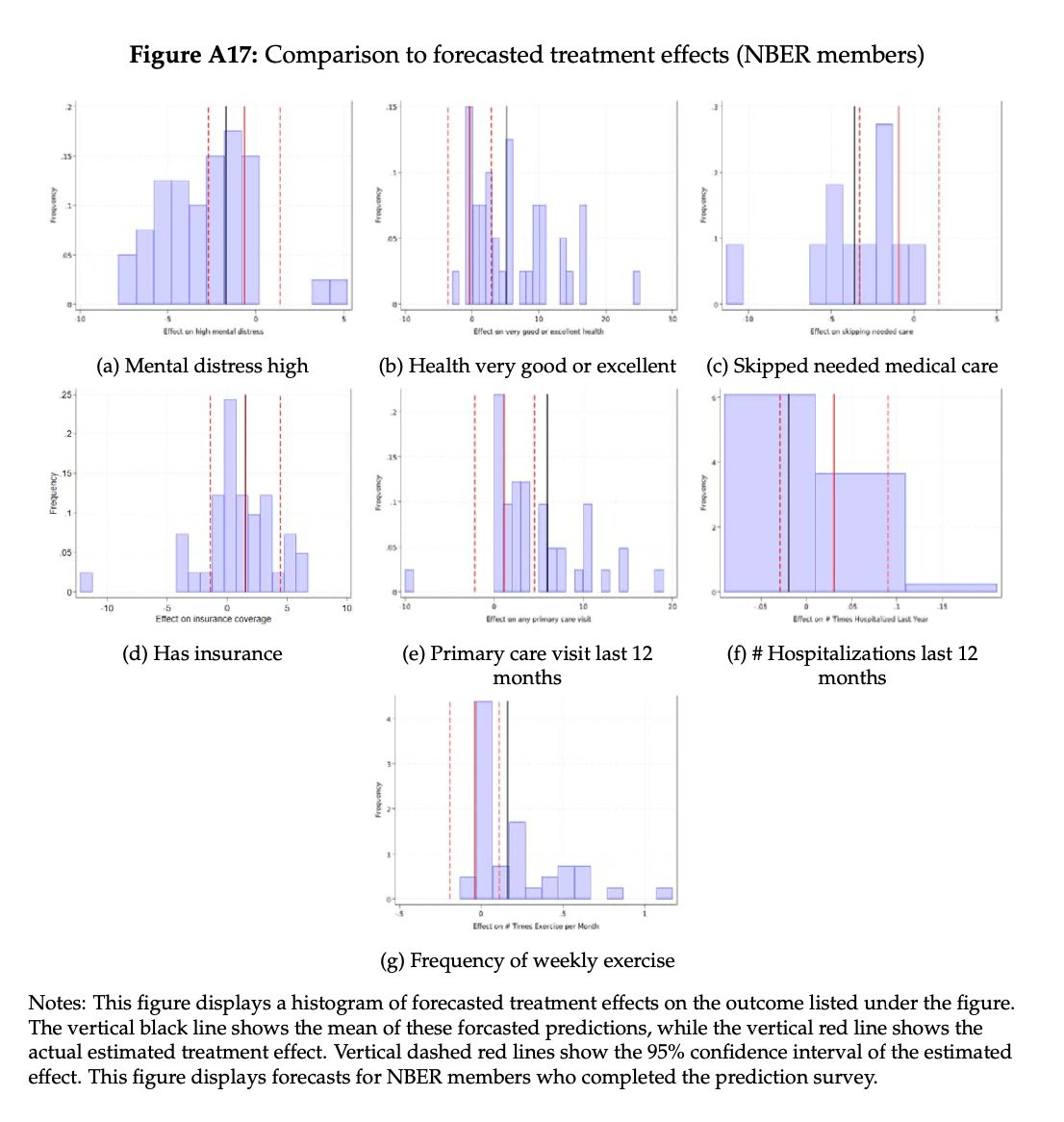
Another cool note is that the authors collected ex ante forecasts of what the researchers would find.

Eva Vivalt: So I can say that experts were reasonably accurate for labor supply (the magnitude of what we saw at endline is higher but it’s within the confidence intervals) but inaccurate for other employment outcomes, e.g., they were overoptimistic about education and the wage rate.

Key differences:

  1. Prediction was increase in hourly wage, actual effect was -$0.23/hr at endline.

  2. Prediction was searching for work less, result was looking more by the endline.

  3. Prediction was more secondary education (2.5%-4.5%) versus no found effect.

This confirms the study results were disappointing.

Rob Wiblin asks, is it so bad or surprising that the money mostly went to consumption? The answer is, it’s not stunning, but the effects were worse than expected in many areas, and we were hoping to get other positive effects and less negative effects along with the consumption.

The decrease in work is no surprise – the issue is what we got in exchange.

Noah Smith: Another disappointing result for basic income. Unlike some earlier, smaller studies, this big RCT finds a significant disemployment effect. Even just $1000 per month causes some people to stop working, or to work less.

Alex Howlett: This is not disappointing. It’s exactly what we should expect. If Universal Basic Income doesn’t cause people to work less, then we haven’t set the amount high enough.

Well, yes, and I do think Noah Smith was jumping to conclusions there. We should indeed expect people to work less when given money. Along with ‘giving people money costs money’ that is the key downside of redistribution and progressive taxation.

If you say ‘people working is bad and we should want them to do less of that’ then I am going to disagree. Yes, if the amount of production could be held constant while people worked less, that would be great, we should do that. But we should presume that the jobs in question are productive.

The deal is, we spend money and we reduce the amount of production and work. In exchange, the people who get the benefits, well, benefit. They are better off. This is some combination of them being better off for themselves, them getting to invest and become more productive and beneficial for society (including having more children and investing more in those children), and buying their support for a stable and prosperous civilization.

You want to spend less, impact quantity of working hours less, and get more other benefits. Instead, we found more impact on work (although not a catastrophic amount), and little other benefits. And that’s terrible.

In extremis, you can have scenarios where Giving People Money leads to investment, and that investment increases productivity or frees up time and human capital, such that you end up with more production, or even with more time spent on work. This is especially true if everyone involved is highly liquidity or solvency constrained and has very good investment opportunities. In third world villages this is plausibly the case. In a result that should surprise no one, giving $36k to lower income Americans is now known not to be able to do that.

There is a fun argument in the comments between Noah Smith and Matt Darling, involving whether previous studies predicted there would be an employment effect. Noah’s position is that previous studies showed no effect. I notice that ‘sufficiently large cash transfers will cause people to work less’ is so obvious an implication that it never occured to me it could be otherwise unless this enabled lots of new investment.

John Arnold: Consensus among academics is that results of the OpenResearch UBI study were between mixed and disappointing. Yet most articles in the popular press (Forbes, Bloomberg, Vox, NPR, Quartz) characterize the results in a positive tone and ignore or bury the null/negative results.

Other outlets that have written extensively about UBI (NYT, WaPo) have ignored the story. Would they have covered it had the results been more positive? Coincidentally, a smaller, narrower UBI study was also released today that did have positive results (27% reduction in ER visits). WaPo covered that one.

This is a prime example of how much bias creeps into if and how a study is reported.

I will give a shout out to @WIRED’s coverage of the study, which I found to be an accurate and balanced description of the findings.

The NPR write-up focused on Sam Altman’s funding of the study, and on heartwarming anecdotes about individuals. It was indeed quite bad, attempting to put a positive spin on things.

The Bloomberg write-up from Sarah Holder and Shirin Ghaffary is entitled ‘Sam Altman-Backed Group Completes Largest US Study on Basic Income’ and it says up top ‘it found increased flexibility and autonomy for recipients.’ That the big takeaway is that the dollars provided ‘flexibility.’ This article too is clearly desperate to put on a positive spin on the results.

The Vox writeup from Oshan Jarow is entitled ‘AI isn’t a good argument for basic income,’ and repeatedly emphasizes the UBI is good but linking it to AI endangers the UBI project. Which is a weird angle. Then Oshan says that it shows benefits that have nothing to do with AI. What benefits? Well, the bad news is people worked a bit less, but the good news is this gave ‘the freedom to choose more leisure time’? And ‘interviews with participants paint a much brighter picture than the numbers’?

This felt very much like an ‘arguments as soldiers’ advocacy piece. Oshan Jarow clearly came in thinking UBI was definitely amazingly great and the question is how to get it to happen and what arguments are best to help with that. The actual study results were inconveniences to be spun. If you have the best study ever on UBI and you say ‘ignore the numbers and listen to the anecdotes’ then you are not winning.

(I couldn’t easily find the Quartz coverage).

Again, that does not mean UBI is a bad idea. I don’t think this study showed that. These still seem like rather blatant attempts to spin the results here into something they are not.

Here’s a data point you can read either way:

Scott Santens: Personally, I think one of the more interesting findings from @sama’s unconditional basic income pilot is how spending on others (like friends and family and charities) increased by 25%. It’s encouraging to see how much more giving we are when we have greater ability to give.

It is good that spending on others increased 25%, but income over those three years increased by more than that, and they did not end the period substantially wealthier. So in percentage of income terms, spending did not go up. But in terms of percentage of reported spending, it did. As Lyman Stone notes there, there isn’t enough reported spending and reduced earning to account for the money, yet reported wealth did not seem to increase much (or debt decrease much).

Colin Fraser explains the debt as ‘they bought cars’ and such, quoting the paper, but I don’t think the magnitude there is high enough to explain this.

Ramez Naam: Yesterday, results from OpenAI’s basic income study came out, with disappointing results. $1,000 / month for 3 months had little impact on people’s lives.

My response to this: Let’s focus on *lowering the cost of livingfor people, particularly at the bottom of the income.

How? By taking three of the most expensive things in America [Housing, Healthcare, and Eduction] and removing restrictions on supply, while introducing price competition.

Ease housing permitting. Force price clarity & consistency in medicine. Embrace competition in education.

Ramez makes excellent suggestions, that would be excellent with or without UBI. I would also note that we limit the ability to access lower-quality (or simply lower-quantity in many cases like housing) goods, including goods that would have been fine or even excellent in the not-too-distant past, raising the cost of living. We could absolutely make someone’s $30k/year go a lot farther than it does today, and we should do that no matter how much cash we give them on top of it.

A key question for UBI is whether it should be a substitute for the existing social safety net, or whether it is proposed in addition to the current social safety net. Is this an additional redistributive transfer, or are we having our transfers take a different form?

Among others, Arnold Kling notes that our current redistributive system effectively imposes very high marginal tax rates on the poor, as earning more causes them to lose their benefits. He notes that if we replaced the current system with UBI, especially a UBI that was not adequate to live on by itself but was still substantial (e.g. he suggests $5k/year for a family of four) then that would instead incentivize more work.

I continue to see a strong argument for doing less of our existing mess of conditional transfers, often confusing in-kind transfers that lose a lot of the value, and instead spending that money on UBI (and adjusting tax rates accordingly, so that above a threshold the effects cancel out). Then you would decide whether that was too little or too much UBI, as a distinct discussion.

What this study does is look at the effects of more UBI spending on its own, which is different. I do think this made me more likely to support transfers that target families with young children, including the child tax credit, as money better spent than giving UBI to all adults. That could also be considered as a UBI given to children via parents.

Josh Schwartz: I am being pushed off my position supporting UBI by the results of scientific study. It is a blow to the ego but I feel like if I don’t model the ability to respond to evidence, I can’t credibly teach that skill!

Peter Meijer: I was initially open to some form of UBI as a means of streamlining an administratively-bloated welfare system to increase benefits at lower cost to taxpayers, but several high quality studies have thoroughly undermined any argument for UBI.

Post from Eliezer Yudkowsky explaining why you are only as rich as your access to the least available vital resource. Having lots of Nice Things and needs met does not matter if one is missing, here air to breathe.

The pattern does seem to be that something ends up being scarce and expensive and considered vital, and that we require more and more things in ways that ensure people have to worry about not making ends meet.

Robin Hanson: “What would it be like for people to not be poor? I reply: You wouldn’t see people working 60-hour weeks, at jobs where they have to smile and bear it when their bosses abuse them.”

I doubt this. Status competition might induce many to do this, no matter how rich everyone is.

That is, it just might not be possible for everyone to be rich in status, and people may put in great efforts to increase their status, regardless of how rich they are in other ways.

Perhaps you’d say, it would look like no one working at those jobs in order to get the money. People would doubtless still do such work in the ‘rockstar’ style professions, the high stakes status competitions and places where everyone wants in on the action. But you would still have the option to opt out. Most people value status, but most people do not value status enough to work horrible 60-hour weeks purely for status.

We are looking into UBI in case conditions change. But then conditions will change.

James Miller: You can’t extrapolate from how UBI works when given to poor people today with how it would work in the future on people who today are middle class but in the future have been made unemployable by AI and robotics.

Sharmake Farah: What I’d say given the UBI results is that it only really makes sense for people who are essentially unemployable, as they spend it on leisure.

Which does suggest that it’s useful for it’s original purpose, but not for the other purposes it got added into.

Quite so. If this type of future does indeed come to pass, where large groups of people become ZMP (zero marginal product) workers without jobs, then everything is different.

If we give UBI to the poor now, we want to help their lives be better now and to consume more and also we want them to invest in becoming more productive.

In a world where those people cannot gainfully work, then work is a cost, not a benefit. UBI would hit very differently. A study like this tells us little about that world.

I strongly believe we should continue to study schemes to Give People Money in various ways, especially over long periods of time, and seeing what happens to people when their resources and incentives change. We will learn a lot. Thanks again for past-Altman for funding this study, and for all those involved for making it happen.

On the UBI Paper Read More »