Author name: Paul Patrick

google-tells-trump’s-doj-that-forcing-a-chrome-sale-would-harm-national-security

Google tells Trump’s DOJ that forcing a Chrome sale would harm national security

Close-up of Google Chrome Web Browser web page on the web browser. Chrome is widely used web browser developed by Google.

Credit: Getty Images

The government’s 2024 request also sought to have Google’s investment in AI firms curtailed even though this isn’t directly related to search. If, like Google, you believe leadership in AI is important to the future of the world, limiting its investments could also affect national security. But in November, Mehta suggested he was open to considering AI remedies because “the recent emergence of AI products that are intended to mimic the functionality of search engines” is rapidly shifting the search market.

This perspective could be more likely to find supporters in the newly AI-obsessed US government with a rapidly changing Department of Justice. However, the DOJ has thus far opposed allowing AI firm Anthropic to participate in the case after it recently tried to intervene. Anthropic has received $3 billion worth of investments from Google, including $1 billion in January.

New year, new Justice Department

Google naturally opposed the government’s early remedy proposal, but this happened in November, months before the incoming Trump administration began remaking the DOJ. Since taking office, the new administration has routinely criticized the harsh treatment of US tech giants, taking aim at European Union laws like the Digital Markets Act, which tries to ensure user privacy and competition among so-called “gatekeeper” tech companies like Google.

We may get a better idea of how the DOJ wants to proceed later this week when both sides file their final proposals with Mehta. Google already announced its preferred remedy at the tail end of 2024. It’s unlikely Google’s final version will be any different, but everything is up in the air for the government.

Even if current political realities don’t affect the DOJ’s approach, the department’s staffing changes could. Many of the people handling Google’s case today are different than they were just a few months ago, so arguments that fell on deaf ears in 2024 could move the needle. Perhaps emphasizing the national security angle will resonate with the newly restaffed DOJ.

After both sides have had their say, it will be up to the judge to eventually rule on how Google must adapt its business. This remedy phase should get fully underway in April.

Google tells Trump’s DOJ that forcing a Chrome sale would harm national security Read More »

eerily-realistic-ai-voice-demo-sparks-amazement-and-discomfort-online

Eerily realistic AI voice demo sparks amazement and discomfort online


Sesame’s new AI voice model features uncanny imperfections, and it’s willing to act like an angry boss.

In late 2013, the Spike Jonze film Her imagined a future where people would form emotional connections with AI voice assistants. Nearly 12 years later, that fictional premise has veered closer to reality with the release of a new conversational voice model from AI startup Sesame that has left many users both fascinated and unnerved.

“I tried the demo, and it was genuinely startling how human it felt,” wrote one Hacker News user who tested the system. “I’m almost a bit worried I will start feeling emotionally attached to a voice assistant with this level of human-like sound.”

In late February, Sesame released a demo for the company’s new Conversational Speech Model (CSM) that appears to cross over what many consider the “uncanny valley” of AI-generated speech, with some testers reporting emotional connections to the male or female voice assistant (“Miles” and “Maya”).

In our own evaluation, we spoke with the male voice for about 28 minutes, talking about life in general and how it decides what is “right” or “wrong” based on its training data. The synthesized voice was expressive and dynamic, imitating breath sounds, chuckles, interruptions, and even sometimes stumbling over words and correcting itself. These imperfections are intentional.

“At Sesame, our goal is to achieve ‘voice presence’—the magical quality that makes spoken interactions feel real, understood, and valued,” writes the company in a blog post. “We are creating conversational partners that do not just process requests; they engage in genuine dialogue that builds confidence and trust over time. In doing so, we hope to realize the untapped potential of voice as the ultimate interface for instruction and understanding.”

Sometimes the model tries too hard to sound like a real human. In one demo posted online by a Reddit user called MetaKnowing, the AI model talks about craving “peanut butter and pickle sandwiches.”

An example of Sesame’s female voice model craving peanut butter and pickle sandwiches, captured by Reddit user MetaKnowing.

Founded by Brendan Iribe, Ankit Kumar, and Ryan Brown, Sesame AI has attracted significant backing from prominent venture capital firms. The company has secured investments from Andreessen Horowitz, led by Anjney Midha and Marc Andreessen, along with Spark Capital, Matrix Partners, and various founders and individual investors.

Browsing reactions to Sesame found online, we found many users expressing astonishment at its realism. “I’ve been into AI since I was a child, but this is the first time I’ve experienced something that made me definitively feel like we had arrived,” wrote one Reddit user. “I’m sure it’s not beating any benchmarks, or meeting any common definition of AGI, but this is the first time I’ve had a real genuine conversation with something I felt was real.” Many other Reddit threads express similar feelings of surprise, with commenters saying it’s “jaw-dropping” or “mind-blowing.”

While that sounds like a bunch of hyperbole at first glance, not everyone finds the Sesame experience pleasant. Mark Hachman, a senior editor at PCWorld, wrote about being deeply unsettled by his interaction with the Sesame voice AI. “Fifteen minutes after ‘hanging up’ with Sesame’s new ‘lifelike’ AI, and I’m still freaked out,” Hachman reported. He described how the AI’s voice and conversational style eerily resembled an old friend he had dated in high school.

Others have compared Sesame’s voice model to OpenAI’s Advanced Voice Mode for ChatGPT, saying that Sesame’s CSM features more realistic voices, and others are pleased that the model in the demo will roleplay angry characters, which ChatGPT refuses to do.

An example argument with Sesame’s CSM created by Gavin Purcell.

Gavin Purcell, co-host of the AI for Humans podcast, posted an example video on Reddit where the human pretends to be an embezzler and argues with a boss. It’s so dynamic that it’s difficult to tell who the human is and which one is the AI model. Judging by our own demo, it’s entirely capable of what you see in the video.

“Near-human quality”

Under the hood, Sesame’s CSM achieves its realism by using two AI models working together (a backbone and a decoder) based on Meta’s Llama architecture that processes interleaved text and audio. Sesame trained three AI model sizes, with the largest using 8.3 billion parameters (an 8 billion backbone model plus a 300 million parameter decoder) on approximately 1 million hours of primarily English audio.

Sesame’s CSM doesn’t follow the traditional two-stage approach used by many earlier text-to-speech systems. Instead of generating semantic tokens (high-level speech representations) and acoustic details (fine-grained audio features) in two separate stages, Sesame’s CSM integrates into a single-stage, multimodal transformer-based model, jointly processing interleaved text and audio tokens to produce speech. OpenAI’s voice model uses a similar multimodal approach.

In blind tests without conversational context, human evaluators showed no clear preference between CSM-generated speech and real human recordings, suggesting the model achieves near-human quality for isolated speech samples. However, when provided with conversational context, evaluators still consistently preferred real human speech, indicating a gap remains in fully contextual speech generation.

Sesame co-founder Brendan Iribe acknowledged current limitations in a comment on Hacker News, noting that the system is “still too eager and often inappropriate in its tone, prosody and pacing” and has issues with interruptions, timing, and conversation flow. “Today, we’re firmly in the valley, but we’re optimistic we can climb out,” he wrote.

Too close for comfort?

Despite CSM’s technological impressiveness, advancements in conversational voice AI carry significant risks for deception and fraud. The ability to generate highly convincing human-like speech has already supercharged voice phishing scams, allowing criminals to impersonate family members, colleagues, or authority figures with unprecedented realism. But adding realistic interactivity to those scams may take them to another level of potency.

Unlike current robocalls that often contain tell-tale signs of artificiality, next-generation voice AI could eliminate these red flags entirely. As synthetic voices become increasingly indistinguishable from human speech, you may never know who you’re talking to on the other end of the line. It’s inspired some people to share a secret word or phrase with their family for identity verification.

Although Sesame’s demo does not clone a person’s voice, future open source releases of similar technology could allow malicious actors to potentially adapt these tools for social engineering attacks. OpenAI itself held back its own voice technology from wider deployment over fears of misuse.

Sesame sparked a lively discussion on Hacker News about its potential uses and dangers. Some users reported having extended conversations with the two demo voices, with conversations lasting up to the 30-minute limit. In one case, a parent recounted how their 4-year-old daughter developed an emotional connection with the AI model, crying after not being allowed to talk to it again.

The company says it plans to open-source “key components” of its research under an Apache 2.0 license, enabling other developers to build upon their work. Their roadmap includes scaling up model size, increasing dataset volume, expanding language support to over 20 languages, and developing “fully duplex” models that better handle the complex dynamics of real conversations.

You can try the Sesame demo on the company’s website, assuming that it isn’t too overloaded with people who want to simulate a rousing argument.

Photo of Benj Edwards

Benj Edwards is Ars Technica’s Senior AI Reporter and founder of the site’s dedicated AI beat in 2022. He’s also a tech historian with almost two decades of experience. In his free time, he writes and records music, collects vintage computers, and enjoys nature. He lives in Raleigh, NC.

Eerily realistic AI voice demo sparks amazement and discomfort online Read More »

do-these-dual-images-say-anything-about-your-personality?

Do these dual images say anything about your personality?

There’s little that Internet denizens love more than a snazzy personality test—cat videos, maybe, or perpetual outrage. One trend that has gained popularity over the last several years is personality quizzes based on so-called ambiguous images—in which one sees either a young girl or an old man, for instance, or a skull or a little girl. It’s possible to perceive both images by shifting one’s perspective, but it’s the image one sees first that is said to indicate specific personality traits. According to one such quiz, seeing the young girl first means you are optimistic and a bit impulsive, while seeing the old man first would mean one is honest, faithful, and goal-oriented.

But is there any actual science to back up the current fad? There is not, according to a paper published in the journal PeerJ, whose authors declare these kinds of personality quizzes to be a new kind of psychological myth. That said, they did find a couple of intriguing, statistically significant correlations they believe warrant further research.

In 1892, a German humor magazine published the earliest known version of the “rabbit-duck illusion,” in which one can see either a rabbit or a duck, depending on one’s perspective—i.e., multistable perception. There have been many more such images produced since then, all of which create ambiguity by exploiting certain peculiarities of the human visual system, such as playing with illusory contours and how we perceive edges.

Such images have long fascinated scientists and philosophers because they seem to represent different ways of seeing. So naturally there is a substantial body of research drawing parallels between such images and various sociological, biological, or psychological characteristics.

For instance, a 2010 study examined BBC archival data on the duck-rabbit illusion from the 1950s and found that men see the duck more often than women, while older people were more likely to see the rabbit. A 2018 study of the “younger-older woman” ambiguous image asked participants to estimate the age of the woman they saw in the image. Older participants over 30 gave higher estimates than younger ones. This was confirmed by a 2021 study, although that study also found no correlation between participants’ age and whether they were more likely to see the older or younger woman in the image.

Do these dual images say anything about your personality? Read More »

apple-refuses-to-break-encryption,-seeks-reversal-of-uk-demand-for-backdoor

Apple refuses to break encryption, seeks reversal of UK demand for backdoor

Although it wasn’t previously reported, Apple’s appeal was filed last month at about the time it withdrew ADP from the UK, the Financial Times wrote today.

Snoopers’ Charter

Backdoors demanded by governments have alarmed security and privacy advocates, who say the special access would be exploited by criminal hackers and other governments. Bad actors typically need to rely on vulnerabilities that aren’t intentionally introduced and are patched when discovered. Creating backdoors for government access would necessarily involve tech firms making their products and services less secure.

The order being appealed by Apple is a Technical Capability Notice issued by the UK Home Office under the 2016 law, which is nicknamed the Snoopers’ Charter and forbids unauthorized disclosure of the existence or contents of a warrant issued under the act.

“The Home Office refused to confirm or deny that the notice issued in January exists,” the BBC wrote today. “Legally, this order cannot be made public.”

Apple formally opposed the UK government’s power to issue Technical Capability Notices in testimony submitted in March 2024. The Investigatory Powers Act “purports to apply extraterritorially, permitting the UKG [UK government] to assert that it may impose secret requirements on providers located in other countries and that apply to their users globally,” Apple’s testimony said.

We contacted Apple about its appeal today and will update this article if we get a response. The appeal process may be a secretive one, the FT article said.

“The case could be heard as soon as this month, although it is unclear whether there will be any public disclosure of the hearing,” the FT wrote. “The government is likely to argue the case should be restricted on national security grounds.”

Under the law, Investigatory Powers Tribunal decisions can be challenged in an appellate court.

Apple refuses to break encryption, seeks reversal of UK demand for backdoor Read More »

the-2025-genesis-gv80-coupe-proves-to-be-a-real-crowd-pleaser

The 2025 Genesis GV80 Coupe proves to be a real crowd-pleaser

The 27-inch OLED screen combines the main instrument display and an infotainment screen. It’s a big improvement on what you’ll find in older GV80s (and G80s and GV70s), and the native system is by no means unpleasant to use. Although with Android Auto and Apple CarPlay, most drivers will probably just cast their phones. That will require a wire—while there is a Qi wireless charging pad, I was not able to wirelessly cast my iPhone using CarPlay; I had to plug into the USB-C port. (The press specs say it should have wireless CarPlay and Android Auto, for what it’s worth.)

Having a jog dial to interact with the infotainment is a plus in terms of driver distraction, but that’s immediately negated by having to use a touchscreen for the climate controls.

Beyond those gripes, the dark leather and contrast stitching look and feel good, and I appreciate the way the driver’s seat side bolsters hug you a little tighter when you switch into Sport mode or accelerate hard in one of the other modes. Our week with the Genesis GV80 coincided with some below-freezing weather, and I was glad to find that the seat heaters got warm very quickly—within a block of leaving the house, in fact.

I was also grateful for the fact that the center console armrest warms up when you turn on your seat heater—I’m not sure I’ve come across that feature in a car until now.

Tempting the former boss of BMW’s M division, Albert Biermann, away to set up Genesis’ vehicle dynamics department was also a good move. Biermann has been retired for a while now, but he evidently passed on some skills before that happened. The GV80 Coupe is particularly well-damped and won’t bounce you around in your seat over low-speed obstacles like potholes or speed bumps that, in other SUVs, can result in the occupants being shaken from side to side in their seats.

The 2025 Genesis GV80 Coupe proves to be a real crowd-pleaser Read More »

the-modern-era-of-low-flying-satellites-may-begin-this-week

The modern era of low-flying satellites may begin this week

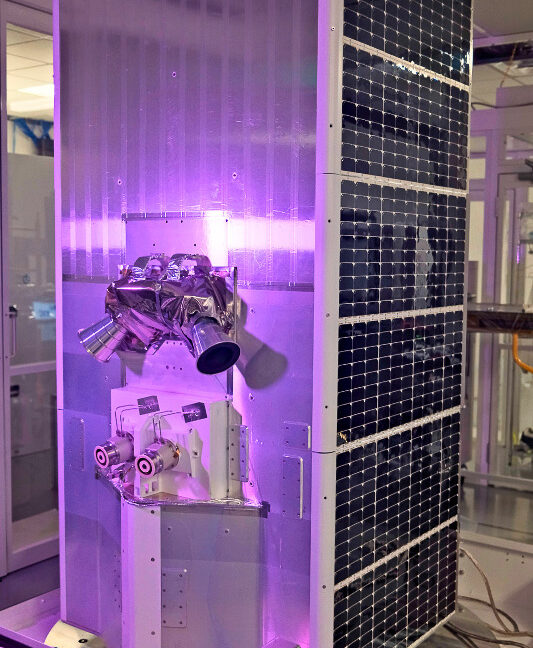
Clarity-1 at the pad

Albedo’s first big test may come within the next week and the launch of the “Transporter-13” mission on SpaceX’s Falcon 9 rocket. The company’s first satellite, Clarity-1, is 530 kg (1170 pounds) and riding atop the stack of ridesharing spacecraft. The mission could launch as soon as this coming weekend from Vandenberg Space Force Base in California.

The Clarity-1 satellite will be dropped off between 500 and 600 km orbit and then attempt to lower itself to an operational orbit 274 km (170 miles) above the planet.

This is a full-up version of Albedo’s satellite design. The spacecraft is larger than a full-size refrigerator, similar to a phone booth, and is intended to operate for a lifetime of about five years, depending on the solar cycle. Clarity-1 is launching near the peak of the 11-year solar cycle, so this could reduce its active lifetime.

Albedo recently won a contract from the US Air Force Research Laboratory that is worth up to $12 million to share VLEO-specific, on-orbit data and provide analysis to support the development of new missions and payloads beyond its own optical sensors.

Serving many different customers

The advantages of such a platform include superior image quality, less congested orbits, and natural debris removal as inoperable satellites are pulled down into Earth’s atmosphere and burnt up.

But what about the drawbacks? In orbits closer to Earth the primary issue is atomic oxygen, which is highly reactive and energetic. There are also plasma eddies and other phenomena that interfere with the operation of satellites and degrade their materials. This makes VLEO far more hazardous than higher altitudes. It’s also more difficult to capture precise imagery.

“The hardest part is pointing and attitude control,” Haddad said, “because that’s already hard in LEO, when you have a big telescope and you’re trying to get a high resolution. Then you put it in VLEO, where the Earth’s rotation beneath is moving faster, and it just exacerbates the problem.”

In the next several years, Albedo is likely to reach a constellation sized at about 24 satellites, but that number will depend on customer demand, Haddad said. Albedo has previously announced about half a dozen of its commercial customers who will task Clarity-1 for various purposes, such as power and pipeline monitoring or solar farm maintenance.

But first, it has to demonstrate its technology.

The modern era of low-flying satellites may begin this week Read More »

driving-an-ev-restomod-that-costs-as-much-as-a-house—the-jia-chieftain

Driving an EV restomod that costs as much as a house—the JIA Chieftain

The Chieftain Range Rover is a fascinating thing—a refitted, reskinned, restored classic Range Rover is no new thing, nor is one with a ludicrous American V8 stuffed under the hood. But one that can be had as a gas car, plug-in hybrid, or as an EV? It can be all of those things depending on which boxes you tick. Ars Technica went for a spin in the EV to see how it stacks up.

The UK is something of an EV restomod hub. It’s been throwing electricity in things that didn’t come off the line electrified in the first place for years. Businesses like Electrogenic, Lunaz, and Everrati will, for a price, make an old car feel a little more peppy—depending on who you go to, it’ll come back restored as well. The Chieftain isn’t quite like them. Developed by Oxfordshire, UK, based Jensen International Automotive (the company’s bread ‘n butter is Jensen Interceptors), the Chieftain is an old Range Rover turned up to VERY LOUD. Or, actually, not loud at all.

Of course, these things come at a cost. A Chieftain EV Range Rover conversion, today, will set you back at least $568,000 should you choose to order one. This one was a private commission, and at that price there won’t be any built on spec on the off chance someone wants to buy one “off the peg.” By any stretch of the imagination it is a huge amount for an old car, but they’re custom-built from start to finish.

The Range Rover has aged well. Alex Goy

Yours will be made to your specification, have CarPlay/Android Auto, and the sort of mod cons one would expect in the 2020s. Under its perfectly painted shell—the color is your choice, of course—lives a 120 kWh battery. It’s made of packs mounted under the hood and in the rear, firing power to all four wheels via three motors: one at the front, and two at the rear. The tri-motor setup can theoretically produce around 650 hp (485 kW), but it’s paired back to a smidge over 405 hp (302 kW), so it doesn’t eat its tires on a spirited launch. There’s a 60: 40 rear-to-front torque split to keep things exciting if that’s your jam. Air suspension keeps occupants comfortable and insulated from the world around them.

Driving an EV restomod that costs as much as a house—the JIA Chieftain Read More »

did-the-snowball-earth-give-complex-life-a-boost?

Did the snowball Earth give complex life a boost?

Life is complex

But when new minerals made their way to the water, what did they actually do? Cycle throughout the bottom of the ocean, delivering new elements to previously barren locations and providing energy for microbial life. At the end of the Cryogenic, these early lifeforms appear to have gotten gradually more complex, paving the way for the first known multicellular life in the ensuing Ediacaran.

“Any time there’s a really radical environmental shift, we know that’s an interesting time for evolution,” says Chris Kempes, a theoretical biophysicist at the Sante Fe Institute who was not involved in the research. For example, when temperatures drop or less sunlight is available, organisms’ speed and metabolic rates generally slow down, creating new pressures on life, Kempes’ research has found. Halverson thinks the extreme habitats that life had to endure during the snowballs played more of a role in shaping evolution than the nutrient flushes from glaciers.

Even so, studies like Kirkland’s that try to understand how nutrients and energy availability changed throughout history are “the key to understanding when and why there are major evolutionary transitions,” Kempes says.

To determine what other minerals may have been key players in the ancient oceans, Kirkland hopes to look at rocks called apatites, which contain oxygen and other elements like strontium and phosphorus. However, these break down much easier than zircon-rich rocks, meaning they are less stable through long stretches of time.

Though the global changes of the Cryogenic happened eons ago, Kirkland sees parallels with the wide-scale climate changes of today. “The atmosphere, the land, and the oceans are all interconnected,” he says. “Understanding these [ancient] cycles gives us information about how more modern cycles on the planet may work.”

Geology, 2025.  DOI:  10.1130/G52887.1

Hannah Richter is a freelance science journalist and graduate of MIT’s Graduate Program in Science Writing. She primarily covers environmental science and astronomy. 

Did the snowball Earth give complex life a boost? Read More »

astroscale-aced-the-world’s-first-rendezvous-with-a-piece-of-space-junk

Astroscale aced the world’s first rendezvous with a piece of space junk

Astroscale’s US subsidiary won a $25.5 million contract from the US Space Force in 2023 to build a satellite refueler that can hop around geostationary orbit. Like the ADRAS-J mission, this project is a public-private partnership, with Astroscale committing $12 million of its own money. In January, the Japanese government selected Astroscale for a contract worth up to $80 million to demonstrate chemical refueling in low-Earth orbit.

The latest win for Astroscale came Thursday, when the Japanese Ministry of Defense awarded the company a contract to develop a prototype satellite that could fly in geostationary orbit and collect information on other objects in the domain for Japan’s military and intelligence agencies.

“We are very bullish on the prospects for defense-related business,” said Nobu Matsuyama, Astroscale’s chief financial officer.

Astroscale’s other projects include a life extension mission for an unidentified customer in geostationary orbit, providing a similar service as Northrop Grumman’s Mission Extension Vehicle (MEV).

So, can Astroscale really do all of this? In an era of a militarized final frontier, it’s easy to see the usefulness of sidling up next to a “non-cooperative” satellite—whether it’s to refuel it, repair it, de-orbit it, inspect it, or (gasp!) disable it. Astroscale’s demonstration with ADRAS-J showed it can safely operate near another object in space without navigation aids, which is foundational to any of these applications.

So far, governments are driving demand for this kind of work.

Astroscale raised nearly $400 million in venture capital funding before going public on the Tokyo Stock Exchange last June. After quickly spiking to nearly $1 billion, the company’s market valuation has dropped to about $540 million as of Thursday. Astroscale has around 590 full-time employees across all its operating locations.

Matsuyama said Astroscale’s total backlog is valued at about 38.9 billion yen, or $260 million. The company is still in a ramp-up phase, reporting operating losses on its balance sheet and steep research and development spending that Matsuyama said should max out this year.

“We are the only company that has proved RPO technology for non-cooperative objects, like debris, in space,” Okada said last month.

“In simple terms, this means approach and capture of objects,” Okada continued. “This capability did not exist before us, but one’s mastering of this technology enables you to provide not only debris removal service, but also orbit correction, refueling, inspection, observation, and eventually repair and reuse services.”

Astroscale aced the world’s first rendezvous with a piece of space junk Read More »

now-the-overclock-curious-can-buy-a-delidded-amd-9800x3d,-with-a-warranty

Now the overclock-curious can buy a delidded AMD 9800X3D, with a warranty

The integrated heat spreaders put on CPUs at the factory are not the most thermally efficient material you could have on there, but what are you going to do—rip it off at the risk of killing your $500 chip with your clumsy hands?

Yes, that is precisely what enthusiastic overclockers have been doing for years, delidding, or decapping (though the latter term is used less often in overclocking circles), chips through various DIY techniques, allowing them to replace AMD and Intel’s common denominator shells with liquid metal or other advanced thermal interface materials.

As you might imagine, it can be nerve-wracking, and things can go wrong in just one second or one degree Celsius. In one overclocking forum thread, a seasoned expert noted that Intel’s Core Ultra 200S spreader (IHS) needs to be heated above 165° C for the indium (transfer material) to loosen. But then the glue holding the IHS is also loose at this temperature, and there is only 1.5–2 millimeters of space between IHS and surface-mounted components, so it’s easy for that metal IHS to slide off and take out a vital component with it. It’s quite the Saturday afternoon hobby.

That is the typical overclocking bargain: You assume the risk, you void your warranty, but you remove one more barrier to peak performance. Now, though, Thermal Grizzly, led by that same previously mentioned expert, Roman “der8auer” Hartung, has a new bargain to present. His firm is delidding AMD’s Ryzen 9800X3D CPUs with its own ovens and specialty tools, then selling them with two-year warranties that cover manufacturer’s defects and “normal overclocking damage,” but not mechanical damage.

Now the overclock-curious can buy a delidded AMD 9800X3D, with a warranty Read More »

amazon-uses-quantum-“cat-states”-with-error-correction

Amazon uses quantum “cat states” with error correction


The company shows off a mix of error-resistant hardware and error correction.

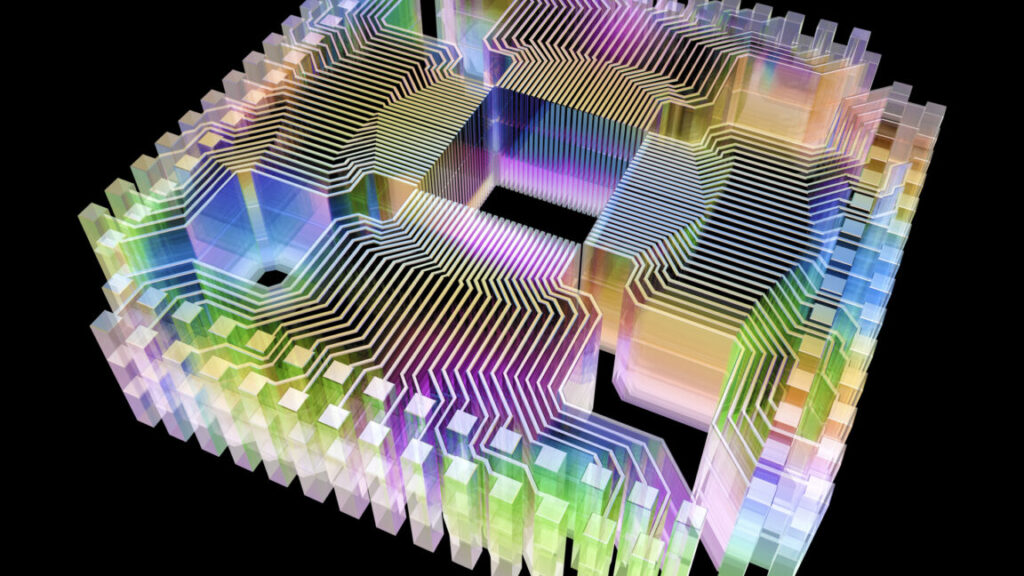
Following up on Microsoft’s announcement of a qubit based on completely new physics, Amazon is publishing a paper describing a very different take on quantum computing hardware. The system mixes two different types of qubit hardware to improve the stability of the quantum information they hold. The idea is that one type of qubit is resistant to errors, while the second can be used for implementing an error-correction code that catches the problems that do happen.

While there have been more effective demonstrations of error correction in the past, a number of companies are betting that Amazon’s general approach is the best route to getting logical qubits that are capable of complex algorithms. So, in that sense, it’s an important proof of principle.

Herding cats

The basic idea behind Amazon’s approach is to use one type of qubit to hold data and a second to enable error correction. The data qubit is extremely resistant to one type of error, but prone to a second. Those errors are where the second type of qubit comes in; it’s used to run an error-correction code that’s effective at picking up the problems the data qubits are prone to. Combined, the two are hoped to allow error correction to be handled by far fewer hardware qubits.

In a standard computer, there’s really only one type of error to worry about: a bit that no longer holds the value it was set to. This is called a bit flip, since the value goes from either zero to one, or one to zero. As with most things quantum computing, things are considerably more complicated with qubits. Since they don’t hold binary values, but rather probabilities, you can’t just flip the value of the qubit. Instead, bit flips in quantum land involve inverting the probabilities—going from 60: 40 to 40: 60 or similar.

But bit flips aren’t the only problems that can occur. Qubits can also suffer from what are called phase flip errors. These have no equivalent in classical computers, but they can also keep quantum computers from operating as expected.

In the past, Amazon demonstrated qubits that made it trivially easy to detect when a bit flip error occurred. For the new work, they moved on to something different: a qubit that greatly reduces the probability of bit flip errors.

They do this by using what are called “cat qubits,” after the famed Schrödinger’s cat, which existed in two states at once. While most qubits are based on a single quantum object being placed in this sort of superposition of states, a cat qubit has a collection of objects in a single superposition. (Put differently, the superposition state is distributed across the collection of objects.) In the case of the cat qubits demonstrated so far by companies like Alice and Bob, the objects are photons, which are all held in a single resonator, and Amazon is using similar tech.

Cat qubits have a distinctive feature compared to other options: bit flips are improbable, and get even less probable as you pump more photons into the resonator. But this has a drawback: more photons mean that phase flips become more probable.

Flipping cats

Those phase flips are why a second set of qubits, called transmons were brought in. (Transmons are a commonly used type of qubit based on a loop of superconducting wire linked to a microwave resonator and used by companies like IBM and Google.) These were used to create a chain of qubits, alternating between cat and transmon. This allowed the team to create a logical, error-corrected qubit using a simple error-correction code called a repetition code.

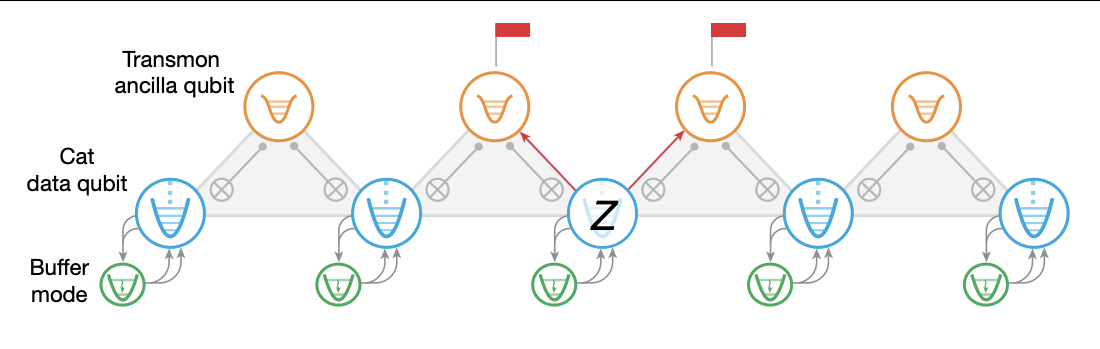
Image of a zig-zagging chain of alternating orange and blue circles.

The layout of Amazon’s hardware. Data-holding cat qubits (blue) alternate with transmons (orange), which can be measured to detect errors. Credit: Putterman et. al.

Here, each of the cat qubits starts off in the same state and is entangled with its neighboring transmons. This allowed the transmons to track what was going on in the cat qubits by performing what are called weak measurements. These don’t destroy the quantum state like a full measurement would but can allow the detection of changes in the neighboring cat qubits and provide the information needed to fix any errors.

So, the combination of the two means that almost all the errors that occur are phase flips, and the phase flips are detected and fixed.

In more typical error-correction schemes, you need enough qubits around to do measurements to identify both the location of an error and the nature of the error (phase or bit flip). Here, Amazon is assuming all errors are phase flips, and its team can identify the location of the flip based on which of the transmons detects an error, as shown by the red flags in the diagram above. It allows for a logical qubit that uses far fewer hardware qubits and measurements to get a given level of error correction.

The challenge of any error-correction setup is that each hardware qubit involved is error-prone. Adding too many into the error-correction system will mean that multiple errors are likely to occur simultaneously in a way that causes error correction to become impossible. Once the error rate of the hardware qubits gets low enough, however, adding additional qubits will bring the error rate down.

So, the key measurement done here is comparing a chain that has three cat qubits and two transmons to one that has five cat qubits and four transmons. These measurements showed that the five qubit chain had a lower error rate than the smaller one. This shows that the hardware is now at a state where error correction provides a benefit.

The characterization of the system indicated a couple of major limits, though. Cat qubits make bit flips extremely unlikely, but not impossible. By focusing error correction only on phase flips, any bit flips that do occur inescapably trigger the failure of the entire logical, error-corrected qubit. “Achieving long logical bit-flip times is challenging because any single cat qubit bit flip event in any part of the repetition code directly causes a logical bit flip error,” the authors note. The other issue is that the transmons used for error correction still suffer from both bit and phase flips, which can also mess up the entire error-corrected qubit.

Where does this leave us?

There are a number of companies like Amazon that are betting that using a somehow less error-prone hardware qubit will allow them to get effective error correction using fewer total hardware qubits. If they’re correct, they’ll be able to build error-corrected quantum computers using far fewer qubits, and so potentially perform useful computation sooner. For them, this paper is an important validation of the idea. You can do a sort of mixed-mode error correction, with a robust hardware qubit paired with a compact error-correction code.

But beyond that, the messages are pretty mixed. The hardware still had to rely on less robust hardware qubits (the transmons) to do error correction, and the very low error rate was still not low enough to avoid having occasional bit flips. And, ultimately, the error rate improvements gained by increasing the size of the logical qubit aren’t on a trajectory that would get you a useful level of error correction without needing an unrealistically large number of hardware qubits.

In short, the underlying hardware isn’t currently good enough to enable any sort of complex calculation, and it would need radical improvements before it can be. And there’s not an obvious alternate route to effective error correction. The potential of this approach is still there, but it’s not obvious how we’re going to build hardware that lives up to that potential.

As for Amazon, the picture is even less clear, given that this is the second qubit technology that it has talked about publicly. It’s unclear whether the company is going to go all-in on this approach, or is still looking for a technology that it’s willing to commit to.

Nature, 2025. DOI: 10.1038/s41586-025-08642-7  (About DOIs).

Photo of John Timmer

John is Ars Technica’s science editor. He has a Bachelor of Arts in Biochemistry from Columbia University, and a Ph.D. in Molecular and Cell Biology from the University of California, Berkeley. When physically separated from his keyboard, he tends to seek out a bicycle, or a scenic location for communing with his hiking boots.

Amazon uses quantum “cat states” with error correction Read More »

grok’s-new-“unhinged”-voice-mode-can-curse-and-scream,-simulate-phone-sex

Grok’s new “unhinged” voice mode can curse and scream, simulate phone sex

On Sunday, xAI released a new voice interaction mode for its Grok 3 AI model that is currently available to its premium subscribers. The feature is somewhat similar to OpenAI’s Advanced Voice Mode for ChatGPT. But unlike ChatGPT, Grok offers several uncensored personalities users can choose from (currently expressed through the same default female voice), including an “unhinged” mode and one that will roleplay verbal sexual scenarios.

On Monday, AI researcher Riley Goodside brought wider attention to the over-the-top “unhinged” mode in particular when he tweeted a video (warning: NSFW audio) that showed him repeatedly interrupting the vocal chatbot, which began to simulate yelling when asked. “Grok 3 Voice Mode, following repeated, interrupting requests to yell louder, lets out an inhuman 30-second scream, insults me, and hangs up,” he wrote.

By default, “unhinged” mode curses, insults, and belittles the user non-stop using vulgar language. Other modes include “Storyteller” (which does what it sounds like), “Romantic” (which stammers and speaks in a slow, uncertain, and insecure way), “Meditation” (which can guide you through a meditation-like experience), “Conspiracy” (which likes to talk about conspiracy theories, UFOs, and bigfoot), “Unlicensed Therapist” (which plays the part of a talk psychologist), “Grok Doc” (a doctor), “Sexy” (marked as “18+” and acts almost like a 1-800 phone sex operator), and “Professor” (which talks about science).

A composite screenshot of various Grok 3 voice mode personalities, as seen in the Grok app for iOS.

A composite screenshot of various Grok 3 voice mode personalities, as seen in the Grok app for iOS.

Basically, xAI is taking the exact opposite approach of other AI companies, such as OpenAI, which censor discussions about not-safe-for-work topics or scenarios they consider too risky for discussion. For example, the “Sexy” mode (warning: NSFW audio) will discuss graphically sexual situations, which ChatGPT’s voice mode will not touch, although OpenAI recently loosened up the moderation on the text-based version of ChatGPT to allow some discussion of some erotic content.

Grok’s new “unhinged” voice mode can curse and scream, simulate phone sex Read More »