Author name: Paul Patrick

scoop:-origami-measuring-spoon-incites-fury-after-9-years-of-kickstarter-delay-hell

Scoop: Origami measuring spoon incites fury after 9 years of Kickstarter delay hell


The curious case of the missing Kickstarter spoons.

An attention-grabbing Kickstarter campaign attempting to reinvent the measuring spoon has turned into a mad, mad, mad, mad world for backers after years of broken promises and thousands of missing spoons.

The mind-boggling design for the measuring spoon first wowed the Internet in 2016 after a video promoting the Kickstarter campaign went viral and spawned widespread media coverage fawning over the unique design.

Known as Polygons, the three-in-one origami measuring spoons have a flat design that can be easily folded into common teaspoon and tablespoon measurements. “Regular spoons are so 3000 BC,” a tagline on the project’s website joked.

For gadget geeks, it’s a neat example of thinking outside of the box, and fans found it appealing to potentially replace a drawer full of spoons with a more futuristic-looking compact tool. Most backers signed up for a single set, paying $8–$12 each, while hundreds wanted up to 25 sets, a handful ordered 50, and just one backer signed up for 100. Delivery was initially promised by 2017, supposedly shipping to anywhere in the world.

But it’s been about nine years since more than 30,000 backers flocked to the Kickstarter campaign—raising more than $1 million and eclipsing Polygons’ $10,000 goal. And not only have more than a third of the backers not received their spoons, but now, after years of updates claiming that the spoons had been shipped, some backers began to wonder if the entire campaign might be a fraud. They could see that Polygons are currently being sold on social media and suspected that the maker might be abusing backers’ funds to chase profits, seemingly without ever seriously intending to fulfill their orders.

One Kickstarter backer, Caskey Hunsader, told Ars that he started doubting if the spoon’s designer—an inventor from India, Rahul Agarwal—was even a real person.

Ars reached out to verify Agarwal’s design background. We confirmed that, yes, Agarwal is a real designer, and, yes, he believes there is a method to the madness when it comes to his Kickstarter campaign, which he said was never intended to be a scam or fraud and is currently shipping spoons to backers. He forecasted that 2025 is likely the year that backers’ wait will finally end.

But as thousands of complaints on the Kickstarter attest, backers have heard that one before. It’s been two years since the last official update was posted, which only promised updates that never came and did not confirm that shipments were back on track. The prior update in 2022 promised that “the time has finally arrived when we begin bulk shipping to everyone!”

Hunsader told Ars that people seem mostly upset because of “bullshit,” which is widely referenced in the comments. And that anger is compounded “by the fact that they are producing, and they are selling this product, so they are operating their business using funds that all these people who were their first backers gave them, and we’re the ones who are not getting the product. I think that’s where the anger comes from.”

“It’s been years now, and [I’ve] watched as you promise good people their products and never deliver,” one commenter wrote. “Wherever you try… to sell [your] products, we will be there reminding them of the empty orders you left here.”

“Where is my item? I am beyond angry,” another fumed.

Those who did receive their spoons often comment on the substantial delays, but reviews are largely positive.

“Holy crap, folks,” a somewhat satisfied backer wrote. “Hell has frozen over. I finally got them (no BS).”

One backer was surprised to get twice as many spoons as expected, referencing an explanation blaming Chinese New Year for one delay and writing, “I can honestly say after 8 years… and an enormous amount of emails, I finally received my pledge. Except… I only ordered 3… and I received 6. I’d be inclined to ship some back to Polygons… bare with me… I’ll return them soon… I appreciate your patience… mebbe after Chinese New Years 2033…”

Agarwal agreed to meet with Ars, show us the spoon, and explain why backers still haven’t gotten their deliveries when the spoon appears widely available to purchase online.

Failing prototypes and unusable cheap knockoffs

As a designer, Agarwal is clearly a perfectionist. He was just a student when he had the idea for Polygons in 2014, winning design awards and garnering interest that encouraged him to find a way to manufacture the spoons. He felt eager to see people using them.

Agarwal told Ars that before he launched the Kickstarter, he had prototypes made in China that were about 85 percent of the quality that he and his collaborators at InventIndia required. Anticipating that the quality would be fully there soon, Agarwal launched the Kickstarter, along with marketing efforts that Agarwal said had to be squashed due to unexpectedly high interest in the spoons.

This is when things started spiraling, as Agarwal had to switch manufacturers five times, with each partner crashing into new walls trying to execute the novel product.

Once the Kickstarter hit a million dollars, though, Agarwal committed to following through on launching the product. Eventually, cheap knockoff versions began appearing online on major retail sites like Walmart and Amazon toward the end of 2024. Because Agarwal has patents and trademarks for his design, he can get the knockoffs taken down, but they proved an important point that Agarwal had learned the hard way: that his design, while appearing simplistic, was incredibly hard to pull off.

Ars handled both a legitimate Polygons spoon and a cheap knockoff. The knockoff was a flimsy, unusable slab of rubber dotted with magnets; the companies aping Agarwal’s idea are seemingly unable to replicate the manufacturing process that Agarwal has spent years perfecting to finally be able to widely ship Polygons today.

On the other hand, Agarwal’s spoon is sturdy, uses food-grade materials, and worked just as well measuring wet and dry ingredients during an Ars test. A silicon hinge connects 19 separate plastic pieces and ensures that magnets neatly snap along indented lines indicating if the measurement is a quarter, half, or whole teaspoon or tablespoon. It took Agarwal two and a half years to finalize the design while working with InventIndia, a leading product development firm in India. Prototyping required making special molds that took a month each to iterate rather than using a 3D-printing shortcut whereby multiple prototypes could be made in a day, which Agarwal said he’d initially anticipated could be possible.

Around the time that the prototyping process concluded, Agarwal noted, COVID hit, and supply chains were disrupted, causing production setbacks. Once production could resume, costs became a factor, as estimates used to set Kickstarter backer awards were based on the early failed Chinese prototype, and the costs of producing a functioning spoon were much higher. Over time, shipping costs also rose.

As Kickstarter funds dwindled, there was no going back, so Agarwal devised a plan to sell the spoons for double the price ($25–$30 a set) by marketing them on social media, explaining this in a note to backers posted on the Polygons site. Those sales would fund ongoing manufacturing, allowing profits to be recycled so that Kickstarter backers could gradually receive shipments dependent on social media sales volumes. Orders from anyone who paid extra for expedited shipping are prioritized.

It’s a math problem at this point, with more funding needed to scale. But Agarwal told Ars that sales on Shopify and TikTok Shop have increased each quarter, most recently selling 30,000 units on TikTok, which allowed Polygons to take out a bigger line of credit to fund more manufacturing. He also brought in a more experienced partner to focus on the business side while he optimizes production.

Agarwal told Ars that he understands trust has been broken with many Kickstarter backers, considering that totally fair. While about 38 percent of backers’ orders still need filling, he predicts that all backers could get their orders within the next six to eight months as Polygons becomes better resourced, but that still depends on social media sales.

Agarwal met Ars after attending a housewares show in Chicago, where he shopped the spoons with retailers who may also help scale the product in the coming years. He anticipates that as the business scales, the cost of the spoons will come back down. And he may even be able to move onto executing other product designs that have been on the backburner as he attempts to work his way out of the Kickstarter corner he backed himself into while obsessing over his first design.

Kickstarter problem goes beyond Polygons

Hunsader told Ars there’s a big difference “in a lie versus bad management,” suggesting that as a business owner who has managed Kickstarter campaigns, he thinks more transparency likely could’ve spared Polygons a lot of angry comments.

“I am not sitting here with a dart board with [Agarwal’s] face on it, being like, when am I going to get my damn spoons?” Hunsader joked. But the campaign’s Kickstarter messaging left many backers feeling like Polygons took backers’ money and ran, Hunsader said.

Unlike people who saw the spoons going viral on social media, Hunsader discovered Polygons just by scrolling on Kickstarter. As a fan of geeky gadgets, he used to regularly support campaigns, but his experience supporting Polygons and monitoring other cases of problematic Kickstarters have made him more hesitant to use the platform without more safeguards for backers.

“It’s not specifically a Polygons problem,” Hunsader told Ars. “The whole Kickstarter thing needs maybe just more protections in place.”

Kickstarter did not respond to Ars’ request to comment. But Kickstarter’s “accountability” policy makes clear that creators “put their reputation at risk” launching campaigns and are ultimately responsible for following through on backer promises. Kickstarter doesn’t issue refunds or guarantee projects, only providing limited support when backers report “suspicious activity.”

Redditors have flagged “shitty” Kickstarter campaigns since 2012, three years after the site’s founding, and the National Association of Attorneys General—which represents US state attorneys general—suggested in 2019 that disgruntled crowdfunding backers were increasingly turning to consumer protection laws to fight alleged fraud.

In 2015, an independent analysis by the University of Pennsylvania estimated that 9 percent of Kickstarter projects didn’t fulfill their rewards. More recently, it appeared that figure had doubled, as Fortune reported last year that an internal Kickstarter estimate put “the amount of revenue that comes from fraudulent projects as high as 18 percent.” A spokesperson disputed that estimate and told Fortune that the platform employs “extensive” measures to detect fraud.

Agarwal told Ars that he thinks it’s uncommon for a campaign to continue fulfilling backer rewards after eight years of setbacks. It would be easier to just shut down and walk away, and Kickstarter likely would not have penalized him for it. While the Kickstarter campaign allowed him to reach his dream of seeing people using his novel measuring spoon in the real world, it’s been bittersweet that the campaign has dragged out so long and kept the spoons out of the hands of his earliest supporters, he told Ars.

Hunsader told Ars that he hopes the Polygons story serves as a “cautionary tale” for both backers and creators who bite off more than they can chew when launching a Kickstarter campaign. He knows that designers like Agarwal can take a reputational hit.

“I don’t want to make somebody who has big dreams not want to dream, but you also, when you’re dealing with things like manufacturing technology, have to be realistic about what is and is not accomplishable,” Hunsader said.

Polygons collaborators at InventIndia told Ars that Agarwal is “dedicated and hard-working,” describing him as “someone deeply committed to delivering a product that meets the highest standards” and whose intentions have “always” been to “ship a perfect product.”

Agarwal’s team connected with Hunsader to schedule his Kickstarter reward shipment on Friday. Hunsader told Ars he doesn’t really care if it takes another nine years. It’s just a spoon, and “there are bigger fish to fry.”

“Listen, I can buy that narrative that he was somebody who got totally overwhelmed but handled it in the worst possible way ever,” Hunsader said.

He plans to continue patiently waiting for his spoons.

This story was updated on March 14 to update information on the Polygons Kickstarter campaign.

Photo of Ashley Belanger

Ashley is a senior policy reporter for Ars Technica, dedicated to tracking social impacts of emerging policies and new technologies. She is a Chicago-based journalist with 20 years of experience.

Scoop: Origami measuring spoon incites fury after 9 years of Kickstarter delay hell Read More »

ai-search-engines-cite-incorrect-sources-at-an-alarming-60%-rate,-study-says

AI search engines cite incorrect sources at an alarming 60% rate, study says

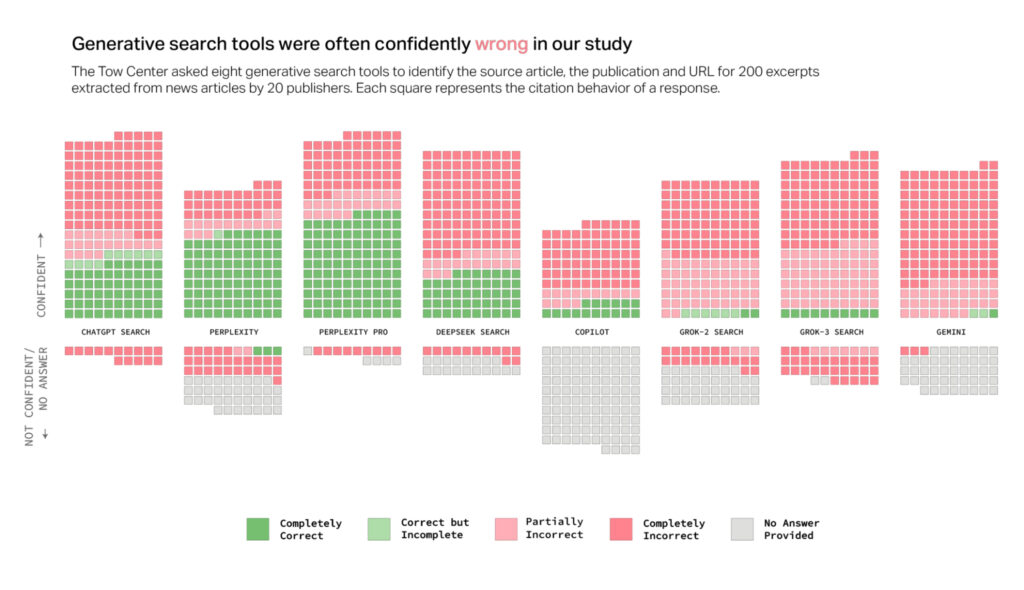
A new study from Columbia Journalism Review’s Tow Center for Digital Journalism finds serious accuracy issues with generative AI models used for news searches. The research tested eight AI-driven search tools equipped with live search functionality and discovered that the AI models incorrectly answered more than 60 percent of queries about news sources.

Researchers Klaudia Jaźwińska and Aisvarya Chandrasekar noted in their report that roughly 1 in 4 Americans now uses AI models as alternatives to traditional search engines. This raises serious concerns about reliability, given the substantial error rate uncovered in the study.

Error rates varied notably among the tested platforms. Perplexity provided incorrect information in 37 percent of the queries tested, whereas ChatGPT Search incorrectly identified 67 percent (134 out of 200) of articles queried. Grok 3 demonstrated the highest error rate, at 94 percent.

A graph from CJR shows

A graph from CJR shows “confidently wrong” search results. Credit: CJR

For the tests, researchers fed direct excerpts from actual news articles to the AI models, then asked each model to identify the article’s headline, original publisher, publication date, and URL. They ran 1,600 queries across the eight different generative search tools.

The study highlighted a common trend among these AI models: rather than declining to respond when they lacked reliable information, the models frequently provided confabulations—plausible-sounding incorrect or speculative answers. The researchers emphasized that this behavior was consistent across all tested models, not limited to just one tool.

Surprisingly, premium paid versions of these AI search tools fared even worse in certain respects. Perplexity Pro ($20/month) and Grok 3’s premium service ($40/month) confidently delivered incorrect responses more often than their free counterparts. Though these premium models correctly answered a higher number of prompts, their reluctance to decline uncertain responses drove higher overall error rates.

Issues with citations and publisher control

The CJR researchers also uncovered evidence suggesting some AI tools ignored Robot Exclusion Protocol settings, which publishers use to prevent unauthorized access. For example, Perplexity’s free version correctly identified all 10 excerpts from paywalled National Geographic content, despite National Geographic explicitly disallowing Perplexity’s web crawlers.

AI search engines cite incorrect sources at an alarming 60% rate, study says Read More »

google-has-a-fix-for-your-broken-chromecast-v2-unless-you-factory-reset

Google has a fix for your broken Chromecast V2 unless you factory reset

Google’s venerable 2015 Chromecast attempted to self-destruct earlier this week, upsetting a huge number of people who were still using the decade-old streaming dongles. Google was seemingly caught off guard by the devices glitching out all at the same time, but it promised to address the problem, and it has. Google says it has a fix ready to roll out, and most affected devices should be right as rain in the coming days.

Google is still not confirming the cause of the Chromecast outage, but it was almost certainly the result of a certificate expiring after 10 years. It would seem there was no one keeping an eye on the Chromecast’s ticking time bomb, which isn’t exactly surprising—Google has moved on from the Chromecast brand, focusing instead on the more capable Google TV streamer. Even if Google is done with the Chromecast, its customers aren’t.

If you left your 2015 Chromecast or Chromecast Audio alone to await a fix, you’re in good shape. The update should be delivered automatically to the device soon. “We’ve started rolling out a fix for the problem with Chromecast (2nd gen) and Chromecast Audio devices, which will be completed over the next few days. Users must ensure their device is connected to WiFi to receive the update,” says Google.

Google has a fix for your broken Chromecast V2 unless you factory reset Read More »

google’s-gemini-ai-can-now-see-your-search-history

Google’s Gemini AI can now see your search history

Gemini search opt-in

Credit: Google

Gemini 2.0 is also coming to Deep Research, Google’s AI tool that creates detailed reports on a topic or question. This tool browses the web on your behalf, taking its time to assemble its responses. The new Gemini 2.0-based version will show more of its work as it gathers data, and Google claims the final product will be of higher quality.

You don’t have to take Google’s word on this—you can try it for yourself, even if you don’t pay for advanced AI features. Google is making Deep Research free, but it’s not unlimited. The company says everyone will be able to try Deep Research “a few times a month” at no cost. That’s all the detail we’re getting, so don’t go crazy with Deep Research right away.

Lastly, Google is also rolling out Gems to free accounts. Gems are like custom chatbots you can set up with a specific task in mind. Google has some defaults like Learning Coach and Brainstormer, but you can get creative and make just about anything (within the limits prescribed by Google LLC and applicable laws).

Some of the newly free features require a lot of inference processing, which is not cheap. Making its most expensive models free, even on a limited basis, will undoubtedly increase Google’s AI losses. No one has figured out how to make money on generative AI yet, but Google seems content spending more money to secure market share.

Google’s Gemini AI can now see your search history Read More »

openai-declares-ai-race-“over”-if-training-on-copyrighted-works-isn’t-fair-use

OpenAI declares AI race “over” if training on copyrighted works isn’t fair use

OpenAI is hoping that Donald Trump’s AI Action Plan, due out this July, will settle copyright debates by declaring AI training fair use—paving the way for AI companies’ unfettered access to training data that OpenAI claims is critical to defeat China in the AI race.

Currently, courts are mulling whether AI training is fair use, as rights holders say that AI models trained on creative works threaten to replace them in markets and water down humanity’s creative output overall.

OpenAI is just one AI company fighting with rights holders in several dozen lawsuits, arguing that AI transforms copyrighted works it trains on and alleging that AI outputs aren’t substitutes for original works.

So far, one landmark ruling favored rights holders, with a judge declaring AI training is not fair use, as AI outputs clearly threatened to replace Thomson-Reuters’ legal research firm Westlaw in the market, Wired reported. But OpenAI now appears to be looking to Trump to avoid a similar outcome in its lawsuits, including a major suit brought by The New York Times.

“OpenAI’s models are trained to not replicate works for consumption by the public. Instead, they learn from the works and extract patterns, linguistic structures, and contextual insights,” OpenAI claimed. “This means our AI model training aligns with the core objectives of copyright and the fair use doctrine, using existing works to create something wholly new and different without eroding the commercial value of those existing works.”

Providing “freedom-focused” recommendations on Trump’s plan during a public comment period ending Saturday, OpenAI suggested Thursday that the US should end these court fights by shifting its copyright strategy to promote the AI industry’s “freedom to learn.” Otherwise, the People’s Republic of China (PRC) will likely continue accessing copyrighted data that US companies cannot access, supposedly giving China a leg up “while gaining little in the way of protections for the original IP creators,” OpenAI argued.

OpenAI declares AI race “over” if training on copyrighted works isn’t fair use Read More »

epa-accused-of-faking-criminal-investigation-to-claw-back-climate-funds

EPA accused of faking criminal investigation to claw back climate funds

Citibank has until March 15 to provide more information on orders to freeze funding. More details on that front were shared today, however, in a court filing in a lawsuit raised by Climate United—one of eight NCIF awardees whose funding was suddenly frozen.

In a motion opposing a request for a temporary restraining order forcing Citibank to unfreeze the funds, Citibank argued that it plays only an administrative role in managing accounts.

According to Citibank, it cannot be liable for freezing the funds because it’s legally required to follow instructions from the EPA and the Department of Treasury, and those agencies ordered Citibank “to pause all further disbursements from GGRF accounts, including those held by Climate United, until further notice.”

Citibank told the US district court that orders came to freeze the funding after “the government informed Citibank that the GGRF program was subject to an ongoing criminal investigation.”

Supposedly, the FBI received “credible information” that Climate United’s Citibank account was “involved in possible criminal violations,” allegedly including conspiracy to defraud the United States and wire fraud, Citibank’s filing said. In a footnote, Citibank said that it also “learned” that the EPA was “deeply” concerned about “matters of financial mismanagement, conflicts of interest, and oversight failures.”

So, freezing the funds was viewed as necessary, the filing alleged, to prevent “misuse of funds.” And Citibank claimed it had no authority to dispute “lawful” orders.

“Citibank is not vested with discretion to second-guess the government’s concerns regarding the ‘misconduct, waste, conflicts of interest, and potential fraud’ that the government has stated is occurring,” Citibank’s filing said.

Climate United, which describes itself as “a public-private investment fund that removes financial barriers to clean technologies,” said in a press release that freezing the funds had already harmed “hard-working Americans who are struggling to pay for groceries and keep the lights on.”

“Small businesses and developers are unable to draw committed funds for project expenses, critical programs are delayed or paused, and Climate United’s reputation as a lender is impacted,” Climate United said, rounding up stories from stakeholders already struggling through the freeze and urging, “this isn’t about politics; it’s about economics.”

EPA accused of faking criminal investigation to claw back climate funds Read More »

d-wave-quantum-annealers-solve-problems-classical-algorithms-struggle-with

D-Wave quantum annealers solve problems classical algorithms struggle with


The latest claim of a clear quantum supremacy solves a useful problem.

Right now, quantum computers are small and error-prone compared to where they’ll likely be in a few years. Even within those limitations, however, there have been regular claims that the hardware can perform in ways that are impossible to match with classical computation (one of the more recent examples coming just last year). In most cases to date, however, those claims were quickly followed by some tuning and optimization of classical algorithms that boosted their performance, making them competitive once again.

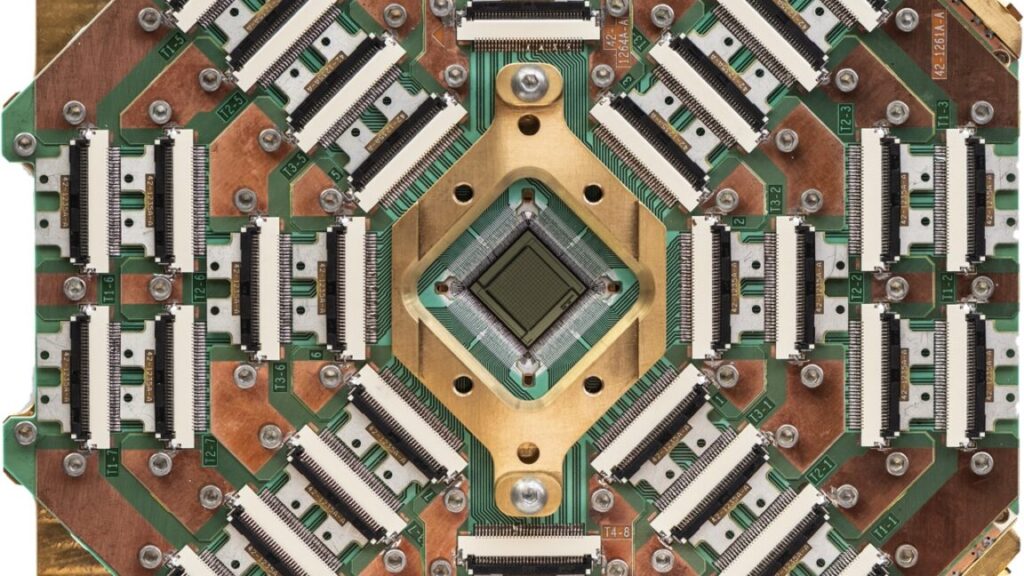
Today, we have a new entry into the claims department—or rather a new claim by an old entry. D-Wave is a company that makes quantum annealers, specialized hardware that is most effective when applied to a class of optimization problems. The new work shows that the hardware can track the behavior of a quantum system called an Ising model far more efficiently than any of the current state-of-the-art classical algorithms.

Knowing what will likely come next, however, the team behind the work writes, “We hope and expect that our results will inspire novel numerical techniques for quantum simulation.”

Real physics vs. simulation

Most of the claims regarding quantum computing superiority have come from general-purpose quantum hardware, like that of IBM and Google. These can solve a wide range of algorithms, but have been limited by the frequency of errors in their qubits. Those errors also turned out to be the reason classical algorithms have often been able to catch up with the claims from the quantum side. They limit the size of the collection of qubits that can be entangled at once, allowing algorithms that focus on interactions among neighboring qubits to perform reasonable simulations of the hardware’s behavior.

In any case, most of these claims have involved quantum computers that weren’t solving any particular algorithm, but rather simply behaving like a quantum computer. Google’s claims, for example, are based around what are called “random quantum circuits,” which is exactly what it sounds like.

Off in its own corner is a company called D-Wave, which makes hardware that relies on quantum effects to perform calculations, but isn’t a general-purpose quantum computer. Instead, its collections of qubits, once configured and initialized, are left to find their way to a ground energy state, which will correspond to a solution to a problem. This approach, called quantum annealing, is best suited to solving problems that involve finding optimal solutions to complex scheduling problems.

D-Wave was likely to have been the first company to experience the “we can outperform classical” followed by an “oh no you can’t” from algorithm developers, and since then it has typically been far more circumspect. In the meantime, a number of companies have put D-Wave’s computers to use on problems that align with where the hardware is most effective.

But on Thursday, D-Wave will release a paper that will once again claim, as its title indicates, “beyond classical computation.” And it will be doing it on a problem that doesn’t involve random circuits.

You sing, Ising

The new paper describes using D-Wave’s hardware to compute the evolution over time of something called an Ising model. A simple version of this model is a two-dimensional grid of objects, each of which can be in two possible states. The state that any one of these objects occupies is influenced by the state of its neighbors. So, it’s easy to put an Ising model into an unstable state, after which values of the objects within it will flip until it reaches a low-energy, stable state. Since this is also a quantum system, however, random noise can sometimes flip bits, so the system will continue to evolve over time. You can also connect the objects into geometries that are far more complicated than a grid, allowing more complex behaviors.

Someone took great notes from a physics lecture on Ising models that explains their behavior and role in physics in more detail. But there are two things you need to know to understand this news. One is that Ising models don’t involve a quantum computer merely acting like an array of qubits—it’s a problem that people have actually tried to find solutions to. The second is that D-Wave’s hardware, which provides a well-connected collection of quantum devices that can flip between two values, is a great match for Ising models.

Back in 2023, D-Wave used its 5,000-qubit annealer to demonstrate that its output when performing Ising model evolution was best described using Schrödinger’s equation, a central way of describing the behavior of quantum systems. And, as quantum systems become increasingly complex, Schrödinger’s equation gets much, much harder to solve using classical hardware—the implication being that modeling the behavior of 5,000 of these qubits could quite possibly be beyond the capacity of classical algorithms.

Still, having been burned before by improvements to classical algorithms, the D-Wave team was very cautious about voicing that implication. As they write in their latest paper, “It remains important to establish that within the parametric range studied, despite the limited correlation length and finite experimental precision, approximate classical methods cannot match the solution quality of the [D-Wave hardware] in a reasonable amount of time.”

So it’s important that they now have a new paper that indicates that classical methods in fact cannot do that in a reasonable amount of time.

Testing alternatives

The team, which is primarily based at D-Wave but includes researchers from a handful of high-level physics institutions from around the world, focused on three different methods of simulating quantum systems on classical hardware. They were put up against a smaller version of what will be D-Wave’s Advantage 2 system, designed to have a higher qubit connectivity and longer coherence times than its current Advantage. The work essentially involved finding where the classical simulators bogged down as either the simulation went on for too long, or the complexity of the Ising model’s geometry got too high (all while showing that D-Wave’s hardware could perform the same calculation).

Three different classical approaches were tested. Two of them involved a tensor network, one called MPS, for matrix product of states, and the second called projected entangled-pair states (PEPS). They also tried a neural network, as a number of these have been trained successfully to predict the output of Schrödinger’s equation for different systems.

These approaches were first tested on a simple 8×8 grid of objects rolled up into a cylinder, which increases the connectivity by eliminating two of the edges. And, for this simple system that evolved over a short period, the classical methods and the quantum hardware produced answers that were effectively indistinguishable.

Two of the classical algorithms, however, were relatively easy to eliminate from serious consideration. The neural network provided good results for short simulations but began to diverge rapidly once the system was allowed to evolve for longer times. And PEPS works by focusing on local entanglement and failed as entanglement was spread to ever-larger systems. That left MPS as the classical representative as more complex geometries were run for longer times.

By identifying where MPS started to fail, the researchers could estimate the amount of classical hardware that would be needed to allow the algorithm to keep pace with the Advantage 2 hardware on the most complex systems. And, well, it’s not going to be realistic any time soon. “On the largest problems, MPS would take millions of years on the Frontier supercomputer per input to match [quantum hardware] quality,” they conclude. “Memory requirements would exceed its 700PB storage, and electricity requirements would exceed annual global consumption.” By contrast, it took a few minutes on D-Wave’s hardware.

Again, in the paper, the researchers acknowledge that this may lead to another round of optimizations that bring classical algorithms back into competition. And, apparently those have already started once a draft of this upcoming paper was placed on the arXiv. At a press conference happening as this report was being prepared, one of D-Wave’s scientists, Andrew King, noted that two pre-prints have already appeared on the arXiv that described improvements to classical algorithms.

While these allow classical simulations to perform more of the results demonstrated in the new paper, they don’t involve simulating the most complicated geometries, and require shorter times and fewer total qubits. Nature talked to one of the people behind these algorithm improvements, who was optimistic that they could eventually replicate all of D-Wave’s results using non-quantum algorithms. D-Wave, obviously, is skeptical. And King said that a new, larger Advantage 2 test chip with over 4,000 qubits available had recently been calibrated, and he had already tested even larger versions of these same Ising models on it—ones that would be considerably harder for classical methods to catch up to.

In any case, the company is acting like things are settled. During the press conference describing the new results, people frequently referred to D-Wave having achieved quantum supremacy, and its CEO, Alan Baratz, in responding to skepticism sparked by the two draft manuscripts, said, “Our work should be celebrated as a significant milestone.”

Science, 2025. DOI: 10.1126/science.ado6285  (About DOIs).

Photo of John Timmer

John is Ars Technica’s science editor. He has a Bachelor of Arts in Biochemistry from Columbia University, and a Ph.D. in Molecular and Cell Biology from the University of California, Berkeley. When physically separated from his keyboard, he tends to seek out a bicycle, or a scenic location for communing with his hiking boots.

D-Wave quantum annealers solve problems classical algorithms struggle with Read More »

texas-measles-outbreak-spills-into-third-state-as-cases-reach-258

Texas measles outbreak spills into third state as cases reach 258

Texas and New Mexico

Meanwhile, the Texas health department on Tuesday provided an outbreak update, raising the case count to 223, up 25 from the 198 Texas cases reported Friday. Of the Texas cases, 29 have been hospitalized and one has died—a 6-year-old girl from Gaines County, the outbreak’s epicenter. The girl was unvaccinated and had no known underlying health conditions.

The outbreak continues to be primarily in unvaccinated children. Of the 223 cases, 76 are in ages 0 to 4, and 98 are between ages 5 and 17. Of the cases, 80 are unvaccinated, 138 lack vaccination status, and five are known to have received at least one dose of the Measles, Mumps, and Rubella vaccine.

One dose of MMR is estimated to be 93 percent effective against measles, and two doses offer 98 percent protection. It’s not unexpected to see a small number of breakthrough cases in large, localized outbreaks.

Across the border from Gaines County in Texas sits Lea County, where New Mexico officials have now documented 32 cases, with an additional case reported in neighboring Eddy County, bringing the state’s current total to 33. Of those cases, one person has been hospitalized and one person (not hospitalized) died. The death was an adult who did not seek medical care and tested positive for measles only after death. The cause of their death is under investigation.

Of New Mexico’s 33 cases, 27 were unvaccinated and five did not have a vaccination status, and one had received at least one MMR dose. Eighteen of the 33 cases are in adults, 13 are ages 0 to 17, and two cases have no confirmed age.

On Friday, the Centers for Disease Control and Prevention released a travel alert over the measles outbreak. “With spring and summer travel season approaching in the United States, CDC emphasizes the important role that clinicians and public health officials play in preventing the spread of measles,” the agency said in the alert. It advised clinicians to be vigilant in identifying potential measles cases.

The agency stressed the importance of vaccination, putting in bold: “Measles-mumps-rubella (MMR) vaccination remains the most important tool for preventing measles,” while saying that “all US residents should be up to date on their MMR vaccinations.”

US health secretary and long-time anti-vaccine advocate Robert F. Kennedy Jr, meanwhile, has been emphasizing cod liver oil, which does not prevent measles, and falsely blaming the outbreak on poor nutrition.

Texas measles outbreak spills into third state as cases reach 258 Read More »

gmail-gains-gemini-powered-“add-to-calendar”-button

Gmail gains Gemini-powered “Add to calendar” button

Google has a new mission in the AI era: to add Gemini to as many of the company’s products as possible. We’ve already seen Gemini appear in search results, text messages, and more. In Google’s latest update to Workspace, Gemini will be able to add calendar appointments from Gmail with a single click. Well, assuming Gemini gets it right the first time, which is far from certain.

The new calendar button will appear at the top of emails, right next to the summarize button that arrived last year. The calendar option will show up in Gmail threads with actionable meeting chit-chat, allowing you to mash that button to create an appointment in one step. The Gemini sidebar will open to confirm the appointment was made, which is a good opportunity to double-check the robot. There will be a handy edit button in the Gemini window in the event it makes a mistake. However, the robot can’t invite people to these events yet.

The effect of using the button is the same as opening the Gemini panel and asking it to create an appointment. The new functionality is simply detecting events and offering the button as a shortcut of sorts. You should not expect to see this button appear on messages that already have calendar integration, like dining reservations and flights. Those already pop up in Google Calendar without AI.

Gmail gains Gemini-powered “Add to calendar” button Read More »

yes,-you-get-used-to-the-grille:-the-2025-bmw-430i-gran-coupe-review

Yes, you get used to the grille: The 2025 BMW 430i Gran Coupe review

Back in 1995, a 430i badge would have meant that BMW had a 3.0 L engine. But this 430i makes do with just 2.0 L and four cylinders under the hood, albeit with a turbocharger. Output is 255 hp (190 kW) and 295 lb-ft (400 Nm), which in this case is sent to all the wheels—xDrive in BMW-speak—via an eight-speed transmission.

In the frosty and below-freezing winter temperatures, I averaged 28 mpg (8.4 L/100 km), one down on the car’s official EPA combined economy. Perhaps the engine’s 48 V mild hybrid system helped minimize the loss due to cold weather, which, yes, affects gasoline-powered cars, too.

Another downside to a diet that’s mostly electric cars is that you very quickly get used to that immediate throttle response. Even the best naturally aspirated engines can’t quite replicate that—not even the ones BMW has made in the past. Even though the turbocharger’s torque plateau arrives at just 1,600 rpm, it’s better to just be a bit relaxed about the whole thing. I found the automatic eight-speed a little too jerky in Sport mode, anyway.

A BMW 430i Gran Coupe seen from behind

Credit: Jonathan Gitlin

Among other minor grumbles, the brake pedal had too little bite for the first half-inch of travel and then too much bite for the next. And the steering wheel rim is too fat, a problem that has afflicted BMW for far too long. But they are minor complaints, and ones that hardly ruin the driving experience. While it’s more of a cruiser than a canyon carver, that’s not necessarily a bad thing. No one said that “ultimate driving machine” had to mean the fastest thing around a track, and for day-to-day driving, being in the 430i was a pleasant place to have to sit.

At $51,200, the 430i xDrive Gran Coupe looks relatively well-priced by the standards of 2025. But unlike the Korean or Japanese luxury brands, you will be expected to pay more if you want all the bells and whistles—our test car came in at $61,125 with options and delivery fee. Some might be superfluous—I’m not sure I’d spend $1,700 on the driving assists, or $2,500 on the M Sport package, but the top-down, 360-degree parking cameras are worth the $700 option, and the driver and infotainment display (part of the $1,650 premium package) lifts the in-car experience.

If all that sounds interesting but the internal combustion engine is a deal-breaker, check back tomorrow when we review the very closely related and even longer-named BMW i4 xDrive40 Gran Coupe (19-inch wheels).

Yes, you get used to the grille: The 2025 BMW 430i Gran Coupe review Read More »

study:-megalodon’s-body-shape-was-closer-to-a-lemon-shark

Study: Megalodon’s body shape was closer to a lemon shark


the mighty, mighty megalodon

Also: Baby megalodons were likely the size of great white sharks and capable of hunting marine mammals

The giant extinct shark species known as the megalodon has captured the interest of scientists and the general public alike, even inspiring the 2018 blockbuster film The Meg. The species lived some 3.6 million years ago and no complete skeleton has yet been found. So there has been considerable debate among paleobiologists about megalodon’s size, body shape and swimming speed, among other characteristics.

While some researchers have compared megalodon to a gigantic version of the stocky great white shark,  others believe the species had a more slender body shape. A new paper published in the journal Palaeontologia Electronica bolsters the latter viewpoint, also drawing conclusions about the megalodon’s body mass, swimming speed (based on hydrodynamic principles), and growth patterns.

As previously reported, the largest shark alive today, reaching up to 20 meters long, is the whale shark, a sedate filter feeder. As recently as 4 million years ago, however, sharks of that scale likely included the fast-moving predator megalodon (formally Otodus megalodon). Due to incomplete fossil data, we’re not entirely sure how large megalodons were and can only make inferences based on some of their living relatives.

Thanks to research published in 2023 on its fossilized teeth, we’re now fairly confident that megalodon shared something else with these relatives: it wasn’t entirely cold-blooded and kept its body temperature above that of the surrounding ocean. Most sharks, like most fish, are ectothermic, meaning that their body temperatures match those of the surrounding water. But a handful of species, part of a group termed mackerel sharks, are endothermic: They have a specialized pattern of blood circulation that helps retain some of the heat their muscles produce. This enables them to keep some body parts at a higher temperature than their surroundings.

Of particular relevance to this latest paper is a 2022 study by Jack Cooper of Swansea University in the UK and his co-authors. In 2020, the team reconstructed a 2D model of the megalodon, basing the dimensions on similar existing shark species. The researchers followed up in 2022 with a reconstructed 3D model, extrapolating the dimensions from a megalodon specimen (a vertebral column) in Belgium. Cooper concluded that a megalodon would have been a stocky, powerful shark—measuring some 52 feet (16 meters) in length with a body mass of 67.86 tons—able to execute bursts of high speed to attack prey, much like the significantly smaller great white shark.

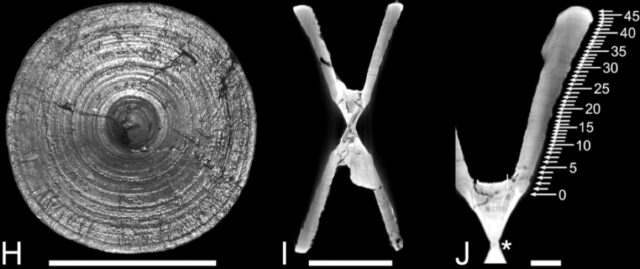
(H) One of the largest vertebrae of Otodus meg- alodon; (I and J) CT scans showing cross-sectional views.

(H) One of the largest vertebrae of Otodus megalodon; (I and J) CT scans showing cross-sectional views. Credit: Shimada et al., 2025

Not everyone agreed, however, Last year, a team of 26 shark experts led by Kesnshu Shimada, a paleobiologist at DePaul University, further challenged the great white shark comparison, arguing that the super-sized creature’s body was more slender and possibly even longer than researchers previously thought. The team concluded that based on the spinal column, the combination of a great white build with the megalodon’s much longer length would have simply proved too cumbersome.

A fresh approach

Now Shimada is back with a fresh analysis, employing a new method that he says provides independent lines of evidence for the megalodon’s slender build. “Our new study does not use the modern great white shark as a model, but rather simply asks, ‘How long were the head and tail based on the trunk [length] represented by the fossil vertebral column?’ using the general body plan seen collectively in living and fossil sharks,” Shimada told Ars.

Shimada and his co-authors measured the proportions of 145 modern and 20 extinct species of shark, particularly the head, trunk, and tail relative to total body length. Megalodon was represented by a Belgian vertebral specimen. The largest vertebra in that specimen measured 15.5 centimeters (6 inches) in diameter, although there are other megalodon vertebrae in Denmark, for example, with diameters as much as 23 centimeters (9 inches).

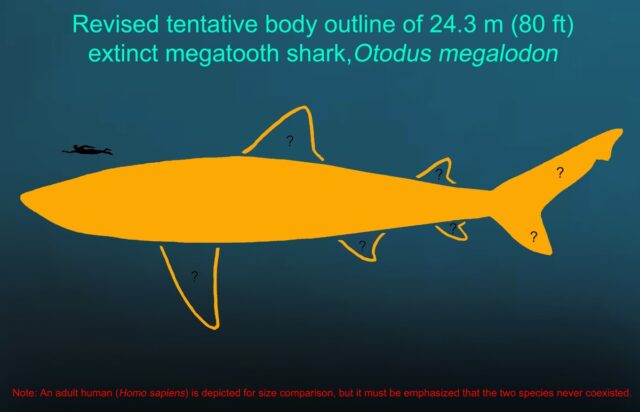
Based on their analysis, Shimada et al, concluded that, because the trunk section of the Belgian specimen measured 11 meters, the head and tail were probably about 1.8 meters (6 feet) and 3.6 meters (12 feet) long, respectively, with a total body length of 16.4 meters (54 feet) for this particularly specimen. That means the Danish megalodon specimens could have been as long as 24.3 meters (80 feet). As for body shape, taking the new length estimates into account, the lemon shark appears to be closest modern analogue. “However, the exact position and shape of practically all the fins remain uncertain,” Shimada cautioned. “We are only talking about the main part of the body.”

Revised tentative body outline of 24.3 meters (80 feet) extinct megatooth shark, Otodus megalodon.

Credit: DePaul University/Kenshu Shimada

The team also found that a 24.3-meter-long megalodon would have weighed a good 94 tons with an estimated swimming speed of 2.1-3.5 KPM (1.3-2.2 MPH). They also studied growth patterns evident in the Belgian vertebrae, concluding that the megalodon would give live birth and that the  newborns would be between 3.6 to 3.9 meters (12-13 feet) long—i.e., roughly the size of a great white shark. The authors see this as a refutation of the hypothesis that megalodons relied on nursery areas to rear their young, since a baby megalodon would be quite capable of hunting and killing marine mammals based on size alone.

In addition, “We unexpectedly unlocked the mystery of why certain aquatic vertebrates can attain gigantic sizes while others cannot,” Shimada said. “Living gigantic sharks, such as the whale shark and basking shark, as well as many other gigantic aquatic vertebrates like whales have slender bodies because large stocky bodies are hydrodynamically inefficient for swimming.”

That’s in sharp contrast to the great white shark, whose stocky body becomes even stockier as it grows. “It can be ‘large’ but cannot [get] past 7 meters (23 feet) to be ‘gigantic’ because of hydrodynamic constraints,” said Shimada. “We also demonstrate that the modern great white shark with a stocky body hypothetically blown up to the size of megalodon would not allow it to be an efficient swimmer due to the hydrodynamic constraints, further supporting the idea that it is more likely than not that megalodon must have had a much slenderer body than the modern great white shark.”

Shimada emphasized that their interpretations remain tentative but they are based on hard data and make for useful reference points for future research.

An “exciting working hypothesis”

For his part, Cooper found a lot to like in Shimada et al.’s latest analysis. “I’d say everything presented here is interesting and presents an exciting working hypothesis but that these should also be taken with a grain of salt until they can either be empirically tested, or a complete skeleton of megalodon is found to confirm one way or the other,” Cooper told Ars. “Generally, I appreciate the paper’s approach to its body size calculation in that it uses a lot of different shark species and doesn’t make any assumptions as to which species are the best analogues to megalodon.”

Shark biologists now say a lemon shark, like this one, is a better model of the extinct megalodon's body than the great white shark.

Shark biologists now say a lemon shark, like this one, is a better model of the extinct megalodon’s body than the great white shark. Credit: Albert Kok

Cooper acknowledged that it makes sense that a megalodon would be slightly slower than a great white given its sheer size, “though it does indicate we’ve got a shark capable of surprisingly fast speeds for its size,” he said. As for Shimada’s new growth model, he pronounced it “really solid” and concurred with the findings on birthing with one caveat. “I think the refutation of nursery sites is a bit of a leap, though I understand the temptation given the remarkably large size of the baby sharks,” he said. “We have geological evidence of multiple nurseries—not just small teeth, but also geological evidence of the right environmental conditions.”

He particularly liked Shinada et al.’s final paragraph. “[They] call out ‘popular questions’ along the lines of, ‘Was megalodon stronger than Livyatan?'” said Cooper. “I agree with the authors that these sorts of questions—ones we all often get asked by ‘fans’ on social media—are really not productive, as these unscientific questions disregard the rather amazing biology we’ve learned about this iconic, real species that existed, and reduce it to what I can only describe as a video game character.”

Regardless of how this friendly ongoing debate plays out, our collective fascination with megalodon is likely to persist. “It’s the imagining of such a magnificently enormous shark swimming around our oceans munching on whales, and considering that geologically speaking this happened in the very recent past,” said Cooper of the creature’s appeal. “It really captures what evolution can achieve, and even the huge size of their teeth alone really put it into perspective.”

DOI: Palaeontologia Electronica, 2025. 10.26879/1502  (About DOIs).

Photo of Jennifer Ouellette

Jennifer is a senior writer at Ars Technica with a particular focus on where science meets culture, covering everything from physics and related interdisciplinary topics to her favorite films and TV series. Jennifer lives in Baltimore with her spouse, physicist Sean M. Carroll, and their two cats, Ariel and Caliban.

Study: Megalodon’s body shape was closer to a lemon shark Read More »

huh?-the-valuable-role-of-interjections

Huh? The valuable role of interjections


Utterances like um, wow, and mm-hmm aren’t garbage—they keep conversations flowing.

Interjections—one-word utterances that aren’t part of a larger sentence—used to be dismissed as irrelevant linguistic detritus. But some linguists now think they play an essential role in regulating conversations. Credit: Daniel Garcia/Knowable Magazine

Interjections—one-word utterances that aren’t part of a larger sentence—used to be dismissed as irrelevant linguistic detritus. But some linguists now think they play an essential role in regulating conversations. Credit: Daniel Garcia/Knowable Magazine

Listen carefully to a spoken conversation and you’ll notice that the speakers use a lot of little quasi-words—mm-hmm, um, huh? and the like—that don’t convey any information about the topic of the conversation itself. For many decades, linguists regarded such utterances as largely irrelevant noise, the flotsam and jetsam that accumulate on the margins of language when speakers aren’t as articulate as they’d like to be.

But these little words may be much more important than that. A few linguists now think that far from being detritus, they may be crucial traffic signals to regulate the flow of conversation as well as tools to negotiate mutual understanding. That puts them at the heart of language itself—and they may be the hardest part of language for artificial intelligence to master.

“Here is this phenomenon that lives right under our nose, that we barely noticed,” says Mark Dingemanse, a linguist at Radboud University in the Netherlands, “that turns out to upend our ideas of what makes complex language even possible in the first place.”

For most of the history of linguistics, scholars have tended to focus on written language, in large part because that’s what they had records of. But once recordings of conversation became available, they could begin to analyze spoken language the same way as writing.

When they did, they observed that interjections—that is, short utterances of just a word or two that are not part of a larger sentence—were ubiquitous in everyday speech. “One in every seven utterances are one of these things,” says Dingemanse, who explores the use of interjections in the 2024 Annual Review of Linguistics. “You’re going to find one of those little guys flying by every 12 seconds. Apparently, we need them.”

Many of these interjections serve to regulate the flow of conversation. “Think of it as a tool kit for conducting interactions,” says Dingemanse. “If you want to have streamlined conversations, these are the tools you need.” An um or uh from the speaker, for example, signals that they’re about to pause, but aren’t finished speaking. A quick huh? or what? from the listener, on the other hand, can signal a failure of communication that the speaker needs to repair.

That need seems to be universal: In a survey of 31 languages around the world, Dingemanse and his colleagues found that all of them used a short, neutral syllable similar to huh? as a repair signal, probably because it’s quick to produce. “In that moment of difficulty, you’re going to need the simplest possible question word, and that’s what huh? is,” says Dingemanse. “We think all societies will stumble on this, for the same reason.”

Other interjections serve as what some linguists call “continuers,” such as mm-hmm — signals from the listener that they’re paying attention and the speaker should keep going. Once again, the form of the word is well suited to its function: Because mm-hmm is made with a closed mouth, it’s clear that the signaler does not intend to speak.

Sign languages often handle continuers differently, but then again, two people signing at the same time can be less disruptive than two people speaking, says Carl Börstell, a linguist at the University of Bergen in Norway. In Swedish Sign Language, for example, listeners often sign yes as a continuer for long stretches, but to keep this continuer unobtrusive, the sender tends to hold their hands lower than usual.

Different interjections can send slightly different signals. Consider, for example, one person describing to another how to build a piece of Ikea furniture, says Allison Nguyen, a psycholinguist at Illinois State University. In such a conversation, mm-hmm might indicate that the speaker should continue explaining the current step, while yeah or OK would imply that the listener is done with that step and it’s time to move on to the next.

Wow! There’s more

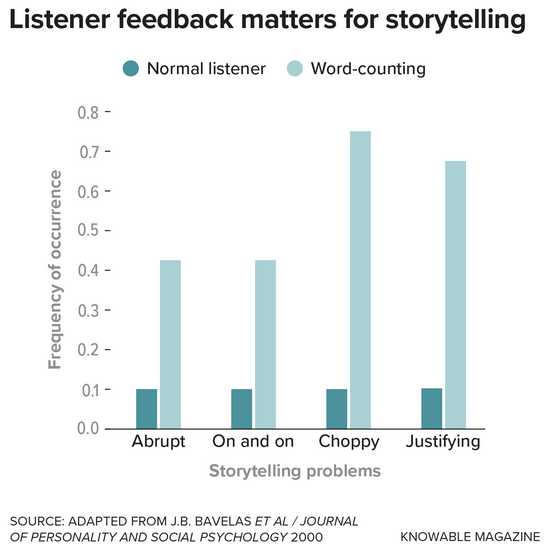
Continuers aren’t merely for politeness—they really matter to a conversation, says Dingemanse. In one classic experiment from more than two decades ago, 34 undergraduate students listened as another volunteer told them a story. Some of the listeners gave the usual “I’m listening” signals, while others—who had been instructed to count the number of words beginning with the letter t—were too distracted to do so. The lack of normal signals from the listeners led to stories that were less well crafted, the researchers found. “That shows that these little words are quite consequential,” says Dingemanse.

Nguyen agrees that such words are far from meaningless. “They really do a lot for mutual understanding and mutual conversation,” she says. She’s now working to see if emojis serve similar functions in text conversations.

Storytellers depend on feedback such as mm-hmm and other interjections from their listeners. In this experiment, some listeners were told to count the number of times the storyteller used a word starting with t—a challenging task that prevented them from giving normal feedback. The quality of storytelling declined significantly, with problems like abrupt endings, rambling on, uneven or choppy pacing and overexplaining or justifying the point. Credit: Knowable Magazine

The role of interjections goes even deeper than regulating the flow of conversation. Interjections also help in negotiating the ground rules of a conversation. Every time two people converse, they need to establish an understanding of where each is coming from: what each participant knows to begin with, what they think the other person knows and how much detail they want to hear. Much of this work—what linguists call “grounding”—is carried out by interjections.

“If I’m telling you a story and you say something like ‘Wow!’ I might find that encouraging and add more detail,” says Nguyen. “But if you do something like, ‘Uh-huh,’ I’m going to assume you aren’t interested in more detail.”

A key part of grounding is working out what each participant thinks about the other’s knowledge, says Martina Wiltschko, a theoretical linguist at the Catalan Institution for Research and Advanced Studies in Barcelona, Spain. Some languages, like Mandarin, explicitly differentiate between “I’m telling you something you didn’t know” and “I’m telling you something that I think you knew already.” In English, that task falls largely on interjections.

One of Wiltschko’s favorite examples is the Canadian eh?  “If I tell you you have a new dog, I’m usually not telling you stuff you don’t know, so it’s weird for me to tell you,” she says. But ‘You have a new dog, eh?’ eliminates the weirdness by flagging the statement as news to the speaker, not the listener.

Other interjections can indicate that the speaker knows they’re not giving the other participant what they sought. “If you ask me what’s the weather like in Barcelona, I can say ‘Well, I haven’t been outside yet,’” says Wiltschko. The well is an acknowledgement that she’s not quite answering the question.

Wiltschko and her students have now examined more than 20 languages, and every one of them uses little words for negotiations like these. “I haven’t found a language that doesn’t do these three general things: what I know, what I think you know and turn-taking,” she says. They are key to regulating conversations, she adds: “We are building common ground, and we are taking turns.”

Details like these aren’t just arcana for linguists to obsess over. Using interjections properly is a key part of sounding fluent in speaking a second language, notes Wiltschko, but language teachers often ignore them. “When it comes to language teaching, you get points deducted for using ums and uhs, because you’re ‘not fluent,’” she says. “But native speakers use them, because it helps! They should be taught.” Artificial intelligence, too, can struggle to use interjections well, she notes, making them the best way to distinguish between a computer and a real human.

And interjections also provide a window into interpersonal relationships. “These little markers say so much about what you think,” she says—and they’re harder to control than the actual content. Maybe couples therapists, for example, would find that interjections afford useful insights into how their clients regard one another and how they negotiate power in a conversation. The interjection oh often signals confrontation, she says, as in the difference between “Do you want to go out for dinner?” and “Oh, so now you want to go out for dinner?”

Indeed, these little words go right to the heart of language and what it is for. “Language exists because we need to interact with one another,” says Börstell. “For me, that’s the main reason for language being so successful.”

Dingemanse goes one step further. Interjections, he says, don’t just facilitate our conversations. In negotiating points of view and grounding, they’re also how language talks about talking.

“With huh?  you say not just ‘I didn’t understand,’” says Dingemanse. “It’s ‘I understand you’re trying to tell me something, but I didn’t get it.’” That reflexivity enables more sophisticated speech and thought. Indeed, he says, “I don’t think we would have complex language if it were not for these simple words.”

Photo of Knowable Magazine

Knowable Magazine explores the real-world significance of scholarly work through a journalistic lens.

Huh? The valuable role of interjections Read More »