Author name: Paul Patrick

trump-is-forcing-states-to-funnel-grant-money-to-starlink,-senate-democrats-say

Trump is forcing states to funnel grant money to Starlink, Senate Democrats say

Lutnick’s announcement of the BEAD overhaul also criticized what he called the program’s “woke mandates” and “burdensome regulations.” Republicans like Sen. Ted Cruz (R-Texas) have criticized a requirement for ISPs that accept subsidies to offer low-cost Internet plans to people with low incomes, though the low-cost rule was originally imposed by Congress in the law that created the BEAD program.

Letter: Projects could be delayed two years

Although Musk last week announced his departure from the government and criticized a Trump spending bill for allegedly “undermining” DOGE’s cost-cutting work, Trump still seems favorably inclined toward Starlink. Trump said in a press conference on Friday that with Starlink, Musk “saved a lot of lives, probably hundreds of lives in North Carolina,” referring to Starlink offering emergency connectivity after Hurricane Helene.

Democrats’ letter to Trump and Lutnick said that fiber and other terrestrial broadband technologies will be better than satellite both for residential connectivity and business networks that support US-based manufacturing.

“Data centers, smart warehouses, robotic assembly lines, and chip fabrication plants all depend on fast, stable, and scalable bandwidth. If we want these job-creating facilities built throughout the United States, including rural areas… we must act now—and we must build the high-speed, high-capacity networks those technologies demand,” the letter said.

Democrats also said the Trump administration’s rewrite of program rules could delay projects by two years.

“For six months, states have been waiting to break ground on scores of projects, held back only by the Commerce Department’s bureaucratic delays,” the letter said. “If states are forced to redo or rework their plans, they will not only miss this year’s construction season but next year’s as well, delaying broadband deployment by years. That’s why we urge the Administration to move swiftly to approve state plans, and release the $42 billion allocated to the states by the BEAD Program.”

Separately from BEAD, Trump said last month that he is killing a $2.75 billion broadband grant program authorized by Congress. The Digital Equity Act of 2021 allows for several types of grants benefitting low-income households, people who are at least 60 years old, people incarcerated in state or local prisons and jails, veterans, people with disabilities, people with language barriers, people who live in rural areas, and people who are members of a racial or ethnic minority group. Trump called the program “racist and illegal,” saying his administration would stop distributing Digital Equity Act grants.

Trump is forcing states to funnel grant money to Starlink, Senate Democrats say Read More »

some-parts-of-trump’s-proposed-budget-for-nasa-are-literally-draconian

Some parts of Trump’s proposed budget for NASA are literally draconian


“That’s exactly the kind of thing that NASA should be concentrating its resources on.”

Artist’s illustration of the DRACO nuclear rocket engine in space. Credit: Lockheed Martin

New details of the Trump administration’s plans for NASA, released Friday, revealed the White House’s desire to end the development of an experimental nuclear thermal rocket engine that could have shown a new way of exploring the Solar System.

Trump’s NASA budget request is rife with spending cuts. Overall, the White House proposes reducing NASA’s budget by about 24 percent, from $24.8 billion this year to $18.8 billion in fiscal year 2026. In previous stories, Ars has covered many of the programs impacted by the proposed cuts, which would cancel the Space Launch System rocket and Orion spacecraft and terminate numerous robotic science missions, including the Mars Sample Return, probes to Venus, and future space telescopes.

Instead, the leftover funding for NASA’s human exploration program would go toward supporting commercial projects to land on the Moon and Mars.

NASA’s initiatives to pioneer next-generation space technologies are also hit hard in the White House’s budget proposal. If the Trump administration gets its way, NASA’s Space Technology Mission Directorate, or STMD, will see its budget cut nearly in half, from $1.1 billion to $568 million.

Trump’s budget request isn’t final. Both Republican-controlled houses of Congress will write their own versions of the NASA budget, which must be reconciled before going to the White House for President Trump’s signature.

“The budget reduces Space Technology by approximately half, including eliminating failing space propulsion projects,” the White House wrote in an initial overview of the NASA budget request released May 2. “The reductions also scale back or eliminate technology projects that are not needed by NASA or are better suited to private sector research and development.”

Breathing fire

Last week, the White House and NASA put a finer point on these “failing space propulsion projects.”

“This budget provides no funding for Nuclear Thermal Propulsion and Nuclear Electric Propulsion projects,” officials wrote in a technical supplement released Friday detailing Trump’s NASA budget proposal. “These efforts are costly investments, would take many years to develop, and have not been identified as the propulsion mode for deep space missions. The nuclear propulsion projects are terminated to achieve cost savings and because there are other nearer-term propulsion alternatives for Mars transit.”

Foremost among these cuts, the White House proposes to end NASA’s participation in the Demonstration Rocket for Agile Cislunar Operations (DRACO) project. NASA said this proposal “reflects the decision by our partner to cancel” the DRACO mission, which would have demonstrated a nuclear thermal rocket engine in space for the first time.

NASA’s partner on the DRACO mission was the Defense Advanced Research Projects Agency, or DARPA, the Pentagon’s research and development arm. A DARPA spokesperson confirmed the agency was closing out the project.

“DARPA has completed the agency’s involvement in the Demonstration Rocket for Agile Cislunar Orbit (DRACO) program and is transitioning its knowledge to our DRACO mission partner, the National Aeronautics and Space Administration (NASA), and to other potential DOD programs,” the spokesperson said in a response to written questions.

A nuclear rocket engine, which was to be part of NASA’s aborted NERVA program, is tested at Jackass Flats, Nevada, in 1967. Credit: Corbis via Getty Images)

Less than two years ago, NASA and DARPA announced plans to move forward with the roughly $500 million DRACO project, targeting a launch into Earth orbit aboard a traditional chemical rocket in 2027. “With the help of this new technology, astronauts could journey to and from deep space faster than ever, a major capability to prepare for crewed missions to Mars,” former NASA administrator Bill Nelson said at the time.

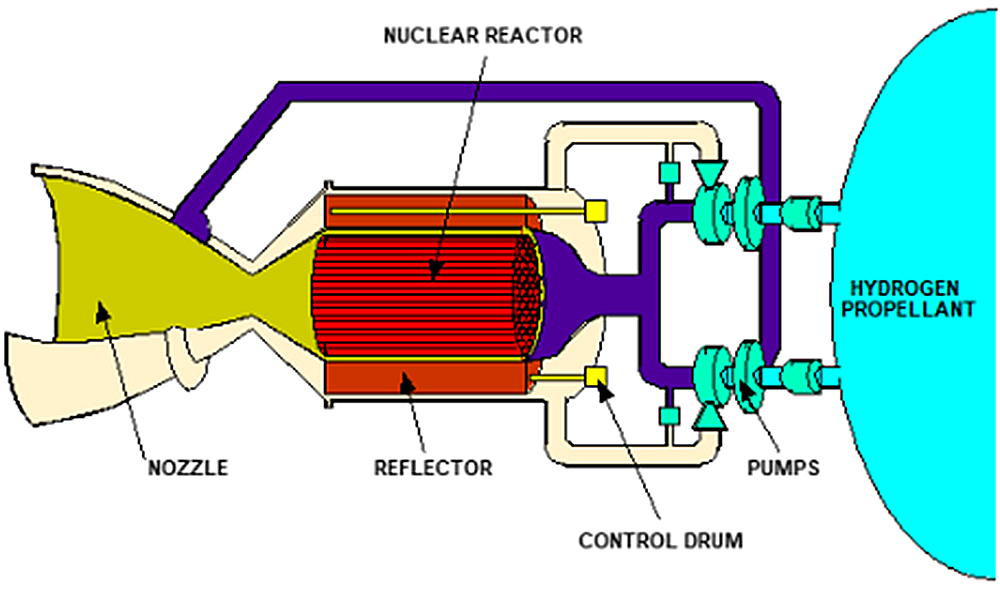
The DRACO mission would have consisted of several elements, including a nuclear reactor to rapidly heat up super-cold liquid hydrogen fuel stored in an insulated tank onboard the spacecraft. Temperatures inside the engine would reach nearly 5,000° Fahrenheit, boiling the hydrogen and driving the resulting gas through a nozzle, generating thrust. From the outside, the spacecraft’s design looks a lot like the upper stage of a traditional rocket. However, theoretically, a nuclear thermal rocket engine like DRACO’s would offer twice the efficiency of the highest-performing conventional rocket engines. That translates to significantly less fuel that a mission to Mars would have to carry across the Solar System.

Essentially, a nuclear thermal rocket engine combines the high-thrust capability of a chemical engine with some of the fuel efficiency benefits of low-thrust solar-electric engines. With DRACO, engineers sought hard data to verify their understanding of nuclear propulsion and wanted to make sure the nuclear engine’s challenging design actually worked. DRACO would have used high-assay low-enriched uranium to power its nuclear reactor.

Nuclear electric propulsion uses an onboard nuclear reactor to power plasma thrusters that create thrust by accelerating an ionized gas, like xenon, through a magnetic field. Nuclear electric propulsion would provide another leap in engine efficiency beyond the capabilities of a system like DRACO and may ultimately offer the most attractive option for enduring deep space transportation.

NASA led the development of DRACO’s nuclear rocket engine, while DARPA was responsible for the overall spacecraft design, operations, and the thorny problem of securing regulatory approval to launch a nuclear reactor into orbit. The reactor on DRACO would have launched in “cold” mode before activating in space, reducing the risk to people on the ground in the event of a launch accident. The Space Force agreed to pay for DRACO’s launch on a United Launch Alliance Vulcan rocket.

DARPA and NASA selected Lockheed Martin as the lead contractor for the DRACO spacecraft in 2023. BWX Technologies, a leader in the US nuclear industry, won the contract to develop the mission’s reactor.

“We received the notice from DARPA that it ended the DRACO program,” a Lockheed Martin spokesperson said. “While we’re disappointed with the decision, it doesn’t change our vision of how nuclear power influences how we will explore and operate in the vastness of space.”

Mired in the lab

More than 60 years have passed since a US-built nuclear reactor launched into orbit. Aviation Week reported in January that one problem facing DRACO engineers involved questions about how to safely test the nuclear thermal engine on the ground while adhering to nuclear safety protocols.

“We’re bringing two things together—space mission assurance and nuclear safety—and there’s a fair amount of complexity,” said Matthew Sambora, a DRACO program manager at DARPA, in an interview with Aviation Week. At the time, DARPA and NASA had already given up on a 2027 launch to concentrate on developing a prototype engine using helium as a propellant before moving on to an operational engine with more energetic liquid hydrogen fuel, Aviation Week reported.

Greg Meholic, an engineer at the Aerospace Corporation, highlighted the shortfall in ground testing capability in a presentation last year. Nuclear thermal propulsion testing “requires that engine exhaust be scrubbed of radiologics before being released,” he wrote. This requirement “could result in substantially large, prohibitively expensive facilities that take years to build and qualify.”

These safety protocols weren’t as stringent when NASA and the Air Force first pursued nuclear propulsion in the 1960s. Now, the first serious 21st-century effort to fly a nuclear rocket engine in space is grinding to a halt.

“Given that our near-term human exploration and science needs do not require nuclear propulsion, current demonstration projects will end,” wrote Janet Petro, NASA’s acting administrator, in a letter accompanying the Trump administration’s budget release last week.

This figure illustrates the major elements of a typical nuclear thermal rocket engine. Credit: NASA/Glenn Research Center

NASA’s 2024 budget allocated $117 million for nuclear propulsion work, an increase from $91 million the previous year. Congress added more funding for NASA’s nuclear propulsion programs over the Biden administration’s proposed budget in recent years, signaling support on Capitol Hill that may save at least some nuclear propulsion initiatives next year.

It’s true that nuclear propulsion isn’t required for any NASA missions currently on the books. Today’s rockets are good at hurling cargo and people off planet Earth, but once a spacecraft arrives in orbit, there are several ways to propel it toward more distant destinations.

NASA’s existing architecture for sending astronauts to the Moon uses the SLS rocket and Orion spacecraft, both of which are proposed for cancellation and look a lot like the vehicles NASA used to fly astronauts to the Moon more than 50 years ago. SpaceX’s reusable Starship, designed with an eye toward settling Mars, uses conventional chemical propulsion, with methane and liquid oxygen propellants that SpaceX one day hopes to generate on the surface of the Red Planet.

So NASA, SpaceX, and other companies don’t need nuclear propulsion to beat China back to the Moon or put the first human footprints on Mars. But there’s a broad consensus that in the long run, nuclear rockets offer a better way of moving around the Solar System.

The military’s motive for funding nuclear thermal propulsion was its potential for becoming a more efficient means of maneuvering around the Earth. Many of the military’s most important spacecraft are limited by fuel, and the Space Force is investigating orbital refueling and novel propulsion methods to extend the lifespan of satellites.

NASA’s nuclear power program is not finished. The Trump administration’s budget proposal calls for continued funding for the agency’s fission surface power program, with the goal of fielding a nuclear reactor that could power a base on the surface of the Moon or Mars. Lockheed and BWXT, the contractors involved in the DRACO mission, are part of the fission surface power program.

There is some funding in the White House’s budget request for tech demos using other methods of in-space propulsion. NASA would continue funding experiments in long-term storage and transfer of cryogenic propellants like liquid methane, liquid hydrogen, and liquid oxygen. These joint projects between NASA and industry could pave the way for orbital refueling and orbiting propellant depots, aligning with the direction of companies like SpaceX, Blue Origin, and United Launch Alliance.

But many scientists and engineers believe nuclear propulsion offers the only realistic path for a sustainable campaign ferrying people between the Earth and Mars. A report commissioned by NASA and the National Academies concluded in 2021 that an aggressive tech-development program could advance nuclear thermal propulsion enough for a human expedition to Mars in 2039. The prospects for nuclear electric propulsion were murkier.

This would have required NASA to substantially increase its budget for nuclear propulsion immediately, likely by an order of magnitude beyond the agency’s baseline funding level, or to an amount exceeding $1 billion per year, said Bobby Braun, co-chair of the National Academies report, in a 2021 interview with Ars. That didn’t happen.

Going nuclear

The interplanetary transportation architectures envisioned by NASA and SpaceX will, at least initially, primarily use chemical propulsion for the cruise between Earth and Mars.

Kurt Polzin, chief engineer of NASA’s space nuclear propulsion projects, said significant technical hurdles stand in the way of any propulsion system selected to power heavy cargo and humans to Mars.

“Anybody who says that they’ve solved the problem, you don’t know that because you don’t have enough data,” Polzin said last week at the Humans to the Moon and Mars Summit in Washington.

“We know that to do a Mars mission with a Starship, you need lots of refuelings at Earth, you need lots of refuelings at Mars, which you have to send in advance,” Polzin said. “You either need to send that propellant in advance or send a bunch of material and hardware to the surface to be set up and robotically make your propellant in situ while you’re there.”

Elon Musk’s SpaceX is betting on chemical propulsion for round-trip flights to Mars with its Starship rocket. This will require assembly of propellant-generation plants on the Martian surface. Credit: SpaceX

Last week, SpaceX founder Elon Musk outlined how the company plans to land its first Starships on Mars. His roadmap includes more than 100 cargo flights to deliver equipment to produce methane and liquid oxygen propellants on the surface of Mars. This is necessary for any Starship to launch off the Red Planet and return to Earth.

“You can start to see that this starts to become a Rube Goldberg way to do Mars,” Polzin said. “Will I say it can’t work? No, but will I say that it’s really, really difficult and challenging. Are there a lot of miracles to make it work? Absolutely. So the notion that SpaceX has solved Mars or is going to do Mars with Starship, I would challenge that on its face. I don’t think the analysis and the data bear that out.”

Engineers know how methane-fueled rocket engines perform in space. Scientists have created liquid oxygen and liquid methane since the late 1800s. Scaling up a propellant plant on Mars to produce thousands of tons of cryogenic liquids is another matter. In the long run, this might be a suitable solution for Musk’s vision of creating a city on Mars, but it comes with immense startup costs and risks. Still, nuclear propulsion is an entirely untested technology as well.

“The thing with nuclear is there are challenges to making it work, too,” Polzin said. “However, all of my challenges get solved here at Earth and in low-Earth orbit before I leave. Nuclear is nice. It has a higher specific impulse, especially when we’re talking about nuclear thermal propulsion. It has high thrust, which means it will get our astronauts there and back quickly, but I can carry all the fuel I need to get back with me, so I don’t need to do any complicated refueling at Mars. I can return without having to make propellant or send any pre-positioned propellant to get back.”

The tug of war over nuclear propulsion is nothing new. The Air Force started a program to develop reactors for nuclear thermal rockets at the height of the Cold War. NASA took over the Air Force’s role a few years later, and the project proceeded into the next phase, called the Nuclear Engine for Rocket Vehicle Application (NERVA). President Richard Nixon ultimately canceled the NERVA project in 1973 after the government had spent $1.4 billion on it, equivalent to about $10 billion in today’s dollars. Despite nearly two decades of work, NERVA never flew in space.

Doing the hard things

The Pentagon and NASA studied several more nuclear thermal and nuclear electric propulsion initiatives before DRACO. Today, there’s a nascent commercial business case for compact nuclear reactors beyond just the government. But there’s scant commercial interest in mounting a full-scale nuclear propulsion demonstration solely with private funding.

Fred Kennedy, co-founder and CEO of a space nuclear power company called Dark Fission, said most venture capital investors lack the appetite to wait for financial returns in nuclear propulsion that they may see in 15 or 20 years.

“It’s a truism: Space is hard,” said Kennedy, a former DARPA program manager. “Nuclear turns out to be hard for reasons we can all understand. So space-nuclear is hard-squared, folks. As a result, you give this to your average associate at a VC firm and they get scared quick. They see the moles all over your face, and they run away screaming.”

But commercial launch costs are coming down. With sustained government investment and streamlined regulations, “this is the best chance we’ve had in a long time” to get a nuclear propulsion system into space, Kennedy said.

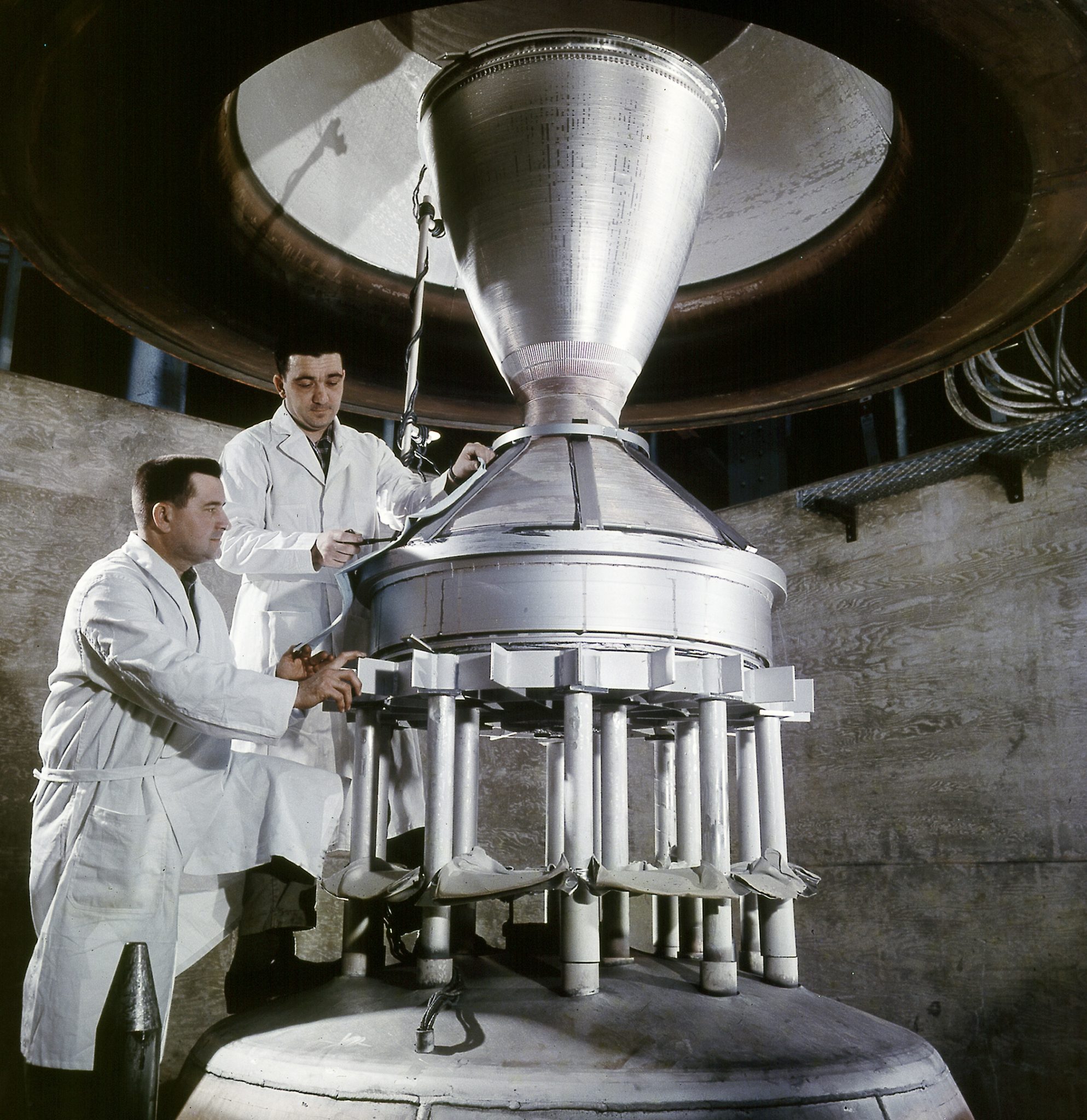
Technicians prepare a nozzle for a prototype nuclear thermal rocket engine in 1964. Credit: NASA

“I think, right now, we’re in this transitional period where companies like mine are going have to rely on some government largesse, as well as hopefully both commercial partnerships and honest private investment,” Kennedy said. “Three years ago, I would have told you I thought I could have done the whole thing with private investment, but three years have turned my hair white.”

Those who share Kennedy’s view thought they were getting an ally in the Trump administration. Jared Isaacman, the billionaire commercial astronaut Trump nominated to become the next NASA administrator, promised to prioritize nuclear propulsion in his tenure as head of the nation’s space agency.

During his Senate confirmation hearing in April, Isaacman said NASA should turn over management of heavy-lift rockets, human-rated spacecraft, and other projects to commercial industry. This change, he said, would allow NASA to focus on the “near-impossible challenges that no company, organization, or agency anywhere in the world would be able to undertake.”

The example Isaacman gave in his confirmation hearing was nuclear propulsion. “That’s something that no company would ever embark upon,” he told lawmakers. “There is no obvious economic return. There are regulatory challenges. That’s exactly the kind of thing that NASA should be concentrating its resources on.”

But the White House suddenly announced on Saturday that it was withdrawing Isaacman’s nomination days before the Senate was expected to confirm him for the NASA post. While there’s no indication that Trump’s withdrawal of Isaacman had anything to do with any specific part of the White House’s funding plan, his removal leaves NASA without an advocate for nuclear propulsion and a number of other projects falling under the White House’s budget ax.

Photo of Stephen Clark

Stephen Clark is a space reporter at Ars Technica, covering private space companies and the world’s space agencies. Stephen writes about the nexus of technology, science, policy, and business on and off the planet.

Some parts of Trump’s proposed budget for NASA are literally draconian Read More »

milky-way-galaxy-might-not-collide-with-andromeda-after-all

Milky Way galaxy might not collide with Andromeda after all

100,000 computer simulations reveal Milky Way’s fate—and it might not be what we thought.

It’s been textbook knowledge for over a century that our Milky Way galaxy is doomed to collide with another large spiral galaxy, Andromeda, in the next 5 billion years and merge into one even bigger galaxy. But a fresh analysis published in the journal Nature Astronomy is casting that longstanding narrative in a more uncertain light. The authors conclude that the likelihood of this collision and merger is closer to the odds of a coin flip, with a roughly 50 percent probability that the two galaxies will avoid such an event during the next 10 billion years.

Both the Milky Way and the Andromeda galaxies (M31) are part of what’s known as the Local Group (LG), which also hosts other smaller galaxies (some not yet discovered) as well as dark matter (per the prevailing standard cosmological model). Both already have remnants of past mergers and interactions with other galaxies, according to the authors.

“Predicting future mergers requires knowledge about the present coordinates, velocities, and masses of the systems partaking in the interaction,” the authors wrote. That involves not just the gravitational force between them but also dynamical friction. It’s the latter that dominates when galaxies are headed toward a merger, since it causes galactic orbits to decay.

This latest analysis is the result of combining data from the Hubble Space Telescope and the European Space Agency’s (ESA) Gaia space telescope to perform 100,000 Monte Carlo computer simulations, taking into account not just the Milky Way and Andromeda but the full LG system. Those simulations yielded a very different prediction: There is approximately a 50/50 chance of the galaxies colliding within the next 10 billion years. There is still a 2 percent chance that they will collide in the next 4 to 5 billion years. “Based on the best available data, the fate of our galaxy is still completely open,” the authors concluded.

Milky Way galaxy might not collide with Andromeda after all Read More »

colon-cancer-recurrence-and-deaths-cut-28%-by-simple-exercise,-trial-finds

Colon cancer recurrence and deaths cut 28% by simple exercise, trial finds

“Quite impressive”

The exercise group, which had supervised exercise for the first six months of the three-year intervention, reported more exercise over the study. At the end, the exercise group was averaging over 20 MET hours per week, while the education group’s average was around 15 MET hours per week. The exercise group also scored better at cardiorespiratory fitness and physical functioning.

Still, with the health education, the control group also saw a boost to their exercise during the trial, with their average starting around 10 MET hours per week. These findings “raise the possibility of an even more powerful effect of exercise on cancer outcomes as compared with a completely sedentary control group,” the researchers note.

For now, it’s not entirely clear how exercise keeps cancers at bay, but it squares with numerous other observational studies that have linked exercise to better outcomes in cancer patients. Researchers have several hypotheses, including that exercise might cause “increased fluid shear stress, enhanced immune surveillance, reduced inflammation, improved insulin sensitivity, and altered microenvironment of major sites of metastases,” the authors note.

In the study, exercise seemed to keep local and distant colon cancer from recurring, as well as prevent new cancers, including breast, prostate, and colorectal cancers.

Outside experts hailed the study’s findings. “This indicates that exercise has a similarly strong effect as previously shown for chemotherapy, which is really quite impressive,” Marco Gerlinger, a gastrointestinal cancer expert at Queen Mary University of London, said in a statement. “One of the commonest questions from patients is what they can do to reduce the risk that their cancer comes back. Oncologists can now make a very clear evidence-based recommendation.”

“Having worked in bowel cancer research for 30 years, this is an exciting breakthrough in the step-wise improvement in cure rates,” David Sebag-Montefiore, a clinical oncologist at the University of Leeds, said. “The great appeal of a structured moderate intensity exercise is that it offers the benefits without the downside of the well-known side effects of our other treatments.”

Colon cancer recurrence and deaths cut 28% by simple exercise, trial finds Read More »

broadcom-ends-business-with-vmware’s-lowest-tier-channel-partners

Broadcom ends business with VMware’s lowest-tier channel partners

Broadcom has cut the lowest tier in its VMware partner program. The move allows the enterprise technology firm to continue its focus on customers with larger VMware deployments, but it also risks more migrations from VMware users and partners.

Broadcom ousts low-tier VMware partners

In a blog post on Sunday, Broadcom executive Brian Moats announced that the Broadcom Advantage Partner Program for VMware Resellers, which became the VMware partner program after Broadcom eliminated the original one in January 2024, would now offer three tiers instead of four. Broadcom is killing the Registered tier, leaving the Pinnacle, Premier, and Select tiers.

The reduction is a result of Broadcom’s “strategic direction” and a “comprehensive partner review” and affects VMware’s Americas, Asia-Pacific, and Japan geographies, Moats wrote. Affected partners are receiving 60 days’ notice, Laura Falko, Broadcom’s head of global partner programs, marketing, and experience, told The Register.

Moats wrote that the “vast majority of customer impact and business momentum comes from partners operating within the top three tiers.”

Similarly, Falko told The Register that most of the removed partners were “inactive and lack the capabilities to support customers through VMware’s evolving private cloud journey.”

Ars asked Broadcom to specify how many removed partners were inactive and what specific capabilities they lacked, but a company representative only directed us to Moats’ blog post.

Canadian managed services provider (MSP) Members IT Group is one of the partners that learned this week that it will no longer be a VMware reseller. CTO Dean Colpitts noted that Members IT Group has been a VMware partner for over 19 years and is also a VMware user. Colpitts previously told Ars that the firm’s VMware business had declined since Broadcom’s acquisition and blamed Broadcom for this:

The only reason we were “inactive” is because of their own stupid greed. We and our customers would have happily continued along even with a 10 or 20 percent  increase in price. 50 percent and more with zero warning last year after customers already had their FY24 budgets sets was the straw that broke the camel’s back …

We have transacted a couple of deals with [VMware] since the program change, but nothing like we previously would have done before Broadcom took over.

Members IT Group will be moving its client base to Hewlett-Packard Enterprise’s VM Essentials virtualization solution.

Broadcom ends business with VMware’s lowest-tier channel partners Read More »

rfk-jr’s-fluoride-ban-would-ruin-25-million-kids’-teeth,-cost-$9.8-billion

RFK Jr.’s fluoride ban would ruin 25 million kids’ teeth, cost $9.8 billion

In all, the increased decay and boosted dental costs would disproportionately affect children who are in low-income families, in rural areas, and/or on public health insurance.

The study’s findings are likely unsurprising to those in the public health community, who have consistently supported fluoridation. The practice, however beneficial, has a long history of being under attack. After its introduction in the US in 1945, conspiracy theorists claimed fluoridation was a communist plot and a form of government mind control. More recently, critics have claimed that fluoridation lowers IQ.

The data linking water fluoridation to low IQ is controversial. Many of the studies on the topic are of poor quality and have numerous confounding factors and flawed methods. Many compare IQ levels in communities in China and other countries, where there are areas with water that is naturally high in fluoride—much, much higher than what is intentionally added to US water. Further, a federal meta-analysis—a type of study that aggregates and reanalyzes data from independent studies—has been plagued by criticism for bias, poor statistical methods, and a lack of data transparency.

But despite the controversy, one thing is clear in all the data and debate: Any possible association with low IQ and fluoridation only occurs at excessive levels—levels more than twice the amount used in the US and recommended by the US Centers for Disease Control and Prevention. The CDC recommendation for water fluoridation levels is 0.7 mg/L, while potential harms are not observed until water levels exceed 1.5 mg/L. Some areas in China have natural levels as high as 11.8 mg/L.

The authors of the new study conclude that, at current US levels, the benefits are clear.

“These findings suggest that, despite the potential harms of excessive fluoride exposure, fluoridation at safe levels offers both individual and societal benefits that would be at risk.”

RFK Jr.’s fluoride ban would ruin 25 million kids’ teeth, cost $9.8 billion Read More »

cdc-updates-covid-vaccine-recommendations,-but-not-how-rfk-jr.-wanted

CDC updates COVID vaccine recommendations, but not how RFK Jr. wanted

In practice, it is unclear how this change will affect access to the vaccines. Health insurers are required to cover vaccines on the CDC schedules. But, it’s yet to be seen if children will only be able to get vaccinated at their doctor’s office (rather than a pharmacy or vaccine clinic) or if additional consent forms would be required, etc. Uncertainty about the changes and requirements alone may lead to fewer children getting vaccinated.

In the adult immunization schedule, when viewed “by medical condition or other indication” (table 2), the COVID-19 vaccination recommendation for pregnancy is now shaded gray, meaning “no guidance/not applicable.” Hovering a cursor over the box brings up the recommendation to “Delay vaccination until after pregnancy if vaccine is indicated.” Previously, COVID-19 vaccines were recommended during pregnancy. The change makes it less likely that health insurers will cover the cost of vaccination during pregnancy.

The change is at odds with Trump’s Food and Drug Administration, which just last week confirmed that pregnancy puts people at increased risk of severe COVID-19 and, therefore, vaccination is recommended. Medical experts have decried the loss of the recommendation, which is also at odds with clear data showing the risks of COVID-19 during pregnancy and the benefits of vaccination.

The President of the American College of Obstetricians and Gynecologists (ACOG) put out a statement shortly after the Tuesday video, saying that the organization was “extremely disappointed” with Kennedy’s announcement.

“It is very clear that COVID-19 infection during pregnancy can be catastrophic and lead to major disability, and it can cause devastating consequences for families,” ACOG President Steven Fleischman said.

CDC updates COVID vaccine recommendations, but not how RFK Jr. wanted Read More »

man-who-stole-1,000-dvds-from-employer-strikes-plea-deal-over-movie-leaks

Man who stole 1,000 DVDs from employer strikes plea deal over movie leaks

An accused movie pirate who stole more than 1,000 Blu-ray discs and DVDs while working for a DVD manufacturing company struck a plea deal this week to lower his sentence after the FBI claimed the man’s piracy cost movie studios millions.

Steven Hale no longer works for the DVD company. He was arrested in March, accused of “bypassing encryption that prevents unauthorized copying” and ripping pre-release copies of movies he could only access because his former employer was used by major movie studios. As alleged by the feds, his game was beating studios to releases to achieve the greatest possible financial gains from online leaks.

Among the popular movies that Hale is believed to have leaked between 2021 and 2022 was Spider-Man: No Way Home, which the FBI alleged was copied “tens of millions of times” at an estimated loss of “tens of millions of dollars” for just one studio on one movie. Other movies Hale ripped included animated hits like Encanto and Sing 2, as well as anticipated sequels like The Matrix: Resurrections and Venom: Let There Be Carnage.

The cops first caught wind of Hale’s scheme in March 2022. They seized about 1,160 Blu-rays and DVDs in what TorrentFreak noted were the days just “after the Spider-Man movie leaked online.” It’s unclear why it took close to three years before Hale’s arrest, but TorrentFreak suggested that Hale’s case is perhaps part of a bigger investigation into the Spider-Man leaks.

Man who stole 1,000 DVDs from employer strikes plea deal over movie leaks Read More »

your-next-gaming-dice-could-be-shaped-like-a-dragon-or-armadillo

Your next gaming dice could be shaped like a dragon or armadillo


“Let it roll, baby, roll”

Statistically, “the real behavior of a rolling object is largely a function of its geometry.”

What if you could make your dice any shape at all—not just boxes and polyhedra, but dragons or other game-relevant shapes?

Most people are familiar with conventional cubical six-sided dice, but there are also polyhedral versions like the 20-sided dice used in ancient Rome and to play Dungeons and Dragons. Researchers have figured out how to design dice with even more exotic shapes, like a kitten, a dragon, or an armadillo. And they are “fair” dice: Experiments with 3D-printed versions produced results that closely matched predicted random outcomes, according to a forthcoming paper currently in press at the journal ACM Transactions on Graphics.

Dice are examples of so-called “rigid bodies,” broadly defined as shapes that move as one solid piece, with no need for bending or twisting. Such shapes “are of scientific interest because they model so many of the phenomena we encounter in our daily lives: anything from the way your dishes roll around on the floor when you drop them, to how the gears in your watch push on each other, to how a satellite tumbles around under the pull of gravity,” co-author Keenan Crane of Carnegie-Mellon University told Ars. “So there’s an intense focus on developing computational methods for understanding and predicting how rigid bodies are going to behave.”

Crane and his co-authors—including lead author and CMU graduate student Hossein Baktash, as well as co-authors from Nvidia Research and Adobe Research—wanted to explore where and how a rigid body will land when tossed. They chose dice as the best (and most fun) context in which to explore that question.

“But it’s also helpful to understand, for instance, if you load up a 3D model on your computer, how should it be displayed on screen—which direction is ‘up’?” said Crane. “Or if you drop a rigid object in the ocean, can you design it so that it lands with the proper orientation, with high probability?”

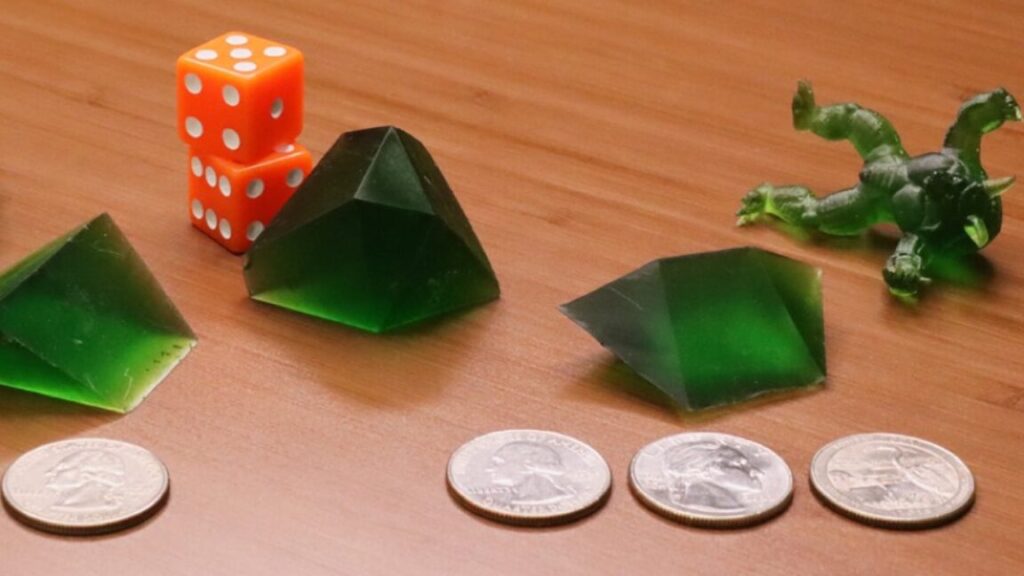
Conducting trial throws of each of seven unusually shaped dice

Conducting trial throws of each of seven unusually shaped dice. Credit: Keenan Crane

The group began with the assumption that when it comes to the rest behavior of a rolling irregularly shaped rigid body—such as the pig-shaped “dice” from the commercial game Pass the Pigs—the effects of momentum would be negligible. They wanted to approach the problem from the perspective of analytical geometry rather than dynamical simulations, so they essentially mapped the corners, edges, and faces onto a sphere and simulated how gravity would act upon such objects as they fell and came to rest.

The ultimate objective was to estimate the probability distribution over the possible range of resting configurations using just geometry. They ran multiple computer simulations of seven weirdly shaped designs for dice and then created physical 3D-printed versions to test them experimentally, tossing each die between 100 and 1,000 times.

They tweaked each shape until the experimental resting positions were within 3 or 4 percent of the predicted probability outcomes. These designs included a single die simulating two rolling six-sided dice (D6+D6); two binomial dice simulating flipping two and three fair coins, respectively; and three versions of a single die with three equally likely outcomes, shaped like a kitten, an armadillo, and a dragon. They also analyzed a talus-shaped model, similar to the sheep’s knuckles or “astragali” used as dice in antiquity for gambling or divination. Baktash recalled playing with such objects as a child growing up in Iran.

“These irregular dice were in a way similar to the ones we’ve designed, in that they don’t have even probabilities—like 1/4, 1/4, 1/4, 1/4—but rather depend on the very particular shape of the knuckles,” said Crane. “People bet on different outcomes, using past experience to build up their intuition about which sides are most likely. Hossein’s tool can do this much more directly: By just looking at the shape, it can directly give you some pretty accurate probabilities. If we were able to time travel back and gamble in ancient Greece, we might be able to make a lot of money (in BC-adjusted dollar).”

The algorithm efficiently and robustly computed the probability of all resting configurations (in 3 ms) of the pig model from the popular game Pass the Pigs. Keenan Crane

So one day soon, gamers might be able to choose from a wide selection of exotically shaped dice for future play—and even 3D print their own designs. (You can already 3D print the team’s designs since Baktash posted the STL files.) The new tool might also prove useful for creating natural-looking arrangements of geometry or adjusting a design so that an object is better able to stand upright, akin to the “Daruma doll,” a traditional Japanese toy that is hollow and weighted at the bottom so that it always returns to an upright position when tilted over. “Our approach makes it possible to bake this property into the geometry of the shape itself,” said Crane.

As for more “serious” applications, Crane points to underwater construction, “where the low-momentum assumption is very realistic and it’s important for things to land in the proper orientation,” he said. “Alternatively, if you imagine each little grain of sand or soil is a rigid particle, the statistics of how they land might help understand things like how soil settles and compacts. The exciting thing about putting research like this out in the world is that, a few years later, other folks inevitably find use cases for it that we never could have imagined.”

There are some inevitable tradeoffs. Oklahoma State University mathematician Henry Segerman told New Scientist that the method isn’t “necessarily a silver-bullet solution to designing weird dice, because it ignores friction, bouncing, and other real-world momentum effects. It’s more like they are—very efficiently—predicting where a die ends up if you put it down with a random orientation on a non-slip surface in low gravity. It slowly falls over and rolls down to land, without slipping or bouncing.”

Crane and his co-authors acknowledge as much in their paper. “On the one hand, [critics] are absolutely correct that our model does not make perfect predictions from the perspective of idealized geometry and physics,” said Crane. “On the other hand, if your goal is to literally make dice for tabletop games, it’s perfectly reasonable to make these kinds of approximations.”

still of one of the STL files used to 3D print the dice.

You can 3D print these unusually shaped dice using the STL files. Credit: Hossein Baktash

That’s partly because of the nature of statistics. “If you flip a coin or roll a die only a few times, it can be very hard to tell whether it’s fair or not,” said Crane. “Suppose I roll a 6-sided die just once, and it comes up with a ‘5.’ Is it fair, or not? Impossible to say. Likewise, if I play Settlers of Catan, I might roll the dice only about 100 times in the whole game. Even if the dice are actually fair, the distribution of rolls I see throughout this short game might vary quite a bit from the idealized distribution—I might just happen to roll a lot more nines that game than usual. So, in a real game, there may not be a huge practical difference between using fair dice and dice that have a small bias. The signal-to-noise ratio is so low that the practical effect over a short game is pretty small.”

Then there is the human factor: Even assuming perfect dice, how people handle them is imperfect and unpredictable; even fair coins don’t yield 50/50 odds because of that. “There will always be some kind of ‘dice handling bias’ due to the way that people pick up, shake (or not shake!), and toss dice,” said Crane. “If you wanted to make dice that exhibit perfect statistics in practice, rather than just in theory, you might need to take an interdisciplinary approach that incorporated not just geometry and physics, but also ideas from psychology, design, and so on.”

“I think the reality is that if we wanted more perfect statistics, we would just ask a computer to generate a random number,” Crane concluded. “The reason people use dice for tabletop games is because it’s tactile and fun. I think Hossein’s approach does a great job of making dice rolling even more fun—while still remaining grounded on some solid mathematical principles.”

Photo of Jennifer Ouellette

Jennifer is a senior writer at Ars Technica with a particular focus on where science meets culture, covering everything from physics and related interdisciplinary topics to her favorite films and TV series. Jennifer lives in Baltimore with her spouse, physicist Sean M. Carroll, and their two cats, Ariel and Caliban.

Your next gaming dice could be shaped like a dragon or armadillo Read More »

trump-bans-sales-of-chip-design-software-to-china

Trump bans sales of chip design software to China

Johnson, who heads China Strategies Group, a risk consultancy, said that China had successfully leveraged its stranglehold on rare earths to bring the US to the negotiating table in Geneva, which “left the Trump administration’s China hawks eager to demonstrate their export control weapons still have purchase.”

While it accounts for a relatively small share of the overall semiconductor industry, EDA software allows chip designers and manufacturers to develop and test the next generation of chips, making it a critical part in the supply chain.

Synopsys, Cadence Design Systems, and Siemens EDA—part of Siemens Digital Industries Software, a subsidiary of Germany’s Siemens AG—account for about 80 percent of China’s EDA market. Synopsys and Cadence did not immediately respond to requests for comment.

In fiscal year 2024, Synopsys reported almost $1 billion in China sales, roughly 16 percent of its revenue. Cadence said China accounted for $550 million or 12 percent of its revenue.

Synopsys shares fell 9.6 percent on Wednesday, while those of Cadence lost 10.7 percent.

Siemens said in a statement the EDA industry had been informed last Friday about new export controls. It said it had supported customers in China “for more than 150 years” and would “continue to work with our customers globally to mitigate the impact of these new restrictions while operating in compliance with applicable national export control regimes.”

In 2022, the Biden administration introduced restrictions on sales of the most sophisticated chip design software to China, but the companies continued to sell export control-compliant products to the country.

In his first term as president, Donald Trump banned China’s Huawei from using American EDA tools. Huawei is seen as an emerging competitor to Nvidia with its “Ascend” AI chips.

Nvidia chief executive Jensen Huang recently warned that successive attempts by American administrations to hamstring China’s AI ecosystem with export controls had failed.

Last year Synopsys entered into an agreement to buy Ansys, a US simulation software company, for $35 billion. The deal still requires approval from Chinese regulators. Ansys shares fell 5.3 percent on Wednesday.

On Wednesday the US Federal Trade Commission announced that both companies would need to divest certain software tools to receive its approval for the deal.

The export restrictions have encouraged Chinese competitors, with three leading EDA companies—Empyrean Technology, Primarius, and Semitronix—significantly growing their market share in recent years.

Shares of Empyrean, Primarius, and Semitronix rose more than 10 percent in early trading in China on Thursday.

© 2025 The Financial Times Ltd. All rights reserved. Not to be redistributed, copied, or modified in any way.

Trump bans sales of chip design software to China Read More »

thousands-of-asus-routers-are-being-hit-with-stealthy,-persistent-backdoors

Thousands of Asus routers are being hit with stealthy, persistent backdoors

GreyNoise said it detected the campaign in mid-March and held off reporting on it until after the company notified unnamed government agencies. That detail further suggests that the threat actor may have some connection to a nation-state.

The company researchers went on to say that the activity they observed was part of a larger campaign reported last week by fellow security company Sekoia. Researchers at Sekoia said that Internet scanning by network intelligence firm Censys suggested as many as 9,500 Asus routers may have been compromised by ViciousTrap, the name used to track the unknown threat actor.

The attackers are backdooring the devices by exploiting multiple vulnerabilities. One is CVE-2023-39780, a command-injection flaw that allows for the execution of system commands, which Asus patched in a recent firmware update, GreyNoise said. The remaining vulnerabilities have also been patched but, for unknown reasons, have not received CVE tracking designations.

The only way for router users to determine whether their devices are infected is by checking the SSH settings in the configuration panel. Infected routers will show that the device can be logged in to by SSH over port 53282 using a digital certificate with a truncated key of: ssh-rsa AAAAB3NzaC1yc2EAAAABIwAAAQEAo41nBoVFfj4HlVMGV+YPsxMDrMlbdDZ…

To remove the backdoor, infected users should remove the key and the port setting.

People can also determine if they’ve been targeted if system logs indicate that they have been accessed through the IP addresses 101.99.91[.]151, 101.99.94[.]173, 79.141.163[.]179, or 111.90.146[.]237. Users of any router brand should always ensure their devices receive security updates in a timely manner.

Thousands of Asus routers are being hit with stealthy, persistent backdoors Read More »

healthy-man-goes-camping—lands-in-icu-for-40-days-with-respiratory-failure

Healthy man goes camping—lands in ICU for 40 days with respiratory failure

It was a diagnostic challenge, and doctors began reviewing the list of possibilities that could match his condition. The first guess of pneumonia could explain some of his respiratory findings, but he didn’t have a cough, had tested negative for common respiratory pathogens, and the lung imaging didn’t quite fit, making it seem unlikely. Blood cancers, such as polycythemia vera, might be able to explain the high concentrations of blood cells. And it might also make him more vulnerable to opportunistic lung infections, like a fungal infection that could explain the halo sign. But blood cancers were also deemed unlikely given that he didn’t have enlarged organs, which is often seen with such conditions. Another possibility was pulmonary–renal syndrome, but that also didn’t line up with the man’s case.

Diagnosis

There was one other possibility that seemed to tick all the boxes: fever, gastrointestinal symptoms, low oxygen saturation, pulmonary edema, and shock—a hantavirus infection.

Hantaviruses are RNA viruses that infect rodents worldwide. They typically cause asymptomatic, chronic infections in the animals, which spread the virus widely into their environments through their urine, feces, and saliva. Humans get infected when virus particles from rodent-contaminated areas are stirred up into the air and inhaled or through direct contact with the virus via the eyes, nose, mouth, or cuts.

In humans, the viral infection is anything but asymptomatic. While the disease mechanism isn’t entirely understood, the virus appears to be able to modulate immune responses in humans, causing blood vessels and capillaries in various places in the body to start leaking plasma. This leads to fluid building up in the lungs (the pulmonary edema) and systemic circulatory collapse.

A cardiopulmonary hantavirus infection typically has four stages: the incubation period, which can last up to 45 days after virus exposure; a prodromal phase of up to 12 days, which is marked by fever, fatigue, and pains; the cardiopulmonary phase, where breathing trouble, low oxygen saturation, and shock can develop; then, if you make it, the fourth stage, in which respiratory symptoms improve, but there’s lingering fatigue and the kidneys make abnormally large amounts of urine.

Healthy man goes camping—lands in ICU for 40 days with respiratory failure Read More »