Author name: Paul Patrick

hydrogen-aviation-startup-zeroavia-lands-largest-funding-round-to-date

Hydrogen aviation startup ZeroAvia lands largest funding round to date

ZeroAvia, one of the leading zero-emission aviation companies in the world, just announced its largest financing round to date. The funding round was co-led by Airbus, Barclays Sustainable Impact Capital, and NEOM.

Other participants included Bill Gates’ Breakthrough Energy Ventures, Alaska Airlines, and the Amazon Climate Pledge Fund. No exact funding amount has been disclosed due to legal reasons, but a spokesperson for the startup confirmed to TNW that it is ZeroAvia’s largest to date, following a Series B of $72mn and a Series A of $56mn. 

Based out of Kemble, UK, and Hollister, California, ZeroAvia develops hydrogen-electric fuel cell propulsion architecture for aircraft. The funding will allow it to keep working on its first product, the ZA600. 

This is a 500kW to 750kW powertrain capable of powering a 9 to 19-seater aircraft, with the ambitious timeline of entry into service in 2025. Fuelled by gaseous hydrogen tanks, it will be able to carry passengers up to 300NM (555.6km). 

The <3 of EU tech

The latest rumblings from the EU tech scene, a story from our wise ol’ founder Boris, and some questionable AI art. It’s free, every week, in your inbox. Sign up now!

It will also allow the company to continue work on the 2-5.4MW modular powertrain ZA2000 program. This will first be used to retrofit a Dash 8 400 76-seat testbed aircraft, supplied by Alaska Airlines. 

“Anybody following the development of hydrogen aviation — and its potential to transform the industry — will see this investment as a positive step,” said Val Miftakhov, founder and CEO of ZeroAvia. “For ZeroAvia to now have investors such as Airbus coming on board is the strongest possible validation of the prospects for hydrogen-electric propulsion technology.” 

Airbus on board for hydrogen fuel cell certification pathway collab

European aerospace giant Airbus has indeed been bullish on hydrogen and its promise to decarbonise air travel. This includes the ZEROe program, which will use the very first A380 as a demonstrator aircraft, with the aim of delivering a commercial hydrogen-powered aircraft into service by 2035. The company recently ground tested its own 1.2MW hydrogen fuel-cell, the power its engineers believe it will take for commercial aircraft to fly.  

Meanwhile, ZeroAvia has already performed successful flights with a Dornier 228 testbed aircraft powered by the ZA600 and an electric engine on one of the wings. This, the VP of Airbus’ ZEROe aircraft, Glen LLewellyn, says puts the company in a strong position to take its technology to the next stages of development. 

“In addition, ZeroAvia is supporting the development of a wider hydrogen ecosystem for aviation — technologies, decarbonised hydrogen supply and certification of hydrogen propulsion systems — which all complement well with our own ambition to bring a ZEROe hydrogen-powered aircraft to service by 2035,” LLewellyn added.


Airbus and ZeroAvia have also entered into a partnership on certification approaches for hydrogen power systems, an area where established OEMs have significantly more experience compared to startups in the aerospace industry. The two will also work together on other critical technical areas, including liquid hydrogen fuel storage (which promises greater range compared to gaseous), flight and ground testing of fuel cell propulsion systems, and development of hydrogen refuelling infrastructure and operations.  

Hydrogen aviation startup ZeroAvia lands largest funding round to date Read More »
european-space-startup-chooses-indian-rocket-for-moon-mission-prototype-launch

European space startup chooses Indian rocket for Moon mission prototype launch

Europe’s dawdling on the Ariane 6 is becoming increasingly costly as the new era of space race exploration — and exploitation — heats up. The Exploration Company, based in Bordeaux and Munich, has just signed an agreement with the Indian Space Research Organisation (ISRO), in service of its aim of making it to the Moon by 2028. 

The startup will partner with ISRO’s commercial arm, New Space India Limited (NSIL), for launch services using ISRO’s medium-lift Polar Satellite Launch Vehicle (PSLV). 

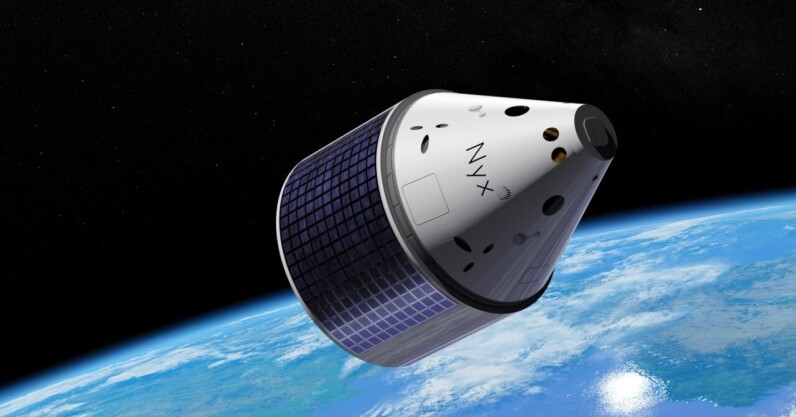
The first mission is scheduled to launch in January 2024, and will involve testing of the Bikini. This is a small prototype of the startup’s modular and reusable orbital vehicle called Nyx, named after the Greek goddess of the night and the creation of the cosmos. Nyx is intended to have open interfaces, available on a SpaceStore to enable space and non-space companies to develop new applications. 

While Bikini will burn up in the atmosphere, it will be followed by a reentry prototype called Mission Possible, complete with a planned ocean splashdown. The first orbital mission is currently scheduled for 2026. 

Bikini was originally intended to fly with Arianespace’s three-stage launch system Ariane 6 this autumn. However, delays to the program of the European launch vehicle has caused the German startup to seek its ride to space elsewhere. (Last we heard, Ariane 6 is now scheduled to launch next year.)

The <3 of EU tech

The latest rumblings from the EU tech scene, a story from our wise ol’ founder Boris, and some questionable AI art. It’s free, every week, in your inbox. Sign up now!

The reusable space capsule race to the Moon and back

This is not the only space mission business Europe has lost out on as a result of its launch vehicle vacuum. For instance, UK-based Open Cosmos is launching its satellites onboard SpaceX’s Falcon 9. Indeed, the European Space Agency’s (ESA) own Earth Cloud Aerosol and Radiation Explorer (EarthCARE) satellite mission is likely to commission SpaceX for the launch — and it won’t be the first instance.


Meanwhile, The Exploration Company is hoping to compete with Musk’s SpaceX and its Dragon spacecraft, and bridge the space cargo capacity gap for Europe. 

The startup intends for Nyx to bring cargo, and eventually people, to the International Space Station (ISS) and the Moon. For Moon delivery — including to Lunar Gateway, NASA’s first planned lunar orbit space station — prices will start at €150,000 per kilogram.


“America has reusable capsules. China has reusable capsules. Europe has no [equivalent] capsules. It’s quite important we have the capacity to do this,” cofounder and CEO Hélène Huby told Sifted earlier this year. 

The company is privately funded and in February raised €40mn in the largest ever Series A for European space tech, taking the total amount of funding to €46.8mn.

Published

Back to top

European space startup chooses Indian rocket for Moon mission prototype launch Read More »

this-steam-add-on-aims-to-make-it-easier-to-sleep-in-vr

This Steam Add-on Aims to Make It Easier to Sleep in VR

Sleeping in VR is definitely a thing. Just head to any of the so-called ‘sleep worlds’ in VRChat to see avatars snoozing away whilst curled up on a virtual couch. Now a Steam overlay looks to make it easier for the VR sleepers among us to catch their forty winks.

Called OyasumiVR – VR Sleeping Utilities, the software is designed to detect when you’re asleep and automate various tasks, something its creator ‘Raphii’ says can help make VR sleeping “as comfortable as possible.”

OyasumiVR can is also said to dim headset brightness, trigger avatar animations based on your sleeping pose, automatically handle invite requests so you’re not disturbed, and automate various SteamVR settings.

There’s actually a pretty extensive array of features beyond those mentioned above, including the ability to create shutdown sequences so you can automatically turn off controllers, base stations, quit SteamVR, or even shut down Windows entirely—just what you need if you’re looking to drift off to asleep in VR, but want to wake up in your own bed.

Originally projected to land on Steam on August 25th, OyasumiVR – VR Sleeping Utilities is available for free starting today on Steam. You check out the full list of features on the linked Steam page to see if it’s right for you.

This Steam Add-on Aims to Make It Easier to Sleep in VR Read More »

apple-confirms-vision-pro-still-slated-to-release-in-early-2024

Apple Confirms Vision Pro Still Slated to Release in Early 2024

Apple’s “Wonderlust” product launch event featured the official unveiling of iPhone 15 and both Watch Series 9 and Ultra 2. While XR wasn’t a major focus of the event, Apple confirmed its upcoming mixed reality standalone Vision Pro isn’t seeing any delays to push it off its early 2024 release.

First unveiled at WWDC in June, Apple CEO Tim Cook said last night during the product event that Vision Pro is still “on track for release in early 2024.”

Vision Pro, which comes along with the very ‘pro’ price tag of $3,500, has reportedly been the subject of multiple delays in the past. The MR headset was widely thought to arrive sometime in 2022, although several successive reports maintained it was delayed multiple times since then.

With an “early 2024” launch in site, Apple seems to be making some of the right moves in the background, as the company has already opened up applications for developer units which are undoubtedly already in the hands of studios.

Meanwhile, the Cupertino tech giant also announced it’s prepping iPhone 15 Pro to take stereoscopic video which can be viewed on Vision Pro. It’s an interesting choice, as features on company’s most premium ‘Pro’ phone offerings tend to trickle down in successive generations. Here, the phone’s ultrawide and main cameras work together to create what Apple calls a “three-dimensional video.”

Apple Confirms Vision Pro Still Slated to Release in Early 2024 Read More »

iphone-15-pro-is-apple’s-first-smartphone-with-spatial-video-capture,-for-viewing-on-vision-pro

iPhone 15 Pro is Apple’s First Smartphone With Spatial Video Capture, for Viewing on Vision Pro

Apple today announced its iPhone 15 lineup of smartphones, including the iPhone 15 Pro which will be the company’s first phone to capture spatial video for immersive viewing on Vision Pro.

While Apple Vision Pro itself works as a spatial camera, allowing users to capture immersive photos and videos, I think we can all agree that wearing a camera on your head isn’t the most convenient way to capture content.

Image courtesy Apple

Apple seems to feel the same way. Today during the company’s iPhone 15 announcement, it was revealed that the new iPhone 15 Pro will be capable of capturing spatial video which can be viewed immersively on the company’s upcoming Vision Pro headset. The base versions of the phone, the iPhone 15 and iPhone 15 Plus, won’t have the spatial capture capability.

Details on exactly how this function works are slim for the time being.

“We use the ultrawide and main cameras together to create a three-dimensional video,” the company said during its announcement. But it isn’t clear if “three-dimensional” means stereoscopic footage with a fixed viewpoint, or some kind of depth projection with a bit of 6DOF wiggle room.

Given that the iPhone 15 Pro cameras are so close together—not offering enough distance between the two views for straightforward stereo capture—it seems that some kind of depth projection or scene reconstruction will be necessary.

Image courtesy Apple pro 

Apple didn’t specifically say whether the phone’s depth-sensor was involved, but considering the phone uses it for other camera functions, we wouldn’t be surprised to find that it has some role to play. Curiously, Apple didn’t mention spatial photo capture, but ostensibly this should be possible as well.

While users will be able to watch their immersive videos on Vision Pro, Apple also said they’ll be able to share the footage with others who can watch on their own headset.

While the new iPhone 15 lineup will launch on September 22nd, Apple says the spatial capture capability won’t be available until “later this year”—which is curious considering the company also said today that Vision Pro is “on track to launch in early 2024.” Perhaps the company plans to allow creators to access the spatial video files for editing and use outside of Apple’s platform?

iPhone 15 Pro is Apple’s First Smartphone With Spatial Video Capture, for Viewing on Vision Pro Read More »

roblox-developer-conference-attendees-receive-free-quest-pros-ahead-of-quest-3-launch

Roblox Developer Conference Attendees Receive Free Quest Pros Ahead of Quest 3 Launch

Roblox has done very well on Quest. When it launched on the standalone VR platform back in July, it managed to break one million downloads in its first five days, essentially making the online game the hottest social VR platform currently available on Quest. Now Roblox has also showered attendees at its annual developer conference this past weekend with free Quest Pros.

Despite being in direct competition with Meta’s Horizon Worlds social VR platform, there doesn’t seem to be any bad blood over the explosive growth of Roblox on Quest.

A message was sent to attendees at RDC23 this past weekend, stating that Meta is footing the bill to provide a heap of free Quest Pros, its $1,000 mixed reality standalone.

“The news is out! We want to give a special thanks to our partner meta. They have offered to provide all RDC23 attendees with Meta Quest Pro headsets to help you create the best Roblox experiences for VR,” the message reads.

Developers didn’t have to wait long, as they collected their free Quest Pros on site at RDC23.

During the RDC 2023 keynote, Baszucki also revealed that Roblox now features “over 50,000 experiences that are ready right now on Meta Quest.”

Roblox is currently available on the Quest platform via App Lab, however the company says it’s set for its “full” release on Quest sometime in September. Baszucki didn’t specify when, although it’s a good bet that the popular social platform will be a launch day title on Quest 3, which could come as early as September 27th during Connect, Meta’s annual developer conference.

The company also announced Roblox is headed to PlayStation in October, however it’s not clear if that will include PSVR or PSVR 2 support as well.

Roblox Developer Conference Attendees Receive Free Quest Pros Ahead of Quest 3 Launch Read More »

meta-releases-‘citadel’-co-op-vr-adventure,-its-second-marquee-title-in-‘horizon-worlds’

Meta Releases ‘Citadel’ Co-op VR Adventure, Its Second Marquee Title in ‘Horizon Worlds’

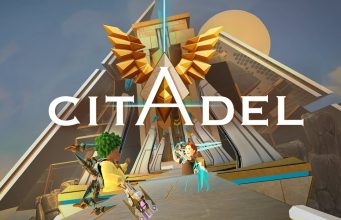
In late July, Meta introduced a hero shooter called Super Rumble’ to Horizon Worlds, aiming to improve user retention on its social VR platform with the promise of higher quality first-party content. Now Meta released its second big anchor minigame on Horizon Worlds, a co-op adventure game called ‘Citadel’.

Citadel is what Meta calls a “rogue-lite action-adventure puzzle platformer FPS,” offering up both solo and co-op play.

Here’s how Meta describes the action:

Combining combat, puzzle-solving, and skillful gameplay, each room in Citadel gives players a new challenge to overcome. With numerous hidden secrets to uncover across 30 rooms, Citadel offers a wealth of content to explore. And after completing the game in Casual mode, those up for an additional challenge can take on Veteran mode for an even greater sense of achievement (and additional bragging rights).

As you infiltrate the citadel, find hidden relics, and eliminate enemy forces, you’ll unlock weapons and rewards and earn credit to buy new armor with unique stats to upgrade your hit points, number of lives, and speed. Mix and match helmets and torso armors at will to fully customize your gameplay experience.

Stocking Horizon Worlds with higher quality content has only been one piece of Meta’s user retention puzzle. Back in April, the company announced it was set to officially open the platform to kids ages 13+. Meta has also recently begun a closed beta for Android users, opening the platform to non-VR devices for the first time.

The company says it’s hoping to open Horizon Worlds to iOS devices and standard web browsers too at some point, which could help the platform gain greater traction amid some already fairly fierce competition. This comes as Meta opened Quest up the online gaming powerhouse Roblox, joining popular social VR platforms Rec Room, VRChat, and Gym Class on the Quest platform.

Meta Releases ‘Citadel’ Co-op VR Adventure, Its Second Marquee Title in ‘Horizon Worlds’ Read More »

ubotica-and-ibm-bring-one-click-deployment-of-ai-on-board-satellites

Ubotica and IBM bring one-click deployment of AI on board satellites

Amid the increasing commercialisation of space tech, Ubotica has partnered up with IBM to simplify the use of AI applications on board low-Earth-orbit (LEO) satellites.

Founded in 2016, the Dublin-headquartered startup provides its CogniSAT edge computing platform for artificial intelligence systems on satellites, which enables AI inference to be performed on data directly in space.

This is with the aim of addressing a pressing challenge: the costly and time-consuming storage and processing of data on the ground. And that’s also what the new partnership is all about.

According to the two companies, their mutual customers will be able to deploy their AI models directly to satellites using the CogniSAT platform “with a single click.” They can then use the models to produce data insights in space.

The <3 of EU tech

The latest rumblings from the EU tech scene, a story from our wise ol’ founder Boris, and some questionable AI art. It’s free, every week, in your inbox. Sign up now!

This approach is expected to bring a dual advantage. Firstly, it will enhance autonomy and decision-making capabilities at the edge, reducing reliance on ground systems. Secondly, it will lead to substantial cost savings for satellite constellation operators, both in terms of capital and operations.

Capital expenses are lowered “through savings in communications infrastructure brought by reducing the amount of raw data that needs to be downlinked for processing,” Sean Mitchell, Ubotica’s CCO, told TNW. 

“OpEx is reduced by the savings in the bandwidth needed to communicate insights from onboard processing,” he added.

Under the new deal, Ubotica will leverage IBM’s cloud infrastructure and watsonx.ai components (the tech giant’s AI and data platform).

Specifically, the startup will begin by installing a Red Hat OpenShift Kubernetes Service (ROKS) cluster, on which it will build components to create a hybrid cloud AI platform.

Ubotica’s initial architecture (which will integrate elements from the Open Data Hub) will also align with the underlying implementation of watsonx.ai. Over the next year, the company might incorporate additional IBM services, such as Watson Studio, Watson Open Scale, or tools from Cloud Pak for Data.

The partnership, which builds on the startup’s previous successes, is sure to solidify Ubotica’s place in the global space tech race.

The startup has been providing AI solutions to the European Space Agency (ESA) and NASA JPS since 2020. This year, it achieved another milestone with the launch of CongiSAT-6, the first satellite to use space AI to independently plan image tasking and generate insights through onboard processing of image sensor data.

Ubotica and IBM bring one-click deployment of AI on board satellites Read More »

carbon-offset-data-startup-treefera-raises-e2m-to-map-forests-with-ai

Carbon offset data startup Treefera raises €2M to map forests with AI

Treefera says it wants to transform the accuracy, transparency, and efficiency of the carbon offset industry with AI and data from a trillion trees across the globe. It just received a vote of confidence in the form of a €2mn seed round led by Concept Ventures and participation from the CTO of Intel, among others.

The practice of voluntary offsetting has faced criticism from various quarters, with concerns ranging from it being simply inefficient to directly detrimental to the quest for decarbonisation as a whole. Nonetheless, it is big business.

Most companies touting net-zero carbon emissions by 2035, 2040, or 2050 are factoring offsets into the equation. In 2021, the carbon offsetting market was worth nearly $2bn. With ESG pressure on companies from investors increasing, predictions say it could grow to as much as $40bn by the end of the decade, and hit a staggering $250bn by 2050.

At the same time, trust in carbon offsetting has taken a massive hit over the past couple of years — and not without cause. Not all carbon credits are created equal. The cheaper they are, the more useless they are likely to be. 

A study published last month in the journal Science found that only 5.4 million, or 6%, of a potential 89 million offset credits were linked to additional carbon reductions through preserved forests. The vast majority originated from projects that barely reduced deforestation. 

Treefera was founded in 2022 by Jonathan Horn, theoretical physicist and former Managing Director at J.P. Morgan, and Caroline Grey, former CCO at UiPath

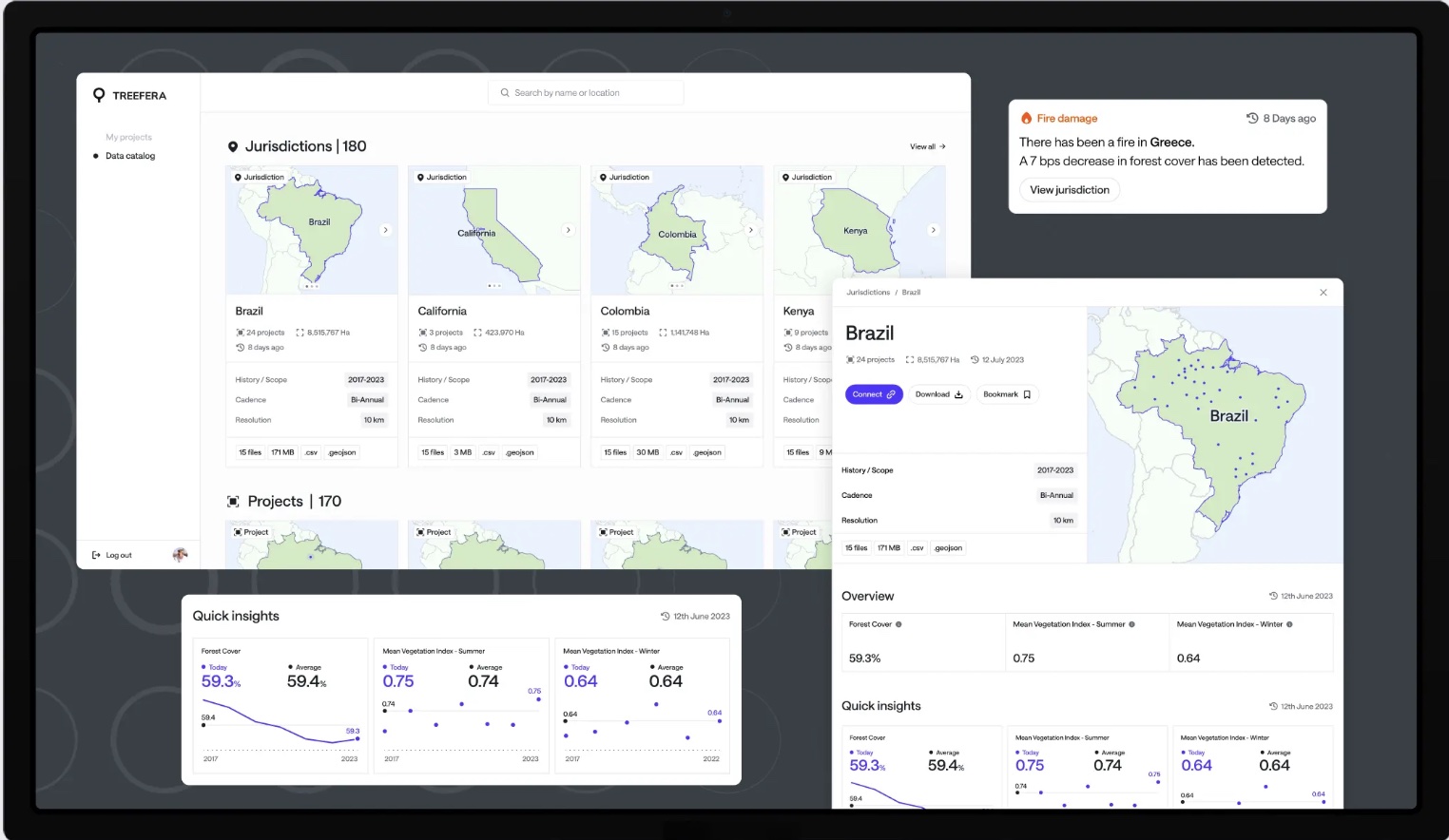
Its AI driven platform measures, monitors, and verifies (a practice known as MRV) carbon credits. Having mapped a trillion trees globally covering jurisdictions (countries and large regions) as well as 197+ registered forest projects, the startup says it has an unprecedented repository of data. 

A screen shot of the Treefera platform

It then applies a combination of deep learning models and novel AI search techniques to determine the accuracy with which carbon credits are priced, based on information on things such as tree health and carbon sequestration and other important “reversal risks,” including fire, flood, and drought. 

“Treefera’s transformative AI tool has the power to revolutionise the world’s approach to forest data and conservation,” Horn said. “Our platform enables instant analysis and insights of carbon offset projects, and critically allows easy integration of that trusted data into our clients’ analytics environment through an API.”

The company, based out of London and New York, says it will use the raised capital to enhance platform capabilities, expand its team, and extend its global market presence.

Carbon offset data startup Treefera raises €2M to map forests with AI Read More »

eu-president:-europe-is-the-‘global-pioneer’-of-citizen’s-digital-rights

EU president: Europe is the ‘global pioneer’ of citizen’s digital rights

Europeans have become “pioneers in online rights” and now want to lead a “global framework for AI,” the EU’s top official said today.

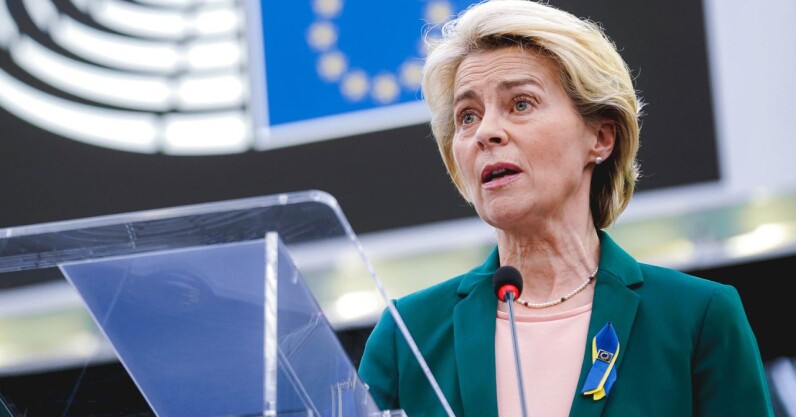
Ursula von der Leyen, the European Commission’s president, revealed the bloc’s digital plans during her State of the Union address in Strasbourg. She used the speech to flaunt the achievements of her three-year reign.

A particularly large spotlight was shone on her tech policies.

“We have set the path for the digital transition and become global pioneers in online rights,” von der Leyen said.

The former German defence minister praised the bloc’s work on semiconductor self-sufficiency, which centres on the Chips Act. Backed with €43bn of funding, the legislation aims to double the EU’s market share in semiconductors to at least 20% by 2030.

The <3 of EU tech

The latest rumblings from the EU tech scene, a story from our wise ol’ founder Boris, and some questionable AI art. It’s free, every week, in your inbox. Sign up now!

Von der Leyen also touted the union’s clean tech industry, as well as the digital projects in NextGenerationEU, a COVID-19 recovery plan. Her biggest brag, however, involved digital safety.

Europe has led on managing the risks of the digital world,” she said.

To the chagrin of Silicon Valley, the EU has become the world’s most formidable tech regulator. Tough laws on privacy, tax avoidance, antitrust, and online content have led to eye-popping fines for some of the biggest companies in the US.  Von der Leyen warned them that more rules are coming.

To justify the intervention, she argued that disinformation, data exploitation, and “harmful content” have reduced the public’s trust and breached their rights.

“In response, Europe has become the global pioneer of citizen’s rights in the digital world,” she said.

As evidence for this claim, von der Leyen pointed to two recent regulations: the Digital Services Act (DSA), which imposes rules on content moderation, and the Digital Market Act (DMA), which aims to reign in big tech’s dominance.

Her next big target is artificial intelligence.

“We need an open dialogue with those that develop and deploy AI.

In recent months, concerns have grown about AI causing job losses, discrimination, surveillance, and even extinction. To mitigate the threats, the EU will soon adopt the AI Act, the first-ever comprehensive legislation for the tech.

Von der Leyen described the rules as “a blueprint for the whole world.” She also laid out the next steps of the EU’s plan.

“I believe Europe, together with partners, should lead the way on a new global framework for AI, built on three pillars: guardrails, governance, and guiding innovation,” she said.

The main guardrails will be provided by the AI Act. For governance, von der Leven called for the creation of a global panel of scientists, tech companies and independent experts. Together, they would inform policymakers about developments in the field.

On innovation, she announced a project that will enable AI startups to train their models on the EU’s high-performance computers. The private sector, however, will likely want further support. In an open letter published in June, some of Europe’s biggest companies warn that the AI Act will inhibit innovation and jeopardise the continent’s businesses.

Von der Leyen, meanwhile, called for closer collaboration with the private sector.

“We need an open dialogue with those that develop and deploy AI,” she said. “It happens in the United States, where seven major tech companies have already agreed to voluntary rules around safety, security and trust.

“It happens here, where we will work with AI companies, so that they voluntarily commit to the principles of the AI Act before it comes into force. Now we should bring all of this work together towards minimum global standards for safe and ethical use of AI.”

EU president: Europe is the ‘global pioneer’ of citizen’s digital rights Read More »

european-fintech-funding-drops-70%-in-first-half-of-2023

European fintech funding drops 70% in first half of 2023

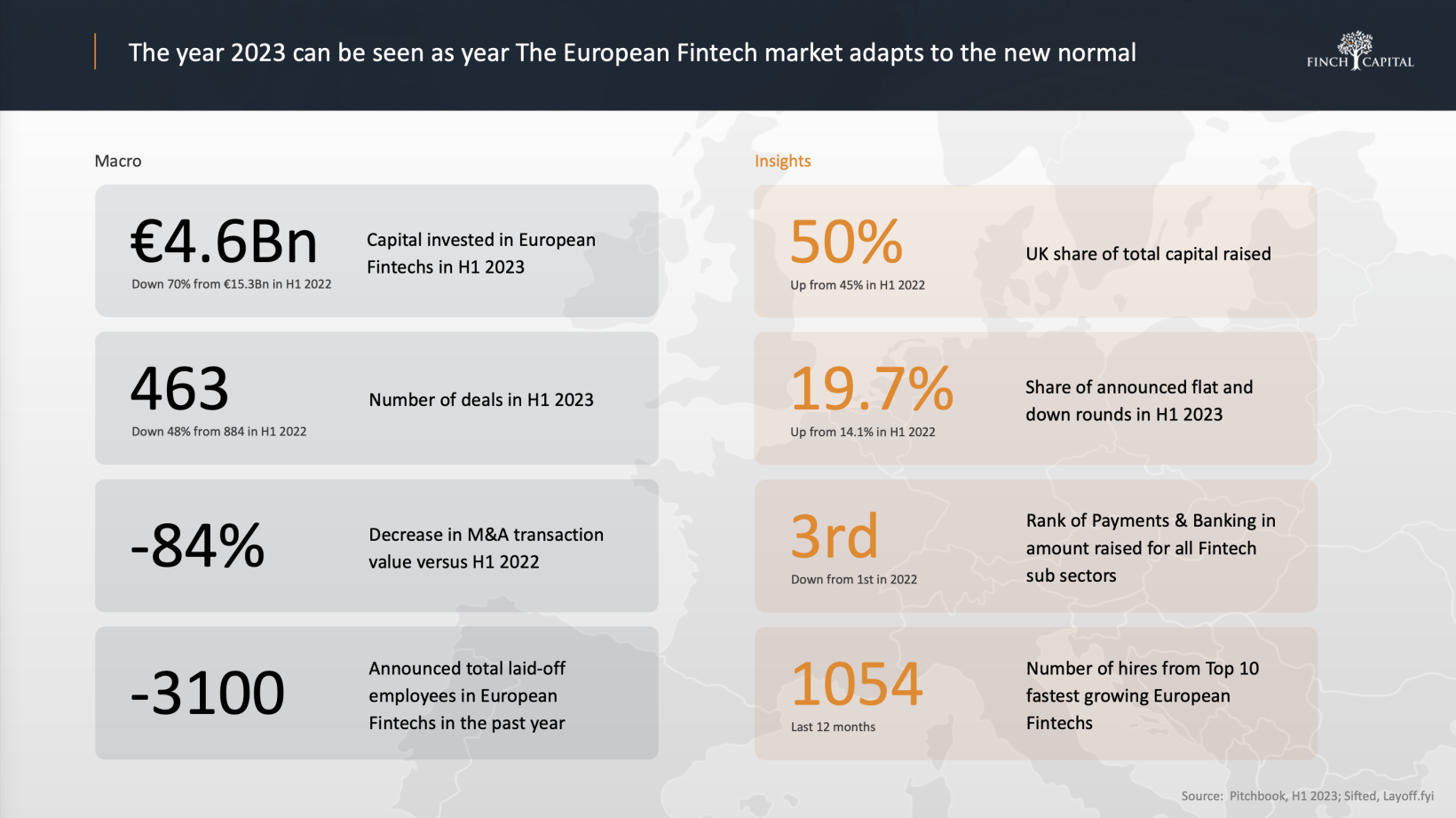
Fintech funding in Europe has been greatly affected by the challenging economic environment, the latest report by Finch Capital has found. Specifically, startups in the sector raised a total of €4.6bn in the first half of 2023 — down 70% from €15.3bn in H1 2022.

“Since mid-2022 we have seen an increase in investment discipline in public and private markets, resulting in less funding, lay-offs, less IPOs, flight to quality, and focus on capital efficiency,” said Radboud Vlaar, Managing Partner at Finch Capital.

Amid this increased funding discipline, this year’s first half has seen a 48% decline in the number of deals (434 in total) alongside an 84% decrease in M&A transaction sizes, compared to the equivalent 2022 levels. On the bright side, overall M&A activity fell only by 5% with volumes to match those of the past year.

Meanwhile, although the top 20 funding rounds are back to pre-2020 levels, investment dropped the most for the rest, which accounted for less than 40% of the total deal volume. Startups in the Series A to C stages have felt the heaviest impact. In contrast, seed rounds continued to attract funding.

Slide from the State of European Fintech Report 2023
Credit: Finch Capital

The <3 of EU tech

The latest rumblings from the EU tech scene, a story from our wise ol’ founder Boris, and some questionable AI art. It’s free, every week, in your inbox. Sign up now!

From a valuation perspective, public markets have withdrawn to 2019 levels, after record growth in 2020-2021, but are showing signs of stabilisation. Private markets are also transitioning to 2019 valuation levels at a comparable but slower pace.

“We should also start to see a slow recovery of the IPO market in the next semester as valuations have started to slowly pick up and inflation is declining,” noted Vlaar.

Crypto on the rise

Crypto and Lending have attracted most of the investments, displacing Payments and Banking — a traditionally resilient category that saw record capital deployed in 2022. Notably, one in three fintech startups are now labelled as crypto/blockchain.

From B2C to B2B

The report has also found that the trend of the past years towards B2B fintech is here to stay. One reason why is the growing interest in regulation technology as payments and open banking are increasingly consolidating. Another is generative AI’s potential applications in retail banking and the insurance sector.

The UK leads in funding

A well-established fintech hotspot, the UK has shown more resilience and accounted for over 50% of the funding in Europe.

Nevertheless, the UK, Germany, and France also saw a 70% decline in funding value, but optimistically, exits continued consistently. Poland recorded the biggest drop at 89.9%. Overall, countries with an active Series A-B investor base, have seen valuations hold up with small increases in post-money valuations.

The “new normal”

“Consolidation and more competitive investment flows, combined with still significant levels of undeployed capital, will bring maturity to the fintech sector. This new normal level of activity demonstrates the refocus of the fintech ecosystem on long term sustainability versus short term gains,” said Vlaar.

And although the overall environment will continue to be challenging in the next 12 months, he added that this will result in “a more healthy and sustainable startup, hiring, and investor ecosystem.”

European fintech funding drops 70% in first half of 2023 Read More »

introducing-‘the-time-is-now:-toolkit-for-change’

Introducing ‘The Time is Now: Toolkit for Change’

Climate change anxiety is real, and it can cause feelings of powerlessness, or even apathy. While it is true that no soggy straws in the world will help as long as billion-dollar industries keep indiscriminately pumping oil out of the ground, it is also false to believe that our individual efforts do not matter. 

In a new game published last week, called The Time is Now: Toolkit for Change, the creators have taken to a good old low-tech tabletop approach to make people think about how, for instance, their relationship with technology can have a more positive impact on the environment

The idea is to gather a group of people — colleagues, friends or family — and to generate ideas and solutions, from an individual to a societal level, to what is undoubtedly one of the greatest generational challenges of our time. (Note: one of the game’s originators, Niels Sipkema, is the Director of TNW Programs, which is how we got our hands on a pre-release edition.)

Based on six of the United Nations Sustainable Development Goals (SDGs), the cards of the game present questions or problems involving an environmental component to be read out loud by one player. The others then pitch their solutions to the problem described on the card. 

The reader then picks a winner, who places the card on an “action canvas” along vectors of what can be accomplished by ourselves (cycling to work), what can begin tomorrow, (say, choosing a sustainable caterer for your company event), what needs some more time and planning (investing in carbon removal startups), and what can be done with some help (solar panels on the roof of your building). 

If you cannot think of anything technologically groundbreaking, the prompt from the game’s creators reads: “If you can’t be serious, be funny, blunt, green, or smart.” The TNW test group found themselves being all of those things — to varying degrees, depending on who you ask — during a runthrough of the game. 

The actions we take is a vote for the kind of world we want to live in

We may not all be quantum engineers that can develop the new clean fusion fuel of the future, but we can all make informed decisions and conscious choices in our relationship to the planet. (After learning about the carbon cost of digital clutter, at least one of the players rushed to delete a few thousand photos of their cat from the cloud.) 

Every action we take — what we choose to consume, how we choose to travel, and where we choose to invest — is a vote cast for the kind of world we want to live in. Pointing a finger and saying “but they don’t, so why should I,” simply isn’t good enough. 

But when choices regarding our habits are presented with an added appendage of guilt, or a serving of shame on the side, they become harder to maintain. Just look at yo-yo dieting. 

However, when introduced with a sense of agency coupled with positive reinforcement (for instance, such as winning a pitch), we are much more likely to stick to the habits we are trying to build. 

In either case, we have to have the, sometimes terribly inconvenient, conversations — for the sake of future generations. The Time is Now: Toolkit for Change is an effective approach to that end. 

The Time is Now: Toolkit for Change is created by Gerard Drost, Niels Sipkema, Johannes van der Erenbeemt, and Bjorn Uyens, a team that also made The Startup Game. It is published by BISPublishers and available here

Introducing ‘The Time is Now: Toolkit for Change’ Read More »