Author name: Kris Guyer

human-drivers-keep-rear-ending-waymos

Human drivers keep rear-ending Waymos

Traffic safety —

We took a close look at the 23 most serious Waymo crashes.

A Waymo vehicle in San Francisco.

Enlarge / A Waymo vehicle in San Francisco.

Photo by JasonDoiy via Getty Images

On a Friday evening last November, police chased a silver sedan across the San Francisco Bay Bridge. The fleeing vehicle entered San Francisco and went careening through the city’s crowded streets. At the intersection of 11th and Folsom streets, it sideswiped the fronts of two other vehicles, veered onto a sidewalk, and hit two pedestrians.

According to a local news story, both pedestrians were taken to the hospital with one suffering major injuries. The driver of the silver sedan was injured, as was a passenger in one of the other vehicles.

No one was injured in the third car, a driverless Waymo robotaxi. Still, Waymo was required to report the crash to government agencies. It was one of 20 crashes with injuries that Waymo has reported through June.  And it’s the only crash Waymo has classified as causing a serious injury.

Twenty injuries might sound like a lot, but Waymo’s driverless cars have traveled more than 22 million miles. So driverless Waymo taxis have been involved in fewer than one injury-causing crash for every million miles of driving—a much better rate than a typical human driver.

Last week Waymo released a new website to help the public put statistics like this in perspective. Waymo estimates that typical drivers in San Francisco and Phoenix—Waymo’s two biggest markets—would have caused 64 crashes over those 22 million miles. So Waymo vehicles get into injury-causing crashes less than one-third as often, per mile, as human-driven vehicles.

Waymo claims an even more dramatic improvement for crashes serious enough to trigger an airbag. Driverless Waymos have experienced just five crashes like that, and Waymo estimates that typical human drivers in Phoenix and San Francisco would have experienced 31 airbag crashes over 22 million miles. That implies driverless Waymos are one-sixth as likely as human drivers to experience this type of crash.

The new data comes at a critical time for Waymo, which is rapidly scaling up its robotaxi service. A year ago, Waymo was providing 10,000 rides per week. Last month, Waymo announced it was providing 100,000 rides per week. We can expect more growth in the coming months.

So it really matters whether Waymo is making our roads safer or more dangerous. And all the evidence so far suggests that it’s making them safer.

It’s not just the small number of crashes Waymo vehicles experience—it’s also the nature of those crashes. Out of the 23 most serious Waymo crashes, 16 involved a human driver rear-ending a Waymo. Three others involved a human-driven car running a red light before hitting a Waymo. There were no serious crashes where a Waymo ran a red light, rear-ended another car, or engaged in other clear-cut misbehavior.

Digging into Waymo’s crashes

In total, Waymo has reported nearly 200 crashes through June 2024, which works out to about one crash every 100,000 miles. Waymo says 43 percent of crashes across San Francisco and Phoenix had a delta-V of less than 1 mph—in other words, they were very minor fender-benders.

But let’s focus on the 23 most severe crashes: those that either caused an injury, caused an airbag to deploy, or both. These are good crashes to focus on not only because they do the most damage but because human drivers are more likely to report these types of crashes, making it easier to compare Waymo’s software to human drivers.

Most of these—16 crashes in total—involved another car rear-ending a Waymo. Some were quite severe: three triggered airbag deployments, and one caused a “moderate” injury. One vehicle rammed the Waymo a second time as it fled the scene, prompting Waymo to sue the driver.

There were three crashes where a human-driven car ran a red light before crashing into a Waymo:

  • One was the crash I mentioned at the top of this article. A car fleeing the police ran a red light and slammed into a Waymo, another car, and two pedestrians, causing several injuries.
  • In San Francisco, a pair of robbery suspects fleeing police in a stolen car ran a red light “at a high rate of speed” and slammed into the driver’s side door of a Waymo, triggering an airbag. The suspects were uninjured and fled on foot. The Waymo was thankfully empty.
  • In Phoenix, a car ran a red light and then “made contact with the SUV in front of the Waymo AV, and both of the other vehicles spun.” The Waymo vehicle was hit in the process, and someone in one of the other vehicles suffered an injury Waymo described as minor.

There were two crashes where a Waymo got sideswiped by a vehicle in an adjacent lane:

  • In San Francisco, Waymo was stopped at a stop sign in the right lane when another car hit the Waymo while passing it on the left.
  • In Tempe, Arizona, an SUV “overtook the Waymo AV on the left” and then “initiated a right turn,” cutting the Waymo off and causing a crash. A passenger in the SUV said they suffered moderate injuries.

Finally, there were two crashes where another vehicle turned left across the path of a Waymo vehicle:

  • In San Francisco, a Waymo and a large truck were approaching an intersection from opposite directions when a bicycle behind the truck made a sudden left in front of the Waymo. Waymo says the truck blocked Waymo’s vehicle from seeing the bicycle until the last second. The Waymo slammed on its brakes but wasn’t able to stop in time. The San Francisco Fire Department told local media that the bicyclist suffered only minor injuries and was able to leave the scene on their own.
  • A Waymo in Phoenix was traveling in the right lane. A row of stopped cars was in the lane to its left. As Waymo approached an intersection, a car coming from the opposite direction made a left turn through a gap in the row of stopped cars. Again, Waymo says the row of stopped cars blocked it from seeing the turning car until it was too late. A passenger in the turning vehicle reported minor injuries.

It’s conceivable that Waymo was at fault in these last two cases—it’s impossible to say without more details. It’s also possible that Waymo’s erratic braking contributed to a few of those rear-end crashes. Still, it seems clear that a non-Waymo vehicle bore primary responsibility for most, and possibly all, of these crashes.

“About as good as you can do”

One should always be skeptical when a company publishes a self-congratulatory report about its own safety record. So I called Noah Goodall, a civil engineer with many years of experience studying roadway safety, to see what he made of Waymo’s analysis.

“They’ve been the best of the companies doing this,” Goodall told me. He noted that Waymo has a team of full-time safety researchers who publish their work in reputable journals.

Waymo knows precisely how often its own vehicles crash because its vehicles are bristling with sensors. The harder problem is calculating an appropriate baseline for human-caused crashes.

That’s partly because human drivers don’t always report their own crashes to the police, insurance companies, or anyone else. But it’s also because crash rates differ from one area to another. For example, there are far more crashes per mile in downtown San Francisco than in the suburbs of Phoenix.

Waymo tried to account for these factors as it calculated crash rates for human drivers in both Phoenix and San Francisco. To ensure an apples-to-apples comparison, Waymo’s analysis excludes freeway crashes from its human-driven benchmark, since Waymo’s commercial fleet doesn’t use freeways yet.

Waymo estimates that human drivers fail to report 32 percent of injury crashes; the company raised its benchmark for human crashes to account for that. But even without this under-reporting adjustment, Waymo’s injury crash rate would still be roughly 60 percent below that of human drivers. The true number is probably somewhere between the adjusted number (70 percent fewer crashes) and the unadjusted one (60 percent fewer crashes). It’s an impressive figure either way.

Waymo says it doesn’t apply an under-reporting adjustment to its human benchmark for airbag crashes, since humans almost always report crashes that are severe enough to trigger an airbag. So it’s easier to take Waymo’s figure here—an 84 percent decline in airbag crashes—at face value.

Waymo’s benchmarks for human drivers are “about as good as you can do,” Goodall told me. “It’s very hard to get this kind of data.”

When I talked to other safety experts, they were equally positive about the quality of Waymo’s analysis. For example, last year, I asked Phil Koopman, a professor of computer engineering at Carnegie Mellon, about a previous Waymo study that used insurance data to show its cars were significantly safer than human drivers. Koopman told me Waymo’s findings were statistically credible, with some minor caveats.

Similarly, David Zuby, the chief research officer at the Insurance Institute for Highway Safety, had mostly positive things to say about a December study analyzing Waymo’s first 7.1 million miles of driverless operations.

I found a few errors in Waymo’s data

If you look closely, you’ll see that one of the numbers in this article differs slightly from Waymo’s safety website. Specifically, Waymo says that its vehicles get into crashes that cause injury 73 percent less often than human drivers, while the figure I use in this article is 70 percent.

This is because I spotted a couple of apparent classification mistakes in the raw data Waymo used to generate its statistics.

Each time Waymo reports a crash to the National Highway Traffic Safety Administration, it records the severity of injuries caused by the crash. This can be fatal, serious, moderate, minor, none, or unknown.

When Waymo shared an embargoed copy of its numbers with me early last week, it said that there had been 16 injury crashes. However, when I looked at the data Waymo had submitted to federal regulators, it showed 15 minor injuries, two moderate injuries, and one serious injury, for a total of 18.

When I asked Waymo about this discrepancy, the company said it found a programming error. Waymo had recently started using a moderate injury category and had not updated the code that generated its crash statistics to count these crashes. Waymo fixed the error quickly enough that the official version Waymo published on Thursday of last week showed 18 injury crashes.

However, as I continued looking at the data, I noticed another apparent mistake: Two crashes had been put in the “unknown” injury category, yet the narrative for each crash indicated an injury had occurred. One report said “the passenger in the Waymo AV reported an unspecified injury.” The other stated that “an individual involved was transported from the scene to a hospital for medical treatment.”

I notified Waymo about this apparent mistake on Friday and they said they are looking into it. As I write this, the website still claims a 73 percent reduction in injury crashes. But I think it’s clear that these two “unknown” crashes were actually injury crashes. So, all of the statistics in this article are based on the full list of 20 injury crashes.

I think this illustrates that I come by my generally positive outlook on Waymo honestly: I probably scrutinize Waymo’s data releases more carefully than any other journalist, and I’m not afraid to point out when the numbers don’t add up.

Based on my conversations with Waymo, I’m convinced these were honest mistakes rather than deliberate efforts to cover up crashes. I could only identify these mistakes because Waymo went out of its way to make its findings reproducible. It would make no sense to do that if the company simultaneously tried to fake its statistics.

Could there be other injury or airbag-triggering crashes that Waymo isn’t counting? It’s certainly possible, but I doubt there have been very many. You might have noticed that I linked to local media reporting for some of Waymo’s most significant crashes. If Waymo deliberately covered up a severe crash, there would be a big risk that a crash would get reported in the media and then Waymo would have to explain to federal regulators why it wasn’t reporting all legally required crashes.

So, despite the screwups, I find Waymo’s data to be fairly credible, and those data show that Waymo’s vehicles crash far less often than human drivers on public roads.

Tim Lee was on staff at Ars from 2017 to 2021. Last year, he launched a newsletter, Understanding AI, that explores how AI works and how it’s changing our world. You can subscribe here.

Human drivers keep rear-ending Waymos Read More »

“mnt-reform-next”-combines-open-source-hardware-and-usable-performance

“MNT Reform Next” combines open source hardware and usable performance

mnt reformed —

New design has sleeker profile, uses more RAM and better CPU than the original.

More streamlined (but still user-replaceable) battery packs are responsible for some of the Reform Next's space savings.

Enlarge / More streamlined (but still user-replaceable) battery packs are responsible for some of the Reform Next’s space savings.

MNT Research

  • The current booting prototype of the MNT Reform Next.

    MNT Research

  • The casing prototype is still being prototyped with 3D prints, but the final version will be anodized aluminum.

    MNT Research

  • One of three “port boards” that handle internal and external connectivity.

    MNT Research

  • More streamlined (but still user-replaceable) battery packs are responsible for some of the Reform Next’s space savings.

    MNT Research

The original MNT Reform laptop was an interesting experiment, an earnest stab at the idea of a laptop that used entirely open source, moddable hardware as well as open source software. But as a modern Internet-connected laptop, its chunky design and (especially) its super-slow processor let it down.

MNT Research has been upgrading the Reform laptop and its smaller counterpart, the Pocket Reform, continuously since we took a look at it two-and-a-half years ago. The most significant upgrade is probably the Rockchip RK3588 processor upgrade, which offers four ARM Cortex-A76 CPU cores (the same ones used in the Raspberry Pi 5’s Broadcom SoC) and four ARM Cortex-A55 cores, plus either 16GB or 32GB of RAM. While still not a high-end speed demon, these specs are enough to make it a competent workhorse laptop for browsing and productivity apps.

Now, MNT is revisiting the Reform with a more significant design update. The MNT Reform Next is smaller and thinner, defaults to a more traditional glass trackpad instead of a trackball, and is starting with the Rockchip RK3588 instead of the poky NXP/Freescale processor that the original laptop was saddled with.

MNT says that the new Reform’s thinner profile is enabled by splitting the motherboard into multiple, smaller boards that are easier to replace and by designing “completely custom battery packs that tightly integrated electronics into the mechanical structure.” MNT details a motherboard with a CPU module connected to it and three different “port boards” to add internal and external connectivity.

The batteries themselves are still user-replaceable LiFePO4 batteries, though there are switches on the motherboard for people who want to use Li-ion batteries instead. “This optional user choice trades longer runtime for less safety and environmental friendliness,” according to MNT’s blog post.

The new Reform adds additional ports, including HDMI and USB-C, and it retains the mechanical keyboard that we liked from the original. It charges over USB-C. It also features four PCIe lanes internally for connecting M.2 storage.

Per usual, MNT is announcing this product many months or years before it will be available. The company says the Reform Next is in the “prototype stage,” and to get the first batches, you’ll need to support the project via the Crowd Supply crowdfunding site first. Pricing and more detailed availability information haven’t been announced, but if the idea of an entirely open laptop still appeals to you, the company says it will have more to share “later this week.”

“MNT Reform Next” combines open source hardware and usable performance Read More »

these-household-brands-want-to-redefine-what-counts-as-“recyclable”

These household brands want to redefine what counts as “recyclable”

These household brands want to redefine what counts as “recyclable”

Olga Pankova/Moment via Getty Images

This story was originally published by ProPublica, a Pulitzer Prize-winning investigative newsroom. Sign up for The Big Story newsletter to receive stories like this one in your inbox.

Most of the products in the typical kitchen use plastics that are virtually impossible to recycle.

The film that acts as a lid on Dole Sunshine fruit bowls, the rings securing jars of McCormick dried herbs, the straws attached to Juicy Juice boxes, the bags that hold Cheez-Its and Cheerios—they’re all destined for the dumpster.

Now a trade group representing those brands and hundreds more is pressuring regulators to make plastic appear more environmentally friendly, a proposal experts say could worsen a crisis that is flooding the planet and our bodies with the toxic material.

The Consumer Brands Association believes companies should be able to stamp “recyclable” on products that are technically “capable” of being recycled, even if they’re all but guaranteed to end up in a landfill. As ProPublica previously reported, the group argued for a looser definition of “recyclable” in written comments to the Federal Trade Commission as the agency revises the Green Guides—guidelines for advertising products with sustainable attributes.

The association’s board of directors includes officials from some of the world’s richest companies, such as PepsiCo, Procter & Gamble, Coca-Cola, Land O’Lakes, Keurig Dr Pepper, Hormel Foods Corporation, Molson Coors Beverage Company, Campbell Soup, Kellanova, Mondelez International, Conagra Brands, J.M. Smucker, and Clorox.

Some of the companies own brands that project health, wellness, and sustainability. That includes General Mills, owner of Annie’s macaroni and cheese; The Honest Co., whose soaps and baby wipes line the shelves at Whole Foods; and Colgate-Palmolive, which owns the natural deodorant Tom’s of Maine.

ProPublica contacted the 51 companies on the association’s board of directors to ask if they agreed with the trade group’s definition of “recyclable.” Most did not respond. None said they disagreed with the definition. Nine companies referred ProPublica back to the association.

“The makers of America’s household brands are committed to creating a more circular economy which is why the industry has set sustainability goals and invested in consumer education tools” with “detailed recycling instructions,” Joseph Aquilina, the association’s vice president and deputy general counsel, wrote in an email.

The Green Guides are meant to increase consumer trust in sustainable products. Though these guidelines are not laws, they serve as a national reference for companies and other government agencies for how to define terms like “compostable,” “nontoxic” and “recyclable.” The Federal Trade Commission is revising the guides for the first time since 2012.

Most of the plastic we encounter is functionally not recyclable. It’s too expensive or technically difficult to deal with the health risks posed by the dyes and flame retardants found in many products. Collecting, sorting, storing and shipping the plastic for reprocessing often costs much more than plowing it into a landfill. Though some newer technologies have pushed the boundaries of what’s possible, these plastic-recycling techniques are inefficient and exist in such limited quantities that experts say they can’t be relied upon. The reality is: Only 5 percent of Americans’ discarded plastic gets recycled. And while soda bottles and milk jugs can be turned into new products, other common forms of plastic, like flimsy candy wrappers and chip bags, are destined for trash heaps and oceans, where they can linger for centuries without breaking down.

The current Green Guides allow companies to label products and packaging as “recyclable” if at least 60 percent of Americans have access to facilities that will take the material. As written, the guidelines don’t specify whether it’s enough for the facilities to simply collect and sort the items or if there needs to be a reasonable expectation that the material will be made into something new.

These household brands want to redefine what counts as “recyclable” Read More »

apple-will-release-ios-18,-macos-15,-ipados-18,-other-updates-on-september-16

Apple will release iOS 18, macOS 15, iPadOS 18, other updates on September 16

update time —

Apple Intelligence won’t be part of the initial launch.

Apple will release iOS 18, macOS 15, iPadOS 18, other updates on September 16

Apple

Apple plans to release the next versions of iOS, iPadOS, macOS, and watchOS to the general public on September 16, the company announced via its website following its iPhone-centric product event earlier today. We should also see updates for tvOS and the HomePod operating system on the same date.

The new releases bring a number of new features and refinements to Apple’s platforms: better texting with Android devices thanks to support for the RCS standard, iPhone Mirroring that allows you to interact with your iPhone via your Mac, more UI customization options for iPhones and iPads, and other improvements besides.

What won’t be included in these initial releases is any hint of Apple Intelligence, the batch of generative AI and machine learning features that Apple announced at its Worldwide Developers Conference in June. Apple is testing some of the Apple Intelligence features in betas of iOS 18.1, iPadOS 18.1, and macOS 15.1, updates that will be released later this fall. When Apple Intelligence does arrive, compatibility will be limited: it will require an iPhone 15 Pro or one of the just-announced iPhone 16 or 16 Pro models; an iPad Air or Pro with an M1, M2, or M4 chip; or an Apple Silicon Mac. Apple will also be withholding Apple Intelligence from devices in the EU, at least for now.

The new operating systems will run on most of the same hardware that is currently compatible with iOS 17, iPadOS 17, and macOS Sonoma, including the last few generations of Intel Macs from 2018, 2019, and 2020. But there are a handful of exceptions, like the 2018 MacBook Air and a handful of older iPads. Phones as old as 2018’s iPhone XR and XS will be able to install and run the iOS 18 update.

Apple has released multiple beta versions of each operating system since WWDC in June, and release candidate builds will likely go out to users and developers today. These will enable developers to get final versions of their apps ready for launch day. Users who want to move over to the new operating systems early can also do so—you can be relatively confident that most of the biggest bugs have been worked out over the summer betas. However, as always when installing major updates, you should ensure you have good backups of your data beforehand.

Apple will release iOS 18, macOS 15, iPadOS 18, other updates on September 16 Read More »

apple-updates-both-of-its-new-iphones-with-a18-and-a18-pro-chips

Apple updates both of its new iPhones with A18 and A18 Pro chips

new silicon —

Both new iPhones get new chips at the same time for the first time in years.

Apple updates both of its new iPhones with A18 and A18 Pro chips

Apple

For the last couple years, Apple has reserved its most significant silicon updates for its iPhone Pro models, while the less expensive non-Pro iPhones have made do with year-old chips. This year, Apple is introducing new A18-series chips for both Pro and non-Pro iPhones, chips which it says are “designed for Apple Intelligence from the ground up.”

The Apple A18 (no Pro, no Bionic, just A18) will power the new iPhone 16 and 16 Plus—the iPhone 15 used an A16 Bionic, and jumping two chip generations in one year makes for more impressive-sounding performance numbers.

Like the last few generations of iPhone chip, the A18 includes a 6-core CPU with two high-performance processor cores and four high-efficiency cores. Apple says the CPU is 30 percent faster than the A16 chip in the iPhone 15. The A18 also includes a 5-core GPU that Apple says is 40 percent faster than the GPU in the iPhone 15—the A18 GPU also supports hardware-accelerated ray tracing, which was introduced in the A17 Pro.

The A18 includes a six-core CPU with two high-performance cores and four high-efficiency cores.

Enlarge / The A18 includes a six-core CPU with two high-performance cores and four high-efficiency cores.

Apple

A 16-core neural engine will accelerate Apple Intelligence’s AI and machine learning capabilities, and 17 percent higher memory bandwidth compared to the A16 rounds out its capabilities. The chip is built using a “second-generation 3 nm” manufacturing process, most likely from longtime Apple manufacturing partner TSMC.

Apple didn’t mention RAM specifically—it rarely does, for iPhones—but the A18 likely has at least 8GB of RAM to help it run Apple Intelligence models. The A16 in the iPhone 15 included 6GB of RAM.

Apple

The iPhone 16 Pro gets a new Pro chip; the A18 Pro’s upgrades over the A18 are mostly subtle, and it’s less of an upgrade over the iPhone 15 Pro and its A17 Pro chip.

Apple is still using a six-core CPU with two high-performance cores and four high-efficiency cores, but Apple says that “larger caches” and “next-generation ML accelerators” will boost its performance a bit beyond the cores in the regular A18. Apple says CPU performance should be around 15 percent faster than in the A17 Pro.

The GPU in the A18 Pro uses the same architecture as the A18, but it has six GPU cores instead of five, and it is 20 percent faster than the A17 Pro’s GPU. Apple said that hardware-accelerated ray tracing could be up to twice as fast as in the A17 Pro, but the regular A18 Pro should benefit from this improvement, too. The A18 Pro has the same 16-core Neural Engine as the A18, and also benefits from 17 percent more memory bandwidth.

Better video and I/O capabilities help separate the A18 Pro from the regular A18.

Enlarge / Better video and I/O capabilities help separate the A18 Pro from the regular A18.

Apple

Some things that make the A18 Pro “pro” are related to its I/O, and its media encoding and decoding hardware. The A18 Pro supports ProRes video encoding, has a new image signal processor that apparently isn’t in the A18, and also supports “faster USB 3 speeds” than the A17 Pro. For those using their iPhones to shoot professional-grade video, these are small but welcome improvements over the A18 that will help shoot better video, and make it easier to offload video to a computer when it’s time to edit.

Apple updates both of its new iPhones with A18 and A18 Pro chips Read More »

apple-announces-$179-airpods-4-with-active-noise-cancellation

Apple announces $179 AirPods 4 with active noise cancellation

Apple Audio —

AirPods Pro and Max get new features, too.

  • The AirPods 4.

    Apple

  • The new earbuds have shorter stems.

    Apple

  • Inside the earbuds.

    Apple

  • A closer look at the stems.

    Apple

  • The new AirPods case with USB-C and wireless charging.

    Apple

  • The AirPods 3 with its longer stems.

    Valentina Palladino

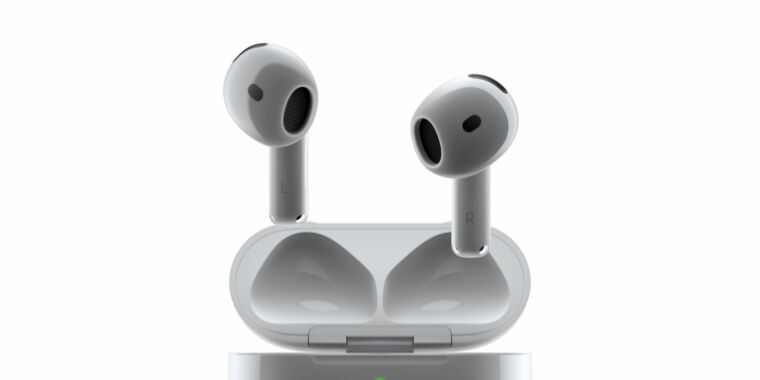
Apple announced the fourth-generation AirPods today during its It’s Glowtime event. As you can tell from the gallery above, the AirPods 4 look different from their predecessor. They also have Active Noise Cancellation (ANC) if you’re willing to pay extra.

Apple said that it mapped and analyzed “thousands” of ear shapes with 3D photogrammetry, laser topography, and other modeling tools to design the AirPods 4’s new form. Apple claims the new shape will make for a better fit. The new earbuds appear to have shorter stems. They look more similar to the AirPods Pro now but without the silicone tips. The stems also allow users to play/pause media and end or mute calls with a “quick press,” Apple claims, noting a new force sensor.

The new AirPods move from Apple’s H1 chip to the H2, which the current AirPods Pro use. Compared to the H1, Apple has said that the H2 is supposed to be up to twice as good at noise cancellation. Upgraded mics and computational audio are also supposed to aid in ANC.

The AirPods 4 inherit several AirPods Pro features. They claim personalized spatial audio, which uses head tracking, and machine learning-powered voice isolation as features. The AirPods are also supposed to be able to automatically lower the volume of whatever’s currently playing when you start talking to someone in real life. The Transparency mode lets you hear outside noises while media’s playing, and Adaptive Audio automatically blends Transparency mode with ANC.

The fourth-gen AirPods also have a new acoustic architecture that Apple claimed, without getting into much detail, delivers “richer” bass and “clearer” highs.

The new earbuds also have a redesigned case that’s 10 percent smaller by volume and is 2 inches (50 mm) long. It incorporates Apple’s slow, (European Union law-driven) shift from the proprietary Lightning charging port to USB-C. Apple said the case should last for up to 30 hours. It also supports wireless charging, including Qi.

The AirPods 4 will start at $129, which is cheaper than what the AirPods 3 have been going for ($179). But if you want ANC, they’ll cost $179. The AirPods 4 come out on September 20 but can be pre-ordered today.

Smaller updates to AirPods Pro and AirPods Max

Apple didn’t announce a new AirPods Pro or AirPods Max today but is adding some features to the current versions.

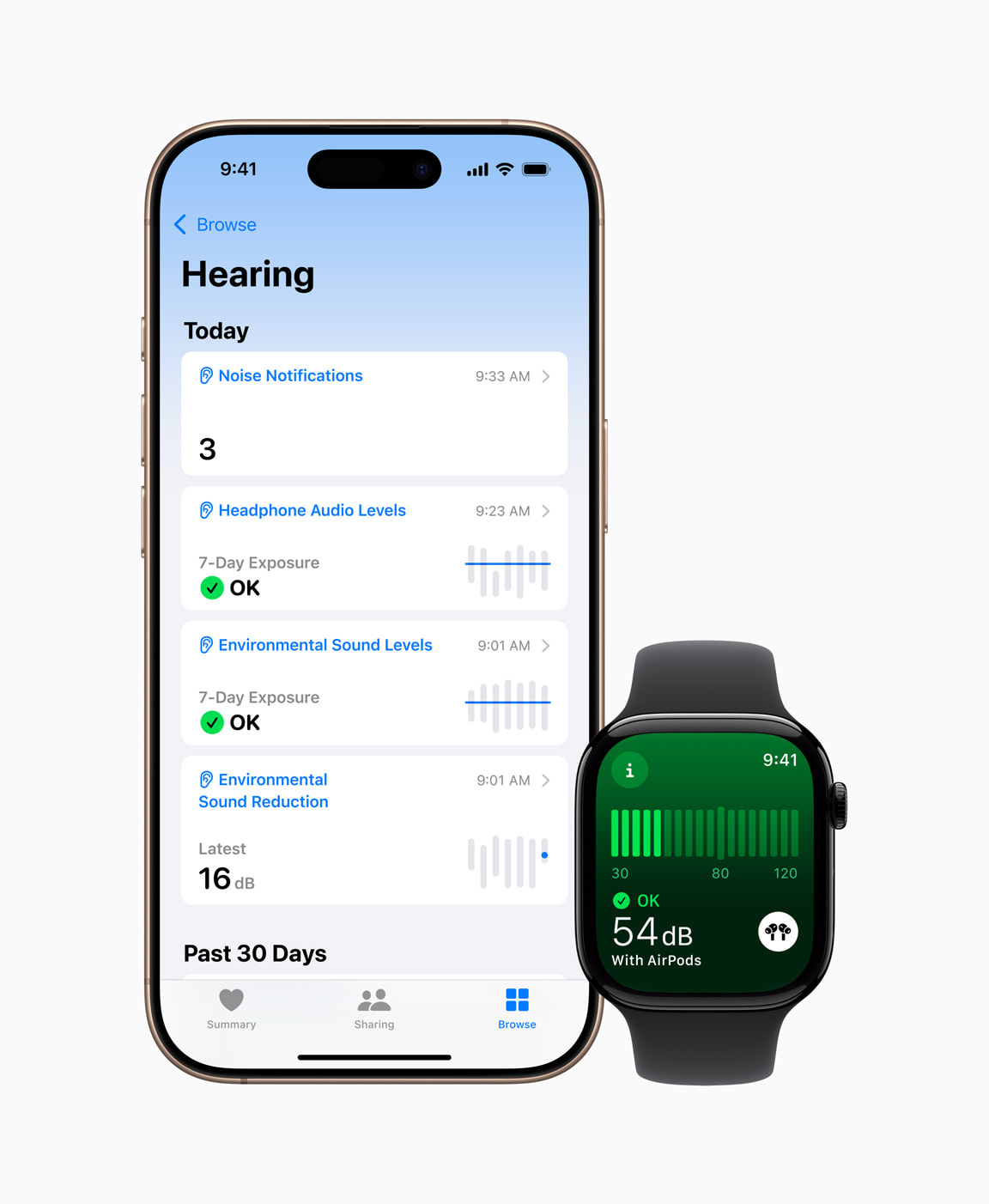
The AirPods Pro are getting a software update this fall that will allow the the earbuds to serve as a “clinical-grade hearing aid,” Apple CEO Tim Cook said. The feature is limited to people with “mild to moderate hearing loss,” Apple’s announcement said.

The fall update will also add a Hearing Protection feature to help quiet loud environmental sounds. “The ear tips help to provide passive noise reduction, while the H2 chip helps to actively reduce louder, more intermittent noise at 48,000 times per second,” per Apple’s announcement. Finally, the update will allow you to use the AirPods Pro as earplugs by use of an updated “multiband high dynamic range algorithm,” and add a hearing test.

AirPods Pro updates are all about hearing health.

Enlarge / AirPods Pro updates are all about hearing health.

Apple

The AirPods Max, meanwhile, are joining the move to USB-C. They’re also getting personalized spatial audio and new colors: midnight, blue, purple, orange, and starlight.

This version of the AirPods Max will be available on September 20 and will cost $549. Pre-orders start today.

Listing image by Apple

Apple announces $179 AirPods 4 with active noise cancellation Read More »
no-one-wanted-these-ps5-concord-discs-until-sony-stopped-making-them

No one wanted these PS5 Concord discs until Sony stopped making them

Oh, so now you want to buy it —

eBay prices have risen quickly less than a week since online game’s shutdown.

  • If you paid $40 for the physical edition of Concord, you can make a lot more than that back on eBay.

    Kyle Orland

  • The “Limited Edition” Concord-themed DualSense controller has seen some rapid resale price inflation as well.

    Kyle Orland

As recently as a week ago, a new disc copy of Sony’s team-based shooter Concord on the PlayStation 5 would set you back about $40 at most retailers. Now that Sony has shut off the game’s servers after just two weeks, you might think those now-useless discs would be practically worthless.

Instead, the physical version of Concord on PS5 has become a surprise collector’s item. An Ars analysis of nearly 300 eBay listings completed between September 3–8 shows new copies of the now-defunct game selling for a median price of $100 since the game’s shutdown. That going rate peaked at a median of $118 on September 5, up from $89.50 on September 3, before settling at $110 for eBay sales made on September 8.

Supply and demand

As usual with gaming collectibles, the price increase has less to do with playability and more to do with rarity. GameDiscoverCo analyst Simon Carless told IGN last month that he estimated an underwhelming 25,000 total sales for Concord across PS5 and PC. Even if we assume 80 percent of those sales were on the PS5, most of those console sales probably came as purely digital downloads, given long-running industry trends and the game’s focus on online play.

That means the total number of PS5 Concord discs in the wild could number in the single-digit thousands, easily making it one of the rarest physical first-party games Sony has ever released. And with Sony officially halting Concord sales as of September 3, that number isn’t going to go up anytime soon.

Sony encouraged players who purchased a physical copy of Concord to “please refer to the refund process of the retailer you purchased it from to obtain your refund.” Players who followed that advice missed out on the opportunity to make a pretty quick return on their investment through eBay reselling, though. A couple of lucky eBay sellers even pulled in nearly $500 for sealed copies of the game sold on September 5.

Concord discs ready to flip.” height=”400″ src=”https://cdn.arstechnica.net/wp-content/uploads/2024/09/concorddiscs-300×400.png” width=”300″>

Enlarge / One eBay seller seemed to have a lot of Concord discs ready to flip.

eBay

Even without those kinds of outliers, though, most eBay sellers have been able to get between $87 (20th percentile) and $120 (80th percentile) for new disc copies of the game since it was discontinued. That’s an easy 100 to 200 percent return on a $40 investment in well under a month. And the photos on some of those eBay listings suggest a few sellers were looking to cash in by reselling dozens of copies in individual lots.

The collector’s mania for Concord has seemingly extended to a limited edition-themed controller that Sony was selling for $85 as well. Completed eBay listings for that controller went for a median price of $252.50 on September 8, up from just $132 on September 3. Unlike the game they’re based on, though, those controllers have the benefit of still working with PS5 hardware well into the future.

The <em>Concord</em>-themed DualSense controller at least still works now that the game has been discontinued.” height=”580″ src=”https://cdn.arstechnica.net/wp-content/uploads/2024/09/concordcontroller.png” width=”580″></img><figcaption>
<p>The <em>Concord</em>-themed DualSense controller at least still works now that the game has been discontinued.</p>
<p>Sony</p>
</figcaption></figure>
<p>At the moment, it’s hard to tell how long these pricing trends will last. If there’s a wider market of PlayStation collectors looking for a rare piece of Sony history, <em>Concord</em> could become the modern equivalent of <a href=the NES’ Stadium Events—a rare but forgettable game that collectors still value. But if speculators are driving the current mania—hoping to quickly resell it for more to the next person in line—the pricing bubble could burst just as quickly as it inflated.

All that speculation could also come crashing down if Sony decides to relaunch Concord sales in the future. In the game’s shutdown announcement, Sony said it was “explor[ing] options, including those that will better reach our players.” Already, there is a tongue-in-cheek petition effort to convince Sony to do just that, with nearly 2,000 signatories to its name. “We were all busy that week,” the petition’s title reads. “Please release Concord again.”

Listing image by eBay

No one wanted these PS5 Concord discs until Sony stopped making them Read More »
the-golden-age-of-offbeat-arctic-research

The Golden Age of offbeat Arctic research

cold war dreamers —

The Cold War spawned some odd military projects that were doomed to fail.

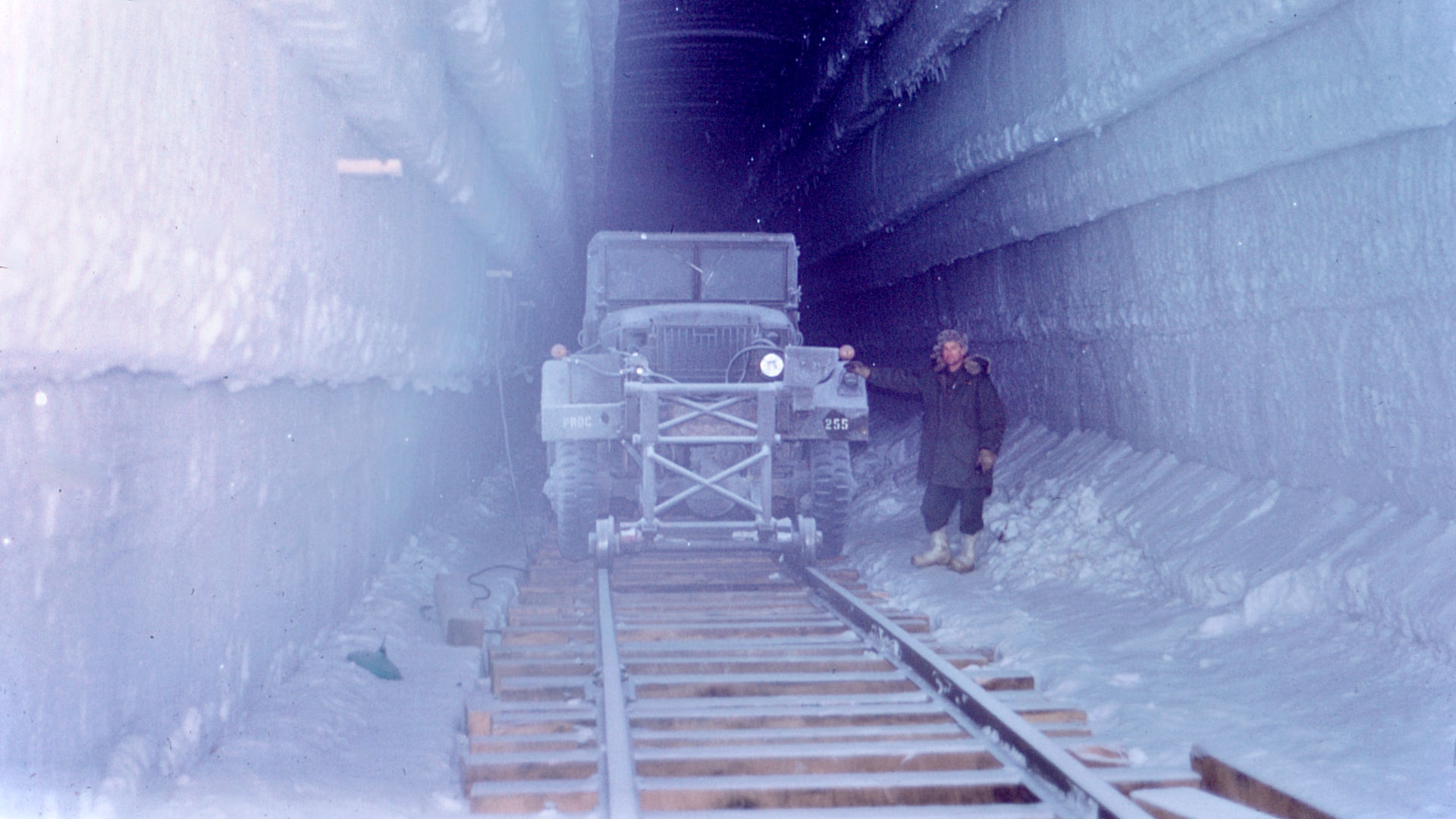
At the US Army’s Camp Century on the Greenland ice sheet, an Army truck equipped with a railroad wheel conversion rides on 1,300 feet of track under the snow.

Enlarge / At the US Army’s Camp Century on the Greenland ice sheet, an Army truck equipped with a railroad wheel conversion rides on 1,300 feet of track under the snow.

In recent years, the Arctic has become a magnet for climate change anxiety, with scientists nervously monitoring the Greenland ice sheet for signs of melting and fretting over rampant environmental degradation. It wasn’t always that way.

At the height of the Cold War in the 1950s, as the fear of nuclear Armageddon hung over American and Soviet citizens, ­idealistic scientists and engineers saw the vast Arctic region as a place of unlimited potential for creating a bold new future. Greenland emerged as the most tantalizing proving ground for their research.

Scientists and engineers working for and with the US military cooked up a rash of audacious cold-region projects—some innovative, many spit-balled, and most quickly abandoned. They were the stuff of science fiction: disposing of nuclear waste by letting it melt through the ice; moving people, supplies, and missiles below the ice using subways, some perhaps atomic powered; testing hovercraft to zip over impassable crevasses; making furniture from a frozen mix of ice and soil; and even building a nuclear-powered city under the ice sheet.

Today, many of their ideas, and the fever dreams that spawned them, survive only in the yellowed pages and covers of magazines like “REAL: the exciting magazine FOR MEN” and dozens of obscure Army technical reports.

Karl and Bernhard Philberth, both physicists and ordained priests, thought Greenland’s ice sheet the perfect repository for nuclear waste. Not all the waste—first they’d reprocess spent reactor fuel so that the long-lived nuclides would be recycled. The remaining, mostly short-lived radionuclides would be fused into glass or ceramic and surrounded by a few inches of lead for transport. They imagined several million radioactive medicine balls about 16 inches in diameter scattered over a small area of the ice sheet (about 300 square miles) far from the coast.

Because the balls were so radioactive, and thus warm, they would melt their way into the ice, each with the energy of a bit less than two dozen 100-watt incandescent light bulbs—a reasonable leap from Karl Philberth’s expertise designing heated ice drills that worked by melting their way through glaciers. The hope was that by the time the ice carrying the balls emerged at the coast thousands or tens of thousands of years later, the radioactivity would have decayed away. One of the physicists later reported that the idea was shown to him, by God, in a vision.

US Army test of the Snowblast in Greenland in the 1950s, a machine designed to smooth snow runways.

Enlarge / US Army test of the Snowblast in Greenland in the 1950s, a machine designed to smooth snow runways.

Of course, the plan had plenty of unknowns and led to heated discussion at scientific meetings when it was presented—what, for example, would happen if the balls got crushed or caught up in flows of meltwater near the base of the ice sheet. And would the radioactive balls warm the ice so much that the ice flowed faster at the base, speeding the balls’ trip to the coast?

Logistical challenges, scientific doubt, and politics sunk the project. Producing millions of radioactive glass balls wasn’t yet practical, and the Danes, who at the time controlled Greenland, were never keen on allowing nuclear waste disposal on what they saw as their island. Some skeptics even worried about climate change melting the ice. Nonetheless, the Philberths made visits to the ice sheet and published peer-reviewed scientific papers about their waste dream.

The Golden Age of offbeat Arctic research Read More »
wavecore-runs-right-through-a-concrete-wall-with-gigabit-speed-network-signal

WaveCore runs right through a concrete wall with gigabit-speed network signal

Thick as a brick —

Core drilling is tricky. Getting a 6 GHz signal through concrete is now easier.

Business-like man standing in a concrete loft space

Enlarge / “Hmm, no signal here. I’m trying to figure it out, but nothing comes to mind …”

Getty Images

One issue in getting office buildings networked that you don’t typically face at home is concrete—and lots of it. Concrete walls are an average of 8 inches thick inside most commercial real estate.

Keeping a network running through them is not merely a matter of running cord. Not everybody has the knowledge or tools to punch through that kind of wall. Even if they do, you can’t just put a hole in something that might be load-bearing or part of a fire control system without imaging, permits, and contractors. The bandwidths that can work through these walls, like 3G, are being phased out, and the bandwidths that provide enough throughput for modern systems, like 5G, can’t make it through.

That’s what WaveCore, from Airvine Scientific, aims to fix, and I can’t help but find it fascinating after originally seeing it on The Register. The company had previously taken on lesser solid obstructions, like plaster and thick glass, with its WaveTunnel. Two WaveCore units on either side of a wall (or on different floors) can push through a stated 12 inches of concrete. In their in-house testing, Airvine reports pushing just under 4Gbps through 12 inches of garage concrete, and it can bend around corners, even 90 degrees. Your particular cement and aggregate combinations may vary, of course.

  • The WaveCore device, installed in a garage space during Airvine Scientific’s testing.

  • Concept drawing of how WaveCore punches through concrete walls (kind of).

    Airvine Scientific

The spec sheet shows that a 6 GHz radio is the part that, through “beam steering,” blasts through concrete, with a 2.4 GHz radio for control functions. There’s PoE or barrel connector power, and RJ45 ethernet in the 1, 2.5, 5, and 10Gbps sizes.

6 GHz concrete fidelity (Con-Fi? Crete-Fi?) is just one of the slightly uncommon connections that may or may not be making their way into office spaces soon. LiFi, standardized as 802.11bb, is seeking to provide an intentionally limited scope to connectivity, whether for security restrictions or radio frequency safety. And Wi-Fi 7, certified earlier this year, aims to multiply data rates by bonding connections over the various bands already in place.

WaveCore runs right through a concrete wall with gigabit-speed network signal Read More »

telegram-is-not-an-“anarchic-paradise,”-ceo-pavel-durov-says-after-arrest

Telegram is not an “anarchic paradise,” CEO Pavel Durov says after arrest

The Telegram app icon on a phone screen

Getty Images | picture alliance

Telegram CEO Pavel Durov, in his first public comments since being arrested by French authorities, said that Telegram is not an “anarchic paradise” but promised that the platform will enhance its moderation of harmful content.

While Telegram has room for improvement, “the claims in some media that Telegram is some sort of anarchic paradise are absolutely untrue,” Durov wrote on Telegram yesterday. “We take down millions of harmful posts and channels every day. We publish daily transparency reports (like this or this). We have direct hotlines with NGOs to process urgent moderation requests faster.”

The links Durov provided go to Telegram channels that report the number of groups and channels banned for terrorist content and child-abuse content. Telegram has been criticized by groups such as the National Center for Missing and Exploited Children (NCMEC) for allegedly not cooperating on removal of child sexual abuse material.

Durov said Telegram has heard criticism that its moderation efforts are “not enough,” adding that “Telegram’s abrupt increase in user count to 950M caused growing pains that made it easier for criminals to abuse our platform. That’s why I made it my personal goal to ensure we significantly improve things in this regard. We’ve already started that process internally, and I will share more details on our progress with you very soon.”

Durov is forbidden from leaving France after his indictment last week. Prosecutor Laure Beccuau alleged that law enforcement authorities received a near-total lack of response from Telegram to requests for cooperation in cases related to crimes against minors, drug crimes, and online hate.

FAQ signals new approach to “private” messages

Telegram already made a change to its FAQ in a section on how the company handles illegal content. The change suggests Telegram may do more moderation of private messages.

An Internet Archive capture of the FAQ page from yesterday contained the following text:

Q: There’s illegal content on Telegram. How do I take it down?

All Telegram chats and group chats are private amongst their participants. We do not process any requests related to them.

But sticker sets, channels, and bots on Telegram are publicly available. If you find sticker sets or bots on Telegram that you think are illegal, please ping us at [email protected].

You can also use the ‘report’ buttons right inside our apps, see this post on our official @ISISwatch channel for details.

That section in the current version of the FAQ page was heavily rewritten. The statement that all chats are private and that Telegram does not “process any requests related to them” has been removed. It now says, “All Telegram apps have ‘Report’ buttons that let you flag illegal content for our moderators—in just a few taps,” and goes on to provide more specific instructions on how to report illegal content in messages.

Some of the key language removed from the section on illegal content remains in the FAQ section on how to report copyright infringement. The copyright section still contains the statement that all chats are private and that Telegram does not “process any requests related to them.” Despite that, testing the app today showed that clicking “Report” on a Telegram message provides an option to report copyright infringement. Users can also report messages for spam, violence, pornography, child abuse, illegal drugs, or personal details.

Telegram messages do not have end-to-end encryption by default, but the security feature can be enabled for one-on-one conversations. The app has social-network features letting users create groups of up to 200,000 people and channels for posting of public messages to audiences of any size. Telegram users cannot enable end-to-end encryption on group messages.

Telegram is not an “anarchic paradise,” CEO Pavel Durov says after arrest Read More »

internet-picks-“werewolf-clawing-off-its-own-shirt”-as-new-michigan-“i-voted”-sticker

Internet picks “werewolf clawing off its own shirt” as new Michigan “I Voted” sticker

RAWR —

“It was just so hot in that voting booth!”

A picture of the winning sticker.

Voting really feels good to this werewolf.

State of Michigan

You can’t just ask the Internet to vote on something and assume you’ll get a “normal” result.

The town of Fort Wayne, Indiana, learned this the hard way in 2011, when an online vote to name a new government center in town went with “Harry Baals.” Though Mr. Baals was in fact a respected former mayor of the town back in the 1930s, contemporary officials weren’t convinced that his name was chosen out of merely historical interest.

Or there was the time in 2015 when the British Columbia Ferry Service asked Internet users to name its newest ships and perhaps win a $500 prize. Contest entries included:

  • Spirit of The WalletSucker
  • The Floating Crapsickle
  • Royal Docksitter
  • The Coastal Corruption
  • HMS Cantafford
  • Queen of the Damned

Or again—and perhaps most famously—there was the UK government’s gloriously naive decision in 2016 to let the Internet pick a new name for a £200 million polar research vessel. And 124,109 members of the general public chose… Boaty McBoatface. (This was later overridden by the government, which named the ship the RRS Sir David Attenborough instead, but one of the boat’s remotely operated underwater vehicles was named Boaty McBoatface as a consolation prize.)

Even the not-quite-bleeding-edge-of-tech New York Times recognized in its headline on the story that this is “What You Get When You Let the Internet Decide.”

So, despite many years of cautionary tales, the state of Michigan this year launched a contest to design some new “I Voted” sticker designs. (NB: For our non-American readers, these stickers are often given out when you vote in elections so that you can shame any nonvoting friends, family, and colleagues with your civic virtue.)

The state commissioned designs from local school kids, no doubt anticipating that said designs would feature things like heartwarming drawings of the Michigan mitten. And they let the Internet weigh in on the results.

More than 57,000 people did so—and that’s why voters across the state, once they cast a ballot in this year’s presidential election, might be handed a round sticker featuring a werewolf ripping its own shirt to shreds as it throws its head back and howls like a maniac in front of an American flag. And it is glorious.

Why not?

This piece of inspired artwork came from the mind and pen of 12-year-old Jane Hynous of Grosse Pointe Farms. Though the contest selected nine winners, Hynous’ design beat every other entry by a wide margin. (See all winners here.)

The New York Times called Hynous to talk about the sticker and received this terrific quote:

“I didn’t want to do something that usually you think of when you think of Michigan,” she said. “I was like, ‘Why not make a wolf pulling his shirt off?'”

Why not, indeed? Clearly, the Internet has delivered on this one.

Election clerks can also order the traditional design. But why?

Enlarge / Election clerks can also order the traditional design. But why?

Michigan plans to print a million stickers, which will feature all nine winning designs, and local election clerks will need to order specific designs from the state. (They can also order the original, boring American flag “I Voted” stickers. But why would they?)

So if you live in Michigan, and if this November you want your shirt adorned with an insane werewolf celebrating the vote you just cast, now is the time to let your local clerk know.

Still, despite these great designs, I can’t help but feel that an opportunity was lost. No “Votey McVoteface”? Perhaps in 2028.

Internet picks “werewolf clawing off its own shirt” as new Michigan “I Voted” sticker Read More »

ai-and-the-technological-richter-scale

AI and the Technological Richter Scale

The Technological Richter scale is introduced about 80% of the way through Nate Silver’s new book On the Edge.

A full review is in the works (note to prediction markets: this post alone does NOT on its own count as a review, but this counts as part of a future review), but this concept seems highly useful, stands on its own and I want a reference post for it. Nate skips around his chapter titles and timelines, so why not do the same here?

Nate Silver, On the Edge (location 8,088 on Kindle): The Richter scale was created by the physicist Charles Richter in 1935 to quantify the amount of energy released by earthquakes.

It has two key features that I’ll borrow for my Technological Richter Scale (TRS). First, it is logarithmic. A magnitude 7 earthquake is actually ten times more powerful than a mag 6. Second, the frequency of earthquakes is inversely related to their Richter magnitude—so 6s occur about ten times more often than 7s. Technological innovations can also produce seismic disruptions.

Let’s proceed quickly through the lower readings of the Technological Richter Scale.

  1. Like a half-formulated thought in the shower.

  2. Is an idea you actuate, but never disseminate: a slightly better method to brine a chicken that only you and your family know about.

  3. Begins to show up in the official record somewhere, an idea you patent or make a prototype of.

  4. An invention successful enough that somebody pays for it; you sell it commercially or someone buys the IP.

  5. A commercially successful invention that is important in its category, say, Cool Ranch Doritos, or the leading brand of windshield wipers.

  6. An invention can have a broader societal impact, causing a disruption within its field and some ripple effects beyond it. A TRS 6 will be on the short list for technology of the year. At the low end of the 6s (a TRS 6.0) are clever and cute inventions like Post-it notes that provide some mundane utility. Toward the high end (a 6.8 or 6.9) might be something like the VCR, which disrupted home entertainment and had knock-on effects on the movie industry. The impact escalates quickly from there.

  7. One of the leading inventions of the decade and has a measurable impact on people’s everyday lives. Something like credit cards would be toward the lower end of the 7s, and social media a high 7.

  8. A truly seismic invention, a candidate for technology of the century, triggering broadly disruptive effects throughout society. Canonical examples include automobiles, electricity, and the internet.

  9. By the time we get to TRS 9, we’re talking about the most important inventions of all time, things that inarguably and unalterably changed the course of human history. You can count these on one or two hands. There’s fire, the wheel, agriculture, the printing press. Although they’re something of an odd case, I’d argue that nuclear weapons belong here also. True, their impact on daily life isn’t necessarily obvious if you’re living in a superpower protected by its nuclear umbrella (someone in Ukraine might feel differently). But if we’re thinking in expected-value terms, they’re the first invention that had the potential to destroy humanity.

  10. Finally, a 10 is a technology that defines a new epoch, one that alters not only the fate of humanity but that of the planet. For roughly the past twelve thousand years, we have been in the Holocene, the geological epoch defined not by the origin of Homo sapiens per se but by humans becoming the dominant species and beginning to alter the shape of the Earth with our technologies. AI wresting control of this dominant position from humans would qualify as a 10, as would other forms of a “technological singularity,” a term popularized by the computer scientist Ray Kurzweil.

One could quibble with some of these examples. Credit cards as a low 7, below social media, while the VCR is a 6.85 and you get to 6 with a Post-it note? Also one could worry we should condense the lower end of the scale to make room at the top.

Later he puts ‘the blockchain’ in the 7s, and I’m going to have to stop him right there. No. Blockchain is not on par with credit cards or mobile phones (either of which is reasonable at a 7 but a plausible 8), that makes no sense, and it also isn’t more important than (for example) the microwave oven, which he places at 6. Yes, crypto people like to get excited, but everyone chill.

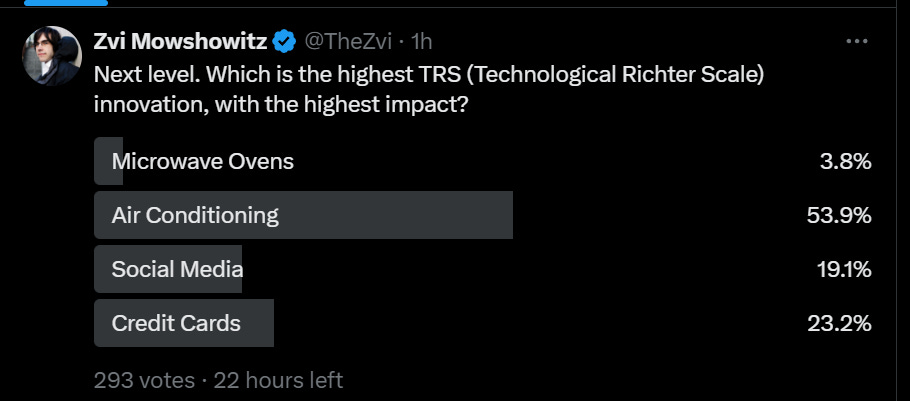
I ran a poll to sanity check this, putting Blockchain up against various 6s.

This was a wipe-out, sufficient that I’m sending blockchain down to at best a low 6.

Claude estimates the microwave has already saved $4.5 trillion in time value alone, and you should multiply that several times over for other factors. The total market cap of Crypto is $2 trillion, that number is super fake given how illiquid so many coins are (and e.g. ~20% of Bitcoin, or 10% of the overall total, likely died with Satoshi and so on). And if you tell me there’s so much other value created, and crypto is going to transform the world, let me find that laugh track.

Microwaves then correctly got crushed when put up against real 7s.

I think this is sleeping on credit cards, at least if you include debit cards. Smooth payment rails are a huge deal. And electricity rather correctly smoked The Internet and automobiles (and air conditioning). This game is fun.

The overall point is also clear.

What is the range of plausible scores on this scale for generative AI?

The (unoriginal) term that I have used a few times, for the skeptic case, the AI-fizzle world, is that AI could prove to be ‘only internet big.’ In that scenario, GPT-5-level models are about as good as it gets, and they don’t enable dramatically better things than today’s GPT-4-level models. We then spend a long time getting the most out of what those have to offer.

I think that even if we see no major improvements from there, an 8.0 is already baked in. Counting the improvements I am very confident we can get about an 8.5.

In that scenario, we distill what we already have, costs fall by at least one additional order of magnitude, we build better scaffolding and prompting techniques, we integrate all this into our lives and civilization.

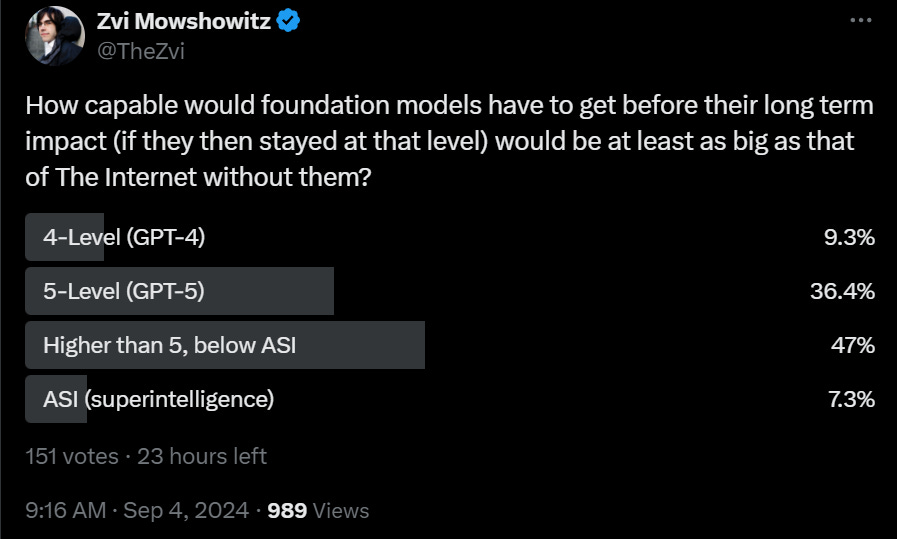
I asked Twitter, how advanced would frontier models have to get, before they were at least Internet Big, or a solid 8?

I think that 5-level models, given time to have their costs reduced and to be properly utilized, will inevitably be at least internet big, but only 45% of respondents agreed. I also think that 5-level models are inevitable – even if things are going to peter out, we should still have that much juice left in the tank.

Whereas, and I think this is mind-numbingly obvious, any substantial advances beyond that get us at least into the 9s, which probably gets us ASI (or an AGI capable of enabling the building of an ASI) and therefore is at least a 10.0. You could argue that since it changes the destiny of the universe instead of only Earth, it’s 11.0. Even if humanity retains control over the future and we get the outcomes we hope to get, creating things smarter than we are changes everything, well beyond things like agriculture or fire.

There are otherwise clearly intelligent people who seem to sincerely disagree with this. I try to understand it. On some levels, sometimes, I manage to do that.

On other levels, no, that is completely bonkers nuts, Obvious Nonsense.

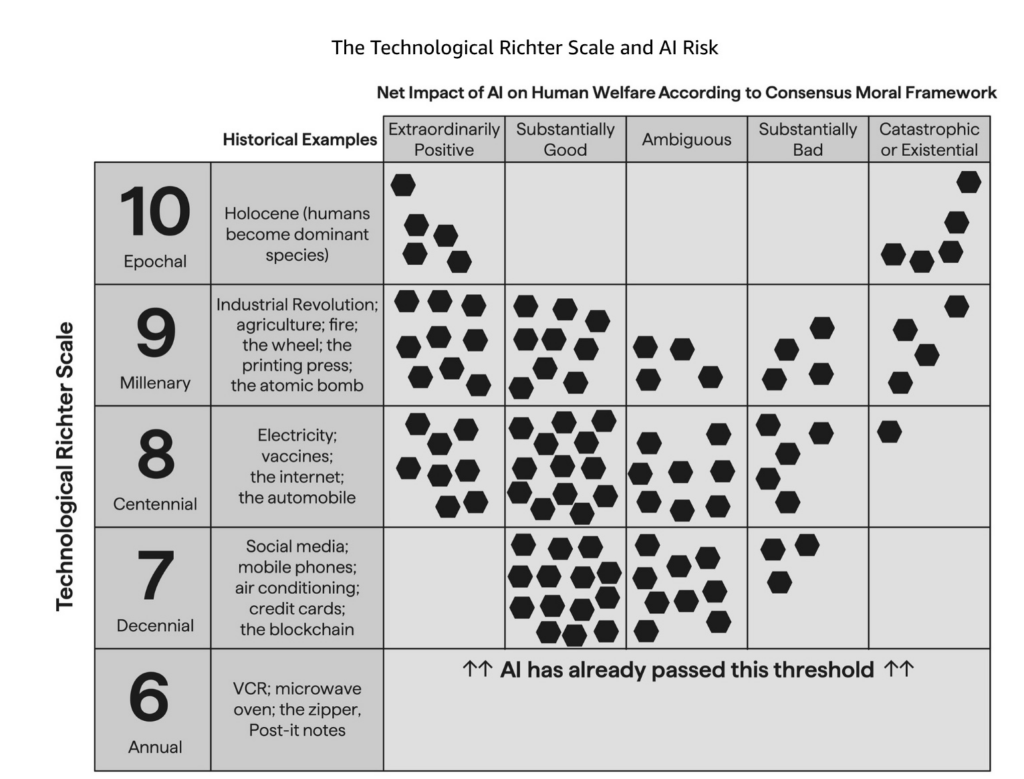
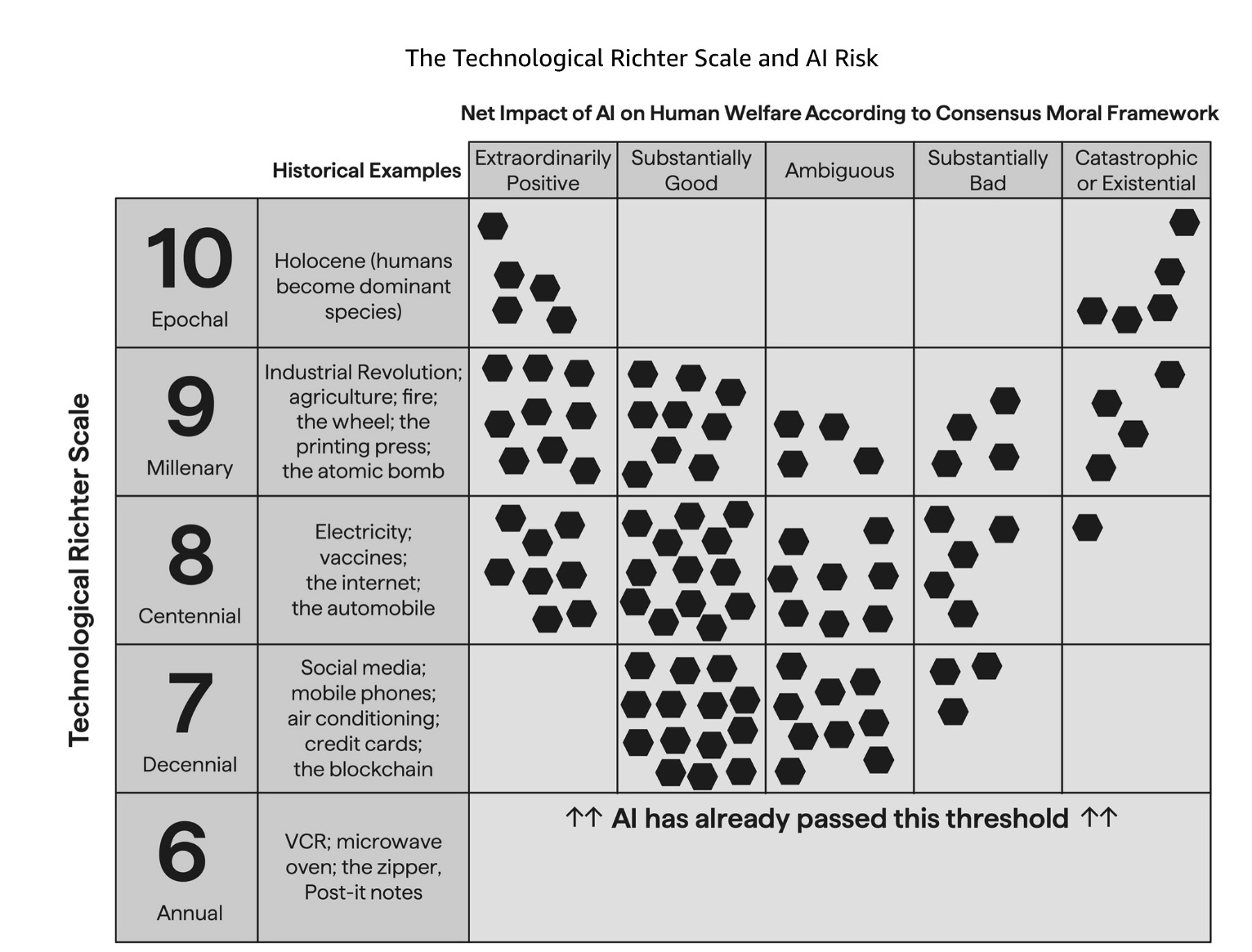
Nate Silver offers this chart.

As I noted, I think you can move that ‘AI has already passed this threshold’ line up.

No, it hasn’t been as impactful as those things at 7 yet, but if civilization continues relatively normally that is inevitable.

I think this chart is actually overly pessimistic at the 8-level, and would be at the 7-level if that was still a possibility. Put me in the ‘probably extraordinary positive’ category if we stay there. The only worry is if AI at that level enables some highly disruptive technology with no available defenses, but I’d be 70%+ we’re on the extreme left in the 8-range. At the 7-range I’d be 90%+ we’re at least substantially good, and then it’s a question of how extraordinary you have to be to count.

If you tell me we got stuck at 9-level, the obvious question is how we got a 9 and then did not get a 10 soon thereafter. It’s actually tricky to imagine one without the other. But let us suppose that via some miracle of physics that is where AI stops? My guess is the distribution above is reasonable, but it’s hard because every time I try to imagine that world my brain basically shoots back ‘does not compute.’

What if it does go to 10-level, fully transformational AI? Nate nails the important point, which is that the result is either very, very good or it is very, very bad. The chart above puts the odds at 50/50. I think the odds are definitely against us here. When I think about 10-level scenarios where we survive, it always involves something going much better than I expect, and usually it involves multiple such somethings. I think we are still drawing live, but a huge portion of that is Model Error – the possibility that I am thinking about this wrong, missing or wrong about very important things.

The baseline scenario is that we create things smarter than ourselves, and then rapidly control over the future belongs to those smarter things, and this does not lead to good outcomes for humanity, or probably any humans surviving for long.

No, that does not require any kind of ‘sharp left turn’ or particular failure mode, it is simply what happens under competition, when everyone is under pressure to turn more and more things over to more and more ruthless AIs to compete against each other.

That even assumes we ‘solve alignment’ sufficiently to even get that far, and we very much should not be assuming that.

One can also get into all the other problems and obstacles, many of which Eliezer Yudkowsky covers under A List of Lethalities.

Almost all arguments I hear against this seem (to put it politely) extremely poor, and highly motivated. Mostly they do not even consider the real issues involved at all.

Most arguments that everything will work out fine, that are not nonsense, are not arguing we’ll get a 10.0 and survive it. Mostly they are arguing we do not get a 10.0.

It would very much help the discourse if people would be clearer on this. If they would say ‘I do not expect transformational AI, I think it is about an 8.0, but I agree that if it is going to hit 9+ then we should be very worried’ then we could focus on the actual crux of the matter.

Or if we could hear such arguments, respond with ‘so you don’t think AI is transformational, it won’t go beyond 8.0?’ and they could say yes. That works too.

What are some of the most common arguments against transformational AI?

It is very hard to state many of the common arguments without strawmanning, or sounding like one is strawmanning. But this is a sincere attempt to list as many of them as possible, and to distill their actual core arguments.

  1. We are on an S-curve of capabilities, and near the top, and that will be that.

  2. A sufficiently intelligent computer would take too much [compute, power, data].

  3. Look how stupid current AIs are, they can’t even solve [some simple thing].

  4. Intelligence does not much matter, so it won’t make much difference.

  5. Intelligence does not much matter because we won’t let it have physical impacts.

  6. Intelligence does not much matter without [X] which AIs will always lack.

  7. Intelligence does not much matter because everything is already invented.

  8. Intelligence has a natural limit about where humans are.

  9. Intelligence of AI has a natural limit at the level of your training data.

  10. AI can only reproduce what is in its training data.

  11. AI can only recombine the types of things in its training data.

  12. AI cannot be creative, or invent new things.

  13. AI is dumb, it can only do narrow things, that’s not intelligence.

  14. AI does not have goals, or does not have desires, or memory, and so on.

  15. AI will always be too unreliable to do anything important.

  16. AI will have some fatal weakness, and you can be Kirk.

  17. Intelligence is not real, there is only domain knowledge and skill.

  18. Humans are special, a computer could never [do X].

  19. Humans are special because we are embodied.

  20. Humans are special because we are [sentient, conscious, ensouled, common sense].

  21. Humans are special because we are so much more efficient somehow.

  22. Humans are special because ultimately humans will only trust or want humans.

  23. There is a lot of hype in AI, so it is all fake.

  24. Everything is fake, so AI is fake too.

  25. AI is a tool, and will always remain a mere tool.

  26. AI is just math, math is harmless.

  27. AI can only do what it can do now, we can ignore speculative claims.

  28. AI that does that sounds like science fiction, so we can ignore your claims.

  29. AI that does that implies an absurd future, so we can ignore your claims.

  30. AGI is not well defined so it will never exist.

  31. Arguments involving religious beliefs or God or aliens or what not.

  32. Arguments from various science fiction worlds where AI does not do this.

  33. Humanity will agree to stop building AI, we’re not that stupid.

  34. No, that whole thing is stupid, and I don’t like your stupid face.

I sincerely wish I was kidding here. I’m not.

A few of these are actual arguments that give one pause. It is not so implausible that we are near the top of an S-curve, that in some sense we don’t have the techniques and training data to get much more intelligence out of the AIs than we already have. Diminishing returns could set in, the scaling laws could break, and AI would get more expensive a lot faster than it makes everything easier, and progress stalls. The labs say there are no signs of it, but that proves nothing. We will, as we always do, learn a lot when we see the first 5-level models, or when we fail to see them for sufficiently long.

Then there are those that perhaps made sense in the past, but where the hypothesis has been falsified. Yes, humans say they want to trust humans and not AIs, but when humans in the loop are inconvenient, we already know what they will do, and of course if the AI in question was sufficiently capable it would not matter anyway.

Most tragically, there was a time it seemed plausible we would simply not built it exactly because we don’t want a 10.0-level event. That seems like a dim hope now, although we should still consider trying to postpone that event until we are ready.

Others are more absurd. I am especially frustrated by the arguments that I call Intelligence Denialism – that if you made something much smarter than a human, that it wouldn’t be able to do anything too impactful, or that intelligence is an incoherent concept. No, it couldn’t fool or manipulate me, or people in general, or make tons of money. No, it wouldn’t be able to run things much more productively, or invent new techniques, or whatever. And so on.

Many arguments accidentally disprove humans, or human civilization.

Then there are the ones that are word salads, or Obvious Nonsense, or pointing to obstacles that could not possibly bind over the medium term if nothing else was standing in the way, or aren’t arguments for the point in question. For example, you say the true intelligence requires embodiment? I mean I don’t see why you think that, but if true then there is an obvious fix. The true intelligence won’t matter because it won’t have a body? Um, you can get humans to do things by offering them money.

Or my favorite, the Marc Andreessen classic ‘AI is just math,’ to which the response is ‘so is the universe, and also so are you and me, what are you even talking about.’

I tried several times to write out taxonomies of the arguments that transformational AI will turn out fine. What I discovered was that going into details here rapidly took this post beyond scope, and getting it right is important but difficult.

This is very much not an attempt to argue for or against existential risk, or any particular conditional probability of doom. It is primarily here to contrast this list with the above list of arguments against transformational AI.

Briefly, one might offer the following high-level taxonomy.

  1. Arguments that human extinction is fine. (e.g. either AIs will have value inherently, AIs will carry our information and values, something else is The Good and can be maximized without us, or humanity is net negative, and so on.)

  2. Arguments from the AIs using advanced decision theories (e.g. FDT over CDT).

  3. Arguments from moral realism, fully robust alignment, that ‘good enough’ alignment is good enough in practice, and related concepts.

  4. Arguments from there being a benevolent future singleton or de facto singleton.

  5. Arguments from coordination being hard, and AIs not being able to coordinate, and that we will be protected by game theory (e.g. because AIs will be using CDT).

  6. Arguments from coordination being easy, and AIs, humans or both being thus able to coordinate far better than humans ever have. Also see de facto singleton.

  7. Arguments we have to gamble on it being fine, given our other options. So we therefore must assume everything will be fine, or act as if it will be, or treat that distribution of outcomes as overall fine, or similar.

  8. Arguments from science fiction or otherwise reasoning from what feels plausible, or from humans retaining some comparative advantage somehow.

  9. Arguments from blind faith, forms of just world hypothesis, failure to be able to imagine failure, or our general ability to figure things out and muddle through.

  10. Arguments from good outcomes being so cheap the AIs will allow them.

  11. Arguments that assume the default outcome must be fine, and then arguing against a particular bad scenario, which proves things will be fine.

  12. Arguments from uncertainty, therefore you can dismiss such concerns.

  13. Arguments from authority, or ad hominem, that worried people are bad.

I list ‘extinction is fine’ first because it is a values disagreement, and because it is important to realize a lot of people actually take such positions, and that this has had important impacts (e.g. fear of those who believe such arguments building AGI first motivating Musk to help create OpenAI).

The rest are in a combination of logical order and a roughly descending order of plausibility and of quality of the best of each class of arguments. Point seven is also unique, and is roughly the Point of No Return, beyond which the arguments get a lot worse.

The argument of whether we should proceed, and in what way, is of course vastly more complex than this and involves lots of factors on all sides.

A key set of relatively good arguments make the case that alignment of AIs and their objectives and what they do to what we want AIs to be doing is somewhere between easy (or even happens ‘by default’) and extremely difficult but solvable in time with the right investments. Reasonable people disagree on the difficulty level here, and I am of the position the problem is probably very difficult but not as impossible as some others (e.g. Yudkowsky) think.

Most (but not all!) people making such arguments then fail to grapple with what I tried calling Phase 2. That after you know how to get AIs to do what you want them to do, you still have to get to an equilibrium where this turns out well for humans, despite the default outcome of ‘humans all have very capable AIs that do what they want, and the humans are otherwise free’ is ‘the humans all turn everything over to their AIs and set them loose to compete’ because anyone not doing that loses out, on an individual level and on a corporate or national level.

What we want here is a highly ‘unnatural’ result, for the less competitive, less intelligent thing (the humans) to stay on top or at least stick around and have a bunch of resources, despite our inability to earn them in the marketplace, or ability to otherwise compete for them or for the exercise of power. So you have to find a way to intervene on the situation that fixes this, while preserving what we care about, that we can collectively agree to implement. And wow, that seems hard.

A key category is point 11: The argument that by default, creating entities far smarter, cheaper, more efficient, more competitive and more capable than ourselves will lead to good outcomes for us. If we can dismiss a particular bad scenario, we will definitely be in a good scenario. Then they choose a particular bad scenario, and find a step where they can dismiss it – or, they simply say ‘there are a lot of steps here, and one of them will not happen this way.’ Then they say since the bad scenario won’t happen, things will go well.

A remarkably large percentage of arguments for things being fine are either point 1 (human extinction is fine), point 11 (this particular bad end is implausible so things will be good) or points 12 and 13.

AI and the Technological Richter Scale Read More »