Author name: Rejus Almole

boar’s-head-will-never-make-liverwurst-again-after-outbreak-that-killed-9

Boar’s Head will never make liverwurst again after outbreak that killed 9

Insanitary —

The Jarratt, Virginia, plant is now closed indefinitely.

A recall notice is posted next to Boar's Head meats that are displayed at a Safeway store on July 31, 2024, in San Rafael, California.

Enlarge / A recall notice is posted next to Boar’s Head meats that are displayed at a Safeway store on July 31, 2024, in San Rafael, California.

The Boar’s Head deli-meat plant at the epicenter of a nationwide Listeria outbreak that killed nine people so far harbored the deadly germ in a common area of the facility deemed “low risk” for Listeria. Further, it had no written plans to prevent cross-contamination of the dangerous bacteria to other products and areas. That’s according to a federal document newly released by Boar’s Head.

On Friday, the company announced that it is indefinitely closing that Jarratt, Virginia-based plant and will never again produce liverwurst—the product that Maryland health investigators first identified as the source of the outbreak strain of Listeria monocytogenes. The finding led to the recall of more than 7 million pounds of Boar’s Head meat. The Jarratt plant, where the company’s liverwurst is made, has been shuttered since late July amid the investigation into how the outbreak occurred.

In the September 13 update, Boar’s Head explained that:

[O]ur investigation has identified the root cause of the contamination as a specific production process that only existed at the Jarratt facility and was used only for liverwurst. With this discovery, we have decided to permanently discontinue liverwurst.

While the statement seems to offer some closure on the outbreak’s source, previously released inspection reports described a facility riddled with sanitation failures. Between August 1, 2023, and August 2, 2024, the facility was cited for 69 violations, which included water leaks, mold in numerous places, algal growth, “meat buildup” caking equipment, and walls that were also crawling with flies and gnats, sightings of other insects, rancid smells, trash and debris on the floors, and even “ample amounts of blood in puddles.”

The New York Times also reported that a 2022 inspection found that the plant posed an “imminent threat” to public health and that inspectors cited “extensive rust, deli meats exposed to wet ceilings, green mold and holes in the walls.”

Cross-contamination

The document newly released by Boar’s Head is a letter dated July 31 from the US Department of Agriculture’s Food Safety and Inspection Service notifying the company that the Jarratt facility was suspended. The basis of the suspension was an inspection finding from July 24 and 25 of L. monocytogenes contaminating a pallet jack in a large room where ready-to-eat meats were processed. The room was a common area not specific to liverwurst processing and was deemed by Boar’s Head to be “low risk” for Listeria.

Meats from eight processing lines were in the room, with lines 1 through 4 on the left side and 5 through 8 on the right, handling hot dogs and other small sausages. The contaminated pallet jack was designated for production line 2, which was handling Beechwood Hams, and was used to move racks of hams from blast coolers to production lines in the processing room.

However, inspectors noted that the pallet jacks and product racks in the room weren’t kept to designated production lines, and instead, employees moved them between all of the lines and all of the blast coolers, enabling cross-contamination. And, while the equipment was moved around, people did, too. Although employees typically stuck to one production line, they would sometimes move between lines, and there were no procedures for employees to change personal protective equipment (PPE)—gloves, disposable aprons, and arm covers—when they switched. Inspectors saw them switching without changing their PPE.

“They also observed employees who freely move between all lines without directly interacting with product such as those removing garbage, removing product debris from the floors, removing condensation from overhead structures, or performing maintenance,” the USDA officials wrote.

Outbreak spread

Given that this was in a room full of meats that were supposedly ready to eat, the USDA concluded that Boar’s Head “failed to maintain sanitary conditions” and that its Listeria control program was “ineffective.”

To date, 57 people from 18 states have been sickened. All 57 were hospitalized, and nine people died. The Centers for Disease Control and Prevention reported that health officials have interviewed 44 people sickened during the outbreak, who said they ate various deli-sliced meats. Only 25 reported eating deli-sliced liverwurst.

In light of the outbreak, Boar’s Head said it is revamping its safety and quality assurances at its other facilities and hiring experienced food safety experts. “You have our promise that we will work tirelessly to regain your trust and ensure that all Boar’s Head products consistently meet the high standards that you deserve and expect. We are determined to learn from this experience and emerge stronger.”

Boar’s Head will never make liverwurst again after outbreak that killed 9 Read More »

us-can’t-ban-tiktok-for-security-reasons-while-ignoring-temu,-other-apps

US can’t ban TikTok for security reasons while ignoring Temu, other apps

Andrew J. Pincus, attorney for TikTok and ByteDance, leaves the E. Barrett Prettyman US Court House with members of his legal team as the U.S. Court of Appeals hears oral arguments in the case <em>TikTok Inc. v. Merrick Garland</em> on September 16 in Washington, DC. ” src=”https://cdn.arstechnica.net/wp-content/uploads/2024/09/GettyImages-2172424134-800×620.jpg”></img><figcaption>
<p><a data-height=Enlarge / Andrew J. Pincus, attorney for TikTok and ByteDance, leaves the E. Barrett Prettyman US Court House with members of his legal team as the U.S. Court of Appeals hears oral arguments in the case TikTok Inc. v. Merrick Garland on September 16 in Washington, DC.

The fight to keep TikTok operating unchanged in the US reached an appeals court Monday, where TikTok and US-based creators teamed up to defend one of the world’s most popular apps from a potential US ban.

TikTok lawyer Andrew Pincus kicked things off by warning a three-judge panel that a law targeting foreign adversaries that requires TikTok to divest from its allegedly China-controlled owner, ByteDance, is “unprecedented” and could have “staggering” effects on “the speech of 170 million Americans.”

Pincus argued that the US government was “for the first time in history” attempting to ban speech by a specific US speaker—namely, TikTok US, the US-based entity that allegedly curates the content that Americans see on the app.

The government justified the law by claiming that TikTok may in the future pose a national security risk because updates to the app’s source code occur in China. Essentially, the US is concerned that TikTok collecting data in the US makes it possible for the Chinese government to both spy on Americans and influence Americans by manipulating TikTok content.

But Pincus argued that there’s no evidence of that, only the FBI warning “about the potential that the Chinese Communist Party could use TikTok to threaten US homeland security, censor dissidents, and spread its malign influence on US soil.” And because the law carves out China-owned and controlled e-commerce apps like Temu and Shein—which a US commission deemed a possible danger and allegedly process even more sensitive data than TikTok—the national security justification for targeting TikTok is seemingly so under-inclusive as to be fatal to the government’s argument, Pincus argued.

Jeffrey Fisher, a lawyer for TikTok creators, agreed, warning the panel that “what the Supreme Court tells us when it comes to under-inclusive arguments is” that they “often” are “a signal that something else is at play.”

Daniel Tenny, a lawyer representing the US government, defended Congress’ motivations for passing the law, explaining that the data TikTok collects is “extremely valuable to a foreign adversary trying to compromise the security” of the US. He further argued that a foreign adversary controlling “what content is shown to Americans” is just as problematic.

Rather than targeting Americans’ expression on the app, Tenny argued that because ByteDance controls TikTok’s source code, the speech on TikTok is not American speech but “expression by Chinese engineers in China.” This is the “core point” that the US hopes the appeals court will embrace, that as long as ByteDance oversees TikTok’s source code, the US will have justified concerns about TikTok data security and content manipulation. The only solution, the US government argues, is divestment.

TikTok has long argued that divestment isn’t an option and that the law will force a ban. Pincus told the court that the “critical issue” with the US government’s case is that the US does not have any evidence that TikTok US is under Chinese control. Because the US is only concerned about some “future Chinese control,” the burden that the law places on speech must meet the highest standard of constitutional scrutiny. Any finding otherwise, Pincus warned the court, risked turning the First Amendment “on its head,” potentially allowing the government to point to foreign ownership to justify regulating US speech on any platform.

But as the panel explained, the US government had tried for two years to negotiate with ByteDance and find through Project Texas a way to maintain TikTok in the US while avoiding national security concerns. Because every attempt to find a suitable national security arrangement has seemingly failed, Congress was potentially justified in passing the law, the panel suggested, especially if the court rules that the law is really just trying to address foreign ownership—not regulate content. And even though the law currently only targets TikTok directly, the government could argue that’s seemingly because TikTok is so far the only foreign adversary-controlled company flagged as a potential national security risk, the panel suggested.

TikTok insisted that divestment is not the answer and that Congress has made no effort to find a better solution. Pincus argued that the US did not consider less restrictive means for achieving the law’s objectives without burdening speech on TikTok, such as a disclosure mechanism that could prevent covert influence on the app by a foreign adversary.

But US circuit judge Neomi Rao pushed back on this, suggesting that disclosure maybe isn’t “always” the only appropriate mechanism to block propaganda in the US—especially when the US government has no way to quickly assess constantly updated TikTok source code developed in China. Pincus had confirmed that any covert content manipulation uncovered on the app would only be discovered after users were exposed.

“They say it would take three years to just review the existing code,” Rao said. “How are you supposed to have disclosure in that circumstance?”

“I think disclosure has been the historic answer for covert content manipulation,” Pincus told the court, branding the current law as “unusual” for targeting TikTok and asking the court to overturn the alleged ban.

The government has given ByteDance until mid-January to sell TikTok, or else the app risks being banned in the US. The appeals court is expected to rule by early December.

US can’t ban TikTok for security reasons while ignoring Temu, other apps Read More »

apple-software-leaks-new-mac-mini-with-five-usb-c-ports-ahead-of-rumored-event

Apple software leaks new Mac mini with five USB-C ports ahead of rumored event

m4 macs with m4 max? —

Apple often launches Macs and iPads in October, after the iPhone dust settles.

Apple's M3 Max-powered 16-inch MacBook Pro. New Pro laptops and some desktops could be on tap for later this fall.

Enlarge / Apple’s M3 Max-powered 16-inch MacBook Pro. New Pro laptops and some desktops could be on tap for later this fall.

Andrew Cunningham

Apple’s newest iPhones and Apple Watches don’t come out until later this week, but the rumor mill is already indicating that Apple is planning a product announcement for October to refresh some of the products that didn’t get a mention at the iPhone event. Apple scheduled its release calendar similarly last year, when it announced and released new iPhones in September and then launched the first wave of M3 Macs around Halloween.

Bloomberg’s Mark Gurman believes that the event will mainly focus on the first wave of Macs with M4 processors, following the standard M4’s introduction in the iPad Pro earlier this year. As he has reported previously, he expects new MacBook Pro models with the M4 and “pro-level M4 chip options,” presumably the M4 Pro and M4 Max. He also expects an M4 version of the 24-inch iMac.

But the most interesting of the new Macs will still be the redesigned Mac mini, which hasn’t gotten an M3 update at all and has been using the same basic external design since 2010. This Mac mini is said to be closer in size to the Apple TV than the current mini, but still uses an internal power supply so that owners won’t have to wrangle a power brick. At least some of the current device’s ports will be replaced by USB-C and/or Thunderbolt ports, something that MacRumors apparently confirmed earlier today when they found a reference to an “Apple silicon Mac mini (5 ports)” in an Apple software update (some of those ports are reportedly on the front of the device, a nice Mac Studio design upgrade that I’d like to see on a new Mac mini).

The “five port” descriptor does imply that there will be another model with either more or fewer ports—Apple used similar terminology to distinguish the two- and four-port versions of some MacBook Pro models in the Intel days. The current M2 Mac mini models have fewer ports than the models with the M2 Pro chip, because the more powerful processor also has more I/O capabilities—assuming we get one Mac mini with an M4 and an upgraded model with an M4 Pro, we’d expect the Pro version to have more ports.

Gurman says that other Mac models, including the Mac Studio, Mac Pro, and MacBook Air, will see M4-series updates throughout 2025. Of those, the Mac Studio and the Mac Pro have gone the longest without an update—they’re all still using M2-series chips.

Apple is also said to be planning some new lower-end iPads for the October event—not the first time that Macs and iPads have shared billing for one of these late-fall product announcements. The $349 iPad 10 and the iPad mini have both gone over a year without any kind of hardware update; it seems likely that they’ll both get newer chips, if not significantly updated designs.

Apple software leaks new Mac mini with five USB-C ports ahead of rumored event Read More »

ios-18-brings-rcs-to-major-carrier-iphones,-but-prepaid-plans-are-still-waiting

iOS 18 brings RCS to major carrier iPhones, but prepaid plans are still waiting

Not exactly flipping the switch —

A future iOS update may be needed to unlock better Apple-to-Android messages.

Thumb hovering over the Messages app on an iPhone

Enlarge / Illustration of a person who refuses to check their iPhone’s messages until RCS is enabled on their MVNO carrier, out of respect for their Android-toting friends and family.

Getty Images

The future of inter-OS mobile messaging is here, it’s just unevenly distributed.

With iOS 18, Apple has made it possible for non-Apple phones to message with iPhones through Rich Communication Services (RCS). This grants upgrades from standard SMS text messages, like read receipts, easier and higher-quality media sending, typing indicators, and emoji/response compatibility. More than that, it allows for messaging while on Wi-Fi without cellular services and makes group messages far less painful to navigate and leave. Notably, RCS messages between iPhones and non-iPhones will not be encrypted, like Apple’s private iMessage service available exclusively between Apple devices.

iOS 18 makes these RCS upgrades possible, but certainly not guaranteed, at least as of today. Lots of people have already been enjoying cross-platform RCS messaging when texting with iOS 18 beta users. And iPhones on the big carriers’ plans can now trade RCS with Android users. But some iPhone users, particularly on mobile virtual network operators (MVNOs)—typically pre-paid services that do not own network hardware but resell major carrier access—do not have an RCS option available to them yet.

Google, a major proponent of Apple adopting RCS, confirmed to Ars that Google Fi, its own MVNO cellular service, does not, as of this writing, offer RCS chat for iPhone users on Fi messaging with Android users. Android users on Google Fi can use RCS with iPhones on other carriers, so long as that iPhone has “RCS interoperability enabled.”

Reading between the lines, you might conclude that Google is waiting on Apple to enable RCS on a network-by-network basis, both for Fi and for Android users at large. And a Google spokesperson would suggest that is correct.

“We have been working for a long time to accelerate the adoption of RCS, and are excited that Apple is taking steps to adopt RCS with the launch of iOS 18,” a Google spokesperson said in a statement. “Only Apple has the ability to enable RCS interoperability for iPhone users on Fi, and our hope is that they will do so in the near future.”

Ars has contacted Apple, along with carriers Mint Mobile and Boost Mobile, for comment on RCS availability across carriers and will update this post with new information. Some customers of MVNOs offered by the major carriers themselves, like those on Visible from Verizon, have reported having RCS access with iOS 18 installed.

Apple got the message, kept it green

Users of other MVNOs have asked on Reddit why their upgrade from basic SMS to RCS did not occur during the iOS 18 betas. A co-founder and current CFO of Mint Mobile said on September 9 that it would “be a few months, unfortunately,” as the “backend transition is taking some time… Believe me, we want this out as soon as we can,” wrote Rizwan Kassim.

A moderator for the Mint Mobile subreddit suggested that the backend transition involves carriers setting up a relay API for messages, adding that to the “carrier bundle” they deliver to customers and then providing Apple with information it can add to a future iOS update.

If you have an iPhone that isn’t on one of the major carriers’ primary plans (AT&T, T-Mobile, or Verizon) and want to check if RCS should be available, you can do that in Settings. Head to General, choose About, and scroll down to the Carrier line under your active SIM or eSIM. Tap the “Carrier” line until you see “IMS Status.” If it reads “Voice & SMS,” you don’t have RCS yet, but if you see “Voice, SMS & RCS,” you do.

The version of RCS that iPhone and Android users might use now, or soon, is the “RCS Universal Profile,” which does not include the encryption that Google’s own messaging apps provide over RCS. Google’s “Get the Message” campaign tried to shame Apple into adopting RCS. The related site notes that “Apple is starting to #GetTheMessage” with RCS adoption but that iPhone users will have to “check with your carrier” to turn on the feature.

Apple announced RCS support in November 2023. The company’s choice of a particularly strong green color to denote messages that are not going over its own iMessage servers—but culturally associated with Android—have inspired both a notable Drake track, a wild month of efforts by messaging startup Beeper to work around its Apple-only nature, and a portion of the Department of Justice’s antitrust lawsuit against Apple. RCS support, whenever it arrives for whatever carrier, will not change the color of cross-platform messages.

iOS 18 brings RCS to major carrier iPhones, but prepaid plans are still waiting Read More »

mice-made-transparent-with-a-dye-used-in-doritos

Mice made transparent with a dye used in Doritos

Under the skin —

Matching refractive indexes lets some wavelengths pass cleanly through the skin.

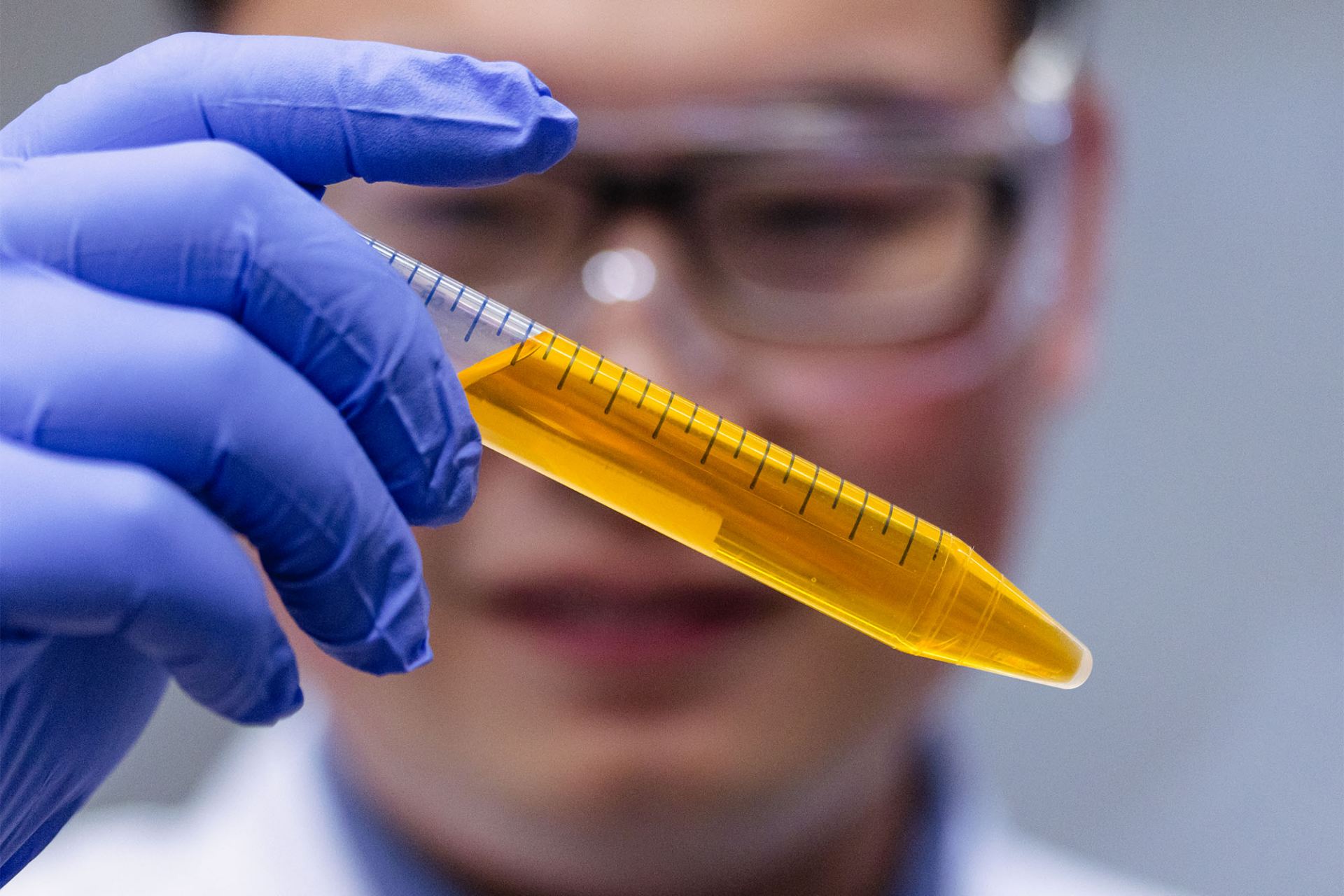
Zihao Ou, who helped develop this solution, holds a tube of it.

Enlarge / Zihao Ou, who helped develop this solution, holds a tube of it.

One key challenge in medical imaging is to look past skin and other tissue that are opaque to see internal organs and structures. This is the reason we need things like ultrasonography, magnetic resonance, or X-rays. There are chemical clearing agents that can make tissue transparent, like acrylamide or tetrahydrofuran, but they are almost never used in living organisms because they’re either highly toxic or can dissolve away essential biomolecules.

But now, a team of Stanford University scientists has finally found an agent that can reversibly make skin transparent without damaging it. This agent was tartrazine, a popular yellow-orange food dye called FD&C Yellow 5 that is notably used for coloring Doritos.

Playing with light

We can’t see through the skin because it is a complex tissue comprising aqueous-based components such as cell interiors and other fluids, as well as protein and lipids. The refractive index is a value that indicates how much light slows down (on average, of course) while going through a material compared to going through a vacuum. The refractive index of those aqueous components is low, while the refractive index of the proteins and lipids is high. As a result, light traveling through skin constantly bends as it endlessly crosses the boundary between high and low refractive index materials.

This scatters the light—once it penetrates the skin, it never gets back. What we see is just the light that bounces off the skin’s surface. The trick to making things transparent is mostly about making their refractive index uniform, so light, or at least some part of the spectrum, doesn’t bend all the time and doesn’t get scattered. This is exactly where the Doritos dye came in.

“The most surprising part of this study is that we usually expect dye molecules to make things less transparent,” says Guosong Hong, an assistant professor of materials science and engineering at Stanford and senior author of the paper. “For example, if you mix blue pen ink in water, the more ink you add, the less light can pass through the water. However, in our experiment, when we dissolve tartrazine in an opaque material like muscle or skin, which normally scatters light, the more tartrazine we add, the clearer the material becomes. This goes against what we typically expect with dyes.”

Transparency lotion

Hong’s team simply dissolved the dye in an aqueous solution and created a transparency-inducing lotion of sorts. It worked, because the dye reduced the difference in refractive index between water and lipids in the skin. Then the team started massaging it gently into a bit of polymer gel that emulated the light-scattering properties of tissue. From there, they moved to thinly sliced chicken breasts and to live mice.

The “transparency lotion” needed just a few minutes to start working when applied to a mouse’s skin. Massaged into a shaven scalp, it lets the scientists see the cerebral blood vessels with laser speckle contrast imaging, a technique that normally requires removal of the scalp to work. When applied to the mouse’s abdomen, it made all the internal organs, including the liver, bladder, and small intestine, visible to the naked eye. All that was needed to reverse the effect and make the skin opaque again was washing the lotion off with water.

There were some problems, though. One of them was that tartrazine absorbed most light at wavelengths around 257 and 428 nanometers, which let us see shades of violet and blue. On the other hand, it had minimal absorption above 600 nanometers, which meant that the transparent skin tinted everything red. The second issue was the depth of penetration. The lotion worked well only at spots where the skin was thin, and couldn’t penetrate deep enough where the skin was thicker.

Finally, its formulation was not universal. It relied on finding a chemical that could match the refractive index of lipids when dissolved in water, but the exact composition of the lotion was determined through trial and error. If there’s a lot of mouse-to-mouse variation, it might make it hard to come up with a one-size-fits-all solution.

Tattoos and needles

The problem of penetrating deeper into thick skin was partially solved by making the application a bit more painful. “Using microneedle patch applicators or subcutaneous injections could help deliver the molecules through thicker layers of skin,” Hong explains. The red tint issue, he suggested, might be handled by testing different dyes. “The research in my lab is currently focused on identifying molecules with sharp absorption in the near-ultraviolet region, minimizing spectral tailing into the visible range to ensure tissue transparency without the presence of a red tone,” Hong said.

“This study has only been conducted on animals. However, if the same technique could be applied to humans, it could offer a variety of benefits in biology, diagnostics, and even cosmetics,” Hong suggests. The benefits he is focusing on include evaluating deep-seated tumors without relying on biopsies, making blood tests less stressful by making locating the veins easier, and even things like improved laser tattoo removals by allowing the pigment beneath the skin to be targeted precisely.

But there is some bad news. Even though the FD&C Yellow 5 dye is widely available, replicating Hong’s results at home and making the transparency lotion on your own is not the brightest idea. “We strongly discourage attempting this on the human skin, as the toxicology of dye molecules in humans, particularly when applied topically, has not been fully evaluated,” Hong says.

And, in the end, it might not even work. “The human skin is significantly thicker than mouse skin, with the stratum corneum, the outermost layer of the epidermis, serving as a substantial barrier that prevents effective delivery of molecules into the dermis,” Hong explains

Science, 2024. DOI: 10.1126/science.adm6869

Mice made transparent with a dye used in Doritos Read More »

a-cartoon-butt-clenching-a-bar-of-soap-has-invaded-my-online-ads

A cartoon butt clenching a bar of soap has invaded my online ads

The state of New York says that this guy is the

Enlarge / The state of New York says that this guy is the “assman,” not me. Show him the butt ads!

Seinfeld

According to my research, everyone has a butt.

But that doesn’t mean, when I’m imbibing my morning cuppa and reading up on the recent presidential debate, that I want to see an ad showing an illustrated derrière with a bar of soap clenched firmly between its two ripe cheeks.

The ad that finally broke me.

Enlarge / The ad that finally broke me.

Yet there it was, a riotous rump residing right in the middle of a New York Times article this week, causing me to reflect on just how far the Gray Lady has stooped to pick up those ad dollars lying in the gutter.

It’s not the first time this sort of thing has sullied the “paper of record.” In 2022, I was forward-thinking enough to grab a screenshot of the Times helping to sell me some sort of wipe with the tagline: “When your butt doesn’t smell like butt.” It was also marketed as deodorant for “your pits and lady bits.”

Would Don Draper have written

Enlarge / Would Don Draper have written “smell like butt” on one of his ads?

Not having any “lady bits” to deodorize, this was not particularly compelling, but the true high point of ass-related irrelevancy at the Times came when I was served an ad featuring a mournful-looking dog who pointed the business end of his hindquarters directly at the camera. “It’s time to leave your dog’s anal gland problems behind,” I was told.

I have never owned a dog, nor—to my children’s continuing dissatisfaction—ever will. It was therefore left to Ars Technica’s Managing Editor Eric Bangeman, who is a noted canine lover and a true “friend to all creatures, even rats,” to explain to me just what this baffling advertisement meant.

really don’t want a pet in the house.” height=”231″ src=”https://cdn.arstechnica.net/wp-content/uploads/2024/09/ars-ad-screenshot-anal-glands-640×231.jpg” width=”640″>

Enlarge / Now I really don’t want a pet in the house.

Once you start looking for these oddly direct ads in self-consciously “classy” media outlets, you see them everywhere, including in The Atlantic, where a bidet ad once promised that it would make my “butt crack smile.”

(Perhaps this last ad can be blamed on my boss, who has spoken in such glowing terms about high-end Japanese toilet technology that I Googled it—probably marking myself as some kind of “ass man” for life.)

Whatever the reason for seeing one of these ads, all of them looked cheap, and none of them felt relevant. I have nothing against the noble bidet, but having “holy sthis thing’s a gamechanger!!!” appear in the middle of my screen while pondering some chinstroker of an article was not exactly why I had visited The Atlantic.

The game, it has been changed. By this stream of water. Shooting at your butt.

Enlarge / The game, it has been changed. By this stream of water. Shooting at your butt.

The great irony of online advertising these days is that it’s often claimed to be “targeted,” mining our personal and demographic information to serve us the ads that we allegedly want to see. Wouldn’t I prefer to view ads “relevant to my interests”? Maybe. But I can say with confidence that after two decades of being “extremely online” for work, the number of ads I have voluntarily and enthusiastically clicked upon must number in the low double digits.

Instead, the engines powering these ad networks continue to bombard me with two kinds of ads: 1) those that are wholly irrelevant to my interests and 2) those that are relevant to my interests because they display the exact product I once looked at in some online store. Ad targeting companies may “know a lot about me,” but they don’t know me in any truly useful way.

They don’t know, for instance, why I looked at some product online, or if I already made a decision not to buy it (or to buy it elsewhere), or if I just wanted to better understand my boss’s love of Japanese bidets. They don’t know whether I have (or want) a dog. And they (clearly) don’t know that I would be repulsed by an edible product shaped like a human ear and featuring both bite marks and Mike Tyson’s name.

Oh, come on.

Enlarge / Oh, come on.

(Fortunately, you can completely opt out of ads at some sites, including Ars Technica, by subscribing for a few bucks a month—and contributing directly to our bottom line.)

A cartoon butt clenching a bar of soap has invaded my online ads Read More »

meet-the-winners-of-the-2024-ig-nobel-prizes

Meet the winners of the 2024 Ig Nobel Prizes

Science that makes you laugh then think —

The award ceremony features miniature operas, scientific demos, and the 24/7 lectures.

The Ig Nobel Prizes honor

Enlarge / The Ig Nobel Prizes honor “achievements that first make people laugh and then make them think.”

Aurich Lawson / Getty Images

Curiosity is the driving force behind all science, which may explain why so many scientists sometimes find themselves going in some decidedly eccentric research directions. Did you hear about the WWII plan to train pigeons as missile guidance systems? How about experiments on the swimming ability of a dead rainbow trout or that time biologists tried to startle cows by popping paper bags by their heads? These and other unusual research endeavors were honored tonight in a virtual ceremony to announce the 2024 recipients of the annual Ig Nobel Prizes. Yes, it’s that time of year again, when the serious and the silly converge—for science.

Established in 1991, the Ig Nobels are a good-natured parody of the Nobel Prizes; they honor “achievements that first make people laugh and then make them think.” The unapologetically campy awards ceremony features miniature operas, scientific demos, and the 24/7 lectures whereby experts must explain their work twice: once in 24 seconds and the second in just seven words. Acceptance speeches are limited to 60 seconds. And as the motto implies, the research being honored might seem ridiculous at first glance, but that doesn’t mean it’s devoid of scientific merit.

Viewers can tune in for the usual 24/7 lectures, as well as the premiere of a “non-opera” featuring various songs about water, in keeping with the evening’s theme. In the weeks following the ceremony, the winners will also give free public talks, which will be posted on the Improbable Research website.

Without further ado, here are the winners of the 2023 Ig Nobel prizes.

Peace

Citation: B.F. Skinner, for experiments to see the feasibility of housing live pigeons inside missiles to guide the flight paths of the missiles.

This entertaining 1960 paper by American psychologist B.F. Skinner is kind of a personal memoir relating “the history of a crackpot idea, born on the wrong side of the tracks intellectually speaking but eventually vindicated in a sort of middle class respectability.” Project Pigeon was a World War II research program at the Naval Research Laboratory with the objective of training pigeons to serve as missile guidance systems. At the time, in the early 1940s, the machinery required to guide Pelican missiles was so bulky that there wasn’t much room left for actual explosives—hence the name, since it resembled a pelican “whose beak can hold more than its belly can.”

Skinner reasoned that pigeons could be a cheaper, more compact solution since the birds are especially good at responding to patterns. (He dismissed the ethical questions as a “peacetime luxury,” given the high global stakes of WWII.) His lab devised a novel harnessing system for the birds, positioned them vertically above a translucent plastic plate (screen), and trained them to “peck” at a projected image of a target somewhere along the New Jersey coast on the screen—a camera obscura effect. “The guiding signal was picked up from the point of contact of screen and beak,” Skinner wrote. Eventually, they created a version that used three pigeons to make the system more robust—just in case a pigeon got distracted at a key moment or something.

Nose cone of NIST glide bomb showing the three-pigeon guidance system.

Enlarge / Nose cone of NIST glide bomb showing the three-pigeon guidance system.

American Psychological Association/B.F. Skinner Foundation

There was understandably a great deal of skepticism about the viability of using pigeons for missile guidance; at one point, Skinner lamented, his team “realized that a pigeon was more easily controlled than a physical scientist serving on a committee.” But Skinner’s team persisted, and in 1944, they finally got the chance to demonstrate Project Pigeon for a committee of top scientists and show that the birds’ behavior could be controlled. The sample pigeon behaved perfectly. “But the spectacle of a living pigeon carrying out its assignment, no matter how beautifully, simply reminded the committee of how utterly fantastic our proposal was.” Apparently, there was much “restrained merriment.”

Even though this novel homing device was resistant to jamming, could react to a wide variety of target practice, needed no scarce materials, and was so simple to make that production could start in 30 days, the committee nixed the project. (By this point, as we now know, military focus had shifted to the Manhattan Project.) Skinner was left with “a loftful of curiously useless equipment and a few dozen pigeons with a strange interest in a feature of the New Jersey coast.” But vindication came in the early 1950s when the project was briefly revived as Project ORCON at the Naval Research Laboratory, which refined the general idea and led to the development of a Pick-off Display Converter for radar operators. Skinner himself never lost faith in this particular “crackpot idea.”

Meet the winners of the 2024 Ig Nobel Prizes Read More »

the-future-of-boeing’s-crewed-spaceflight-program-is-muddy-after-starliner’s-return

The future of Boeing’s crewed spaceflight program is muddy after Starliner’s return

10 years later … —

“The final chapter on Starliner has not been written yet.”

Boeing's uncrewed Starliner spaceraft backs away from the International Space Station moments after undocking on September 6, 2024.

Enlarge / Boeing’s uncrewed Starliner spaceraft backs away from the International Space Station moments after undocking on September 6, 2024.

NASA

Nearly a decade ago to the day, I stood in the international terminal of Houston’s main airport checking my phone. As I waited to board a flight for Moscow, an announcement from NASA was imminent, with the agency due to make its selections for private companies that would transport astronauts to the International Space Station.

Then, just before boarding the direct flight to Moscow, a news release from NASA popped into my inbox about its Commercial Crew Program. The space agency, under a fixed price agreement, agreed to pay Boeing $4.2 billion to develop the Starliner spacecraft; SpaceX would receive $2.6 billion for the development of its Crew Dragon vehicle.

At the time, the Space Shuttle had been retired for three years, and NASA’s astronauts had to fly to the International Space Station aboard the Soyuz spacecraft. “Today, we are one step closer to launching our astronauts from US soil on American spacecraft and ending the nation’s sole reliance on Russia by 2017,” NASA Administrator Charles Bolden said in the release.

I knew this only too well. As the space reporter for the Houston Chronicle, I was traveling with NASA officials to Russia to visit Star City, where astronauts train, and see Roscosmos’ mission control facilities. From there, we flew to Kazakhstan to tour the spaceport in Baikonur and observe the launch of the Expedition 41 crew to the space station. The mission included two Russian astronauts and NASA’s Butch Wilmore. I wrote about this as the fifth part of my Adrift series on the state of America’s space program.

A decade later, it all seems surreal. I cannot imagine, as I did a decade ago, standing near soldiers in Moscow watching a “Peace March” of thousands of protestors through the Russian capital city. There is no room for dissent in Russia today. The airport we used to fly from Moscow to Kazakhstan, Domodedovo, has been attacked by Ukrainian drones. I almost certainly can never go back to Russia, especially after being branded a “war criminal” by the country’s space boss.

But history turns in interesting ways. Ten years after his Soyuz flight from Kazakhstan, Wilmore launched from Florida on Boeing’s Starliner spacecraft. Last weekend, this Boeing spacecraft came back to Earth without Wilmore and his copilot Suni Williams on board. Here we were once again: Wilmore flying in space and me thinking and writing about the future of NASA’s human spaceflight programs.

I couldn’t help but wonder: After all that happened in the last decade, has the Commercial Crew Program been a success?

Boeing becomes a no-show

Commercial Crew was a bold bet by NASA that won the space agency many critics. Could private companies really step up and provide a service that only nations had before?

NASA’s two selections, Boeing and SpaceX, did not make that 2017 target for their initial crewed flights. For a few years, Congress lagged in funding the program, and during the second half of the 2010s, each of the companies ran into significant technical problems. SpaceX overcame serious issues with its parachutes and an exploding spacecraft in 2019 to triumphantly reach orbit in the summer of 2020 with its Demo-2 mission, flying NASA astronauts Doug Hurley and Bob Behnken to and from the space station.

Since then, SpaceX has completed seven operational missions to the station, carrying astronauts from the United States, Europe, Japan, Russia, the Middle East, and elsewhere into orbit. A crew from the eighth mission is on the station right now, and the ninth Crew Dragon mission will launch later this month to bring Wilmore and Williams back to Earth. Crew Dragon has been nothing short of a smashing success for SpaceX and the United States, establishing a vital lifeline at a time when—amid deteriorating relations between America and Russia—NASA reliance on Soyuz likely would have been untenable.

Starliner has faced a more difficult road. Its first uncrewed test flight in late 2019 was cut short early after serious software problems. Afterward, NASA designated the flight as a “high visibility close call” and said Boeing would need to fly a second uncrewed test flight. This mission in 2022 was more successful, but lingering concerns and issues with flammable tape and parachutes delayed the first crew flight until June of this year. The fate of Starliner’s third flight this summer, and its intermittently failing thrusters that ultimately led to its crew needing an alternative ride back to Earth, has been well documented.

The future of Boeing’s crewed spaceflight program is muddy after Starliner’s return Read More »

ai-ruling-on-jobless-claims-could-make-mistakes-courts-can’t-undo,-experts-warn

AI ruling on jobless claims could make mistakes courts can’t undo, experts warn

AI ruling on jobless claims could make mistakes courts can’t undo, experts warn

Nevada will soon become the first state to use AI to help speed up the decision-making process when ruling on appeals that impact people’s unemployment benefits.

The state’s Department of Employment, Training, and Rehabilitation (DETR) agreed to pay Google $1,383,838 for the AI technology, a 2024 budget document shows, and it will be launched within the “next several months,” Nevada officials told Gizmodo.

Nevada’s first-of-its-kind AI will rely on a Google cloud service called Vertex AI Studio. Connecting to Google’s servers, the state will fine-tune the AI system to only reference information from DETR’s database, which officials think will ensure its decisions are “more tailored” and the system provides “more accurate results,” Gizmodo reported.

Under the contract, DETR will essentially transfer data from transcripts of unemployment appeals hearings and rulings, after which Google’s AI system will process that data, upload it to the cloud, and then compare the information to previous cases.

In as little as five minutes, the AI will issue a ruling that would’ve taken a state employee about three hours to reach without using AI, DETR’s information technology administrator, Carl Stanfield, told The Nevada Independent. That’s highly valuable to Nevada, which has a backlog of more than 40,000 appeals stemming from a pandemic-related spike in unemployment claims while dealing with “unforeseen staffing shortages” that DETR reported in July.

“The time saving is pretty phenomenal,” Stanfield said.

As a safeguard, the AI’s determination is then reviewed by a state employee to hopefully catch any mistakes, biases, or perhaps worse, hallucinations where the AI could possibly make up facts that could impact the outcome of their case.

Google’s spokesperson Ashley Simms told Gizmodo that the tech giant will work with the state to “identify and address any potential bias” and to “help them comply with federal and state requirements.” According to the state’s AI guidelines, the agency must prioritize ethical use of the AI system, “avoiding biases and ensuring fairness and transparency in decision-making processes.”

If the reviewer accepts the AI ruling, they’ll sign off on it and issue the decision. Otherwise, the reviewer will edit the decision and submit feedback so that DETR can investigate what went wrong.

Gizmodo noted that this novel use of AI “represents a significant experiment by state officials and Google in allowing generative AI to influence a high-stakes government decision—one that could put thousands of dollars in unemployed Nevadans’ pockets or take it away.”

Google declined to comment on whether more states are considering using AI to weigh jobless claims.

AI ruling on jobless claims could make mistakes courts can’t undo, experts warn Read More »

sony-announces-ps5-pro,-a-$700-graphical-upgrade-available-nov.-7

Sony announces PS5 Pro, a $700 graphical upgrade available Nov. 7

More power —

New unit won’t include a disc drive, but will improve frame rate in high-fidelity games.

The cool racing stripe means it's faster.

Enlarge / The cool racing stripe means it’s faster.

Sony today announced the PlayStation 5 Pro, a mid-generation hardware upgrade that will play the same game library as 2020’s PlayStation 5, but with higher frame rates and better resolution than on the original system. The new units will be available on November 7 for $700, Sony said.

The updated hardware will come complete with 2TB of solid-state storage (up from 1TB on the original PS5), but without an Ultra HD Blu-Ray disc drive, which users can purchase as an add-on accessory for $80.

In a video presentation Tuesday, Sony’s Mark Cerny said PS5 developers “desire more graphics performance” in order to deliver the visuals they want at a frame rate of 60 fps. The lack of enough graphical power on the PS5 leads to a difficult decision for players between the higher resolution of “fidelity” mode and the smoother frame rates of “performance” mode (with three-quarters of players choosing the latter, according to Cerny).

The goal of the PS5 Pro, Cerny says, is delivering “the graphics that the game creators aspire to, at the high frame rates players typically prefer.” To do this, the new system will sport a larger GPU that can support “up to 45 percent faster rendering,” Cerny said, with 67 percent more compute units and 28 percent faster video RAM than the PS5. This will allow for “almost fidelity-like graphics at ‘performance’ frame rates” of 60 frames per second in many existing PS5 games, Cerny said.

  • The two sides of this comparison are supposed to look comparable in fidelity, but the PS5 Pro is running at 60 fps, as opposed to 30 fps on the PS5.

  • Spider-Man 2 is one of the games that will benefit from smoother frame rates at high-fidelity on PS5 Pro.

  • Ratchet & Clank: Rift Apart was shown running much more smoothly on the PS5 Pro.

  • Compared to the high-frame-rate “performance” mode on PS5, many games show increased fidelity on the PS5 Pro.

  • AI upscaling helps Ratchet & Clank: Rift Apart crowd scenes look sharped on PS5 Pro.

  • Incidental details like spider-Man 2‘s street traffic look sharper on the PS5 Pro than “performance” mode on the PS5.

  • The PS5 Pro allows for ray-traced car reflections in Gran Turismo 7 while maintaining a 60 fps frame rate.

  • The PS5 Pro allows for “further realism in the casting of shadows” in Hogwarts Legacy, Cerny said.

  • Horizon: Forbidden West get “improvements to lighting and visual effects” on the PS5 Pro, Cerny said.

  • Horizon: Forbidden West cinematics will show “[improvements to] the hair and skin” in cinematics on the PS5 Pro, Cerny said.

The PS5 Pro will also bring what Cerny says is a “streamlined and accelerated approach” to ray-tracing, with individual rays calculated at “double or even triple the speeds of PlayStation 5.” In examples shown on video, Cerny highlighted how reflections between cars are now available at 60 fps for Gran Turismo 7 on the PS5 Pro, and how games like Hogwarts Legacy could have more realistic shadow effects.

An “AI library” called PlayStation Spectral Super Resolution (PSSR) will be available on the PS5 Pro to automatically upscale in-game scenes as well. Cerny highlighted how this can make distant crowds in a game like Ratchet & Clank: Rift Apart to look much clearer.

Titles that can take advantage of the PS5 Pro’s more powerful GPU will be marketed as “PS5 Pro Enhanced.” Titles that will sport that designation include:

  • Alan Wake 2
  • Assassin’s Creed: Shadows
  • Demon’s Souls
  • Dragon’s Dogma 2
  • Final Fantasy 7 Rebirth
  • Gran Turismo 7
  • Hogwarts Legacy
  • Horizon Forbidden West
  • Marvel’s Spider-Man 2
  • Ratchet & Clank: Rift Apart
  • The Crew Motorfest
  • The First Descendant
  • The Last of Us Part II Remastered

Other titles will be able to take advantage of “PS5 Pro Game Boost,” which Sony says “may stabilize or improve the performance of supported PS4 and PS5 games.”

PS5.5

The upgrade follows the history of the PS4 Pro, which launched almost exactly three years after the PS4 and offered the capacity for higher resolutions, faster frame rates, or both in many PS4 library games. The PS5 Pro comes further into the lifecycle for Sony’s latest console, though, and at a point where Sony has yet to lower the $500 launch price for the console and increased the price of the disc-drive-free Digital Edition last year (though inflation has taken some of the sting out of that nominal pricing).

The PS5 Pro comes after last year’s launch of a redesigned PS5 “Slim” model, which reduced the original PS5’s famously massive bulk while keeping the internal processing power the same while

Microsoft has yet to show any sign of plans for a similar update for the Xbox Series X/S, which also launched in late 2020. Earlier this year, though, Microsoft announced the first disc-drive-free edition of the Xbox Series X for this holiday season.

Nintendo, which launched a Switch with an improved OLED screen in 2021, is widely expected to launch a backward- compatible follow-up to the Switch in 2025.

This story has been updated with additional details and visuals from Sony’s announcement.

Sony announces PS5 Pro, a $700 graphical upgrade available Nov. 7 Read More »

economics-roundup-#3

Economics Roundup #3

I am posting this now largely because it is the right place to get in discussion of unrealized capital gains taxes and other campaign proposals, but also there is always plenty of other stuff going on. As always, remember that there are plenty of really stupid proposals always coming from all sides. I’m not spending as much time talking about why it’s awful to for example impose gigantic tariffs on everything, because if you are reading this I presume you already know.

The problem, perhaps, in a nutshell:

Tess: like 10% of people understand how markets work and about 10% deeply desire and believe in a future that’s drastically better than the present but you need both of these to do anything useful and they’re extremely anticorrelated so we’re probably all fucked.

In my world the two are correlated. If you care about improving the world, you invest in learning about markets. Alas, in most places, that is not true.

The problem, in a nutshell, attempt number two:

Robin Hanson: There are two key facts near this:

  1. Government, law, and social norms in fact interfere greatly in many real markets.

  2. Economists have many ways to understand “market failure” deviations from supply and demand, and the interventions that make sense for each such failure.

Economists’ big error is: claiming that fact #2 is the main explanation for fact #1. This strong impression is given by most introductory econ textbooks, and accompanying lectures, which are the main channels by which economists influence the world.

As a result, when considering actual interventions in markets, the first instinct of economists and their students is to search for nearby plausible market failures which might explain interventions there. Upon finding a match, they then typically quit and declare this as the best explanation of the actual interventions.

Yep. There are often market failures, and a lot of the time it will be very obvious why the government is intervening (e.g. ‘so people don’t steal other people’s stuff’) but if you see a government intervention that does not have an obvious explanation, your first thought should not be to assume the policy is there to sensibly correct a market failure.

Kamala Harris endorses Biden’s no-good-very-bad 44.6% capital gains tax rate proposal, including the cataclysmic 25% tax on unrealized capital gains, via confirming she supports all Biden budget proposals. Which is not the same as calling for it on the campaign trail, but is still support.

She later pared back the proposed topline rate to 33%, which is still a big jump, and I don’t see anything there about her pulling back on the unrealized capital gains tax.

Technically speaking, the proposal for those with a net worth over $100 million is an annual minimum 25% tax on your net annual income, realized and unrealized including the theoretical ‘value’ of fully illiquid assets, with taxes on unrealized gains counting as prepayments against future realized gains (including allowing refunds if you ultimately make less). Also, there is a ‘deferral’ option on your illiquid assets if you are insufficiently liquid, but that carries a ‘deferral charge’ up to 10%, which I presume will usually be correct to take given the cost of not compounding.

All of this seems like a huge unforced error, as the people who know how bad this is care quite a lot, offered without much consideration. It effectively invokes what I dub Deadpool’s Law, which to quote Cassandra Nova is: You don’t fing matter.

The most direct ‘you’ is a combination of anyone who cares about startups, successful private businesses or creation of value, and anyone with a rudimentary understanding of economics. The broader ‘you’ is, well, everyone and everything, since we all depend on the first two groups.

One might think that ‘private illiquid business’ is an edge case here. It’s not.

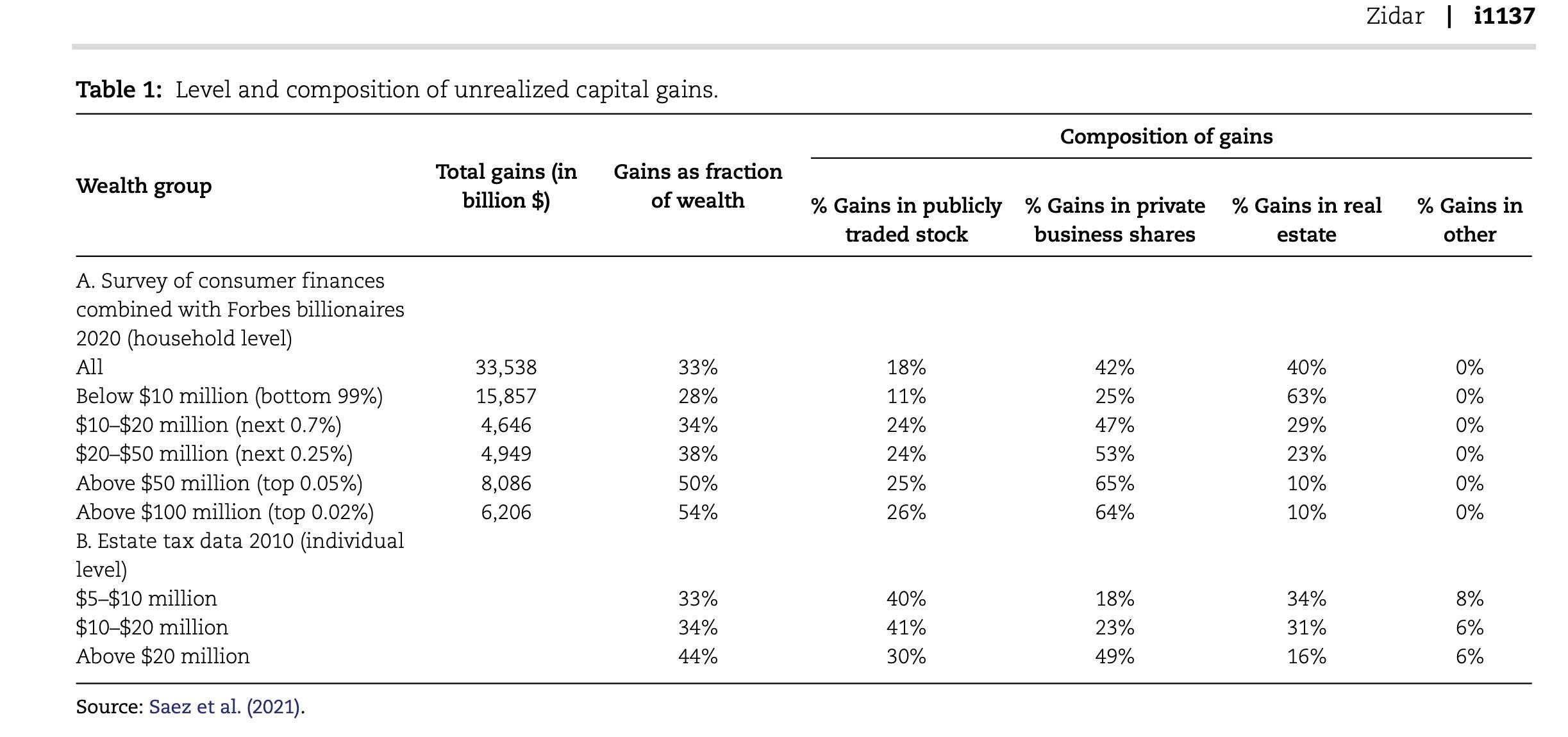
Owen Zidar: The discussions of unrealized capital gains for the very rich (ie those with wealth exceeding $100M) are often missing a key fact – two thirds of unrealized gains at the very top is from gains in private businesses (From SCF data)

When people discuss capital gains, they often evoke esoteric theories and think about simple assets like selling stock. They should really have ordinary private businesses in mind (like beverage distributors and car dealers) when thinking about these proposals at the top.

The share of transactions that stock sales represent has fallen substantially. It’s not about someone’s apple stock. We should be thinking about the decisions of private business owners when analyzing how behavior might respond to these policy changes.

As in, 64% of gains for those worth over $100m are in shares in private business, versus only 26% public stocks.

Here Dylan Matthews gives a steelman defense of the proposal. He says Silicon Valley is actually ‘exempt,’ so they should stop worrying, and their taxes can be deferred if over 80% of your assets are illiquid. That’s quite the conditional, there is an additional charge for doing it, there is very much a spot where you don’t cross 80% and also cannot reasonably pay the tax, if your illiquid assets then go to zero (as happens in startups) you could be screwed beyond words, and all the rates involved are outrageous beyond words, but yes it isn’t as bad as the headlines sound.

Roon: Probably not on board but it’s definitely clear sans behavioral econ stuff charging only at realization time causes pretty distorted incentives including eg holding onto windfall long after you think it’s stopped accumulating and thereby depriving new opportunities of capital.

Otoh this is caused untold gains for people who would’ve been too paperhands to hold otherwise.

Also untold unrealized gains that turned into losses. Easy come, easy go. Certainly the distortion here is massive. I do agree this is a problem. I like the realistic solutions even less, especially as they would effectively make it impossible for founders to maintain control.

Perhaps in some narrow circumstances there is something that could be done, and one could argue for taxing unrealized gains on some highly liquid and fungible investment types, so you avoid perverse outcomes including sabotage of value (e.g. in the hypothetical ‘harbinger tax’ world, you actively want to sabotage the resale value of everything you own that you want to actually use).

But would that come with a reduction in the headline rate? Here, clearly that is not the intention. So the compounding of the taxes every year would mean an insane effective tax rate, where you lose most of your gains, and in general capital would be taxed prohibitively. No good. Very bad.

And also of course if you tax liquidity you get a lot less liquidity. Already companies postpone going public a lot, we have private equity, and so on. You have lots of reasons to not want to be part of the market. What happens if you add to that bigly?

We should not be shocked that Silicon Valley talked about the consequences of a proposal while hallucinating a different proposal. They have a pattern of doing that. But it is not like the details added here solve the problem.

When you look at the details further, and start asking practical questions, as Tyler Cowen does here, you see how disastrously deep the problems go. Even in an ideal version of the policy, you are facing nightmare after nightmare starting with the accounting, massive distortion after distortion, you cripple innovation and business activity, and liquidity takes a massive hit. Tax planning becomes central to life, everything gets twisted and much value is intentionally destroyed or hidden, as with all Harbinger tax proposals. This is in the context of Tyler critiquing an attempted defense of the proposal by Jason Furman.

Jason Furman on Twitter says that his critiques are for a given overall level of taxation of capital gains. Arthur calls him out on the obvious, which is that we are not proposing to hold the overall level of taxation of capital gains constant, the headline rate is not coming down and thus if this passes the effective rate is going way, way up. And Harris proposes to raise the baseline rate to 44.6%.

Tyler Cowen successfully persuaded me the proposal is worse than I thought it was, which is impressive given how bad I already thought it to be.

Alex Tabarrok throws in the distortion that a lot of valuation of investments is a change in the discount rate. The stock price can and sometimes does double without expected returns changing. And he emphases Tyler’s point that divorcing the entrepreneur from his capital is terrible for productivity, and is likely to happen at exactly the worst time. Many have also added the obvious, which is that the entrepreneur and investors involved can backchain from that, so likely you never even reach that point, the company will often never be founded.

Here the CEO of Dune Analytics reports on the exodus of wealthy individuals that is Norway, including himself after he closed a Series B and was about to face an outright impossible tax bill.

The most ironic part of this is that the arguments for taxing unrealized capital gains are relatively strong among people with much lower net worths, if you could keep the overall level of capital taxation constant. You encourage someone like me to rebalance, and not to feel ‘locked into’ my portfolio, and my tax planning on those assets stops mattering. The need to diversify actually matters. Whereas it scarcely matters if people with over $100 million get to ‘diversify’ and indeed I hope they do not do so with most of their wealth.

Also a 44.6% capital gains tax, or even the reduced 33% later proposal, is disastrous enough on its own, on its face.

The good point Dylan makes here, in addition to ‘step-up on death is the no-brainer,’ is that currently capital gains taxes involve a huge distortion because you can indefinitely dodge them by not selling even fully liquid assets. I have a severely ‘unbalanced’ portfolio of assets for this reason, and even getting rid of the step-up on death would not change that in many cases.

The good news is I don’t see this actually happening. Neither do most others, for example here’s Brian Riedl pointing out this isn’t designed to be a real proposal, which is why they never vote on it.

The better news is that this could create momentum for the actually good proposals, like ending the capital gains step-up on death or taxing borrowing against appreciated stocks. I do think those wins could be a big deal.

The bad news is that the downside if it did happen is so so bad, and you can never be fully sure. The other bad news is that there are lots of other bad economic proposals, including Trump’s tariffs and Harris’s war on ‘price gouging,’ to worry about.

The more I think this, the issue is we fail to close other obvious tax loopholes that are used by the wealthy. In particular, borrowing against assets without paying capital gains, and especially doing this combined with the step-up of cost basis at death.

In today’s age of electronic records, asking that cost basis be tracked indefinitely for assets with substantial cost basis seems eminently reasonable.

So I see two potential compromises here, we can do either or both.

  1. Backdate this responsibility to a fixed date, and say that you can choose the known true cost basis or the cost basis from a fixed date of let’s say 2010, whichever is higher, to not retroactively kill people without good records. If we want to exempt family farms up to some size limit or whatever special interests, sure, I don’t care.

  2. Set a size limit. Your estate can only ‘step up’ the cost basis by some fixed amount, let’s say $10 million total. If you’re worth more than that, you’re worth enough to keep good records or pay up.

Then we can combine that with the obvious way to deal with loans against assets, which is to say for tax purposes that any loan on an asset that exceeds its cost basis is a realized capital gain (which also counts as a basis step-up). You just realized part of the gain. You have to pay taxes on that part of your gain now.

Tyler Cowen argues against this by noting that if the loan against an asset charges interest, you aren’t any wealthier from having access to it. Someone is loaning you that money for a reason. Except I would say, if you have a so-far untaxed asset worth $100, and you borrow $100 against it (yes obviously in real life you don’t get the full amount), you should be able to use appreciation of the asset to pay the interest on the borrowing, so you can indeed effectively spend down what you have earned, in expectation. So I see why people see this as evading a tax.

And we should also say that if you donate stocks or other appreciated assets, you can only claim the cost basis as a deduction unless you also pay the capital gains tax on the gain.

We might also have to do something regarding trust funds.

In exchange, lower the overall capital gains rate to keep total revenue constant.

Scott Sumner uses this opportunity to ask why we would even tax realized capital gains, with the original sin being taxing income rather than consumption. I strongly agree with him. Given that we are stuck with income taxes as a baseline, we should strive to minimize capital gains as a revenue source.

I’ll stop there rather than continue beating on the dead horse.

We can now move on to talking about ordinary decent deeply stupid and destructive ideas, such as the Trump proposal, now copied by Harris, to not tax service tips.

Alex Tabarrok: If tip’s aren’t taxed, tips will increase, wages will fall, no increase in compensation.

The potential catch on total compensation is if the minimum wage binds. If tips are untaxed, the market wage for many jobs would presumably be actively negative. So even limiting it at $0 would cause an issue. That’s a relatively small issue.

The straightforward and obvious issue is this is stupid tax policy. Why should the waiter who lives off tips and earns more pay lower taxes than the cook in the back? This does not make any sense, on any level, other than political bribery.

Tyler Cowen tries to focus on the contradictory economic logic between tips and minimum wage. Either labor supply is elastic or inelastic, so either the minimum wage kills jobs or this new subsidy gets captured by employers in the form of lower wages. Unless, of course, this is illegal, via the minimum wage?

I see this as asking the wrong questions. You do not need to know the elasticity of labor supply to know not taxing tips is bad policy. No one involved is thinking in these economic terms, or cares. Bribery is bribery, pure and simple.

Also one can make a case that this will increase tipping. If people know tips are untaxed, then this is a reason to tip generously. Perhaps this increases total amount paid by consumers, so there is room for both employee and employer to benefit? But it would do so by being effectively inflationary, if this did not go along with lower base prices.

The bigger and more fun to think about issue is: What happens when there is a very strong incentive to classify as much of everyone’s income as possible as tips? What other jobs can qualify as offering ‘service tips’ versus not, and which can be used to effectively launder pay?

As an obvious example, a wide variety of sex workers can non-suspiciously be paid mostly in tips, and if elite can be paid vast amounts of money per hour, and it is definitely service work. Who is to say what happens there? What you’re into? Could be anything.

The case for not taxing tips is that if honest workers declare tips while dishonest workers are free not to and mostly suffer no consequences, what you are actually taxing is honesty and abiding by the law. I do find this unfortunate, and the de facto law here is to not report tips up to some murky threshold, and similar to the rule for gamblers, that if you want to conspicuously spend the money then you have to declare it. Alas, there are many such cases, where you need a law on the books to prevent rampant abuse.

On the question of food and grocery prices, they aren’t even up in real terms.

Dean Baker: Contrary to what you read in the papers, food is not expensive. In the last decade, food prices have risen 27.3 percent, the overall inflation rate has been 32.0 percent. The average hourly wage has risen 43.3 percent.

Why weren’t reporters telling us about all the people who couldn’t afford food ten years ago?

Your periodic reminder that an hour of unskilled labor buys increasing amounts of higher quality food over time. Food prices are something people notice and feel. They look for the ones that go up, not the ones that go down. The fact that food is cheaper in real terms, and also better, is seemingly not going to change that.

I sympathize. It gets to me too, when I see the prices of staples like milk. Yet I also know that those additional costs are trivial, and that the time I spend to get good prices is either spent on principle, or time wasted.

I do not sympathize with those warning about ‘price gouging’ or attempting to impose anything remotely resembling price controls, especially on food. If this actually happens, the downside risk of shortages here should not be underestimated.

John Cochrane fully and correctly bites all the bullets and writes Praise for Price Gouging.

These two paragraphs are one attempt among many attempts to explain why letting prices adjust when demand rises is good, actually.

John Cochrane: But what about people who can’t “afford” $10 gas and just have to get, say, to work? Rule number one of economics is, don’t distort prices in order to transfer income. In the big scheme of things, even a month of having to pay $10 for gas is not a huge change in the distribution of lifetime resources available to people. “Afford” is a squishy concept. You say you can’t afford $100 to fill your tank. But if I offer to sell you a Porsche for $100 you might suddenly be able to “afford” it.

But more deeply, if distributional consequences of a shock are important, then hand out cash. So long as everyone faces the same prices. Give everyone $100 to “pay for gas.” But let them keep the $100 or spend it on something else if they look at the $10 price of gas and decide it’s worth inconvenient substitutes like car pooling, public transit, bicycles, nor not going, and using the money on something else instead.

The post contains many excellent arguments, yet I predict (as did others) this will persuade approximately zero people, the same way John failed to persuade his mother as described in the post. People simply don’t want to hear it.

The FTC’s attempted ban on noncompetes is blocked nationwide for now, with the Fifth Circuit (drink?) setting it aside and holding it unlawful, that the FTC lacks the statutory authority. The FTC does quite obviously lack the statutory authority, and also as noted earlier IANAL and I doubt courts still think like this but to me this seems like a retroactive abrogation of contracts, and de facto a rather large taking without compensation in many cases, And That’s Terrible?

Your periodic reminder that no matter how much tough it might be today in various ways, we used to be poor, and work hard, and have little, and yes that kind of sucked.

Eric Nelson: These posts make me crazy. My father worked two jobs and my mother worked one to support 3 kids. We lived a life this woman would consider abuse now. Canned food, 1 TV, no microwave, no computers, no vacations, no air conditioning, beater cars, no dentist, no brand name anything.

In the mid80s, as a teen, I worked 365 days a year at 5am to make money so I could afford Converse sneakers, cassette tapes, and college applications.

Mark Miller tries to defend this as legit, saying that everyone clipped coupons and bought what was in season and bought their clothes all on sale and ate all their meals at home, but it was all on one income so it was great.

Even if that was typical, that sounds to me like one person earning income and two people working. Except the second person’s job was optimizing to save money, and doing various tasks we now get to largely outsource to either other people or technology. A lot of that saving money was navigating price discrimination schemes. All of it was extremely low effective wage for the extra non-job work. People went to extreme lengths, like yard sales, to raise even a little extra cash because they had no good way to use that time productively, and turn that time into money.

As usual, a lot of responses are not aware that home ownership rates are essentially unchanged, both overall and by generation by age, versus older statistics, and despite less children the new homes are bigger.

So, once again: We are vastly richer than we were. We consume vastly superior quality goods, in larger quantities, with more variety, even if you exclude pure technology and electronics (televisions, computers, phones and so on), including housing. An hour of work buys you vastly more of all that. Those who dispute this are flat out wrong.

The part I most appreciate: All things entertainment and information and communication, which are hugely important, are night and day different. You can access the world’s information for almost free. You can play the best games in history for almost free. You can watch infinite content for free. Those used to be damn expensive.

However, the ‘standard of living’ going up also means that what we consider the bare necessities, the things we must buy, have also gone way up. As Eric points out, we would not find what those ‘comfortable’ families of yesteryear had to be remotely acceptable, in any area.

In many cases, it would be illegal to offer something that shoddy, or be considered neglect to deny such goods. In others, you would simply be mocked and disheartened or be unable to properly function.

Then there are the things that actually did get vastly worse or more expensive. Housing (we end up with more anyway, because we pay the price), healthcare and education are vastly more expensive, and all mostly to stay in place. On top of that, various forms of social connection are much harder to get, friendship and community are in freefall and difficult to get even with great effort, atomization and loneliness are up, attention is down while addiction is up, dating is more toxic and difficult, people feel more constrained, freedom for children has collapsed, expectations for resources invested in children especially time is way up, and as a result of all that felt ability to raise children as a result of all of this is way down.

As a result, many people do find life tougher, and feel less able to accomplish reasonable life goals including having a family and children. And That’s Terrible. But we need to focus on the actual problems, not on an imagined idyllic past.

In particular, we need to be willing to let people live more like they did in the actual past, if they prefer to do that. Rather than rendering it illegal to live the way Eric Nelson grew up, we should enable and not look down upon living cheap and giving up many of the modern comforts if that is their best option.

The Revolution of Rising Expectations, and the Revolution of Rising Requirements, are the key to understanding what has happened, and why people struggle so much.

Arnold Kling questions the productivity statistics, citing all the measurement problems, and notes that life in 2024 is dramatically better than 1974 in many ways. Yes, our physical stuff is dramatically better in ways people do not appreciate.

The big problem is that most of the examples here are also examples of new stuff that raises our expected standard of living. We went from torture root canals to painless root canals, that is great, so is the better food and entertainment and phones and so on, but that does not allow us to make ends meet or raise a family. Whereas other aspects that are not our ‘stuff’ have also gotten worse and more onerous, or more expensive, or we are forced to purchase a lot more of them.

I would definitely take 2024 over any previous time (at least ignoring AI existential risks), but the downsides are quite real. People miss something real, but they don’t know how to properly describe what they have lost, and glam onto a false image.

That’s why I emphasize the need to consider what an accurate ‘Cost of Thriving’ index would look like.

And that’s more often than not a good thing.

We instead get this persistent claim that ‘we don’t make things like we used to,’ that the older furniture and appliances were better and especially more durable. J.D. Vance is the latest to make such claims. Is it true?

Jeremy Horpedahl has some things to say about J.D.’s 40 year old fridge.

Jeremy Horpedahl: I don’t know anything about whether fridges of the past preserved lettuce longer, but let me tell you a few things about 40-year-old fridges in this here thread Most important point: fridges are *much cheapertoday. How much? Almost 5 times cheaper…

Let’s compare apples to apples as much as we can.

In 1984, you could buy a 25.7 cu foot side-by-side fridge/freezer with water/ice in the door for $1,359.99.

Today, you can get a similar model at Home Depot for $998

That’s right… it’s cheaper today in *nominal terms.*

But wages also increased since 1984, from about $8.50 to $30

So with the time it took to buy the 1984 fridge new, you could have to work about 160 hours.

With 160 hours of work today, you would earn $4,800, enough to buy almost FIVE FRIDGES today.

But wait, there’s more!

Sears estimated the annual cost to operate that fridge was $116.

Using the national average electricity price in 1984 (8.2 cents/kWh), it used about 1,415 kWh. To operate the 1984 fridge today (assuming no efficiency loss) would cost about $250/year.

But the 2024 fridge only uses about 647 kWh per year — only about 45% as much electricity (the improvement over 1970s fridges is even more dramatic). That will cost $115 today.

In other words, if you still have a 40-year old fridge, you could throw it out and buy a new one, and in about 7.5 years it will have paid for itself in lower energy costs (assuming current prices, but also assuming that 1984 fridge is still as efficient as it was new).

But wait, you might ask, will that new fridge even last 7.5 years? Doesn’t stuff wear out faster today? Data is a little harder to find (anecdotes are easy to find!), but using the Residential Energy Consumption Survey we can see this is a bit overstated.

The oldest cutoff is 20 years. In 1990, just 8.4% of households used a fridge that was 20 years or older. In 2020, this was slightly lower: 5.5%.

But 20 year fridges were never common 10 years or older? Again a decline, from 38.2% to 35.1% — but not dramatically different.

It’s fine if J.D. Vance enjoys his 1984 fridge, but this doesn’t mean “economics is fake.”

Bottom line on this question: if you were offered a $5,000 fridge, costing $250 per year in electricity to operate, keeping vegetables fresh slightly longer (4 weeks instead of 3), but it was guaranteed to last 50 years, would you buy it?

There are many valid complaints about 2024. Our appliances are not one of them.

Furniture might be one area where the old stuff is competitive, but my guess is this is also a failure to account for real prices, or how much we actually (don’t) value durability.

Another study finds that public disclosure of wages causes wage suppression.

Abstract (Junyoung Jeong): This study examines whether wage disclosure assists employers in suppressing wages.

These findings suggest that wage disclosure enables employers in concentrated markets to tacitly coordinate and suppress wages.

I continue to think this gets the mechanism wrong. Wage disclosure does not primarily assist employers in suppressing wages. What it primarily does, as I’ve discussed before, is give employers much stronger incentive to suppress wages. Everyone is constantly comparing their salary to the salary of others, and comparing that to the status hierarchy (or sometimes to productivity or market value or seniority or what not).

Thus, before, it often would make sense to pay someone more because they were worth the money, or because they had other offers, or they negotiated hard. Now, if you do that, everyone else will get mad, treat that as a status and productivity claim, and also use that information against you. This hits especially hard when you have a 10x programmer or other similarly valuable employee. People won’t accept them getting what they are worth.

I first encountered this watching the old show L.A. Law. One prospective associate asks for more money than is typical. He’s Worth It, so they want to give it to him, but they worry about what would happen if the other more senior associates found out, as they’d either have to match the raise, or the contradiction between wages and social hierarchy would cause a rebellion.

Exactly. It is because wage disclosure allows comparison and coordination on wages, and allows employees to complain when they are treated ‘unfairly,’ that it ends up raising the cost of offering higher wages, thus suppressing them. Chalk up one more for ‘you can make people better off on average, or you can make things look fair.’

Due to a combination of factors but it is claimed primarily due to unions, it costs about five times as much to put the same show on in New York as it does in London, with exactly the same cast and set. It is amazing that such additional costs (however they arise) can be overcome and we still put on lots of shows here.

National industrial concentration is up, in the sense that within industry concentration is up, but the shift from manufacturing to services means that local employment concentration is down. I notice I don’t know why we should care, exactly?

The 2002 Bush steel tariffs cost more jobs due to high steel prices than they protected, including losing jobs in steel processing. Long term, it makes the whole industry uncompetitive as well, same as our shipbuilding under the Jones Act.

Department of Justice lawsuits for alleged fraud in FHA mortgages caused 20% reduction in subsequent FHA mortgage lending in the area, concentrated on the heavily litigated against banks. Demand, meet supply. What else would you expect? The banks are acting rationally, if you wanted the banks to issue mortgages to poor people you wouldn’t sue them for doing that.

SwiftOnSecurity thread about people’s delusions about car insurance, thinking it is a magical incantation that fixes what is wrong rather than a commercial product. Patrick McKenzie has additional thoughts about how to deal with such delusions as a customer service department.

Tyler Cowen talks eight things Republicans get wrong about free trade. He is of course right about all of them. It is especially dismaying that we might get highly destructive tariffs soon, especially on intermediate goods. On the margin shouting into the void like this can only be helpful.

New study on changes in entrepreneurship on online platforms like Shopify, with minority and female entrepreneurs especially appreciating the support such platforms bring despite the associated costs. A lot of businesses saw strong growth.

A challenge: Does it ‘conserve resources’ if the conserved resources fall into the hands of someone who would waste them? There are of course

From Chris Freiman.

Market to fire the CEO you say?

It is not a strong as it looks, because in this case everyone knew to fire the CEO. I knew the market wanted this CEO fired, and I don’t care at all. Still, a strong case.

New York City’s biggest taxi insurer, insuring 60% of taxis including rideshare vehicles, is insolvent, risking a crisis. Other than ‘liabilities exceeding premiums’ the article doesn’t explain how this happened? Medallion values crashed but that was a while ago and shouldn’t be causing this. They worry that ‘drivers will face increased premiums’ but if the insurer offering current premiums is now insolvent, presumably they were indeed not charging enough.

What, me leave California because they tax me over 10% of my gross income?

Roon: the only reason to leave California for tax reasons is if you believe you’ve made most of the money you’ll ever make in the past.

Which is fine but there’s a vaguely giving up vibe to it.

So first off, yeah, can’t leave, the vibes would be off. Classic California.

Second, obviously there are other good reasons to want to live somewhere else, and 10%+ of gross income is a huge cost, especially if you do plan to earn a lot more. Of course it is a good reason to leave. Roon is essentially assuming that one can only make money in California, that it would obviously be a much bigger hit than 10% (really 15%+ given other taxes) to be somewhere else. Why assume that? Especially since most people do not work in AI.

The Less-Efficient Market Hypothesis, a paper by Clifford Asness.

Abstract: Market efficiency is a central issue in asset pricing and investment management, but while the level of efficiency is often debated, changes in that level are relatively absent from the discussion.

I argue that over the past 30+ years markets have become less informationally efficient in the relative pricing of common stocks, particularly over medium horizons.

I offer three hypotheses for why this has occurred, arguing that technologies such as social media are likely the biggest culprit.

Looking ahead, investors willing to take the other side of these inefficiencies should rationally be rewarded with higher expected returns, but also greater risks. I conclude with some ideas to make rational, diversifying strategies easier to stick with amid a less-efficient market.

The Efficient Market Hypothesis is Now More False. I find the evidence here for less efficient markets unconvincing. I do suspect that markets are indeed less long-term efficient, for other reasons, including ‘the reaction to AI does not make sense’ and also the whole meme stock craze.

Economics Roundup #3 Read More »

roblox-announces-ai-tool-for-generating-3d-game-worlds-from-text

Roblox announces AI tool for generating 3D game worlds from text

ease of use —

New AI feature aims to streamline game creation on popular online platform.

Someone holding up a smartphone with

On Friday, Roblox announced plans to introduce an open source generative AI tool that will allow game creators to build 3D environments and objects using text prompts, reports MIT Tech Review. The feature, which is still under development, may streamline the process of creating game worlds on the popular online platform, potentially opening up more aspects of game creation to those without extensive 3D design skills.

Roblox has not announced a specific launch date for the new AI tool, which is based on what it calls a “3D foundational model.” The company shared a demo video of the tool where a user types, “create a race track,” then “make the scenery a desert,” and the AI model creates a corresponding model in the proper environment.

The system will also reportedly let users make modifications, such as changing the time of day or swapping out entire landscapes, and Roblox says the multimodal AI model will ultimately accept video and 3D prompts, not just text.

A video showing Roblox’s generative AI model in action.

The 3D environment generator is part of Roblox’s broader AI integration strategy. The company reportedly uses around 250 AI models across its platform, including one that monitors voice chat in real time to enforce content moderation, which is not always popular with players.

Next-token prediction in 3D

Roblox’s 3D foundational model approach involves a custom next-token prediction model—a foundation not unlike the large language models (LLMs) that power ChatGPT. Tokens are fragments of text data that LLMs use to process information. Roblox’s system “tokenizes” 3D blocks by treating each block as a numerical unit, which allows the AI model to predict the most likely next structural 3D element in a sequence. In aggregate, the technique can build entire objects or scenery.


Anupam Singh, vice president of AI and growth engineering at Roblox, told MIT Tech Review about the challenges in developing the technology. “Finding high-quality 3D information is difficult,” Singh said. “Even if you get all the data sets that you would think of, being able to predict the next cube requires it to have literally three dimensions, X, Y, and Z.”

According to Singh, lack of 3D training data can create glitches in the results, like a dog with too many legs. To get around this, Roblox is using a second AI model as a kind of visual moderator to catch the mistakes and reject them until the proper 3D element appears. Through iteration and trial and error, the first AI model can create the proper 3D structure.

Notably, Roblox plans to open-source its 3D foundation model, allowing developers and even competitors to use and modify it. But it’s not just about giving back—open source can be a two-way street. Choosing an open source approach could also allow the company to utilize knowledge from AI developers if they contribute to the project and improve it over time.

The ongoing quest to capture gaming revenue

News of the new 3D foundational model arrived at the 10th annual Roblox Developers Conference in San Jose, California, where the company also announced an ambitious goal to capture 10 percent of global gaming content revenue through the Roblox ecosystem, and the introduction of “Party,” a new feature designed to facilitate easier group play among friends.

In March 2023, we detailed Roblox’s early foray into AI-powered game development tools, as revealed at the Game Developers Conference. The tools included a Code Assist beta for generating simple Lua functions from text descriptions, and a Material Generator for creating 2D surfaces with associated texture maps.

At the time, Roblox Studio head Stef Corazza described these as initial steps toward “democratizing” game creation with plans for AI systems that are now coming to fruition. The 2023 tools focused on discrete tasks like code snippets and 2D textures, laying the groundwork for the more comprehensive 3D foundational model announced at this year’s Roblox Developer’s Conference.

The upcoming AI tool could potentially streamline content creation on the platform, possibly accelerating Roblox’s path toward its revenue goal. “We see a powerful future where Roblox experiences will have extensive generative AI capabilities to power real-time creation integrated with gameplay,” Roblox said  in a statement. “We’ll provide these capabilities in a resource-efficient way, so we can make them available to everyone on the platform.”

Roblox announces AI tool for generating 3D game worlds from text Read More »