Author name: Rejus Almole

research-monkeys-still-having-a-ball-days-after-busting-out-of-lab,-policy-say

Research monkeys still having a ball days after busting out of lab, policy say

If you need any inspiration for cutting loose and relaxing this weekend, look no further than a free-wheeling troop of monkeys that broke out of their South Carolina research facility Wednesday and, as of noon Friday, were still “playfully exploring” with their newfound freedom.

In an update Friday, the police department of Yemassee, SC said that the 43 young, female rhesus macaque monkeys are still staying around the perimeter of the Alpha Genesis Primate Research Facility. “The primates are exhibiting calm and playful behavior, which is a positive indication,” the department noted.

The fun-loving furballs got free after a caretaker “failed to secure doors” at the facility.

Alpha Genesis staff have been keeping an eye on the escapees, trying to entice them back in with food. But, instead of taking the bait, the primates have been playing on the perimeter fence while still keeping in touch with the monkeys inside by cooing to them.

“They’re just being goofy monkeys jumping back and forth playing with each other,” Alpha Genesis CEO Greg Westergaard told CBS News Thursday. “It’s kind of like a playground situation here.”

Yemassee police note that the monkeys are very young and small—only about 6 or 7 pounds each. They have not been used for any testing yet, don’t carry any disease, and pose no health risk to the public. Still, area residents have been advised to keep their doors and windows locked in case the wee primates try to pay a visit.

This isn’t the first time—or even the second time—Alpha Genesis has had trouble keeping its monkeys under control. In 2018, the US Department of Agriculture fined the company $12,600 for violations between 2014 and 2016 that included four monkey breakouts. In those incidents, a total of 30 monkeys escaped. One was never found.

Research monkeys still having a ball days after busting out of lab, policy say Read More »

the-voice-of-america-online’s-“you’ve-got-mail”-has-died-at-age-74

The voice of America Online’s “You’ve got mail” has died at age 74

In 1995, Wired Magazine’s AOL forum asked Edwards to record 10 humorous sound files using his iconic voice. The results, which include classics such as “You want fries with that,” “You’ve got credit card debt,” and “Stop touching me!” still live on in the depths of The Internet Archive. He also ran a side business recording custom sound files for AOL users.

A screenshot of America Online's version 2.5 client in 1995.

A screenshot of America Online’s version 2.5 client in 1995.

A screenshot of America Online’s version 2.5 client in 1995.

Over time, the “You’ve got mail” line became something of a cultural reference point, as tech journalist Harry McCracken pointed out in 2011 on his Technologizer blog, with various news headlines often borrowing the “You’ve got [something]” structure for humorous effect.

Edwards’ voice greeting became so embedded in American popular culture that it inspired the 1998 romantic comedy You’ve Got Mail. The film stars Tom Hanks and Meg Ryan as rival bookstore owners who unknowingly fall in love through anonymous email exchanges. Director Nora Ephron built the movie’s narrative around the anticipation that AOL users felt when hearing Edwards’ voice announce new messages, with the film grossing $250 million worldwide.

Elwood Edwards’ 2015 appearance on The Tonight Show Starring Jimmy Fallon.

At WKYC, Edwards worked behind the scenes as a graphics specialist, camera operator, and general production staff member since 2002. His voice work brought him occasional moments in the spotlight, including an appearance in a 2000 episode of The Simpsons, where he played a virtual doctor announcing, “You’ve got leprosy.” He appeared on The Tonight Show Starring Jimmy Fallon in 2015, performing his classic greeting along with phrases suggested by the audience.

Before his death, Edwards worked as an Uber driver. His voice continues to greet users of AOL’s current email service, maintaining an enduring connection to the early days of consumer Internet access.

The voice of America Online’s “You’ve got mail” has died at age 74 Read More »

trump’s-likely-fcc-chair-wrote-project-2025-chapter-on-how-he’d-run-the-agency

Trump’s likely FCC chair wrote Project 2025 chapter on how he’d run the agency


Brendan Carr wants to preserve data caps, punish NBC, and give money to SpaceX.

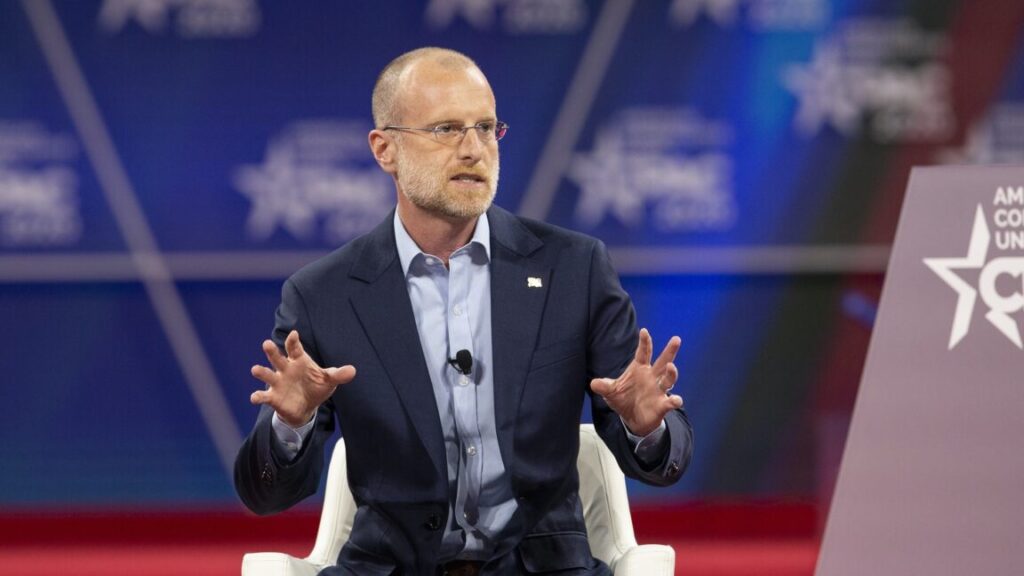
FCC Commissioner Brendan Carr speaking at a conference and gesturing with his hands.

FCC Commissioner Brendan Carr speaks during the Conservative Political Action Conference (CPAC) in Maryland on Saturday, Feb. 29, 2020. Credit: Getty Images | Bloomberg

FCC Commissioner Brendan Carr speaks during the Conservative Political Action Conference (CPAC) in Maryland on Saturday, Feb. 29, 2020. Credit: Getty Images | Bloomberg

The Republican who is likely to lead the Federal Communications Commission under President-elect Donald Trump detailed how he would run the agency when he wrote a chapter for the conservative Heritage Foundation’s Project 2025. Carr, a longtime opponent of net neutrality rules and other broadband regulations, has also made his views clear numerous times when opposing rulemakings initiated by the current Democratic majority.

If Trump makes Carr the next FCC chairman after his inauguration, the FCC is likely to ditch consumer protection initiatives, like a recently announced inquiry into data caps, and attempt to regulate Big Tech companies while reducing regulation of Internet service providers. That could include forcing Big Tech companies to pay into a fund that subsidizes ISPs’ broadband network construction.

A Carr-led FCC could also try to punish news organizations that are perceived to be anti-Trump. Just before the election, Carr alleged that NBC putting Kamala Harris on Saturday Night Live was “a clear and blatant effort to evade the FCC’s Equal Time rule,” and that the FCC should consider issuing penalties. Despite Carr’s claim, NBC did provide equal time to the Trump campaign.

Carr might also try to steer money to Elon Musk’s Starlink system. Carr was a vocal opponent of the FCC decision to deny SpaceX’s application for $886 million in government funding and claimed that “President Biden gave federal agencies a greenlight” to punish Musk after he bought Twitter.

FCC chair’s power

Carr became an FCC commissioner in August 2017 after being nominated by then-President Trump. Carr was previously a legal adviser to Commissioner Ajit Pai and was briefly the FCC’s general counsel during Pai’s first year as chair in 2017.

Carr’s Project 2025 chapter, published in 2023, said “the FCC’s Chairperson serves as the agency’s CEO and is empowered with significant authority that is not shared with other Commissioners.” The chair “sets the FCC’s agenda, decides what matters the agency will vote on and when, and has authority to organize and coordinate the FCC’s work,” Carr wrote. Although the president’s nominations for each commissioner require Senate approval, the president can appoint any sitting commissioner to the chair spot without a Senate vote.

The chair does not have unlimited power, of course. Congress can expand or reduce the FCC’s authority by passing new laws or eliminating existing ones. FCC decisions are routinely challenged in court, and a recent Supreme Court ruling limited the regulatory authority of federal agencies.

Carr wants the FCC to regulate less, at least when it comes to Internet service providers. “The FCC is a New Deal–era agency. Its history of regulation tends to reflect the view that the federal government should impose heavy-handed regulation rather than relying on competition and market forces to produce optimal outcomes,” he wrote.

The FCC, he said, “should engage in a serious top-to-bottom review of its regulations and take steps to rescind any that are overly cumbersome or outdated,” and “focus its efforts on creating a market-friendly regulatory environment that fosters innovation and competition from a wide range of actors, including cable-based, broadband-based, and satellite-based Internet providers.”

Chris Lewis, president and CEO of consumer advocacy group Public Knowledge, told Ars that Carr appears to be a leading candidate for the chairmanship “because of his experience and active presence in trying to chart a course for Republicans on telecom policy,” with the Project 2025 chapter being a prime example.

Public Knowledge generally argues that the FCC should take a bigger role in regulating Internet providers. “The public expects that there is an agency protecting consumers over communications networks and I think it would be wise for the new majorities and new administration to be clearheaded about that,” Lewis said.

Carr targets Big Tech and online speech

The FCC should have four primary goals, Carr wrote. Those goals are “reining in Big Tech, promoting national security, unleashing economic prosperity, and ensuring FCC accountability and good governance.”

On Big Tech, Carr wants to implement Trump’s 2020 plan to crack down on social media websites for alleged anti-conservative bias. At the time, Trump formally petitioned the FCC to reinterpret Section 230 of the Communications Decency Act in a way that would limit social media platforms’ legal protections for hosting third-party content when the platforms take down content they consider objectionable.

Trump was so keen on getting this done in 2020 that he withdrew his re-nomination of then-Commissioner Michael O’Rielly, a Republican who took the party line on most issues but did not support Trump’s attempt to punish social networks. Trump and the Senate replaced O’Rielly with Nathan Simington, who was a member of the Trump administration before becoming an FCC commissioner just before Trump’s first term ended. Simington is another possible chairman and has similar views as Carr, but Carr has a longer tenure on the FCC and has sought the media spotlight more than Simington.

In the Project 2025 publication, Carr’s “reining in Big Tech” section said the FCC “should issue an order that interprets Section 230 in a way that eliminates the expansive, non-textual immunities that courts have read into the statute.”

“The FCC has an important role to play in addressing the threats to individual liberty posed by corporations that are abusing dominant positions in the market. Nowhere is that clearer than when it comes to Big Tech and its attempts to drive diverse political viewpoints from the digital town square,” Carr wrote.

First Amendment

Lewis said Public Knowledge is worried that changes to Section 230 would harm the ability of online platforms to moderate content or choose not to moderate content, because companies could face great legal liability for those choices if 230 is weakened or scrapped.

O’Rielly argued in a July 2020 speech that apparently angered Trump that the FCC shouldn’t regulate in this area. “The First Amendment protects us from limits on speech imposed by the government—not private actors—and we should all reject demands, in the name of the First Amendment, for private actors to curate or publish speech in a certain way,” O’Rielly said at the time. “Like it or not, the First Amendment’s protections apply to corporate entities, especially when they engage in editorial decision making.”

Carr claimed in his Project 2025 chapter that “the FCC has authority to take this action because Section 230 is codified in the Communications Act,” and he pointed to Supreme Court Justice Clarence Thomas’ views on the law as evidence that the FCC can act.

Carr’s chapter also said the FCC should “address TikTok’s threat to US national security,” saying the Chinese-owned social network “provides Beijing with an opportunity to run a foreign influence campaign by determining the news and information that the app feeds to millions of Americans.”

Carr’s Kamala Harris complaint

On November 2, Carr claimed that NBC was trying to evade the Equal Time rule by putting Democratic nominee Kamala Harris on Saturday Night Live. “The purpose of the rule is to avoid exactly this type of biased and partisan conduct—a licensed broadcaster using the public airwaves to exert its influence for one candidate on the eve of an election. Unless the broadcaster offered Equal Time to other qualifying campaigns,” Carr wrote.

Carr later told Fox News that “all remedies should be on the table,” including “license revocations.”

“One commissioner standing alone, there’s no real consequence that I can impose at this point,” he said. “You need the FCC chairperson or at least three commissioners on the FCC to agree to take action. We’ll see if we end up there with this commission or otherwise.”

Carr was wrong about the Equal Time rule, media advocacy group Free Press said on November 3. The group pointed to an FCC fact sheet that says the rule “does not require a station to provide opposing candidates with programs identical to the initiating candidate.”

“Despite Carr’s claim, there is no evidence that the network was trying to avoid the rules,” Free Press said. “Broadcasters have no legal obligation to set aside broadcast time for opposing candidates, unless the candidates request it. Equal-opportunity requests are commonplace in the final days of a national election, and broadcasters typically honor them.”

NBC did honor a request for equal time from the Trump campaign, giving him two free 60-second messages during NASCAR and NFL coverage.

“Carr is desperate to become the FCC chair”

Free Press co-CEO Jessica González said, “It’s bizarre that a sitting FCC commissioner would engage in such a blatant and wrongheaded attempt to curry favor with a presidential candidate. But this is just the sort of reckless behavior we’ve come to expect from Brendan Carr. You’d expect an FCC commissioner to be familiar with his own agency’s regulations. Instead Carr seems willing to concoct falsehoods if it means he’ll get noticed by the former president.”

González added, “It’s no secret around Washington that Carr is desperate to become the FCC chair should Trump be elected president. First Carr wrote a chapter in the widely discredited policy platform for Project 2025, a far-right master plan to disassemble US democracy. Now he’s making grossly inaccurate claims about communications law to win points with the former president.”

Carr continued claiming that NBC violated the rule even after Trump was given free TV time. “NBC and SNL decided to bring just one candidate on less than 50 hours before Election Day,” he wrote on November 6. “The FCC has previously addressed these types of ‘last minute’ situations. I encourage any candidate that does not believe that their Equal Time rights were honored to bring the issue forward to the FCC for our adjudication.”

Making Big Tech pay

Carr wants to help Internet service providers achieve a long-held dream of making tech companies pay for broadband network upgrades. Carr’s Project 2025 chapter said the FCC should “require that Big Tech begin to contribute a fair share” into “the FCC’s roughly $9 billion Universal Service Fund.”

The fund has long been paid for by telecom companies, which generally pass the cost on to consumers on their telephone bills. “While Big Tech derives tremendous value from the federal government’s universal service investments—using those federally supported networks to deliver their products and realize significant profits—these large corporations have avoided paying a fair share into the program,” Carr wrote.

The Biden administration urged Europe to reject a similar idea last year, saying that payments from online platforms to ISPs would “distort competition” and undermine net neutrality. The European plan was also criticized by Meta, Google, Netflix, and the Body of European Regulators for Electronic Communications (BEREC). The group of regulators from European countries said it found no evidence of “free-riding” by tech companies or evidence that ISPs’ costs weren’t fully covered.

If he becomes chair, Carr would have significant influence over which companies get money from the Universal Service Fund. Carr was angry about the FCC decision to reject Starlink’s application to receive $885.51 million in broadband funding.

The grant was tentatively awarded during Pai’s tenure but canceled in a 2022 ruling that called Starlink a “nascent LEO [low Earth orbit] satellite technology” with “recognized capacity constraints.” The Biden-era FCC had earlier pointed out that Pai’s system for choosing grant winners led to “complaints that the program was poised to fund broadband to parking lots and well-served urban areas.”

When the FCC rejected Starlink’s appeal in 2023, Carr said the FCC decision “certainly fits the Biden Administration’s pattern of regulatory harassment.” The FCC, Carr said, is one of a “growing list of administrative agencies that are taking action against Elon Musk’s businesses.” He alleged that “the Biden Administration is choosing to prioritize its political and ideological goals at the expense of connecting Americans.”

Killing broadband regulation

Carr also wants to help ISPs avoid regulation. A Carr-led FCC would likely drop the agency’s legal defense of its net neutrality rules, and that defense is off to a rocky start in court already.

California and other states have been regulating net neutrality themselves since the Pai FCC eliminated Obama-Era rules that prohibited paid prioritization and blocking or throttling of lawful traffic. The next FCC chair could try to revive Pai’s attempt to preempt state laws, which was rejected in court in 2019.

Carr would likely try to halt or unwind other initiatives that Democratic Chairwoman Jessica Rosenworcel has undertaken to help broadband consumers. Carr dissented last year in the FCC’s 3-2 decision to impose rules that prohibit discrimination in access to broadband services. Carr described Rosenworcel’s discrimination proposal as “President Biden’s plan to give the administrative state effective control of all Internet services and infrastructure in the US,” claiming it was “motivated by an ideology of government control that is not compatible with the fundamental precepts of free market capitalism.”

Rosenworcel last month announced a formal inquiry into data caps to consider their effect on consumers and whether the FCC has authority to regulate them. In dissent, Carr said, “I cannot support the Biden-Harris Administration’s inexorable march towards rate regulation,” and that “the FCC plainly does not have the legal authority” to regulate data caps.

He also said that data caps can be good for Internet users. “Prohibiting customers from choosing to purchase plans with data caps—which are more affordable than unlimited ones—necessarily regulates the service rates they are paying for,” Carr said.

Lewis told Ars that ditching the data cap inquiry means that “we will miss out on opportunities to look at when a broadband provider preferences its own streaming service or other service over a competitor’s. Ending the data caps probe will mean we will not be able to look at those sorts of specific cases and see if there is an anticompetitive practice.”

Photo of Jon Brodkin

Jon is a Senior IT Reporter for Ars Technica. He covers the telecom industry, Federal Communications Commission rulemakings, broadband consumer affairs, court cases, and government regulation of the tech industry.

Trump’s likely FCC chair wrote Project 2025 chapter on how he’d run the agency Read More »

recap:-our-“ai-in-dc”-conference-was-great—here’s-what-you-missed

Recap: Our “AI in DC” conference was great—here’s what you missed


Experts were assembled, tales told, and cocktails consumed. It was fun!

Photograph of the exterior of the International Spy Museum in DC

Our venue. So spy-ish! Credit: DC Event Photojournalism

Our venue. So spy-ish! Credit: DC Event Photojournalism

Ars Technica descended in force last week upon our nation’s capital, setting up shop in the International Spy Museum for a three-panel discussion on artificial intelligence, infrastructure, security, and how compliance with policy changes over the next decade or so might shape the future of business computing in all its forms. Much like our San Jose event last month, the venue was packed to the rafters with Ars readers eager for knowledge (and perhaps some free drinks, which is definitely why I was there!). A bit over 200 people were eventually herded into one of the conference spaces in the venue’s upper floors, and Ars Editor-in-Chief Ken Fisher hopped on stage to take us in.

“Today’s event about privacy, compliance, and making infrastructure smarter, I think, could not be more perfectly timed,” said Fisher. “I don’t know about your orgs, but I know Ars Technica and our parent company, Condé Nast, are currently thinking about generative AI and how it touches almost every aspect or could touch almost every aspect of our business.”

Photograph of a panel discussion

Ars EIC Ken Fisher takes the stage to kick things off.

Credit: DC Event Photojournalism

Ars EIC Ken Fisher takes the stage to kick things off. Credit: DC Event Photojournalism

Fisher continued: “I think the media talks about how [generative AI] is going to maybe write news and take over content, but the reality is that generative AI has a lot of potential to help us in finance, to help us with opex, to help us with planning—to help us with pretty much every aspect of our business and in our business. And from what I’m reading online, many folks are starting to have this dream that generative AI is going to lead them into a world where they can replace a lot of SaaS services where they can make a pivot to first-party data.”

First-party data and first-party software development, concluded Fisher, will be critically important when paired with generative AI—”table stakes,” Fisher called them, for participating in the future of business.

After Ken, it was on to our first panel!

“The Key to Compliance with Emerging Technologies”

Up first were Anton Dam, an engineering VP with Auditboard; John Verdi of the Future of Privacy Forum; and Jim Comstock, a cloud storage program director at IBM. The main concern of this panel was how companies will keep up with shifting compliance requirements as the pace of advancement continues to increase.

Each panelist had somewhat of a complementary take. AuditBoard’s Dam emphasized how quickly AI is shifting things around and pointed out the need for organizations to be proactive—to be mindful of regulatory changes before they happen and to have plans in place. “If you want to stay compliant,” Dam said, “you have to be proactive and not wait for, say, agency guidance.”

Photograph of panelists on a stage

Hutchinson, Comstock, Dam, and Verdi.

Credit: DC Event Photojournalism

Hutchinson, Comstock, Dam, and Verdi. Credit: DC Event Photojournalism

FPF’s John Verdi dwelled for a bit on the challenge of doing just that and balancing innovation against the need to comply with regs. He noted that a “privacy by design” approach for products—where considerations about compliance are factored into something’s design from the very beginning rather than being treated as bolt-ons later—ultimately serves both the customer and the business.

Cross-border compliance also came up—with big cloud providers and data that perhaps resides in different countries, different laws apply. Making sure you’re doing what all of those laws say is hugely complex, and IBM’s Comstock pointed out that customers need to both work with vendors and also hold those vendors accountable for where one’s data resides.

“Data Security in the Age of AI-Assisted Cyber Espionage”

Next, we shifted to an infosec outlook, bringing on a four-person panel that included former Ars Technica senior security editor Sean Gallagher, who is currently keeping the world safe at Sophos X-Ops. Joining Sean were Kate Highnam, an ML engineer at Booz-Allen Hamilton; Dr. Scott White, director of cybersecurity at George Washington University; and Elisa Ortiz, a storage and product marketing director at IBM.

Photograph of panelists on a stage

Hutchinson, Ortiz, White, Highnam, and Gallagher.

Credit: DC Event Photojournalism

Hutchinson, Ortiz, White, Highnam, and Gallagher. Credit: DC Event Photojournalism

For this panel, we wanted to look at the landscape around us, and Sean kicked the session off with a sobering description of the most profligate cyber threats as they currently exist today. “Pig butchering” was at the top of his list—that is, a shockingly common romance scam where victims are tricked into an emotional connection with a scammer, who then extorts them for money. (As Sean explained, the scammers themselves are often also victims, typically being trapped without their passports in foreign countries and forced to engage in scamming as their only hope to escape back home.) Scams like this increasingly use AI to work around language barriers—if a scammer who only speaks Cantonese targets a victim who only speaks German, for example, the scammers have begun using LLMs to carry on the scam, with LLMs providing not just basic translation but also native colloquialisms and other human-like linguistic tweaks to help sell the scheme.

Dr. Scott White of GWU took us from scams to national security, pointing out how AI can and is transforming intelligence gathering in addition to romance scams. Booz-Allen Hamilton’s Kate Highnam continued this line of discussion, walking us through several ways that machine learning helps with detecting cyber-espionage activities. As good as the tools are, she emphasized that—at least for the foreseeable future—there will continue to need to be a human in the loop when AI is used for detection of crimes. “AI is really good for generalizing our directions,” she said, “but at the end of the day, we have to make sure that we are very clear with our assumptions.”

IBM’s Ortiz closed out the panel by reminding us that threats don’t just come in through the proverbial front door—one of the areas where companies can have significant vulnerabilities is via their backups. As attackers increasingly target backups, Ortiz advocated broad use of predictive analytics and real-time anomaly detection in order to spy out any oddness attackers might be up to.

“The Best Infrastructure Solution for Your AI/ML Strategy”

Our final panel had a deceptively simple title and an impossible task, because there is no “best” infrastructure solution. But there might be a best infrastructure solution for you, and that’s what we wanted to look at. Joining me on stage were Daniel Fenton, head of AI platforms at JLL; Arun Natarajan, director of AI innovation at the IRS; Amy Hirst, VP of site reliability engineering and user experience at IBM; and Matt Klos, an IBM senior solutions architect.

Photograph of panelists on a stage

Fenton, Natarajan, Hirst, and Klos. (You can’t see me, but I’m just off-stage to the left.)

Credit: DC Event Photojournalism

Fenton, Natarajan, Hirst, and Klos. (You can’t see me, but I’m just off-stage to the left.) Credit: DC Event Photojournalism

It’s always fascinating to get to ask the IRS anything, and Natarajan gave insightful answers. He opened by contrasting the goals and challenges of the IRS’s IT strategy as a government service organization to the goals of a typical enterprise, and there are obvious significant differences. Fancy features don’t count as much as stability, security, and integration with legacy systems. AI is being looked at where appropriate, but what the IRS needs from AI more than anything else is transparency, and that can sometimes be lacking. “We’re challenged with ensuring ethical AI and transparency to the taxpayer, which requires a different approach than private sector solutions.”

Other panelists, like JLL’s Fenton, emphasized the use of open architecture to ensure flexibility; IBM’s Klos also noted that often, even the best laid plans of data center engineers gang aft agley due not to architecture issues or poor design but to actual physical infrastructure not being what was expected. “One of the biggest pitfalls I see is power,” he explained. “Customers assume it’s everywhere, but it’s often a limiting factor, especially in high-demand AI infrastructure.”

Amy Hirst pointed out that when building one’s own AI/ML setup, traditional performance metrics still apply—and they apply across multiple stacks, including both storage and networking. Her advice sounds somewhat traditional but holds absolutely true, even now. “You have to consider both latency and throughput,” she said. “Both are key to establishing your system’s needs for AI workloads.”

Drinks and everything thereafter

And with that, our panel discussions were done. The group dispersed, with some folks heading downstairs for a private tour of the museum’s Bond in Motion exhibit, which featured the various on-screen rides of 007. Then there was a convergence on the bar and about an hour of fun conversations.

Cocktail time! Did our photographer snag you in a picture? Comment below and say hi! DC Event Photojournalism

For me, the networking and socializing are always the best parts of events like this, and getting to shake hands and swap business cards with Ars readers is one of the most exciting and joyful parts of this job. A special thank you to everyone who stuck around for the cocktail hour and who got a chance to say hi—you’re special, and I’m glad you came to the event!

And if you’re reading this and you’re sad that you didn’t get to make it to any of our events this year, that’s OK—we’ll do more next year. Stay tuned to the front page because Ars might be coming to your town next!

Photo of Lee Hutchinson

Lee is the Senior Technology Editor, and oversees story development for the gadget, culture, IT, and video sections of Ars Technica. A long-time member of the Ars OpenForum with an extensive background in enterprise storage and security, he lives in Houston.

Recap: Our “AI in DC” conference was great—here’s what you missed Read More »

trump-plans-to-dismantle-biden-ai-safeguards-after-victory

Trump plans to dismantle Biden AI safeguards after victory

That’s not the only uncertainty at play. Just last week, House Speaker Mike Johnson—a staunch Trump supporter—said that Republicans “probably will” repeal the bipartisan CHIPS and Science Act, which is a Biden initiative to spur domestic semiconductor chip production, among other aims. Trump has previously spoken out against the bill. After getting some pushback on his comments from Democrats, Johnson said he would like to “streamline” the CHIPS Act instead, according to The Associated Press.

Then there’s the Elon Musk factor. The tech billionaire spent tens of millions through a political action committee supporting Trump’s campaign and has been angling for regulatory influence in the new administration. His AI company, xAI, which makes the Grok-2 language model, stands alongside his other ventures—Tesla, SpaceX, Starlink, Neuralink, and X (formerly Twitter)—as businesses that could see regulatory changes in his favor under a new administration.

What might take its place

If Trump strips away federal regulation of AI, state governments may step in to fill any federal regulatory gaps. For example, in March, Tennessee enacted protections against AI voice cloning, and in May, Colorado created a tiered system for AI deployment oversight. In September, California passed multiple AI safety bills, one requiring companies to publish details about their AI training methods and a contentious anti-deepfake bill aimed at protecting the likenesses of actors.

So far, it’s unclear what Trump’s policies on AI might represent besides “deregulate whenever possible.” During his campaign, Trump promised to support AI development centered on “free speech and human flourishing,” though he provided few specifics. He has called AI “very dangerous” and spoken about its high energy requirements.

Trump allies at the America First Policy Institute have previously stated they want to “Make America First in AI” with a new Trump executive order, which still only exists as a speculative draft, to reduce regulations on AI and promote a series of “Manhattan Projects” to advance military AI capabilities.

During his previous administration, Trump signed AI executive orders that focused on research institutes and directing federal agencies to prioritize AI development while mandating that federal agencies “protect civil liberties, privacy, and American values.”

But with a different AI environment these days in the wake of ChatGPT and media-reality-warping image synthesis models, those earlier orders don’t likely point the way to future positions on the topic. For more details, we’ll have to wait and see what unfolds.

Trump plans to dismantle Biden AI safeguards after victory Read More »

endurance-tells-story-of-two-expeditions,-centuries-apart

Endurance tells story of two expeditions, centuries apart


New NatGeo documentary was directed by the same duo who brought us the Oscar-winning Free Solo.

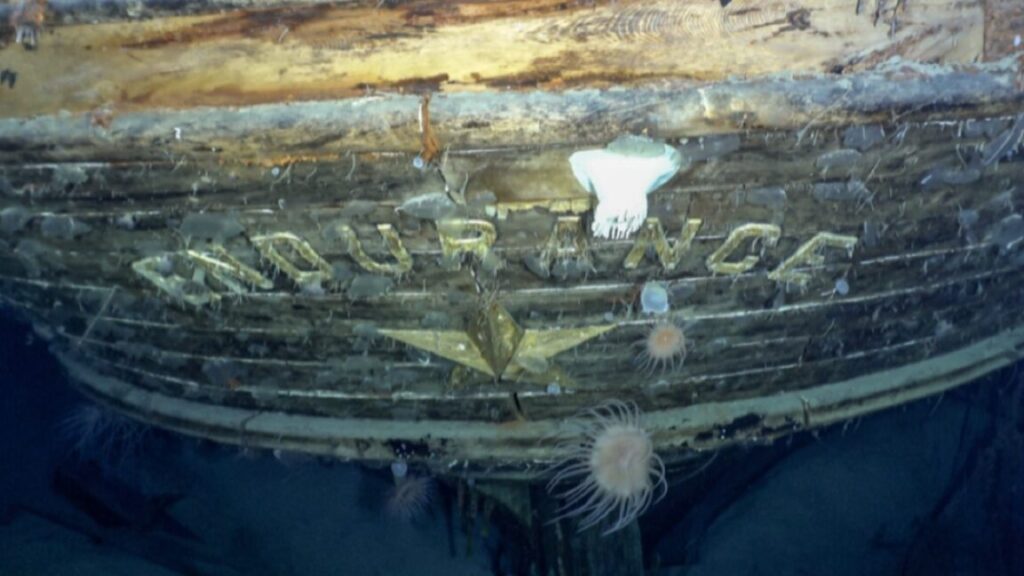
The intact stern of the good ship Endurance. Credit: Falklands Maritime Heritage Trust

The story of Arctic explorer Ernest Shackleton’s failed 1914 expedition to be the first to traverse the continent of Antarctica has long captured the popular imagination, as have the various efforts to locate the wreckage of his ship, the Endurance. The ship was finally found in 2022, nearly 107 years after it sank beneath the ice. The stories of Shackleton’s adventures and the 2022 expedition are told in parallel in Endurance, a new documentary from National Geographic now streaming on Disney+.

Endurance is directed by Oscar winners Jimmy Chin and Chai Vasarhelyi (Free Solo). According to Vasarhelyi, she and Chin had been obsessed with the Shackleton story for a long time. The discovery of the shipwreck in 2022 gave them the perfect opportunity to tell the story again for a new audience, making use of all the technological advances that have been made in recent years.

“I think the Shackleton story is at the heart of the DNA of our films,” Vasarhelyi told Ars. “It’s the greatest human survival story ever. It really speaks to having these audacious objectives and dreams. When everyone tells you that you can’t, you want to do it anyway. It requires you to then have the actual courage, grit, discipline, and strength of character to see it through. Shackleton is that story. He didn’t sensibly achieve any of his goals, but through his failure he found his strength: being able to inspire the confidence of his men.”

As previously reported, Endurance set sail from Plymouth on August 6, 1914, with Shackleton joining his crew in Buenos Aires, Argentina. By the time they reached the Weddell Sea in January 1915, accumulating pack ice and strong gales slowed progress to a crawl. Endurance became completely icebound on January 24, and by mid-February, Shackleton ordered the boilers to be shut off so that the ship would drift with the ice until the weather warmed sufficiently for the pack to break up. It would be a long wait. For 10 months, the crew endured the freezing conditions. In August, ice floes pressed into the ship with such force that the ship’s decks buckled.

The ship’s structure nonetheless remained intact, but by October 25, Shackleton realized Endurance was doomed. He and his men opted to camp out on the ice some two miles (3.2 km) away, taking as many supplies as they could with them. Compacted ice and snow continued to fill the ship until a pressure wave hit on November 13, crushing the bow and splitting the main mast—all of which was captured on camera by crew photographer Frank Hurley. Another pressure wave hit in the late afternoon on November 21, lifting the ship’s stern. The ice floes parted just long enough for Endurance to finally sink into the ocean before closing again to erase any trace of the wreckage.

When the sea ice finally disintegrated in April 1916, the crew launched lifeboats and managed to reach Elephant Island five days later. Shackleton and five of his men set off for South Georgia the next month to get help—a treacherous 720-mile journey by open boat. A storm blew them off course, and they ended up landing on the unoccupied southern shore. So Shackleton left three men behind while he and a companion navigated dangerous mountain terrain to reach the whaling station at Stromness on May 2. A relief ship collected the other three men and finally arrived back on Elephant Island in August. Miraculously, Shackleton’s crew was still alive.

Icebound

Ernest Shackleton aboard the Endurance. BF/Frank Hurley

Hurley’s photographs and footage—including Hurley’s 1919 feature documentary, South—were a crucial source for Vasarhelyi and Chin, as was the use of supplementary footage from 1920s and 1930s films depicting polar expeditions. The directors even convinced the British Film Institute to let them color-treat some of the original expedition footage.

“The BFI had lovingly restored the footage and been great custodians of it, but they also had been very strict about never color treating the footage,” said Vasarhelyi. “We made our argument and it shows what great partners they were that they agreed. It’s not colorized, it’s color treated, which is a slight difference. It just added drama and personality where suddenly you could kind of see the faces in a way that you couldn’t just by adding contrast. It was just trying to animate and identify and connect audiences with this story.”

The directors filmed original re-enactments for those parts of the Shackleton story that Hurley was not on hand to visually document firsthand, because he left his equipment behind when the crew was forced to abandon the Endurance. All he had after that was a small pocket camera. And Hurley wasn’t with Shackleton for the final rescue expedition. Most of the outdoor re-enactments were shot on location in Iceland, while some interior re-enactments were shot on a soundstage in Los Angeles.

This involved shooting under harsh freezing conditions on Icelandic glaciers in January and required building replica boats and sourcing period-specific costumes. Fortunately, “Burberry, who had made the original Shackleton gear, had the pattern still and they knew what type of leather it was,” said Vasarhelyi. “And so they made us 11 costume outfits that are the real costumes. We were able to source models of the real artifacts. The ice was freezing on the Burberry coats. The [re-enactors] had 9-millimeter wetsuits inside the Burberry outfits.”

Chin and Vasarhelyi also relied on the diaries of various crew members to capture the events in the crew’s voices. “The proper way into the Shackleton stories is through the diaries because you have primary accounts from many different points of view of the same events,” said Vasarhelyi. “But how to make it feel… vivid was the question.” The answer: using AI to reproduce the voices of Shackleton and others as preserved in historical recordings. They were able to sample those original voices and build an AI model from that, applying it to present-day voices (selected for their similarities to the original voices) reading the text.

Vasarhelyi acknowledges this was a controversial choice but defends the decision because it brought another dimension of immediacy to the final documentary. “Every part of me thinks that we have to educate ourselves; we need to regulate it,” she said. “I support our guilds in trying to protect our creative rights. But in this case, it was a good tool to use. For me, there was a real goosebump moment, watching Frank Hurley’s footage and you realize that you actually are watching real events that are 110 years old that were filmed by guys who survived two years in the ice without their boat. And then you add the tools of sound design and there is just something magical about it.

The hunt for Endurance

The S.A. Agulhas II surrounded by sea ice as it makes its way toward the coordinates to find the Endurance. Falklands Maritime Heritage Trust/James Blake

People had been hunting for the wreckage of the Endurance ever since its sinking. Shackleton’s brilliant navigator, Frank Worsley, painstakingly calculated the coordinates for the position where Endurance sank using a sextant and chronometer. He recorded that position in his log book: 68°39’30” south; 52°26’30” west. But there was some question as to the accuracy of the marine chronometers he used to fix longitude, which would have affected the final coordinates.

Organized by the Falklands Maritime Heritage Trust, the $10 million Endurance22 expedition team set sail from Cape Town, South Africa, in early February on board the icebreaker S.A. Agulhas II. They arrived at the search area 10 days later. To account for any navigational errors by Worsley, the search area was quite broad. The team used battery-powered submersibles to comb the ocean floor for six-hour stretches, twice a day, augmented with sonar scans of the seabed to hunt for any protrusions. There was a limited window to find the wreck before the ice froze up and trapped the S.A. Agulhas II (the expedition vessel) in the ice, much like the Endurance.

There was a moment when the 2022 expedition members thought they had succeeded, but the object glimpsed in the data turned out to be a debris field from the vessel, not the vessel itself. Still, it was a promising sign, and the expedition persevered. After all, “How can you be associated with the Shackleton story and give up?” said Vasarhelyi.

One sticking point was determining the direction of drift after the Endurance sank. The team had the idea of combining the original 1914 observations with an AI weather model created by the European Union and essentially running it backward to narrow the search further. “That’s another ‘good’ AI moment,” said Vasarhelyi. “It was one of those moments where the past spoke to the present that the whole movie turns on. But there is an argument that they could have maybe looked at this data a little earlier.”

Finally, as the search was coming down to the wire, the Endurance22 team finally found the long-sought wreckage 3,008 meters down, roughly four miles (6.4 km) south of the ship’s last recorded position. The ship was in pristine condition partly because of the lack of wood-eating microbes in those waters. In fact, the Endurance22 expedition’s exploration director, Mensun Bound, told The New York Times at the time that the shipwreck was the finest example he’s ever seen; Endurance was “in a brilliant state of preservation.”

Once the wreck had been found, the team recorded as much as they could with high-resolution cameras and other instruments. Vasarhelyi, particularly, noted the technical challenge of deploying a remote digital 4K camera with lighting at 9,800 feet underwater, and the first deployment at that depth of photogrammetric and laser technology, resulting in a stunning millimeter-scale digital reconstruction of the entire shipwreck. “The payoff [was] seeing that incredible 3D imagery from 3,000 feet below the Weddell Sea,” she said.

What lies beneath

The Endurance as discovered underwater during the 2022 expedition. Falklands Maritime Heritage Trust

Chin and Vasarhelyi skillfully wove together these parallel storylines for their documentary: Shackleton and his men struggling to survive and Expedition22 racing against time to find the wreckage of the Endurance. “Because they actually found it, the 2022 expedition gave us an amazing payoff to this story,” said Vasarhelyi. “But the stakes of both narratives are very different. One is mortal stakes, and the other one is reputational. I think that the reasons why individuals find themselves in these circumstances are really interesting because normally they’re pretty personal, and people can identify with that.”

It was challenging to decide how much to include of both narrative threads; the directors certainly had enough material for five or more hours. They chose to focus on the broad strokes augmented by personal moments of humanity and occasional humor—not to mention heartbreak, such as the moment when Shackleton and his men are forced to kill their sled dogs for food. “We had a debate about whether to include the dogs, and I was like, ‘We have to,'” said Vasarhelyi. “It shows how desperate they were, and it also is a great character moment. That must have been awful, but it was the right thing to do, almost a merciful thing instead of letting them starve to death.”

Along with the tremendous courage and perseverance displayed by Shackleton and his men, Vasarhelyi said she was impressed with their grace under pressure. “I was astonished by the civility that Shackleton and his men depended on to preserve their humanity while they are in this dire circumstance, be it [putting on] burlesque shows or listening to the gramophone,” she said. “The story has an audacity and a strength of will that is inherently human and a view of leadership that felt so daring. This is really the holy grail of survival stories.”

Photo of Jennifer Ouellette

Jennifer is a senior reporter at Ars Technica with a particular focus on where science meets culture, covering everything from physics and related interdisciplinary topics to her favorite films and TV series. Jennifer lives in Baltimore with her spouse, physicist Sean M. Carroll, and their two cats, Ariel and Caliban.

Endurance tells story of two expeditions, centuries apart Read More »

researchers-spot-black-hole-feeding-at-40x-its-theoretical-limit

Researchers spot black hole feeding at 40x its theoretical limit


Similar feeding events could explain the rapid growth of supermassive black holes.

How did supermassive black holes end up at the center of every galaxy? A while back, it wasn’t that hard to explain: That’s where the highest concentration of matter is, and the black holes had billions of years to feed on it. But as we’ve looked ever deeper into the Universe’s history, we keep finding supermassive black holes, which shortens the timeline for their formation. Rather than making a leisurely meal of nearby matter, these black holes have gorged themselves in a feeding frenzy.

With the advent of the Webb Space Telescope, the problem has pushed up against theoretical limits. The matter falling into a black hole generates radiation, with faster feeding meaning more radiation. And that radiation can drive off nearby matter, choking off the black hole’s food supply. That sets a limit on how fast black holes can grow unless matter is somehow fed directly into them. The Webb was used to identify early supermassive black holes that needed to have been pushing against the limit for their entire existence.

But the Webb may have just identified a solution to the dilemma as well. It has spotted a black hole that appears to have been feeding at 40 times the theoretical limit for millions of years, allowing growth at a pace sufficient to build a supermassive black hole.

Setting limits

Matter falling into a black hole generally gathers into what’s called an accretion disk, orbiting the body and heating up due to collisions with the rest of the disk, all while losing energy in the form of radiation. Eventually, if enough energy is lost, the material falls into the black hole. The more matter there is, the brighter the accretion disk gets, and the more matter that gets driven off before it can fall in. The point where the radiation pressure drives away as much matter as the black hole pulls in is called the Eddington Limit. The bigger the black hole, the higher this limit.

It is possible to exceed the Eddington Limit if matter falls directly into the black hole without spending time in the accretion disk, but it requires a fairly distinct configuration of nearby clouds of gas, something that’s unlikely to persist for more than a few million years.

That creates a problem for supermassive black holes. The only way we know to form a black hole—the death of a massive star in a supernova—tends to produce them with only a few times the mass of the Sun. Even assuming unusually massive stars in the early Universe, along with a few black hole mergers, it’s expected that most of the potential seeds of a supermassive black hole are in the area of 100 times the Sun’s mass. There are theoretical ideas about the direct collapse of gas clouds that avoid the intervening star formation and immediately form a black hole with 10,000 times the mass of the Sun or more, but they remain entirely hypothetical.

In either case, black holes would need to suck down a lot of matter before reaching supermassive proportions. But most of the early supermassive black holes spotted using the Webb are feeding at roughly 20 percent of the Eddington limit, based on their lack of X-ray emissions. This either means that they fed at well beyond the Eddington Limit earlier in their history or that they started their existences as very heavy black holes.

The object that’s the focus of this new report, LID-568, was first spotted using the Chandra X-ray Telescope (an observatory that was recently threatened with shutdown). LID-568 is luminous at X-ray wavelengths, which is why Chandra could spot it, and suggests the possibility that it is feeding at an extremely high rate. Imaging in the infrared shows that it appears to be a point source, so the research team concluded that most of the light we’re seeing comes directly from the accretion disk, rather than from the stars in the galaxy it occupies.

But that made it difficult to determine any details about the black hole’s environment or to figure out how old it was relative to the Big Bang at the time we’re viewing it. So, the researchers pointed the Webb at it to capture details that other observatories couldn’t image.

A fast eater

Use of spectroscopy revealed that we were viewing LID-568 as it existed about 1.5 billion years after the Big Bang. The emissions from gas and dust in the area were low, which suggests that the black hole resides in a dwarf galaxy. Based on the emission of hydrogen, the researchers estimate that the black hole is roughly a million times the mass of the Sun—nothing you’d want to get close to, but small compared to many supermassive black holes.

It’s actually similar in mass to a number of black holes the Webb was used to identify in galaxies that are considerably older. But it’s much, much brighter (as bright as something 10 times heavier) and includes the X-ray emissions that those lack. In fact, it’s so bright compared to its mass that the researchers estimate that it could only produce that much radiation if it were feeding at well above the Eddington Limit. Ultimately, they estimate that it’s exceeding the Eddington Limit by a factor of over 40.

Critically, the Webb was able to identify two lobes of material that were moving toward us at high velocities, based on the blue shifting of hydrogen emissions lines. These suggest that the material is moving at over 500 kilometers a second and stretched for tens of thousands of light years away from the black hole. (Presumably, these obscured similar blobs of material moving away from us.) Given their length and apparent velocity, and assuming they represent gas driven off by the black hole, the researchers estimated how long it was emitting this intense radiation.

Working back from there, they estimate the black hole’s original mass was about 100 times that of the Sun. “This lifetime suggests that a substantial fraction of the mass growth of LID-568 may have occurred in a single, super-Eddington accretion episode,” they conclude. For that to work, the black hole had to have ended up in a giant molecular cloud and stayed there feeding for over 10 million years.

The researchers suspect that this intense activity interfered with star formation in the galaxy, which is one of the reasons that it is relatively star-poor. That may explain why we see some very massive black holes at the center of relatively small galaxies in the present Universe.

So what does this mean?

In some ways, this is potentially good news for cosmologists. Forming supermassive black holes as quickly as the size/age of those observed by Webb would seemingly require them to have fed at or slightly above the Eddington Limit for most of their history, which was easy to view as unlikely. If the Eddington Limit can be exceeded by a factor of 40 for over 10 million years, however, this seems to be less of an issue.

But, at the same time, the graph showing mass versus luminosity of supermassive black holes the research team generated shows that LID-568 is in a class by itself. If there were a lot of black holes feeding at these rates, it should be easy to identify more. And it’s a safe bet that these researchers are checking other X-ray sources to see if there are additional examples.

Nature Astronomy, 2024. DOI: 10.1038/s41550-024-02402-9  (About DOIs).

Photo of John Timmer

John is Ars Technica’s science editor. He has a Bachelor of Arts in Biochemistry from Columbia University, and a Ph.D. in Molecular and Cell Biology from the University of California, Berkeley. When physically separated from his keyboard, he tends to seek out a bicycle, or a scenic location for communing with his hiking boots.

Researchers spot black hole feeding at 40x its theoretical limit Read More »

the-trek-checkpoint-sl-7-axs-gen-3-may-be-the-perfect-gravel-bike

The Trek Checkpoint SL 7 AXS Gen 3 may be the perfect gravel bike

As I followed a friend down a flow-y, undulating single-track trail, I started laughing. Unlike my mountain bike-riding companion, I was on a gravel bike, the new Trek Checkpoint SL 7 AXS Gen 3. You might be wondering why a review of a gravel bike is starting with such a ride. The answer is simple—the Checkpoint had excelled everywhere else I rode it, so I was curious to see how it would fare on a non-technical MTB track. Amazingly well, as it turns out.

Unlike every other bike Ars has reviewed to this point, the Checkpoint SL 7 Gen 3 has no battery and no motor—there’s no e- in this bike. As is the case with our other bike reviews, sometimes we ask for a specific model, but manufacturers tend to contact us when we’ve already got a garage full of bikes we’ve not finished the reviews for (there are currently 12 bikes in my garage, some of which belong to other family members).

Launched in 2018, the Checkpoint is Trek’s gravel-centric bike. For 2025, Trek has split its gravel lineup into the third-generation Checkpoint Trek and the Checkmate SLR 9 AXS. The latter features a lighter-weight frame, a power meter, and SRAM’s new Red XPLR groupset. Selling for $11,999, the Checkmate is a gravel racer. Priced several thousand less at $5,699, the Checkpoint SL 7 AXS is now Trek’s top gravel bike for those looking for a fun day out on the trails.

With the Gen 3 Checkpoint, Trek has added mounts all over the frame, tweaked the geometry to make it more comfortable for long rides, improved ride comfort by reworking the rear IsoSpeed decoupler (which softens the bumpiness from rough trails and pavement), and increased the tire clearance to 50 mm (42 mm with fenders). Trek uses three different types of carbon on its drop handlebar bikes. The top-of-the-line OCLV 900 shows up on the racing-focused Madone road bike, while the OCLV 800 is used in the Domane endurance bike lineup as well as the Checkmate. The SL 7 uses Trek’s 500 Series OCLV carbon, and the bike weighs in at 19.85 lb (9.0 kg)—about 100 g heavier than the Gen 2. The drivetrain comes from SRAM, with a SRAM Force XPLR AXS D2 groupset.

The Trek Checkpoint SL 7 AXS Gen 3 may be the perfect gravel bike Read More »

what-this-500-year-old-shipwreck-can-tell-us-about-how-we-age

What this 500-year-old shipwreck can tell us about how we age

Dem collarbones

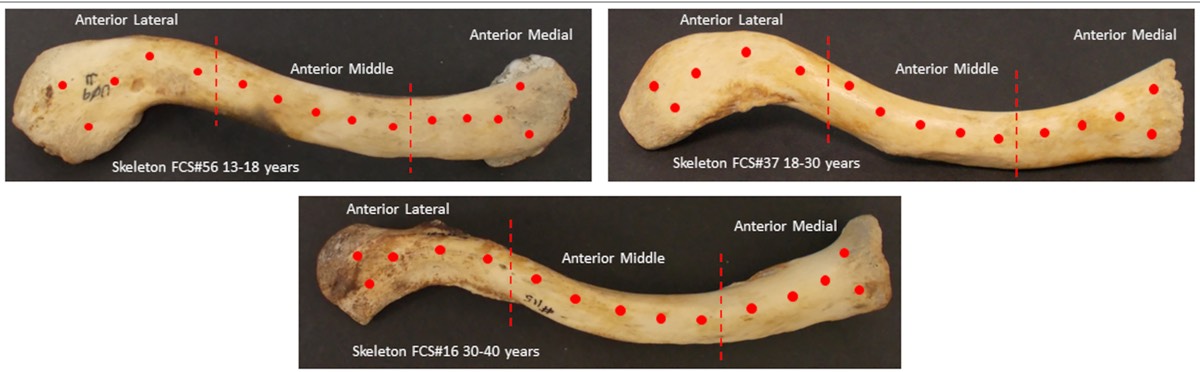
A schematic to illustrate the approximate location from which the measurements were taken; an example right clavicle from each age group.

A schematic to illustrate the approximate location from which the measurements were taken; an example right clavicle from each age group.

Credit: S.I. Shalnkland et al., PLOS ONE 2024

A schematic to illustrate the approximate location from which the measurements were taken; an example right clavicle from each age group. Credit: S.I. Shalnkland et al., PLOS ONE 2024

Most of the recovered human remains were jumbled up, but over the years, preservationists have partially reconstructed some 98 individuals, all men between 10 and 40 years of age. The new study focused on 12 clavicle (collar) bones, which links the upper limb to the torso and is one of the most commonly fractured bones. Per the authors, it’s one of the first bones to start ossifying in utero, but the last to fully fuse, usually between 22 and 25 years old.

That was a boon for determining the age of the Mary Rose crew members, but the authors thought differences in bone mineral and protein chemistry could also shed light on bone changes related not just to aging, but also to lifestyle or disease, and even whether a crewman was right- or left-handed had an impact on those changes. They specifically looked at changes in phosphate, carbonate, and amine (the foundation of collagen), all major components of bone.

The results: mineral content of the bones of all 12 men increased with age, while the protein content decreased. Those changes were more significant in right clavicles rather than left ones, an intriguing result suggesting a preference for right-handed crew members. The authors note that this might be because, at the time, being left-handed was often associated with witchcraft. Perhaps those right-handed crew members put more stress on their right side while performing their duties, and this, in turn, asymmetrically altered their clavicle chemistry.

“Having grown up fascinated by the Mary Rose, it has been amazing to have the opportunity to work with these remains,” said co-author Sheona Shankland of Lancaster University. “The preservation of the bones and the non-destructive nature of the technique allows us to learn more about the lives of these sailors, but also furthers our understanding of the human skeleton, relevant to the modern world.”

PLoS ONE, 2024. DOI: 10.1371/journal.pone.0311717  (About DOIs).

What this 500-year-old shipwreck can tell us about how we age Read More »

charger-recall-spells-more-bad-news-for-humane’s-maligned-ai-pin

Charger recall spells more bad news for Humane’s maligned AI Pin

Other Humane charging accessories, like the Charge Pad, are said to be unaffected because Humane doesn’t use the same unnamed vendor for any parts besides the Charge Case Accessory’s battery.

Humane’s statement puts the blame on this anonymous third-party vendor. The company said it realized there was a problem when a user reported a “charging issue while using a third-party USB-C cable and third-party power source.” The company added:

Our investigation determined that the battery supplier was no longer meeting our quality standards and that certain battery cells supplied by this vendor may pose a fire safety risk. As a result, we immediately disqualified this battery vendor while we work to identify a new vendor to avoid such issues and maintain our high quality standards.

Impacted customers can get a refund for the accessory (up to $149) or a replacement via an online form. While refunds will go through within 14 business days, users seeking a replacement Charge Case Accessory have to wait until Humane makes one. That could take three to six months, the San Francisco firm estimates.

In the meantime, Humane is telling customers to properly dispose of their Charge Case Accessories (which means not throwing them in a trash can or the used battery recycling boxes found at some stores).

Another obstacle for Humane

A well-executed recall in the name of user safety isn’t automatically a death knell for a product, but Humane has already been struggling to maintain a positive reputation, and its ability to sell AI Pins in the long term was already in question before this mishap.

The AI Pin’s launch was marred by a myriad of complaints, including the pin’s inability to properly clip to some clothing, slow voice responses, short battery life, limitations with the laser projector working outside of dark rooms, and overall limited functionality. Soon after the product was released, The New York Times reported that the company’s founders, two former Apple executives, ignored negative internal reviews and even let go of an engineer who questioned the product. Humane spokesperson Zoz Cuccias admitted to The Verge in August that upon releasing the wearable, Humane “knew we were at the starting line, not the finish line.”

Charger recall spells more bad news for Humane’s maligned AI Pin Read More »

not-just-chatgpt-anymore:-perplexity-and-anthropic’s-claude-get-desktop-apps

Not just ChatGPT anymore: Perplexity and Anthropic’s Claude get desktop apps

There’s a lot going on in the world of Mac apps for popular AI services. In the past week, Anthropic has released a desktop app for its popular Claude chatbot, and Perplexity launched a native app for its AI-driven search service.

On top of that, OpenAI updated its ChatGPT Mac app with support for its flashy advanced voice feature.

Like the ChatGPT app that debuted several weeks ago, the Perplexity app adds a keyboard shortcut that allows you to enter a query from anywhere on your desktop. You can use the app to ask follow-up questions and carry on a conversation about what it finds.

It’s free to download and use, but Perplexity offers subscriptions for major users.

Perplexity’s search emphasis meant it wasn’t previously a direct competitor to OpenAI’s ChatGPT, but OpenAI recently launched SearchGPT, a search-focused variant of its popular product. SearchGPT is not yet supported in the desktop app, though.

Anthropic’s Claude, on the other hand, is a more direct competitor to ChatGPT. It works similarly to ChatGPT but has different strengths, particularly in software development. The Claude app is free to download, but it’s in beta, and like Perplexity and OpenAI, Anthropic charges for more advanced users.

When ChatGPT launched its Mac app, it didn’t release a Windows app right away, saying that it was focused on where its users were at the time. A Windows app recently arrived, and Anthropic took a different approach, simultaneously introducing Windows and Mac apps.

Previously, all these tools offered mobile apps and web apps, but not necessarily native desktop apps.

Not just ChatGPT anymore: Perplexity and Anthropic’s Claude get desktop apps Read More »

microsoft-reports-big-profits-amid-massive-ai-investments

Microsoft reports big profits amid massive AI investments

Microsoft reported quarterly earnings that impressed investors and showed how resilient the company is even as it spends heavily on AI.

Some investors have been uneasy about the company’s aggressive spending on AI, while others have demanded it. During this quarter, Microsoft reported that it spent $20 billion on capital expenditures, nearly double what it had spent during the same quarter last year.

However, the company satisfied both groups of investors, as it revealed it has still been doing well in the short term amid those long-term investments. The fiscal quarter, which covered July through September, saw overall sales rise 16 percent year over year to $65.6 billion. Despite all that AI spending, profits were up 11 percent, too.

The growth was largely driven by Azure and cloud services, which saw a 33 percent increase in revenue. The company attributed 12 percent of that to AI-related products and services.

Meanwhile, Microsoft’s gaming division continued to challenge long-standing assumptions that hardware is king, with Xbox content and services posting 61 percent increased year-over-year revenue despite a 29 percent drop in hardware sales.

Microsoft has famously been inching away from the classic strategy of keeping software and services exclusive to its hardware, launching first-party games like Sea of Thieves not just on PC but on the competing PlayStation 5 console from Sony. Compared to the Xbox, the PlayStation is dominant in sales and install base for this generation.

But don’t make the mistake of assuming that a 61 percent jump in content and services revenue is solely because Microsoft’s Game Pass subscription service is taking off. The company attributed 53 points of that to the recent $69 billion Activision acquisition.

Microsoft reports big profits amid massive AI investments Read More »