The hit new deckbuilding game is coming to all major digital platforms next year!
PHILADELPHIA, PA – November 30th, 2018 – Stone Blade Entertainment, in collaboration with Temple Gates Games, is bringing the hit deckbuilding game, Shards of Infinity, to iOS, Android, and Steam!
Designed by Justin Gary and Gary Arant, Shards of Infinity combines an unprecedented level of strategy and customization. Stone Blade Entertainment is well known for their depth of strategy and innovation, and Shards of Infinity is their hit follow-up to the award winning deckbuilding game, Ascension. Shards of Infinity introduces the innovative Mastery mechanic, giving players multiple paths to victory in a quick, cutthroat game that always leaves players wanting to play “just one more game.”
Temple Gates Games has a long history of success working with board game publishers. They specialize in digitizing card games including Ascension, making it the first deckbuilding game to take place in virtual reality. Their amazing attention to detail and background in digital gaming make them the ideal partner to develop Shards of Infinity for a digital audience.
The digital version of Shards of Infinity will release in Spring 2019 for $7.99 across all platforms. Players will enjoy local pass-and-play, asynchronous multiplayer, and can take on challenging AI opponents! Temple Gates Games is known for including world-class AI which uses neural network technology to create formidable opponents. As the AI trains it will grow stronger to keep up with advanced Shards of Infinity players.
Gamers wanting to learn more about the progress of the Shards of Infinity digital game are encouraged to sign up for Stone Blade Entertainment newsletter.
For more information, please contact [email protected]. For more information online, please visit stoneblade.com and TempleGatesGames.com.
To say anything less would be an understatement. I grew up playing TCGs and CCGs, hosting tournaments of all kinds and was even an official Magic judge at one point.
I love card games.
When I first heard about Dominion I had been out of the card game world for a few years… and when I played it I was hooked. This new format was just what I needed. An amazing card-driven experience without the need for endless packs being opened chasing cards, or sweating over trades to get that PERFECT card to finish my tournament deck.
Deckbuilders now come in many shapes and sizes. I’ve played quite a few, to say the least… and I have to say that this new kid on the block is FANTASTIC.
I’ve watched Darren Terpstra, founder of Ginger Snap Gaming, post about Ignite in boardgame and design groups for quite a while now. I was initially drawn in (hah) by a post he made asking for critiques on his cover art. It was eye-catching and I’ve been following his progress ever since.
What I like the most about Ignite is that it takes the elements of deck building I love (customizable play experience) and combines it with variable player powers, grid movementand a sprinkling of area control. I’m a big fan of Shining Force, Final Fantasy Tactics, etc!
Dominion, as some know, is the official genesis of the deck building genre. There have been some well-received versions since then that have helped shape the genre and set new standards of design: Star Realms, Ascension, DC, Legendary, Paperback, Clank! and Terrors of London. They all introduced different elements such as a 2-player focus, faction synergy (à la Magic: The Gathering), non-combat win conditions, point-to-point movement, and more.
I BELIEVE IGNITE IS THE NEXT BIG STEP IN DECK BUILDING GAMEPLAY AND DESIGN. IT’S USE OF GRID MOVEMENT, VARIABLE PLAYER POWERS, AND BEAUTIFUL MINIS SETS IT APART FROM ALL OTHERS IN THE GENRE.
Below is the basic prototype board layout for 2-4 players. The 6×12 area in the middle is comprised of random tiles that will contain Plains, Lava, Water, and Forest terrain. The outer brown area is the Village. In the center 4 spots of the board, there is also a Bazaar (not pictured below, as the rules have been updated since I played). To the right is the Market, where all your 16 Battle Decks are located. There are many, many Battle Decks, so each game feels very different.
On the board you’ll also see 6 tokens. Those represent the Races my wife and I chose for that round, however, now 2 player mode allows each player to pick two races each. This both increases strategy as you can synergize your races abilities and increases the tension on the board as you can control and threaten more spaces on the board. In the published version of the game, all races will be minis, not tokens (pictured later).
Below is a screenshot from the updated rulebook, so you can see a clearer—and no glare—version of what I’m saying. The yellow outlines are showing you the shapes of the board pieces and how they interlock.
From afar the Village tiles look like a muddy brown, but they are quite detailed if you look at them more closely.
And the Cards look great. This one is pricey and costs 10 Honor (the number in the middle) and produces 2 Honor (upper left). Why is it so expensive? Well, it’s a Movement card, which allows you to move your units around the board. It also allows you to move through a unit (not normally allowed) and deal 1 damage to them (units have 3 health total)! If the enemy has a Shield, you still get Knocked Down and the controlling player will have to discard a card to stand them back up! Plus, that’s one badass looking unicorn!
Earlier I mentioned the Races. Each race either has a bonus which is economic or card-based, or it is a racial bonus applied to the units themselves. There are 9 races here, but he has more developed for expansions and stretch goals as well!
The race(s) you choose are very important. They are your variable player power for the game, which should then affect your strategic decisions throughout the game along with which Battle Cards you decide to purchase. Those two sets of choices, along with the grid movement and area control make each playthrough quite different creates new puzzles/strategies to unlock for yourself each time.
Plus, there are even more elements to the game that allow you to dive deeper and deeper into the gameplay. For example, Titles:
From the Rulebook, “Title cards are optional cards you can add to the market. Add only 1 or 2 titles cards per game. Title cards do not count toward the 16 battle deck limit. There is only 1 copy of each title card. A title card does not have a cost in the center of the card. Rather, it has multiple costs in the upper left-hand corner. The first player to purchase a title card may purchase it for any of the costs listed. When it is purchased, it is placed in front of that player and stays out on the table. On each subsequent turn after it’s purchased, the card’s owner may use the title card’s effect.
Another player, on their turn, can steal the title card away by purchasing it for a cost higher than what the previous player paid for it. They can purchase it for any listed price, as long as it is a higher price. The new owner places it in front of them and may use its effect on each subsequent turn. If a title card is ever purchased for its maximum cost, other players can continue to steal it by purchasing it at its maximum cost.”
AND there are multiple gameplay variants to apply once you’ve become familiar with the rules. This game alone could provide years of replay. It’s definitely worth checking out, and will be on Kickstarter in less than a week!
Want to win it before people can even back it on Kickstarter? Check out their official launch giveaway!
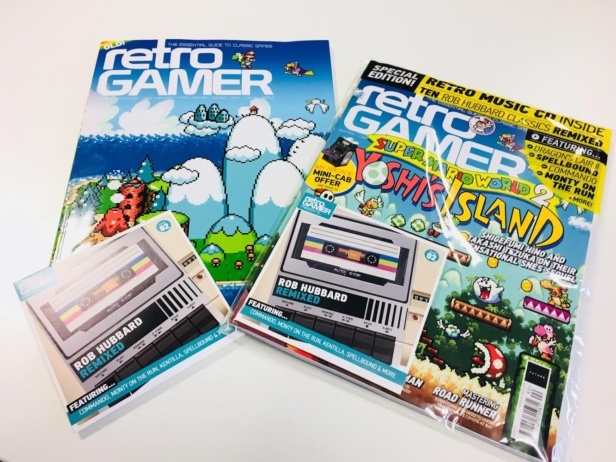
Issue 192 of Retro Gamer is available to buy now from all good newsagents and My Favourite Magazines, and we’ve teamed up with C64Audio.com to deliver a special package for our readers. Each copy of the magazine comes with a CD full of Rob Hubbard remixes – the best of the game music legend’s Commodore 64 work is represented here, with tunes from the likes of Monty On The Run, Commando, and Dragon’s Lair II remixed and reimagined by the likes of Matt Gray, Uncle And The Bacon and even Rob himself (see the full track listing below). Inside the magazine itself, you’ll also find an interview with Rob talking about Project Hubbard and the upcoming 8-Bit Symphony concert, due to take place on 15th June 2019.
That’s not all though, as you’ll have noticed that our cover story is on Yoshi’s Island, one of the greatest 2D platform games ever made. Nintendo’s Takashi Tezuka and Shigefumi Hino reveal the development process behind the SNES classic, from the initial decision to avoid another Mario game to the game’s beautiful hand-drawn style, and of course the use of the SuperFX 2 enhancement chip.
There’s plenty more to see elsewhere in the issue. Former Ocean Software artist Mark R Jones tells the story of his first month at the company in his own words, with unseen sketches and photographs from the time. Our regular Making Of features examine the cult C64 classic Space Taxi, Lucasarts’ eccentric management sim Afterlife, EA’s dangerous extreme sports title Skitchin’ and the PlayStation ninja classic Tenchu: Stealth Assassins. We also catch up with the Road Runner in an Ultimate Guide, and look back at the evolution of Head Over Heels with Jon Ritman and Bernie Drummond.
That’s not all, either. Rebecca Heineman discusses her decades in the games industry in In The Chair, we take a look at the Amiga CD32 in our Minority Report, and Julian Gollop tells all about the history of his strategy studio Mythos Games. The long-awaited ToeJam & Earl: Back In The Groove is reviewed, and of course the magazine features the usual selection of Retro Revivals, news, columns and guides. And if all of this sounds like something you want to be a part of long-term, we’ve got a great offer of a free mini arcade cabinet for new subscribers.
What makes a videogame feel great? Is it the game itself, the friends you enjoy it playing with, or the machine powering the amazing experience that you’re completely engrossed in?
For most of us, the answer is all three. And if you happened to chance upon a bustling amusement arcade during your youth then you’ll fully understand why.
Games played on a classic arcade cabinet seemed to come alive. They’d pull you in with graphics that would pop from the screen and provide robust, chunky controls that perfectly complemented the game.
Above all else, though, they would entice you with audio that would not only scream to be heard over the sounds from other games but compete with the chatter and laughter filling the room.
That’s because arcades were a destination, a place for you to hang out with your pals and have fun. And if you want to replicate that enjoyment, then how better than a modern arcade cabinet packed with the greatest of hits?
Step forward the Arcade1UP cabinets, a range of amazing machines that bring the arcade home with no quarters or tokens required.
They allow your favorite games from yesteryear to come back to life in the way that they should always be played – with arcade-style joysticks, trackballs and buttons.
At a wallet-friendly introductory rate of $299 they really are a bargain. But if you want to guarantee one, then you’ll need to be quick.
GameStop, which is the only retailer allowing pre-orders in store, expects them to sell as fast as your reactions will need to be to master these games. You can, however, also order at gamestop.com.
But why are they set to be popular? Well, the cabinets will inevitably light up your room thanks to a 17-inch LCD screen that will perfectly showcase the games in their original form, with the same graphics and sounds that made them instantly appealing the first time around.
The machines will also turn heads for their sheer presence since each upright cabinet stands at three-fourths the size of the original machine.
Most crucially, however, are the classic games you’ll be able to enjoy.
GameStop will have a finger-twitching four cabinets in total and each one contains up to four games.
The Asteroids-led cabinet comes with the addition of Major Havoc, Lunar Lander and Tempest;
Rampage is bundled with Gauntlet, Joust and Defender;
Centipede includes Missile Command, Crystal Castles and Atari Millipede; and
Street Fighter II Champion Edition has the addition of Super Street Fighter II Turbo and Super Street Fighter II: The New Challengers.
But just as important as the selection of games, is the look of the cabinets, each of which are faithfully decorated with the eye-catching marquee and side artwork of the leading title.
This was no mean feat for Arcade1UP which went to great lengths to find the original art sheets in order to recreate them, helping those memories to come flooding back.
To add to the fun, the cabinets need to be self-assembled so you get a chance to go behind the scenes of the machines and get up close with each of the parts inside and out. This is a very simple process and it has enabled the makers to keep the cost of these impressive cabinets down.
Don’t forget, you need to get your pre-order in to guarantee one or more of the cabinets, though. Ask the staff at your local GameStop for more information or head over to gamestop.com.
Are you a human being of a certain age, whose geographical location and status as a television viewer allowed you to watch Movies Games And Videos on ITV? If so: congratulations, you are old like us, and you evidently had a lot of free time on Saturday afternoons like us too. We remember it because the show had an odd habit of featuring Neo Geo games, and you didn’t often see that outside of an arcade.
But also, you might remember Steve Priestley, the forever unseen narrator of that particular television programme. Well, thanks to Funtenga Video Software, he’s back doing the thing we all remember – narrating footage of game previews. But these are no ordinary games! Instead, you will see men fighting their trusty vessels and the wonders of Thanks Blaster. It really does defy reasonable explanation, so we’d advise you just click the play button and leave the problem of working it out to future you.
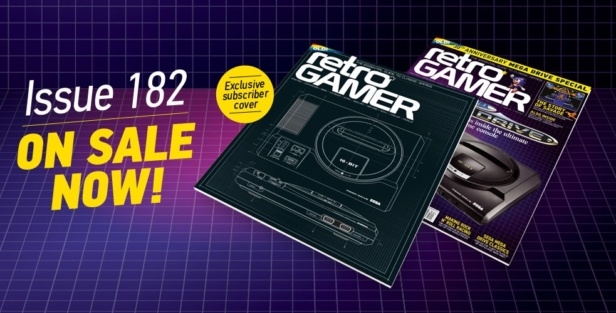
Retro Gamer issue 182 has hit the shelves today, and if you’re a fan of the Mega Drive you won’t want to miss it. Our cover feature takes a deep dive into the technology that makes the 30 year old console tick, with key developers including Mark Cerny, Trip Hawkins and Rieko Kodama giving their expert insight. What’s more, we have two added gifts – a fantastic sticker sheet featuring classic Sega sprites and iconography, and a guide to the Mega Drive’s essential games. If all that gets you in the mood for to revisit some 16-bit hits, we’ve also reviewed the new Sega Mega Drive Classics collection.
There’s plenty more inside, too. We have features on the creation of Savage, Rock ‘N’ Roll Racing and EyeToy: Play, an Ultimate Guide to Konami’s arcade racer WEC Le Mans, and a Minority Report focusing on the Atari 8-bit range. Outside of specific games, we’ve got a collector’s guide to Eighties publisher Software Projects, a look back at Brian Howarth’s Digital Fantasia, and an examination of games made using the Build engine. Our sit-down interview for the month is with Matt Gray, the musician behind games such as Last Ninja 2 and Driller. And of course we’ve got all the usual favourites including Retro Revivals, Hardware Heaven and The Unconverted.
The Mixfit Vue mixes nutrients that are stored inside the device and contain a variety of essential vitamins, minerals and protein that are dispensed incrementally, depending on the unique needs of an individual. Then, there are Pods, which are supplementary, single-use mixes formulated to support an individual’s specific fitness or wellness goal such as supporting vision health or workout recovery. To begin using the Mixfit Vue, the consumer fills the back reservoir with water, turns the device on, connects to their home WiFi network and places the Core Pack cartridges inside the device. From there just tap “Mix It” to dispense!
The Mixfit platform has several different levels of personalization which enable more accurate modulation and precision in nutrient delivery. Each level of personalization is dependent upon providing access to different categories of health data, starting with the Mixfit’s Baseline Goals and Lifestyle questionnaire as the first level of personalization. The next level of personalization occurs when an individual logs their diet and meals, and connects their wearable devices and health apps. As new types of bio-sensing wearables become commoditized and digital diagnostic technologies evolve, Mixfit will integrate advanced diagnostics data from connected devices and leverage new data to improve contextual recommendations and more accurately adjust unique mix ingredients and their quantities. Providing drinks as unique as the individual.
Aveine was born out of an encounter between three entrepreneurs with a shared passion for wine and technology.It was naturally over a bottle of wine that they came up with an idea for a device that would reinvent winetasting. Tapping into France’s heritage as a great wine-producing country, and today’s advanced technology, Aveine creates connected objects and services that allow people to embrace authentic French art de vivre, which is all about exploring and sharing new experiences. Crafted as a lifestyle brand, Aveine is presenting its first product – the Aveine Smart Wine Aerator – perfectly calibrated to any bottle, giving everyone the opportunity to enjoy wine at its best.
• Preciselycalculates the ideal aerationof any wine, allowing immediate consumption upon opening of the bottle.
• Uses patented technology to recreate the aeration process in a controlled manner by mixing air into the wine as it flows from the bottle, exposing it to more oxygen.
• The process does not alter the wine’s intrinsic qualities (no chemicals are involved).
• The wine aerator can be used with all types of wine bottles.
Somabar is the world’s first robot bartender created for beer and wine restaurants.
After three years of development, Somabar announced the completion of manufacturing development of its robot bartender at the 2018 Western Foodservice & Hospitality Expo, where it won Best Product of the Year. Originally crowdfunded on Kickstarter in 2015 as a consumer product, Somabar found heavy demand from the foodservice and hospitality industries where bartending has become increasingly regulated and expensive. Somabar made the decision to completely redesign its concept to be robust enough for high volume restaurants and meet sanitation standards required for all restaurants in America. Somabar was officially granted NSF certification in December 2018 allowing it to operate in all restaurants in the U.S. and began shipping its original Kickstarter backers with these commercial robot bartenders.
Why restaurants? Restaurant owners are used to working through endless regulations, but liquor licensing and rules for human bartenders are the most costly and complicated. Regulations vary by state, and costs can be dizzying, especially in areas that strictly limit the supply of licenses, usually through lottery systems. In parts of New Jersey, among the most expensive states, the cost of a restaurant full-liquor license has reached $2million.
Somabar’s goal is to help restaurants navigate this bureaucratic minefield with its robot bartender. Somabar currently operates exclusively in beer and wine licensed restaurants which typically do not have a bartender nor a full liquor license. Beer and wine licenses are unrestricted in number, can be issued in a matter of weeks and cost as little as $500. Somabar helps restaurants make the leap from serving just beer and wine to serving highly profitable cocktails. Operating under a restaurant’s beer and wine license, Somabar uses 24% ABV low-proof spirits like agave wine for traditional tequila cocktails, soju for vodka cocktails and over 20 other varietals of low-proof based spirits. The Somabar robot bartender suggests thousands of low-proof cocktails that can be made with the press of a button by any restaurant employee, including waiters and bussers, automatically and legally from the Somabar robot bartender, with virtually no bartending training required.
Somabar launched this month, following its NSF certification, with a number of restaurants near its headquarters in Los Angeles including the well-known luxury supermarket chain Gelson’s, for their new line of wine and tapas restaurants. What’s the verdict? According to Gelson’s general manager, Tony De Lucrezia, “Somabar’s low-proof cocktails have been a hit with our customers and dramatically improved our per-drink profit margins.”
Plott’s extended reality (XR) platform and accompanying hardware bringsreal world elements and dimensions into the LetsPlott app, a design center for conceptualizing and measuring the project in AR. From creative idea, to virtual design, then back to reality with the help of innovative hardware solutions, Plott is the ideal tool for anyone from the beginner to a professional DIYer, that provides actionable, turn-by-turn directions to pinpoint real world coordinates with accuracy.
80% of first time DIYers fail to measure accurately on their first attempt and as a result, decide not to pursue another project. “ Our goal with the LetsPlott Platform is to eliminate the complicated and challenging tasks of DIY projects, such as measuring and calculating, to provide users with the necessary tools to spend more time bringing their virtual designs to life,” says David Xing, Founder of Plott. “As a result, we created the only interactive, AR driven platform that provides DIYers with the tools to imagine their creations in the digital form, then guide them in the actual space to complete their real-life projects. Plott is the ultimate home improvement tool no matter how much experience the user has or how challenging the project is.”
Plott’s integrated hardware includes Cubit, which features a rubber wheel for measuring along any surface, dual lasers for measurement accuracy, and a digital screen that clearly guides users to the coordinates of their physical indoor project. Coming soon is Plott’s Carta, measuring wheel-style tool that virtually maps any outdoor space as you walk in real time.
Within the LetsPlott app, users can see exactly how a project will look, make notes, and even add images and links. The final step is to seamlessly transfer the curated design from the digital concept back into the real world.
The LetsPlott app and Platform is available now on iOS and Android. Cubit (MSRP $99) will be available for purchase in March 2019, while Carta (MSRP ≈ $150) will launch in Q3 2019. For more information on Plott’s award-winning technology and products, visit letsplott.com
Monitors for home and nursery that include Alexa capabilities, facial recognition, smart zoning and even sleep analysis will all be on the launchpad at this year’s CES, from Binatone, official licensee of the Motorola brand.
Binatone, Indianapolis, IN.
Helping parents has always been the driving force for Binatone’s development of new baby products from Motorola. 2019 will see cutting edge devices and services focussed on baby sleep and well-being with first looks at PepCom and CES.
The Motorola Halo is a unique baby monitor that can attach to any cot or crib giving an unparalleled ‘parent’s eye view’ of the baby. At the heart of Halo is a 1080p camera with IR night vision to 10m with two-way audio activated by motion and audio sensors. This feeds crystal clear video and audio to a connected home-viewer or, if parents prefer, they can access the camera on their smart phone via the partner Hubble-for-Baby app from anywhere they choose. The Hubble app has been specifically developed for all Motorola connected products and unlocks many features to help parents of new-borns and young infants.
The unit’s camera also doubles as a portable monitor and can easily be detached from the cot/crib mount and positioned anywhere in the home, making it both a fixed and mobile solution.
In addition to the camera, the cot/crib mount has a choice of ambient soft glow light settings and a night sky ‘virtual mobile’ to project sky scenes onto the nursery ceiling. The two-way audio can also be used to play lullabies and other soothing sounds direct through the speaker from the Hubble-for-Baby services accessed through the partner app.
The Halo sets a new standard in nursery monitoring and coupled with the Hubble-for-Baby partner app, will become the benchmark for new parents looking for more than just a monitor.
The Hubble IoT platform has also undergone an overhaul transformation with some new, exciting services added for 2019. Hubble-for-Baby app will be introducing a number of key features to help parents track and monitor their baby’s development.
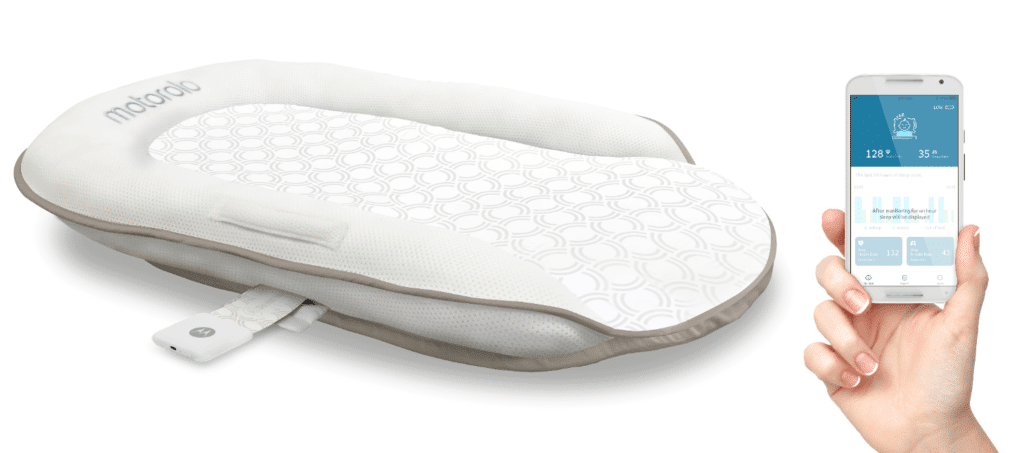
Sleep is a critical feature for development and Hubble-for-Baby allows any connected Motorola baby monitor to do much more than just record your baby sleeping. A baby tracking diary, access to expert sleep advice, in-depth sleep analytics and smart zoning are all part of the new Hubble-for Baby app which can be accessed from any connected Motorola baby monitor.
In addition to the new nursery products, Binatone is launching a brand-new home monitoring system. The Motorola Mods for Home uses a state-of-the-art 1080p waterproof camera that can be combined with several stands and cases, making it the ultimate modular system. Choose from outdoor battery packs to night stands to build your own personal home monitoring system. The Mods system can be adapted to fit any user’s needs.
The Mods also connects to Hubble-for-Home app and benefits from the same AI developments at the heart of Motorola nursery products. Smart zoning coupled with person recognition will ensure that users only get notified when people enter or leave the smart zone, no more false alarms from stray dogs or branches swinging in the wind. The Mods also features new facial recognition AI which has increased accuracy and speed enabling positive ID within one second of being detected. Hubble-for-Home is available across a number of new Motorola home products, including the Mods, brand new indoor and outdoor cameras, and a new connected video doorbell.
A Swedish company, Yevo Labs, is building its latest headphones with material from an improbable source: guns.
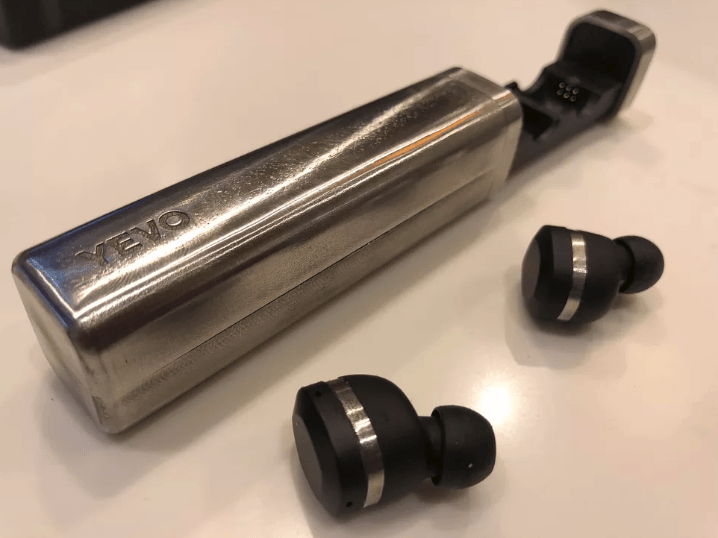
The headphones themselves are pretty standard Bluetooth earbuds, based on the company’s previously released Yevo 1 design. It’s around the edges that things get interesting. The accent metal is less polished than the mirror-finish chrome-like plating you’d find on its onyx-, ivory- or jet black-colored $249 headphones.
The carrying case, which also doubles as a battery-powered charger, is heavy. Like a power tool. And the metal it’s made from feels rough, industrial. Yevo plans to sell this version for $499 when it’s released in the next few months.
“In a way, this is the most valuable material in the world,” said Andreas Vural, Yevo’s founder and president. “It’s a firearm that may have taken someone’s life.”
This is a statement piece. It’s a visceral reminder that this was made from something substantial. And it’s completely unlike anything I’ve ever seen while covering CES.
And while CES has become home to technological advancements from around the world, smart firearms rarely make an appearance. When it comes to guns more broadly, the annual Shot Show will draw about 65,000 people from across the firearms industry to Vegas when it begins later this month.
Andreas Vural, founder and president of Yevo Labs, wearing his headphones made with metal from recycled guns.Ian Sherr/CNET
Vural, who flashed a smile when we first met, became more serious as I sat opening and closing the gun metal case. Its predecessor, which came out last year, has been a hit, Vural said, with demand consistently outstripping supply. He declined to offer hard sales data. That headphone charging case looks like a supersized lipstick tube or a carrier for a nice pair of reading glasses. The headphones are concealed in a compartment that slides out and then back in, with a satisfying click to indicate it’s closed. It’s pretty lightweight too.
The model made from guns is coarse by comparison. It almost seems unfinished. The bit that holds the headphones slides out feeling like it’s grinding against the metal, which Yevo bought from a Swedish initiative called Humanium. In addition to its weight, the Humanium-metal headphones also cost five times more to make. Yevo is using it to make both the accent metals around the edge of the headphones, as well as for the outside case.
Everything about this gun metal device says it isn’t a piece of tech meant to disappear into the background of my everyday life.
“We want to bring more awareness” to the issue of gun violence, Vural said. And a portion of sales will go back to Humanium as well.
Tech for good
Yevo may be the first company making a product with a recycled gun, but it’s part of a trend in the tech industry. Companies are beginning to build technology with attention paid to more than just the design and price.
Apple, for example, publishes an environmental report card for each of its products, telling customers what type of pollutants are in them. And nearly all the paper used in its product packaging is either recycled or from “responsibly managed” forests.
Apple’s Liam recycling machine holds an iPhone before going to work.Apple
“We put an incredible amount of money into designing the best products in the world,” Lisa Jackson, Apple’s vice president of environment, policy and social initiatives, said when first announcing Liam in 2016. We “put that same amount of energy into thinking about what to do when they can no longer be used.”
PC giant Dell, meanwhile, has begun using recycled plastics, diverted from ending up in the ocean, in packaging for its high-end laptops. Surprisingly, the company says it’s helped drive down costs.
“There’s a broad perception that sustainability costs more,” said Oliver Campbell, who heads up Dell’s packaging team. “We’re proving that when it’s done correctly it actually costs less.”
Dell’s packaging tray for PCs, made in part with ocean plastics.Dell
He added that Michael Dell, the company’s founder and CEO, pushes his teams to be more sustainable, but to do it in a way that either keeps costs the same or better. That way, it’s more likely the company can adopt those efforts across its business.
But there’s more companies could do, said Kyle Wiens, head of the tech repair website iFixit. While it’s good that companies are being more thoughtful about how they can reuse products or divert them from landfills, recycling and reuse needs to take a bigger role.
“It should be factored into the design upfront,” he said.
Meanwhile, Vural said he’s hoping his headphones will get people to think differently about the products they buy, and how much power they have as consumers to push for positive change.
“For us, it’s an amazing feeling taking something that negative and creating something positive out of it,” he said.